Keeping Students Connected: Using Assistive Technology & Instructional Strategies to Aid Students with Disabilities Presented by: Lauren C. Parris
Overview of Working with Students with Disabilities (SWD) Types of Disabilities Autism, Deaf-Blindness, Deafness, Emotional Disturbance, Hearing Impairment, Mental Retardation, Multiple Disabilities, Orthopedic Impairment, Other Health Impairment, Specific Learning Disability, Speech/Language Impairment, Traumatic Brain Injury, Visual Impairment including Blindness The Individuals with Disabilities Education Act (IDEA) established the need for an Individualized Education Plan (IEP) for all students who possessed disabilities that impacted their progress in the General Education (GENED) Curriculum.  This plan is a legally binding document and must be followed after team development.  The team includes parents/guardians, SPED teacher, GENED teacher, related service providers, local education agency representative,  and student if applicable.
Overview Continued-IEPs IEP Components Results of most recent evaluation Description of student’s strengths and weaknesses Parental concerns Impact of disability in GENED curriculum Consideration of special factors including assistive technology (AT) Annual goals and short-term objectives Participation in statewide and local assessments Instructional support and accommodations Participation in GENED & Special Education (SPED) services Consideration of extended school year Transition plan if eligible
Overview Continued-Least Restrictive Environment After components of the IEP are compiled, the team decides how and where the student’s needs can best be met in the  least restrictive environment   (LRE) . LRE is defined as “to the maximum extent appropriate, children with disabilities are educated with children who are not disabled…with the use of supplemental aids and services .” LRE is mandated as part of IDEA.  The continuum of placements in determining LRE includes the following ordered from the least to most restrictive placement: GENED Consultation Supportive Instruction Collaboration Co-Teaching Special Education
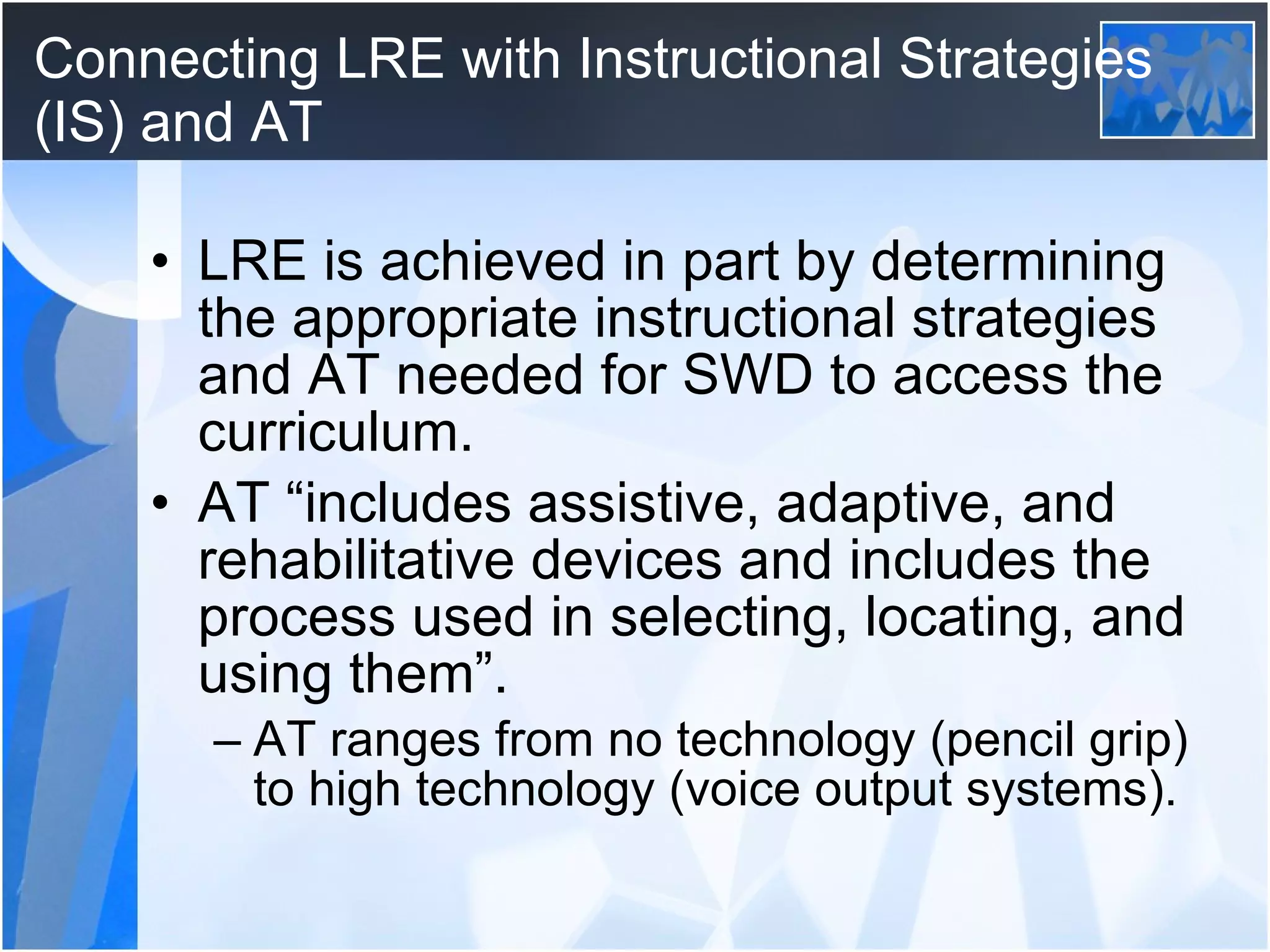
Connecting LRE with Instructional Strategies (IS) and AT LRE is achieved in part by determining the appropriate instructional strategies and AT needed for SWD to access the curriculum. AT “includes assistive, adaptive, and rehabilitative devices and includes the process used in selecting, locating, and using them”.  AT ranges from no technology (pencil grip) to high technology (voice output systems).
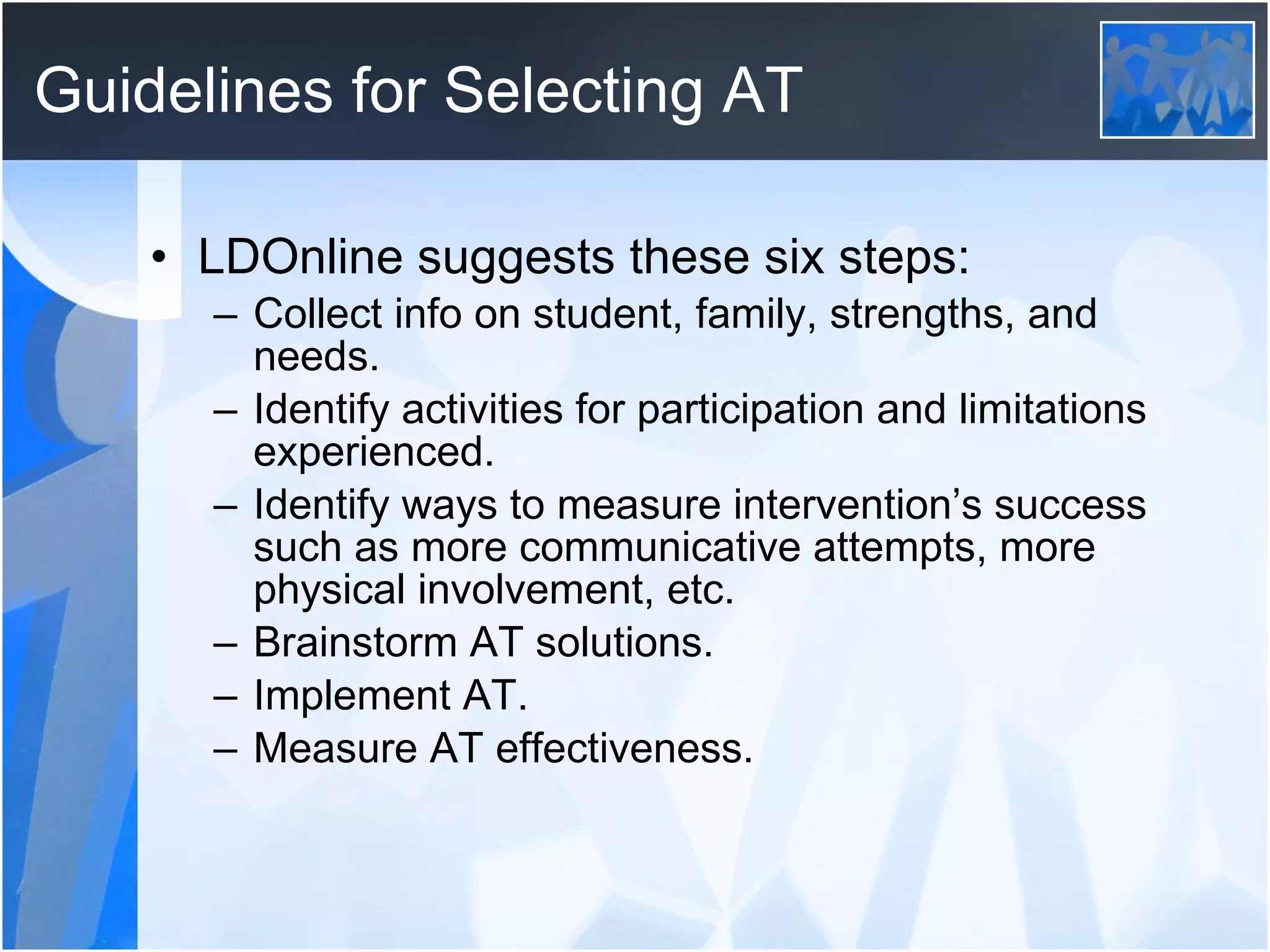
Guidelines for Selecting AT LDOnline suggests these six steps: Collect info on student, family, strengths, and needs. Identify activities for participation and limitations experienced. Identify ways to measure intervention’s success such as more communicative attempts, more physical involvement, etc. Brainstorm AT solutions. Implement AT. Measure AT effectiveness.
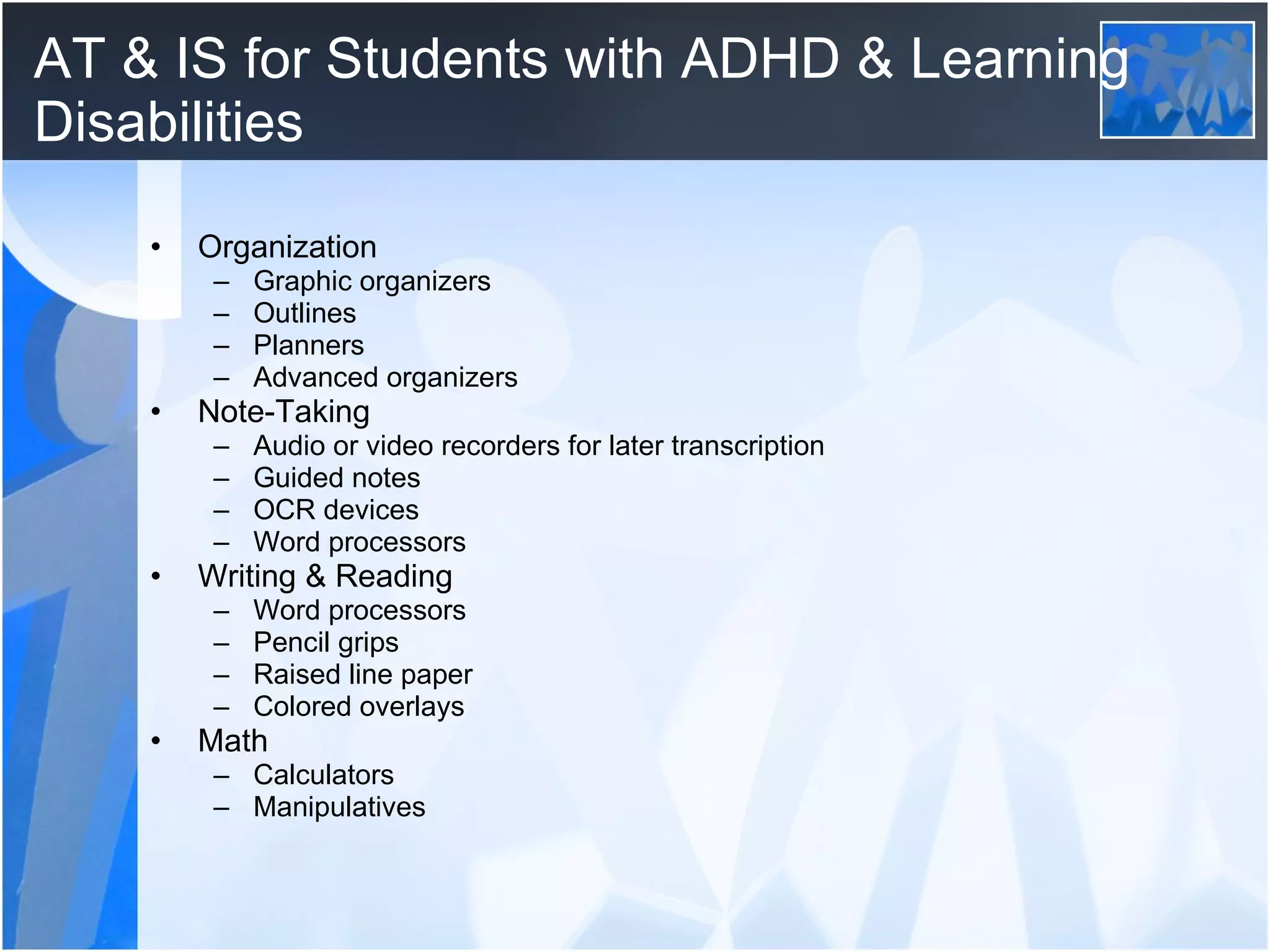
AT & IS for Students with ADHD & Learning Disabilities Organization Graphic organizers Outlines Planners Advanced organizers Note-Taking Audio or video recorders for later transcription Guided notes OCR devices Word processors Writing & Reading Word processors Pencil grips Raised line paper Colored overlays Math Calculators Manipulatives
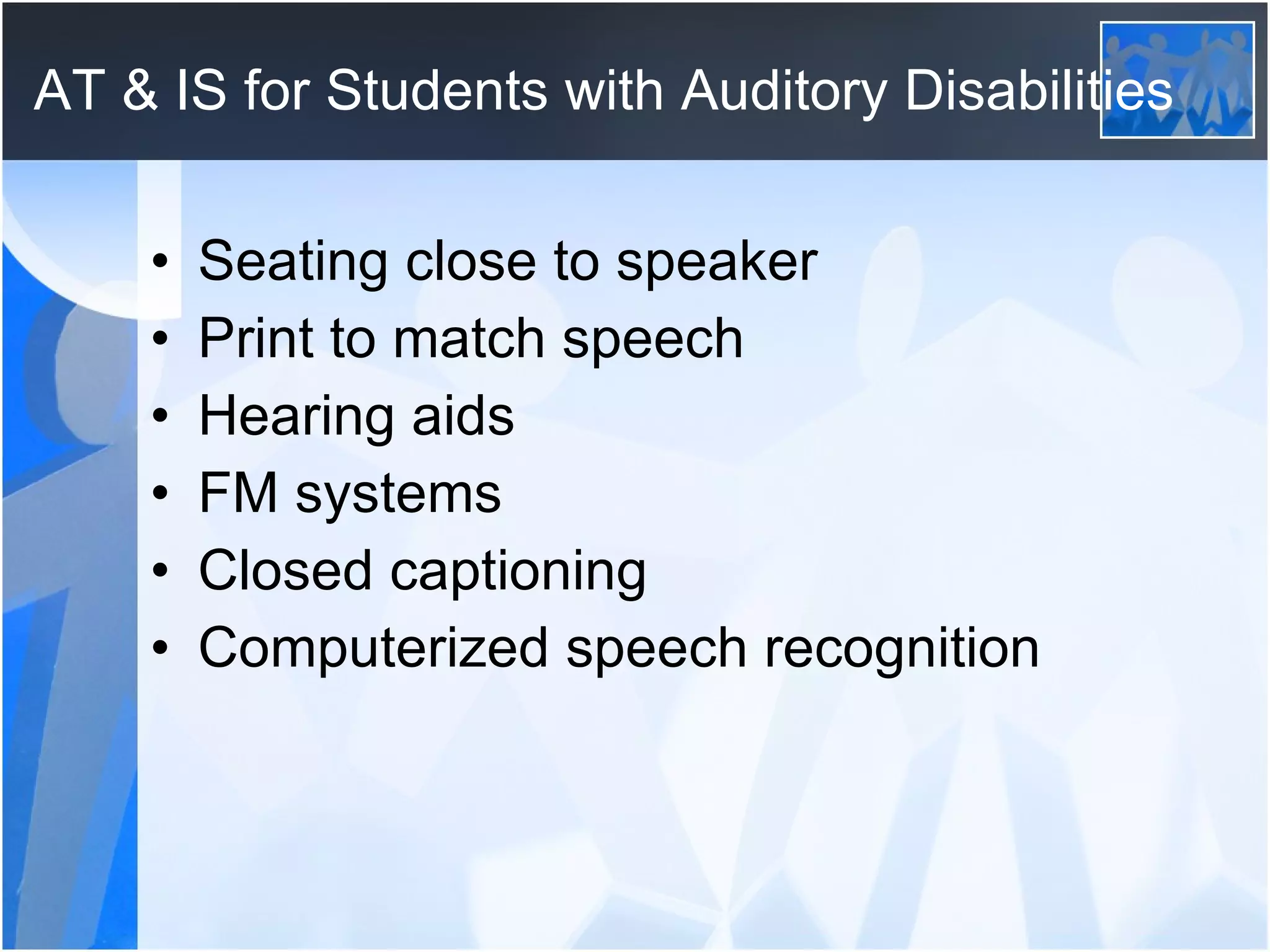
AT & IS for Students with Auditory Disabilities Seating close to speaker Print to match speech Hearing aids FM systems Closed captioning Computerized speech recognition
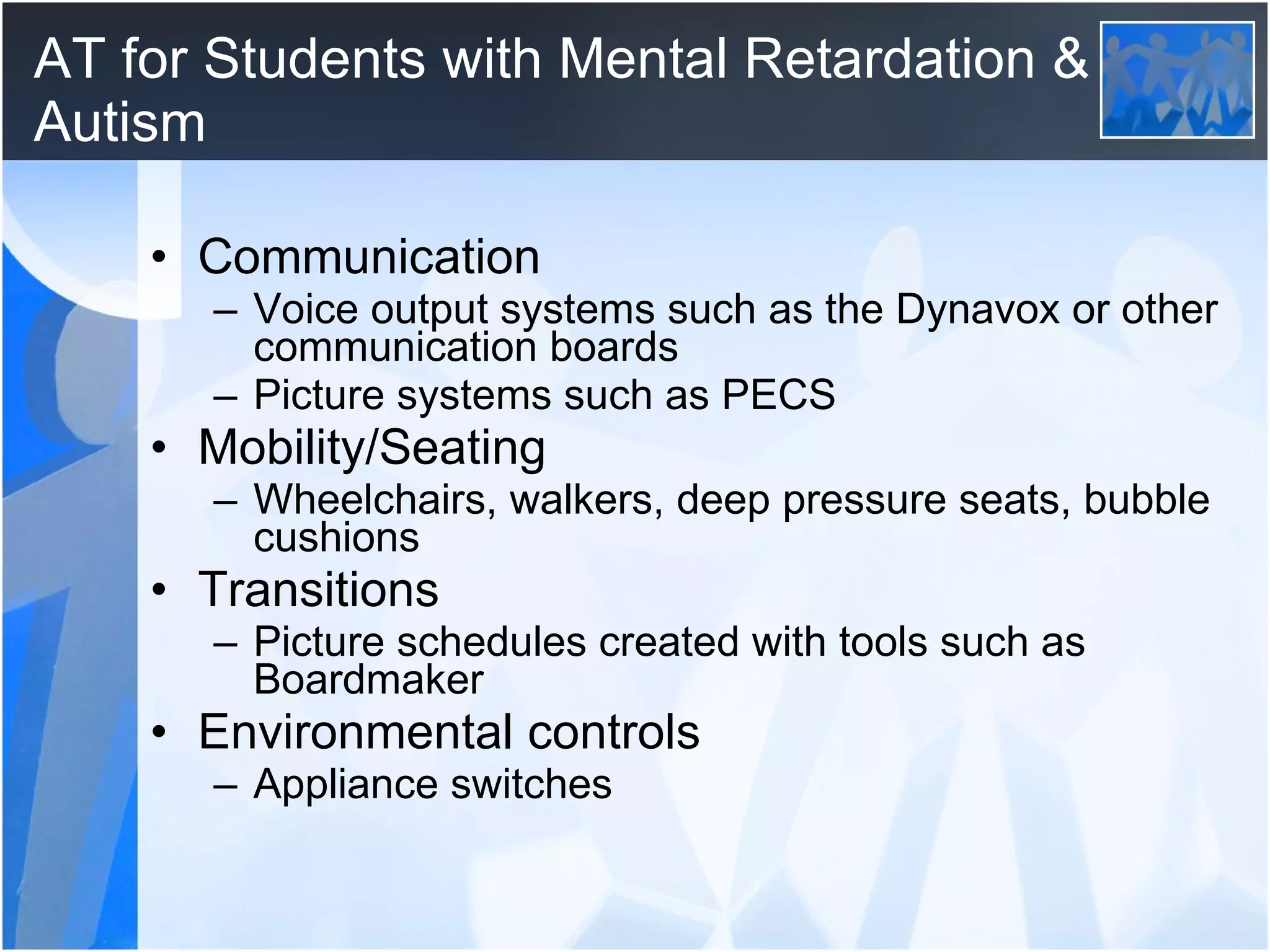
AT for Students with Mental Retardation & Autism Communication Voice output systems such as the Dynavox or other communication boards Picture systems such as PECS Mobility/Seating Wheelchairs, walkers, deep pressure seats, bubble cushions Transitions Picture schedules created with tools such as Boardmaker Environmental controls Appliance switches
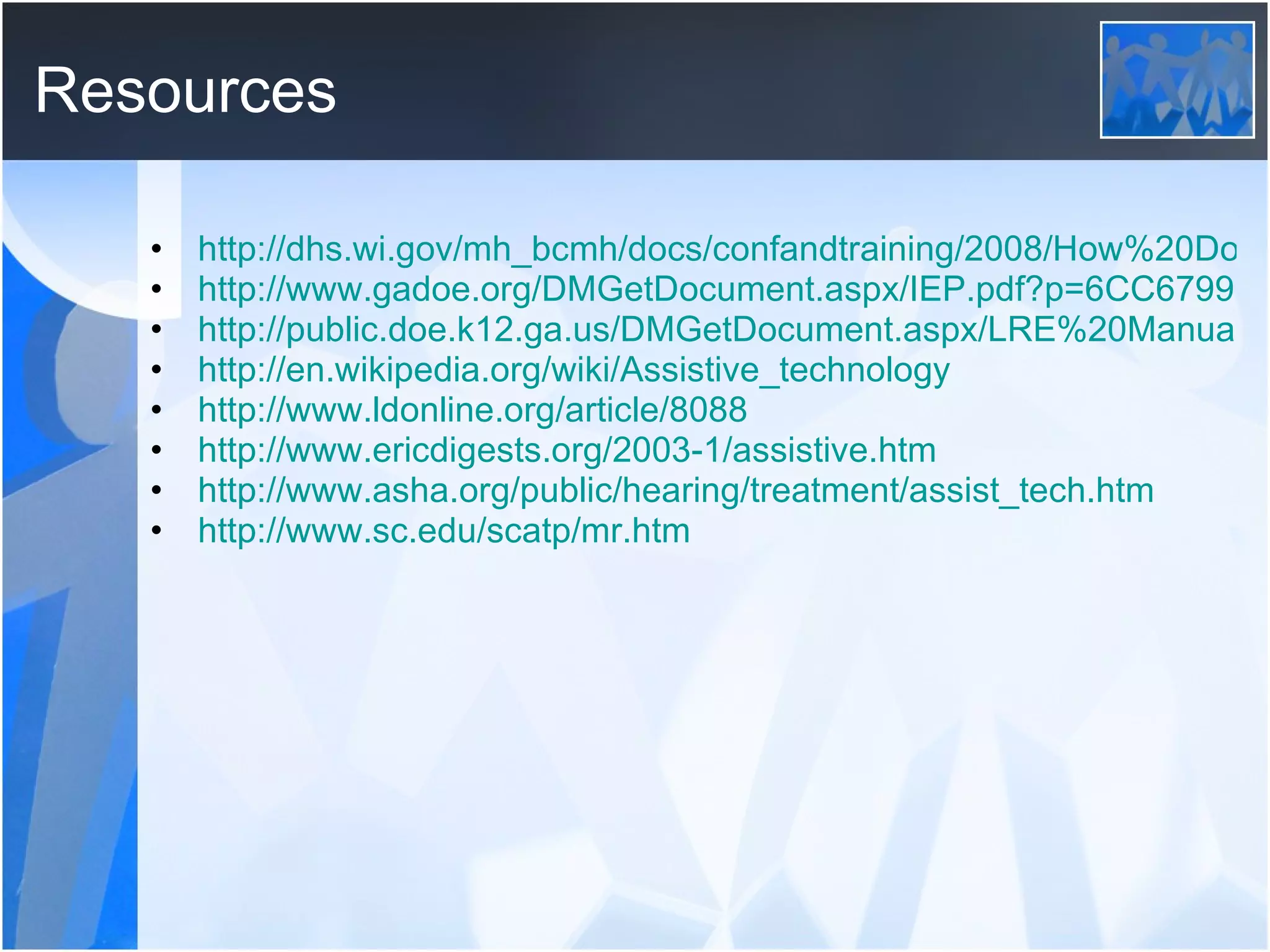
Resources http://dhs.wi.gov/mh_bcmh/docs/confandtraining/2008/How%20Does%20IDEA%20Define%20the%2013%20Disability%20Categories.pdf http://www.gadoe.org/DMGetDocument.aspx/IEP.pdf?p=6CC6799F8C1371F606B72D92BBBEA0203B56369F8E2E3C29A79ACDC07DF7A808&Type=D http://public.doe.k12.ga.us/DMGetDocument.aspx/LRE%20Manual%20Handouts%20july%2020,%2006%20pages%201-7.doc?p=6CC6799F8C1371F60338A933EB3665E6AFF2FAD380ECDE6FA90A6AABC59A38B5&Type=D http://en.wikipedia.org/wiki/Assistive_technology http://www.ldonline.org/article/8088 http://www.ericdigests.org/2003-1/assistive.htm http://www.asha.org/public/hearing/treatment/assist_tech.htm http://www.sc.edu/scatp/mr.htm

M6 web quest_activity_lp

  • 1.
    Keeping Students Connected:Using Assistive Technology & Instructional Strategies to Aid Students with Disabilities Presented by: Lauren C. Parris
  • 2.
    Overview of Workingwith Students with Disabilities (SWD) Types of Disabilities Autism, Deaf-Blindness, Deafness, Emotional Disturbance, Hearing Impairment, Mental Retardation, Multiple Disabilities, Orthopedic Impairment, Other Health Impairment, Specific Learning Disability, Speech/Language Impairment, Traumatic Brain Injury, Visual Impairment including Blindness The Individuals with Disabilities Education Act (IDEA) established the need for an Individualized Education Plan (IEP) for all students who possessed disabilities that impacted their progress in the General Education (GENED) Curriculum. This plan is a legally binding document and must be followed after team development. The team includes parents/guardians, SPED teacher, GENED teacher, related service providers, local education agency representative, and student if applicable.
  • 3.
    Overview Continued-IEPs IEPComponents Results of most recent evaluation Description of student’s strengths and weaknesses Parental concerns Impact of disability in GENED curriculum Consideration of special factors including assistive technology (AT) Annual goals and short-term objectives Participation in statewide and local assessments Instructional support and accommodations Participation in GENED & Special Education (SPED) services Consideration of extended school year Transition plan if eligible
  • 4.
    Overview Continued-Least RestrictiveEnvironment After components of the IEP are compiled, the team decides how and where the student’s needs can best be met in the least restrictive environment (LRE) . LRE is defined as “to the maximum extent appropriate, children with disabilities are educated with children who are not disabled…with the use of supplemental aids and services .” LRE is mandated as part of IDEA. The continuum of placements in determining LRE includes the following ordered from the least to most restrictive placement: GENED Consultation Supportive Instruction Collaboration Co-Teaching Special Education
  • 5.
    Connecting LRE withInstructional Strategies (IS) and AT LRE is achieved in part by determining the appropriate instructional strategies and AT needed for SWD to access the curriculum. AT “includes assistive, adaptive, and rehabilitative devices and includes the process used in selecting, locating, and using them”. AT ranges from no technology (pencil grip) to high technology (voice output systems).
  • 6.
    Guidelines for SelectingAT LDOnline suggests these six steps: Collect info on student, family, strengths, and needs. Identify activities for participation and limitations experienced. Identify ways to measure intervention’s success such as more communicative attempts, more physical involvement, etc. Brainstorm AT solutions. Implement AT. Measure AT effectiveness.
  • 7.
    AT & ISfor Students with ADHD & Learning Disabilities Organization Graphic organizers Outlines Planners Advanced organizers Note-Taking Audio or video recorders for later transcription Guided notes OCR devices Word processors Writing & Reading Word processors Pencil grips Raised line paper Colored overlays Math Calculators Manipulatives
  • 8.
    AT & ISfor Students with Auditory Disabilities Seating close to speaker Print to match speech Hearing aids FM systems Closed captioning Computerized speech recognition
  • 9.
    AT for Studentswith Mental Retardation & Autism Communication Voice output systems such as the Dynavox or other communication boards Picture systems such as PECS Mobility/Seating Wheelchairs, walkers, deep pressure seats, bubble cushions Transitions Picture schedules created with tools such as Boardmaker Environmental controls Appliance switches
  • 10.
    Resources http://dhs.wi.gov/mh_bcmh/docs/confandtraining/2008/How%20Does%20IDEA%20Define%20the%2013%20Disability%20Categories.pdf http://www.gadoe.org/DMGetDocument.aspx/IEP.pdf?p=6CC6799F8C1371F606B72D92BBBEA0203B56369F8E2E3C29A79ACDC07DF7A808&Type=Dhttp://public.doe.k12.ga.us/DMGetDocument.aspx/LRE%20Manual%20Handouts%20july%2020,%2006%20pages%201-7.doc?p=6CC6799F8C1371F60338A933EB3665E6AFF2FAD380ECDE6FA90A6AABC59A38B5&Type=D http://en.wikipedia.org/wiki/Assistive_technology http://www.ldonline.org/article/8088 http://www.ericdigests.org/2003-1/assistive.htm http://www.asha.org/public/hearing/treatment/assist_tech.htm http://www.sc.edu/scatp/mr.htm