Transient Simulation
for Hydrate Mitigation Aims
for Optimal Production
In kuwait field
In the deep high-pressure/high-temperature North Kuwait
Jurassic (NKJ) fields, the pipelines connecting the wells to the
processing facility are neither buried nor insulated.
During the winter, the well fluid cools to below hydrate-
formation temperature in the flowline, causing hydrate
crystallization and even plugging.
This paper presents the traditional methods of hydrate
mitigation used in the NKJ fields and the way in which a
transient model was initially built and continuously improved.
Challenges
Hydrate Formation
Hydrates usually forms at night and early morning in
winter.
Robust solution is needed for minimizing production
downtime.
No proper flow-assurance study or modeling was
conducted.
predictive transient tool is needed to know.
Slug Flow
Low-condensate/gas--ratio and high-water/gas-ratio
wells have a tendency to create slug flow in the
pipeline.
when the pipeline is heated, the -fluids expand and
gas holdup increases in the line.
when the pipeline cools, liquid hydrocarbon
accumulates in the line, increasing the liquid holdup.
At night, when the pipeline cools, liquid hydrocarbon
accumulates in the line, increasing the liquid holdup
Pipeline Corrosion
An acid-gas environment with water
production makes the system very corrosive.
The current practice is to inject 10 L/h of
corrosion inhibitor, which is expected to coat
the whole pipeline and protect it from
corrosion.
Hydrate-Inhibition Operational Envelope
Available pumps have a maximum capacity of 20 L/h
per pump, which is not enough.
MeOH injection is performed manually and pumping
is continued throughout the day during the winter.
The injection pumps and the chemical tanks are not
connected to the supervisory control and data
acquisition system.
Current Well Modeling and
Liquide loading
current well and pipeline models are steady state
Choke reduction will result in liquid loading in some
of the low-reservoir-pressure wells.
Proper design of hydrate inhibition will eliminate the
need for the choke reduction and, thus, avoid liquid
loading.
Solution
To address some of the challenges, a transient
modeling solution began in 2014 for the producing
NKJ wells.
In the first phase, a pilot of an offline transient
solution was deployed, with hydrate and surge
advisers as the key deliverable.
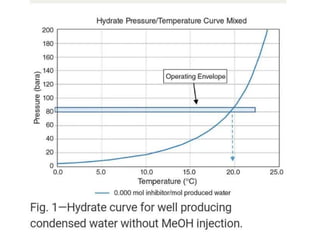
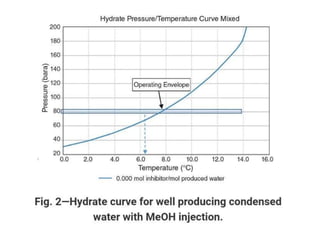
Hydrate Adviser :- From the initial -hydrate-
prediction results, additional water-sample analysis
was conducted to account for different salts in the
formation water.
On the basis of the transient-modeling and sampling
results, NKJ wells can be divided into three
categories.
Category A Wells
These wells have no brine production.
water content in these wells is so low (<5%) that it
falls out of the water-measurement range of
available multiphase flowmeters.
The modeling of Category A wells was performed by
saturating the fluid composition to the reservoir
pressure and temperature to account for the
condensed water from the gas phase.
Category B Wells
Wells That Produce Saline Formation Water.
more detailed overview of the concentrations of
different types of salt is required.
Sensitivity analysis was conducted for different salt
types and their effect on the hydrate curve.
The hydrate curves with detailed salt descriptions
have a close match with actual field conditions.
Category C Wells
Wells That Produce High-Salinity Formation Water.
formation water with high salt concentrations
(>280,000 ppm)
Overdosing with MeOH is not recommended for
high-salinity-water wells.
Surge Adviser :-accounting for changes in the flow
behavior in the pipeline resulting from various
factors
Corrosion and Gas Velocity :- the fluid velocity in gas
pipelines should be less than 60 to 80 ft/sec to
minimize noise and to allow for corrosion inhibition.
A lower velocity limit of 50 ft/sec should be used in
the presence of known corrosive agents such as
carbon dioxide.
The minimum gas velocity should be between 10 and
15 ft/sec, which minimizes liquid fallout.
If the velocity is high, the fluid will disturb the
corrosion-inhibitor coating and generate corrosion
sites
Conclusion
Hydrate Formation
Transient modeling can mimic field conditions if
accurate water properties are used to generate the
hydrate curve.
The effect of the salts present in the formation water
and the MeOH injection is well-understood, and
MeOH injection can be optimized by the use of
transient modeling.
The solution should be scaled up to include all the
new wells, and the system should be used to
minimize the production losses resulting from
hydrates.
Slug flow and pipeline corrosion
Sensitivity analysis conducted for ambient
temperature and the choke changes clearly
demonstrates that the flow from wells will always
have slug behavior at the inlet of the facility.
Modeling of the gas velocity in the pipeline is
important for predicting pipeline corrosion
Transient Modeling
steady-state models are capable of simulating flow-
assurance scenarios.
Dynamic hydrate and surge advisers can be used with the
transient modeling.
key function of the hydrate adviser is to monitor the
temperature margins of potential hydrate-formation
regions throughout the production network
the key function of the surge adviser is to calculate the
formation, location, and size of terrain slugs or liquid
surges in the production system.

transient simulation

  • 1.
    Transient Simulation for HydrateMitigation Aims for Optimal Production In kuwait field
  • 2.
    In the deephigh-pressure/high-temperature North Kuwait Jurassic (NKJ) fields, the pipelines connecting the wells to the processing facility are neither buried nor insulated. During the winter, the well fluid cools to below hydrate- formation temperature in the flowline, causing hydrate crystallization and even plugging. This paper presents the traditional methods of hydrate mitigation used in the NKJ fields and the way in which a transient model was initially built and continuously improved.
  • 3.
  • 4.
    Hydrate Formation Hydrates usuallyforms at night and early morning in winter. Robust solution is needed for minimizing production downtime. No proper flow-assurance study or modeling was conducted. predictive transient tool is needed to know.
  • 5.
    Slug Flow Low-condensate/gas--ratio andhigh-water/gas-ratio wells have a tendency to create slug flow in the pipeline. when the pipeline is heated, the -fluids expand and gas holdup increases in the line. when the pipeline cools, liquid hydrocarbon accumulates in the line, increasing the liquid holdup. At night, when the pipeline cools, liquid hydrocarbon accumulates in the line, increasing the liquid holdup
  • 6.
    Pipeline Corrosion An acid-gasenvironment with water production makes the system very corrosive. The current practice is to inject 10 L/h of corrosion inhibitor, which is expected to coat the whole pipeline and protect it from corrosion.
  • 7.
    Hydrate-Inhibition Operational Envelope Availablepumps have a maximum capacity of 20 L/h per pump, which is not enough. MeOH injection is performed manually and pumping is continued throughout the day during the winter. The injection pumps and the chemical tanks are not connected to the supervisory control and data acquisition system.
  • 8.
    Current Well Modelingand Liquide loading current well and pipeline models are steady state Choke reduction will result in liquid loading in some of the low-reservoir-pressure wells. Proper design of hydrate inhibition will eliminate the need for the choke reduction and, thus, avoid liquid loading.
  • 9.
  • 10.
    To address someof the challenges, a transient modeling solution began in 2014 for the producing NKJ wells. In the first phase, a pilot of an offline transient solution was deployed, with hydrate and surge advisers as the key deliverable. Hydrate Adviser :- From the initial -hydrate- prediction results, additional water-sample analysis was conducted to account for different salts in the formation water. On the basis of the transient-modeling and sampling results, NKJ wells can be divided into three categories.
  • 11.
    Category A Wells Thesewells have no brine production. water content in these wells is so low (<5%) that it falls out of the water-measurement range of available multiphase flowmeters. The modeling of Category A wells was performed by saturating the fluid composition to the reservoir pressure and temperature to account for the condensed water from the gas phase.
  • 14.
    Category B Wells WellsThat Produce Saline Formation Water. more detailed overview of the concentrations of different types of salt is required. Sensitivity analysis was conducted for different salt types and their effect on the hydrate curve. The hydrate curves with detailed salt descriptions have a close match with actual field conditions.
  • 15.
    Category C Wells WellsThat Produce High-Salinity Formation Water. formation water with high salt concentrations (>280,000 ppm) Overdosing with MeOH is not recommended for high-salinity-water wells. Surge Adviser :-accounting for changes in the flow behavior in the pipeline resulting from various factors
  • 16.
    Corrosion and GasVelocity :- the fluid velocity in gas pipelines should be less than 60 to 80 ft/sec to minimize noise and to allow for corrosion inhibition. A lower velocity limit of 50 ft/sec should be used in the presence of known corrosive agents such as carbon dioxide. The minimum gas velocity should be between 10 and 15 ft/sec, which minimizes liquid fallout. If the velocity is high, the fluid will disturb the corrosion-inhibitor coating and generate corrosion sites
  • 17.
  • 18.
    Hydrate Formation Transient modelingcan mimic field conditions if accurate water properties are used to generate the hydrate curve. The effect of the salts present in the formation water and the MeOH injection is well-understood, and MeOH injection can be optimized by the use of transient modeling. The solution should be scaled up to include all the new wells, and the system should be used to minimize the production losses resulting from hydrates.
  • 19.
    Slug flow andpipeline corrosion Sensitivity analysis conducted for ambient temperature and the choke changes clearly demonstrates that the flow from wells will always have slug behavior at the inlet of the facility. Modeling of the gas velocity in the pipeline is important for predicting pipeline corrosion
  • 20.
    Transient Modeling steady-state modelsare capable of simulating flow- assurance scenarios. Dynamic hydrate and surge advisers can be used with the transient modeling. key function of the hydrate adviser is to monitor the temperature margins of potential hydrate-formation regions throughout the production network the key function of the surge adviser is to calculate the formation, location, and size of terrain slugs or liquid surges in the production system.