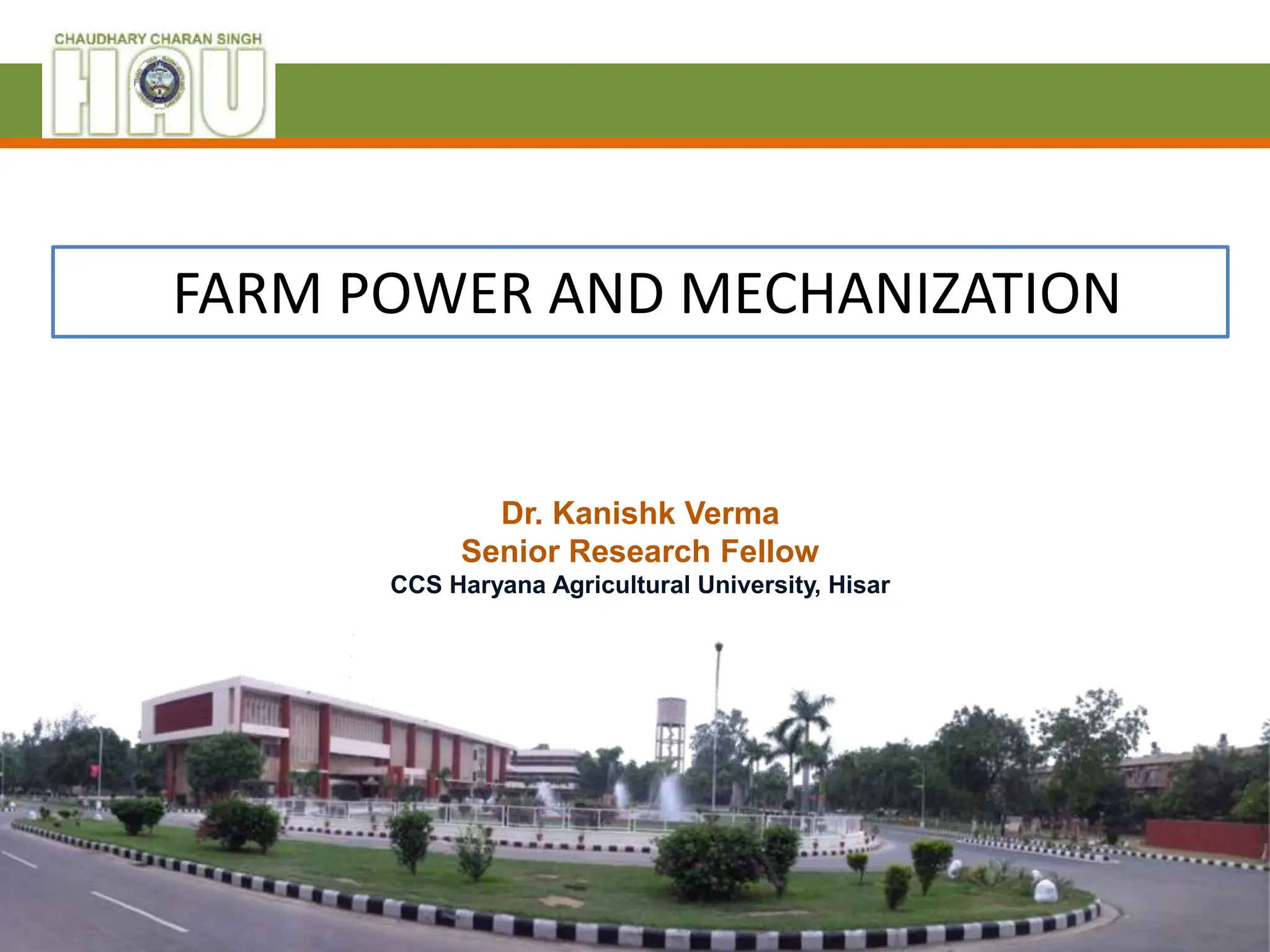
FARM POWER AND MECHANIZATION
Dr. Kanishk Verma
Senior Research Fellow
CCS Haryana Agricultural University, Hisar
Introduction
 Various types of agricultural operations performed on a farm can
be broadly classified as:
 Tractive work such as seed bed preparation, cultivation, harvesting
and transportation, and
 Stationary work like silage cutting, feed grinding, threshing,
winnowing and lifting of irrigation water.
For doing these operations different types of power available is
needed and classified as:
• Human power
• Animal power
• Mechanical power
• Electrical power
• Wind power
Different types of mechanization
 AGRICULTURAL MECHANIZATION involves the design,
manufacture, distribution, use and servicing of all types of
agricultural tools, equipment and machines. It includes three main
power sources: human, animal and mechanical with special
emphasis on mechanical (tractive power).
 FARM MECHANIZATION: is technically equivalent to agricultural
mechanization but refers to only those activities normally
occurring inside the boundaries of the farm unit or at the farm
unit level (example: village, community, co-operatives etc).
 TRACTORIZATION: refers to the application of any size tractor to
activities associated with agriculture.
Different types of mechanization
 MOTORIZATION: refers to the application of all types of mechanical
motors or engines, regardless of energy source, to activities related to
agriculture.
 AGRICULTURAL IMPLEMENTS: are devices attached to, pulled behind,
pushed, or otherwise used with human, animal or mechanical power
source to carry out an agricultural operation.
 AGRICULTURAL MACHINERY: is a general term used to describe tractors,
combines, implements, machines and any other device more
sophisticated than hand tools which are animal or mechanically
powered.
 AGRICULTURAL EQUIPMENT: generally refers to stationary mechanical
devices such as irrigation pump-set.
SCOPE OF FARM MECHANIZATION:
 Improved irrigation facility in the country.
 Introduction of high yielding varieties of seeds.
 Introduction of high dose of fertilizers and pesticides for
different crops.
 Introduction of new crops in different parts of the country.
 Multiple cropping system and intensive cultivation followed in
different parts of the country.
BENEFITS OF FARM MECHANIZATION
 Timeliness of operation
 Precision of operation
 Improvement of work environment
 Enhancement of safety
 Reduction of drudgery of labour
 Reduction of loss of crops and food products
 Increased productivity of land
 Increased economic return to farmers
 Improved dignity of farmers
 Progress and prosperity in rural areas
PRESENT STATUS OF FARM MECHANIZATION:
Present status of farm mechanization is quite appreciating. We
have:
a) Improved manual tools.
b) Improved animal drawn implements.
c) Tractor operated implements.
d) Custom hiring units on the farm.
e) Other stationary equipments like threshers, irrigation pumps,
sprayers, dusters etc
LIMITING FACTORS IN FARM MECHANIZATION
There are various limitations in adopting farm mechanization:
1) Small and fragmented land holdings.
2) Less investing capacity of farmers.
3) Agricultural labour is easily available.
4) Adequate draught animals are available in the country.
5) Lack of availability of suitable farm machines for different
operations.
6) Lack of repair and servicing facilities for machines.
7) Lack of trained man power.
8) Lack of co-ordination between research organization and
manufacturers.
9) High cost of machines.
10) Inadequate quality control of machines.
BOTTLENECKS IN INDIAN FARM MECHANIZATION SYSTEM
• Low annual use of tractors (only 500-600 hrs/year against recommended
1000 hrs/yr).
• Non availability of matching equipment.
• Cumbersome and energy inefficient designs.
• Poor reliability, frequent breakdowns and high repair and maintenance cost.
• Low quality.
• Use of ungraded materials, absence of inter-changeability of components.
• Inadequate R&D, Testing &Training facilities and inadequate Research
funding.
• Inadequate user education.
• Lack of standardization.
• Non-availability of relevant literature like operator’s manual, parts
catalogues etc.
PRIORITY AREAS FOR INDIAN AGRICULTURAL MECHANIZATION
• Intensification of R & D to introduce energy efficient machines for
relatively un-mechanized crops such as cotton, sugarcane, oil
seeds, pulses, vegetables & fruits. Use reverse engineering and
enforce close collaboration with farm machinery manufacturers.
Assist Indian manufacturers in seeking collaboration with well
known foreign firms wherever desired engineering technologies
are not available.
• Intensify research in the area of tractor design engineering due to
their extensive use in Indian farming. India is now the largest
tractor manufacturer in the world. TMA needs to be involved in
this task.
• Farm machinery management research to find out use patterns,
annual usage, breakdown frequencies, repair & maintenance cost
and above all reliability.
PRIORITY AREAS FOR INDIAN AGRICULTURAL MECHANIZATION
• Research on safety, comfort, exhaust emissions and health hazards
in the use of mechanical power sources and machines needs to be
expedited.
• Emphasis be laid on conservation farming and energy
saving/energy efficient tools and machines.
• An area of utmost importance from environmental point of view is
proper utilization of about 540 million tonnes of crop residues
available in India. Punjab alone has 10 million tonnes paddy straw
which is mostly burnt. Burning needs to be banned. Appropriate
machines for incorporation of residues into the soil, for mulching,
for collection, handling & transport for briquetting, gasification,
power generation, and/or allied usage is a priority area in the field
of mechanization.
• Research on alternate engine /tractor fuels including bio-diesel,
ethanol, producer gas need to be intensified.
PRIORITY AREAS FOR INDIAN AGRICULTURAL MECHANIZATION
• Greater emphasis be laid on design and manufacture of high
capacity and precision machines for multi farm use, for
corporate/contract farming as well as for custom hiring through
Agri. Business Centres being promoted by Govt. of India for the
benefit of rural youths.
• Equipment for post harvest transport, bulk handling, cleaning
grading drying milling packaging and storage are urgently
required. These could be imported wherever non-existent. Next
revolution in agriculture must be ushered in the area of efficient
food processing & agro industries to transform the rural areas &
utilize the surpluses. Mechanization packages will be crucial to
ensure success of contract/corporate farming.
• Mandi mechanization with a view to introduce bulk handling of
grains is an urgent need.
PRIORITY AREAS FOR INDIAN AGRICULTURAL MECHANIZATION
• Nearly two-third of the cultivated area is rainfed. Farm power
available in these areas is barely 0.3 kW/ha. Hence, mechanization
of these areas should be under taken on priority basis. Large horse
power tractors and suitable equipment for conservation of soil
moisture, seed bed preparation, seeding/planting, harvesting etc.,
are required.
• The benefits of farm mechanization have so far remained confined
to mainly wheat-based cropping systems. These need to be
expanded to all cropping systems including horticulture.
• The present credit policy based on land mortgage is not
favourable to small farmers to own mechanical prime movers. It
excludes them from the benefits of farm mechanization and
supplementing their incomes through hiring out their spare
operational capacity. Instead of land mortgage, viability and
hypothecation of the machinery may be better criteria.
PRIORITY AREAS FOR INDIAN AGRICULTURAL MECHANIZATION
• There being a positive relationship between power availability and
agricultural productivity, power constraint should be removed. An
annual growth rate of 4% over 1996 base in power supply to raise
it from 1kW/ha to 2kW/ha by 2020 will be adequate to maintain a
growth rate of 3% or more in agricultural production. This is based
on “power-production relation” studies in India and abroad. The
additional power will be supplied by tractors, power tillers, self-
propelled machines, engines and electric motors.
• For precision farming, precision equipment for planting and plant
protection are required.
• Increasing emphasis on Integrated Pest management and Organic
farming would require use of efficient cultivation machinery for
weeding and hoeing. Research in this area would be necessary to
evolve optimum planting geometry and practices.
SUGGESTIONS FOR FURTHER IMPROVEMENT
• No Farm Machinery research/development project should be initiated
without conducting a market survey to assess the client needs and
perceptions.
• Greater industry-institution collaboration by undertaking joint research
projects and use of reverse engineering would be helpful for speedy
development and commercialization of new equipment.
• Computer Aided Design (CAD) must be used for optimum design, cost
reduction and reliability. All R&D organizations must have a CAD facility
with latest design packages. Train R&D engineers to develop proficiency
in computer aided design.
• R&D engineers must ensure compatibility of their designs with BIS/ISO
standards, norms and practices.
• Standardization of critical components to ensure quality, durability and
inter changeability is essential.
• Up gradation of manufacturing technology to upgrade quality and
reduce the cost.
SYMBOL OF TRUST

Dr Kanishk.ppt

  • 1.
    FARM POWER ANDMECHANIZATION Dr. Kanishk Verma Senior Research Fellow CCS Haryana Agricultural University, Hisar
  • 2.
    Introduction  Various typesof agricultural operations performed on a farm can be broadly classified as:  Tractive work such as seed bed preparation, cultivation, harvesting and transportation, and  Stationary work like silage cutting, feed grinding, threshing, winnowing and lifting of irrigation water. For doing these operations different types of power available is needed and classified as: • Human power • Animal power • Mechanical power • Electrical power • Wind power
  • 3.
    Different types ofmechanization  AGRICULTURAL MECHANIZATION involves the design, manufacture, distribution, use and servicing of all types of agricultural tools, equipment and machines. It includes three main power sources: human, animal and mechanical with special emphasis on mechanical (tractive power).  FARM MECHANIZATION: is technically equivalent to agricultural mechanization but refers to only those activities normally occurring inside the boundaries of the farm unit or at the farm unit level (example: village, community, co-operatives etc).  TRACTORIZATION: refers to the application of any size tractor to activities associated with agriculture.
  • 4.
    Different types ofmechanization  MOTORIZATION: refers to the application of all types of mechanical motors or engines, regardless of energy source, to activities related to agriculture.  AGRICULTURAL IMPLEMENTS: are devices attached to, pulled behind, pushed, or otherwise used with human, animal or mechanical power source to carry out an agricultural operation.  AGRICULTURAL MACHINERY: is a general term used to describe tractors, combines, implements, machines and any other device more sophisticated than hand tools which are animal or mechanically powered.  AGRICULTURAL EQUIPMENT: generally refers to stationary mechanical devices such as irrigation pump-set.
  • 5.
    SCOPE OF FARMMECHANIZATION:  Improved irrigation facility in the country.  Introduction of high yielding varieties of seeds.  Introduction of high dose of fertilizers and pesticides for different crops.  Introduction of new crops in different parts of the country.  Multiple cropping system and intensive cultivation followed in different parts of the country.
  • 6.
    BENEFITS OF FARMMECHANIZATION  Timeliness of operation  Precision of operation  Improvement of work environment  Enhancement of safety  Reduction of drudgery of labour  Reduction of loss of crops and food products  Increased productivity of land  Increased economic return to farmers  Improved dignity of farmers  Progress and prosperity in rural areas
  • 7.
    PRESENT STATUS OFFARM MECHANIZATION: Present status of farm mechanization is quite appreciating. We have: a) Improved manual tools. b) Improved animal drawn implements. c) Tractor operated implements. d) Custom hiring units on the farm. e) Other stationary equipments like threshers, irrigation pumps, sprayers, dusters etc
  • 8.
    LIMITING FACTORS INFARM MECHANIZATION There are various limitations in adopting farm mechanization: 1) Small and fragmented land holdings. 2) Less investing capacity of farmers. 3) Agricultural labour is easily available. 4) Adequate draught animals are available in the country. 5) Lack of availability of suitable farm machines for different operations. 6) Lack of repair and servicing facilities for machines. 7) Lack of trained man power. 8) Lack of co-ordination between research organization and manufacturers. 9) High cost of machines. 10) Inadequate quality control of machines.
  • 9.
    BOTTLENECKS IN INDIANFARM MECHANIZATION SYSTEM • Low annual use of tractors (only 500-600 hrs/year against recommended 1000 hrs/yr). • Non availability of matching equipment. • Cumbersome and energy inefficient designs. • Poor reliability, frequent breakdowns and high repair and maintenance cost. • Low quality. • Use of ungraded materials, absence of inter-changeability of components. • Inadequate R&D, Testing &Training facilities and inadequate Research funding. • Inadequate user education. • Lack of standardization. • Non-availability of relevant literature like operator’s manual, parts catalogues etc.
  • 10.
    PRIORITY AREAS FORINDIAN AGRICULTURAL MECHANIZATION • Intensification of R & D to introduce energy efficient machines for relatively un-mechanized crops such as cotton, sugarcane, oil seeds, pulses, vegetables & fruits. Use reverse engineering and enforce close collaboration with farm machinery manufacturers. Assist Indian manufacturers in seeking collaboration with well known foreign firms wherever desired engineering technologies are not available. • Intensify research in the area of tractor design engineering due to their extensive use in Indian farming. India is now the largest tractor manufacturer in the world. TMA needs to be involved in this task. • Farm machinery management research to find out use patterns, annual usage, breakdown frequencies, repair & maintenance cost and above all reliability.
  • 11.
    PRIORITY AREAS FORINDIAN AGRICULTURAL MECHANIZATION • Research on safety, comfort, exhaust emissions and health hazards in the use of mechanical power sources and machines needs to be expedited. • Emphasis be laid on conservation farming and energy saving/energy efficient tools and machines. • An area of utmost importance from environmental point of view is proper utilization of about 540 million tonnes of crop residues available in India. Punjab alone has 10 million tonnes paddy straw which is mostly burnt. Burning needs to be banned. Appropriate machines for incorporation of residues into the soil, for mulching, for collection, handling & transport for briquetting, gasification, power generation, and/or allied usage is a priority area in the field of mechanization. • Research on alternate engine /tractor fuels including bio-diesel, ethanol, producer gas need to be intensified.
  • 12.
    PRIORITY AREAS FORINDIAN AGRICULTURAL MECHANIZATION • Greater emphasis be laid on design and manufacture of high capacity and precision machines for multi farm use, for corporate/contract farming as well as for custom hiring through Agri. Business Centres being promoted by Govt. of India for the benefit of rural youths. • Equipment for post harvest transport, bulk handling, cleaning grading drying milling packaging and storage are urgently required. These could be imported wherever non-existent. Next revolution in agriculture must be ushered in the area of efficient food processing & agro industries to transform the rural areas & utilize the surpluses. Mechanization packages will be crucial to ensure success of contract/corporate farming. • Mandi mechanization with a view to introduce bulk handling of grains is an urgent need.
  • 13.
    PRIORITY AREAS FORINDIAN AGRICULTURAL MECHANIZATION • Nearly two-third of the cultivated area is rainfed. Farm power available in these areas is barely 0.3 kW/ha. Hence, mechanization of these areas should be under taken on priority basis. Large horse power tractors and suitable equipment for conservation of soil moisture, seed bed preparation, seeding/planting, harvesting etc., are required. • The benefits of farm mechanization have so far remained confined to mainly wheat-based cropping systems. These need to be expanded to all cropping systems including horticulture. • The present credit policy based on land mortgage is not favourable to small farmers to own mechanical prime movers. It excludes them from the benefits of farm mechanization and supplementing their incomes through hiring out their spare operational capacity. Instead of land mortgage, viability and hypothecation of the machinery may be better criteria.
  • 14.
    PRIORITY AREAS FORINDIAN AGRICULTURAL MECHANIZATION • There being a positive relationship between power availability and agricultural productivity, power constraint should be removed. An annual growth rate of 4% over 1996 base in power supply to raise it from 1kW/ha to 2kW/ha by 2020 will be adequate to maintain a growth rate of 3% or more in agricultural production. This is based on “power-production relation” studies in India and abroad. The additional power will be supplied by tractors, power tillers, self- propelled machines, engines and electric motors. • For precision farming, precision equipment for planting and plant protection are required. • Increasing emphasis on Integrated Pest management and Organic farming would require use of efficient cultivation machinery for weeding and hoeing. Research in this area would be necessary to evolve optimum planting geometry and practices.
  • 15.
    SUGGESTIONS FOR FURTHERIMPROVEMENT • No Farm Machinery research/development project should be initiated without conducting a market survey to assess the client needs and perceptions. • Greater industry-institution collaboration by undertaking joint research projects and use of reverse engineering would be helpful for speedy development and commercialization of new equipment. • Computer Aided Design (CAD) must be used for optimum design, cost reduction and reliability. All R&D organizations must have a CAD facility with latest design packages. Train R&D engineers to develop proficiency in computer aided design. • R&D engineers must ensure compatibility of their designs with BIS/ISO standards, norms and practices. • Standardization of critical components to ensure quality, durability and inter changeability is essential. • Up gradation of manufacturing technology to upgrade quality and reduce the cost.
  • 16.