1
Transaction Design patterns
Helmi Ben Abdallah @rchitect J2EE
2
A Brief Introduction to the Patterns
• The transaction design patterns that are described in the next are :
• Client Owner Transaction Design Pattern
• Domain Service Owner Transaction Design Pattern
• Server Delegate Owner Transaction Design Pattern
3
CLIENT OWNER TRANSACTION DESIGN PATTERN
4
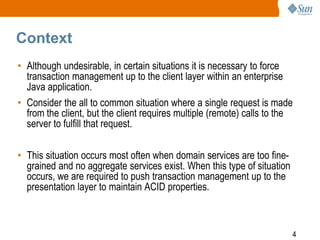
Context
• Although undesirable, in certain situations it is necessary to force
transaction management up to the client layer within an enterprise
Java application.
• Consider the all to common situation where a single request is made
from the client, but the client requires multiple (remote) calls to the
server to fulfill that request.
• This situation occurs most often when domain services are too fine-
grained and no aggregate services exist. When this type of situation
occurs, we are required to push transaction management up to the
presentation layer to maintain ACID properties.
5
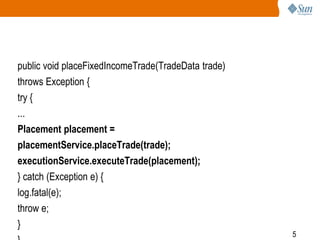
public void placeFixedIncomeTrade(TradeData trade)
throws Exception {
try {
...
Placement placement =
placementService.placeTrade(trade);
executionService.executeTrade(placement);
} catch (Exception e) {
log.fatal(e);
throw e;
}
6
Forces
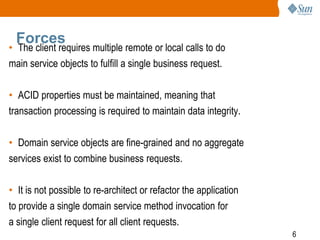
• The client requires multiple remote or local calls to do
main service objects to fulfill a single business request.
• ACID properties must be maintained, meaning that
transaction processing is required to maintain data integrity.
• Domain service objects are fine-grained and no aggregate
services exist to combine business requests.
• It is not possible to re-architect or refactor the application
to provide a single domain service method invocation for
a single client request for all client requests.
7
Solution
8
Consequences
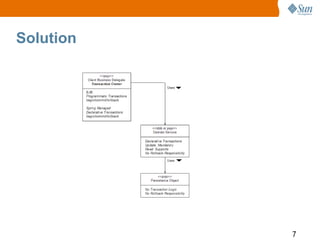
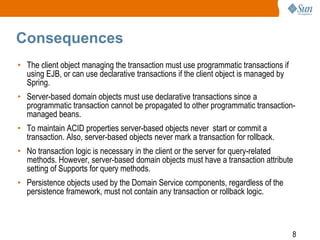
• The client object managing the transaction must use programmatic transactions if
using EJB, or can use declarative transactions if the client object is managed by
Spring.
• Server-based domain objects must use declarative transactions since a
programmatic transaction cannot be propagated to other programmatic transaction-
managed beans.
• To maintain ACID properties server-based objects never start or commit a
transaction. Also, server-based objects never mark a transaction for rollback.
• No transaction logic is necessary in the client or the server for query-related
methods. However, server-based domain objects must have a transaction attribute
setting of Supports for query methods.
• Persistence objects used by the Domain Service components, regardless of the
persistence framework, must not contain any transaction or rollback logic.
9
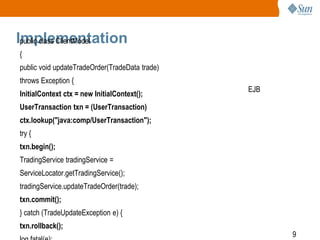
Implementationpublic class ClientModel
{
public void updateTradeOrder(TradeData trade)
throws Exception {
InitialContext ctx = new InitialContext();
UserTransaction txn = (UserTransaction)
ctx.lookup("java:comp/UserTransaction");
try {
txn.begin();
TradingService tradingService =
ServiceLocator.getTradingService();
tradingService.updateTradeOrder(trade);
txn.commit();
} catch (TradeUpdateException e) {
txn.rollback();
EJB
10
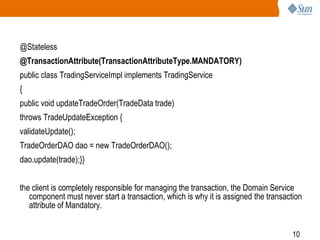
@Stateless
@TransactionAttribute(TransactionAttributeType.MANDATORY)
public class TradingServiceImpl implements TradingService
{
public void updateTradeOrder(TradeData trade)
throws TradeUpdateException {
validateUpdate();
TradeOrderDAO dao = new TradeOrderDAO();
dao.update(trade);}}
the client is completely responsible for managing the transaction, the Domain Service
component must never start a transaction, which is why it is assigned the transaction
attribute of Mandatory.
11
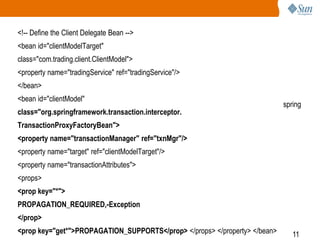
<!-- Define the Client Delegate Bean -->
<bean id="clientModelTarget"
class="com.trading.client.ClientModel">
<property name="tradingService" ref="tradingService"/>
</bean>
<bean id="clientModel"
class="org.springframework.transaction.interceptor.
TransactionProxyFactoryBean">
<property name="transactionManager" ref="txnMgr"/>
<property name="target" ref="clientModelTarget"/>
<property name="transactionAttributes">
<props>
<prop key="*">
PROPAGATION_REQUIRED,-Exception
</prop>
<prop key="get*">PROPAGATION_SUPPORTS</prop> </props> </property> </bean>
spring
12
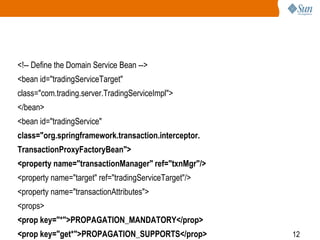
<!-- Define the Domain Service Bean -->
<bean id="tradingServiceTarget"
class="com.trading.server.TradingServiceImpl">
</bean>
<bean id="tradingService"
class="org.springframework.transaction.interceptor.
TransactionProxyFactoryBean">
<property name="transactionManager" ref="txnMgr"/>
<property name="target" ref="tradingServiceTarget"/>
<property name="transactionAttributes">
<props>
<prop key="*">PROPAGATION_MANDATORY</prop>
<prop key="get*">PROPAGATION_SUPPORTS</prop>
13
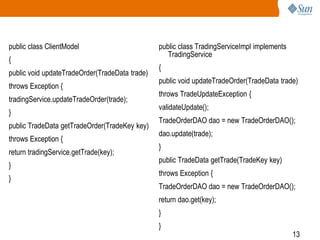
public class ClientModel
{
public void updateTradeOrder(TradeData trade)
throws Exception {
tradingService.updateTradeOrder(trade);
}
public TradeData getTradeOrder(TradeKey key)
throws Exception {
return tradingService.getTrade(key);
}
}
public class TradingServiceImpl implements
TradingService
{
public void updateTradeOrder(TradeData trade)
throws TradeUpdateException {
validateUpdate();
TradeOrderDAO dao = new TradeOrderDAO();
dao.update(trade);
}
public TradeData getTrade(TradeKey key)
throws Exception {
TradeOrderDAO dao = new TradeOrderDAO();
return dao.get(key);
}
}
14
DOMAIN SERVICE OWNER TRANSACTION
DESIGN PATTERN
15
• The Domain Service Owner Transaction Design Pattern is the most commonly
used transaction design pattern and applies to most Java-based application
architectures you are likely to en-counter.
• In EJB the Domain Service component is typically implemented as a Stateless
SessionBean and therefore uses the Declarative Transaction Model to manage
transactions.
• In Spring the Domain Service component is mplemented as a POJO and also
uses declarative transaction management.
16
the server layer should be responsible for
managing transactions.
• First, we may not know the type of client accessing the backend
services. For example, a Web Services client cannot feasibly
start and propagate a transaction to our domain service.
• Second, assigning responsibility for transaction management at
the client layer typically places too much of a burden on the
client, which should primarily be responsible for presentation
logic, not server-based or middleware logic like transaction
processing.
17
• For these reasons, enterprise Java applications are usually
designed with course-grained domain services that handle a single
business request as a single unit of work. This simplifies the overall
architecture and increases overall application performance.
• It therefore becomes a question of which components should be
responsible for starting the transaction, committing the transaction,
marking the transaction for rollback, and how the transaction should
be propagated to the persistence framework.
18
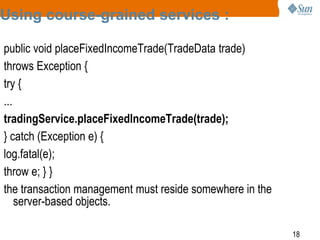
Using course-grained services :
public void placeFixedIncomeTrade(TradeData trade)
throws Exception {
try {
...
tradingService.placeFixedIncomeTrade(trade);
} catch (Exception e) {
log.fatal(e);
throw e; } }
the transaction management must reside somewhere in the
server-based objects.
19
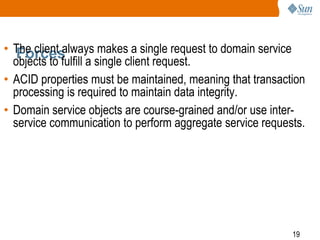
Forces• The client always makes a single request to domain service
objects to fulfill a single client request.
• ACID properties must be maintained, meaning that transaction
processing is required to maintain data integrity.
• Domain service objects are course-grained and/or use inter-
service communication to perform aggregate service requests.
20
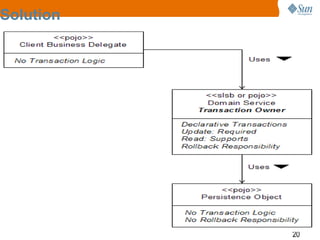
Solution
21
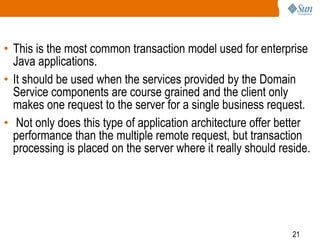
• This is the most common transaction model used for enterprise
Java applications.
• It should be used when the services provided by the Domain
Service components are course grained and the client only
makes one request to the server for a single business request.
• Not only does this type of application architecture offer better
performance than the multiple remote request, but transaction
processing is placed on the server where it really should reside.
22
Consequences
• The client (regardless of its type) does not contain any transaction logic
and does not manage any aspect of the transaction processing.
• Since the Domain Service component is starting and managing the
transaction, update methods must invoke the setRollbackOnly()method on
application (checked) exceptions.
• Persistence objects used by the Domain Service, regardless of the
persistence framework, do not contain any transaction or rollback logic.
• Server-based domain objects use declarative transactions
and use a transaction attribute of Requiredfor update
related methods and Supports for read operations.
23
• To maintain ACID properties client-based objects can never
start a transaction, commit a transaction, or mark a
transaction for rollback.
• Persistence objects used by the Domain Service components,
regardless of the persistence framework, must not contain
any transaction or rollback logic.
24
• If EJB 2.1 Entity Beans are used, the transaction attribute for
update operations must be set to Mandatory and no rollback logic
is used.
• For read operations the Entity Bean method should have a
transaction attribute setting of Required for Container-managed
Persistence (CMP) Entity Beans or Supports for Bean managed
Persistence (BMP) Entity Beans.
25
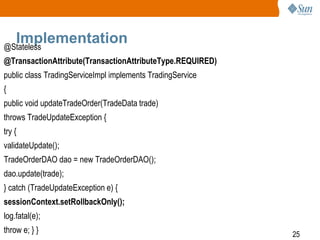
Implementation@Stateless
@TransactionAttribute(TransactionAttributeType.REQUIRED)
public class TradingServiceImpl implements TradingService
{
public void updateTradeOrder(TradeData trade)
throws TradeUpdateException {
try {
validateUpdate();
TradeOrderDAO dao = new TradeOrderDAO();
dao.update(trade);
} catch (TradeUpdateException e) {
sessionContext.setRollbackOnly();
log.fatal(e);
throw e; } }
26
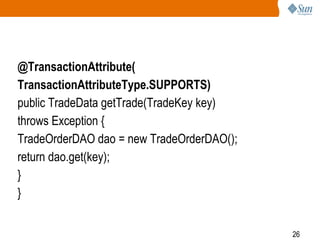
@TransactionAttribute(
TransactionAttributeType.SUPPORTS)
public TradeData getTrade(TradeKey key)
throws Exception {
TradeOrderDAO dao = new TradeOrderDAO();
return dao.get(key);
}
}
27
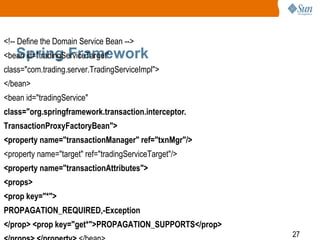
Spring Framework
<!-- Define the Domain Service Bean -->
<bean id="tradingServiceTarget"
class="com.trading.server.TradingServiceImpl">
</bean>
<bean id="tradingService"
class="org.springframework.transaction.interceptor.
TransactionProxyFactoryBean">
<property name="transactionManager" ref="txnMgr"/>
<property name="target" ref="tradingServiceTarget"/>
<property name="transactionAttributes">
<props>
<prop key="*">
PROPAGATION_REQUIRED,-Exception
</prop> <prop key="get*">PROPAGATION_SUPPORTS</prop>
28
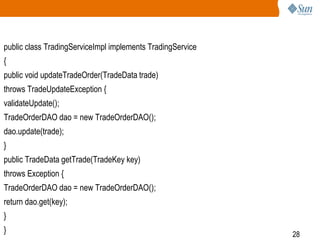
public class TradingServiceImpl implements TradingService
{
public void updateTradeOrder(TradeData trade)
throws TradeUpdateException {
validateUpdate();
TradeOrderDAO dao = new TradeOrderDAO();
dao.update(trade);
}
public TradeData getTrade(TradeKey key)
throws Exception {
TradeOrderDAO dao = new TradeOrderDAO();
return dao.get(key);
}
}
29
Server Delegate Owner Transaction Design
Pattern
30
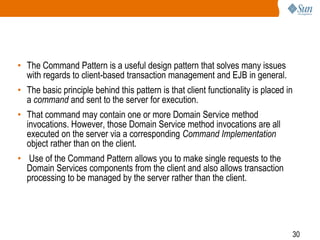
• The Command Pattern is a useful design pattern that solves many issues
with regards to client-based transaction management and EJB in general.
• The basic principle behind this pattern is that client functionality is placed in
a command and sent to the server for execution.
• That command may contain one or more Domain Service method
invocations. However, those Domain Service method invocations are all
executed on the server via a corresponding Command Implementation
object rather than on the client.
• Use of the Command Pattern allows you to make single requests to the
Domain Services components from the client and also allows transaction
processing to be managed by the server rather than the client.
31
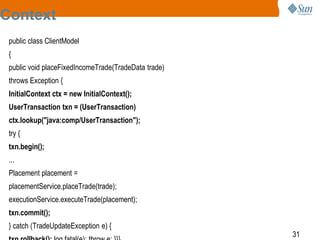
Context
public class ClientModel
{
public void placeFixedIncomeTrade(TradeData trade)
throws Exception {
InitialContext ctx = new InitialContext();
UserTransaction txn = (UserTransaction)
ctx.lookup("java:comp/UserTransaction");
try {
txn.begin();
...
Placement placement =
placementService.placeTrade(trade);
executionService.executeTrade(placement);
txn.commit();
} catch (TradeUpdateException e) {
32
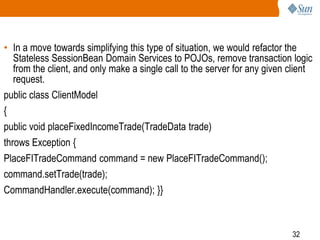
• In a move towards simplifying this type of situation, we would refactor the
Stateless SessionBean Domain Services to POJOs, remove transaction logic
from the client, and only make a single call to the server for any given client
request.
public class ClientModel
{
public void placeFixedIncomeTrade(TradeData trade)
throws Exception {
PlaceFITradeCommand command = new PlaceFITradeCommand();
command.setTrade(trade);
CommandHandler.execute(command); }}
33
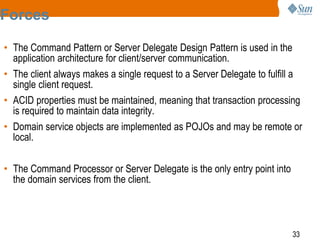
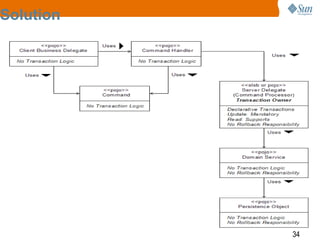
Forces
• The Command Pattern or Server Delegate Design Pattern is used in the
application architecture for client/server communication.
• The client always makes a single request to a Server Delegate to fulfill a
single client request.
• ACID properties must be maintained, meaning that transaction processing
is required to maintain data integrity.
• Domain service objects are implemented as POJOs and may be remote or
local.
• The Command Processor or Server Delegate is the only entry point into
the domain services from the client.
34
Solution
35
Consequences
• The client (regardless of its type) does not contain any transaction logic and
does not manage any aspect of the transaction processing.
• Since the Server Delegate component is starting and managing the
transaction, update methods must invoke the setRollbackOnly() method on
application exceptions.
• The transaction established by the Server Delegate is propagated to the
POJO-based Domain Services objects as well as the Persistence objects used
by the Domain Service (regardless of the persistence framework).
Furthermore, none of these components contain any transaction or rollback
logic.
• Server Delegate objects use declarative transactions and use a transaction
attribute of Requiredfor update-related methods and Supportsfor read
operations.
36
• To maintain ACID properties client-based objects can never start a
transaction, commit a transaction, or mark a transaction for rollback.
• Persistence objects and Domain Services do not contain any transaction or
rollback logic.
• If EJB 2.1 Entity Beans are used, the transaction attribute for update
operations must be set to Mandatoryand no rollback logic is used. For read
operations the Entity Bean method should have a transaction attribute
setting of Requiredfor Container-managed Persistence (CMP) Entity Beans
or Supportsfor Bean-managed Persistence (BMP) Entity Beans.
37
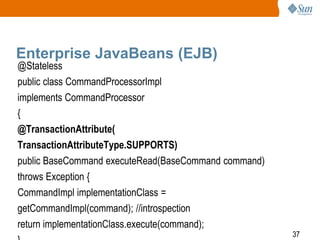
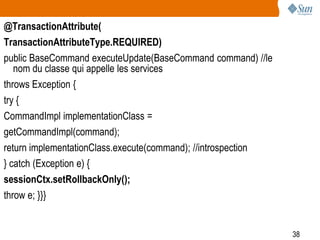
Enterprise JavaBeans (EJB)
@Stateless
public class CommandProcessorImpl
implements CommandProcessor
{
@TransactionAttribute(
TransactionAttributeType.SUPPORTS)
public BaseCommand executeRead(BaseCommand command)
throws Exception {
CommandImpl implementationClass =
getCommandImpl(command); //introspection
return implementationClass.execute(command);
38
@TransactionAttribute(
TransactionAttributeType.REQUIRED)
public BaseCommand executeUpdate(BaseCommand command) //le
nom du classe qui appelle les services
throws Exception {
try {
CommandImpl implementationClass =
getCommandImpl(command);
return implementationClass.execute(command); //introspection
} catch (Exception e) {
sessionCtx.setRollbackOnly();
throw e; }}}
39
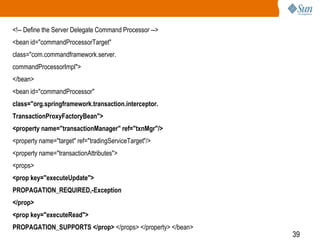
<!-- Define the Server Delegate Command Processor -->
<bean id="commandProcessorTarget"
class="com.commandframework.server.
commandProcessorImpl">
</bean>
<bean id="commandProcessor"
class="org.springframework.transaction.interceptor.
TransactionProxyFactoryBean">
<property name="transactionManager" ref="txnMgr"/>
<property name="target" ref="tradingServiceTarget"/>
<property name="transactionAttributes">
<props>
<prop key="executeUpdate">
PROPAGATION_REQUIRED,-Exception
</prop>
<prop key="executeRead">
PROPAGATION_SUPPORTS </prop> </props> </property> </bean>
40
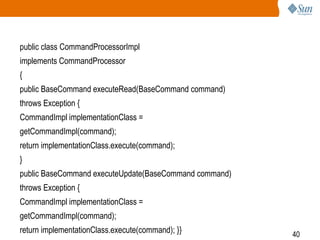
public class CommandProcessorImpl
implements CommandProcessor
{
public BaseCommand executeRead(BaseCommand command)
throws Exception {
CommandImpl implementationClass =
getCommandImpl(command);
return implementationClass.execute(command);
}
public BaseCommand executeUpdate(BaseCommand command)
throws Exception {
CommandImpl implementationClass =
getCommandImpl(command);
return implementationClass.execute(command); }}
41
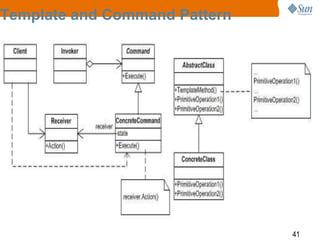
Template and Command Pattern
42
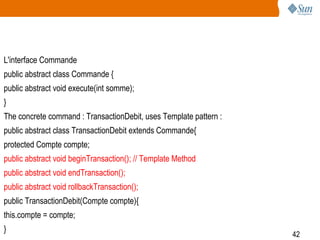
L'interface Commande
public abstract class Commande {
public abstract void execute(int somme);
}
The concrete command : TransactionDebit, uses Template pattern :
public abstract class TransactionDebit extends Commande{
protected Compte compte;
public abstract void beginTransaction(); // Template Method
public abstract void endTransaction();
public abstract void rollbackTransaction();
public TransactionDebit(Compte compte){
this.compte = compte;
}
43
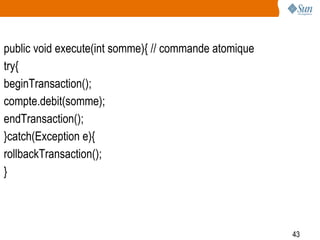
public void execute(int somme){ // commande atomique
try{
beginTransaction();
compte.debit(somme);
endTransaction();
}catch(Exception e){
rollbackTransaction();
}
44
• http://www.theserverside.com/patterns/thread.tss?thread_i
d=14387.
• http://www.ibm.com/developerworks/ibm/library/i-
extreme13/
45
Transaction processing is very important and also necessary to
maintain data integrity in both your application and database.
Transaction management in Java does not have to be
complicated using the transaction design patterns described
in this chapter makes transaction processing easy to
understand, implement, and maintain.

Transaction design patterns

  • 1.
    1 Transaction Design patterns HelmiBen Abdallah @rchitect J2EE
  • 2.
    2 A Brief Introductionto the Patterns • The transaction design patterns that are described in the next are : • Client Owner Transaction Design Pattern • Domain Service Owner Transaction Design Pattern • Server Delegate Owner Transaction Design Pattern
  • 3.
  • 4.
    4 Context • Although undesirable,in certain situations it is necessary to force transaction management up to the client layer within an enterprise Java application. • Consider the all to common situation where a single request is made from the client, but the client requires multiple (remote) calls to the server to fulfill that request. • This situation occurs most often when domain services are too fine- grained and no aggregate services exist. When this type of situation occurs, we are required to push transaction management up to the presentation layer to maintain ACID properties.
  • 5.
    5 public void placeFixedIncomeTrade(TradeDatatrade) throws Exception { try { ... Placement placement = placementService.placeTrade(trade); executionService.executeTrade(placement); } catch (Exception e) { log.fatal(e); throw e; }
  • 6.
    6 Forces • The clientrequires multiple remote or local calls to do main service objects to fulfill a single business request. • ACID properties must be maintained, meaning that transaction processing is required to maintain data integrity. • Domain service objects are fine-grained and no aggregate services exist to combine business requests. • It is not possible to re-architect or refactor the application to provide a single domain service method invocation for a single client request for all client requests.
  • 7.
  • 8.
    8 Consequences • The clientobject managing the transaction must use programmatic transactions if using EJB, or can use declarative transactions if the client object is managed by Spring. • Server-based domain objects must use declarative transactions since a programmatic transaction cannot be propagated to other programmatic transaction- managed beans. • To maintain ACID properties server-based objects never start or commit a transaction. Also, server-based objects never mark a transaction for rollback. • No transaction logic is necessary in the client or the server for query-related methods. However, server-based domain objects must have a transaction attribute setting of Supports for query methods. • Persistence objects used by the Domain Service components, regardless of the persistence framework, must not contain any transaction or rollback logic.
  • 9.
    9 Implementationpublic class ClientModel { publicvoid updateTradeOrder(TradeData trade) throws Exception { InitialContext ctx = new InitialContext(); UserTransaction txn = (UserTransaction) ctx.lookup("java:comp/UserTransaction"); try { txn.begin(); TradingService tradingService = ServiceLocator.getTradingService(); tradingService.updateTradeOrder(trade); txn.commit(); } catch (TradeUpdateException e) { txn.rollback(); EJB
  • 10.
    10 @Stateless @TransactionAttribute(TransactionAttributeType.MANDATORY) public class TradingServiceImplimplements TradingService { public void updateTradeOrder(TradeData trade) throws TradeUpdateException { validateUpdate(); TradeOrderDAO dao = new TradeOrderDAO(); dao.update(trade);}} the client is completely responsible for managing the transaction, the Domain Service component must never start a transaction, which is why it is assigned the transaction attribute of Mandatory.
  • 11.
    11 <!-- Define theClient Delegate Bean --> <bean id="clientModelTarget" class="com.trading.client.ClientModel"> <property name="tradingService" ref="tradingService"/> </bean> <bean id="clientModel" class="org.springframework.transaction.interceptor. TransactionProxyFactoryBean"> <property name="transactionManager" ref="txnMgr"/> <property name="target" ref="clientModelTarget"/> <property name="transactionAttributes"> <props> <prop key="*"> PROPAGATION_REQUIRED,-Exception </prop> <prop key="get*">PROPAGATION_SUPPORTS</prop> </props> </property> </bean> spring
  • 12.
    12 <!-- Define theDomain Service Bean --> <bean id="tradingServiceTarget" class="com.trading.server.TradingServiceImpl"> </bean> <bean id="tradingService" class="org.springframework.transaction.interceptor. TransactionProxyFactoryBean"> <property name="transactionManager" ref="txnMgr"/> <property name="target" ref="tradingServiceTarget"/> <property name="transactionAttributes"> <props> <prop key="*">PROPAGATION_MANDATORY</prop> <prop key="get*">PROPAGATION_SUPPORTS</prop>
  • 13.
    13 public class ClientModel { publicvoid updateTradeOrder(TradeData trade) throws Exception { tradingService.updateTradeOrder(trade); } public TradeData getTradeOrder(TradeKey key) throws Exception { return tradingService.getTrade(key); } } public class TradingServiceImpl implements TradingService { public void updateTradeOrder(TradeData trade) throws TradeUpdateException { validateUpdate(); TradeOrderDAO dao = new TradeOrderDAO(); dao.update(trade); } public TradeData getTrade(TradeKey key) throws Exception { TradeOrderDAO dao = new TradeOrderDAO(); return dao.get(key); } }
  • 14.
    14 DOMAIN SERVICE OWNERTRANSACTION DESIGN PATTERN
  • 15.
    15 • The DomainService Owner Transaction Design Pattern is the most commonly used transaction design pattern and applies to most Java-based application architectures you are likely to en-counter. • In EJB the Domain Service component is typically implemented as a Stateless SessionBean and therefore uses the Declarative Transaction Model to manage transactions. • In Spring the Domain Service component is mplemented as a POJO and also uses declarative transaction management.
  • 16.
    16 the server layershould be responsible for managing transactions. • First, we may not know the type of client accessing the backend services. For example, a Web Services client cannot feasibly start and propagate a transaction to our domain service. • Second, assigning responsibility for transaction management at the client layer typically places too much of a burden on the client, which should primarily be responsible for presentation logic, not server-based or middleware logic like transaction processing.
  • 17.
    17 • For thesereasons, enterprise Java applications are usually designed with course-grained domain services that handle a single business request as a single unit of work. This simplifies the overall architecture and increases overall application performance. • It therefore becomes a question of which components should be responsible for starting the transaction, committing the transaction, marking the transaction for rollback, and how the transaction should be propagated to the persistence framework.
  • 18.
    18 Using course-grained services: public void placeFixedIncomeTrade(TradeData trade) throws Exception { try { ... tradingService.placeFixedIncomeTrade(trade); } catch (Exception e) { log.fatal(e); throw e; } } the transaction management must reside somewhere in the server-based objects.
  • 19.
    19 Forces• The clientalways makes a single request to domain service objects to fulfill a single client request. • ACID properties must be maintained, meaning that transaction processing is required to maintain data integrity. • Domain service objects are course-grained and/or use inter- service communication to perform aggregate service requests.
  • 20.
  • 21.
    21 • This isthe most common transaction model used for enterprise Java applications. • It should be used when the services provided by the Domain Service components are course grained and the client only makes one request to the server for a single business request. • Not only does this type of application architecture offer better performance than the multiple remote request, but transaction processing is placed on the server where it really should reside.
  • 22.
    22 Consequences • The client(regardless of its type) does not contain any transaction logic and does not manage any aspect of the transaction processing. • Since the Domain Service component is starting and managing the transaction, update methods must invoke the setRollbackOnly()method on application (checked) exceptions. • Persistence objects used by the Domain Service, regardless of the persistence framework, do not contain any transaction or rollback logic. • Server-based domain objects use declarative transactions and use a transaction attribute of Requiredfor update related methods and Supports for read operations.
  • 23.
    23 • To maintainACID properties client-based objects can never start a transaction, commit a transaction, or mark a transaction for rollback. • Persistence objects used by the Domain Service components, regardless of the persistence framework, must not contain any transaction or rollback logic.
  • 24.
    24 • If EJB2.1 Entity Beans are used, the transaction attribute for update operations must be set to Mandatory and no rollback logic is used. • For read operations the Entity Bean method should have a transaction attribute setting of Required for Container-managed Persistence (CMP) Entity Beans or Supports for Bean managed Persistence (BMP) Entity Beans.
  • 25.
    25 Implementation@Stateless @TransactionAttribute(TransactionAttributeType.REQUIRED) public class TradingServiceImplimplements TradingService { public void updateTradeOrder(TradeData trade) throws TradeUpdateException { try { validateUpdate(); TradeOrderDAO dao = new TradeOrderDAO(); dao.update(trade); } catch (TradeUpdateException e) { sessionContext.setRollbackOnly(); log.fatal(e); throw e; } }
  • 26.
    26 @TransactionAttribute( TransactionAttributeType.SUPPORTS) public TradeData getTrade(TradeKeykey) throws Exception { TradeOrderDAO dao = new TradeOrderDAO(); return dao.get(key); } }
  • 27.
    27 Spring Framework <!-- Definethe Domain Service Bean --> <bean id="tradingServiceTarget" class="com.trading.server.TradingServiceImpl"> </bean> <bean id="tradingService" class="org.springframework.transaction.interceptor. TransactionProxyFactoryBean"> <property name="transactionManager" ref="txnMgr"/> <property name="target" ref="tradingServiceTarget"/> <property name="transactionAttributes"> <props> <prop key="*"> PROPAGATION_REQUIRED,-Exception </prop> <prop key="get*">PROPAGATION_SUPPORTS</prop>
  • 28.
    28 public class TradingServiceImplimplements TradingService { public void updateTradeOrder(TradeData trade) throws TradeUpdateException { validateUpdate(); TradeOrderDAO dao = new TradeOrderDAO(); dao.update(trade); } public TradeData getTrade(TradeKey key) throws Exception { TradeOrderDAO dao = new TradeOrderDAO(); return dao.get(key); } }
  • 29.
    29 Server Delegate OwnerTransaction Design Pattern
  • 30.
    30 • The CommandPattern is a useful design pattern that solves many issues with regards to client-based transaction management and EJB in general. • The basic principle behind this pattern is that client functionality is placed in a command and sent to the server for execution. • That command may contain one or more Domain Service method invocations. However, those Domain Service method invocations are all executed on the server via a corresponding Command Implementation object rather than on the client. • Use of the Command Pattern allows you to make single requests to the Domain Services components from the client and also allows transaction processing to be managed by the server rather than the client.
  • 31.
    31 Context public class ClientModel { publicvoid placeFixedIncomeTrade(TradeData trade) throws Exception { InitialContext ctx = new InitialContext(); UserTransaction txn = (UserTransaction) ctx.lookup("java:comp/UserTransaction"); try { txn.begin(); ... Placement placement = placementService.placeTrade(trade); executionService.executeTrade(placement); txn.commit(); } catch (TradeUpdateException e) {
  • 32.
    32 • In amove towards simplifying this type of situation, we would refactor the Stateless SessionBean Domain Services to POJOs, remove transaction logic from the client, and only make a single call to the server for any given client request. public class ClientModel { public void placeFixedIncomeTrade(TradeData trade) throws Exception { PlaceFITradeCommand command = new PlaceFITradeCommand(); command.setTrade(trade); CommandHandler.execute(command); }}
  • 33.
    33 Forces • The CommandPattern or Server Delegate Design Pattern is used in the application architecture for client/server communication. • The client always makes a single request to a Server Delegate to fulfill a single client request. • ACID properties must be maintained, meaning that transaction processing is required to maintain data integrity. • Domain service objects are implemented as POJOs and may be remote or local. • The Command Processor or Server Delegate is the only entry point into the domain services from the client.
  • 34.
  • 35.
    35 Consequences • The client(regardless of its type) does not contain any transaction logic and does not manage any aspect of the transaction processing. • Since the Server Delegate component is starting and managing the transaction, update methods must invoke the setRollbackOnly() method on application exceptions. • The transaction established by the Server Delegate is propagated to the POJO-based Domain Services objects as well as the Persistence objects used by the Domain Service (regardless of the persistence framework). Furthermore, none of these components contain any transaction or rollback logic. • Server Delegate objects use declarative transactions and use a transaction attribute of Requiredfor update-related methods and Supportsfor read operations.
  • 36.
    36 • To maintainACID properties client-based objects can never start a transaction, commit a transaction, or mark a transaction for rollback. • Persistence objects and Domain Services do not contain any transaction or rollback logic. • If EJB 2.1 Entity Beans are used, the transaction attribute for update operations must be set to Mandatoryand no rollback logic is used. For read operations the Entity Bean method should have a transaction attribute setting of Requiredfor Container-managed Persistence (CMP) Entity Beans or Supportsfor Bean-managed Persistence (BMP) Entity Beans.
  • 37.
    37 Enterprise JavaBeans (EJB) @Stateless publicclass CommandProcessorImpl implements CommandProcessor { @TransactionAttribute( TransactionAttributeType.SUPPORTS) public BaseCommand executeRead(BaseCommand command) throws Exception { CommandImpl implementationClass = getCommandImpl(command); //introspection return implementationClass.execute(command);
  • 38.
    38 @TransactionAttribute( TransactionAttributeType.REQUIRED) public BaseCommand executeUpdate(BaseCommandcommand) //le nom du classe qui appelle les services throws Exception { try { CommandImpl implementationClass = getCommandImpl(command); return implementationClass.execute(command); //introspection } catch (Exception e) { sessionCtx.setRollbackOnly(); throw e; }}}
  • 39.
    39 <!-- Define theServer Delegate Command Processor --> <bean id="commandProcessorTarget" class="com.commandframework.server. commandProcessorImpl"> </bean> <bean id="commandProcessor" class="org.springframework.transaction.interceptor. TransactionProxyFactoryBean"> <property name="transactionManager" ref="txnMgr"/> <property name="target" ref="tradingServiceTarget"/> <property name="transactionAttributes"> <props> <prop key="executeUpdate"> PROPAGATION_REQUIRED,-Exception </prop> <prop key="executeRead"> PROPAGATION_SUPPORTS </prop> </props> </property> </bean>
  • 40.
    40 public class CommandProcessorImpl implementsCommandProcessor { public BaseCommand executeRead(BaseCommand command) throws Exception { CommandImpl implementationClass = getCommandImpl(command); return implementationClass.execute(command); } public BaseCommand executeUpdate(BaseCommand command) throws Exception { CommandImpl implementationClass = getCommandImpl(command); return implementationClass.execute(command); }}
  • 41.
  • 42.
    42 L'interface Commande public abstractclass Commande { public abstract void execute(int somme); } The concrete command : TransactionDebit, uses Template pattern : public abstract class TransactionDebit extends Commande{ protected Compte compte; public abstract void beginTransaction(); // Template Method public abstract void endTransaction(); public abstract void rollbackTransaction(); public TransactionDebit(Compte compte){ this.compte = compte; }
  • 43.
    43 public void execute(intsomme){ // commande atomique try{ beginTransaction(); compte.debit(somme); endTransaction(); }catch(Exception e){ rollbackTransaction(); }
  • 44.
  • 45.
    45 Transaction processing isvery important and also necessary to maintain data integrity in both your application and database. Transaction management in Java does not have to be complicated using the transaction design patterns described in this chapter makes transaction processing easy to understand, implement, and maintain.

Editor's Notes

  • #22 This is particularly important when using web services clients or third-party client packages that are not easily modified.