1
Non-Metallic Environmental
Toxicants
By: Sagni Hanbisa
B-pharm, MSc in Pharmacology
Wallaga University
2
Poisoning with organic solvent
1. Methanol
Common industrial solvent as paint remover,
varnishes
• Routes of poisoning
– Inhalation/dermal/oral
• Mechanism of poisoning
– Produces acidosis (formic acid)
• S/S
– Blurred vision due to optic nerve damage
– headache, vertigo
3
• Rx
 maintain ABC dep'ing on need, sympt.therapy,
 Protect eyes from strong light-b/c optic n is
damaged
 Keep victim warm
 NaHCO3 to correct acidosis
 Ethanol(specific antidote)
hemodialysis
4
2. Ethanol
• common solvent in many household
products, mouthwash, cosmetics and
industry
• Routes of poisoning
– Inhalation/dermal/oral
• Mechanism of poisoning
– Central depression
5
• S/S
• Acute
– intoxication
– Alcohol smell/drunkness
– CNS stimulation
• Chronic
– appetite suppression/malnut.induced
complication
– hepatitis
– ketoacidosis
6
• Rx
 supportive therapy
 Symptomatic
• Diazepam-for over excit.
• caffeine-for over depress.
 alcohol withdrawal(acute/chronic)
 alcohol antabuse(chronic)-disulfiram
7
3. Isopropanol
• Used as alcohol rub(hosp.,toilet), hand lotion-if no
water available-before and after food.
• Mechanism of toxicity:
– 2 to 3 times more potent CNS depressant than ethanol.
• Major metabolite –acetone (CNS depressants)
• S/S
– Gastritis
– Vomiting with aspiration
• Rx:
– Maintain ABCD,symp.therapy
– Hemodialysis(if in circulation provided it recommended)
– Gastric lavage(if in GI)
8
4. Glycols
i. Ethyleneglycol
• Used improperly in juice, wines or beer
to give flavor
• Metabolized to CO2 and formic acid
– glyoxal + glyoxylic acid ___ oxalic acid
• Routes of exposure
– Oral/dermal/inhalation
• Mechanism of poisoning
– Acidosis (formic acid)and kidney
damage (nephrotoxicity)/oxalic acid/
9
• S/S
–CNS depression (30min-12h),
edema(12-48h), acute renal failure (24
–72 h)
• Rx
–Maintain ABCD,continue symt.therapy
–(Diazepam for convulsion, IV Ca for
muscle spasm), ethanol (specific
antidote), dialysis, emesis
10
ii. Propylene glycol
– Similar to ethylene glycol
– Less toxic
• Therefore, Preferred solvent for drugs,
cosmetics, lotions, ointments, food
materials…than ethyleneglycol.
11
Prevention of solvent exposure
• Avoid indiscriminate use of cosmotics and
lotions, ex:if EG avoid it.
• Avoid toxic solvents in any preparation
such as food, cosmetics, drugs,(i.e, unless
they are very crucial.)
• Use butane(while cooking)gas carefully-
(proper closure)
• Handle solvents like benzene carefully
12
Poisoning with environmental pollutants
• Enter body predominantly through
lungs/inhalation/
• Particles >/=5 um deposited in upper
airway
• Those deposited in unciliated anterior
portion of nose remain till removed by
wiping, sneezing, or blowing
• Particles < 1 um remain suspended in
inhaled air, reach alveoli and absorbed
13
• Sources
– Transportation (60%)
– Industry (18%)
– Electric power generation (13%)
– Space heating (6%)
– Refuse/waste disposal (3%)
• Characteristics
– Reducing pollutants
• SO2 and smoke from incomplete combustion
– Oxidizing pollutants
• HC, NO2, photochemical oxidants
14
• Types
– Carbonmonoxide (52%)
– Sulfur oxides (18%)
– Hydrocarbons (12%)
– Particulate matter (10%)
– Nitrgen oxide (6%)
15
1. CO
• Tasteless, colorless, odorless gas produced
by incomplete combustion of organic cpds
• Obtained from
– In nature (90%) through oxidation of methane
and terpine, forest fires, etc
– Human activity (10%)
• Automobile by products
• Coal, fuel,wood burning
• Tobacco smoking
– Human body (0.5%) through Hgb metabolism
as carboxy Hgb
16
• Most victims die from acute poisoning/
i.e,smoke/than from burns
• Efficient natural ways of removal
– Reaction of CO with ambient OH-to form
CO2
– Upper atmosphere as a sink
– Soil as a sink
17
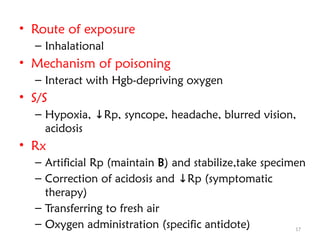
• Route of exposure
– Inhalational
• Mechanism of poisoning
– Interact with Hgb-depriving oxygen
• S/S
– Hypoxia, Rp, syncope, headache, blurred vision,
↓
acidosis
• Rx
– Artificial Rp (maintain B) and stabilize,take specimen
– Correction of acidosis and Rp (symptomatic
↓
therapy)
– Transferring to fresh air
– Oxygen administration (specific antidote)
18
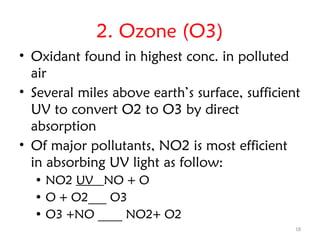
2. Ozone (O3)
• Oxidant found in highest conc. in polluted
air
• Several miles above earth’s surface, sufficient
UV to convert O2 to O3 by direct
absorption
• Of major pollutants, NO2 is most efficient
in absorbing UV light as follow:
• NO2 UV NO + O
• O + O2___ O3
• O3 +NO ____ NO2+ O2
19
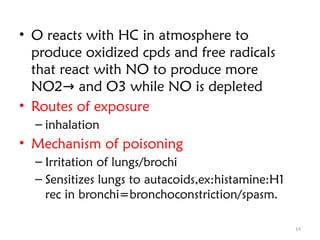
• O reacts with HC in atmosphere to
produce oxidized cpds and free radicals
that react with NO to produce more
NO2 and O3 while NO is depleted
→
• Routes of exposure
– inhalation
• Mechanism of poisoning
– Irritation of lungs/brochi
– Sensitizes lungs to autacoids,ex:histamine:H1
rec in bronchi=bronchoconstriction/spasm.
20
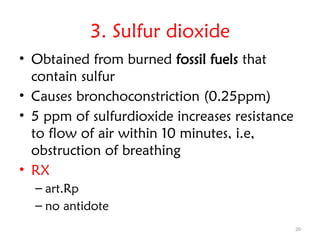
3. Sulfur dioxide
• Obtained from burned fossil fuels that
contain sulfur
• Causes bronchoconstriction (0.25ppm)
• 5 ppm of sulfurdioxide increases resistance
to flow of air within 10 minutes, i.e,
obstruction of breathing
• RX
– art.Rp
– no antidote
21
4. Nitrogen dioxide
• Lung irritant pulmonary complication
→
• Risky to farmers as it can be released from
silage
5. Particulate matters
– Inhalation of dust silcosis
→
– Asbestosis results from inhalation of asbestos
dust
– usually affects the URT - removed by
sneezing,coughing or whiping.
22
Hydrocarbons
• Organ cpds that contain H and C atoms
only
• Most are extracted from petroleum
distillation, e.g., terpentin distilled from
pine woods
• Sources
– Lighter fluid, kerosine, naphta, lubricating oils,
asphalt, benzene
• Routes of exposure: inhalation (abuse), oral
23
• Classes-based on volatility
– High volatile: methane, buthane –CNS
symptoms ex:comma
– Intermediate volatile: gasoline, terpentine,
naphtha-aspiration
– Low volatile: kerosine (cooking), petrolium
spirit-pulmonary complication
– Minimal volatile: lubricating oil(semisolid),
asphalt(solid)-nontoxic
24
• Pathology
– Pulmonary complications: pneumonitis
– CNS toxicity – CNS depression
– Cardiac manifestations: arrhythmias
– Cutaneous injury: wound
– GI effects: irritation
– Kidney damage
• S/S:
– aspiration, nausea/vomiting/D, dizziness ,
erythema(skin)
25
• Rx:
– No specific antidotes
– Supportive-maintain ABCD/symptomatic Rx
• Positive airway pressure
• Cloth removal
– Correction of fluid/electrolytes imbalance
N.B. no gastric emptying-b/c of aspiration
and no gastric charcoal-active. charcoal
doesn't bind
26
Poisoning with food contaminants
• Over 3000 different substances added to
food
• Primary purpose of additives
– Color
– Texture
– Flavor
– Preservative
• Include
27
i. Nitrites
– From use of fertilizers-plant if consumed.
– Toxicity manifested in form of methemoglobinemia
ii. Mercury
– From use as antifungal agent(spray)on seeds-if
consumed
– in sea water/fish/- if consumed
iii. Lead
– From use of Pb pots(to cook food some of them
enter), shellfish, air born
iv. Hepatotoxins
– From plants like castor oil
28
V. Goiterogens
– From plants like cabbage
– Toxicity manifested in form of methemoglobinemia
vi. saponins
– From plants like soybeans (hemolyse RBC)
vii. neurotoxins
– From fish
viii. Fungal toxins
– Aflatoxin - contaminate milk,beans,meat,
ergots(alkaloids-cont.rice)
ix. Mushrooms
– From plants
29
Poisoning with household products
• Most common household products include
– Bleaches
• Include oxalic acid, hypochlorate
• Commercial liquid bleaches cause esophageal
damage
• Granular bleaches-more toxic
– Cosmetics
• perfumes/colognes/,aftershave lotions, oral hygiene
products ,shampoo–mainly dependent on their
concentration of alcohol
• deoderants composed of Al and Zn -low toxicity
• for accidental,homicide or sucide
30
– Hair products
• Dyes/bleaches (hydrogen peroxide-low toxicity)
• Hair straightening/hair waving (contains NaOH,
ammonium hydroxide, potassium carbonate,
potassium bicarbonate-corrosive)
– Detergent and soaps
• Soaps-salts of fatty acid –low toxicity (nausea,
vomiting, diarrhea)
• Detergents –non-soap (granular, liquid or spray)
– Contain surfactants
»Nonionic
»Ionic
-cationic (ammonium quaternary compounds)
-amphoteric
31
– Plants
– Hydrocarbons: kerosin
– Insecticides: organophosphates
– Art supplies: magic markers
– Paints/varnishes
32
Prevention of household products
poisoning
– Advocating child resistant containers
– Keeping products in their original containers
– Storing food and chemicals separately
– Purchasing least toxic chemicals/check exp.date
and small chem ingredient/
– Purchasing smallest possible amount
– Not giving medicines in presence of children
– Keeping chemicals out of sight or reach of
children
– Keeping a bottle of emetic
33
General management of detergent
poisoning
– for eye/skin exposure-irrigation with water for
15 min
– For ingestion -dilution with water/milk
immediately (gastric emptying/charcoal) not
recommended)
– Neutralization not recommended
– Esophagoscopy in case of bloody
vomiting/oral ulcer
– Antimicrobials not routinely recommended
34
Acids and alkali poisoning
• Sources for acids
– Household products
• Automobile battery (sufuric acid)
• Toilet bowel cleaner (HCl)
• Metal cleaners/antirusts (phosphoric acid, oxalic
acid, HCl, sulfuric acid, chromic acid)
35
– Industrial uses
• Acetic acid (printing, dying, disinfection)
• Carbolic acid (dying, disinfection)
• Chromic acid (leather tanning, photography,
cement)
• Formic acid (glue manufacturing, tanning)
• HCl (dye, bleaching, plumbing)
• Nitric acid (leather tanning, chemical
manufacturing)
• Phosphoric acid (metal cleaning, disinfection)
36
• Sources for alkalis
– Household bleaches (Na hypochlorite)
– Detergents (Na tripolyphosphate)
– Drain cleaners (NaOH)
– Cement (CaO, silca, aluminium Oxide)
– Ammonium compounds (ammonium
hydroxide)
– drugs-antacid
37
• Mechanisms
– Acids: coagulation necrosis acid penetration
→↓
superficial damage
→
– Alkalis: liquification necrosis (fat/protein
saponification) deep tissue damage further
→ →
injury through thrombosis
38
• Factors affecting degree of injury
– Concentration (pH)
– Volume
– Contact time
– Pre-existing stomach state
• Empty stomach-damages 2/3 sparing only fundus
• Full stomach-damages only pylorus and lower
curvature
39
• Time course of injury
– Inflammatory stage:0-4 days-tissue necrosis
– Granulation stage: 4-7 days-mucus sloughing
– Perforation stage: 7-21 days-peritonitis, sepsis
– Cicatrization (dense fibrous tissue) stage: > 21
days –scar, esophageal obstruction
• Location of injury
– Acid-stomach pylorus
– Alkali-esophagus
40
• S/S
– Pharengeal pain
– Erythema edema-skin
– Hypotension-bv dilated
– Rp depression
• Rx
– Stabilization (airway support)-intensive care
– IV line establishment immediately
– Maintain ABCD, specimen to analysis
– Vital sign monitoring (symptomatic therapy)
– Fluid/electrolytes (symptomatic therapy),i.e,
• parentral food+Glucose+fluid+electrolyte are given
along the IV line never give orally b/c the GI is damaged.
41
• Treatment of poison-if confirmed-no
antidote
– Dilutional therapy: 1 or 2 glass of milk/water.
C/I in shock
– Neutralization contraindicated-b/c heat is
generated w/c totally damage the GI
– Gastric lavage
– Perforation requires surgery
– Parenteral nutrition
– ICU admission
42
Thanks!!

Toxic non-metallic.pptx bbbffffffffffffffffffffffffff

  • 1.
    1 Non-Metallic Environmental Toxicants By: SagniHanbisa B-pharm, MSc in Pharmacology Wallaga University
  • 2.
    2 Poisoning with organicsolvent 1. Methanol Common industrial solvent as paint remover, varnishes • Routes of poisoning – Inhalation/dermal/oral • Mechanism of poisoning – Produces acidosis (formic acid) • S/S – Blurred vision due to optic nerve damage – headache, vertigo
  • 3.
    3 • Rx  maintainABC dep'ing on need, sympt.therapy,  Protect eyes from strong light-b/c optic n is damaged  Keep victim warm  NaHCO3 to correct acidosis  Ethanol(specific antidote) hemodialysis
  • 4.
    4 2. Ethanol • commonsolvent in many household products, mouthwash, cosmetics and industry • Routes of poisoning – Inhalation/dermal/oral • Mechanism of poisoning – Central depression
  • 5.
    5 • S/S • Acute –intoxication – Alcohol smell/drunkness – CNS stimulation • Chronic – appetite suppression/malnut.induced complication – hepatitis – ketoacidosis
  • 6.
    6 • Rx  supportivetherapy  Symptomatic • Diazepam-for over excit. • caffeine-for over depress.  alcohol withdrawal(acute/chronic)  alcohol antabuse(chronic)-disulfiram
  • 7.
    7 3. Isopropanol • Usedas alcohol rub(hosp.,toilet), hand lotion-if no water available-before and after food. • Mechanism of toxicity: – 2 to 3 times more potent CNS depressant than ethanol. • Major metabolite –acetone (CNS depressants) • S/S – Gastritis – Vomiting with aspiration • Rx: – Maintain ABCD,symp.therapy – Hemodialysis(if in circulation provided it recommended) – Gastric lavage(if in GI)
  • 8.
    8 4. Glycols i. Ethyleneglycol •Used improperly in juice, wines or beer to give flavor • Metabolized to CO2 and formic acid – glyoxal + glyoxylic acid ___ oxalic acid • Routes of exposure – Oral/dermal/inhalation • Mechanism of poisoning – Acidosis (formic acid)and kidney damage (nephrotoxicity)/oxalic acid/
  • 9.
    9 • S/S –CNS depression(30min-12h), edema(12-48h), acute renal failure (24 –72 h) • Rx –Maintain ABCD,continue symt.therapy –(Diazepam for convulsion, IV Ca for muscle spasm), ethanol (specific antidote), dialysis, emesis
  • 10.
    10 ii. Propylene glycol –Similar to ethylene glycol – Less toxic • Therefore, Preferred solvent for drugs, cosmetics, lotions, ointments, food materials…than ethyleneglycol.
  • 11.
    11 Prevention of solventexposure • Avoid indiscriminate use of cosmotics and lotions, ex:if EG avoid it. • Avoid toxic solvents in any preparation such as food, cosmetics, drugs,(i.e, unless they are very crucial.) • Use butane(while cooking)gas carefully- (proper closure) • Handle solvents like benzene carefully
  • 12.
    12 Poisoning with environmentalpollutants • Enter body predominantly through lungs/inhalation/ • Particles >/=5 um deposited in upper airway • Those deposited in unciliated anterior portion of nose remain till removed by wiping, sneezing, or blowing • Particles < 1 um remain suspended in inhaled air, reach alveoli and absorbed
  • 13.
    13 • Sources – Transportation(60%) – Industry (18%) – Electric power generation (13%) – Space heating (6%) – Refuse/waste disposal (3%) • Characteristics – Reducing pollutants • SO2 and smoke from incomplete combustion – Oxidizing pollutants • HC, NO2, photochemical oxidants
  • 14.
    14 • Types – Carbonmonoxide(52%) – Sulfur oxides (18%) – Hydrocarbons (12%) – Particulate matter (10%) – Nitrgen oxide (6%)
  • 15.
    15 1. CO • Tasteless,colorless, odorless gas produced by incomplete combustion of organic cpds • Obtained from – In nature (90%) through oxidation of methane and terpine, forest fires, etc – Human activity (10%) • Automobile by products • Coal, fuel,wood burning • Tobacco smoking – Human body (0.5%) through Hgb metabolism as carboxy Hgb
  • 16.
    16 • Most victimsdie from acute poisoning/ i.e,smoke/than from burns • Efficient natural ways of removal – Reaction of CO with ambient OH-to form CO2 – Upper atmosphere as a sink – Soil as a sink
  • 17.
    17 • Route ofexposure – Inhalational • Mechanism of poisoning – Interact with Hgb-depriving oxygen • S/S – Hypoxia, Rp, syncope, headache, blurred vision, ↓ acidosis • Rx – Artificial Rp (maintain B) and stabilize,take specimen – Correction of acidosis and Rp (symptomatic ↓ therapy) – Transferring to fresh air – Oxygen administration (specific antidote)
  • 18.
    18 2. Ozone (O3) •Oxidant found in highest conc. in polluted air • Several miles above earth’s surface, sufficient UV to convert O2 to O3 by direct absorption • Of major pollutants, NO2 is most efficient in absorbing UV light as follow: • NO2 UV NO + O • O + O2___ O3 • O3 +NO ____ NO2+ O2
  • 19.
    19 • O reactswith HC in atmosphere to produce oxidized cpds and free radicals that react with NO to produce more NO2 and O3 while NO is depleted → • Routes of exposure – inhalation • Mechanism of poisoning – Irritation of lungs/brochi – Sensitizes lungs to autacoids,ex:histamine:H1 rec in bronchi=bronchoconstriction/spasm.
  • 20.
    20 3. Sulfur dioxide •Obtained from burned fossil fuels that contain sulfur • Causes bronchoconstriction (0.25ppm) • 5 ppm of sulfurdioxide increases resistance to flow of air within 10 minutes, i.e, obstruction of breathing • RX – art.Rp – no antidote
  • 21.
    21 4. Nitrogen dioxide •Lung irritant pulmonary complication → • Risky to farmers as it can be released from silage 5. Particulate matters – Inhalation of dust silcosis → – Asbestosis results from inhalation of asbestos dust – usually affects the URT - removed by sneezing,coughing or whiping.
  • 22.
    22 Hydrocarbons • Organ cpdsthat contain H and C atoms only • Most are extracted from petroleum distillation, e.g., terpentin distilled from pine woods • Sources – Lighter fluid, kerosine, naphta, lubricating oils, asphalt, benzene • Routes of exposure: inhalation (abuse), oral
  • 23.
    23 • Classes-based onvolatility – High volatile: methane, buthane –CNS symptoms ex:comma – Intermediate volatile: gasoline, terpentine, naphtha-aspiration – Low volatile: kerosine (cooking), petrolium spirit-pulmonary complication – Minimal volatile: lubricating oil(semisolid), asphalt(solid)-nontoxic
  • 24.
    24 • Pathology – Pulmonarycomplications: pneumonitis – CNS toxicity – CNS depression – Cardiac manifestations: arrhythmias – Cutaneous injury: wound – GI effects: irritation – Kidney damage • S/S: – aspiration, nausea/vomiting/D, dizziness , erythema(skin)
  • 25.
    25 • Rx: – Nospecific antidotes – Supportive-maintain ABCD/symptomatic Rx • Positive airway pressure • Cloth removal – Correction of fluid/electrolytes imbalance N.B. no gastric emptying-b/c of aspiration and no gastric charcoal-active. charcoal doesn't bind
  • 26.
    26 Poisoning with foodcontaminants • Over 3000 different substances added to food • Primary purpose of additives – Color – Texture – Flavor – Preservative • Include
  • 27.
    27 i. Nitrites – Fromuse of fertilizers-plant if consumed. – Toxicity manifested in form of methemoglobinemia ii. Mercury – From use as antifungal agent(spray)on seeds-if consumed – in sea water/fish/- if consumed iii. Lead – From use of Pb pots(to cook food some of them enter), shellfish, air born iv. Hepatotoxins – From plants like castor oil
  • 28.
    28 V. Goiterogens – Fromplants like cabbage – Toxicity manifested in form of methemoglobinemia vi. saponins – From plants like soybeans (hemolyse RBC) vii. neurotoxins – From fish viii. Fungal toxins – Aflatoxin - contaminate milk,beans,meat, ergots(alkaloids-cont.rice) ix. Mushrooms – From plants
  • 29.
    29 Poisoning with householdproducts • Most common household products include – Bleaches • Include oxalic acid, hypochlorate • Commercial liquid bleaches cause esophageal damage • Granular bleaches-more toxic – Cosmetics • perfumes/colognes/,aftershave lotions, oral hygiene products ,shampoo–mainly dependent on their concentration of alcohol • deoderants composed of Al and Zn -low toxicity • for accidental,homicide or sucide
  • 30.
    30 – Hair products •Dyes/bleaches (hydrogen peroxide-low toxicity) • Hair straightening/hair waving (contains NaOH, ammonium hydroxide, potassium carbonate, potassium bicarbonate-corrosive) – Detergent and soaps • Soaps-salts of fatty acid –low toxicity (nausea, vomiting, diarrhea) • Detergents –non-soap (granular, liquid or spray) – Contain surfactants »Nonionic »Ionic -cationic (ammonium quaternary compounds) -amphoteric
  • 31.
    31 – Plants – Hydrocarbons:kerosin – Insecticides: organophosphates – Art supplies: magic markers – Paints/varnishes
  • 32.
    32 Prevention of householdproducts poisoning – Advocating child resistant containers – Keeping products in their original containers – Storing food and chemicals separately – Purchasing least toxic chemicals/check exp.date and small chem ingredient/ – Purchasing smallest possible amount – Not giving medicines in presence of children – Keeping chemicals out of sight or reach of children – Keeping a bottle of emetic
  • 33.
    33 General management ofdetergent poisoning – for eye/skin exposure-irrigation with water for 15 min – For ingestion -dilution with water/milk immediately (gastric emptying/charcoal) not recommended) – Neutralization not recommended – Esophagoscopy in case of bloody vomiting/oral ulcer – Antimicrobials not routinely recommended
  • 34.
    34 Acids and alkalipoisoning • Sources for acids – Household products • Automobile battery (sufuric acid) • Toilet bowel cleaner (HCl) • Metal cleaners/antirusts (phosphoric acid, oxalic acid, HCl, sulfuric acid, chromic acid)
  • 35.
    35 – Industrial uses •Acetic acid (printing, dying, disinfection) • Carbolic acid (dying, disinfection) • Chromic acid (leather tanning, photography, cement) • Formic acid (glue manufacturing, tanning) • HCl (dye, bleaching, plumbing) • Nitric acid (leather tanning, chemical manufacturing) • Phosphoric acid (metal cleaning, disinfection)
  • 36.
    36 • Sources foralkalis – Household bleaches (Na hypochlorite) – Detergents (Na tripolyphosphate) – Drain cleaners (NaOH) – Cement (CaO, silca, aluminium Oxide) – Ammonium compounds (ammonium hydroxide) – drugs-antacid
  • 37.
    37 • Mechanisms – Acids:coagulation necrosis acid penetration →↓ superficial damage → – Alkalis: liquification necrosis (fat/protein saponification) deep tissue damage further → → injury through thrombosis
  • 38.
    38 • Factors affectingdegree of injury – Concentration (pH) – Volume – Contact time – Pre-existing stomach state • Empty stomach-damages 2/3 sparing only fundus • Full stomach-damages only pylorus and lower curvature
  • 39.
    39 • Time courseof injury – Inflammatory stage:0-4 days-tissue necrosis – Granulation stage: 4-7 days-mucus sloughing – Perforation stage: 7-21 days-peritonitis, sepsis – Cicatrization (dense fibrous tissue) stage: > 21 days –scar, esophageal obstruction • Location of injury – Acid-stomach pylorus – Alkali-esophagus
  • 40.
    40 • S/S – Pharengealpain – Erythema edema-skin – Hypotension-bv dilated – Rp depression • Rx – Stabilization (airway support)-intensive care – IV line establishment immediately – Maintain ABCD, specimen to analysis – Vital sign monitoring (symptomatic therapy) – Fluid/electrolytes (symptomatic therapy),i.e, • parentral food+Glucose+fluid+electrolyte are given along the IV line never give orally b/c the GI is damaged.
  • 41.
    41 • Treatment ofpoison-if confirmed-no antidote – Dilutional therapy: 1 or 2 glass of milk/water. C/I in shock – Neutralization contraindicated-b/c heat is generated w/c totally damage the GI – Gastric lavage – Perforation requires surgery – Parenteral nutrition – ICU admission
  • 42.