Leonardo da Vinci Networks
540346-LLP-1-2013-1-GR-LEONARDO-LNW
2013-2015
Training Handbook
With the support of the Lifelong Learning Programme of the European Union
This project has been funded with support from the European Commission.
This publication [communication] reflects the views only of the author, and the Commission
cannot be held responsible for any use which may be made of the information contained therein.
Effective Writers & Communicators
EWC
Leonardo da Vinci Networks
540346-LLP-1-2013-1-GR-LEONARDO-LNW
2013-2015
Training Handbook
With the support of the Lifelong Learning Programme of the European Union
This project has been funded with support from the European Commission. This
publication [communication] reflects the views only of the author, and the
Commission cannot be held responsible for any use which may be made of the
information contained therein.
Effective Writers and Communicators - Training Handbook
Introduction
-2-
With the support of the Lifelong Learning
Programme of the European Union
Table of Contents
Introduction.................................................................... 6
Pre-requisite skills...................................................................................7
How to be a part of EWC’s aim..................................................................8
The learner’s journey on effective writing & communication........................ 10
Introduction for the handbook ................................................................ 13
Training Manual - Contents .................................................................... 16
1. Module 1: Think Before You Write .............................. 20
1.1. Chapter 1.1: Think Logically ........................................................ 23
1.1.1. Introduction......................................................................... 23
1.1.2. A Starting-Up....................................................................... 27
1.1.3. B Vocabulary Development .................................................... 27
1.1.4. C Skills Focus....................................................................... 32
1.1.5. Self- assessment.................................................................. 34
1.1.6. List of suggested readings ..................................................... 37
1.1.7. Notes.................................................................................. 38
1.2. Chapter 1.2: Write Logically ........................................................ 39
1.2.1. Introduction......................................................................... 39
1.2.2. A Starting-Up....................................................................... 40
1.2.3. B Vocabulary Development .................................................... 40
1.2.4. C Skills Focus....................................................................... 46
1.2.5. Self- assessment.................................................................. 49
1.2.6. Bibliography ........................................................................ 55
1.2.7. List of suggested readings ..................................................... 56
1.3. Chapter 1.4: Write well............................................................... 57
1.3.1. Introduction......................................................................... 57
1.3.2. A Starting-up ....................................................................... 58
1.3.3. B Vocabulary Development .................................................... 59
1.3.4. C Skills focus ....................................................................... 61
1.3.5. Self-assessment test............................................................. 64
1.3.6. List of Suggested Readings .................................................... 67
1.4. Chapter 1.4: Write creatively....................................................... 68
1.4.1. Introduction......................................................................... 68
Effective Writers and Communicators - Training Handbook
Introduction
-3-
With the support of the Lifelong Learning
Programme of the European Union
1.4.2. A Starting-up ....................................................................... 69
1.4.3. B Vocabulary Development .................................................... 70
1.4.4. C Skills Focus....................................................................... 72
1.4.5. Self-Assessment Test............................................................ 73
1.4.6. List of Suggested Readings .................................................... 75
1.5. Chapter 1.5: Revision exercises ................................................... 76
2. Module 2: Let’s Get Down To Business........................ 80
2.1. Chapter 2.1: Introductions .......................................................... 83
2.1.1. Introduction......................................................................... 83
2.1.2. A Starting-up ....................................................................... 83
2.1.3. B Vocabulary Development .................................................... 92
2.1.4. C Skills Focus....................................................................... 99
2.1.5. Introduction....................................................................... 102
2.1.6. A Starting-up ..................................................................... 102
2.1.7. B Vocabulary Development .................................................. 102
2.1.8. C Skills Focus..................................................................... 109
2.2. Chapter 2.2: Getting Paid ......................................................... 111
2.2.1. Introduction....................................................................... 111
2.2.2. A Starting-up ..................................................................... 111
2.2.3. B Vocabulary Development .................................................. 115
2.2.4. C Skills Focus..................................................................... 120
2.2.5. Self-Assessment Test.......................................................... 125
2.2.6. List of Suggested Readings .................................................. 126
2.3. Chapter 2.3: Business Travel..................................................... 127
2.3.1. Introduction....................................................................... 127
2.3.2. A Starting-up ..................................................................... 127
2.3.3. B Vocabulary Development .................................................. 129
2.3.4. C Skills Focus..................................................................... 136
2.3.5. Self-Assessment Test.......................................................... 139
2.3.6. List of Suggested Readings .................................................. 140
3. Module 3: It’s a Deal...............................................141
3.1. Chapter 3.1: Strategic communication........................................ 143
3.1.1. Introduction....................................................................... 143
3.1.2. A Starting-up ..................................................................... 144
Effective Writers and Communicators - Training Handbook
Introduction
-4-
With the support of the Lifelong Learning
Programme of the European Union
3.1.3. B Vocabulary Development .................................................. 145
3.1.4. C Skills Focus..................................................................... 147
3.1.5. D Self – Assessment Test ................................................... 149
3.1.6. List of Suggested Readings .................................................. 152
3.1.7. Notes................................................................................ 152
3.2. Chapter 3.2: Business Proposal.................................................. 153
3.2.1. Introduction....................................................................... 153
3.2.2. A Starting-up ..................................................................... 154
3.2.3. B Vocabulary Development .................................................. 154
3.2.4. C Skills Focus..................................................................... 155
3.2.5. Self-Assessment Test.......................................................... 158
3.2.6. List of Suggested Readings .................................................. 161
3.3. Chapter 3.3: CRM .................................................................... 162
3.3.1. Introduction....................................................................... 162
3.3.2. A Starting-up ..................................................................... 163
3.3.3. B Vocabulary Development .................................................. 163
3.3.4. C Skills Focus..................................................................... 165
3.3.5. Self – Assessment Test ....................................................... 170
3.3.6. List of Suggested Readings .................................................. 172
3.4. Chapter 3.4: Revision exercises ................................................. 173
4. Module 4: Let’s Have a Project .................................182
4.1. Chapter 4.1: Planning a Project ................................................. 186
4.1.1. Introduction....................................................................... 186
4.1.2. A Starting-up ..................................................................... 187
4.1.3. B Vocabulary Development .................................................. 187
4.1.4. C Skills Focus..................................................................... 192
4.1.5. Self-Assessment Test.......................................................... 196
4.2. Chapter 4.2: Writing a Project ................................................... 198
4.2.1. Introduction....................................................................... 198
4.2.2. A Starting-up ..................................................................... 198
4.2.3. B Vocabulary Development .................................................. 199
4.2.4. C Skills Focus..................................................................... 205
4.2.5. Self-Assessment Test.......................................................... 215
4.2.6. List of Suggested Readings .................................................. 218
Effective Writers and Communicators - Training Handbook
Introduction
-5-
With the support of the Lifelong Learning
Programme of the European Union
4.3. Chapter 4.3: Managing a Project................................................ 221
4.3.1. Introduction....................................................................... 221
4.3.2. A Starting-up ..................................................................... 222
4.3.3. B Vocabulary Development .................................................. 222
4.3.4. C Skills Focus..................................................................... 232
4.3.5. Self-Assessment Test.......................................................... 237
4.4. Chapter 4.4: Reporting On a Project........................................... 244
4.4.1. Introduction....................................................................... 244
4.4.2. A Starting-up ..................................................................... 244
4.4.3. B Vocabulary Development .................................................. 244
4.4.4. C Skills Focus..................................................................... 252
4.4.5. Self-Assessment Test.......................................................... 255
4.4.6. List of Suggested Readings .................................................. 258
Bibliography.................................................................259
Effective Writers and Communicators - Training Handbook
Introduction
-6-
With the support of the Lifelong Learning
Programme of the European Union
Introduction
WELCOME
This manual has been created to be used both as a self-study tool and also as the main
delivery source for the overall educational experience that the EWC online course offers.
Following the preparation of the training handbook prototype, the EWC team had the
chance to pilot test both the impact of this training handbook, the functionality of the
e-learning platform and the effect of the overall online course.
More than 850 students across Europe have participated in the pilot sessions enrolling
themselves on the EWC training course. During the piloting period, participants had the
opportunity to learn, test their acquired skills, publish articles, be part and interact with
several groups of other participants through the Social Networking Platform. The
suggestions, comments and recommendations for improvement collected from
participants were a valuable feedback for the EWC team, so as to optimize the EWC
training course and adapt it to actual users’ needs. The final result is a complete training
package that includes this training handbook, an online platform that hosts the e-
learning course and the social networking platform.
Effective Writers and Communicators - Training Handbook
Introduction
-7-
With the support of the Lifelong Learning
Programme of the European Union
Pre-requisite skills
This training package is directly aimed at young professionals, students, employees and
entrepreneurs that want to improve their communication skills, both written and verbal.
However, the training course and this manual are also aimed at Vocational Education
and Training providers, Higher Education Institutions, educators and SMEs that will have
the opportunity to incorporate the training course in their curricula, VET practices,
competence development and appraisal mechanisms, and to utilize it as part of their
formal skill development and learning opportunities.
The course is open for free to those people interested in acquiring these kind of skills
and knowledge. The course is offered in English and the recommended language
understanding and knowledge is at least a B2.
In case the trainee or the training organization prefers to use the online training course,
basic computer skills are needed together with access to the Internet.
Effective Writers and Communicators - Training Handbook
Introduction
-8-
With the support of the Lifelong Learning
Programme of the European Union
How to be a part of EWC’s aim
Are you a student, a young SME employee or a young
entrepreneur?
The EWC project is open to tertiary
education institution students, young SME
employees and entrepreneurs willing to
improve their communication skills in
English and, therefore, their employability
and their access to the international
market.
If you wish to improve written and verbal
communication skills, share your ideas
and concerns, enhance your employability and access the international market, the EWC
course is here for you. The e-learning and Social Networking Platforms allow you to
explore and attend the online course and contact other people like you from all over
Europe. If you are interested in benefiting from the training course, you can contact
your national contact partner, or simply visit our website.
Are you a VET provider, a SME, a higher education
institution or an educator?
EWC project enables SMEs, VET providers, and educators to incorporate the training
course on professional writing and communication in their curricula, VET practices,
competence development and appraisal mechanisms, and to utilize it as part of their
formal skills development and learning priorities.
If you are in need of high quality
material for teaching, training and
competence assessment in your
everyday work, you can visit our e-
learning course and incorporate it in
your curricula, VET practices and
competence development and
appraisal mechanisms. Having
decided, though, that EWC course is
of interest to you, several questions
of how you can adapt it to your
practices and techniques might be raised. For this purpose, we have produced the “Train
the trainers’ guidelines” and “Strategic plan and guidelines for SMEs, VET providers and
educators”. These two reports will be the first step in discovering several techniques of
Effective Writers and Communicators - Training Handbook
Introduction
-9-
With the support of the Lifelong Learning
Programme of the European Union
integrating our course with your training and competence development practices and
finally delivering it to your trainees.
The EWC consortium is always available in helping and supporting you to exploit this
course with the best result. Partners, also, invite you to join the EWC network and
communicate your offers of internships, traineeships and opportunities for business and
project development collaborations through the EWC network and Social Networking
Platform.
Finally, EWC members invite you to explore with them the possibilities for further
exploitation of the project and of final products. The EWC project is more willing to
expand its network and attract new members, given the fact that the online nature of
EWC products allow for a much larger number and geographical spread of trainees and
employers to benefit from them.
Effective Writers and Communicators - Training Handbook
Introduction
-10-
With the support of the Lifelong Learning
Programme of the European Union
The learner’s journey on effective writing & communication
International competitiveness for SMEs and international mobility for young employees
and entrepreneurs in Europe – both prerequisites for success in today’s globalized
market - require effective communication skills, particularly in English, which is
becoming the world’s lingua franca. The acquisition of such skills is crucial for young
workers and entrepreneurs, since poor verbal and non-verbal communication is the
source of many commercial transaction failures. Such failures can impede both the
competitiveness of SMEs and young entrepreneurs, and in the career progress of their
employees.
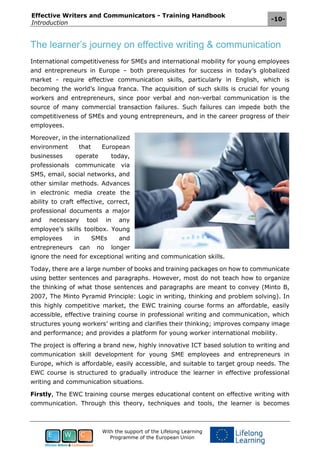
Moreover, in the internationalized
environment that European
businesses operate today,
professionals communicate via
SMS, email, social networks, and
other similar methods. Advances
in electronic media create the
ability to craft effective, correct,
professional documents a major
and necessary tool in any
employee’s skills toolbox. Young
employees in SMEs and
entrepreneurs can no longer
ignore the need for exceptional writing and communication skills.
Today, there are a large number of books and training packages on how to communicate
using better sentences and paragraphs. However, most do not teach how to organize
the thinking of what those sentences and paragraphs are meant to convey (Minto B,
2007, The Minto Pyramid Principle: Logic in writing, thinking and problem solving). In
this highly competitive market, the EWC training course forms an affordable, easily
accessible, effective training course in professional writing and communication, which
structures young workers’ writing and clarifies their thinking; improves company image
and performance; and provides a platform for young worker international mobility.
The project is offering a brand new, highly innovative ICT based solution to writing and
communication skill development for young SME employees and entrepreneurs in
Europe, which is affordable, easily accessible, and suitable to target group needs. The
EWC course is structured to gradually introduce the learner in effective professional
writing and communication situations.
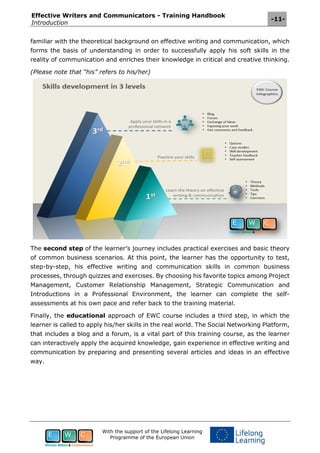
Firstly, The EWC training course merges educational content on effective writing with
communication. Through this theory, techniques and tools, the learner is becomes
Effective Writers and Communicators - Training Handbook
Introduction
-11-
With the support of the Lifelong Learning
Programme of the European Union
familiar with the theoretical background on effective writing and communication, which
forms the basis of understanding in order to successfully apply his soft skills in the
reality of communication and enriches their knowledge in critical and creative thinking.
(Please note that “his” refers to his/her)
The second step of the learner’s journey includes practical exercises and basic theory
of common business scenarios. At this point, the learner has the opportunity to test,
step-by-step, his effective writing and communication skills in common business
processes, through quizzes and exercises. By choosing his favorite topics among Project
Management, Customer Relationship Management, Strategic Communication and
Introductions in a Professional Environment, the learner can complete the self-
assessments at his own pace and refer back to the training material.
Finally, the educational approach of EWC course includes a third step, in which the
learner is called to apply his/her skills in the real world. The Social Networking Platform,
that includes a blog and a forum, is a vital part of this training course, as the learner
can interactively apply the acquired knowledge, gain experience in effective writing and
communication by preparing and presenting several articles and ideas in an effective
way.
Effective Writers and Communicators - Training Handbook
Introduction
-12-
With the support of the Lifelong Learning
Programme of the European Union
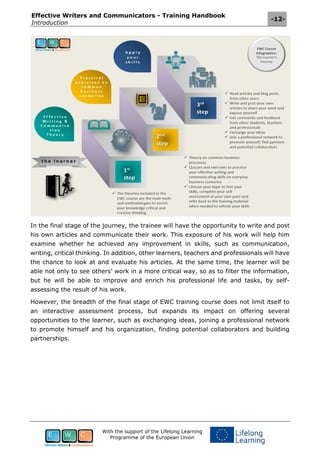
In the final stage of the journey, the trainee will have the opportunity to write and post
his own articles and communicate their work. This exposure of his work will help him
examine whether he achieved any improvement in skills, such as communication,
writing, critical thinking. In addition, other learners, teachers and professionals will have
the chance to look at and evaluate his articles. At the same time, the learner will be
able not only to see others’ work in a more critical way, so as to filter the information,
but he will be able to improve and enrich his professional life and tasks, by self-
assessing the result of his work.
However, the breadth of the final stage of EWC training course does not limit itself to
an interactive assessment process, but expands its impact on offering several
opportunities to the learner, such as exchanging ideas, joining a professional network
to promote himself and his organization, finding potential collaborators and building
partnerships.
Effective Writers and Communicators - Training Handbook
Introduction
-13-
With the support of the Lifelong Learning
Programme of the European Union
Introduction for the handbook
Modules
This manual is a main component of a three-part training programme on effective
writing and communication. It can be used as a self-learning tool that can be
downloaded from the EWC site or can be part of a more integrated learning process that
transforms the training content into an interactive learning process, revolving around a
series of video lectures, and gives the opportunity to practice through several quizzes
and problem solving exercises.
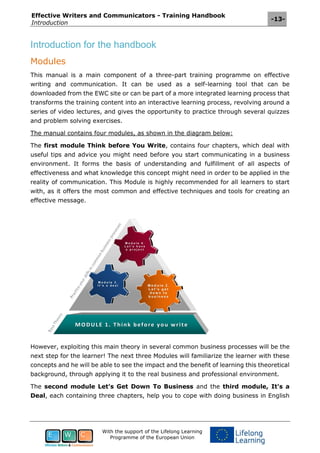
The manual contains four modules, as shown in the diagram below:
The first module Think before You Write, contains four chapters, which deal with
useful tips and advice you might need before you start communicating in a business
environment. It forms the basis of understanding and fulfillment of all aspects of
effectiveness and what knowledge this concept might need in order to be applied in the
reality of communication. This Module is highly recommended for all learners to start
with, as it offers the most common and effective techniques and tools for creating an
effective message.
MODULE 1. Think before you write
However, exploiting this main theory in several common business processes will be the
next step for the learner! The next three Modules will familiarize the learner with these
concepts and he will be able to see the impact and the benefit of learning this theoretical
background, through applying it to the real business and professional environment.
The second module Let's Get Down To Business and the third module, It's a
Deal, each containing three chapters, help you to cope with doing business in English
Effective Writers and Communicators - Training Handbook
Introduction
-14-
With the support of the Lifelong Learning
Programme of the European Union
and the language you need to do it. In more detail they will provide you with practical
tips on:
 managing a conversation,
 developing an effective presentation and
 introducing yourself in the most understanding and effective manner
 talking about your products and services
 be persuasive
 online marketing
 trade fairs
 customer service and support
 CRM in B2B market.
In the fourth module, Let's Set up a Project, which contains four chapters, you will
learn:
 How to make your project successful.
 Develop a project idea
 Set up a successful consortium
 About intercultural communication
 Report on past events.
Chapters
Each chapter is divided into three parts: Starting-up, Vocabulary Development,
Skills Focus. Each chapter is followed by a Self-Assessment Test.
A. Starting-up
You are offered a variety of interesting activities leading you into the topic of the
chapter. It contains key words and phrases of the language covered by each
chapter.
B. Vocabulary Development
This part provides thorough practice of the important words and phrases
introduced in the previous part – starting-up. You will also learn other new words
and phrases which you can use when you carry out the tasks in the chapter.
You will read authentic articles on a variety of topics. You will develop your reading
skills and learn essential business vocabulary.
C. Skills Focus
You will develop essential business communication skills, such as making
presentations, taking part in meetings, telephoning, and using English in social
Effective Writers and Communicators - Training Handbook
Introduction
-15-
With the support of the Lifelong Learning
Programme of the European Union
situations. This part will develop the key communicative language and strategies
needed to succeed in an international work environment.
You will work with authentic material to improve your writing in English. This part
provides practice for the most important types of document you will need to write at
work, making you more confident at writing in English. You will be able to express
yourself more clearly and make a good impression. Model texts are examined and used
as a basis to write your own.
Effective Writers and Communicators - Training Handbook
Training Manual - Contents
- 16 -
With the support of the Lifelong Learning
Programme of the European Union
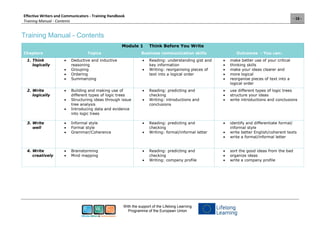
Training Manual - Contents
Module 1 Think Before You Write
Chapters Topics Business communication skills Outcomes - You can:
1. Think
logically
 Deductive and inductive
reasoning
 Grouping
 Ordering
 Summarizing
 Reading: understanding gist and
key information
 Writing: reorganising pieces of
text into a logical order
 make better use of your critical
 thinking skills
 make your ideas clearer and
 more logical
 reorganise pieces of text into a
logical order
2. Write
logically
 Building and making use of
different types of logic trees
 Structuring ideas through issue
tree analysis
 Introducing data and evidence
into logic trees
 Reading: predicting and
checking
 Writing: introductions and
conclusions
 use different types of logic trees
 structure your ideas
 write introductions and conclusions
3. Write
well
 Informal style
 Formal style
 Grammar/Coherence
 Reading: predicting and
checking
 Writing: formal/informal letter
 identify and differentiate formal/
informal style
 write better English/coherent texts
 write a formal/informal letter
4. Write
creatively
 Brainstorming
 Mind mapping
 Reading: predicting and
checking
 Writing: company profile
 sort the good ideas from the bad
 organize ideas
 write a company profile
Effective Writers and Communicators - Training Handbook
Training Manual - Contents
- 17 -
With the support of the Lifelong Learning
Programme of the European Union
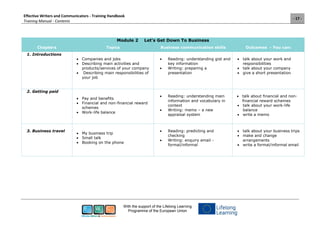
Module 2 Let's Get Down To Business
Chapters Topics Business communication skills Outcomes - You can:
1. Introductions
 Companies and jobs
 Describing main activities and
products/services of your company
 Describing main responsibilities of
your job
 Reading: understanding gist and
key information
 Writing: preparing a
presentation
 talk about your work and
responsibilities
 talk about your company
 give a short presentation
2. Getting paid
 Pay and benefits
 Financial and non-financial reward
schemes
 Work-life balance
 Reading: understanding main
information and vocabulary in
context
 Writing: memo – a new
appraisal system
 talk about financial and non-
financial reward schemes
 talk about your work-life
balance
 write a memo
3. Business travel
 My business trip
 Small talk
 Booking on the phone
 Reading: predicting and
checking
 Writing: enquiry email -
formal/informal
 talk about your business trips
 make and change
arrangements
 write a formal/informal email
Effective Writers and Communicators - Training Handbook
Training Manual - Contents
- 18 -
With the support of the Lifelong Learning
Programme of the European Union
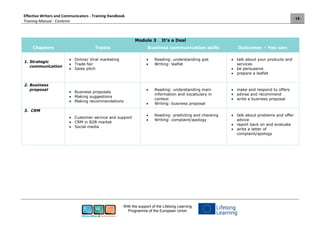
Module 3 It's a Deal
Chapters Topics Business communication skills Outcomes - You can:
1. Strategic
communication
 Online/ Viral marketing
 Trade fair
 Sales pitch
 Reading: understanding gist
 Writing: leaflet
 talk about your products and
services
 be persuasive
 prepare a leaflet
2. Business
proposal
 Business proposals
 Making suggestions
 Making recommendations
 Reading: understanding main
information and vocabulary in
context
 Writing: business proposal
 make and respond to offers
 advise and recommend
 write a business proposal
3. CRM
 Customer service and support
 CRM in B2B market
 Social media
 Reading: predicting and checking
 Writing: complaint/apology
 talk about problems and offer
advice
 report back on and evaluate
 write a letter of
complaint/apology
Effective Writers and Communicators - Training Handbook
Training Manual - Contents
- 19 -
With the support of the Lifelong Learning
Programme of the European Union
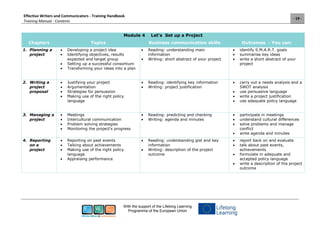
Module 4 Let's Set up a Project
Chapters Topics Business communication skills Outcomes - You can:
1. Planning a
project
 Developing a project idea
 Identifying objectives, results
expected and target group
 Setting up a successful consortium
 Transforming your ideas into a plan
 Reading: understanding main
information
 Writing: short abstract of your project
 identify S.M.A.R.T. goals
 summarise key ideas
 write a short abstract of your
project
2. Writing a
project
proposal
 Justifying your project
 Argumentation
 Strategies for persuasion
 Making use of the right policy
language
 Reading: identifying key information
 Writing: project justification
 carry out a needs analysis and a
SWOT analysis
 use persuasive language
 write a project justification
 use adequate policy language
3. Managing a
project
 Meetings
 Intercultural communication
 Problem solving strategies
 Monitoring the project's progress
 Reading: predicting and checking
 Writing: agenda and minutes
 participate in meetings
 understand cultural differences
 solve problems and manage
conflict
 write agenda and minutes
4. Reporting
on a
project
 Reporting on past events
 Talking about achievements
 Making use of the right policy
language
 Appraising performance
 Reading: understanding gist and key
information
 Writing: description of the project
outcome
 report back on and evaluate
 talk about past events,
achievements
 formulate in adequate and
accepted policy language
 write a description of the project
outcome
Module 1
1. Think logically
2. Write logically
3. Write well
4. Write creatively
Chapters
THINK BEFORE YOU WRITE
Effective Writers and Communicators - Training Handbook
Module 1: Think Before You Write
-20-
With the support of the Lifelong Learning
Programme of the European Union
1. Module 1: Think Before You Write
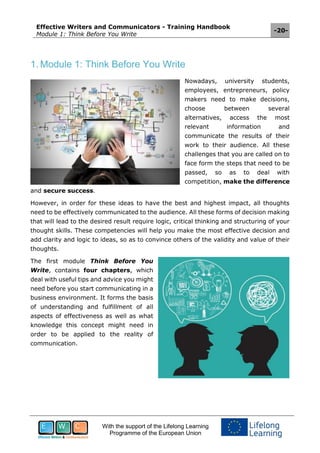
Nowadays, university students,
employees, entrepreneurs, policy
makers need to make decisions,
choose between several
alternatives, access the most
relevant information and
communicate the results of their
work to their audience. All these
challenges that you are called on to
face form the steps that need to be
passed, so as to deal with
competition, make the difference
and secure success.
However, in order for these ideas to have the best and highest impact, all thoughts
need to be effectively communicated to the audience. All these forms of decision making
that will lead to the desired result require logic, critical thinking and structuring of your
thought skills. These competencies will help you make the most effective decision and
add clarity and logic to ideas, so as to convince others of the validity and value of their
thoughts.
The first module Think Before You
Write, contains four chapters, which
deal with useful tips and advice you might
need before you start communicating in a
business environment. It forms the basis
of understanding and fulfillment of all
aspects of effectiveness as well as what
knowledge this concept might need in
order to be applied to the reality of
communication.
Effective Writers and Communicators - Training Handbook
Module 1: Think Before You Write
-21-
With the support of the Lifelong Learning
Programme of the European Union
Think & Write logically
In short, the first two chapters of this handbook will offer you some of the main tools
and methodologies that will enrich your thinking. Articulating your thoughts in a clear
and concise manner will allow your ideas to be better understood. Through writing and
thinking logically you can eliminate most communication barriers and be assured that
your audience will receive the exact message you intended. However, improving how
you mentally process information requires further skills and knowledge, so as to assure
effectiveness in the communication process.
Write Well & Creatively
Professional writing in English is one of the soft skills that is given little attention in
teaching English as a foreign language, particularly when talking about young SME
workers and entrepreneurs. Developing a higher degree of competence in English
language writing skills can help improve your own job performance and help build a
successful future career.
Creative writing is one of the soft skills that SMEs and young professionals feel that they
are lacking. Ability to come up with new ideas is a key to succeed in business at any
stage. In more detail, this unit offers several techniques on how to work on your
creativity and ability to be innovative. For example, one of the ways to get the attention
is through an easily remembered company name, a catchy product name, a visually
attractive logo, a user-friendly website, a constantly updated profile on social media,
and so on.
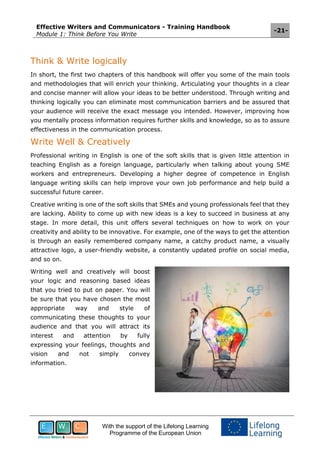
Writing well and creatively will boost
your logic and reasoning based ideas
that you tried to put on paper. You will
be sure that you have chosen the most
appropriate way and style of
communicating these thoughts to your
audience and that you will attract its
interest and attention by fully
expressing your feelings, thoughts and
vision and not simply convey
information.
Effective Writers and Communicators - Training Handbook
Module 1: Think Before You Write
-22-
With the support of the Lifelong Learning
Programme of the European Union
 Going through this Module will provide you with the most
common and effective techniques and tools of creating an
effective message. Exploiting this main theory in several
common business processes will be the next step for you!
 You will familiarise yourself with these concepts and you will
manage to see the impact and benefit of learning this
theoretical background, through applying it in real business
and professional environment!
Effective Writers and Communicators - Training Handbook
Module 1: Think Before You Write
-23-
With the support of the Lifelong Learning
Programme of the European Union
1.1. Chapter 1.1: Think Logically
You will learn to:
 Make better use of your critical thinking skills
 Make your ideas clearer and more logical
 Reorganize pieces of text into a logical order
1.1.1. Introduction
Logic, critical thinking and structuring your thoughts skills will help you make the most
effective decision and make your ideas clearer and more logical, so as to communicate
them to others and convince them for the validity and the value of your thoughts. So,
learning about the meaning and importance of ordering, grouping, summarizing and
reasoning will allow you to understand key information, choose the most relevant data
that support your ideas and arguments and construct both a conversation and a written
document in a way that can help the reader and your interlocutor understand your
thoughts and points of view.
Ordering
Ordering helps you arrange your ideas in a way that takes into consideration logic, time,
space and importance of ideas, hence it enriches your thoughts with effectiveness and
as a result will make clear everything that you want to communicate to colleagues,
clients, friends and other partners.
Ordering is used with points (your opinions) and examples supporting your opinions.
You have the freedom to choose how you order information, but your order should be
clear. In other words, your order should need no further explanation. Your audience will
understand just by following the progression of your ideas.
In chronological order or time order, items, events, or even ideas are arranged in
the order in which they occur.
In spatial order items are arranged according to their physical position or
relationships.
In climactic order or order of importance items are arranged from least important to
most important.
Topical order refers to organization that emerges from the topic itself
Effective Writers and Communicators - Training Handbook
Module 1: Think Before You Write
-24-
With the support of the Lifelong Learning
Programme of the European Union
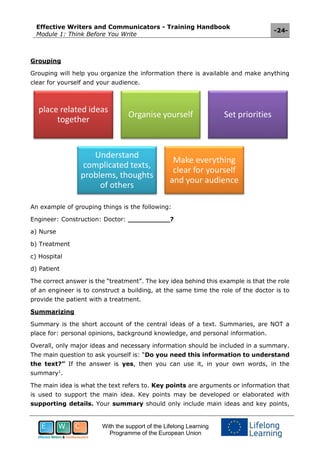
Grouping
Grouping will help you organize the information there is available and make anything
clear for yourself and your audience.
An example of grouping things is the following:
Engineer: Construction: Doctor: __________?
a) Nurse
b) Treatment
c) Hospital
d) Patient
The correct answer is the “treatment”. The key idea behind this example is that the role
of an engineer is to construct a building, at the same time the role of the doctor is to
provide the patient with a treatment.
Summarizing
Summary is the short account of the central ideas of a text. Summaries, are NOT a
place for: personal opinions, background knowledge, and personal information.
Overall, only major ideas and necessary information should be included in a summary.
The main question to ask yourself is: “Do you need this information to understand
the text?” If the answer is yes, then you can use it, in your own words, in the
summary1
.
The main idea is what the text refers to. Key points are arguments or information that
is used to support the main idea. Key points may be developed or elaborated with
supporting details. Your summary should only include main ideas and key points,
place related ideas
together
Organise yourself Set priorities
Understand
complicated texts,
problems, thoughts
of others
Make everything
clear for yourself
and your audience
Effective Writers and Communicators - Training Handbook
Module 1: Think Before You Write
-25-
With the support of the Lifelong Learning
Programme of the European Union
not supporting details. Your main aim is your readers to understand the source’s
arguments, main ideas, or plot.
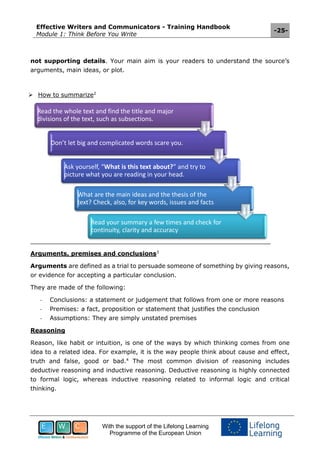
 How to summarize2
Arguments, premises and conclusions3
Arguments are defined as a trial to persuade someone of something by giving reasons,
or evidence for accepting a particular conclusion.
They are made of the following:
- Conclusions: a statement or judgement that follows from one or more reasons
- Premises: a fact, proposition or statement that justifies the conclusion
- Assumptions: They are simply unstated premises
Reasoning
Reason, like habit or intuition, is one of the ways by which thinking comes from one
idea to a related idea. For example, it is the way people think about cause and effect,
truth and false, good or bad.4
The most common division of reasoning includes
deductive reasoning and inductive reasoning. Deductive reasoning is highly connected
to formal logic, whereas inductive reasoning related to informal logic and critical
thinking.
Read the whole text and find the title and major
divisions of the text, such as subsections.
Don’t let big and complicated words scare you.
Ask yourself, “What is this text about?” and try to
picture what you are reading in your head.
What are the main ideas and the thesis of the
text? Check, also, for key words, issues and facts
Read your summary a few times and check for
continuity, clarity and accuracy
Effective Writers and Communicators - Training Handbook
Module 1: Think Before You Write
-26-
With the support of the Lifelong Learning
Programme of the European Union
 Deductive reasoning definition
Deductive reasoning, informally known as “top-down” logic, is the process of reasoning
from one or more general statements or hypothesis to reach a specific and logical
conclusion5
. An indicative deductive reasoning case is the following:
1. All dogs are animals
2. A bulldog is a dog
3. Therefore, a bulldog is an animal
The first premise states that all dogs belong to the category of animals. The second
premise states that “a bulldog” is classified as “a dog”. Hence, the conclusion is that a
bulldog is an animal.
Inductive reasoning definition
On the other hand, inductive reasoning is the opposite considering broad generalisations
from specific observations, hence going from a specific to a general pattern. It is also
known as “bottom-up” logic, where premises provide evidence of some degree of
support for the conclusion, but do not ensure it. As indicated in the example below,
statistical syllogisms are an example of inductive reasoning6
. An indicative inductive
reasoning case is the following:
1. Tom has won three times in a row in casino.
2. Thus, Tom will probably win in his next visit to casino.
Effective Writers and Communicators - Training Handbook
Module 1: Think Before You Write
-27-
With the support of the Lifelong Learning
Programme of the European Union
1.1.2. A Starting-Up
Exercise 1.1.2.1
Read the following list of words and select if the word is a premise or a
conclusion indicator.
Premise indicators
Conclusion indicators
1. Because
2. Follows that
3. As indicated by
4. Given that
5. Consequently
6. Clearly
7. Therefore
8. Due to
9. Hence
1.1.3. B Vocabulary Development
Exercise 1.1.3.1 (concluding)
Read the following short texts and select if the statement is true, false or Can’t
Say.
Text 1
Job hopping, i.e. changing from one job to another within a period of months, is
becoming more and more popular One of the main reasons for this is that the structure
of work is changing. Employers are looking for workers who can get a job done. After
such a task, workers move on to another job. Part time and flexible work leads to people
having more than on job.
In addition, rising unemployment and salary freezes have forced people to move to
other jobs. In other cases, many career workers are in search of a new challenge
somewhere else. Many employers, however, often see job hoppers as a disadvantage
to their firm. They think that a person who cannot hold on to a job for a longer period
of time will not do a firm any good. A person who changes jobs every few years or even
months is not respected by a company that values loyalty.
On the other side, employers like to hire people who have had several jobs, as they are
able to adapt quickly to new working environments. Research shows that people who
stay with a company for longer time actually have chances climbing the career ladder.
Effective Writers and Communicators - Training Handbook
Module 1: Think Before You Write
-28-
With the support of the Lifelong Learning
Programme of the European Union
The same research also shows that moving around more quickly can actually increase
an employee’s salary.
Answer options
1. True
2. False
3. Can’t say
Statement A:
Job hopping is changing departments within the same company
Statement B:
Sometimes, there is a higher probability for promotion for people that remain in the
same organization for many years.
Statement C:
Employers never prefer job hopping.
Text 27
When you ask your employees to write their goals, teach them to create S.M.A.R.T.
goals that support your own aims for the same period.
Effective Writers and Communicators - Training Handbook
Module 1: Think Before You Write
-29-
With the support of the Lifelong Learning
Programme of the European Union
A S.M.A.R.T. goal is defined as one that is specific, measurable, achievable, results-
focused, and time-bound.
Specific: Goals should be simplistically written and clearly define the 6 Ws, i.e. they
should ask “WHO” is involved, “WHAT” do I want to accomplish, “WHERE” by identifying
the location, “WHEN” by establishing a time frame, “WHICH” by finding out the potential
requirements and constraints, “WHY” by determining the purpose or benefits of
accomplishing the goal.
Measurable: so as to have tangible evidence proving that you have accomplished the
goal. Usually, the entire goal statement is a measure for the project, but there are
usually several short-term or smaller measurements built into the goal that can be
identified by asking questions such as “How much of this I want to achieve?”, “How
many of these I need to get what I expect?”.
Achievable: The goals should stretch you slightly so you feel challenged, but defined
well enough so that you can achieve them. You must use the appropriate knowledge,
skills, and abilities needed to achieve the goal.
You can meet almost any goal when you plan your steps wisely and establish a
timeframe that allows you to carry out those steps. As you carry out the steps, you can
achieve goals that may have seemed impossible when you started. On the other hand,
if a goal is impossible to be achieved, you may not even try to accomplish it. Achievable
goals motivate employees. Impossible goals demotivate them.
Results-focused: Goals should measure outcomes, not activities.
Time-bound: Goals should be linked to a timeframe that creates a practical sense of
urgency, or results in tension between the current reality and the vision of the goal.
Without such tension, the goal is unlikely to produce a relevant outcome.
Statement A:
Specific refers to determining our aims, to the way we can approach them and to the
expected outcome
Statement B:
Goals should not consider the result and effect they will have on the organization.
Statement C:
Setting a deadline helps us to identify what is absolutely necessary to focus on each
time and whether there is a possibility to achieve our goal.
Effective Writers and Communicators - Training Handbook
Module 1: Think Before You Write
-30-
With the support of the Lifelong Learning
Programme of the European Union
Exercise 1.1.3.2 (concluding)
Based on the following statements, which is the correct conclusion drawn?
1) Engineers need to be licensed as qualified engineers by the Technical Chamber of
Greece (TCG) in order to work in Greece. Many of the qualified engineers have studied
abroad. Some of those who studied abroad have taken additional exams for their degree
to be valid in Greece.
A) Only engineers can be licensed by TCG
B) Some of TCG members have finished their studies in a non- Greek university
C) Only those studied abroad have taken an exam to get the license
D) Those licensed by TCG can only work in Greece.
2) Of the following two statements, both of which cannot be true, but both can also be
false. Which are these two statements?
I. All girls wear glasses
II. No girl wears glasses
III. Some girls wear glasses
IV. Some girls do not wear glasses
A) I & II
B) III & IV
C) I & III
D) II & IV
3) Craig works as a full- time employee in a company that sells home- delivered diet
packages. Each Monday morning, he delivers 20 meal packages to customers in his
neighborhood. If Craig is not able to deliver the meals, Alex, a part-time employee in
this company, is responsible to deliver the packages for him in this area.
A) It takes Craig the whole Monday morning to deliver the meal packages.
B) Craig and Alex know each other.
Effective Writers and Communicators - Training Handbook
Module 1: Think Before You Write
-31-
With the support of the Lifelong Learning
Programme of the European Union
C) Craig and Alex work in the same company.
D) Alex wants to change his contract into a full- time job.
Exercise 1.1.3.3 (ordering)
In each question below, there is a sentence of which some parts are not in the
right order. Rearrange these parts which are labelled A, B, C and D to produce
the correct sentence. Choose the proper sequence.
1. Consumers:
A : newer products and services
B : very demanding
C : all the time
D : and are asking for
E : have become
2. As the economic crisis
A : millions of Europeans
B : what the future holds
C : live with insecurity,
D : has planted its roots
E : uncertain about
3. Traineeships
A : in easing
B : particularly in the context
C : have an important role
D : the transition between education and work,
E : of the economic crisis
4. After arriving home,
A : in the underground station
B : we remembered that
C : to get the keys he left
D :
E :
Luc was waiting for us
at the office a week ago
Effective Writers and Communicators - Training Handbook
Module 1: Think Before You Write
-32-
With the support of the Lifelong Learning
Programme of the European Union
1.1.4. C Skills Focus
Exercise 1.1.4.1 (grouping)
Choose the best suited word to complete the sequence
1) Engineer: Construction: Doctor: __________?
A) Nurse
B) Treatment
C) Hospital
D) Patient
2) Physics: Mechanics: Maths : __________ ?
A) Numbers
B) Mathematician
C) Student
D) Algebra
3) Finance department: Accountant: : Human Resources Department : __________ ?
A) Salary
B) Recruiting and placement manager
C) Internship
D) Public Relations Specialist
4) Migration Politics: governing : : Policy : __________ ?
A) Practice of government
B) Authorities
C) Public life
D) Action plan
Effective Writers and Communicators - Training Handbook
Module 1: Think Before You Write
-33-
With the support of the Lifelong Learning
Programme of the European Union
Exercise 1.1.4.2 (inductive & deductive reasoning)
Match the following arguments based on their appropriate form of reasoning
(inductive / deductive)
Reasoning Argument
Inductive
Deductive
1. A young postgraduate is looking for a job. His/ her last two
applications were not approved. Thus, the next one will
probably not be a success.
2. Before 1900, there was no colored film. Roundhay Garden
Scene is a movie of 1888. Hence, Roundhay Garden is not
a colored film.
3. Since all squares are rectangles and all rectangles have four
sides, all squares have four sides.
4. All the calls for the Minister are answered firstly by his
secretary, according to his directions. Therefore, the next
call will be answered by the secretary.
Exercise 1.1.4.3 (summarizing)
Choose from A to the necessary information required to write the summary of
the following text (More than one choice)
Martin Blair has fulfilled his academic studies in hospitality and management and has
worked as a restaurant manager for more than 10 years. He is a first-time entrepreneur
who draws on his experience in the food service industry to develop two different
restaurant concepts almost simultaneously. He must decide whether to grow one or
both of the concepts, and whether to use franchising after examining the pros and cons
of using it as a growth strategy8
.
A. Academic studies
B. Restaurant manager
C. First- time entrepreneur
D. Food service industry
E. Almost simultaneously
F. Franchising
G. Restaurant concepts
H. Franchising’s pros and cons
Effective Writers and Communicators - Training Handbook
Module 1: Think Before You Write
-34-
With the support of the Lifelong Learning
Programme of the European Union
Exercise 1.1.4.4 (Deductive and inductive reasoning
Match the following characteristics with the appropriate form of reasoning (deductive or
inductive)
Differences between inductive and deductive reasoning
Reasoning Characteristics
Inductive
Deductive
1. Open domain
2. Mathematical Induction
3. Bottom- up logic
4. Top- down logic
5. Statistical syllogisms
6. Applying general rules over the entirety of a closed
domain of discourse
1.1.5. Self- assessment
Exercise 1.1.5.1 Summarizing
Choose from A to the necessary information required to write the summary of
the following text (More than one choice)
A penny for your thoughts? If it’s a 1943 copper penny, it could be worth as much as
fifty thousand dollars. In 1943, most pennies were made out of steel since copper was
needed for World War II, so, the 1943 copper penny is ultra-rare. Another rarity is the
1955 double die penny. These pennies were mistakenly double stamped, so they have
overlapping dates and letters. If it’s uncirculated, it’d easily fetch $25,000 at an
auction. Now that’s a pretty penny.9
A. Both pennies are valuable
B. The two pennies were mistakenly double stamped
C. A 1943 copper penny could be worth as much as fifty thousand dollars
D. Both pennies are rare
E. The 1943 copper penny and the 1955 double die penny are referred
F. Most pennies were made out of steel
Effective Writers and Communicators - Training Handbook
Module 1: Think Before You Write
-35-
With the support of the Lifelong Learning
Programme of the European Union
Exercise 1.1.5.2 (Paraphrasing and Summarizing)
Please try to rephrase the main idea of each short text in your own words,
without repeating words or sentence structure from the original statement.
Text 110
:
Buying a computer is fraught with trade-offs between prices, performance, mobility and
features. Now a new class of computers known as netbooks is emerging that tries to
strike a new balance. These miniature laptops, weighing only about one kilogram, are
more portable than full-sized notebook computers, but — of course — offer fewer
features and lower performance.
Text 211
:
Throughout our research, people said that the leadership style bound to succeed in
today’s global and interdependent world is democratic and based on common interests.
It is anchored in influence rather than authority, empowerment not control,
collaboration instead of dominance. It’s looking for win-win solutions that have a chance
to last.
Exercise 1.1.5.3 (ordering)
In each question below, there is a sentence of which some parts have been
jumbled up. Rearrange these parts which are labelled P, Q, R and S to produce
the correct sentence. Choose the proper sequence.
1. When he12
:
P : did not know
Q : he was nervous and
R : heard the hue and cry at midnight
Effective Writers and Communicators - Training Handbook
Module 1: Think Before You Write
-36-
With the support of the Lifelong Learning
Programme of the European Union
S : what to do
The Proper sequence should be:
A. RQPS B. QSPR
C. SQPR D. PQRS
2. It has been established that13
P : Einstein was
Q : although a great scientist
R : weak in arithmetic
S : right from his school days
The Proper sequence should be:
A. SRPQ B. QPRS
C. QPSR D. RQPS
3. If you need help14
P : promptly and politely
Q : ask for attendants
R : to help our customers
S : who have instructions
The Proper sequence should be:
A. SQPR B. QPSR
C. QSRP D. SQRP
4. This time15
P : exactly what he had been told
Q : the young man did
R : beyond his dreams
S : and the plan succeeded
The Proper sequence should be:
A. QPRS B. QPSR
C. PQSR D. QSRP
Effective Writers and Communicators - Training Handbook
Module 1: Think Before You Write
-37-
With the support of the Lifelong Learning
Programme of the European Union
Exercise 1.1.5.4 (concluding) 16
Find the correct statement
1) The Pacific yew is an evergreen tree that grows in the Pacific Northwest. The Pacific
yew has a fleshy, poisonous fruit. Recently, taxol, a substance found in the bark of
the Pacific yew, was discovered to be a promising new anticancer drug.
This paragraph best supports the statement that
A) Taxol is poisonous when taken by healthy people.
B) Taxol has cured people from various diseases.
C) People should not eat the fruit of the Pacific yew.
D) The Pacific yew was considered worthless until taxol was discovered.
2) Three ladies X, Y and Z marry three men A, B and C. X is married to A, Y is not
married to an engineer, Z is not married to a doctor, C is not a doctor and A is a
lawyer.
Then which of the following statements is correct?
A. Y is married to C who is an engineer
B. Z is married to C who is a doctor
C. X is married to a doctor
D. None of these
1.1.6. List of suggested readings
1. http://www.indiabix.com/
2. http://www.psychometricinstitute.com.au/
3. http://hbsp.harvard.edu/list/brief-cases
4. http://www.howtosummarize.info/
Effective Writers and Communicators - Training Handbook
Module 1: Think Before You Write
-38-
With the support of the Lifelong Learning
Programme of the European Union
1.1.7. Notes
1 Summarizing Lesson PowerPoint: Getting to the point. [online]. Available at: http://www.ereadingworksheets.com [Accessed 17
June 2014]
2Nina 2014, How do you write a Summary of an Article. [online]. Available at: http://www.howtosummarize.info/how-do-you-write-a-
summary-of-an-article/ [Accessed 24 June 2014]
3Bo Bennett, Logically Fallacious. [online]. Available at: http://www.logicallyfallacious.com/index.php/introduction [Accessed 22
September 2015]
4 Michel Foucault, "What is Enlightenment?" in The Essential Foucault, eds. Paul Rabinow and Nikolas Rose, New York: The New
Press, 43-57.
5 Sternberg, R. J. (2009). Cognitive Psychology. Belmont, CA: Wadsworth. p. 578
6 Copi, I. M., Cohen, C., & Flage, D. E. (2007). Essentials of logic (2nd ed.). Upper Saddle River, NJ: Pearson Education, Inc.
7 UHR Development, Writing S.M.A.R.T. Goals. [online]. Available at:
http://www.hr.virginia.edu/uploads/documents/media/Writing_SMART_Goals.pdf [Accessed 26 May 2014]
8 Stevenson H., Roberts M., 2013. Martin Blair case. Harvard business publishing for educators.. Available at:
http://hbsp.harvard.edu/list/brief-cases [Accessed 9 May 2014]
9 Summarizing Lesson PowerPoint: Getting to the point. [online]. Available at: http://www.ereadingworksheets.com [Accessed 20
June 2014]
10] Wahl, Andrew. “Office tech: your next computer?” Canadian Business Magazine (Feb 16, 2009). 28.
11 Henein, Amal and Morissette, Francoise. Made in Canada Leadership: Wisdom from the Nation’s Best and Brightest on Leadership
Practice and Development. Mississauga: John Wiley & Sons Canada, 2007. 162
12 India Bix, Verbal Ability, Available at: http://www.indiabix.com/verbal-ability/ordering-of-words/ [Accessed 12 June 2014]
13 India Bix, Verbal Ability, Available at: http://www.indiabix.com/verbal-ability/ordering-of-words/ [Accessed 12 June 2014]/
14 Simply learnt. Question on rearrangement of jumbled words. Available at: http://www.simplylearnt.com/test-
question/MTAwNTMw [Accessed 11 June 2014]
15 The Online Test Centre. Ordering of words. Available at: http://www.theonlinetestcentre.com/ordering-words3.html [Accessed
20 June 2014]
16 Finance Professionals Corner, 2013. Logical reasoning- judgment. Available at:
http://www.aruacademy.com/discussion/2013/04/24/logical-reasoning-judgement-2/ [Accessed 11 June 2014]
Effective Writers and Communicators - Training Handbook
Module 1: Think Before You Write
-39-
With the support of the Lifelong Learning
Programme of the European Union
1.2. Chapter 1.2: Write Logically
You will learn to:
 Use different types of logic trees
 Structure your ideas
 Use logic frameworks (write introductions and conclusions)
This chapter will help you predict, checking, support your text with data and evidence
in a logical and critical order and finally preparing and introduction and conclusion that
will present to the reader of your document the logic of your thoughts. Several
frameworks used in a business environment are presented here, since they are used by
many professionals, so as to help them present their ideas in a structural, logic way
1.2.1. Introduction
Issue or logic trees can be categorized into two, general, categories: (i) diagnosis trees
and (ii) solution trees. They follow four basic rules so as to describe a graphical
representation of a key problem17
.
1) They normally answer “why” or “how” questions
2) They start from the main question (left side) and they expand to the analysis (to the
right)
3) Their branches do not overlap (are mutually exclusive) and there are no gaps
(collectively exhaustive) (MECE)
4) They use an intuitive breakdown
“WHY” logic trees or diagnostic trees
This type of a logic tree helps you search for all possible causes of a problem. For
constructing diagnostic trees, one should start listing all possible causes of a problem
in logical groups on the first column to the right of the key problem. These groupings
should follow rule No (3), above. Then, the construction of the rest of the issue tree
continues to the right.
“HOW” logic trees or solution trees
This category aims to identify the possible solutions for the key problem. Generally,
they are used before diagnostic trees. The process of issuing trees is done when all
elements are adequately analyzed. The problem is analyzed in depth (moving from left
to right) until several possible solutions are identified. After this stage, the decision
Effective Writers and Communicators - Training Handbook
Module 1: Think Before You Write
-40-
With the support of the Lifelong Learning
Programme of the European Union
making process takes place. There is not always only one correct issue tree for each
problem. However, the rule of mutually exclusive and collectively exhaustive solutions
is followed in all steps.
Decision Matrix18
Following the logic trees in the decision making process, a decision matrix can be used
in order to rank and compare the identified solutions. Each solution will be ranked
according to several criteria, which depend on the special characteristics of each
problem. Each criterion will be attributed a “relative weight”. Some indicative criteria
when considering the problem of increasing a company’s profitability are cost, efficiency
and flexibility of each solution.
The next step of the decision making process involves the identification of the
appropriate data sources that will enable further analysis of the possible solutions. It
should be noted that the identified data sources per solution are indicative and can be
extended to any desired depth.
Overall, the use of logic trees and decision matrixes, is a hard decision making process.
Thus, in many occasions, it is preferred to use existing frameworks, which require less
time and effort. Examples of such frameworks are presented in the Vocabulary
Development section.
1.2.2. A Starting-Up
Exercise 1.2.2.1
Select if the following statements are true or false:
1) Issue (logic) trees are generated randomly and do not follow any specific rule.
2) The branches of issue trees can be overlapped.
3) Issue trees consistently answer “why” or “how” questions.
4) There is only one correct issue tree per problem.
5) The branches of issue trees should cover all the possible solutions.
1.2.3. B Vocabulary Development
Exercise 1.2.3.1
Key problem: Given the fact that profit equals the difference of Total Revenues and
Total Costs (π= TR - TC), there are two ways to increase profit; either to reduce costs
or to increase revenues. Costs can be either Fixed (expenses that have to be paid
independently of any business activity19
) or Variable (costs that vary on a company’s
Effective Writers and Communicators - Training Handbook
Module 1: Think Before You Write
-41-
With the support of the Lifelong Learning
Programme of the European Union
production volume20
) and Total Revenues arise from multiplying price by quantity of
products sold.
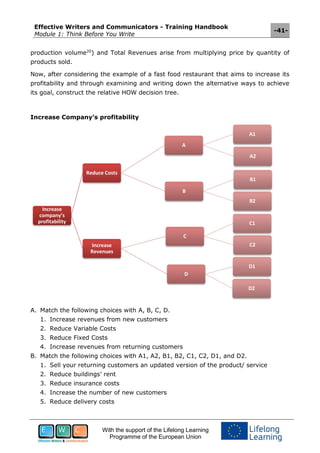
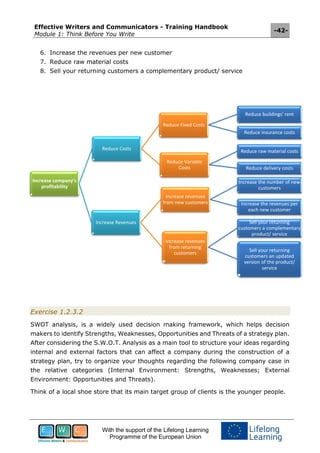
Now, after considering the example of a fast food restaurant that aims to increase its
profitability and through examining and writing down the alternative ways to achieve
its goal, construct the relative HOW decision tree.
Increase Company’s profitability
A. Match the following choices with A, B, C, D.
1. Increase revenues from new customers
2. Reduce Variable Costs
3. Reduce Fixed Costs
4. Increase revenues from returning customers
B. Match the following choices with A1, A2, B1, B2, C1, C2, D1, and D2.
1. Sell your returning customers an updated version of the product/ service
2. Reduce buildings’ rent
3. Reduce insurance costs
4. Increase the number of new customers
5. Reduce delivery costs
Increase
company’s
profitability
Reduce Costs
Α
A1
Α2
B
B1
B2
Increase
Revenues
C
C1
C2
D
D1
D2
Effective Writers and Communicators - Training Handbook
Module 1: Think Before You Write
-42-
With the support of the Lifelong Learning
Programme of the European Union
6. Increase the revenues per new customer
7. Reduce raw material costs
8. Sell your returning customers a complementary product/ service
Exercise 1.2.3.2
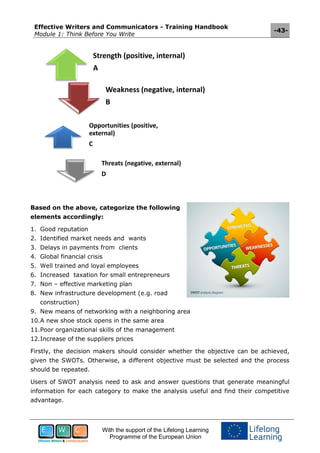
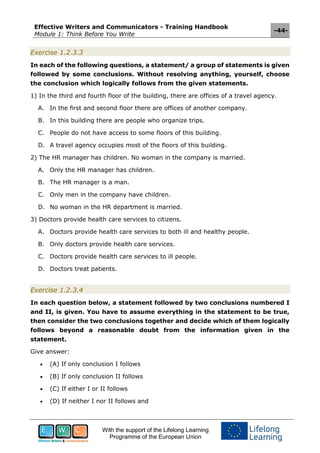
SWOT analysis, is a widely used decision making framework, which helps decision
makers to identify Strengths, Weaknesses, Opportunities and Threats of a strategy plan.
After considering the S.W.O.T. Analysis as a main tool to structure your ideas regarding
internal and external factors that can affect a company during the construction of a
strategy plan, try to organize your thoughts regarding the following company case in
the relative categories (Internal Environment: Strengths, Weaknesses; External
Environment: Opportunities and Threats).
Think of a local shoe store that its main target group of clients is the younger people.
Increase company’s
profitability
Reduce Costs
Reduce Fixed Costs
Reduce buildings' rent
Reduce insurance costs
Reduce Variable
Costs
Reduce raw material costs
Reduce delivery costs
Increase Revenues
Increase revenues
from new customers
Increase the number of new
customers
Increase the revenues per
each new customer
Increase revenues
from returning
customers
Sell your returning
customers a complementary
product/ service
Sell your returning
customers an updated
version of the product/
service
Effective Writers and Communicators - Training Handbook
Module 1: Think Before You Write
-43-
With the support of the Lifelong Learning
Programme of the European Union
Based on the above, categorize the following
elements accordingly:
1. Good reputation
2. Identified market needs and wants
3. Delays in payments from clients
4. Global financial crisis
5. Well trained and loyal employees
6. Increased taxation for small entrepreneurs
7. Non – effective marketing plan
8. New infrastructure development (e.g. road
construction)
9. New means of networking with a neighboring area
10.A new shoe stock opens in the same area
11.Poor organizational skills of the management
12.Increase of the suppliers prices
Firstly, the decision makers should consider whether the objective can be achieved,
given the SWOTs. Otherwise, a different objective must be selected and the process
should be repeated.
Users of SWOT analysis need to ask and answer questions that generate meaningful
information for each category to make the analysis useful and find their competitive
advantage.
Strength (positive, internal)
A
Weakness (negative, internal)
B
Opportunities (positive,
external)
C
Threats (negative, external)
D
Effective Writers and Communicators - Training Handbook
Module 1: Think Before You Write
-44-
With the support of the Lifelong Learning
Programme of the European Union
Exercise 1.2.3.3
In each of the following questions, a statement/ a group of statements is given
followed by some conclusions. Without resolving anything, yourself, choose
the conclusion which logically follows from the given statements.
1) In the third and fourth floor of the building, there are offices of a travel agency.
A. In the first and second floor there are offices of another company.
B. In this building there are people who organize trips.
C. People do not have access to some floors of this building.
D. A travel agency occupies most of the floors of this building.
2) The HR manager has children. No woman in the company is married.
A. Only the HR manager has children.
B. The HR manager is a man.
C. Only men in the company have children.
D. No woman in the HR department is married.
3) Doctors provide health care services to citizens.
A. Doctors provide health care services to both ill and healthy people.
B. Only doctors provide health care services.
C. Doctors provide health care services to ill people.
D. Doctors treat patients.
Exercise 1.2.3.4
In each question below, a statement followed by two conclusions numbered I
and II, is given. You have to assume everything in the statement to be true,
then consider the two conclusions together and decide which of them logically
follows beyond a reasonable doubt from the information given in the
statement.
Give answer:
 (A) If only conclusion I follows
 (B) If only conclusion II follows
 (C) If either I or II follows
 (D) If neither I nor II follows and
Effective Writers and Communicators - Training Handbook
Module 1: Think Before You Write
-45-
With the support of the Lifelong Learning
Programme of the European Union
 (E) If both I and II follow.
1) Statements: Governments and politicians may influence policy outcomes in ways
that involve little or no direct expenditure or regulatory action. The provision of
information by itself may sometimes be enough to influence desired outcomes.21
Conclusions:
I) Government intervention in policy making takes various forms.
II) Politicians always use public speeches to influence desired outcomes.
A. Only conclusion I follows
B. Only conclusion II follows
C. Either I or II follows
D. Neither I nor II follows
E. Both I and II follow
Explanation: The statement implies that governments and politicians can affect policy
making with various ways. Public speeches can influence desired policy outcomes, but
they are not used only for this purpose by politicians.
2) Statements: A rights business ethics approach is based on the belief that all
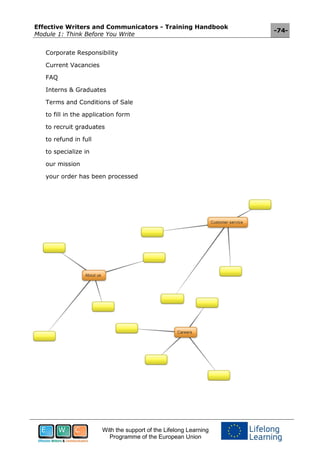
individuals have rights in life and should be treated with respect and dignity.22
Conclusions:
I) All individuals are respected and treated with dignity.
II) A rights ethics approach in business takes as given that no individual is excluded
from having rights in life.
A. Only conclusion I follows
B. Only conclusion II follows
C. Either I or II follows
D. Neither I nor II follows
E. Both I and II follow
Explanation: The statement implies that those using the rights ethics approach take
as given human rights and that respect and dignity should be a main priority when
doing business.
Effective Writers and Communicators - Training Handbook
Module 1: Think Before You Write
-46-
With the support of the Lifelong Learning
Programme of the European Union
1.2.4. C Skills Focus
Exercise 1.2.4.1
The following schemes represent some commonly used
frameworks in decision making processes. In the examples
below, match the missing elements with the appropriate
boxes:
1)Profitability framework
The profitability framework helps identify different ways to improve the profit occurring
from a product or business unit.
Match ABC with one choice from 1-3
1. Fixed
2. Variable
3. Price x Quantity
2) Marketing 7P’s framework23
The marketing mix is often associated with the seven P's. Product refers to all items
that satisfy customer’s demands. Price refers to the amount the customer pays for the
product, which is very important as it determines company’s profit. Promotion refers
to communication methods used to provide information about the product. Place
(distribution) refers to providing the product at an easily accessible by consumers place.
People refers to anyone who comes into contact with the company’s customers.
Moreover, Process of giving a service and the behavior of those delivering it, are crucial
to customer satisfaction. Finally, Physical evidence is about where the service will be
Effective Writers and Communicators - Training Handbook
Module 1: Think Before You Write
-47-
With the support of the Lifelong Learning
Programme of the European Union
delivered. It can be used to ensure a positive experience and attract the interest of the
customers.
Exercise 1.2.4.2
Answer Answer
1. Direct Marketing 2. Channels coverage
3. Online experience of brand 4. Discounts
5. Brand name 6. Quality
7. Design Features 8. Packages
9. Training & Skills 10. Advertising
11. Public relations 12. Payment methods
13. Variety 14. Sales promotion
15. Culture/ image 16. Returns
17. List price 18. Research &
Development
3) McKinsey 7S framework24
This framework points out that there are seven internal aspects of an organization that
need to be approached if it is to be successful.
Effective Writers and Communicators - Training Handbook
Module 1: Think Before You Write
-48-
With the support of the Lifelong Learning
Programme of the European Union
The 7S model can be used in a wide variety of situations where an alignment perspective
is useful, for example, it helps you to:
 Improve the performance of a company.
 Examine the potential effects of future changes within a company.
 Align departments and processes during a merger or acquisition.
 Determine the best way to implement a proposed strategy.
The model, involves seven elements that are categorized as “Hard” and “Soft”.
Hard" elements are easier to be defined or identified and management can directly
influence them: These are strategy statements; organization charts and reporting lines;
formal processes and IT systems.
"Soft" elements, on the other hand, can be more difficult to be described, and are less
tangible and more influenced by culture. However, these soft elements are as important
as the hard elements for the organization to be successful.
More specifically:
Strategy: the plan devised to maintain and build competitive advantage over the
competition.
Structure: the way the organization is structured and who reports to whom.
Systems: the daily activities and procedures that staff members engage in to get the
job done.
Shared Values: called "superordinate goals" when the model was first developed.
These are the core values of the company that are evidenced in the corporate culture
and the general work ethics.
Style: the style of leadership adopted.
Staff: the employees and their general capabilities.
Skills: the actual skills and competencies of the employees working for the company.
Exercise 1.2.4.3
Match the following issues with each element of the 7S model. Each point
applies to only one element.
A. Division of company’s team
B. Lines of communication between each department of the company
C. Autocratic leadership
D. How the company deals with competition
Effective Writers and Communicators - Training Handbook
Module 1: Think Before You Write
-49-
With the support of the Lifelong Learning
Programme of the European Union
E. Centralized/ Decentralized decision making
F. Job positions
G. Competencies monitoring and assessment
H. Fundamental beliefs
I. How the company achieves its objectives
J. Hierarchy
K. Internal rules and processes
L. Organization’s culture
M. Competitive/ cooperative team members
1.2.5. Self- assessment
Exercise 1.2.5.1
Based on the descriptions above, categorize the given elements either as
“hard” or soft”:
1. Strategy
2. Style
3. Structure
4. Share Values
5. Skills
6. Systems
7. Staff
Exercise 1.2.5.225
In each of the following questions, a statement/group of statements is given
followed by some conclusions. Without resolving anything, yourself, choose
the conclusion which logically follows from the given statements).
1) Soldiers serve their country.
A. Men generally serve their country.
McKinsey's 7S
Hard A
Soft B
Effective Writers and Communicators - Training Handbook
Module 1: Think Before You Write
-50-
With the support of the Lifelong Learning
Programme of the European Union
B. Those who serve their country are soldiers.
C. Some men who are soldiers serve their country.
D. Women do not serve their country because they are not soldiers.
2) A factory worker has five children. No one else in the factory has five children.
A. All workers in the factory have five children each.
B. Everybody in the factory has children.
C. Some of the factory workers have more than five children.
D. Only one worker in the factory has exactly five children.
3) Television convinces viewers that the likelihood of their becoming the victim of a
violent crime is extremely high; at the same time by its very nature, TV persuades
viewers to passively accept whatever happens to them.
A. TV viewing promotes criminal behaviour.
B. TV viewers are most likely to be victimized than others.
C. People should not watch TV.
D. TV promotes a feeling of helpless vulnerability in viewers.
4) The government is soon going to introduce a bill which would permit the instituting
of private universities under very strict directions.
A. We have some private universities in our country even now.
B. The demand for more universities is being stepped up.
C. Such directions can also be issued without informing the Parliament.
D. The government gives directions to establish anything in private sector.
E. Unless and until the directions are given, the private universities can charge
exorbitant fees.
5) All that glitters is not gold.
A. Non-metals also glitter.
B. Only gold glitters.
C. Not all metals glitter.
D. Glittering things may be deceptive.
6) Many business offices are located in buildings having two to eight floors. If a building
has more than three floors, it has a lift.
A. All floors may be reached by lifts.
Effective Writers and Communicators - Training Handbook
Module 1: Think Before You Write
-51-
With the support of the Lifelong Learning
Programme of the European Union
B. Only floors above the third floor have lifts.
C. Seventh floors have lifts.
D. Second floors do not have lifts.
Exercise 1.2.5.326
In each question below, a statement followed by two conclusions numbered I and II, is
given. You have to assume everything in the statement to be true, then consider the
two conclusions together and decide which of them logically follows beyond a reasonable
doubt from the information given in the statement.
Give answer:
(A) If only conclusion I follows
(B) If only conclusion II follows
(C) If either I or II follows
(D) If neither I nor II follows and
(E) If both I and II follow.
1) Statements: Wind is an inexhaustible source of energy and an aerogenerator can
convert it into electricity. Though not much has been done in this field, the survey shows
that there is vast potential for developing wind as alternative source of energy.
Conclusions:
I) Energy by wind is comparatively newly emerging field.
II) The energy crisis can be dealt by exploring more in the field of aero-generation.
A. Only conclusion I follows
B. Only conclusion II follows
C. Either I or II follows
D. Neither I nor II follows
E. Both I and II follow
2) Statements: The best way to escape from a problem is to solve it.27
Conclusions:
I) Your life will be dull if you don't face a problem.
II) To escape from problems, you should always have some solutions with you.
Effective Writers and Communicators - Training Handbook
Module 1: Think Before You Write
-52-
With the support of the Lifelong Learning
Programme of the European Union
A. Only conclusion I follows
B. Only conclusion II follows
C. Either I or II follows
D. Neither I nor II follows
E. Both I and II follow
3) Statements: Parents are prepared to pay any price for an elite education to their
children28
.
Conclusions:
I) All parents these days are very well off.
II) Parents have an obsessive passion for a perfect development of their children
through good schooling.
A. Only conclusion I follows
B. Only conclusion II follows
C. Either I or II follows
D. Neither I nor II follows
E. Both I and II follow
Exercise 1.2.5.4
Alex has graduated from a German university, after completing his bachelor and master
on financial mathematics and has worked as in the finance and banking sector for three
years in Berlin. He decided to enter the UK labor market and has already applied for a
job in various UK banks, through mainly focusing on the position of financial analyst.
Unfortunately, his first interview for this job position, in a famous bank, was not a
success.
After considering a few reasons that might have played a role in this unsuccessful trial,
try to fulfill the WHY decision tree below by matching the available choices in the third
column (1) with the two boxes in the second column (“Because of Alex” and “Because
of the bank). This process can help you to determine the most important factors that
led Alex not to be accepted for this job position.
Effective Writers and Communicators - Training Handbook
Module 1: Think Before You Write
-53-
With the support of the Lifelong Learning
Programme of the European Union
1. Inadequate budget/ affordability issues to meet interviewee’s expectations
2. Unfamiliarity with bank’s processes, activities and aims and what it looks for in a
first interview Lack of confidence and certainty; anxiety and emotional turmoil
3. A higher salary was expected
4. Delay of reply regarding interview’s results due to CV’s load and/ or disagreement
between the recruiters
5. Not adequate working experience
6. Further skills were expected (analytical and interpersonal skills; a higher grade
in before interview tests
7. Not yet granted with the professional credential Chartered Financial Analyst
charter
Exercise 1.2.5.5
Jessops has been a leader in the photographic business for over 75 years. The Jessops
story began in 1935, when Frank Jessop opened a photography store in Leicester.
Today, the company is the UK’s premier photographic retailer operating from over 200
stores around the UK. In addition, it has an online shop and call centre. Jessops is the
trading name of The Jessop Group Limited, which is a subsidiary of Snap Equity Limited.
A key part of Jessops’ product portfolio is its photo and imaging business29
. Through
carefully going through the following external environment changes (A to N) that can
Why Alex
was not
accepted as
a financial
analyst in
this bank?
Because of
Alex
Α
B
C
D
Because of
the bank
E
F
G
H
Effective Writers and Communicators - Training Handbook
Module 1: Think Before You Write
-54-
With the support of the Lifelong Learning
Programme of the European Union
affect Jessops categorize them into political, economic, social and technological,
environmental and governmental changes (External Environment Analysis).
EXTERNAL
ENVIRONMENT FACTORS-
CATEGORIES
EXTERNAL ENVIRONMENT CHANGES
1. Political
2. Economic
3. Social
4. Technology
5. Environmental
6. Government
A. New digital cameras and digital media enable ordinary
people to make high- quality photographs, which can
be quickly edited and altered
B. The use of computers and mobiles is highly increasing
C. Online competitors and online photo printing
companies
D. Today, higher consumers’ expectations and people are
not prepared to wait
E. Less disposable income to purchase luxury goods, such
as camera
F. Unemployment rate increase
G. Tastes and fashions change
H. Increased use of social media where people can share
photos and videos
I. Programs that aim to support small and medium size
entrepreneurs
J. Government initiatives to promote recycling.
K. Modern photographic equipment is much more
affordable
L. The use of digital technology, shopping online and
online printing images methods are getting more and
more famous, compared to traditional methods, such
as printing and developing photos in a store
M. Regulations to reduce the amount of electronic waste
going to landfill sites
N. Customers are now able to print images taken from
social media in a variety of sizes and shapes, a fact
that can highly increase the demand for Jessops’
products
O. Recession
P. Limited natural resources and climate change
Effective Writers and Communicators - Training Handbook
Module 1: Think Before You Write
-55-
With the support of the Lifelong Learning
Programme of the European Union
1.2.6. Bibliography
1. Sternberg, R. J. (2009). Cognitive Psychology. Belmont, CA: Wadsworth. p. 578
2. Copi, I. M., Cohen, C., & Flage, D. E. (2007). Essentials of logic (2nd ed.).
Upper Saddle River, NJ: Pearson Education, Inc.
3. Nina 2014, How do you write a Summary of an Article. [online]. Available at:
http://www.howtosummarize.info/how-do-you-write-a-summary-of-an-article/
[Accessed 24 June 2014]
4. Summarizing Lesson PowerPoint: Getting to the point. [online]. Available at:
http://www.ereadingworksheets.com [Accessed 17 June 2014]
5. Rensselaer Polytechnic Institute, Management Styles- Persuasive. .
6. UHR Development, Writing S.M.A.R.T. Goals. [online]. Available at:
http://www.hr.virginia.edu/uploads/documents/media/Writing_SMART_Goals.p
df [Accessed 26 May 2014]
7. World Health Organization, 2009. Milestones in Health Promotion: Statements
from Global Conference.Switzerland.
8. Ridell W. C., Song X., 2012. Does Education reduce unemployment? New
evidence on the impact of education on unemployment and re- employment.
Intereconomics.
9. European Commission- Europe 2020. Shadow economy and undeclared work.
[pdf] European Commission. Available at:
http://ec.europa.eu/europe2020/pdf/themes/07_shadow_economy.pdf
[Accessed 9 May 2014]
10. Stevenson H., Roberts M., 2013. Martin Blair case. Harvard business
publishing for educators.. Available at: http://hbsp.harvard.edu/list/brief-cases
[Accessed 9 May 2014]
11.Institute of Psychometric Coaching. Question 1. Available at:
http://www.psychometricinstitute.com.au/answer-
result.asp?answerid=4197630 [Accessed 20 June 2014]
12.India Bix, Verbal Ability, Available at: http://www.indiabix.com/verbal-
ability/ordering-of-words/ [Accessed 12 June 2014]
13.India Bix, Logical reasoning: theme- detection, Available at:
http://www.indiabix.com/logical-reasoning/theme-detection/discussion-641
[Accessed 13 June 2014]
14.Simply learnt. Question on rearrangement of jumbled words. Available at:
http://www.simplylearnt.com/test-question/MTAwNTMw [Accessed 11 June
2014]
15. The Online Test Centre. Ordering of words. Available at:
http://www.theonlinetestcentre.com/ordering-words3.html [Accessed 20 June
2014]
Effective Writers and Communicators - Training Handbook
Module 1: Think Before You Write
-56-
With the support of the Lifelong Learning
Programme of the European Union
16.Finance Professionals Corner, 2013. Logical reasoning- judgment. Available at:
http://www.aruacademy.com/discussion/2013/04/24/logical-reasoning-
judgement-2/ [Accessed 11 June 2014]
17.Sentence Re- arrangement. Available at: <
https://groups.google.com/forum/#!topic/vp-info/vlpLIcy1tks> [Accessed 5
June 2014]
18.Powerful problem solving: Ideas to become outstanding problem solvers, 2010.
19.Investopedia. Fixed costs Available at:.<
http://www.investopedia.com/terms/f/fixedcost.asp> [Accessed 2 May 2014]
20.Transportation Economics/ Regulation. Available at: <
http://www.saylor.org/site/wp-content/uploads/2012/06/Transportation-
Economics.pdf> [Accessed 9 June 2014]
21.WiseGEEK,. Business Ethics. Available at: http://www.wisegeek.com/what-are-
basic-business-ethics-theories.htm [Accessed 23 June 2014]
22.The Chartered Institute of Marketing, 2009. Marketing and the 7Ps: A brief
summary of marketing and how it works. Available at:
http://www.cim.co.uk/files/7ps.pdf [Accessed 19 June 2014]
23.Mind tools- Essential skills for an excellent career. Available at:
http://www.mindtools.com
24.Business case studies. Responding to changes in the market environment: A
Jessops case study. Available at:
http://businesscasestudies.co.uk/jessops/responding-to-changes-in-the-
market-environment/introduction.html [Accessed 20 June 2014]
1.2.7. List of suggested readings
1. http://businesscasestudies.co.uk/#axzz374Yxs9Kq
2. http://www.mindtools.com/fulltoolkit.htm
3. http://www.investopedia.com/terms/f/
Effective Writers and Communicators - Training Handbook
Module 1: Think Before You Write
-57-
With the support of the Lifelong Learning
Programme of the European Union
1.3. Chapter 1.4: Write well
You will learn to:
 identify and differentiate formal/ informal style
 write better English/coherent texts
 write a formal/informal letter
1.3.1. Introduction
One needs to be careful how they speak in different situations. With people one knows
well, in relaxed and unofficial contexts, informal language is normally used. On the other
hand, in official public notices, business context, and polite conversations with
strangers, formal language is mainly used. It typically has stricter grammar rules and
often uses more difficult vocabulary.
Professionals need to communicate in official and unofficial contexts. One of the integral
parts of effective communication in the English language in the professional
environment is written communication. Developing a higher degree of competence in
English language writing skills (what is written and how it is expressed) can help
improve your own job performance and help build a successful future career.
A key aspect of the world of commerce and professionalism is correspondence. It shows
the competence and professionalism of the person who has written it and the company
they work for. Unclear or confusing correspondence may lead to misunderstandings,
delays, lost business and poor interpersonal relations. Clear and effective
correspondence is a significant part of running an efficient business and can promote
good relations.
One might not feel confident enough when faced
with real business communication, such as writing
business letters, e-mails, memos, reports,
analyses, product descriptions, etc. Thus, in the
professional world, being able to write well, i.e. no
obvious grammar, spelling and punctuation errors
(those could make the meaning unclear), is one
of the keys to being successful in nearly every
field. To make sure that business correspondence
achieve what we want to achieve they need to
display the important qualities of coherence,
conciseness, clarity and level of formality.
Effective Writers and Communicators - Training Handbook
Module 1: Think Before You Write
-58-
With the support of the Lifelong Learning
Programme of the European Union
Coherence in writing means the readers can move from sentence to sentence within a
paragraph without any trouble following the train of thought. Clarity is using short,
common and concrete words and avoiding jargon or slang, because some of the
language used work is exclusive to a company or profession, and others might not know
what they mean. Conciseness is using short words and sentences rather than long and
complex ones, and avoiding unnecessary details. All of that will be practiced in the
course.
The level of formality depends on the purpose of the letter and the relationship with the
reader. A business letter with the right level of formality looks professional and will
create the right kind of impression on potential clients. There are different ways to
express the level of formality in writing, such as the choice of words, phrases and
expressions, the use of specific grammar structures and the use of contractions for
informal messages.
1.3.2. A Starting-up
Exercise 1.3.2.1
Match the informal phrases with the formal phrases.
1. Thanks for your email.
2. Re your last email.
3. Do you want me to book it?
4. I'll get back to you soon.
5. Let me know if you need
anything else.
a) Thank you for your email of
16th June.
b) Do not hesitate to contact us
again if you require any further
information.
c) I will contact you again shortly.
d) Would you like me to reserve it?
e) I am writing with regard to your
recent email.
Tips:
Business letters are in a formal style, you should avoid short forms and informal
expressions.
Effective Writers and Communicators - Training Handbook
Module 1: Think Before You Write
-59-
With the support of the Lifelong Learning
Programme of the European Union
1.3.3. B Vocabulary Development
Exercise 1.3.3.1
Put the phrases into groups.
To:
From:
Subject: Meeting – Monday 9.00 am
Dear Peter
I am afraid I will not be able to attend the meeting on Monday at 9.00 am. Since I
will miss the meeting, I was wondering if you could send me a copy of the minutes? I
will write to Susan as well, to inform her that I will not be there.
Once again, please accept my apologies. I can assure you that I will be at the next
meeting.
Regards
Jane
To:
From:
Subject: Meeting – Monday 9.00 am
Hello Peter
Sorry, I can't make it on Monday at 9.00 am. Since I will miss the meeting, please
could you send me a copy of the minutes? I will write to Susan as well, to tell her
that I won't be there.
Once again, I'm sorry. I promise you that I will be at the next meeting.
Effective Writers and Communicators - Training Handbook
Module 1: Think Before You Write
-60-
With the support of the Lifelong Learning
Programme of the European Union
Regards
Jane
Formal Informal
1. 1.
2. 2.
3. 3.
4. 4.
5. 5.
6. 6.
7. 7.
Exercise 1.3.3.2
Complete the missing words. The first letters are given.
Hello John
I´m s.................... I c.................... make it next Wednesday. Could we meet next
Friday instead?
Peter
D.................... John
I am a.................... I will not be a................... to attend the meeting next
Wednesday. I was w.................... if we could meet on Friday instead?
Regards
Peter
Effective Writers and Communicators - Training Handbook
Module 1: Think Before You Write
-61-
With the support of the Lifelong Learning
Programme of the European Union
1.3.4. C Skills focus
Exercise 1.3.4.1
Put the phrases into groups.
In addition However On the other hand As a result Furthermore
Nevertheless Moreover Consequently Therefore
and .................... ....................
....................
but .................... ....................
....................
so .................... ....................
....................
Exercise 1.3.4.2
Which is right?
I am writing to complain about the shipment of dictionaries we have received today.
Firstly, our order dated 12 January 2014 clearly stated that we needed 45 English-
Slovak pocket dictionaries. 1 However/In addition, we only received 40 dictionaries.
2 Furthermore/As a result, we wanted 3rd edition but we received 1st edition.
3 In addition/Consequently, one of the boxes was damaged, and 4 as a result/on the
other hand all the dictionaries were badly stained 5 so/however we decided to contact
you immediately.
Exercise 1.3.4.3
Are the statements true or false?
1. If you are not sure which of the three titles Dear Miss Taylor or Dear Mrs Taylor or
Dear Ms Taylor is appropriate. it is best to stick to Ms.
2. If a letter begins with Dear Sir/Madam, it will close with Yours sincerely.
3. In English there are various ways of writing the date. British style is to put the
day, then the month, then the year (2 December 2014). American style is to have
the month before the day (December 2, 2014 or 12-2-2014).
4. If a letter begins with Dear Mr Black, it will close with Yours faithfully.
Effective Writers and Communicators - Training Handbook
Module 1: Think Before You Write
-62-
With the support of the Lifelong Learning
Programme of the European Union
5. In American English, the endings Sincerely or Sincerely yours can be used,
whether or not you write to a named person.
Tips:
Title Status Complimentary close
Mr male married/unmarried Yours sincerely
Mrs female married Yours sincerely
Miss female unmarried Yours sincerely
Ms female married/unmarried Yours sincerely
Sir male-name not known Yours faithfully
Madam female-name not known Yours faithfully
Sir/Madam unsure whether male/female Yours faithfully
Exercise 1.3.4.4
Put the pieces of text into a logical order.
1. Soňa Kováčová
2. Lecturer
3. Department of Languages
4. You were recommended to us by the Department of languages Comenius
University in Bratislava. We are interested in your products, in particular the
special offer of the coursebook The Business 3rd
edition.
5. I was wondering if you could send us your latest catalogue and price list?
6. TUKE is a large university with nine faculties offering tuition to more than 10,
000 students. Thus, we will probably place substantial orders if the prices of
your products are competitive.
7. We would also like to know if you offer any discounts.
8. We hope to hear from you soon.
9. Soňa Kováčová
10. Technická univerzita v Košiciach
11. Katedra jazykov
a. Vysokoškolská 4
b. 042 00 Košice
c. Slovensko
12. 4 May 2014
Effective Writers and Communicators - Training Handbook
Module 1: Think Before You Write
-63-
With the support of the Lifelong Learning
Programme of the European Union
13. Yours faithfully
14. ABC Ventures s.r.o.
Krivá 6, 949 01 Poprad
15. predaj@abcventures.com
16. Dear Sir/Madam
Technická univerzita v Košiciach
Katedra jazykov
Vysokoškolská 4
042 00 Košice
Slovensko
4 May 2014
The Sales Department
Slovak Ventures s.r.o.
Kasalova 6, 949 01 Nitra
predaj@venturesbooks.com
Dear Sir/Madam
You were recommended to us by the Department of languages PU in Prešov. We are
interested in your products, in particular special offer of Business English coursebooks.
TUKE is a large university with nine faculties offering tuition to more than 10, 000
students. Thus, we will probably place substantial orders if the prices of your products
are competitive.
I was wondering if you could send us your latest catalogue and price list?
We would also like to know if you offer any discounts.
Effective Writers and Communicators - Training Handbook
Module 1: Think Before You Write
-64-
With the support of the Lifelong Learning
Programme of the European Union
We hope to hear from you soon.
Yours faithfully
Katarina Szabova
Katarina Szabova
Lecturer
Department of Languages
1.3.5. Self-assessment test
Exercise 1.3.5.1
Choose the correct word/phrase. In each case, only one is correct.
To:
From:
1 Topic/ Subject/ Item: Meeting – Monday 9.00 am
2 Hi/ Dear/ Hello Peter
I am sorry to 3 inform you/ tell/ enquire at such sort notice but 4 sorry/ pardon me/ I
am afraid I 5 will/ shall/ should not be able to 6 go/ attend/ control the meeting 7 on/
-/ at Monday 8 -/ on/ at 9.00 am. Since 9 I will/ I'll/ I'd miss the meeting, 10 I was
asking/ wondering/ requesting if you could send me a copy of the minutes?
Once again, 11 please accept my apologies/ I'm sorry for/ excuse me. 12 You can be
sure / I can assure you / You can be confident that I will be at the next meeting.
13 Regards/ Best compliments/ Bye
Jane
Effective Writers and Communicators - Training Handbook
Module 1: Think Before You Write
-65-
With the support of the Lifelong Learning
Programme of the European Union
Exercise 1.3.5.2
Find ten mistakes and correct them.
KMK s.r.o. Letná 6, 949 01 Levoča
Telephone:
+44(0)55 452 587
Email: predaj@KMK.com
www.kmk.com
2 June 2014
Mr Peter Belo
LPress
Pražská 4
042 00 Košice
Slovensko
Daer Mr Belo
I'm writing to you to complain about the shipment of T-shirts we received yesterday
against the order No.15489.
Firstly, the T-shirts you sent were not the ones that we ordered. Our order clearly
stated that we wanted 350 blue T-shirts with our logo printed on the left sleeve. In
addition, we received 350 white T-shirts. Therefore, the logo is printed on the back.
To make matters worse, your staff were very unhelpful when I called to sort it out. I
was passed from one person to another and on the other hand I ended the call.
We've been yours customers for more than seven years and have not received that
kind of treatment before. Shall you, please, resolve the issue within the next 10 days?
Effective Writers and Communicators - Training Handbook
Module 1: Think Before You Write
-66-
With the support of the Lifelong Learning
Programme of the European Union
Yours faithfully
Karin Balogová
Karin Balogová
Purchasing Manager
Exercise 1.3.5.3
There are no capitals, punctuation, or paragraphs in this letter. Write out the
letter correctly and divide the body of the letter into four paragraphs.
The Sales Department
ABC Ventures s.r.o.
Krivá 6, 949 01 Poprad
predaj@ABCbooks.com
24 may 2014
Ms Soňa Kováčová
Technická univerzita v Košiciach
Katedra jazykov
Vysokoškolská 4
042 00 Košice
Slovensko
dear ms kováčová
thank you for your enquiry of 4 may about the business coursebooks i have pleasure in
enclosing our current catalogue and price list unfortunately the coursebook the business
3rd
edition has been sold out please note that the coursebook the business 3rd
edition
will not be in stock anymore as the 4th
edition is coming out in september in response
Effective Writers and Communicators - Training Handbook
Module 1: Think Before You Write
-67-
With the support of the Lifelong Learning
Programme of the European Union
to your enquiry about discounts, we can give a 10% quantity discount on orders over €
2, 000 thank you for your interest we hope to hear from you soon
yours sincerely
alexandra keverová
alexandra keverová
sales manager
enc.
1.3.6. List of Suggested Readings
1. Emmerson, P.: Business Grammar Builder. 2nd
ed. Intermediate to Upper-
intermediate. Macmillan. 2010.
2. Ashley, A.: Oxford Handbook of Commercial Correspondence. Oxford University
Press. 2005.
3. Formal Letter Writing. Available at:
http://www.usingenglish.com/resources/letter-writing.php [accessed 15 May
2014]
4. Sample Letters. Available at:
https://owl.english.purdue.edu/owl/resource/653/02/ [accessed 18 May 2014]
Effective Writers and Communicators - Training Handbook
Module 1: Think Before You Write
-68-
With the support of the Lifelong Learning
Programme of the European Union
1.4. Chapter 1.4: Write creatively
You will learn to:
 sort the good ideas from the bad
 organise ideas
 write a company profile
1.4.1. Introduction
To succeed in business, you have to stand out from the crowd. One of the ways to get
the attention of customers is through an easily remembered company name, a catchy
product name, a visually attractive logo, a user-friendly website, a constantly updated
profile on social media, and so on. This
chapter will introduce you to some of the
basic ways of coming up with creative ideas.
If you get stuck with a problem and you
cannot find a solution the following list of 10
brainstorming techniques may help you to get
out of the situation you are in.
1. Free Writing
Free writing is one of the most unpredictable forms of writing. You do not know where
your mind will lead you, but be sure that it will be interesting. There is no special
preparation for this method, just start writing.
2. Wordplay
Start writing about your favorite topic. Use words that rhyme. Note down the lyrics of
a song that is going through your head. Pick the prefix or suffix you like and start listing
all the words containing the prefix or suffix. Try to be as silly as possible.
3. What If?
Ask some 'what if' questions and see where the answers take you. What if the money
grew on trees? What if you had two heads? What would happen if everyone was
telepathic?
4. Mind Map
Mind mapping is an exciting method of coming up with ideas. Write a concept or idea
in the center of your page. Write other concepts and ideas around that idea until
something interests you. Each idea is written down and then linked by lines or curves
to its major or minor idea or resulting in a web of relationships.
Effective Writers and Communicators - Training Handbook
Module 1: Think Before You Write
-69-
With the support of the Lifelong Learning
Programme of the European Union
5. Analogy
Take two unrelated topics and try to connect them. You can start with the question 'How
is _____ like a ______?' Your mind is thus led toward answering questions, so you will
start finding answers. Write down your list and see where it takes you.
6. Role Playing
What would someone else do in a situation you are in? What would the person you
dislike the most do? What would someone else have for lunch? This exercise is about
looking at things from different angles.
7. Teleportation
How would you solve this problem if you were in a different place? Different country?
Different geographic region? Different universe?
8. Attribute change
How would you approach this if you were a different gender? Age? Race? Intellect?
Nationality? With each attribute change, you may try out a new spectrum of thinking.
9. Syllable Mixup
Write the syllables of two-syllable or three-syllable words on separate cards. Read all
the syllables separately, then mix them up and keep on reading them all aloud in order
to make a new word. It’s challenging and fun when the words sound silly all mixed up.
10. Gap Filling
Write down your current spot – Point A – and your target – Point B. What is the gap
between A and B? What thing you need to put between A and B to fill up the gap? Note
them down and think about what it takes to get them.
In this chapter you will work with four of the brainstorming techniques: Mind Mapping,
Syllable Mixup, Attribute Change and Rolestorming.
1.4.2. A Starting-up
Exercise 1.4.2.1
Complete the diagram with these words and phrases.
FAQ, general information, terms and conditions of sale, working here, news & events
Effective Writers and Communicators - Training Handbook
Module 1: Think Before You Write
-70-
With the support of the Lifelong Learning
Programme of the European Union
1.4.3. B Vocabulary Development
Exercise 1.4.3.1
Match these pieces of text to the corresponding subheadings.
About us Careers Customer service Contact
us
General Information Working Here FAQ
History Current Vacancies Terms and Conditions of Sale
Corporate Responsibility Interns & Graduates
CMT Prooptiki is an independent management consulting firm, specializing in health &
social care consulting, EU project consulting, social & economic development,
established in Athens in 1992.
A core team of specialist consultants combining experience of the health & social care
sector with commercial and business expertise enables us to apply a rich blend of
knowledge and insight to provide real added value for our clients.
At BEGA, we integrate corporate responsibility into all we do. As part of our company’s
corporate responsibility efforts, we provide a safe and healthy workplace for our
employees, and ensure that our business activities are sustainable, conducted in an
environmentally responsible manner.
Effective Writers and Communicators - Training Handbook
Module 1: Think Before You Write
-71-
With the support of the Lifelong Learning
Programme of the European Union
Can I cancel or change my order?
Once your order has been processed, I’m afraid we are not able to make any changes.
If you do not want to keep the items when they are delivered, simply return the whole
package to us, and we will refund you in full, including postage.
We offer a variety of challenging internship and new graduate positions throughout our
business sectors. We are actively recruiting students and new graduates for current and
future business needs across our organization. To be considered, please fill in the
application form below.
When you join the BEGA team, you’ll have the opportunity to connect with coworkers
in an environment that’s unique and diverse. Employees share experiences,
perspectives, and creative solutions. We collaborate through integrated product teams,
cross-functional teams, and employee resource groups.
Exercise 1.4.3.2
Read the text below and choose the word which best fits each gap.
core, founded in, mission, specializing in, include
Company Profile
Navigator Consulting Group is an international consultancy 1 ……………. business
development and economic transformation in the changing global economy. 2
……………. 1995 in Athens, Greece, our Group comprises companies and offices in
London, England; Athens, Greece; Lefkosia, Cyprus; and Kyiv, Ukraine, together with
a wide network of associated partners in the CEE and NIS regions.
Our 3 ……………. is to support the process of strategic change. We guide companies
and institutions through strategic development, performance improvement and
growth. Our role is to act as a trusted advisor, providing objective and results-
oriented analysis, solutions and implementation.
Our services are distributed in six 4 ……………. areas:
 Investment Advisory
 Corporate Strategy
 Marketing & Sales
 Human Resources
 Internet Strategy
 Business Incubation
Effective Writers and Communicators - Training Handbook
Module 1: Think Before You Write
-72-
With the support of the Lifelong Learning
Programme of the European Union
Our clients 5 ……………. multinational corporations as well as regional market leaders
in such sectors as natural resources and building materials; food processing; fast-
moving consumer goods; packaging; and other manufacturers. We are also advisors
to the European Commission, international financial institutions and national
governments.
1.4.4. C Skills Focus
Exercise 1.4.4.1
You have decided to create a catchy name for your company. (Syllable Mixup
brainstorming technique).
Start by brainstorming a list of words you'd like customers to associate with your
company. Think about the following for example:
 what is special about what you are offering
 if your business name tells your customers what to expect
 if your name is easy to pronounce and remember
 if your name will not cause misunderstandings in other languages
Once you've got your list cut each word up into syllables. Combine two or three
syllables at random and say it aloud. Make a note of any combinations that sound
especially catchy or evocative. Try to come up with 7 names.
Exercise 1.4.4.2
Now look at the 7 names from exercise 1. Try to narrow down the list to 5
names. Think about the following (Attribute Change/ Rolestorming
brainstorming techniques):
 How would you think about the business name if you were a different gender?
Age? Race? Intellect? Height? Weight? Nationality? With each attribute change,
you become exposed to a new spectrum of thinking you were subconsciously
closed off from.
 How would you think about the business name if you were someone else? Your
parent? Your teacher? Your manager? Your partner? Your best friend? Your
enemy?
Effective Writers and Communicators - Training Handbook
Module 1: Think Before You Write
-73-
With the support of the Lifelong Learning
Programme of the European Union
Exercise 1.4.4.3
You have decided to create a catchy name for your product. Start by
brainstorming a list of words you'd like customers to associate with your
product. Think about the following for example:
 appeal to the target customer
 easy to pronounce in several languages
 short and simple
 memorable
 unique
Try to come up with 20, or 25 if you can. Do not judge the ideas, just fill the page.
Now pick the 10 best names from your list. Cut each word up into syllables.
Combine two or three syllables at random. Check if it sounds good. Make a note of
combinations that you feel have the right appeal. Try to come up with 5 names.
Tips:
Let the customers vote on a new product name on the website (e.g. give them a
choice of two or three names).
Exercise 1.4.4.4
Now you have decided to create your company’s website to let customers know
more about your company and its products and services.
 What makes a good website?
 What comes into your mind when thinking about your website?
List 25 ideas, do not stop until you have reached the number. Do not judge the ideas,
just fill the page.
Tips:
When brainstorming, go for volume and write whatever you can think of without
restricting yourself. Do not stop until you have reached the given number.
1.4.5. Self-Assessment Test
Exercise 1.4.5.1
Complete the diagram with these words and phrases.
a safe and healthy workplace
Effective Writers and Communicators - Training Handbook
Module 1: Think Before You Write
-74-
With the support of the Lifelong Learning
Programme of the European Union
Corporate Responsibility
Current Vacancies
FAQ
Interns & Graduates
Terms and Conditions of Sale
to fill in the application form
to recruit graduates
to refund in full
to specialize in
our mission
your order has been processed
Effective Writers and Communicators - Training Handbook
Module 1: Think Before You Write
-75-
With the support of the Lifelong Learning
Programme of the European Union
Exercise 1.4.5.2
Match these words to their meanings.
1. FAQ
2. core
3. to found
4. to specialize in
5. an order
a) most important or most basic
b) to be involved in one particular area of business
c) a request to make, supply, or deliver food or goods
d) to start an organization, company, political party
e) an abbreviation for frequently asked questions: a list of questions and answers
intended to help people understand something, especially on the Internet
1.4.6. List of Suggested Readings
1. Emmerson, P.: Business Vocabulary Builder. Intermediate to Upper-
intermediate. Macmillan. 2009.
2. Isaac, B.: 10 Brainstorming Techniques that Help Stimulate Your Individual
Creativity [online]. 2010. Available at:
http://www.persistenceunlimited.com/2010/08/10-brainstorming-techniques-
that-help-stimulate-your-individual-creativity/ [accessed 01 June 2014]
3. 25 Useful Brainstorming Techniques [online]. 2009. Available at:
http://personalexcellence.co/blog/25-brainstorming-techniques/ [accessed 21
May 2014]
4. Bubble.us. Brainstorming made simple. Available at: https://bubbl.us/
[accessed 21 May 2014]
Effective Writers and Communicators - Training Handbook
Module 1: Think Before You Write
-76-
With the support of the Lifelong Learning
Programme of the European Union
1.5. Chapter 1.5: Revision exercises
Exercise 1.5.1 (grouping)
Choose the best suited word to complete the sequence
1) Doctor: Patient: : Politician : __________ ?
A) Voter
B) Chair
C) Money
D) Public
2) Ignorance : Education : : Disease : __________ ?
A) Hospital
B) Doctor
C) Medicine
D) Nurse
3) Man : Biography : : Nation : __________ ?
A) History
B) Geography
C) People
D) Leader
Exercise 1.5.2 (reasoning – concluding)
Each of the following questions contains a small paragraph followed by a question on
it. Read each paragraph carefully and answer the question given below it.
1) The prevention of accidents makes it necessary not only that safety devices be used
to guard exposed machinery but also that mechanics be instructed in safety rules which
they must follow for their own protection, and that lighting in the plant be adequate30
.
The passage best supports the statement that accidents:
A. are always avoidable.
B. may be due to ignorance.
C. cannot be entirely overcome
D. can be eliminated with the help of safety rules.
Effective Writers and Communicators - Training Handbook
Module 1: Think Before You Write
-77-
With the support of the Lifelong Learning
Programme of the European Union
E. usually result from inadequate machinery.
Exercise 1.5.3 (Deductive and inductive reasoning)
Match the following characteristics with the appropriate form of reasoning
(deductive or inductive)
Reasoning Characteristics
Inductive
Deductive
1. Open domain with epistemic uncertainty
2. Mathematical Induction
3. Bottom- up logic
4. Generalizing or extrapolating from initial information
to reach the conclusion
5. Top- down logic
6. Statistical syllogisms
7. Applying general rules over the entirety of a closed
domain of discourse
Exercise 1.5.4 (Deductive and inductive reasoning)
Characterize the following arguments as inductive or deductive form of
reasoning (only one choice matches to each argument)
A. The stock price of company “X” has decreased for the past three days. Thus,
it will probably decrease today.
B. John will dispatch the merchandise if it is in stock. The merchandise is in stock.
Thus, John will dispatch it.
C. 4 out of 5 times, the sale is successful. So, it is very likely to be successful
again.
D. All scientists are smart. All chemists are scientists. Thus, all chemists are
smart.
Exercise 1.5.5
Match the beginnings with the endings.
1. I ordered 5 cartridges.
2. I ordered 5 cartridges,
3. I was wondering
Effective Writers and Communicators - Training Handbook
Module 1: Think Before You Write
-78-
With the support of the Lifelong Learning
Programme of the European Union
4. I'm afraid I can't make
5. Please accept my apologies for
a) it on Wednesday.
b) if you could forward it to me.
c) but I only received 3.
d) However, I received only 3.
e) everything that happened.
Exercise 1.5.6
Complete each sentence with a word or a phrase from the list below. You may
not need all of them.
on the other hand of further consequently from
apologize regard
1. I would take the taxi to get there. …………………., the tram would be a lot
cheaper.
2. The management introduced new safety regulations, …………………., the accident
rate has dropped by 3%.
3. Thank you for your letter …………………. 3 October.
4. Please do not hesitate to contact us, if you need any …………………. information.
5. I am writing to you with …………………. to your recent complaint.
17
Powerful problem solving: Ideas to become outstanding problem solvers, 2010. Build issue trees: diagnosis trees and
solution trees. Available at: http://powerful-problem-solving.com/build-logic-trees [Accessed 2 May 2014]
18
Powerful problem solving: Ideas to become outstanding problem solvers, 2010. Integrate decision making into your
overall problem- solving approach. Available at: http://powerful-problem-solving.com/?s=decision+matrix [Accessed
2 May 2014]
19
Investopedia. Fixed costs Available at:.< http://www.investopedia.com/terms/f/fixedcost.asp> [Accessed 2 May
2014]
20
Investopedia. Variable costs Available at:.< http://www.investopedia.com/terms/v/variablecost.asp> [Accessed 2
May 2014]
21
Transportation Economics, 2013. Regulation. Regulation. Available at:
http://en.wikibooks.org/wiki/Transportation_Economics/Regulation [Accessed 23 June 2014]
22
WiseGEEK,. Business Ethics. Available at: http://www.wisegeek.com/what-are-basic-business-ethics-theories.htm
[Accessed 23 June 2014]
Effective Writers and Communicators - Training Handbook
Module 1: Think Before You Write
-79-
With the support of the Lifelong Learning
Programme of the European Union
23
The Chartered Institute of Marketing, 2009. Marketing and the 7Ps: A brief summary of marketing and how it
works. Available at: http://www.cim.co.uk/files/7ps.pdf [Accessed 19 June 2014]
24
Mind tools- Essential skills for an excellent career. The McKinsey 7S Framework. Available at:
http://www.mindtools.com/pages/article/newSTR_91.htm [Accessed 2 May 2014]
25
India Bix, Logical reasoning: Statement and Conclusion, Available at: http://www.indiabix.com/logical-
reasoning/statement-and-conclusion/040001 [Accessed 20 June 2014]
26
India Bix, Logical reasoning: Statement and Conclusion, Available at: http://www.indiabix.com/logical-
reasoning/statement-and-conclusion/discussion-588 [Accessed 20 June 2014]
27
India Bix, Logical reasoning: Statement and Conclusion, Available at: http://www.indiabix.com/logical-
reasoning/statement-and-conclusion/041001 [Accessed 20 June 2014]
28
India Bix, Logical reasoning: Statement and Conclusion, Available at: http://www.indiabix.com/logical-
reasoning/statement-and-conclusion/041002 [Accessed 20 June 2014]
29
Business case studies. Responding to changes in the market environment: A Jessops case study. Available at:
http://businesscasestudies.co.uk/jessops/responding-to-changes-in-the-market-environment/introduction.html
[Accessed 20 June 2014]
30 India Bix, Logical reasoning: Theme detection, Available at: http://www.indiabix.com/logical-reasoning/theme-detection/038002
[Accessed 12 June 2014]
Module 2
1. Introductions
2. Getting paid
3. Business travel
Chapters
LET'S GET DOWN
TO BUSINESS
Module 2
1. Introductions
2. Getting paid
3. Business travel
Chapters
LET'S GET DOWN
TO BUSINESS
Effective Writers and Communicators - Training Handbook
Module 2: Let’s Get Down To Business
-80-
With the support of the Lifelong Learning
Programme of the European Union
2. Module 2: Let’s Get Down To Business
Business communication expands itself in many situations.
“So please tell me about your work, about yourself, about your organization”.
These types of phrases are part of your everyday professional life. Whether you are a
young person looking for a job, an organization employee or an entrepreneur you will
hear these words many times in your career during an interview, in an event, in
networking situations.
Effective Writers and Communicators - Training Handbook
Module 2: Let’s Get Down To Business
-81-
With the support of the Lifelong Learning
Programme of the European Union
This Module will offer you the chance to understand and assess yourself on how to
introduce yourself and your job in a professional context, manage interviews and
introductions in an event, develop an effective presentation, be familiar with structure
and terminology of employment and corporate policies. Moreover, it will help you see
in practice how communication works in a professional environment, what are the
barriers you need to overcome and what you need to do to reach effectiveness and
finally success for your objectives.
In this context, Module 2 “Let’s Get Down to business” will provide you with
practical tips on:
 managing a conversation,
 developing an effective presentation and
 Introducing yourself in the most understanding and effective manner.
Moreover, you will learn about:
 payment schemes and employment policies,
 on how to handle an interview and
 How to better promote yourself and your job.
BUSINESS
SITUATIONS
jobs
festivals
job
interview
confere
nces
business
travel
meeting
with
clients
project
meeting
Effective Writers and Communicators - Training Handbook
Module 2: Let’s Get Down To Business
-82-
With the support of the Lifelong Learning
Programme of the European Union
However, there are so many situations in which you will find yourself trying to think
“how can I talk to this person?”, “what do I want him to understand?”, “what
does he want to hear from me?” Business travel is one of the most common ones
and will be discussed in detail in the last unit of Module 2. Talking about your business
trips, making and changing arrangements through direct (verbal) or indirect (written)
communication usually form one important part of the professional daily routine and
require effective communication skills either in a written or in a verbal way.
Using techniques such as grouping, ordering, summarizing and reasoning will always
help you make your thoughts logical and think of what you hear from others in a critical
way. But, they will also help you present yourself or your organization in a clear and
more attractive to others way, so as to make the difference and stand out from the
crowd.
Tips and suggestions on how to write well and creatively will differentiate your
presentation, yourself from the rest of interviewees, or your competitors and will
definitely help you on avoiding misunderstandings and mistakes when you want to
arrange business travel.
Apart from the specialized vocabulary, tips and suggestions you get through Module 2,
you can always adapt your thinking and writing logically, well and creatively skills in
several situations and try to use logic trees that answer “why do you think you are
better from the rest applicants for this job position?” or “how do you feel your
organization can offer the best quality in a potential collaboration with my company?”
questions.
Finally, learning about key frameworks, such as SWOT analysis, will help you
prepare yourself for an interview or a conference and “who you are” will be
clear to your audience.
Combining this with well and creative writing will assure success through
choosing the best style of communication in a business situation and through
making a presentation, an organization profile or an application letter more
attractive.
When reading these
practical tips, always
remember the theory
of the first Module!
Effective Writers and Communicators - Training Handbook
Module 2: Let’s Get Down To Business
-83-
With the support of the Lifelong Learning
Programme of the European Union
2.1. Chapter 2.1: Introductions
2.1.1. Introduction
Introducing Yourself and Your Job
You will learn to:
 Introduce yourself in a variety of professional
contexts
 Introduce your company to a professional
audience
 Describe your job and wider profession verbally
All individual and company names used in this module are fictitious and are not
intended to resemble any existing individuals or companies.
2.1.2. A Starting-up
Often in your professional career, you will be asked by others about your job, your
company and what you do professionally. How you introduce yourself plays an
important role in professional networking, and can affect your career. In this section,
we will review different approaches in introducing yourself and your company, in both
informal and formal contexts.
Introductions in the Professional Context
When introducing yourself in the professional context, it is important to have a clear
plan in your mind for what you would like to achieve. The introduction is only really the
starting point of this process. Reasons for introducing yourself typically fall into a
number of categories:
a. An introduction is essential because you are interviewing for a job in a new corporate
employer.
b. An introduction is necessary because you will be working with a wider group of
colleagues whom you do not current know. For instance, you are starting a project
meeting with your clients.
c. An introduction is necessary because you desire to interact further with a specific
individual. For instance, you may wish to introduce yourself to a keynote speaker at
a conference.
d. An introduction is necessary because a total stranger introduces himself to you at a
dinner reception.
Effective Writers and Communicators - Training Handbook
Module 2: Let’s Get Down To Business
-84-
With the support of the Lifelong Learning
Programme of the European Union
In each case, it helps to have the following game plan in mind:
a. What am I trying to achieve through this introduction?
b. How can I best interpret my achievements and company to my interlocutor?
c. Are there any common areas between myself and my interlocutor?
d. Are there any cultural or social norms which I should observe?
e. Are there any controversies or sources of confusion I should be aware of?
f. How should I close the introduction? What are the next steps?
Let’s look at each of these points in more detail.
What am I trying to achieve?
If you are taking the initiative in introducing yourself, you probably already know the
objective of your introduction. Let’s take a moment to specify what this is.
Context Desired
Achievement
Sub-Achievements
Job Interview To be recruited  To stand-out from competitors
 To demonstrate your skills and
competences
 To build a rapport with your interviewer
Project
Meeting
To work
effectively with
new clients and
colleagues
 To introduce yourself in a memorable
way
 To provide the groundwork for later
introductions and discussions with
participants and colleagues
Conference
Coffee Break
To network with
conference
participants
 To meet keynote speakers or other
recognised figures
 To meet other conference participants
whom you may not know
How can I interpret my achievements and my company’s
achievements?
Professionally, we live in a performance-oriented world. If you are introducing yourself
to a professional contact, they want to know a little about you and how you (and your
employer) differentiate yourselves. Reflect on what your achievements are, or what
your company has achieved, in a way that clearly leaves an impression without boasting
about it.
Effective Writers and Communicators - Training Handbook
Module 2: Let’s Get Down To Business
-85-
With the support of the Lifelong Learning
Programme of the European Union
Remember that your introduction will be a single opening statement, designed to gain
further interest that can be followed up on the spot (i.e. through dialogue) or at a later
time.
Examples of a single opening statement
Introducer: “Hi, I’m Mary and I teach European history at St. John’s University. I’m also
a writer on current history for The Independent.
Introducer: “My name is Philip. I’m a consultant with Magellan Consulting. We specialise
in corporate valuations and due diligence. Our most recent project was the EUR 470
million Eurotransport merger.
Introducer: “My name is Anna. I manage the front office at the Grange Hotel in St.
Paul’s.”
Examples of a single opening statement in a dialogue context
Introducer: “Hi, I’m John, and I work for Goldman Sachs in currency trading.”
Interlocutor: “Excellent, what kind of trading do you do?”
Introducer: “I handle a foreign exchange portfolio of about $ 2 billion per day, mainly
yen / USD.”
Introducer: “My name is Anna. I manage the front office at the Grange Hotel in St.
Paul’s.”
Interlocutor: “I think I’ve heard of that hotel, but I’ve never stayed there.”
Introducer: It’s a really excellent hotel. We just won Time Out’s award for hottest bar
in London.
Introducer: “Hi, my name is Paul. I work at Masterson Insurance, and have recently
moved to London from our office in Paris.”
Interlocutor: “How are you handling the change to London?”
Introducer: “Well, the weather is much better.”
Effective Writers and Communicators - Training Handbook
Module 2: Let’s Get Down To Business
-86-
With the support of the Lifelong Learning
Programme of the European Union
Are there any common areas between myself and my
interlocutor?
You are typically trying to build rapport between yourself and the person you are
introducing yourself to. This means that you want to move the conversation towards
these common areas, through a dialogue. Typically, this requires you to politely or
indirectly ask a follow-up question. In “polite society”, it was always considered impolite
for a man to ask a woman a direct question. Although we have gotten past this in
professional circles, please be
careful what kind of questions you
ask!
Examples of building rapport:
 Have you had prior professional
contact, even indirectly?
 Where are you from?
 Where did you study?
 Have you both worked at the
same employer in the past?
 Are you working in the same
sector?
 Are there any immediate areas of potential cooperation?
To illustrate how this works, we will reverse the roles of introducer and interlocutor from
the previous examples.
Interlocutor: “Hi, I’m Mary and I teach European history at St. John’s University. I’m
also a writer on current history for The Independent.
Introducer: “Yes, I just read your article comparing 2014 with 1914 and the origins of
the First World War. Fascinating reading.”
Interlocutor: “My name is Philip. I’m a consultant with Magellan Consulting. We
specialise in corporate valuations and due diligence. Our most recent project was the
EUR 470 million Eurotransport merger.
Introducer: “I think I saw on your CV that you studied at Cambridge. What year where
you there? I graduated in 1989.”
Effective Writers and Communicators - Training Handbook
Module 2: Let’s Get Down To Business
-87-
With the support of the Lifelong Learning
Programme of the European Union
Interlocutor: “My name is Anna. I manage the front office at the Grange Hotel in St.
Paul’s.”
Introducer: “That’s a great hotel. We typically use the Saint Regis in Knightsbridge for
our events, but we are thinking of choosing someplace closer to the City.”
Are there any cultural or social norms which I should
observe?
In fact, there are numerous written and unwritten rules of etiquette that you should
observe when introducing yourself. The context of your introduction counts. Since this
will differ from place to place and context to context, a few of them are introduced here.
a. Remember to always speak clearly and confidently. Smile at appropriate intervals.
Maintain eye contact with your interlocutor.
b. Respect personal space: avoid over-crowding your interlocutor by standing or sitting
to closely to them.
c. Minimise hand contact: at a first meeting, it is wise to restrict yourself to a quick
handshake at the initial introduction and at the parting. Some people favour hugs;
others kisses on the cheek. Some executives like to slap backs or touch their
interlocutors on the shoulder to emphasise points. It may be better to avoid this
level of familiarity at a first professional context.
d. Avoid off-colour jokes: avoid jokes which may make your hosts or interlocutors
uncomfortable. Especially avoid racist, ethnic or religious jokes. Play it safe.
e. Decide whether to use formal or informal forms of address: most European
languages have a formal (usually plural) and informal (usually singular) form of
address. This is lacking in English. At the same time, many native English speakers
insist on being addressed on a first-name basis, whereas many non-native English
speakers insist on being addressed with their full title (e.g. “Philip” versus “Mr.
Vignon” or “Dr Gotthard”). Be careful to understand what the business context
requires when choosing the form of address you will use for your interlocutor.
f. Listen to your interlocutor: don’t dominate the conversation. Allow your interlocutor
to express his or her opinions.
g. Watch out for unnecessary jargon: our professional vocabulary is ridden by jargon,
ranging from incomprehensible acronyms to sayings drawn from popular culture.
Respect your interlocutor by speaking in a language they can understand.
Effective Writers and Communicators - Training Handbook
Module 2: Let’s Get Down To Business
-88-
With the support of the Lifelong Learning
Programme of the European Union
Are there any controversies or sources of confusion I should
be aware of?
We often find ourselves having to address difficult situations, controversies or confusion
in our introductions. There are a number of examples of this:
 Confusion over the employer: Often times, someone may mistake your employer for
someone else. For instance, Navigator Consulting may been mistaken for Navigant
Consulting. If you are in a situation where people confuse your employer with
another one, make sure you know who the other employer is, and can clearly
differentiate between the two.
 Employer controversy: Imagine working for Goldman Sachs at the height of the
2008-2010 financial crisis, or for BP during the Gulf of Mexico oil spill. If your
employer is under controversy, be aware of the facts and have a strategy for dealing
with them. If the employer of your interlocutor is under controversy, an objective
and supportive discussion of the facts may find relief and gratitude on the part of
your interlocutor.
 Ethnic or religious controversy: Imagine a scientific conference attended by Israelis
and Palestinians, or by Ukrainians and Russians. Be aware of the key issues affecting
your interlocutors, and make sure you communicate professionally and objectively,
avoiding controversy.
Closing the Introduction and Next Steps
Knowing what the next steps of your discussion or presentation will be are invaluable.
Have a “game plan” for closing the introduction. There are two essential choices here:
a. Your introduction closes, and you move on (or the next person in line introduces him
or herself), or
b. You can engage in a more detailed professional or social conversation.
If you are in the second situation, then you need to have the next steps in your
conversation in mind. While this will depend on what you wish to achieve, remember to
have your objectives in mind so you are ready for it.
Examples of discussions after the introduction:
 Detailed exchange of information on a specific job role or business function
Effective Writers and Communicators - Training Handbook
Module 2: Let’s Get Down To Business
-89-
With the support of the Lifelong Learning
Programme of the European Union
 Detailed discussion of current or professional events
 Detailed discussion of peripheral issues, e.g. news, social issues, etc.
Please remember the basic rules we have already covered: Allow your interlocutor the
space to express their own opinions. Avoid off-colour jokes or inappropriate contact.
Avoid jargon that cannot be understood by your interlocutor. Make sure that your
conversation adds value for both sides.
What to do when you are not presently employed?
Unemployment often carries a social stigma in our professionally-oriented lives. This is
a main reason why so many euphemisms have arisen to express unemployment status
in different ways. Examples include: “I’m taking a break between jobs.”
“I’m on sabbatical.”
“I’m in transition.”
If you are unemployed, remember that there is no shame in your condition. Find a way
to express what your normal professional aspirations or responsibilities are, and also
create an opportunity for your interlocutor to help you with ideas or job leads. Here are
some examples.
ACME Trucks
Interlocutor: “So, what do you do?”
Introducer: “I’ve recently stopped working at ACME Trucks, and am interviewing for
new positions in transport and logistics management.”
This response switches the emphasis of the conversation from the past (“I’ve stopped
working”) to the future (“interviewing for new positions”). It also gives the interlocutor
the opening to make recommendations or share job leads.
Recent Arrival
Interlocutor: “So, what do you do?”
Effective Writers and Communicators - Training Handbook
Module 2: Let’s Get Down To Business
-90-
With the support of the Lifelong Learning
Programme of the European Union
Introducer: “I’ve actually just moved to London from Bratislava, and am considering
work opportunities in the hospitality or event management sectors. In Bratislava, I was
responsible for the front desk of the Sheraton Hotel.”
This response creates several discussion openings. Bratislava is an opening to discuss
where you are from. By linking your former employment in Bratislava to a well-known
brand, you establish your value. And by outlining more than one sector (hospitality and
event management), you create multiple openings for the interlocutor to recommend
potential employers or job leads.
The Job Changer
Interlocutor: “So, what do you do?”
Introducer: “Up until last year I was working as a management accountant at PWC. The
work was extremely repetitive, and although I enjoyed it, I’m now looking for something
where I can take a more active management role and work in different situations.”
This response clearly explains why you have left your previous employer. Try to express
this in neutral terms, i.e. “the work was very repetitive,” “I wasn’t using my full range
of analytical skills,” etc. At the same time, this demonstrates that you have a clearer
idea of where you are heading, and that you want to set challenges for yourself.
How to handle places of origin?
A common conversation flow is to ask someone where they are from, and then to discuss
that. Please be aware that immigrants or business visitors may be both proud but also
conflicted by the status in their home countries. If you yourself are a visitor, then you
also know how often these conversations turn into clichés.
Examples:
Interlocutor: “Where are you from?”
Introducer: “I’m from Egypt.”
Interlocutor: “Oh, I’ve always wanted to visit the Pyramids.”
Interlocutor: “Your name sounds foreign. Are you from Greece?”
Effective Writers and Communicators - Training Handbook
Module 2: Let’s Get Down To Business
-91-
With the support of the Lifelong Learning
Programme of the European Union
Introducer: “Yes, I’m from Athens.”
Interlocutor: “How is the financial crisis going?”
No matter how well-intentioned you or your interlocutor might be, this kind of
conversation can typically be counter-productive because it all too often defaults to
clichés or stereotypes (or memories of a past vacation).
If confronted by such a discussion, your choices typically fall into three categories:
a. Acknowledge, and change the subject
b. Acknowledge, and continue a general conversation which may not produce any value
c. Acknowledge, and try to turn the subject into something relevant to your area of
expertise.
Some examples of this follow:
Interlocutor: “Where are you from?”
Introducer: “I’m from Egypt.”
Interlocutor: “Oh, I’ve always wanted to visit the Pyramids.”
Introducer: “Yes, they really are magnificent. Have you visited the Egypt rooms at the
British Museum?”
Interlocutor: “Where are you from?”
Introducer: “I’m from Egypt.”
Interlocutor: “Oh, I’ve always wanted to visit the Pyramids.”
Introducer: “There are so many things to see besides the Pyramids: Luxor, the Red
Sea.” (This may be an interesting tourism-related conversation, but it may have nothing
to do with real professional networking).
Interlocutor: “Your name sounds foreign. Are you from Greece?”
Introducer: “Yes, I’m from Athens.”
Interlocutor: “How is the financial crisis going?”
Effective Writers and Communicators - Training Handbook
Module 2: Let’s Get Down To Business
-92-
With the support of the Lifelong Learning
Programme of the European Union
Introducer: “Well, it’s created huge social problems, but it’s also created some
opportunities for change. Last year, my consultancy participated in a major privatisation
project, and this year we’ve managed to attract some serious foreign investment into
Greece.” (This conversation takes a negative situation, and reverses it to emphasise
professional achievements.)
Corporate or Professional Policy on Confidentiality
Please remember that if you are presenting yourself and your company that you may
have a corporate confidentiality policy which presents you from disclosing key
information. This confidentiality policy may be an internal corporate document, or it
may be required by law. For instance, if you work in the legal or financial sector and
your job includes mergers, acquisitions or financial transactions, you risk being accused
of financial misconduct or insider trading if you release confidential information.
Examples of proprietary information you are typically not allowed to speak
about includes:
 Clients: If you are working for high-profile clients, e.g. in the legal, consulting,
accounting or financial sectors, you are typically barred from discussing specific
details of the client or the case.
 Technology Sector: If you are working for a software development, hardware or
telecommunications firm, you are typically not allowed to discuss technical
information relating to patents, research and development or equivalent information.
 Defence or Public Sector: If you are working for a defence-related company or other
public sector company, there are obvious limits as to what you can disclose.
 Speaking with the Press: For obvious reasons, always be careful when discussing
your work with members of the press.
2.1.3. B Vocabulary Development
Introduction Scenarios
In order to demonstrate the wide diversity of introductions in the professional context,
let’s review how you would introduce yourself in three different contexts:
1. A job interview
2. A project meeting
3. A conference coffee break
Effective Writers and Communicators - Training Handbook
Module 2: Let’s Get Down To Business
-93-
With the support of the Lifelong Learning
Programme of the European Union
Job Interview
Job interviews are among the most difficult settings in which you have to introduce
yourself. In addition to the natural stress of creating a good impression to strangers,
you will often be deliberately placed in difficult situations to see how you handle
yourself. General questions asked during an initial job interview include:
 Give us a short introduction to yourself and your professional experience.
 What would you consider to be your main professional achievements?
 How would your friends describe you?
 List three main strengths. List three main weaknesses.
 Please describe an important ethical challenge you have faced over the past 24
months. How did you resolve this?
 Do your academic qualifications relate to your current job? Please give some specific
examples.
 Where do you want to be in five years from today?
In addition to general questions, most interviewers will ask role-specific or sector-
specific questions. Examples of this might include:
 At XXX Mining, we are currently preparing to be certified for the Extractive Industries
Transparency Initiative Standard. What do you know of this standard, and have you
ever worked with it before?
 We expect all staff at YYY Accounting to prepare for the CFA Level III exam. How far
up to speed are you with this certification, and do you have time to prepare for it in
your spare time?
 At ZZZ Industries, our lean management plan calls for a reduction of procurement
costs by 5% in 2 years. As a procurement executive, how can you help us drive cost
reductions in supply contracts?
Prior to each interview, take some time to review what you know about the company
and the position you are interviewing for. Review corporate information on the website,
and see if you can communicate with other contacts familiar with the company and its
employment practises. Professional networks such as LinkedIn are a good resource for
this. Check as well whether the company is in the news, and try to determine what are
Effective Writers and Communicators - Training Handbook
Module 2: Let’s Get Down To Business
-94-
With the support of the Lifelong Learning
Programme of the European Union
the main challenges and opportunities it faces. If the company is a public one, you will
find a lot of useful information in its Annual Report, which is typically provided online.
In terms of your preparation and performance during the interview, remember the
following points:
1. The people who are interviewing you are interested in seeing exactly how you can
support their company. Try to look at your CV and your overall competencies, and
determine how these can be put to the use of the company and the specific position
you are interviewing for. Look at yourself through the interviewer/s’ eyes, and ask
yourself what they are looking for.
2. People are less interested in you reciting a list of qualifications than they are in how
you would respond to a specific challenge or situation. Look back over your
professional career as well as your personal objectives. Can you pinpoint instances
where your work has made a material difference to a previous employer, or to
another stakeholder? Are you able to describe how this happened in succinct and
coherent terms?
3. Show that you are prepared for the interview and the employer. Try to relate why
your skills in the particular position can support the company in its current situation
and future growth track. For instance, if you are a computer engineer, and you know
that the company is rolling out a new ERP system, make sure you can discuss the
challenges and improvements such a roll-out can bring.
4. Remember to speak clearly and calmly. Maintain eye contact with your interlocutors,
and remember to smile and engage with your interviewers.
5. Walk into the interview confidently. Observe your body language and avoid
slouching, slumping, crossing your arms in a defensive position across your body,
etc.
6. Prioritise and categorise your responses. For instance, if an interviewer asks you
what would you do to reduce procurement costs by 5% in 2 years, respond by
establishing three initiatives, or five tasks. Enumerate what you can do, in the
priority you would do it.
Effective Writers and Communicators - Training Handbook
Module 2: Let’s Get Down To Business
-95-
With the support of the Lifelong Learning
Programme of the European Union
7. Finally, remember to be prepared with meaningful questions of your own. When
given the opportunity, query your interviewers about key issues faced by the
company. Ask them to relate their experience with the challenges you will face. Make
sure the questions are specific and “spot on” in terms of their relevance.
Remember to dress appropriately for the interview, taking your personal grooming into
account.
A Project Meeting
You will often be asked to introduce yourself to
your colleagues at a project meeting. Some
common tactics for such an introduction include
the following:
1. If it is the first time you are working with the
specific group of professionals, make sure you
provide sufficient detail so that you stand out
but remain accessible for future dialogue.
2. If you are working with professionals in the same company, but from different
departments, try to introduce something about your department or function that
others can relate to. Humour is a great tactic in this situation.
Let’s view some examples of effective introductions in this context.
Example 1: A Project Meeting of 8 Different Companies working on a Common
Project
Good morning everyone. My name is Maria Photiou. I’m a project manager with the
National Training Centre. My responsibilities include co-ordinating 100 training
programmes each year involving a total of 2,500 participants.
Analysis:
 The introduction is formal: it includes a first name, last name, formal job title and
name of employer.
Effective Writers and Communicators - Training Handbook
Module 2: Let’s Get Down To Business
-96-
With the support of the Lifelong Learning
Programme of the European Union
 The presenter establishes her qualifications by referring to the scale of work she
implements each year.
Example 2: A Training Programme on eCommerce
Good morning. My name is John Mandrake. I handle the new eCommerce initiative for
TAMCO stores, a national network of 47 retail points employing over 500 staff. We are
just starting our eCommerce roll-out, and I’m here to learn about how we can avoid
costly mistakes made by our competitors.
Analysis:
 The introduction is formal: it includes a first name, last name, informal title and
employer name.
 The introduction creates sympathy: TAMCO is just starting its eCommerce initiative.
Other participants in the training programme can sympathise with the tremendous
volume of work to be done.
 The introduction creates an memorable opening through some subtle humour.
Everyone at that training is probably aware of “costly mistakes made by our
competitors”, as they have probably made some of those mistakes themselves.
A Conference Coffee Break
Cocktail receptions, dinner receptions, coffee breaks at conferences, buffet lunches,
after-work drinks and equivalent occasions can test the most dedicated of networkers.
It is quite difficult of the average person to approach a total stranger, introduce
themselves, and keep a conversation going. Here are some tips to introducing yourself
to a total stranger.
1. When introducing yourself, try to have a clear idea of why you are interested in the
specific person you are approaching. This can be because they are a speaker or
recognised expert in their field. It may be because they work at an employer you
are interested in developing contacts with. It may also be because they are standing
by themselves and you need someone to talk to so that you don’t stand by yourself.
Whatever the case, try to have an opening gambit ready.
2. Introduce yourself quickly and informally, and turn the conversation over to them
as soon as you can with a specific question or topic. Remember our previous
introduction sequence and take these into account when developing your approach:
a. Establish common areas
b. Be aware of social or cultural norms
Effective Writers and Communicators - Training Handbook
Module 2: Let’s Get Down To Business
-97-
With the support of the Lifelong Learning
Programme of the European Union
c. Be aware of controversy or confusion
3. If the person you are approaching is a total stranger, you will need to establish a
common area as soon as possible. This can typically be done by referring to a general
event or issue which you feel will be of interest.
4. If the person you are approaching is a recognised expert (e.g. a speaker at a
conference, a published author, a titan of industry), make sure you can engage them
with a topic that will genuinely interest them.
5. As always: maintain eye contact, speak clearly and confidently, smile and observe
social and cultural norms.
Here are some examples to help you along. Each of these scenarios is set in a context
where one stranger walks up to another stranger and begins talking.
Example 1: Introducing yourself to a Recognised Contact (a speaker at the
conference you are attending): A Technical Approach
“Dr. Dawson, hi. I’m Bogdan, from SpaceBioIndustries. I really appreciated your
presentation on crystal growth in zero gravity. Could you tell me a bit more about how
catalysts increase growth rate in zero gravity? From your experience, how easy is it to
predict catalytic behaviour?”
Analysis:
 The introducer provides a formal address to the interlocutor (“Dr Dawson”), while
introducing himself on a first-name basis. In most contexts, this will lead to a first-
name relationship.
 The question is prefaced by a compliment: “I really appreciated your presentation…”
 The question is highly focussed in technical terms. It concerns a specific issue
(catalyst impact on crystal growth rate), and invites the interlocutor to share start a
discussion on multiple levels, and with multiple openings.
Effective Writers and Communicators - Training Handbook
Module 2: Let’s Get Down To Business
-98-
With the support of the Lifelong Learning
Programme of the European Union
Example 2: Introducing Yourself to a Titan of Industry (a speaker or
participant at a conference you are attending): An Acolyte Approach
“Mr. Welch, my name is Julie Andrews. I’m a procurement manager as XYZ
Microelectronics. I really loved your book “Managing from the Gut”. One of my
responsibilities is contracting, and one of my main frustrations is convincing my supply
partners to share their pricing information with me. How can I demonstrate why
information sharing will lead to a win-win gain, not just a one-sided gain?”
Analysis:
 Introducing yourself to “Neutron Jack Welch” is no easy task. He’s been everywhere,
seen everything, met anyone of importance. You can also be sure he is very set in
his ways.
 This introduction is an easy one. It is prefaced by a direct reference to a book, which
is an indirect way of complimenting the interlocutor on his vast professional
achievements.
 The scenario mentioned–sharing pricing points—is a common problem globally. The
answer is therefore going to be an easy one. Mr. Welch will share his experience
anecdotally.
 The direct benefit is an introduction to a Titan of Industry. The indirect benefit would
be an invitation to a personal meeting, or a discussion of common contacts in the
industry. In any case, the introduction and discussion are means to start the
engagement.
Example 3: Introducing Yourself to a Total Stranger (at a Conference): A
Comrades-in-Arms Approach
“Hi. I saw you participating in our session on accounting standards for extractive
industry transparency. What did you think of the new standard on government
procurement contracts? I have no idea how we are going to implement that.”
Analysis:
Effective Writers and Communicators - Training Handbook
Module 2: Let’s Get Down To Business
-99-
With the support of the Lifelong Learning
Programme of the European Union
 This introduction is actually not an introduction at all: it’s an invitation to discussion.
The actual introduction will come later “By the way, my name is Gerhard Botha. I
handle government relations at Multinational Minerals Corp.”
 Neither the introducer nor the interlocutor know each other. The only common
ground is that they have both participated in a joint session.
 By “confessing” that “I have no idea how we are going to implement that”, the
introducer creates an opening for the interlocutor, who can respond by either
agreeing, or with some specific suggestions for how to implement the new standard.
The Parting Shot
One of the most effective introductions I ever heard was from my college roommate,
Lance. Freshman year at university, our residential advisor gathered all 15 first-year
students in our residential group, and asked us to introduce ourselves by saying our
names, one true fact, and one lie about ourselves.
When it was Lance’s turn, he got up and without batting an eyelid, said “Hi, my name
is Lance. I’m from Nebraska, and my parents run a deep-sea fishing operation.” It took
a second before everyone started laughing. (There is no sea in Nebraska).
This is a great example of how a simple introduction can lead to a life-long friendship.
2.1.4. C Skills Focus
Here are some introduction scenarios. Use your best judgement to evaluate what is
wrong—and what is right—about them.
Exercise 2.1.4.1 Tatyana the Nuclear Engineer
(Introducing herself at a job interview)
“My name is Dr. Tatyana Mandlikova. I have studied nuclear physics at Tomsk University
of Engineering. I began my career as a Safety Engineer at the Tomsk Nuclear Power
Plant before transferring to the Tomsk Municipality Nuclear Safety Commission. In 1987
I moved to Moscow and began work as an Engineer at the Moscow Regional Nuclear
Safety Commission, where I was responsible for checking sealants and cooling towers.
Effective Writers and Communicators - Training Handbook
Module 2: Let’s Get Down To Business
-100-
With the support of the Lifelong Learning
Programme of the European Union
In 2001 I became Regional Commissioner for Cooling Towers, and in 2003 was
promoted to Senior Regional Commissioner. In 2005 I joined the Academy of Sciences,
and co-authored the National Study on Cooling Tower Safety. By the way, the leader of
this Study Group was Dr. Grigory Michailovich, who was later promoted to National
Commissar for Nuclear Power. He is a very good friend of mine. Also in 2005 I advised
the Kazak Committee on Nuclear Safety on Cooling Tower Safety. In 2008 I became a
senior advisor to the World Bank for nuclear energy, and advised on nuclear energy
safety standards. I was also the lead author for the Manual “Cooling Tower Safety
Standards” at the International Atomic Energy Agency. This manual was recognised as
a seminal work by the president of the IAEA at the time.”
1.1 If you could use one word to describe Dr. Tatyana Mandlikova, what would that be?
a. ____ Insecure
b. ____ Narcissistic
c. ____ Rambling
d. ____ Incoherent
e. ____ All of the Above
1.2 In this introduction, what is the most important full-time position Dr. Mandlikova
has achieved?
a. Engineer, Moscow Regional Nuclear Safety Commission
b. Consultant to the IAEA
c. Senior Regional Commissioner for Cooling Towers
d. Safety Engineer at Tomsk Nuclear Power Plant
e. Consultant to the World Bank
1.3 Does this introduction encourage you speak to Dr. Mandlikova on a first-name
basis?
a. Yes
b. No
1.4 If you had to introduce yourself to Dr. Mandlikova, what do you think she would
respond to the most favourably?
a. A joke about the glowing mushrooms of Chernobyl
b. A reference to your common friend, Dr. Grigory Michailovich
c. A critique of the manual, “Cooling Tower Safety Standards”
d. A negative reference to the President of Russia
Effective Writers and Communicators - Training Handbook
Module 2: Let’s Get Down To Business
-101-
With the support of the Lifelong Learning
Programme of the European Union
Exercise 2.1.4.2 Jonathan the Accountant
(Introducing himself at the start of a training programme where 12 people
must introduce themselves)
“Hi. My name is Jonathan. I’m an accountant.”
2.1 What’s wrong with this introduction?
a. It’s too brief.
b. The employer name is not specified.
c. There is no real personal information involved
d. There is no indication of personal motivation for attending the seminar.
e. All of the above.
2.2 Rank the most effective alternative introductions for Jonathan the Accountant
a. “Hi. My name is Jonathan. I’m an accountant.”
b. “Hi. My name is Jonathan Adams. I’m a tax accountant with EasyTaxAccountants,
specialising in corporate income tax.”
c. “Hi. My name is Jonathan Adams. I’m an accountant with EasyTaxAccountants.”
d. “Hi. My name is Jonathan Adams. I’m a tax accountant with
EasyTaxAccountants, and I’m here to learn more about corporate income tax
standards.
2.3 What would the most effective approach to Jonathan be at the coffee break?
a. Hi Jonathan. What do you call 20 accountants at the bottom of a lake?
b. Hi Jonathan. Which accounting firm do you work for?
c. Hi Jonathan. What kind of accounting do you do?
d. Hi Jonathan. Wasn’t your firm involved in that money laundering scandal last
month?
Analysis
Many people get incredibly shy when asked to introduce themselves in a public context.
Don’t be. Introducing yourself is easy. Give your name, your employer and your
specialisation. If time is available, state why you are at the specific event, or introduce
a bit of humour into the situation. This will pay off later, when people understand that
you are approachable and can be spoken with.
Effective Writers and Communicators - Training Handbook
Module 2: Let’s Get Down To Business
-102-
With the support of the Lifelong Learning
Programme of the European Union
2.1.5. Introduction
You will learn to:
 Structure a corporate presentation
 Tailor slide content with audience requirements
2.1.6. A Starting-up
If you are working in a professional capacity, you will often be required to make an
introductory presentation about your company. This may come at sales pitches,
conferences or training programmes. Typically, a single presentation will suffice for
most contexts, but in many cases you will also need to differentiate your presentation
to the specific context.
In this training unit, we will review how to develop a general presentation of your
company. We assume that this would be developed using Microsoft Powerpoint or an
equivalent presentation software. Alternatives to presentation software are also
possible.
2.1.7. B Vocabulary Development
Five Basic Questions
Prior to actually developing the content, it is important to answer five basic questions
relating to your presentation:
 Who is your audience?
 What interests them?
 What are you trying to achieve with this presentation?
 How much information should you usefully present?
 How much time do you have?
Let’s review each question in more detail and determine how this will affect your
presentation.
Who is your audience?
Knowing who your audience is will directly determine the content and structure of your
presentation. Here are some examples of different audiences:
a. The procurement team of a potential customer that you are pitching to
b. An audience of your peers at a professional conference you are attending
Effective Writers and Communicators - Training Handbook
Module 2: Let’s Get Down To Business
-103-
With the support of the Lifelong Learning
Programme of the European Union
c. A general audience drawn from multiple sectors who are not aware of your
company or sector.
As illustrated by these examples, your presentation will be calibrated to the technical
level and fluency of different audiences.
2. What interests them?
The second point to consider is what your audience is interested in? This may sound
counter-intuitive. After all, you are presenting your company, which has its own
interests and priorities. But in order for your presentation to be successful, it has to
match the expectations and interests of your audience.
What are you trying to achieve?
Finally, it helps to have a clear understanding of what you are trying to achieve with
your presentation. Is it a general brand-building exercise or a specific sales pitch? What
is the next step you anticipate at the conclusion of the presentation?
Before moving on to questions 4 and 5, look at how the first three questions are
integrated in the table below.
Procurement team at a
sales pitch
Audience of your peers
at a conference
General audience
Who is
your
audience?
Managers and decision-
makers from procurement,
accounting, possibly
technical and marketing /
sales departments
Other professionals
from your sector or
business function with
a high technical
fluency in what you
are presenting
General
professionals from
multiple sectors
and backgrounds
What
interests
them?
a. Technical compliance
with their procurement
requirements
b. Superior price/quality
characteristics
c. Reassurance that you
understand their needs
d. Reassurance that you
will invest in the
relationship
a. State-of-the-art in
your sector
b. Learning from your
successes and failures
c. Competitive
intelligence
d. Other collateral
benefits, e.g.
recruiting you, or
being recruited by you
a. State-of-the-art
in your sector
b. Your
contribution to
specific trends
or issues
c. Cooperation
possibilities
d. Other collateral
benefits, e.g.
recruiting you,
or being
recruited by you
Effective Writers and Communicators - Training Handbook
Module 2: Let’s Get Down To Business
-104-
With the support of the Lifelong Learning
Programme of the European Union
Procurement
team at a sales
pitch
Audience of your
peers at a
conference
General audience
What are
you trying
to
achieve?
a. Win the
procurement
contract
b. Collect business
intelligence on your
competitors
c. Collect business
intelligence on the
specific company
and its operations
d. If you do not win:
lay the framework
for future
cooperation
a. Demonstrate your
individual technical
competence
b. Demonstrate the
competencies and
leadership of your
company
c. Collect competitive
intelligence
d. Network with your
peers for future
opportunities and
leads
a. Demonstrate
your
individual
technical
competence
e. Demonstrate
the
competencies
and leadership
of your company
f. Gain business
leads for future
sales or
cooperation
g. Collect
competitive
intelligence
h. Network with
your peers for
future
opportunities
and leads
This framework should guide you in determining which content to put in your
presentation. Keep this in mind, as we will return to tailoring the content to your
audience, their expectations and your objectives further in this section.
How much information should you usefully present?
This question may appear simplistic, but in fact it calls for difficult decisions. Let’s look
at some of the factors that limit the information you should present:
a. Confidentiality: Always be aware that your presentation and the data therein
will be circulated far beyond the group you are presenting to. This means that
your first consideration should be to determine what information you should be
presenting from a confidentiality viewpoint. Here are two simple examples which
illustrate this:
 Client Identities: If you present a client list or references in your presentation,
you run the risk that your competitors will start marketing towards them, and
try to replace you as a supplier.
 Quantitative Data: If you are presenting specific examples of your products
or services with concrete data, be careful how these will be used. They may
Effective Writers and Communicators - Training Handbook
Module 2: Let’s Get Down To Business
-105-
With the support of the Lifelong Learning
Programme of the European Union
be used by your competitors, for example, to demonstrate why their
equivalent products or services are superior.
b. Tolerance: Remember who your audience is. If they are high-level executives,
they may not be interested in micro-level tactics or detailed information. They
want to see the outcome, not necessarily the inputs. If they are not from your
sector, remember to minimise complex details or jargon.
c. Setting: If you are presenting in a conference, remember that your presentation
will be one of tens or even hundreds presented. Make sure you are not repeating
what everyone else is repeating. And if you are, do it in a memorable and unique
way.
d. Death by Powerpoint: Remember to avoid “Death by Powerpoint”. People have
limited attention spans. Keep your focus and provide useful information.
How much time do you have?
Finally, reflect on how much time you have. There are no rules of thumb, but in general,
one slide should take between 1 and 5 minutes to present, depending on the level of
detail in the slide. Tailor your presentation accordingly.
With these five general questions answered, we can move on to a general presentation
structure.
General Presentation Structure
Your general corporate presentation should include the following components:
a. An attractive cover page
b. A table of contents
c. A one-page summary of
what your company does
d. One or more sections of
detailed product groups or
services provided
e. A slide with quantitative
data (sales, customers,
etc.)
Effective Writers and Communicators - Training Handbook
Module 2: Let’s Get Down To Business
-106-
With the support of the Lifelong Learning
Programme of the European Union
f. At least one slide with outcomes or case studies
g. A closing slide with your contact information
h. A disclaimer and legal notice slide.
Let’s look at these in more detail.
a. Cover Page
Your cover page should be formatted with the corporate colours and logo of your
company. It should include a title and, if the presentation is occurring at a conference
or event, the name, date and place of the conference. It is strongly recommended to
include one or more graphics or images relating to your company. These could be photos
of your facilities, your products / services in action, stock photos, etc.
b. Table of Contents
Short presentations (5-10 slides) don’t need a table of contents. Longer presentations
should have one .
c. One-page Summary
The opening page of your presentation is among the most important. Consider that this
is your chance to immediately engage your audience and retain their attention. This
page is crucial: format it correctly with an engaging mix of images, data and context.
Some presenters use this page to pose a question of relevance to the audience, and
then show how their companies respond to this question. Whichever approach you use,
focus your attention here, and make this page the most relevant and the most engaging
to your audience.
d. Product / Service Sections
If you are going to present detailed products, product categories, or services offered,
make sure to calibrate the level of detail to the audience you are presenting to. Try to
think about what you are presenting through their eyes and perceptions. Consider
keeping a common format for each individual product or service, if this is possible, to
make it easier for your audience to understand.
e. Quantitative Data
At one point in your presentation, you may wish to add some quantitative data which
shows exactly why your company is the best choice. Quantitative data could include:
 Historical sales and profit growth
 Staff numbers and office locations
 Number of installed products or service applications
 Defects or quality information
 Product or service performance
Effective Writers and Communicators - Training Handbook
Module 2: Let’s Get Down To Business
-107-
With the support of the Lifelong Learning
Programme of the European Union
Remember to use graphic images where possible (pie charts, bar charts, etc) to clearly
illustrate trends in the data.
f. Outcomes and Case Studies
Always remember to consider how your products and/or services lead to specific
outcomes, or are used in specific cases. A case study approach can be used to show
how your company solved a specific issue, and what the benefit was for your customers.
These are also called project references. You may consider getting your customers to
provide you with a testimonial which reflects the value of your services.
g. Closing Slide
Your closing slide is typically a Call-to-Action. What do you want your audience to do as
a result of your presentation? Typical options include:
 Contact us for further information
 Contact us for a free consultation or demonstration
 Visit our facilities
 Attend our conferences or other events
 Request a proposal or quotation.
Close your presentation on a high note.
h. Disclaimer / Terms of Use
Somewhere in your presentation, it’s a good idea to include a legal disclaimer or terms
of use. This provides you with basic legal protection and legal cover. This is typically
put in small-case font either on the last slide, or possibly under the Table of Contents.
Examples of this include:
 Brand and logo copyrights
 Photo and image copyrights
 Permissions to reproduce or transfer
 Permission to post online
 Authorisation samples for protected or regulated professions.
Consult with your legal department to determine what the disclaimer should include.
Contact Information
Remember to include your contact information in at least one slide in your deck. This
can be at the beginning (usually in the second slide or table of content) or at the end
(usually in your conclusion slide).
General Content Structure
Some advice on selecting and formatting content for your presentation follows.
Effective Writers and Communicators - Training Handbook
Module 2: Let’s Get Down To Business
-108-
With the support of the Lifelong Learning
Programme of the European Union
 Use Graphics and Images: A picture is worth a thousand words. This is never more
true than in presentations. Avoid text-heavy presentations: provide graphics such
as photos, charts or other images which your audience can relate to.
 Focus on Outcomes: Unless you are presenting a complex scientific process or
methodology which is up for peer review, most members of your audience will prefer
to focus on the outcomes, or results, of what you do. For example, anyone can see
that they are an accountant. Few can say that as a result of their accounting services,
they reduced operating expenditure by 15% as a result of identifying better
procurement practises. Make sure that what you present has value for your
audience.
 Use Tables and Bullet Points: Your presentation is not a dictionary that you expect
the audience to read. Most of the time, you are presenting the summary of a
situation or service. Use bullet points, numbered lists, tables and other techniques
to present data clearly and succinctly. Remember that people scan a presented slide:
they don’t read it.
 Don’t Copy Block Text: Related to the previous point is an admonition never to copy
block text into your presentation. Your audience will not be able to read it during
your presentation, and hopefully neither will you. You are there to present, not to
read.
 Adapt Font Sizes and Page Layout: If you are presenting to a large audience, make
sure your font size is large enough to be seen at the back of the room. There are
few things more irritating than to be at the back of a 500-person audience and see
a presentation on a screen in Times New Roman 12-point font. Remember that what
you project on a screen is not what people see on a printed page.
 Avoid Clutter: Clutter in a presentation includes clashing colours; different font sizes,
types and colours; too many clashing graphic elements on a page; and unclear
images or charts. Keep your presentation as simple and coherent as possible.
 Don’t Plagiarise: Plagiarism is a situation where you use other people’s work without
attribution and without placing this work in italics, quotation marks or other format
Effective Writers and Communicators - Training Handbook
Module 2: Let’s Get Down To Business
-109-
With the support of the Lifelong Learning
Programme of the European Union
which indicates that it is not your work. The same applies to graphics: don’t copy-
paste other people’s logos or graphics without permission, or attribution.
Finally, remember that in your presentation, you are not there to read text. You are
there to present, i.e. to summarise, to narrate, to discuss. If your audience wants to
read text, they can view your content in the form of articles, web pages or other content.
What the audience is looking for is quality. They rely on you to assimilate and synthesize
valuable information for their benefit.
2.1.8. C Skills Focus
Exercise 2.1.8.1
1. Assume you are representing an International Accounting Firm. What
would be the most relevant content to include in a sales pitch for tax advice
to a multinational manufacturer? Please rank in order of most important to
less important.
a. The number of qualified accountants employed by your firm.
b. The date your company was founded.
c. The tax savings your firm would deliver to the multinational.
d. The general key account management system used by your firm.
2. At the same sales presentation, which single slide in your presentation
would be considered the most relevant by the multinational firm you are
pitching to?
a. A slide with a photo of your company headquarters
b. A slide with your mission statement
c. A slide showing the photos and short CVs of your accountants who will work on
the project
d. A slide with the number of accountants you employ
3. Which slide below would most likely constitute a violation of your corporate
confidentiality policy?
a. A slide showing your accounting firms’ financial turnover
b. A slide showing how much money you saved for a competitor to the multinational
c. A slide with your company’s management structure
d. A slide showing which accounting standards you comply with
4. Assume you are an accountant presenting at the annual meeting of the
Chartered Financial Analyst (CFA) Association in London. What content
from your presentation would be considered the most useful by your
audience?
a. Your company’s vision, mission and core values statements
b. Your company’s experience in applying a new accounting standard
Effective Writers and Communicators - Training Handbook
Module 2: Let’s Get Down To Business
-110-
With the support of the Lifelong Learning
Programme of the European Union
c. Your curriculum vitae and contact information
d. Your corporate social responsibility policy
5. Assume you are an accountant presenting your company at a monthly
meeting of the London Venture Capital Association. What content in your
presentation would lead to the highest number of requests for cooperation?
a. Your offer of reduced accounting rates for high technology start-ups
b. Case studies of accounting services provided to other high tech start-ups
c. Team CVs indicating real expertise with tech start-ups
d. All of the above
Effective Writers and Communicators - Training Handbook
Module 2: Let’s Get Down To Business
-111-
With the support of the Lifelong Learning
Programme of the European Union
2.2. Chapter 2.2: Getting Paid
You will learn to understand:
 Pay and benefits
 Financial and non-financial incentives
 Work-life balance
All individual and company names used in this module are fictitious and are not intended
to resemble any existing individuals or companies.
2.2.1. Introduction
If you are working in Europe today, understanding your salary and benefits can be a
bewildering task. Assuming you are in regular, full-time employment as a salaried
employee (or are seeking employment as such), you will be faced with a complex series
of information and decisions that you must make. Since this affects your take-home
pay, and therefore your motivation, it is important to understand how the process of
getting paid works.
The content and examples that follow
will be of benefit to you in your current
job, or when interviewing for a new job.
The examples are drawn from the
United Kingdom, taking into account
the specific currency and employment
issues relating to the UK.
2.2.2. A Starting-up
In the following example, Stanislas Podolski is interviewing for a job as a senior
consultant at a multinational consulting firm, ABC Advisors. Please review the questions
he asks regarding his pay and benefits and answer the questions that follow.
Effective Writers and Communicators - Training Handbook
Module 2: Let’s Get Down To Business
-112-
With the support of the Lifelong Learning
Programme of the European Union
Net and Gross Salary
The gross salary is defined as the monthly or annual wage before personal income taxes
and other contributions are deducted by the employer. The net salary is the take-home
pay, i.e. the net amount of money earned after deductions.
Example of how this is used in an interview situation:
Employer: “We offer a salary of £ 5,000 per month.”
Stanislas: “Could you let me know whether that’s gross or net? What would the net
wage be?”
Employer: “Taxes are withheld from this amount, as are other deductions. These
amount to approximately 20% per month.”
Exercise 2.2.2.1
If the employer withholds 20% of Stanislas’ gross wage per month, then
Stanislas’ net monthly wage is:
a. £ 2,000 per month
b. £ 3,000 per month
c. £ 3,500 per month
d. £ 4,000 per month
Performance Incentives
Performance incentives are offered by employers to their staff that meet annual or other
performance targets. Such targets are typically expressed as output levels (such as
sales performance, cases processed, etc.) but can also be linked to a competency
performance plan. Performance incentives are usually known as “bonus schemes”, but
a wide range of other options exist.
Example of how this is used in an interview situation:
Stanislas: “What kind of performance incentive or bonus schemes do you offer?”
Employer: “Once your trial period is completed, we offer a 25% salary bonus based on
meeting sales targets and your annual competency evaluation. The sales target is
determined by your line manager; the competency evaluation is implemented by both
your manager and the HR department.”
Effective Writers and Communicators - Training Handbook
Module 2: Let’s Get Down To Business
-113-
With the support of the Lifelong Learning
Programme of the European Union
Exercise 2.2.2.2
Stanislas’ annual gross wage is £ 60,000. Assuming he meets his sales targets
and competency evaluation and makes his 25% bonus, what would his annual
gross wage be?
a. £ 65,000 per year
b. £ 70,000 per year
c. £ 75,500 per year
d. £ 80,000 per year
Annual Leave
A key benefit for many employees is the number of vacation days offered by the
employer. There is typically a statutory minimum in each country. In the UK, this is 28
days (5.6 weeks) for employees on regular shifts, although many employers include
public holidays as part of this annual minimum leave.
Example of how this is used in an interview situation:
Employer: “We offer 28 days annual leave, including bank holidays. However, no leave
is permitted in the first 6 months of your contract, which is your trial period, apart from
weekends and bank holidays of course.”
Stanislas: “How many bank holidays will there be in 2014?”
Employer: “There are typically 8 bank holidays each year.”
Exercise 2.2.2.3
In his first year of employment at ABC Advisors, how many days of annual
leave (not including bank holidays) can Stanislas claim after the first 6
months?
a. 8 days
b. 10 days
c. 12 days
d. 14 days
Other Benefits
Employers typically offer a range of other benefits to employees. These may include
transport allowances (such as metro fare or car allowances), subsidised meals at the
Effective Writers and Communicators - Training Handbook
Module 2: Let’s Get Down To Business
-114-
With the support of the Lifelong Learning
Programme of the European Union
corporate offices, supplemental health insurance for family members, discounts on
health club memberships, stock options, and others. These non-financial benefits are
not part of the wage, but play an important role in employee retention and motivation.
Example of how this is used in an interview situation:
Stanislas: “Are there any other benefits offered by ABC Advisors?”
Employer: “We offer a supplemental family health insurance package including dental
and eyecare cover. For staff who stay with us for over 2 years, we offer a retention
package that includes stock options equivalent to of 5% of your wage per year, subject
to meeting performance criteria. We also co-fund business education for employees who
have been with us for 5 years or more.”
Exercise 2.2.2.4
Which of the following affects Stanislas’ benefits at ABC Advisors in the first
month of his employment?
a. He and his family benefit from dental and eyecare insurance
b. He will receive stock options equivalent to 5% of his salary
c. He can study for an Executive MBA and receive 50% of the tuition cost from his
employer
Career Track
A key issue to take into account is your career track, or the progression of your career
at your employer. This can include promotions to senior ranks, but it can also include
lateral rotations, i.e. job assignments in different departments, cities or even countries,
commensurate to your current position.
Example of how this is used in an interview situation:
Stanislas: “What kind of a career path can I expect at ABC Advisors?”
Employer: “We have a performance-based career track. You’ll be expected to work in
your current position for about 2 years, and in this time successfully implement at least
6 projects. You will be mentored in this time, and also receive at least 4 performance
evaluations. The next step is Engagement Manager: you will be expected to manage
teams of consultants working on projects, and delivering the project. This phase lasts
about 2 years. After that, you are on Partner track. We offer a junior partnership, for a
Effective Writers and Communicators - Training Handbook
Module 2: Let’s Get Down To Business
-115-
With the support of the Lifelong Learning
Programme of the European Union
further 2-3 years. If you can prove that you can manage client relationships and acquire
projects, you can be voted in as Partner, approximately 6 years after you join us.”
Exercise 2.2.2.5
In a performance-based firm like ABC Advisors, what do you think will be the
single most important criterion which determines whether or not Stanislas
becomes partner?
a. His ability to comply with administrative reporting requirements
b. The Executive MBA he will earn after 5 years with ABC Advisors
c. His ability to generate significant financial income for ABC Advisors
d. His ability to stay with the company for 6 years
2.2.3. B Vocabulary Development
Vocabulary Development in Listening
Please view the following compensation interview video and answer the questions that
follow. The scenario is based on Maria Lorenzo being offered the position of Front Office
Manager at the Belvedere Hotel.
Recruiter: “Thank you for the interview today. We are happy to offer you the position
of Front Office Manager at the Belvedere Hotel. This is a full-time position based on a
40-hour workweek. Before we finish, perhaps there are some questions about the hotel
compensation policy you would like to ask?”
Maria: “Yes, I’d like to know more about the working times. I understand that flexibility
is needed in the hotel business, but I have a family with two young children and I’d like
to be sure that my career will not disrupt our family life.”
Recruiter: “Your working time is 8 hours per day, from 08:00 – 17:00, with a one-hour
lunch break. We will ask you to work flexible hours at least two days per week, including
possibly one weekend day. The Front Office has a total of 8 staff and a requirement for
two staff to be on duty at any given time, but there are points during the year where
we need to shuffle shifts to accommodate vacation time, sick leave, etc.”
Maria: “I understand that. So I will have to be prepared to take at least one weekend
shift. But is there a limit to the number of times that occurs during the month?”
Effective Writers and Communicators - Training Handbook
Module 2: Let’s Get Down To Business
-116-
With the support of the Lifelong Learning
Programme of the European Union
Recruiter: “I would say that it doesn’t happen more than one week per month.”
Maria: “Thank you. Can you also let me know about the vacation times? Are there any
black-out dates or restrictions on when I can take these?”
Recruiter: “Yes. Christmas and New Year’s are usually a black-out date. As Manager,
we will expect you to be on call, although not necessarily present. There is also a 4-
week period in the summer where we try to have the Manager on call due to high
reservations. In any case, we definitely offer time off at other times during the year.
It’s all a question of planning.”
Maria: “And please let me know about total vacation time. I understand that there are
28 days in total, of which 8 are public holidays. But is there a cap or restriction on the
number of days I can take at once?”
Recruiter: “No, we don’t really have a policy on that, except for common sense. So far,
we’ve never had anyone take all 20 days at once: we would have to see how that can
actually be planned. On average, we hope that our staff will not take more than 10
contiguous work days at a time. But it depends on the circumstance.”
Maria: “And my final question is on overtime. What is the policy on overtime in terms
of the total number of hours and the hourly rate?”
Recruiter: “That’s a good question. As you know, we are governed by the EU Working
Time Directive, meaning that you will not be working more than 48 hours per week
unless you choose to and confirm this in writing. The Hotel may ask you to work up to
this amount of time. The overtime rates are 1.25 during weekdays; 1.5 during
weekends, and 2.0 during bank holidays. You can also choose time on in lieu of overtime
pay.”
Maria: “Thank you, that seems like standard practise. I’m happy to accept the position.”
Recruiter: “And we are happy to offer it. Welcome to the Belvedere Hotel. An
employment contract will be drawn up for you tomorrow.”
Effective Writers and Communicators - Training Handbook
Module 2: Let’s Get Down To Business
-117-
With the support of the Lifelong Learning
Programme of the European Union
Exercise 2.2.3.1
1. In the context of when an employee can schedule their holidays, a “black
out date” means:
a. A day when the electricity is cut
b. A day when holidays cannot be scheduled due to a high workload or other
employer reason
c. A day when frequent flier miles cannot be used
d. A day in which the employer closes due to bad trading conditions
2. If Maria works overtime on two weekends (4 days), for how many days will
she be paid according to her employer’s overtime policy?
a. 2 days
b. 4 days
c. 6 days
d. 8 days
3. According to the EU Working Time Directive, the standard workweek is not
more than 48 hours, unless the employees confirms in writing that they will
work more hours. Which of the following questions regarding how this
Directive would be applied to Maria’s employment contract is true?
a. Maria can only work a maximum of 48 hours in a single week
b. Maria can work a maximum of 48 hours from Monday to Friday, but additional
hours on Saturday and Sunday
c. Under the EU Working Time Directive, Maria is not required to work on a bank
holiday
d. Maria can work more than 48 hours only if she agrees to do so in writing
Vocabulary Development in Reading: Corporate
Employment Policy
Please read the following corporate employment policy and answer the questions that
follow.
Fitzrandolph Bank
Salary and Benefits Policy
Salary & Benefits Policy
The Bank provides a compensation package that includes a base salary, pension and an
annual individual incentive. These benefits are offered to all staff. This policy sets out
our compensation policy and components of the total compensation package.
Effective Writers and Communicators - Training Handbook
Module 2: Let’s Get Down To Business
-118-
With the support of the Lifelong Learning
Programme of the European Union
The compensation package includes the following components:
Base salary: This is the basic salary for your role and determines all other benefits
including statutory pension contributions made by the Bank, flexible benefits allowance,
incentive, overtime, holiday and sick pay.
Pension: In addition to deductions made to National Insurance, the Bank offers an opt-
in pension plan for all employees. This scheme is managed by First Investment Advisors
and provides seven different pensions packages.
Core Benefits: In addition to core holidays (23 days for all full-time staff, exempting
bank holidays), these include life assurance, permanent health assurance and private
medical insurance.
Non-financial benefits: The Bank offers a range of non-financial benefits including:
 Access to learning and development opportunities;
 Flexible working schedules (flextime);
 On-site health services;
 Subsidised fitness centre;
 Subsidised staff restaurant
Annual Individual Incentives
The Bank offers an individual incentive plan through which employees have the
opportunity to receive an annual payment of up to 25% of their salary, depending on
their performance and contribution. Performance is evaluated against a mix of
qualitative and quantitative performance indicators as well as our competency system.
Competencies are reviewed annually: all staff are evaluated by at least one line
manager and one co-worker.
Payment Policy
The Bank manages the payment of all staff salaries. Your salary will be paid on the 30th
of each month into your nominated bank account by electronic transfer. If the 30th falls
on a weekend or public holiday, your salary will be paid on the previous working day.
Your payslip will itemise your pay, deductions and net amount paid.
Effective Writers and Communicators - Training Handbook
Module 2: Let’s Get Down To Business
-119-
With the support of the Lifelong Learning
Programme of the European Union
Payroll Deductions
Tax, National Insurance Contributions and any other statutory payments are deducted
from your pay on a regular basis. We have a statutory right to make other deductions
from your pay, for example, if you owe money to the Bank as a result of any
overpayment of remuneration or expenses or in order to comply with a court order.
Questions on Reading Comprehension
Exercise 2.2.3.2
1. Fitzrandolph Bank complies with national insurance requirements (and deducts these
from payroll, but also offers a private pension scheme. Are all employees required
to join this pension scheme?
YES
NO
2. Fitzrandolph Bank provides a financial bonus of up to 25% of annual salary, based
on a performance review. Which of the following job outcomes would reflect badly
on the performance review?
a. The staff person is awarded overtime and consistently volunteers for longer hours
b. The staff person regularly volunteers for and contributes to staff functions and
events
c. The staff person receives high marks by his line manager
d. The staff person used flexible working time to attend to family matters.
3. Which of the following benefits would be classified as a non-core benefit?
a. Holidays
b. Life assurance
c. External gym membership
d. Private medical assurance
4. Assuming there are 8 bank holidays each year, how many total holidays does
Fitzrandolph Bank offer its staff?
a. 15 days
b. 23 days
Effective Writers and Communicators - Training Handbook
Module 2: Let’s Get Down To Business
-120-
With the support of the Lifelong Learning
Programme of the European Union
c. 31 days
d. 35 days
5. Fitzrandolph Bank offers on-site health services. In your opinion, how would on-site
health services be advantageous for an employer from services offered under the
National Health System (NHS)?
a. They offer services that the NHS does not
b. They offer a rapid evaluation without the waiting period involved in seeing an
NHS doctor
c. They are cheaper than the NHS services
d. They catch medical issues early.
2.2.4. C Skills Focus
Skills Focus in Writing: Writing an Employment Application
or Motivation Letter
In this example, we will review an application letter for a position of Marketing and Sales
Manager for a national restaurant chain. Also known as a motivation letter, the objective
is to introduce the candidate for the post, highlighting the most important features and
expertise.
Mr. Gerald Lowry
Human Resources Manager
ABC Restaurants
334 Bassingdon Lane
London EC2A 4GB
England
15 April 2014
Employment as Marketing & Sales Manager
Dear Mr. Lowry,
I am writing to express my interest in the position of Marketing and Sales Manager for
ABC Restaurants, which was advertised in The Sunday Times on 12 April 2014.
Effective Writers and Communicators - Training Handbook
Module 2: Let’s Get Down To Business
-121-
With the support of the Lifelong Learning
Programme of the European Union
My most recent employment was as Marketing Launch Manager with Mark Oliver’s
restaurant chain, Espagna. In this position, I worked closely with Mark Oliver and a
team of 20 chefs, restaurant managers and advertising executives to prepare for the
£ 15 million launch of 4 Espagna restaurants in London. My responsibilities included
coordinating the creative campaign and media buying. Our launch was featured in
national press, including a Channel 4 special.
Prior to this, I worked as an advertising manager at McCann Murflesson, the top-5
international advertising agency, where I supported advertising accounts for
Heineken, McDonald’s and FIFA, among others.
I am highly interested in the position of Marketing & Sales Manager for ABC
Restaurants because of my prior experience in the restaurant and catering sector.
ABC is in a strong stage of development, and I understand that each year, the
company plans several new restaurant openings in London and other cities. My in-
depth skills in media buying, advertising, public relations and below-the-line
advertising can support ABC in gaining not only the right media exposure, but the
exposure with the highest return on investment.
In addition to my CV, I enclose letters of recommendation from Mark Oliver and
Jeoffrey McCann, as well as an article from TimeOut London in which I am
interviewed.
I would be pleased to meet you for an interview and learn more about the
requirements of this position.
Sincerely yours,
Mark Matthews
Comments:
The main points to consider in writing an application letter are the following:
Effective Writers and Communicators - Training Handbook
Module 2: Let’s Get Down To Business
-122-
With the support of the Lifelong Learning
Programme of the European Union
1. In the introductory sentence, establish how you have heard of the position in
question.
2. Establish your track record using achievements. In the letter seen here, the second
paragraph mentions a celebrity chef, but also specific data: 4 restaurants, a team
of 20 launch partners, a £ 15 million budget.
3. Use your letter to establish why your skills and experience are of benefit to the
employer. Don’t just write “I want to work for you….”. Write “I want to work with
you because ….”.
4. In order to make your CV stand out, consider what additional information can be
provided relevant to the position. In this case, not only letters of recommendation
are included, but a relevant article is attached.
5. Politely request an interview at the employer's convenience. Thank the reader for
his/her consideration and indicate that you are looking forward to hearing from
him/her.
In short, you need to consider how to stand out, and how to reassure an employer
that you will be there to support them. Your cover letter and CV need to be of interest
to the potential employer.
Exercise 2.2.4.1
1. In this CV, Mark Matthews has not made any mention of his educational
qualifications. Please make a list of the most relevant types of education in terms
of how this could contribute to the specific job at the specific employer.
a. MA, German Literature
b. MSc, Petroleum Engineering
c. MBA, specialisation in Marketing & Sales
d. Graduate of the Cordon Bleu Cooking Institute
2. ABC Restaurants is a growing chain of pubs and casual dining restaurants, with 32
locations in London and a Turnover of over £ 215 million. Which of the following
factors would you consider are the most important from Mark Matthews’ CV?
Effective Writers and Communicators - Training Handbook
Module 2: Let’s Get Down To Business
-123-
With the support of the Lifelong Learning
Programme of the European Union
a. That he managed a £ 15 launch of four restaurants
b. That he worked with a celebrity chef
c. That he worked with big companies such as Heineken and FIFA
d. That he was featured in TimeOut London
3. Working at ABC Restaurants will likely be a stressful position, which will include
work outside normal working hours and also during weekends to keep up with
press interviews, new restaurant launches, launch parties, VIP photo opportunities,
etc. Given this expectation, what would be the least welcome employment demand
Mark could make during the recruitment interview?
a. A company car or transport stipend
b. A company laptop or tablet
c. A rigid insistence on a 40-hour work week
d. A gym membership
4. If you were Mark and were interviewing at ABC Restaurants, what do you think
would be the most likely non-financial incentive offered by the company?
a. A 25 day vacation plus bank holidays
b. Business class flight upgrades
c. Season tickets to the Globe Theatre
d. Subsidised meals at ABC Restaurants
5. If you were the HR Manager at ABC Restaurants and you were reviewing
application letters, which factor would be decisive in deciding to reject an
applicant?
a. The applicant doesn’t like pub food or pub atmosphere
b. The applicant is a non-smoker
c. The applicant doesn’t have a driver’s license
d. The applicant cannot work after 17:00 each day
Skills Focus Follow-up
Speaking about your employment terms in an informal context may quickly leave a
non-native English speaker bewildered by the range of jargon used. Please view the
following cases of correct (or at least widely accepted) employment vocabulary in a
casual context, and ensure that you are comfortable with its use.
Effective Writers and Communicators - Training Handbook
Module 2: Let’s Get Down To Business
-124-
With the support of the Lifelong Learning
Programme of the European Union
Exercise 2.2.4.2
1. “Tuesday is a bank holiday, so I’ll be taking Monday as a bridge day and have a
four-day weekend.”
In this context, a bridge day refers to a:
a. Taking Monday as an official vacation day, enabling a four-day weekend
b. Taking Monday and spending it on a bridge
c. Taking Monday as an official sick day
d. Taking Monday and Tuesday as official vacation days
2. “After taxes and deductibles, I clear one thousand pounds per week, net.”
In this context, the net salary is calculated taking into account the following:
a. Withheld income taxes
b. Withheld payroll and social insurance taxes
c. Withheld private healthcare coverage
d. All of the above
3. “My cousin works at ABC retail on a zero-hour contract. Most weeks, they give him
45 hours of work, but there are some weeks when he doesn’t work at all.”
In this context, a zero-hour contract is:
a. A contract with no working time in it
b. A contract where the employer does not have to offer working hours, but where
the employee must be available for work
c. A contract where the work time starts at midnight
d. A contract where each hour starts at zero
6. “I’ve just started at XYZ Bank. My work contract specifies a 40 hour work-week,
but we do 40 hours in the first 3 days.”
Assuming this is not an exaggeration, what can you conclude about this company
and its work practises?
a. The staff understand that long hours are necessary for advancement
b. The staff are being paid overtime for working so long
c. The staff are paid a high salary irrespective of the hours worked
d. The staff have signed exemptions to the EU Working Time Directive.
Effective Writers and Communicators - Training Handbook
Module 2: Let’s Get Down To Business
-125-
With the support of the Lifelong Learning
Programme of the European Union
7. “Jonathan was just recruited by another bank. He’ll be on gardening leave until he
starts on January 1st
.”
In this context, “gardening leave” refers to:
a. A 4-day holiday that all English firms give to their employees to tend their
gardens
b. A period of time during which staff who have resigned or been terminated
remain away from their workplace during their statutory notice period
c. A vacation taken by Jonathan to work in the Royal Gardens
d. A mandatory vacation without pay
2.2.5. Self-Assessment Test
Exercise 2.2.5.1
1. Which example listed below is not a statutory (state-required) payroll deduction?
a. National Health Insurance
b. National Income Tax (withheld)
c. National Solidarity Tax
d. Private Pension Contribution
2. Flexible working time means:
a. Employees may work more than 40 hours per week
b. Employees may work from home one day per week
c. Employees may exercise while at work
d. Employees may take additional time off
3. Which of the following incentives is the most valuable, in economic terms?
a. An annual performance bonus equivalent to 25% of your current salary
b. An annual performance bonus equivalent to one month of your current salary
c. Extra holiday in lieu of overtime pay
d. An annual metro ticket costing £ 2 per day
Exercise 2.2.5.2
TRUE OF FAULSE
1. The EU Working Time Directive means that no employee in the European Union
should work more than 48 hours per week.
Effective Writers and Communicators - Training Handbook
Module 2: Let’s Get Down To Business
-126-
With the support of the Lifelong Learning
Programme of the European Union
2. No employee can be forced to work on public holidays (or bank holidays).
3. All employers are required to provide a minimum number of work hours per week.
4. National public holidays can be counted in annual vacation time, providing the
distinction is made in a contract.
5. All employers offer a performance incentive.
6. All employers offer overtime pay.
7. All employees have a contract with their employer.
2.2.6. List of Suggested Readings
The UK Government has a comprehensive guide to employment, salary and contract
conditions on its website: https://www.gov.uk/browse/working
The Chartered Institute of Personnel and Development has a series of guides to
employment, internships, zero-hours contracts and other employment issues on its
website: http://www.cipd.co.uk/hr-resources/guides/default.aspx
Effective Writers and Communicators - Training Handbook
Module 2: Let’s Get Down To Business
-127-
With the support of the Lifelong Learning
Programme of the European Union
2.3. Chapter 2.3: Business Travel
You will learn to:
 Understand corporate travel policies
 Schedule a flight and book a hotel
 Talk about travel comfortably
All individual and company names used in this module are fictitious and are not
intended to resemble any existing individuals or companies.
2.3.1. Introduction
Travel is an important part of our lives today. If you are working in a management or
specialist position, it is almost certain that you will travel for business. And most people
travel for holidays. Understanding the jargon of travel will serve you well in a
professional and personal context, and help you in your ability to master a frequently-
used part of the English language.
2.3.2. A Starting-up
Part 1: Business Travel
Business travel is typically managed by external travel services providers that have
been pre-qualified or pre-approved by your employer. This typically occurs through an
annual or multi-annual travel services tender, which different companies bid on. The
results of this is that every employee in your company will travel based on certain rules
that have been pre-agreed between your employer and the travel services provider.
Some examples of business travel regulations include:
 Approved airlines or carriers
 Approved seating classes depending on the route and the number of hours flown
(economy / business / first) as well as depending on the employee status
 Approved hotel chains and room types
 Approved classes of rail travel (first class / second class)
 Approved categories of car rental
 Regulations on extending your stay for personal benefit.
Most business travel must be booked through an approved travel agent or key account
manager based on travel policies.
Effective Writers and Communicators - Training Handbook
Module 2: Let’s Get Down To Business
-128-
With the support of the Lifelong Learning
Programme of the European Union
Introductory Questions
Exercise 2.3.2.1
1. If you are a permanent employee of a company, which of the following statements
is likely to be true regarding your corporate travel policy?
a. All business travel must be approved by my employer
b. Business travel regulations exist to protect the employer from fraud and misuse
of funds
c. Business travel should be booked using a specific travel agent or using specific
hotels and airlines
d. All of the above
2. Assume you are a staff member of a large company, and need to travel from London
to Paris for a business meeting which occurs at 11:00 the next day. What travel
arrangement is your employer least likely to accept?
a. Economy class, same-day return airfare from London to Paris on British Airways
or Air France
b. Economy class, same-day return airfare from London to Paris on a low-cost airline
such as Ryanair or EasyJet
c. Economy class airfare from London to Frankfurt to Paris on Lufthansa, return the
following day
d. Economy class, same-day return train fair using the Eurostar train service from
London to Paris
3. Although nearly any travel option today can be booked online, many companies
prefer to use an authorised travel agent. What are the reasons for this? Choose all
the correct answers which apply.
a. The travel agent follows expenditure, safety and insurance guidelines which
individual corporate staff may not
b. The travel agent is a relative of one of the managers and has been given this
position as a favour
c. The travel agent can issue proper invoices which online travel agencies or airlines
cannot
d. The travel agent offers a single point of contact and absolves line managers of
the responsibility to pre-approve single line items in the travel itinerary
4. When you are booking a flight online or via a travel agency, which of the following
pieces of information is most useful?
Effective Writers and Communicators - Training Handbook
Module 2: Let’s Get Down To Business
-129-
With the support of the Lifelong Learning
Programme of the European Union
a. Knowing your departure and arrival times on both ends of the journey (outbound
and return)
b. Knowing your preferred carriers and hub airports if travelling through a hub
c. Knowing the budget you are willing to pay for the flight
d. All of the above
5. You are accompanying your Chief Executive Officer on a business trip from London
to New York City. The CEO is travelling First Class on Virgin Atlantic. Prior to booking
your flight, what factors in your corporate travel policy should you consider?
a. Whether your corporate travel policy allows you to travel first class on a
transatlantic flight
b. Whether your CEO wants to work with you on the flight, and can authorise an
exception to your normal travel policy
c. Whether your corporate travel policy allows more than two corporate executives
to travel on the same flight for safety reasons
d. All of the above
2.3.3. B Vocabulary Development
Vocabulary Development: Calling your Travel Agent (Video
/ Listening)
The following is a typical dialogue between a traveller and their travel agent. Please
follow the dialogue and familiarise yourself with the types of information requested and
implied in the conversation. Then answer the questions below.
“Hi, this is Jane Simons at Tradewinds Travel. How may I help you?”
“Jane, hi, this is Matthew Goodson calling. How are you?”
“Hi Matthew! I’m fine, thanks, how are you doing this morning?”
“Very well thanks. I’m calling you to see about booking a flight to Riga next week. I’ll
be travelling from Monday to Friday.”
“OK, let me check for you. That would be the 21st
to the 25th
June?”
“That’s right, I need to leave in the morning and arrive anytime before 6:00 PM.”
“OK, there are direct flights only with Ryanair. Otherwise, I have to route you through
Warsaw, Copenhagen or other European hubs. What do you prefer?”
“I think I’ll try Warsaw, if that’s all right. I’m a Miles & More member.”
Effective Writers and Communicators - Training Handbook
Module 2: Let’s Get Down To Business
-130-
With the support of the Lifelong Learning
Programme of the European Union
“All right, I can book you a round trip economy class ticket with LOT, leaving Monday
the 21st
from Heathrow at 09:00, returning Friday the 25th
at midnight. The ticket costs
342 pounds including tax.”
“Thanks. Can you tell me how long the transfer time is? What time do I finally arrive
on Monday?”
“Transfer time is 3 hours in Warsaw. You’ll arrive at 5:00 pm local time on Monday.
Remember that there’s a 2 hour time difference.”
“Thanks that sounds good. Please book it.”
“Do you need a hotel?”
“Sure, what do you have on offer?”
“Let me transfer you to Dianne, who covers hotels for us. Before I transfer you, who
should I make the invoice out to?”
“Just bill it to my company, will you? That’s Dynamic Tech Ltd.”
“Dynamic Tech it is. Good to speak with you Matthew. I’ll transfer you now.”
“Thanks Jane.”
“Good morning, this is Dianne at Tradewind. Jane told me you’re looking for a hotel in
Riga?”
“Good morning Dianne. Yes, I’m looking for a single room in Riga, Monday to Friday
next week.”
“Are you looking for a city centre business hotel, or something different?”
“City centre is fine.”
“Right, there are several available. I can offer you the Radisson Blu or the Centra Hotal.
The Radison Blue is 576 pounds, bed/breakfast/taxes, and the Centra is 482 pounds,
bed/breakfast/taxes. Both are in the city centre.”
“Do both hotels have a gym?”
“The Radisson has a fitness centre. The Centra does not.”
“And do they have wifi?”
“Yes, both hotels have free wifi.”
“OK, please book the Radisson.”
“Thanks, will do. Whom do we bill?”
“Dynamic Tech Ltd. Our data are on file with you.”
Effective Writers and Communicators - Training Handbook
Module 2: Let’s Get Down To Business
-131-
With the support of the Lifelong Learning
Programme of the European Union
“Thanks, I’ll issue a voucher and invoice. Where can I send these?”
“Please email them to me. Matthew@dynamictech.com. Thanks.”
“Will do. Do you need any additional services? Airport transfer? Travel insurance?”
“No, please book the hotel with my gold visa card. That should handle the insurance.”
“I’ll do that Matthew, thank you. Have a nice day.”
“Thanks, you too.”
Exercise 2.3.3.1
1. When booking a flight to Riga, Matthew mentioned that he needed to land in Riga
by 06:00 PM. In your opinion, what are the reasons for this?
a. Because he had a dinner meeting at 08:00 PM and didn’t want to be late
b. Because he knew that direct flights were difficult to find and he might have to fly
through a hub
c. Because he didn’t want to arrive too late in Riga and be tired for his appointments
the next day
d. All of the above
2. For the Riga flight, Matthew chose to fly with LOT, even though this would have
meant a longer journey time and a 3-hour transfer through Warsaw. What was his
main reason for doing so?
a. Because he preferred LOT for its comfortable service
b. Because he liked travelling through Warsaw Airport
c. Because he was a Miles & More member and would collect loyalty points
d. Because he though LOT would be cheaper
3. Taking into account the correct answer in question 2, what does this tell us about
the corporate travel policies of DynamicTech?
a. It’s a small, informal company that allows managers to make their own decisions
on flights
b. It’s a company which allows managers to gain and use personal frequent flier
miles from corporate travel according to their personal preference
c. It’s a company without a policy on approved airlines
d. All of the above
Effective Writers and Communicators - Training Handbook
Module 2: Let’s Get Down To Business
-132-
With the support of the Lifelong Learning
Programme of the European Union
4. When choosing a hotel, Matthew used three criteria to make his choice. What were
these?
a. City centre hotel, breakfast included in price, Wifi
b. City centre hotel, gym, wifi
c. City centre hotel, gym, price of room
d. City centre hotel, wifi, price of room
5. What factors would have made this a much longer telephone call?
a. If Matthew had asked for a cheaper hotel in Riga
b. If Matthew had asked for the prices of each flight
c. If Dianne had given four hotel choices instead of two
d. All of the aboveC
Vocabulary Development – Reading Exercise
The text below shows an example of a corporate travel policy. Please review it, and
answer the questions that follow.
ABC Multinational Corporate Travel Policy
1. Introduction
1.1This is the corporate travel policy of ABC Multinational. This policy applies to all ABC
employees and contractors, and is valid as of 10 June 2014. Questions relating to
this travel policy may be addressed to Mary Williams in the Finance Department,
email marywilliams@abcmultinational.com, or tel 207-444-6565.
1.2The purpose of this travel policy is to ensure the optimal use of corporate financial
resources, staff comfort and client and supplier relationships. While exceptions to
this policy may be approved by management, this policy is expected to apply without
alteration.
1.3Travel will only by authorised for specific travel required for the implementation of
corporate activities and objectives. It is the responsibility of each line manager to
ensure that all employee travel meets these objectives, and that reimbursement is
only made for reasonable travel expenditure. All travel expenses should be reported
in a timely manner.
Effective Writers and Communicators - Training Handbook
Module 2: Let’s Get Down To Business
-133-
With the support of the Lifelong Learning
Programme of the European Union
2. Arranging Travel Services at ABC Multinational
2.1 Any travel services booked must be done using Form 36.B: Travel Authorisation
Form (“TAF”). The TAF can be found on the corporate intranet as well as in your copy
of the ABC Multinational ISO Manual.
2.2. All travel must be authorised by your manager prior to reserving the travel services
in question with our authorised travel agents, Guzman Travel. For this reason, assure
that you plan your travel in advance of your departure dates.
2.3. For 2014-2015, Guzman Travel has been selected as our Travel Services
representative. Once your TAF has been approved, you must send a copy of the
approved TAF by email to Guzman for processing. Guzman may follow up with additional
questions by email or by telephone call.
3. Air Travel
3.1 Air travel should utilise the most economical and the most direct route possible,
consistent with wider travel requirements and objectives. The Travel Services Provider
will advise on all air travel options within a 2-hour time window before and after the
preferred time of departure. Any deviations from the lowest fare available must be
approved by your manager.
3.2 Employees below the rank of Vice President are expected to fly economy class,
unless the total flight time is over 6 hours. If the totally flight time is over 6 hours, then
a business class upgrade is possible providing that this does not cost more than 100%
of the cost of a full economy fare.
3.3 Employees of Vice President or above are permitted to fly business class for flights
of over 2 hours, providing that the business class fare does not cost more than 100%
of the cost of full economy fare. Exceptions are permitted for long-haul flights.
Effective Writers and Communicators - Training Handbook
Module 2: Let’s Get Down To Business
-134-
With the support of the Lifelong Learning
Programme of the European Union
3.4 No more than 5 ABC Multinational executives may take the same flight. This is for
security and safety reasons. Exceptions will be made when attending the ABC
Multinational EMEA meetings.
4. Hotels and Lodging
4.1 All hotel nights must be made with the pre-approved hotel chains authorised by our
Travel Services Advisor. For 2014-2015, these include Hilton, Best Western, Courtyard
Inn, Marriott and Intercontinental. Alternative choices are possible, providing that the
cost of a single room night does not exceed EUR 150 / $ 200 per night.
4.2 All hotel bookings will either be made through our Travel Services Representative,
or, if this is not possible, by direct booking. In case of direct booking, the ABC
Multinational employee must ensure that the invoice is made out to ABC Multinational,
and include our legal address and VAT number.
4.3 ABC Multinational will reimburse only the hotel night (bed/breakfast/taxes) and any
food consumption in line with per diem policy. Hotel extras, such as mini bar, pay TV or
cleaning services will not be reimbursed.
5. Per Diem Expenditure
5.1 Per diem, or daily expenditure allowed, includes the cost of food and local transport
expenditure. Food expenditure is capped at a limit of EUR 100 / $ 160 per person per
day while on company travel. Any reasonable point-to-point transport in the destination
will be paid for, e.g. for taxi, metro or bus travel. All receipts must be collected and
presented for reimbursement.
Exercise 2.3.3.2
Questions on ABC Multinational Corporate Travel Policy
1. You are a Claims Specialist in the Department of Claims at ABC Multinational. You
are planning a trip from London to Dubai to attend regional client meetings. The
total flight time between London and Dubai is 7 hours, 25 minutes. According to the
ABC Travel Policy, which class of airfare can you choose?
Effective Writers and Communicators - Training Handbook
Module 2: Let’s Get Down To Business
-135-
With the support of the Lifelong Learning
Programme of the European Union
a. Economy Class
b. Business Class
c. Business Class, as long as the total airfare is not twice the cost of full economy
class airfare on the same flight
d. A and B
e. A and C
2. For your flight to Dubai, you have narrowed your choices to fly British Airways,
Emirates or Lufthansa. The costs of each carrier in different classes is shown below.
According to these costs, which business class fare on which carrier is NOT ELIGIBLE
under the ABC Multinational Travel Policy?
Carrier British Airways Emirates Lufthansa
Economy Class EUR 545 EUR 625 EUR 485
Full Economy Class EUR 1,250 EUR 1,450 EUR 1,225
Business Class EUR 1,955 EUR 3,250 EUR 1,899
A. British Airways
B. Emirates
C. Lufthansa
D. British and Emirates
E. British and Lufthansa
3. According to the ABC Multinational Corporate Travel Policy, what is the correct
sequence of events for booking your trip to Dubai?
a. Research flights online and book the cheapest option
b. Research flights online and call Guzman Travel to arrange the bookings
c. Fill out a TAF and get authorisation for your trip, then contact Guzman Travel
d. Fill out a TAF and then book online
e. Travel first, and then submit your expenditure for reimbursement
4. Which of the following items on your hotel bill WOULD NOT be reimbursed by ABC
Multinational?
a. Hotels Nights
b. Room Service Dinner
c. Hotel Taxes
d. Breakfast
e. Mini-Bar Expenses
Effective Writers and Communicators - Training Handbook
Module 2: Let’s Get Down To Business
-136-
With the support of the Lifelong Learning
Programme of the European Union
2.3.4. C Skills Focus
Skills Focus: Writing an Email for a Travel Booking
Another method of booking your travel is by email. Although this is rarely used in an
era of internet bookings, many travellers choose this to receive price quotes from travel
suppliers, or when they are too busy to view multiple offers.
Some examples of emails in this category are shown below.
Requesting Meeting Services
To: reservations@galahotels.com
From: Matthew Goodson
Date: 18 June 2014
Re: Request for Quote: Dynamic Tech Group Meeting in Riga 14-17 October
Dear Sir, Madam,
I am organising a meeting of our corporate sales team in Riga, which will occur on
October 14-17, 2014. We require the following services:
 12 double rooms and 8 single rooms, check in 14 October, check-out 17 October
 one conference room for 20 people, classroom-style seating for two days (15-16
October)
 audiovisual projector for 15-16 October
 coffee break and meal package: 2 coffee breaks + lunch on 15-16 October
Please give us your best price offer for our event by 20 June 2014. Please also note that
I will be on an inspection visit to Riga from 21-25 June and would appreciate viewing
your hotel.
Thanks,
Matthew Goodson
Effective Writers and Communicators - Training Handbook
Module 2: Let’s Get Down To Business
-137-
With the support of the Lifelong Learning
Programme of the European Union
Corporate Sales Manager
Dynamic Tech Ltd.
144 Waterford Way
Sussex, BN43 2GN
England
Tel +44-(0)1403-224-5754
Fax +44-(0)1403-224-5755
www.dynamictech.com
Exercise 2.3.4.1
1. Why is the subject line of this email effective?
a. It starts with the words “Request for Quote”, which alerts the hotel that this is a
specific business opportunity
b. It includes information that it is a Group Meeting
c. It includes the dates of the bookings
d. All of the above
2. The email identifies the check-in and check-in dates and the dates of the event
separately. Why is this important?
a. Because the hotel will charge the bedrooms and meeting rooms separately, and
needs to know the total room nights in order to formulate the price.
b. Because the bedrooms are more expensive than the meeting rooms
c. Because the meeting rooms are larger than the bedrooms
d. All of the above
3. The email includes a closing with clear instructions. From the viewpoint of a
reservation or events manager at Gala taking action on the basis of this email, what
is the most important point to consider in terms of the response?
a. That Matthew is requesting a quote on behalf of Dynamic Tech
b. That Matthew is requesting a quote with coffee breaks and lunches
c. That Matthew is requesting a response by 20 June
d. That Matthew is requesting an audiovisual projector
Effective Writers and Communicators - Training Handbook
Module 2: Let’s Get Down To Business
-138-
With the support of the Lifelong Learning
Programme of the European Union
Commentary on the Email Structure
When writing emails to book travel, it’s important to be precise and clear with your
request and with the follow-up required by your service provider. Here are some reasons
why Matthew’s email is an effective one:
a. Matthew clearly identifies who he is. His email signature contains his contact
information and corporate website. He mentions that the event is for the corporate
sales team. This makes it easier for the events manager to verify Matthew’s identity
and get a better idea of whether this is a serious client or not.
b. The type of room (double, single) and the check-in and check-out date are clearly
defined.
c. The conference request includes both the number of seats required as well as the
seating arrangement (classroom style).
d. The coffee and meal package request is straightforward.
e. There is a clear deadline requested for the response.
f. Matthew mentions he will be doing an inspection visit. This is enough to show any
event manager that Matthew is serious and that this is a genuine sales opportunity,
rather than a “fishing email”.
If you are requesting travel by email remember to include similar guidelines in your
email.
Skills Focus: Writing an Email for a Holiday Package
Exercise 2.3.4.2
Please select which words should be used in the blank spaces that follow.
Vocabulary to Match: dinner; trekking holidays; flights; accommodation;
breakfast
To: holidays@galatravel.com
From: Matthew Goodson
Date: 18 June 2014
Re: Summer Trekking Packages
Dear Sir, Madam,
I am writing to request further information on trekking holidays this summer.
Effective Writers and Communicators - Training Handbook
Module 2: Let’s Get Down To Business
-139-
With the support of the Lifelong Learning
Programme of the European Union
My wife and a small group (8 people total) are interested in (a) _______ in the Swiss
Alps. Ideally, this would be the “Haut Tour” or a version of it, departing from Geneva or
environs at the beginning of August 2014.
We are looking for anything from 7 to 10 nights, including an experienced guide,
overnight (b) _______ in double rooms, and portage services. The tour package should
include (c) _____ and dinner (d)______. We are happy to join other groups, as long as
they are English speaking.
Please let us know if (e) ______ are included, or if we should book our own.
Please send me any options available.
Thank you for your consideration.
Sincerely yours,
Matthew Goodson
The Old Mill
22 West Sussex Way
Sussex, BP2H 1JV
England
2.3.5. Self-Assessment Test
Exercise 2.3.5.1
Please answer the questions below which test your vocabulary and familiarity with
1. An Airport Transfer refers to which services below?
a. a change of airport
b. transportation from your place of residence to the airport
c. transportation from your hotel to your airport
d. sending money to the airport
Effective Writers and Communicators - Training Handbook
Module 2: Let’s Get Down To Business
-140-
With the support of the Lifelong Learning
Programme of the European Union
2. The opposite of a round trip is:
a. a square trip
b. a one-way trip
c. a two-way trip
d. no trip
3. Travel insurance provides financial compensation in case of lost luggage,
catastrophic injury and flight cancellations. Is travel insurance mandatory?
a. Yes
b. No
4. A travel voucher indicates that the customer has either pre-paid for the travel
service, or will pay another provider for the travel service. When travelling using a
pre-paid service, is it a good idea to have the travel voucher printed and ready to
show the hotel?
a. Yes
b. No
5. Are hotels obligated to offer all prices using the bed / breakfast / taxes price
quotations?
a. Yes
b. No
2.3.6. List of Suggested Readings
ABTA, the UK Travel Association, has an excellent online guide for travellers on their
website: http://abta.com/resource-zone
Module 3
1. Strategic communication
2. Business proposal
3. CRM
Chapters
IT'S A DEAL
Effective Writers and Communicators - Training Handbook
Module 3: It’s A Deal
-141-
With the support of the Lifelong Learning
Programme of the European Union
3. Module 3: It’s a Deal
New entrepreneurs or those who seek to create
a new business need a good knowledge of the
stages of their business activity, specifically
communication strategy and customer service.
This is important as communication develops
and creates cooperative relationships within and
beyond the company and allows adaptation to
new circumstances. Communication is a key
factor in the development of business activity. It
is important for a business to be able to propose
solutions to emerging issues by making successful deals.
Communication with clients, suppliers, colleagues and services has a decisive role in
the shaping of the image of the company, whether it is done through written texts or
by telephone. Effective writing and communicating is important in achieving the
company’s goals and is a key element in the development and the competitiveness of
the company. An important element of this is writing proposals which will yield
successful solutions to the company’s viability.
In this context, Module 3 “It’s a deal” was devised to provide useful and practical
information regarding written communication and to assist in particular, young
entrepreneurs and all those who are interested in developing their skills or improving
existing ones.
The third module, “It’s a deal”, contains three chapters, which deal with useful tips
and advice you might need before you start communicating in a business environment.
It forms the basis of understanding and fulfillment of all aspects of effectiveness and
what knowledge this concept might need so as to be applied in the reality of
communication. By attending this module you will be able to make and respond to
offers; to write a business proposal; to talk about problems and offer advice.
Strategic Communication
In short, the first chapter of this module aims to strengthen the capacity of university
students, employees and entrepreneurs in communication, making effective use of
appropriate communication tools. Through this module, attendees will better
understand the value of communication and how it supports the strategy of their
organization.
Effective Writers and Communicators - Training Handbook
Module 3: It’s A Deal
-142-
With the support of the Lifelong Learning
Programme of the European Union
Business Proposal
Business proposal writing is more than about just good writing. Writing proposals may
be one of the most important tools for bringing in business. In short, the second chapter
of this module describes the design and implementation of a business proposal
presenting the methodology needed without taking too much time and effort. It offers
practical tips particularly on how to create winning business proposals.
Customer Relationship Management
Customer Relationship Management, or CRM, is an essential part of modern business
management. It enables you to focus on your organisation’s relationships with individual
people – whether these are customers, service users, colleagues or suppliers.
With a CRM system, your business has one place in which to store every customer,
every lead, and every service request, all of their contact info, preferences and history
so your conversations are always personal, relevant, and up-to-date.
Effective Writers and Communicators - Training Handbook
Module 3: It’s A Deal
-143-
With the support of the Lifelong Learning
Programme of the European Union
3.1. Chapter 3.1: Strategic communication
You will learn to:
 Talk about your products and services
 To be persuasive
 Prepare a leaflet
3.1.1. Introduction1
Strategic communication is an umbrella term to describe the activities of disciplines
including public relations, management communication, and advertising. Research in
strategic communication draws on diverse disciplines, including organizational
communication, management, military history, mass communication, public relations,
advertising, and marketing. Hallahan, et al. 2007 (see Defining Strategic
Communication) notes that “although the term strategic communication has been used
in the academic literature for many years, scholars are only now in the process of
coherently exploring this in terms of a unified body of knowledge”.
Develop the Sales and Marketing Plan
The product you have or have developed may very well be sensational, but it will not
go very far without an outstanding marketing strategy. You can think of it this way:
your marketing plan will be a detailed outreach plan to your customers. The work you
did before reaching this step will serve you as basis for the outreach plan.
An effective marketing and selling strategy will be vital on the road to the success of
your business. There is sometimes confusion between the concepts of marketing and
selling. The two are completely different tasks and require different skills. Essentially,
marketing entails the processes of research, market analysis, product development and
promotion, while selling is the process in which there is the most contact with the
customers. It is in fact the result from executing the marketing strategy.
The main purpose of carrying out a market analysis is to allow you as an entrepreneur
to become familiar with all aspects of the market, so that your product and company
can be positioned so as to acquire its share of sales in a particular market. A market
analysis enables you to establish pricing, distribution and promotional strategies that
will allow the company to become profitable within a competitive environment. In
addition, it provides an indication of the growth potential within the industry, and this
will allow you to develop your own estimates for the future of your business.
A comprehensive marketing plan is made out of the following parts:
Effective Writers and Communicators - Training Handbook
Module 3: It’s A Deal
-144-
With the support of the Lifelong Learning
Programme of the European Union
* Marketplace
* Market competition
* Strengths, Weaknesses, Opportunities and Threats
* Goals
* Strategy
* Budget
* Sales Forecast
* Marketing Plan Summary
* Controls
Before writing your marketing plan, you should think about your product or service:
what differentiates your product from your competitors? You should capitalize on the
benefits your customer will get from using your product in comparison to others’ and
this will lead to finding a niche.
There are two ways to bring a new product into the world. With the quiet approach, a
price tag is attached and there is a transition of beta customers into paying customers.
That’s great if you have a clear notion of who your customers are and your sales team
has a comprehensive list of them. More likely, however, you need to attract a little
attention.
Industry trade fairs are a common way to introduce yourself, but the best reason to
launch at a fair has nothing to do with making a grand entrance: It’s the hard deadline
a trade fair creates. A public launch imposes a drop-dead completion timeline for
everything your team is working on, and that counteracts the impulse to keep tinkering.
Set specific but realistic publicity goals: a short list of journalists to reach, the number
of blog mentions you want, a target for website hits and registrations. Treat early
customers like VIPs. (Each early adopter is typically in a position to shape the buying
behavior of 10 prospective customers.)
3.1.2. A Starting-up
Exercise 3.1.21
Complete the sentences with the adjectives from the boxes.
simultaneous virtual - time-consuming face-to face unreliable
1. I prefer a __________ conversation because you can learn a lot from people’s
expressions.
2. Social networking sites offer people the chance to make friends although it’s in a
______ world.
Effective Writers and Communicators - Training Handbook
Module 3: It’s A Deal
-145-
With the support of the Lifelong Learning
Programme of the European Union
3. I never send letters now. The postal service can be ______ ; letters often don’t
arrive on time.
4. Megan was having ______ chats online with various friends.
5. I prefer checking my spelling on the computer. Using a dictionary is too
___________.
3.1.3. B Vocabulary Development
Writing publicity material
Exercise 3.1.3.1
Read this publicity letter and match the four paragraphs with the suitable
topic:
BEST QUALITY PINE
for your office
Thank you for your recent enquiry. We at Jensens specialise in the design and
production of Scandinavian pine furniture for the automated and semi-automated office.
Attractively designed pinewood creates a softer and more tasteful working environment
than conventional metal furniture can provide. However, pinewood is as hard and as
durable as several metal alloys, and meets the high standards of security and durability
required in office furniture.
We will design and produce furniture to your personal specification. On the other hand,
you might wish to take advantage of our special 15% discount on items purchased from
current stocks. This discount is available until 31st
December. Nevertheless, we suggest
that you examine your office needs now so as to benefit from our discount offer before
stocks run out. I enclose our illustrated catalogue, together with an order form and
current price list.
We very much hope that you will decide to enjoy the advantages of Scandinavian pine
office furniture. Please write or call us –without obligation – if you have any questions
concerning our office furniture range. We look forward to hearing from you.
Jan Jensen & Son
Designers and Producers of Scandinavian Pine Furniture
Specialists in Office Furniture
Ellevvej 4, 7701, Daars, Denmark (Tel: 098-2233)
Effective Writers and Communicators - Training Handbook
Module 3: It’s A Deal
-146-
With the support of the Lifelong Learning
Programme of the European Union
Exercise 3.1.3.2
Complete the statements with appropriate forms of words from the article
above.
Death of the salesmen: The end of door to door selling leaves financial brands
with an identity crisis
As the men from the Pru,
Britannic Assurance and Sun
Life of Canada hang up their
hats and make their last
house calls, companies with
(1) brands / branding / brand
positioning built on friendly
face-to-face contact are re-
evaluating the way they
market their brands. The
death of the life assurance
salesmen mirrors a move
across the financial industry
to shun direct customer
contact in favour of <remote>
communication via the
telephone and the Internet.
But both the Britannic and
Prudential brands are based
on face-to-face advice. Now
the companies must maintain
the personable feel of their
brands, and consumers’
trust. «The entire (2)
preference /awareness
/positioning of these
companies is built on a face-
to-face service: it’s their
brand (3) promise /familiarity
/preference. When you take
the personal touch away, that
promise is broken. It risks
damaging the brand (4)
awareness /equity
/recognition,»
says David Gray, director of
Creative Leap, the branding
agency for Marks & Spenser’s
financial services.
“The direct sales force and
branch staff have been the face
of the brand. But the
accountants have made the
decisions from the cost-cutting
point of view, not the (5)
branding /promise /awareness
one. It leaves them with
questions about who they are
and what they stand for.
Consumers are already
disappointed with financial
services: this is just another nail
in the coffin,”says Gray.
The Guardian
Effective Writers and Communicators - Training Handbook
Module 3: It’s A Deal
-147-
With the support of the Lifelong Learning
Programme of the European Union
3.1.4. C Skills Focus
Exercise 3.1.4.1
Fill in the blanks with the phrases in the box.
I owe you big time / appreciate / I thought you did a great job / Don’t mention it /
Thanks /
What’s going on / a million / Seriously / What are you working on
A: __________________________________________________________(1)?
B: Some visual aids. I have to give another presentation next week.
A: Really? _______________________________________________ (2) with the last
one.
B: ________________________ (3). I really ____________________ (4) that.
________________________ (5) with you?
A: I’m finishing up the report we were working on.
B: Hey, thanks (6) ________________________ . ___________________(7) .
A: No problem.
B: _________________! I don’t think I could get this presentation done without your
help.
A: ______________________________________ (9) .
Exercise 3.1.4.2
Match the two parts of these sentences containing expressions from the
article.
E-COMMERCE: AFTER BOOM AND BUST
Old economy, new economy
In the late 1990s companies raised vast amounts of money from investors for e-
commerce Internet sites, both business-to-consumer (B2C) and business – to –
business (B2B). B2B, where business obtains supplies using the Internet, is also
referred to as e-procurement.
Effective Writers and Communicators - Training Handbook
Module 3: It’s A Deal
-148-
With the support of the Lifelong Learning
Programme of the European Union
Commentators talked about the old economy, with companies doing business in
traditional ways, and the new economy, with companies doing business over the
Internet. This was the dotcom frenzy, the period of large numbers of Internet start-
ups, many promising riches for investors, some of whom believed that the usual laws
of economics no longer applied. However, most of the sites from that time have now
disappeared.
1. B2B e-commerce can cut firms’
costs because
a. the low prices they promised
consumers meant that the scale of
their business had to be enormous.
2. The company operates four e-
commerce sites,
b. but I felt more comfortable
investing in a fund whose core
holdings are large multinationals
3. There was a huge temptation for
me to follow the dotcom frenzy
c. it reduces procurement costs,
both by making it easier to find the
cheapest supplier and through
efficiency gains
4. Management theorists agreed
that old-fashioned command – and-
control management styles would
not work
d. selling books, CDs, DVDs and
computer games
5. There has been a trend for
investors to shift funds out of the
technology, media and telecoms
sectors
e. in the new economy, where
creativity and innovation are
everything.
6. As the early web firms were
addressing the business – to –
consumer market
f. back into old economy companies
such as oil and cars producers
Effective Writers and Communicators - Training Handbook
Module 3: It’s A Deal
-149-
With the support of the Lifelong Learning
Programme of the European Union
Exercise 3.1.4.3
Complete the table. Put a stress mark in front of the stressed syllable in each
word of more than one syllable. (The first one has been done for you).
Verb Noun
a’ pprove (of)
conform ( to)
delight
eliminate
expect
fit
satisfaction
specify
tolerance
vary
3.1.5. D Self – Assessment Test
Exercise 3.1.5.1
Read the text and choose the best answer (A, B, C, or D) for each gap
Vital means of communication
More advanced methods of communication have changed the way that we 1_______
with each other and the world. In the developed world we are all aware of the
advantages of 2_________ in touch by texting, phoning, email and 3_________, which
allows 4__________ with multiple friends. Indeed, most of us would argue that we
simply can’t do 5_________ our phone or laptop. But recent events of a catastrophic
nature have shown that mobile phones and radios have become vital in developing
countries. On 12 January, 2010, a massive earthquake occurred in Haiti at a 6________
of 8.1 miles. Approximately 200,000 people died and many roads and houses were
destroyed. Only twelve days later, an emergency information service offered free text
messages that would allow people 7 ________ down missing relatives and seek advice
on housing and food problems. Injured people were directed via text messages to the
nearest hospital where they would have access 8______________ medical care. Those
without phones were advised to 9________________in to the local radio station for
important news announcements. Survivors say that without such communication there
would have been much greater 10_____________ of life.
Effective Writers and Communicators - Training Handbook
Module 3: It’s A Deal
-150-
With the support of the Lifelong Learning
Programme of the European Union
1 A. interact B. comment C. display D. overhear
2 A. calling B. staying C. losing D. having
3 A. advertising B. snail mail C. chain email D. instant messaging
4 A. freak B. face-to-face C. immense D. simultaneous
5 A. out of B. away C. without D. with
6 A. depth B. length C. strength D. width
7 A. track B. cut C. slow D. find
8 A. in B. of C. to D. for
9 A. move B. turn C. crash D. tune
10 A. threat B. loss C. leak D. hazard
Exercise 3.1.5.2
Rewrite this job application in its full form:
Dear Sir,
I/interested/position/advertised/5th
April/like to apply.
Main qualification for/position/my 8 years’ sales experience/Jason/American
photographic good manufacturer. When I joined/their European trade/limited to France.
Since then/extended the trade into Britain and Holland/doubled the number of
companies on Jason’s European export list.
Though lacking formal training/photographic good manufacture/acquired considerable
on-the-job Knowhow/range and capabilities of high-sensitivity photo-materials.
Published several articles/photographic journals. Attended several company sales
training courses/wide experience/technical demonstrations.
Though/good relations/present employer/welcome/opportunity/younger, expanding
company.
Enclose/curriculum vitae/hope/hear from you soon.
Yours faithfully
Ronald Burns
Effective Writers and Communicators - Training Handbook
Module 3: It’s A Deal
-151-
With the support of the Lifelong Learning
Programme of the European Union
Exercise 3.1.5.3
Complete the sentences with the words from the box
Strategy / threat / prices / pressure / advantage / position
1. He was criticized for being too Eurocentric and failing to pay sufficient attention
to the competitive ____________ from South East Asia.
2. Businesses can sustain their performances over the long term by having some
competitive _____________ to keep them ahead.
3. For the money-conscious consumer, alternative retail outlets can offer organic
food at more competitive________________.
4. First Chicago will enhance its competitive _______________ and boost its
financial growth through the transaction, which is expected to add to earnings
immediately.
5. Mall stores are under more competitive __________ than at any time in their
40-year history, with new discussions and superstores increasingly moving in
alongside traditional malls.
6. Decades of management theorizing around the world have produced mountains
of books, many of which promise to deliver the secret of success. But there is no
consensus on competitive ___.
Effective Writers and Communicators - Training Handbook
Module 3: It’s A Deal
-152-
With the support of the Lifelong Learning
Programme of the European Union
3.1.6. List of Suggested Readings
Argenti, P. A., R. A. Howell, and K. A. Beck. 2005. The strategic communication
imperative. MIT Sloan Management Review 46.3: 83–89.
Hallahan, K., D. Holtzhausen, B. van Ruler, D. Vercic, and K. Sriramesh. 2007. Defining
strategic communication. International Journal of Strategic Communication 1:3–35.
DOI: 10.1080/15531180701285244
Steyn, B. 2003. From strategy to corporate communication strategy: A
conceptualization. Journal of Communication Management 8.2: 168–183.
DOI: 10.1108/13632540410807637
3.1.7.Notes
1
http://www.oxfordbibliographies.com/view/document/obo-9780199756841/obo-9780199756841-0007.xml
Effective Writers and Communicators - Training Handbook
Module 3: It’s A Deal
-153-
With the support of the Lifelong Learning
Programme of the European Union
3.2. Chapter 3.2: Business Proposal
You will learn to:
 make and respond to offers
 advise and recommend, to be persuasive
 write a business proposal
3.2.1. Introduction
Writing Successful proposals
A proposal is a detailed plan of action that a writer submits to a reader or group
of readers for approval. The readers are usually in a position of authority – supervisors,
managers, department heads, company buyers, boards of private foundations, elected
officials, military or civic leaders – to endorse or reject the writer’s plan.
Proposals are written for many purposes and many different audiences. You can
write an internal proposal, for example to your boss, seeking authorization to hire staff,
change a procedure, or to purchase a new piece of equipment for the office. Or, you
can write sales proposals to potential customers, offering a product or a service.
Proposals must be highly persuasive to succeed. Your proposals must convince
readers that your plan will help them improve their businesses, make their jobs easier,
save them money, enhance their image, or all of these. The tone of your proposal should
be “Here is what I can do for you”.
Internal proposals: The primary purpose of an internal proposal is to offer a
realistic and constructive plan to help your company run its business more efficiently
and economically.
Sales proposal: is the most common type of proposal. Its purpose is to sell your
company’s products or services for a set fee. A short sales proposal is a marketing
tool that includes a sales pitch as well as a detailed description of the work you
propose to do.
Effective Writers and Communicators - Training Handbook
Module 3: It’s A Deal
-154-
With the support of the Lifelong Learning
Programme of the European Union
3.2.2. A Starting-up
Exercise 3.2.2.1
Match the pairs in these two lists:
List 1 List 2
1. We will accept responsibility for
the goods,
a) we shall be happy to accept your
invitation
2. Should you have any difficulty
finding your way,
b) please telephone us and we will pick
you up
3. Unless you think the matter is
urgent
c) we see a strong possibility of a
contract
4. If you could agree to these
conditions,
d) we could postpone the question of
insurance
5. Provided that the airline strike is
over by the 2nd
,
e) on condition that you pay the
transport costs.
3.2.3. B Vocabulary Development
Exercise 3.2.3.1
As you read this letter, make a list of expressions the writer uses to suggest
or propose something.
Your company has a reputation as a producer of high quality diet foods. We hope that
you will be interested in DietPlan, our new fructose-concentrate which can be used as
a base for diet food. I enclose an information sheet outlining Diet Plan’s marketing
possibilities and present export costs.
Should you see any likelihood of using DietPlan in the development of new products,
we would very much like to hear from you. We could also share with you our experience
in diet food preparation.
Please let me know if you would like to receive samples.
Yours faithfully,
Effective Writers and Communicators - Training Handbook
Module 3: It’s A Deal
-155-
With the support of the Lifelong Learning
Programme of the European Union
Exercise 3.2.3.2
Rewrite the following sentences using each of these expressions once.
May well / little prospect / impossible / bound to / very probably
1. The fall in textile prices will affect our foreign business.
2. This latest setback is likely to force Lawsons to close.
3. I do think we will be able to come to terms.
4. There will be no opportunity to settle this before Christmas.
5. There is not much chance of amalgamation.
3.2.4. C Skills Focus
Memos
Memorandum, from which the term memo comes, is a Latin Word for « something to
be remembered». The Latin meaning points to the memo’s chief function: to record
information of immediate importance and interest in the busy world of work. Memos
are brief in-house correspondence sent up and down the corporate ladder. Employees
send memos to their supervisors, and workers send memos to one another
Standard memo format
MEMO
TO: Lucy
FROM: Roger
DATE: September 11, 2014-10-12
SUBJECT: Review of Successful Web Site Seminar
As you Know, I attended the “How to Build a Successful Web Site” seminar on
September 11 and learned the “rules and tools” we will need to redesign our own site.
Here is a review of the major topics covered by the director, Jackie Lowery.
1. Keep your Web site content-based –hit your target audience.
Effective Writers and Communicators - Training Handbook
Module 3: It’s A Deal
-156-
With the support of the Lifelong Learning
Programme of the European Union
2. Visualize and “map out” your site’s ad links.
3. Design your web site to look the way you envisioned it – make it aesthetically
pleasing.
4. Make your site easy to navigate.
5. Maintain your page outline; make changes when necessary.
6. Create hot links and image maps to usher users from page to page.
Complete your site with sound and animation.
Could you meet in the next day or two to discuss recreating our own Web site in light
of these guidelines? I would really like your suggestions about this project.
Thanks.
Effective Writers and Communicators - Training Handbook
Module 3: It’s A Deal
-157-
With the support of the Lifelong Learning
Programme of the European Union
Exercise 3.2.4.1
Fill in the gaps in the following worksheet in order to present your project.
The project
Exercise 3.2.4.2
Complete the estate agent’s advertisement with the adjectives in the box.
1. The name of our group is:
……………………………………………………………..
2. We are the marketing team of one of the following
companies (circle one)
a. Candy Company (selling lollipop and fruity chewy
drops
b. Furniture Moving Company (with a fleet of 2 trucks
and 30 workers)
3. Target clients:
………………………………………………………………
………………………………………………………………
………………………………………………………………
4. Our marketing plan is:
………………………………………………………
………………………………………………………………
………………………………………………………………
5. We are following these steps to expand our network and
decide on the sales efforts:
………………………………………………………………
………………………………………………………………
Effective Writers and Communicators - Training Handbook
Module 3: It’s A Deal
-158-
With the support of the Lifelong Learning
Programme of the European Union
If you are considering moving, look no further than the 1)…………..flats and houses on
offer from ESTEGMAM. From flats with the 2)…….views in town to 3)…………..houses
surrounded by green fields, ESTEGMAM has the 4)………….home for you. This selection
of modern and 5)……… flats and houses are 6)………..for both businesses and families.
They are well furnished and equipped to offer 7)……..comfort to you. To make a 8)
…….move simply call 0122992662.
3.2.5. Self-Assessment Test
Exercise 3.2.5.1
Look at A opposite. Were (a) hard skills or (b) soft skills mainly required at
each of the following stages of a project to design insurance products? The
project manager……
A. Hard and soft skills
For a long time, hard skills, for example skills in technical subjects, were considered the
most important thing in business. But more and more, people are realizing the
importance of soft skills – the skills you need to work with other people, and in the case
of managers, to manage people in tactful and non-authoritarian, non-dictatorial ways.
1. employed someone with a doctorate in mathematics to work on risk probabilities.
(a) hard skills
maximum
great
affordable
suitable
Newly-built
ideal
spacious
best
Effective Writers and Communicators - Training Handbook
Module 3: It’s A Deal
-159-
With the support of the Lifelong Learning
Programme of the European Union
(b) soft skills
2. gave three days off to a team member who said they had family problems at home.
(a) hard skills
(b) soft skills
3. analyzed her own feelings of frustration that the project was going too slowly.
(a) hard skills
(b) soft skills
4. dealt politely but firmly with a request by her boss to finish the project a month
earlier
(a) hard skills
(b) soft skills
5. did market testing of the product with a number of potential customers of the
product and analyzed the results on computer.
(a) hard skills
(b) soft skills
6. did careful research on the Internet to find the best advertising agency to launch the
product.
(a) hard skills
(b) soft skills
Effective Writers and Communicators - Training Handbook
Module 3: It’s A Deal
-160-
With the support of the Lifelong Learning
Programme of the European Union
Exercise 3.2.5.2
Match the underlined words and phrases in this memo using the words in the
box.
Satisfaction / tolerances / expectations / delight /
elimination of variation / conformity to specification
Memo
From: Jacqueline Toubon
To: all hotels managers
Buying a family holiday is a big investment for a lot of people, both financially and
emotionally. So, we don’t just want (1) them to be happy with what they get; we
want (2) them to be extremely happy.
We want to avoid the situation where things are different from what customers were
expecting and instead we want (3) standards to be exactly as described. When the
hotel does not come up to the description in the brochure, our clients are extremely
angry. This means (4) avoiding changes or differences in relation to what we promise.
Customers may find that things are better than they thought they would be, for
example, the food may be better or the rooms more comfortable. Although this may
be a way of going beyond (5) what customers were hoping for, it is important to keep
control of costs. To use a comparison with manufacturing industry, we have to keep
standards within certain (6) limits.
Exercise 3.2.5.3
Read the following article. Complete the statements by people working for
different organizations with appropriate forms of expressions.
A. Segmentation
A segment is a group of customers or potential customers with similar
characteristics, needs and requirements.
Effective Writers and Communicators - Training Handbook
Module 3: It’s A Deal
-161-
With the support of the Lifelong Learning
Programme of the European Union
Segmentation, which can be done in various ways, allows marketers to identify and
differentiate between the needs of the target groups of customers that make up a
particular market. They may offer different products to different segments, or the
same product, marketing it in different ways. For example, power tools are designed
and marketed differently for professional users and do-it-yourself enthusiasts.
1. “I work for a food products company. We make a powder that can be added to hot
milk to make a nutritious drink. It is used to make two different products and is sold
under two different names, to mothers who feed it to their babies, and to od people
who drink it to get important vitamins. This is the basis of our…………… Of course,
these are two entirely different…………………”
2. “I market beer. With our Heavyside Brew, we go for heavy drinkers of beer who
drink it to pubs, never at home: this is our …………….. …………for this product.
3. “I work on health campaigns to discourage people from smoking. One of the most
important ……………… ………………………….. is young people from 12 to18. We want to
discourage them from taking up smoking in the first place.”
3.2.6. List of Suggested Readings
1. Bacon, T.R., Pugh, D.G. “Powerful Proposals: How to Give Your Business the
Winning Edge”. Business Communication Quarterly. 71.407 (2008). Web. 16
October 2010. <http://bcq.sagepub.com/content/71/3/407.citation>.
2. “Generic Format of a Formal Proposal”. Office of Sponsored Projects. Trustees of
Dartmouth College, 2010. Web. 29 October 2010.
<http://www.dartmouth.edu/~osp/resources/manual/pre-award/format.html>.
3. Hopkins, Lara. “Definition and Elements of a Business Proposal”. Ezine Articles.
EzineArticles.com, 26 August 2009. Web. 30 October 2010. <
4. “How to Write a Business Proposal”. eHow. eHow Business and Finance. Web. 29
October 2010. <http://www.ehow.com/how_12848_write-business-
proposal.html>.
5. “How to Write a Proposal that Wins”. Proposal Kit. Cyber Sea Inc. Web. 5
November 2010. <http://www.proposalkit.com/htm/how-to-write-a-
proposal.htm>.
6. Little, Meredith. “What to Include in Formal and Informal Proposals”. Tech
Republic. CBS Interactive Inc, 22 April 2002. Web. 30 October 2010.
<http://articles.techrepublic.com.com/5100-10878_11-1039250.html>.
7. Video: The Key Forms of Business Writing: Proposals. UpWritePress. 2010.
YouTube. Web. 18 October 2010.
<http://www.youtube.com/watch?v=oA2VUdsSGNc&feature=related>.
Effective Writers and Communicators - Training Handbook
Module 3: It’s A Deal
-162-
With the support of the Lifelong Learning
Programme of the European Union
3.3. Chapter 3.3: CRM
You will learn to:
 talk about problems and offer advice
 report back and evaluate
 write a letter of complaint/apology
3.3.1. Introduction
Customer Relationship Management
CRM - principles, strategy, solutions, applications, systems, software, and ideas for effective customer
relationship management
Customer Relationship Management, or CRM, is an essential part of modern business
management. Customer Relationship Management concerns the relationship between
the organization and its customers. Customers are the lifeblood of any organization be
it a global corporation with thousands of employees and a multi-billion turnover, or a
sole trader with a handful of regular customers. It enables you to focus on your
organisation’s relationships with individual people – whether those are customers,
service users, colleagues or suppliers. With a CRM system, your business has one place
in which to store every customer, every lead, every service request, all of their contact
info, preferences, and history so your conversations are always personal, relevant, and
up-to-date
In the framework of Leonardo da Vinci ToI project (2012-1-ES1-LEO05-50335) named
Entrepreneurship Trainers for VET: A Novel Generation Learning approach (ENTANGLE),
in which the contracting organization is Fundación Maimona (ES), the partner Business
Development Friesland (BDF), based in Leeuwarden, developed among others the
following module: Module 4 – Channels and Customer Relationships.
Effective Writers and Communicators - Training Handbook
Module 3: It’s A Deal
-163-
With the support of the Lifelong Learning
Programme of the European Union
3.3.2. A Starting-up
Exercise 3.3.2.1
Match the two parts of these sentences
1. There is overwhelming evidence
that customer satisfaction is
correlated
a. any existing borrower who
moves home and continues to
borrow with us is entitled to a one
per cent discount
2. With our customer loyalty
scheme,
b. with employee satisfaction
3. The financial services industry is
struggling, partly because
c. prices in an attempt to stop
customers defections
4. The internet service provider has
introduced flat rate
d. of customer dissatisfaction with
high charges
5. Excellent product quality has
helped them to built strong customer
alliance and
e. than just mere satisfaction
6. Customer delight is more f. increasing market share
3.3.3. B Vocabulary Development
Exercise 3.3.3.1
Complete the following using the correct form of the word shown in brackets.
1. We offered the discount to all our ..................customers. (exist)
2. Unfortunately, the customer was not ..........with the discount we offered him.
(satisfy)
3.The ..........date is approximately two weeks after the date the order is placed.
(deliver)
4. Our service is both fast and........... (rely)
5. We’re sure that the new product meets our customers’........................... (require)
6. We don’t want to lose them - they’re a long-standing and .................customer.
(value)
7. We received three .........from customers yesterday. (complain)
8. They sent the invoice, but haven’t received the ..........from the customer yet. (pay)
Effective Writers and Communicators - Training Handbook
Module 3: It’s A Deal
-164-
With the support of the Lifelong Learning
Programme of the European Union
Exercise 3.3.3.2
Complete the article by choosing the best sentence (a-d) to go in each of the
gaps (1-4).
Dispensing with loyalty
The assumption that loyal customers are more profitable is dated-companies need to
focus on mutual benefit. Will we ever really get to grips with the concept of loyalty, or
would it be better to dispense with it altogether? (1)
…………………………………………………………………………………………………..It costs less money to
serve loyal customers. They provide the best opportunities to sell more. But as
companies experiment with loyalty marketing, doubts are coming to the surface.
(2)………………………………….. In most categories, the big spenders tend also to be buyers
of different products. It’s the small spenders who buy the same brand again and again,
but only very infrequently. This 100% loyal customer is worth hardly anything compared
to the promiscuous “flitter”. Conclusion: the 80/20 rule rules. (3)……………………..
Ehrenburg’s scepticism was matched by experienced business-to-business marketers
who quickly pointed out that the most financially significant <loyal> accounts are often
the least profitable. (4)…………….
a. Don’t go for loyalty per se, go for the 20% of customers who really count, no matter
how < loyal> they might be.
b. One of the earliest doubters was Professor Andrew Ehrenburg of South Bank
University, whose long experience with purchasing data led him to argue that often the
most <loyal> customers are the least profitable.
c. The big idea behind loyalty is that loyal customers are more profitable. Keeping
existing customers is cheaper than finding new ones.
d. They’re the product of big, powerful customers getting such good deals that there’s
hardly any margin left for the seller.
Effective Writers and Communicators - Training Handbook
Module 3: It’s A Deal
-165-
With the support of the Lifelong Learning
Programme of the European Union
3.3.4. C Skills Focus
Writing Letters
Letters are among the most important and official writing you will do in your job.
Businesses take letter writing very seriously, and employers will expect you to prepare
and respond to your correspondence effectively. Your signature on a letter tells the
reader you are accountable for everything in it. The higher up the corporate ladder you
climb, the more letters you will be expected to write.
A complaint letter from a consumer
Each of us, either as customers or business people, at some time has been frustrated
by a defective product, inadequate or rude service, or incorrect billing. When we get no
satisfaction from calling an 800 number and are routed through a series of menu
options, our frustration level goes up. Usually our first response is to write a letter
dripping with juicy insults. But a hate letter rarely gets positive results.
17 Westwood Drive
Magnolia, MA 01930
Mtrigg@roof.com
September 15, 2014
Mr. Ralph Montoya
Customers Relations Department
Smith Sports Equipment
P.O. Box 1014
Tulsa, OK 74109-1014
Dear Mr. Montoya:
Effective Writers and Communicators - Training Handbook
Module 3: It’s A Deal
-166-
With the support of the Lifelong Learning
Programme of the European Union
On August 22, 2014, I purchased a Smith reel, model 191, at the Uni-Mart Store on
Marsh Avenue in Magnolia. The reel sold for $54.95 plus tax. The reel is not working
effectively, and I am returning it to you under separate cover by first-class mail.
I had made no more than five casts with reel when it began to malfunction. The button
that releases the spool and allows the line to cast will not spring back into position after
casting. In addition, the gears make a grinding noise when I try to retrieve the line.
Because of these problems, I was unable to continue my participation in the Gloucester
Fishing Tournament last week.
I am requesting that a new reel be sent to me fee of charge in place of the defective
one I returned. I would also like to Know what was wrong with the defective reel.
I would appreciate your processing my claim within the next two weeks.
Sincerely yours,
Michael Trigg
A complaint letter is a delicate one to write. First off, avoid the following:
o name calling
o sarcasm
o insults
o threats
o anger
o unflattering clip art
o intimidating type fonts (e.g. all capital letters)
The Key thing to keep in mind is that you can disagree without being disagreeable. Be
rational, not hostile. Just to let off steam, you might want to write an angry letter but
then tear it up, replacing all the heat with courteous and diplomatic language.
o Establishing the Right Tone
Effective Writers and Communicators - Training Handbook
Module 3: It’s A Deal
-167-
With the support of the Lifelong Learning
Programme of the European Union
o Writing an Effective Complaint Letter: Following these five steps in writing your
letter of complaint.
o Begin with a detailed description of the product or service
o State exactly what is wrong with the product or service
o Briefly describe the inconvenience you have experienced
o Indicate precisely what you want done
o Ask for prompt handling of your claim.
Exercise 3.3.4.1
Put the words in the right order to make sentences.
a. rarely /we /been /able to /prices/ goods/at these/have /offer.
Answer:
……………………………………………………………………………………………………………………………………
b. discounts /can /custom /we /only on /goods /consider /made.
Answer:
……………………………………………………………………………………………………………………………………
c. be /under /circumstances /any /can /credit /not /granted.
Answer:
……………………………………………………………………………………………………………………………………
Exercise 3.3.4.2
Are the statements true or false?
Jack Murray, CA
20 Cedar Crest
Dear Ms Quinn,
Effective Writers and Communicators - Training Handbook
Module 3: It’s A Deal
-168-
With the support of the Lifelong Learning
Programme of the European Union
Are you disappointed or angry that so much of your money goes to taxes each year?
Do you feel that your taxes are as low as they possibly could be? Would you like to cut
your annual tax bill by next April 15th
?
I am a certified public accountant specializing in tax and estate planning for business
owners. A number of my clients in the distribution business have found that their taxes
dropped dramatically by up to 25% in some cases with my tax planning strategies. They
are, of course, entirely, legal. Some of them could save you money.
Next week, I will call to arrange a meeting at your convenience. If you give me thirty
minutes of your time, I will offer you a new way of thinking about your taxes.
I look forward to speaking with you soon.
Sincerely,
Jack Murray (CPA)
1. Ms Quinn has asked Jack Murray for help because a lot of her money goes on
taxes.
Select one:
 True
 False
2. Jack Murray specializes in tax and estate planning.
Select one:
 True
 False
3. His clients are happy because their taxes have increased.
Select one:
 True
 False
4. Jack Murray’s strategies are completely legal.
Select one:
 True
Effective Writers and Communicators - Training Handbook
Module 3: It’s A Deal
-169-
With the support of the Lifelong Learning
Programme of the European Union
 False
5. He wants to meet Ms Quinn to explain to her how she can cut her taxes.
Select one:
 True
 False
Exercise 3.3.4.3
Please answer the questions. Multiple answers are possible:
1. A post on your channel should
a. try to sell something directly
b. not involve any hard sell tactics
c. be short and simple
2. For getting employees engaged on your social media channels you should
a. try to engage them by communicating your social media strategy
b. give them a strict guideline and threaten them with legal consequences
c. give them a positive guideline focused on best practices
3. For managing of social media channels efficiently and successfully you
a. should focus on a few platforms
b. could use tools to manage your channels
c. should spend at least 4 hours a day for this task
4. Your social media channels should replace your website
a. Yes, there is no use for having a website
b. No, the website should be a part of your communication strategy
5. A good way of integration of social media in to your website is
a. to have links to your social media channels
Effective Writers and Communicators - Training Handbook
Module 3: It’s A Deal
-170-
With the support of the Lifelong Learning
Programme of the European Union
b. to aggregate the communication on your website
c. to use the same brand design
3.3.5. Self – Assessment Test
Exercise 3.3.5.1
Answer to the following questions. Some questions have multiple answers.
1. What is social media?
a. a new software for watching TV on your computer
b. technologies for expanding communication to interactive dialogues
c. among others tools that help you to build up a social network
2. Social media differ from traditional media because
a. it makes the ordinary customer of information to a provider of information
b. it is digital
c. it is creating an interactive dialogue
3. A blog is
a. a tool to make online shopping more convenient
b. a new online encyclopedia
c. an online diary or log published on the internet
4. Which of the following tools/platforms is the right one if you want to share videos
with a larger audience?
a. YouTube
b. E-Mail
c. Wikipedia
5. Which of the following tools is the right one if you want to create a social network
to communicate with other people?
a. Facebook
Effective Writers and Communicators - Training Handbook
Module 3: It’s A Deal
-171-
With the support of the Lifelong Learning
Programme of the European Union
b. E-Mail
c. YouTube
6. When using social media tools you should
a. try to be on every platform
b. focus on a few
c. not use it all
Exercise 3.3.5.2
Complete the text with words from the box
Entrants / strategic acquisitions / subsidiaries / profitability / unwieldy conglomerate
/ takeovers
«….. We make a wide range of consumer goods. Over the years we have made a number
of (1) …………, buying companies that fit in with our long – term plan of being the number
one consumer goods company in Europe. These (2) …… mean that we now own a large
number of (3) ……………………., each with its own brands. We have become an (4)
…………………………………, and all this is very difficult to manage. So we are now reducing
the number of brands from 300 to 100,and getting each unit of the company to
concentrate on our long-term goal, which is increased (5) ………and therefore better
results for our shareholders. And our increased power will certainly dissuade new (6)
……. from coming into the industry, so our position will be further strengthened.»
Exercise 3.3.5.3
Complete the passage using compounds from the box:
dome-shaped / fairytale / breathtaking / air-conditioned / crystal clear / world-famous
/
activity-packed / mouth-watering
Welcome to the 1)……. Ganna Resort Hotel. With its 2) …….roofs, the Ganna Resort has
a magnificent architectural design that creates a 3)…….. impression and provides an
ambiance of peace and privacy.
Effective Writers and Communicators - Training Handbook
Module 3: It’s A Deal
-172-
With the support of the Lifelong Learning
Programme of the European Union
The resort offers a fresh passion for discovery of real fun and tranquility. Enjoy the 4)
……. Waters of the Red Sea, its marine life and sandy beaches, while relaxing amid the
finest in luxurious accommodation, facilities and services. The Ganna Hotel is located
on a stretch of white sandy beach in Sharm –el- Sheik. The 948 spacious and 5)
…………rooms feature a 6)………. view of the coral reefs and spectacular coastline.
Experience a holiday including diving, scuba diving, windsurfing, and water skiing.
Unwind and relax in the 7)……… Health Club with its own sauna, whirlpool and steam
bath.
The nights in Ganna are charged with scents, sensuality and appeal. Enjoy
8)………….cuisine together with a programme of folklore music and dance in the Arabian
Nights restaurant. Taste the forceful flavour of Middle Eastern food with its green olive
oil and wild herbs.
3.3.6. List of Suggested Readings
Elise Moreau, Top 10 Social Media Management Applications, WWW-Page. (24.
October 2012) http://webtrends.about.com/od/pr6/tp/The-Top-10-Social-Media-
Management-Applications.htm
Business Link. 2009. “Practical Advice for businesses – Customer Relationship
Management” [Online]
Available at:
http://www.businesslink.gov.uk/bdotg/action/detail?type=RESOURCES&itemId=1075
422944
[Accessed at: 2009/10/27
European Commission, Enterprise and Industry Information. 2010. [Online]
http://ec.europa.eu/enterprise/policies/sme/facts-figures-analysis/sme-
definition/index_en.htm
[Accessed: 20010/04/10]
Video:
Howes L.: Top 8 ways to use Social Media, WWW-Page. (27. August 2012):
http://www.youtube.com/watch?v=aiD872mh334
Effective Writers and Communicators - Training Handbook
Module 3: It’s A Deal
-173-
With the support of the Lifelong Learning
Programme of the European Union
3.4. Chapter 3.4: Revision exercises
Exercise 3.4.1
Complete the sentences with words from the box
Pioneers / first move advantage / pioneer
1. The alliance put ARM in partnership with Psion, the early __________ of
pocket-sized computers.
2. Freeserve was the first Internet service provider to drop upfront charges and,
with this _____ _________ ____________, came to dominate the UK market.
3. But when one company ___________ a successful business, competition
inevitably intensifies. Consumers benefit from the resulting cut in prices and
improvements
Exercise 3.4.2
Look at the following facts about the development of the market for online
books sales. Complete the facts with appropriate forms of expressions from
the box.
Mature /dropped out / dominate /shakeout and consolidation
1. Some smaller companies stopped selling altogether: they………………. ………..
2. There is a trend towards fewer and bigger companies in the market, a trend
towards …….
3. Amazon and a few others lead the industry : they ……………. It.
4. The market is no longer young: it is now ………
Exercise 3.4.3
Read the article and complete the sentences below with appropriate forms of
expressions from the article.
The next big thing
Is Knowledge Management an electronic or a people revolution? asks Adrian Barrett.
Effective Writers and Communicators - Training Handbook
Module 3: It’s A Deal
-174-
With the support of the Lifelong Learning
Programme of the European Union
Whilst Knowledge Management is a concept that has its roots in the
libraries of antiquity, its metamorphosis into today’s hot management topic has been
based on recent developments in technology which have allowed the effective
management of huge amount of information.
Many international organizations now use intranets to make the sharing of
information possible across offices separated by thousands of miles and disparate time
zones. The professional services firm, Ernst & Young, for example, has developed
KnowledgeWeb, an intranet of over a million pieces of information managed by a
sophisticated search engine and used by some 70,000 practitioners in over 140
countries worldwide.
In the same sector, KPMG uses Kworld, a global messaging and knowledge
sharing system developed in conjunction with Microsoft. In addition to disseminating
information about potential clients and to gather information on market developments
around the world.
The phenomenon is not just limited to professional services firms.
Telecommunications giant BT has been developed its own Intranet since 1994, which is
now accessed more than 14 million times every month by the company’s 85,000 users.
The version employed by industrial conglomerate GKN includes facilities termed
Innovation and Learning, for sharing ideas on business development, and Fast Forward,
which assesses processes to identify and transfer best practice throughout the group.
For the technology to be effective, however, it needs to provide much more than
just a platform for information sharing. According to Graig Ramsay, director of
operations at e-business consultancy Scient, it is important to ensure content “comes
with both a context and a shelf life. The Key challenge is understanding what the end
user is trying to accomplish with the content and then delivering the right content in
the form best suited to accomplishing that task while keeping the knowledge up to
date.” Without these controls, companies risk making the information deluge from which
we all suffer into an overload.
1. Knowledge management has changed dramatically in recent years. This
________ has meant it has become an important management topic.
Effective Writers and Communicators - Training Handbook
Module 3: It’s A Deal
-175-
With the support of the Lifelong Learning
Programme of the European Union
2. If things are different and unconnected, they are _____________.
3. If you _________ information, you distribute it.
4. If you _____________ information, you collect it.
5. An important, successful, development etc. is a _______________.
6. If you ____________ or _______ ___________ information, you can find and
use it.
7. If you ______ information, you evaluate it.
8. The company intranet can provide a ___________ , or opportunity for sharing
ideas.
9. Information must be looked at in relation to other information – this is its
______________, and it is only useful for a limited time – this is its _____
____.
10.It’s important to know what users are trying to achieve or ________ with the
information that they obtain.
11.An _______ of information is when there is too much of it to handle effectively.
Exercise 3.4.4
Match the two parts of these extracts.
1. Citizens’ rights organizations are becoming more and more concerned
2. One expert has defined customer relationship management as
3. We need to create one-to-one marketing and built
4. Under the Data Protection Act, people have the right
a.” identifying, attracting and retaining the most valuable customers to sustain
profitable growth
b.one-to-one relationships. We have to offer our customers sets of services tailored to
their needs.
c. to ask to see the information that companies and government departments hold
about them.
d. about the problems of privacy and confidentiality on marketing databases.
Effective Writers and Communicators - Training Handbook
Module 3: It’s A Deal
-176-
With the support of the Lifelong Learning
Programme of the European Union
Exercise 3.4.5
Choose from the alternative given. Add words where necessary.
The sound is reproduced/reproduced by reversing the record process. Laser reads disc
pointing/by pointing beam of light onto disc’s surface. Consequently/if this happens, the
pattern of tiny holes is detected by laser and reduced/reduces to a binary sample again.
Has to pass through digital analogue converter in order to be/after being changed into
analogue signal. This signal/hi-fi (high-fidelity) equipment is then amplified into musical
sound by means of this signal/hi-fi (high- fidelity) equipment.
Exercise 3.4.6
Arrange these sentences into their correct order.
a) I look forward very much to hearing from you.
b) As an English teacher, I feel many of my students would be interested in it.
c) I have just received my free copy of the first issue of Youth world.
d) Would you please let me know whether it is possible for students to get the
magazine of a reduced price?
e) Some of them could well become subscribers.
f) If so, I would be happy to announce this to my class.
Exercise 3.4.7
This reading comprehension focuses on social networks. It's followed by key
vocabulary relating to social networks and technology and a follow-up quiz to
test understanding.1
Social Networks
Do the names MySpace, Facebook, Orkut, etc. ring a bell? They probably do because
they are some of the most popular sites on the internet today. These sites are all called
'social networking' sites because they help people meet and discuss things online. Each
of these social networking sites has its own strengths: MySpace is especially popular
among teenagers, Facebook is popular with college age people, Orkut is especially loved
in Brazil, and CyWorld is the site to visit in South Korea. The common thread between
all of these social networks is that they provide a place for people to interact, rather
than a place to go to read or listen to 'content'.
Effective Writers and Communicators - Training Handbook
Module 3: It’s A Deal
-177-
With the support of the Lifelong Learning
Programme of the European Union
Web 2.0
Social networks are considered to be web 2.0. What does this mean? To understand
this, it's important to understand what the original web did (often called web 1.0). Back
in the nineties, the internet - or web - was a place to go to read articles, listen to music,
get information, etc. Most people didn't contribute to the sites. They just 'browsed' the
sites and took advantage of the information or resources provided. Of course, some
people did create their own sites. However, creating a site was difficult. You needed to
know basic HTML coding (the original language the internet uses to 'code' pages). It
certainly wasn't something most people wanted to do as it could take hours to get a
basic page just right. Things began to get easier when blogs (from web log) were
introduced. With blogs, many more people began writing 'posts', as well as commenting
on other people's blogs.
MySpace Surprises Everybody
In 2003 a site named MySpace took the internet by storm. It was trying to mimic the
most popular features of Friendster, the first social networking site. It quickly became
popular among young users and the rest was history. Soon everyone was trying to
develop a social networking site. The sites didn't provide 'content' to people, they helped
people create, communicate and share what they loved including music, images and
videos. They key to the success of these sites is that they provide a platform on which
users create the content. This is very different from the beginning of the internet which
focused on providing 'content' for people to enjoy.
Key to Success
Relying on users to create content is the key to the success of web 2.0 companies.
Besides the social networking sites discussed here, other huge success stories include:
Wikipedia, Digg.com and the latest success - Twitter. All of these companies rely on the
desire of users to communicate with each other, thereby creating the 'content' that
others want to consume.
1. Which social networking site was not mentioned in the reading?
a. My Space
b. LinkedIn
c. Facebook
Effective Writers and Communicators - Training Handbook
Module 3: It’s A Deal
-178-
With the support of the Lifelong Learning
Programme of the European Union
2. What is Facebook?
a. A blog
b. A content site
c. A social networking site
3. Where is Orkut especially popular?
a. In Japan
b. In South Korea
c. In Brazil
4. Which phrase best describes what people do at social networking sites?
a. They interact with other people.
b. They browse articles and other content.
c. They code pages in HTML.
5. Social networks are considered:
a. Web 1.0 sites
b. Web 2.0 sites
c. Web blogs
6. What was the original web mainly used for?
a. Interacting with other people
b. Browsing content
c. Creating pages in HTML
7. Why didn't many people create web pages in the beginning?
a. They didn't like communicating with others.
b. They didn't feel comfortable coding HTML pages.
c. They didn't know they could create web pages.
8. Which is the best description of web 2.0 sites?
a. They are content driven sites.
b. They are platforms for interaction.
c. They are like blogs, but better.
Effective Writers and Communicators - Training Handbook
Module 3: It’s A Deal
-179-
With the support of the Lifelong Learning
Programme of the European Union
9. What do web 2.0 sites rely on?
a. Articles written by professional journalists
b. Users creating content
c. Fast internet connections
10. What is most important for these new sites?
a. Users' desire to communicate with each other
b. Users' desire to read interesting content written by professionals
c. Users' desire to learn coding
Exercise 3.4.8
Match the underlined words from the passage (1-6) with their meanings (a-f).
1. virtually
2. spot
3. prospect
4. priority
5. appointment
6. commitment
a. a promise of firm decision to do something
b. something that is very important and must be dealt
with before other things
c. a possible future client
d. to see or notice someone or something, usually
because you are looking hard
e. almost
f. formal arrangement to meet or visit someone at a
particular time and place
Exercise 3.4.9
Fill in the blanks with words from ex.2a.
1. You have to be able to identify a positive …………….. and focus on the work to be done.
2. Try out the product in the comfort of your own home with absolutely no……… to buy!
3. If you……………any mistakes in the essay just mark them with a pencil
4. We will make an ………………..with the head of the company to tell him our
disappointment with their product.
5…………………………everyone gets a headache now and then.
6. Your first ……… should be the client who is most interested in your product.
Effective Writers and Communicators - Training Handbook
Module 3: It’s A Deal
-180-
With the support of the Lifelong Learning
Programme of the European Union
Exercise 3.4.10
Look at the advertisement for an activity tour and the handwritten notes giving
details of why you are unhappy. Write a letter complaining about the tour.
Complete the second sentence.
Action Activity Days Free Lunch
No need to bring any money.
Not only are activities paid for but you get
a good lunch, too.
For the best day out go on Action
Activity Day.
An unforgettable day
of fun and adventure!
Leave: 6 a.m. from the bus
station.
No queues for any activities!
Trained Instructors
We are here for you. We’ll
help you and make sure you
and safe, whatever you do
Left at
7.30
We spent
two hours
waiting for
the first
activity
No one could
find them
between 2
p.m. and 4
p.m.
Two
sandwiches
each!
Effective Writers and Communicators - Training Handbook
Module 3: It’s A Deal
-181-
With the support of the Lifelong Learning
Programme of the European Union
Exercise 3.4.11
Match the words and phrases to their meanings (a-f).
1.benchmark a. (gradually) becoming
2.fulfilling b. a reference point by which you
judge something
3. emerging as c. terminology from a management
course
4.sceptics d. given a new image
5.management-course speak e. making you feel happy and
satisfied
6.dressed up in new clothing f. people who doubt the truth of an
idea
1
http://esl.about.com/od/readingintermediate/a/r_social.htm
Module 4
1. Planning a project
2. Writing a project proposal
3. Managing a project
4. Reporting on a project
Chapters
LET'S SET UP A PROJECT
Effective Writers and Communicators - Training Handbook
Module 4: Let’s Have A Project
-182-
With the support of the Lifelong Learning
Programme of the European Union
4. Module 4: Let’s Have a Project
Entrepreneurship and project management
The worlds of entrepreneurs and
the world of project managers are
coming closer to each other.
Project entrepreneurs are
individuals who are engaged in the
repeated assembly of temporary
organization. These are
organizations that have limited
lives devoted to producing a
singular objective or goal. They get
disbanded very rapidly when the
project ends. Project entrepreneurs
have to rewire these temporary
ventures whenever new project
opportunities emerge. As a result, they are exposed repeatedly to problems and tasks
typical of the entrepreneurial process.
Project management is a very popular topic
among entrepreneurs. Every genius idea
needs to be backed with proper
management and every management
needs to have a thought process that leads
to success. If best practices of both
entrepreneurship and project management
are applied in the right sense and at right
time, there will be no second thought that
the venture or project will not be
successful.
Bringing in entrepreneurship into the
organization culture and backed up with a
project management process will bring
much added value to the business.
Entrepreneurship provides a sense of
ownership and project management will be
the driving force.
Effective Writers and Communicators - Training Handbook
Module 4: Let’s Have A Project
-183-
With the support of the Lifelong Learning
Programme of the European Union
What do we mean with project management?
Often a project is a defined as a temporary endeavour undertaken to create a unique
product or service. Project management is an approach setting such work apart from
other regular work activities, organising it in a special way by putting staff and resources
together to fulfil the project activities. Each project is based on a project plan.
Another definition is that a project will
delivered business and /or technical
objectives. A project is made up of
defined processes and tasks. It will run
for a set period of time and it has a
budget and resources. At the end of
the project the results will be
evaluated and the knowledge will be
disseminated.
There are different types of projects.
Projects can be arranged in different
sectors. Building and construction is
something completely different from caring, gardening or educating. Projects can be a
stand-alone activity as well as part of an organisation’s process (i.e. ICT) or substantial
element of the organisation itself. Some organisations exist solely for projects, which
means their survival depends on project grants. Other organisations once started as a
project (i.e. social enterprises) and became independent organisations. However, all
these type of activities have something in common as to why it is called a project.
Effective Writers and Communicators - Training Handbook
Module 4: Let’s Have A Project
-184-
With the support of the Lifelong Learning
Programme of the European Union
What are project characteristics?
 Projects are clearly goal-oriented usually with specific objectives. They must have
clearly defined boundaries, input and output.
 Projects involve co-ordinating a number of interrelated activities often across
functional boundaries.
 Projects consist of activities that are ordered according to their position in time
and space.
 Projects are of finite duration, they will start and finish.
 Projects are in some way unique.
Further on, a project must have a recipient of the process’ outcome, a customer, a
client. The transformation which takes place within the process must add value to the
recipient, either upstream or downstream.
A project cannot exist for itself, it must be embedded in an organisational structure.
In this module we will use examples of all kind of projects, but most of them will be
based on a call for proposals or a call for tenders, because this brings you as an
entrepreneur some extra money.
Effective Writers and Communicators - Training Handbook
Module 4: Let’s Have A Project
-185-
With the support of the Lifelong Learning
Programme of the European Union
Entrepreneurship and project management is not easy, but it is also a chance, an
opportunity and a challenge.
Working on a project is like working on a temporary job in a very structured way with
a limited budget and a limited timeline.
This module will take you further. It does not go through all the ins and outs of project
management. 4 units focusing particularly on 4 key elements of project management
strongly related to effective writing and communicating have been developed:
1. Planning a project
2. Writing a project
3. Managing the project
4. Reporting on the project
Effective Writers and Communicators - Training Handbook
Module 4: Let’s Have A Project
-186-
With the support of the Lifelong Learning
Programme of the European Union
4.1. Chapter 4.1: Planning a Project
4.1.1. Introduction
A project will deliver business and/or technical objectives; is made up of defined
processes & tasks; will run for set period of time; has a budget and resources, and an
evaluation of its results.
Projects
- are clearly goal-oriented – usually with
specific objectives
- involve co-ordinating a number of
interrelated activities – often across
functional boundaries
- are of finite duration – they will start and
finish
- are in some way unique
Project proposals are written presentations
(often following a given template)
- in which you explain why this project is important and relevant
- in which you formulate the objectives
- in which you outline the expected main results, outcome and impact
- describing how you will organise the work effectively
- showing your company’s ability to deliver the requirements
After submission the proposal can be accepted or rejected. If accepted there will be a
project contract including the conditions and requirements and the project will be
evaluated and assessed in these terms.
Tenders are written presentations,
- tailored to meet the needs of the purchasing organisation,
- showing your company’s ability to deliver the requirements,
- is contract-based
- evaluated against a set of criteria to establish your suitability for undertaking the
work to the standard required
- evaluated your ability to undertake the work and within the budgets set
Effective Writers and Communicators - Training Handbook
Module 4: Let’s Have A Project
-187-
With the support of the Lifelong Learning
Programme of the European Union
4.1.2. A Starting-up
Keys ideas for a Project
Let’s assume that you want to organise an art exhibition of paintings and sculptures.
Write down in 5 minutes arbitrarily some key ideas for such a project:
Read carefully what you have written and take out 5 key words which are
characteristic for working on this project:
1.
2.
3.
4.
5.
4.1.3. B Vocabulary Development
Reading
Exercise 4.1.3.1
Assessment of project proposals
Read the following text and answer the following questions:
Each of the award criteria is defined through several elements which must be taken
into account by experts when analysing an application. These elements form an
exhaustive list of points to be considered before giving a score for the given criterion.
When assessing applications against award criteria experts make a judgement on the
extent to which applications meet the defined criteria. This judgement must be based
on the information provided in the application. Experts cannot assume information that
is not explicitly provided. Information relevant for a specific award criterion may appear
in different parts of the application and experts take all of it into account when scoring
the award criterion. Experts must duly consider the type of project, the scale of the
activities and the grant request when analysing the grant applications. As projects may
vary widely in terms of their size, complexity, experience and capacity of the
Effective Writers and Communicators - Training Handbook
Module 4: Let’s Have A Project
-188-
With the support of the Lifelong Learning
Programme of the European Union
participating organisations, whether they are more process or product oriented etc.,
experts have to integrate the proportionality principle into the assessment of all award
criteria (relevance; project design and implementation; partnership and project
management; impact and dissemination).
1. Are experts free in assessing a project proposal? Yes/no
2. What are the main award criteria (4) for assessing EU-
projects?
1.
2.
3.
4.
3. Is an expert allowed to take into account specific
project characteristics like the size and the complexity?
Yes/no
4. Is an expert allowed to take into account information
about the applicant which is not written in the
application?
Yes/no
5.
Is an expert allowed to take a look at the applicant’s
website to gather some more information?
Yes/no
Exercise 4.1.3.2
Evaluation of tenders
Read the following text and answer the questions below:
All local authorities are bound by the same government rules and regulations which
state that tenders must always list the evaluation criteria and the relative weightings
in relation to the contract (including if an interview process will be involved) and will
also give an indication as to the % weighting of Price ‘vs.’ Quality balance of the overall
score. It does not matter what process the authority uses to evaluate tender
submissions, the important thing is what criteria tenders will be evaluated upon and
that all tenders are treated equally and transparently. It is also important to note at
this point that tender submissions cannot be scored against criteria that are not listed
in the tender documentation.
1. Are all local authorities bound to the same
government rules and regulations for tenders?
Yes/no
2. Do the evaluation criteria have to be mentioned in
the tender documentation?
Yes/no
3. Do the weightings have to be mentioned in the
tender documentation?
Yes/no
Effective Writers and Communicators - Training Handbook
Module 4: Let’s Have A Project
-189-
With the support of the Lifelong Learning
Programme of the European Union
Exercise 4.1.3.3
SMART goals and objectives
Carefully read the text below
Specific means
 Well defined and focused
False/true
 Special
False/true
 Clear to anyone that has a basic knowledge of the project False/true
 What exactly you will accomplish False/true
Measurable means
 Knowing when something has been achieved False/true
 Knowing if the goal is obtainable False/true
 How you have reached the goal False/true
 Knowing what you have achieved False/true
Achievable means
 What we think what can be achieved False/true
 Agreement with all the stakeholders what the goals
 should be False/true
 Within the availability of resources, knowledge and time False/true
 Having the resources to realize your objectives and goals False/true
Relevant means
 Why we think this goal is significant False/true
 Why the customer thinks the goal is relevant False/true
 Why we think the goal is significant and the customer
 thinks it is relevant False/true
Time Based means
 Not too much time, which can affect project performance False/true
 Working in time False/true
 Enough time to achieve the goal False/true
 No delay allowed False/true
 When the goal will be achieved False/true
Effective Writers and Communicators - Training Handbook
Module 4: Let’s Have A Project
-190-
With the support of the Lifelong Learning
Programme of the European Union
Additional reading texts
Reading text 1 - Example of a call for project proposals
Europe for Citizens programme 2014
The EU's strength is the diversity and potential of its nearly 500 million inhabitants. The Europe
for Citizens programme helps promote understanding between the Union and its citizens, seeks
to deepen awareness of what it means to be a European, and assists in developing a sense of
European identity.
The Europe for Citizens programme (2014-2020) aims to give the citizen a key role in the
development of the European Union: promoting Europe’s common values and history, fostering
a sense of ownership of the EU project among citizens, and developing ideas and activities with
a European angle.
Two strands
European remembrance
This strand of the programme focusses on Europe as a peace project. We must keep the
memories of the past alive while we build the future. The programme will support initiatives
which reflect on the causes of the totalitarian regimes that blighted Europe's modern history,
look at its other defining moments and reference points, and consider different historical
perspectives. Remembering the lessons of the past is a pre-requisite for building a brighter
future.
Democratic engagement and civic participation
This part of the programme aims at fostering the close involvement of citizens and civil society
organisations in European policy-making. Citizens' organisations can draw on funding to
encourage and develop the responsible, democratic civic engagement of the general public in
the processes of European integration. This will often include the strengthening of the general
public's understanding of how EU policies are shaped today.
Type of actions that will be granted: town twinning, network of towns and civil society projects
Budget: EUR 185,5 million for the period 2014-2020
Eligible applicants: NGO’s, civil society organisations, local authorities, think-tanks,
trade unions, federations, educational institutions, volunteer networks and
organisations active in the field of voluntary work, sport bodies, associations of
survivors, associations of families of victims, memorials, museums
Effective Writers and Communicators - Training Handbook
Module 4: Let’s Have A Project
-191-
With the support of the Lifelong Learning
Programme of the European Union
Reading text 2
Example of Scope of Requirements for a Tender
Document Scope of Requirements
Goal: To test version 2.0 of the Atlas system.
Sponsor: Dorothy Matrix
Project Manager: C. P. Yew
Deliverables:
 Test scenarios reflecting the behaviour of the end-users as they perform daily, monthly and
annual tasks.
 Test data for positive, negative and boundary conditions.
 An isolated test environment that is separate from the development environment and
identical to the post-release production environment.
 A test plan providing a schedule and a methodology for executing the test scenarios using
 the test data in the test environment.
Critical Success Factors:
 Provide adequate information about product quality and test coverage so that the
development team can evaluate risks and priorities.
 Maximize the effectiveness of testing resources.
 Document tests so that they can be reproduced and re-used. Develop automated regression
and performance tests for core functionality that will reduce testing effort on future
releases.
Critical Success Measures:
 Weekly reports will be distributed to the development team presenting statistical data on
defects found and functions tested. In a survey performed after the release, 75% of
developers and end -users will rate the quality and coverage reports “Good” or “Excellent.”
 After the release, developers will be able to identify three major decisions that were
significantly influenced by the quality and coverage reports.
Effective Writers and Communicators - Training Handbook
Module 4: Let’s Have A Project
-192-
With the support of the Lifelong Learning
Programme of the European Union
4.1.4. C Skills Focus
Skills Focus (writing)
Case study: city camping project
Exercise 4.1.4.1
Proof of interest
Assume your dream is to set up a city camp site. The city council is looking for an
entrepreneur who is interested to in developing this type of project. If you are this
entrepreneur what could you write to show your interest?
For example
a) You have a good idea
b) You have experience
c) You have knowledge
d) You need work
e) You like collaborating with the city council
f) You have always wanted to be the owner of camp site
g) You know how to do it
h) You can do it better than anybody else
Choose three good reasons and prioritise them
1.
2.
3.
Exercise 4.1.4.2
Identifying the rationale
In the rationale for a project you should make clear why the project is relevant, how it
meets new trends and developments, how it contributes to solving major problems,
etc.
However, most crucial is how that you have to you adapt your project’s objectives,
goals, etc.to the guidelines of the policy of the institution or public body that is going
to finance it. It is not just about having a relevant project idea – what matters most
is whether your idea suits the idea of the financing body.
So try to answer the following questions:
What could be the reason for establishing a city camp site?
a) It is a good service for tourists
Effective Writers and Communicators - Training Handbook
Module 4: Let’s Have A Project
-193-
With the support of the Lifelong Learning
Programme of the European Union
b) There is a lack of camping sites in the neighbourhood
c) It is good commercial business
d) People ask for it
e) Each city has one
What could be the interest of the city council?
a. To avoid the negative aspects of free camping
b. To guarantee a secure place
c. To make the city more attractive for tourists
d. To earn extra money
e. Competition with commercial camp sites
Exercise 4.1.4.3
Write down your idea in max.350 words
Rationale for a city camping
What might be the benefits for the city?
In what way should a city camp site be more attractive than other camp sites?
Effective Writers and Communicators - Training Handbook
Module 4: Let’s Have A Project
-194-
With the support of the Lifelong Learning
Programme of the European Union
Exercise 4.1.4.4
What will be the main project objectives for this project? What will interest
and persuade the city council most about it?
Project objectives are:
1. To set up a city camp site
2. To develop a concept for city camping
3. To set up a city camp site as a social enterprise
4. To re-integrate unemployed people by creating a city camp site as a social
enterprise
Exercise 4.1.4.5
If the objective of the project is to re-integrate unemployed people by creating a city
camp site as a social enterprise, write down the expected outcomes and results of this
project.
To formulate the results: try to specify and quantify what you can:
 How many unemployed should work there?
 How many places will the camp need?
 How many guests need to come to make the camp profitable?
 What should be the rates for camp users?
 What kind of facilities have to be created for the campers?
 How will the camp site generate income?
To formulate the outcomes you have to think a little bit behind the scene:
 How should the unemployed be trained and guided?
 Who should manage the camp site?
 What kind of campers is the camp site looking for?
 How will the camp enlarge the touristic attractiveness of the city?
Outcomes and results
Effective Writers and Communicators - Training Handbook
Module 4: Let’s Have A Project
-195-
With the support of the Lifelong Learning
Programme of the European Union
Exercise 4.1.4.6
Now formulate smart goals for this project:
Project goals are:
1. Opening/start of the camp site: …………………(date)
2. Having the camping season from ……………….. till ……………..
3. Managing the camp by ……………………………
4. Training the staff of the camp in ……… (Knowledge, skills) and before …….
(date)
5. Guiding the staff members by …………………………………………
6. Creating the following facilities for the campers:…………………………………………..
7. …………………………………………………………………………………………………………………..
Exercise 4.1.4.7
Identifying target users
Choose and describe the target audience that you want to reach with the city camping
project:
1. Rich foreign tourists
2. People who haven’t got a lot of money
3. Youngsters
4. Senior people with caravans.
Exercise 4.1.4.8
Identifying activities
Make a chronological list of activities which are necessary to achieve the project
objectives in order to establish the city camp site:
1.
2.
3.
4.
5.
6.
7.
8..
Effective Writers and Communicators - Training Handbook
Module 4: Let’s Have A Project
-196-
With the support of the Lifelong Learning
Programme of the European Union
4.1.5. Self-Assessment Test
Exercise 4.1.5.1
Objectives and goals
I know how to assess an idea for a project
Not at all Not very much A little bit Well
I have an idea of how to transform my idea into a project proposal
Not at all Not very much A little bit Well
I know the difference between a call for proposals and a call for tenders
Not at all Not very much A little bit Well
I am able to formulate the main objective of my project
Not at all not very much a little bit well
The main objective of the project is:
I am able to distinguish the differences between objectives and more specific goals
Not at all not very much a little bit well
More specific goals of the project are:
Effective Writers and Communicators - Training Handbook
Module 4: Let’s Have A Project
-197-
With the support of the Lifelong Learning
Programme of the European Union
Exercise 4.1.5.2
SMART goals
Goals should be SMART - specific, measurable, agreed upon, realistic and time-based.
Order the following goals in order, starting with the most SMART one and at ending
with the least SMART one:
a) Increase the number of students scoring proficient or advanced on the CST
Algebra I test
b) Older migrants will improve their readings skills by 5% measured by the
RCS (Reading Comprehension Standard)
c) Increase the number of female students scoring proficient in Algebra I
d) Musicians will increase in improvisations on classical schedules
e) Musicians will improve their reading comprehension cluster scores by 5%
f) The number of medical students in the Netherlands who finds a job within a
year will increase by 5% compared with last year.
Exercise 4.1.5.3
Abstract of a project
Go back to your initial ideas for a project.
Write a short abstract of your project:
Effective Writers and Communicators - Training Handbook
Module 4: Let’s Have A Project
-198-
With the support of the Lifelong Learning
Programme of the European Union
4.2. Chapter 4.2: Writing a Project
4.2.1. Introduction
For fundraising to be successful, it is very important that the proposer is
enthusiastic and that he is competent in presenting his ideas. Many organizations have
their own format for a project application, which is fine, of course, and these
organizations may continue to use their own format. Sometimes the organiser to whom
we apply and send our proposal might have their own format and structure for
applicants to follow the following tips apply to organizations that don’t use their own
formats. Be at least very "SMART" (Specific, Measurable, Achievable, Realistic and
Time-bound) in the wording of the proposal.
As soon as you have a notion of the scope of the project (see 4.1) , it is time to write
an appropriate application or to make an adequate project plan.
In this module we will discuss how to start, what you have to consider and any rules
to follow.
4.2.2. A Starting-up
Exercise 4.2.2.1
Content of an application
What is needed in an application? In the box below you’ll find all the ingredients. Try
to put them in a logical sequence.
CONTENT OF AN APPLICATION
1
2
3
4
5
6
7
Effective Writers and Communicators - Training Handbook
Module 4: Let’s Have A Project
-199-
With the support of the Lifelong Learning
Programme of the European Union
8
9
10
11
12
13
14
4.2.3. B Vocabulary Development
Exercise 4.2.3.1
The introduction
Introduce yourself as an applicant of the project proposal:
Introduction
My organisation is ……………………………………………….
The objectives of my organisation are:
……………………………………………………………………………………………………………………..
……………………………………………………………………………………………………………………..
Relevant experience which we have in this area is
…………………………………………………………………………………………………………………….
…………………………………………………………………………………………………………………….
Who are our partners?
………………………………………………………………………………………………………………..
…………………………………………………………………………………………………………………..
……………………………………………………………………………………………………………………
Check if you can answer the same questions as above for these partner
organisations.
Effective Writers and Communicators - Training Handbook
Module 4: Let’s Have A Project
-200-
With the support of the Lifelong Learning
Programme of the European Union
Exercise 4.2.3.2
Risks
Someone is telling you about possible risks during the life of a project:
“All projects bring with them an element of risk. In the best-planned projects there are
uncertainties and unexpected events can always occur for example project staff might
leave unexpectedly, the budget might suddenly be cut or a fire or theft might affect the
project progress. The majority of risks are however related to the fact that your plan is
based on estimates and they are therefore manageable. Risk management is a
mechanism to help you to predict and deal with events that might prevent project
outcomes being delivered on time.”
The sort of areas you will be looking at for associated risks are:
 the activities along the timeline and any threats to completion and to timescales
 the project components: people, equipment, infrastructure requirements, other
resources
 deals with contractors and suppliers
 other projects that might have an impact
 organisational changes that might take place during the project
 outside influences that might affect the project such as changes in funding,
government policy or the requirements of a funding body
To undertake an initial risk assessment as part of starting up the project, you should
answer these questions:
- What could possibly happen to affect the project?
 What is the likelihood of this happening?
 How will it affect the project?
 What can we do about it?
Reading
Exercise 4.2.3.3
What does it mean?
Read the following text carefully:
Effective Writers and Communicators - Training Handbook
Module 4: Let’s Have A Project
-201-
With the support of the Lifelong Learning
Programme of the European Union
Description of particular conditions: Under the framework agreement(s) and contract(s)
awarded pursuant to this Contract Notice, the successful applicants and any supply
chain will be required to actively participate in the achievement of social and/or
environmental objectives relating to recruitment and training and supply chain
initiatives and environmental and social sustainability. Accordingly, the contract
performance conditions may relate in particular to social and/or environmental
requirements.
Answer the following questions:
QUESTION ANSWER
What does it mean? What do they
expect from you?
If you are successful you and your
partners should actively participate in
the achievement of social/and/or
environmental objectives relating to
recruitment, training, supply chain
initiatives and environmental and social
sustainability.
What does the following mean:
actively participate in the
achievement of social/and/or
environmental objectives relating to
recruitment, training, supply
initiatives and environmental and
social sustainability?
Be as socially and environmentally
responsible as possible in the way you
recruit and train people and in the way
you supply initiatives in the chain of
project partners.
How can you obtain social and
environmental objectives through
the way you recruit, train and in the
realisation of supply chain
initiatives?
Recruit and select as far as possible
people less likely to be considered from
the labour market (i.e. young migrants,
disabled people, etc.)
Train them in a way that you waste as
little as possible of energy resources
(i.e. fuel, oil, paper, printing ink,
electricity, etc.)
Create also a social and environmental
objective in the way you supply
initiatives within the partnership
How can you achieve as far as
possible environmental and social
sustainability?
Explain explicitly what kind of
environmental and social measures you
are taking to achieve the project
objective.
Effective Writers and Communicators - Training Handbook
Module 4: Let’s Have A Project
-202-
With the support of the Lifelong Learning
Programme of the European Union
Exercise 4.2.3.4
Does the project need a legal entity?
If you read in a tender document the following phrase:
The Authority may require organisations who are successful on a joint bid to establish
a separate legal entity for the purposes of entering into the framework agreement.
Is it true or false?
Entering into the framework agreement means to belong to those organisations who
are selected to do the job
True/false
It means that your organisation will get a contract to do the work
True/false
It means that more than one organisation has been selected to do the work
True/false
It means that your organisation is obliged to establish together with the other
selected organisations a separate legal entity for the project
True/false
Which of the following could be a legal entity:
 A written statement for collaboration between organisations?
True/false
 A signed contract for collaboration between organisations?
True/false
 An association of organisations
True/false
 A joint venture
True/false
 A foundation
True/false
 A business company
True/false
 A legal partnership
True/false
Effective Writers and Communicators - Training Handbook
Module 4: Let’s Have A Project
-203-
With the support of the Lifelong Learning
Programme of the European Union
To make the right choice in a selecting a form of legal entity you should consult a
notary: True/false
Exercise 4.2.3.5
If you read in a tender document the following phrase:
Up to 20 operators for each lot will be invited to tender. However where scores are
equal more may be invited.
Up to 10 operators will be appointed to each lot
Answer the following multiple choice questions
 Which statement reflects the meaning of the phrase above?
a. You can divide the work into different lots and select the ones you are
applying for.
a) Together the operators together have to divide the work in several lots and
divide them under the selected partners
b) The consumer has divided the work in different lots and you have to decide
for which lots you are going to apply.
1) Which statement reflects the meaning of the phrase above?
a) Up to 20 operators are selected to do the work
b) Up to 20 operators are selected to do one lot
c) Even more operators might be selected if the score among them is equal
d) Up to 10 operators are selected to do the work
e) Up to 10 operators are selected to do one lot
2) Which statement reflects the meaning of the phrase above?
a) You can apply for one or more lots?
b) You can apply only for one lot?
3) Which statement reflects the meaning of the phrase above?
a) If appointed you will do the work for one lot
b) If appointed you will do the work for one lot together with up to 10 other
operators
Effective Writers and Communicators - Training Handbook
Module 4: Let’s Have A Project
-204-
With the support of the Lifelong Learning
Programme of the European Union
Exercise 4.2.3.6
Background of the project
Projects can be chartered and authorised as a result of one or more of the following
features: a market demand, a business need, a customer request, a technological
advance, a legal requirement, a social need
What is the case?
1. If a non-governmental organisation is authorising a project to raise the
awareness of donating blood?
a) A market demand
b) A business need
c) A customer request
d) A technological advance
e) A legal requirement
f) A social need
2. If a publisher is authorising a project to write a new book to increase its
revenues?
a) A market demand
b) A business need
c) A customer request
d) A technological advance
e) A legal requirement
f) A social need
3. If a government authorises a project to establish laws for controlling the home
loan system?
a) A market demand
b) A business need
c) A customer request
d) A technological advance
e) A legal requirement
f) A social need
4. If an amusement park is authorising a company to develop a new roller
coaster?
a) A market demand
b) A business need
c) A customer request
Effective Writers and Communicators - Training Handbook
Module 4: Let’s Have A Project
-205-
With the support of the Lifelong Learning
Programme of the European Union
d) A technological advance
e) A legal requirement
f) A social need
5. If an electronic firm is authorising a new project to develop a faster, cheaper
and smaller netbook?
a) A market demand
b) A business need
c) A customer request
d) A technological advance
e) A legal requirement
f) A social need
6. If an adult education centre is authorising the development of online courses?
a) A market demand
b) A business need
c) A customer request
d) A technological advance
e) A legal requirement
f) A social need
7. If a bulb grower decides to invest in a new kind of tulip?
a) A market demand
b) A business need
c) A customer request
d) A technological advance
e) A legal requirement
f) A social need
4.2.4. C Skills Focus
Here you see all the constituents for an application again:
* Title page
* Content
* Introduction
* Background information
* Problem definition
* Problem solution
* Risks
* Proposed actions
* Expected results
* Sustainability
* Costs
* Evaluation
* Summary
* Annexes
Effective Writers and Communicators - Training Handbook
Module 4: Let’s Have A Project
-206-
With the support of the Lifelong Learning
Programme of the European Union
Sometimes the order is a little bit different. You should follow the headings in the
programme of requirements.
Sometimes you also have a template that you have to fill in – read it in advance
before you start writing
More and more often we see that this process is digitalised and goes completely
online. In that case always make a print for yourself to check everything twice before
you choose “submit”.
Exercise 4.2.4.1
Make your idea more attractive
Remember, your dream was to set up a city camp site.
The city council is looking for an entrepreneur who is interested in developing this
type of project.
How can you make the following description of your city camp site more attractive?
Just outside the city is the campsite near the river and located next to most of the sights
and not far away from the railway station and the motor way. A short walk brings you
in the old town and back home on the camp you’ll find several facilities and a good
atmosphere.
People come here to save money and to enjoy the best of city life.
Read the characteristics about city camping below:
Planning a visit to a European city? Save money by staying on a camp site close to all
the famous sights just outside the ancient city walls is an olive grove that doubles as a
Effective Writers and Communicators - Training Handbook
Module 4: Let’s Have A Project
-207-
With the support of the Lifelong Learning
Programme of the European Union
large, shady campsite with views over the rooftops of the city to the hills beyond.
Located next to most of the sights, the camp site is around a 15-minute (uphill) walk
from the railway station
A fabulous location, only five minutes' walk over the bridge to the old town. Visit the
famous church, then relax in one of the many excellent bars and cafes. Stay at a
traditional camp site with masses of atmosphere, decent facilities including a shop and
bar, and plenty of shade.
The city campsite is in a fantastic location, from where it's easy to see the sights without
a long, tiring journey each way. As well as pitches there's also a choice of two- or six-
person tents or caravans in flat, shady areas, free Wi-Fi and electricity – and a great
communal spirit among its travellers.
Even better, there are miles of cycle paths just outside the city. Activities for kids include
a nearby wild park where they can feed deer, wild pigs and sheep.
The city camp area is a clean, cool, well-shaded site on a bend in the mighty river.
When you're dusty and parched from all that culture, you can revive yourself back at
the site's full-size swimming pool.
Now describe your city camp site in the most attractive way in 5 sentences using the
following points of references:
1. Location:
2. Attractions/Sightseeing:
3. Facilities:
4. Ways of transport:
5. Why you should go there:
Effective Writers and Communicators - Training Handbook
Module 4: Let’s Have A Project
-208-
With the support of the Lifelong Learning
Programme of the European Union
Exercise 4.2.4.2
Interest of the stakeholder
Read the following text:
Municipality seeks well-functioning city
camp site
The municipality wants to have a well-
functioning city camp site because there
actually is no site that fulfils this role. The
municipality prefers a fully commercial company and wants to give the operator enough
space to function properly and profitable. A fresh start must be made under the name
"City Resort". The camping site should be a family site and would be situated at the
former fields of the local football club, close to the long-distance hiking trail. The
municipality points out that the location is in the flood plain of the river. Therefore it
will be only allowed to have caravans here from April to October. In autumn and winter,
the site should be completely cleared. Moreover, the municipality does not want to sell
the ground, but only give a long lease, because there may be a flood channel in the
long term. Year placeholders are welcome if they maintain their pitch well.
If this is what you know about the municipality’s ideas about a city camp site, what can
you do in the promotion of your project plan to convince the municipality that you can
fulfil their requirements. Try to make use of the language of the municipality because
the recipient will recognise its own language. This is more than cut and copy. It is
showing that you understand what the recipient means and that you respond to it. Try
to describe your ideas in this language or explain where your ideas are linked to the
prevailing policy terms
Describe your plan in 5- 10 sentence showing that you take into account the opinion
of the municipality:
Effective Writers and Communicators - Training Handbook
Module 4: Let’s Have A Project
-209-
With the support of the Lifelong Learning
Programme of the European Union
Exercise 4.2.4.3
Formulate precisely and accurately
To make your formulation more precise and sharper you can replace each of the
sentences in the left column by one from the right column:
Many tourists want to have the camp close to the city
Many youngsters prefer a camp close to city life.
The city camp needs passing campers, but also a fixed number of yearly placeholders.
If only caravans are allowed on the camping site from April to October the city camp
will generate a less profitable income.
If the camp site should be completely cleared In autumn and winter the camp will
generate less income to be profitable.
70% of the persons between 16 – 25 years of age like to go to a camp close to a city
where you can find discos and nightlife.
If the camping should be closed in autumn and winter the site will lose more than
€ 42.875
The city camp site needs 50 yearly placeholders to have a guaranteed fixed income of
€ 85.750
25% of tourists visiting the city prefer camping close to the city sites
No caravans between October and April means an income loss of € 42.875
Effective Writers and Communicators - Training Handbook
Module 4: Let’s Have A Project
-210-
With the support of the Lifelong Learning
Programme of the European Union
Exercise 4.2.4.4
Problem definition and problem solution
The heart of a project application is problem definition.
Bear in mind who will be the recipient, the reader, who is going to assess your
proposal.
On the one hand you should copy the way the recipient identifies the problem, on the
other hand it is good to give your own view underlined by a thorough analysis.
A present-day example is the following:
Municipalities are getting more tasks and less money, so they have financial problems
and need to cut public spending.
Therefore they will probably make the decision to reduce or withdraw subsidies, to
outsource less, to increase local taxes and/or to postpone or cancel future plans.
This is the way municipalities, the media and many citizens define the problems local
authorities are faced with.
In developing your project plan you have to consider and to evaluate the actual
problem and the way it has been defined.
Gather information about this and compare. Look at what is happening elsewhere and
how others try to find a way out.
Exercise: compare problems
Municipalities are struggling with major problems: more tasks, less money, financial
troubles.
Compare how they look at the consequences of this situation:
1) How do we prevent redundancies within the organization?
2) How can we cut down on our costs?
3) How do we acquire at least 2 new financial sources within a year?
4) Consider more high-qualitative and less cost-effective service to citizens?
What perspective do you prefer? What do you think you a municipality prefers?
Each choice implicates another approach, another strategy and leads to other
activities and other results.
Effective Writers and Communicators - Training Handbook
Module 4: Let’s Have A Project
-211-
With the support of the Lifelong Learning
Programme of the European Union
Fill in what measures could belong to what choice.
PREVENT
REDUNDANCIES
CUT DOWN THE
COSTS
ACQUIRE NEW
FINANCIAL
RESOURCES
MORE HIGH-
QUALITATIVE
AND LESS COST-
EFFECTIVE
SERVICE
 Reduce the working hours for each service
 More support from ICT
 Create more sales
 Acquire sponsors
 Reduce personal costs
 Quality measurement
 Demotion
 Promote voluntary resignation
 Endorse entrepreneurship
 Reduce all costs as much as possible
 Organise crowdfunding
 Fund raising
 Lay off staff
The example also shows that sometimes you have to break the problem into parts to
identify and explore possible solutions. There is never one solution, you can always find
several options.
And it is important to select the best (or the least inefficient) solution.
If you think you have selected the best solution, check it first. Test it, take action,
review and create evidence. Once you have selected the best solution try to convince
your customer.
By following this model you show you have studied the problem and you have
illustrated the way you work to find the best solution.
Repeat the exercise to train yourself.
Effective Writers and Communicators - Training Handbook
Module 4: Let’s Have A Project
-212-
With the support of the Lifelong Learning
Programme of the European Union
A business company has run into difficulties by the (credit) crisis. Compare the
problems below.
1) How do we prevent redundancies within the organization?
2) How can we cut down on our costs?
3) How do we recruit within half a year at least 3 new customers?
4) Consider new product-market combinations for the organization?
MY CHOICE IS:
POSSIBLE
ACTIONS
Possible positive
effects
Possible negative
effects
Final results
THIS SOLUTION IS:
If you are not satisfied, or if you need to compare more data you can repeat this
exercise for the other perspectives as well.
Finally a good hint might be to make the problem more ambitious.
Instead of "How can we cut down on our costs?" you can also ask, "How can we halve
the cost to double sales?"
Effective Writers and Communicators - Training Handbook
Module 4: Let’s Have A Project
-213-
With the support of the Lifelong Learning
Programme of the European Union
Exercises in rethinking:
Which do you prefer……? And why?
A glass can be half full, it can
also be half empty
If it is windy some people build
wind shields others construct
windmills
Consider what should be or see
what there is and what you
can do with it
To see a difficulty in every
opportunity or to see a chance
in each problem
Transform a problem into a fact
or create an opportunity out of
a fact
Look for or find
Exercise 4.2.4.5
Activity planning
You have an idea what your project will be about, what you want to achieve, what the
overall goal is and of the more concrete goals which are specific, measurable,
identifiable, realistic and time-related.
You also know the first target audience and what other groups might possibly benefit.
Together this is what we call the project scope.
Now you have to explain what specific actions to take to achieve those objectives and
achieve the general purpose. Describe exactly what will happen in the project (what,
how, when, by who or what means).
So, you are still going to develop a city camping project. Select which of the following
activities should be part of your activity list
* Needs analysis activities
* Identifying necessary means and
resources
* Marketing research activities
* Contracting a builder, gardener,
etc.
* Making a communication plan
* Developing a camp design plan
* Developing a facilities plan
* Looking for partners to
collaborate
* Developing a staff plan
* Contract negotiations with the
municipality
* Communication activities
* Promotion plan
Effective Writers and Communicators - Training Handbook
Module 4: Let’s Have A Project
-214-
With the support of the Lifelong Learning
Programme of the European Union
* Stakeholder analysis
* Building project organisation
Promotion activities
* Gardening activities
* Dissemination plan
* Exploitation plan
* Financial plan
* Time and work planning
* Budget management activities
* Time management activities
* Looking for extra funding
* Getting necessary permits
* Dissemination activities
* Building activities
* Staff recruitment, selection and
training
* Realisation of planned facilities
* Exploitation activities
Try to prioritise them and put them in the schedule below
WHAT ACTIVITY HOW WHEN WHO
Effective Writers and Communicators - Training Handbook
Module 4: Let’s Have A Project
-215-
With the support of the Lifelong Learning
Programme of the European Union
4.2.5. Self-Assessment Test
Exercise 4.2.5.1
Project plan
An application must comply in all respects with the requirements of the client.
In a tender, the relationship between price and quality is key.
In a project application the argumentation is the crucial point.
Both as in a project and in a tender, it is important that you give the best possible
picture of what you have to offer and how you are going to work. Be realistic and
don’t pretend your proposal is better than it actually is.
If the content of your project plan lists:
1. Rationale
2. Risks
3. Project organisation
4. Project budget
5. Exploitation and dissemination
6. Evaluation
Under what heading would you position the following aspects?
RATIONALE RISKS PROJECT
ORGANISATION
PROJECT
BUDGET
EXPLOITATION
AND
DISSEMINATION
EVALUATION
* Objectives
* Project scope
* Problem definition
* Project members
* Need analysis
* Results
* Communication plan
* Description of the situation
* Project activities
* Impact
* Time planning
Effective Writers and Communicators - Training Handbook
Module 4: Let’s Have A Project
-216-
With the support of the Lifelong Learning
Programme of the European Union
* Budget planning
* Outcomes
* Risk management
* Financial administration
* Promotion
* Plan of action
* Sustainability
Exercise 4.2.5.2
Writing tips
Crucial Important Don’t
forget
Not so
importa
nt
Don’t
know
Study market research reports
Know your client
Study submission guides
Start with a winning query
Be honest
Make things more attractive
Write simple
Study the policy language of the
recipient of your application
Use active voice
Describe your ideas in the language of
your client.
Use verbs and nouns precisely
Explain where your ideas are linked to
the prevailing policy terms
Give evidence as much as possible
Don’t give your own interpretation of
policy terms
Be as precise and as accurate as
possible
Kill your darlings
Do not simply cut and copy
Do not make it better than it is
Incorporate the interpretation of your
client
Watch for words you tend to overuse
Create structure
Use measurable objectives, goals and
results
Effective Writers and Communicators - Training Handbook
Module 4: Let’s Have A Project
-217-
With the support of the Lifelong Learning
Programme of the European Union
Crucial Important Don’t
forget
Not so
importa
nt
Don’t
know
Check the most recent developments in
policy language
Realise that policy terms may
fluctuating in time
Total score
Calculate your score in each column:
- If you score is 12 or more in the last two columns (not so important/ don’t
know) you should study this chapter again
- If you score in the middle column (don’t forget) is 12 or higher, you need to
realise that you have to practise these hints more , because it is not
automatically between your ears
- If you score in the first two columns (crucial/important) is 15 – 18 you have
succeeded for this chapter.
- If you have in the first two columns (crucial/important) 20-24 points it is a
really good score;
- If you have the highest score in the first column (crucial), you have an
excellent score
Effective Writers and Communicators - Training Handbook
Module 4: Let’s Have A Project
-218-
With the support of the Lifelong Learning
Programme of the European Union
4.2.6. List of Suggested Readings
Two texts to get an impression of the language in the Erasmus+ guidelines. Erasmus+
is a good example to get an impression of the language and the procedures belonging
to the submission guides of other EU Programmes.
Text 1 Example of a text from project guidelines (Erasmus+)
WHAT ARE THE AIMS OF A MOBILITY PROJECT?
Education, training and youth activities play a key role in providing people of all ages with the
necessary means to participate actively in the labour market and in society at large. Projects
under this Action promote transnational mobility activities targeting learners (students,
trainees, apprentices, young people and volunteers), and staff (professors, teachers, trainers,
youth workers, and people working in organisations active in the education, training and
youth fields) and aiming to:
support learners in the acquisition of competences (knowledge, skills and attitudes) with a
view to improving their personal development and employability in the European labour
market;
support the professional development of those who work in education, training and youth
with a view to innovating and improving the quality of teaching, training and youth work
across Europe;
enhance notably the participants' foreign languages competence;
raise participants' awareness and understanding of other cultures and countries, offering
them the opportunity to build networks of international contacts, to actively participate in
society anddevelop a sense of European citizenship and identity;
increase the capacities, attractiveness and international dimension of organisations active
in the education, training and youth fields so that they are able to offer activities and
programmes that better respond to the needs of individuals, within and outside Europe;
reinforce synergies and transitions between formal, non-formal education, vocational
training, employment and entrepreneurship;
ensure a better recognition of competences gained through the learning periods abroad.
This Action also supports international mobility activities from or to Partner Countries in the
fields of higher education and youth. In this context, the further aims of the Action are to:
enhance the attractiveness of higher education in Europe and support European higher
education institutions in competing on the higher education market worldwide;
support the internationalisation, attractiveness and modernisation of higher education
institutions outside Europe in view of promoting the development of Partner Countries;
promote non-formal learning and cooperation in the field of youth with Partner Countries.
Depending on the profile of participants involved, the following types of mobility projects are
supported under Key Action 1 of the Erasmus+ Programme:
in the field of Education and Training:
* mobility project for higher education students and staff;
* mobility project for VET learners and staff;
* mobility project for school staff;
* mobility project for adult education staff
in the field of Youth
* mobility project for young people and youth workers
Effective Writers and Communicators - Training Handbook
Module 4: Let’s Have A Project
-219-
With the support of the Lifelong Learning
Programme of the European Union
MOBILITY PROJECTS IN THE FIELD OF EDUCATION, RAINING AND
YOUTH
In addition, in line with the annual Work Programme adopted by the Commission, priority
will be given to projects that pursue one or more of the relevant priorities described in the
introduction chapters on "Education and Training" and "Youth" in Part B of this Guide.4
WHAT IS A MOBILITY PROJECT?
Organisations active in the fields of education, training and youth will receive support from
the Erasmus+ Programme to carry out projects promoting different types of mobility. A
mobility project will consist of the following stages:
Preparation (including practical arrangements, selection of participants, set up of
agreements with partners and participants, linguistic/intercultural/task-related preparation of
participants before departure);
Implementation of the mobility activities;
Follow-up (including the evaluation of the activities, the formal recognition -where
applicable -of the learning outcomes of participants during the activity, as well as the
dissemination and use of the project's outcomes).
An important innovation introduced in Erasmus+ compared to many actions of mobility
supported under past European programmes is that Erasmus+ reinforces the support offered
to the participants of mobility activities in improving their foreign language competences
before and during their stay abroad. A European online linguistic support service will be
gradually launched by the European Commission starting from the year 2014 which will
provide the participants in long-term mobility activities with the opportunity to assess their
knowledge of the language they will use to study, work or volunteer abroad as well as to
follow an online language course to improve their competences.-
Furthermore, Erasmus+, more than in the past programmes, will offer space for developing
mobility activities that involve partner organisations with different backgrounds and active in
different fields or socio-economic sectors (e.g. traineeships of university students or VET
learners in enterprises, NGOs, public bodies; teachers in schools following professional
development courses in companies or training centres; business experts giving lectures or
training in higher education institutions, companies active in Corporate Social Responsibility
developing volunteering schemes with associations and social enterprises, etc.).
A third important element of innovation and quality of mobility activities is that Erasmus+
participating organisations will have the possibility to organise mobility activities within a
broader strategic framework and in the medium term. Through a single grant application,
covering a period of up to two years, the coordinator of a mobility project will be able to
organise several mobility activities, allowing many individuals to go abroad in different
countries. As a consequence, under Erasmus+ the applicant organisations will be able to
conceive their project in line with the needs of participants, but also according to their
internal plans for internationalisation, capacity building and modernisation.
Effective Writers and Communicators - Training Handbook
Module 4: Let’s Have A Project
-220-
With the support of the Lifelong Learning
Programme of the European Union
Text 2 Extract from a project application form (Erasmus+)
Effective Writers and Communicators - Training Handbook
Module 4: Let’s Have A Project
-221-
With the support of the Lifelong Learning
Programme of the European Union
4.3. Chapter 4.3: Managing a Project
4.3.1. Introduction
Basic knowledge you need about project management:
- Define the project objectives in detail
- Get the right people involved
- Estimate the time and the costs
- Break the project down using the 40-hour rule
- Establish a change procedure
- Agree on acceptance criteria
 Following these basic principles every project consists of temporary activities that
have predetermined start and end dates.
 It uses restricted resources. It has a single goal or a set of goals.
 All events are to be realized to develop a single and new output.
 Usually there is a budget for the project.
 And usually there is a project manager who is responsible for coordinating all
activities.
Effective Writers and Communicators - Training Handbook
Module 4: Let’s Have A Project
-222-
With the support of the Lifelong Learning
Programme of the European Union
4.3.2. A Starting-up
Exercise 4.3.2.1
Five key words
What are the five key words in this wordle on project management?
1.
2.
3.
4.
5.
4.3.3. B Vocabulary Development
Listening script
Exercise 4.3.3.1
Looking for opportunities
You are a software designer and you hear somebody on the local radio station:
Effective Writers and Communicators - Training Handbook
Module 4: Let’s Have A Project
-223-
With the support of the Lifelong Learning
Programme of the European Union
Northumbria University is contemplating significant changes to the way it organises and
manages the ‘Student Journey’, notably process efficiency and technology. The
University is seeking expressions of interest from potential suppliers who are able to
support a major transformation programme likely to start in autumn 2014 and
specifically, organisations that possess both the skills and track record in the Higher
Education sector of organisation design and or process change and or software selection
and or software supply and or software implementation
Answer the following questions:
- Does this sounds interesting to you?
- If yes, why? If not, why not?
- What do you think: is this a call for tenders or a call for proposals?
- What is TED?
TED (Tenders Electronic Daily) is the online version of the 'Supplement to the
Official Journal of the European Union', dedicated to European public procurement.
TED provides free access to business opportunities. It is updated five times a week
with approximately 1500 public procurement notices from the European Union, the
European Economic Area and beyond. You can browse, search and sort
procurement notices by country, region, business sector and more. Information
about every procurement document is published in the 24 official EU languages.
All notices from the European Union's institutions are published in full in these
languages.
Surf on the internet to www.ted.europa.eu
1. Register yourself and log in
2. Explore the site by searching on business opportunities
Effective Writers and Communicators - Training Handbook
Module 4: Let’s Have A Project
-224-
With the support of the Lifelong Learning
Programme of the European Union
3. Explore the site by searching on business sector
4. Explore the site by headings
5. Choose one interesting notice to study closer
You may not find the link to the call for tenders from the Northumbria University,
because the information will be outdated, but assuming you could find it, what would
be your next step?
Decide whether it is interesting enough for you to study the programme of
requirements. If so, and if the tender still is interesting, consider if you would apply.
You should base your decision on knowledge what you have to offer, awareness of what
the project will cost you in terms of organisation, time, staff and money, an estimation
of possible risks. And an impression of what you can gain from the project.
In other words, you need to know the ins and outs of project management to make a
well-considered decision.
Partnership composition
You hear the following conversation about an European project:
A: “You cannot do the work alone, you need help from others”
B:”You need a solid project team, a strong partnership and an adequate and effective
project organisation”
A: “So who would be a good coordinator?”
B: “The coordinating body doesn’t always deliver the project coordinator”
A: “How do you select partners?”
B: “In EU projects the partnership needs to show European values”
A: “So we should bridge lingual and cultural borders?”
B: “You need collaboration and communication skills”
A: “Maybe we should work with partners we already know”
B: “We also need partners with complementary expertise”
A: “But it might be easier to work with comparable organisations from other
countries”
If you want to be in this project, try to identify where you are.
The questions below are interrelated. Answer them as well as you can and put them in
a schedule that illustrates to you how they are interrelated.
 Do you want to be the coordinator of the project? Yes/no
Effective Writers and Communicators - Training Handbook
Module 4: Let’s Have A Project
-225-
With the support of the Lifelong Learning
Programme of the European Union
 Do you already have three partners from other countries? Yes/no
 Do you know somebody else who can be the coordinator? Yes/no
 Are you looking for a partner to be the coordinator?? Yes/no
 Do the partners offer enough extra value? Yes/no
 Do you have some options for other partners? Yes/no
 Do you need to search for other partners? Yes/no
Yes
Do they offer
enough extra
value?
Yes
No
Yes
Do you have
already 3 partners
form 3 other EU-
countries?
Do you have
some
options?
Check
extra
value
No
Do you need
to search for
Go to
partner
search
Do you want to be a
project
coordinator?
Yes Contact them
Do you know
somebody else?
No No Go to partner search
Are you looking for
a partner to be
coordinator?
Yes Go to partner search
Look for other partners
Contact candidates to check
extra value and to describe
the partnership
Contact them to describe the
partnership
Contact them to describe the
partnership
Effective Writers and Communicators - Training Handbook
Module 4: Let’s Have A Project
-226-
With the support of the Lifelong Learning
Programme of the European Union
Reading
Exercise 4.3.3.2
Partner search
For a European project you need
partners from at least three other EU-
member states for your project. Read
the following partner search request to
fit your own purpose:
Partner needed for Erasmus+ KA2
Strategic Partnership – deadline 1
October. We are looking for an NGO or
Public Body with Social Theatre as a
tool for intercultural integration at local level.
1. Urgent search for young participants from Bulgaria to participate in a project
about youth democracy that has already been approved .
2. Dear all, I am writing on behalf of KIMEM, a state institution dependent on the
Ministry of education and in charge of the planning and coordination of all kinds
of educational and training activities in pre-school, primary, secondary and adult
education. I am working here as project coordinator. We are preparing a project
Erasmus plus in the Collaborative programme of Sports. We need partners from
programme countries. This project is about economically disadvantaged kids who
have never done sports professionally before. We choose korfball and foot tennis.
Please, any association or person interested can contact me by email to …………..
And I will provide you with extra information.
Regards, O.
To whom are you sending which answer?
Select one:
To whom will you send which answer?
1. We are running a youth democracy programme that has already been approved
and we might have space for some Bulgarian youngsters. We would like to
hear more about the number of persons, their age and their gender. Please
contact us.
2. We are interested in social theatre and would like to be a partner in your
project. Please provide us with more information.
Effective Writers and Communicators - Training Handbook
Module 4: Let’s Have A Project
-227-
With the support of the Lifelong Learning
Programme of the European Union
3. We are involved in several programmes for disadvantaged children aged
between 6-15 years and we are interested in being a partner in your
Collaborative programme of Sports. However, our preferences are football and
hockey – is this a problem? Please let us know….
Exercise 4.3.3.3
Project Organisation
Read the following text
My new project is called, Smarter Cities? Big Data, Ubiquitous Surveillance and
Urban Management, and it’s funded by the Canada Social Sciences and Humanities
Research Council (SSHRC) under their Digital Economy theme. It will be a critical five-
year comparative study of ‘smart city’ (or ‘intelligent city’ or ‘ubiquitous city’ etc.)
initiatives in three countries: Canada, the USA and the UK, and it covers three whole
city schemes (one in each country) as well as other military, police and private
commercial projects.
I am working with two of my favourite Surveillance Studies scholars on this: Professor
Steve Graham from Newcastle University in the UK (author of Cities Under
Siege and co-author of Splintering Urbanism) and Torin Monahan at the University
of North Carolina in Chapel Hill, USA (author of Surveillance in the Time of
Insecurity and co-author of SuperVision). The project will involve a team of graduate
students, led by Michael Carter (Geography, Queen’s), and several MA students in
Sociology and Geography here, and will also pull in a number of visiting students and
postdoc researchers.
As is often the case with this type of projects, it’s already expanding with contacts in
Spain / Catalunya (Barcelona), Japan (Yokohama) and Brazil (Rio de Janeiro). These
contacts are only, potential partners at the moment, but I hope to collaborate with a
number of other academic and commercial researchers in the same area to share our
work and to organise some major joint events in the future
Answer the following questions:
1) What kind of project is this?
a) A Canadian project on smarter cities in which other countries might also
participate
b) An international comparative study of smart cities in Canada, the USA and
the UK
Effective Writers and Communicators - Training Handbook
Module 4: Let’s Have A Project
-228-
With the support of the Lifelong Learning
Programme of the European Union
c) An exchange programme between graduate students from Canada, the
USA, the UK, Spain, Japan and Brazil
2) How is it organised?
a) It is a five-year programme and covers one city in each participating
country
b) It is a five-year programme and covers three whole city schemes ( one per
country)
c) It is a five-year programme and covers three whole city schemes (one per
country) as well as other military, police and private commercial projects
3) What could you learn from it about project organisation?
a) Nothing, because not much is said about it
b) For such a project it seems important to have a clear and transparent
project management (which is not the case here)
c) It is a project limited to three countries, but they are considering to expand
the partnership with interested candidate participants from other
countries
Exercise 4.3.3.4
Project Organisation Models
The project organisation can be built on several models depending on the context:
Which of the elements below belong to which model?
o Effective when a very technical issue is involved and the consultant has
special skills.
o This works well in situations in which the client retains full control and
responsibility.
o Decisions on how to proceed are made by the client manager. The
consultant may prepare recommendations.
o The client selects methods of data collection and analysis.
Effective Writers and Communicators - Training Handbook
Module 4: Let’s Have A Project
-229-
With the support of the Lifelong Learning
Programme of the European Union
o The parties reach an understanding on the nature and scope of their
expectations prior to implementing problem-solving strategies
o The consultant/expert applies specialized knowledge to implement action
plans. The consultant improves upon the outcome.
o Client plays an inactive role.
o Consultant plans, implements, or recommends.
o Decision making is bilateral characterized by mutual exchange and respect
for expertise of both parties.
o Collaboration is not required and two-way communication is limited.
Question and answer mode is operating.
o Client judges and evaluates after project has been executed.
o Consultant and client work to become interdependent.
Functional
management
Projectized
management
Matrixized
management
Exercise 4.3.3.5
Reading text extra - Six ways of persuasion
We want to know how people think and take decisions because our success in everything
we do in life depends on it. Here are the 6 best persuasion strategies ever (introduced
by Robert Cialdini) - and why they are useful in business and life.
#1 Reciprocity: If I do something for you, you'll be more inclined to do something for
me in return.
Effective Writers and Communicators - Training Handbook
Module 4: Let’s Have A Project
-230-
With the support of the Lifelong Learning
Programme of the European Union
The way businesses use this is by giving away things such free samples, trial runs or
bonuses. The client feels in debt to the company for having received a favour and will
be more willing to comply with a request from them. When they want to get a good
response rate on surveys, researchers attach a small monetary gift to the surveys they
send out.
#2 Social proof
We are social beings and throughout history we discovered that our chances of survival
and success are higher when we stick with the pack. So we tend to trust said pack.
Facebook uses social proof a lot in its advertising. The so-called social ads list the
number of people who've already 'liked' a page in order to convince you to do the same.
The same principle is at work when someone asks you to sign a petition and shows
you a long list of people who have already signed. When companies use testimonials
from happy clients - yes, you see social proof at work yet again!
#3 Commitment & Consistency: People's brains cannot stand having contradictory
thoughts. Our brains work around the clock to solve all conflicts between thoughts,
ideas, opinions, etc. We need to be consistent. A good sales person won't try to sell
their product immediately. They will first try to get you to open the door. Then they will
try to come into your house. Then they will ask you a few simple questions for which
the answer will always be "yes". And because you've let them into your house, and you
let them have a conversation with you, and you've said "yes" a few times already, the
next logical step is to say "yes" to the question about buying their product. Now, of
course, it doesn't work 100% of the times, but it is effective and you will be more
inclined to buy at the end if you've made small concessions on the way. Copywriters
use this technique as well by asking simple questions in the copy that they're sure the
reader will answer with "yes". And, by the way, do you know how John Lennon fell in
love with Yoko Ono? Read on, I'll tell you...
#4 Liking: This is an easy one. If I like you, I'm going to be more inclined to comply
with a request from you, than from someone I don't know or like. Businesses (and
people) use stories to get you to like and trust them. A story makes a company human.
And if you can relate to that story, you will start feeling an attachment that will make
you more vulnerable to advertisements or offers from that company.
Also, when using celebrity endorsers, companies hope that by liking the celebrity, you'll
like them too and, hopefully, buy their products.
Effective Writers and Communicators - Training Handbook
Module 4: Let’s Have A Project
-231-
With the support of the Lifelong Learning
Programme of the European Union
#5 Scarcity: Oh, no! Only 2 left? I'd better get my hands on one right now! It's an
irrational panic you get every time you think you might miss out on something if you
don't act right away.
You can see this technique used everywhere. Every time "the offer expires at midnight"
or there is a "limited stock" or "only the first 50 customers get the discount", your fear
of missing out is exploited.
The less available a product/opportunity is the more desirable it becomes.
#6 Authority: “It makes great sense to comply with the wishes of properly constituted
authorities. It makes so much sense, in fact, that people often comply when it makes
no sense at all.” - Robert Cialdini
Researchers found that people are very much willing to comply with the requests made
by a person wearing a white lab coat. Why? Because we associate white coats with
doctors and doctors with authority. We're used to listening to authority figures since the
day we are born. It's no wonder that it's a mental reflex. That's why "90% of dentists
use X toothpaste" and it's also why the man and woman advertising that piece of home
fitness equipment look as fit as one gets. Now, here's the thing. John Lennon was
visiting an art gallery in London in 1966, where Yoko Ono was having an exhibition. He
thought that pretty much everything in there was just bad art, until he came across an
installation. The idea of the piece was that he had to climb on a ladder and look through
a spyglass to see a word printed in tiny letters on a canvas suspended from the ceiling.
So he did. He climbed all the way up, looked through the spyglass and saw the word
"yes". Nothing more. Maybe you knew the story already. If you didn't, it's a good
example of influence at work and also a romantic touch to all this talk about persuasion.
Consider which way of persuasion you need to use in your project proposal.
Effective Writers and Communicators - Training Handbook
Module 4: Let’s Have A Project
-232-
With the support of the Lifelong Learning
Programme of the European Union
4.3.4. C Skills Focus
Exercise 4.3.4.1
SWOT-analysis
Make a SWOT-analysis for your city camping project to identify the strengths and
weaknesses, the opportunities as well as the threats
Strengths Weaknesses
Opportunities Threats
If the SWOT-analysis is requested by third parties, what would you write in a different
way?
Strengths Weaknesses
Opportunities Threats
Effective Writers and Communicators - Training Handbook
Module 4: Let’s Have A Project
-233-
With the support of the Lifelong Learning
Programme of the European Union
Exercise 4.3.4.2
Problem solving
The term problem-solving refers to the mental process that people go through to
discover, analyse and solve problems. This involves all the steps in the problem process,
including the discovery of the problem, the decision to tackle the issue, understanding
the problem, researching the available options and taking actions to achieve your goals.
Before problem-solving can occur, it is important to first understand the exact nature
of the problem itself. If your understanding of the issue is faulty, your attempts to
resolve it will also be incorrect or flawed.
There are a number of different mental process at work during problem-solving. These
include:
 Perceptually recognizing a problem
 Representing the problem in memory
 Considering relevant information that applies to the current problem
 Identify different aspects of the problem
 Labelling and describing the problem
 Looking for possible solutions, making a decision
Questions: what to do in which order?
1. What should you do when there are different opinions in the team how to fulfil a
task?
a) Explore if this is an obstacle
b) Label and describe the problem
c) Look for possible solutions, make a decision
2. What should you do when some people delay the project?
a) Estimate how big is the delay
b) Consider relevant information that applies to the current problem
c) Look for possible solutions
3. What should you do when there is a conflict of interest between partners in the
project?
a) Identify the different interests
b) Discuss with both partners what each of them can contribute to overcome the
conflict
c) Check how serious the conflict is
Effective Writers and Communicators - Training Handbook
Module 4: Let’s Have A Project
-234-
With the support of the Lifelong Learning
Programme of the European Union
Exercise 4.3.4.3
Monitor the process
It can help to write a monitor plan, which gives a start and end date for each research
activity and states who is responsible for which activities. You could also include details
of the support or training that you will need to provide to your team at each stage of
the project. Here is an example of what a monitor plan for a research project could look
like.
It can be difficult to estimate how long individual tasks will take. The classic mistake is
to be optimistic about how quickly the team can collect the data, meaning that the
analysis and writing up has to be rushed. You will need to take into account of school
holidays and periods when you and the group may not be able to give much time to the
project (such as exam time).
Make sure that everyone signs up to the project plan and review progress against it as
you go along. You could make this a standing agenda item at team meetings, so that
the group ticks off tasks as it completes them.
Effective Writers and Communicators - Training Handbook
Module 4: Let’s Have A Project
-235-
With the support of the Lifelong Learning
Programme of the European Union
Exercise 4.3.4.4
Agenda for project team meeting
Successful project meetings require careful planning. The framework of a project
meeting can create a vibrant learning experience, or it can result in a hectic day where
information is rushed and important topics get lost in the race against the clock.
Creating a project meeting agenda is more than an administrative task of breaking the
allocated time into topics. It also provides an opportunity to evaluate how the time will
be spent. An agenda that is well thought out creates a road map for a successful project
meeting.
Create an outline for an agenda for a project meeting. Don’t fill in the details; you’ll
come back to that. Focus on getting the framework in place so that nothing is forgotten
in the final agenda. Include the following sections:
- Location
- Introduction
- Topics and sessions
- Summary
- Objectives
- Question and answer session
- Evaluation
And add a brief explanation to each to the issues, including who is the presenter or
who is responsible.
Agenda for project meeting
1.
2.
3.
4.
5.
6.
Effective Writers and Communicators - Training Handbook
Module 4: Let’s Have A Project
-236-
With the support of the Lifelong Learning
Programme of the European Union
Exercise 4.3.4.5
Writing the minutes of a project meeting
You shouldn’t be intimidated by the term
“minutes” since it’s actually a little
misleading. After all, your project doesn’t
want or need a record of its meeting
proceedings minute by minute! But it is
important to capture the essence of the
meeting, including details such as:
 Decisions made (motions made,
votes, etc.)
 next steps planned
 identification and tracking of action items
Minutes are a tangible record of the meeting for its participants and a source of
information for members who were unable to attend. In some cases, meeting
minutes can act as a reference point, for example:
 when a meeting’s outcomes impact other collaborative activities or projects
within the organization
 minutes can serve to notify (or remind) individuals of tasks assigned to
them and/or timelines
You can find helpful templates on http://office.microsoft.com/en-
ca/templates/results.aspx?qu=meeting+agenda+minutes
Choose a template and test it when recording minutes of a meeting.
The method of sharing or distribution will depend on the tools that you and your
organization use. Since minutes and other documentation can create a pile of paper,
it’s great if you can use a paperless sharing process. For example, if you are using a
word processing tool (e.g., Microsoft Word) that doesn’t offer online sharing, you might
want to create a PDF of the document and send this and the other attachments or
meeting documentation via email. Alternately, if you are all using Google docs – for
meeting invitations, agenda and additional document sharing – you can simply “share”
the document with that group once it has been finalized. Project partners can simply
read the documents online and save a few trees! If you are wondering about the types
of tools you might use specifically for meeting minutes, here are some tools
 Google Docs - Also supports collaborative note taking. [There are sample
templates for minutes in Google docs. If you send out a meeting request using
Effective Writers and Communicators - Training Handbook
Module 4: Let’s Have A Project
-237-
With the support of the Lifelong Learning
Programme of the European Union
Google Calendar, you can attach a Google doc agenda outline. Once minutes are
drafted (using the outline), you can simply share the document with the group
(using their email addresses.]
 OneNote (if you are a Microsoft user) - Very fast allows for organization of
notes. Also support audio recording with corresponding note time-stamping
 Evernote - Great note taking tool
 Meeting Mix - Pretty good all in one tool, also support agenda sharing
 Textpad / TextMate - Fast, light weight, non-intrusive, requires that you
manage your notes in text files or export to another collaborative environment.4
 Agreedo: supports creation of meeting minutes and tracking the results.
4.3.5. Self-Assessment Test
Exercise 4.3.5.1
Need analysis
Suppose you are sitting down to write objectives for yourself. How do you know
where to start? How do you get more specific? You cannot work on everything
at the same time. What should be your priorities?
One way to work out your priorities is to do a needs analysis for yourself to
determine what you want to develop in this project..
You may find some items with high ratings on your list that aren’t relevant for your
current stage of learning. You have to select your priorities based on what you are
able to develop in this project.
Follow these steps to make a needs analysis:
1. Think of situations in which you want or need to use the final product of
your project
 at home
 in work situations
 for pleasure
 for socializing
 in learning situations
2. For each situation, make a list of specific things you need to do.
Effective Writers and Communicators - Training Handbook
Module 4: Let’s Have A Project
-238-
With the support of the Lifelong Learning
Programme of the European Union
3. Rank each need on your list from one to five according to three criteria:
 The frequency with which the need arises
 The urgency of the need
 Its importance to you personally
4. Add the three ratings to get a total
Results: The items with the highest totals represent what you most want to
include in your learning program.
Exercise 4.3.5.2
Additional text reading.
Project Roles and Responsibilities
There are many groups of people involved in both the project and project
management lifecycles. Read the text below carefully.
The Project Team is the group responsible for planning and executing the project. It
consists of a Project Manager and a variable number of Project Team members, who
are brought in to deliver their tasks according to the project schedule.
 The Project Manager is the person responsible for ensuring that the Project
Team completes the project. The Project Manager develops the Project Plan
with the team and manages the team’s performance of project tasks. It is also
the responsibility of the Project Manager to secure acceptance and approval of
deliverables from the Project Sponsor and Stakeholders. The Project Manager is
responsible for communication, including status reporting, risk management,
escalation of issues that cannot be resolved in the team, and, in general,
making sure the project is delivered in budget, on schedule, and within scope.
 The Project Team Members are responsible for executing tasks and
producing deliverables as outlined in the Project Plan and directed by the
Project Manager, at whatever level of effort or participation has been defined
for them.
 On larger projects, some Project Team members may serve as Team Leads,
providing task and technical leadership, and sometimes maintaining a portion of
the project plan.
The Executive Sponsor is a manager with demonstrable interest in the outcome of
the project who is ultimately responsible for securing spending authority and
Effective Writers and Communicators - Training Handbook
Module 4: Let’s Have A Project
-239-
With the support of the Lifelong Learning
Programme of the European Union
resources for the project. Ideally, the Executive Sponsor should be the highest-
ranking manager possible, in proportion to the project size and scope. The Executive
Sponsor acts as a vocal and visible champion, legitimizes the project’s goals and
objectives, keeps abreast of major project activities, and is the ultimate decision-
maker for the project. The Executive Sponsor provides support for the Project Sponsor
and/or Project Director and Project Manager and has final approval of all scope
changes, and signs off on approvals to proceed to each succeeding project phase. The
Executive Sponsor may elect to delegate some of the above responsibilities to the
Project Sponsor and/or Project Director.
The Project Sponsor and/or Project Director is a manager with demonstrable
interest in the outcome of the project who is responsible for securing spending
authority and resources for the project. The Project Sponsor acts as a vocal and
visible champion, legitimizes the project’s goals and objectives, keeps abreast of
major project activities, and is a decision-maker for the project. The Project Sponsor
will participate in and/or lead project initiation; the development of the Project
Charter. He or she will participate in project planning (high level) and the
development of the Project Initiation Plan. The
Project Sponsor provides support for the Project Manager; assists with major issues,
problems, and policy conflicts; removes obstacles; is active in planning the scope;
approves scope changes; signs off on major deliverables; and signs off on approvals
to proceed to each succeeding project phase. The Project Sponsor generally chairs the
steering committee on large projects. The Project Sponsor may elect to delegate any
of the above responsibilities to other personnel either on or outside the Project Team
The Steering Committee generally includes management representatives from the
key organizations involved in the project oversight and control, and any other key
stakeholder groups that have special interest in the outcome of the project. The
Steering committee acts individually and collectively as a vocal and visible project
champion throughout their representative organizations; generally they approve
project deliverables, help resolve issues and policy decisions, approve scope changes,
and provide direction and guidance to the project. Depending on how the project is
organized, the steering committee can be involved in providing resources, assist in
securing funding, act as liaisons to executive groups and sponsors, and fill other roles
as defined by the project.
Customers comprise the business units that identified the need for the product or
service the project will develop. Customers can be at all levels of an organization.
Since it is frequently not feasible for all the Customers to be directly involved in the
project, the following roles are identified:
Effective Writers and Communicators - Training Handbook
Module 4: Let’s Have A Project
-240-
With the support of the Lifelong Learning
Programme of the European Union
 Customer Representatives are members of the Customer community who
are identified and made available to the project for their subject matter
expertise. Their responsibility is to accurately represent their business units’
needs to the Project Team, and to validate the deliverables that describe the
product or service that the project will produce. Customer Representatives are
also expected to bring information about the project back to the Customer
community. Towards the end of the project, Customer Representatives will test
the product or service the project is developing, using and evaluating it while
providing feedback to the Project Team.
 Customer Decision-Makers are those members of the Customer community
who have been designated to make project decisions on behalf of major
business units that will use, or will be affected by, the product or service the
project will deliver. Customer Decision-Makers are responsible for achieving
consensus of their business unit on project issues and outputs, and
communicating it to the Project Manager. They attend project meetings as
requested by the Project Manager, review and approve process deliverables,
and provide subject matter expertise to the Project Team. On some projects
they may also serve as Customer Representatives or be part of the Steering
Committee.
Stakeholders are all those groups, units, individuals, or organizations, internal or
external to our organization, which are impacted by, or can impact, the outcomes of
the project. This includes the Project Team, Sponsors, Steering Committee,
Customers, and Customer co-workers who will be affected by the change in Customer
work practices due to the new product or service; Customer managers affected by
modified workflows or logistics; Customer correspondents affected by the quantity or
quality of newly available information; and other similarly affected groups.
Key Stakeholders are a subset of Stakeholders who, if their support were to be
withdrawn, would cause the project to fail.
Vendors are contracted to provide additional products or services the project will
require and are another member of the Project Team.
Project roles will vary depending on the size and complexity of the project and the
business you are in. The project governance model your organization uses is
especially important here. Who will be responsible for overseeing the project
deliverables and project performance and for overcoming obstacles —the Project
Sponsor or a complete Steering Committee? Which project team members will be
working on the project full-time and which will also share a reporting line with their
line manager?
Effective Writers and Communicators - Training Handbook
Module 4: Let’s Have A Project
-241-
With the support of the Lifelong Learning
Programme of the European Union
Below is a summary of the major project roles and responsibilities that could apply to
your project.
Role Project Activities
Project Sponsor provides agreement for funding the project and executive
intervention to overcome organizational roadblocks
Steering
Committee
guides project progress and provides senior level advice for
aspects outside the realm of influence of the Project Manager
Project Manager responsible for ensuring that the project is delivered on time,
within scope and on budget
Stakeholder any person or group that has an active interest in the project
outcome or process
Business Analyst analyses an organization's structures and processes to
determine areas for improvement and creates a requirements
specification
Team Leader manages a group within the project to achieve a specific block
of project activities
Project
Administrator
responsible for administrative tasks throughout the life of the
project
Projects Office coordinates the organization's project resourcing, high-level
reporting, project management coaching and facilitation
services
Critically review the list above to determine which project roles should apply in your
case.
How do you compile your project team and arrange the project Organisation?
Exercise 4.3.5.3
Properties of several project roles
Read the listed properties below and answer the questions at the end of the list:
1. Feels responsible for his own contribution
2. Determines which objective should be pursued and what the result should be
3. Manages a project in a way that doesn’t rely on improvisation or routine
4. Contributes with his expertise
5. Ensures that the work needed to be done is done
Effective Writers and Communicators - Training Handbook
Module 4: Let’s Have A Project
-242-
With the support of the Lifelong Learning
Programme of the European Union
6. Doesn’t call a task a project too early: it is only a project if it is clear what and
what will not be the result at the end
7. Sets the main project results
8. Determines the management requirements (but doesn’t provide project
management)
9. Ensures that the product/result to be delivered is formulated precisely and
that it has been tested for feasibility and enforceability
10. Provides legitimacy to enforce the project (money, capacity, time, etc)
11. Provides clarity about each other's roles and tasks
12. Behaves as a worker and not as a representative or observer
13. Provides monitoring of borders and communication with the environment
14. Has agreed with the contractor at what times he takes decisions
15. Protects the project against the issues of the day
16. Works in advance with all stakeholders, so all elements are discussed and
agreed upon
17. Helps others and allows help from others
18. Sends/manages active time/money/quality/information/organization
19. Maintains the (strategic) position
20. Is a big stick when things are going wrong and backs people when needed
21. Ensures a balance between his own responsibilities and powers
22. Engages in activities that are not in his job description
23. Involved from beginning to end and defends the project
24. Respects appointments and uses no excuses, apologizes, and "yes, buts .." t
25. Is driving forward and keeps others to appointments
26. Takes responsibility and doesn’t simply wait for others to do the work
27. Knows who has what interest
28. Immediately deals with objections: these are openly discussed with the team
members and stakeholders
29. Repairs errors as quickly as possible and does not blame others
30. Does not behave as a victim (and also does not allow others to do so)
31. Will manage a meaningful use of his time
32. Opens doors to equal or higher level
33. Reports on the progress of the work
Effective Writers and Communicators - Training Handbook
Module 4: Let’s Have A Project
-243-
With the support of the Lifelong Learning
Programme of the European Union
Mention at least 10 properties which a client needs?
Mention at least 10 properties which a project coordinator needs?
Mention at least 10 properties which the project employees need?
The client The project
coordinator
The project employees
Effective Writers and Communicators - Training Handbook
Module 4: Let’s Have A Project
-244-
With the support of the Lifelong Learning
Programme of the European Union
4.4. Chapter 4.4: Reporting On a Project
4.4.1. Introduction
4.4.2. A Starting-up
Exercise 4.4.2.1
Valorisation strategy
Originally a French term, "valorisation" is a concept which is now widely used and
accepted in the European educational and training community. It can be described as
the process of disseminating and exploiting the results of projects with a view to
optimising their value, strengthening their impact, transferring them, integrating them
in a sustainable way and using them actively in systems and practices at local, regional,
national and European levels. To achieve these objectives, "valorisation" must be based
on the analysis at an early stage of the requirements which a project must meet. It is
also essential to ensure the active involvement of potential end-users and target groups
during the project’s developments.
In short, "valorisation" involves disseminating and piloting the most innovative
practices, exploiting them, developing them in different contexts and gradually
incorporating them into formal and informal systems of training, into the methods
used by businesses and associations, and into the learning experience of every
individual.
Consider what you can do already in the beginning of a project to achieve valorisation
of the outcomes:
1.
2.
3.
4.
5.
4.4.3. B Vocabulary Development
Effective Writers and Communicators - Training Handbook
Module 4: Let’s Have A Project
-245-
With the support of the Lifelong Learning
Programme of the European Union
Listening script
Exercise 4.4.3.1
Product design
Listening to what an advisor is telling his client:
Regularly poor people come to see me with wonderful concepts and good ideas.
Concepts and ideas that emerged from brainstorming sessions or just in the shower or
at the coffee machine.
Then the challenge is to work all plans out in a technical working unit. This was also the
case with Anouk. Last month Anouk came to us with a brilliant concept and was full of
questions: «Can you make this? How much will it cost? And how long will it take? "
In the past I would have come back with a litany of questions. Anouk, how do you see
the development in your mind? How would you classify the whole? How do your clients
go through the process?
And this is just the big picture. Once we get started with the realization every detail
must be worked out in a functional design, so the programmers know exactly what
happens at the action. That would bring Anouk completely panicked.
Now I tell her another story: " together we formulate a vision of the product as
specifically as possible and we define its main characteristics it should have. But when
it comes to the implementation of that vision and the fine- tuning of how the core
characteristics of a product are completed , we will have to recognize that we needed it
will encounter “. Taking into account changing insights during the project will generate
a product that reflects what you're looking for. I continue: "We do not stand up against
it, but embrace the changing perceptions. Thus, we can finally deliver the product that
most reflects what you're looking for, instead of the product that you had in mind at
the beginning. The latter would mean that your product is only as good as the first
exploratory brushstrokes. "
"A design must be breathing along with improved insights. We keep the project
organized and flexible. "Anouk still looked at me with big question marks in her eyes.
Can you summarize what the advisor is telling Anouk?
If you were Anouk, what would be your response?
Effective Writers and Communicators - Training Handbook
Module 4: Let’s Have A Project
-246-
With the support of the Lifelong Learning
Programme of the European Union
Exercise 4.4.3.2
Engaging your stakeholders
Listen to this PR-expert:
There are different ways to tell your story:
- Newsletters
- Through newspapers
- Through websites
- Digital stories
- Conference abstracts and posters
- Journal articles
- Grand Rounds
- Seminars and teaching sessions
- Websites
- Editorials
- Elevator speech
What would be your preferred mix of instruments?
The story begins with the application form… Throughout the duration of the project
the team will collect details and evidence for the story, formalised through the
reviews. At the end of the project the team are asked to put together a report
detailing the journey. This provides most of the information for a journal article, all
that is needed is the angle, building a narrative.
What would be the angle of your project story?
Exercise 4.4.3.3
Final project report
At the end of a project you have to prove your accountability by delivering a final
project, most often also including a financial report. Listen what this expert has to say
about the project report.
The project report is an extremely important aspect of the project. It should be properly
structured and also necessary and appropriate information regarding the project. No
data fields are to be exposed in the project field.
Effective Writers and Communicators - Training Handbook
Module 4: Let’s Have A Project
-247-
With the support of the Lifelong Learning
Programme of the European Union
The aim of the project is to produce a good product and a good report and that software,
hardware, theory etc. that you developed during the project are merely a means to this
end.
Design document has to be progressively converted to a project report as and when
the various stages of project are completed. Ideally you should produce the bulk of the
report as you go along and use the last week or two to bring it together into a coherent
document.
How can you prepare yourself in writing a proper final report?
Reading
Exercise 4.4.3.4
Executive summary
Here you is a helpful template for writing an executive summary of your project:
1) Context: Where was this improvement work done? What sort of unit/department?
What staff/client groups were involved?
2) Problem: What was the specific problem or system dysfunction that you set out
to address? How was it affecting patient/client care?
3) Assessment of problem and analysis of its causes: How did you quantify the
problem? Did you involve your staff at this stage? How did you assess the causes
of the problem? What solutions/changes were needed to make improvements?
4) Intervention: Describe the intervention used in sufficient detail so that others
could reproduce it.
5) Study design: If your study was formal research, then describe the study
design (for example, observational, quasi-experimental, experimental) chosen
to measure the impact of the intervention.
6) Strategy for change: How did you implement the proposed change? What staff
or other groups were involved? How did you disseminate the results of your
analysis and your plans for change to the groups involved with/affected by the
planned change? What was the timetable for change?
7) Measurement of improvement: How did you measure the effects of your planned
changes? Describe the analytical methods used and the results obtained.
8) Effects of changes: What were the effects of your changes? How far did these
changes resolve the problem that triggered your work? How did this improve
patient/client care? What problems were encountered with the process of
changes or with the changes?
Effective Writers and Communicators - Training Handbook
Module 4: Let’s Have A Project
-248-
With the support of the Lifelong Learning
Programme of the European Union
9) Lessons learnt: What lessons have you learnt from this work? What would you
do differently next time?
10) Message for others: What is the main message based on the experience that you
describe here that you would like to convey to others? Discuss what your findings
mean for patients and/or systems of care.
See how you can answer each question briefly. A more detailed description can
follow in the rest of the final report.
My executive summary:
Effective Writers and Communicators - Training Handbook
Module 4: Let’s Have A Project
-249-
With the support of the Lifelong Learning
Programme of the European Union
Exercise 4.4.3.5
Dissemination strategy
Here you see an example of a dissemination strategy
Make your own dissemination schedule
Stakeholders Method of
communication
When Who
Exercise 4.4.3.6
How to write a Project Report?
A tidy, well laid out and consistently formatted document makes for easier reading and
suggests a careful and professional attitude towards its preparation. Remember that
Effective Writers and Communicators - Training Handbook
Module 4: Let’s Have A Project
-250-
With the support of the Lifelong Learning
Programme of the European Union
quantity does not automatically guarantee quality. A 150 page report is not twice as
good as a 75-page one. Nor is a 10,000 line implementation twice as good as a 5,000
line one. Conciseness, clarity and elegance are invaluable qualities in report writing,
just as they are in programming, and will be rewarded appropriately. Try to ensure that
your report contains the following elements (the exact structure, chapter titles etc. is
up to you):
Title page
This should include the project title and the name of the author of the report. You can
also list the name of your supervisor if you wish. IMPORTANT: Before submission you
should assemble a project directory which contains all your software, READMEs etc. and
your project report (source files and pdf or postscript).
Abstract
The abstract is a very brief summary of the report's contents. It should be about half
a page long. Somebody unfamiliar with your project should have a good idea of what
it's about having read the abstract alone and will know whether it will be of interest to
them.
Acknowledgements
It is usual to thank those individuals who have provided particularly useful assistance,
technical or otherwise, during your project. Your supervisor will obviously be pleased to
be acknowledged as he or she will have invested quite a lot of time overseeing your
progress.
Contents page This should list the main chapters and (sub)sections of your report.
Choose self-explanatory chapter and section titles and use double spacing for clarity. If
possible you should include page numbers indicating where each chapter/section
begins. Try to avoid too many levels of subheading - three is sufficient.
Introduction
Background
The background section of the report should set the project into context and give the
proposed layout for achieving the project goals. The background section can be included
as part of the introduction but is usually better presented as a separate chapter,
especially if the project involved a significant amount of ground work. When referring
to other pieces of work, cite the sources where they are referred to or used, rather than
just listing them at the end.
Body of report
Effective Writers and Communicators - Training Handbook
Module 4: Let’s Have A Project
-251-
With the support of the Lifelong Learning
Programme of the European Union
The central part of the report usually consists of three or four chapters detailing the
technical work undertaken during the project. The structure of these chapters is highly
project dependent. They can reflect the chronological development of the project, e.g.
design, implementation, experimentation, optimisation, evaluation etc. If you have built
a new piece of software you should describe and justify the design of your programme
at some high level, possibly using an approved graphical formalism such as UML. It
should also document any interesting problems with, or features of, your
implementation. Integration and testing are also important to discuss in some cases.
You need to discuss the content of these sections thoroughly with your supervisor.
Evaluation
Conclusions and Future Work
Bibliography
This consists of a list of all the books, articles, manuals etc. used in the project and
referred to in the report. You should provide enough information to allow the reader to
find the source. In the case of a text book you should quote the name of the publisher
as well as the author(s). A weakness of many reports is inadequate citation of a source
of information. It's easy to get this right so there are no excuses. Each entry in the
bibliography should list the author(s) and title of the piece of work and should give full
details of where it can be found.
Appendix
The appendices contain information which is peripheral to the main body of the report.
Information typically included are things like parts of the code, tables, test cases or any
other material which would break up the theme of the text if it appeared in situ. You
should try to bind all your material in a single volume and create the black book.
Program Listings
Complete program listings should NOT be part of the report except in specific cases at
the request of your supervisor.
You are strongly advised to spend some time looking at the reports of previous project
students to get a feel for what's good and bad. Here you find a website where you can
find several progress and final reports:
http://eacea.ec.europa.eu/llp/project_reports/project_reports_en.php
Effective Writers and Communicators - Training Handbook
Module 4: Let’s Have A Project
-252-
With the support of the Lifelong Learning
Programme of the European Union
4.4.4. C Skills Focus
Exercise 4.4.4.1
Project leaflet
A project leaflet is a kind of business card for your project. It contains all formal data
as mentioned in the project application or contract. However, it is also a kind of
advertisement and therefore it is written in an attractive and popular style. It is
meant to create curiosity and get people interested. The form can vary from a simple
flyer to a more glossy document
 Be concise, use the active voice and as much as possible in a 3rd person style.
Use max 800-950 words.
 Please keep in mind that the readers of the leaflet do not necessarily have a
technical background (e.g. public funding authorities, press, etc.), so needs and
results should be expressed in terms of benefits to ‘the man in the street’.
 Note that the subheadings given in the template describe the content of each
section, but more appealing project-specific headings are required.
Write a text for a project leaflet1
Rationale
Objectives
Expected outcomes/ results/products
Effective Writers and Communicators - Training Handbook
Module 4: Let’s Have A Project
-253-
With the support of the Lifelong Learning
Programme of the European Union
Exercise 4.4.4.2
Create a project poster
1. Look at it from the point of view of your target audience! Think carefully about your
message and what you want your message/your poster to achieve.
- Executive summary [30 words]
- Relevance Call [45 words]
- Market innovation [100 words]
- Technical innovation [120 words]
2. Use an attractive design to add value to a clear message. Your poster should have
a balanced layout between text and images. Use large, strong images that will
attract people to your poster (illustrations, images, photos, diagrams, graphs,
screenshots …) write your text using short, vigorous formulation. Bullet points may
be better than long sentences, but don’t leave out essential verbs or essential
prepositions (e.g. "to", "during" and "for")! Omit detail – you can always provide
this verbally.
3. The lay out of your poster should reflect your corporate identity.The provided Word-
templates are intended to make it easier for you to submit your poster. Please
adhere to the styles and frames defined in the template and shown in the design
guidelines documents!
4. Specifications of digital images/scans (pictures, logos etc.) As your poster design in
A4 format has to be enlarged to A0 format (841mm x 1189mm), in other words by
4 times, please submit digital images as large as possible.
Exercise 4.4.4.3
Introduction of a project report
This is one of the most important components of the report. It should begin with a clear
statement of what the project is about so that the nature and scope of the project can
be understood by a lay reader. It should summarise everything you set out to achieve,
provide a clear summary of the project's background, relevance and main contributions.
The introduction should set the context for the project and should provide the reader
with a summary of the key things to look out for in the remainder of the report. When
Effective Writers and Communicators - Training Handbook
Module 4: Let’s Have A Project
-254-
With the support of the Lifelong Learning
Programme of the European Union
detailing the contributions it is helpful to provide pointers to the section(s) of the report
that provide the relevant technical details. The introduction itself should be largely non-
technical. It is useful to state the main objectives of the project as part of the
introduction. However, avoid the temptation to list low-level objectives one after
another in the introduction and then later, in the evaluation section (see below), say
reference to like "All the objectives of the project have been met...".
Write an introduction for the progress report of your project
Exercise 4.4.4.4
Evaluation paragraph in the project report
Evaluation
Be warned that many projects fall down through poor evaluation. Simply building a
system and documenting its design and functionality is not enough to gain top marks.
It is extremely important that you evaluate what you have done both in absolute terms
and in comparison with existing techniques, software, hardware etc. This might involve
quantitative evaluation and qualitative evaluation such as expressiveness, functionality,
ease-of-use etc. At some point you should also evaluate the strengths and weaknesses
of what you have done. Avoid statements like "The project has been a complete success
and we have solved all the problems associated with it.
It is important to understand that there is no such thing as a perfect project. Even the
very best pieces of work have their limitations and you are expected to provide a proper
critical appraisal of what you have done.
Write an evaluation text for the progress report of your project
Effective Writers and Communicators - Training Handbook
Module 4: Let’s Have A Project
-255-
With the support of the Lifelong Learning
Programme of the European Union
Exercise 4.4.4.5
Concluding part of the project report
Conclusions and Future Work
The project's conclusions should list the things which have been learnt as a result of the
work you have done. For example, "The use of overloading in C++ provides a very
elegant mechanism for transparent parallelisation of sequential programs". Avoid
tedious personal reflections like "I learned a lot about C++ programming..." It is
common to finish the report by listing ways in which the project can be taken further.
This might, for example, be a plan for doing the project better if you had a chance to
do it again, turning the project deliverables into a more polished end product.
Write the concluding part of the final report of your project
4.4.5. Self-Assessment Test
Exercise 4.4.5.1
Building a narrative
Internal doubts within the project team can be a barrier to building your dissemination
story. How would you try to persuade your team?
• “We’re not far enough along”
• “It’s only service development/local audit”
Effective Writers and Communicators - Training Handbook
Module 4: Let’s Have A Project
-256-
With the support of the Lifelong Learning
Programme of the European Union
• “It’s poor quality research”
• “You can’t analyse this type of data/project in a robust way”
• “Our intervention hasn’t worked”
And how would you tackle these issues in your external communication?
Exercise 4.4.5.2
Useful hints and tips
Here are some useful frames for write-up and dissemination
• Rationale and concept for change
• Report of work in progress
• Scoping or systematic review of current evidence
• Link to current high level policy themes
• Research note/protocol/agenda/methods
• Commentary on the improvement journey (e.g. barriers and enablers
• Instructional/educational: Doing improvement work in area X
• Evaluative research/quasi-experiment (what effect has the intervention had
upon outcome Y? Time series designs; SPC; Cohort study; Pre- post
longitudinal study)
• Analysis of project sub-themes based upon existing data (How much variation
is present in process X? Why? What are the implications for quality of care and
current guidelines?)
• Alternative sources of evaluation (health professionals views/ratings; user
satisfaction survey; )
• Case study of quality improvement work (rationale – narrative – example
data)
• Qualitative/ethnographic/narrative/social sciences focus (systematic study of
phenomenon that can’t be easily measured)
• Mixed methods design, triangulation/synthesis of multiple data sources (that
might not stand on their own)
Which ones might be useful for you and where would you use these?
Effective Writers and Communicators - Training Handbook
Module 4: Let’s Have A Project
-257-
With the support of the Lifelong Learning
Programme of the European Union
Exercise 4.4.5.3
Press release
Your project is finished. Write a short press release to inform the public about the
results and outcomes
Press release
Exercise 4.4.5.4
Project newsletter
The function of a newsletter is to share the progress in the projects, to give
information and to share news. It is not duplicating the information from the project
leaflet.
What would be interesting content for the 2nd
newsletter of your project?
Content newsletter
1.
2....
Effective Writers and Communicators - Training Handbook
Module 4: Let’s Have A Project
-258-
With the support of the Lifelong Learning
Programme of the European Union
4.4.6. List of Suggested Readings
1. Berkun, S. ,Making Things Happen: Mastering Project Management. Sebastopol,
O’Reilly Media Inc. 2008
2. Taylor, P. ,The Lazy Project Manager: How to Be Twice As Productive and Still
Leave the Office Early, Oxford, infinite Ideas Limited 2011
3. Griffith, T.L., The Plugged-In Manager: Get in Tune with Your People, Technology,
and Organization to Thrive. San Francisco, Jossey Bass 2012
4. Garrett, D. , Project Pain Reliever: A Just-In-Time Handbook for Anyone Managing
Projects. For Lauderdale , J. Ross publishing 2012
5. Project Management Institute, A Guide to the Project Management Body of
Knowledge. Project Management Institute Inc. 2013
6. Clark Graigh, J. , Project Management Lite: Just Enough to Get the Job
Done…Nothing more. CreateSpace Independent Publishing Platform, 2012
7. Verzuh, E. , The Fast Forward MBA in Project Management (Fourth Edition),
Hoboken, John Wiley & Sons Inc. 2012
8. Schmidt, T., Strategic Project Management Made Simple – Practical Tools for
Leaders and Teams. Hoboken, John Wiley & Sons Inc. 2009
9. Heldman, K., Project Management JumpStart (Third Edition). Indianapolis,Wiley
Publishing Inc. 2011
10. Horine, G., Project Management Absolute Beginner’s Guide (Third Edition).
Indianapolis, Que Publishing, 2012
11.Barker S. and Cole, R., Brilliant Project Management: What the best project
managers know, do, and say (Third Edition). Pearson, Brilliant Business Pearson
2012
12.Roberts, P., Guide to Project Management: Getting it right and achieving lasting
benefit (Second Edition). Hoboken, John Wiley & Sons Inc. 2013
13.Kezner, H. , Project Management: A Systems Approach to Planning, Scheduling,
and Controlling (11th Edition). Hoboken, John Wiley & Sons Inc. 2013
Effective Writers and Communicators - Training Handbook
Bibliography
-259-
With the support of the Lifelong Learning
Programme of the European Union
Bibliography
1. Bo Bennett, Logically Fallacious. [online]. Available at:
http://www.logicallyfallacious.com/index.php/introduction [Accessed 22
September 2015]
2. Business case studies. Responding to changes in the market environment: A Jessops
case study. Available at: http://businesscasestudies.co.uk/jessops/responding-to-
changes-in-the-market-environment/introduction.html [Accessed 20 June 2014]
3. Copi, I. M., Cohen, C., & Flage, D. E. (2007). Essentials of logic (2nd ed.). Upper
Saddle River, NJ: Pearson Education, Inc.
4. Finance Professionals Corner, 2013. Logical reasoning- judgment. Available at:
http://www.aruacademy.com/discussion/2013/04/24/logical-reasoning-
judgement-2/ [Accessed 11 June 2014]
5. Henein, Amal and Morissette, Francoise. Made in Canada Leadership: Wisdom from
the Nation’s Best and Brightest on Leadership Practice and Development.
Mississauga: John Wiley & Sons Canada, 2007. 162
6. http://www.oxfordbibliographies.com/view/document/obo-9780199756841/obo-
9780199756841-0007.xml
7. India Bix, Logical reasoning: Statement and Conclusion, Available at:
http://www.indiabix.com/logical-reasoning/statement-and-conclusion/040001
[Accessed 20 June 2014]
8. India Bix, Logical reasoning: Statement and Conclusion, Available at:
http://www.indiabix.com/logical-reasoning/statement-and-conclusion/041001
[Accessed 20 June 2014]
9. India Bix, Logical reasoning: Statement and Conclusion, Available at:
http://www.indiabix.com/logical-reasoning/statement-and-conclusion/041002
[Accessed 20 June 2014]
10.India Bix, Logical reasoning: Statement and Conclusion, Available at:
http://www.indiabix.com/logical-reasoning/statement-and-conclusion/discussion-
588 [Accessed 20 June 2014]
11.India Bix, Verbal Ability, Available at: http://www.indiabix.com/verbal-
ability/ordering-of-words/ [Accessed 12 June 2014]
12.India Bix, Verbal Ability, Available at: http://www.indiabix.com/verbal-
ability/ordering-of-words/ [Accessed 12 June 2014]/
13.Investopedia. Fixed costs Available at:.<
http://www.investopedia.com/terms/f/fixedcost.asp> [Accessed 2 May 2014]
14.Investopedia. Variable costs Available at:.<
http://www.investopedia.com/terms/v/variablecost.asp> [Accessed 2 May 2014]
Effective Writers and Communicators - Training Handbook
Bibliography
-260-
With the support of the Lifelong Learning
Programme of the European Union
15.Michel Foucault, "What is Enlightenment?" in The Essential Foucault, eds. Paul
Rabinow and Nikolas Rose, New York: The New Press, 43-57.
16.Mind tools- Essential skills for an excellent career. The McKinsey 7S Framework.
Available at: http://www.mindtools.com/pages/article/newSTR_91.htm [Accessed
2 May 2014]
17.Nina 2014, How do you write a Summary of an Article. [online]. Available at:
http://www.howtosummarize.info/how-do-you-write-a-summary-of-an-article/
[Accessed 24 June 2014]
18.Powerful problem solving: Ideas to become outstanding problem solvers, 2010.
Build issue trees: diagnosis trees and solution trees. Available at: http://powerful-
problem-solving.com/build-logic-trees [Accessed 2 May 2014]
19.Powerful problem solving: Ideas to become outstanding problem solvers, 2010.
Integrate decision making into your overall problem- solving approach. Available
at: http://powerful-problem-solving.com/?s=decision+matrix [Accessed 2 May
2014]
20.Simply learnt. Question on rearrangement of jumbled words. Available at:
http://www.simplylearnt.com/test-question/MTAwNTMw [Accessed 11 June 2014]
21.Sternberg, R. J. (2009). Cognitive Psychology. Belmont, CA: Wadsworth. p. 578
22.Stevenson H., Roberts M., 2013. Martin Blair case. Harvard business publishing
for educators.. Available at: http://hbsp.harvard.edu/list/brief-cases [Accessed 9
May 2014]
23.Summarizing Lesson PowerPoint: Getting to the point. [online]. Available at:
http://www.ereadingworksheets.com [Accessed 17 June 2014]
24.The Chartered Institute of Marketing, 2009. Marketing and the 7Ps: A brief
summary of marketing and how it works. Available at:
http://www.cim.co.uk/files/7ps.pdf [Accessed 19 June 2014]
25.The Online Test Centre. Ordering of words. Available at:
http://www.theonlinetestcentre.com/ordering-words3.html [Accessed 20 June
2014]
26.Transportation Economics, 2013. Regulation. Regulation. Available at:
http://en.wikibooks.org/wiki/Transportation_Economics/Regulation [Accessed 23
June 2014]
27.UHR Development, Writing S.M.A.R.T. Goals. [online]. Available at:
http://www.hr.virginia.edu/uploads/documents/media/Writing_SMART_Goals.pdf
[Accessed 26 May 2014]
28.Wahl, Andrew. “Office tech: your next computer?” Canadian Business Magazine (Feb
16, 2009). 28.
29.WiseGEEK,. Business Ethics. Available at: http://www.wisegeek.com/what-are-
basic-business-ethics-theories.htm [Accessed 23 June 2014]
Leonardo da Vinci Networks
540346-LLP-1-2013-1-GR-LEONARDO-LNW
2013-2015
With the support of the Lifelong Learning Programme of the European Union
This project has been funded with support from the European Commission.
This publication [communication] reflects the views only of the author, and the Commission
cannot be held responsible for any use which may be made of the information contained therein.
Training Handbook

Training Handbook Training HandbookTraining Handbook.pdf

  • 1.
    Leonardo da VinciNetworks 540346-LLP-1-2013-1-GR-LEONARDO-LNW 2013-2015 Training Handbook With the support of the Lifelong Learning Programme of the European Union This project has been funded with support from the European Commission. This publication [communication] reflects the views only of the author, and the Commission cannot be held responsible for any use which may be made of the information contained therein.
  • 2.
    Effective Writers &Communicators EWC Leonardo da Vinci Networks 540346-LLP-1-2013-1-GR-LEONARDO-LNW 2013-2015 Training Handbook With the support of the Lifelong Learning Programme of the European Union This project has been funded with support from the European Commission. This publication [communication] reflects the views only of the author, and the Commission cannot be held responsible for any use which may be made of the information contained therein.
  • 3.
    Effective Writers andCommunicators - Training Handbook Introduction -2- With the support of the Lifelong Learning Programme of the European Union Table of Contents Introduction.................................................................... 6 Pre-requisite skills...................................................................................7 How to be a part of EWC’s aim..................................................................8 The learner’s journey on effective writing & communication........................ 10 Introduction for the handbook ................................................................ 13 Training Manual - Contents .................................................................... 16 1. Module 1: Think Before You Write .............................. 20 1.1. Chapter 1.1: Think Logically ........................................................ 23 1.1.1. Introduction......................................................................... 23 1.1.2. A Starting-Up....................................................................... 27 1.1.3. B Vocabulary Development .................................................... 27 1.1.4. C Skills Focus....................................................................... 32 1.1.5. Self- assessment.................................................................. 34 1.1.6. List of suggested readings ..................................................... 37 1.1.7. Notes.................................................................................. 38 1.2. Chapter 1.2: Write Logically ........................................................ 39 1.2.1. Introduction......................................................................... 39 1.2.2. A Starting-Up....................................................................... 40 1.2.3. B Vocabulary Development .................................................... 40 1.2.4. C Skills Focus....................................................................... 46 1.2.5. Self- assessment.................................................................. 49 1.2.6. Bibliography ........................................................................ 55 1.2.7. List of suggested readings ..................................................... 56 1.3. Chapter 1.4: Write well............................................................... 57 1.3.1. Introduction......................................................................... 57 1.3.2. A Starting-up ....................................................................... 58 1.3.3. B Vocabulary Development .................................................... 59 1.3.4. C Skills focus ....................................................................... 61 1.3.5. Self-assessment test............................................................. 64 1.3.6. List of Suggested Readings .................................................... 67 1.4. Chapter 1.4: Write creatively....................................................... 68 1.4.1. Introduction......................................................................... 68
  • 4.
    Effective Writers andCommunicators - Training Handbook Introduction -3- With the support of the Lifelong Learning Programme of the European Union 1.4.2. A Starting-up ....................................................................... 69 1.4.3. B Vocabulary Development .................................................... 70 1.4.4. C Skills Focus....................................................................... 72 1.4.5. Self-Assessment Test............................................................ 73 1.4.6. List of Suggested Readings .................................................... 75 1.5. Chapter 1.5: Revision exercises ................................................... 76 2. Module 2: Let’s Get Down To Business........................ 80 2.1. Chapter 2.1: Introductions .......................................................... 83 2.1.1. Introduction......................................................................... 83 2.1.2. A Starting-up ....................................................................... 83 2.1.3. B Vocabulary Development .................................................... 92 2.1.4. C Skills Focus....................................................................... 99 2.1.5. Introduction....................................................................... 102 2.1.6. A Starting-up ..................................................................... 102 2.1.7. B Vocabulary Development .................................................. 102 2.1.8. C Skills Focus..................................................................... 109 2.2. Chapter 2.2: Getting Paid ......................................................... 111 2.2.1. Introduction....................................................................... 111 2.2.2. A Starting-up ..................................................................... 111 2.2.3. B Vocabulary Development .................................................. 115 2.2.4. C Skills Focus..................................................................... 120 2.2.5. Self-Assessment Test.......................................................... 125 2.2.6. List of Suggested Readings .................................................. 126 2.3. Chapter 2.3: Business Travel..................................................... 127 2.3.1. Introduction....................................................................... 127 2.3.2. A Starting-up ..................................................................... 127 2.3.3. B Vocabulary Development .................................................. 129 2.3.4. C Skills Focus..................................................................... 136 2.3.5. Self-Assessment Test.......................................................... 139 2.3.6. List of Suggested Readings .................................................. 140 3. Module 3: It’s a Deal...............................................141 3.1. Chapter 3.1: Strategic communication........................................ 143 3.1.1. Introduction....................................................................... 143 3.1.2. A Starting-up ..................................................................... 144
  • 5.
    Effective Writers andCommunicators - Training Handbook Introduction -4- With the support of the Lifelong Learning Programme of the European Union 3.1.3. B Vocabulary Development .................................................. 145 3.1.4. C Skills Focus..................................................................... 147 3.1.5. D Self – Assessment Test ................................................... 149 3.1.6. List of Suggested Readings .................................................. 152 3.1.7. Notes................................................................................ 152 3.2. Chapter 3.2: Business Proposal.................................................. 153 3.2.1. Introduction....................................................................... 153 3.2.2. A Starting-up ..................................................................... 154 3.2.3. B Vocabulary Development .................................................. 154 3.2.4. C Skills Focus..................................................................... 155 3.2.5. Self-Assessment Test.......................................................... 158 3.2.6. List of Suggested Readings .................................................. 161 3.3. Chapter 3.3: CRM .................................................................... 162 3.3.1. Introduction....................................................................... 162 3.3.2. A Starting-up ..................................................................... 163 3.3.3. B Vocabulary Development .................................................. 163 3.3.4. C Skills Focus..................................................................... 165 3.3.5. Self – Assessment Test ....................................................... 170 3.3.6. List of Suggested Readings .................................................. 172 3.4. Chapter 3.4: Revision exercises ................................................. 173 4. Module 4: Let’s Have a Project .................................182 4.1. Chapter 4.1: Planning a Project ................................................. 186 4.1.1. Introduction....................................................................... 186 4.1.2. A Starting-up ..................................................................... 187 4.1.3. B Vocabulary Development .................................................. 187 4.1.4. C Skills Focus..................................................................... 192 4.1.5. Self-Assessment Test.......................................................... 196 4.2. Chapter 4.2: Writing a Project ................................................... 198 4.2.1. Introduction....................................................................... 198 4.2.2. A Starting-up ..................................................................... 198 4.2.3. B Vocabulary Development .................................................. 199 4.2.4. C Skills Focus..................................................................... 205 4.2.5. Self-Assessment Test.......................................................... 215 4.2.6. List of Suggested Readings .................................................. 218
  • 6.
    Effective Writers andCommunicators - Training Handbook Introduction -5- With the support of the Lifelong Learning Programme of the European Union 4.3. Chapter 4.3: Managing a Project................................................ 221 4.3.1. Introduction....................................................................... 221 4.3.2. A Starting-up ..................................................................... 222 4.3.3. B Vocabulary Development .................................................. 222 4.3.4. C Skills Focus..................................................................... 232 4.3.5. Self-Assessment Test.......................................................... 237 4.4. Chapter 4.4: Reporting On a Project........................................... 244 4.4.1. Introduction....................................................................... 244 4.4.2. A Starting-up ..................................................................... 244 4.4.3. B Vocabulary Development .................................................. 244 4.4.4. C Skills Focus..................................................................... 252 4.4.5. Self-Assessment Test.......................................................... 255 4.4.6. List of Suggested Readings .................................................. 258 Bibliography.................................................................259
  • 7.
    Effective Writers andCommunicators - Training Handbook Introduction -6- With the support of the Lifelong Learning Programme of the European Union Introduction WELCOME This manual has been created to be used both as a self-study tool and also as the main delivery source for the overall educational experience that the EWC online course offers. Following the preparation of the training handbook prototype, the EWC team had the chance to pilot test both the impact of this training handbook, the functionality of the e-learning platform and the effect of the overall online course. More than 850 students across Europe have participated in the pilot sessions enrolling themselves on the EWC training course. During the piloting period, participants had the opportunity to learn, test their acquired skills, publish articles, be part and interact with several groups of other participants through the Social Networking Platform. The suggestions, comments and recommendations for improvement collected from participants were a valuable feedback for the EWC team, so as to optimize the EWC training course and adapt it to actual users’ needs. The final result is a complete training package that includes this training handbook, an online platform that hosts the e- learning course and the social networking platform.
  • 8.
    Effective Writers andCommunicators - Training Handbook Introduction -7- With the support of the Lifelong Learning Programme of the European Union Pre-requisite skills This training package is directly aimed at young professionals, students, employees and entrepreneurs that want to improve their communication skills, both written and verbal. However, the training course and this manual are also aimed at Vocational Education and Training providers, Higher Education Institutions, educators and SMEs that will have the opportunity to incorporate the training course in their curricula, VET practices, competence development and appraisal mechanisms, and to utilize it as part of their formal skill development and learning opportunities. The course is open for free to those people interested in acquiring these kind of skills and knowledge. The course is offered in English and the recommended language understanding and knowledge is at least a B2. In case the trainee or the training organization prefers to use the online training course, basic computer skills are needed together with access to the Internet.
  • 9.
    Effective Writers andCommunicators - Training Handbook Introduction -8- With the support of the Lifelong Learning Programme of the European Union How to be a part of EWC’s aim Are you a student, a young SME employee or a young entrepreneur? The EWC project is open to tertiary education institution students, young SME employees and entrepreneurs willing to improve their communication skills in English and, therefore, their employability and their access to the international market. If you wish to improve written and verbal communication skills, share your ideas and concerns, enhance your employability and access the international market, the EWC course is here for you. The e-learning and Social Networking Platforms allow you to explore and attend the online course and contact other people like you from all over Europe. If you are interested in benefiting from the training course, you can contact your national contact partner, or simply visit our website. Are you a VET provider, a SME, a higher education institution or an educator? EWC project enables SMEs, VET providers, and educators to incorporate the training course on professional writing and communication in their curricula, VET practices, competence development and appraisal mechanisms, and to utilize it as part of their formal skills development and learning priorities. If you are in need of high quality material for teaching, training and competence assessment in your everyday work, you can visit our e- learning course and incorporate it in your curricula, VET practices and competence development and appraisal mechanisms. Having decided, though, that EWC course is of interest to you, several questions of how you can adapt it to your practices and techniques might be raised. For this purpose, we have produced the “Train the trainers’ guidelines” and “Strategic plan and guidelines for SMEs, VET providers and educators”. These two reports will be the first step in discovering several techniques of
  • 10.
    Effective Writers andCommunicators - Training Handbook Introduction -9- With the support of the Lifelong Learning Programme of the European Union integrating our course with your training and competence development practices and finally delivering it to your trainees. The EWC consortium is always available in helping and supporting you to exploit this course with the best result. Partners, also, invite you to join the EWC network and communicate your offers of internships, traineeships and opportunities for business and project development collaborations through the EWC network and Social Networking Platform. Finally, EWC members invite you to explore with them the possibilities for further exploitation of the project and of final products. The EWC project is more willing to expand its network and attract new members, given the fact that the online nature of EWC products allow for a much larger number and geographical spread of trainees and employers to benefit from them.
  • 11.
    Effective Writers andCommunicators - Training Handbook Introduction -10- With the support of the Lifelong Learning Programme of the European Union The learner’s journey on effective writing & communication International competitiveness for SMEs and international mobility for young employees and entrepreneurs in Europe – both prerequisites for success in today’s globalized market - require effective communication skills, particularly in English, which is becoming the world’s lingua franca. The acquisition of such skills is crucial for young workers and entrepreneurs, since poor verbal and non-verbal communication is the source of many commercial transaction failures. Such failures can impede both the competitiveness of SMEs and young entrepreneurs, and in the career progress of their employees. Moreover, in the internationalized environment that European businesses operate today, professionals communicate via SMS, email, social networks, and other similar methods. Advances in electronic media create the ability to craft effective, correct, professional documents a major and necessary tool in any employee’s skills toolbox. Young employees in SMEs and entrepreneurs can no longer ignore the need for exceptional writing and communication skills. Today, there are a large number of books and training packages on how to communicate using better sentences and paragraphs. However, most do not teach how to organize the thinking of what those sentences and paragraphs are meant to convey (Minto B, 2007, The Minto Pyramid Principle: Logic in writing, thinking and problem solving). In this highly competitive market, the EWC training course forms an affordable, easily accessible, effective training course in professional writing and communication, which structures young workers’ writing and clarifies their thinking; improves company image and performance; and provides a platform for young worker international mobility. The project is offering a brand new, highly innovative ICT based solution to writing and communication skill development for young SME employees and entrepreneurs in Europe, which is affordable, easily accessible, and suitable to target group needs. The EWC course is structured to gradually introduce the learner in effective professional writing and communication situations. Firstly, The EWC training course merges educational content on effective writing with communication. Through this theory, techniques and tools, the learner is becomes
  • 12.
    Effective Writers andCommunicators - Training Handbook Introduction -11- With the support of the Lifelong Learning Programme of the European Union familiar with the theoretical background on effective writing and communication, which forms the basis of understanding in order to successfully apply his soft skills in the reality of communication and enriches their knowledge in critical and creative thinking. (Please note that “his” refers to his/her) The second step of the learner’s journey includes practical exercises and basic theory of common business scenarios. At this point, the learner has the opportunity to test, step-by-step, his effective writing and communication skills in common business processes, through quizzes and exercises. By choosing his favorite topics among Project Management, Customer Relationship Management, Strategic Communication and Introductions in a Professional Environment, the learner can complete the self- assessments at his own pace and refer back to the training material. Finally, the educational approach of EWC course includes a third step, in which the learner is called to apply his/her skills in the real world. The Social Networking Platform, that includes a blog and a forum, is a vital part of this training course, as the learner can interactively apply the acquired knowledge, gain experience in effective writing and communication by preparing and presenting several articles and ideas in an effective way.
  • 13.
    Effective Writers andCommunicators - Training Handbook Introduction -12- With the support of the Lifelong Learning Programme of the European Union In the final stage of the journey, the trainee will have the opportunity to write and post his own articles and communicate their work. This exposure of his work will help him examine whether he achieved any improvement in skills, such as communication, writing, critical thinking. In addition, other learners, teachers and professionals will have the chance to look at and evaluate his articles. At the same time, the learner will be able not only to see others’ work in a more critical way, so as to filter the information, but he will be able to improve and enrich his professional life and tasks, by self- assessing the result of his work. However, the breadth of the final stage of EWC training course does not limit itself to an interactive assessment process, but expands its impact on offering several opportunities to the learner, such as exchanging ideas, joining a professional network to promote himself and his organization, finding potential collaborators and building partnerships.
  • 14.
    Effective Writers andCommunicators - Training Handbook Introduction -13- With the support of the Lifelong Learning Programme of the European Union Introduction for the handbook Modules This manual is a main component of a three-part training programme on effective writing and communication. It can be used as a self-learning tool that can be downloaded from the EWC site or can be part of a more integrated learning process that transforms the training content into an interactive learning process, revolving around a series of video lectures, and gives the opportunity to practice through several quizzes and problem solving exercises. The manual contains four modules, as shown in the diagram below: The first module Think before You Write, contains four chapters, which deal with useful tips and advice you might need before you start communicating in a business environment. It forms the basis of understanding and fulfillment of all aspects of effectiveness and what knowledge this concept might need in order to be applied in the reality of communication. This Module is highly recommended for all learners to start with, as it offers the most common and effective techniques and tools for creating an effective message. MODULE 1. Think before you write However, exploiting this main theory in several common business processes will be the next step for the learner! The next three Modules will familiarize the learner with these concepts and he will be able to see the impact and the benefit of learning this theoretical background, through applying it to the real business and professional environment. The second module Let's Get Down To Business and the third module, It's a Deal, each containing three chapters, help you to cope with doing business in English
  • 15.
    Effective Writers andCommunicators - Training Handbook Introduction -14- With the support of the Lifelong Learning Programme of the European Union and the language you need to do it. In more detail they will provide you with practical tips on:  managing a conversation,  developing an effective presentation and  introducing yourself in the most understanding and effective manner  talking about your products and services  be persuasive  online marketing  trade fairs  customer service and support  CRM in B2B market. In the fourth module, Let's Set up a Project, which contains four chapters, you will learn:  How to make your project successful.  Develop a project idea  Set up a successful consortium  About intercultural communication  Report on past events. Chapters Each chapter is divided into three parts: Starting-up, Vocabulary Development, Skills Focus. Each chapter is followed by a Self-Assessment Test. A. Starting-up You are offered a variety of interesting activities leading you into the topic of the chapter. It contains key words and phrases of the language covered by each chapter. B. Vocabulary Development This part provides thorough practice of the important words and phrases introduced in the previous part – starting-up. You will also learn other new words and phrases which you can use when you carry out the tasks in the chapter. You will read authentic articles on a variety of topics. You will develop your reading skills and learn essential business vocabulary. C. Skills Focus You will develop essential business communication skills, such as making presentations, taking part in meetings, telephoning, and using English in social
  • 16.
    Effective Writers andCommunicators - Training Handbook Introduction -15- With the support of the Lifelong Learning Programme of the European Union situations. This part will develop the key communicative language and strategies needed to succeed in an international work environment. You will work with authentic material to improve your writing in English. This part provides practice for the most important types of document you will need to write at work, making you more confident at writing in English. You will be able to express yourself more clearly and make a good impression. Model texts are examined and used as a basis to write your own.
  • 17.
    Effective Writers andCommunicators - Training Handbook Training Manual - Contents - 16 - With the support of the Lifelong Learning Programme of the European Union Training Manual - Contents Module 1 Think Before You Write Chapters Topics Business communication skills Outcomes - You can: 1. Think logically  Deductive and inductive reasoning  Grouping  Ordering  Summarizing  Reading: understanding gist and key information  Writing: reorganising pieces of text into a logical order  make better use of your critical  thinking skills  make your ideas clearer and  more logical  reorganise pieces of text into a logical order 2. Write logically  Building and making use of different types of logic trees  Structuring ideas through issue tree analysis  Introducing data and evidence into logic trees  Reading: predicting and checking  Writing: introductions and conclusions  use different types of logic trees  structure your ideas  write introductions and conclusions 3. Write well  Informal style  Formal style  Grammar/Coherence  Reading: predicting and checking  Writing: formal/informal letter  identify and differentiate formal/ informal style  write better English/coherent texts  write a formal/informal letter 4. Write creatively  Brainstorming  Mind mapping  Reading: predicting and checking  Writing: company profile  sort the good ideas from the bad  organize ideas  write a company profile
  • 18.
    Effective Writers andCommunicators - Training Handbook Training Manual - Contents - 17 - With the support of the Lifelong Learning Programme of the European Union Module 2 Let's Get Down To Business Chapters Topics Business communication skills Outcomes - You can: 1. Introductions  Companies and jobs  Describing main activities and products/services of your company  Describing main responsibilities of your job  Reading: understanding gist and key information  Writing: preparing a presentation  talk about your work and responsibilities  talk about your company  give a short presentation 2. Getting paid  Pay and benefits  Financial and non-financial reward schemes  Work-life balance  Reading: understanding main information and vocabulary in context  Writing: memo – a new appraisal system  talk about financial and non- financial reward schemes  talk about your work-life balance  write a memo 3. Business travel  My business trip  Small talk  Booking on the phone  Reading: predicting and checking  Writing: enquiry email - formal/informal  talk about your business trips  make and change arrangements  write a formal/informal email
  • 19.
    Effective Writers andCommunicators - Training Handbook Training Manual - Contents - 18 - With the support of the Lifelong Learning Programme of the European Union Module 3 It's a Deal Chapters Topics Business communication skills Outcomes - You can: 1. Strategic communication  Online/ Viral marketing  Trade fair  Sales pitch  Reading: understanding gist  Writing: leaflet  talk about your products and services  be persuasive  prepare a leaflet 2. Business proposal  Business proposals  Making suggestions  Making recommendations  Reading: understanding main information and vocabulary in context  Writing: business proposal  make and respond to offers  advise and recommend  write a business proposal 3. CRM  Customer service and support  CRM in B2B market  Social media  Reading: predicting and checking  Writing: complaint/apology  talk about problems and offer advice  report back on and evaluate  write a letter of complaint/apology
  • 20.
    Effective Writers andCommunicators - Training Handbook Training Manual - Contents - 19 - With the support of the Lifelong Learning Programme of the European Union Module 4 Let's Set up a Project Chapters Topics Business communication skills Outcomes - You can: 1. Planning a project  Developing a project idea  Identifying objectives, results expected and target group  Setting up a successful consortium  Transforming your ideas into a plan  Reading: understanding main information  Writing: short abstract of your project  identify S.M.A.R.T. goals  summarise key ideas  write a short abstract of your project 2. Writing a project proposal  Justifying your project  Argumentation  Strategies for persuasion  Making use of the right policy language  Reading: identifying key information  Writing: project justification  carry out a needs analysis and a SWOT analysis  use persuasive language  write a project justification  use adequate policy language 3. Managing a project  Meetings  Intercultural communication  Problem solving strategies  Monitoring the project's progress  Reading: predicting and checking  Writing: agenda and minutes  participate in meetings  understand cultural differences  solve problems and manage conflict  write agenda and minutes 4. Reporting on a project  Reporting on past events  Talking about achievements  Making use of the right policy language  Appraising performance  Reading: understanding gist and key information  Writing: description of the project outcome  report back on and evaluate  talk about past events, achievements  formulate in adequate and accepted policy language  write a description of the project outcome
  • 21.
    Module 1 1. Thinklogically 2. Write logically 3. Write well 4. Write creatively Chapters THINK BEFORE YOU WRITE
  • 22.
    Effective Writers andCommunicators - Training Handbook Module 1: Think Before You Write -20- With the support of the Lifelong Learning Programme of the European Union 1. Module 1: Think Before You Write Nowadays, university students, employees, entrepreneurs, policy makers need to make decisions, choose between several alternatives, access the most relevant information and communicate the results of their work to their audience. All these challenges that you are called on to face form the steps that need to be passed, so as to deal with competition, make the difference and secure success. However, in order for these ideas to have the best and highest impact, all thoughts need to be effectively communicated to the audience. All these forms of decision making that will lead to the desired result require logic, critical thinking and structuring of your thought skills. These competencies will help you make the most effective decision and add clarity and logic to ideas, so as to convince others of the validity and value of their thoughts. The first module Think Before You Write, contains four chapters, which deal with useful tips and advice you might need before you start communicating in a business environment. It forms the basis of understanding and fulfillment of all aspects of effectiveness as well as what knowledge this concept might need in order to be applied to the reality of communication.
  • 23.
    Effective Writers andCommunicators - Training Handbook Module 1: Think Before You Write -21- With the support of the Lifelong Learning Programme of the European Union Think & Write logically In short, the first two chapters of this handbook will offer you some of the main tools and methodologies that will enrich your thinking. Articulating your thoughts in a clear and concise manner will allow your ideas to be better understood. Through writing and thinking logically you can eliminate most communication barriers and be assured that your audience will receive the exact message you intended. However, improving how you mentally process information requires further skills and knowledge, so as to assure effectiveness in the communication process. Write Well & Creatively Professional writing in English is one of the soft skills that is given little attention in teaching English as a foreign language, particularly when talking about young SME workers and entrepreneurs. Developing a higher degree of competence in English language writing skills can help improve your own job performance and help build a successful future career. Creative writing is one of the soft skills that SMEs and young professionals feel that they are lacking. Ability to come up with new ideas is a key to succeed in business at any stage. In more detail, this unit offers several techniques on how to work on your creativity and ability to be innovative. For example, one of the ways to get the attention is through an easily remembered company name, a catchy product name, a visually attractive logo, a user-friendly website, a constantly updated profile on social media, and so on. Writing well and creatively will boost your logic and reasoning based ideas that you tried to put on paper. You will be sure that you have chosen the most appropriate way and style of communicating these thoughts to your audience and that you will attract its interest and attention by fully expressing your feelings, thoughts and vision and not simply convey information.
  • 24.
    Effective Writers andCommunicators - Training Handbook Module 1: Think Before You Write -22- With the support of the Lifelong Learning Programme of the European Union  Going through this Module will provide you with the most common and effective techniques and tools of creating an effective message. Exploiting this main theory in several common business processes will be the next step for you!  You will familiarise yourself with these concepts and you will manage to see the impact and benefit of learning this theoretical background, through applying it in real business and professional environment!
  • 25.
    Effective Writers andCommunicators - Training Handbook Module 1: Think Before You Write -23- With the support of the Lifelong Learning Programme of the European Union 1.1. Chapter 1.1: Think Logically You will learn to:  Make better use of your critical thinking skills  Make your ideas clearer and more logical  Reorganize pieces of text into a logical order 1.1.1. Introduction Logic, critical thinking and structuring your thoughts skills will help you make the most effective decision and make your ideas clearer and more logical, so as to communicate them to others and convince them for the validity and the value of your thoughts. So, learning about the meaning and importance of ordering, grouping, summarizing and reasoning will allow you to understand key information, choose the most relevant data that support your ideas and arguments and construct both a conversation and a written document in a way that can help the reader and your interlocutor understand your thoughts and points of view. Ordering Ordering helps you arrange your ideas in a way that takes into consideration logic, time, space and importance of ideas, hence it enriches your thoughts with effectiveness and as a result will make clear everything that you want to communicate to colleagues, clients, friends and other partners. Ordering is used with points (your opinions) and examples supporting your opinions. You have the freedom to choose how you order information, but your order should be clear. In other words, your order should need no further explanation. Your audience will understand just by following the progression of your ideas. In chronological order or time order, items, events, or even ideas are arranged in the order in which they occur. In spatial order items are arranged according to their physical position or relationships. In climactic order or order of importance items are arranged from least important to most important. Topical order refers to organization that emerges from the topic itself
  • 26.
    Effective Writers andCommunicators - Training Handbook Module 1: Think Before You Write -24- With the support of the Lifelong Learning Programme of the European Union Grouping Grouping will help you organize the information there is available and make anything clear for yourself and your audience. An example of grouping things is the following: Engineer: Construction: Doctor: __________? a) Nurse b) Treatment c) Hospital d) Patient The correct answer is the “treatment”. The key idea behind this example is that the role of an engineer is to construct a building, at the same time the role of the doctor is to provide the patient with a treatment. Summarizing Summary is the short account of the central ideas of a text. Summaries, are NOT a place for: personal opinions, background knowledge, and personal information. Overall, only major ideas and necessary information should be included in a summary. The main question to ask yourself is: “Do you need this information to understand the text?” If the answer is yes, then you can use it, in your own words, in the summary1 . The main idea is what the text refers to. Key points are arguments or information that is used to support the main idea. Key points may be developed or elaborated with supporting details. Your summary should only include main ideas and key points, place related ideas together Organise yourself Set priorities Understand complicated texts, problems, thoughts of others Make everything clear for yourself and your audience
  • 27.
    Effective Writers andCommunicators - Training Handbook Module 1: Think Before You Write -25- With the support of the Lifelong Learning Programme of the European Union not supporting details. Your main aim is your readers to understand the source’s arguments, main ideas, or plot.  How to summarize2 Arguments, premises and conclusions3 Arguments are defined as a trial to persuade someone of something by giving reasons, or evidence for accepting a particular conclusion. They are made of the following: - Conclusions: a statement or judgement that follows from one or more reasons - Premises: a fact, proposition or statement that justifies the conclusion - Assumptions: They are simply unstated premises Reasoning Reason, like habit or intuition, is one of the ways by which thinking comes from one idea to a related idea. For example, it is the way people think about cause and effect, truth and false, good or bad.4 The most common division of reasoning includes deductive reasoning and inductive reasoning. Deductive reasoning is highly connected to formal logic, whereas inductive reasoning related to informal logic and critical thinking. Read the whole text and find the title and major divisions of the text, such as subsections. Don’t let big and complicated words scare you. Ask yourself, “What is this text about?” and try to picture what you are reading in your head. What are the main ideas and the thesis of the text? Check, also, for key words, issues and facts Read your summary a few times and check for continuity, clarity and accuracy
  • 28.
    Effective Writers andCommunicators - Training Handbook Module 1: Think Before You Write -26- With the support of the Lifelong Learning Programme of the European Union  Deductive reasoning definition Deductive reasoning, informally known as “top-down” logic, is the process of reasoning from one or more general statements or hypothesis to reach a specific and logical conclusion5 . An indicative deductive reasoning case is the following: 1. All dogs are animals 2. A bulldog is a dog 3. Therefore, a bulldog is an animal The first premise states that all dogs belong to the category of animals. The second premise states that “a bulldog” is classified as “a dog”. Hence, the conclusion is that a bulldog is an animal. Inductive reasoning definition On the other hand, inductive reasoning is the opposite considering broad generalisations from specific observations, hence going from a specific to a general pattern. It is also known as “bottom-up” logic, where premises provide evidence of some degree of support for the conclusion, but do not ensure it. As indicated in the example below, statistical syllogisms are an example of inductive reasoning6 . An indicative inductive reasoning case is the following: 1. Tom has won three times in a row in casino. 2. Thus, Tom will probably win in his next visit to casino.
  • 29.
    Effective Writers andCommunicators - Training Handbook Module 1: Think Before You Write -27- With the support of the Lifelong Learning Programme of the European Union 1.1.2. A Starting-Up Exercise 1.1.2.1 Read the following list of words and select if the word is a premise or a conclusion indicator. Premise indicators Conclusion indicators 1. Because 2. Follows that 3. As indicated by 4. Given that 5. Consequently 6. Clearly 7. Therefore 8. Due to 9. Hence 1.1.3. B Vocabulary Development Exercise 1.1.3.1 (concluding) Read the following short texts and select if the statement is true, false or Can’t Say. Text 1 Job hopping, i.e. changing from one job to another within a period of months, is becoming more and more popular One of the main reasons for this is that the structure of work is changing. Employers are looking for workers who can get a job done. After such a task, workers move on to another job. Part time and flexible work leads to people having more than on job. In addition, rising unemployment and salary freezes have forced people to move to other jobs. In other cases, many career workers are in search of a new challenge somewhere else. Many employers, however, often see job hoppers as a disadvantage to their firm. They think that a person who cannot hold on to a job for a longer period of time will not do a firm any good. A person who changes jobs every few years or even months is not respected by a company that values loyalty. On the other side, employers like to hire people who have had several jobs, as they are able to adapt quickly to new working environments. Research shows that people who stay with a company for longer time actually have chances climbing the career ladder.
  • 30.
    Effective Writers andCommunicators - Training Handbook Module 1: Think Before You Write -28- With the support of the Lifelong Learning Programme of the European Union The same research also shows that moving around more quickly can actually increase an employee’s salary. Answer options 1. True 2. False 3. Can’t say Statement A: Job hopping is changing departments within the same company Statement B: Sometimes, there is a higher probability for promotion for people that remain in the same organization for many years. Statement C: Employers never prefer job hopping. Text 27 When you ask your employees to write their goals, teach them to create S.M.A.R.T. goals that support your own aims for the same period.
  • 31.
    Effective Writers andCommunicators - Training Handbook Module 1: Think Before You Write -29- With the support of the Lifelong Learning Programme of the European Union A S.M.A.R.T. goal is defined as one that is specific, measurable, achievable, results- focused, and time-bound. Specific: Goals should be simplistically written and clearly define the 6 Ws, i.e. they should ask “WHO” is involved, “WHAT” do I want to accomplish, “WHERE” by identifying the location, “WHEN” by establishing a time frame, “WHICH” by finding out the potential requirements and constraints, “WHY” by determining the purpose or benefits of accomplishing the goal. Measurable: so as to have tangible evidence proving that you have accomplished the goal. Usually, the entire goal statement is a measure for the project, but there are usually several short-term or smaller measurements built into the goal that can be identified by asking questions such as “How much of this I want to achieve?”, “How many of these I need to get what I expect?”. Achievable: The goals should stretch you slightly so you feel challenged, but defined well enough so that you can achieve them. You must use the appropriate knowledge, skills, and abilities needed to achieve the goal. You can meet almost any goal when you plan your steps wisely and establish a timeframe that allows you to carry out those steps. As you carry out the steps, you can achieve goals that may have seemed impossible when you started. On the other hand, if a goal is impossible to be achieved, you may not even try to accomplish it. Achievable goals motivate employees. Impossible goals demotivate them. Results-focused: Goals should measure outcomes, not activities. Time-bound: Goals should be linked to a timeframe that creates a practical sense of urgency, or results in tension between the current reality and the vision of the goal. Without such tension, the goal is unlikely to produce a relevant outcome. Statement A: Specific refers to determining our aims, to the way we can approach them and to the expected outcome Statement B: Goals should not consider the result and effect they will have on the organization. Statement C: Setting a deadline helps us to identify what is absolutely necessary to focus on each time and whether there is a possibility to achieve our goal.
  • 32.
    Effective Writers andCommunicators - Training Handbook Module 1: Think Before You Write -30- With the support of the Lifelong Learning Programme of the European Union Exercise 1.1.3.2 (concluding) Based on the following statements, which is the correct conclusion drawn? 1) Engineers need to be licensed as qualified engineers by the Technical Chamber of Greece (TCG) in order to work in Greece. Many of the qualified engineers have studied abroad. Some of those who studied abroad have taken additional exams for their degree to be valid in Greece. A) Only engineers can be licensed by TCG B) Some of TCG members have finished their studies in a non- Greek university C) Only those studied abroad have taken an exam to get the license D) Those licensed by TCG can only work in Greece. 2) Of the following two statements, both of which cannot be true, but both can also be false. Which are these two statements? I. All girls wear glasses II. No girl wears glasses III. Some girls wear glasses IV. Some girls do not wear glasses A) I & II B) III & IV C) I & III D) II & IV 3) Craig works as a full- time employee in a company that sells home- delivered diet packages. Each Monday morning, he delivers 20 meal packages to customers in his neighborhood. If Craig is not able to deliver the meals, Alex, a part-time employee in this company, is responsible to deliver the packages for him in this area. A) It takes Craig the whole Monday morning to deliver the meal packages. B) Craig and Alex know each other.
  • 33.
    Effective Writers andCommunicators - Training Handbook Module 1: Think Before You Write -31- With the support of the Lifelong Learning Programme of the European Union C) Craig and Alex work in the same company. D) Alex wants to change his contract into a full- time job. Exercise 1.1.3.3 (ordering) In each question below, there is a sentence of which some parts are not in the right order. Rearrange these parts which are labelled A, B, C and D to produce the correct sentence. Choose the proper sequence. 1. Consumers: A : newer products and services B : very demanding C : all the time D : and are asking for E : have become 2. As the economic crisis A : millions of Europeans B : what the future holds C : live with insecurity, D : has planted its roots E : uncertain about 3. Traineeships A : in easing B : particularly in the context C : have an important role D : the transition between education and work, E : of the economic crisis 4. After arriving home, A : in the underground station B : we remembered that C : to get the keys he left D : E : Luc was waiting for us at the office a week ago
  • 34.
    Effective Writers andCommunicators - Training Handbook Module 1: Think Before You Write -32- With the support of the Lifelong Learning Programme of the European Union 1.1.4. C Skills Focus Exercise 1.1.4.1 (grouping) Choose the best suited word to complete the sequence 1) Engineer: Construction: Doctor: __________? A) Nurse B) Treatment C) Hospital D) Patient 2) Physics: Mechanics: Maths : __________ ? A) Numbers B) Mathematician C) Student D) Algebra 3) Finance department: Accountant: : Human Resources Department : __________ ? A) Salary B) Recruiting and placement manager C) Internship D) Public Relations Specialist 4) Migration Politics: governing : : Policy : __________ ? A) Practice of government B) Authorities C) Public life D) Action plan
  • 35.
    Effective Writers andCommunicators - Training Handbook Module 1: Think Before You Write -33- With the support of the Lifelong Learning Programme of the European Union Exercise 1.1.4.2 (inductive & deductive reasoning) Match the following arguments based on their appropriate form of reasoning (inductive / deductive) Reasoning Argument Inductive Deductive 1. A young postgraduate is looking for a job. His/ her last two applications were not approved. Thus, the next one will probably not be a success. 2. Before 1900, there was no colored film. Roundhay Garden Scene is a movie of 1888. Hence, Roundhay Garden is not a colored film. 3. Since all squares are rectangles and all rectangles have four sides, all squares have four sides. 4. All the calls for the Minister are answered firstly by his secretary, according to his directions. Therefore, the next call will be answered by the secretary. Exercise 1.1.4.3 (summarizing) Choose from A to the necessary information required to write the summary of the following text (More than one choice) Martin Blair has fulfilled his academic studies in hospitality and management and has worked as a restaurant manager for more than 10 years. He is a first-time entrepreneur who draws on his experience in the food service industry to develop two different restaurant concepts almost simultaneously. He must decide whether to grow one or both of the concepts, and whether to use franchising after examining the pros and cons of using it as a growth strategy8 . A. Academic studies B. Restaurant manager C. First- time entrepreneur D. Food service industry E. Almost simultaneously F. Franchising G. Restaurant concepts H. Franchising’s pros and cons
  • 36.
    Effective Writers andCommunicators - Training Handbook Module 1: Think Before You Write -34- With the support of the Lifelong Learning Programme of the European Union Exercise 1.1.4.4 (Deductive and inductive reasoning Match the following characteristics with the appropriate form of reasoning (deductive or inductive) Differences between inductive and deductive reasoning Reasoning Characteristics Inductive Deductive 1. Open domain 2. Mathematical Induction 3. Bottom- up logic 4. Top- down logic 5. Statistical syllogisms 6. Applying general rules over the entirety of a closed domain of discourse 1.1.5. Self- assessment Exercise 1.1.5.1 Summarizing Choose from A to the necessary information required to write the summary of the following text (More than one choice) A penny for your thoughts? If it’s a 1943 copper penny, it could be worth as much as fifty thousand dollars. In 1943, most pennies were made out of steel since copper was needed for World War II, so, the 1943 copper penny is ultra-rare. Another rarity is the 1955 double die penny. These pennies were mistakenly double stamped, so they have overlapping dates and letters. If it’s uncirculated, it’d easily fetch $25,000 at an auction. Now that’s a pretty penny.9 A. Both pennies are valuable B. The two pennies were mistakenly double stamped C. A 1943 copper penny could be worth as much as fifty thousand dollars D. Both pennies are rare E. The 1943 copper penny and the 1955 double die penny are referred F. Most pennies were made out of steel
  • 37.
    Effective Writers andCommunicators - Training Handbook Module 1: Think Before You Write -35- With the support of the Lifelong Learning Programme of the European Union Exercise 1.1.5.2 (Paraphrasing and Summarizing) Please try to rephrase the main idea of each short text in your own words, without repeating words or sentence structure from the original statement. Text 110 : Buying a computer is fraught with trade-offs between prices, performance, mobility and features. Now a new class of computers known as netbooks is emerging that tries to strike a new balance. These miniature laptops, weighing only about one kilogram, are more portable than full-sized notebook computers, but — of course — offer fewer features and lower performance. Text 211 : Throughout our research, people said that the leadership style bound to succeed in today’s global and interdependent world is democratic and based on common interests. It is anchored in influence rather than authority, empowerment not control, collaboration instead of dominance. It’s looking for win-win solutions that have a chance to last. Exercise 1.1.5.3 (ordering) In each question below, there is a sentence of which some parts have been jumbled up. Rearrange these parts which are labelled P, Q, R and S to produce the correct sentence. Choose the proper sequence. 1. When he12 : P : did not know Q : he was nervous and R : heard the hue and cry at midnight
  • 38.
    Effective Writers andCommunicators - Training Handbook Module 1: Think Before You Write -36- With the support of the Lifelong Learning Programme of the European Union S : what to do The Proper sequence should be: A. RQPS B. QSPR C. SQPR D. PQRS 2. It has been established that13 P : Einstein was Q : although a great scientist R : weak in arithmetic S : right from his school days The Proper sequence should be: A. SRPQ B. QPRS C. QPSR D. RQPS 3. If you need help14 P : promptly and politely Q : ask for attendants R : to help our customers S : who have instructions The Proper sequence should be: A. SQPR B. QPSR C. QSRP D. SQRP 4. This time15 P : exactly what he had been told Q : the young man did R : beyond his dreams S : and the plan succeeded The Proper sequence should be: A. QPRS B. QPSR C. PQSR D. QSRP
  • 39.
    Effective Writers andCommunicators - Training Handbook Module 1: Think Before You Write -37- With the support of the Lifelong Learning Programme of the European Union Exercise 1.1.5.4 (concluding) 16 Find the correct statement 1) The Pacific yew is an evergreen tree that grows in the Pacific Northwest. The Pacific yew has a fleshy, poisonous fruit. Recently, taxol, a substance found in the bark of the Pacific yew, was discovered to be a promising new anticancer drug. This paragraph best supports the statement that A) Taxol is poisonous when taken by healthy people. B) Taxol has cured people from various diseases. C) People should not eat the fruit of the Pacific yew. D) The Pacific yew was considered worthless until taxol was discovered. 2) Three ladies X, Y and Z marry three men A, B and C. X is married to A, Y is not married to an engineer, Z is not married to a doctor, C is not a doctor and A is a lawyer. Then which of the following statements is correct? A. Y is married to C who is an engineer B. Z is married to C who is a doctor C. X is married to a doctor D. None of these 1.1.6. List of suggested readings 1. http://www.indiabix.com/ 2. http://www.psychometricinstitute.com.au/ 3. http://hbsp.harvard.edu/list/brief-cases 4. http://www.howtosummarize.info/
  • 40.
    Effective Writers andCommunicators - Training Handbook Module 1: Think Before You Write -38- With the support of the Lifelong Learning Programme of the European Union 1.1.7. Notes 1 Summarizing Lesson PowerPoint: Getting to the point. [online]. Available at: http://www.ereadingworksheets.com [Accessed 17 June 2014] 2Nina 2014, How do you write a Summary of an Article. [online]. Available at: http://www.howtosummarize.info/how-do-you-write-a- summary-of-an-article/ [Accessed 24 June 2014] 3Bo Bennett, Logically Fallacious. [online]. Available at: http://www.logicallyfallacious.com/index.php/introduction [Accessed 22 September 2015] 4 Michel Foucault, "What is Enlightenment?" in The Essential Foucault, eds. Paul Rabinow and Nikolas Rose, New York: The New Press, 43-57. 5 Sternberg, R. J. (2009). Cognitive Psychology. Belmont, CA: Wadsworth. p. 578 6 Copi, I. M., Cohen, C., & Flage, D. E. (2007). Essentials of logic (2nd ed.). Upper Saddle River, NJ: Pearson Education, Inc. 7 UHR Development, Writing S.M.A.R.T. Goals. [online]. Available at: http://www.hr.virginia.edu/uploads/documents/media/Writing_SMART_Goals.pdf [Accessed 26 May 2014] 8 Stevenson H., Roberts M., 2013. Martin Blair case. Harvard business publishing for educators.. Available at: http://hbsp.harvard.edu/list/brief-cases [Accessed 9 May 2014] 9 Summarizing Lesson PowerPoint: Getting to the point. [online]. Available at: http://www.ereadingworksheets.com [Accessed 20 June 2014] 10] Wahl, Andrew. “Office tech: your next computer?” Canadian Business Magazine (Feb 16, 2009). 28. 11 Henein, Amal and Morissette, Francoise. Made in Canada Leadership: Wisdom from the Nation’s Best and Brightest on Leadership Practice and Development. Mississauga: John Wiley & Sons Canada, 2007. 162 12 India Bix, Verbal Ability, Available at: http://www.indiabix.com/verbal-ability/ordering-of-words/ [Accessed 12 June 2014] 13 India Bix, Verbal Ability, Available at: http://www.indiabix.com/verbal-ability/ordering-of-words/ [Accessed 12 June 2014]/ 14 Simply learnt. Question on rearrangement of jumbled words. Available at: http://www.simplylearnt.com/test- question/MTAwNTMw [Accessed 11 June 2014] 15 The Online Test Centre. Ordering of words. Available at: http://www.theonlinetestcentre.com/ordering-words3.html [Accessed 20 June 2014] 16 Finance Professionals Corner, 2013. Logical reasoning- judgment. Available at: http://www.aruacademy.com/discussion/2013/04/24/logical-reasoning-judgement-2/ [Accessed 11 June 2014]
  • 41.
    Effective Writers andCommunicators - Training Handbook Module 1: Think Before You Write -39- With the support of the Lifelong Learning Programme of the European Union 1.2. Chapter 1.2: Write Logically You will learn to:  Use different types of logic trees  Structure your ideas  Use logic frameworks (write introductions and conclusions) This chapter will help you predict, checking, support your text with data and evidence in a logical and critical order and finally preparing and introduction and conclusion that will present to the reader of your document the logic of your thoughts. Several frameworks used in a business environment are presented here, since they are used by many professionals, so as to help them present their ideas in a structural, logic way 1.2.1. Introduction Issue or logic trees can be categorized into two, general, categories: (i) diagnosis trees and (ii) solution trees. They follow four basic rules so as to describe a graphical representation of a key problem17 . 1) They normally answer “why” or “how” questions 2) They start from the main question (left side) and they expand to the analysis (to the right) 3) Their branches do not overlap (are mutually exclusive) and there are no gaps (collectively exhaustive) (MECE) 4) They use an intuitive breakdown “WHY” logic trees or diagnostic trees This type of a logic tree helps you search for all possible causes of a problem. For constructing diagnostic trees, one should start listing all possible causes of a problem in logical groups on the first column to the right of the key problem. These groupings should follow rule No (3), above. Then, the construction of the rest of the issue tree continues to the right. “HOW” logic trees or solution trees This category aims to identify the possible solutions for the key problem. Generally, they are used before diagnostic trees. The process of issuing trees is done when all elements are adequately analyzed. The problem is analyzed in depth (moving from left to right) until several possible solutions are identified. After this stage, the decision
  • 42.
    Effective Writers andCommunicators - Training Handbook Module 1: Think Before You Write -40- With the support of the Lifelong Learning Programme of the European Union making process takes place. There is not always only one correct issue tree for each problem. However, the rule of mutually exclusive and collectively exhaustive solutions is followed in all steps. Decision Matrix18 Following the logic trees in the decision making process, a decision matrix can be used in order to rank and compare the identified solutions. Each solution will be ranked according to several criteria, which depend on the special characteristics of each problem. Each criterion will be attributed a “relative weight”. Some indicative criteria when considering the problem of increasing a company’s profitability are cost, efficiency and flexibility of each solution. The next step of the decision making process involves the identification of the appropriate data sources that will enable further analysis of the possible solutions. It should be noted that the identified data sources per solution are indicative and can be extended to any desired depth. Overall, the use of logic trees and decision matrixes, is a hard decision making process. Thus, in many occasions, it is preferred to use existing frameworks, which require less time and effort. Examples of such frameworks are presented in the Vocabulary Development section. 1.2.2. A Starting-Up Exercise 1.2.2.1 Select if the following statements are true or false: 1) Issue (logic) trees are generated randomly and do not follow any specific rule. 2) The branches of issue trees can be overlapped. 3) Issue trees consistently answer “why” or “how” questions. 4) There is only one correct issue tree per problem. 5) The branches of issue trees should cover all the possible solutions. 1.2.3. B Vocabulary Development Exercise 1.2.3.1 Key problem: Given the fact that profit equals the difference of Total Revenues and Total Costs (π= TR - TC), there are two ways to increase profit; either to reduce costs or to increase revenues. Costs can be either Fixed (expenses that have to be paid independently of any business activity19 ) or Variable (costs that vary on a company’s
  • 43.
    Effective Writers andCommunicators - Training Handbook Module 1: Think Before You Write -41- With the support of the Lifelong Learning Programme of the European Union production volume20 ) and Total Revenues arise from multiplying price by quantity of products sold. Now, after considering the example of a fast food restaurant that aims to increase its profitability and through examining and writing down the alternative ways to achieve its goal, construct the relative HOW decision tree. Increase Company’s profitability A. Match the following choices with A, B, C, D. 1. Increase revenues from new customers 2. Reduce Variable Costs 3. Reduce Fixed Costs 4. Increase revenues from returning customers B. Match the following choices with A1, A2, B1, B2, C1, C2, D1, and D2. 1. Sell your returning customers an updated version of the product/ service 2. Reduce buildings’ rent 3. Reduce insurance costs 4. Increase the number of new customers 5. Reduce delivery costs Increase company’s profitability Reduce Costs Α A1 Α2 B B1 B2 Increase Revenues C C1 C2 D D1 D2
  • 44.
    Effective Writers andCommunicators - Training Handbook Module 1: Think Before You Write -42- With the support of the Lifelong Learning Programme of the European Union 6. Increase the revenues per new customer 7. Reduce raw material costs 8. Sell your returning customers a complementary product/ service Exercise 1.2.3.2 SWOT analysis, is a widely used decision making framework, which helps decision makers to identify Strengths, Weaknesses, Opportunities and Threats of a strategy plan. After considering the S.W.O.T. Analysis as a main tool to structure your ideas regarding internal and external factors that can affect a company during the construction of a strategy plan, try to organize your thoughts regarding the following company case in the relative categories (Internal Environment: Strengths, Weaknesses; External Environment: Opportunities and Threats). Think of a local shoe store that its main target group of clients is the younger people. Increase company’s profitability Reduce Costs Reduce Fixed Costs Reduce buildings' rent Reduce insurance costs Reduce Variable Costs Reduce raw material costs Reduce delivery costs Increase Revenues Increase revenues from new customers Increase the number of new customers Increase the revenues per each new customer Increase revenues from returning customers Sell your returning customers a complementary product/ service Sell your returning customers an updated version of the product/ service
  • 45.
    Effective Writers andCommunicators - Training Handbook Module 1: Think Before You Write -43- With the support of the Lifelong Learning Programme of the European Union Based on the above, categorize the following elements accordingly: 1. Good reputation 2. Identified market needs and wants 3. Delays in payments from clients 4. Global financial crisis 5. Well trained and loyal employees 6. Increased taxation for small entrepreneurs 7. Non – effective marketing plan 8. New infrastructure development (e.g. road construction) 9. New means of networking with a neighboring area 10.A new shoe stock opens in the same area 11.Poor organizational skills of the management 12.Increase of the suppliers prices Firstly, the decision makers should consider whether the objective can be achieved, given the SWOTs. Otherwise, a different objective must be selected and the process should be repeated. Users of SWOT analysis need to ask and answer questions that generate meaningful information for each category to make the analysis useful and find their competitive advantage. Strength (positive, internal) A Weakness (negative, internal) B Opportunities (positive, external) C Threats (negative, external) D
  • 46.
    Effective Writers andCommunicators - Training Handbook Module 1: Think Before You Write -44- With the support of the Lifelong Learning Programme of the European Union Exercise 1.2.3.3 In each of the following questions, a statement/ a group of statements is given followed by some conclusions. Without resolving anything, yourself, choose the conclusion which logically follows from the given statements. 1) In the third and fourth floor of the building, there are offices of a travel agency. A. In the first and second floor there are offices of another company. B. In this building there are people who organize trips. C. People do not have access to some floors of this building. D. A travel agency occupies most of the floors of this building. 2) The HR manager has children. No woman in the company is married. A. Only the HR manager has children. B. The HR manager is a man. C. Only men in the company have children. D. No woman in the HR department is married. 3) Doctors provide health care services to citizens. A. Doctors provide health care services to both ill and healthy people. B. Only doctors provide health care services. C. Doctors provide health care services to ill people. D. Doctors treat patients. Exercise 1.2.3.4 In each question below, a statement followed by two conclusions numbered I and II, is given. You have to assume everything in the statement to be true, then consider the two conclusions together and decide which of them logically follows beyond a reasonable doubt from the information given in the statement. Give answer:  (A) If only conclusion I follows  (B) If only conclusion II follows  (C) If either I or II follows  (D) If neither I nor II follows and
  • 47.
    Effective Writers andCommunicators - Training Handbook Module 1: Think Before You Write -45- With the support of the Lifelong Learning Programme of the European Union  (E) If both I and II follow. 1) Statements: Governments and politicians may influence policy outcomes in ways that involve little or no direct expenditure or regulatory action. The provision of information by itself may sometimes be enough to influence desired outcomes.21 Conclusions: I) Government intervention in policy making takes various forms. II) Politicians always use public speeches to influence desired outcomes. A. Only conclusion I follows B. Only conclusion II follows C. Either I or II follows D. Neither I nor II follows E. Both I and II follow Explanation: The statement implies that governments and politicians can affect policy making with various ways. Public speeches can influence desired policy outcomes, but they are not used only for this purpose by politicians. 2) Statements: A rights business ethics approach is based on the belief that all individuals have rights in life and should be treated with respect and dignity.22 Conclusions: I) All individuals are respected and treated with dignity. II) A rights ethics approach in business takes as given that no individual is excluded from having rights in life. A. Only conclusion I follows B. Only conclusion II follows C. Either I or II follows D. Neither I nor II follows E. Both I and II follow Explanation: The statement implies that those using the rights ethics approach take as given human rights and that respect and dignity should be a main priority when doing business.
  • 48.
    Effective Writers andCommunicators - Training Handbook Module 1: Think Before You Write -46- With the support of the Lifelong Learning Programme of the European Union 1.2.4. C Skills Focus Exercise 1.2.4.1 The following schemes represent some commonly used frameworks in decision making processes. In the examples below, match the missing elements with the appropriate boxes: 1)Profitability framework The profitability framework helps identify different ways to improve the profit occurring from a product or business unit. Match ABC with one choice from 1-3 1. Fixed 2. Variable 3. Price x Quantity 2) Marketing 7P’s framework23 The marketing mix is often associated with the seven P's. Product refers to all items that satisfy customer’s demands. Price refers to the amount the customer pays for the product, which is very important as it determines company’s profit. Promotion refers to communication methods used to provide information about the product. Place (distribution) refers to providing the product at an easily accessible by consumers place. People refers to anyone who comes into contact with the company’s customers. Moreover, Process of giving a service and the behavior of those delivering it, are crucial to customer satisfaction. Finally, Physical evidence is about where the service will be
  • 49.
    Effective Writers andCommunicators - Training Handbook Module 1: Think Before You Write -47- With the support of the Lifelong Learning Programme of the European Union delivered. It can be used to ensure a positive experience and attract the interest of the customers. Exercise 1.2.4.2 Answer Answer 1. Direct Marketing 2. Channels coverage 3. Online experience of brand 4. Discounts 5. Brand name 6. Quality 7. Design Features 8. Packages 9. Training & Skills 10. Advertising 11. Public relations 12. Payment methods 13. Variety 14. Sales promotion 15. Culture/ image 16. Returns 17. List price 18. Research & Development 3) McKinsey 7S framework24 This framework points out that there are seven internal aspects of an organization that need to be approached if it is to be successful.
  • 50.
    Effective Writers andCommunicators - Training Handbook Module 1: Think Before You Write -48- With the support of the Lifelong Learning Programme of the European Union The 7S model can be used in a wide variety of situations where an alignment perspective is useful, for example, it helps you to:  Improve the performance of a company.  Examine the potential effects of future changes within a company.  Align departments and processes during a merger or acquisition.  Determine the best way to implement a proposed strategy. The model, involves seven elements that are categorized as “Hard” and “Soft”. Hard" elements are easier to be defined or identified and management can directly influence them: These are strategy statements; organization charts and reporting lines; formal processes and IT systems. "Soft" elements, on the other hand, can be more difficult to be described, and are less tangible and more influenced by culture. However, these soft elements are as important as the hard elements for the organization to be successful. More specifically: Strategy: the plan devised to maintain and build competitive advantage over the competition. Structure: the way the organization is structured and who reports to whom. Systems: the daily activities and procedures that staff members engage in to get the job done. Shared Values: called "superordinate goals" when the model was first developed. These are the core values of the company that are evidenced in the corporate culture and the general work ethics. Style: the style of leadership adopted. Staff: the employees and their general capabilities. Skills: the actual skills and competencies of the employees working for the company. Exercise 1.2.4.3 Match the following issues with each element of the 7S model. Each point applies to only one element. A. Division of company’s team B. Lines of communication between each department of the company C. Autocratic leadership D. How the company deals with competition
  • 51.
    Effective Writers andCommunicators - Training Handbook Module 1: Think Before You Write -49- With the support of the Lifelong Learning Programme of the European Union E. Centralized/ Decentralized decision making F. Job positions G. Competencies monitoring and assessment H. Fundamental beliefs I. How the company achieves its objectives J. Hierarchy K. Internal rules and processes L. Organization’s culture M. Competitive/ cooperative team members 1.2.5. Self- assessment Exercise 1.2.5.1 Based on the descriptions above, categorize the given elements either as “hard” or soft”: 1. Strategy 2. Style 3. Structure 4. Share Values 5. Skills 6. Systems 7. Staff Exercise 1.2.5.225 In each of the following questions, a statement/group of statements is given followed by some conclusions. Without resolving anything, yourself, choose the conclusion which logically follows from the given statements). 1) Soldiers serve their country. A. Men generally serve their country. McKinsey's 7S Hard A Soft B
  • 52.
    Effective Writers andCommunicators - Training Handbook Module 1: Think Before You Write -50- With the support of the Lifelong Learning Programme of the European Union B. Those who serve their country are soldiers. C. Some men who are soldiers serve their country. D. Women do not serve their country because they are not soldiers. 2) A factory worker has five children. No one else in the factory has five children. A. All workers in the factory have five children each. B. Everybody in the factory has children. C. Some of the factory workers have more than five children. D. Only one worker in the factory has exactly five children. 3) Television convinces viewers that the likelihood of their becoming the victim of a violent crime is extremely high; at the same time by its very nature, TV persuades viewers to passively accept whatever happens to them. A. TV viewing promotes criminal behaviour. B. TV viewers are most likely to be victimized than others. C. People should not watch TV. D. TV promotes a feeling of helpless vulnerability in viewers. 4) The government is soon going to introduce a bill which would permit the instituting of private universities under very strict directions. A. We have some private universities in our country even now. B. The demand for more universities is being stepped up. C. Such directions can also be issued without informing the Parliament. D. The government gives directions to establish anything in private sector. E. Unless and until the directions are given, the private universities can charge exorbitant fees. 5) All that glitters is not gold. A. Non-metals also glitter. B. Only gold glitters. C. Not all metals glitter. D. Glittering things may be deceptive. 6) Many business offices are located in buildings having two to eight floors. If a building has more than three floors, it has a lift. A. All floors may be reached by lifts.
  • 53.
    Effective Writers andCommunicators - Training Handbook Module 1: Think Before You Write -51- With the support of the Lifelong Learning Programme of the European Union B. Only floors above the third floor have lifts. C. Seventh floors have lifts. D. Second floors do not have lifts. Exercise 1.2.5.326 In each question below, a statement followed by two conclusions numbered I and II, is given. You have to assume everything in the statement to be true, then consider the two conclusions together and decide which of them logically follows beyond a reasonable doubt from the information given in the statement. Give answer: (A) If only conclusion I follows (B) If only conclusion II follows (C) If either I or II follows (D) If neither I nor II follows and (E) If both I and II follow. 1) Statements: Wind is an inexhaustible source of energy and an aerogenerator can convert it into electricity. Though not much has been done in this field, the survey shows that there is vast potential for developing wind as alternative source of energy. Conclusions: I) Energy by wind is comparatively newly emerging field. II) The energy crisis can be dealt by exploring more in the field of aero-generation. A. Only conclusion I follows B. Only conclusion II follows C. Either I or II follows D. Neither I nor II follows E. Both I and II follow 2) Statements: The best way to escape from a problem is to solve it.27 Conclusions: I) Your life will be dull if you don't face a problem. II) To escape from problems, you should always have some solutions with you.
  • 54.
    Effective Writers andCommunicators - Training Handbook Module 1: Think Before You Write -52- With the support of the Lifelong Learning Programme of the European Union A. Only conclusion I follows B. Only conclusion II follows C. Either I or II follows D. Neither I nor II follows E. Both I and II follow 3) Statements: Parents are prepared to pay any price for an elite education to their children28 . Conclusions: I) All parents these days are very well off. II) Parents have an obsessive passion for a perfect development of their children through good schooling. A. Only conclusion I follows B. Only conclusion II follows C. Either I or II follows D. Neither I nor II follows E. Both I and II follow Exercise 1.2.5.4 Alex has graduated from a German university, after completing his bachelor and master on financial mathematics and has worked as in the finance and banking sector for three years in Berlin. He decided to enter the UK labor market and has already applied for a job in various UK banks, through mainly focusing on the position of financial analyst. Unfortunately, his first interview for this job position, in a famous bank, was not a success. After considering a few reasons that might have played a role in this unsuccessful trial, try to fulfill the WHY decision tree below by matching the available choices in the third column (1) with the two boxes in the second column (“Because of Alex” and “Because of the bank). This process can help you to determine the most important factors that led Alex not to be accepted for this job position.
  • 55.
    Effective Writers andCommunicators - Training Handbook Module 1: Think Before You Write -53- With the support of the Lifelong Learning Programme of the European Union 1. Inadequate budget/ affordability issues to meet interviewee’s expectations 2. Unfamiliarity with bank’s processes, activities and aims and what it looks for in a first interview Lack of confidence and certainty; anxiety and emotional turmoil 3. A higher salary was expected 4. Delay of reply regarding interview’s results due to CV’s load and/ or disagreement between the recruiters 5. Not adequate working experience 6. Further skills were expected (analytical and interpersonal skills; a higher grade in before interview tests 7. Not yet granted with the professional credential Chartered Financial Analyst charter Exercise 1.2.5.5 Jessops has been a leader in the photographic business for over 75 years. The Jessops story began in 1935, when Frank Jessop opened a photography store in Leicester. Today, the company is the UK’s premier photographic retailer operating from over 200 stores around the UK. In addition, it has an online shop and call centre. Jessops is the trading name of The Jessop Group Limited, which is a subsidiary of Snap Equity Limited. A key part of Jessops’ product portfolio is its photo and imaging business29 . Through carefully going through the following external environment changes (A to N) that can Why Alex was not accepted as a financial analyst in this bank? Because of Alex Α B C D Because of the bank E F G H
  • 56.
    Effective Writers andCommunicators - Training Handbook Module 1: Think Before You Write -54- With the support of the Lifelong Learning Programme of the European Union affect Jessops categorize them into political, economic, social and technological, environmental and governmental changes (External Environment Analysis). EXTERNAL ENVIRONMENT FACTORS- CATEGORIES EXTERNAL ENVIRONMENT CHANGES 1. Political 2. Economic 3. Social 4. Technology 5. Environmental 6. Government A. New digital cameras and digital media enable ordinary people to make high- quality photographs, which can be quickly edited and altered B. The use of computers and mobiles is highly increasing C. Online competitors and online photo printing companies D. Today, higher consumers’ expectations and people are not prepared to wait E. Less disposable income to purchase luxury goods, such as camera F. Unemployment rate increase G. Tastes and fashions change H. Increased use of social media where people can share photos and videos I. Programs that aim to support small and medium size entrepreneurs J. Government initiatives to promote recycling. K. Modern photographic equipment is much more affordable L. The use of digital technology, shopping online and online printing images methods are getting more and more famous, compared to traditional methods, such as printing and developing photos in a store M. Regulations to reduce the amount of electronic waste going to landfill sites N. Customers are now able to print images taken from social media in a variety of sizes and shapes, a fact that can highly increase the demand for Jessops’ products O. Recession P. Limited natural resources and climate change
  • 57.
    Effective Writers andCommunicators - Training Handbook Module 1: Think Before You Write -55- With the support of the Lifelong Learning Programme of the European Union 1.2.6. Bibliography 1. Sternberg, R. J. (2009). Cognitive Psychology. Belmont, CA: Wadsworth. p. 578 2. Copi, I. M., Cohen, C., & Flage, D. E. (2007). Essentials of logic (2nd ed.). Upper Saddle River, NJ: Pearson Education, Inc. 3. Nina 2014, How do you write a Summary of an Article. [online]. Available at: http://www.howtosummarize.info/how-do-you-write-a-summary-of-an-article/ [Accessed 24 June 2014] 4. Summarizing Lesson PowerPoint: Getting to the point. [online]. Available at: http://www.ereadingworksheets.com [Accessed 17 June 2014] 5. Rensselaer Polytechnic Institute, Management Styles- Persuasive. . 6. UHR Development, Writing S.M.A.R.T. Goals. [online]. Available at: http://www.hr.virginia.edu/uploads/documents/media/Writing_SMART_Goals.p df [Accessed 26 May 2014] 7. World Health Organization, 2009. Milestones in Health Promotion: Statements from Global Conference.Switzerland. 8. Ridell W. C., Song X., 2012. Does Education reduce unemployment? New evidence on the impact of education on unemployment and re- employment. Intereconomics. 9. European Commission- Europe 2020. Shadow economy and undeclared work. [pdf] European Commission. Available at: http://ec.europa.eu/europe2020/pdf/themes/07_shadow_economy.pdf [Accessed 9 May 2014] 10. Stevenson H., Roberts M., 2013. Martin Blair case. Harvard business publishing for educators.. Available at: http://hbsp.harvard.edu/list/brief-cases [Accessed 9 May 2014] 11.Institute of Psychometric Coaching. Question 1. Available at: http://www.psychometricinstitute.com.au/answer- result.asp?answerid=4197630 [Accessed 20 June 2014] 12.India Bix, Verbal Ability, Available at: http://www.indiabix.com/verbal- ability/ordering-of-words/ [Accessed 12 June 2014] 13.India Bix, Logical reasoning: theme- detection, Available at: http://www.indiabix.com/logical-reasoning/theme-detection/discussion-641 [Accessed 13 June 2014] 14.Simply learnt. Question on rearrangement of jumbled words. Available at: http://www.simplylearnt.com/test-question/MTAwNTMw [Accessed 11 June 2014] 15. The Online Test Centre. Ordering of words. Available at: http://www.theonlinetestcentre.com/ordering-words3.html [Accessed 20 June 2014]
  • 58.
    Effective Writers andCommunicators - Training Handbook Module 1: Think Before You Write -56- With the support of the Lifelong Learning Programme of the European Union 16.Finance Professionals Corner, 2013. Logical reasoning- judgment. Available at: http://www.aruacademy.com/discussion/2013/04/24/logical-reasoning- judgement-2/ [Accessed 11 June 2014] 17.Sentence Re- arrangement. Available at: < https://groups.google.com/forum/#!topic/vp-info/vlpLIcy1tks> [Accessed 5 June 2014] 18.Powerful problem solving: Ideas to become outstanding problem solvers, 2010. 19.Investopedia. Fixed costs Available at:.< http://www.investopedia.com/terms/f/fixedcost.asp> [Accessed 2 May 2014] 20.Transportation Economics/ Regulation. Available at: < http://www.saylor.org/site/wp-content/uploads/2012/06/Transportation- Economics.pdf> [Accessed 9 June 2014] 21.WiseGEEK,. Business Ethics. Available at: http://www.wisegeek.com/what-are- basic-business-ethics-theories.htm [Accessed 23 June 2014] 22.The Chartered Institute of Marketing, 2009. Marketing and the 7Ps: A brief summary of marketing and how it works. Available at: http://www.cim.co.uk/files/7ps.pdf [Accessed 19 June 2014] 23.Mind tools- Essential skills for an excellent career. Available at: http://www.mindtools.com 24.Business case studies. Responding to changes in the market environment: A Jessops case study. Available at: http://businesscasestudies.co.uk/jessops/responding-to-changes-in-the- market-environment/introduction.html [Accessed 20 June 2014] 1.2.7. List of suggested readings 1. http://businesscasestudies.co.uk/#axzz374Yxs9Kq 2. http://www.mindtools.com/fulltoolkit.htm 3. http://www.investopedia.com/terms/f/
  • 59.
    Effective Writers andCommunicators - Training Handbook Module 1: Think Before You Write -57- With the support of the Lifelong Learning Programme of the European Union 1.3. Chapter 1.4: Write well You will learn to:  identify and differentiate formal/ informal style  write better English/coherent texts  write a formal/informal letter 1.3.1. Introduction One needs to be careful how they speak in different situations. With people one knows well, in relaxed and unofficial contexts, informal language is normally used. On the other hand, in official public notices, business context, and polite conversations with strangers, formal language is mainly used. It typically has stricter grammar rules and often uses more difficult vocabulary. Professionals need to communicate in official and unofficial contexts. One of the integral parts of effective communication in the English language in the professional environment is written communication. Developing a higher degree of competence in English language writing skills (what is written and how it is expressed) can help improve your own job performance and help build a successful future career. A key aspect of the world of commerce and professionalism is correspondence. It shows the competence and professionalism of the person who has written it and the company they work for. Unclear or confusing correspondence may lead to misunderstandings, delays, lost business and poor interpersonal relations. Clear and effective correspondence is a significant part of running an efficient business and can promote good relations. One might not feel confident enough when faced with real business communication, such as writing business letters, e-mails, memos, reports, analyses, product descriptions, etc. Thus, in the professional world, being able to write well, i.e. no obvious grammar, spelling and punctuation errors (those could make the meaning unclear), is one of the keys to being successful in nearly every field. To make sure that business correspondence achieve what we want to achieve they need to display the important qualities of coherence, conciseness, clarity and level of formality.
  • 60.
    Effective Writers andCommunicators - Training Handbook Module 1: Think Before You Write -58- With the support of the Lifelong Learning Programme of the European Union Coherence in writing means the readers can move from sentence to sentence within a paragraph without any trouble following the train of thought. Clarity is using short, common and concrete words and avoiding jargon or slang, because some of the language used work is exclusive to a company or profession, and others might not know what they mean. Conciseness is using short words and sentences rather than long and complex ones, and avoiding unnecessary details. All of that will be practiced in the course. The level of formality depends on the purpose of the letter and the relationship with the reader. A business letter with the right level of formality looks professional and will create the right kind of impression on potential clients. There are different ways to express the level of formality in writing, such as the choice of words, phrases and expressions, the use of specific grammar structures and the use of contractions for informal messages. 1.3.2. A Starting-up Exercise 1.3.2.1 Match the informal phrases with the formal phrases. 1. Thanks for your email. 2. Re your last email. 3. Do you want me to book it? 4. I'll get back to you soon. 5. Let me know if you need anything else. a) Thank you for your email of 16th June. b) Do not hesitate to contact us again if you require any further information. c) I will contact you again shortly. d) Would you like me to reserve it? e) I am writing with regard to your recent email. Tips: Business letters are in a formal style, you should avoid short forms and informal expressions.
  • 61.
    Effective Writers andCommunicators - Training Handbook Module 1: Think Before You Write -59- With the support of the Lifelong Learning Programme of the European Union 1.3.3. B Vocabulary Development Exercise 1.3.3.1 Put the phrases into groups. To: From: Subject: Meeting – Monday 9.00 am Dear Peter I am afraid I will not be able to attend the meeting on Monday at 9.00 am. Since I will miss the meeting, I was wondering if you could send me a copy of the minutes? I will write to Susan as well, to inform her that I will not be there. Once again, please accept my apologies. I can assure you that I will be at the next meeting. Regards Jane To: From: Subject: Meeting – Monday 9.00 am Hello Peter Sorry, I can't make it on Monday at 9.00 am. Since I will miss the meeting, please could you send me a copy of the minutes? I will write to Susan as well, to tell her that I won't be there. Once again, I'm sorry. I promise you that I will be at the next meeting.
  • 62.
    Effective Writers andCommunicators - Training Handbook Module 1: Think Before You Write -60- With the support of the Lifelong Learning Programme of the European Union Regards Jane Formal Informal 1. 1. 2. 2. 3. 3. 4. 4. 5. 5. 6. 6. 7. 7. Exercise 1.3.3.2 Complete the missing words. The first letters are given. Hello John I´m s.................... I c.................... make it next Wednesday. Could we meet next Friday instead? Peter D.................... John I am a.................... I will not be a................... to attend the meeting next Wednesday. I was w.................... if we could meet on Friday instead? Regards Peter
  • 63.
    Effective Writers andCommunicators - Training Handbook Module 1: Think Before You Write -61- With the support of the Lifelong Learning Programme of the European Union 1.3.4. C Skills focus Exercise 1.3.4.1 Put the phrases into groups. In addition However On the other hand As a result Furthermore Nevertheless Moreover Consequently Therefore and .................... .................... .................... but .................... .................... .................... so .................... .................... .................... Exercise 1.3.4.2 Which is right? I am writing to complain about the shipment of dictionaries we have received today. Firstly, our order dated 12 January 2014 clearly stated that we needed 45 English- Slovak pocket dictionaries. 1 However/In addition, we only received 40 dictionaries. 2 Furthermore/As a result, we wanted 3rd edition but we received 1st edition. 3 In addition/Consequently, one of the boxes was damaged, and 4 as a result/on the other hand all the dictionaries were badly stained 5 so/however we decided to contact you immediately. Exercise 1.3.4.3 Are the statements true or false? 1. If you are not sure which of the three titles Dear Miss Taylor or Dear Mrs Taylor or Dear Ms Taylor is appropriate. it is best to stick to Ms. 2. If a letter begins with Dear Sir/Madam, it will close with Yours sincerely. 3. In English there are various ways of writing the date. British style is to put the day, then the month, then the year (2 December 2014). American style is to have the month before the day (December 2, 2014 or 12-2-2014). 4. If a letter begins with Dear Mr Black, it will close with Yours faithfully.
  • 64.
    Effective Writers andCommunicators - Training Handbook Module 1: Think Before You Write -62- With the support of the Lifelong Learning Programme of the European Union 5. In American English, the endings Sincerely or Sincerely yours can be used, whether or not you write to a named person. Tips: Title Status Complimentary close Mr male married/unmarried Yours sincerely Mrs female married Yours sincerely Miss female unmarried Yours sincerely Ms female married/unmarried Yours sincerely Sir male-name not known Yours faithfully Madam female-name not known Yours faithfully Sir/Madam unsure whether male/female Yours faithfully Exercise 1.3.4.4 Put the pieces of text into a logical order. 1. Soňa Kováčová 2. Lecturer 3. Department of Languages 4. You were recommended to us by the Department of languages Comenius University in Bratislava. We are interested in your products, in particular the special offer of the coursebook The Business 3rd edition. 5. I was wondering if you could send us your latest catalogue and price list? 6. TUKE is a large university with nine faculties offering tuition to more than 10, 000 students. Thus, we will probably place substantial orders if the prices of your products are competitive. 7. We would also like to know if you offer any discounts. 8. We hope to hear from you soon. 9. Soňa Kováčová 10. Technická univerzita v Košiciach 11. Katedra jazykov a. Vysokoškolská 4 b. 042 00 Košice c. Slovensko 12. 4 May 2014
  • 65.
    Effective Writers andCommunicators - Training Handbook Module 1: Think Before You Write -63- With the support of the Lifelong Learning Programme of the European Union 13. Yours faithfully 14. ABC Ventures s.r.o. Krivá 6, 949 01 Poprad 15. predaj@abcventures.com 16. Dear Sir/Madam Technická univerzita v Košiciach Katedra jazykov Vysokoškolská 4 042 00 Košice Slovensko 4 May 2014 The Sales Department Slovak Ventures s.r.o. Kasalova 6, 949 01 Nitra predaj@venturesbooks.com Dear Sir/Madam You were recommended to us by the Department of languages PU in Prešov. We are interested in your products, in particular special offer of Business English coursebooks. TUKE is a large university with nine faculties offering tuition to more than 10, 000 students. Thus, we will probably place substantial orders if the prices of your products are competitive. I was wondering if you could send us your latest catalogue and price list? We would also like to know if you offer any discounts.
  • 66.
    Effective Writers andCommunicators - Training Handbook Module 1: Think Before You Write -64- With the support of the Lifelong Learning Programme of the European Union We hope to hear from you soon. Yours faithfully Katarina Szabova Katarina Szabova Lecturer Department of Languages 1.3.5. Self-assessment test Exercise 1.3.5.1 Choose the correct word/phrase. In each case, only one is correct. To: From: 1 Topic/ Subject/ Item: Meeting – Monday 9.00 am 2 Hi/ Dear/ Hello Peter I am sorry to 3 inform you/ tell/ enquire at such sort notice but 4 sorry/ pardon me/ I am afraid I 5 will/ shall/ should not be able to 6 go/ attend/ control the meeting 7 on/ -/ at Monday 8 -/ on/ at 9.00 am. Since 9 I will/ I'll/ I'd miss the meeting, 10 I was asking/ wondering/ requesting if you could send me a copy of the minutes? Once again, 11 please accept my apologies/ I'm sorry for/ excuse me. 12 You can be sure / I can assure you / You can be confident that I will be at the next meeting. 13 Regards/ Best compliments/ Bye Jane
  • 67.
    Effective Writers andCommunicators - Training Handbook Module 1: Think Before You Write -65- With the support of the Lifelong Learning Programme of the European Union Exercise 1.3.5.2 Find ten mistakes and correct them. KMK s.r.o. Letná 6, 949 01 Levoča Telephone: +44(0)55 452 587 Email: predaj@KMK.com www.kmk.com 2 June 2014 Mr Peter Belo LPress Pražská 4 042 00 Košice Slovensko Daer Mr Belo I'm writing to you to complain about the shipment of T-shirts we received yesterday against the order No.15489. Firstly, the T-shirts you sent were not the ones that we ordered. Our order clearly stated that we wanted 350 blue T-shirts with our logo printed on the left sleeve. In addition, we received 350 white T-shirts. Therefore, the logo is printed on the back. To make matters worse, your staff were very unhelpful when I called to sort it out. I was passed from one person to another and on the other hand I ended the call. We've been yours customers for more than seven years and have not received that kind of treatment before. Shall you, please, resolve the issue within the next 10 days?
  • 68.
    Effective Writers andCommunicators - Training Handbook Module 1: Think Before You Write -66- With the support of the Lifelong Learning Programme of the European Union Yours faithfully Karin Balogová Karin Balogová Purchasing Manager Exercise 1.3.5.3 There are no capitals, punctuation, or paragraphs in this letter. Write out the letter correctly and divide the body of the letter into four paragraphs. The Sales Department ABC Ventures s.r.o. Krivá 6, 949 01 Poprad predaj@ABCbooks.com 24 may 2014 Ms Soňa Kováčová Technická univerzita v Košiciach Katedra jazykov Vysokoškolská 4 042 00 Košice Slovensko dear ms kováčová thank you for your enquiry of 4 may about the business coursebooks i have pleasure in enclosing our current catalogue and price list unfortunately the coursebook the business 3rd edition has been sold out please note that the coursebook the business 3rd edition will not be in stock anymore as the 4th edition is coming out in september in response
  • 69.
    Effective Writers andCommunicators - Training Handbook Module 1: Think Before You Write -67- With the support of the Lifelong Learning Programme of the European Union to your enquiry about discounts, we can give a 10% quantity discount on orders over € 2, 000 thank you for your interest we hope to hear from you soon yours sincerely alexandra keverová alexandra keverová sales manager enc. 1.3.6. List of Suggested Readings 1. Emmerson, P.: Business Grammar Builder. 2nd ed. Intermediate to Upper- intermediate. Macmillan. 2010. 2. Ashley, A.: Oxford Handbook of Commercial Correspondence. Oxford University Press. 2005. 3. Formal Letter Writing. Available at: http://www.usingenglish.com/resources/letter-writing.php [accessed 15 May 2014] 4. Sample Letters. Available at: https://owl.english.purdue.edu/owl/resource/653/02/ [accessed 18 May 2014]
  • 70.
    Effective Writers andCommunicators - Training Handbook Module 1: Think Before You Write -68- With the support of the Lifelong Learning Programme of the European Union 1.4. Chapter 1.4: Write creatively You will learn to:  sort the good ideas from the bad  organise ideas  write a company profile 1.4.1. Introduction To succeed in business, you have to stand out from the crowd. One of the ways to get the attention of customers is through an easily remembered company name, a catchy product name, a visually attractive logo, a user-friendly website, a constantly updated profile on social media, and so on. This chapter will introduce you to some of the basic ways of coming up with creative ideas. If you get stuck with a problem and you cannot find a solution the following list of 10 brainstorming techniques may help you to get out of the situation you are in. 1. Free Writing Free writing is one of the most unpredictable forms of writing. You do not know where your mind will lead you, but be sure that it will be interesting. There is no special preparation for this method, just start writing. 2. Wordplay Start writing about your favorite topic. Use words that rhyme. Note down the lyrics of a song that is going through your head. Pick the prefix or suffix you like and start listing all the words containing the prefix or suffix. Try to be as silly as possible. 3. What If? Ask some 'what if' questions and see where the answers take you. What if the money grew on trees? What if you had two heads? What would happen if everyone was telepathic? 4. Mind Map Mind mapping is an exciting method of coming up with ideas. Write a concept or idea in the center of your page. Write other concepts and ideas around that idea until something interests you. Each idea is written down and then linked by lines or curves to its major or minor idea or resulting in a web of relationships.
  • 71.
    Effective Writers andCommunicators - Training Handbook Module 1: Think Before You Write -69- With the support of the Lifelong Learning Programme of the European Union 5. Analogy Take two unrelated topics and try to connect them. You can start with the question 'How is _____ like a ______?' Your mind is thus led toward answering questions, so you will start finding answers. Write down your list and see where it takes you. 6. Role Playing What would someone else do in a situation you are in? What would the person you dislike the most do? What would someone else have for lunch? This exercise is about looking at things from different angles. 7. Teleportation How would you solve this problem if you were in a different place? Different country? Different geographic region? Different universe? 8. Attribute change How would you approach this if you were a different gender? Age? Race? Intellect? Nationality? With each attribute change, you may try out a new spectrum of thinking. 9. Syllable Mixup Write the syllables of two-syllable or three-syllable words on separate cards. Read all the syllables separately, then mix them up and keep on reading them all aloud in order to make a new word. It’s challenging and fun when the words sound silly all mixed up. 10. Gap Filling Write down your current spot – Point A – and your target – Point B. What is the gap between A and B? What thing you need to put between A and B to fill up the gap? Note them down and think about what it takes to get them. In this chapter you will work with four of the brainstorming techniques: Mind Mapping, Syllable Mixup, Attribute Change and Rolestorming. 1.4.2. A Starting-up Exercise 1.4.2.1 Complete the diagram with these words and phrases. FAQ, general information, terms and conditions of sale, working here, news & events
  • 72.
    Effective Writers andCommunicators - Training Handbook Module 1: Think Before You Write -70- With the support of the Lifelong Learning Programme of the European Union 1.4.3. B Vocabulary Development Exercise 1.4.3.1 Match these pieces of text to the corresponding subheadings. About us Careers Customer service Contact us General Information Working Here FAQ History Current Vacancies Terms and Conditions of Sale Corporate Responsibility Interns & Graduates CMT Prooptiki is an independent management consulting firm, specializing in health & social care consulting, EU project consulting, social & economic development, established in Athens in 1992. A core team of specialist consultants combining experience of the health & social care sector with commercial and business expertise enables us to apply a rich blend of knowledge and insight to provide real added value for our clients. At BEGA, we integrate corporate responsibility into all we do. As part of our company’s corporate responsibility efforts, we provide a safe and healthy workplace for our employees, and ensure that our business activities are sustainable, conducted in an environmentally responsible manner.
  • 73.
    Effective Writers andCommunicators - Training Handbook Module 1: Think Before You Write -71- With the support of the Lifelong Learning Programme of the European Union Can I cancel or change my order? Once your order has been processed, I’m afraid we are not able to make any changes. If you do not want to keep the items when they are delivered, simply return the whole package to us, and we will refund you in full, including postage. We offer a variety of challenging internship and new graduate positions throughout our business sectors. We are actively recruiting students and new graduates for current and future business needs across our organization. To be considered, please fill in the application form below. When you join the BEGA team, you’ll have the opportunity to connect with coworkers in an environment that’s unique and diverse. Employees share experiences, perspectives, and creative solutions. We collaborate through integrated product teams, cross-functional teams, and employee resource groups. Exercise 1.4.3.2 Read the text below and choose the word which best fits each gap. core, founded in, mission, specializing in, include Company Profile Navigator Consulting Group is an international consultancy 1 ……………. business development and economic transformation in the changing global economy. 2 ……………. 1995 in Athens, Greece, our Group comprises companies and offices in London, England; Athens, Greece; Lefkosia, Cyprus; and Kyiv, Ukraine, together with a wide network of associated partners in the CEE and NIS regions. Our 3 ……………. is to support the process of strategic change. We guide companies and institutions through strategic development, performance improvement and growth. Our role is to act as a trusted advisor, providing objective and results- oriented analysis, solutions and implementation. Our services are distributed in six 4 ……………. areas:  Investment Advisory  Corporate Strategy  Marketing & Sales  Human Resources  Internet Strategy  Business Incubation
  • 74.
    Effective Writers andCommunicators - Training Handbook Module 1: Think Before You Write -72- With the support of the Lifelong Learning Programme of the European Union Our clients 5 ……………. multinational corporations as well as regional market leaders in such sectors as natural resources and building materials; food processing; fast- moving consumer goods; packaging; and other manufacturers. We are also advisors to the European Commission, international financial institutions and national governments. 1.4.4. C Skills Focus Exercise 1.4.4.1 You have decided to create a catchy name for your company. (Syllable Mixup brainstorming technique). Start by brainstorming a list of words you'd like customers to associate with your company. Think about the following for example:  what is special about what you are offering  if your business name tells your customers what to expect  if your name is easy to pronounce and remember  if your name will not cause misunderstandings in other languages Once you've got your list cut each word up into syllables. Combine two or three syllables at random and say it aloud. Make a note of any combinations that sound especially catchy or evocative. Try to come up with 7 names. Exercise 1.4.4.2 Now look at the 7 names from exercise 1. Try to narrow down the list to 5 names. Think about the following (Attribute Change/ Rolestorming brainstorming techniques):  How would you think about the business name if you were a different gender? Age? Race? Intellect? Height? Weight? Nationality? With each attribute change, you become exposed to a new spectrum of thinking you were subconsciously closed off from.  How would you think about the business name if you were someone else? Your parent? Your teacher? Your manager? Your partner? Your best friend? Your enemy?
  • 75.
    Effective Writers andCommunicators - Training Handbook Module 1: Think Before You Write -73- With the support of the Lifelong Learning Programme of the European Union Exercise 1.4.4.3 You have decided to create a catchy name for your product. Start by brainstorming a list of words you'd like customers to associate with your product. Think about the following for example:  appeal to the target customer  easy to pronounce in several languages  short and simple  memorable  unique Try to come up with 20, or 25 if you can. Do not judge the ideas, just fill the page. Now pick the 10 best names from your list. Cut each word up into syllables. Combine two or three syllables at random. Check if it sounds good. Make a note of combinations that you feel have the right appeal. Try to come up with 5 names. Tips: Let the customers vote on a new product name on the website (e.g. give them a choice of two or three names). Exercise 1.4.4.4 Now you have decided to create your company’s website to let customers know more about your company and its products and services.  What makes a good website?  What comes into your mind when thinking about your website? List 25 ideas, do not stop until you have reached the number. Do not judge the ideas, just fill the page. Tips: When brainstorming, go for volume and write whatever you can think of without restricting yourself. Do not stop until you have reached the given number. 1.4.5. Self-Assessment Test Exercise 1.4.5.1 Complete the diagram with these words and phrases. a safe and healthy workplace
  • 76.
    Effective Writers andCommunicators - Training Handbook Module 1: Think Before You Write -74- With the support of the Lifelong Learning Programme of the European Union Corporate Responsibility Current Vacancies FAQ Interns & Graduates Terms and Conditions of Sale to fill in the application form to recruit graduates to refund in full to specialize in our mission your order has been processed
  • 77.
    Effective Writers andCommunicators - Training Handbook Module 1: Think Before You Write -75- With the support of the Lifelong Learning Programme of the European Union Exercise 1.4.5.2 Match these words to their meanings. 1. FAQ 2. core 3. to found 4. to specialize in 5. an order a) most important or most basic b) to be involved in one particular area of business c) a request to make, supply, or deliver food or goods d) to start an organization, company, political party e) an abbreviation for frequently asked questions: a list of questions and answers intended to help people understand something, especially on the Internet 1.4.6. List of Suggested Readings 1. Emmerson, P.: Business Vocabulary Builder. Intermediate to Upper- intermediate. Macmillan. 2009. 2. Isaac, B.: 10 Brainstorming Techniques that Help Stimulate Your Individual Creativity [online]. 2010. Available at: http://www.persistenceunlimited.com/2010/08/10-brainstorming-techniques- that-help-stimulate-your-individual-creativity/ [accessed 01 June 2014] 3. 25 Useful Brainstorming Techniques [online]. 2009. Available at: http://personalexcellence.co/blog/25-brainstorming-techniques/ [accessed 21 May 2014] 4. Bubble.us. Brainstorming made simple. Available at: https://bubbl.us/ [accessed 21 May 2014]
  • 78.
    Effective Writers andCommunicators - Training Handbook Module 1: Think Before You Write -76- With the support of the Lifelong Learning Programme of the European Union 1.5. Chapter 1.5: Revision exercises Exercise 1.5.1 (grouping) Choose the best suited word to complete the sequence 1) Doctor: Patient: : Politician : __________ ? A) Voter B) Chair C) Money D) Public 2) Ignorance : Education : : Disease : __________ ? A) Hospital B) Doctor C) Medicine D) Nurse 3) Man : Biography : : Nation : __________ ? A) History B) Geography C) People D) Leader Exercise 1.5.2 (reasoning – concluding) Each of the following questions contains a small paragraph followed by a question on it. Read each paragraph carefully and answer the question given below it. 1) The prevention of accidents makes it necessary not only that safety devices be used to guard exposed machinery but also that mechanics be instructed in safety rules which they must follow for their own protection, and that lighting in the plant be adequate30 . The passage best supports the statement that accidents: A. are always avoidable. B. may be due to ignorance. C. cannot be entirely overcome D. can be eliminated with the help of safety rules.
  • 79.
    Effective Writers andCommunicators - Training Handbook Module 1: Think Before You Write -77- With the support of the Lifelong Learning Programme of the European Union E. usually result from inadequate machinery. Exercise 1.5.3 (Deductive and inductive reasoning) Match the following characteristics with the appropriate form of reasoning (deductive or inductive) Reasoning Characteristics Inductive Deductive 1. Open domain with epistemic uncertainty 2. Mathematical Induction 3. Bottom- up logic 4. Generalizing or extrapolating from initial information to reach the conclusion 5. Top- down logic 6. Statistical syllogisms 7. Applying general rules over the entirety of a closed domain of discourse Exercise 1.5.4 (Deductive and inductive reasoning) Characterize the following arguments as inductive or deductive form of reasoning (only one choice matches to each argument) A. The stock price of company “X” has decreased for the past three days. Thus, it will probably decrease today. B. John will dispatch the merchandise if it is in stock. The merchandise is in stock. Thus, John will dispatch it. C. 4 out of 5 times, the sale is successful. So, it is very likely to be successful again. D. All scientists are smart. All chemists are scientists. Thus, all chemists are smart. Exercise 1.5.5 Match the beginnings with the endings. 1. I ordered 5 cartridges. 2. I ordered 5 cartridges, 3. I was wondering
  • 80.
    Effective Writers andCommunicators - Training Handbook Module 1: Think Before You Write -78- With the support of the Lifelong Learning Programme of the European Union 4. I'm afraid I can't make 5. Please accept my apologies for a) it on Wednesday. b) if you could forward it to me. c) but I only received 3. d) However, I received only 3. e) everything that happened. Exercise 1.5.6 Complete each sentence with a word or a phrase from the list below. You may not need all of them. on the other hand of further consequently from apologize regard 1. I would take the taxi to get there. …………………., the tram would be a lot cheaper. 2. The management introduced new safety regulations, …………………., the accident rate has dropped by 3%. 3. Thank you for your letter …………………. 3 October. 4. Please do not hesitate to contact us, if you need any …………………. information. 5. I am writing to you with …………………. to your recent complaint. 17 Powerful problem solving: Ideas to become outstanding problem solvers, 2010. Build issue trees: diagnosis trees and solution trees. Available at: http://powerful-problem-solving.com/build-logic-trees [Accessed 2 May 2014] 18 Powerful problem solving: Ideas to become outstanding problem solvers, 2010. Integrate decision making into your overall problem- solving approach. Available at: http://powerful-problem-solving.com/?s=decision+matrix [Accessed 2 May 2014] 19 Investopedia. Fixed costs Available at:.< http://www.investopedia.com/terms/f/fixedcost.asp> [Accessed 2 May 2014] 20 Investopedia. Variable costs Available at:.< http://www.investopedia.com/terms/v/variablecost.asp> [Accessed 2 May 2014] 21 Transportation Economics, 2013. Regulation. Regulation. Available at: http://en.wikibooks.org/wiki/Transportation_Economics/Regulation [Accessed 23 June 2014] 22 WiseGEEK,. Business Ethics. Available at: http://www.wisegeek.com/what-are-basic-business-ethics-theories.htm [Accessed 23 June 2014]
  • 81.
    Effective Writers andCommunicators - Training Handbook Module 1: Think Before You Write -79- With the support of the Lifelong Learning Programme of the European Union 23 The Chartered Institute of Marketing, 2009. Marketing and the 7Ps: A brief summary of marketing and how it works. Available at: http://www.cim.co.uk/files/7ps.pdf [Accessed 19 June 2014] 24 Mind tools- Essential skills for an excellent career. The McKinsey 7S Framework. Available at: http://www.mindtools.com/pages/article/newSTR_91.htm [Accessed 2 May 2014] 25 India Bix, Logical reasoning: Statement and Conclusion, Available at: http://www.indiabix.com/logical- reasoning/statement-and-conclusion/040001 [Accessed 20 June 2014] 26 India Bix, Logical reasoning: Statement and Conclusion, Available at: http://www.indiabix.com/logical- reasoning/statement-and-conclusion/discussion-588 [Accessed 20 June 2014] 27 India Bix, Logical reasoning: Statement and Conclusion, Available at: http://www.indiabix.com/logical- reasoning/statement-and-conclusion/041001 [Accessed 20 June 2014] 28 India Bix, Logical reasoning: Statement and Conclusion, Available at: http://www.indiabix.com/logical- reasoning/statement-and-conclusion/041002 [Accessed 20 June 2014] 29 Business case studies. Responding to changes in the market environment: A Jessops case study. Available at: http://businesscasestudies.co.uk/jessops/responding-to-changes-in-the-market-environment/introduction.html [Accessed 20 June 2014] 30 India Bix, Logical reasoning: Theme detection, Available at: http://www.indiabix.com/logical-reasoning/theme-detection/038002 [Accessed 12 June 2014]
  • 82.
    Module 2 1. Introductions 2.Getting paid 3. Business travel Chapters LET'S GET DOWN TO BUSINESS
  • 83.
    Module 2 1. Introductions 2.Getting paid 3. Business travel Chapters LET'S GET DOWN TO BUSINESS
  • 84.
    Effective Writers andCommunicators - Training Handbook Module 2: Let’s Get Down To Business -80- With the support of the Lifelong Learning Programme of the European Union 2. Module 2: Let’s Get Down To Business Business communication expands itself in many situations. “So please tell me about your work, about yourself, about your organization”. These types of phrases are part of your everyday professional life. Whether you are a young person looking for a job, an organization employee or an entrepreneur you will hear these words many times in your career during an interview, in an event, in networking situations.
  • 85.
    Effective Writers andCommunicators - Training Handbook Module 2: Let’s Get Down To Business -81- With the support of the Lifelong Learning Programme of the European Union This Module will offer you the chance to understand and assess yourself on how to introduce yourself and your job in a professional context, manage interviews and introductions in an event, develop an effective presentation, be familiar with structure and terminology of employment and corporate policies. Moreover, it will help you see in practice how communication works in a professional environment, what are the barriers you need to overcome and what you need to do to reach effectiveness and finally success for your objectives. In this context, Module 2 “Let’s Get Down to business” will provide you with practical tips on:  managing a conversation,  developing an effective presentation and  Introducing yourself in the most understanding and effective manner. Moreover, you will learn about:  payment schemes and employment policies,  on how to handle an interview and  How to better promote yourself and your job. BUSINESS SITUATIONS jobs festivals job interview confere nces business travel meeting with clients project meeting
  • 86.
    Effective Writers andCommunicators - Training Handbook Module 2: Let’s Get Down To Business -82- With the support of the Lifelong Learning Programme of the European Union However, there are so many situations in which you will find yourself trying to think “how can I talk to this person?”, “what do I want him to understand?”, “what does he want to hear from me?” Business travel is one of the most common ones and will be discussed in detail in the last unit of Module 2. Talking about your business trips, making and changing arrangements through direct (verbal) or indirect (written) communication usually form one important part of the professional daily routine and require effective communication skills either in a written or in a verbal way. Using techniques such as grouping, ordering, summarizing and reasoning will always help you make your thoughts logical and think of what you hear from others in a critical way. But, they will also help you present yourself or your organization in a clear and more attractive to others way, so as to make the difference and stand out from the crowd. Tips and suggestions on how to write well and creatively will differentiate your presentation, yourself from the rest of interviewees, or your competitors and will definitely help you on avoiding misunderstandings and mistakes when you want to arrange business travel. Apart from the specialized vocabulary, tips and suggestions you get through Module 2, you can always adapt your thinking and writing logically, well and creatively skills in several situations and try to use logic trees that answer “why do you think you are better from the rest applicants for this job position?” or “how do you feel your organization can offer the best quality in a potential collaboration with my company?” questions. Finally, learning about key frameworks, such as SWOT analysis, will help you prepare yourself for an interview or a conference and “who you are” will be clear to your audience. Combining this with well and creative writing will assure success through choosing the best style of communication in a business situation and through making a presentation, an organization profile or an application letter more attractive. When reading these practical tips, always remember the theory of the first Module!
  • 87.
    Effective Writers andCommunicators - Training Handbook Module 2: Let’s Get Down To Business -83- With the support of the Lifelong Learning Programme of the European Union 2.1. Chapter 2.1: Introductions 2.1.1. Introduction Introducing Yourself and Your Job You will learn to:  Introduce yourself in a variety of professional contexts  Introduce your company to a professional audience  Describe your job and wider profession verbally All individual and company names used in this module are fictitious and are not intended to resemble any existing individuals or companies. 2.1.2. A Starting-up Often in your professional career, you will be asked by others about your job, your company and what you do professionally. How you introduce yourself plays an important role in professional networking, and can affect your career. In this section, we will review different approaches in introducing yourself and your company, in both informal and formal contexts. Introductions in the Professional Context When introducing yourself in the professional context, it is important to have a clear plan in your mind for what you would like to achieve. The introduction is only really the starting point of this process. Reasons for introducing yourself typically fall into a number of categories: a. An introduction is essential because you are interviewing for a job in a new corporate employer. b. An introduction is necessary because you will be working with a wider group of colleagues whom you do not current know. For instance, you are starting a project meeting with your clients. c. An introduction is necessary because you desire to interact further with a specific individual. For instance, you may wish to introduce yourself to a keynote speaker at a conference. d. An introduction is necessary because a total stranger introduces himself to you at a dinner reception.
  • 88.
    Effective Writers andCommunicators - Training Handbook Module 2: Let’s Get Down To Business -84- With the support of the Lifelong Learning Programme of the European Union In each case, it helps to have the following game plan in mind: a. What am I trying to achieve through this introduction? b. How can I best interpret my achievements and company to my interlocutor? c. Are there any common areas between myself and my interlocutor? d. Are there any cultural or social norms which I should observe? e. Are there any controversies or sources of confusion I should be aware of? f. How should I close the introduction? What are the next steps? Let’s look at each of these points in more detail. What am I trying to achieve? If you are taking the initiative in introducing yourself, you probably already know the objective of your introduction. Let’s take a moment to specify what this is. Context Desired Achievement Sub-Achievements Job Interview To be recruited  To stand-out from competitors  To demonstrate your skills and competences  To build a rapport with your interviewer Project Meeting To work effectively with new clients and colleagues  To introduce yourself in a memorable way  To provide the groundwork for later introductions and discussions with participants and colleagues Conference Coffee Break To network with conference participants  To meet keynote speakers or other recognised figures  To meet other conference participants whom you may not know How can I interpret my achievements and my company’s achievements? Professionally, we live in a performance-oriented world. If you are introducing yourself to a professional contact, they want to know a little about you and how you (and your employer) differentiate yourselves. Reflect on what your achievements are, or what your company has achieved, in a way that clearly leaves an impression without boasting about it.
  • 89.
    Effective Writers andCommunicators - Training Handbook Module 2: Let’s Get Down To Business -85- With the support of the Lifelong Learning Programme of the European Union Remember that your introduction will be a single opening statement, designed to gain further interest that can be followed up on the spot (i.e. through dialogue) or at a later time. Examples of a single opening statement Introducer: “Hi, I’m Mary and I teach European history at St. John’s University. I’m also a writer on current history for The Independent. Introducer: “My name is Philip. I’m a consultant with Magellan Consulting. We specialise in corporate valuations and due diligence. Our most recent project was the EUR 470 million Eurotransport merger. Introducer: “My name is Anna. I manage the front office at the Grange Hotel in St. Paul’s.” Examples of a single opening statement in a dialogue context Introducer: “Hi, I’m John, and I work for Goldman Sachs in currency trading.” Interlocutor: “Excellent, what kind of trading do you do?” Introducer: “I handle a foreign exchange portfolio of about $ 2 billion per day, mainly yen / USD.” Introducer: “My name is Anna. I manage the front office at the Grange Hotel in St. Paul’s.” Interlocutor: “I think I’ve heard of that hotel, but I’ve never stayed there.” Introducer: It’s a really excellent hotel. We just won Time Out’s award for hottest bar in London. Introducer: “Hi, my name is Paul. I work at Masterson Insurance, and have recently moved to London from our office in Paris.” Interlocutor: “How are you handling the change to London?” Introducer: “Well, the weather is much better.”
  • 90.
    Effective Writers andCommunicators - Training Handbook Module 2: Let’s Get Down To Business -86- With the support of the Lifelong Learning Programme of the European Union Are there any common areas between myself and my interlocutor? You are typically trying to build rapport between yourself and the person you are introducing yourself to. This means that you want to move the conversation towards these common areas, through a dialogue. Typically, this requires you to politely or indirectly ask a follow-up question. In “polite society”, it was always considered impolite for a man to ask a woman a direct question. Although we have gotten past this in professional circles, please be careful what kind of questions you ask! Examples of building rapport:  Have you had prior professional contact, even indirectly?  Where are you from?  Where did you study?  Have you both worked at the same employer in the past?  Are you working in the same sector?  Are there any immediate areas of potential cooperation? To illustrate how this works, we will reverse the roles of introducer and interlocutor from the previous examples. Interlocutor: “Hi, I’m Mary and I teach European history at St. John’s University. I’m also a writer on current history for The Independent. Introducer: “Yes, I just read your article comparing 2014 with 1914 and the origins of the First World War. Fascinating reading.” Interlocutor: “My name is Philip. I’m a consultant with Magellan Consulting. We specialise in corporate valuations and due diligence. Our most recent project was the EUR 470 million Eurotransport merger. Introducer: “I think I saw on your CV that you studied at Cambridge. What year where you there? I graduated in 1989.”
  • 91.
    Effective Writers andCommunicators - Training Handbook Module 2: Let’s Get Down To Business -87- With the support of the Lifelong Learning Programme of the European Union Interlocutor: “My name is Anna. I manage the front office at the Grange Hotel in St. Paul’s.” Introducer: “That’s a great hotel. We typically use the Saint Regis in Knightsbridge for our events, but we are thinking of choosing someplace closer to the City.” Are there any cultural or social norms which I should observe? In fact, there are numerous written and unwritten rules of etiquette that you should observe when introducing yourself. The context of your introduction counts. Since this will differ from place to place and context to context, a few of them are introduced here. a. Remember to always speak clearly and confidently. Smile at appropriate intervals. Maintain eye contact with your interlocutor. b. Respect personal space: avoid over-crowding your interlocutor by standing or sitting to closely to them. c. Minimise hand contact: at a first meeting, it is wise to restrict yourself to a quick handshake at the initial introduction and at the parting. Some people favour hugs; others kisses on the cheek. Some executives like to slap backs or touch their interlocutors on the shoulder to emphasise points. It may be better to avoid this level of familiarity at a first professional context. d. Avoid off-colour jokes: avoid jokes which may make your hosts or interlocutors uncomfortable. Especially avoid racist, ethnic or religious jokes. Play it safe. e. Decide whether to use formal or informal forms of address: most European languages have a formal (usually plural) and informal (usually singular) form of address. This is lacking in English. At the same time, many native English speakers insist on being addressed on a first-name basis, whereas many non-native English speakers insist on being addressed with their full title (e.g. “Philip” versus “Mr. Vignon” or “Dr Gotthard”). Be careful to understand what the business context requires when choosing the form of address you will use for your interlocutor. f. Listen to your interlocutor: don’t dominate the conversation. Allow your interlocutor to express his or her opinions. g. Watch out for unnecessary jargon: our professional vocabulary is ridden by jargon, ranging from incomprehensible acronyms to sayings drawn from popular culture. Respect your interlocutor by speaking in a language they can understand.
  • 92.
    Effective Writers andCommunicators - Training Handbook Module 2: Let’s Get Down To Business -88- With the support of the Lifelong Learning Programme of the European Union Are there any controversies or sources of confusion I should be aware of? We often find ourselves having to address difficult situations, controversies or confusion in our introductions. There are a number of examples of this:  Confusion over the employer: Often times, someone may mistake your employer for someone else. For instance, Navigator Consulting may been mistaken for Navigant Consulting. If you are in a situation where people confuse your employer with another one, make sure you know who the other employer is, and can clearly differentiate between the two.  Employer controversy: Imagine working for Goldman Sachs at the height of the 2008-2010 financial crisis, or for BP during the Gulf of Mexico oil spill. If your employer is under controversy, be aware of the facts and have a strategy for dealing with them. If the employer of your interlocutor is under controversy, an objective and supportive discussion of the facts may find relief and gratitude on the part of your interlocutor.  Ethnic or religious controversy: Imagine a scientific conference attended by Israelis and Palestinians, or by Ukrainians and Russians. Be aware of the key issues affecting your interlocutors, and make sure you communicate professionally and objectively, avoiding controversy. Closing the Introduction and Next Steps Knowing what the next steps of your discussion or presentation will be are invaluable. Have a “game plan” for closing the introduction. There are two essential choices here: a. Your introduction closes, and you move on (or the next person in line introduces him or herself), or b. You can engage in a more detailed professional or social conversation. If you are in the second situation, then you need to have the next steps in your conversation in mind. While this will depend on what you wish to achieve, remember to have your objectives in mind so you are ready for it. Examples of discussions after the introduction:  Detailed exchange of information on a specific job role or business function
  • 93.
    Effective Writers andCommunicators - Training Handbook Module 2: Let’s Get Down To Business -89- With the support of the Lifelong Learning Programme of the European Union  Detailed discussion of current or professional events  Detailed discussion of peripheral issues, e.g. news, social issues, etc. Please remember the basic rules we have already covered: Allow your interlocutor the space to express their own opinions. Avoid off-colour jokes or inappropriate contact. Avoid jargon that cannot be understood by your interlocutor. Make sure that your conversation adds value for both sides. What to do when you are not presently employed? Unemployment often carries a social stigma in our professionally-oriented lives. This is a main reason why so many euphemisms have arisen to express unemployment status in different ways. Examples include: “I’m taking a break between jobs.” “I’m on sabbatical.” “I’m in transition.” If you are unemployed, remember that there is no shame in your condition. Find a way to express what your normal professional aspirations or responsibilities are, and also create an opportunity for your interlocutor to help you with ideas or job leads. Here are some examples. ACME Trucks Interlocutor: “So, what do you do?” Introducer: “I’ve recently stopped working at ACME Trucks, and am interviewing for new positions in transport and logistics management.” This response switches the emphasis of the conversation from the past (“I’ve stopped working”) to the future (“interviewing for new positions”). It also gives the interlocutor the opening to make recommendations or share job leads. Recent Arrival Interlocutor: “So, what do you do?”
  • 94.
    Effective Writers andCommunicators - Training Handbook Module 2: Let’s Get Down To Business -90- With the support of the Lifelong Learning Programme of the European Union Introducer: “I’ve actually just moved to London from Bratislava, and am considering work opportunities in the hospitality or event management sectors. In Bratislava, I was responsible for the front desk of the Sheraton Hotel.” This response creates several discussion openings. Bratislava is an opening to discuss where you are from. By linking your former employment in Bratislava to a well-known brand, you establish your value. And by outlining more than one sector (hospitality and event management), you create multiple openings for the interlocutor to recommend potential employers or job leads. The Job Changer Interlocutor: “So, what do you do?” Introducer: “Up until last year I was working as a management accountant at PWC. The work was extremely repetitive, and although I enjoyed it, I’m now looking for something where I can take a more active management role and work in different situations.” This response clearly explains why you have left your previous employer. Try to express this in neutral terms, i.e. “the work was very repetitive,” “I wasn’t using my full range of analytical skills,” etc. At the same time, this demonstrates that you have a clearer idea of where you are heading, and that you want to set challenges for yourself. How to handle places of origin? A common conversation flow is to ask someone where they are from, and then to discuss that. Please be aware that immigrants or business visitors may be both proud but also conflicted by the status in their home countries. If you yourself are a visitor, then you also know how often these conversations turn into clichés. Examples: Interlocutor: “Where are you from?” Introducer: “I’m from Egypt.” Interlocutor: “Oh, I’ve always wanted to visit the Pyramids.” Interlocutor: “Your name sounds foreign. Are you from Greece?”
  • 95.
    Effective Writers andCommunicators - Training Handbook Module 2: Let’s Get Down To Business -91- With the support of the Lifelong Learning Programme of the European Union Introducer: “Yes, I’m from Athens.” Interlocutor: “How is the financial crisis going?” No matter how well-intentioned you or your interlocutor might be, this kind of conversation can typically be counter-productive because it all too often defaults to clichés or stereotypes (or memories of a past vacation). If confronted by such a discussion, your choices typically fall into three categories: a. Acknowledge, and change the subject b. Acknowledge, and continue a general conversation which may not produce any value c. Acknowledge, and try to turn the subject into something relevant to your area of expertise. Some examples of this follow: Interlocutor: “Where are you from?” Introducer: “I’m from Egypt.” Interlocutor: “Oh, I’ve always wanted to visit the Pyramids.” Introducer: “Yes, they really are magnificent. Have you visited the Egypt rooms at the British Museum?” Interlocutor: “Where are you from?” Introducer: “I’m from Egypt.” Interlocutor: “Oh, I’ve always wanted to visit the Pyramids.” Introducer: “There are so many things to see besides the Pyramids: Luxor, the Red Sea.” (This may be an interesting tourism-related conversation, but it may have nothing to do with real professional networking). Interlocutor: “Your name sounds foreign. Are you from Greece?” Introducer: “Yes, I’m from Athens.” Interlocutor: “How is the financial crisis going?”
  • 96.
    Effective Writers andCommunicators - Training Handbook Module 2: Let’s Get Down To Business -92- With the support of the Lifelong Learning Programme of the European Union Introducer: “Well, it’s created huge social problems, but it’s also created some opportunities for change. Last year, my consultancy participated in a major privatisation project, and this year we’ve managed to attract some serious foreign investment into Greece.” (This conversation takes a negative situation, and reverses it to emphasise professional achievements.) Corporate or Professional Policy on Confidentiality Please remember that if you are presenting yourself and your company that you may have a corporate confidentiality policy which presents you from disclosing key information. This confidentiality policy may be an internal corporate document, or it may be required by law. For instance, if you work in the legal or financial sector and your job includes mergers, acquisitions or financial transactions, you risk being accused of financial misconduct or insider trading if you release confidential information. Examples of proprietary information you are typically not allowed to speak about includes:  Clients: If you are working for high-profile clients, e.g. in the legal, consulting, accounting or financial sectors, you are typically barred from discussing specific details of the client or the case.  Technology Sector: If you are working for a software development, hardware or telecommunications firm, you are typically not allowed to discuss technical information relating to patents, research and development or equivalent information.  Defence or Public Sector: If you are working for a defence-related company or other public sector company, there are obvious limits as to what you can disclose.  Speaking with the Press: For obvious reasons, always be careful when discussing your work with members of the press. 2.1.3. B Vocabulary Development Introduction Scenarios In order to demonstrate the wide diversity of introductions in the professional context, let’s review how you would introduce yourself in three different contexts: 1. A job interview 2. A project meeting 3. A conference coffee break
  • 97.
    Effective Writers andCommunicators - Training Handbook Module 2: Let’s Get Down To Business -93- With the support of the Lifelong Learning Programme of the European Union Job Interview Job interviews are among the most difficult settings in which you have to introduce yourself. In addition to the natural stress of creating a good impression to strangers, you will often be deliberately placed in difficult situations to see how you handle yourself. General questions asked during an initial job interview include:  Give us a short introduction to yourself and your professional experience.  What would you consider to be your main professional achievements?  How would your friends describe you?  List three main strengths. List three main weaknesses.  Please describe an important ethical challenge you have faced over the past 24 months. How did you resolve this?  Do your academic qualifications relate to your current job? Please give some specific examples.  Where do you want to be in five years from today? In addition to general questions, most interviewers will ask role-specific or sector- specific questions. Examples of this might include:  At XXX Mining, we are currently preparing to be certified for the Extractive Industries Transparency Initiative Standard. What do you know of this standard, and have you ever worked with it before?  We expect all staff at YYY Accounting to prepare for the CFA Level III exam. How far up to speed are you with this certification, and do you have time to prepare for it in your spare time?  At ZZZ Industries, our lean management plan calls for a reduction of procurement costs by 5% in 2 years. As a procurement executive, how can you help us drive cost reductions in supply contracts? Prior to each interview, take some time to review what you know about the company and the position you are interviewing for. Review corporate information on the website, and see if you can communicate with other contacts familiar with the company and its employment practises. Professional networks such as LinkedIn are a good resource for this. Check as well whether the company is in the news, and try to determine what are
  • 98.
    Effective Writers andCommunicators - Training Handbook Module 2: Let’s Get Down To Business -94- With the support of the Lifelong Learning Programme of the European Union the main challenges and opportunities it faces. If the company is a public one, you will find a lot of useful information in its Annual Report, which is typically provided online. In terms of your preparation and performance during the interview, remember the following points: 1. The people who are interviewing you are interested in seeing exactly how you can support their company. Try to look at your CV and your overall competencies, and determine how these can be put to the use of the company and the specific position you are interviewing for. Look at yourself through the interviewer/s’ eyes, and ask yourself what they are looking for. 2. People are less interested in you reciting a list of qualifications than they are in how you would respond to a specific challenge or situation. Look back over your professional career as well as your personal objectives. Can you pinpoint instances where your work has made a material difference to a previous employer, or to another stakeholder? Are you able to describe how this happened in succinct and coherent terms? 3. Show that you are prepared for the interview and the employer. Try to relate why your skills in the particular position can support the company in its current situation and future growth track. For instance, if you are a computer engineer, and you know that the company is rolling out a new ERP system, make sure you can discuss the challenges and improvements such a roll-out can bring. 4. Remember to speak clearly and calmly. Maintain eye contact with your interlocutors, and remember to smile and engage with your interviewers. 5. Walk into the interview confidently. Observe your body language and avoid slouching, slumping, crossing your arms in a defensive position across your body, etc. 6. Prioritise and categorise your responses. For instance, if an interviewer asks you what would you do to reduce procurement costs by 5% in 2 years, respond by establishing three initiatives, or five tasks. Enumerate what you can do, in the priority you would do it.
  • 99.
    Effective Writers andCommunicators - Training Handbook Module 2: Let’s Get Down To Business -95- With the support of the Lifelong Learning Programme of the European Union 7. Finally, remember to be prepared with meaningful questions of your own. When given the opportunity, query your interviewers about key issues faced by the company. Ask them to relate their experience with the challenges you will face. Make sure the questions are specific and “spot on” in terms of their relevance. Remember to dress appropriately for the interview, taking your personal grooming into account. A Project Meeting You will often be asked to introduce yourself to your colleagues at a project meeting. Some common tactics for such an introduction include the following: 1. If it is the first time you are working with the specific group of professionals, make sure you provide sufficient detail so that you stand out but remain accessible for future dialogue. 2. If you are working with professionals in the same company, but from different departments, try to introduce something about your department or function that others can relate to. Humour is a great tactic in this situation. Let’s view some examples of effective introductions in this context. Example 1: A Project Meeting of 8 Different Companies working on a Common Project Good morning everyone. My name is Maria Photiou. I’m a project manager with the National Training Centre. My responsibilities include co-ordinating 100 training programmes each year involving a total of 2,500 participants. Analysis:  The introduction is formal: it includes a first name, last name, formal job title and name of employer.
  • 100.
    Effective Writers andCommunicators - Training Handbook Module 2: Let’s Get Down To Business -96- With the support of the Lifelong Learning Programme of the European Union  The presenter establishes her qualifications by referring to the scale of work she implements each year. Example 2: A Training Programme on eCommerce Good morning. My name is John Mandrake. I handle the new eCommerce initiative for TAMCO stores, a national network of 47 retail points employing over 500 staff. We are just starting our eCommerce roll-out, and I’m here to learn about how we can avoid costly mistakes made by our competitors. Analysis:  The introduction is formal: it includes a first name, last name, informal title and employer name.  The introduction creates sympathy: TAMCO is just starting its eCommerce initiative. Other participants in the training programme can sympathise with the tremendous volume of work to be done.  The introduction creates an memorable opening through some subtle humour. Everyone at that training is probably aware of “costly mistakes made by our competitors”, as they have probably made some of those mistakes themselves. A Conference Coffee Break Cocktail receptions, dinner receptions, coffee breaks at conferences, buffet lunches, after-work drinks and equivalent occasions can test the most dedicated of networkers. It is quite difficult of the average person to approach a total stranger, introduce themselves, and keep a conversation going. Here are some tips to introducing yourself to a total stranger. 1. When introducing yourself, try to have a clear idea of why you are interested in the specific person you are approaching. This can be because they are a speaker or recognised expert in their field. It may be because they work at an employer you are interested in developing contacts with. It may also be because they are standing by themselves and you need someone to talk to so that you don’t stand by yourself. Whatever the case, try to have an opening gambit ready. 2. Introduce yourself quickly and informally, and turn the conversation over to them as soon as you can with a specific question or topic. Remember our previous introduction sequence and take these into account when developing your approach: a. Establish common areas b. Be aware of social or cultural norms
  • 101.
    Effective Writers andCommunicators - Training Handbook Module 2: Let’s Get Down To Business -97- With the support of the Lifelong Learning Programme of the European Union c. Be aware of controversy or confusion 3. If the person you are approaching is a total stranger, you will need to establish a common area as soon as possible. This can typically be done by referring to a general event or issue which you feel will be of interest. 4. If the person you are approaching is a recognised expert (e.g. a speaker at a conference, a published author, a titan of industry), make sure you can engage them with a topic that will genuinely interest them. 5. As always: maintain eye contact, speak clearly and confidently, smile and observe social and cultural norms. Here are some examples to help you along. Each of these scenarios is set in a context where one stranger walks up to another stranger and begins talking. Example 1: Introducing yourself to a Recognised Contact (a speaker at the conference you are attending): A Technical Approach “Dr. Dawson, hi. I’m Bogdan, from SpaceBioIndustries. I really appreciated your presentation on crystal growth in zero gravity. Could you tell me a bit more about how catalysts increase growth rate in zero gravity? From your experience, how easy is it to predict catalytic behaviour?” Analysis:  The introducer provides a formal address to the interlocutor (“Dr Dawson”), while introducing himself on a first-name basis. In most contexts, this will lead to a first- name relationship.  The question is prefaced by a compliment: “I really appreciated your presentation…”  The question is highly focussed in technical terms. It concerns a specific issue (catalyst impact on crystal growth rate), and invites the interlocutor to share start a discussion on multiple levels, and with multiple openings.
  • 102.
    Effective Writers andCommunicators - Training Handbook Module 2: Let’s Get Down To Business -98- With the support of the Lifelong Learning Programme of the European Union Example 2: Introducing Yourself to a Titan of Industry (a speaker or participant at a conference you are attending): An Acolyte Approach “Mr. Welch, my name is Julie Andrews. I’m a procurement manager as XYZ Microelectronics. I really loved your book “Managing from the Gut”. One of my responsibilities is contracting, and one of my main frustrations is convincing my supply partners to share their pricing information with me. How can I demonstrate why information sharing will lead to a win-win gain, not just a one-sided gain?” Analysis:  Introducing yourself to “Neutron Jack Welch” is no easy task. He’s been everywhere, seen everything, met anyone of importance. You can also be sure he is very set in his ways.  This introduction is an easy one. It is prefaced by a direct reference to a book, which is an indirect way of complimenting the interlocutor on his vast professional achievements.  The scenario mentioned–sharing pricing points—is a common problem globally. The answer is therefore going to be an easy one. Mr. Welch will share his experience anecdotally.  The direct benefit is an introduction to a Titan of Industry. The indirect benefit would be an invitation to a personal meeting, or a discussion of common contacts in the industry. In any case, the introduction and discussion are means to start the engagement. Example 3: Introducing Yourself to a Total Stranger (at a Conference): A Comrades-in-Arms Approach “Hi. I saw you participating in our session on accounting standards for extractive industry transparency. What did you think of the new standard on government procurement contracts? I have no idea how we are going to implement that.” Analysis:
  • 103.
    Effective Writers andCommunicators - Training Handbook Module 2: Let’s Get Down To Business -99- With the support of the Lifelong Learning Programme of the European Union  This introduction is actually not an introduction at all: it’s an invitation to discussion. The actual introduction will come later “By the way, my name is Gerhard Botha. I handle government relations at Multinational Minerals Corp.”  Neither the introducer nor the interlocutor know each other. The only common ground is that they have both participated in a joint session.  By “confessing” that “I have no idea how we are going to implement that”, the introducer creates an opening for the interlocutor, who can respond by either agreeing, or with some specific suggestions for how to implement the new standard. The Parting Shot One of the most effective introductions I ever heard was from my college roommate, Lance. Freshman year at university, our residential advisor gathered all 15 first-year students in our residential group, and asked us to introduce ourselves by saying our names, one true fact, and one lie about ourselves. When it was Lance’s turn, he got up and without batting an eyelid, said “Hi, my name is Lance. I’m from Nebraska, and my parents run a deep-sea fishing operation.” It took a second before everyone started laughing. (There is no sea in Nebraska). This is a great example of how a simple introduction can lead to a life-long friendship. 2.1.4. C Skills Focus Here are some introduction scenarios. Use your best judgement to evaluate what is wrong—and what is right—about them. Exercise 2.1.4.1 Tatyana the Nuclear Engineer (Introducing herself at a job interview) “My name is Dr. Tatyana Mandlikova. I have studied nuclear physics at Tomsk University of Engineering. I began my career as a Safety Engineer at the Tomsk Nuclear Power Plant before transferring to the Tomsk Municipality Nuclear Safety Commission. In 1987 I moved to Moscow and began work as an Engineer at the Moscow Regional Nuclear Safety Commission, where I was responsible for checking sealants and cooling towers.
  • 104.
    Effective Writers andCommunicators - Training Handbook Module 2: Let’s Get Down To Business -100- With the support of the Lifelong Learning Programme of the European Union In 2001 I became Regional Commissioner for Cooling Towers, and in 2003 was promoted to Senior Regional Commissioner. In 2005 I joined the Academy of Sciences, and co-authored the National Study on Cooling Tower Safety. By the way, the leader of this Study Group was Dr. Grigory Michailovich, who was later promoted to National Commissar for Nuclear Power. He is a very good friend of mine. Also in 2005 I advised the Kazak Committee on Nuclear Safety on Cooling Tower Safety. In 2008 I became a senior advisor to the World Bank for nuclear energy, and advised on nuclear energy safety standards. I was also the lead author for the Manual “Cooling Tower Safety Standards” at the International Atomic Energy Agency. This manual was recognised as a seminal work by the president of the IAEA at the time.” 1.1 If you could use one word to describe Dr. Tatyana Mandlikova, what would that be? a. ____ Insecure b. ____ Narcissistic c. ____ Rambling d. ____ Incoherent e. ____ All of the Above 1.2 In this introduction, what is the most important full-time position Dr. Mandlikova has achieved? a. Engineer, Moscow Regional Nuclear Safety Commission b. Consultant to the IAEA c. Senior Regional Commissioner for Cooling Towers d. Safety Engineer at Tomsk Nuclear Power Plant e. Consultant to the World Bank 1.3 Does this introduction encourage you speak to Dr. Mandlikova on a first-name basis? a. Yes b. No 1.4 If you had to introduce yourself to Dr. Mandlikova, what do you think she would respond to the most favourably? a. A joke about the glowing mushrooms of Chernobyl b. A reference to your common friend, Dr. Grigory Michailovich c. A critique of the manual, “Cooling Tower Safety Standards” d. A negative reference to the President of Russia
  • 105.
    Effective Writers andCommunicators - Training Handbook Module 2: Let’s Get Down To Business -101- With the support of the Lifelong Learning Programme of the European Union Exercise 2.1.4.2 Jonathan the Accountant (Introducing himself at the start of a training programme where 12 people must introduce themselves) “Hi. My name is Jonathan. I’m an accountant.” 2.1 What’s wrong with this introduction? a. It’s too brief. b. The employer name is not specified. c. There is no real personal information involved d. There is no indication of personal motivation for attending the seminar. e. All of the above. 2.2 Rank the most effective alternative introductions for Jonathan the Accountant a. “Hi. My name is Jonathan. I’m an accountant.” b. “Hi. My name is Jonathan Adams. I’m a tax accountant with EasyTaxAccountants, specialising in corporate income tax.” c. “Hi. My name is Jonathan Adams. I’m an accountant with EasyTaxAccountants.” d. “Hi. My name is Jonathan Adams. I’m a tax accountant with EasyTaxAccountants, and I’m here to learn more about corporate income tax standards. 2.3 What would the most effective approach to Jonathan be at the coffee break? a. Hi Jonathan. What do you call 20 accountants at the bottom of a lake? b. Hi Jonathan. Which accounting firm do you work for? c. Hi Jonathan. What kind of accounting do you do? d. Hi Jonathan. Wasn’t your firm involved in that money laundering scandal last month? Analysis Many people get incredibly shy when asked to introduce themselves in a public context. Don’t be. Introducing yourself is easy. Give your name, your employer and your specialisation. If time is available, state why you are at the specific event, or introduce a bit of humour into the situation. This will pay off later, when people understand that you are approachable and can be spoken with.
  • 106.
    Effective Writers andCommunicators - Training Handbook Module 2: Let’s Get Down To Business -102- With the support of the Lifelong Learning Programme of the European Union 2.1.5. Introduction You will learn to:  Structure a corporate presentation  Tailor slide content with audience requirements 2.1.6. A Starting-up If you are working in a professional capacity, you will often be required to make an introductory presentation about your company. This may come at sales pitches, conferences or training programmes. Typically, a single presentation will suffice for most contexts, but in many cases you will also need to differentiate your presentation to the specific context. In this training unit, we will review how to develop a general presentation of your company. We assume that this would be developed using Microsoft Powerpoint or an equivalent presentation software. Alternatives to presentation software are also possible. 2.1.7. B Vocabulary Development Five Basic Questions Prior to actually developing the content, it is important to answer five basic questions relating to your presentation:  Who is your audience?  What interests them?  What are you trying to achieve with this presentation?  How much information should you usefully present?  How much time do you have? Let’s review each question in more detail and determine how this will affect your presentation. Who is your audience? Knowing who your audience is will directly determine the content and structure of your presentation. Here are some examples of different audiences: a. The procurement team of a potential customer that you are pitching to b. An audience of your peers at a professional conference you are attending
  • 107.
    Effective Writers andCommunicators - Training Handbook Module 2: Let’s Get Down To Business -103- With the support of the Lifelong Learning Programme of the European Union c. A general audience drawn from multiple sectors who are not aware of your company or sector. As illustrated by these examples, your presentation will be calibrated to the technical level and fluency of different audiences. 2. What interests them? The second point to consider is what your audience is interested in? This may sound counter-intuitive. After all, you are presenting your company, which has its own interests and priorities. But in order for your presentation to be successful, it has to match the expectations and interests of your audience. What are you trying to achieve? Finally, it helps to have a clear understanding of what you are trying to achieve with your presentation. Is it a general brand-building exercise or a specific sales pitch? What is the next step you anticipate at the conclusion of the presentation? Before moving on to questions 4 and 5, look at how the first three questions are integrated in the table below. Procurement team at a sales pitch Audience of your peers at a conference General audience Who is your audience? Managers and decision- makers from procurement, accounting, possibly technical and marketing / sales departments Other professionals from your sector or business function with a high technical fluency in what you are presenting General professionals from multiple sectors and backgrounds What interests them? a. Technical compliance with their procurement requirements b. Superior price/quality characteristics c. Reassurance that you understand their needs d. Reassurance that you will invest in the relationship a. State-of-the-art in your sector b. Learning from your successes and failures c. Competitive intelligence d. Other collateral benefits, e.g. recruiting you, or being recruited by you a. State-of-the-art in your sector b. Your contribution to specific trends or issues c. Cooperation possibilities d. Other collateral benefits, e.g. recruiting you, or being recruited by you
  • 108.
    Effective Writers andCommunicators - Training Handbook Module 2: Let’s Get Down To Business -104- With the support of the Lifelong Learning Programme of the European Union Procurement team at a sales pitch Audience of your peers at a conference General audience What are you trying to achieve? a. Win the procurement contract b. Collect business intelligence on your competitors c. Collect business intelligence on the specific company and its operations d. If you do not win: lay the framework for future cooperation a. Demonstrate your individual technical competence b. Demonstrate the competencies and leadership of your company c. Collect competitive intelligence d. Network with your peers for future opportunities and leads a. Demonstrate your individual technical competence e. Demonstrate the competencies and leadership of your company f. Gain business leads for future sales or cooperation g. Collect competitive intelligence h. Network with your peers for future opportunities and leads This framework should guide you in determining which content to put in your presentation. Keep this in mind, as we will return to tailoring the content to your audience, their expectations and your objectives further in this section. How much information should you usefully present? This question may appear simplistic, but in fact it calls for difficult decisions. Let’s look at some of the factors that limit the information you should present: a. Confidentiality: Always be aware that your presentation and the data therein will be circulated far beyond the group you are presenting to. This means that your first consideration should be to determine what information you should be presenting from a confidentiality viewpoint. Here are two simple examples which illustrate this:  Client Identities: If you present a client list or references in your presentation, you run the risk that your competitors will start marketing towards them, and try to replace you as a supplier.  Quantitative Data: If you are presenting specific examples of your products or services with concrete data, be careful how these will be used. They may
  • 109.
    Effective Writers andCommunicators - Training Handbook Module 2: Let’s Get Down To Business -105- With the support of the Lifelong Learning Programme of the European Union be used by your competitors, for example, to demonstrate why their equivalent products or services are superior. b. Tolerance: Remember who your audience is. If they are high-level executives, they may not be interested in micro-level tactics or detailed information. They want to see the outcome, not necessarily the inputs. If they are not from your sector, remember to minimise complex details or jargon. c. Setting: If you are presenting in a conference, remember that your presentation will be one of tens or even hundreds presented. Make sure you are not repeating what everyone else is repeating. And if you are, do it in a memorable and unique way. d. Death by Powerpoint: Remember to avoid “Death by Powerpoint”. People have limited attention spans. Keep your focus and provide useful information. How much time do you have? Finally, reflect on how much time you have. There are no rules of thumb, but in general, one slide should take between 1 and 5 minutes to present, depending on the level of detail in the slide. Tailor your presentation accordingly. With these five general questions answered, we can move on to a general presentation structure. General Presentation Structure Your general corporate presentation should include the following components: a. An attractive cover page b. A table of contents c. A one-page summary of what your company does d. One or more sections of detailed product groups or services provided e. A slide with quantitative data (sales, customers, etc.)
  • 110.
    Effective Writers andCommunicators - Training Handbook Module 2: Let’s Get Down To Business -106- With the support of the Lifelong Learning Programme of the European Union f. At least one slide with outcomes or case studies g. A closing slide with your contact information h. A disclaimer and legal notice slide. Let’s look at these in more detail. a. Cover Page Your cover page should be formatted with the corporate colours and logo of your company. It should include a title and, if the presentation is occurring at a conference or event, the name, date and place of the conference. It is strongly recommended to include one or more graphics or images relating to your company. These could be photos of your facilities, your products / services in action, stock photos, etc. b. Table of Contents Short presentations (5-10 slides) don’t need a table of contents. Longer presentations should have one . c. One-page Summary The opening page of your presentation is among the most important. Consider that this is your chance to immediately engage your audience and retain their attention. This page is crucial: format it correctly with an engaging mix of images, data and context. Some presenters use this page to pose a question of relevance to the audience, and then show how their companies respond to this question. Whichever approach you use, focus your attention here, and make this page the most relevant and the most engaging to your audience. d. Product / Service Sections If you are going to present detailed products, product categories, or services offered, make sure to calibrate the level of detail to the audience you are presenting to. Try to think about what you are presenting through their eyes and perceptions. Consider keeping a common format for each individual product or service, if this is possible, to make it easier for your audience to understand. e. Quantitative Data At one point in your presentation, you may wish to add some quantitative data which shows exactly why your company is the best choice. Quantitative data could include:  Historical sales and profit growth  Staff numbers and office locations  Number of installed products or service applications  Defects or quality information  Product or service performance
  • 111.
    Effective Writers andCommunicators - Training Handbook Module 2: Let’s Get Down To Business -107- With the support of the Lifelong Learning Programme of the European Union Remember to use graphic images where possible (pie charts, bar charts, etc) to clearly illustrate trends in the data. f. Outcomes and Case Studies Always remember to consider how your products and/or services lead to specific outcomes, or are used in specific cases. A case study approach can be used to show how your company solved a specific issue, and what the benefit was for your customers. These are also called project references. You may consider getting your customers to provide you with a testimonial which reflects the value of your services. g. Closing Slide Your closing slide is typically a Call-to-Action. What do you want your audience to do as a result of your presentation? Typical options include:  Contact us for further information  Contact us for a free consultation or demonstration  Visit our facilities  Attend our conferences or other events  Request a proposal or quotation. Close your presentation on a high note. h. Disclaimer / Terms of Use Somewhere in your presentation, it’s a good idea to include a legal disclaimer or terms of use. This provides you with basic legal protection and legal cover. This is typically put in small-case font either on the last slide, or possibly under the Table of Contents. Examples of this include:  Brand and logo copyrights  Photo and image copyrights  Permissions to reproduce or transfer  Permission to post online  Authorisation samples for protected or regulated professions. Consult with your legal department to determine what the disclaimer should include. Contact Information Remember to include your contact information in at least one slide in your deck. This can be at the beginning (usually in the second slide or table of content) or at the end (usually in your conclusion slide). General Content Structure Some advice on selecting and formatting content for your presentation follows.
  • 112.
    Effective Writers andCommunicators - Training Handbook Module 2: Let’s Get Down To Business -108- With the support of the Lifelong Learning Programme of the European Union  Use Graphics and Images: A picture is worth a thousand words. This is never more true than in presentations. Avoid text-heavy presentations: provide graphics such as photos, charts or other images which your audience can relate to.  Focus on Outcomes: Unless you are presenting a complex scientific process or methodology which is up for peer review, most members of your audience will prefer to focus on the outcomes, or results, of what you do. For example, anyone can see that they are an accountant. Few can say that as a result of their accounting services, they reduced operating expenditure by 15% as a result of identifying better procurement practises. Make sure that what you present has value for your audience.  Use Tables and Bullet Points: Your presentation is not a dictionary that you expect the audience to read. Most of the time, you are presenting the summary of a situation or service. Use bullet points, numbered lists, tables and other techniques to present data clearly and succinctly. Remember that people scan a presented slide: they don’t read it.  Don’t Copy Block Text: Related to the previous point is an admonition never to copy block text into your presentation. Your audience will not be able to read it during your presentation, and hopefully neither will you. You are there to present, not to read.  Adapt Font Sizes and Page Layout: If you are presenting to a large audience, make sure your font size is large enough to be seen at the back of the room. There are few things more irritating than to be at the back of a 500-person audience and see a presentation on a screen in Times New Roman 12-point font. Remember that what you project on a screen is not what people see on a printed page.  Avoid Clutter: Clutter in a presentation includes clashing colours; different font sizes, types and colours; too many clashing graphic elements on a page; and unclear images or charts. Keep your presentation as simple and coherent as possible.  Don’t Plagiarise: Plagiarism is a situation where you use other people’s work without attribution and without placing this work in italics, quotation marks or other format
  • 113.
    Effective Writers andCommunicators - Training Handbook Module 2: Let’s Get Down To Business -109- With the support of the Lifelong Learning Programme of the European Union which indicates that it is not your work. The same applies to graphics: don’t copy- paste other people’s logos or graphics without permission, or attribution. Finally, remember that in your presentation, you are not there to read text. You are there to present, i.e. to summarise, to narrate, to discuss. If your audience wants to read text, they can view your content in the form of articles, web pages or other content. What the audience is looking for is quality. They rely on you to assimilate and synthesize valuable information for their benefit. 2.1.8. C Skills Focus Exercise 2.1.8.1 1. Assume you are representing an International Accounting Firm. What would be the most relevant content to include in a sales pitch for tax advice to a multinational manufacturer? Please rank in order of most important to less important. a. The number of qualified accountants employed by your firm. b. The date your company was founded. c. The tax savings your firm would deliver to the multinational. d. The general key account management system used by your firm. 2. At the same sales presentation, which single slide in your presentation would be considered the most relevant by the multinational firm you are pitching to? a. A slide with a photo of your company headquarters b. A slide with your mission statement c. A slide showing the photos and short CVs of your accountants who will work on the project d. A slide with the number of accountants you employ 3. Which slide below would most likely constitute a violation of your corporate confidentiality policy? a. A slide showing your accounting firms’ financial turnover b. A slide showing how much money you saved for a competitor to the multinational c. A slide with your company’s management structure d. A slide showing which accounting standards you comply with 4. Assume you are an accountant presenting at the annual meeting of the Chartered Financial Analyst (CFA) Association in London. What content from your presentation would be considered the most useful by your audience? a. Your company’s vision, mission and core values statements b. Your company’s experience in applying a new accounting standard
  • 114.
    Effective Writers andCommunicators - Training Handbook Module 2: Let’s Get Down To Business -110- With the support of the Lifelong Learning Programme of the European Union c. Your curriculum vitae and contact information d. Your corporate social responsibility policy 5. Assume you are an accountant presenting your company at a monthly meeting of the London Venture Capital Association. What content in your presentation would lead to the highest number of requests for cooperation? a. Your offer of reduced accounting rates for high technology start-ups b. Case studies of accounting services provided to other high tech start-ups c. Team CVs indicating real expertise with tech start-ups d. All of the above
  • 115.
    Effective Writers andCommunicators - Training Handbook Module 2: Let’s Get Down To Business -111- With the support of the Lifelong Learning Programme of the European Union 2.2. Chapter 2.2: Getting Paid You will learn to understand:  Pay and benefits  Financial and non-financial incentives  Work-life balance All individual and company names used in this module are fictitious and are not intended to resemble any existing individuals or companies. 2.2.1. Introduction If you are working in Europe today, understanding your salary and benefits can be a bewildering task. Assuming you are in regular, full-time employment as a salaried employee (or are seeking employment as such), you will be faced with a complex series of information and decisions that you must make. Since this affects your take-home pay, and therefore your motivation, it is important to understand how the process of getting paid works. The content and examples that follow will be of benefit to you in your current job, or when interviewing for a new job. The examples are drawn from the United Kingdom, taking into account the specific currency and employment issues relating to the UK. 2.2.2. A Starting-up In the following example, Stanislas Podolski is interviewing for a job as a senior consultant at a multinational consulting firm, ABC Advisors. Please review the questions he asks regarding his pay and benefits and answer the questions that follow.
  • 116.
    Effective Writers andCommunicators - Training Handbook Module 2: Let’s Get Down To Business -112- With the support of the Lifelong Learning Programme of the European Union Net and Gross Salary The gross salary is defined as the monthly or annual wage before personal income taxes and other contributions are deducted by the employer. The net salary is the take-home pay, i.e. the net amount of money earned after deductions. Example of how this is used in an interview situation: Employer: “We offer a salary of £ 5,000 per month.” Stanislas: “Could you let me know whether that’s gross or net? What would the net wage be?” Employer: “Taxes are withheld from this amount, as are other deductions. These amount to approximately 20% per month.” Exercise 2.2.2.1 If the employer withholds 20% of Stanislas’ gross wage per month, then Stanislas’ net monthly wage is: a. £ 2,000 per month b. £ 3,000 per month c. £ 3,500 per month d. £ 4,000 per month Performance Incentives Performance incentives are offered by employers to their staff that meet annual or other performance targets. Such targets are typically expressed as output levels (such as sales performance, cases processed, etc.) but can also be linked to a competency performance plan. Performance incentives are usually known as “bonus schemes”, but a wide range of other options exist. Example of how this is used in an interview situation: Stanislas: “What kind of performance incentive or bonus schemes do you offer?” Employer: “Once your trial period is completed, we offer a 25% salary bonus based on meeting sales targets and your annual competency evaluation. The sales target is determined by your line manager; the competency evaluation is implemented by both your manager and the HR department.”
  • 117.
    Effective Writers andCommunicators - Training Handbook Module 2: Let’s Get Down To Business -113- With the support of the Lifelong Learning Programme of the European Union Exercise 2.2.2.2 Stanislas’ annual gross wage is £ 60,000. Assuming he meets his sales targets and competency evaluation and makes his 25% bonus, what would his annual gross wage be? a. £ 65,000 per year b. £ 70,000 per year c. £ 75,500 per year d. £ 80,000 per year Annual Leave A key benefit for many employees is the number of vacation days offered by the employer. There is typically a statutory minimum in each country. In the UK, this is 28 days (5.6 weeks) for employees on regular shifts, although many employers include public holidays as part of this annual minimum leave. Example of how this is used in an interview situation: Employer: “We offer 28 days annual leave, including bank holidays. However, no leave is permitted in the first 6 months of your contract, which is your trial period, apart from weekends and bank holidays of course.” Stanislas: “How many bank holidays will there be in 2014?” Employer: “There are typically 8 bank holidays each year.” Exercise 2.2.2.3 In his first year of employment at ABC Advisors, how many days of annual leave (not including bank holidays) can Stanislas claim after the first 6 months? a. 8 days b. 10 days c. 12 days d. 14 days Other Benefits Employers typically offer a range of other benefits to employees. These may include transport allowances (such as metro fare or car allowances), subsidised meals at the
  • 118.
    Effective Writers andCommunicators - Training Handbook Module 2: Let’s Get Down To Business -114- With the support of the Lifelong Learning Programme of the European Union corporate offices, supplemental health insurance for family members, discounts on health club memberships, stock options, and others. These non-financial benefits are not part of the wage, but play an important role in employee retention and motivation. Example of how this is used in an interview situation: Stanislas: “Are there any other benefits offered by ABC Advisors?” Employer: “We offer a supplemental family health insurance package including dental and eyecare cover. For staff who stay with us for over 2 years, we offer a retention package that includes stock options equivalent to of 5% of your wage per year, subject to meeting performance criteria. We also co-fund business education for employees who have been with us for 5 years or more.” Exercise 2.2.2.4 Which of the following affects Stanislas’ benefits at ABC Advisors in the first month of his employment? a. He and his family benefit from dental and eyecare insurance b. He will receive stock options equivalent to 5% of his salary c. He can study for an Executive MBA and receive 50% of the tuition cost from his employer Career Track A key issue to take into account is your career track, or the progression of your career at your employer. This can include promotions to senior ranks, but it can also include lateral rotations, i.e. job assignments in different departments, cities or even countries, commensurate to your current position. Example of how this is used in an interview situation: Stanislas: “What kind of a career path can I expect at ABC Advisors?” Employer: “We have a performance-based career track. You’ll be expected to work in your current position for about 2 years, and in this time successfully implement at least 6 projects. You will be mentored in this time, and also receive at least 4 performance evaluations. The next step is Engagement Manager: you will be expected to manage teams of consultants working on projects, and delivering the project. This phase lasts about 2 years. After that, you are on Partner track. We offer a junior partnership, for a
  • 119.
    Effective Writers andCommunicators - Training Handbook Module 2: Let’s Get Down To Business -115- With the support of the Lifelong Learning Programme of the European Union further 2-3 years. If you can prove that you can manage client relationships and acquire projects, you can be voted in as Partner, approximately 6 years after you join us.” Exercise 2.2.2.5 In a performance-based firm like ABC Advisors, what do you think will be the single most important criterion which determines whether or not Stanislas becomes partner? a. His ability to comply with administrative reporting requirements b. The Executive MBA he will earn after 5 years with ABC Advisors c. His ability to generate significant financial income for ABC Advisors d. His ability to stay with the company for 6 years 2.2.3. B Vocabulary Development Vocabulary Development in Listening Please view the following compensation interview video and answer the questions that follow. The scenario is based on Maria Lorenzo being offered the position of Front Office Manager at the Belvedere Hotel. Recruiter: “Thank you for the interview today. We are happy to offer you the position of Front Office Manager at the Belvedere Hotel. This is a full-time position based on a 40-hour workweek. Before we finish, perhaps there are some questions about the hotel compensation policy you would like to ask?” Maria: “Yes, I’d like to know more about the working times. I understand that flexibility is needed in the hotel business, but I have a family with two young children and I’d like to be sure that my career will not disrupt our family life.” Recruiter: “Your working time is 8 hours per day, from 08:00 – 17:00, with a one-hour lunch break. We will ask you to work flexible hours at least two days per week, including possibly one weekend day. The Front Office has a total of 8 staff and a requirement for two staff to be on duty at any given time, but there are points during the year where we need to shuffle shifts to accommodate vacation time, sick leave, etc.” Maria: “I understand that. So I will have to be prepared to take at least one weekend shift. But is there a limit to the number of times that occurs during the month?”
  • 120.
    Effective Writers andCommunicators - Training Handbook Module 2: Let’s Get Down To Business -116- With the support of the Lifelong Learning Programme of the European Union Recruiter: “I would say that it doesn’t happen more than one week per month.” Maria: “Thank you. Can you also let me know about the vacation times? Are there any black-out dates or restrictions on when I can take these?” Recruiter: “Yes. Christmas and New Year’s are usually a black-out date. As Manager, we will expect you to be on call, although not necessarily present. There is also a 4- week period in the summer where we try to have the Manager on call due to high reservations. In any case, we definitely offer time off at other times during the year. It’s all a question of planning.” Maria: “And please let me know about total vacation time. I understand that there are 28 days in total, of which 8 are public holidays. But is there a cap or restriction on the number of days I can take at once?” Recruiter: “No, we don’t really have a policy on that, except for common sense. So far, we’ve never had anyone take all 20 days at once: we would have to see how that can actually be planned. On average, we hope that our staff will not take more than 10 contiguous work days at a time. But it depends on the circumstance.” Maria: “And my final question is on overtime. What is the policy on overtime in terms of the total number of hours and the hourly rate?” Recruiter: “That’s a good question. As you know, we are governed by the EU Working Time Directive, meaning that you will not be working more than 48 hours per week unless you choose to and confirm this in writing. The Hotel may ask you to work up to this amount of time. The overtime rates are 1.25 during weekdays; 1.5 during weekends, and 2.0 during bank holidays. You can also choose time on in lieu of overtime pay.” Maria: “Thank you, that seems like standard practise. I’m happy to accept the position.” Recruiter: “And we are happy to offer it. Welcome to the Belvedere Hotel. An employment contract will be drawn up for you tomorrow.”
  • 121.
    Effective Writers andCommunicators - Training Handbook Module 2: Let’s Get Down To Business -117- With the support of the Lifelong Learning Programme of the European Union Exercise 2.2.3.1 1. In the context of when an employee can schedule their holidays, a “black out date” means: a. A day when the electricity is cut b. A day when holidays cannot be scheduled due to a high workload or other employer reason c. A day when frequent flier miles cannot be used d. A day in which the employer closes due to bad trading conditions 2. If Maria works overtime on two weekends (4 days), for how many days will she be paid according to her employer’s overtime policy? a. 2 days b. 4 days c. 6 days d. 8 days 3. According to the EU Working Time Directive, the standard workweek is not more than 48 hours, unless the employees confirms in writing that they will work more hours. Which of the following questions regarding how this Directive would be applied to Maria’s employment contract is true? a. Maria can only work a maximum of 48 hours in a single week b. Maria can work a maximum of 48 hours from Monday to Friday, but additional hours on Saturday and Sunday c. Under the EU Working Time Directive, Maria is not required to work on a bank holiday d. Maria can work more than 48 hours only if she agrees to do so in writing Vocabulary Development in Reading: Corporate Employment Policy Please read the following corporate employment policy and answer the questions that follow. Fitzrandolph Bank Salary and Benefits Policy Salary & Benefits Policy The Bank provides a compensation package that includes a base salary, pension and an annual individual incentive. These benefits are offered to all staff. This policy sets out our compensation policy and components of the total compensation package.
  • 122.
    Effective Writers andCommunicators - Training Handbook Module 2: Let’s Get Down To Business -118- With the support of the Lifelong Learning Programme of the European Union The compensation package includes the following components: Base salary: This is the basic salary for your role and determines all other benefits including statutory pension contributions made by the Bank, flexible benefits allowance, incentive, overtime, holiday and sick pay. Pension: In addition to deductions made to National Insurance, the Bank offers an opt- in pension plan for all employees. This scheme is managed by First Investment Advisors and provides seven different pensions packages. Core Benefits: In addition to core holidays (23 days for all full-time staff, exempting bank holidays), these include life assurance, permanent health assurance and private medical insurance. Non-financial benefits: The Bank offers a range of non-financial benefits including:  Access to learning and development opportunities;  Flexible working schedules (flextime);  On-site health services;  Subsidised fitness centre;  Subsidised staff restaurant Annual Individual Incentives The Bank offers an individual incentive plan through which employees have the opportunity to receive an annual payment of up to 25% of their salary, depending on their performance and contribution. Performance is evaluated against a mix of qualitative and quantitative performance indicators as well as our competency system. Competencies are reviewed annually: all staff are evaluated by at least one line manager and one co-worker. Payment Policy The Bank manages the payment of all staff salaries. Your salary will be paid on the 30th of each month into your nominated bank account by electronic transfer. If the 30th falls on a weekend or public holiday, your salary will be paid on the previous working day. Your payslip will itemise your pay, deductions and net amount paid.
  • 123.
    Effective Writers andCommunicators - Training Handbook Module 2: Let’s Get Down To Business -119- With the support of the Lifelong Learning Programme of the European Union Payroll Deductions Tax, National Insurance Contributions and any other statutory payments are deducted from your pay on a regular basis. We have a statutory right to make other deductions from your pay, for example, if you owe money to the Bank as a result of any overpayment of remuneration or expenses or in order to comply with a court order. Questions on Reading Comprehension Exercise 2.2.3.2 1. Fitzrandolph Bank complies with national insurance requirements (and deducts these from payroll, but also offers a private pension scheme. Are all employees required to join this pension scheme? YES NO 2. Fitzrandolph Bank provides a financial bonus of up to 25% of annual salary, based on a performance review. Which of the following job outcomes would reflect badly on the performance review? a. The staff person is awarded overtime and consistently volunteers for longer hours b. The staff person regularly volunteers for and contributes to staff functions and events c. The staff person receives high marks by his line manager d. The staff person used flexible working time to attend to family matters. 3. Which of the following benefits would be classified as a non-core benefit? a. Holidays b. Life assurance c. External gym membership d. Private medical assurance 4. Assuming there are 8 bank holidays each year, how many total holidays does Fitzrandolph Bank offer its staff? a. 15 days b. 23 days
  • 124.
    Effective Writers andCommunicators - Training Handbook Module 2: Let’s Get Down To Business -120- With the support of the Lifelong Learning Programme of the European Union c. 31 days d. 35 days 5. Fitzrandolph Bank offers on-site health services. In your opinion, how would on-site health services be advantageous for an employer from services offered under the National Health System (NHS)? a. They offer services that the NHS does not b. They offer a rapid evaluation without the waiting period involved in seeing an NHS doctor c. They are cheaper than the NHS services d. They catch medical issues early. 2.2.4. C Skills Focus Skills Focus in Writing: Writing an Employment Application or Motivation Letter In this example, we will review an application letter for a position of Marketing and Sales Manager for a national restaurant chain. Also known as a motivation letter, the objective is to introduce the candidate for the post, highlighting the most important features and expertise. Mr. Gerald Lowry Human Resources Manager ABC Restaurants 334 Bassingdon Lane London EC2A 4GB England 15 April 2014 Employment as Marketing & Sales Manager Dear Mr. Lowry, I am writing to express my interest in the position of Marketing and Sales Manager for ABC Restaurants, which was advertised in The Sunday Times on 12 April 2014.
  • 125.
    Effective Writers andCommunicators - Training Handbook Module 2: Let’s Get Down To Business -121- With the support of the Lifelong Learning Programme of the European Union My most recent employment was as Marketing Launch Manager with Mark Oliver’s restaurant chain, Espagna. In this position, I worked closely with Mark Oliver and a team of 20 chefs, restaurant managers and advertising executives to prepare for the £ 15 million launch of 4 Espagna restaurants in London. My responsibilities included coordinating the creative campaign and media buying. Our launch was featured in national press, including a Channel 4 special. Prior to this, I worked as an advertising manager at McCann Murflesson, the top-5 international advertising agency, where I supported advertising accounts for Heineken, McDonald’s and FIFA, among others. I am highly interested in the position of Marketing & Sales Manager for ABC Restaurants because of my prior experience in the restaurant and catering sector. ABC is in a strong stage of development, and I understand that each year, the company plans several new restaurant openings in London and other cities. My in- depth skills in media buying, advertising, public relations and below-the-line advertising can support ABC in gaining not only the right media exposure, but the exposure with the highest return on investment. In addition to my CV, I enclose letters of recommendation from Mark Oliver and Jeoffrey McCann, as well as an article from TimeOut London in which I am interviewed. I would be pleased to meet you for an interview and learn more about the requirements of this position. Sincerely yours, Mark Matthews Comments: The main points to consider in writing an application letter are the following:
  • 126.
    Effective Writers andCommunicators - Training Handbook Module 2: Let’s Get Down To Business -122- With the support of the Lifelong Learning Programme of the European Union 1. In the introductory sentence, establish how you have heard of the position in question. 2. Establish your track record using achievements. In the letter seen here, the second paragraph mentions a celebrity chef, but also specific data: 4 restaurants, a team of 20 launch partners, a £ 15 million budget. 3. Use your letter to establish why your skills and experience are of benefit to the employer. Don’t just write “I want to work for you….”. Write “I want to work with you because ….”. 4. In order to make your CV stand out, consider what additional information can be provided relevant to the position. In this case, not only letters of recommendation are included, but a relevant article is attached. 5. Politely request an interview at the employer's convenience. Thank the reader for his/her consideration and indicate that you are looking forward to hearing from him/her. In short, you need to consider how to stand out, and how to reassure an employer that you will be there to support them. Your cover letter and CV need to be of interest to the potential employer. Exercise 2.2.4.1 1. In this CV, Mark Matthews has not made any mention of his educational qualifications. Please make a list of the most relevant types of education in terms of how this could contribute to the specific job at the specific employer. a. MA, German Literature b. MSc, Petroleum Engineering c. MBA, specialisation in Marketing & Sales d. Graduate of the Cordon Bleu Cooking Institute 2. ABC Restaurants is a growing chain of pubs and casual dining restaurants, with 32 locations in London and a Turnover of over £ 215 million. Which of the following factors would you consider are the most important from Mark Matthews’ CV?
  • 127.
    Effective Writers andCommunicators - Training Handbook Module 2: Let’s Get Down To Business -123- With the support of the Lifelong Learning Programme of the European Union a. That he managed a £ 15 launch of four restaurants b. That he worked with a celebrity chef c. That he worked with big companies such as Heineken and FIFA d. That he was featured in TimeOut London 3. Working at ABC Restaurants will likely be a stressful position, which will include work outside normal working hours and also during weekends to keep up with press interviews, new restaurant launches, launch parties, VIP photo opportunities, etc. Given this expectation, what would be the least welcome employment demand Mark could make during the recruitment interview? a. A company car or transport stipend b. A company laptop or tablet c. A rigid insistence on a 40-hour work week d. A gym membership 4. If you were Mark and were interviewing at ABC Restaurants, what do you think would be the most likely non-financial incentive offered by the company? a. A 25 day vacation plus bank holidays b. Business class flight upgrades c. Season tickets to the Globe Theatre d. Subsidised meals at ABC Restaurants 5. If you were the HR Manager at ABC Restaurants and you were reviewing application letters, which factor would be decisive in deciding to reject an applicant? a. The applicant doesn’t like pub food or pub atmosphere b. The applicant is a non-smoker c. The applicant doesn’t have a driver’s license d. The applicant cannot work after 17:00 each day Skills Focus Follow-up Speaking about your employment terms in an informal context may quickly leave a non-native English speaker bewildered by the range of jargon used. Please view the following cases of correct (or at least widely accepted) employment vocabulary in a casual context, and ensure that you are comfortable with its use.
  • 128.
    Effective Writers andCommunicators - Training Handbook Module 2: Let’s Get Down To Business -124- With the support of the Lifelong Learning Programme of the European Union Exercise 2.2.4.2 1. “Tuesday is a bank holiday, so I’ll be taking Monday as a bridge day and have a four-day weekend.” In this context, a bridge day refers to a: a. Taking Monday as an official vacation day, enabling a four-day weekend b. Taking Monday and spending it on a bridge c. Taking Monday as an official sick day d. Taking Monday and Tuesday as official vacation days 2. “After taxes and deductibles, I clear one thousand pounds per week, net.” In this context, the net salary is calculated taking into account the following: a. Withheld income taxes b. Withheld payroll and social insurance taxes c. Withheld private healthcare coverage d. All of the above 3. “My cousin works at ABC retail on a zero-hour contract. Most weeks, they give him 45 hours of work, but there are some weeks when he doesn’t work at all.” In this context, a zero-hour contract is: a. A contract with no working time in it b. A contract where the employer does not have to offer working hours, but where the employee must be available for work c. A contract where the work time starts at midnight d. A contract where each hour starts at zero 6. “I’ve just started at XYZ Bank. My work contract specifies a 40 hour work-week, but we do 40 hours in the first 3 days.” Assuming this is not an exaggeration, what can you conclude about this company and its work practises? a. The staff understand that long hours are necessary for advancement b. The staff are being paid overtime for working so long c. The staff are paid a high salary irrespective of the hours worked d. The staff have signed exemptions to the EU Working Time Directive.
  • 129.
    Effective Writers andCommunicators - Training Handbook Module 2: Let’s Get Down To Business -125- With the support of the Lifelong Learning Programme of the European Union 7. “Jonathan was just recruited by another bank. He’ll be on gardening leave until he starts on January 1st .” In this context, “gardening leave” refers to: a. A 4-day holiday that all English firms give to their employees to tend their gardens b. A period of time during which staff who have resigned or been terminated remain away from their workplace during their statutory notice period c. A vacation taken by Jonathan to work in the Royal Gardens d. A mandatory vacation without pay 2.2.5. Self-Assessment Test Exercise 2.2.5.1 1. Which example listed below is not a statutory (state-required) payroll deduction? a. National Health Insurance b. National Income Tax (withheld) c. National Solidarity Tax d. Private Pension Contribution 2. Flexible working time means: a. Employees may work more than 40 hours per week b. Employees may work from home one day per week c. Employees may exercise while at work d. Employees may take additional time off 3. Which of the following incentives is the most valuable, in economic terms? a. An annual performance bonus equivalent to 25% of your current salary b. An annual performance bonus equivalent to one month of your current salary c. Extra holiday in lieu of overtime pay d. An annual metro ticket costing £ 2 per day Exercise 2.2.5.2 TRUE OF FAULSE 1. The EU Working Time Directive means that no employee in the European Union should work more than 48 hours per week.
  • 130.
    Effective Writers andCommunicators - Training Handbook Module 2: Let’s Get Down To Business -126- With the support of the Lifelong Learning Programme of the European Union 2. No employee can be forced to work on public holidays (or bank holidays). 3. All employers are required to provide a minimum number of work hours per week. 4. National public holidays can be counted in annual vacation time, providing the distinction is made in a contract. 5. All employers offer a performance incentive. 6. All employers offer overtime pay. 7. All employees have a contract with their employer. 2.2.6. List of Suggested Readings The UK Government has a comprehensive guide to employment, salary and contract conditions on its website: https://www.gov.uk/browse/working The Chartered Institute of Personnel and Development has a series of guides to employment, internships, zero-hours contracts and other employment issues on its website: http://www.cipd.co.uk/hr-resources/guides/default.aspx
  • 131.
    Effective Writers andCommunicators - Training Handbook Module 2: Let’s Get Down To Business -127- With the support of the Lifelong Learning Programme of the European Union 2.3. Chapter 2.3: Business Travel You will learn to:  Understand corporate travel policies  Schedule a flight and book a hotel  Talk about travel comfortably All individual and company names used in this module are fictitious and are not intended to resemble any existing individuals or companies. 2.3.1. Introduction Travel is an important part of our lives today. If you are working in a management or specialist position, it is almost certain that you will travel for business. And most people travel for holidays. Understanding the jargon of travel will serve you well in a professional and personal context, and help you in your ability to master a frequently- used part of the English language. 2.3.2. A Starting-up Part 1: Business Travel Business travel is typically managed by external travel services providers that have been pre-qualified or pre-approved by your employer. This typically occurs through an annual or multi-annual travel services tender, which different companies bid on. The results of this is that every employee in your company will travel based on certain rules that have been pre-agreed between your employer and the travel services provider. Some examples of business travel regulations include:  Approved airlines or carriers  Approved seating classes depending on the route and the number of hours flown (economy / business / first) as well as depending on the employee status  Approved hotel chains and room types  Approved classes of rail travel (first class / second class)  Approved categories of car rental  Regulations on extending your stay for personal benefit. Most business travel must be booked through an approved travel agent or key account manager based on travel policies.
  • 132.
    Effective Writers andCommunicators - Training Handbook Module 2: Let’s Get Down To Business -128- With the support of the Lifelong Learning Programme of the European Union Introductory Questions Exercise 2.3.2.1 1. If you are a permanent employee of a company, which of the following statements is likely to be true regarding your corporate travel policy? a. All business travel must be approved by my employer b. Business travel regulations exist to protect the employer from fraud and misuse of funds c. Business travel should be booked using a specific travel agent or using specific hotels and airlines d. All of the above 2. Assume you are a staff member of a large company, and need to travel from London to Paris for a business meeting which occurs at 11:00 the next day. What travel arrangement is your employer least likely to accept? a. Economy class, same-day return airfare from London to Paris on British Airways or Air France b. Economy class, same-day return airfare from London to Paris on a low-cost airline such as Ryanair or EasyJet c. Economy class airfare from London to Frankfurt to Paris on Lufthansa, return the following day d. Economy class, same-day return train fair using the Eurostar train service from London to Paris 3. Although nearly any travel option today can be booked online, many companies prefer to use an authorised travel agent. What are the reasons for this? Choose all the correct answers which apply. a. The travel agent follows expenditure, safety and insurance guidelines which individual corporate staff may not b. The travel agent is a relative of one of the managers and has been given this position as a favour c. The travel agent can issue proper invoices which online travel agencies or airlines cannot d. The travel agent offers a single point of contact and absolves line managers of the responsibility to pre-approve single line items in the travel itinerary 4. When you are booking a flight online or via a travel agency, which of the following pieces of information is most useful?
  • 133.
    Effective Writers andCommunicators - Training Handbook Module 2: Let’s Get Down To Business -129- With the support of the Lifelong Learning Programme of the European Union a. Knowing your departure and arrival times on both ends of the journey (outbound and return) b. Knowing your preferred carriers and hub airports if travelling through a hub c. Knowing the budget you are willing to pay for the flight d. All of the above 5. You are accompanying your Chief Executive Officer on a business trip from London to New York City. The CEO is travelling First Class on Virgin Atlantic. Prior to booking your flight, what factors in your corporate travel policy should you consider? a. Whether your corporate travel policy allows you to travel first class on a transatlantic flight b. Whether your CEO wants to work with you on the flight, and can authorise an exception to your normal travel policy c. Whether your corporate travel policy allows more than two corporate executives to travel on the same flight for safety reasons d. All of the above 2.3.3. B Vocabulary Development Vocabulary Development: Calling your Travel Agent (Video / Listening) The following is a typical dialogue between a traveller and their travel agent. Please follow the dialogue and familiarise yourself with the types of information requested and implied in the conversation. Then answer the questions below. “Hi, this is Jane Simons at Tradewinds Travel. How may I help you?” “Jane, hi, this is Matthew Goodson calling. How are you?” “Hi Matthew! I’m fine, thanks, how are you doing this morning?” “Very well thanks. I’m calling you to see about booking a flight to Riga next week. I’ll be travelling from Monday to Friday.” “OK, let me check for you. That would be the 21st to the 25th June?” “That’s right, I need to leave in the morning and arrive anytime before 6:00 PM.” “OK, there are direct flights only with Ryanair. Otherwise, I have to route you through Warsaw, Copenhagen or other European hubs. What do you prefer?” “I think I’ll try Warsaw, if that’s all right. I’m a Miles & More member.”
  • 134.
    Effective Writers andCommunicators - Training Handbook Module 2: Let’s Get Down To Business -130- With the support of the Lifelong Learning Programme of the European Union “All right, I can book you a round trip economy class ticket with LOT, leaving Monday the 21st from Heathrow at 09:00, returning Friday the 25th at midnight. The ticket costs 342 pounds including tax.” “Thanks. Can you tell me how long the transfer time is? What time do I finally arrive on Monday?” “Transfer time is 3 hours in Warsaw. You’ll arrive at 5:00 pm local time on Monday. Remember that there’s a 2 hour time difference.” “Thanks that sounds good. Please book it.” “Do you need a hotel?” “Sure, what do you have on offer?” “Let me transfer you to Dianne, who covers hotels for us. Before I transfer you, who should I make the invoice out to?” “Just bill it to my company, will you? That’s Dynamic Tech Ltd.” “Dynamic Tech it is. Good to speak with you Matthew. I’ll transfer you now.” “Thanks Jane.” “Good morning, this is Dianne at Tradewind. Jane told me you’re looking for a hotel in Riga?” “Good morning Dianne. Yes, I’m looking for a single room in Riga, Monday to Friday next week.” “Are you looking for a city centre business hotel, or something different?” “City centre is fine.” “Right, there are several available. I can offer you the Radisson Blu or the Centra Hotal. The Radison Blue is 576 pounds, bed/breakfast/taxes, and the Centra is 482 pounds, bed/breakfast/taxes. Both are in the city centre.” “Do both hotels have a gym?” “The Radisson has a fitness centre. The Centra does not.” “And do they have wifi?” “Yes, both hotels have free wifi.” “OK, please book the Radisson.” “Thanks, will do. Whom do we bill?” “Dynamic Tech Ltd. Our data are on file with you.”
  • 135.
    Effective Writers andCommunicators - Training Handbook Module 2: Let’s Get Down To Business -131- With the support of the Lifelong Learning Programme of the European Union “Thanks, I’ll issue a voucher and invoice. Where can I send these?” “Please email them to me. Matthew@dynamictech.com. Thanks.” “Will do. Do you need any additional services? Airport transfer? Travel insurance?” “No, please book the hotel with my gold visa card. That should handle the insurance.” “I’ll do that Matthew, thank you. Have a nice day.” “Thanks, you too.” Exercise 2.3.3.1 1. When booking a flight to Riga, Matthew mentioned that he needed to land in Riga by 06:00 PM. In your opinion, what are the reasons for this? a. Because he had a dinner meeting at 08:00 PM and didn’t want to be late b. Because he knew that direct flights were difficult to find and he might have to fly through a hub c. Because he didn’t want to arrive too late in Riga and be tired for his appointments the next day d. All of the above 2. For the Riga flight, Matthew chose to fly with LOT, even though this would have meant a longer journey time and a 3-hour transfer through Warsaw. What was his main reason for doing so? a. Because he preferred LOT for its comfortable service b. Because he liked travelling through Warsaw Airport c. Because he was a Miles & More member and would collect loyalty points d. Because he though LOT would be cheaper 3. Taking into account the correct answer in question 2, what does this tell us about the corporate travel policies of DynamicTech? a. It’s a small, informal company that allows managers to make their own decisions on flights b. It’s a company which allows managers to gain and use personal frequent flier miles from corporate travel according to their personal preference c. It’s a company without a policy on approved airlines d. All of the above
  • 136.
    Effective Writers andCommunicators - Training Handbook Module 2: Let’s Get Down To Business -132- With the support of the Lifelong Learning Programme of the European Union 4. When choosing a hotel, Matthew used three criteria to make his choice. What were these? a. City centre hotel, breakfast included in price, Wifi b. City centre hotel, gym, wifi c. City centre hotel, gym, price of room d. City centre hotel, wifi, price of room 5. What factors would have made this a much longer telephone call? a. If Matthew had asked for a cheaper hotel in Riga b. If Matthew had asked for the prices of each flight c. If Dianne had given four hotel choices instead of two d. All of the aboveC Vocabulary Development – Reading Exercise The text below shows an example of a corporate travel policy. Please review it, and answer the questions that follow. ABC Multinational Corporate Travel Policy 1. Introduction 1.1This is the corporate travel policy of ABC Multinational. This policy applies to all ABC employees and contractors, and is valid as of 10 June 2014. Questions relating to this travel policy may be addressed to Mary Williams in the Finance Department, email marywilliams@abcmultinational.com, or tel 207-444-6565. 1.2The purpose of this travel policy is to ensure the optimal use of corporate financial resources, staff comfort and client and supplier relationships. While exceptions to this policy may be approved by management, this policy is expected to apply without alteration. 1.3Travel will only by authorised for specific travel required for the implementation of corporate activities and objectives. It is the responsibility of each line manager to ensure that all employee travel meets these objectives, and that reimbursement is only made for reasonable travel expenditure. All travel expenses should be reported in a timely manner.
  • 137.
    Effective Writers andCommunicators - Training Handbook Module 2: Let’s Get Down To Business -133- With the support of the Lifelong Learning Programme of the European Union 2. Arranging Travel Services at ABC Multinational 2.1 Any travel services booked must be done using Form 36.B: Travel Authorisation Form (“TAF”). The TAF can be found on the corporate intranet as well as in your copy of the ABC Multinational ISO Manual. 2.2. All travel must be authorised by your manager prior to reserving the travel services in question with our authorised travel agents, Guzman Travel. For this reason, assure that you plan your travel in advance of your departure dates. 2.3. For 2014-2015, Guzman Travel has been selected as our Travel Services representative. Once your TAF has been approved, you must send a copy of the approved TAF by email to Guzman for processing. Guzman may follow up with additional questions by email or by telephone call. 3. Air Travel 3.1 Air travel should utilise the most economical and the most direct route possible, consistent with wider travel requirements and objectives. The Travel Services Provider will advise on all air travel options within a 2-hour time window before and after the preferred time of departure. Any deviations from the lowest fare available must be approved by your manager. 3.2 Employees below the rank of Vice President are expected to fly economy class, unless the total flight time is over 6 hours. If the totally flight time is over 6 hours, then a business class upgrade is possible providing that this does not cost more than 100% of the cost of a full economy fare. 3.3 Employees of Vice President or above are permitted to fly business class for flights of over 2 hours, providing that the business class fare does not cost more than 100% of the cost of full economy fare. Exceptions are permitted for long-haul flights.
  • 138.
    Effective Writers andCommunicators - Training Handbook Module 2: Let’s Get Down To Business -134- With the support of the Lifelong Learning Programme of the European Union 3.4 No more than 5 ABC Multinational executives may take the same flight. This is for security and safety reasons. Exceptions will be made when attending the ABC Multinational EMEA meetings. 4. Hotels and Lodging 4.1 All hotel nights must be made with the pre-approved hotel chains authorised by our Travel Services Advisor. For 2014-2015, these include Hilton, Best Western, Courtyard Inn, Marriott and Intercontinental. Alternative choices are possible, providing that the cost of a single room night does not exceed EUR 150 / $ 200 per night. 4.2 All hotel bookings will either be made through our Travel Services Representative, or, if this is not possible, by direct booking. In case of direct booking, the ABC Multinational employee must ensure that the invoice is made out to ABC Multinational, and include our legal address and VAT number. 4.3 ABC Multinational will reimburse only the hotel night (bed/breakfast/taxes) and any food consumption in line with per diem policy. Hotel extras, such as mini bar, pay TV or cleaning services will not be reimbursed. 5. Per Diem Expenditure 5.1 Per diem, or daily expenditure allowed, includes the cost of food and local transport expenditure. Food expenditure is capped at a limit of EUR 100 / $ 160 per person per day while on company travel. Any reasonable point-to-point transport in the destination will be paid for, e.g. for taxi, metro or bus travel. All receipts must be collected and presented for reimbursement. Exercise 2.3.3.2 Questions on ABC Multinational Corporate Travel Policy 1. You are a Claims Specialist in the Department of Claims at ABC Multinational. You are planning a trip from London to Dubai to attend regional client meetings. The total flight time between London and Dubai is 7 hours, 25 minutes. According to the ABC Travel Policy, which class of airfare can you choose?
  • 139.
    Effective Writers andCommunicators - Training Handbook Module 2: Let’s Get Down To Business -135- With the support of the Lifelong Learning Programme of the European Union a. Economy Class b. Business Class c. Business Class, as long as the total airfare is not twice the cost of full economy class airfare on the same flight d. A and B e. A and C 2. For your flight to Dubai, you have narrowed your choices to fly British Airways, Emirates or Lufthansa. The costs of each carrier in different classes is shown below. According to these costs, which business class fare on which carrier is NOT ELIGIBLE under the ABC Multinational Travel Policy? Carrier British Airways Emirates Lufthansa Economy Class EUR 545 EUR 625 EUR 485 Full Economy Class EUR 1,250 EUR 1,450 EUR 1,225 Business Class EUR 1,955 EUR 3,250 EUR 1,899 A. British Airways B. Emirates C. Lufthansa D. British and Emirates E. British and Lufthansa 3. According to the ABC Multinational Corporate Travel Policy, what is the correct sequence of events for booking your trip to Dubai? a. Research flights online and book the cheapest option b. Research flights online and call Guzman Travel to arrange the bookings c. Fill out a TAF and get authorisation for your trip, then contact Guzman Travel d. Fill out a TAF and then book online e. Travel first, and then submit your expenditure for reimbursement 4. Which of the following items on your hotel bill WOULD NOT be reimbursed by ABC Multinational? a. Hotels Nights b. Room Service Dinner c. Hotel Taxes d. Breakfast e. Mini-Bar Expenses
  • 140.
    Effective Writers andCommunicators - Training Handbook Module 2: Let’s Get Down To Business -136- With the support of the Lifelong Learning Programme of the European Union 2.3.4. C Skills Focus Skills Focus: Writing an Email for a Travel Booking Another method of booking your travel is by email. Although this is rarely used in an era of internet bookings, many travellers choose this to receive price quotes from travel suppliers, or when they are too busy to view multiple offers. Some examples of emails in this category are shown below. Requesting Meeting Services To: reservations@galahotels.com From: Matthew Goodson Date: 18 June 2014 Re: Request for Quote: Dynamic Tech Group Meeting in Riga 14-17 October Dear Sir, Madam, I am organising a meeting of our corporate sales team in Riga, which will occur on October 14-17, 2014. We require the following services:  12 double rooms and 8 single rooms, check in 14 October, check-out 17 October  one conference room for 20 people, classroom-style seating for two days (15-16 October)  audiovisual projector for 15-16 October  coffee break and meal package: 2 coffee breaks + lunch on 15-16 October Please give us your best price offer for our event by 20 June 2014. Please also note that I will be on an inspection visit to Riga from 21-25 June and would appreciate viewing your hotel. Thanks, Matthew Goodson
  • 141.
    Effective Writers andCommunicators - Training Handbook Module 2: Let’s Get Down To Business -137- With the support of the Lifelong Learning Programme of the European Union Corporate Sales Manager Dynamic Tech Ltd. 144 Waterford Way Sussex, BN43 2GN England Tel +44-(0)1403-224-5754 Fax +44-(0)1403-224-5755 www.dynamictech.com Exercise 2.3.4.1 1. Why is the subject line of this email effective? a. It starts with the words “Request for Quote”, which alerts the hotel that this is a specific business opportunity b. It includes information that it is a Group Meeting c. It includes the dates of the bookings d. All of the above 2. The email identifies the check-in and check-in dates and the dates of the event separately. Why is this important? a. Because the hotel will charge the bedrooms and meeting rooms separately, and needs to know the total room nights in order to formulate the price. b. Because the bedrooms are more expensive than the meeting rooms c. Because the meeting rooms are larger than the bedrooms d. All of the above 3. The email includes a closing with clear instructions. From the viewpoint of a reservation or events manager at Gala taking action on the basis of this email, what is the most important point to consider in terms of the response? a. That Matthew is requesting a quote on behalf of Dynamic Tech b. That Matthew is requesting a quote with coffee breaks and lunches c. That Matthew is requesting a response by 20 June d. That Matthew is requesting an audiovisual projector
  • 142.
    Effective Writers andCommunicators - Training Handbook Module 2: Let’s Get Down To Business -138- With the support of the Lifelong Learning Programme of the European Union Commentary on the Email Structure When writing emails to book travel, it’s important to be precise and clear with your request and with the follow-up required by your service provider. Here are some reasons why Matthew’s email is an effective one: a. Matthew clearly identifies who he is. His email signature contains his contact information and corporate website. He mentions that the event is for the corporate sales team. This makes it easier for the events manager to verify Matthew’s identity and get a better idea of whether this is a serious client or not. b. The type of room (double, single) and the check-in and check-out date are clearly defined. c. The conference request includes both the number of seats required as well as the seating arrangement (classroom style). d. The coffee and meal package request is straightforward. e. There is a clear deadline requested for the response. f. Matthew mentions he will be doing an inspection visit. This is enough to show any event manager that Matthew is serious and that this is a genuine sales opportunity, rather than a “fishing email”. If you are requesting travel by email remember to include similar guidelines in your email. Skills Focus: Writing an Email for a Holiday Package Exercise 2.3.4.2 Please select which words should be used in the blank spaces that follow. Vocabulary to Match: dinner; trekking holidays; flights; accommodation; breakfast To: holidays@galatravel.com From: Matthew Goodson Date: 18 June 2014 Re: Summer Trekking Packages Dear Sir, Madam, I am writing to request further information on trekking holidays this summer.
  • 143.
    Effective Writers andCommunicators - Training Handbook Module 2: Let’s Get Down To Business -139- With the support of the Lifelong Learning Programme of the European Union My wife and a small group (8 people total) are interested in (a) _______ in the Swiss Alps. Ideally, this would be the “Haut Tour” or a version of it, departing from Geneva or environs at the beginning of August 2014. We are looking for anything from 7 to 10 nights, including an experienced guide, overnight (b) _______ in double rooms, and portage services. The tour package should include (c) _____ and dinner (d)______. We are happy to join other groups, as long as they are English speaking. Please let us know if (e) ______ are included, or if we should book our own. Please send me any options available. Thank you for your consideration. Sincerely yours, Matthew Goodson The Old Mill 22 West Sussex Way Sussex, BP2H 1JV England 2.3.5. Self-Assessment Test Exercise 2.3.5.1 Please answer the questions below which test your vocabulary and familiarity with 1. An Airport Transfer refers to which services below? a. a change of airport b. transportation from your place of residence to the airport c. transportation from your hotel to your airport d. sending money to the airport
  • 144.
    Effective Writers andCommunicators - Training Handbook Module 2: Let’s Get Down To Business -140- With the support of the Lifelong Learning Programme of the European Union 2. The opposite of a round trip is: a. a square trip b. a one-way trip c. a two-way trip d. no trip 3. Travel insurance provides financial compensation in case of lost luggage, catastrophic injury and flight cancellations. Is travel insurance mandatory? a. Yes b. No 4. A travel voucher indicates that the customer has either pre-paid for the travel service, or will pay another provider for the travel service. When travelling using a pre-paid service, is it a good idea to have the travel voucher printed and ready to show the hotel? a. Yes b. No 5. Are hotels obligated to offer all prices using the bed / breakfast / taxes price quotations? a. Yes b. No 2.3.6. List of Suggested Readings ABTA, the UK Travel Association, has an excellent online guide for travellers on their website: http://abta.com/resource-zone
  • 145.
    Module 3 1. Strategiccommunication 2. Business proposal 3. CRM Chapters IT'S A DEAL
  • 146.
    Effective Writers andCommunicators - Training Handbook Module 3: It’s A Deal -141- With the support of the Lifelong Learning Programme of the European Union 3. Module 3: It’s a Deal New entrepreneurs or those who seek to create a new business need a good knowledge of the stages of their business activity, specifically communication strategy and customer service. This is important as communication develops and creates cooperative relationships within and beyond the company and allows adaptation to new circumstances. Communication is a key factor in the development of business activity. It is important for a business to be able to propose solutions to emerging issues by making successful deals. Communication with clients, suppliers, colleagues and services has a decisive role in the shaping of the image of the company, whether it is done through written texts or by telephone. Effective writing and communicating is important in achieving the company’s goals and is a key element in the development and the competitiveness of the company. An important element of this is writing proposals which will yield successful solutions to the company’s viability. In this context, Module 3 “It’s a deal” was devised to provide useful and practical information regarding written communication and to assist in particular, young entrepreneurs and all those who are interested in developing their skills or improving existing ones. The third module, “It’s a deal”, contains three chapters, which deal with useful tips and advice you might need before you start communicating in a business environment. It forms the basis of understanding and fulfillment of all aspects of effectiveness and what knowledge this concept might need so as to be applied in the reality of communication. By attending this module you will be able to make and respond to offers; to write a business proposal; to talk about problems and offer advice. Strategic Communication In short, the first chapter of this module aims to strengthen the capacity of university students, employees and entrepreneurs in communication, making effective use of appropriate communication tools. Through this module, attendees will better understand the value of communication and how it supports the strategy of their organization.
  • 147.
    Effective Writers andCommunicators - Training Handbook Module 3: It’s A Deal -142- With the support of the Lifelong Learning Programme of the European Union Business Proposal Business proposal writing is more than about just good writing. Writing proposals may be one of the most important tools for bringing in business. In short, the second chapter of this module describes the design and implementation of a business proposal presenting the methodology needed without taking too much time and effort. It offers practical tips particularly on how to create winning business proposals. Customer Relationship Management Customer Relationship Management, or CRM, is an essential part of modern business management. It enables you to focus on your organisation’s relationships with individual people – whether these are customers, service users, colleagues or suppliers. With a CRM system, your business has one place in which to store every customer, every lead, and every service request, all of their contact info, preferences and history so your conversations are always personal, relevant, and up-to-date.
  • 148.
    Effective Writers andCommunicators - Training Handbook Module 3: It’s A Deal -143- With the support of the Lifelong Learning Programme of the European Union 3.1. Chapter 3.1: Strategic communication You will learn to:  Talk about your products and services  To be persuasive  Prepare a leaflet 3.1.1. Introduction1 Strategic communication is an umbrella term to describe the activities of disciplines including public relations, management communication, and advertising. Research in strategic communication draws on diverse disciplines, including organizational communication, management, military history, mass communication, public relations, advertising, and marketing. Hallahan, et al. 2007 (see Defining Strategic Communication) notes that “although the term strategic communication has been used in the academic literature for many years, scholars are only now in the process of coherently exploring this in terms of a unified body of knowledge”. Develop the Sales and Marketing Plan The product you have or have developed may very well be sensational, but it will not go very far without an outstanding marketing strategy. You can think of it this way: your marketing plan will be a detailed outreach plan to your customers. The work you did before reaching this step will serve you as basis for the outreach plan. An effective marketing and selling strategy will be vital on the road to the success of your business. There is sometimes confusion between the concepts of marketing and selling. The two are completely different tasks and require different skills. Essentially, marketing entails the processes of research, market analysis, product development and promotion, while selling is the process in which there is the most contact with the customers. It is in fact the result from executing the marketing strategy. The main purpose of carrying out a market analysis is to allow you as an entrepreneur to become familiar with all aspects of the market, so that your product and company can be positioned so as to acquire its share of sales in a particular market. A market analysis enables you to establish pricing, distribution and promotional strategies that will allow the company to become profitable within a competitive environment. In addition, it provides an indication of the growth potential within the industry, and this will allow you to develop your own estimates for the future of your business. A comprehensive marketing plan is made out of the following parts:
  • 149.
    Effective Writers andCommunicators - Training Handbook Module 3: It’s A Deal -144- With the support of the Lifelong Learning Programme of the European Union * Marketplace * Market competition * Strengths, Weaknesses, Opportunities and Threats * Goals * Strategy * Budget * Sales Forecast * Marketing Plan Summary * Controls Before writing your marketing plan, you should think about your product or service: what differentiates your product from your competitors? You should capitalize on the benefits your customer will get from using your product in comparison to others’ and this will lead to finding a niche. There are two ways to bring a new product into the world. With the quiet approach, a price tag is attached and there is a transition of beta customers into paying customers. That’s great if you have a clear notion of who your customers are and your sales team has a comprehensive list of them. More likely, however, you need to attract a little attention. Industry trade fairs are a common way to introduce yourself, but the best reason to launch at a fair has nothing to do with making a grand entrance: It’s the hard deadline a trade fair creates. A public launch imposes a drop-dead completion timeline for everything your team is working on, and that counteracts the impulse to keep tinkering. Set specific but realistic publicity goals: a short list of journalists to reach, the number of blog mentions you want, a target for website hits and registrations. Treat early customers like VIPs. (Each early adopter is typically in a position to shape the buying behavior of 10 prospective customers.) 3.1.2. A Starting-up Exercise 3.1.21 Complete the sentences with the adjectives from the boxes. simultaneous virtual - time-consuming face-to face unreliable 1. I prefer a __________ conversation because you can learn a lot from people’s expressions. 2. Social networking sites offer people the chance to make friends although it’s in a ______ world.
  • 150.
    Effective Writers andCommunicators - Training Handbook Module 3: It’s A Deal -145- With the support of the Lifelong Learning Programme of the European Union 3. I never send letters now. The postal service can be ______ ; letters often don’t arrive on time. 4. Megan was having ______ chats online with various friends. 5. I prefer checking my spelling on the computer. Using a dictionary is too ___________. 3.1.3. B Vocabulary Development Writing publicity material Exercise 3.1.3.1 Read this publicity letter and match the four paragraphs with the suitable topic: BEST QUALITY PINE for your office Thank you for your recent enquiry. We at Jensens specialise in the design and production of Scandinavian pine furniture for the automated and semi-automated office. Attractively designed pinewood creates a softer and more tasteful working environment than conventional metal furniture can provide. However, pinewood is as hard and as durable as several metal alloys, and meets the high standards of security and durability required in office furniture. We will design and produce furniture to your personal specification. On the other hand, you might wish to take advantage of our special 15% discount on items purchased from current stocks. This discount is available until 31st December. Nevertheless, we suggest that you examine your office needs now so as to benefit from our discount offer before stocks run out. I enclose our illustrated catalogue, together with an order form and current price list. We very much hope that you will decide to enjoy the advantages of Scandinavian pine office furniture. Please write or call us –without obligation – if you have any questions concerning our office furniture range. We look forward to hearing from you. Jan Jensen & Son Designers and Producers of Scandinavian Pine Furniture Specialists in Office Furniture Ellevvej 4, 7701, Daars, Denmark (Tel: 098-2233)
  • 151.
    Effective Writers andCommunicators - Training Handbook Module 3: It’s A Deal -146- With the support of the Lifelong Learning Programme of the European Union Exercise 3.1.3.2 Complete the statements with appropriate forms of words from the article above. Death of the salesmen: The end of door to door selling leaves financial brands with an identity crisis As the men from the Pru, Britannic Assurance and Sun Life of Canada hang up their hats and make their last house calls, companies with (1) brands / branding / brand positioning built on friendly face-to-face contact are re- evaluating the way they market their brands. The death of the life assurance salesmen mirrors a move across the financial industry to shun direct customer contact in favour of <remote> communication via the telephone and the Internet. But both the Britannic and Prudential brands are based on face-to-face advice. Now the companies must maintain the personable feel of their brands, and consumers’ trust. «The entire (2) preference /awareness /positioning of these companies is built on a face- to-face service: it’s their brand (3) promise /familiarity /preference. When you take the personal touch away, that promise is broken. It risks damaging the brand (4) awareness /equity /recognition,» says David Gray, director of Creative Leap, the branding agency for Marks & Spenser’s financial services. “The direct sales force and branch staff have been the face of the brand. But the accountants have made the decisions from the cost-cutting point of view, not the (5) branding /promise /awareness one. It leaves them with questions about who they are and what they stand for. Consumers are already disappointed with financial services: this is just another nail in the coffin,”says Gray. The Guardian
  • 152.
    Effective Writers andCommunicators - Training Handbook Module 3: It’s A Deal -147- With the support of the Lifelong Learning Programme of the European Union 3.1.4. C Skills Focus Exercise 3.1.4.1 Fill in the blanks with the phrases in the box. I owe you big time / appreciate / I thought you did a great job / Don’t mention it / Thanks / What’s going on / a million / Seriously / What are you working on A: __________________________________________________________(1)? B: Some visual aids. I have to give another presentation next week. A: Really? _______________________________________________ (2) with the last one. B: ________________________ (3). I really ____________________ (4) that. ________________________ (5) with you? A: I’m finishing up the report we were working on. B: Hey, thanks (6) ________________________ . ___________________(7) . A: No problem. B: _________________! I don’t think I could get this presentation done without your help. A: ______________________________________ (9) . Exercise 3.1.4.2 Match the two parts of these sentences containing expressions from the article. E-COMMERCE: AFTER BOOM AND BUST Old economy, new economy In the late 1990s companies raised vast amounts of money from investors for e- commerce Internet sites, both business-to-consumer (B2C) and business – to – business (B2B). B2B, where business obtains supplies using the Internet, is also referred to as e-procurement.
  • 153.
    Effective Writers andCommunicators - Training Handbook Module 3: It’s A Deal -148- With the support of the Lifelong Learning Programme of the European Union Commentators talked about the old economy, with companies doing business in traditional ways, and the new economy, with companies doing business over the Internet. This was the dotcom frenzy, the period of large numbers of Internet start- ups, many promising riches for investors, some of whom believed that the usual laws of economics no longer applied. However, most of the sites from that time have now disappeared. 1. B2B e-commerce can cut firms’ costs because a. the low prices they promised consumers meant that the scale of their business had to be enormous. 2. The company operates four e- commerce sites, b. but I felt more comfortable investing in a fund whose core holdings are large multinationals 3. There was a huge temptation for me to follow the dotcom frenzy c. it reduces procurement costs, both by making it easier to find the cheapest supplier and through efficiency gains 4. Management theorists agreed that old-fashioned command – and- control management styles would not work d. selling books, CDs, DVDs and computer games 5. There has been a trend for investors to shift funds out of the technology, media and telecoms sectors e. in the new economy, where creativity and innovation are everything. 6. As the early web firms were addressing the business – to – consumer market f. back into old economy companies such as oil and cars producers
  • 154.
    Effective Writers andCommunicators - Training Handbook Module 3: It’s A Deal -149- With the support of the Lifelong Learning Programme of the European Union Exercise 3.1.4.3 Complete the table. Put a stress mark in front of the stressed syllable in each word of more than one syllable. (The first one has been done for you). Verb Noun a’ pprove (of) conform ( to) delight eliminate expect fit satisfaction specify tolerance vary 3.1.5. D Self – Assessment Test Exercise 3.1.5.1 Read the text and choose the best answer (A, B, C, or D) for each gap Vital means of communication More advanced methods of communication have changed the way that we 1_______ with each other and the world. In the developed world we are all aware of the advantages of 2_________ in touch by texting, phoning, email and 3_________, which allows 4__________ with multiple friends. Indeed, most of us would argue that we simply can’t do 5_________ our phone or laptop. But recent events of a catastrophic nature have shown that mobile phones and radios have become vital in developing countries. On 12 January, 2010, a massive earthquake occurred in Haiti at a 6________ of 8.1 miles. Approximately 200,000 people died and many roads and houses were destroyed. Only twelve days later, an emergency information service offered free text messages that would allow people 7 ________ down missing relatives and seek advice on housing and food problems. Injured people were directed via text messages to the nearest hospital where they would have access 8______________ medical care. Those without phones were advised to 9________________in to the local radio station for important news announcements. Survivors say that without such communication there would have been much greater 10_____________ of life.
  • 155.
    Effective Writers andCommunicators - Training Handbook Module 3: It’s A Deal -150- With the support of the Lifelong Learning Programme of the European Union 1 A. interact B. comment C. display D. overhear 2 A. calling B. staying C. losing D. having 3 A. advertising B. snail mail C. chain email D. instant messaging 4 A. freak B. face-to-face C. immense D. simultaneous 5 A. out of B. away C. without D. with 6 A. depth B. length C. strength D. width 7 A. track B. cut C. slow D. find 8 A. in B. of C. to D. for 9 A. move B. turn C. crash D. tune 10 A. threat B. loss C. leak D. hazard Exercise 3.1.5.2 Rewrite this job application in its full form: Dear Sir, I/interested/position/advertised/5th April/like to apply. Main qualification for/position/my 8 years’ sales experience/Jason/American photographic good manufacturer. When I joined/their European trade/limited to France. Since then/extended the trade into Britain and Holland/doubled the number of companies on Jason’s European export list. Though lacking formal training/photographic good manufacture/acquired considerable on-the-job Knowhow/range and capabilities of high-sensitivity photo-materials. Published several articles/photographic journals. Attended several company sales training courses/wide experience/technical demonstrations. Though/good relations/present employer/welcome/opportunity/younger, expanding company. Enclose/curriculum vitae/hope/hear from you soon. Yours faithfully Ronald Burns
  • 156.
    Effective Writers andCommunicators - Training Handbook Module 3: It’s A Deal -151- With the support of the Lifelong Learning Programme of the European Union Exercise 3.1.5.3 Complete the sentences with the words from the box Strategy / threat / prices / pressure / advantage / position 1. He was criticized for being too Eurocentric and failing to pay sufficient attention to the competitive ____________ from South East Asia. 2. Businesses can sustain their performances over the long term by having some competitive _____________ to keep them ahead. 3. For the money-conscious consumer, alternative retail outlets can offer organic food at more competitive________________. 4. First Chicago will enhance its competitive _______________ and boost its financial growth through the transaction, which is expected to add to earnings immediately. 5. Mall stores are under more competitive __________ than at any time in their 40-year history, with new discussions and superstores increasingly moving in alongside traditional malls. 6. Decades of management theorizing around the world have produced mountains of books, many of which promise to deliver the secret of success. But there is no consensus on competitive ___.
  • 157.
    Effective Writers andCommunicators - Training Handbook Module 3: It’s A Deal -152- With the support of the Lifelong Learning Programme of the European Union 3.1.6. List of Suggested Readings Argenti, P. A., R. A. Howell, and K. A. Beck. 2005. The strategic communication imperative. MIT Sloan Management Review 46.3: 83–89. Hallahan, K., D. Holtzhausen, B. van Ruler, D. Vercic, and K. Sriramesh. 2007. Defining strategic communication. International Journal of Strategic Communication 1:3–35. DOI: 10.1080/15531180701285244 Steyn, B. 2003. From strategy to corporate communication strategy: A conceptualization. Journal of Communication Management 8.2: 168–183. DOI: 10.1108/13632540410807637 3.1.7.Notes 1 http://www.oxfordbibliographies.com/view/document/obo-9780199756841/obo-9780199756841-0007.xml
  • 158.
    Effective Writers andCommunicators - Training Handbook Module 3: It’s A Deal -153- With the support of the Lifelong Learning Programme of the European Union 3.2. Chapter 3.2: Business Proposal You will learn to:  make and respond to offers  advise and recommend, to be persuasive  write a business proposal 3.2.1. Introduction Writing Successful proposals A proposal is a detailed plan of action that a writer submits to a reader or group of readers for approval. The readers are usually in a position of authority – supervisors, managers, department heads, company buyers, boards of private foundations, elected officials, military or civic leaders – to endorse or reject the writer’s plan. Proposals are written for many purposes and many different audiences. You can write an internal proposal, for example to your boss, seeking authorization to hire staff, change a procedure, or to purchase a new piece of equipment for the office. Or, you can write sales proposals to potential customers, offering a product or a service. Proposals must be highly persuasive to succeed. Your proposals must convince readers that your plan will help them improve their businesses, make their jobs easier, save them money, enhance their image, or all of these. The tone of your proposal should be “Here is what I can do for you”. Internal proposals: The primary purpose of an internal proposal is to offer a realistic and constructive plan to help your company run its business more efficiently and economically. Sales proposal: is the most common type of proposal. Its purpose is to sell your company’s products or services for a set fee. A short sales proposal is a marketing tool that includes a sales pitch as well as a detailed description of the work you propose to do.
  • 159.
    Effective Writers andCommunicators - Training Handbook Module 3: It’s A Deal -154- With the support of the Lifelong Learning Programme of the European Union 3.2.2. A Starting-up Exercise 3.2.2.1 Match the pairs in these two lists: List 1 List 2 1. We will accept responsibility for the goods, a) we shall be happy to accept your invitation 2. Should you have any difficulty finding your way, b) please telephone us and we will pick you up 3. Unless you think the matter is urgent c) we see a strong possibility of a contract 4. If you could agree to these conditions, d) we could postpone the question of insurance 5. Provided that the airline strike is over by the 2nd , e) on condition that you pay the transport costs. 3.2.3. B Vocabulary Development Exercise 3.2.3.1 As you read this letter, make a list of expressions the writer uses to suggest or propose something. Your company has a reputation as a producer of high quality diet foods. We hope that you will be interested in DietPlan, our new fructose-concentrate which can be used as a base for diet food. I enclose an information sheet outlining Diet Plan’s marketing possibilities and present export costs. Should you see any likelihood of using DietPlan in the development of new products, we would very much like to hear from you. We could also share with you our experience in diet food preparation. Please let me know if you would like to receive samples. Yours faithfully,
  • 160.
    Effective Writers andCommunicators - Training Handbook Module 3: It’s A Deal -155- With the support of the Lifelong Learning Programme of the European Union Exercise 3.2.3.2 Rewrite the following sentences using each of these expressions once. May well / little prospect / impossible / bound to / very probably 1. The fall in textile prices will affect our foreign business. 2. This latest setback is likely to force Lawsons to close. 3. I do think we will be able to come to terms. 4. There will be no opportunity to settle this before Christmas. 5. There is not much chance of amalgamation. 3.2.4. C Skills Focus Memos Memorandum, from which the term memo comes, is a Latin Word for « something to be remembered». The Latin meaning points to the memo’s chief function: to record information of immediate importance and interest in the busy world of work. Memos are brief in-house correspondence sent up and down the corporate ladder. Employees send memos to their supervisors, and workers send memos to one another Standard memo format MEMO TO: Lucy FROM: Roger DATE: September 11, 2014-10-12 SUBJECT: Review of Successful Web Site Seminar As you Know, I attended the “How to Build a Successful Web Site” seminar on September 11 and learned the “rules and tools” we will need to redesign our own site. Here is a review of the major topics covered by the director, Jackie Lowery. 1. Keep your Web site content-based –hit your target audience.
  • 161.
    Effective Writers andCommunicators - Training Handbook Module 3: It’s A Deal -156- With the support of the Lifelong Learning Programme of the European Union 2. Visualize and “map out” your site’s ad links. 3. Design your web site to look the way you envisioned it – make it aesthetically pleasing. 4. Make your site easy to navigate. 5. Maintain your page outline; make changes when necessary. 6. Create hot links and image maps to usher users from page to page. Complete your site with sound and animation. Could you meet in the next day or two to discuss recreating our own Web site in light of these guidelines? I would really like your suggestions about this project. Thanks.
  • 162.
    Effective Writers andCommunicators - Training Handbook Module 3: It’s A Deal -157- With the support of the Lifelong Learning Programme of the European Union Exercise 3.2.4.1 Fill in the gaps in the following worksheet in order to present your project. The project Exercise 3.2.4.2 Complete the estate agent’s advertisement with the adjectives in the box. 1. The name of our group is: …………………………………………………………….. 2. We are the marketing team of one of the following companies (circle one) a. Candy Company (selling lollipop and fruity chewy drops b. Furniture Moving Company (with a fleet of 2 trucks and 30 workers) 3. Target clients: ……………………………………………………………… ……………………………………………………………… ……………………………………………………………… 4. Our marketing plan is: ……………………………………………………… ……………………………………………………………… ……………………………………………………………… 5. We are following these steps to expand our network and decide on the sales efforts: ……………………………………………………………… ………………………………………………………………
  • 163.
    Effective Writers andCommunicators - Training Handbook Module 3: It’s A Deal -158- With the support of the Lifelong Learning Programme of the European Union If you are considering moving, look no further than the 1)…………..flats and houses on offer from ESTEGMAM. From flats with the 2)…….views in town to 3)…………..houses surrounded by green fields, ESTEGMAM has the 4)………….home for you. This selection of modern and 5)……… flats and houses are 6)………..for both businesses and families. They are well furnished and equipped to offer 7)……..comfort to you. To make a 8) …….move simply call 0122992662. 3.2.5. Self-Assessment Test Exercise 3.2.5.1 Look at A opposite. Were (a) hard skills or (b) soft skills mainly required at each of the following stages of a project to design insurance products? The project manager…… A. Hard and soft skills For a long time, hard skills, for example skills in technical subjects, were considered the most important thing in business. But more and more, people are realizing the importance of soft skills – the skills you need to work with other people, and in the case of managers, to manage people in tactful and non-authoritarian, non-dictatorial ways. 1. employed someone with a doctorate in mathematics to work on risk probabilities. (a) hard skills maximum great affordable suitable Newly-built ideal spacious best
  • 164.
    Effective Writers andCommunicators - Training Handbook Module 3: It’s A Deal -159- With the support of the Lifelong Learning Programme of the European Union (b) soft skills 2. gave three days off to a team member who said they had family problems at home. (a) hard skills (b) soft skills 3. analyzed her own feelings of frustration that the project was going too slowly. (a) hard skills (b) soft skills 4. dealt politely but firmly with a request by her boss to finish the project a month earlier (a) hard skills (b) soft skills 5. did market testing of the product with a number of potential customers of the product and analyzed the results on computer. (a) hard skills (b) soft skills 6. did careful research on the Internet to find the best advertising agency to launch the product. (a) hard skills (b) soft skills
  • 165.
    Effective Writers andCommunicators - Training Handbook Module 3: It’s A Deal -160- With the support of the Lifelong Learning Programme of the European Union Exercise 3.2.5.2 Match the underlined words and phrases in this memo using the words in the box. Satisfaction / tolerances / expectations / delight / elimination of variation / conformity to specification Memo From: Jacqueline Toubon To: all hotels managers Buying a family holiday is a big investment for a lot of people, both financially and emotionally. So, we don’t just want (1) them to be happy with what they get; we want (2) them to be extremely happy. We want to avoid the situation where things are different from what customers were expecting and instead we want (3) standards to be exactly as described. When the hotel does not come up to the description in the brochure, our clients are extremely angry. This means (4) avoiding changes or differences in relation to what we promise. Customers may find that things are better than they thought they would be, for example, the food may be better or the rooms more comfortable. Although this may be a way of going beyond (5) what customers were hoping for, it is important to keep control of costs. To use a comparison with manufacturing industry, we have to keep standards within certain (6) limits. Exercise 3.2.5.3 Read the following article. Complete the statements by people working for different organizations with appropriate forms of expressions. A. Segmentation A segment is a group of customers or potential customers with similar characteristics, needs and requirements.
  • 166.
    Effective Writers andCommunicators - Training Handbook Module 3: It’s A Deal -161- With the support of the Lifelong Learning Programme of the European Union Segmentation, which can be done in various ways, allows marketers to identify and differentiate between the needs of the target groups of customers that make up a particular market. They may offer different products to different segments, or the same product, marketing it in different ways. For example, power tools are designed and marketed differently for professional users and do-it-yourself enthusiasts. 1. “I work for a food products company. We make a powder that can be added to hot milk to make a nutritious drink. It is used to make two different products and is sold under two different names, to mothers who feed it to their babies, and to od people who drink it to get important vitamins. This is the basis of our…………… Of course, these are two entirely different…………………” 2. “I market beer. With our Heavyside Brew, we go for heavy drinkers of beer who drink it to pubs, never at home: this is our …………….. …………for this product. 3. “I work on health campaigns to discourage people from smoking. One of the most important ……………… ………………………….. is young people from 12 to18. We want to discourage them from taking up smoking in the first place.” 3.2.6. List of Suggested Readings 1. Bacon, T.R., Pugh, D.G. “Powerful Proposals: How to Give Your Business the Winning Edge”. Business Communication Quarterly. 71.407 (2008). Web. 16 October 2010. <http://bcq.sagepub.com/content/71/3/407.citation>. 2. “Generic Format of a Formal Proposal”. Office of Sponsored Projects. Trustees of Dartmouth College, 2010. Web. 29 October 2010. <http://www.dartmouth.edu/~osp/resources/manual/pre-award/format.html>. 3. Hopkins, Lara. “Definition and Elements of a Business Proposal”. Ezine Articles. EzineArticles.com, 26 August 2009. Web. 30 October 2010. < 4. “How to Write a Business Proposal”. eHow. eHow Business and Finance. Web. 29 October 2010. <http://www.ehow.com/how_12848_write-business- proposal.html>. 5. “How to Write a Proposal that Wins”. Proposal Kit. Cyber Sea Inc. Web. 5 November 2010. <http://www.proposalkit.com/htm/how-to-write-a- proposal.htm>. 6. Little, Meredith. “What to Include in Formal and Informal Proposals”. Tech Republic. CBS Interactive Inc, 22 April 2002. Web. 30 October 2010. <http://articles.techrepublic.com.com/5100-10878_11-1039250.html>. 7. Video: The Key Forms of Business Writing: Proposals. UpWritePress. 2010. YouTube. Web. 18 October 2010. <http://www.youtube.com/watch?v=oA2VUdsSGNc&feature=related>.
  • 167.
    Effective Writers andCommunicators - Training Handbook Module 3: It’s A Deal -162- With the support of the Lifelong Learning Programme of the European Union 3.3. Chapter 3.3: CRM You will learn to:  talk about problems and offer advice  report back and evaluate  write a letter of complaint/apology 3.3.1. Introduction Customer Relationship Management CRM - principles, strategy, solutions, applications, systems, software, and ideas for effective customer relationship management Customer Relationship Management, or CRM, is an essential part of modern business management. Customer Relationship Management concerns the relationship between the organization and its customers. Customers are the lifeblood of any organization be it a global corporation with thousands of employees and a multi-billion turnover, or a sole trader with a handful of regular customers. It enables you to focus on your organisation’s relationships with individual people – whether those are customers, service users, colleagues or suppliers. With a CRM system, your business has one place in which to store every customer, every lead, every service request, all of their contact info, preferences, and history so your conversations are always personal, relevant, and up-to-date In the framework of Leonardo da Vinci ToI project (2012-1-ES1-LEO05-50335) named Entrepreneurship Trainers for VET: A Novel Generation Learning approach (ENTANGLE), in which the contracting organization is Fundación Maimona (ES), the partner Business Development Friesland (BDF), based in Leeuwarden, developed among others the following module: Module 4 – Channels and Customer Relationships.
  • 168.
    Effective Writers andCommunicators - Training Handbook Module 3: It’s A Deal -163- With the support of the Lifelong Learning Programme of the European Union 3.3.2. A Starting-up Exercise 3.3.2.1 Match the two parts of these sentences 1. There is overwhelming evidence that customer satisfaction is correlated a. any existing borrower who moves home and continues to borrow with us is entitled to a one per cent discount 2. With our customer loyalty scheme, b. with employee satisfaction 3. The financial services industry is struggling, partly because c. prices in an attempt to stop customers defections 4. The internet service provider has introduced flat rate d. of customer dissatisfaction with high charges 5. Excellent product quality has helped them to built strong customer alliance and e. than just mere satisfaction 6. Customer delight is more f. increasing market share 3.3.3. B Vocabulary Development Exercise 3.3.3.1 Complete the following using the correct form of the word shown in brackets. 1. We offered the discount to all our ..................customers. (exist) 2. Unfortunately, the customer was not ..........with the discount we offered him. (satisfy) 3.The ..........date is approximately two weeks after the date the order is placed. (deliver) 4. Our service is both fast and........... (rely) 5. We’re sure that the new product meets our customers’........................... (require) 6. We don’t want to lose them - they’re a long-standing and .................customer. (value) 7. We received three .........from customers yesterday. (complain) 8. They sent the invoice, but haven’t received the ..........from the customer yet. (pay)
  • 169.
    Effective Writers andCommunicators - Training Handbook Module 3: It’s A Deal -164- With the support of the Lifelong Learning Programme of the European Union Exercise 3.3.3.2 Complete the article by choosing the best sentence (a-d) to go in each of the gaps (1-4). Dispensing with loyalty The assumption that loyal customers are more profitable is dated-companies need to focus on mutual benefit. Will we ever really get to grips with the concept of loyalty, or would it be better to dispense with it altogether? (1) …………………………………………………………………………………………………..It costs less money to serve loyal customers. They provide the best opportunities to sell more. But as companies experiment with loyalty marketing, doubts are coming to the surface. (2)………………………………….. In most categories, the big spenders tend also to be buyers of different products. It’s the small spenders who buy the same brand again and again, but only very infrequently. This 100% loyal customer is worth hardly anything compared to the promiscuous “flitter”. Conclusion: the 80/20 rule rules. (3)…………………….. Ehrenburg’s scepticism was matched by experienced business-to-business marketers who quickly pointed out that the most financially significant <loyal> accounts are often the least profitable. (4)……………. a. Don’t go for loyalty per se, go for the 20% of customers who really count, no matter how < loyal> they might be. b. One of the earliest doubters was Professor Andrew Ehrenburg of South Bank University, whose long experience with purchasing data led him to argue that often the most <loyal> customers are the least profitable. c. The big idea behind loyalty is that loyal customers are more profitable. Keeping existing customers is cheaper than finding new ones. d. They’re the product of big, powerful customers getting such good deals that there’s hardly any margin left for the seller.
  • 170.
    Effective Writers andCommunicators - Training Handbook Module 3: It’s A Deal -165- With the support of the Lifelong Learning Programme of the European Union 3.3.4. C Skills Focus Writing Letters Letters are among the most important and official writing you will do in your job. Businesses take letter writing very seriously, and employers will expect you to prepare and respond to your correspondence effectively. Your signature on a letter tells the reader you are accountable for everything in it. The higher up the corporate ladder you climb, the more letters you will be expected to write. A complaint letter from a consumer Each of us, either as customers or business people, at some time has been frustrated by a defective product, inadequate or rude service, or incorrect billing. When we get no satisfaction from calling an 800 number and are routed through a series of menu options, our frustration level goes up. Usually our first response is to write a letter dripping with juicy insults. But a hate letter rarely gets positive results. 17 Westwood Drive Magnolia, MA 01930 Mtrigg@roof.com September 15, 2014 Mr. Ralph Montoya Customers Relations Department Smith Sports Equipment P.O. Box 1014 Tulsa, OK 74109-1014 Dear Mr. Montoya:
  • 171.
    Effective Writers andCommunicators - Training Handbook Module 3: It’s A Deal -166- With the support of the Lifelong Learning Programme of the European Union On August 22, 2014, I purchased a Smith reel, model 191, at the Uni-Mart Store on Marsh Avenue in Magnolia. The reel sold for $54.95 plus tax. The reel is not working effectively, and I am returning it to you under separate cover by first-class mail. I had made no more than five casts with reel when it began to malfunction. The button that releases the spool and allows the line to cast will not spring back into position after casting. In addition, the gears make a grinding noise when I try to retrieve the line. Because of these problems, I was unable to continue my participation in the Gloucester Fishing Tournament last week. I am requesting that a new reel be sent to me fee of charge in place of the defective one I returned. I would also like to Know what was wrong with the defective reel. I would appreciate your processing my claim within the next two weeks. Sincerely yours, Michael Trigg A complaint letter is a delicate one to write. First off, avoid the following: o name calling o sarcasm o insults o threats o anger o unflattering clip art o intimidating type fonts (e.g. all capital letters) The Key thing to keep in mind is that you can disagree without being disagreeable. Be rational, not hostile. Just to let off steam, you might want to write an angry letter but then tear it up, replacing all the heat with courteous and diplomatic language. o Establishing the Right Tone
  • 172.
    Effective Writers andCommunicators - Training Handbook Module 3: It’s A Deal -167- With the support of the Lifelong Learning Programme of the European Union o Writing an Effective Complaint Letter: Following these five steps in writing your letter of complaint. o Begin with a detailed description of the product or service o State exactly what is wrong with the product or service o Briefly describe the inconvenience you have experienced o Indicate precisely what you want done o Ask for prompt handling of your claim. Exercise 3.3.4.1 Put the words in the right order to make sentences. a. rarely /we /been /able to /prices/ goods/at these/have /offer. Answer: …………………………………………………………………………………………………………………………………… b. discounts /can /custom /we /only on /goods /consider /made. Answer: …………………………………………………………………………………………………………………………………… c. be /under /circumstances /any /can /credit /not /granted. Answer: …………………………………………………………………………………………………………………………………… Exercise 3.3.4.2 Are the statements true or false? Jack Murray, CA 20 Cedar Crest Dear Ms Quinn,
  • 173.
    Effective Writers andCommunicators - Training Handbook Module 3: It’s A Deal -168- With the support of the Lifelong Learning Programme of the European Union Are you disappointed or angry that so much of your money goes to taxes each year? Do you feel that your taxes are as low as they possibly could be? Would you like to cut your annual tax bill by next April 15th ? I am a certified public accountant specializing in tax and estate planning for business owners. A number of my clients in the distribution business have found that their taxes dropped dramatically by up to 25% in some cases with my tax planning strategies. They are, of course, entirely, legal. Some of them could save you money. Next week, I will call to arrange a meeting at your convenience. If you give me thirty minutes of your time, I will offer you a new way of thinking about your taxes. I look forward to speaking with you soon. Sincerely, Jack Murray (CPA) 1. Ms Quinn has asked Jack Murray for help because a lot of her money goes on taxes. Select one:  True  False 2. Jack Murray specializes in tax and estate planning. Select one:  True  False 3. His clients are happy because their taxes have increased. Select one:  True  False 4. Jack Murray’s strategies are completely legal. Select one:  True
  • 174.
    Effective Writers andCommunicators - Training Handbook Module 3: It’s A Deal -169- With the support of the Lifelong Learning Programme of the European Union  False 5. He wants to meet Ms Quinn to explain to her how she can cut her taxes. Select one:  True  False Exercise 3.3.4.3 Please answer the questions. Multiple answers are possible: 1. A post on your channel should a. try to sell something directly b. not involve any hard sell tactics c. be short and simple 2. For getting employees engaged on your social media channels you should a. try to engage them by communicating your social media strategy b. give them a strict guideline and threaten them with legal consequences c. give them a positive guideline focused on best practices 3. For managing of social media channels efficiently and successfully you a. should focus on a few platforms b. could use tools to manage your channels c. should spend at least 4 hours a day for this task 4. Your social media channels should replace your website a. Yes, there is no use for having a website b. No, the website should be a part of your communication strategy 5. A good way of integration of social media in to your website is a. to have links to your social media channels
  • 175.
    Effective Writers andCommunicators - Training Handbook Module 3: It’s A Deal -170- With the support of the Lifelong Learning Programme of the European Union b. to aggregate the communication on your website c. to use the same brand design 3.3.5. Self – Assessment Test Exercise 3.3.5.1 Answer to the following questions. Some questions have multiple answers. 1. What is social media? a. a new software for watching TV on your computer b. technologies for expanding communication to interactive dialogues c. among others tools that help you to build up a social network 2. Social media differ from traditional media because a. it makes the ordinary customer of information to a provider of information b. it is digital c. it is creating an interactive dialogue 3. A blog is a. a tool to make online shopping more convenient b. a new online encyclopedia c. an online diary or log published on the internet 4. Which of the following tools/platforms is the right one if you want to share videos with a larger audience? a. YouTube b. E-Mail c. Wikipedia 5. Which of the following tools is the right one if you want to create a social network to communicate with other people? a. Facebook
  • 176.
    Effective Writers andCommunicators - Training Handbook Module 3: It’s A Deal -171- With the support of the Lifelong Learning Programme of the European Union b. E-Mail c. YouTube 6. When using social media tools you should a. try to be on every platform b. focus on a few c. not use it all Exercise 3.3.5.2 Complete the text with words from the box Entrants / strategic acquisitions / subsidiaries / profitability / unwieldy conglomerate / takeovers «….. We make a wide range of consumer goods. Over the years we have made a number of (1) …………, buying companies that fit in with our long – term plan of being the number one consumer goods company in Europe. These (2) …… mean that we now own a large number of (3) ……………………., each with its own brands. We have become an (4) …………………………………, and all this is very difficult to manage. So we are now reducing the number of brands from 300 to 100,and getting each unit of the company to concentrate on our long-term goal, which is increased (5) ………and therefore better results for our shareholders. And our increased power will certainly dissuade new (6) ……. from coming into the industry, so our position will be further strengthened.» Exercise 3.3.5.3 Complete the passage using compounds from the box: dome-shaped / fairytale / breathtaking / air-conditioned / crystal clear / world-famous / activity-packed / mouth-watering Welcome to the 1)……. Ganna Resort Hotel. With its 2) …….roofs, the Ganna Resort has a magnificent architectural design that creates a 3)…….. impression and provides an ambiance of peace and privacy.
  • 177.
    Effective Writers andCommunicators - Training Handbook Module 3: It’s A Deal -172- With the support of the Lifelong Learning Programme of the European Union The resort offers a fresh passion for discovery of real fun and tranquility. Enjoy the 4) ……. Waters of the Red Sea, its marine life and sandy beaches, while relaxing amid the finest in luxurious accommodation, facilities and services. The Ganna Hotel is located on a stretch of white sandy beach in Sharm –el- Sheik. The 948 spacious and 5) …………rooms feature a 6)………. view of the coral reefs and spectacular coastline. Experience a holiday including diving, scuba diving, windsurfing, and water skiing. Unwind and relax in the 7)……… Health Club with its own sauna, whirlpool and steam bath. The nights in Ganna are charged with scents, sensuality and appeal. Enjoy 8)………….cuisine together with a programme of folklore music and dance in the Arabian Nights restaurant. Taste the forceful flavour of Middle Eastern food with its green olive oil and wild herbs. 3.3.6. List of Suggested Readings Elise Moreau, Top 10 Social Media Management Applications, WWW-Page. (24. October 2012) http://webtrends.about.com/od/pr6/tp/The-Top-10-Social-Media- Management-Applications.htm Business Link. 2009. “Practical Advice for businesses – Customer Relationship Management” [Online] Available at: http://www.businesslink.gov.uk/bdotg/action/detail?type=RESOURCES&itemId=1075 422944 [Accessed at: 2009/10/27 European Commission, Enterprise and Industry Information. 2010. [Online] http://ec.europa.eu/enterprise/policies/sme/facts-figures-analysis/sme- definition/index_en.htm [Accessed: 20010/04/10] Video: Howes L.: Top 8 ways to use Social Media, WWW-Page. (27. August 2012): http://www.youtube.com/watch?v=aiD872mh334
  • 178.
    Effective Writers andCommunicators - Training Handbook Module 3: It’s A Deal -173- With the support of the Lifelong Learning Programme of the European Union 3.4. Chapter 3.4: Revision exercises Exercise 3.4.1 Complete the sentences with words from the box Pioneers / first move advantage / pioneer 1. The alliance put ARM in partnership with Psion, the early __________ of pocket-sized computers. 2. Freeserve was the first Internet service provider to drop upfront charges and, with this _____ _________ ____________, came to dominate the UK market. 3. But when one company ___________ a successful business, competition inevitably intensifies. Consumers benefit from the resulting cut in prices and improvements Exercise 3.4.2 Look at the following facts about the development of the market for online books sales. Complete the facts with appropriate forms of expressions from the box. Mature /dropped out / dominate /shakeout and consolidation 1. Some smaller companies stopped selling altogether: they………………. ……….. 2. There is a trend towards fewer and bigger companies in the market, a trend towards ……. 3. Amazon and a few others lead the industry : they ……………. It. 4. The market is no longer young: it is now ……… Exercise 3.4.3 Read the article and complete the sentences below with appropriate forms of expressions from the article. The next big thing Is Knowledge Management an electronic or a people revolution? asks Adrian Barrett.
  • 179.
    Effective Writers andCommunicators - Training Handbook Module 3: It’s A Deal -174- With the support of the Lifelong Learning Programme of the European Union Whilst Knowledge Management is a concept that has its roots in the libraries of antiquity, its metamorphosis into today’s hot management topic has been based on recent developments in technology which have allowed the effective management of huge amount of information. Many international organizations now use intranets to make the sharing of information possible across offices separated by thousands of miles and disparate time zones. The professional services firm, Ernst & Young, for example, has developed KnowledgeWeb, an intranet of over a million pieces of information managed by a sophisticated search engine and used by some 70,000 practitioners in over 140 countries worldwide. In the same sector, KPMG uses Kworld, a global messaging and knowledge sharing system developed in conjunction with Microsoft. In addition to disseminating information about potential clients and to gather information on market developments around the world. The phenomenon is not just limited to professional services firms. Telecommunications giant BT has been developed its own Intranet since 1994, which is now accessed more than 14 million times every month by the company’s 85,000 users. The version employed by industrial conglomerate GKN includes facilities termed Innovation and Learning, for sharing ideas on business development, and Fast Forward, which assesses processes to identify and transfer best practice throughout the group. For the technology to be effective, however, it needs to provide much more than just a platform for information sharing. According to Graig Ramsay, director of operations at e-business consultancy Scient, it is important to ensure content “comes with both a context and a shelf life. The Key challenge is understanding what the end user is trying to accomplish with the content and then delivering the right content in the form best suited to accomplishing that task while keeping the knowledge up to date.” Without these controls, companies risk making the information deluge from which we all suffer into an overload. 1. Knowledge management has changed dramatically in recent years. This ________ has meant it has become an important management topic.
  • 180.
    Effective Writers andCommunicators - Training Handbook Module 3: It’s A Deal -175- With the support of the Lifelong Learning Programme of the European Union 2. If things are different and unconnected, they are _____________. 3. If you _________ information, you distribute it. 4. If you _____________ information, you collect it. 5. An important, successful, development etc. is a _______________. 6. If you ____________ or _______ ___________ information, you can find and use it. 7. If you ______ information, you evaluate it. 8. The company intranet can provide a ___________ , or opportunity for sharing ideas. 9. Information must be looked at in relation to other information – this is its ______________, and it is only useful for a limited time – this is its _____ ____. 10.It’s important to know what users are trying to achieve or ________ with the information that they obtain. 11.An _______ of information is when there is too much of it to handle effectively. Exercise 3.4.4 Match the two parts of these extracts. 1. Citizens’ rights organizations are becoming more and more concerned 2. One expert has defined customer relationship management as 3. We need to create one-to-one marketing and built 4. Under the Data Protection Act, people have the right a.” identifying, attracting and retaining the most valuable customers to sustain profitable growth b.one-to-one relationships. We have to offer our customers sets of services tailored to their needs. c. to ask to see the information that companies and government departments hold about them. d. about the problems of privacy and confidentiality on marketing databases.
  • 181.
    Effective Writers andCommunicators - Training Handbook Module 3: It’s A Deal -176- With the support of the Lifelong Learning Programme of the European Union Exercise 3.4.5 Choose from the alternative given. Add words where necessary. The sound is reproduced/reproduced by reversing the record process. Laser reads disc pointing/by pointing beam of light onto disc’s surface. Consequently/if this happens, the pattern of tiny holes is detected by laser and reduced/reduces to a binary sample again. Has to pass through digital analogue converter in order to be/after being changed into analogue signal. This signal/hi-fi (high-fidelity) equipment is then amplified into musical sound by means of this signal/hi-fi (high- fidelity) equipment. Exercise 3.4.6 Arrange these sentences into their correct order. a) I look forward very much to hearing from you. b) As an English teacher, I feel many of my students would be interested in it. c) I have just received my free copy of the first issue of Youth world. d) Would you please let me know whether it is possible for students to get the magazine of a reduced price? e) Some of them could well become subscribers. f) If so, I would be happy to announce this to my class. Exercise 3.4.7 This reading comprehension focuses on social networks. It's followed by key vocabulary relating to social networks and technology and a follow-up quiz to test understanding.1 Social Networks Do the names MySpace, Facebook, Orkut, etc. ring a bell? They probably do because they are some of the most popular sites on the internet today. These sites are all called 'social networking' sites because they help people meet and discuss things online. Each of these social networking sites has its own strengths: MySpace is especially popular among teenagers, Facebook is popular with college age people, Orkut is especially loved in Brazil, and CyWorld is the site to visit in South Korea. The common thread between all of these social networks is that they provide a place for people to interact, rather than a place to go to read or listen to 'content'.
  • 182.
    Effective Writers andCommunicators - Training Handbook Module 3: It’s A Deal -177- With the support of the Lifelong Learning Programme of the European Union Web 2.0 Social networks are considered to be web 2.0. What does this mean? To understand this, it's important to understand what the original web did (often called web 1.0). Back in the nineties, the internet - or web - was a place to go to read articles, listen to music, get information, etc. Most people didn't contribute to the sites. They just 'browsed' the sites and took advantage of the information or resources provided. Of course, some people did create their own sites. However, creating a site was difficult. You needed to know basic HTML coding (the original language the internet uses to 'code' pages). It certainly wasn't something most people wanted to do as it could take hours to get a basic page just right. Things began to get easier when blogs (from web log) were introduced. With blogs, many more people began writing 'posts', as well as commenting on other people's blogs. MySpace Surprises Everybody In 2003 a site named MySpace took the internet by storm. It was trying to mimic the most popular features of Friendster, the first social networking site. It quickly became popular among young users and the rest was history. Soon everyone was trying to develop a social networking site. The sites didn't provide 'content' to people, they helped people create, communicate and share what they loved including music, images and videos. They key to the success of these sites is that they provide a platform on which users create the content. This is very different from the beginning of the internet which focused on providing 'content' for people to enjoy. Key to Success Relying on users to create content is the key to the success of web 2.0 companies. Besides the social networking sites discussed here, other huge success stories include: Wikipedia, Digg.com and the latest success - Twitter. All of these companies rely on the desire of users to communicate with each other, thereby creating the 'content' that others want to consume. 1. Which social networking site was not mentioned in the reading? a. My Space b. LinkedIn c. Facebook
  • 183.
    Effective Writers andCommunicators - Training Handbook Module 3: It’s A Deal -178- With the support of the Lifelong Learning Programme of the European Union 2. What is Facebook? a. A blog b. A content site c. A social networking site 3. Where is Orkut especially popular? a. In Japan b. In South Korea c. In Brazil 4. Which phrase best describes what people do at social networking sites? a. They interact with other people. b. They browse articles and other content. c. They code pages in HTML. 5. Social networks are considered: a. Web 1.0 sites b. Web 2.0 sites c. Web blogs 6. What was the original web mainly used for? a. Interacting with other people b. Browsing content c. Creating pages in HTML 7. Why didn't many people create web pages in the beginning? a. They didn't like communicating with others. b. They didn't feel comfortable coding HTML pages. c. They didn't know they could create web pages. 8. Which is the best description of web 2.0 sites? a. They are content driven sites. b. They are platforms for interaction. c. They are like blogs, but better.
  • 184.
    Effective Writers andCommunicators - Training Handbook Module 3: It’s A Deal -179- With the support of the Lifelong Learning Programme of the European Union 9. What do web 2.0 sites rely on? a. Articles written by professional journalists b. Users creating content c. Fast internet connections 10. What is most important for these new sites? a. Users' desire to communicate with each other b. Users' desire to read interesting content written by professionals c. Users' desire to learn coding Exercise 3.4.8 Match the underlined words from the passage (1-6) with their meanings (a-f). 1. virtually 2. spot 3. prospect 4. priority 5. appointment 6. commitment a. a promise of firm decision to do something b. something that is very important and must be dealt with before other things c. a possible future client d. to see or notice someone or something, usually because you are looking hard e. almost f. formal arrangement to meet or visit someone at a particular time and place Exercise 3.4.9 Fill in the blanks with words from ex.2a. 1. You have to be able to identify a positive …………….. and focus on the work to be done. 2. Try out the product in the comfort of your own home with absolutely no……… to buy! 3. If you……………any mistakes in the essay just mark them with a pencil 4. We will make an ………………..with the head of the company to tell him our disappointment with their product. 5…………………………everyone gets a headache now and then. 6. Your first ……… should be the client who is most interested in your product.
  • 185.
    Effective Writers andCommunicators - Training Handbook Module 3: It’s A Deal -180- With the support of the Lifelong Learning Programme of the European Union Exercise 3.4.10 Look at the advertisement for an activity tour and the handwritten notes giving details of why you are unhappy. Write a letter complaining about the tour. Complete the second sentence. Action Activity Days Free Lunch No need to bring any money. Not only are activities paid for but you get a good lunch, too. For the best day out go on Action Activity Day. An unforgettable day of fun and adventure! Leave: 6 a.m. from the bus station. No queues for any activities! Trained Instructors We are here for you. We’ll help you and make sure you and safe, whatever you do Left at 7.30 We spent two hours waiting for the first activity No one could find them between 2 p.m. and 4 p.m. Two sandwiches each!
  • 186.
    Effective Writers andCommunicators - Training Handbook Module 3: It’s A Deal -181- With the support of the Lifelong Learning Programme of the European Union Exercise 3.4.11 Match the words and phrases to their meanings (a-f). 1.benchmark a. (gradually) becoming 2.fulfilling b. a reference point by which you judge something 3. emerging as c. terminology from a management course 4.sceptics d. given a new image 5.management-course speak e. making you feel happy and satisfied 6.dressed up in new clothing f. people who doubt the truth of an idea 1 http://esl.about.com/od/readingintermediate/a/r_social.htm
  • 187.
    Module 4 1. Planninga project 2. Writing a project proposal 3. Managing a project 4. Reporting on a project Chapters LET'S SET UP A PROJECT
  • 188.
    Effective Writers andCommunicators - Training Handbook Module 4: Let’s Have A Project -182- With the support of the Lifelong Learning Programme of the European Union 4. Module 4: Let’s Have a Project Entrepreneurship and project management The worlds of entrepreneurs and the world of project managers are coming closer to each other. Project entrepreneurs are individuals who are engaged in the repeated assembly of temporary organization. These are organizations that have limited lives devoted to producing a singular objective or goal. They get disbanded very rapidly when the project ends. Project entrepreneurs have to rewire these temporary ventures whenever new project opportunities emerge. As a result, they are exposed repeatedly to problems and tasks typical of the entrepreneurial process. Project management is a very popular topic among entrepreneurs. Every genius idea needs to be backed with proper management and every management needs to have a thought process that leads to success. If best practices of both entrepreneurship and project management are applied in the right sense and at right time, there will be no second thought that the venture or project will not be successful. Bringing in entrepreneurship into the organization culture and backed up with a project management process will bring much added value to the business. Entrepreneurship provides a sense of ownership and project management will be the driving force.
  • 189.
    Effective Writers andCommunicators - Training Handbook Module 4: Let’s Have A Project -183- With the support of the Lifelong Learning Programme of the European Union What do we mean with project management? Often a project is a defined as a temporary endeavour undertaken to create a unique product or service. Project management is an approach setting such work apart from other regular work activities, organising it in a special way by putting staff and resources together to fulfil the project activities. Each project is based on a project plan. Another definition is that a project will delivered business and /or technical objectives. A project is made up of defined processes and tasks. It will run for a set period of time and it has a budget and resources. At the end of the project the results will be evaluated and the knowledge will be disseminated. There are different types of projects. Projects can be arranged in different sectors. Building and construction is something completely different from caring, gardening or educating. Projects can be a stand-alone activity as well as part of an organisation’s process (i.e. ICT) or substantial element of the organisation itself. Some organisations exist solely for projects, which means their survival depends on project grants. Other organisations once started as a project (i.e. social enterprises) and became independent organisations. However, all these type of activities have something in common as to why it is called a project.
  • 190.
    Effective Writers andCommunicators - Training Handbook Module 4: Let’s Have A Project -184- With the support of the Lifelong Learning Programme of the European Union What are project characteristics?  Projects are clearly goal-oriented usually with specific objectives. They must have clearly defined boundaries, input and output.  Projects involve co-ordinating a number of interrelated activities often across functional boundaries.  Projects consist of activities that are ordered according to their position in time and space.  Projects are of finite duration, they will start and finish.  Projects are in some way unique. Further on, a project must have a recipient of the process’ outcome, a customer, a client. The transformation which takes place within the process must add value to the recipient, either upstream or downstream. A project cannot exist for itself, it must be embedded in an organisational structure. In this module we will use examples of all kind of projects, but most of them will be based on a call for proposals or a call for tenders, because this brings you as an entrepreneur some extra money.
  • 191.
    Effective Writers andCommunicators - Training Handbook Module 4: Let’s Have A Project -185- With the support of the Lifelong Learning Programme of the European Union Entrepreneurship and project management is not easy, but it is also a chance, an opportunity and a challenge. Working on a project is like working on a temporary job in a very structured way with a limited budget and a limited timeline. This module will take you further. It does not go through all the ins and outs of project management. 4 units focusing particularly on 4 key elements of project management strongly related to effective writing and communicating have been developed: 1. Planning a project 2. Writing a project 3. Managing the project 4. Reporting on the project
  • 192.
    Effective Writers andCommunicators - Training Handbook Module 4: Let’s Have A Project -186- With the support of the Lifelong Learning Programme of the European Union 4.1. Chapter 4.1: Planning a Project 4.1.1. Introduction A project will deliver business and/or technical objectives; is made up of defined processes & tasks; will run for set period of time; has a budget and resources, and an evaluation of its results. Projects - are clearly goal-oriented – usually with specific objectives - involve co-ordinating a number of interrelated activities – often across functional boundaries - are of finite duration – they will start and finish - are in some way unique Project proposals are written presentations (often following a given template) - in which you explain why this project is important and relevant - in which you formulate the objectives - in which you outline the expected main results, outcome and impact - describing how you will organise the work effectively - showing your company’s ability to deliver the requirements After submission the proposal can be accepted or rejected. If accepted there will be a project contract including the conditions and requirements and the project will be evaluated and assessed in these terms. Tenders are written presentations, - tailored to meet the needs of the purchasing organisation, - showing your company’s ability to deliver the requirements, - is contract-based - evaluated against a set of criteria to establish your suitability for undertaking the work to the standard required - evaluated your ability to undertake the work and within the budgets set
  • 193.
    Effective Writers andCommunicators - Training Handbook Module 4: Let’s Have A Project -187- With the support of the Lifelong Learning Programme of the European Union 4.1.2. A Starting-up Keys ideas for a Project Let’s assume that you want to organise an art exhibition of paintings and sculptures. Write down in 5 minutes arbitrarily some key ideas for such a project: Read carefully what you have written and take out 5 key words which are characteristic for working on this project: 1. 2. 3. 4. 5. 4.1.3. B Vocabulary Development Reading Exercise 4.1.3.1 Assessment of project proposals Read the following text and answer the following questions: Each of the award criteria is defined through several elements which must be taken into account by experts when analysing an application. These elements form an exhaustive list of points to be considered before giving a score for the given criterion. When assessing applications against award criteria experts make a judgement on the extent to which applications meet the defined criteria. This judgement must be based on the information provided in the application. Experts cannot assume information that is not explicitly provided. Information relevant for a specific award criterion may appear in different parts of the application and experts take all of it into account when scoring the award criterion. Experts must duly consider the type of project, the scale of the activities and the grant request when analysing the grant applications. As projects may vary widely in terms of their size, complexity, experience and capacity of the
  • 194.
    Effective Writers andCommunicators - Training Handbook Module 4: Let’s Have A Project -188- With the support of the Lifelong Learning Programme of the European Union participating organisations, whether they are more process or product oriented etc., experts have to integrate the proportionality principle into the assessment of all award criteria (relevance; project design and implementation; partnership and project management; impact and dissemination). 1. Are experts free in assessing a project proposal? Yes/no 2. What are the main award criteria (4) for assessing EU- projects? 1. 2. 3. 4. 3. Is an expert allowed to take into account specific project characteristics like the size and the complexity? Yes/no 4. Is an expert allowed to take into account information about the applicant which is not written in the application? Yes/no 5. Is an expert allowed to take a look at the applicant’s website to gather some more information? Yes/no Exercise 4.1.3.2 Evaluation of tenders Read the following text and answer the questions below: All local authorities are bound by the same government rules and regulations which state that tenders must always list the evaluation criteria and the relative weightings in relation to the contract (including if an interview process will be involved) and will also give an indication as to the % weighting of Price ‘vs.’ Quality balance of the overall score. It does not matter what process the authority uses to evaluate tender submissions, the important thing is what criteria tenders will be evaluated upon and that all tenders are treated equally and transparently. It is also important to note at this point that tender submissions cannot be scored against criteria that are not listed in the tender documentation. 1. Are all local authorities bound to the same government rules and regulations for tenders? Yes/no 2. Do the evaluation criteria have to be mentioned in the tender documentation? Yes/no 3. Do the weightings have to be mentioned in the tender documentation? Yes/no
  • 195.
    Effective Writers andCommunicators - Training Handbook Module 4: Let’s Have A Project -189- With the support of the Lifelong Learning Programme of the European Union Exercise 4.1.3.3 SMART goals and objectives Carefully read the text below Specific means  Well defined and focused False/true  Special False/true  Clear to anyone that has a basic knowledge of the project False/true  What exactly you will accomplish False/true Measurable means  Knowing when something has been achieved False/true  Knowing if the goal is obtainable False/true  How you have reached the goal False/true  Knowing what you have achieved False/true Achievable means  What we think what can be achieved False/true  Agreement with all the stakeholders what the goals  should be False/true  Within the availability of resources, knowledge and time False/true  Having the resources to realize your objectives and goals False/true Relevant means  Why we think this goal is significant False/true  Why the customer thinks the goal is relevant False/true  Why we think the goal is significant and the customer  thinks it is relevant False/true Time Based means  Not too much time, which can affect project performance False/true  Working in time False/true  Enough time to achieve the goal False/true  No delay allowed False/true  When the goal will be achieved False/true
  • 196.
    Effective Writers andCommunicators - Training Handbook Module 4: Let’s Have A Project -190- With the support of the Lifelong Learning Programme of the European Union Additional reading texts Reading text 1 - Example of a call for project proposals Europe for Citizens programme 2014 The EU's strength is the diversity and potential of its nearly 500 million inhabitants. The Europe for Citizens programme helps promote understanding between the Union and its citizens, seeks to deepen awareness of what it means to be a European, and assists in developing a sense of European identity. The Europe for Citizens programme (2014-2020) aims to give the citizen a key role in the development of the European Union: promoting Europe’s common values and history, fostering a sense of ownership of the EU project among citizens, and developing ideas and activities with a European angle. Two strands European remembrance This strand of the programme focusses on Europe as a peace project. We must keep the memories of the past alive while we build the future. The programme will support initiatives which reflect on the causes of the totalitarian regimes that blighted Europe's modern history, look at its other defining moments and reference points, and consider different historical perspectives. Remembering the lessons of the past is a pre-requisite for building a brighter future. Democratic engagement and civic participation This part of the programme aims at fostering the close involvement of citizens and civil society organisations in European policy-making. Citizens' organisations can draw on funding to encourage and develop the responsible, democratic civic engagement of the general public in the processes of European integration. This will often include the strengthening of the general public's understanding of how EU policies are shaped today. Type of actions that will be granted: town twinning, network of towns and civil society projects Budget: EUR 185,5 million for the period 2014-2020 Eligible applicants: NGO’s, civil society organisations, local authorities, think-tanks, trade unions, federations, educational institutions, volunteer networks and organisations active in the field of voluntary work, sport bodies, associations of survivors, associations of families of victims, memorials, museums
  • 197.
    Effective Writers andCommunicators - Training Handbook Module 4: Let’s Have A Project -191- With the support of the Lifelong Learning Programme of the European Union Reading text 2 Example of Scope of Requirements for a Tender Document Scope of Requirements Goal: To test version 2.0 of the Atlas system. Sponsor: Dorothy Matrix Project Manager: C. P. Yew Deliverables:  Test scenarios reflecting the behaviour of the end-users as they perform daily, monthly and annual tasks.  Test data for positive, negative and boundary conditions.  An isolated test environment that is separate from the development environment and identical to the post-release production environment.  A test plan providing a schedule and a methodology for executing the test scenarios using  the test data in the test environment. Critical Success Factors:  Provide adequate information about product quality and test coverage so that the development team can evaluate risks and priorities.  Maximize the effectiveness of testing resources.  Document tests so that they can be reproduced and re-used. Develop automated regression and performance tests for core functionality that will reduce testing effort on future releases. Critical Success Measures:  Weekly reports will be distributed to the development team presenting statistical data on defects found and functions tested. In a survey performed after the release, 75% of developers and end -users will rate the quality and coverage reports “Good” or “Excellent.”  After the release, developers will be able to identify three major decisions that were significantly influenced by the quality and coverage reports.
  • 198.
    Effective Writers andCommunicators - Training Handbook Module 4: Let’s Have A Project -192- With the support of the Lifelong Learning Programme of the European Union 4.1.4. C Skills Focus Skills Focus (writing) Case study: city camping project Exercise 4.1.4.1 Proof of interest Assume your dream is to set up a city camp site. The city council is looking for an entrepreneur who is interested to in developing this type of project. If you are this entrepreneur what could you write to show your interest? For example a) You have a good idea b) You have experience c) You have knowledge d) You need work e) You like collaborating with the city council f) You have always wanted to be the owner of camp site g) You know how to do it h) You can do it better than anybody else Choose three good reasons and prioritise them 1. 2. 3. Exercise 4.1.4.2 Identifying the rationale In the rationale for a project you should make clear why the project is relevant, how it meets new trends and developments, how it contributes to solving major problems, etc. However, most crucial is how that you have to you adapt your project’s objectives, goals, etc.to the guidelines of the policy of the institution or public body that is going to finance it. It is not just about having a relevant project idea – what matters most is whether your idea suits the idea of the financing body. So try to answer the following questions: What could be the reason for establishing a city camp site? a) It is a good service for tourists
  • 199.
    Effective Writers andCommunicators - Training Handbook Module 4: Let’s Have A Project -193- With the support of the Lifelong Learning Programme of the European Union b) There is a lack of camping sites in the neighbourhood c) It is good commercial business d) People ask for it e) Each city has one What could be the interest of the city council? a. To avoid the negative aspects of free camping b. To guarantee a secure place c. To make the city more attractive for tourists d. To earn extra money e. Competition with commercial camp sites Exercise 4.1.4.3 Write down your idea in max.350 words Rationale for a city camping What might be the benefits for the city? In what way should a city camp site be more attractive than other camp sites?
  • 200.
    Effective Writers andCommunicators - Training Handbook Module 4: Let’s Have A Project -194- With the support of the Lifelong Learning Programme of the European Union Exercise 4.1.4.4 What will be the main project objectives for this project? What will interest and persuade the city council most about it? Project objectives are: 1. To set up a city camp site 2. To develop a concept for city camping 3. To set up a city camp site as a social enterprise 4. To re-integrate unemployed people by creating a city camp site as a social enterprise Exercise 4.1.4.5 If the objective of the project is to re-integrate unemployed people by creating a city camp site as a social enterprise, write down the expected outcomes and results of this project. To formulate the results: try to specify and quantify what you can:  How many unemployed should work there?  How many places will the camp need?  How many guests need to come to make the camp profitable?  What should be the rates for camp users?  What kind of facilities have to be created for the campers?  How will the camp site generate income? To formulate the outcomes you have to think a little bit behind the scene:  How should the unemployed be trained and guided?  Who should manage the camp site?  What kind of campers is the camp site looking for?  How will the camp enlarge the touristic attractiveness of the city? Outcomes and results
  • 201.
    Effective Writers andCommunicators - Training Handbook Module 4: Let’s Have A Project -195- With the support of the Lifelong Learning Programme of the European Union Exercise 4.1.4.6 Now formulate smart goals for this project: Project goals are: 1. Opening/start of the camp site: …………………(date) 2. Having the camping season from ……………….. till …………….. 3. Managing the camp by …………………………… 4. Training the staff of the camp in ……… (Knowledge, skills) and before ……. (date) 5. Guiding the staff members by ………………………………………… 6. Creating the following facilities for the campers:………………………………………….. 7. ………………………………………………………………………………………………………………….. Exercise 4.1.4.7 Identifying target users Choose and describe the target audience that you want to reach with the city camping project: 1. Rich foreign tourists 2. People who haven’t got a lot of money 3. Youngsters 4. Senior people with caravans. Exercise 4.1.4.8 Identifying activities Make a chronological list of activities which are necessary to achieve the project objectives in order to establish the city camp site: 1. 2. 3. 4. 5. 6. 7. 8..
  • 202.
    Effective Writers andCommunicators - Training Handbook Module 4: Let’s Have A Project -196- With the support of the Lifelong Learning Programme of the European Union 4.1.5. Self-Assessment Test Exercise 4.1.5.1 Objectives and goals I know how to assess an idea for a project Not at all Not very much A little bit Well I have an idea of how to transform my idea into a project proposal Not at all Not very much A little bit Well I know the difference between a call for proposals and a call for tenders Not at all Not very much A little bit Well I am able to formulate the main objective of my project Not at all not very much a little bit well The main objective of the project is: I am able to distinguish the differences between objectives and more specific goals Not at all not very much a little bit well More specific goals of the project are:
  • 203.
    Effective Writers andCommunicators - Training Handbook Module 4: Let’s Have A Project -197- With the support of the Lifelong Learning Programme of the European Union Exercise 4.1.5.2 SMART goals Goals should be SMART - specific, measurable, agreed upon, realistic and time-based. Order the following goals in order, starting with the most SMART one and at ending with the least SMART one: a) Increase the number of students scoring proficient or advanced on the CST Algebra I test b) Older migrants will improve their readings skills by 5% measured by the RCS (Reading Comprehension Standard) c) Increase the number of female students scoring proficient in Algebra I d) Musicians will increase in improvisations on classical schedules e) Musicians will improve their reading comprehension cluster scores by 5% f) The number of medical students in the Netherlands who finds a job within a year will increase by 5% compared with last year. Exercise 4.1.5.3 Abstract of a project Go back to your initial ideas for a project. Write a short abstract of your project:
  • 204.
    Effective Writers andCommunicators - Training Handbook Module 4: Let’s Have A Project -198- With the support of the Lifelong Learning Programme of the European Union 4.2. Chapter 4.2: Writing a Project 4.2.1. Introduction For fundraising to be successful, it is very important that the proposer is enthusiastic and that he is competent in presenting his ideas. Many organizations have their own format for a project application, which is fine, of course, and these organizations may continue to use their own format. Sometimes the organiser to whom we apply and send our proposal might have their own format and structure for applicants to follow the following tips apply to organizations that don’t use their own formats. Be at least very "SMART" (Specific, Measurable, Achievable, Realistic and Time-bound) in the wording of the proposal. As soon as you have a notion of the scope of the project (see 4.1) , it is time to write an appropriate application or to make an adequate project plan. In this module we will discuss how to start, what you have to consider and any rules to follow. 4.2.2. A Starting-up Exercise 4.2.2.1 Content of an application What is needed in an application? In the box below you’ll find all the ingredients. Try to put them in a logical sequence. CONTENT OF AN APPLICATION 1 2 3 4 5 6 7
  • 205.
    Effective Writers andCommunicators - Training Handbook Module 4: Let’s Have A Project -199- With the support of the Lifelong Learning Programme of the European Union 8 9 10 11 12 13 14 4.2.3. B Vocabulary Development Exercise 4.2.3.1 The introduction Introduce yourself as an applicant of the project proposal: Introduction My organisation is ………………………………………………. The objectives of my organisation are: …………………………………………………………………………………………………………………….. …………………………………………………………………………………………………………………….. Relevant experience which we have in this area is ……………………………………………………………………………………………………………………. ……………………………………………………………………………………………………………………. Who are our partners? ……………………………………………………………………………………………………………….. ………………………………………………………………………………………………………………….. …………………………………………………………………………………………………………………… Check if you can answer the same questions as above for these partner organisations.
  • 206.
    Effective Writers andCommunicators - Training Handbook Module 4: Let’s Have A Project -200- With the support of the Lifelong Learning Programme of the European Union Exercise 4.2.3.2 Risks Someone is telling you about possible risks during the life of a project: “All projects bring with them an element of risk. In the best-planned projects there are uncertainties and unexpected events can always occur for example project staff might leave unexpectedly, the budget might suddenly be cut or a fire or theft might affect the project progress. The majority of risks are however related to the fact that your plan is based on estimates and they are therefore manageable. Risk management is a mechanism to help you to predict and deal with events that might prevent project outcomes being delivered on time.” The sort of areas you will be looking at for associated risks are:  the activities along the timeline and any threats to completion and to timescales  the project components: people, equipment, infrastructure requirements, other resources  deals with contractors and suppliers  other projects that might have an impact  organisational changes that might take place during the project  outside influences that might affect the project such as changes in funding, government policy or the requirements of a funding body To undertake an initial risk assessment as part of starting up the project, you should answer these questions: - What could possibly happen to affect the project?  What is the likelihood of this happening?  How will it affect the project?  What can we do about it? Reading Exercise 4.2.3.3 What does it mean? Read the following text carefully:
  • 207.
    Effective Writers andCommunicators - Training Handbook Module 4: Let’s Have A Project -201- With the support of the Lifelong Learning Programme of the European Union Description of particular conditions: Under the framework agreement(s) and contract(s) awarded pursuant to this Contract Notice, the successful applicants and any supply chain will be required to actively participate in the achievement of social and/or environmental objectives relating to recruitment and training and supply chain initiatives and environmental and social sustainability. Accordingly, the contract performance conditions may relate in particular to social and/or environmental requirements. Answer the following questions: QUESTION ANSWER What does it mean? What do they expect from you? If you are successful you and your partners should actively participate in the achievement of social/and/or environmental objectives relating to recruitment, training, supply chain initiatives and environmental and social sustainability. What does the following mean: actively participate in the achievement of social/and/or environmental objectives relating to recruitment, training, supply initiatives and environmental and social sustainability? Be as socially and environmentally responsible as possible in the way you recruit and train people and in the way you supply initiatives in the chain of project partners. How can you obtain social and environmental objectives through the way you recruit, train and in the realisation of supply chain initiatives? Recruit and select as far as possible people less likely to be considered from the labour market (i.e. young migrants, disabled people, etc.) Train them in a way that you waste as little as possible of energy resources (i.e. fuel, oil, paper, printing ink, electricity, etc.) Create also a social and environmental objective in the way you supply initiatives within the partnership How can you achieve as far as possible environmental and social sustainability? Explain explicitly what kind of environmental and social measures you are taking to achieve the project objective.
  • 208.
    Effective Writers andCommunicators - Training Handbook Module 4: Let’s Have A Project -202- With the support of the Lifelong Learning Programme of the European Union Exercise 4.2.3.4 Does the project need a legal entity? If you read in a tender document the following phrase: The Authority may require organisations who are successful on a joint bid to establish a separate legal entity for the purposes of entering into the framework agreement. Is it true or false? Entering into the framework agreement means to belong to those organisations who are selected to do the job True/false It means that your organisation will get a contract to do the work True/false It means that more than one organisation has been selected to do the work True/false It means that your organisation is obliged to establish together with the other selected organisations a separate legal entity for the project True/false Which of the following could be a legal entity:  A written statement for collaboration between organisations? True/false  A signed contract for collaboration between organisations? True/false  An association of organisations True/false  A joint venture True/false  A foundation True/false  A business company True/false  A legal partnership True/false
  • 209.
    Effective Writers andCommunicators - Training Handbook Module 4: Let’s Have A Project -203- With the support of the Lifelong Learning Programme of the European Union To make the right choice in a selecting a form of legal entity you should consult a notary: True/false Exercise 4.2.3.5 If you read in a tender document the following phrase: Up to 20 operators for each lot will be invited to tender. However where scores are equal more may be invited. Up to 10 operators will be appointed to each lot Answer the following multiple choice questions  Which statement reflects the meaning of the phrase above? a. You can divide the work into different lots and select the ones you are applying for. a) Together the operators together have to divide the work in several lots and divide them under the selected partners b) The consumer has divided the work in different lots and you have to decide for which lots you are going to apply. 1) Which statement reflects the meaning of the phrase above? a) Up to 20 operators are selected to do the work b) Up to 20 operators are selected to do one lot c) Even more operators might be selected if the score among them is equal d) Up to 10 operators are selected to do the work e) Up to 10 operators are selected to do one lot 2) Which statement reflects the meaning of the phrase above? a) You can apply for one or more lots? b) You can apply only for one lot? 3) Which statement reflects the meaning of the phrase above? a) If appointed you will do the work for one lot b) If appointed you will do the work for one lot together with up to 10 other operators
  • 210.
    Effective Writers andCommunicators - Training Handbook Module 4: Let’s Have A Project -204- With the support of the Lifelong Learning Programme of the European Union Exercise 4.2.3.6 Background of the project Projects can be chartered and authorised as a result of one or more of the following features: a market demand, a business need, a customer request, a technological advance, a legal requirement, a social need What is the case? 1. If a non-governmental organisation is authorising a project to raise the awareness of donating blood? a) A market demand b) A business need c) A customer request d) A technological advance e) A legal requirement f) A social need 2. If a publisher is authorising a project to write a new book to increase its revenues? a) A market demand b) A business need c) A customer request d) A technological advance e) A legal requirement f) A social need 3. If a government authorises a project to establish laws for controlling the home loan system? a) A market demand b) A business need c) A customer request d) A technological advance e) A legal requirement f) A social need 4. If an amusement park is authorising a company to develop a new roller coaster? a) A market demand b) A business need c) A customer request
  • 211.
    Effective Writers andCommunicators - Training Handbook Module 4: Let’s Have A Project -205- With the support of the Lifelong Learning Programme of the European Union d) A technological advance e) A legal requirement f) A social need 5. If an electronic firm is authorising a new project to develop a faster, cheaper and smaller netbook? a) A market demand b) A business need c) A customer request d) A technological advance e) A legal requirement f) A social need 6. If an adult education centre is authorising the development of online courses? a) A market demand b) A business need c) A customer request d) A technological advance e) A legal requirement f) A social need 7. If a bulb grower decides to invest in a new kind of tulip? a) A market demand b) A business need c) A customer request d) A technological advance e) A legal requirement f) A social need 4.2.4. C Skills Focus Here you see all the constituents for an application again: * Title page * Content * Introduction * Background information * Problem definition * Problem solution * Risks * Proposed actions * Expected results * Sustainability * Costs * Evaluation * Summary * Annexes
  • 212.
    Effective Writers andCommunicators - Training Handbook Module 4: Let’s Have A Project -206- With the support of the Lifelong Learning Programme of the European Union Sometimes the order is a little bit different. You should follow the headings in the programme of requirements. Sometimes you also have a template that you have to fill in – read it in advance before you start writing More and more often we see that this process is digitalised and goes completely online. In that case always make a print for yourself to check everything twice before you choose “submit”. Exercise 4.2.4.1 Make your idea more attractive Remember, your dream was to set up a city camp site. The city council is looking for an entrepreneur who is interested in developing this type of project. How can you make the following description of your city camp site more attractive? Just outside the city is the campsite near the river and located next to most of the sights and not far away from the railway station and the motor way. A short walk brings you in the old town and back home on the camp you’ll find several facilities and a good atmosphere. People come here to save money and to enjoy the best of city life. Read the characteristics about city camping below: Planning a visit to a European city? Save money by staying on a camp site close to all the famous sights just outside the ancient city walls is an olive grove that doubles as a
  • 213.
    Effective Writers andCommunicators - Training Handbook Module 4: Let’s Have A Project -207- With the support of the Lifelong Learning Programme of the European Union large, shady campsite with views over the rooftops of the city to the hills beyond. Located next to most of the sights, the camp site is around a 15-minute (uphill) walk from the railway station A fabulous location, only five minutes' walk over the bridge to the old town. Visit the famous church, then relax in one of the many excellent bars and cafes. Stay at a traditional camp site with masses of atmosphere, decent facilities including a shop and bar, and plenty of shade. The city campsite is in a fantastic location, from where it's easy to see the sights without a long, tiring journey each way. As well as pitches there's also a choice of two- or six- person tents or caravans in flat, shady areas, free Wi-Fi and electricity – and a great communal spirit among its travellers. Even better, there are miles of cycle paths just outside the city. Activities for kids include a nearby wild park where they can feed deer, wild pigs and sheep. The city camp area is a clean, cool, well-shaded site on a bend in the mighty river. When you're dusty and parched from all that culture, you can revive yourself back at the site's full-size swimming pool. Now describe your city camp site in the most attractive way in 5 sentences using the following points of references: 1. Location: 2. Attractions/Sightseeing: 3. Facilities: 4. Ways of transport: 5. Why you should go there:
  • 214.
    Effective Writers andCommunicators - Training Handbook Module 4: Let’s Have A Project -208- With the support of the Lifelong Learning Programme of the European Union Exercise 4.2.4.2 Interest of the stakeholder Read the following text: Municipality seeks well-functioning city camp site The municipality wants to have a well- functioning city camp site because there actually is no site that fulfils this role. The municipality prefers a fully commercial company and wants to give the operator enough space to function properly and profitable. A fresh start must be made under the name "City Resort". The camping site should be a family site and would be situated at the former fields of the local football club, close to the long-distance hiking trail. The municipality points out that the location is in the flood plain of the river. Therefore it will be only allowed to have caravans here from April to October. In autumn and winter, the site should be completely cleared. Moreover, the municipality does not want to sell the ground, but only give a long lease, because there may be a flood channel in the long term. Year placeholders are welcome if they maintain their pitch well. If this is what you know about the municipality’s ideas about a city camp site, what can you do in the promotion of your project plan to convince the municipality that you can fulfil their requirements. Try to make use of the language of the municipality because the recipient will recognise its own language. This is more than cut and copy. It is showing that you understand what the recipient means and that you respond to it. Try to describe your ideas in this language or explain where your ideas are linked to the prevailing policy terms Describe your plan in 5- 10 sentence showing that you take into account the opinion of the municipality:
  • 215.
    Effective Writers andCommunicators - Training Handbook Module 4: Let’s Have A Project -209- With the support of the Lifelong Learning Programme of the European Union Exercise 4.2.4.3 Formulate precisely and accurately To make your formulation more precise and sharper you can replace each of the sentences in the left column by one from the right column: Many tourists want to have the camp close to the city Many youngsters prefer a camp close to city life. The city camp needs passing campers, but also a fixed number of yearly placeholders. If only caravans are allowed on the camping site from April to October the city camp will generate a less profitable income. If the camp site should be completely cleared In autumn and winter the camp will generate less income to be profitable. 70% of the persons between 16 – 25 years of age like to go to a camp close to a city where you can find discos and nightlife. If the camping should be closed in autumn and winter the site will lose more than € 42.875 The city camp site needs 50 yearly placeholders to have a guaranteed fixed income of € 85.750 25% of tourists visiting the city prefer camping close to the city sites No caravans between October and April means an income loss of € 42.875
  • 216.
    Effective Writers andCommunicators - Training Handbook Module 4: Let’s Have A Project -210- With the support of the Lifelong Learning Programme of the European Union Exercise 4.2.4.4 Problem definition and problem solution The heart of a project application is problem definition. Bear in mind who will be the recipient, the reader, who is going to assess your proposal. On the one hand you should copy the way the recipient identifies the problem, on the other hand it is good to give your own view underlined by a thorough analysis. A present-day example is the following: Municipalities are getting more tasks and less money, so they have financial problems and need to cut public spending. Therefore they will probably make the decision to reduce or withdraw subsidies, to outsource less, to increase local taxes and/or to postpone or cancel future plans. This is the way municipalities, the media and many citizens define the problems local authorities are faced with. In developing your project plan you have to consider and to evaluate the actual problem and the way it has been defined. Gather information about this and compare. Look at what is happening elsewhere and how others try to find a way out. Exercise: compare problems Municipalities are struggling with major problems: more tasks, less money, financial troubles. Compare how they look at the consequences of this situation: 1) How do we prevent redundancies within the organization? 2) How can we cut down on our costs? 3) How do we acquire at least 2 new financial sources within a year? 4) Consider more high-qualitative and less cost-effective service to citizens? What perspective do you prefer? What do you think you a municipality prefers? Each choice implicates another approach, another strategy and leads to other activities and other results.
  • 217.
    Effective Writers andCommunicators - Training Handbook Module 4: Let’s Have A Project -211- With the support of the Lifelong Learning Programme of the European Union Fill in what measures could belong to what choice. PREVENT REDUNDANCIES CUT DOWN THE COSTS ACQUIRE NEW FINANCIAL RESOURCES MORE HIGH- QUALITATIVE AND LESS COST- EFFECTIVE SERVICE  Reduce the working hours for each service  More support from ICT  Create more sales  Acquire sponsors  Reduce personal costs  Quality measurement  Demotion  Promote voluntary resignation  Endorse entrepreneurship  Reduce all costs as much as possible  Organise crowdfunding  Fund raising  Lay off staff The example also shows that sometimes you have to break the problem into parts to identify and explore possible solutions. There is never one solution, you can always find several options. And it is important to select the best (or the least inefficient) solution. If you think you have selected the best solution, check it first. Test it, take action, review and create evidence. Once you have selected the best solution try to convince your customer. By following this model you show you have studied the problem and you have illustrated the way you work to find the best solution. Repeat the exercise to train yourself.
  • 218.
    Effective Writers andCommunicators - Training Handbook Module 4: Let’s Have A Project -212- With the support of the Lifelong Learning Programme of the European Union A business company has run into difficulties by the (credit) crisis. Compare the problems below. 1) How do we prevent redundancies within the organization? 2) How can we cut down on our costs? 3) How do we recruit within half a year at least 3 new customers? 4) Consider new product-market combinations for the organization? MY CHOICE IS: POSSIBLE ACTIONS Possible positive effects Possible negative effects Final results THIS SOLUTION IS: If you are not satisfied, or if you need to compare more data you can repeat this exercise for the other perspectives as well. Finally a good hint might be to make the problem more ambitious. Instead of "How can we cut down on our costs?" you can also ask, "How can we halve the cost to double sales?"
  • 219.
    Effective Writers andCommunicators - Training Handbook Module 4: Let’s Have A Project -213- With the support of the Lifelong Learning Programme of the European Union Exercises in rethinking: Which do you prefer……? And why? A glass can be half full, it can also be half empty If it is windy some people build wind shields others construct windmills Consider what should be or see what there is and what you can do with it To see a difficulty in every opportunity or to see a chance in each problem Transform a problem into a fact or create an opportunity out of a fact Look for or find Exercise 4.2.4.5 Activity planning You have an idea what your project will be about, what you want to achieve, what the overall goal is and of the more concrete goals which are specific, measurable, identifiable, realistic and time-related. You also know the first target audience and what other groups might possibly benefit. Together this is what we call the project scope. Now you have to explain what specific actions to take to achieve those objectives and achieve the general purpose. Describe exactly what will happen in the project (what, how, when, by who or what means). So, you are still going to develop a city camping project. Select which of the following activities should be part of your activity list * Needs analysis activities * Identifying necessary means and resources * Marketing research activities * Contracting a builder, gardener, etc. * Making a communication plan * Developing a camp design plan * Developing a facilities plan * Looking for partners to collaborate * Developing a staff plan * Contract negotiations with the municipality * Communication activities * Promotion plan
  • 220.
    Effective Writers andCommunicators - Training Handbook Module 4: Let’s Have A Project -214- With the support of the Lifelong Learning Programme of the European Union * Stakeholder analysis * Building project organisation Promotion activities * Gardening activities * Dissemination plan * Exploitation plan * Financial plan * Time and work planning * Budget management activities * Time management activities * Looking for extra funding * Getting necessary permits * Dissemination activities * Building activities * Staff recruitment, selection and training * Realisation of planned facilities * Exploitation activities Try to prioritise them and put them in the schedule below WHAT ACTIVITY HOW WHEN WHO
  • 221.
    Effective Writers andCommunicators - Training Handbook Module 4: Let’s Have A Project -215- With the support of the Lifelong Learning Programme of the European Union 4.2.5. Self-Assessment Test Exercise 4.2.5.1 Project plan An application must comply in all respects with the requirements of the client. In a tender, the relationship between price and quality is key. In a project application the argumentation is the crucial point. Both as in a project and in a tender, it is important that you give the best possible picture of what you have to offer and how you are going to work. Be realistic and don’t pretend your proposal is better than it actually is. If the content of your project plan lists: 1. Rationale 2. Risks 3. Project organisation 4. Project budget 5. Exploitation and dissemination 6. Evaluation Under what heading would you position the following aspects? RATIONALE RISKS PROJECT ORGANISATION PROJECT BUDGET EXPLOITATION AND DISSEMINATION EVALUATION * Objectives * Project scope * Problem definition * Project members * Need analysis * Results * Communication plan * Description of the situation * Project activities * Impact * Time planning
  • 222.
    Effective Writers andCommunicators - Training Handbook Module 4: Let’s Have A Project -216- With the support of the Lifelong Learning Programme of the European Union * Budget planning * Outcomes * Risk management * Financial administration * Promotion * Plan of action * Sustainability Exercise 4.2.5.2 Writing tips Crucial Important Don’t forget Not so importa nt Don’t know Study market research reports Know your client Study submission guides Start with a winning query Be honest Make things more attractive Write simple Study the policy language of the recipient of your application Use active voice Describe your ideas in the language of your client. Use verbs and nouns precisely Explain where your ideas are linked to the prevailing policy terms Give evidence as much as possible Don’t give your own interpretation of policy terms Be as precise and as accurate as possible Kill your darlings Do not simply cut and copy Do not make it better than it is Incorporate the interpretation of your client Watch for words you tend to overuse Create structure Use measurable objectives, goals and results
  • 223.
    Effective Writers andCommunicators - Training Handbook Module 4: Let’s Have A Project -217- With the support of the Lifelong Learning Programme of the European Union Crucial Important Don’t forget Not so importa nt Don’t know Check the most recent developments in policy language Realise that policy terms may fluctuating in time Total score Calculate your score in each column: - If you score is 12 or more in the last two columns (not so important/ don’t know) you should study this chapter again - If you score in the middle column (don’t forget) is 12 or higher, you need to realise that you have to practise these hints more , because it is not automatically between your ears - If you score in the first two columns (crucial/important) is 15 – 18 you have succeeded for this chapter. - If you have in the first two columns (crucial/important) 20-24 points it is a really good score; - If you have the highest score in the first column (crucial), you have an excellent score
  • 224.
    Effective Writers andCommunicators - Training Handbook Module 4: Let’s Have A Project -218- With the support of the Lifelong Learning Programme of the European Union 4.2.6. List of Suggested Readings Two texts to get an impression of the language in the Erasmus+ guidelines. Erasmus+ is a good example to get an impression of the language and the procedures belonging to the submission guides of other EU Programmes. Text 1 Example of a text from project guidelines (Erasmus+) WHAT ARE THE AIMS OF A MOBILITY PROJECT? Education, training and youth activities play a key role in providing people of all ages with the necessary means to participate actively in the labour market and in society at large. Projects under this Action promote transnational mobility activities targeting learners (students, trainees, apprentices, young people and volunteers), and staff (professors, teachers, trainers, youth workers, and people working in organisations active in the education, training and youth fields) and aiming to: support learners in the acquisition of competences (knowledge, skills and attitudes) with a view to improving their personal development and employability in the European labour market; support the professional development of those who work in education, training and youth with a view to innovating and improving the quality of teaching, training and youth work across Europe; enhance notably the participants' foreign languages competence; raise participants' awareness and understanding of other cultures and countries, offering them the opportunity to build networks of international contacts, to actively participate in society anddevelop a sense of European citizenship and identity; increase the capacities, attractiveness and international dimension of organisations active in the education, training and youth fields so that they are able to offer activities and programmes that better respond to the needs of individuals, within and outside Europe; reinforce synergies and transitions between formal, non-formal education, vocational training, employment and entrepreneurship; ensure a better recognition of competences gained through the learning periods abroad. This Action also supports international mobility activities from or to Partner Countries in the fields of higher education and youth. In this context, the further aims of the Action are to: enhance the attractiveness of higher education in Europe and support European higher education institutions in competing on the higher education market worldwide; support the internationalisation, attractiveness and modernisation of higher education institutions outside Europe in view of promoting the development of Partner Countries; promote non-formal learning and cooperation in the field of youth with Partner Countries. Depending on the profile of participants involved, the following types of mobility projects are supported under Key Action 1 of the Erasmus+ Programme: in the field of Education and Training: * mobility project for higher education students and staff; * mobility project for VET learners and staff; * mobility project for school staff; * mobility project for adult education staff in the field of Youth * mobility project for young people and youth workers
  • 225.
    Effective Writers andCommunicators - Training Handbook Module 4: Let’s Have A Project -219- With the support of the Lifelong Learning Programme of the European Union MOBILITY PROJECTS IN THE FIELD OF EDUCATION, RAINING AND YOUTH In addition, in line with the annual Work Programme adopted by the Commission, priority will be given to projects that pursue one or more of the relevant priorities described in the introduction chapters on "Education and Training" and "Youth" in Part B of this Guide.4 WHAT IS A MOBILITY PROJECT? Organisations active in the fields of education, training and youth will receive support from the Erasmus+ Programme to carry out projects promoting different types of mobility. A mobility project will consist of the following stages: Preparation (including practical arrangements, selection of participants, set up of agreements with partners and participants, linguistic/intercultural/task-related preparation of participants before departure); Implementation of the mobility activities; Follow-up (including the evaluation of the activities, the formal recognition -where applicable -of the learning outcomes of participants during the activity, as well as the dissemination and use of the project's outcomes). An important innovation introduced in Erasmus+ compared to many actions of mobility supported under past European programmes is that Erasmus+ reinforces the support offered to the participants of mobility activities in improving their foreign language competences before and during their stay abroad. A European online linguistic support service will be gradually launched by the European Commission starting from the year 2014 which will provide the participants in long-term mobility activities with the opportunity to assess their knowledge of the language they will use to study, work or volunteer abroad as well as to follow an online language course to improve their competences.- Furthermore, Erasmus+, more than in the past programmes, will offer space for developing mobility activities that involve partner organisations with different backgrounds and active in different fields or socio-economic sectors (e.g. traineeships of university students or VET learners in enterprises, NGOs, public bodies; teachers in schools following professional development courses in companies or training centres; business experts giving lectures or training in higher education institutions, companies active in Corporate Social Responsibility developing volunteering schemes with associations and social enterprises, etc.). A third important element of innovation and quality of mobility activities is that Erasmus+ participating organisations will have the possibility to organise mobility activities within a broader strategic framework and in the medium term. Through a single grant application, covering a period of up to two years, the coordinator of a mobility project will be able to organise several mobility activities, allowing many individuals to go abroad in different countries. As a consequence, under Erasmus+ the applicant organisations will be able to conceive their project in line with the needs of participants, but also according to their internal plans for internationalisation, capacity building and modernisation.
  • 226.
    Effective Writers andCommunicators - Training Handbook Module 4: Let’s Have A Project -220- With the support of the Lifelong Learning Programme of the European Union Text 2 Extract from a project application form (Erasmus+)
  • 227.
    Effective Writers andCommunicators - Training Handbook Module 4: Let’s Have A Project -221- With the support of the Lifelong Learning Programme of the European Union 4.3. Chapter 4.3: Managing a Project 4.3.1. Introduction Basic knowledge you need about project management: - Define the project objectives in detail - Get the right people involved - Estimate the time and the costs - Break the project down using the 40-hour rule - Establish a change procedure - Agree on acceptance criteria  Following these basic principles every project consists of temporary activities that have predetermined start and end dates.  It uses restricted resources. It has a single goal or a set of goals.  All events are to be realized to develop a single and new output.  Usually there is a budget for the project.  And usually there is a project manager who is responsible for coordinating all activities.
  • 228.
    Effective Writers andCommunicators - Training Handbook Module 4: Let’s Have A Project -222- With the support of the Lifelong Learning Programme of the European Union 4.3.2. A Starting-up Exercise 4.3.2.1 Five key words What are the five key words in this wordle on project management? 1. 2. 3. 4. 5. 4.3.3. B Vocabulary Development Listening script Exercise 4.3.3.1 Looking for opportunities You are a software designer and you hear somebody on the local radio station:
  • 229.
    Effective Writers andCommunicators - Training Handbook Module 4: Let’s Have A Project -223- With the support of the Lifelong Learning Programme of the European Union Northumbria University is contemplating significant changes to the way it organises and manages the ‘Student Journey’, notably process efficiency and technology. The University is seeking expressions of interest from potential suppliers who are able to support a major transformation programme likely to start in autumn 2014 and specifically, organisations that possess both the skills and track record in the Higher Education sector of organisation design and or process change and or software selection and or software supply and or software implementation Answer the following questions: - Does this sounds interesting to you? - If yes, why? If not, why not? - What do you think: is this a call for tenders or a call for proposals? - What is TED? TED (Tenders Electronic Daily) is the online version of the 'Supplement to the Official Journal of the European Union', dedicated to European public procurement. TED provides free access to business opportunities. It is updated five times a week with approximately 1500 public procurement notices from the European Union, the European Economic Area and beyond. You can browse, search and sort procurement notices by country, region, business sector and more. Information about every procurement document is published in the 24 official EU languages. All notices from the European Union's institutions are published in full in these languages. Surf on the internet to www.ted.europa.eu 1. Register yourself and log in 2. Explore the site by searching on business opportunities
  • 230.
    Effective Writers andCommunicators - Training Handbook Module 4: Let’s Have A Project -224- With the support of the Lifelong Learning Programme of the European Union 3. Explore the site by searching on business sector 4. Explore the site by headings 5. Choose one interesting notice to study closer You may not find the link to the call for tenders from the Northumbria University, because the information will be outdated, but assuming you could find it, what would be your next step? Decide whether it is interesting enough for you to study the programme of requirements. If so, and if the tender still is interesting, consider if you would apply. You should base your decision on knowledge what you have to offer, awareness of what the project will cost you in terms of organisation, time, staff and money, an estimation of possible risks. And an impression of what you can gain from the project. In other words, you need to know the ins and outs of project management to make a well-considered decision. Partnership composition You hear the following conversation about an European project: A: “You cannot do the work alone, you need help from others” B:”You need a solid project team, a strong partnership and an adequate and effective project organisation” A: “So who would be a good coordinator?” B: “The coordinating body doesn’t always deliver the project coordinator” A: “How do you select partners?” B: “In EU projects the partnership needs to show European values” A: “So we should bridge lingual and cultural borders?” B: “You need collaboration and communication skills” A: “Maybe we should work with partners we already know” B: “We also need partners with complementary expertise” A: “But it might be easier to work with comparable organisations from other countries” If you want to be in this project, try to identify where you are. The questions below are interrelated. Answer them as well as you can and put them in a schedule that illustrates to you how they are interrelated.  Do you want to be the coordinator of the project? Yes/no
  • 231.
    Effective Writers andCommunicators - Training Handbook Module 4: Let’s Have A Project -225- With the support of the Lifelong Learning Programme of the European Union  Do you already have three partners from other countries? Yes/no  Do you know somebody else who can be the coordinator? Yes/no  Are you looking for a partner to be the coordinator?? Yes/no  Do the partners offer enough extra value? Yes/no  Do you have some options for other partners? Yes/no  Do you need to search for other partners? Yes/no Yes Do they offer enough extra value? Yes No Yes Do you have already 3 partners form 3 other EU- countries? Do you have some options? Check extra value No Do you need to search for Go to partner search Do you want to be a project coordinator? Yes Contact them Do you know somebody else? No No Go to partner search Are you looking for a partner to be coordinator? Yes Go to partner search Look for other partners Contact candidates to check extra value and to describe the partnership Contact them to describe the partnership Contact them to describe the partnership
  • 232.
    Effective Writers andCommunicators - Training Handbook Module 4: Let’s Have A Project -226- With the support of the Lifelong Learning Programme of the European Union Reading Exercise 4.3.3.2 Partner search For a European project you need partners from at least three other EU- member states for your project. Read the following partner search request to fit your own purpose: Partner needed for Erasmus+ KA2 Strategic Partnership – deadline 1 October. We are looking for an NGO or Public Body with Social Theatre as a tool for intercultural integration at local level. 1. Urgent search for young participants from Bulgaria to participate in a project about youth democracy that has already been approved . 2. Dear all, I am writing on behalf of KIMEM, a state institution dependent on the Ministry of education and in charge of the planning and coordination of all kinds of educational and training activities in pre-school, primary, secondary and adult education. I am working here as project coordinator. We are preparing a project Erasmus plus in the Collaborative programme of Sports. We need partners from programme countries. This project is about economically disadvantaged kids who have never done sports professionally before. We choose korfball and foot tennis. Please, any association or person interested can contact me by email to ………….. And I will provide you with extra information. Regards, O. To whom are you sending which answer? Select one: To whom will you send which answer? 1. We are running a youth democracy programme that has already been approved and we might have space for some Bulgarian youngsters. We would like to hear more about the number of persons, their age and their gender. Please contact us. 2. We are interested in social theatre and would like to be a partner in your project. Please provide us with more information.
  • 233.
    Effective Writers andCommunicators - Training Handbook Module 4: Let’s Have A Project -227- With the support of the Lifelong Learning Programme of the European Union 3. We are involved in several programmes for disadvantaged children aged between 6-15 years and we are interested in being a partner in your Collaborative programme of Sports. However, our preferences are football and hockey – is this a problem? Please let us know…. Exercise 4.3.3.3 Project Organisation Read the following text My new project is called, Smarter Cities? Big Data, Ubiquitous Surveillance and Urban Management, and it’s funded by the Canada Social Sciences and Humanities Research Council (SSHRC) under their Digital Economy theme. It will be a critical five- year comparative study of ‘smart city’ (or ‘intelligent city’ or ‘ubiquitous city’ etc.) initiatives in three countries: Canada, the USA and the UK, and it covers three whole city schemes (one in each country) as well as other military, police and private commercial projects. I am working with two of my favourite Surveillance Studies scholars on this: Professor Steve Graham from Newcastle University in the UK (author of Cities Under Siege and co-author of Splintering Urbanism) and Torin Monahan at the University of North Carolina in Chapel Hill, USA (author of Surveillance in the Time of Insecurity and co-author of SuperVision). The project will involve a team of graduate students, led by Michael Carter (Geography, Queen’s), and several MA students in Sociology and Geography here, and will also pull in a number of visiting students and postdoc researchers. As is often the case with this type of projects, it’s already expanding with contacts in Spain / Catalunya (Barcelona), Japan (Yokohama) and Brazil (Rio de Janeiro). These contacts are only, potential partners at the moment, but I hope to collaborate with a number of other academic and commercial researchers in the same area to share our work and to organise some major joint events in the future Answer the following questions: 1) What kind of project is this? a) A Canadian project on smarter cities in which other countries might also participate b) An international comparative study of smart cities in Canada, the USA and the UK
  • 234.
    Effective Writers andCommunicators - Training Handbook Module 4: Let’s Have A Project -228- With the support of the Lifelong Learning Programme of the European Union c) An exchange programme between graduate students from Canada, the USA, the UK, Spain, Japan and Brazil 2) How is it organised? a) It is a five-year programme and covers one city in each participating country b) It is a five-year programme and covers three whole city schemes ( one per country) c) It is a five-year programme and covers three whole city schemes (one per country) as well as other military, police and private commercial projects 3) What could you learn from it about project organisation? a) Nothing, because not much is said about it b) For such a project it seems important to have a clear and transparent project management (which is not the case here) c) It is a project limited to three countries, but they are considering to expand the partnership with interested candidate participants from other countries Exercise 4.3.3.4 Project Organisation Models The project organisation can be built on several models depending on the context: Which of the elements below belong to which model? o Effective when a very technical issue is involved and the consultant has special skills. o This works well in situations in which the client retains full control and responsibility. o Decisions on how to proceed are made by the client manager. The consultant may prepare recommendations. o The client selects methods of data collection and analysis.
  • 235.
    Effective Writers andCommunicators - Training Handbook Module 4: Let’s Have A Project -229- With the support of the Lifelong Learning Programme of the European Union o The parties reach an understanding on the nature and scope of their expectations prior to implementing problem-solving strategies o The consultant/expert applies specialized knowledge to implement action plans. The consultant improves upon the outcome. o Client plays an inactive role. o Consultant plans, implements, or recommends. o Decision making is bilateral characterized by mutual exchange and respect for expertise of both parties. o Collaboration is not required and two-way communication is limited. Question and answer mode is operating. o Client judges and evaluates after project has been executed. o Consultant and client work to become interdependent. Functional management Projectized management Matrixized management Exercise 4.3.3.5 Reading text extra - Six ways of persuasion We want to know how people think and take decisions because our success in everything we do in life depends on it. Here are the 6 best persuasion strategies ever (introduced by Robert Cialdini) - and why they are useful in business and life. #1 Reciprocity: If I do something for you, you'll be more inclined to do something for me in return.
  • 236.
    Effective Writers andCommunicators - Training Handbook Module 4: Let’s Have A Project -230- With the support of the Lifelong Learning Programme of the European Union The way businesses use this is by giving away things such free samples, trial runs or bonuses. The client feels in debt to the company for having received a favour and will be more willing to comply with a request from them. When they want to get a good response rate on surveys, researchers attach a small monetary gift to the surveys they send out. #2 Social proof We are social beings and throughout history we discovered that our chances of survival and success are higher when we stick with the pack. So we tend to trust said pack. Facebook uses social proof a lot in its advertising. The so-called social ads list the number of people who've already 'liked' a page in order to convince you to do the same. The same principle is at work when someone asks you to sign a petition and shows you a long list of people who have already signed. When companies use testimonials from happy clients - yes, you see social proof at work yet again! #3 Commitment & Consistency: People's brains cannot stand having contradictory thoughts. Our brains work around the clock to solve all conflicts between thoughts, ideas, opinions, etc. We need to be consistent. A good sales person won't try to sell their product immediately. They will first try to get you to open the door. Then they will try to come into your house. Then they will ask you a few simple questions for which the answer will always be "yes". And because you've let them into your house, and you let them have a conversation with you, and you've said "yes" a few times already, the next logical step is to say "yes" to the question about buying their product. Now, of course, it doesn't work 100% of the times, but it is effective and you will be more inclined to buy at the end if you've made small concessions on the way. Copywriters use this technique as well by asking simple questions in the copy that they're sure the reader will answer with "yes". And, by the way, do you know how John Lennon fell in love with Yoko Ono? Read on, I'll tell you... #4 Liking: This is an easy one. If I like you, I'm going to be more inclined to comply with a request from you, than from someone I don't know or like. Businesses (and people) use stories to get you to like and trust them. A story makes a company human. And if you can relate to that story, you will start feeling an attachment that will make you more vulnerable to advertisements or offers from that company. Also, when using celebrity endorsers, companies hope that by liking the celebrity, you'll like them too and, hopefully, buy their products.
  • 237.
    Effective Writers andCommunicators - Training Handbook Module 4: Let’s Have A Project -231- With the support of the Lifelong Learning Programme of the European Union #5 Scarcity: Oh, no! Only 2 left? I'd better get my hands on one right now! It's an irrational panic you get every time you think you might miss out on something if you don't act right away. You can see this technique used everywhere. Every time "the offer expires at midnight" or there is a "limited stock" or "only the first 50 customers get the discount", your fear of missing out is exploited. The less available a product/opportunity is the more desirable it becomes. #6 Authority: “It makes great sense to comply with the wishes of properly constituted authorities. It makes so much sense, in fact, that people often comply when it makes no sense at all.” - Robert Cialdini Researchers found that people are very much willing to comply with the requests made by a person wearing a white lab coat. Why? Because we associate white coats with doctors and doctors with authority. We're used to listening to authority figures since the day we are born. It's no wonder that it's a mental reflex. That's why "90% of dentists use X toothpaste" and it's also why the man and woman advertising that piece of home fitness equipment look as fit as one gets. Now, here's the thing. John Lennon was visiting an art gallery in London in 1966, where Yoko Ono was having an exhibition. He thought that pretty much everything in there was just bad art, until he came across an installation. The idea of the piece was that he had to climb on a ladder and look through a spyglass to see a word printed in tiny letters on a canvas suspended from the ceiling. So he did. He climbed all the way up, looked through the spyglass and saw the word "yes". Nothing more. Maybe you knew the story already. If you didn't, it's a good example of influence at work and also a romantic touch to all this talk about persuasion. Consider which way of persuasion you need to use in your project proposal.
  • 238.
    Effective Writers andCommunicators - Training Handbook Module 4: Let’s Have A Project -232- With the support of the Lifelong Learning Programme of the European Union 4.3.4. C Skills Focus Exercise 4.3.4.1 SWOT-analysis Make a SWOT-analysis for your city camping project to identify the strengths and weaknesses, the opportunities as well as the threats Strengths Weaknesses Opportunities Threats If the SWOT-analysis is requested by third parties, what would you write in a different way? Strengths Weaknesses Opportunities Threats
  • 239.
    Effective Writers andCommunicators - Training Handbook Module 4: Let’s Have A Project -233- With the support of the Lifelong Learning Programme of the European Union Exercise 4.3.4.2 Problem solving The term problem-solving refers to the mental process that people go through to discover, analyse and solve problems. This involves all the steps in the problem process, including the discovery of the problem, the decision to tackle the issue, understanding the problem, researching the available options and taking actions to achieve your goals. Before problem-solving can occur, it is important to first understand the exact nature of the problem itself. If your understanding of the issue is faulty, your attempts to resolve it will also be incorrect or flawed. There are a number of different mental process at work during problem-solving. These include:  Perceptually recognizing a problem  Representing the problem in memory  Considering relevant information that applies to the current problem  Identify different aspects of the problem  Labelling and describing the problem  Looking for possible solutions, making a decision Questions: what to do in which order? 1. What should you do when there are different opinions in the team how to fulfil a task? a) Explore if this is an obstacle b) Label and describe the problem c) Look for possible solutions, make a decision 2. What should you do when some people delay the project? a) Estimate how big is the delay b) Consider relevant information that applies to the current problem c) Look for possible solutions 3. What should you do when there is a conflict of interest between partners in the project? a) Identify the different interests b) Discuss with both partners what each of them can contribute to overcome the conflict c) Check how serious the conflict is
  • 240.
    Effective Writers andCommunicators - Training Handbook Module 4: Let’s Have A Project -234- With the support of the Lifelong Learning Programme of the European Union Exercise 4.3.4.3 Monitor the process It can help to write a monitor plan, which gives a start and end date for each research activity and states who is responsible for which activities. You could also include details of the support or training that you will need to provide to your team at each stage of the project. Here is an example of what a monitor plan for a research project could look like. It can be difficult to estimate how long individual tasks will take. The classic mistake is to be optimistic about how quickly the team can collect the data, meaning that the analysis and writing up has to be rushed. You will need to take into account of school holidays and periods when you and the group may not be able to give much time to the project (such as exam time). Make sure that everyone signs up to the project plan and review progress against it as you go along. You could make this a standing agenda item at team meetings, so that the group ticks off tasks as it completes them.
  • 241.
    Effective Writers andCommunicators - Training Handbook Module 4: Let’s Have A Project -235- With the support of the Lifelong Learning Programme of the European Union Exercise 4.3.4.4 Agenda for project team meeting Successful project meetings require careful planning. The framework of a project meeting can create a vibrant learning experience, or it can result in a hectic day where information is rushed and important topics get lost in the race against the clock. Creating a project meeting agenda is more than an administrative task of breaking the allocated time into topics. It also provides an opportunity to evaluate how the time will be spent. An agenda that is well thought out creates a road map for a successful project meeting. Create an outline for an agenda for a project meeting. Don’t fill in the details; you’ll come back to that. Focus on getting the framework in place so that nothing is forgotten in the final agenda. Include the following sections: - Location - Introduction - Topics and sessions - Summary - Objectives - Question and answer session - Evaluation And add a brief explanation to each to the issues, including who is the presenter or who is responsible. Agenda for project meeting 1. 2. 3. 4. 5. 6.
  • 242.
    Effective Writers andCommunicators - Training Handbook Module 4: Let’s Have A Project -236- With the support of the Lifelong Learning Programme of the European Union Exercise 4.3.4.5 Writing the minutes of a project meeting You shouldn’t be intimidated by the term “minutes” since it’s actually a little misleading. After all, your project doesn’t want or need a record of its meeting proceedings minute by minute! But it is important to capture the essence of the meeting, including details such as:  Decisions made (motions made, votes, etc.)  next steps planned  identification and tracking of action items Minutes are a tangible record of the meeting for its participants and a source of information for members who were unable to attend. In some cases, meeting minutes can act as a reference point, for example:  when a meeting’s outcomes impact other collaborative activities or projects within the organization  minutes can serve to notify (or remind) individuals of tasks assigned to them and/or timelines You can find helpful templates on http://office.microsoft.com/en- ca/templates/results.aspx?qu=meeting+agenda+minutes Choose a template and test it when recording minutes of a meeting. The method of sharing or distribution will depend on the tools that you and your organization use. Since minutes and other documentation can create a pile of paper, it’s great if you can use a paperless sharing process. For example, if you are using a word processing tool (e.g., Microsoft Word) that doesn’t offer online sharing, you might want to create a PDF of the document and send this and the other attachments or meeting documentation via email. Alternately, if you are all using Google docs – for meeting invitations, agenda and additional document sharing – you can simply “share” the document with that group once it has been finalized. Project partners can simply read the documents online and save a few trees! If you are wondering about the types of tools you might use specifically for meeting minutes, here are some tools  Google Docs - Also supports collaborative note taking. [There are sample templates for minutes in Google docs. If you send out a meeting request using
  • 243.
    Effective Writers andCommunicators - Training Handbook Module 4: Let’s Have A Project -237- With the support of the Lifelong Learning Programme of the European Union Google Calendar, you can attach a Google doc agenda outline. Once minutes are drafted (using the outline), you can simply share the document with the group (using their email addresses.]  OneNote (if you are a Microsoft user) - Very fast allows for organization of notes. Also support audio recording with corresponding note time-stamping  Evernote - Great note taking tool  Meeting Mix - Pretty good all in one tool, also support agenda sharing  Textpad / TextMate - Fast, light weight, non-intrusive, requires that you manage your notes in text files or export to another collaborative environment.4  Agreedo: supports creation of meeting minutes and tracking the results. 4.3.5. Self-Assessment Test Exercise 4.3.5.1 Need analysis Suppose you are sitting down to write objectives for yourself. How do you know where to start? How do you get more specific? You cannot work on everything at the same time. What should be your priorities? One way to work out your priorities is to do a needs analysis for yourself to determine what you want to develop in this project.. You may find some items with high ratings on your list that aren’t relevant for your current stage of learning. You have to select your priorities based on what you are able to develop in this project. Follow these steps to make a needs analysis: 1. Think of situations in which you want or need to use the final product of your project  at home  in work situations  for pleasure  for socializing  in learning situations 2. For each situation, make a list of specific things you need to do.
  • 244.
    Effective Writers andCommunicators - Training Handbook Module 4: Let’s Have A Project -238- With the support of the Lifelong Learning Programme of the European Union 3. Rank each need on your list from one to five according to three criteria:  The frequency with which the need arises  The urgency of the need  Its importance to you personally 4. Add the three ratings to get a total Results: The items with the highest totals represent what you most want to include in your learning program. Exercise 4.3.5.2 Additional text reading. Project Roles and Responsibilities There are many groups of people involved in both the project and project management lifecycles. Read the text below carefully. The Project Team is the group responsible for planning and executing the project. It consists of a Project Manager and a variable number of Project Team members, who are brought in to deliver their tasks according to the project schedule.  The Project Manager is the person responsible for ensuring that the Project Team completes the project. The Project Manager develops the Project Plan with the team and manages the team’s performance of project tasks. It is also the responsibility of the Project Manager to secure acceptance and approval of deliverables from the Project Sponsor and Stakeholders. The Project Manager is responsible for communication, including status reporting, risk management, escalation of issues that cannot be resolved in the team, and, in general, making sure the project is delivered in budget, on schedule, and within scope.  The Project Team Members are responsible for executing tasks and producing deliverables as outlined in the Project Plan and directed by the Project Manager, at whatever level of effort or participation has been defined for them.  On larger projects, some Project Team members may serve as Team Leads, providing task and technical leadership, and sometimes maintaining a portion of the project plan. The Executive Sponsor is a manager with demonstrable interest in the outcome of the project who is ultimately responsible for securing spending authority and
  • 245.
    Effective Writers andCommunicators - Training Handbook Module 4: Let’s Have A Project -239- With the support of the Lifelong Learning Programme of the European Union resources for the project. Ideally, the Executive Sponsor should be the highest- ranking manager possible, in proportion to the project size and scope. The Executive Sponsor acts as a vocal and visible champion, legitimizes the project’s goals and objectives, keeps abreast of major project activities, and is the ultimate decision- maker for the project. The Executive Sponsor provides support for the Project Sponsor and/or Project Director and Project Manager and has final approval of all scope changes, and signs off on approvals to proceed to each succeeding project phase. The Executive Sponsor may elect to delegate some of the above responsibilities to the Project Sponsor and/or Project Director. The Project Sponsor and/or Project Director is a manager with demonstrable interest in the outcome of the project who is responsible for securing spending authority and resources for the project. The Project Sponsor acts as a vocal and visible champion, legitimizes the project’s goals and objectives, keeps abreast of major project activities, and is a decision-maker for the project. The Project Sponsor will participate in and/or lead project initiation; the development of the Project Charter. He or she will participate in project planning (high level) and the development of the Project Initiation Plan. The Project Sponsor provides support for the Project Manager; assists with major issues, problems, and policy conflicts; removes obstacles; is active in planning the scope; approves scope changes; signs off on major deliverables; and signs off on approvals to proceed to each succeeding project phase. The Project Sponsor generally chairs the steering committee on large projects. The Project Sponsor may elect to delegate any of the above responsibilities to other personnel either on or outside the Project Team The Steering Committee generally includes management representatives from the key organizations involved in the project oversight and control, and any other key stakeholder groups that have special interest in the outcome of the project. The Steering committee acts individually and collectively as a vocal and visible project champion throughout their representative organizations; generally they approve project deliverables, help resolve issues and policy decisions, approve scope changes, and provide direction and guidance to the project. Depending on how the project is organized, the steering committee can be involved in providing resources, assist in securing funding, act as liaisons to executive groups and sponsors, and fill other roles as defined by the project. Customers comprise the business units that identified the need for the product or service the project will develop. Customers can be at all levels of an organization. Since it is frequently not feasible for all the Customers to be directly involved in the project, the following roles are identified:
  • 246.
    Effective Writers andCommunicators - Training Handbook Module 4: Let’s Have A Project -240- With the support of the Lifelong Learning Programme of the European Union  Customer Representatives are members of the Customer community who are identified and made available to the project for their subject matter expertise. Their responsibility is to accurately represent their business units’ needs to the Project Team, and to validate the deliverables that describe the product or service that the project will produce. Customer Representatives are also expected to bring information about the project back to the Customer community. Towards the end of the project, Customer Representatives will test the product or service the project is developing, using and evaluating it while providing feedback to the Project Team.  Customer Decision-Makers are those members of the Customer community who have been designated to make project decisions on behalf of major business units that will use, or will be affected by, the product or service the project will deliver. Customer Decision-Makers are responsible for achieving consensus of their business unit on project issues and outputs, and communicating it to the Project Manager. They attend project meetings as requested by the Project Manager, review and approve process deliverables, and provide subject matter expertise to the Project Team. On some projects they may also serve as Customer Representatives or be part of the Steering Committee. Stakeholders are all those groups, units, individuals, or organizations, internal or external to our organization, which are impacted by, or can impact, the outcomes of the project. This includes the Project Team, Sponsors, Steering Committee, Customers, and Customer co-workers who will be affected by the change in Customer work practices due to the new product or service; Customer managers affected by modified workflows or logistics; Customer correspondents affected by the quantity or quality of newly available information; and other similarly affected groups. Key Stakeholders are a subset of Stakeholders who, if their support were to be withdrawn, would cause the project to fail. Vendors are contracted to provide additional products or services the project will require and are another member of the Project Team. Project roles will vary depending on the size and complexity of the project and the business you are in. The project governance model your organization uses is especially important here. Who will be responsible for overseeing the project deliverables and project performance and for overcoming obstacles —the Project Sponsor or a complete Steering Committee? Which project team members will be working on the project full-time and which will also share a reporting line with their line manager?
  • 247.
    Effective Writers andCommunicators - Training Handbook Module 4: Let’s Have A Project -241- With the support of the Lifelong Learning Programme of the European Union Below is a summary of the major project roles and responsibilities that could apply to your project. Role Project Activities Project Sponsor provides agreement for funding the project and executive intervention to overcome organizational roadblocks Steering Committee guides project progress and provides senior level advice for aspects outside the realm of influence of the Project Manager Project Manager responsible for ensuring that the project is delivered on time, within scope and on budget Stakeholder any person or group that has an active interest in the project outcome or process Business Analyst analyses an organization's structures and processes to determine areas for improvement and creates a requirements specification Team Leader manages a group within the project to achieve a specific block of project activities Project Administrator responsible for administrative tasks throughout the life of the project Projects Office coordinates the organization's project resourcing, high-level reporting, project management coaching and facilitation services Critically review the list above to determine which project roles should apply in your case. How do you compile your project team and arrange the project Organisation? Exercise 4.3.5.3 Properties of several project roles Read the listed properties below and answer the questions at the end of the list: 1. Feels responsible for his own contribution 2. Determines which objective should be pursued and what the result should be 3. Manages a project in a way that doesn’t rely on improvisation or routine 4. Contributes with his expertise 5. Ensures that the work needed to be done is done
  • 248.
    Effective Writers andCommunicators - Training Handbook Module 4: Let’s Have A Project -242- With the support of the Lifelong Learning Programme of the European Union 6. Doesn’t call a task a project too early: it is only a project if it is clear what and what will not be the result at the end 7. Sets the main project results 8. Determines the management requirements (but doesn’t provide project management) 9. Ensures that the product/result to be delivered is formulated precisely and that it has been tested for feasibility and enforceability 10. Provides legitimacy to enforce the project (money, capacity, time, etc) 11. Provides clarity about each other's roles and tasks 12. Behaves as a worker and not as a representative or observer 13. Provides monitoring of borders and communication with the environment 14. Has agreed with the contractor at what times he takes decisions 15. Protects the project against the issues of the day 16. Works in advance with all stakeholders, so all elements are discussed and agreed upon 17. Helps others and allows help from others 18. Sends/manages active time/money/quality/information/organization 19. Maintains the (strategic) position 20. Is a big stick when things are going wrong and backs people when needed 21. Ensures a balance between his own responsibilities and powers 22. Engages in activities that are not in his job description 23. Involved from beginning to end and defends the project 24. Respects appointments and uses no excuses, apologizes, and "yes, buts .." t 25. Is driving forward and keeps others to appointments 26. Takes responsibility and doesn’t simply wait for others to do the work 27. Knows who has what interest 28. Immediately deals with objections: these are openly discussed with the team members and stakeholders 29. Repairs errors as quickly as possible and does not blame others 30. Does not behave as a victim (and also does not allow others to do so) 31. Will manage a meaningful use of his time 32. Opens doors to equal or higher level 33. Reports on the progress of the work
  • 249.
    Effective Writers andCommunicators - Training Handbook Module 4: Let’s Have A Project -243- With the support of the Lifelong Learning Programme of the European Union Mention at least 10 properties which a client needs? Mention at least 10 properties which a project coordinator needs? Mention at least 10 properties which the project employees need? The client The project coordinator The project employees
  • 250.
    Effective Writers andCommunicators - Training Handbook Module 4: Let’s Have A Project -244- With the support of the Lifelong Learning Programme of the European Union 4.4. Chapter 4.4: Reporting On a Project 4.4.1. Introduction 4.4.2. A Starting-up Exercise 4.4.2.1 Valorisation strategy Originally a French term, "valorisation" is a concept which is now widely used and accepted in the European educational and training community. It can be described as the process of disseminating and exploiting the results of projects with a view to optimising their value, strengthening their impact, transferring them, integrating them in a sustainable way and using them actively in systems and practices at local, regional, national and European levels. To achieve these objectives, "valorisation" must be based on the analysis at an early stage of the requirements which a project must meet. It is also essential to ensure the active involvement of potential end-users and target groups during the project’s developments. In short, "valorisation" involves disseminating and piloting the most innovative practices, exploiting them, developing them in different contexts and gradually incorporating them into formal and informal systems of training, into the methods used by businesses and associations, and into the learning experience of every individual. Consider what you can do already in the beginning of a project to achieve valorisation of the outcomes: 1. 2. 3. 4. 5. 4.4.3. B Vocabulary Development
  • 251.
    Effective Writers andCommunicators - Training Handbook Module 4: Let’s Have A Project -245- With the support of the Lifelong Learning Programme of the European Union Listening script Exercise 4.4.3.1 Product design Listening to what an advisor is telling his client: Regularly poor people come to see me with wonderful concepts and good ideas. Concepts and ideas that emerged from brainstorming sessions or just in the shower or at the coffee machine. Then the challenge is to work all plans out in a technical working unit. This was also the case with Anouk. Last month Anouk came to us with a brilliant concept and was full of questions: «Can you make this? How much will it cost? And how long will it take? " In the past I would have come back with a litany of questions. Anouk, how do you see the development in your mind? How would you classify the whole? How do your clients go through the process? And this is just the big picture. Once we get started with the realization every detail must be worked out in a functional design, so the programmers know exactly what happens at the action. That would bring Anouk completely panicked. Now I tell her another story: " together we formulate a vision of the product as specifically as possible and we define its main characteristics it should have. But when it comes to the implementation of that vision and the fine- tuning of how the core characteristics of a product are completed , we will have to recognize that we needed it will encounter “. Taking into account changing insights during the project will generate a product that reflects what you're looking for. I continue: "We do not stand up against it, but embrace the changing perceptions. Thus, we can finally deliver the product that most reflects what you're looking for, instead of the product that you had in mind at the beginning. The latter would mean that your product is only as good as the first exploratory brushstrokes. " "A design must be breathing along with improved insights. We keep the project organized and flexible. "Anouk still looked at me with big question marks in her eyes. Can you summarize what the advisor is telling Anouk? If you were Anouk, what would be your response?
  • 252.
    Effective Writers andCommunicators - Training Handbook Module 4: Let’s Have A Project -246- With the support of the Lifelong Learning Programme of the European Union Exercise 4.4.3.2 Engaging your stakeholders Listen to this PR-expert: There are different ways to tell your story: - Newsletters - Through newspapers - Through websites - Digital stories - Conference abstracts and posters - Journal articles - Grand Rounds - Seminars and teaching sessions - Websites - Editorials - Elevator speech What would be your preferred mix of instruments? The story begins with the application form… Throughout the duration of the project the team will collect details and evidence for the story, formalised through the reviews. At the end of the project the team are asked to put together a report detailing the journey. This provides most of the information for a journal article, all that is needed is the angle, building a narrative. What would be the angle of your project story? Exercise 4.4.3.3 Final project report At the end of a project you have to prove your accountability by delivering a final project, most often also including a financial report. Listen what this expert has to say about the project report. The project report is an extremely important aspect of the project. It should be properly structured and also necessary and appropriate information regarding the project. No data fields are to be exposed in the project field.
  • 253.
    Effective Writers andCommunicators - Training Handbook Module 4: Let’s Have A Project -247- With the support of the Lifelong Learning Programme of the European Union The aim of the project is to produce a good product and a good report and that software, hardware, theory etc. that you developed during the project are merely a means to this end. Design document has to be progressively converted to a project report as and when the various stages of project are completed. Ideally you should produce the bulk of the report as you go along and use the last week or two to bring it together into a coherent document. How can you prepare yourself in writing a proper final report? Reading Exercise 4.4.3.4 Executive summary Here you is a helpful template for writing an executive summary of your project: 1) Context: Where was this improvement work done? What sort of unit/department? What staff/client groups were involved? 2) Problem: What was the specific problem or system dysfunction that you set out to address? How was it affecting patient/client care? 3) Assessment of problem and analysis of its causes: How did you quantify the problem? Did you involve your staff at this stage? How did you assess the causes of the problem? What solutions/changes were needed to make improvements? 4) Intervention: Describe the intervention used in sufficient detail so that others could reproduce it. 5) Study design: If your study was formal research, then describe the study design (for example, observational, quasi-experimental, experimental) chosen to measure the impact of the intervention. 6) Strategy for change: How did you implement the proposed change? What staff or other groups were involved? How did you disseminate the results of your analysis and your plans for change to the groups involved with/affected by the planned change? What was the timetable for change? 7) Measurement of improvement: How did you measure the effects of your planned changes? Describe the analytical methods used and the results obtained. 8) Effects of changes: What were the effects of your changes? How far did these changes resolve the problem that triggered your work? How did this improve patient/client care? What problems were encountered with the process of changes or with the changes?
  • 254.
    Effective Writers andCommunicators - Training Handbook Module 4: Let’s Have A Project -248- With the support of the Lifelong Learning Programme of the European Union 9) Lessons learnt: What lessons have you learnt from this work? What would you do differently next time? 10) Message for others: What is the main message based on the experience that you describe here that you would like to convey to others? Discuss what your findings mean for patients and/or systems of care. See how you can answer each question briefly. A more detailed description can follow in the rest of the final report. My executive summary:
  • 255.
    Effective Writers andCommunicators - Training Handbook Module 4: Let’s Have A Project -249- With the support of the Lifelong Learning Programme of the European Union Exercise 4.4.3.5 Dissemination strategy Here you see an example of a dissemination strategy Make your own dissemination schedule Stakeholders Method of communication When Who Exercise 4.4.3.6 How to write a Project Report? A tidy, well laid out and consistently formatted document makes for easier reading and suggests a careful and professional attitude towards its preparation. Remember that
  • 256.
    Effective Writers andCommunicators - Training Handbook Module 4: Let’s Have A Project -250- With the support of the Lifelong Learning Programme of the European Union quantity does not automatically guarantee quality. A 150 page report is not twice as good as a 75-page one. Nor is a 10,000 line implementation twice as good as a 5,000 line one. Conciseness, clarity and elegance are invaluable qualities in report writing, just as they are in programming, and will be rewarded appropriately. Try to ensure that your report contains the following elements (the exact structure, chapter titles etc. is up to you): Title page This should include the project title and the name of the author of the report. You can also list the name of your supervisor if you wish. IMPORTANT: Before submission you should assemble a project directory which contains all your software, READMEs etc. and your project report (source files and pdf or postscript). Abstract The abstract is a very brief summary of the report's contents. It should be about half a page long. Somebody unfamiliar with your project should have a good idea of what it's about having read the abstract alone and will know whether it will be of interest to them. Acknowledgements It is usual to thank those individuals who have provided particularly useful assistance, technical or otherwise, during your project. Your supervisor will obviously be pleased to be acknowledged as he or she will have invested quite a lot of time overseeing your progress. Contents page This should list the main chapters and (sub)sections of your report. Choose self-explanatory chapter and section titles and use double spacing for clarity. If possible you should include page numbers indicating where each chapter/section begins. Try to avoid too many levels of subheading - three is sufficient. Introduction Background The background section of the report should set the project into context and give the proposed layout for achieving the project goals. The background section can be included as part of the introduction but is usually better presented as a separate chapter, especially if the project involved a significant amount of ground work. When referring to other pieces of work, cite the sources where they are referred to or used, rather than just listing them at the end. Body of report
  • 257.
    Effective Writers andCommunicators - Training Handbook Module 4: Let’s Have A Project -251- With the support of the Lifelong Learning Programme of the European Union The central part of the report usually consists of three or four chapters detailing the technical work undertaken during the project. The structure of these chapters is highly project dependent. They can reflect the chronological development of the project, e.g. design, implementation, experimentation, optimisation, evaluation etc. If you have built a new piece of software you should describe and justify the design of your programme at some high level, possibly using an approved graphical formalism such as UML. It should also document any interesting problems with, or features of, your implementation. Integration and testing are also important to discuss in some cases. You need to discuss the content of these sections thoroughly with your supervisor. Evaluation Conclusions and Future Work Bibliography This consists of a list of all the books, articles, manuals etc. used in the project and referred to in the report. You should provide enough information to allow the reader to find the source. In the case of a text book you should quote the name of the publisher as well as the author(s). A weakness of many reports is inadequate citation of a source of information. It's easy to get this right so there are no excuses. Each entry in the bibliography should list the author(s) and title of the piece of work and should give full details of where it can be found. Appendix The appendices contain information which is peripheral to the main body of the report. Information typically included are things like parts of the code, tables, test cases or any other material which would break up the theme of the text if it appeared in situ. You should try to bind all your material in a single volume and create the black book. Program Listings Complete program listings should NOT be part of the report except in specific cases at the request of your supervisor. You are strongly advised to spend some time looking at the reports of previous project students to get a feel for what's good and bad. Here you find a website where you can find several progress and final reports: http://eacea.ec.europa.eu/llp/project_reports/project_reports_en.php
  • 258.
    Effective Writers andCommunicators - Training Handbook Module 4: Let’s Have A Project -252- With the support of the Lifelong Learning Programme of the European Union 4.4.4. C Skills Focus Exercise 4.4.4.1 Project leaflet A project leaflet is a kind of business card for your project. It contains all formal data as mentioned in the project application or contract. However, it is also a kind of advertisement and therefore it is written in an attractive and popular style. It is meant to create curiosity and get people interested. The form can vary from a simple flyer to a more glossy document  Be concise, use the active voice and as much as possible in a 3rd person style. Use max 800-950 words.  Please keep in mind that the readers of the leaflet do not necessarily have a technical background (e.g. public funding authorities, press, etc.), so needs and results should be expressed in terms of benefits to ‘the man in the street’.  Note that the subheadings given in the template describe the content of each section, but more appealing project-specific headings are required. Write a text for a project leaflet1 Rationale Objectives Expected outcomes/ results/products
  • 259.
    Effective Writers andCommunicators - Training Handbook Module 4: Let’s Have A Project -253- With the support of the Lifelong Learning Programme of the European Union Exercise 4.4.4.2 Create a project poster 1. Look at it from the point of view of your target audience! Think carefully about your message and what you want your message/your poster to achieve. - Executive summary [30 words] - Relevance Call [45 words] - Market innovation [100 words] - Technical innovation [120 words] 2. Use an attractive design to add value to a clear message. Your poster should have a balanced layout between text and images. Use large, strong images that will attract people to your poster (illustrations, images, photos, diagrams, graphs, screenshots …) write your text using short, vigorous formulation. Bullet points may be better than long sentences, but don’t leave out essential verbs or essential prepositions (e.g. "to", "during" and "for")! Omit detail – you can always provide this verbally. 3. The lay out of your poster should reflect your corporate identity.The provided Word- templates are intended to make it easier for you to submit your poster. Please adhere to the styles and frames defined in the template and shown in the design guidelines documents! 4. Specifications of digital images/scans (pictures, logos etc.) As your poster design in A4 format has to be enlarged to A0 format (841mm x 1189mm), in other words by 4 times, please submit digital images as large as possible. Exercise 4.4.4.3 Introduction of a project report This is one of the most important components of the report. It should begin with a clear statement of what the project is about so that the nature and scope of the project can be understood by a lay reader. It should summarise everything you set out to achieve, provide a clear summary of the project's background, relevance and main contributions. The introduction should set the context for the project and should provide the reader with a summary of the key things to look out for in the remainder of the report. When
  • 260.
    Effective Writers andCommunicators - Training Handbook Module 4: Let’s Have A Project -254- With the support of the Lifelong Learning Programme of the European Union detailing the contributions it is helpful to provide pointers to the section(s) of the report that provide the relevant technical details. The introduction itself should be largely non- technical. It is useful to state the main objectives of the project as part of the introduction. However, avoid the temptation to list low-level objectives one after another in the introduction and then later, in the evaluation section (see below), say reference to like "All the objectives of the project have been met...". Write an introduction for the progress report of your project Exercise 4.4.4.4 Evaluation paragraph in the project report Evaluation Be warned that many projects fall down through poor evaluation. Simply building a system and documenting its design and functionality is not enough to gain top marks. It is extremely important that you evaluate what you have done both in absolute terms and in comparison with existing techniques, software, hardware etc. This might involve quantitative evaluation and qualitative evaluation such as expressiveness, functionality, ease-of-use etc. At some point you should also evaluate the strengths and weaknesses of what you have done. Avoid statements like "The project has been a complete success and we have solved all the problems associated with it. It is important to understand that there is no such thing as a perfect project. Even the very best pieces of work have their limitations and you are expected to provide a proper critical appraisal of what you have done. Write an evaluation text for the progress report of your project
  • 261.
    Effective Writers andCommunicators - Training Handbook Module 4: Let’s Have A Project -255- With the support of the Lifelong Learning Programme of the European Union Exercise 4.4.4.5 Concluding part of the project report Conclusions and Future Work The project's conclusions should list the things which have been learnt as a result of the work you have done. For example, "The use of overloading in C++ provides a very elegant mechanism for transparent parallelisation of sequential programs". Avoid tedious personal reflections like "I learned a lot about C++ programming..." It is common to finish the report by listing ways in which the project can be taken further. This might, for example, be a plan for doing the project better if you had a chance to do it again, turning the project deliverables into a more polished end product. Write the concluding part of the final report of your project 4.4.5. Self-Assessment Test Exercise 4.4.5.1 Building a narrative Internal doubts within the project team can be a barrier to building your dissemination story. How would you try to persuade your team? • “We’re not far enough along” • “It’s only service development/local audit”
  • 262.
    Effective Writers andCommunicators - Training Handbook Module 4: Let’s Have A Project -256- With the support of the Lifelong Learning Programme of the European Union • “It’s poor quality research” • “You can’t analyse this type of data/project in a robust way” • “Our intervention hasn’t worked” And how would you tackle these issues in your external communication? Exercise 4.4.5.2 Useful hints and tips Here are some useful frames for write-up and dissemination • Rationale and concept for change • Report of work in progress • Scoping or systematic review of current evidence • Link to current high level policy themes • Research note/protocol/agenda/methods • Commentary on the improvement journey (e.g. barriers and enablers • Instructional/educational: Doing improvement work in area X • Evaluative research/quasi-experiment (what effect has the intervention had upon outcome Y? Time series designs; SPC; Cohort study; Pre- post longitudinal study) • Analysis of project sub-themes based upon existing data (How much variation is present in process X? Why? What are the implications for quality of care and current guidelines?) • Alternative sources of evaluation (health professionals views/ratings; user satisfaction survey; ) • Case study of quality improvement work (rationale – narrative – example data) • Qualitative/ethnographic/narrative/social sciences focus (systematic study of phenomenon that can’t be easily measured) • Mixed methods design, triangulation/synthesis of multiple data sources (that might not stand on their own) Which ones might be useful for you and where would you use these?
  • 263.
    Effective Writers andCommunicators - Training Handbook Module 4: Let’s Have A Project -257- With the support of the Lifelong Learning Programme of the European Union Exercise 4.4.5.3 Press release Your project is finished. Write a short press release to inform the public about the results and outcomes Press release Exercise 4.4.5.4 Project newsletter The function of a newsletter is to share the progress in the projects, to give information and to share news. It is not duplicating the information from the project leaflet. What would be interesting content for the 2nd newsletter of your project? Content newsletter 1. 2....
  • 264.
    Effective Writers andCommunicators - Training Handbook Module 4: Let’s Have A Project -258- With the support of the Lifelong Learning Programme of the European Union 4.4.6. List of Suggested Readings 1. Berkun, S. ,Making Things Happen: Mastering Project Management. Sebastopol, O’Reilly Media Inc. 2008 2. Taylor, P. ,The Lazy Project Manager: How to Be Twice As Productive and Still Leave the Office Early, Oxford, infinite Ideas Limited 2011 3. Griffith, T.L., The Plugged-In Manager: Get in Tune with Your People, Technology, and Organization to Thrive. San Francisco, Jossey Bass 2012 4. Garrett, D. , Project Pain Reliever: A Just-In-Time Handbook for Anyone Managing Projects. For Lauderdale , J. Ross publishing 2012 5. Project Management Institute, A Guide to the Project Management Body of Knowledge. Project Management Institute Inc. 2013 6. Clark Graigh, J. , Project Management Lite: Just Enough to Get the Job Done…Nothing more. CreateSpace Independent Publishing Platform, 2012 7. Verzuh, E. , The Fast Forward MBA in Project Management (Fourth Edition), Hoboken, John Wiley & Sons Inc. 2012 8. Schmidt, T., Strategic Project Management Made Simple – Practical Tools for Leaders and Teams. Hoboken, John Wiley & Sons Inc. 2009 9. Heldman, K., Project Management JumpStart (Third Edition). Indianapolis,Wiley Publishing Inc. 2011 10. Horine, G., Project Management Absolute Beginner’s Guide (Third Edition). Indianapolis, Que Publishing, 2012 11.Barker S. and Cole, R., Brilliant Project Management: What the best project managers know, do, and say (Third Edition). Pearson, Brilliant Business Pearson 2012 12.Roberts, P., Guide to Project Management: Getting it right and achieving lasting benefit (Second Edition). Hoboken, John Wiley & Sons Inc. 2013 13.Kezner, H. , Project Management: A Systems Approach to Planning, Scheduling, and Controlling (11th Edition). Hoboken, John Wiley & Sons Inc. 2013
  • 265.
    Effective Writers andCommunicators - Training Handbook Bibliography -259- With the support of the Lifelong Learning Programme of the European Union Bibliography 1. Bo Bennett, Logically Fallacious. [online]. Available at: http://www.logicallyfallacious.com/index.php/introduction [Accessed 22 September 2015] 2. Business case studies. Responding to changes in the market environment: A Jessops case study. Available at: http://businesscasestudies.co.uk/jessops/responding-to- changes-in-the-market-environment/introduction.html [Accessed 20 June 2014] 3. Copi, I. M., Cohen, C., & Flage, D. E. (2007). Essentials of logic (2nd ed.). Upper Saddle River, NJ: Pearson Education, Inc. 4. Finance Professionals Corner, 2013. Logical reasoning- judgment. Available at: http://www.aruacademy.com/discussion/2013/04/24/logical-reasoning- judgement-2/ [Accessed 11 June 2014] 5. Henein, Amal and Morissette, Francoise. Made in Canada Leadership: Wisdom from the Nation’s Best and Brightest on Leadership Practice and Development. Mississauga: John Wiley & Sons Canada, 2007. 162 6. http://www.oxfordbibliographies.com/view/document/obo-9780199756841/obo- 9780199756841-0007.xml 7. India Bix, Logical reasoning: Statement and Conclusion, Available at: http://www.indiabix.com/logical-reasoning/statement-and-conclusion/040001 [Accessed 20 June 2014] 8. India Bix, Logical reasoning: Statement and Conclusion, Available at: http://www.indiabix.com/logical-reasoning/statement-and-conclusion/041001 [Accessed 20 June 2014] 9. India Bix, Logical reasoning: Statement and Conclusion, Available at: http://www.indiabix.com/logical-reasoning/statement-and-conclusion/041002 [Accessed 20 June 2014] 10.India Bix, Logical reasoning: Statement and Conclusion, Available at: http://www.indiabix.com/logical-reasoning/statement-and-conclusion/discussion- 588 [Accessed 20 June 2014] 11.India Bix, Verbal Ability, Available at: http://www.indiabix.com/verbal- ability/ordering-of-words/ [Accessed 12 June 2014] 12.India Bix, Verbal Ability, Available at: http://www.indiabix.com/verbal- ability/ordering-of-words/ [Accessed 12 June 2014]/ 13.Investopedia. Fixed costs Available at:.< http://www.investopedia.com/terms/f/fixedcost.asp> [Accessed 2 May 2014] 14.Investopedia. Variable costs Available at:.< http://www.investopedia.com/terms/v/variablecost.asp> [Accessed 2 May 2014]
  • 266.
    Effective Writers andCommunicators - Training Handbook Bibliography -260- With the support of the Lifelong Learning Programme of the European Union 15.Michel Foucault, "What is Enlightenment?" in The Essential Foucault, eds. Paul Rabinow and Nikolas Rose, New York: The New Press, 43-57. 16.Mind tools- Essential skills for an excellent career. The McKinsey 7S Framework. Available at: http://www.mindtools.com/pages/article/newSTR_91.htm [Accessed 2 May 2014] 17.Nina 2014, How do you write a Summary of an Article. [online]. Available at: http://www.howtosummarize.info/how-do-you-write-a-summary-of-an-article/ [Accessed 24 June 2014] 18.Powerful problem solving: Ideas to become outstanding problem solvers, 2010. Build issue trees: diagnosis trees and solution trees. Available at: http://powerful- problem-solving.com/build-logic-trees [Accessed 2 May 2014] 19.Powerful problem solving: Ideas to become outstanding problem solvers, 2010. Integrate decision making into your overall problem- solving approach. Available at: http://powerful-problem-solving.com/?s=decision+matrix [Accessed 2 May 2014] 20.Simply learnt. Question on rearrangement of jumbled words. Available at: http://www.simplylearnt.com/test-question/MTAwNTMw [Accessed 11 June 2014] 21.Sternberg, R. J. (2009). Cognitive Psychology. Belmont, CA: Wadsworth. p. 578 22.Stevenson H., Roberts M., 2013. Martin Blair case. Harvard business publishing for educators.. Available at: http://hbsp.harvard.edu/list/brief-cases [Accessed 9 May 2014] 23.Summarizing Lesson PowerPoint: Getting to the point. [online]. Available at: http://www.ereadingworksheets.com [Accessed 17 June 2014] 24.The Chartered Institute of Marketing, 2009. Marketing and the 7Ps: A brief summary of marketing and how it works. Available at: http://www.cim.co.uk/files/7ps.pdf [Accessed 19 June 2014] 25.The Online Test Centre. Ordering of words. Available at: http://www.theonlinetestcentre.com/ordering-words3.html [Accessed 20 June 2014] 26.Transportation Economics, 2013. Regulation. Regulation. Available at: http://en.wikibooks.org/wiki/Transportation_Economics/Regulation [Accessed 23 June 2014] 27.UHR Development, Writing S.M.A.R.T. Goals. [online]. Available at: http://www.hr.virginia.edu/uploads/documents/media/Writing_SMART_Goals.pdf [Accessed 26 May 2014] 28.Wahl, Andrew. “Office tech: your next computer?” Canadian Business Magazine (Feb 16, 2009). 28. 29.WiseGEEK,. Business Ethics. Available at: http://www.wisegeek.com/what-are- basic-business-ethics-theories.htm [Accessed 23 June 2014]
  • 267.
    Leonardo da VinciNetworks 540346-LLP-1-2013-1-GR-LEONARDO-LNW 2013-2015 With the support of the Lifelong Learning Programme of the European Union This project has been funded with support from the European Commission. This publication [communication] reflects the views only of the author, and the Commission cannot be held responsible for any use which may be made of the information contained therein. Training Handbook