1
Talent Management in an Age of Uncertainty
Workshop Introduction
David North
2
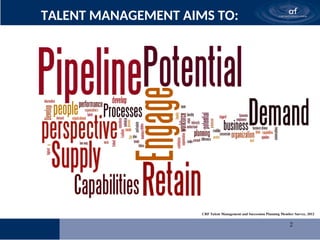
TALENT MANAGEMENT AIMS TO:
CRF Talent Management and Succession Planning Member Survey, 2012
3
TALENT MANAGEMENT AIMS TO:
 Identify and develop a credible pipeline of people to deliver the
organisation’s business plan (succession planning perspective)
 Develop the people that will make the biggest difference to the business,
particularly those with the potential to work at the highest levels (workforce
segmentation perspective)
 Engage and retain the best people (maximize contribution perspective)
 Generate information about talent demand and supply, so the organization
can be fit for the present and the future (workforce planning perspective)
 Develop the capabilities of all people across the organization to drive
business performance (organizational performance perspective)
 Embed business-driven processes to identify and develop potential (process
perspective)
 Facilitate open two-way conversations to understand the true interests and
aspirations of employees (individual perspective)
4
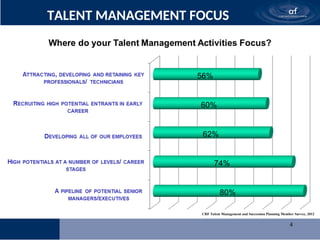
TALENT MANAGEMENT FOCUS
CRF Talent Management and Succession Planning Member Survey, 2012
5
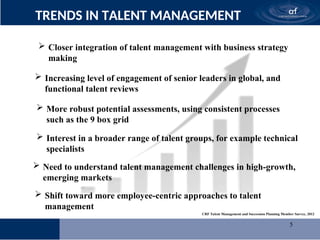
TRENDS IN TALENT MANAGEMENT
 More robust potential assessments, using consistent processes
such as the 9 box grid
 Increasing level of engagement of senior leaders in global, and
functional talent reviews
 Interest in a broader range of talent groups, for example technical
specialists
 Need to understand talent management challenges in high-growth,
emerging markets
 Shift toward more employee-centric approaches to talent
management
 Closer integration of talent management with business strategy
making
CRF Talent Management and Succession Planning Member Survey, 2012
6
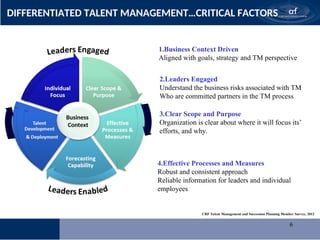
DIFFERENTIATED TALENT MANAGEMENT…CRITICAL FACTORS
Business
Context
2.Leaders Engaged
Understand the business risks associated with TM
Who are committed partners in the TM process
1.Business Context Driven
Aligned with goals, strategy and TM perspective
3.Clear Scope and Purpose
Organization is clear about where it will focus its’
efforts, and why.
4.Effective Processes and Measures
Robust and consistent approach
Reliable information for leaders and individual
employees
CRF Talent Management and Succession Planning Member Survey, 2012
7
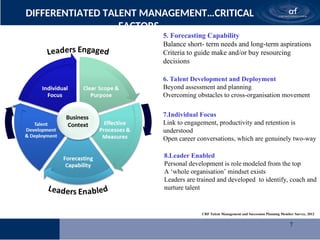
DIFFERENTIATED TALENT MANAGEMENT…CRITICAL
FACTORS
Business
Context
5. Forecasting Capability
Balance short- term needs and long-term aspirations
Criteria to guide make and/or buy resourcing
decisions
6. Talent Development and Deployment
Beyond assessment and planning
Overcoming obstacles to cross-organisation movement
7.Individual Focus
Link to engagement, productivity and retention is
understood
Open career conversations, which are genuinely two-way
8.Leader Enabled
Personal development is role modeled from the top
A ‘whole organisation’ mindset exists
Leaders are trained and developed to identify, coach and
nurture talent
CRF Talent Management and Succession Planning Member Survey, 2012
8
AGENDA
Day One – Tuesday 15 May
09:00 Welcome, Overview of the Workshop & Introductions
09:45 Session 1: The Changing Context of Talent Management
10:45 TEA & COFFEE BREAK
11:00 Talent Management in Context: CRF Member
Perspective
12:30 LUNCH
13:15 Session 2: Strategic Talent Forecasting
15:15 TEA & COFFEE BREAK
15:30 Strategic Talent Forecasting: CRF Member Perspective
17:00 Final comments & close
9
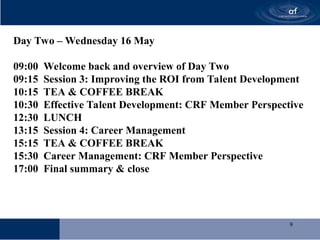
Day Two – Wednesday 16 May
09:00 Welcome back and overview of Day Two
09:15 Session 3: Improving the ROI from Talent Development
10:15 TEA & COFFEE BREAK
10:30 Effective Talent Development: CRF Member Perspective
12:30 LUNCH
13:15 Session 4: Career Management
15:15 TEA & COFFEE BREAK
15:30 Career Management: CRF Member Perspective
17:00 Final summary & close

David-North_Intro-Workshop-FINAL.pptDavid-North_Intro-Workshop-FINAL.ppt

  • 1.
    1 Talent Management inan Age of Uncertainty Workshop Introduction David North
  • 2.
    2 TALENT MANAGEMENT AIMSTO: CRF Talent Management and Succession Planning Member Survey, 2012
  • 3.
    3 TALENT MANAGEMENT AIMSTO:  Identify and develop a credible pipeline of people to deliver the organisation’s business plan (succession planning perspective)  Develop the people that will make the biggest difference to the business, particularly those with the potential to work at the highest levels (workforce segmentation perspective)  Engage and retain the best people (maximize contribution perspective)  Generate information about talent demand and supply, so the organization can be fit for the present and the future (workforce planning perspective)  Develop the capabilities of all people across the organization to drive business performance (organizational performance perspective)  Embed business-driven processes to identify and develop potential (process perspective)  Facilitate open two-way conversations to understand the true interests and aspirations of employees (individual perspective)
  • 4.
    4 TALENT MANAGEMENT FOCUS CRFTalent Management and Succession Planning Member Survey, 2012
  • 5.
    5 TRENDS IN TALENTMANAGEMENT  More robust potential assessments, using consistent processes such as the 9 box grid  Increasing level of engagement of senior leaders in global, and functional talent reviews  Interest in a broader range of talent groups, for example technical specialists  Need to understand talent management challenges in high-growth, emerging markets  Shift toward more employee-centric approaches to talent management  Closer integration of talent management with business strategy making CRF Talent Management and Succession Planning Member Survey, 2012
  • 6.
    6 DIFFERENTIATED TALENT MANAGEMENT…CRITICALFACTORS Business Context 2.Leaders Engaged Understand the business risks associated with TM Who are committed partners in the TM process 1.Business Context Driven Aligned with goals, strategy and TM perspective 3.Clear Scope and Purpose Organization is clear about where it will focus its’ efforts, and why. 4.Effective Processes and Measures Robust and consistent approach Reliable information for leaders and individual employees CRF Talent Management and Succession Planning Member Survey, 2012
  • 7.
    7 DIFFERENTIATED TALENT MANAGEMENT…CRITICAL FACTORS Business Context 5.Forecasting Capability Balance short- term needs and long-term aspirations Criteria to guide make and/or buy resourcing decisions 6. Talent Development and Deployment Beyond assessment and planning Overcoming obstacles to cross-organisation movement 7.Individual Focus Link to engagement, productivity and retention is understood Open career conversations, which are genuinely two-way 8.Leader Enabled Personal development is role modeled from the top A ‘whole organisation’ mindset exists Leaders are trained and developed to identify, coach and nurture talent CRF Talent Management and Succession Planning Member Survey, 2012
  • 8.
    8 AGENDA Day One –Tuesday 15 May 09:00 Welcome, Overview of the Workshop & Introductions 09:45 Session 1: The Changing Context of Talent Management 10:45 TEA & COFFEE BREAK 11:00 Talent Management in Context: CRF Member Perspective 12:30 LUNCH 13:15 Session 2: Strategic Talent Forecasting 15:15 TEA & COFFEE BREAK 15:30 Strategic Talent Forecasting: CRF Member Perspective 17:00 Final comments & close
  • 9.
    9 Day Two –Wednesday 16 May 09:00 Welcome back and overview of Day Two 09:15 Session 3: Improving the ROI from Talent Development 10:15 TEA & COFFEE BREAK 10:30 Effective Talent Development: CRF Member Perspective 12:30 LUNCH 13:15 Session 4: Career Management 15:15 TEA & COFFEE BREAK 15:30 Career Management: CRF Member Perspective 17:00 Final summary & close