Topic-
Team Members-
 NIKHITHA J 1GG22CS004
 PRAJWAL GOUDA B K 1GG21CS034
 RABIYA NAAZ A F 1GG21CS039
 U MANJUNATH 1GG21CS051
Mrs. PRATHIBHA T
(Mini-Project Guide)
||vtu||
GOVERNMENT ENGINEERING COLLEGE
RAMANGARA -562159
MINIPROJECT
INTRODUCTION
Background of the project:-
The background of the smart traffic fine management system project revolves around addressing
inefficiencies and challenges in traditional methods of managing traffic violations and fines. Historically,
manual processes for issuing fines, collecting payments, and maintaining records have been cumbersome,
prone to errors, and time-consuming for both traffic officers and violators. The project seeks to modernize
this process by leveraging technology to automate fine issuance, streamline payment procedures, and
provide administrators with robust tools for monitoring and managing violations. By integrating web-based
technologies like PHP, MySQL, HTML, CSS3, JavaScript, and Bootstrap, the system aims to enhance
accessibility, transparency, and efficiency in handling traffic fines, ultimately improving compliance and
contributing to safer and more organized traffic management systems.
Problem Statement-
1. Manual and Time-Consuming Processes in fine collections.
2. Lack of Transparency and Accessibility
3. Ineffective Compliance Monitoring
4. Security and Data Integrity Concerns
Objectives-
Efficiency: Streamline the process of issuing fines and managing violations to reduce
administrative
burden and processing times.
Accuracy: Ensure accurate and consistent calculation of fines based on predefined rules and
parameters.
Transparency: Provide citizens and authorities with clear and accessible information about
violations,fines, and payment options.
Compliance: Promote adherence to traffic laws through timely enforcement and effective
deterrents.
Safety: Contribute to improved road safety by discouraging reckless driving behaviors through
consistent enforcement.
TRAFFIC FINE MANAGEMENT SYSTEM
Summary of the Existing Research
LITERATURE REVIEW
TRAFFIC FINE MANAGEMENT SYSTEM
Research on traffic fine management systems reveals significant gaps. Traditional methods
rely on manual processes, where officers issue paper tickets and payments are made in
person or by mail, leading to inefficiencies and errors. There is a lack of software solutions
and centralized data storage, and online payment options are limited, making the system
inconvenient and resource-intensive. These issues highlight the need for automated
systems to improve efficiency, accuracy, and convenience.
KEY FINDINGS AND GAPS
TRAFFIC FINE MANAGEMENT SYSTEM
Key Findings:
1. Improved Efficiency: The system enhances the speed and accuracy of traffic violation detection and fine issuance through
automation, reducing administrative delays.
2.Data-Driven Insights: The system generates valuable data on traffic patterns and violation trends, enabling informed decision-
making for infrastructure planning and law enforcement strategies.
3.Transparency and Accountability: Automation promotes transparency in fine issuance and compliance monitoring, fostering trust
through accessible records and clear enforcement procedures.
Potential Gaps:
1. Technological Dependence: Reliance on surveillance technology may introduce vulnerabilities, requiring robust maintenance and
safeguards against downtime or inaccuracies.
2. Privacy Concerns: Extensive surveillance capabilities raise privacy issues, necessitating careful management of data collection,
storage, and access to protect citizen privacy rights.
3. Equity and Fairness: Automated systems must avoid bias in penalizing violations, ensuring equitable treatment across
demographics and vehicle types.
4. Legal and Regulatory Challenges: Compliance with evolving data privacy laws and regulations governing surveillance and
automated decision-making poses ongoing challenges that require careful navigation and adaptation.
REQUIREMENT ANALYSIS
Stakeholder Analysis
Functional and Non-Functional
Requirements
01
02
TRAFFIC FINE MANAGEMENT SYSTEM
2024
TRAFFIC FINE MANAGEMENT SYSTEM
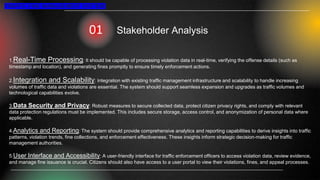
Stakeholder Analysis
1.Real-Time Processing: It should be capable of processing violation data in real-time, verifying the offense details (such as
timestamp and location), and generating fines promptly to ensure timely enforcement actions.
2.Integration and Scalability: Integration with existing traffic management infrastructure and scalability to handle increasing
volumes of traffic data and violations are essential. The system should support seamless expansion and upgrades as traffic volumes and
technological capabilities evolve.
3.Data Security and Privacy: Robust measures to secure collected data, protect citizen privacy rights, and comply with relevant
data protection regulations must be implemented. This includes secure storage, access control, and anonymization of personal data where
applicable.
4.Analytics and Reporting: The system should provide comprehensive analytics and reporting capabilities to derive insights into traffic
patterns, violation trends, fine collections, and enforcement effectiveness. These insights inform strategic decision-making for traffic
management authorities.
5.User Interface and Accessibility: A user-friendly interface for traffic enforcement officers to access violation data, review evidence,
and manage fine issuance is crucial. Citizens should also have access to a user portal to view their violations, fines, and appeal processes.
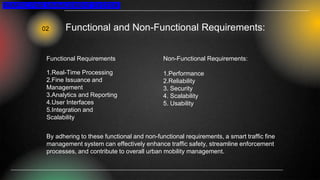
Functional and Non-Functional Requirements:
02
Functional Requirements
1.Real-Time Processing
2.Fine Issuance and
Management
3.Analytics and Reporting
4.User Interfaces
5.Integration and
Scalability
Non-Functional Requirements:
1.Performance
2.Reliability
3. Security
4. Scalability
5. Usability
By adhering to these functional and non-functional requirements, a smart traffic fine
management system can effectively enhance traffic safety, streamline enforcement
processes, and contribute to overall urban mobility management.
TRAFFIC FINE MANAGEMENT SYSTEM
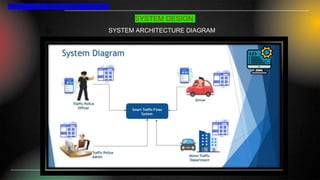
SYSTEM DESIGN
03 SYSTEM ARCHITECTURE DIAGRAM
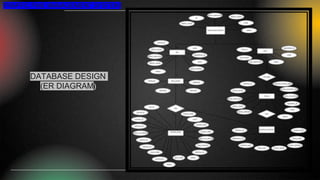
DATABASE DESIGN
(ER DIAGRAM)
TRAFFIC FINE MANAGEMENT SYSTEM
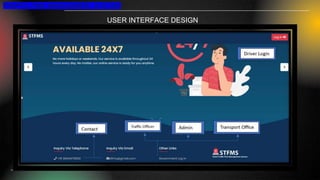
USER INTERFACE DESIGN
TRAFFIC FINE MANAGEMENT SYSTEM
TECHNOLOGIES AND TOOL SELECTION
1. PHP (Hypertext Preprocessor)
PHP is a server-side scripting language used for web development. It's widely used for building dynamic web pages and web
applications.
2. HTML (Hypertext Markup Language):
HTML is the standard markup language used to create and structure web pages and web applications.
3. CSS3 (Cascading Style Sheets):
CSS3 is the latest evolution of the Cascading Style Sheets language. It's used for describing the presentation of web pages,
including layout, colors, and fonts.
4. JavaScript:
JavaScript is a high-level, interpreted programming language that enables interactive and dynamic functionality on web pages.
5. Bootstrap:
Bootstrap is a popular front-end framework for building responsive and mobile-first websites and web applications.
6. MySQL:
MySQL is an open-source relational database management system (RDBMS). It uses SQL (Structured Query Language) to manage
and manipulate data.
7.Xampp Server.
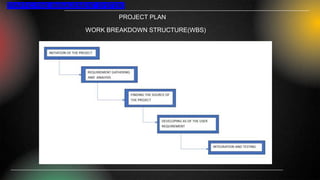
PROJECT PLAN
WORK BREAKDOWN STRUCTURE(WBS)
TRAFFIC FINE MANAGEMENT SYSTEM
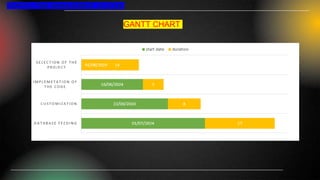
GANTT CHART
TRAFFIC FINE MANAGEMENT SYSTEM
RESOURCE ALLOCATION
When working on a group project where group members cannot be differentiated, it's
essential to foster a collaborative and unified approach to ensure everyone contributes
effectively. Based on the interest of the members or the requirement of the project the
resources are allocated.
Project Management  Prajwal Gowda B K
Database  By all Team Members
Documentation –
Report  U Manjunath ,Nikitha J
Presentation Slide’s  Rabiya Nazz
TRAFFIC FINE MANAGEMENT SYSTEM
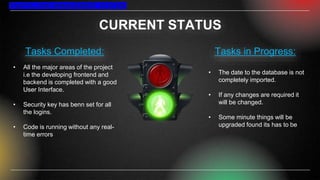
CURRENT STATUS
• All the major areas of the project
i.e the developing frontend and
backend is completed with a good
User Interface.
• Security key has benn set for all
the logins.
• Code is running without any real-
time errors
• The date to the database is not
completely imported.
• If any changes are required it
will be changed.
• Some minute things will be
upgraded found its has to be
Tasks Completed: Tasks in Progress:
TRAFFIC FINE MANAGEMENT SYSTEM
Issues and Challenges:
TRAFFIC FINE MANAGEMENT SYSTEM
2022
The main issues and challeneges are :
*Communication between the teammates as to ensure all are working in the
particular rhythm in a coordination.
*In the coding part it’s the most challenging part in a project where we will be
using the different new types of codes which will not be much familier so that if
we have to change the particular part in a project we have to go in depth of the
analysis of the code and then take the trail and error method where we may the
success I may take the time upto hours.
*And at last , uploading of the data to the database where data will be in the big
amount.
NEXT TASKS
UPCOMING TASKS- Completing of the required changes in the Frontend and
Feeding the data to the database
Immediate Milestones- As soon as the task are completed the project will be
done and it will be under the final review
Risk Management- There are many risk taking works where its very much tough to
handle , so by studying what are the measures can be taken it will be helfull to move
on in the project
TRAFFIC FINE MANAGEMENT SYSTEM
Summary
The smart traffic fine management system project aims to revolutionize the management of
traffic violations and fines through automation and enhanced user interfaces. Leveraging PHP
for backend logic and MySQL for database management, alongside HTML, CSS3, JavaScript,
and Bootstrap for frontend development, the system facilitates seamless interaction between
traffic officers issuing fines and violators making payments online. Key features include real-
time fine issuance, secure payment processing, and comprehensive administrative tools for
monitoring and reporting. Throughout its development, challenges such as coordinating tasks
among undifferentiated team members were addressed through agile methodologies and
rigorous testing practices. The project prioritized user-centric design, robust security measures,
and proactive risk management to ensure a reliable, scalable, and user-friendly solution. Upon
deployment, the system aims to streamline operations, improve compliance, and enhance
overall efficiency in traffic fine management.
TRAFFIC FINE MANAGEMENT SYSTEM
THANK YOU

TRAFFIC FINE MANAGEMENT SYSTEM PPT .pptx

  • 1.
    Topic- Team Members-  NIKHITHAJ 1GG22CS004  PRAJWAL GOUDA B K 1GG21CS034  RABIYA NAAZ A F 1GG21CS039  U MANJUNATH 1GG21CS051 Mrs. PRATHIBHA T (Mini-Project Guide) ||vtu|| GOVERNMENT ENGINEERING COLLEGE RAMANGARA -562159 MINIPROJECT
  • 2.
    INTRODUCTION Background of theproject:- The background of the smart traffic fine management system project revolves around addressing inefficiencies and challenges in traditional methods of managing traffic violations and fines. Historically, manual processes for issuing fines, collecting payments, and maintaining records have been cumbersome, prone to errors, and time-consuming for both traffic officers and violators. The project seeks to modernize this process by leveraging technology to automate fine issuance, streamline payment procedures, and provide administrators with robust tools for monitoring and managing violations. By integrating web-based technologies like PHP, MySQL, HTML, CSS3, JavaScript, and Bootstrap, the system aims to enhance accessibility, transparency, and efficiency in handling traffic fines, ultimately improving compliance and contributing to safer and more organized traffic management systems.
  • 3.
    Problem Statement- 1. Manualand Time-Consuming Processes in fine collections. 2. Lack of Transparency and Accessibility 3. Ineffective Compliance Monitoring 4. Security and Data Integrity Concerns Objectives- Efficiency: Streamline the process of issuing fines and managing violations to reduce administrative burden and processing times. Accuracy: Ensure accurate and consistent calculation of fines based on predefined rules and parameters. Transparency: Provide citizens and authorities with clear and accessible information about violations,fines, and payment options. Compliance: Promote adherence to traffic laws through timely enforcement and effective deterrents. Safety: Contribute to improved road safety by discouraging reckless driving behaviors through consistent enforcement. TRAFFIC FINE MANAGEMENT SYSTEM
  • 4.
    Summary of theExisting Research LITERATURE REVIEW TRAFFIC FINE MANAGEMENT SYSTEM Research on traffic fine management systems reveals significant gaps. Traditional methods rely on manual processes, where officers issue paper tickets and payments are made in person or by mail, leading to inefficiencies and errors. There is a lack of software solutions and centralized data storage, and online payment options are limited, making the system inconvenient and resource-intensive. These issues highlight the need for automated systems to improve efficiency, accuracy, and convenience.
  • 5.
    KEY FINDINGS ANDGAPS TRAFFIC FINE MANAGEMENT SYSTEM Key Findings: 1. Improved Efficiency: The system enhances the speed and accuracy of traffic violation detection and fine issuance through automation, reducing administrative delays. 2.Data-Driven Insights: The system generates valuable data on traffic patterns and violation trends, enabling informed decision- making for infrastructure planning and law enforcement strategies. 3.Transparency and Accountability: Automation promotes transparency in fine issuance and compliance monitoring, fostering trust through accessible records and clear enforcement procedures. Potential Gaps: 1. Technological Dependence: Reliance on surveillance technology may introduce vulnerabilities, requiring robust maintenance and safeguards against downtime or inaccuracies. 2. Privacy Concerns: Extensive surveillance capabilities raise privacy issues, necessitating careful management of data collection, storage, and access to protect citizen privacy rights. 3. Equity and Fairness: Automated systems must avoid bias in penalizing violations, ensuring equitable treatment across demographics and vehicle types. 4. Legal and Regulatory Challenges: Compliance with evolving data privacy laws and regulations governing surveillance and automated decision-making poses ongoing challenges that require careful navigation and adaptation.
  • 6.
    REQUIREMENT ANALYSIS Stakeholder Analysis Functionaland Non-Functional Requirements 01 02 TRAFFIC FINE MANAGEMENT SYSTEM 2024
  • 7.
    TRAFFIC FINE MANAGEMENTSYSTEM Stakeholder Analysis 1.Real-Time Processing: It should be capable of processing violation data in real-time, verifying the offense details (such as timestamp and location), and generating fines promptly to ensure timely enforcement actions. 2.Integration and Scalability: Integration with existing traffic management infrastructure and scalability to handle increasing volumes of traffic data and violations are essential. The system should support seamless expansion and upgrades as traffic volumes and technological capabilities evolve. 3.Data Security and Privacy: Robust measures to secure collected data, protect citizen privacy rights, and comply with relevant data protection regulations must be implemented. This includes secure storage, access control, and anonymization of personal data where applicable. 4.Analytics and Reporting: The system should provide comprehensive analytics and reporting capabilities to derive insights into traffic patterns, violation trends, fine collections, and enforcement effectiveness. These insights inform strategic decision-making for traffic management authorities. 5.User Interface and Accessibility: A user-friendly interface for traffic enforcement officers to access violation data, review evidence, and manage fine issuance is crucial. Citizens should also have access to a user portal to view their violations, fines, and appeal processes.
  • 8.
    Functional and Non-FunctionalRequirements: 02 Functional Requirements 1.Real-Time Processing 2.Fine Issuance and Management 3.Analytics and Reporting 4.User Interfaces 5.Integration and Scalability Non-Functional Requirements: 1.Performance 2.Reliability 3. Security 4. Scalability 5. Usability By adhering to these functional and non-functional requirements, a smart traffic fine management system can effectively enhance traffic safety, streamline enforcement processes, and contribute to overall urban mobility management. TRAFFIC FINE MANAGEMENT SYSTEM
  • 9.
    TRAFFIC FINE MANAGEMENTSYSTEM SYSTEM DESIGN 03 SYSTEM ARCHITECTURE DIAGRAM
  • 10.
  • 11.
    USER INTERFACE DESIGN TRAFFICFINE MANAGEMENT SYSTEM
  • 12.
    TRAFFIC FINE MANAGEMENTSYSTEM TECHNOLOGIES AND TOOL SELECTION 1. PHP (Hypertext Preprocessor) PHP is a server-side scripting language used for web development. It's widely used for building dynamic web pages and web applications. 2. HTML (Hypertext Markup Language): HTML is the standard markup language used to create and structure web pages and web applications. 3. CSS3 (Cascading Style Sheets): CSS3 is the latest evolution of the Cascading Style Sheets language. It's used for describing the presentation of web pages, including layout, colors, and fonts. 4. JavaScript: JavaScript is a high-level, interpreted programming language that enables interactive and dynamic functionality on web pages. 5. Bootstrap: Bootstrap is a popular front-end framework for building responsive and mobile-first websites and web applications. 6. MySQL: MySQL is an open-source relational database management system (RDBMS). It uses SQL (Structured Query Language) to manage and manipulate data. 7.Xampp Server.
  • 13.
    PROJECT PLAN WORK BREAKDOWNSTRUCTURE(WBS) TRAFFIC FINE MANAGEMENT SYSTEM
  • 14.
    GANTT CHART TRAFFIC FINEMANAGEMENT SYSTEM
  • 15.
    RESOURCE ALLOCATION When workingon a group project where group members cannot be differentiated, it's essential to foster a collaborative and unified approach to ensure everyone contributes effectively. Based on the interest of the members or the requirement of the project the resources are allocated. Project Management  Prajwal Gowda B K Database  By all Team Members Documentation – Report  U Manjunath ,Nikitha J Presentation Slide’s  Rabiya Nazz TRAFFIC FINE MANAGEMENT SYSTEM
  • 16.
    CURRENT STATUS • Allthe major areas of the project i.e the developing frontend and backend is completed with a good User Interface. • Security key has benn set for all the logins. • Code is running without any real- time errors • The date to the database is not completely imported. • If any changes are required it will be changed. • Some minute things will be upgraded found its has to be Tasks Completed: Tasks in Progress: TRAFFIC FINE MANAGEMENT SYSTEM
  • 17.
    Issues and Challenges: TRAFFICFINE MANAGEMENT SYSTEM 2022 The main issues and challeneges are : *Communication between the teammates as to ensure all are working in the particular rhythm in a coordination. *In the coding part it’s the most challenging part in a project where we will be using the different new types of codes which will not be much familier so that if we have to change the particular part in a project we have to go in depth of the analysis of the code and then take the trail and error method where we may the success I may take the time upto hours. *And at last , uploading of the data to the database where data will be in the big amount.
  • 18.
    NEXT TASKS UPCOMING TASKS-Completing of the required changes in the Frontend and Feeding the data to the database Immediate Milestones- As soon as the task are completed the project will be done and it will be under the final review Risk Management- There are many risk taking works where its very much tough to handle , so by studying what are the measures can be taken it will be helfull to move on in the project TRAFFIC FINE MANAGEMENT SYSTEM
  • 19.
    Summary The smart trafficfine management system project aims to revolutionize the management of traffic violations and fines through automation and enhanced user interfaces. Leveraging PHP for backend logic and MySQL for database management, alongside HTML, CSS3, JavaScript, and Bootstrap for frontend development, the system facilitates seamless interaction between traffic officers issuing fines and violators making payments online. Key features include real- time fine issuance, secure payment processing, and comprehensive administrative tools for monitoring and reporting. Throughout its development, challenges such as coordinating tasks among undifferentiated team members were addressed through agile methodologies and rigorous testing practices. The project prioritized user-centric design, robust security measures, and proactive risk management to ensure a reliable, scalable, and user-friendly solution. Upon deployment, the system aims to streamline operations, improve compliance, and enhance overall efficiency in traffic fine management. TRAFFIC FINE MANAGEMENT SYSTEM
  • 20.