1 | P a g e
Table of Contents
Introduction....................................................................................................................................................2
Literature review ...........................................................................................................................................3
Traditional project management vs modern project management...........................................3
Project Management..........................................................................................................................3
Traditional and agile project management..................................................................................3
Agile project management definition............................................................................................4
Traditional project management definition .................................................................................4
Three agile project management strengths and weaknesses....................................................4
Challenges faced by companies when implementing agile methodologies...........................6
Management and organizational challenges...............................................................................7
People....................................................................................................................................................7
Process .................................................................................................................................................8
Technology (Tools and Techniques).............................................................................................8
Highlighting the impact of agile project management on IT project and Agile
methodology in the 5th industry of IT...............................................................................................9
Business people and developers must work together daily throughout the project:......9
The main priority is to satisfy the customer through early and continuous delivery of
valuable software:..............................................................................................................................9
Working software is the primary measure of progress: ........................................................10
Findings........................................................................................................................................................11
Hybrid Agile methodology for the 5th industries of software development..........................11
Conclusion...................................................................................................................................................13
References ..................................................................................................................................................14
2 | P a g e
Introduction
A project is a process in which an idea is developed from its inception until either it is
discarded, or the product of the idea has been accepted by the ultimate user. (Koch,
1981). Koch further elaborates on the projects intention, stating that – A project is
intended to produce specific results at a particular point in time at a certain cost, and
may originate from a need to improve and increase facilities so that the end goal of the
company – continuous profitability in its field of endeavor – can be achieved.
It has long been understood that a large portion of software development projects fail.
(Chiyangwa & Mnkandla, 2017). According to Chiyangwa & Mnkandla, organizations
spend a large amount of money adopting agile development processes with an
expectation that the software projects are going to be completed on time, but end up
incurring costs nonetheless.
This research paper explores how organizations implement agile project management
principles in order to remain flexible and profitable.
In the initial stages of any project, capital estimates and preliminary designs have to
be prepared. A provision of contingencies varying from 5 to 25 percent is usually added
to these preliminary estimates to allow for uncertainty and lack of detail at this stage.
(Ferreira, et al., 1982). The successful management of projects whether greenfield or
brownfield in nature, requires that a careful planning process be followed. This is then
followed by the accomplishment of the work itself. (Clegg, 2005).
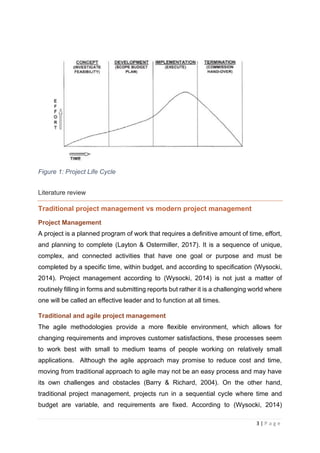
Clegg further describes the four life cycle phases of the time frame through which any
project passes, namely:
• Concept
• Development
• Implementation/ Execution
• Termination / Finish
These will be explored in this research paper, as mentioned above, to evaluate how
companies can use agile methodologies to select projects that keep them profitable.
3 | P a g e
Figure 1: Project Life Cycle
Literature review
Traditional project management vs modern project management
Project Management
A project is a planned program of work that requires a definitive amount of time, effort,
and planning to complete (Layton & Ostermiller, 2017). It is a sequence of unique,
complex, and connected activities that have one goal or purpose and must be
completed by a specific time, within budget, and according to specification (Wysocki,
2014). Project management according to (Wysocki, 2014) is not just a matter of
routinely filling in forms and submitting reports but rather it is a challenging world where
one will be called an effective leader and to function at all times.
Traditional and agile project management
The agile methodologies provide a more flexible environment, which allows for
changing requirements and improves customer satisfactions, these processes seem
to work best with small to medium teams of people working on relatively small
applications. Although the agile approach may promise to reduce cost and time,
moving from traditional approach to agile may not be an easy process and may have
its own challenges and obstacles (Barry & Richard, 2004). On the other hand,
traditional project management, projects run in a sequential cycle where time and
budget are variable, and requirements are fixed. According to (Wysocki, 2014)
4 | P a g e
traditional project management is the historical root of modern project management.
Furthermore, the ultimate goal of the traditional project management is the optimization
and efficiency in following initial detailed project plan (Shenhar & Dvir, 2007).
Agile project management definition
Agile project management is gaining very wide public attention recently, and it is
considered as the project management approach for today’s projects, compared to
what is usually called traditional project management approach (Spundak, 2014).
Agile project management has become a more increasingly popular tool that has been
used by organizations with agile processes and methodologies in use. Agile project
management is a fast and flexible approach for managing all projects, not just a
software development, it has a greater flexibility and stability, less nonproductive
work and faster failure detection (Layton & Ostermiller, 2017).
Traditional project management definition
Traditional project management involves very disciplined and deliberate planning and
control methods (Hass, 2007). The basic idea behind traditional approach is that
projects are relatively simple, predictable and linear with clearly defined boundaries
which makes it easy to plan in detail and follow that plan without much changes
(Spundak, 2014; Barry & Richard, 2004). Traditional project management assumes
that events affecting the project are predictable and that tools and activities are well
understood and it in this approach it is believed that once a phase is complete, it is
assumed that it will not be visited (Hass, 2007).
Three agile project management strengths and weaknesses
The core of agile methodologies is people, customer and each team member in agile
development teams which are the key success or failure factors in agile process (Rajiv
Kumar, 2014). This section dives into the strengths and weaknesses of three specific
agile methodologies, namely Scrum, XP (extreme programming) and Lean.
Scrum
Morampudi states that many organizations prefer Scrum to complete their work in time.
It is hugely beneficial if Scrum get improvised or enhanced with new features so that
projects get better results, the frequency of the failed projects in an organization will
become less (Naga Sri Morampudi, 2013). Kumar agrees that due to its simple
5 | P a g e
development mechanism and managerial attributes, Scrum technology’s popularity is
increasing day by day all around the world (Rajiv Kumar, 2014).
• Strengths:
This methodology mainly relies on effective and efficient communication among the
team members (Qureshi, 2017). It is one of the best in management practices. The
core values as stated by Qureshi in (Qureshi, 2017) are daily inspections, self-
organized teams, the Scrum master, every sprint having a delivery and product owner
setting priorities to the product backlog.
According to (Al-Baik, 2015), Scrum has short iterations which involve continuous
feedback from the customer that makes it easy to cope with the changing needs and
requirements of the industry. This in turn helps in delivering a quality product with
customer satisfaction. Daily Scrum meetings and sprint meetings make it easier to
measure the growth and productivity of a product and an individual working in that
team. Also, testing is done at the end of each sprint which guarantees the quality and
bugs are fixed right away. guarantees the quality and bugs are fixed right away. With
several Scrum meetings, it becomes easier to follow the schedule and deliver the
product on time.
• Weaknesses:
In spite of having several known strengths in Scrum methodology, it has its own
weaknesses. Scrum software development is suitable for small projects and it
becomes comparatively difficult to follow Scrum in large organizations. One of the main
weaknesses of Scrum is reported in (Rizvi, 2015) that many employees in the software
industry lack the knowledge of Scrum. They complete one simple course on Scrum
and call themselves as Scrum masters. Another weakness is it lacks engineering
practices (Qureshi, 2017) and so there were many attempts to combine Scrum with
other methodologies. Scrum is simple to understand but difficult to master (Perkusich,
2017).
Extreme Programming (XP)
Like any other Agile methodology, XP also consists of iterations and in return gives
quality product products with customer satisfaction. XP can also handle unclear and
6 | P a g e
changing requirements in the industry (Korhonen, 2013). Many researchers have
made attempts to integrate XP with Scrum or XP with any other methodology.
• Strengths
Pair programming and continuous integration are the most used practices in XP and
results in improving the productivity (Tarwani, 2016). XP works well with simple and
small-scale projects and focuses more on coding than on the design (Harzl, 2017).
• Weaknesses
The weaknesses of XP as stated in (Korhonen, 2013) are lack of documentations, poor
architectural structure and less focus on design. There were 18 papers reviewed in
(Korhonen, 2013) that showed that there were several attempts made to overcome
these weaknesses. Some of them had solutions to a few weaknesses but not all. In
(Korhonen, 2013), a simplified XP model has been proposed which overcomes all the
weaknesses stated above but there is no validation done for the same.
There are several studies which show that simply placing two programmers in front of
the computer is not enough (pair programming in XP) (Anwer, 2017). Pair
programming requires mutual understanding of both the programmers and a common
skillset. It requires much knowledge and expertise of that domain by both programmers
(Korhonen, 2013).
Lean
Lean is an Agile toolkit which has principles mainly focused on elimination of waste
and maximization of value (Al-Baik, 2015), (Santos, 2018). The Lean methodology has
been claimed as the fastest growing methodology for product development in the past
decade (Ahmad, 2018). It has a very behavioural approach (Hohl, 2018). However,
Lean does not cover the technical and managerial issues. Its concerns are mostly
about minimizing the wastage and hence improving the quality (Al-Baik, 2015).
Challenges faced by companies when implementing agile methodologies
Implementing agile technology comes with a lot of challenges for any organization.
Employing the model of Sridhar Nerur, RadhaKanta Mahapatra, and George
Mangalaraj (N. Sridhar, 2005), we discuss the challenges one after the other:
7 | P a g e
Management and organizational challenges
This is categorized into the following subheadings: Organizational Culture,
Management Style, Organizational Form, and Management of Software Development
Knowledge, Reward Systems. If the management style is that of command-and-control
as against leadership and collaboration, it will be very difficult for the organization to
switch to agile development easily and quickly.
The culture of an organization is the way of life of the organization (spoken and
unspoken), and if the way of life of the organization is the mechanistic (bureaucratic
with high formalization) as is the case for traditional system development, it will be very
difficult for it to adopt the organic (flexible and participative encouraging cooperative
social action) in the case for agile systems development (Godfred Yaw Koi-Akrofi,
2019).
Lack of management of software development knowledge can also pose a
management or organizational challenge to the adoption of agile technology. This is
because for the success with agile, one has to be abreast with even the management
with the traditional methods, and the benefits with which agility comes to the table.
People
People challenges is categorized into the following: Effectively working in a team, high
level of expertise, customer relationships — commitment, understanding or
knowledge, closeness or proximity, trust, respect (Godfred Yaw Koi-Akrofi, 2019).
When it comes to team dynamics with agile systems development, a number of
questions do arise. Some of these questions are: what is the recommended size of the
team to achieve high performance and excellent communication? What should be the
level of expertise of the team members? How professional is the team when it comes
to dealings with customers?
As has already been established, research work by Scott W. Ambler (Ambler, 2009)
suggests that the smaller the team size, the higher the success rate of agile projects.
Again, the findings stated in a study conducted by Ancona and Caldwell's (Caldwell,
1992) reveals that team size could have a direct effect on group efficiency and
communication. Communication — either the absence of it, or miscommunication —
is one of the root causes of project failure. Large teams are vehicles of bad
8 | P a g e
communication inherently. This is based on the amount of geometrically, not linearly,
growing channels of interaction (Abilla, 2008).
A good team communicate well with each other and focus on goals and results.
Everyone in the team contributes their fair share and they offer each other support.
Team members are diverse, and they have good leadership. They are organized and
they have fun. Agile teams should have good attitudes towards customers because
agile methods are customer centered as against traditional methods where customers
only come in at the initial stages of the project management life cycle.
The problem with very technical people is the difficulty in communicating effectively
with customers. Communicating effectively and informally with customers to gather
evolving requirements is a “must have” attribute if one wants to work in an agile team.
Process
With agile systems development, processes are no longer the strict adherence to stage
by stage procedures and elaborate documentation and governance processes, but a
flexible approach to project delivery. This makes agile simple and yet a discipline which
requires knack. Lack of these expertise in itself is enough for agile to be rejected
(Godfred Yaw Koi-Akrofi, 2019).
Agile changes from process-centric to a feature-driven, people-centric approach. It is
short, iterative, test-driven development that emphasizes adaptability, and managing
large, scalable projects. Another issue is in the selection of an appropriate agile
method.
Technology (Tools and Techniques)
This challenge is related to the suitability of current technology and instruments and
fresh skill sets — refactoring, configuration management, and so on. It is very difficult,
in fact almost impossible for an organization to change its technology, tools and
methods to a new one when the current one they are using is working perfectly and
achieving great results for them (Godfred Yaw Koi-Akrofi, 2019).
This is why most organizations find it difficult to adopt agile after using the traditional
methods for a long time and working perfectly for them. Coupled with the new skill sets
that they have to acquire even makes them reluctant the more.
9 | P a g e
Highlighting the impact of agile project management on IT project and Agile
methodology in the 5th industry of IT.
According to (Sowaidan, May 2016) product innovation can only be achieved by using
agile methodology which is highly needed by user’s engagement in the development
process and with the association of skilled team members and effective management
using advanced tools. Some years ago, product development industries were
witnessing changes in a fast paced thereby struggling to adjust their products life cycle,
marketing time and dropped in the production of new products in the organizations and
slowing the production chain. Most organizations are adopting new methods which
give them the opportunity to cope with the changes through the agile processes which
offers flexibility in managing projects that are not offered in traditional methods and
give them the chance of continues improvement throughout the project life cycle and
in return innovations are presented and higher customer satisfaction is achieved. In
order to achieve agile development in project management in IT businesses certain
principles must be considered which form a foundation for the agile development
Business people and developers must work together daily throughout the
project: (Fowler , Highsmith & Ondiek, 2001)an effective delivery of an IT project or
business must involve stakeholders and the project team in every stage of the project
which provide the necessary requirements, as the main purpose of the agile method
is to involve all the concerned parties in the development process to achieve the
expectation of customers, because customers usually have high expectations of the
product and they cannot be fulfilled unless there is frequent communication between
the developers and the stakeholders.
The main priority is to satisfy the customer through early and continuous
delivery of valuable software: The use of software in agile project is a primary focus
to deliver value to customers instead of focusing on documentation and planning,
documentation is important, but customers only interest lies in receiving a working
software that satisfy their needs and help them to achieved greater productivity (Scott
Ambler and Associates n.d., n.d.). Software is very important to customers because it
insures customers receive value immediately, it also enables the product developers
to receive feedbacks from the product stakeholders, these feedbacks can be used to
guide the developers for continuous enhancement for the product.
10 | P a g e
Working software is the primary measure of progress: Software must be tested
before the delivery in sufficient time, it will help the team required time to solve any
unexpected problem that will appear and thus, the iterative method provides an
opportunity to check project progress and avoid risks. Agility focuses on bringing
quality software, designs can be adjusted throughout the project cycle whenever
needed to ensure high quality product is delivered (Fowler, 2001)
However, (Bohner, 2005), even though as a result of risk management some
developers may not fit in this Agile environment, but these major factors such as
developers, testers and people impact in agile projects in IT domain. Agile methods
depend on strong developers which must be amicable, talented, skilled, and have good
communication skill, as they are able to work as a team to handle constant change and
resourceful enough to solve problems. People are greatly involved in a software effort
because there are always customers and end users who want resulting products.
Testers must work closely with the developers as code is being written for quality
assurance, all of which impact Agile methodology in the IT business.
Most organizations faces challenges when applying Agile approach in the first place
(Chandana, 2020), because agile methodologies require a culture change many
companies aren’t ready for. These companies must embrace new management
approaches which break down information and create an environment where
collaborate input is valued, and ideas can grow. This help build trust and improve the
link between individual efforts and the overall success of the organization.
Agile project managers should be braced for resistance, particularly if an organization
has not yet embraced an Agile approach.
According to (Barata, 2016), in the recent years, most manufacturing companies faces
competition which shifted from cost reduction to added value in products. The 5th
generation of industries especially in the IT and manufacturing companies their
production systems are required to be responsive, re-configurable, adaptable, and
flexible. The fulfilment of these requirements is directly related to the method used to
design and develop their control applications. Agile methodology has greatly impacted
the foundation for the development and its related tools for achieving agility in
programming manufacturing control systems. Some manufacturers are demanding for
more and more exclusive, efficient and effective production systems capable to
11 | P a g e
produce as many different product variations as quickly as possible. Manufacturing
companies are striving to introduce flexible and adaptive manufacturing techniques in
order to better meet market needs whilst maintaining the low-cost base of heavily
automated mass production techniques. For example, an existing plant cannot be
rebuilt due to high investment volumes, the changes in hardware components affect
particularly the control software. Therefore, control software is the stage of continuous
modifications during the production system lifecycle which implies an increasing in its
amount and complexity. The idea of applying agile methodology is implementing,
monitoring and control solutions in the automotive industry in order to outline the
challenges faced by the system integrators.
Findings
Through the findings, we are going to try and answer the question of how do the 5th
industry companies implement agile project management to stay flexible and
profitable?
With the industrialisation and the new technological means, software development
teams can be scattered around the world, which makes agile methodologies not
always the best suitable solution for this type of project (Ghilic-Micu, et al., 2014).
However, through our literature review, we have highlighted some key point that
demonstrates the strengths and weaknesses of the implementation of agile project
management methodology. Now we will present how companies can use hybrid agile
project management methodology such as Scrum + to improve and maintain their
productivity and flexibility.
Hybrid Agile methodology for the 5th industries of software development
According to (Jesús, et al., 2019) Scrum+ is a guideline grounded on Scrum and
defines as a set of activities, tasks, roles and criteria to support agile global software
development projects in multimodal environments.
Manole and Avranmescu say that the foundation of software development company
relies on communication. Hence, the practicality of Scrum+ which uses ten distributed
activities/phases to facilitate communication between team members who are not in
the same country.
12 | P a g e
We have narrowed the ten phases to five because only these few phases are not
commonly used in the implementation of agile project management. We decreased
them based on criteria such as transparency of information, flawless integration of
different part of the project, communication between the product owner and the
development teams, evaluation of the evolution of the project and the repartition of
work.
First let us look at the management of the tasks, according to (Kautz, et al., 2014)
teams in a distributed environment should strive to create a dynamic and a better
understanding of the duty allocated to them at the beginning of the project. Therefore,
the Initiation phase is the one during which Scrum+ master can give out responsibilities
to each team representative so that they have the duty to inform their team members
of the task they have to carry throughout the project (Jesús, et al., 2019).
Thanks to the use of internal or external communication mean such as Zoom, Microsoft
Team, Google Meet, Skype, etc., the Scrum+ master will be able to schedule and
record meetings for the sake of transparency to allow documentation of events and
topics discussed (Manole & Avramescu, 2017). This summarizes two phases of
Scrum+ which are Sprint Zero+ and Sprint Retrospective.
During the Sprint Zero + phase, the Scrum+ master and the team representative plan
the strategy that will facilitate the coordination of activities carried out through
development. On the other hand, during the Sprint Retrospective phase, each team
analyses their strengths and weaknesses so far and plan the measures to be taken to
improve the work (Jesús, et al., 2019).
We can see that in both phases, the role of the team representative is to report to the
Scrum+ team master, to inform their teams of the new deadlines and to make sure that
the work is done according to the product owner requirements. Moore, et al.( 2007)
argue that the role of a team leader is to encourage compliance with deadlines without
going through continuous development cycles.
In a distributed environment the Integration phase is a fundamental element of good
collaboration (Manole & Avramescu, 2017). In Scrum+, it is the Scrum+ master who
13 | P a g e
oversees the integration and sharing of the separate pieces of the project generated
by all teams.
The Release phase is the one during which the Scrum+ master present the integrated
to the product owner who will give a feedback of his appreciation of the final product.
Conclusion
From the research presented, we can conclude that agile project management is the
preferred methodology by most organization when executing projects. (Layton &
Ostermiller, 2017). Because of agile project management faster failure detection, this
is ideal in preventing companies incurring financial losses as contingencies can be
triggered early in the project. In contrast to tradition methodologies that adopt a more
sequential approach and rely on fixed requirements, agile methodologies are flexible
and allow off the cuff changes in requirements. This is beneficial when issue crop up
and software development teams have to add or remove features. This has the added
benefit of saving time and money for organizations and directly enhances their ability
to assess and detect failure of a project and adapt to a change in the requirement. This
is how organization can save money on projects instead of waiting for task or project
completion to assess its success.
Agile project management places emphasis on communication. This means that
stakeholders are always aware of the project performance at each stage. With the goal
being that the organization must not lose money on a project, this means that the
project sponsor gets regular updates, and can meet the and change the project
manager to change the requirement or scrap the project entirely.
From an efficiency point of view, the SCRUM ensures that everyone involved in the
project knows what tasks to complete at each iteration of the project.
Given the literature review, contrast in agile and traditional methodologies, we can
conclude that organizations are better suited to adopt agile project management
methodologies when executing projects if the are to remain competitive and profitable.
Agile tolls such as extreme programming, assist in high intensity environments and
allow project teams to deliver robust applications with immediate customer feedback.
From a software development standpoint this is the ideal outcome for any project team.
14 | P a g e
References
Abilla, P., 2008. Team Dynamics: Size Matters Redux. [Online]
Available at: http://www.shmula.com/team-dynamics-size-matters-redux/182/
[Accessed 10 October 2020].
Ahmad, M. O. D. D. C. K. K. &. O. M., 2018. Kanban in software engineering: A systematic mapping study.
Journal of Systems and Software Software, 96(113), p. 137.
Ajmal, S., 2017. Pros and Cons of SCRUM Methodology. [Online]
Available at: https://www.quickstart.com/blog/pros-and-cons-of-scrum-methodology/
[Accessed 10 October 2020].
Al-Baik, O. &. M. J., 2015. The kanban approach, between agility and leanness: A systematic review.
Empirical Software Engineering Engineering.
Ambler, S. W., 2009. The Standish Report, “The CHAOS Report 2009 on IT Project Failure”. [Online]
Available at: https://pmhut.com/the-chaos-report-2009-on-it-project-failure
[Accessed 10 October 2020].
Anwer, F. A. S. W. U. &. M. S. S., 2017. Agile software development models TDD. FDD, DSDM , and Crystal
Methods: A Survey Survey.
Barata, G. O. a. J., 2016. Agile Manufacturing in. [Online]
Available at: https://hal.inria.fr/hal-01274765/document
[Accessed Feb].
Barry, B. & Richard, T., 2004. Balancing Agility and Discipline: A guide for the perplexed. 1st ed. United
States: Pearson Education, Inc.
Bohner, M. C. &. S., 2005. The impact of agile methods on software project management. [Online]
Available at:
file:///C:/Users/cash/Downloads/TheImpactofAgileMethodsonSoftwareProjectManagement.pdf
Caldwell, D. G. A. a. D. F., 1992. Work-groups; Organizational-climate; Organizational effectiveness.
Administrative Science Quarterly, Volume 37, pp. 634-65.
Chandana, 2020. Agile Project Management and Its Impact. [Online]
Available at: https://www.simplilearn.com/agile-project-management-and-its-impact-rar80-article
Chiyangwa, T. B. & Mnkandla, E., 2017. Modelling the critical success factors of agile software. South
African Journal of Information Management.
Clegg, A. M., 2005. Risk in project preparation - ‘determining the project needs and the effects on the
management strategy’. The Journal of The South African Institute of Mining and Metallurgy.
Ferreira, G., Coreejes, A. G. R. & F.C.I.S, 1982. Capital and cost control systems used in the establishment
of the Grootegeluk Coal Mine. JOURNAL OF THE SOUTH AFRICAN INSTITUTE OF MINING AND
METALLURGY.
Fowler , Highsmith & Ondiek, 2001. [Online].
Fowler, &. H., 2001. s.l.: s.n.
15 | P a g e
Ghilic-Micu, B., Stoica, M. & Uscatu, R. C., 2014. Cloud Computing and Agile Organization Development.
Informatica Economică, 18(4), pp. 5-13.
Godfred Yaw Koi-Akrofi, J. K.-A. H. A. M., 2019. UNDERSTANDING THE CHARACTERISTICS, BENEFITS AND
CHALLENGES OF AGILE IT PROJECT MANAGEMENT: A LITERATURE BASED PERSPECTIVE. International
Journal of Software Engineering & Applications, 10(5), p. 20.
Harzl, A., 2017. Can FOSS projects benefit from integrating Kanban: A case study. Journal of Internet
Services and Applications.
Hass, K. B., 2007. The blending of traditional and agile project management. PM World Today, 5(9), pp. 1-
8.
Hohl, P. K. J. V. V. B. A. L. R. G. J. M. J. S. M. M. &. S. K., 2018. Back to the future: Origins and directions of
the “Agile Manifesto” – Views of the originators. Journal of Software Engineering Research and
Development Development.
Jesús, C., Pardo-Calvache & Chilito-Gómez, P. R., 2019. Scrum+: A scaled Scrum for the agile global. redin,
Volume 93, pp. 105-116.
Kautz, K., Heide, J. T. & Uldahl, A., 2014. THE PERCEIVED IMPACT OF THE AGILE DEVELOPMENT AND
PROJECT MANAGEMENT METHOD SCRUM ON INFORMATION SYSTEMS AND SOFTWARE DEVELOPMENT
PRODUCTIVITY. Australasian Journal of Information Systems , 18(3), pp. 303-315.
Koch, J. D., 1981. The general requirements for efficient project management. Journal of South African
Institute of Mining and Metallurgy.
Korhonen, K., 2013. Evaluating the impact of an agile transformation: A longitudinal case study in a
distributed context. Software Quality Journal.
Layton, M. C. & Ostermiller, S. J., 2017. Agile Project Management for Dummies. 2nd ed. Hoboken New
Jersey: John Wiley & Sons Inc.
Manole, M. & Avramescu, M.-S., 2017. A Comparative Analysis of Agile Project Management Tools.
Economy Informatics, 17(1), pp. 25-31.
Moore, R., Reff, K., Graham, J. & Hackerson, B., 2007. Scrum at a Fortune 500 Manufacturing Company.
Washington, DC, IEEE.
N. Sridhar, M. R. a. M. G., 2005. Challenges of Migrating to Agile Methodologies. COMMUNICATIONS OF
THE ACM, 48(5), p. 20.
Naga Sri Morampudi, G. R., 2013. Evaluating Strengths and Weaknesses of Agile Scrum. International
Journal of Computer Applications (0975 – 8887), 65(23), p. 6.
Perkusich, M. G. C. A. H. H. &. P. A., 2017. Assisting the continuous improvement of Scrum projects using
metrics and Bayesian networks.. Journal of Software: Evolution and Process Process.
Qureshi, M. R. J., 2017. Evaluating the quality of proposed agile XScrum modelmodel. International
Journal of Modern Education and Computer Science Science.
Rajiv Kumar, D. A. G. D. H. S., 2014. Agile Methodologies: Working Mechanism with Pros and Cons. GIAN
JYOTI E-JOURNAL, 4(2), p. 27.
16 | P a g e
Rizvi, B. B. E. E. &. G. D., 2015. A systematic review of distributed Agile software engineering. Journal of
Software: Evolution and Process.
Santos, P. S. M. D., 2018. Link to external site , this link will open in a new window window. Journal of
Software Engineering Research and Development.
Scott Ambler and Associates n.d., n.d. s.l.: s.n.
Shenhar, A. J. & Dvir, D., 2007. Reinventing project management: The diamond approach to successful
growth and innovation. Boston, MA: Harvard Business Press.
Sowaidan, A., May 2016. The Impact of Agile Project Management on the Effective Delivery of Innovative
Products. [Online]
Available at: https://bspace.buid.ac.ae/bitstream/1234/973/1/2014203008.pdf
Spundak, M., 2014. Mixed agile/traditional project management methodology – reality or illusion?, s.l.:
Elsevier Ltd.
Tarwani, S. S. &. C. A., 2016. Agile methodologies in software maintenance : A systematic review review.
Informatica.
Wysocki, R. K., 2014. Effective Project Management. 7th ed. Indianapolis: John Wiley & Sons, Inc..

Project Management Research: PRM 3

  • 1.
    1 | Pa g e Table of Contents Introduction....................................................................................................................................................2 Literature review ...........................................................................................................................................3 Traditional project management vs modern project management...........................................3 Project Management..........................................................................................................................3 Traditional and agile project management..................................................................................3 Agile project management definition............................................................................................4 Traditional project management definition .................................................................................4 Three agile project management strengths and weaknesses....................................................4 Challenges faced by companies when implementing agile methodologies...........................6 Management and organizational challenges...............................................................................7 People....................................................................................................................................................7 Process .................................................................................................................................................8 Technology (Tools and Techniques).............................................................................................8 Highlighting the impact of agile project management on IT project and Agile methodology in the 5th industry of IT...............................................................................................9 Business people and developers must work together daily throughout the project:......9 The main priority is to satisfy the customer through early and continuous delivery of valuable software:..............................................................................................................................9 Working software is the primary measure of progress: ........................................................10 Findings........................................................................................................................................................11 Hybrid Agile methodology for the 5th industries of software development..........................11 Conclusion...................................................................................................................................................13 References ..................................................................................................................................................14
  • 2.
    2 | Pa g e Introduction A project is a process in which an idea is developed from its inception until either it is discarded, or the product of the idea has been accepted by the ultimate user. (Koch, 1981). Koch further elaborates on the projects intention, stating that – A project is intended to produce specific results at a particular point in time at a certain cost, and may originate from a need to improve and increase facilities so that the end goal of the company – continuous profitability in its field of endeavor – can be achieved. It has long been understood that a large portion of software development projects fail. (Chiyangwa & Mnkandla, 2017). According to Chiyangwa & Mnkandla, organizations spend a large amount of money adopting agile development processes with an expectation that the software projects are going to be completed on time, but end up incurring costs nonetheless. This research paper explores how organizations implement agile project management principles in order to remain flexible and profitable. In the initial stages of any project, capital estimates and preliminary designs have to be prepared. A provision of contingencies varying from 5 to 25 percent is usually added to these preliminary estimates to allow for uncertainty and lack of detail at this stage. (Ferreira, et al., 1982). The successful management of projects whether greenfield or brownfield in nature, requires that a careful planning process be followed. This is then followed by the accomplishment of the work itself. (Clegg, 2005). Clegg further describes the four life cycle phases of the time frame through which any project passes, namely: • Concept • Development • Implementation/ Execution • Termination / Finish These will be explored in this research paper, as mentioned above, to evaluate how companies can use agile methodologies to select projects that keep them profitable.
  • 3.
    3 | Pa g e Figure 1: Project Life Cycle Literature review Traditional project management vs modern project management Project Management A project is a planned program of work that requires a definitive amount of time, effort, and planning to complete (Layton & Ostermiller, 2017). It is a sequence of unique, complex, and connected activities that have one goal or purpose and must be completed by a specific time, within budget, and according to specification (Wysocki, 2014). Project management according to (Wysocki, 2014) is not just a matter of routinely filling in forms and submitting reports but rather it is a challenging world where one will be called an effective leader and to function at all times. Traditional and agile project management The agile methodologies provide a more flexible environment, which allows for changing requirements and improves customer satisfactions, these processes seem to work best with small to medium teams of people working on relatively small applications. Although the agile approach may promise to reduce cost and time, moving from traditional approach to agile may not be an easy process and may have its own challenges and obstacles (Barry & Richard, 2004). On the other hand, traditional project management, projects run in a sequential cycle where time and budget are variable, and requirements are fixed. According to (Wysocki, 2014)
  • 4.
    4 | Pa g e traditional project management is the historical root of modern project management. Furthermore, the ultimate goal of the traditional project management is the optimization and efficiency in following initial detailed project plan (Shenhar & Dvir, 2007). Agile project management definition Agile project management is gaining very wide public attention recently, and it is considered as the project management approach for today’s projects, compared to what is usually called traditional project management approach (Spundak, 2014). Agile project management has become a more increasingly popular tool that has been used by organizations with agile processes and methodologies in use. Agile project management is a fast and flexible approach for managing all projects, not just a software development, it has a greater flexibility and stability, less nonproductive work and faster failure detection (Layton & Ostermiller, 2017). Traditional project management definition Traditional project management involves very disciplined and deliberate planning and control methods (Hass, 2007). The basic idea behind traditional approach is that projects are relatively simple, predictable and linear with clearly defined boundaries which makes it easy to plan in detail and follow that plan without much changes (Spundak, 2014; Barry & Richard, 2004). Traditional project management assumes that events affecting the project are predictable and that tools and activities are well understood and it in this approach it is believed that once a phase is complete, it is assumed that it will not be visited (Hass, 2007). Three agile project management strengths and weaknesses The core of agile methodologies is people, customer and each team member in agile development teams which are the key success or failure factors in agile process (Rajiv Kumar, 2014). This section dives into the strengths and weaknesses of three specific agile methodologies, namely Scrum, XP (extreme programming) and Lean. Scrum Morampudi states that many organizations prefer Scrum to complete their work in time. It is hugely beneficial if Scrum get improvised or enhanced with new features so that projects get better results, the frequency of the failed projects in an organization will become less (Naga Sri Morampudi, 2013). Kumar agrees that due to its simple
  • 5.
    5 | Pa g e development mechanism and managerial attributes, Scrum technology’s popularity is increasing day by day all around the world (Rajiv Kumar, 2014). • Strengths: This methodology mainly relies on effective and efficient communication among the team members (Qureshi, 2017). It is one of the best in management practices. The core values as stated by Qureshi in (Qureshi, 2017) are daily inspections, self- organized teams, the Scrum master, every sprint having a delivery and product owner setting priorities to the product backlog. According to (Al-Baik, 2015), Scrum has short iterations which involve continuous feedback from the customer that makes it easy to cope with the changing needs and requirements of the industry. This in turn helps in delivering a quality product with customer satisfaction. Daily Scrum meetings and sprint meetings make it easier to measure the growth and productivity of a product and an individual working in that team. Also, testing is done at the end of each sprint which guarantees the quality and bugs are fixed right away. guarantees the quality and bugs are fixed right away. With several Scrum meetings, it becomes easier to follow the schedule and deliver the product on time. • Weaknesses: In spite of having several known strengths in Scrum methodology, it has its own weaknesses. Scrum software development is suitable for small projects and it becomes comparatively difficult to follow Scrum in large organizations. One of the main weaknesses of Scrum is reported in (Rizvi, 2015) that many employees in the software industry lack the knowledge of Scrum. They complete one simple course on Scrum and call themselves as Scrum masters. Another weakness is it lacks engineering practices (Qureshi, 2017) and so there were many attempts to combine Scrum with other methodologies. Scrum is simple to understand but difficult to master (Perkusich, 2017). Extreme Programming (XP) Like any other Agile methodology, XP also consists of iterations and in return gives quality product products with customer satisfaction. XP can also handle unclear and
  • 6.
    6 | Pa g e changing requirements in the industry (Korhonen, 2013). Many researchers have made attempts to integrate XP with Scrum or XP with any other methodology. • Strengths Pair programming and continuous integration are the most used practices in XP and results in improving the productivity (Tarwani, 2016). XP works well with simple and small-scale projects and focuses more on coding than on the design (Harzl, 2017). • Weaknesses The weaknesses of XP as stated in (Korhonen, 2013) are lack of documentations, poor architectural structure and less focus on design. There were 18 papers reviewed in (Korhonen, 2013) that showed that there were several attempts made to overcome these weaknesses. Some of them had solutions to a few weaknesses but not all. In (Korhonen, 2013), a simplified XP model has been proposed which overcomes all the weaknesses stated above but there is no validation done for the same. There are several studies which show that simply placing two programmers in front of the computer is not enough (pair programming in XP) (Anwer, 2017). Pair programming requires mutual understanding of both the programmers and a common skillset. It requires much knowledge and expertise of that domain by both programmers (Korhonen, 2013). Lean Lean is an Agile toolkit which has principles mainly focused on elimination of waste and maximization of value (Al-Baik, 2015), (Santos, 2018). The Lean methodology has been claimed as the fastest growing methodology for product development in the past decade (Ahmad, 2018). It has a very behavioural approach (Hohl, 2018). However, Lean does not cover the technical and managerial issues. Its concerns are mostly about minimizing the wastage and hence improving the quality (Al-Baik, 2015). Challenges faced by companies when implementing agile methodologies Implementing agile technology comes with a lot of challenges for any organization. Employing the model of Sridhar Nerur, RadhaKanta Mahapatra, and George Mangalaraj (N. Sridhar, 2005), we discuss the challenges one after the other:
  • 7.
    7 | Pa g e Management and organizational challenges This is categorized into the following subheadings: Organizational Culture, Management Style, Organizational Form, and Management of Software Development Knowledge, Reward Systems. If the management style is that of command-and-control as against leadership and collaboration, it will be very difficult for the organization to switch to agile development easily and quickly. The culture of an organization is the way of life of the organization (spoken and unspoken), and if the way of life of the organization is the mechanistic (bureaucratic with high formalization) as is the case for traditional system development, it will be very difficult for it to adopt the organic (flexible and participative encouraging cooperative social action) in the case for agile systems development (Godfred Yaw Koi-Akrofi, 2019). Lack of management of software development knowledge can also pose a management or organizational challenge to the adoption of agile technology. This is because for the success with agile, one has to be abreast with even the management with the traditional methods, and the benefits with which agility comes to the table. People People challenges is categorized into the following: Effectively working in a team, high level of expertise, customer relationships — commitment, understanding or knowledge, closeness or proximity, trust, respect (Godfred Yaw Koi-Akrofi, 2019). When it comes to team dynamics with agile systems development, a number of questions do arise. Some of these questions are: what is the recommended size of the team to achieve high performance and excellent communication? What should be the level of expertise of the team members? How professional is the team when it comes to dealings with customers? As has already been established, research work by Scott W. Ambler (Ambler, 2009) suggests that the smaller the team size, the higher the success rate of agile projects. Again, the findings stated in a study conducted by Ancona and Caldwell's (Caldwell, 1992) reveals that team size could have a direct effect on group efficiency and communication. Communication — either the absence of it, or miscommunication — is one of the root causes of project failure. Large teams are vehicles of bad
  • 8.
    8 | Pa g e communication inherently. This is based on the amount of geometrically, not linearly, growing channels of interaction (Abilla, 2008). A good team communicate well with each other and focus on goals and results. Everyone in the team contributes their fair share and they offer each other support. Team members are diverse, and they have good leadership. They are organized and they have fun. Agile teams should have good attitudes towards customers because agile methods are customer centered as against traditional methods where customers only come in at the initial stages of the project management life cycle. The problem with very technical people is the difficulty in communicating effectively with customers. Communicating effectively and informally with customers to gather evolving requirements is a “must have” attribute if one wants to work in an agile team. Process With agile systems development, processes are no longer the strict adherence to stage by stage procedures and elaborate documentation and governance processes, but a flexible approach to project delivery. This makes agile simple and yet a discipline which requires knack. Lack of these expertise in itself is enough for agile to be rejected (Godfred Yaw Koi-Akrofi, 2019). Agile changes from process-centric to a feature-driven, people-centric approach. It is short, iterative, test-driven development that emphasizes adaptability, and managing large, scalable projects. Another issue is in the selection of an appropriate agile method. Technology (Tools and Techniques) This challenge is related to the suitability of current technology and instruments and fresh skill sets — refactoring, configuration management, and so on. It is very difficult, in fact almost impossible for an organization to change its technology, tools and methods to a new one when the current one they are using is working perfectly and achieving great results for them (Godfred Yaw Koi-Akrofi, 2019). This is why most organizations find it difficult to adopt agile after using the traditional methods for a long time and working perfectly for them. Coupled with the new skill sets that they have to acquire even makes them reluctant the more.
  • 9.
    9 | Pa g e Highlighting the impact of agile project management on IT project and Agile methodology in the 5th industry of IT. According to (Sowaidan, May 2016) product innovation can only be achieved by using agile methodology which is highly needed by user’s engagement in the development process and with the association of skilled team members and effective management using advanced tools. Some years ago, product development industries were witnessing changes in a fast paced thereby struggling to adjust their products life cycle, marketing time and dropped in the production of new products in the organizations and slowing the production chain. Most organizations are adopting new methods which give them the opportunity to cope with the changes through the agile processes which offers flexibility in managing projects that are not offered in traditional methods and give them the chance of continues improvement throughout the project life cycle and in return innovations are presented and higher customer satisfaction is achieved. In order to achieve agile development in project management in IT businesses certain principles must be considered which form a foundation for the agile development Business people and developers must work together daily throughout the project: (Fowler , Highsmith & Ondiek, 2001)an effective delivery of an IT project or business must involve stakeholders and the project team in every stage of the project which provide the necessary requirements, as the main purpose of the agile method is to involve all the concerned parties in the development process to achieve the expectation of customers, because customers usually have high expectations of the product and they cannot be fulfilled unless there is frequent communication between the developers and the stakeholders. The main priority is to satisfy the customer through early and continuous delivery of valuable software: The use of software in agile project is a primary focus to deliver value to customers instead of focusing on documentation and planning, documentation is important, but customers only interest lies in receiving a working software that satisfy their needs and help them to achieved greater productivity (Scott Ambler and Associates n.d., n.d.). Software is very important to customers because it insures customers receive value immediately, it also enables the product developers to receive feedbacks from the product stakeholders, these feedbacks can be used to guide the developers for continuous enhancement for the product.
  • 10.
    10 | Pa g e Working software is the primary measure of progress: Software must be tested before the delivery in sufficient time, it will help the team required time to solve any unexpected problem that will appear and thus, the iterative method provides an opportunity to check project progress and avoid risks. Agility focuses on bringing quality software, designs can be adjusted throughout the project cycle whenever needed to ensure high quality product is delivered (Fowler, 2001) However, (Bohner, 2005), even though as a result of risk management some developers may not fit in this Agile environment, but these major factors such as developers, testers and people impact in agile projects in IT domain. Agile methods depend on strong developers which must be amicable, talented, skilled, and have good communication skill, as they are able to work as a team to handle constant change and resourceful enough to solve problems. People are greatly involved in a software effort because there are always customers and end users who want resulting products. Testers must work closely with the developers as code is being written for quality assurance, all of which impact Agile methodology in the IT business. Most organizations faces challenges when applying Agile approach in the first place (Chandana, 2020), because agile methodologies require a culture change many companies aren’t ready for. These companies must embrace new management approaches which break down information and create an environment where collaborate input is valued, and ideas can grow. This help build trust and improve the link between individual efforts and the overall success of the organization. Agile project managers should be braced for resistance, particularly if an organization has not yet embraced an Agile approach. According to (Barata, 2016), in the recent years, most manufacturing companies faces competition which shifted from cost reduction to added value in products. The 5th generation of industries especially in the IT and manufacturing companies their production systems are required to be responsive, re-configurable, adaptable, and flexible. The fulfilment of these requirements is directly related to the method used to design and develop their control applications. Agile methodology has greatly impacted the foundation for the development and its related tools for achieving agility in programming manufacturing control systems. Some manufacturers are demanding for more and more exclusive, efficient and effective production systems capable to
  • 11.
    11 | Pa g e produce as many different product variations as quickly as possible. Manufacturing companies are striving to introduce flexible and adaptive manufacturing techniques in order to better meet market needs whilst maintaining the low-cost base of heavily automated mass production techniques. For example, an existing plant cannot be rebuilt due to high investment volumes, the changes in hardware components affect particularly the control software. Therefore, control software is the stage of continuous modifications during the production system lifecycle which implies an increasing in its amount and complexity. The idea of applying agile methodology is implementing, monitoring and control solutions in the automotive industry in order to outline the challenges faced by the system integrators. Findings Through the findings, we are going to try and answer the question of how do the 5th industry companies implement agile project management to stay flexible and profitable? With the industrialisation and the new technological means, software development teams can be scattered around the world, which makes agile methodologies not always the best suitable solution for this type of project (Ghilic-Micu, et al., 2014). However, through our literature review, we have highlighted some key point that demonstrates the strengths and weaknesses of the implementation of agile project management methodology. Now we will present how companies can use hybrid agile project management methodology such as Scrum + to improve and maintain their productivity and flexibility. Hybrid Agile methodology for the 5th industries of software development According to (Jesús, et al., 2019) Scrum+ is a guideline grounded on Scrum and defines as a set of activities, tasks, roles and criteria to support agile global software development projects in multimodal environments. Manole and Avranmescu say that the foundation of software development company relies on communication. Hence, the practicality of Scrum+ which uses ten distributed activities/phases to facilitate communication between team members who are not in the same country.
  • 12.
    12 | Pa g e We have narrowed the ten phases to five because only these few phases are not commonly used in the implementation of agile project management. We decreased them based on criteria such as transparency of information, flawless integration of different part of the project, communication between the product owner and the development teams, evaluation of the evolution of the project and the repartition of work. First let us look at the management of the tasks, according to (Kautz, et al., 2014) teams in a distributed environment should strive to create a dynamic and a better understanding of the duty allocated to them at the beginning of the project. Therefore, the Initiation phase is the one during which Scrum+ master can give out responsibilities to each team representative so that they have the duty to inform their team members of the task they have to carry throughout the project (Jesús, et al., 2019). Thanks to the use of internal or external communication mean such as Zoom, Microsoft Team, Google Meet, Skype, etc., the Scrum+ master will be able to schedule and record meetings for the sake of transparency to allow documentation of events and topics discussed (Manole & Avramescu, 2017). This summarizes two phases of Scrum+ which are Sprint Zero+ and Sprint Retrospective. During the Sprint Zero + phase, the Scrum+ master and the team representative plan the strategy that will facilitate the coordination of activities carried out through development. On the other hand, during the Sprint Retrospective phase, each team analyses their strengths and weaknesses so far and plan the measures to be taken to improve the work (Jesús, et al., 2019). We can see that in both phases, the role of the team representative is to report to the Scrum+ team master, to inform their teams of the new deadlines and to make sure that the work is done according to the product owner requirements. Moore, et al.( 2007) argue that the role of a team leader is to encourage compliance with deadlines without going through continuous development cycles. In a distributed environment the Integration phase is a fundamental element of good collaboration (Manole & Avramescu, 2017). In Scrum+, it is the Scrum+ master who
  • 13.
    13 | Pa g e oversees the integration and sharing of the separate pieces of the project generated by all teams. The Release phase is the one during which the Scrum+ master present the integrated to the product owner who will give a feedback of his appreciation of the final product. Conclusion From the research presented, we can conclude that agile project management is the preferred methodology by most organization when executing projects. (Layton & Ostermiller, 2017). Because of agile project management faster failure detection, this is ideal in preventing companies incurring financial losses as contingencies can be triggered early in the project. In contrast to tradition methodologies that adopt a more sequential approach and rely on fixed requirements, agile methodologies are flexible and allow off the cuff changes in requirements. This is beneficial when issue crop up and software development teams have to add or remove features. This has the added benefit of saving time and money for organizations and directly enhances their ability to assess and detect failure of a project and adapt to a change in the requirement. This is how organization can save money on projects instead of waiting for task or project completion to assess its success. Agile project management places emphasis on communication. This means that stakeholders are always aware of the project performance at each stage. With the goal being that the organization must not lose money on a project, this means that the project sponsor gets regular updates, and can meet the and change the project manager to change the requirement or scrap the project entirely. From an efficiency point of view, the SCRUM ensures that everyone involved in the project knows what tasks to complete at each iteration of the project. Given the literature review, contrast in agile and traditional methodologies, we can conclude that organizations are better suited to adopt agile project management methodologies when executing projects if the are to remain competitive and profitable. Agile tolls such as extreme programming, assist in high intensity environments and allow project teams to deliver robust applications with immediate customer feedback. From a software development standpoint this is the ideal outcome for any project team.
  • 14.
    14 | Pa g e References Abilla, P., 2008. Team Dynamics: Size Matters Redux. [Online] Available at: http://www.shmula.com/team-dynamics-size-matters-redux/182/ [Accessed 10 October 2020]. Ahmad, M. O. D. D. C. K. K. &. O. M., 2018. Kanban in software engineering: A systematic mapping study. Journal of Systems and Software Software, 96(113), p. 137. Ajmal, S., 2017. Pros and Cons of SCRUM Methodology. [Online] Available at: https://www.quickstart.com/blog/pros-and-cons-of-scrum-methodology/ [Accessed 10 October 2020]. Al-Baik, O. &. M. J., 2015. The kanban approach, between agility and leanness: A systematic review. Empirical Software Engineering Engineering. Ambler, S. W., 2009. The Standish Report, “The CHAOS Report 2009 on IT Project Failure”. [Online] Available at: https://pmhut.com/the-chaos-report-2009-on-it-project-failure [Accessed 10 October 2020]. Anwer, F. A. S. W. U. &. M. S. S., 2017. Agile software development models TDD. FDD, DSDM , and Crystal Methods: A Survey Survey. Barata, G. O. a. J., 2016. Agile Manufacturing in. [Online] Available at: https://hal.inria.fr/hal-01274765/document [Accessed Feb]. Barry, B. & Richard, T., 2004. Balancing Agility and Discipline: A guide for the perplexed. 1st ed. United States: Pearson Education, Inc. Bohner, M. C. &. S., 2005. The impact of agile methods on software project management. [Online] Available at: file:///C:/Users/cash/Downloads/TheImpactofAgileMethodsonSoftwareProjectManagement.pdf Caldwell, D. G. A. a. D. F., 1992. Work-groups; Organizational-climate; Organizational effectiveness. Administrative Science Quarterly, Volume 37, pp. 634-65. Chandana, 2020. Agile Project Management and Its Impact. [Online] Available at: https://www.simplilearn.com/agile-project-management-and-its-impact-rar80-article Chiyangwa, T. B. & Mnkandla, E., 2017. Modelling the critical success factors of agile software. South African Journal of Information Management. Clegg, A. M., 2005. Risk in project preparation - ‘determining the project needs and the effects on the management strategy’. The Journal of The South African Institute of Mining and Metallurgy. Ferreira, G., Coreejes, A. G. R. & F.C.I.S, 1982. Capital and cost control systems used in the establishment of the Grootegeluk Coal Mine. JOURNAL OF THE SOUTH AFRICAN INSTITUTE OF MINING AND METALLURGY. Fowler , Highsmith & Ondiek, 2001. [Online]. Fowler, &. H., 2001. s.l.: s.n.
  • 15.
    15 | Pa g e Ghilic-Micu, B., Stoica, M. & Uscatu, R. C., 2014. Cloud Computing and Agile Organization Development. Informatica Economică, 18(4), pp. 5-13. Godfred Yaw Koi-Akrofi, J. K.-A. H. A. M., 2019. UNDERSTANDING THE CHARACTERISTICS, BENEFITS AND CHALLENGES OF AGILE IT PROJECT MANAGEMENT: A LITERATURE BASED PERSPECTIVE. International Journal of Software Engineering & Applications, 10(5), p. 20. Harzl, A., 2017. Can FOSS projects benefit from integrating Kanban: A case study. Journal of Internet Services and Applications. Hass, K. B., 2007. The blending of traditional and agile project management. PM World Today, 5(9), pp. 1- 8. Hohl, P. K. J. V. V. B. A. L. R. G. J. M. J. S. M. M. &. S. K., 2018. Back to the future: Origins and directions of the “Agile Manifesto” – Views of the originators. Journal of Software Engineering Research and Development Development. Jesús, C., Pardo-Calvache & Chilito-Gómez, P. R., 2019. Scrum+: A scaled Scrum for the agile global. redin, Volume 93, pp. 105-116. Kautz, K., Heide, J. T. & Uldahl, A., 2014. THE PERCEIVED IMPACT OF THE AGILE DEVELOPMENT AND PROJECT MANAGEMENT METHOD SCRUM ON INFORMATION SYSTEMS AND SOFTWARE DEVELOPMENT PRODUCTIVITY. Australasian Journal of Information Systems , 18(3), pp. 303-315. Koch, J. D., 1981. The general requirements for efficient project management. Journal of South African Institute of Mining and Metallurgy. Korhonen, K., 2013. Evaluating the impact of an agile transformation: A longitudinal case study in a distributed context. Software Quality Journal. Layton, M. C. & Ostermiller, S. J., 2017. Agile Project Management for Dummies. 2nd ed. Hoboken New Jersey: John Wiley & Sons Inc. Manole, M. & Avramescu, M.-S., 2017. A Comparative Analysis of Agile Project Management Tools. Economy Informatics, 17(1), pp. 25-31. Moore, R., Reff, K., Graham, J. & Hackerson, B., 2007. Scrum at a Fortune 500 Manufacturing Company. Washington, DC, IEEE. N. Sridhar, M. R. a. M. G., 2005. Challenges of Migrating to Agile Methodologies. COMMUNICATIONS OF THE ACM, 48(5), p. 20. Naga Sri Morampudi, G. R., 2013. Evaluating Strengths and Weaknesses of Agile Scrum. International Journal of Computer Applications (0975 – 8887), 65(23), p. 6. Perkusich, M. G. C. A. H. H. &. P. A., 2017. Assisting the continuous improvement of Scrum projects using metrics and Bayesian networks.. Journal of Software: Evolution and Process Process. Qureshi, M. R. J., 2017. Evaluating the quality of proposed agile XScrum modelmodel. International Journal of Modern Education and Computer Science Science. Rajiv Kumar, D. A. G. D. H. S., 2014. Agile Methodologies: Working Mechanism with Pros and Cons. GIAN JYOTI E-JOURNAL, 4(2), p. 27.
  • 16.
    16 | Pa g e Rizvi, B. B. E. E. &. G. D., 2015. A systematic review of distributed Agile software engineering. Journal of Software: Evolution and Process. Santos, P. S. M. D., 2018. Link to external site , this link will open in a new window window. Journal of Software Engineering Research and Development. Scott Ambler and Associates n.d., n.d. s.l.: s.n. Shenhar, A. J. & Dvir, D., 2007. Reinventing project management: The diamond approach to successful growth and innovation. Boston, MA: Harvard Business Press. Sowaidan, A., May 2016. The Impact of Agile Project Management on the Effective Delivery of Innovative Products. [Online] Available at: https://bspace.buid.ac.ae/bitstream/1234/973/1/2014203008.pdf Spundak, M., 2014. Mixed agile/traditional project management methodology – reality or illusion?, s.l.: Elsevier Ltd. Tarwani, S. S. &. C. A., 2016. Agile methodologies in software maintenance : A systematic review review. Informatica. Wysocki, R. K., 2014. Effective Project Management. 7th ed. Indianapolis: John Wiley & Sons, Inc..