International Journal of Trend in Scientific Research and Development (IJTSRD)
Volume 5 Issue 2, January-February 2021 Available Online: www.ijtsrd.com e-ISSN: 2456 – 6470
@ IJTSRD | Unique Paper ID – IJTSRD38287 | Volume – 5 | Issue – 2 | January-February 2021 Page 29
Traditional Machine Learning and No-Code
Machine Learning with its Features and Application
Hiteshkumar Babubhai Vora, Hardik Anilbhai Mirani, Vraj Bhatt
Information Technology Nirma University, Ahmedabad, Gujarat, India
ABSTRACT
This is the new era of technology development where all the things and work
is done by the machines. The goal of Information Technology is to develop a
device which is able to work like a human itself. For that Artificial Intelligence,
Machine Learning and Deep Learning are going to be used. Machine Learning
is a subpart of the Artificial Intelligent which helps a machinetolearn byitself.
To apply learning processes on machines it required deep knowledge of
programming, mathematics and statistics. Now it is not a big problem, as the
technology is changing day by day the new conceptknownasNo-CodeML and
Auto-Code Generation are introduced. This helps the users to create a model
without doing any kind of coding. In this new technology everyone is able to
create a model and use machine learning. There are several platforms which
provide this kind of facilities. Themodelscreatedonthose platformsgivegood
accuracy and desire outcomes as well.
KEYWORDS: Auto-Code Generation, Deep Learning, Artificial Intelligent, Auto
algorithm selection, No-Code ML platforms
How to cite this paper: Hiteshkumar
Babubhai Vora | Hardik Anilbhai Mirani |
Vraj Bhatt "Traditional Machine Learning
and No-Code Machine Learning with its
Features and Application" Published in
International Journal
of Trend in Scientific
Research and
Development(ijtsrd),
ISSN: 2456-6470,
Volume-5 | Issue-2,
February 2021,
pp.29-32, URL:
www.ijtsrd.com/papers/ijtsrd38287.pdf
Copyright © 2021 by author(s) and
International Journal ofTrendinScientific
Research and Development Journal. This
is an Open Access article distributed
under the terms of
the Creative
CommonsAttribution
License (CC BY 4.0)
(http://creativecommons.org/licenses/by/4.0)
INTRODUCTION
With this fast developing worldcomputersplaya vital rolein
almost every sector. Machine can work as an instruction
given to it. Without giving any instruction to it, it becomes
useless. But with the concept of Artificial Intelligent now
machines are becoming smart enough that they canwork on
their own. This can be achieved through the concepts of
machine learning. Taking an example of allowing only
authorized persons in the organization, if unauthorized
persons try to enter then generate and alert. But as human
faces change slowly day by day it is not possible to recognize
the person without help ofmachinelearning.Inthissituation
machine learning helps to do the tasks.
In this era machine learning has many impacts on the
different real time areas. With the development of new
technology and languages like Python, machine learning is
becoming easy yet it requires more and deep knowledge of
statistics and programming as well.WithintroductiontoNo-
Code ML, it becomes easy to create a model without having
knowledge of the programming and statistics.
TRADITIONAL MACHINE LEARNING APPROACH
Machine learning is a way to train a machine to predict the
future results. In traditional machine learning approach it
needs to train a model by applying the most appropriate
algorithm on the kind of data. In today’s world the data
generated is not in structure or the data which is the most
appropriate in to train the model so that beforeapplyingany
algorithm on the data it is required to arrange thedata in the
most appropriate manners.
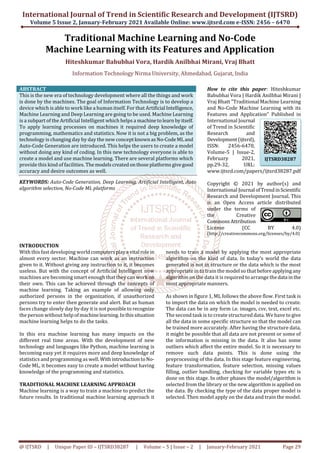
As shown in figure 1, ML follows the above flow. First task is
to import the data on which the model is needed to create.
The data can be in any form i.e. images, csv, text, excel etc.
The second task is to create structured data. We have to give
all the data in some specific structure so that the model can
be trained more accurately. After having the structure data,
it might be possible that all data are not present or some of
the information is missing in the data. It also has some
outliers which affect the entire model. So it is necessary to
remove such data points. This is done using the
preprocessing of the data. In this stage feature engineering,
feature transformation, feature selection, missing values
filling, outlier handling, checking for variable types etc is
done on this stage. In other phases the model/algorithm is
selected from the library or the new algorithm is applied on
the data. By checking the type of the data proper model is
selected. Then model apply on the data and train the model.
IJTSRD38287
International Journal of Trend in Scientific Research and Development (IJTSRD) @ www.ijtsrd.com eISSN: 2456-6470
@ IJTSRD | Unique Paper ID – IJTSRD38287 | Volume – 5 | Issue – 2 | January-February 2021 Page 30
Figure 1: Approach of traditional machine learning
Before training the model partition is done i.e. the train data
and validates data. After training and validation the data
metric and score model is created. If the score is too less or
not reached to the targeted score then the preprocessing,
model applying, model assessment stages are repeated.
When the model reaches the targeted or enough accuracy
then at the next stage the tested data is also added in the
data set and the model is re-trained with the newdata which
is predicted by model. Then in the next stage the model is
deployed and the maintenance of the model is done by
taking all the information of the model's output. If any
further need is created then all the working and predicted
data and results are added into the data set and all the
process from training the model is repeated. On the above
way in every stage a good knowledge of programming and
statistics is needed. But the problem with this is that all
statistics specialists don’t know programming and all the
programmers are not experts in the field of statistics. So as
the solution No-Code ML is introduced.
NO-CODE ML APPROACH
No-Code ML is a process of creating a model with minimum
knowledge of programming and statistics skills. It is an
Artificial Intelligent base algorithm which works for the
coding and accuracy calculation. The No-Code ML works as
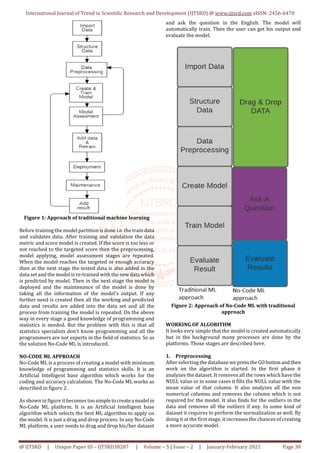
described in figure 2.
As shown in figure it becomes too simpletocreatea model in
No-Code ML platform. It is an Artificial Intelligent base
algorithm which selects the best ML algorithm to apply on
the model. It is just a drag and drop process. In any No-Code
ML platform, a user needs to drag and drop his/her dataset
and ask the question in the English. The model will
automatically train. Then the user can get his output and
evaluate the model.
Figure 2: Approach of No-Code ML with traditional
approach
WORKING OF ALGORITHM
It looks very simple that the model is created automatically
but in the background many processes are done by the
platforms. Those stages are described here.
1. Preprocessing
After selecting the database we presstheGObuttonandthen
work on the algorithm is started. In the first phase it
analyzes the dataset. It removes all the rows which have the
NULL value or in some cases it fills the NULL value with the
mean value of that column. It also analyzes all the non
numerical columns and removes the column which is not
required for the model. It also finds for the outliers in the
data and removes all the outliers if any. In some kind of
dataset it requires to perform the normalization as well. By
doing it at the first stage, it increases the chances of creating
a more accurate model.
International Journal of Trend in Scientific Research and Development (IJTSRD) @ www.ijtsrd.com eISSN: 2456-6470
@ IJTSRD | Unique Paper ID – IJTSRD38287 | Volume – 5 | Issue – 2 | January-February 2021 Page 31
2. Training Model
In this phase many combinations and permutations are
applied on the dataset and algorithm. After applying the
many algorithms as per the data set accuracy is checked for
the many thousands of algorithms. At the end of this phase it
gives a model with the most accurate model. Then it runs it
as a final algorithm on a given data set and stores the model.
All this process takes some time to find the most accurate
model for the dataset.
3. Testing for accuracy
After creating the model AI test the model and find the final
accuracy of the model. This testing is done on the partial
dataset as well. For example if there is one thousand data
rows are there in the dataset then the model accuracy found
on all the batches of hundreds rows for the whole dataset. It
ensures the accuracy for all data in the dataset.
At this point of time No-Code ML works only for regression
and classification algorithms only but in the near future it
will adopt all other algorithms of Machine Learning.
TOOLS OF NO-CODE ML
There are many tools available for performing the No-Code
ML. In the new era of computerscienceandtechnology many
businesses want software based on AI. For that they need to
hire the software engineer and AI experts which cost the
organization a lot, so the solution of that No-Code ML
platform was introduced. Some of them are described here.
1. Create ML
Create ML is Apple's no-code drag and drop tool. It is an
independent macOS application which comes with a bunch
of pre-trained models. It allows us to use transferlearningto
build our own models. It covered all the algorithms for
Natural LanguageProcessing,RecommendationSystem etc…
It provides real-time results on validation data for a model.
The model can be deployed on any iOS application.
2. Google AutoML
This AutoML tool is developed by the world’s leading
company GOOGLE. Google provides the same feature as
CreateML. AutoML currently includes Vision i.e. image
classification, Natural LanguageProcessing,VideoIntelligent
etc… This tool enables the users to train models on specific
to use cases. It allows exporting the model in .pb or .tflite
formation.
3. Teachable Machine
It is also a platform provided by Google. It allows training
models quickly to recognize images, sounds, and poses right
from the browser. It allows directly dragging and dropping
files to teach the model or use a web camera to do this. This
platform uses the library Tensorflow.js.Thisplatformallows
exporting files in Tensorflow.js or tflite formats.
4. Microsoft Azure Automated Machine Learning
Microsoft Azure is a tool which is capable of developing
models at a faster pace. This tool automatically deploys
predicted models with some existing data which are already
filtered with some algorithms. This tool is also able to detect
error in data and rectifies the data. It also gives metrics
visualization enabling a user to make comparisons between
various models.
There are several other platforms which facilitate the same
features.
USE CASES & PERSPECTIVE
Organizations having Less Potential ProgrammersorHaving
No team of Data Scientist or ML Engineers, can Guide the
Sales and marketing team / Analyst team / R & D team and
they will be able to put their efforts for such things like
predictions, classification Etc. Using No- Code ML approach
the Person will be able to solvecomplexData Scienceand ML
problems without knowledge of Python or R programming.
The main purpose and Use Case of No-code ML is to fill the
gap between skilled Programmers and skilled statisticians.
Area of Use:
Various industries are Using and Approaching No-code ML,
Real estate, Finance, Retail & consumer goods, Technology,
Insurance, Healthcare, Fintech, Transportation,banking Etc.
STATISTICS OF SAMPLE PROGRAM
Dataset
Class Image Dataset
Dog 252
Cat 252
Table: 1 Information of Dataset
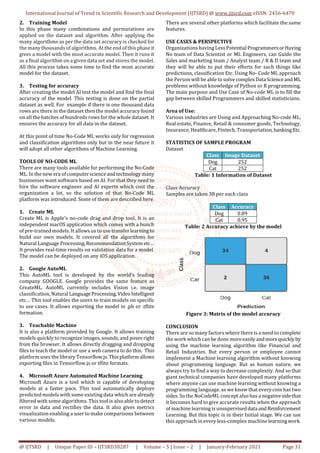
Class Accuracy
Samples are taken 38 per each class
Class Accuracy
Dog 0.89
Cat 0.95
Table: 2 Accuracy achieve by the model
Figure 3: Matrix of the model accuracy
CONCLUSION
There are so many factors where there is a need to complete
the work which can be done moreeasilyandmorequicklyby
using the machine learning algorithm like Financial and
Retail Industries. But every person or employee cannot
implement a Machine learning algorithm without knowing
about programming language. But as human nature, we
always try to find a way to decrease complexity. And so that
giant technical companies have developed many platforms
where anyone can use machine learning without knowing a
programming language. as we know that every coin has two
sides. So the NoCodeML concept also has a negativesidethat
it becomes hard to give accurate results when the approach
of machine learning is unsuperviseddata andReinforcement
Learning. But this topic is in their Initial stage. We can use
this approach in every less-complex machine learningwork.
International Journal of Trend in Scientific Research and Development (IJTSRD) @ www.ijtsrd.com eISSN: 2456-6470
@ IJTSRD | Unique Paper ID – IJTSRD38287 | Volume – 5 | Issue – 2 | January-February 2021 Page 32
REFERENCES
[1] K. He, X. Zhang, S. Ren, J. Sun, Deep residual learning
for image recognition, in: Proceedings of the IEEE
conference on computer vision and pattern
recognition, 2016, pp. 770–778.
[2] Xin He, Kaiyong Zhao, Xiaowen Chu, AutoML: A
Survey of the State-of-the-Art, arXiv:1908.00709v5
[cs.LG] 8 Jul 2020
[3] C. Gong, D. He, X. Tan, T. Qin, L. Wang, T.-Y. Liu, Frage:
frequency-agnosticword representation,in:Advances
in Neural Information Processing Systems, 2018, pp.
1334–1345.
[4] Z. Dai, Z. Yang, Y. Yang, W. W. Cohen, J. Carbonell, Q. V.
Le, R. Salakhutdinov, Transformer-xl: Attentive
language models beyond a fixed-length context,arXiv
preprint arXiv:1901.02860
[5] Teachable machines for accessibility ; November
2017 ; ACM SIGACCESS Accessibility and Computing
[6] https://www.kdnuggets.com/2019/03/why-automl-
wont-replace-data-
scientists.html#:~:text=As%20a%20result%2C%20it
%20is,do%20not%20cover%20this%20approach.

Traditional Machine Learning and No Code Machine Learning with its Features and Application

  • 1.
    International Journal ofTrend in Scientific Research and Development (IJTSRD) Volume 5 Issue 2, January-February 2021 Available Online: www.ijtsrd.com e-ISSN: 2456 – 6470 @ IJTSRD | Unique Paper ID – IJTSRD38287 | Volume – 5 | Issue – 2 | January-February 2021 Page 29 Traditional Machine Learning and No-Code Machine Learning with its Features and Application Hiteshkumar Babubhai Vora, Hardik Anilbhai Mirani, Vraj Bhatt Information Technology Nirma University, Ahmedabad, Gujarat, India ABSTRACT This is the new era of technology development where all the things and work is done by the machines. The goal of Information Technology is to develop a device which is able to work like a human itself. For that Artificial Intelligence, Machine Learning and Deep Learning are going to be used. Machine Learning is a subpart of the Artificial Intelligent which helps a machinetolearn byitself. To apply learning processes on machines it required deep knowledge of programming, mathematics and statistics. Now it is not a big problem, as the technology is changing day by day the new conceptknownasNo-CodeML and Auto-Code Generation are introduced. This helps the users to create a model without doing any kind of coding. In this new technology everyone is able to create a model and use machine learning. There are several platforms which provide this kind of facilities. Themodelscreatedonthose platformsgivegood accuracy and desire outcomes as well. KEYWORDS: Auto-Code Generation, Deep Learning, Artificial Intelligent, Auto algorithm selection, No-Code ML platforms How to cite this paper: Hiteshkumar Babubhai Vora | Hardik Anilbhai Mirani | Vraj Bhatt "Traditional Machine Learning and No-Code Machine Learning with its Features and Application" Published in International Journal of Trend in Scientific Research and Development(ijtsrd), ISSN: 2456-6470, Volume-5 | Issue-2, February 2021, pp.29-32, URL: www.ijtsrd.com/papers/ijtsrd38287.pdf Copyright © 2021 by author(s) and International Journal ofTrendinScientific Research and Development Journal. This is an Open Access article distributed under the terms of the Creative CommonsAttribution License (CC BY 4.0) (http://creativecommons.org/licenses/by/4.0) INTRODUCTION With this fast developing worldcomputersplaya vital rolein almost every sector. Machine can work as an instruction given to it. Without giving any instruction to it, it becomes useless. But with the concept of Artificial Intelligent now machines are becoming smart enough that they canwork on their own. This can be achieved through the concepts of machine learning. Taking an example of allowing only authorized persons in the organization, if unauthorized persons try to enter then generate and alert. But as human faces change slowly day by day it is not possible to recognize the person without help ofmachinelearning.Inthissituation machine learning helps to do the tasks. In this era machine learning has many impacts on the different real time areas. With the development of new technology and languages like Python, machine learning is becoming easy yet it requires more and deep knowledge of statistics and programming as well.WithintroductiontoNo- Code ML, it becomes easy to create a model without having knowledge of the programming and statistics. TRADITIONAL MACHINE LEARNING APPROACH Machine learning is a way to train a machine to predict the future results. In traditional machine learning approach it needs to train a model by applying the most appropriate algorithm on the kind of data. In today’s world the data generated is not in structure or the data which is the most appropriate in to train the model so that beforeapplyingany algorithm on the data it is required to arrange thedata in the most appropriate manners. As shown in figure 1, ML follows the above flow. First task is to import the data on which the model is needed to create. The data can be in any form i.e. images, csv, text, excel etc. The second task is to create structured data. We have to give all the data in some specific structure so that the model can be trained more accurately. After having the structure data, it might be possible that all data are not present or some of the information is missing in the data. It also has some outliers which affect the entire model. So it is necessary to remove such data points. This is done using the preprocessing of the data. In this stage feature engineering, feature transformation, feature selection, missing values filling, outlier handling, checking for variable types etc is done on this stage. In other phases the model/algorithm is selected from the library or the new algorithm is applied on the data. By checking the type of the data proper model is selected. Then model apply on the data and train the model. IJTSRD38287
  • 2.
    International Journal ofTrend in Scientific Research and Development (IJTSRD) @ www.ijtsrd.com eISSN: 2456-6470 @ IJTSRD | Unique Paper ID – IJTSRD38287 | Volume – 5 | Issue – 2 | January-February 2021 Page 30 Figure 1: Approach of traditional machine learning Before training the model partition is done i.e. the train data and validates data. After training and validation the data metric and score model is created. If the score is too less or not reached to the targeted score then the preprocessing, model applying, model assessment stages are repeated. When the model reaches the targeted or enough accuracy then at the next stage the tested data is also added in the data set and the model is re-trained with the newdata which is predicted by model. Then in the next stage the model is deployed and the maintenance of the model is done by taking all the information of the model's output. If any further need is created then all the working and predicted data and results are added into the data set and all the process from training the model is repeated. On the above way in every stage a good knowledge of programming and statistics is needed. But the problem with this is that all statistics specialists don’t know programming and all the programmers are not experts in the field of statistics. So as the solution No-Code ML is introduced. NO-CODE ML APPROACH No-Code ML is a process of creating a model with minimum knowledge of programming and statistics skills. It is an Artificial Intelligent base algorithm which works for the coding and accuracy calculation. The No-Code ML works as described in figure 2. As shown in figure it becomes too simpletocreatea model in No-Code ML platform. It is an Artificial Intelligent base algorithm which selects the best ML algorithm to apply on the model. It is just a drag and drop process. In any No-Code ML platform, a user needs to drag and drop his/her dataset and ask the question in the English. The model will automatically train. Then the user can get his output and evaluate the model. Figure 2: Approach of No-Code ML with traditional approach WORKING OF ALGORITHM It looks very simple that the model is created automatically but in the background many processes are done by the platforms. Those stages are described here. 1. Preprocessing After selecting the database we presstheGObuttonandthen work on the algorithm is started. In the first phase it analyzes the dataset. It removes all the rows which have the NULL value or in some cases it fills the NULL value with the mean value of that column. It also analyzes all the non numerical columns and removes the column which is not required for the model. It also finds for the outliers in the data and removes all the outliers if any. In some kind of dataset it requires to perform the normalization as well. By doing it at the first stage, it increases the chances of creating a more accurate model.
  • 3.
    International Journal ofTrend in Scientific Research and Development (IJTSRD) @ www.ijtsrd.com eISSN: 2456-6470 @ IJTSRD | Unique Paper ID – IJTSRD38287 | Volume – 5 | Issue – 2 | January-February 2021 Page 31 2. Training Model In this phase many combinations and permutations are applied on the dataset and algorithm. After applying the many algorithms as per the data set accuracy is checked for the many thousands of algorithms. At the end of this phase it gives a model with the most accurate model. Then it runs it as a final algorithm on a given data set and stores the model. All this process takes some time to find the most accurate model for the dataset. 3. Testing for accuracy After creating the model AI test the model and find the final accuracy of the model. This testing is done on the partial dataset as well. For example if there is one thousand data rows are there in the dataset then the model accuracy found on all the batches of hundreds rows for the whole dataset. It ensures the accuracy for all data in the dataset. At this point of time No-Code ML works only for regression and classification algorithms only but in the near future it will adopt all other algorithms of Machine Learning. TOOLS OF NO-CODE ML There are many tools available for performing the No-Code ML. In the new era of computerscienceandtechnology many businesses want software based on AI. For that they need to hire the software engineer and AI experts which cost the organization a lot, so the solution of that No-Code ML platform was introduced. Some of them are described here. 1. Create ML Create ML is Apple's no-code drag and drop tool. It is an independent macOS application which comes with a bunch of pre-trained models. It allows us to use transferlearningto build our own models. It covered all the algorithms for Natural LanguageProcessing,RecommendationSystem etc… It provides real-time results on validation data for a model. The model can be deployed on any iOS application. 2. Google AutoML This AutoML tool is developed by the world’s leading company GOOGLE. Google provides the same feature as CreateML. AutoML currently includes Vision i.e. image classification, Natural LanguageProcessing,VideoIntelligent etc… This tool enables the users to train models on specific to use cases. It allows exporting the model in .pb or .tflite formation. 3. Teachable Machine It is also a platform provided by Google. It allows training models quickly to recognize images, sounds, and poses right from the browser. It allows directly dragging and dropping files to teach the model or use a web camera to do this. This platform uses the library Tensorflow.js.Thisplatformallows exporting files in Tensorflow.js or tflite formats. 4. Microsoft Azure Automated Machine Learning Microsoft Azure is a tool which is capable of developing models at a faster pace. This tool automatically deploys predicted models with some existing data which are already filtered with some algorithms. This tool is also able to detect error in data and rectifies the data. It also gives metrics visualization enabling a user to make comparisons between various models. There are several other platforms which facilitate the same features. USE CASES & PERSPECTIVE Organizations having Less Potential ProgrammersorHaving No team of Data Scientist or ML Engineers, can Guide the Sales and marketing team / Analyst team / R & D team and they will be able to put their efforts for such things like predictions, classification Etc. Using No- Code ML approach the Person will be able to solvecomplexData Scienceand ML problems without knowledge of Python or R programming. The main purpose and Use Case of No-code ML is to fill the gap between skilled Programmers and skilled statisticians. Area of Use: Various industries are Using and Approaching No-code ML, Real estate, Finance, Retail & consumer goods, Technology, Insurance, Healthcare, Fintech, Transportation,banking Etc. STATISTICS OF SAMPLE PROGRAM Dataset Class Image Dataset Dog 252 Cat 252 Table: 1 Information of Dataset Class Accuracy Samples are taken 38 per each class Class Accuracy Dog 0.89 Cat 0.95 Table: 2 Accuracy achieve by the model Figure 3: Matrix of the model accuracy CONCLUSION There are so many factors where there is a need to complete the work which can be done moreeasilyandmorequicklyby using the machine learning algorithm like Financial and Retail Industries. But every person or employee cannot implement a Machine learning algorithm without knowing about programming language. But as human nature, we always try to find a way to decrease complexity. And so that giant technical companies have developed many platforms where anyone can use machine learning without knowing a programming language. as we know that every coin has two sides. So the NoCodeML concept also has a negativesidethat it becomes hard to give accurate results when the approach of machine learning is unsuperviseddata andReinforcement Learning. But this topic is in their Initial stage. We can use this approach in every less-complex machine learningwork.
  • 4.
    International Journal ofTrend in Scientific Research and Development (IJTSRD) @ www.ijtsrd.com eISSN: 2456-6470 @ IJTSRD | Unique Paper ID – IJTSRD38287 | Volume – 5 | Issue – 2 | January-February 2021 Page 32 REFERENCES [1] K. He, X. Zhang, S. Ren, J. Sun, Deep residual learning for image recognition, in: Proceedings of the IEEE conference on computer vision and pattern recognition, 2016, pp. 770–778. [2] Xin He, Kaiyong Zhao, Xiaowen Chu, AutoML: A Survey of the State-of-the-Art, arXiv:1908.00709v5 [cs.LG] 8 Jul 2020 [3] C. Gong, D. He, X. Tan, T. Qin, L. Wang, T.-Y. Liu, Frage: frequency-agnosticword representation,in:Advances in Neural Information Processing Systems, 2018, pp. 1334–1345. [4] Z. Dai, Z. Yang, Y. Yang, W. W. Cohen, J. Carbonell, Q. V. Le, R. Salakhutdinov, Transformer-xl: Attentive language models beyond a fixed-length context,arXiv preprint arXiv:1901.02860 [5] Teachable machines for accessibility ; November 2017 ; ACM SIGACCESS Accessibility and Computing [6] https://www.kdnuggets.com/2019/03/why-automl- wont-replace-data- scientists.html#:~:text=As%20a%20result%2C%20it %20is,do%20not%20cover%20this%20approach.