Introduction to Machine
Learning
Whatis Machine Learning and Why Should You Care?
Welcome to the exciting world of Machine Learning! This presentation is designed
for absolute beginners, providing a clear and engaging introduction to a
technology that is rapidly reshaping our world. We'll demystify complex concepts
and show you how machine learning touches your daily life, making it an
essential topic for everyone to understand.
3.
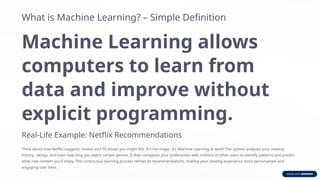
What is MachineLearning? – Simple Definition
Machine Learning allows
computers to learn from
data and improve without
explicit programming.
Real-Life Example: Netflix Recommendations
Think about how Netflix suggests movies and TV shows you might like. It's not magic; it's Machine Learning at work! The system analyzes your viewing
history, ratings, and even how long you watch certain genres. It then compares your preferences with millions of other users to identify patterns and predict
what new content you'll enjoy. This continuous learning process refines its recommendations, making your viewing experience more personalized and
engaging over time.
4.
What is MachineLearning?
Machine Learning (ML) is a revolutionary approach where computers learn from
data to make intelligent decisions or predictions, without being explicitly
programmed for every single task. Unlike traditional software, which relies on a
developer providing step-by-step instructions for every possible scenario, ML
systems are designed to identify patterns, correlations, and relationships within
vast datasets. This ability to "learn" from experience allows them to adapt and
improve over time, performing tasks that would be impossible or impractical to
code manually.
Think of it like teaching a child to recognize animals. You wouldn't give them a
strict rulebook with precise measurements and features for every animal (e.g., "a
cat has fur of exactly this length, and whiskers of precisely that curvature").
Instead, you show them many pictures of cats, dogs, birds, and other animals.
Over time, the child learns to distinguish between them by identifying common
characteristics and subtle differences. Machine Learning works in a very similar
way, but with data instead of visual examples, enabling computers to perform
complex cognitive tasks.
5.
How Machine LearningWorks
Data
Raw information fed into the system
Algorithm
The method that learns from the data
Model
The trained system that has learned patterns
Prediction
The output or decision the model makes
6.
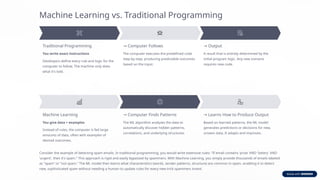
Machine Learning vs.Traditional Programming
Traditional Programming
You write exact instructions
Developers define every rule and logic for the
computer to follow. The machine only does
what it's told.
→ Computer Follows
The computer executes the predefined code
step-by-step, producing predictable outcomes
based on the input.
→ Output
A result that is entirely determined by the
initial program logic. Any new scenario
requires new code.
Machine Learning
You give data + examples
Instead of rules, the computer is fed large
amounts of data, often with examples of
desired outcomes.
→ Computer Finds Patterns
The ML algorithm analyzes the data to
automatically discover hidden patterns,
correlations, and underlying structures.
→ Learns How to Produce Output
Based on learned patterns, the ML model
generates predictions or decisions for new,
unseen data. It adapts and improves.
Consider the example of detecting spam emails. In traditional programming, you would write extensive rules: "If email contains 'prize' AND 'lottery' AND
'urgent', then it's spam." This approach is rigid and easily bypassed by spammers. With Machine Learning, you simply provide thousands of emails labeled
as "spam" or "not spam." The ML model then learns what characteristics (words, sender patterns, structure) are common in spam, enabling it to detect
new, sophisticated spam without needing a human to update rules for every new trick spammers invent.
7.
Why is MachineLearning Important Today?
Machine Learning isn't just a buzzword; it's the invisible force powering much of the technology we interact with daily. Its importance stems from its ability to
handle complexity and scale in ways traditional programming cannot.
• Powers Everyday Tech:
Voice Assistants: Devices like Siri, Alexa, and Google Assistant rely on ML for natural language processing, understanding your spoken commands, and
providing relevant responses.
Recommendation Systems: When Netflix suggests your next binge-worthy show, Amazon recommends products, or Spotify curates a playlist, ML
algorithms are at work, analyzing your past preferences and predicting what you'll like.
Self-Driving Cars: ML is crucial for these vehicles to perceive their environment, interpret sensor data (from cameras, radar, lidar), and make real-time
decisions about navigation, obstacle avoidance, and traffic rules.
Facial Recognition: Unlocking your phone with your face or tagging friends in photos on social media are common applications of ML.
Solves Complex Problems: ML excels at tasks that are too intricate, dynamic, or data-intensive for humans to program manually. This includes:
Predicting Weather Patterns: Analyzing vast amounts of atmospheric data to make more accurate forecasts.
Medical Diagnosis: Assisting doctors in identifying diseases like cancer from medical images with high accuracy.
Financial Fraud Detection: Spotting unusual transaction patterns that might indicate fraudulent activity in real-time.
Scientific Discovery: Accelerating research in fields like drug discovery and materials science by analyzing complex experimental data.
In essence, ML allows us to automate tasks, personalize experiences, and gain insights from data on an unprecedented scale, driving innovation across
almost every sector of our economy and society.
8.
Types of MachineLearning (Simple Overview)
Machine Learning is broadly categorized into three main types, each designed to solve different kinds of problems and learn from different types of data:
Supervised Learning
Learning from labeled examples, where both
the input and the desired output are provided.
The model learns to map inputs to outputs
based on these pairs.
Example: Showing a model thousands of
photos of cats and dogs, each clearly labeled.
The model learns to identify new, unlabeled
photos as either "cat" or "dog."
Common Tasks: Classification (spam detection,
image recognition) and Regression (predicting
house prices, stock values).
Unsupervised Learning
Finding hidden patterns or structures in data
without any predefined labels. The model tries to
make sense of unlabeled data on its own.
Example: Grouping customers based on their
buying habits without being told beforehand what
those groups should be. The model might discover
segments like "budget shoppers" or "luxury
buyers."
Common Tasks: Clustering (customer
segmentation), Dimensionality Reduction
(simplifying complex data).
Reinforcement Learning
Learning by trial and error, through interactions
with an environment. An "agent" performs actions
and receives rewards or penalties, aiming to
maximize cumulative reward.
Example: Training a dog with rewards. The dog
tries different actions; good actions (sitting) get a
treat, bad actions (jumping) get no treat. Over time,
the dog learns desired behaviors.
Common Tasks: Game playing (AlphaGo), robotics,
autonomous navigation.
Understanding these three types provides a foundational grasp of the diverse capabilities of Machine Learning and how it can be applied to a wide array of real-
world challenges.
9.
How Does MachineLearning Work?
The process of building and deploying a Machine Learning model typically involves several key stages. It's a cyclical process, as models often need
refinement and retraining.
1. Collect Data
This is the foundation of any ML project. You
gather relevant information – be it images, text,
numbers, sensor readings, or audio. The quality
and quantity of this data are crucial for the
model's success.
Example: For an image recognition task, you'd
collect thousands of pictures of different objects.
For a medical diagnosis model, you'd gather
patient records, symptoms, and diagnosis
outcomes.
2. Prepare & Clean Data
Raw data is rarely perfect. This stage involves
cleaning (handling missing values, correcting
errors), transforming (formatting data
consistently), and often labeling the data
(especially for supervised learning).
Example: Cropping images, resizing them,
removing irrelevant text from documents, or
labeling patient records with specific disease
codes.
3. Train a Model
This is where the "learning" happens. You feed the
prepared data into a chosen ML algorithm. The
algorithm analyzes this data, identifies patterns,
and adjusts its internal parameters to minimize
errors in its predictions or classifications.
Example: The algorithm learns to associate
certain image features with "cat" or "dog," or
specific patient symptoms with a particular
diagnosis.
4. Test the Model
After training, you evaluate the model's performance on a separate set of
data it has never seen before. This "test data" helps you understand how
well the model generalizes to new situations and avoids simply memorizing
the training data.
Example: Showing the image recognition model new cat and dog pictures
and seeing how accurately it identifies them.
5. Use the Model
Once the model is trained and tested, and its performance is satisfactory, it
can be deployed to make real-world predictions or decisions. This is when it
starts providing value.
Example: Integrating the image recognition model into a photo organizing
app, or using the diagnostic model in a clinical support system.
10.
Real-World Examples YouKnow
Machine Learning is not just for scientists and engineers; it's woven into the fabric of our daily lives, often operating behind the scenes to make our
interactions with technology smoother and more efficient. Here are some common examples:
Email Spam Filters
Every day, your email inbox is
protected by ML. These filters
automatically analyze incoming
emails, identifying characteristics
commonly associated with spam
(e.g., suspicious keywords, sender
addresses, or formatting) and
diverting them to your junk folder
before they even reach you. This
saves you from sifting through
countless unwanted messages.
Netflix Recommendations
After you finish a show, Netflix (and
other streaming services) suggests
what to watch next. This is powered
by sophisticated ML algorithms that
learn your viewing habits, genres
you prefer, actors you like, and even
the time of day you watch. They then
compare your profile to millions of
other users to find content you're
likely to enjoy.
Voice Assistants
Whether you're asking Siri, Alexa, or
Google Assistant a question, setting
a timer, or playing music, ML is hard
at work. Natural Language
Processing (NLP), a subfield of ML,
allows these assistants to
understand your spoken words,
interpret their meaning, and
generate appropriate responses,
making human-computer interaction
feel more natural.
Fraud Detection Systems
When you make a credit card
purchase, ML algorithms are
instantly analyzing the transaction.
They compare it against your typical
spending patterns, location, and
previous transactions. If an activity
seems unusual (e.g., a large
purchase in a foreign country when
you're usually local), the system
might flag it as potential fraud,
protecting your financial security.
11.
Common Misconceptions
As withany powerful technology, Machine Learning is often misunderstood. Separating fact from fiction is crucial for a realistic
understanding of its capabilities and limitations.
ML is not magic; it needs lots of
good data to learn well.
ML models don't spontaneously gain
intelligence. Their performance is
directly tied to the quality, quantity, and
relevance of the data they are trained
on. "Garbage in, garbage out" is a
common adage in ML. If data is biased,
incomplete, or inaccurate, the model's
predictions will reflect those flaws.
It doesn’t “think” like humans
but finds patterns
mathematically.
While ML can perform tasks that seem
intelligent, it doesn't possess
consciousness, emotions, or intuition in
the human sense. It operates based on
complex mathematical algorithms,
identifying statistical correlations and
patterns within data. Its "decisions" are
probabilistic outcomes, not conscious
choices.
ML models can make mistakes
and need careful testing.
No ML model is 100% perfect. They can
make errors, especially when
encountering data significantly
different from what they were trained
on, or due to inherent biases in the
training data. Rigorous testing,
validation, and ongoing monitoring are
essential to ensure models perform
reliably and safely in real-world
applications.
12.
How Can YouStart Learning More?
The world of Machine Learning is accessible to everyone, regardless of your technical background. Here are some fantastic ways to begin your journey:
Explore Free Beginner-Friendly Courses
Many reputable organizations offer excellent introductory courses that require no prior coding knowledge. These are perfect for grasping the
core concepts at your own pace.
Microsoft’s ML for Beginners: A comprehensive curriculum with theory and hands-on exercises.
Google’s ML Crash Course: Focuses on practical application, primarily using TensorFlow.
Coursera/edX: Platforms offering a wide range of beginner ML courses from top universities.
Try Simple Tools & Platforms
You don't need to be a programmer to start experimenting with ML. Many user-friendly tools allow you to build and train simple models through
a graphical interface.
Teachable Machine by Google: A fantastic web-based tool where you can teach a computer to recognize images, sounds, or poses by showing
it examples, all without writing a single line of code.
RunwayML: Offers a suite of AI magic tools for creative projects, often with no-code interfaces.
Stay Curious and Practice
The best way to learn is by doing and continuously exploring. Read articles, watch tutorials, and try to understand how ML impacts products you
use.
Read AI News: Follow tech blogs and news outlets that cover AI and ML developments.
Experiment: Even small experiments with tools like Teachable Machine can build intuition.
Join Communities: Online forums and communities can provide support and further learning opportunities.
13.
The Future isMachine Learning
Machine Learning is not just a passing trend; it's a fundamental shift in how we approach problem-solving and innovation. Its impact will only
continue to grow, making understanding it a crucial skill for navigating the future.
Transforming Industries
From revolutionizing healthcare with
predictive diagnostics and personalized
medicine, to automating financial
analysis, enhancing entertainment
experiences, and optimizing logistics,
ML is the engine of change across nearly
every sector.
Empowering Your Future
Understanding the basics of ML
empowers you not just to be a passive
consumer of technology, but an
informed participant in shaping its
future. It equips you with the knowledge
to critically evaluate AI-powered
solutions and contribute to their ethical
development.
Endless Possibilities
The potential applications of ML are still
being discovered. By starting your
learning journey today, you're
positioning yourself to be part of an
exciting era of innovation and discovery,
where new challenges are met with
intelligent, adaptive solutions.
Start your journey today – the possibilities are endless!
14.
Advantages & Limitationsof Machine Learning
Advantages
Handles complex patterns humans might miss
Improves over time with more data
Automates repetitive tasks
Scales to large datasets efficiently
Enables personalization at scale
Limitations
Requires large amounts of quality data
Can be a "black box" - hard to explain decisions
Prone to bias if training data is biased
Computationally expensive
Needs continuous monitoring and updates
15.
Summary & KeyTakeaways
01
Machine Learning enables computers to
learn from data without explicit
programming
02
It powers everyday technology: Netflix,
Gmail, Google Search, social media, and
more
03
ML differs from traditional programming by
discovering patterns rather than following
rules
04
Three main types: Supervised Learning,
Unsupervised Learning, and Reinforcement
Learning
05
The ML process involves: Data Algorithm
→ →
Model Prediction
→
06
ML has significant advantages but also
important limitations to understand
07
Understanding ML is essential for navigating the future of technology





![1_Introduction to Machine Learning [Autosaved].pptx](https://cdn.slidesharecdn.com/ss_thumbnails/1introductiontomachinelearningautosaved-250910004933-3913b711-thumbnail.jpg?width=640&height=640&fit=bounds)


