Letter of Credit Principles and Theory


                                                               Contract
                                                                   1
                                 Buyer
                                 Buyer                                                        Seller
                                                                                              Seller
                                                                 Goods
                                                        9                      4


                                 2     8    Debit                                  Payment
                                                                                              5
                       Letter of Credit          7                                    6

                        Application                                                               Letter of Credit
                                           Documents                               Documents
                                                         Buyer’s Bank
                                                         Buyer’s Bank                     3


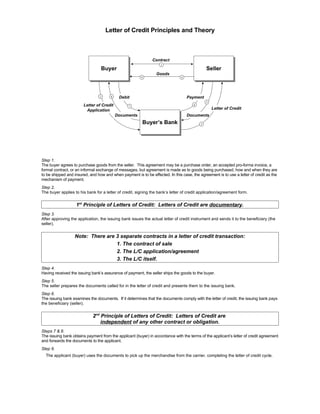
Step 1.
The buyer agrees to purchase goods from the seller. This agreement may be a purchase order, an accepted pro-forma invoice, a
formal contract, or an informal exchange of messages, but agreement is made as to goods being purchased, how and when they are
to be shipped and insured, and how and when payment is to be effected. In this case, the agreement is to use a letter of credit as the
mechanism of payment.
Step 2.
The buyer applies to his bank for a letter of credit, signing the bank’s letter of credit application/agreement form.


                   1st Principle of Letters of Credit: Letters of Credit are documentary.
Step 3.
After approving the application, the issuing bank issues the actual letter of credit instrument and sends it to the beneficiary (the
seller).


                  Note: There are 3 separate contracts in a letter of credit transaction:
                                  1. The contract of sale
                                  2. The L/C application/agreement
                                  3. The L/C itself.
Step 4.
Having received the issuing bank’s assurance of payment, the seller ships the goods to the buyer.
Step 5.
The seller prepares the documents called for in the letter of credit and presents them to the issuing bank.
Step 6.
The issuing bank examines the documents. If it determines that the documents comply with the letter of credit, the issuing bank pays
the beneficiary (seller).


                             2nd Principle of Letters of Credit: Letters of Credit are
                                 independent of any other contract or obligation.
Steps 7 & 8.
The issuing bank obtains payment from the applicant (buyer) in accordance with the terms of the applicant’s letter of credit agreement
and forwards the documents to the applicant.
Step 9.
  The applicant (buyer) uses the documents to pick up the merchandise from the carrier, completing the letter of credit cycle.
Confirmed Letters of Credit


                                                                  Contract
                                     Applicant
                                     Applicant                                              Beneficiary
                                                                                            Beneficiary
                                                                   Goods


                                 L/C         Debit                                        L/C             Pay-
                                Appli-                                                                    ment
                                cation Docu-                                                      Docu-
                                       ments                                                      ments
                                                                     L/C
                                   Applicant’s
                                   Applicant’s                   Documents                  Confirming
                                                                                            Confirming
                                     Bank
                                      Bank                                                    Bank
                                                                                               Bank
                                                                  Payment


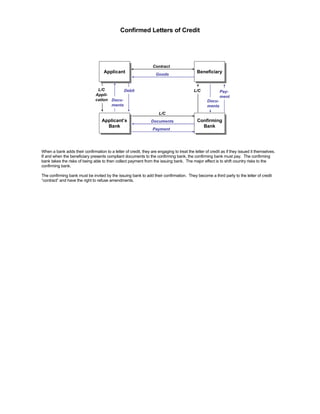
When a bank adds their confirmation to a letter of credit, they are engaging to treat the letter of credit as if they issued it themselves.
If and when the beneficiary presents compliant documents to the confirming bank, the confirming bank must pay. The confirming
bank takes the risks of being able to then collect payment from the issuing bank. The major effect is to shift country risks to the
confirming bank.

The confirming bank must be invited by the issuing bank to add their confirmation. They become a third party to the letter of credit
“contract” and have the right to refuse amendments.
Letter of Credit Reality


                                                                                                     Freight
                                                                                                      Freight
                                 11
                                       Goods                                                       Forwarder        Transport
                                                                                                    Forwarder
                                                                                                                    Documents
                                                                                               5                6
                          Foreign                     Contract                                Goods
                           Foreign                       1                     Seller                    Document
                           Buyer                                               Seller                     Document
                            Buyer                                                             L/C        Preparation
                                                                                                     6   Preparation
                                                                   L/C                                    Company
                                                                         4                                Company
                      L/C    10b
                                  Debit                                                                             6
                     Appli-                          Advising
                                                     Advising                                               L/C &
                     cation Docu-                     Bank
                                   10a                 Bank                                               Documents
                       2    ments
                                                                                        Payment
                                           3a
                                           L/C                                                9a
                          Buyer’s
                          Buyer’s                                                                         Seller’s
                                                                                                          Seller’s
                           Bank
                           Bank                                  Documents                                 Bank
                                                                                                           Bank
                                                                                   9b

                                                                               Reimbursement Claim
                                                3b               Reimbursing
                                                                 Reimbursing             7
                          Reimbursement
                                                                    Bank
                                                                     Bank                            8
                           Authorization
                                                                                             Reimbursement


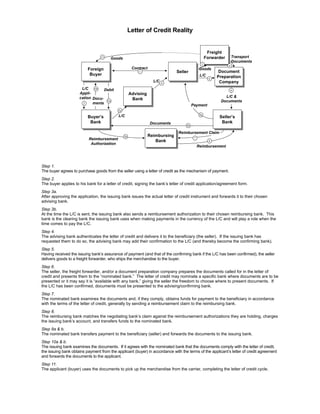
Step 1.
The buyer agrees to purchase goods from the seller using a letter of credit as the mechanism of payment.
Step 2.
The buyer applies to his bank for a letter of credit, signing the bank’s letter of credit application/agreement form.
Step 3a.
After approving the application, the issuing bank issues the actual letter of credit instrument and forwards it to their chosen
advising bank.
Step 3b.
At the time the L/C is sent, the issuing bank also sends a reimbursement authorization to their chosen reimbursing bank. This
bank is the clearing bank the issuing bank uses when making payments in the currency of the L/C and will play a role when the
time comes to pay the L/C.
Step 4.
The advising bank authenticates the letter of credit and delivers it to the beneficiary (the seller). If the issuing bank has
requested them to do so, the advising bank may add their confirmation to the L/C (and thereby become the confirming bank).
Step 5.
Having received the issuing bank’s assurance of payment (and that of the confirming bank if the L/C has been confirmed), the seller
delivers goods to a freight forwarder, who ships the merchandise to the buyer.
Step 6.
The seller, the freight forwarder, and/or a document preparation company prepares the documents called for in the letter of
credit and presents them to the “nominated bank.” The letter of credit may nominate a specific bank where documents are to be
presented or it may say it is “available with any bank,” giving the seller the freedom to choose where to present documents. If
the L/C has been confirmed, documents must be presented to the advising/confirming bank.
Step 7.
The nominated bank examines the documents and, if they comply, obtains funds for payment to the beneficiary in accordance
with the terms of the letter of credit, generally by sending a reimbursement claim to the reimbursing bank.
Step 8.
The reimbursing bank matches the negotiating bank’s claim against the reimbursement authorizations they are holding, charges
the issuing bank’s account, and transfers funds to the nominated bank.
Step 9a & b.
The nominated bank transfers payment to the beneficiary (seller) and forwards the documents to the issuing bank.
Step 10a & b.
The issuing bank examines the documents. If it agrees with the nominated bank that the documents comply with the letter of credit,
the issuing bank obtains payment from the applicant (buyer) in accordance with the terms of the applicant’s letter of credit agreement
and forwards the documents to the applicant.
Step 11.
The applicant (buyer) uses the documents to pick up the merchandise from the carrier, completing the letter of credit cycle.
How Standby Letters of Credit Work


                                                         9          Contract             4
                                                                         1
                                 Applicant
                                 Applicant                                                       Beneficiary
                                                                                                 Beneficiary


                                  2     8

                                               Debit                                     Payment
                         Letter of Credit           7
                                                                                             6
                                                                                                      5

                          Application                                                                     Letter of Credit
                                            Documents                                    Documents
                                                               Applicant’s
                                                               Applicant’s
                                                                 Bank
                                                                  Bank
                                                                                                  3


Step 1.
Two parties enter into a contract that calls for one party to arrange a letter of credit in favor of the other. With a standby letter of credit,
the agreement is that the L/C will not be drawn unless the applicant defaults on the contract. Standby letters of credit can be used as
bid bonds, performance bonds, advance payment guarantees, and for many other purposes.
Step 2.
The first party applies to his bank for a letter of credit, signing the bank’s letter of credit application/agreement form, and
indicating what documents the beneficiary will be required to present in order to be paid.


                     1st Principle of Letters of Credit: Letters of Credit are documentary.
Step 3.
After approving the application, the issuing bank issues the actual letter of credit instrument and sends it to the beneficiary.


                    Note: There are 3 separate contracts in a letter of credit transaction:
                                    1. The underlying contract
                                    2. The L/C application/agreement
                                    3. The L/C itself.
Step 4.
Having received the issuing bank’s assurance that the applicant will perform (or the L/C can be drawn), the beneficiary performs his
end of the contract.
Step 5.
In the event the beneficiary feels the applicant has defaulted, he prepares the documents called for in the letter of credit and
presents them to the issuing bank.
Step 6.
The issuing bank examines the documents. If it determines that the documents comply with the letter of credit, the issuing bank pays
the beneficiary. Note that there is no inquiry into the truth of the documents and permission to pay is not sought from the
applicant, who is likely to not want the bank to pay and to insist he is not in default on the contract.


                               2nd Principle of Letters of Credit: Letters of Credit are
                                   independent of any other contract or obligation.
Steps 7 & 8.
The issuing bank obtains reimbursement for the payment from the applicant and forwards the documents to the applicant.
Step 9.
If the applicant feels the drawing was not justified, he can seek to get the funds returned under the terms of the contract.
How Counter-Guarantees Work


                                                                  Contract
                         Applicant
                         Applicant                                    1                              Beneficiary
                                                                                                     Beneficiary
                                                                             Applicant =
                                                                              Applicant =
                                                   Beneficiary =
                                                    Beneficiary =            Applicant’s
                                                                              Applicant’s
                                                   “Local” Bank
                                                    “Local” Bank                Bank
                                                                                 Bank
                           2                                                                                      4


                     L/C Application                                      Application =                    Guarantee
                                                           L/C                 L/C
                                                           3                      3
                                      Applicant’s
                                       Applicant’s                                       “Local” Bank
                                                                                          “Local” Bank
                                         Bank
                                          Bank


                          Documents = statement there has                         Documents = statement of
                         been a drawing under the guarantee                           contract default


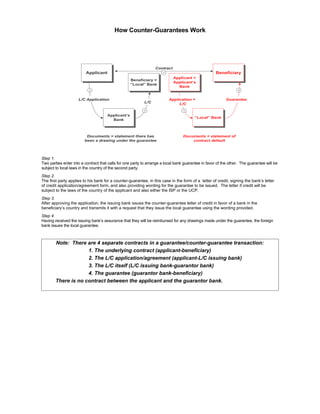
Step 1.
Two parties enter into a contract that calls for one party to arrange a local bank guarantee in favor of the other. The guarantee will be
subject to local laws in the country of the second party.
Step 2.
The first party applies to his bank for a counter-guarantee, in this case in the form of a letter of credit, signing the bank’s letter
of credit application/agreement form, and also providing wording for the guarantee to be issued. The letter if credit will be
subject to the laws of the country of the applicant and also either the ISP or the UCP.
Step 3.
After approving the application, the issuing bank issues the counter-guarantee letter of credit in favor of a bank in the
beneficiary’s country and transmits it with a request that they issue the local guarantee using the wording provided.
Step 4.
Having received the issuing bank’s assurance that they will be reimbursed for any drawings made under the guarantee, the foreign
bank issues the local guarantee.


        Note: There are 4 separate contracts in a guarantee/counter-guarantee transaction:
                     1. The underlying contract (applicant-beneficiary)
                     2. The L/C application/agreement (applicant-L/C issuing bank)
                     3. The L/C itself (L/C issuing bank-guarantor bank)
                     4. The guarantee (guarantor bank-beneficiary)
        There is no contract between the applicant and the guarantor bank.

LC & Guarantee Cycle Diagrams

  • 1.
    Letter of CreditPrinciples and Theory Contract 1 Buyer Buyer Seller Seller Goods 9 4 2 8 Debit Payment 5 Letter of Credit 7 6 Application Letter of Credit Documents Documents Buyer’s Bank Buyer’s Bank 3 Step 1. The buyer agrees to purchase goods from the seller. This agreement may be a purchase order, an accepted pro-forma invoice, a formal contract, or an informal exchange of messages, but agreement is made as to goods being purchased, how and when they are to be shipped and insured, and how and when payment is to be effected. In this case, the agreement is to use a letter of credit as the mechanism of payment. Step 2. The buyer applies to his bank for a letter of credit, signing the bank’s letter of credit application/agreement form. 1st Principle of Letters of Credit: Letters of Credit are documentary. Step 3. After approving the application, the issuing bank issues the actual letter of credit instrument and sends it to the beneficiary (the seller). Note: There are 3 separate contracts in a letter of credit transaction: 1. The contract of sale 2. The L/C application/agreement 3. The L/C itself. Step 4. Having received the issuing bank’s assurance of payment, the seller ships the goods to the buyer. Step 5. The seller prepares the documents called for in the letter of credit and presents them to the issuing bank. Step 6. The issuing bank examines the documents. If it determines that the documents comply with the letter of credit, the issuing bank pays the beneficiary (seller). 2nd Principle of Letters of Credit: Letters of Credit are independent of any other contract or obligation. Steps 7 & 8. The issuing bank obtains payment from the applicant (buyer) in accordance with the terms of the applicant’s letter of credit agreement and forwards the documents to the applicant. Step 9. The applicant (buyer) uses the documents to pick up the merchandise from the carrier, completing the letter of credit cycle.
  • 2.
    Confirmed Letters ofCredit Contract Applicant Applicant Beneficiary Beneficiary Goods L/C Debit L/C Pay- Appli- ment cation Docu- Docu- ments ments L/C Applicant’s Applicant’s Documents Confirming Confirming Bank Bank Bank Bank Payment When a bank adds their confirmation to a letter of credit, they are engaging to treat the letter of credit as if they issued it themselves. If and when the beneficiary presents compliant documents to the confirming bank, the confirming bank must pay. The confirming bank takes the risks of being able to then collect payment from the issuing bank. The major effect is to shift country risks to the confirming bank. The confirming bank must be invited by the issuing bank to add their confirmation. They become a third party to the letter of credit “contract” and have the right to refuse amendments.
  • 3.
    Letter of CreditReality Freight Freight 11 Goods Forwarder Transport Forwarder Documents 5 6 Foreign Contract Goods Foreign 1 Seller Document Buyer Seller Document Buyer L/C Preparation 6 Preparation L/C Company 4 Company L/C 10b Debit 6 Appli- Advising Advising L/C & cation Docu- Bank 10a Bank Documents 2 ments Payment 3a L/C 9a Buyer’s Buyer’s Seller’s Seller’s Bank Bank Documents Bank Bank 9b Reimbursement Claim 3b Reimbursing Reimbursing 7 Reimbursement Bank Bank 8 Authorization Reimbursement Step 1. The buyer agrees to purchase goods from the seller using a letter of credit as the mechanism of payment. Step 2. The buyer applies to his bank for a letter of credit, signing the bank’s letter of credit application/agreement form. Step 3a. After approving the application, the issuing bank issues the actual letter of credit instrument and forwards it to their chosen advising bank. Step 3b. At the time the L/C is sent, the issuing bank also sends a reimbursement authorization to their chosen reimbursing bank. This bank is the clearing bank the issuing bank uses when making payments in the currency of the L/C and will play a role when the time comes to pay the L/C. Step 4. The advising bank authenticates the letter of credit and delivers it to the beneficiary (the seller). If the issuing bank has requested them to do so, the advising bank may add their confirmation to the L/C (and thereby become the confirming bank). Step 5. Having received the issuing bank’s assurance of payment (and that of the confirming bank if the L/C has been confirmed), the seller delivers goods to a freight forwarder, who ships the merchandise to the buyer. Step 6. The seller, the freight forwarder, and/or a document preparation company prepares the documents called for in the letter of credit and presents them to the “nominated bank.” The letter of credit may nominate a specific bank where documents are to be presented or it may say it is “available with any bank,” giving the seller the freedom to choose where to present documents. If the L/C has been confirmed, documents must be presented to the advising/confirming bank. Step 7. The nominated bank examines the documents and, if they comply, obtains funds for payment to the beneficiary in accordance with the terms of the letter of credit, generally by sending a reimbursement claim to the reimbursing bank. Step 8. The reimbursing bank matches the negotiating bank’s claim against the reimbursement authorizations they are holding, charges the issuing bank’s account, and transfers funds to the nominated bank. Step 9a & b. The nominated bank transfers payment to the beneficiary (seller) and forwards the documents to the issuing bank. Step 10a & b. The issuing bank examines the documents. If it agrees with the nominated bank that the documents comply with the letter of credit, the issuing bank obtains payment from the applicant (buyer) in accordance with the terms of the applicant’s letter of credit agreement and forwards the documents to the applicant. Step 11. The applicant (buyer) uses the documents to pick up the merchandise from the carrier, completing the letter of credit cycle.
  • 4.
    How Standby Lettersof Credit Work 9 Contract 4 1 Applicant Applicant Beneficiary Beneficiary 2 8 Debit Payment Letter of Credit 7 6 5 Application Letter of Credit Documents Documents Applicant’s Applicant’s Bank Bank 3 Step 1. Two parties enter into a contract that calls for one party to arrange a letter of credit in favor of the other. With a standby letter of credit, the agreement is that the L/C will not be drawn unless the applicant defaults on the contract. Standby letters of credit can be used as bid bonds, performance bonds, advance payment guarantees, and for many other purposes. Step 2. The first party applies to his bank for a letter of credit, signing the bank’s letter of credit application/agreement form, and indicating what documents the beneficiary will be required to present in order to be paid. 1st Principle of Letters of Credit: Letters of Credit are documentary. Step 3. After approving the application, the issuing bank issues the actual letter of credit instrument and sends it to the beneficiary. Note: There are 3 separate contracts in a letter of credit transaction: 1. The underlying contract 2. The L/C application/agreement 3. The L/C itself. Step 4. Having received the issuing bank’s assurance that the applicant will perform (or the L/C can be drawn), the beneficiary performs his end of the contract. Step 5. In the event the beneficiary feels the applicant has defaulted, he prepares the documents called for in the letter of credit and presents them to the issuing bank. Step 6. The issuing bank examines the documents. If it determines that the documents comply with the letter of credit, the issuing bank pays the beneficiary. Note that there is no inquiry into the truth of the documents and permission to pay is not sought from the applicant, who is likely to not want the bank to pay and to insist he is not in default on the contract. 2nd Principle of Letters of Credit: Letters of Credit are independent of any other contract or obligation. Steps 7 & 8. The issuing bank obtains reimbursement for the payment from the applicant and forwards the documents to the applicant. Step 9. If the applicant feels the drawing was not justified, he can seek to get the funds returned under the terms of the contract.
  • 5.
    How Counter-Guarantees Work Contract Applicant Applicant 1 Beneficiary Beneficiary Applicant = Applicant = Beneficiary = Beneficiary = Applicant’s Applicant’s “Local” Bank “Local” Bank Bank Bank 2 4 L/C Application Application = Guarantee L/C L/C 3 3 Applicant’s Applicant’s “Local” Bank “Local” Bank Bank Bank Documents = statement there has Documents = statement of been a drawing under the guarantee contract default Step 1. Two parties enter into a contract that calls for one party to arrange a local bank guarantee in favor of the other. The guarantee will be subject to local laws in the country of the second party. Step 2. The first party applies to his bank for a counter-guarantee, in this case in the form of a letter of credit, signing the bank’s letter of credit application/agreement form, and also providing wording for the guarantee to be issued. The letter if credit will be subject to the laws of the country of the applicant and also either the ISP or the UCP. Step 3. After approving the application, the issuing bank issues the counter-guarantee letter of credit in favor of a bank in the beneficiary’s country and transmits it with a request that they issue the local guarantee using the wording provided. Step 4. Having received the issuing bank’s assurance that they will be reimbursed for any drawings made under the guarantee, the foreign bank issues the local guarantee. Note: There are 4 separate contracts in a guarantee/counter-guarantee transaction: 1. The underlying contract (applicant-beneficiary) 2. The L/C application/agreement (applicant-L/C issuing bank) 3. The L/C itself (L/C issuing bank-guarantor bank) 4. The guarantee (guarantor bank-beneficiary) There is no contract between the applicant and the guarantor bank.