https://clarken92.github.io/
https://scholar.google.com.au/citations?user=aD6y8joAAAAJ&hl=en
https://www.linkedin.com/in/kien-do-b45846a4
Towards Label and Data Efficient
Deep Learning
Dr. Kien Do
A2I2, Deakin University, Australia
3/16/2022 2
https://innovativeadagency.com/blog/importance-data-collection/
Data are abundant online and can be obtained freely
3/16/2022 3
However, annotating them is often expensive and time consuming
=> We should think more about label efficient learning
https://appen.com/blog/data-annotation/
https://medicalxpress.com/news/2017-10-dementia-costly.html
https://www.roastycoffee.com/coffee-makes-me-tired/
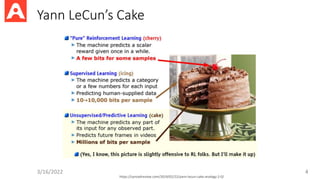
Yann LeCun’s Cake
3/16/2022 4
https://syncedreview.com/2019/02/22/yann-lecun-cake-analogy-2-0/
3/16/2022 5
m.facebook.com/mldcmu/photos/quoting-professor-lecun-april-30-2019-i-now-call-it-self-supervised-learning-bec/2178914695721030/
But unsupervised learning is what most humans and animals do
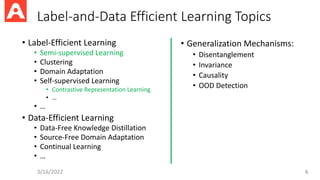
Label-and-Data Efficient Learning Topics
• Label-Efficient Learning
• Semi-supervised Learning
• Clustering
• Domain Adaptation
• Self-supervised Learning
• Contrastive Representation Learning
• …
• …
• Data-Efficient Learning
• Data-Free Knowledge Distillation
• Source-Free Domain Adaptation
• Continual Learning
• …
3/16/2022 6
• Generalization Mechanisms:
• Disentanglement
• Invariance
• Causality
• OOD Detection
Semi-supervised Learning
3/16/2022 7
Semi-supervised Learning (SSL)
• Problem: Combine labeled and unlabeled data (usually >= 90% of the
data) to train a model
• Assumptions:
• Smoothness Assumption
• Cluster Assumption
• Manifold Assumption
3/16/2022 8
Semi-Supervised Learning, Chapelle et al., 2006
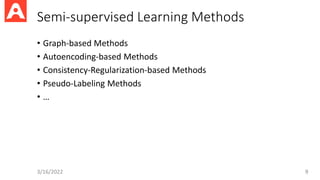
Semi-supervised Learning Methods
• Graph-based Methods
• Autoencoding-based Methods
• Consistency-Regularization-based Methods
• Pseudo-Labeling Methods
• …
3/16/2022 9
Label Propagation (Zhu and Ghahramani, 2004)
• Assume nonnegative similarity scores between samples
• Construct an undirected graph over all nodes with edges weighted by
similarity scores.
• Perform the following steps until convergence:
• Propagate labels: , where is the transition matrix
• Set the class probability of labeled data to the ground-truth
3/16/2022 10
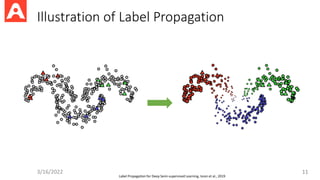
Illustration of Label Propagation
3/16/2022 11
Label Propagation for Deep Semi-supervised Learning, Iscen et al., 2019
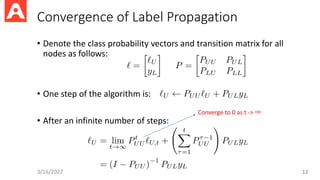
Convergence of Label Propagation
• Denote the class probability vectors and transition matrix for all
nodes as follows:
• One step of the algorithm is:
• After an infinite number of steps:
3/16/2022 12
Converge to 0 as t -> ∞
Label Propagation as Energy Minimization
• The energy function:
where is the graph Laplacian.
3/16/2022 13
smoothness
regularization
label constraint
solution is a harmonic
function satisfying the
Laplace’s equation:
Problems of Label Propagation (LP)
• LP is transductive, thus, cannot handle new samples.
• LP requires matrix inversion for the exact solution, which is usually
costly in practice.
3/16/2022 14
Label Propagation + Gaussian Mixture Model
• Intuition: GMM provides the local fit to data while LP ensures the
global manifold structure.
3/16/2022 15
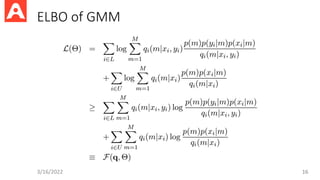
Implicitly assume that
#mixtures ≠ #classes
GMM
ELBO of GMM
3/16/2022 16
GMM Training and Label Inference
• We can train the GMM via the EM algorithm
• After EM converges, we can predict the label as:
3/16/2022 17
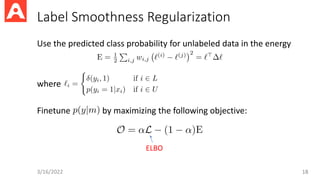
Label Smoothness Regularization
Use the predicted class probability for unlabeled data in the energy
where
Finetune by maximizing the following objective:
3/16/2022 18
ELBO
Training Procedure for LP+GMM
• Train all parameters of p(m), p(x|m), p(y|m) by maximizing via the
standard EM algorithm.
• Fix p(m), p(x|m) and train p(y|m) by maximizing .
3/16/2022 19
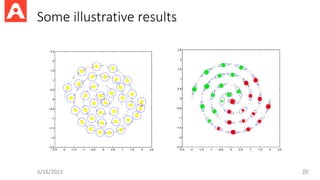
Some illustrative results
3/16/2022 20
Problems of LP + GMM
• EM algorithm is not applicable to high dimensional data like images.
• This method still requires full batch updates.
3/16/2022 21
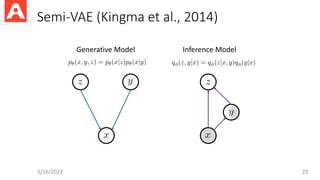
Semi-VAE (Kingma et al., 2014)
3/16/2022 22
Generative Model Inference Model
Training Objective for Semi-VAE
• ELBO on labeled data:
• ELBO on unlabeled data:
• Final objective:
3/16/2022 23
Weight the NLL by soft-label Avoid over-confident predictions
Both y and z are used to predict x
Results
3/16/2022 24
Can some how separate style from class
Not very good
Problems of Semi-VAE
• It is a generative model while the classification problem is
discriminative.
• => It may be better to perform SSL with discriminative model only
• It has no mechanism to ensure that the decoder must use both y and
z to reconstruct x. If z is a big vector, the decoder may just use z.
• => A possible solution is making y and z independent: I(y, z) = 0
3/16/2022 25
Disentanglement
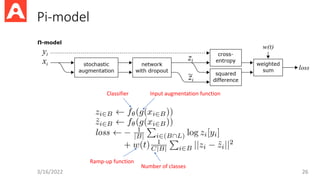
Pi-model
3/16/2022 26
Input augmentation function
Classifier
Ramp-up function
Number of classes
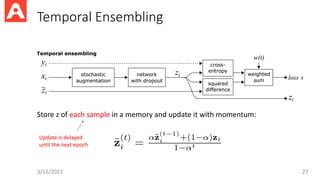
Temporal Ensembling
3/16/2022 27
Store z of each sample in a memory and update it with momentum:
Update is delayed
until the next epoch
Mean Teacher (MT)
3/16/2022 28
Teacher plays the
role of an ensemble
Cross-entropy loss
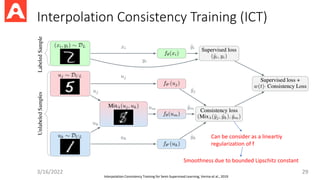
Interpolation Consistency Training (ICT)
3/16/2022 29
Can be consider as a lineartiy
regularization of f
Smoothness due to bounded Lipschitz constant
Interpolation Consistency Training for Semi-Supervised Learning, Verma et al., 2019
Training Procedure of ICT
3/16/2022 30
Mixup as
consistency loss
Like mean teacher
These samples from the teacher model
Train student model
Intuitions
• Intuitions:
• Learn a smooth input-output manifold by forcing the classifier to give
consistent predictions for inputs under simple perturbations.
• Can we have better data and weight perturbations?
3/16/2022 31
Maximum Uncertainty Regularization (MUR)
• Under weak data perturbation, is often close to .
The classifier can only learn a locally smooth mapping from to .
• We want to be: i) not too close to , and ii) difficult for the
classifier to predict correctly.
• We choose to be a maximum uncertain (w.r.t. ) virtual point:
32
3/16/2022 Semi-Supervised Learning with Variational Bayesian Inference and Maximum Uncertainty Regularization, Do et al., 2020
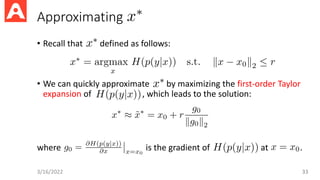
Approximating
• Recall that defined as follows:
• We can quickly approximate by maximizing the first-order Taylor
expansion of , which leads to the solution:
where is the gradient of at .
33
3/16/2022
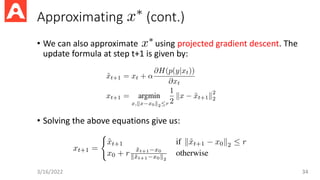
Approximating (cont.)
• We can also approximate using projected gradient descent. The
update formula at step t+1 is given by:
• Solving the above equations give us:
34
3/16/2022
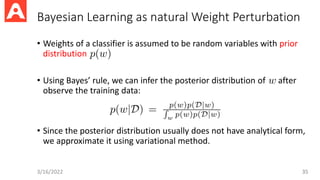
Bayesian Learning as natural Weight Perturbation
• Weights of a classifier is assumed to be random variables with prior
distribution
• Using Bayes’ rule, we can infer the posterior distribution of after
observe the training data:
• Since the posterior distribution usually does not have analytical form,
we approximate it using variational method.
3/16/2022 35
Variational Bayesian Inference (VBI)
3/16/2022 36
Control the model’s complexity
Control the data misfit
Like ensemble methods
Use Variational Dropout to
facilitate this sampling
Note: p(w) is chosen to be the log-uniform distribution by Kingma et al., 2014 and it was shown to be pathological by many
works. However, it cannot be easily replaced [1] and still work well in practice. For a better alternative, please check [2].
[1]: Variational Bayesian dropout: pitfalls and fixes, Hron et al., 2018
[2]: Structured Dropout Variational Inference for Bayesian Neural Networks, Nguyen et al., 2021
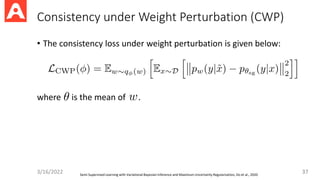
Consistency under Weight Perturbation (CWP)
• The consistency loss under weight perturbation is given below:
where is the mean of .
37
3/16/2022 Semi-Supervised Learning with Variational Bayesian Inference and Maximum Uncertainty Regularization, Do et al., 2020
Final Objective
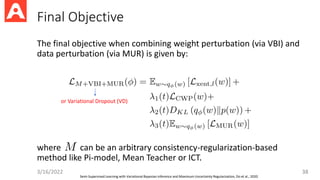
The final objective when combining weight perturbation (via VBI) and
data perturbation (via MUR) is given by:
where can be an arbitrary consistency-regularization-based
method like Pi-model, Mean Teacher or ICT.
38
3/16/2022
Semi-Supervised Learning with Variational Bayesian Inference and Maximum Uncertainty Regularization, Do et al., 2020
or Variational Dropout (VD)
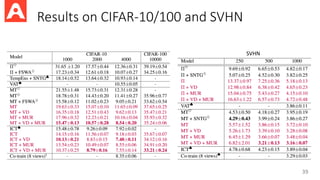
Results on CIFAR-10/100 and SVHN
39
SVHN
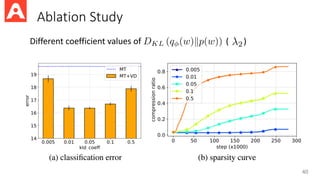
Ablation Study
40
Different coefficient values of ( )
Ablation Study (cont.)
41
Performance with different radiuses Random perturbation vs. MUR
The best value
of radius
Visualization of most uncertain samples
42
MixMatch
3/16/2022 43
Then they perform Mixup between labeled and unlabeled
Importance of Data Augmentation in SSL
• Consistency-Regularization-based methods like Pi-model, Mean
Teacher, ICT, MixMatch use only simple (weak) data augmentation.
• MUR can provide some help but still cannot replace good data
augmentation.
3/16/2022 44
UDA
3/16/2022 45
Strong data augmentation
Results of UDA
3/16/2022 46
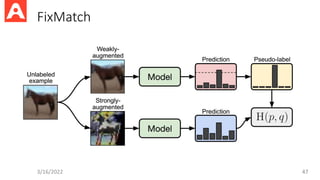
FixMatch
3/16/2022 47
Objective Function of FixMatch
3/16/2022 48
weak augmentation
strong augmentation
unlabeled/labeled ratio threshold
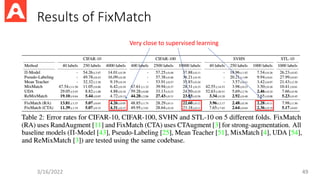
Results of FixMatch
3/16/2022 49
Very close to supervised learning
Ablation Study of FixMatch
3/16/2022 50
Contrastive Learning
3/16/2022 51
Contrastive Learning in old days
• Triplet loss
• Max-margin distance metric:
3/16/2022 52
NCE
• We want to estimate/model the distribution
• Assume we have a noise distribution as reference
=> Transforming into binary classification
3/16/2022 53
P(C=0)/P(C=1)
Noise Constrastive Estimation, Ke Tran
NCE Loss
3/16/2022 54
Non-parametric Instance Discriminator (NID)
3/16/2022 55
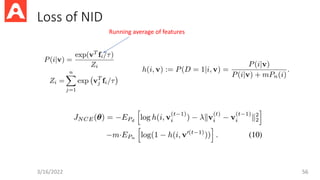
Loss of NID
3/16/2022 56
Running average of features
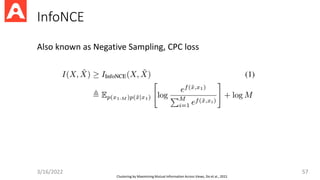
InfoNCE
3/16/2022 57
Clustering by Maximizing Mutual Information Across Views, Do et al., 2021
Also known as Negative Sampling, CPC loss
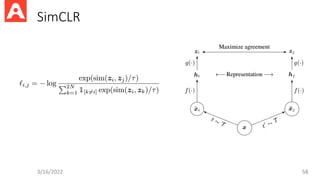
SimCLR
3/16/2022 58
Results with different data augmentations
3/16/2022 59
SimCLR significantly
depends on data
augmentation
Results with different batch size
3/16/2022 60
SimCLR significantly
depends on batch size
Advantages and Drawbacks of SimCLR
• Advantages:
• Simple to implement and use
• Drawbacks:
• Requires large batch size
• Memory intensive <= Addressed by MoCo
3/16/2022 61
MoCo
3/16/2022 62
When run on standard 8 GPU
machines, SimCLR can only
handle 1024 negative samples
Debiased Contrastive Learning
• Sampling bias of standard contrastive loss: Negative samples can be
drawn from the same class as positive samples
3/16/2022 63
Negative distribution Weighting parameter
3/16/2022 64
A practical debiased form based on the
asymptotic form of unbiased loss when N -> ∞
Debiased Contrastive Loss
Results
3/16/2022 65
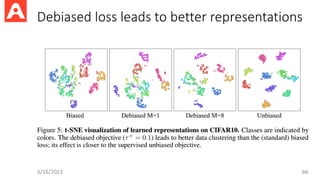
Debiased loss leads to better representations
3/16/2022 66
BYOL
3/16/2022 67
Bootstrap your own latent: A new approach to self-supervised learning, Grill et al., 2020
An autoencoder
Stop gradient
Results with different batch sizes and data
augmentations
3/16/2022 68
Advantages and Drawbacks of BYOL
• Advantages:
• Eliminate the need for negative samples in standard contrastive loss
• Less depends on batch size and data augmentation compared to SimCLR
• Drawbacks:
• Learned representations can be collapsed to the same vector if:
• No prediction network is used
• No gradient stop is enforced on the target (EMA) branch
3/16/2022 69
SwAV
3/16/2022 70
normalized feature
code
prototype
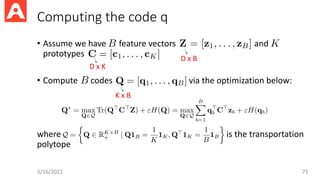
Computing the code q
• Assume we have feature vectors and
prototypes
• Compute codes via the optimization below:
where is the transportation
polytope
3/16/2022 71
D x B
D x K
K x B
Computing the code q (cont.)
• The optimal soft codes Q takes the form of a normalized exponential
matrix:
where and are renormalization vectors in and , respectively.
and are computed using the iterative Sinkhorn-Knopp algorithm.
3/16/2022 72
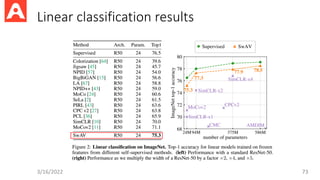
Linear classification results
3/16/2022 73
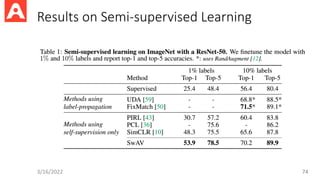
Results on Semi-supervised Learning
3/16/2022 74
Results with small batch sizes
3/16/2022 75
Advantages and Drawbacks of SwAV
• Advantages:
• Does not require negative samples, thus run faster than other methods
• Drawbacks:
• Requires some tricks to avoid collapse such as class balancing, which can
sometimes be violated in real situation
3/16/2022 76
Applications of Contrastive
Learning
3/16/2022 77
Self-Match
3/16/2022 78
SimCLR, MoCo, …
FixMatch
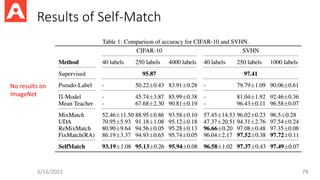
Results of Self-Match
3/16/2022 79
No results on
ImageNet
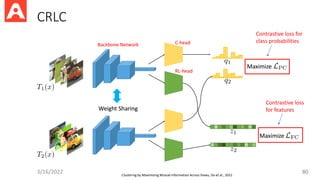
CRLC
3/16/2022 80
Contrastive loss for
class probabilities
Contrastive loss
for features
Clustering by Maximizing Mutual Information Across Views, Do et al., 2021
Training Objective of CRLC
3/16/2022 81
People usually choose f
to be a cosine similarity
but is it a good critic?
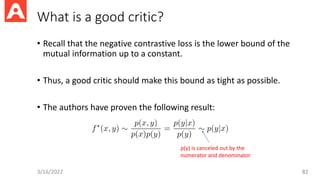
What is a good critic?
• Recall that the negative contrastive loss is the lower bound of the
mutual information up to a constant.
• Thus, a good critic should make this bound as tight as possible.
• The authors have proven the following result:
3/16/2022 82
p(y) is canceled out by the
numerator and denominator
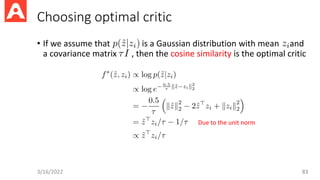
Choosing optimal critic
• If we assume that is a Gaussian distribution with mean and
a covariance matrix , then the cosine similarity is the optimal critic
3/16/2022 83
Due to the unit norm
Choosing optimal critic (cont.)
• The optimal critic is the log-of-dot-product function:
3/16/2022 84
May not be theoretically
equivalent is a practically
good approximation
Clustering Results
3/16/2022 85
SSL Results and Results with different critics
3/16/2022 86
NegJSD and DotPr are bad,
NegL2 is slightly worse
DINO
• Apply contrastive learning on a Vision Transformer (ViT)
• Verify the importance of momentum encoder, multi-crop training for
contrastive learning
• Achieve 78.3% Top 1 accuracy with the k-NN classifier, and 80.1% Top
1 accuracy with the linear classifier.
3/16/2022 87
Better than supervised learning
with some ResNet architectures
Transformer
3/16/2022 88
Efficient Transformers: A Survey, Tay et al. 2020
Vision Transformer
3/16/2022 89
An Image Is Worth 16X16 Words: Transformers for Image Recognition at Scale, Dosovitskiy et al., 2020
An image is
converted into
a sequence of
patches
Simply reuse the
Transformer architecture
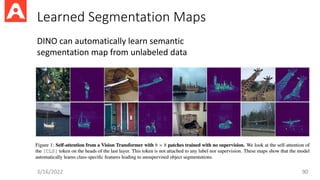
Learned Segmentation Maps
3/16/2022 90
DINO can automatically learn semantic
segmentation map from unlabeled data
Contrastive Learning for Unsupervised Domain
Adaptation
3/16/2022 91
Objective
• Assume labeled data from source domain and unlabeled data from
target domain. Adapt model to the target domain?
3/16/2022 92
Cross domain contrastive loss:
We need pseudo labels
from the target domain
Final objective:
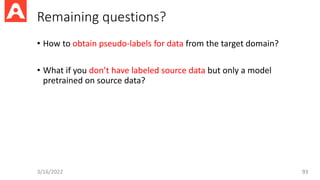
Remaining questions?
• How to obtain pseudo-labels for data from the target domain?
• What if you don’t have labeled source data but only a model
pretrained on source data?
3/16/2022 93
Results
3/16/2022 94
Contrastive Learning for Unsupervised Image-to-
Image Translation
3/16/2022 95
Results of CULIT
3/16/2022 96
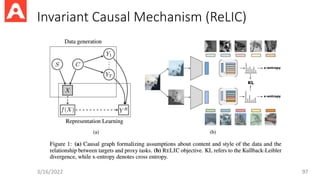
Invariant Causal Mechanism (ReLIC)
3/16/2022 97
Objective of ReLIC
3/16/2022 98
Intervention on the style
99
3/16/2022
Thank you for your attention!
3/16/2022 100
Q&A

Towards Label and Data Efficient Deep Learning.pdf

  • 1.
  • 2.
  • 3.
    3/16/2022 3 However, annotatingthem is often expensive and time consuming => We should think more about label efficient learning https://appen.com/blog/data-annotation/ https://medicalxpress.com/news/2017-10-dementia-costly.html https://www.roastycoffee.com/coffee-makes-me-tired/
  • 4.
    Yann LeCun’s Cake 3/16/20224 https://syncedreview.com/2019/02/22/yann-lecun-cake-analogy-2-0/
  • 5.
  • 6.
    Label-and-Data Efficient LearningTopics • Label-Efficient Learning • Semi-supervised Learning • Clustering • Domain Adaptation • Self-supervised Learning • Contrastive Representation Learning • … • … • Data-Efficient Learning • Data-Free Knowledge Distillation • Source-Free Domain Adaptation • Continual Learning • … 3/16/2022 6 • Generalization Mechanisms: • Disentanglement • Invariance • Causality • OOD Detection
  • 7.
  • 8.
    Semi-supervised Learning (SSL) •Problem: Combine labeled and unlabeled data (usually >= 90% of the data) to train a model • Assumptions: • Smoothness Assumption • Cluster Assumption • Manifold Assumption 3/16/2022 8 Semi-Supervised Learning, Chapelle et al., 2006
  • 9.
    Semi-supervised Learning Methods •Graph-based Methods • Autoencoding-based Methods • Consistency-Regularization-based Methods • Pseudo-Labeling Methods • … 3/16/2022 9
  • 10.
    Label Propagation (Zhuand Ghahramani, 2004) • Assume nonnegative similarity scores between samples • Construct an undirected graph over all nodes with edges weighted by similarity scores. • Perform the following steps until convergence: • Propagate labels: , where is the transition matrix • Set the class probability of labeled data to the ground-truth 3/16/2022 10
  • 11.
    Illustration of LabelPropagation 3/16/2022 11 Label Propagation for Deep Semi-supervised Learning, Iscen et al., 2019
  • 12.
    Convergence of LabelPropagation • Denote the class probability vectors and transition matrix for all nodes as follows: • One step of the algorithm is: • After an infinite number of steps: 3/16/2022 12 Converge to 0 as t -> ∞
  • 13.
    Label Propagation asEnergy Minimization • The energy function: where is the graph Laplacian. 3/16/2022 13 smoothness regularization label constraint solution is a harmonic function satisfying the Laplace’s equation:
  • 14.
    Problems of LabelPropagation (LP) • LP is transductive, thus, cannot handle new samples. • LP requires matrix inversion for the exact solution, which is usually costly in practice. 3/16/2022 14
  • 15.
    Label Propagation +Gaussian Mixture Model • Intuition: GMM provides the local fit to data while LP ensures the global manifold structure. 3/16/2022 15 Implicitly assume that #mixtures ≠ #classes GMM
  • 16.
  • 17.
    GMM Training andLabel Inference • We can train the GMM via the EM algorithm • After EM converges, we can predict the label as: 3/16/2022 17
  • 18.
    Label Smoothness Regularization Usethe predicted class probability for unlabeled data in the energy where Finetune by maximizing the following objective: 3/16/2022 18 ELBO
  • 19.
    Training Procedure forLP+GMM • Train all parameters of p(m), p(x|m), p(y|m) by maximizing via the standard EM algorithm. • Fix p(m), p(x|m) and train p(y|m) by maximizing . 3/16/2022 19
  • 20.
  • 21.
    Problems of LP+ GMM • EM algorithm is not applicable to high dimensional data like images. • This method still requires full batch updates. 3/16/2022 21
  • 22.
    Semi-VAE (Kingma etal., 2014) 3/16/2022 22 Generative Model Inference Model
  • 23.
    Training Objective forSemi-VAE • ELBO on labeled data: • ELBO on unlabeled data: • Final objective: 3/16/2022 23 Weight the NLL by soft-label Avoid over-confident predictions Both y and z are used to predict x
  • 24.
    Results 3/16/2022 24 Can somehow separate style from class Not very good
  • 25.
    Problems of Semi-VAE •It is a generative model while the classification problem is discriminative. • => It may be better to perform SSL with discriminative model only • It has no mechanism to ensure that the decoder must use both y and z to reconstruct x. If z is a big vector, the decoder may just use z. • => A possible solution is making y and z independent: I(y, z) = 0 3/16/2022 25 Disentanglement
  • 26.
    Pi-model 3/16/2022 26 Input augmentationfunction Classifier Ramp-up function Number of classes
  • 27.
    Temporal Ensembling 3/16/2022 27 Storez of each sample in a memory and update it with momentum: Update is delayed until the next epoch
  • 28.
    Mean Teacher (MT) 3/16/202228 Teacher plays the role of an ensemble Cross-entropy loss
  • 29.
    Interpolation Consistency Training(ICT) 3/16/2022 29 Can be consider as a lineartiy regularization of f Smoothness due to bounded Lipschitz constant Interpolation Consistency Training for Semi-Supervised Learning, Verma et al., 2019
  • 30.
    Training Procedure ofICT 3/16/2022 30 Mixup as consistency loss Like mean teacher These samples from the teacher model Train student model
  • 31.
    Intuitions • Intuitions: • Learna smooth input-output manifold by forcing the classifier to give consistent predictions for inputs under simple perturbations. • Can we have better data and weight perturbations? 3/16/2022 31
  • 32.
    Maximum Uncertainty Regularization(MUR) • Under weak data perturbation, is often close to . The classifier can only learn a locally smooth mapping from to . • We want to be: i) not too close to , and ii) difficult for the classifier to predict correctly. • We choose to be a maximum uncertain (w.r.t. ) virtual point: 32 3/16/2022 Semi-Supervised Learning with Variational Bayesian Inference and Maximum Uncertainty Regularization, Do et al., 2020
  • 33.
    Approximating • Recall thatdefined as follows: • We can quickly approximate by maximizing the first-order Taylor expansion of , which leads to the solution: where is the gradient of at . 33 3/16/2022
  • 34.
    Approximating (cont.) • Wecan also approximate using projected gradient descent. The update formula at step t+1 is given by: • Solving the above equations give us: 34 3/16/2022
  • 35.
    Bayesian Learning asnatural Weight Perturbation • Weights of a classifier is assumed to be random variables with prior distribution • Using Bayes’ rule, we can infer the posterior distribution of after observe the training data: • Since the posterior distribution usually does not have analytical form, we approximate it using variational method. 3/16/2022 35
  • 36.
    Variational Bayesian Inference(VBI) 3/16/2022 36 Control the model’s complexity Control the data misfit Like ensemble methods Use Variational Dropout to facilitate this sampling Note: p(w) is chosen to be the log-uniform distribution by Kingma et al., 2014 and it was shown to be pathological by many works. However, it cannot be easily replaced [1] and still work well in practice. For a better alternative, please check [2]. [1]: Variational Bayesian dropout: pitfalls and fixes, Hron et al., 2018 [2]: Structured Dropout Variational Inference for Bayesian Neural Networks, Nguyen et al., 2021
  • 37.
    Consistency under WeightPerturbation (CWP) • The consistency loss under weight perturbation is given below: where is the mean of . 37 3/16/2022 Semi-Supervised Learning with Variational Bayesian Inference and Maximum Uncertainty Regularization, Do et al., 2020
  • 38.
    Final Objective The finalobjective when combining weight perturbation (via VBI) and data perturbation (via MUR) is given by: where can be an arbitrary consistency-regularization-based method like Pi-model, Mean Teacher or ICT. 38 3/16/2022 Semi-Supervised Learning with Variational Bayesian Inference and Maximum Uncertainty Regularization, Do et al., 2020 or Variational Dropout (VD)
  • 39.
    Results on CIFAR-10/100and SVHN 39 SVHN
  • 40.
  • 41.
    Ablation Study (cont.) 41 Performancewith different radiuses Random perturbation vs. MUR The best value of radius
  • 42.
    Visualization of mostuncertain samples 42
  • 43.
    MixMatch 3/16/2022 43 Then theyperform Mixup between labeled and unlabeled
  • 44.
    Importance of DataAugmentation in SSL • Consistency-Regularization-based methods like Pi-model, Mean Teacher, ICT, MixMatch use only simple (weak) data augmentation. • MUR can provide some help but still cannot replace good data augmentation. 3/16/2022 44
  • 45.
  • 46.
  • 47.
  • 48.
    Objective Function ofFixMatch 3/16/2022 48 weak augmentation strong augmentation unlabeled/labeled ratio threshold
  • 49.
    Results of FixMatch 3/16/202249 Very close to supervised learning
  • 50.
    Ablation Study ofFixMatch 3/16/2022 50
  • 51.
  • 52.
    Contrastive Learning inold days • Triplet loss • Max-margin distance metric: 3/16/2022 52
  • 53.
    NCE • We wantto estimate/model the distribution • Assume we have a noise distribution as reference => Transforming into binary classification 3/16/2022 53 P(C=0)/P(C=1) Noise Constrastive Estimation, Ke Tran
  • 54.
  • 55.
  • 56.
    Loss of NID 3/16/202256 Running average of features
  • 57.
    InfoNCE 3/16/2022 57 Clustering byMaximizing Mutual Information Across Views, Do et al., 2021 Also known as Negative Sampling, CPC loss
  • 58.
  • 59.
    Results with differentdata augmentations 3/16/2022 59 SimCLR significantly depends on data augmentation
  • 60.
    Results with differentbatch size 3/16/2022 60 SimCLR significantly depends on batch size
  • 61.
    Advantages and Drawbacksof SimCLR • Advantages: • Simple to implement and use • Drawbacks: • Requires large batch size • Memory intensive <= Addressed by MoCo 3/16/2022 61
  • 62.
    MoCo 3/16/2022 62 When runon standard 8 GPU machines, SimCLR can only handle 1024 negative samples
  • 63.
    Debiased Contrastive Learning •Sampling bias of standard contrastive loss: Negative samples can be drawn from the same class as positive samples 3/16/2022 63 Negative distribution Weighting parameter
  • 64.
    3/16/2022 64 A practicaldebiased form based on the asymptotic form of unbiased loss when N -> ∞ Debiased Contrastive Loss
  • 65.
  • 66.
    Debiased loss leadsto better representations 3/16/2022 66
  • 67.
    BYOL 3/16/2022 67 Bootstrap yourown latent: A new approach to self-supervised learning, Grill et al., 2020 An autoencoder Stop gradient
  • 68.
    Results with differentbatch sizes and data augmentations 3/16/2022 68
  • 69.
    Advantages and Drawbacksof BYOL • Advantages: • Eliminate the need for negative samples in standard contrastive loss • Less depends on batch size and data augmentation compared to SimCLR • Drawbacks: • Learned representations can be collapsed to the same vector if: • No prediction network is used • No gradient stop is enforced on the target (EMA) branch 3/16/2022 69
  • 70.
  • 71.
    Computing the codeq • Assume we have feature vectors and prototypes • Compute codes via the optimization below: where is the transportation polytope 3/16/2022 71 D x B D x K K x B
  • 72.
    Computing the codeq (cont.) • The optimal soft codes Q takes the form of a normalized exponential matrix: where and are renormalization vectors in and , respectively. and are computed using the iterative Sinkhorn-Knopp algorithm. 3/16/2022 72
  • 73.
  • 74.
    Results on Semi-supervisedLearning 3/16/2022 74
  • 75.
    Results with smallbatch sizes 3/16/2022 75
  • 76.
    Advantages and Drawbacksof SwAV • Advantages: • Does not require negative samples, thus run faster than other methods • Drawbacks: • Requires some tricks to avoid collapse such as class balancing, which can sometimes be violated in real situation 3/16/2022 76
  • 77.
  • 78.
  • 79.
    Results of Self-Match 3/16/202279 No results on ImageNet
  • 80.
    CRLC 3/16/2022 80 Contrastive lossfor class probabilities Contrastive loss for features Clustering by Maximizing Mutual Information Across Views, Do et al., 2021
  • 81.
    Training Objective ofCRLC 3/16/2022 81 People usually choose f to be a cosine similarity but is it a good critic?
  • 82.
    What is agood critic? • Recall that the negative contrastive loss is the lower bound of the mutual information up to a constant. • Thus, a good critic should make this bound as tight as possible. • The authors have proven the following result: 3/16/2022 82 p(y) is canceled out by the numerator and denominator
  • 83.
    Choosing optimal critic •If we assume that is a Gaussian distribution with mean and a covariance matrix , then the cosine similarity is the optimal critic 3/16/2022 83 Due to the unit norm
  • 84.
    Choosing optimal critic(cont.) • The optimal critic is the log-of-dot-product function: 3/16/2022 84 May not be theoretically equivalent is a practically good approximation
  • 85.
  • 86.
    SSL Results andResults with different critics 3/16/2022 86 NegJSD and DotPr are bad, NegL2 is slightly worse
  • 87.
    DINO • Apply contrastivelearning on a Vision Transformer (ViT) • Verify the importance of momentum encoder, multi-crop training for contrastive learning • Achieve 78.3% Top 1 accuracy with the k-NN classifier, and 80.1% Top 1 accuracy with the linear classifier. 3/16/2022 87 Better than supervised learning with some ResNet architectures
  • 88.
  • 89.
    Vision Transformer 3/16/2022 89 AnImage Is Worth 16X16 Words: Transformers for Image Recognition at Scale, Dosovitskiy et al., 2020 An image is converted into a sequence of patches Simply reuse the Transformer architecture
  • 90.
    Learned Segmentation Maps 3/16/202290 DINO can automatically learn semantic segmentation map from unlabeled data
  • 91.
    Contrastive Learning forUnsupervised Domain Adaptation 3/16/2022 91
  • 92.
    Objective • Assume labeleddata from source domain and unlabeled data from target domain. Adapt model to the target domain? 3/16/2022 92 Cross domain contrastive loss: We need pseudo labels from the target domain Final objective:
  • 93.
    Remaining questions? • Howto obtain pseudo-labels for data from the target domain? • What if you don’t have labeled source data but only a model pretrained on source data? 3/16/2022 93
  • 94.
  • 95.
    Contrastive Learning forUnsupervised Image-to- Image Translation 3/16/2022 95
  • 96.
  • 97.
    Invariant Causal Mechanism(ReLIC) 3/16/2022 97
  • 98.
    Objective of ReLIC 3/16/202298 Intervention on the style
  • 99.
  • 100.