Faculty of Science
Departmentof Informationand Computing Sciences
SoftwareTechnologyGroup
FAIR Principles for
Research Software
Anna-Lena Lamprecht(@al_lamprecht)
FAIR Software@ NationaleScience Symposium, Amsterdam,21November 2019
Towards FAIR
Principles for
Research
Software
Anna-LenaLamprecht,Leyla
Garcia,Mateusz Kuzak,Carlos
Martinez, RicardoArcila,Eva
Martin Del Pico,Victoria
Dominguez Del Angel,
Stephanie van de Sandt, Jon
Ison, PaulaAndrea Martinez,
PeterMcQuilton, Alfonso
Valencia,Jennifer Harrow,
FotisPsomopoulos,Josep Ll
Gelpi, Neil Chue Hong, Carole
Goble, Salvador Capella-
Gutierrez
DOI: 10.3233/DS-190026
IOS Press DataScience
Journal, Pre-Press
Published 13 November 2019
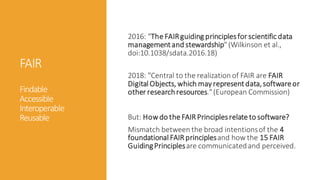
FAIR
Findable
Accessible
Interoperable
Reusable
2016: "The FAIRguiding principlesfor scientific data
managementand stewardship" (Wilkinson et al.,
doi:10.1038/sdata.2016.18)
2018: "Central to the realization of FAIR are FAIR
Digital Objects, which may representdata,softwareor
other researchresources."(European Commission)
But: Howdo the FAIR Principlesrelate to software?
Mismatch between the broad intentionsof the 4
foundational FAIR principlesand how the 15 FAIR
GuidingPrinciplesare communicatedand perceived.
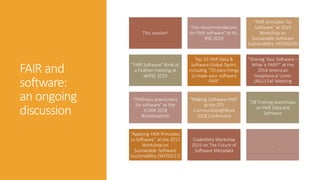
FAIR and
software:
an ongoing
discussion
This session!
Five recommendations
for FAIR software" at NL-
RSE 2019
“FAIR principles for
Software” at 2019
Workshop on
Sustainable Software
Sustainability (WOSSS19)
“FAIR Software” Birds of
a Feather meeting at
deRSE 2019
Top 10 FAIR Data &
Software Global Sprint,
including “10 easy things
to make your software
FAIR”
“Sharing Your Software –
What is FAIR?” at the
2018 American
Geophysical Union
(AGU) Fall Meeting
“FAIRness assessment
for software” at the
ELIXIR 2018
BioHackathon
“Making Software FAIR”
at the DTL
Communities@Work
2018 Conference
TIB Training workshops
on FAIR Data and
Software
“Applying FAIR Principles
to Software” at the 2017
Workshop on
Sustainable Software
Sustainability (WOSSS17)
CodeMeta Workshop
2016 on The Future of
Software Metadata
...
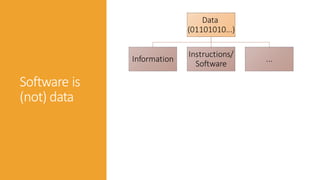
Software is
(not) data
Data
(01101010...)
Information
Instructions/
Software
...
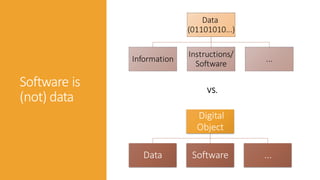
Software is
(not) data
Data
(01101010...)
Information
Instructions/
Software
...
Digital
Object
Data Software ...
VS.
Research
software
Research software is "softwarethat is used to
generate, processor analyze resultsthat youintendto
appear in a publication"(Hettrick et al., 2014).
Many forms.
Many purposes.
Many distribution channels.
Traditionally, often createdas Free and/or Open
Source Software (FOSS).
FAIR and
FOSS
Clear overlap of objectives, but not the same.
FOSS:Open source code, open licenses.
FAIR:Open data not a requirement.
Due to, e.g., privacy and sensitivity concerns with
patients' health records.
Not in the same way valid for research software.
There is even a demand to make methods
available!
Should FAIR software require FOSS?
Ongoing discussion ...
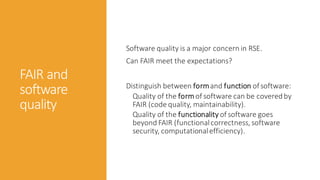
FAIR and
software
quality
Software quality is a major concern in RSE.
Can FAIR meet the expectations?
Distinguish between formand function ofsoftware:
Quality of the formof software can be coveredby
FAIR (code quality, maintainability).
Quality of the functionality of software goes
beyond FAIR (functionalcorrectness, software
security, computationalefficiency).
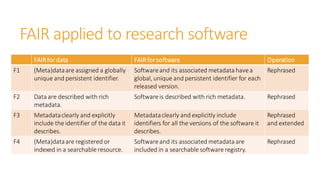
FAIR applied to research software
FAIRfordata FAIRforsoftware Operation
F1 (Meta)dataare assigned a globally
unique and persistent identifier.
Softwareand its associated metadata havea
global, unique and persistent identifier for each
released version.
Rephrased
F2 Data are described with rich
metadata.
Softwareis described with rich metadata. Rephrased
F3 Metadataclearly and explicitly
include the identifier of the data it
describes.
Metadataclearly and explicitly include
identifiers for all the versions of the software it
describes.
Rephrased
and extended
F4 (Meta)dataare registered or
indexed in a searchable resource.
Softwareand its associated metadata are
included in a searchable software registry.
Rephrased
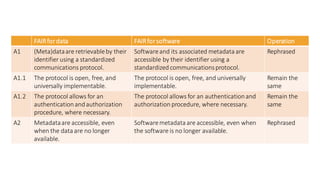
FAIRfordata FAIRforsoftware Operation
A1 (Meta)dataare retrievableby their
identifier using a standardized
communications protocol.
Softwareand its associated metadata are
accessible by their identifier using a
standardizedcommunicationsprotocol.
Rephrased
A1.1 The protocol is open, free, and
universally implementable.
The protocol is open, free, and universally
implementable.
Remain the
same
A1.2 The protocol allows for an
authenticationandauthorization
procedure, where necessary.
The protocol allows for an authenticationand
authorizationprocedure, where necessary.
Remain the
same
A2 Metadataare accessible, even
when the data are no longer
available.
Softwaremetadata are accessible, even when
the software is no longer available.
Rephrased
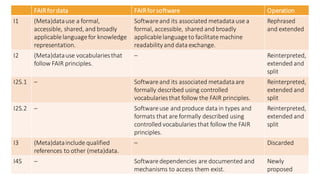
FAIR applied to research software: I
FAIRfordata FAIRforsoftware Operation
I1 (Meta)datause a formal,
accessible, shared, and broadly
applicablelanguagefor knowledge
representation.
Softwareand its associated metadata use a
formal, accessible, shared and broadly
applicablelanguageto facilitatemachine
readability and data exchange.
Rephrased
and extended
I2 (Meta)datause vocabulariesthat
follow FAIR principles.
– Reinterpreted,
extended and
split
I2S.1 – Softwareand its associated metadata are
formally described using controlled
vocabulariesthat follow the FAIR principles.
Reinterpreted,
extended and
split
I2S.2 – Softwareuse and produce data in types and
formats that are formally described using
controlled vocabularies that follow the FAIR
principles.
Reinterpreted,
extended and
split
I3 (Meta)datainclude qualified
references to other (meta)data.
– Discarded
I4S – Softwaredependencies are documented and
mechanisms to access them exist.
Newly
proposed
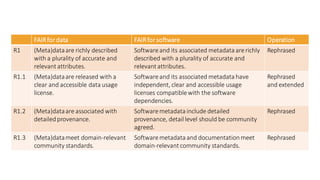
FAIRfordata FAIRforsoftware Operation
R1 (Meta)dataare richly described
with a plurality of accurate and
relevant attributes.
Softwareand its associated metadata arerichly
described with a plurality of accurate and
relevantattributes.
Rephrased
R1.1 (Meta)dataare released with a
clear and accessible data usage
license.
Softwareand its associated metadata have
independent, clear and accessible usage
licenses compatiblewith the software
dependencies.
Rephrased
and extended
R1.2 (Meta)dataare associated with
detailedprovenance.
Softwaremetadata include detailed
provenance, detaillevel should be community
agreed.
Rephrased
R1.3 (Meta)datameet domain-relevant
community standards.
Softwaremetadata and documentationmeet
domain-relevantcommunity standards.
Rephrased
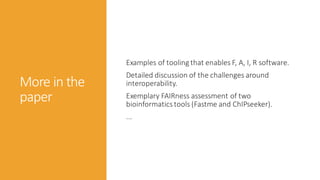
More in the
paper
Examples of tooling that enables F, A, I, R software.
Detailed discussion of the challenges around
interoperability.
Exemplary FAIRness assessment of two
bioinformaticstools (Fastme and ChIPseeker).
...
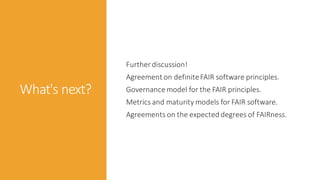
What's next?
Further discussion!
Agreement on definiteFAIR software principles.
Governance model for the FAIR principles.
Metrics and maturity models for FAIR software.
Agreements on the expected degrees of FAIRness.
Acknowledgments
We are grateful to the numerous people who
contributedto the discussions aroundFAIR
researchsoftwareat differentoccasions
preceding the work on this paper.
Making no claims to completeness, these include Peter Doorn, Michel
Dumontier, Chris Erdmann, José María Fernández, Rafael C. Jimenez,
Katrin Leinweber, Jason Maassen, Mustapha Mokrane, Jurriaan Spaaks,
Mark Wilkinson and Amrapali Zaveri.
We also thank the Japan BioHackathon for sponsoring a FAIR software
related project for the 2018 edition. Furthermore, we would like to
thank Stian Soiland-Reyes for his valuable comments on earlier
versions of this manuscript.
NCH and CAG were supported by EP/N006410/1 and EP/S021779/1 for
the UK Software Sustainability Institute. AV, JLG, SCG and CAG were
supported by ELIXIR-EXCELERATE 676559. EM, AV, JLG and SCG has
been additionally supported by PT17/0009/0001. EM and SCG has
been additionally supported by IMI2 FAIRplus 802750.
Thank you!

Towards FAIR principles for research software @ FAIR Software Session, National eScience Symposium 2019, Amsterdam, Netherlands

  • 1.
    Faculty of Science DepartmentofInformationand Computing Sciences SoftwareTechnologyGroup FAIR Principles for Research Software Anna-Lena Lamprecht(@al_lamprecht) FAIR Software@ NationaleScience Symposium, Amsterdam,21November 2019
  • 2.
    Towards FAIR Principles for Research Software Anna-LenaLamprecht,Leyla Garcia,MateuszKuzak,Carlos Martinez, RicardoArcila,Eva Martin Del Pico,Victoria Dominguez Del Angel, Stephanie van de Sandt, Jon Ison, PaulaAndrea Martinez, PeterMcQuilton, Alfonso Valencia,Jennifer Harrow, FotisPsomopoulos,Josep Ll Gelpi, Neil Chue Hong, Carole Goble, Salvador Capella- Gutierrez DOI: 10.3233/DS-190026 IOS Press DataScience Journal, Pre-Press Published 13 November 2019
  • 3.
    FAIR Findable Accessible Interoperable Reusable 2016: "The FAIRguidingprinciplesfor scientific data managementand stewardship" (Wilkinson et al., doi:10.1038/sdata.2016.18) 2018: "Central to the realization of FAIR are FAIR Digital Objects, which may representdata,softwareor other researchresources."(European Commission) But: Howdo the FAIR Principlesrelate to software? Mismatch between the broad intentionsof the 4 foundational FAIR principlesand how the 15 FAIR GuidingPrinciplesare communicatedand perceived.
  • 4.
    FAIR and software: an ongoing discussion Thissession! Five recommendations for FAIR software" at NL- RSE 2019 “FAIR principles for Software” at 2019 Workshop on Sustainable Software Sustainability (WOSSS19) “FAIR Software” Birds of a Feather meeting at deRSE 2019 Top 10 FAIR Data & Software Global Sprint, including “10 easy things to make your software FAIR” “Sharing Your Software – What is FAIR?” at the 2018 American Geophysical Union (AGU) Fall Meeting “FAIRness assessment for software” at the ELIXIR 2018 BioHackathon “Making Software FAIR” at the DTL Communities@Work 2018 Conference TIB Training workshops on FAIR Data and Software “Applying FAIR Principles to Software” at the 2017 Workshop on Sustainable Software Sustainability (WOSSS17) CodeMeta Workshop 2016 on The Future of Software Metadata ...
  • 5.
  • 6.
  • 7.
    Research software Research software is"softwarethat is used to generate, processor analyze resultsthat youintendto appear in a publication"(Hettrick et al., 2014). Many forms. Many purposes. Many distribution channels. Traditionally, often createdas Free and/or Open Source Software (FOSS).
  • 8.
    FAIR and FOSS Clear overlapof objectives, but not the same. FOSS:Open source code, open licenses. FAIR:Open data not a requirement. Due to, e.g., privacy and sensitivity concerns with patients' health records. Not in the same way valid for research software. There is even a demand to make methods available! Should FAIR software require FOSS? Ongoing discussion ...
  • 9.
    FAIR and software quality Software qualityis a major concern in RSE. Can FAIR meet the expectations? Distinguish between formand function ofsoftware: Quality of the formof software can be coveredby FAIR (code quality, maintainability). Quality of the functionality of software goes beyond FAIR (functionalcorrectness, software security, computationalefficiency).
  • 10.
    FAIR applied toresearch software FAIRfordata FAIRforsoftware Operation F1 (Meta)dataare assigned a globally unique and persistent identifier. Softwareand its associated metadata havea global, unique and persistent identifier for each released version. Rephrased F2 Data are described with rich metadata. Softwareis described with rich metadata. Rephrased F3 Metadataclearly and explicitly include the identifier of the data it describes. Metadataclearly and explicitly include identifiers for all the versions of the software it describes. Rephrased and extended F4 (Meta)dataare registered or indexed in a searchable resource. Softwareand its associated metadata are included in a searchable software registry. Rephrased
  • 11.
    FAIRfordata FAIRforsoftware Operation A1(Meta)dataare retrievableby their identifier using a standardized communications protocol. Softwareand its associated metadata are accessible by their identifier using a standardizedcommunicationsprotocol. Rephrased A1.1 The protocol is open, free, and universally implementable. The protocol is open, free, and universally implementable. Remain the same A1.2 The protocol allows for an authenticationandauthorization procedure, where necessary. The protocol allows for an authenticationand authorizationprocedure, where necessary. Remain the same A2 Metadataare accessible, even when the data are no longer available. Softwaremetadata are accessible, even when the software is no longer available. Rephrased
  • 12.
    FAIR applied toresearch software: I FAIRfordata FAIRforsoftware Operation I1 (Meta)datause a formal, accessible, shared, and broadly applicablelanguagefor knowledge representation. Softwareand its associated metadata use a formal, accessible, shared and broadly applicablelanguageto facilitatemachine readability and data exchange. Rephrased and extended I2 (Meta)datause vocabulariesthat follow FAIR principles. – Reinterpreted, extended and split I2S.1 – Softwareand its associated metadata are formally described using controlled vocabulariesthat follow the FAIR principles. Reinterpreted, extended and split I2S.2 – Softwareuse and produce data in types and formats that are formally described using controlled vocabularies that follow the FAIR principles. Reinterpreted, extended and split I3 (Meta)datainclude qualified references to other (meta)data. – Discarded I4S – Softwaredependencies are documented and mechanisms to access them exist. Newly proposed
  • 13.
    FAIRfordata FAIRforsoftware Operation R1(Meta)dataare richly described with a plurality of accurate and relevant attributes. Softwareand its associated metadata arerichly described with a plurality of accurate and relevantattributes. Rephrased R1.1 (Meta)dataare released with a clear and accessible data usage license. Softwareand its associated metadata have independent, clear and accessible usage licenses compatiblewith the software dependencies. Rephrased and extended R1.2 (Meta)dataare associated with detailedprovenance. Softwaremetadata include detailed provenance, detaillevel should be community agreed. Rephrased R1.3 (Meta)datameet domain-relevant community standards. Softwaremetadata and documentationmeet domain-relevantcommunity standards. Rephrased
  • 14.
    More in the paper Examplesof tooling that enables F, A, I, R software. Detailed discussion of the challenges around interoperability. Exemplary FAIRness assessment of two bioinformaticstools (Fastme and ChIPseeker). ...
  • 15.
    What's next? Further discussion! Agreementon definiteFAIR software principles. Governance model for the FAIR principles. Metrics and maturity models for FAIR software. Agreements on the expected degrees of FAIRness.
  • 16.
    Acknowledgments We are gratefulto the numerous people who contributedto the discussions aroundFAIR researchsoftwareat differentoccasions preceding the work on this paper. Making no claims to completeness, these include Peter Doorn, Michel Dumontier, Chris Erdmann, José María Fernández, Rafael C. Jimenez, Katrin Leinweber, Jason Maassen, Mustapha Mokrane, Jurriaan Spaaks, Mark Wilkinson and Amrapali Zaveri. We also thank the Japan BioHackathon for sponsoring a FAIR software related project for the 2018 edition. Furthermore, we would like to thank Stian Soiland-Reyes for his valuable comments on earlier versions of this manuscript. NCH and CAG were supported by EP/N006410/1 and EP/S021779/1 for the UK Software Sustainability Institute. AV, JLG, SCG and CAG were supported by ELIXIR-EXCELERATE 676559. EM, AV, JLG and SCG has been additionally supported by PT17/0009/0001. EM and SCG has been additionally supported by IMI2 FAIRplus 802750.
  • 17.