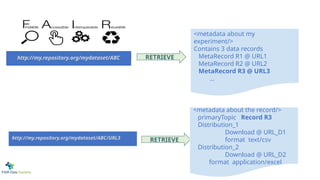
FAIR is aboutdata
But it is even more about metadata
Why would I say that?
Why is FAIR Data not enough? Which principles are about
Metadata?
Under what circumstances would FAIR Data be
impossible/impractical/useless?
3.
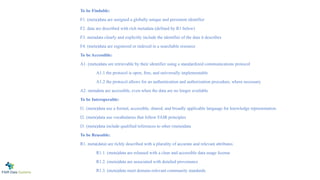
To be Findable:
F1.(meta)data are assigned a globally unique and persistent identifier
F2. data are described with rich metadata (defined by R1 below)
F3. metadata clearly and explicitly include the identifier of the data it describes
F4. (meta)data are registered or indexed in a searchable resource
To be Accessible:
A1. (meta)data are retrievable by their identifier using a standardized communications protocol
A1.1 the protocol is open, free, and universally implementable
A1.2 the protocol allows for an authentication and authorization procedure, where necessary
A2. metadata are accessible, even when the data are no longer available
To be Interoperable:
I1. (meta)data use a formal, accessible, shared, and broadly applicable language for knowledge representation.
I2. (meta)data use vocabularies that follow FAIR principles
I3. (meta)data include qualified references to other (meta)data
To be Reusable:
R1. meta(data) are richly described with a plurality of accurate and relevant attributes
R1.1. (meta)data are released with a clear and accessible data usage license
R1.2. (meta)data are associated with detailed provenance
R1.3. (meta)data meet domain-relevant community standards
4.
When it comesto FAIR Data, be smart
FAIR is about data
But it is even more about metadata
5.
When it comesto FAIR Data, be smart
But when it comes to FAIR METADATA,
go to the limit!
FAIR is about data
But it is even more about metadata
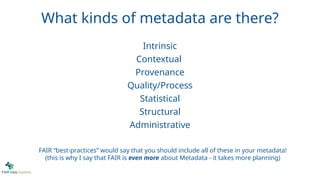
What kinds ofmetadata are there?
FAIR “best-practices” would say that you should include all of these in your metadata!
(this is why I say that FAIR is even more about Metadata - it takes more planning)
Intrinsic
Contextual
Provenance
Quality/Process
Statistical
Structural
Administrative
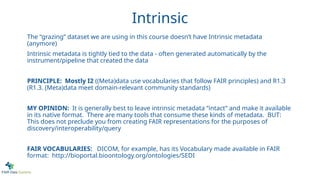
8.
Intrinsic
The “grazing” datasetwe are using in this course doesn’t have Intrinsic metadata
(anymore)
Intrinsic metadata is tightly tied to the data - often generated automatically by the
instrument/pipeline that created the data
PRINCIPLE: Mostly I2 ((Meta)data use vocabularies that follow FAIR principles) and R1.3
(R1.3. (Meta)data meet domain-relevant community standards)
MY OPINION: It is generally best to leave intrinsic metadata “intact” and make it available
in its native format. There are many tools that consume these kinds of metadata. BUT:
This does not preclude you from creating FAIR representations for the purposes of
discovery/interoperability/query
FAIR VOCABULARIES: DICOM, for example, has its Vocabulary made available in FAIR
format: http://bioportal.bioontology.org/ontologies/SEDI
9.
Contextual
Contextual metadata maybe tied to a specific piece of data, or may be tied to a dataset, or
even a set of datasets (e.g. an entire funded project)
→ We may need to create multiple contextual metadata records (“record” or sections of
larger records)
PRINCIPLE: F2 (F2. Data are described with rich metadata) I2 (I2. (Meta)data use
vocabularies that follow FAIR principles), and R1.3 (R1.3. (Meta)data meet domain-relevant
community standards)
MY OPINION: Data that cannot be found is reuseless. Data that can be found and cannot
be understood/interpreted is reuseless. Data that can be found, and understood, but not
assessed for its relevance is reuseless.
FAIR VOCABULARIES: EDAM (Bioinformatics operations, data types, formats, identifiers
and topics); Disease-specific (e.g. NCI Thesaurus); Anatomy (e.g. Foundational Model of
Anatomy - FMA)
10.
Provenance
Provenance metadata isusually attached to all levels - specific piece of data, a dataset, or a
set of datasets (e.g. an entire funded project)
→ We will need to create multiple provenance metadata records
PRINCIPLE: R1.2 (R1.2. (Meta)data are associated with detailed provenance), F2 (F2. Data
are described with rich metadata) and R1.3 (R1.3. (Meta)data meet domain-relevant
community standards)
MY OPINION: Data of unknown origin is reuseless. Data that cannot be properly cited,
should not be used.
FAIR VOCABULARIES: Dublin Core (author, title, etc.) and Data Catalogue (DCAT); EDAM
(Bioinformatics operations, data types, formats, identifiers and topics)
11.
Quality/Process
Quality and Processmetadata is usually attached to a specific piece of data or a dataset
arising from a single process/run
→ We may need to create multiple Quality/Process metadata records
PRINCIPLE: R1.2 (R1.2. (Meta)data are associated with detailed provenance), F2 (F2. Data
are described with rich metadata) and R1.3 (R1.3. (Meta)data meet domain-relevant
community standards)
MY OPINION: Where possible/relevant, quality measures should be made available to
allow assessment of the conformity of a dataset (e.g. is there an ISO standard? A Data Seal
of Approval? etc.)
FAIR VOCABULARIES: Image and Data Quality Assessment Ontology:
http://bioportal.bioontology.org/ontologies/IDQA; Data Quality Ontology -
https://www.ncbi.nlm.nih.gov/pmc/articles/PMC4817336/
12.
Statistical
Statistical metadata isusually attached to other (usually quality/process) metadata, in
order to provide a way of evaluating the quality measures recorded in that metadata
→ We may need to create multiple Statistical metadata records (in this course, we will not
create any… but in your own datasets you probably will need this)
PRINCIPLE: R1.2 (R1.2. (Meta)data are associated with detailed provenance), F2 (F2. Data
are described with rich metadata) and R1.3 (R1.3. (Meta)data meet domain-relevant
community standards)
MY OPINION: Is the dataset representative, or biased? What is the bias within the
dataset? (e.g. contains 95% female, 5% male)
FAIR VOCABULARIES: Depends on the metric - probably EDAM or a more domain-specific
vocabulary
13.
Structural
Structural metadata isassociated with both data and metadata - sometimes directly, and
sometimes “out of band” (e.g. in HTTP headers)
→ We need to find a way to communicate Structural metadata about both data and
metadata
PRINCIPLE: Mostly I1 - the structure/syntax should be as machine-readable as possible.
MY OPINION: FAIR is largely about supporting mechanized access. Vanilla HTML is not a
good option to support machines
FAIR VOCABULARIES: Dublin Core (‘format’) and Data Catalogue (DCAT) have fields
related to the data structure; EDAM (data types, formats); RDF Cube Vocabulary; RO-Crates
vocabulary/schema; and the HTTP Protocol (MIME-type) provides out-of-band structural
metadata
14.
Administrative
Administrative metadata is(in my experience) most frequently associated with datasets or
data catalogues, e.g. dealing with who has access under what conditions.
→ We will need to create Administrative metadata at the catalogue and/or dataset level
(though these might be identical)
PRINCIPLE: Mostly R’s (license, citation), and the A’s (authorization)
MY OPINION: You must not use data that does not have a license, period! You must not
use data that you cannot cite. FAIR requires that the process by which you may become
authorized to obtain data is explicit - no exceptions.
FAIR VOCABULARIES: Dublin Core (‘format’) and Data Catalogue (DCAT) have fields
related to the license; There is some work (ongoing) related to Consent ontologies.
Skunkworks Participants
Mark Wilkinson
MichelDumontier
Barend Mons
Tim Clark
Jun Zhao
Paolo Ciccarese
Paul Groth
Erik van Mulligen
Luiz Olavo Bonino da Silva Santos
Matthew Gamble
Carole Goble
Joël Kuiper
Morris Swertz
Erik Schultes
Erik Schultes
Mercè Crosas
Adrian Garcia
Philip Durbin
Jeffrey Grethe
Katy Wolstencroft
Sudeshna Das
M. Emily Merrill
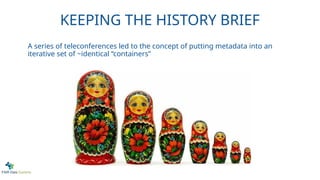
KEEPING THE HISTORYBRIEF
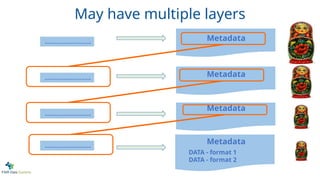
A series of teleconferences led to the concept of putting metadata into an
iterative set of ~identical “containers”
27.
Skunkworks Hackathons
The “containersof containers of containers” idea was
elaborated by the belief that we should also reject any solution
that required a new API
ProgrammableWeb.com already catalogues
>16,000 different Web APIs
28.
Skunkworks Hackathons
The “containersof containers of containers” idea was
elaborated by the belief that we should also reject any solution
that required a new API
ProgrammableWeb.com already catalogues
>16,000 different Web APIs
APIs DO NOT MAKE YOU INTEROPERABLE!
29.
Skunkworks Hackathons
The “containersof containers of containers” idea was
elaborated by the belief that we should also reject any solution
that required a new API
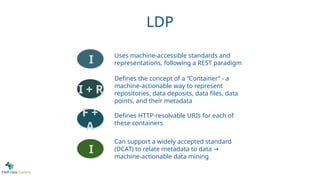
Uses machine-accessible standardsand
representations, following a REST paradigm
I
I + R
F +
A
I
Defines HTTP-resolvable URIs for each of
these containers
Defines the concept of a “Container” - a
machine-actionable way to represent
repositories, data deposits, data files, data
points, and their metadata
Can support a widely accepted standard
(DCAT) to relate metadata to data →
machine-actionable data mining
LDP
33.
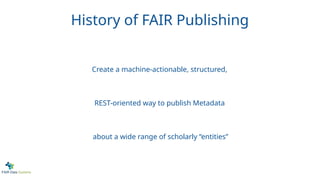
History of FAIRPublishing
Create a machine-actionable, structured,
REST-oriented way to publish Metadata
about a wide range of scholarly “entities”
34.
History of FAIRPublishing
Warehouses (e.g. EBI)
Databases (e.g. UniProt)
Repositories (e.g. Zenodo, INRA-URGI Wheat Repo, UniProt)
Datasets (e.g. output from a workflow)
Research Objects (data a/o workflow a/o results a/o publications)
Data “slices” (e.g. the result of a database query)
Data Records (e.g. image, excel file, patient clinical record)
Other…
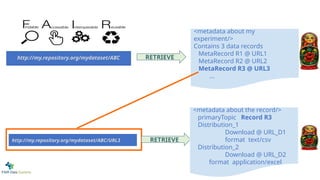
<metadata about my
experiment/>
Contains3 data records
MetaRecord R1 @ URL1
MetaRecord R2 @ URL2
MetaRecord R3 @ URL3
...
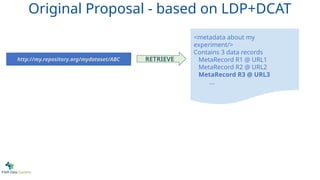
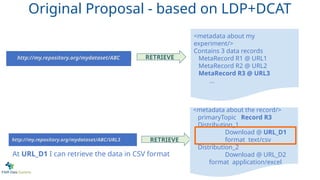
http://my.repository.org/mydataset/ABC RETRIEVE
Original Proposal - based on LDP+DCAT
37.
<metadata about my
experiment/>
Contains3 data records
MetaRecord R1 @ URL1
MetaRecord R2 @ URL2
MetaRecord R3 @ URL3
...
http://my.repository.org/mydataset/ABC RETRIEVE
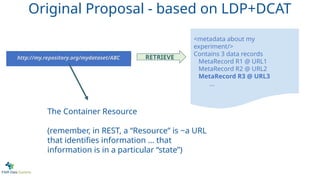
The Container Resource
(remember, in REST, a “Resource” is ~a URL
that identifies information … that
information is in a particular “state”)
Original Proposal - based on LDP+DCAT
38.
<metadata about my
experiment/>
Contains3 data records
MetaRecord R1 @ URL1
MetaRecord R2 @ URL2
MetaRecord R3 @ URL3
...
http://my.repository.org/mydataset/ABC RETRIEVE
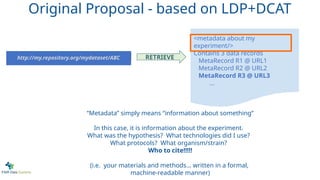
“Metadata” simply means “information about something”
In this case, it is information about the experiment.
What was the hypothesis? What technologies did I use?
What protocols? What organism/strain?
Who to cite!!!!!
(i.e. your materials and methods… written in a formal,
machine-readable manner)
Original Proposal - based on LDP+DCAT
39.
<metadata about my
experiment/>
Contains3 data records
MetaRecord R1 @ URL1
MetaRecord R2 @ URL2
MetaRecord R3 @ URL3
...
http://my.repository.org/mydataset/ABC RETRIEVE
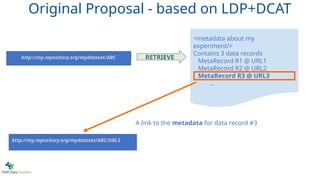
A link to the metadata for data record #3
http://my.repository.org/mydataset/ABC/URL3
Original Proposal - based on LDP+DCAT
40.
<metadata about my
experiment/>
Contains3 data records
MetaRecord R1 @ URL1
MetaRecord R2 @ URL2
MetaRecord R3 @ URL3
...
http://my.repository.org/mydataset/ABC RETRIEVE
http://my.repository.org/mydataset/ABC/URL3 RETRIEVE
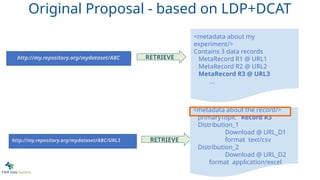
<metadata about the record/>
primaryTopic Record R3
Distribution_1
Download @ URL_D1
format text/csv
Distribution_2
Download @ URL_D2
format application/excel
Original Proposal - based on LDP+DCAT
41.
<metadata about my
experiment/>
Contains3 data records
MetaRecord R1 @ URL1
MetaRecord R2 @ URL2
MetaRecord R3 @ URL3
...
http://my.repository.org/mydataset/ABC RETRIEVE
http://my.repository.org/mydataset/ABC/URL3 RETRIEVE
<metadata about the record/>
primaryTopic Record R3
Distribution_1
Download @ URL_D1
format text/csv
Distribution_2
Download @ URL_D2
format application/excel
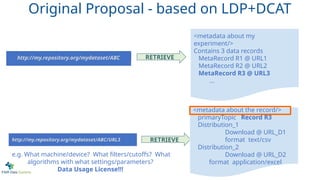
e.g. What machine/device? What filters/cutoffs? What
algorithms with what settings/parameters?
Data Usage License!!!
Original Proposal - based on LDP+DCAT
42.
<metadata about my
experiment/>
Contains3 data records
MetaRecord R1 @ URL1
MetaRecord R2 @ URL2
MetaRecord R3 @ URL3
...
http://my.repository.org/mydataset/ABC RETRIEVE
http://my.repository.org/mydataset/ABC/URL3 RETRIEVE
<metadata about the record/>
primaryTopic Record R3
Distribution_1
Download @ URL_D1
format text/csv
Distribution_2
Download @ URL_D2
format application/excel
At URL_D1 I can retrieve the data in CSV format
Original Proposal - based on LDP+DCAT
43.
<metadata about my
experiment/>
Contains3 data records
MetaRecord R1 @ URL1
MetaRecord R2 @ URL2
MetaRecord R3 @ URL3
...
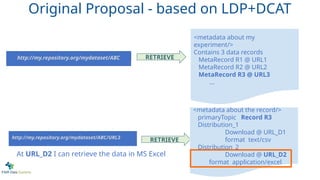
http://my.repository.org/mydataset/ABC RETRIEVE
http://my.repository.org/mydataset/ABC/URL3
RETRIEVE
<metadata about the record/>
primaryTopic Record R3
Distribution_1
Download @ URL_D1
format text/csv
Distribution_2
Download @ URL_D2
format application/excel
At URL_D2 I can retrieve the data in MS Excel
Original Proposal - based on LDP+DCAT
44.
<metadata about my
experiment/>
Contains3 data records
MetaRecord R1 @ URL1
MetaRecord R2 @ URL2
MetaRecord R3 @ URL3
...
http://my.repository.org/mydataset/ABC RETRIEVE
http://my.repository.org/mydataset/ABC/URL3 RETRIEVE
<metadata about the record/>
primaryTopic Record R3
Distribution_1
Download @ URL_D1
format text/csv
Distribution_2
Download @ URL_D2
format application/excel
45.
http://my.repository.org/mydataset/
ABC
http://my.repository.org/mydataset/
ABC/URL3
<metadata about my
experiment/>
Contains3 data records
MetaRecord R1 @ URL1
MetaRecord R2 @ URL2
MetaRecord R3 @ URL3
...
http://my.repository.org/mydataset/ABC RETRIEVE
http://my.repository.org/mydataset/ABC/URL3 RETRIEVE
<metadata about the record/>
primaryTopic Record R3
Distribution_1
Download @ URL_D1
format text/csv
Distribution_2
Download @ URL_D2
format application/excel
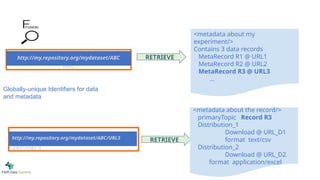
Globally-unique Identifiers for data
and metadata
46.
<metadata about my
experiment/>
Contains3 data records
MetaRecord R1 @ URL1
MetaRecord R2 @ URL2
MetaRecord R3 @ URL3
...
http://my.repository.org/mydataset/ABC RETRIEVE
http://my.repository.org/mydataset/ABC/URL3 RETRIEVE
<metadata about the record/>
primaryTopic Record R3
Distribution_1
Download @ URL_D1
format text/csv
Distribution_2
Download @ URL_D2
format application/excel
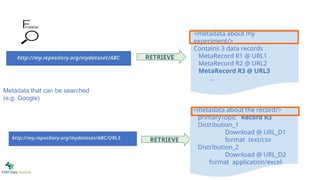
Metadata that can be searched
(e.g. Google)
47.
RETRIEVE
RETRIEVE
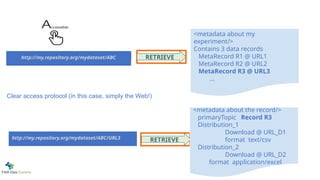
Clear access protocol(in this case, simply the Web!)
<metadata about my
experiment/>
Contains 3 data records
MetaRecord R1 @ URL1
MetaRecord R2 @ URL2
MetaRecord R3 @ URL3
...
http://my.repository.org/mydataset/ABC RETRIEVE
http://my.repository.org/mydataset/ABC/URL3 RETRIEVE
<metadata about the record/>
primaryTopic Record R3
Distribution_1
Download @ URL_D1
format text/csv
Distribution_2
Download @ URL_D2
format application/excel
48.
<metadata about my
experiment/>
Contains3 data records
MetaRecord R1 @ URL1
MetaRecord R2 @ URL2
MetaRecord R3 @ URL3
...
http://my.repository.org/mydataset/ABC RETRIEVE
http://my.repository.org/mydataset/ABC/URL3 RETRIEVE
<metadata about the record/>
primaryTopic Record R3
Distribution_1
Download @ URL_D1
format text/csv
Distribution_2
Download @ URL_D2
format application/excel
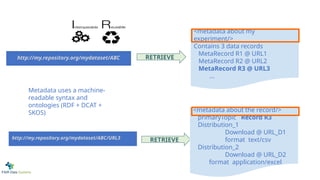
Metadata uses a machine-
readable syntax and
ontologies (RDF + DCAT +
SKOS)
49.
<metadata about my
experiment/>
Contains3 data records
MetaRecord R1 @ URL1
MetaRecord R2 @ URL2
MetaRecord R3 @ URL3
...
http://my.repository.org/mydataset/ABC RETRIEVE
http://my.repository.org/mydataset/ABC/URL3 RETRIEVE
<metadata about the record/>
primaryTopic Record R3
Distribution_1
Download @ URL_D1
format text/csv
Distribution_2
Download @ URL_D2
format application/excel
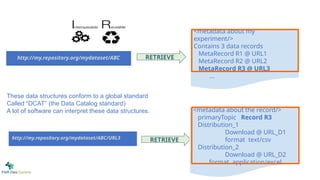
These data structures conform to a global standard
Called “DCAT” (the Data Catalog standard)
A lot of software can interpret these data structures.
50.
<metadata about my
experiment/>
Contains3 data records
MetaRecord R1 @ URL1
MetaRecord R2 @ URL2
MetaRecord R3 @ URL3
...
http://my.repository.org/mydataset/ABC RETRIEVE
RETRIEVE
<metadata about the record/>
primaryTopic Record R3
Distribution_1
Download @ URL_D1
format text/csv
Distribution_2
Download @ URL_D2
format application/excel
http://my.repository.org/mydataset/ABC/URL3
Features
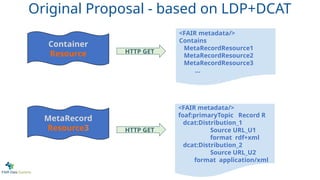
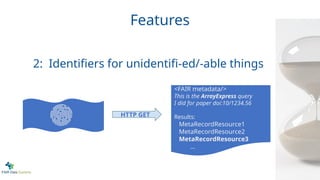
<FAIR metadata/>
This isthe ArrayExpress query
I did for paper doi:10/1234.56
Results:
MetaRecordResource1
MetaRecordResource2
MetaRecordResource3
...
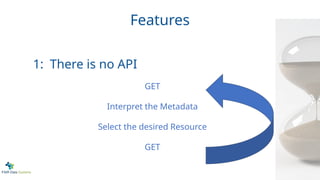
HTTP GET
2: Identifiers for unidentifi-ed/-able things
56.
Features
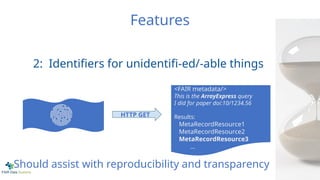
Should assist withreproducibility and transparency
2: Identifiers for unidentifi-ed/-able things
<FAIR metadata/>
This is the ArrayExpress query
I did for paper doi:10/1234.56
Results:
MetaRecordResource1
MetaRecordResource2
MetaRecordResource3
...
HTTP GET
57.
Features
PrimaryTopic: record 1A445
RecordMetadata...
DATA - format 1
DATA - format 2
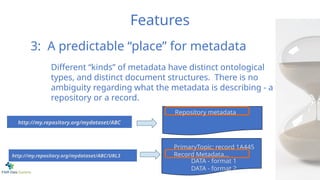
Different “kinds” of metadata have distinct ontological
types, and distinct document structures. There is no
ambiguity regarding what the metadata is describing - a
repository or a record.
Repository metadata
3: A predictable “place” for metadata
http://my.repository.org/mydataset/ABC
http://my.repository.org/mydataset/ABC/URL3
58.
Features
Part of datasetABC
Metadata...
DATA - format 1
DATA - format 2
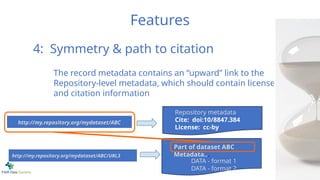
The record metadata contains an “upward” link to the
Repository-level metadata, which should contain license
and citation information
Repository metadata
Cite: doi:10/8847.384
License: cc-by
4: Symmetry & path to citation
http://my.repository.org/mydataset/ABC
http://my.repository.org/mydataset/ABC/URL3
Features
<FAIR metadata/>
foaf:primaryTopic RecordR
dcat:distribution
<<NONE>>
<FAIR metadata/>
Contains
MetaRecordResource3
http://my.repository.org/mydataset/ABC
http://my.repository.org/mydataset/ABC/URL3
GET
GET
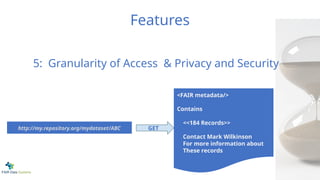
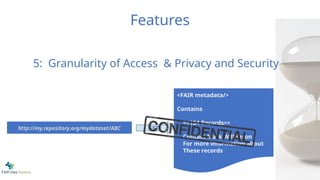
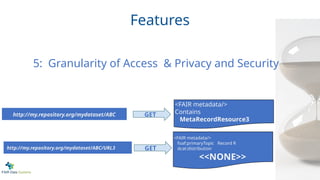
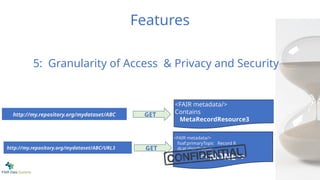
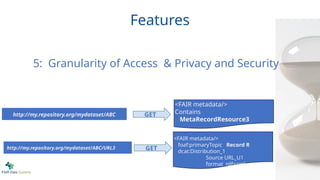
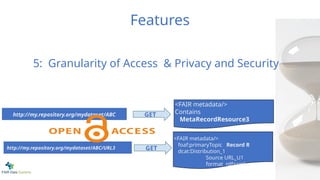
5: Granularity of Access & Privacy and Security
62.
Features
<FAIR metadata/>
foaf:primaryTopic RecordR
dcat:distribution
<<NONE>>
<FAIR metadata/>
Contains
MetaRecordResource3
http://my.repository.org/mydataset/ABC
http://my.repository.org/mydataset/ABC/URL3
GET
GET
5: Granularity of Access & Privacy and Security
63.
Features
<FAIR metadata/>
foaf:primaryTopic RecordR
dcat:Distribution_1
Source URL_U1
format rdf+xml
<FAIR metadata/>
Contains
MetaRecordResource3
http://my.repository.org/mydataset/ABC
http://my.repository.org/mydataset/ABC/URL3
GET
GET
5: Granularity of Access & Privacy and Security
64.
Features
<FAIR metadata/>
foaf:primaryTopic RecordR
dcat:Distribution_1
Source URL_U1
format rdf+xml
<FAIR metadata/>
Contains
MetaRecordResource3
http://my.repository.org/mydataset/ABC
http://my.repository.org/mydataset/ABC/URL3
GET
GET
5: Granularity of Access & Privacy and Security
65.
Features
Thin solution -if it’s private, do nothing! Literally!
5: Granularity of Access & Privacy and Security
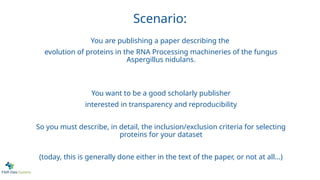
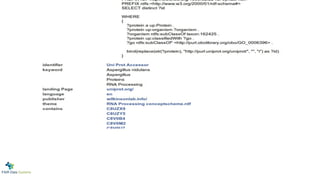
Scenario:
You are publishinga paper describing the
evolution of proteins in the RNA Processing machineries of the fungus
Aspergillus nidulans.
You want to be a good scholarly publisher
interested in transparency and reproducibility
So you must describe, in detail, the inclusion/exclusion criteria for selecting
proteins for your dataset
(today, this is generally done either in the text of the paper, or not at all...)
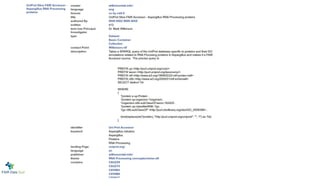
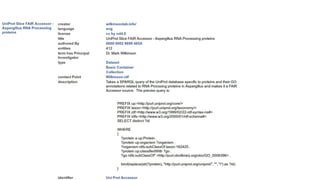
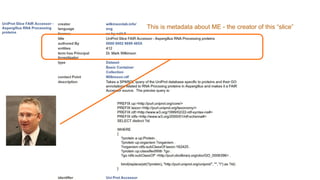
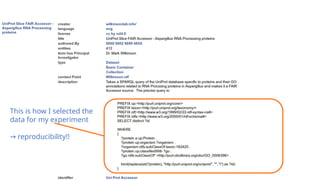
68.
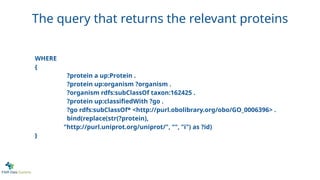
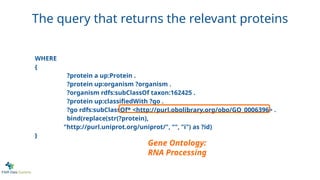
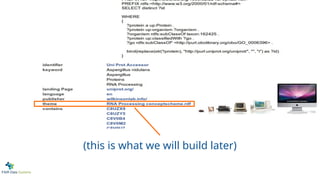
The query thatreturns the relevant proteins
WHERE
{
?protein a up:Protein .
?protein up:organism ?organism .
?organism rdfs:subClassOf taxon:162425 .
?protein up:classifiedWith ?go .
?go rdfs:subClassOf* <http://purl.obolibrary.org/obo/GO_0006396> .
bind(replace(str(?protein),
"http://purl.uniprot.org/uniprot/", "", "i") as ?id)
}
69.
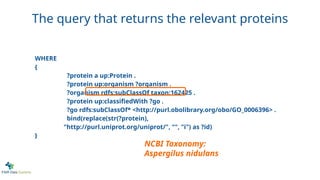
WHERE
{
?protein a up:Protein.
?protein up:organism ?organism .
?organism rdfs:subClassOf taxon:162425 .
?protein up:classifiedWith ?go .
?go rdfs:subClassOf* <http://purl.obolibrary.org/obo/GO_0006396> .
bind(replace(str(?protein),
"http://purl.uniprot.org/uniprot/", "", "i") as ?id)
}
NCBI Taxonomy:
Aspergilus nidulans
The query that returns the relevant proteins
70.
WHERE
{
?protein a up:Protein.
?protein up:organism ?organism .
?organism rdfs:subClassOf taxon:162425 .
?protein up:classifiedWith ?go .
?go rdfs:subClassOf* <http://purl.obolibrary.org/obo/GO_0006396> .
bind(replace(str(?protein),
"http://purl.uniprot.org/uniprot/", "", "i") as ?id)
}
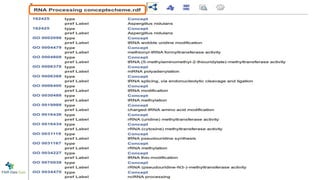
Gene Ontology:
RNA Processing
The query that returns the relevant proteins
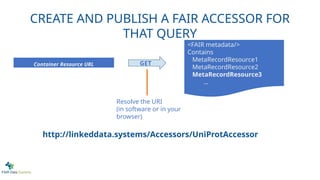
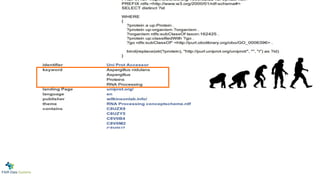
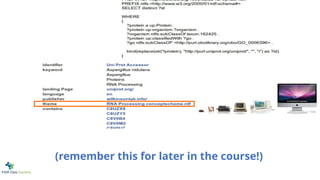
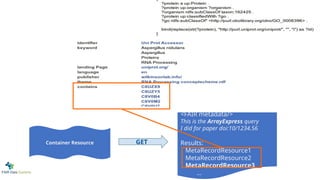
CREATE AND PUBLISHA FAIR ACCESSOR FOR
THAT QUERY
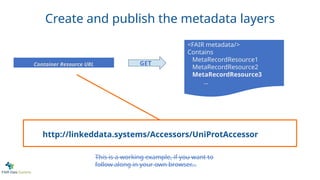
http://linkeddata.systems/Accessors/UniProtAccessor
<FAIR metadata/>
Contains
MetaRecordResource1
MetaRecordResource2
MetaRecordResource3
...
Container Resource URL GET
Resolve the URI
(in software or in your
browser)
73.
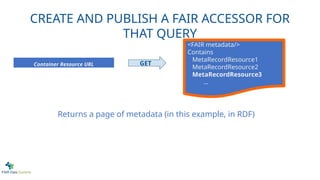
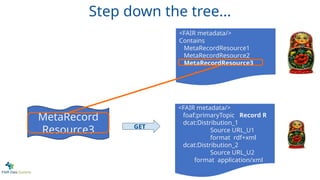
CREATE AND PUBLISHA FAIR ACCESSOR FOR
THAT QUERY
Container Resource URL GET
Returns a page of metadata (in this example, in RDF)
<FAIR metadata/>
Contains
MetaRecordResource1
MetaRecordResource2
MetaRecordResource3
...
<FAIR metadata/>
This isthe ArrayExpress query
I did for paper doi:10/1234.56
Results:
MetaRecordResource1
MetaRecordResource2
MetaRecordResource3
...
Container Resource GET
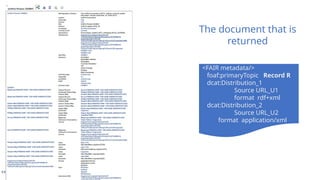
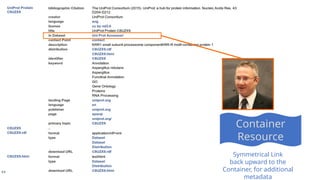
The document thatis
returned
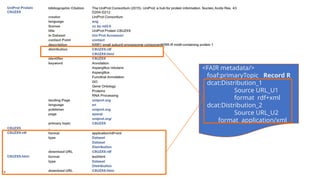
<FAIR metadata/>
foaf:primaryTopic Record R
dcat:Distribution_1
Source URL_U1
format rdf+xml
dcat:Distribution_2
Source URL_U2
format application/xml
86.
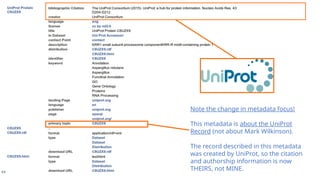
Note the changein metadata focus!
This metadata is about the UniProt
Record (not about Mark Wilkinson).
The record described in this metadata
was created by UniProt, so the citation
and authorship information is now
THEIRS, not MINE.
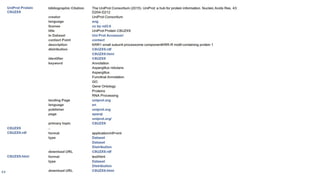
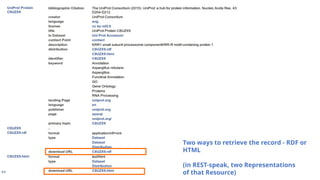
Two ways toretrieve the record - RDF or
HTML
(in REST-speak, two Representations
of that Resource)
90.
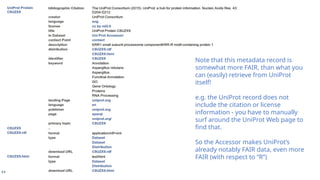
Note that thismetadata record is
somewhat more FAIR, than what you
can (easily) retrieve from UniProt
itself!
e.g. the UniProt record does not
include the citation or license
information - you have to manually
surf around the UniProt Web page to
find that.
So the Accessor makes UniProt’s
already notably FAIR data, even more
FAIR (with respect to “R”)
91.
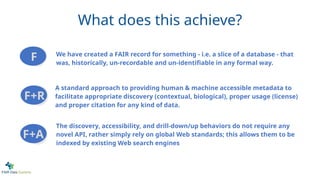
What does thisachieve?
We have created a FAIR record for something - i.e. a slice of a database - that
was, historically, un-recordable and un-identifiable in any formal way.
A standard approach to providing human & machine accessible metadata to
facilitate appropriate discovery (contextual, biological), proper usage (license)
and proper citation for any kind of data.
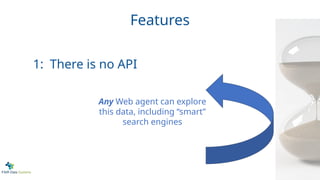
The discovery, accessibility, and drill-down/up behaviors do not require any
novel API, rather simply rely on global Web standards; this allows them to be
indexed by existing Web search engines
F+R
F+A
F
92.
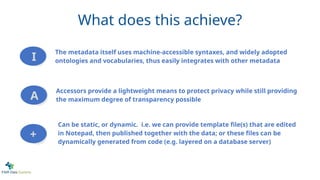
The metadata itselfuses machine-accessible syntaxes, and widely adopted
ontologies and vocabularies, thus easily integrates with other metadata
Accessors provide a lightweight means to protect privacy while still providing
the maximum degree of transparency possible
Can be static, or dynamic. i.e. we can provide template file(s) that are edited
in Notepad, then published together with the data; or these files can be
dynamically generated from code (e.g. layered on a database server)
I
A
+
What does this achieve?
93.
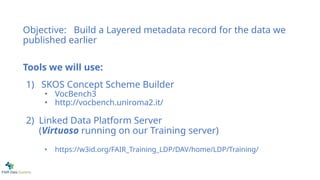
Objective: Build aLayered metadata record for the data we
published earlier
Tools we will use:
1) SKOS Concept Scheme Builder
• VocBench3
• http://vocbench.uniroma2.it/
2) Linked Data Platform Server
(Virtuoso running on our Training server)
• https://w3id.org/FAIR_Training_LDP/DAV/home/LDP/Training/
Self exploration
Install HeaderEditor
Go to your browser’s Extensions/Plugins page
Search for Header Editor
In 5 minutes I will walk you through the configuration process “live”
96.
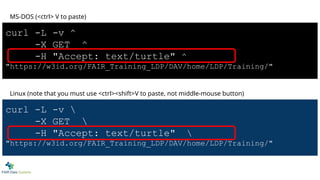
curl -L -v^
-X GET ^
-H "Accept: text/turtle" ^
"https://w3id.org/FAIR_Training_LDP/DAV/home/LDP/Training/"
MS-DOS (<ctrl> V to paste)
curl -L -v
-X GET
-H "Accept: text/turtle"
"https://w3id.org/FAIR_Training_LDP/DAV/home/LDP/Training/"
Linux (note that you must use <ctrl><shift>V to paste, not middle-mouse button)
97.
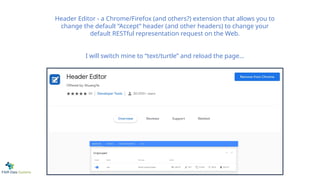
Header Editor -a Chrome/Firefox (and others?) extension that allows you to
change the default “Accept” header (and other headers) to change your
default RESTful representation request on the Web.
I will switch mine to “text/turtle” and reload the page…
98.
Self exploration
Switch onHeader Editor to Accept: text/turtle
Go to another Linked Data Platform resource I have created:
http://ejprd.fair-dtls.surf-hosted.nl:8890/DAV/home/LDP/EJP/erdri_catalog/
Look for the metadata, and the container structure(s)