Towards a more ‘impact-oriented’
institutional M&E system:
common challenges and potential solutions
from a UN perspective
Brighton, March 26-27, 2013
Jos Vaessen (UNESCO)
Oscar Garcia (UNDP)
Juha Uitto (UNDP)
Outline
Characteristics of IE practices in the UN
system
Challenges and solutions in developing
more ‘impact-oriented’ M&E systems
Illustrations of (potential) solutions
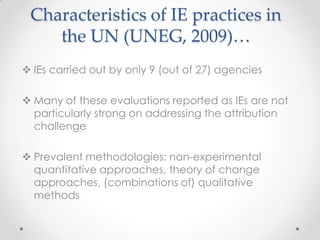
Characteristics of IE practices in
the UN (UNEG, 2009)…
 IEs carried out by only 9 (out of 27) agencies
 Many of these evaluations reported as IEs are not
particularly strong on addressing the attribution
challenge
 Prevalent methodologies: non-experimental
quantitative approaches, theory of change
approaches, (combinations of) qualitative
methods
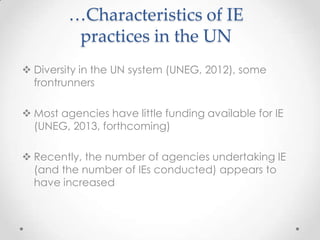
…Characteristics of IE
practices in the UN
 Diversity in the UN system (UNEG, 2012), some
frontrunners
 Most agencies have little funding available for IE
(UNEG, 2013, forthcoming)
 Recently, the number of agencies undertaking IE
(and the number of IEs conducted) appears to
have increased
Examples of pathways of
institutionalization of IE
- Conducting high-profile rigorous impact evaluations to
create institutional demand which may lead to
institutionalization of the practice (middle income country
examples; IEG, 2009)
- Mandatory rigorous IE as a prerequisite for continuation /
increase in public funding for programmes (US example:
Epstein and Klerman, 2012; Latin America examples:
Briceño and Gaarder, 2010)
- Strengthening institutional M&E systems towards
becoming more ‘impact-oriented’ and creating the
conditions for low-cost and high value for money impact
evaluation (Kusek and Rist, 2004; this presentation)
Challenges of strengthening IE
practices in the UN system
 Demand side constraints (e.g. resources)
 ‘Evaluability’ bias in current IEs
 Many interventions aimed at changes at
institutional level (e.g. policy, normative,
catalytic)
 Multi-actor, multi-stranded, multi-site interventions
 ‘Demand’ for evidence on impact at multiple
levels (triple A challenge; White, 2003)
Potential solutions: towards more
‘impact-oriented’ M&E systems
 Improve causal logic (e.g. ToC) at
project/activity level as a framework for data
collection ex ante/interim/ex post
 Develop generic (nested) causal frameworks of
how individual projects/activities fit into larger
programmes
 Develop analytical tools to aggregate/synthesize
impact-related evidence from project/activity to
higher levels
Example 1: Review of Outcome to Impact model
in the GEF (ROtI)
1. A theory-based approach as a framework for
assessing linkages between project outcomes
and potential or actual impacts
2. Desk ROtI:
1. Stage 1: Developing project Theory of Change (TOC) models
2. Stage 2: Assessing outcomes-impacts pathways
3. Stage 3: Rating the Project
3. Ratings can be aggregated
Example 2: UNDP meta -review
1. Meta review of evaluations of country programmes
(commissioned by EO)
2. 30 evaluations were assessed on the criteria
effectiveness, efficiency, sustainability
3. Aggregate frequency analysis of criteria-specific
ratings
4. QCA: common factors explaining performance
criteria
5. Challenges:
1. Rating is ex post
2. Gaps in evidence available from reports
3. Unit of analysis (country programme)) and comparability
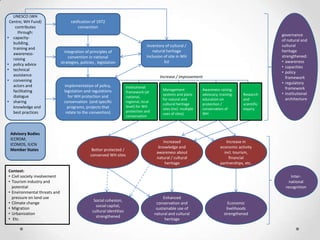
Example 3: articulating the nested intervention
logic of UNESCO’s World Heritage Convention
Ratification of convention
n1 countries
Convention reflected in
policy strategies
n2 (< n1) countries
Convention integrated into
concrete interventions
n3 (< n2) countries
Preservation and sustainable
use of World Heritage sites
UNESCO
support
UNESCO
support
UNESCO
support
effects
effects
effects
effects
Inventory of cultural /
natural heritage
Inclusion of site in WH
list
ratification of 1972
convention
integration of principles of
convention in national
strategies, policies , legislation
implementation of policy,
legislation and regulations
for WH protection and
conservation (and specific
programs, projects that
relate to the convention)
UNESCO (WH
Centre; WH Fund)
contributes
through:
• capacity-
building,
training and
awareness-
raising
• policy advice
• technical
assistance
• convening
actors and
facilitating
dialogue
• sharing
knowledge and
best practices
Institutional
framework (at
national,
regional, local
level) for WH
protection and
conservation
Awareness raising,
advocacy, training,
education on
protection /
conservation of
WH
Better protected /
conserved WH sites
Increased
knowledge and
awareness about
natural / cultural
heritage
Increase in
economic activity
incl. tourism,
financial
partnerships, etc.
Increase / improvement
Social cohesion,
social capital,
cultural identities
strengthened
Enhanced
conservation and
sustainable use of
natural and cultural
heritage
Economic
livelihoods
strengthened
governance
of natural and
cultural
heritage
strengthened:
• awareness
• capacities
• policy
framework
• regulatory
framework
• institutional
architecture
Context:
• Civil society involvement
• Tourism industry and
potential
• Environmental threats and
pressure on land use
• Climate change
• Migration
• Urbanization
• Etc.
Management
systems and plans
for natural and
cultural heritage
sites (incl. multiple
uses of sites)
Advisory Bodies
ICCROM,
ICOMOS, IUCN
Member States
Research
and
scientific
inquiry
Inter-
national
recognition
Example 3 (cont’d): improving M&E systems
 Data collection at four levels in the nested
intervention logic
 Support claims of attribution and aggregation
(magnitude)
 Strengthen learning and accountability through
impact evaluation covering different countries
and assessing causal links at different levels of
the nested intervention logic
Concluding remarks
 Higher gains in more ‘impact-oriented’ M&E
systems rather than ‘simply’ doing more IE
 Focus on institutional change level (attribution
and ‘measurement’)
 Addressing the aggregation challenge:
 Portfolio-wide synthetic analysis (review) of intervention types
 Strengthened (nested) intervention logics
 Systematic data collection on implementation and delivery aligned
to higher-level evaluative exercises (including IE) to analyze
processes of change

Towards a more ‘impact-oriented’ institutional M&E system:

  • 1.
    Towards a more‘impact-oriented’ institutional M&E system: common challenges and potential solutions from a UN perspective Brighton, March 26-27, 2013 Jos Vaessen (UNESCO) Oscar Garcia (UNDP) Juha Uitto (UNDP)
  • 2.
    Outline Characteristics of IEpractices in the UN system Challenges and solutions in developing more ‘impact-oriented’ M&E systems Illustrations of (potential) solutions
  • 3.
    Characteristics of IEpractices in the UN (UNEG, 2009)…  IEs carried out by only 9 (out of 27) agencies  Many of these evaluations reported as IEs are not particularly strong on addressing the attribution challenge  Prevalent methodologies: non-experimental quantitative approaches, theory of change approaches, (combinations of) qualitative methods
  • 4.
    …Characteristics of IE practicesin the UN  Diversity in the UN system (UNEG, 2012), some frontrunners  Most agencies have little funding available for IE (UNEG, 2013, forthcoming)  Recently, the number of agencies undertaking IE (and the number of IEs conducted) appears to have increased
  • 5.
    Examples of pathwaysof institutionalization of IE - Conducting high-profile rigorous impact evaluations to create institutional demand which may lead to institutionalization of the practice (middle income country examples; IEG, 2009) - Mandatory rigorous IE as a prerequisite for continuation / increase in public funding for programmes (US example: Epstein and Klerman, 2012; Latin America examples: Briceño and Gaarder, 2010) - Strengthening institutional M&E systems towards becoming more ‘impact-oriented’ and creating the conditions for low-cost and high value for money impact evaluation (Kusek and Rist, 2004; this presentation)
  • 6.
    Challenges of strengtheningIE practices in the UN system  Demand side constraints (e.g. resources)  ‘Evaluability’ bias in current IEs  Many interventions aimed at changes at institutional level (e.g. policy, normative, catalytic)  Multi-actor, multi-stranded, multi-site interventions  ‘Demand’ for evidence on impact at multiple levels (triple A challenge; White, 2003)
  • 7.
    Potential solutions: towardsmore ‘impact-oriented’ M&E systems  Improve causal logic (e.g. ToC) at project/activity level as a framework for data collection ex ante/interim/ex post  Develop generic (nested) causal frameworks of how individual projects/activities fit into larger programmes  Develop analytical tools to aggregate/synthesize impact-related evidence from project/activity to higher levels
  • 8.
    Example 1: Reviewof Outcome to Impact model in the GEF (ROtI) 1. A theory-based approach as a framework for assessing linkages between project outcomes and potential or actual impacts 2. Desk ROtI: 1. Stage 1: Developing project Theory of Change (TOC) models 2. Stage 2: Assessing outcomes-impacts pathways 3. Stage 3: Rating the Project 3. Ratings can be aggregated
  • 9.
    Example 2: UNDPmeta -review 1. Meta review of evaluations of country programmes (commissioned by EO) 2. 30 evaluations were assessed on the criteria effectiveness, efficiency, sustainability 3. Aggregate frequency analysis of criteria-specific ratings 4. QCA: common factors explaining performance criteria 5. Challenges: 1. Rating is ex post 2. Gaps in evidence available from reports 3. Unit of analysis (country programme)) and comparability
  • 10.
    Example 3: articulatingthe nested intervention logic of UNESCO’s World Heritage Convention Ratification of convention n1 countries Convention reflected in policy strategies n2 (< n1) countries Convention integrated into concrete interventions n3 (< n2) countries Preservation and sustainable use of World Heritage sites UNESCO support UNESCO support UNESCO support effects effects effects effects
  • 11.
    Inventory of cultural/ natural heritage Inclusion of site in WH list ratification of 1972 convention integration of principles of convention in national strategies, policies , legislation implementation of policy, legislation and regulations for WH protection and conservation (and specific programs, projects that relate to the convention) UNESCO (WH Centre; WH Fund) contributes through: • capacity- building, training and awareness- raising • policy advice • technical assistance • convening actors and facilitating dialogue • sharing knowledge and best practices Institutional framework (at national, regional, local level) for WH protection and conservation Awareness raising, advocacy, training, education on protection / conservation of WH Better protected / conserved WH sites Increased knowledge and awareness about natural / cultural heritage Increase in economic activity incl. tourism, financial partnerships, etc. Increase / improvement Social cohesion, social capital, cultural identities strengthened Enhanced conservation and sustainable use of natural and cultural heritage Economic livelihoods strengthened governance of natural and cultural heritage strengthened: • awareness • capacities • policy framework • regulatory framework • institutional architecture Context: • Civil society involvement • Tourism industry and potential • Environmental threats and pressure on land use • Climate change • Migration • Urbanization • Etc. Management systems and plans for natural and cultural heritage sites (incl. multiple uses of sites) Advisory Bodies ICCROM, ICOMOS, IUCN Member States Research and scientific inquiry Inter- national recognition
  • 12.
    Example 3 (cont’d):improving M&E systems  Data collection at four levels in the nested intervention logic  Support claims of attribution and aggregation (magnitude)  Strengthen learning and accountability through impact evaluation covering different countries and assessing causal links at different levels of the nested intervention logic
  • 13.
    Concluding remarks  Highergains in more ‘impact-oriented’ M&E systems rather than ‘simply’ doing more IE  Focus on institutional change level (attribution and ‘measurement’)  Addressing the aggregation challenge:  Portfolio-wide synthetic analysis (review) of intervention types  Strengthened (nested) intervention logics  Systematic data collection on implementation and delivery aligned to higher-level evaluative exercises (including IE) to analyze processes of change