Lessons for interoperability
remedies from UK Open
Banking
Dr Ian Brown, Visiting CyberBRICS Professor,
FGV
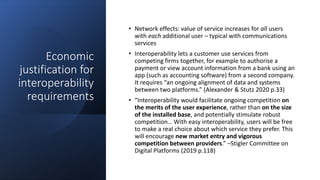
Economic
justification for
interoperability
requirements
• Network effects: value of service increases for all users
with each additional user – typical with communications
services
• Interoperability lets a customer use services from
competing firms together, for example to authorise a
payment or view account information from a bank using an
app (such as accounting software) from a second company.
It requires “an ongoing alignment of data and systems
between two platforms.” (Alexander & Stutz 2020 p.33)
• “Interoperability would facilitate ongoing competition on
the merits of the user experience, rather than on the size
of the installed base, and potentially stimulate robust
competition… With easy interoperability, users will be free
to make a real choice about which service they prefer. This
will encourage new market entry and vigorous
competition between providers.” –Stigler Committee on
Digital Platforms (2019 p.118)
Research questions
What are the costs and benefits of comprehensive standardization vs
competition for the market?
• Complexity of technical and other aspects of standardization
• Security and privacy implications
• Costs of standards development and common services vs per-platform service development
What forms of governance work in which contexts?
How far does full interoperability stimulate diversity, complementary
innovation and/or competition?
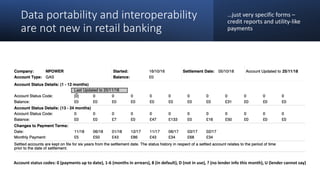
Data portability and interoperability
are not new in retail banking
…just very specific forms –
credit reports and utility-like
payments
Account status codes: 0 (payments up to date), 1-6 (months in arrears), 8 (in default), D (not in use), ? (no lender info this month), U (lender cannot say)
Technical
complexity/
level of
intervention
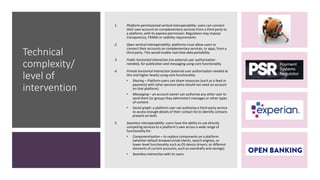
1. Platform-permissioned vertical interoperability: users can connect
their own account on complementary services from a third party to
a platform, with its express permission. Regulators may impose
transparency, FRAND or stability requirements
2. Open vertical interoperability: platforms must allow users to
connect their accounts on complementary services, or apps, from a
third party. This would enable real-time data portability.
3. Public horizontal interaction (no external user authorisation
needed), for publication and messaging using core functionality.
4. Private horizontal interaction (external user authorisation needed at
this and higher levels) using core functionality:
• Sharing – Platform users can share resources (such as a feed or
payment) with other persons (who should not need an account
on that platform).
• Messaging – an account owner can authorise any other user to
send them (or groups they administer) messages or other types
of content.
• Social graph: a platform user can authorise a third-party service
to access enough details of their contact list to identify contacts
present on both.
5. Seamless interoperability: users have the ability to use directly
competing services to a platform’s own across a wide range of
functionality for:
• Componentisation – to replace components on a platform
(whether default browsers/mail clients, search engines, or
lower-level functionality such as OS device drivers; or different
elements of current accounts, such as overdrafts and savings).
• Seamless interaction with its users.
Development of technical remedies
• “First remedy was give everyone a USB stick with their data, they can walk into Barclays. Didn’t think
would be enough - that kind of consumer - not going to happen. 2nd was iPad with data on it, so
getting closer to an API. So CMA asked: would they go step further press a button for API. Thought
would be safer, and more immediate. That kind of remedy, married to very easy consumer inertia or
engagement problem - at least learn about accounts” – Regulator
• “Lloyds showed around data centres CMA asked how is that feeding into product design - doing not a
lot… And at same time, fintechs and funders were coming in saying they were clever things they could
do with the data, not much happening then.” – Regulator
• On Big Tech competition, “quite a few submissions from incumbents from retail banks saying big tech
has so much data, they will enter. Maybe Big Tech should have interop requirements too. But CMA
wasn’t willing to wait for that.” – Regulator
Main issues were not technical
• “There are, of course, significant
technical considerations involved in
defining and implementing an
Open Banking Standard. But the
bulk of the work is not technical;
there are critical issues to take
forward around governance,
security, liability, standards,
communications, regulation and
legal.” Open Banking Working
Group (2016, p.5) supporting
Palfrey & Gasser (2012)
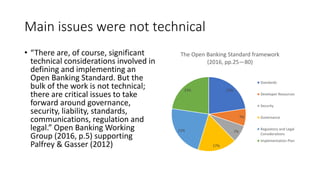
23%
7%
7%
17%
23%
23%
The Open Banking Standard framework
(2016, pp.25—80)
Standards
Developer Resources
Security
Governance
Regulatory and Legal
Considerations
Implementation Plan
Governance
in context
Was not a typical competition
case/remedy – CMA used its market
investigation powers, not abuse of
dominance/collusion
• Creation of specific Implementation Entity with
Implementation Trustee reporting to CMA, not a
sector regulator (Bank of England or Payment
Systems Regulator)
Need for sector-specific development
(APIs, ontologies, governance) and
regulation (initial and ongoing)?
Governance
• On competition for market, “Relatively recent financial shock from 2008, BoE submissions
saying be careful. Yes, capital requirements are distortive but that is a govt/FCA model.” –
Regulator
• “we said use the same APIS, standards, common, open, because if you were an app
developer it would be the problem if you’re a mobile app developer already - you need a
version for Android, iOS, Windows… but magnified 100 times. If there are license-free APIs
out there then people not subject to the remedy, they could adopt them. Most banks have.
They haven’t in Europe. We were criticised by purists who said banks should be competing
on APIs - why would they do that, you want the worst possible APIs? ” - Regulator
• On need for sector regulator, “Quite a few submissions from Payment System Regulator,
because it was very young, worried with the stroke of the chancellor’s pen might go out of
business. Trying to increase market discipline generally. Didn’t think would cause risks to
prudence, stability, anticompetitive - banks claimed, but they couldn’t substantiate.” –
Regulator
More on sector-specific regulators
• “Sector-specific regulation makes sense, partly because these
regulators have the skills and the specific competition regulators,
sandbox, regulatory ability, to handle this. And we needed an OBIE,
engaging daily with the banks. Not something I would say to CMA
adopt this yourself; implementation needs to go to a specific
regulator. Even with capture arguments - shouldn’t be with DMU;
they might devise the policy, but then goes over to sector regulator,
who are working daily and have other strings. Egypt asked can central
bank just does this? Yes, lots of experts, and the competition
authority too; but this isn’t the special skills needed - economists and
data scientists.” - Regulator
Governance tensions
• “consumer advocacy is federal, lots of angles, the disadvantaged, debt, lots of different lobbies - so
we said you should create a forum, banks will pay for it, so it isn’t just one person’s view, big problem
in consumer advocacy, some evidence behind it. Very often the banks were aligned with the
consumer lobby because it was tending not to advocate expansion, it was all the way saying was this
safe, does this provide adequate recompense, what about data risk, which the big banks were
behind, because issues like that would delay the progress of things?” – Regulator
• “not all banks think the same, didn’t have a phalanx of big banks, some aren’t even banks - Nation-
wide - mutual, different perspective, HSBC is international, Barclays is not, Lloyds v big, Santander is
not.” – Regulator
• “Costs are relatively minor - higher estimate I’ve seen of whole implementation, ignores savings by
common standards, was £1.5bn for all the banks over the whole time, and that is same size as one
bank’s bonus pile last year. Banking is a big muscular industry with a large amount of money. Issue for
them has been more timing, pace of change, wanting to take longer, take stock, but there’s never
been a folding of arms, sitting down in middle of road.” – Regulator
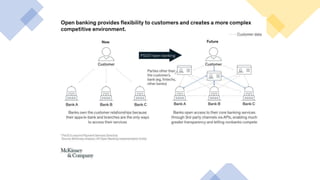
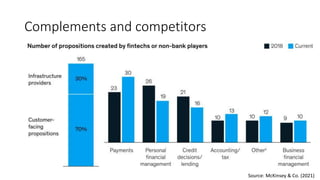
Source: McKinsey & Co. (2021)
Complements and competitors
Conclusions
Does standardization impede innovation? “No evidence, banks weren’t
innovating in the first place. We were trying to accelerate a change happening
already, eg with PSD2, tech development, if anything putting pressure on banks to
do what they should be doing.” - Regulator
Will Big Tech capture finance? “I don’t believe yet the degree of regulation would
allow that kind of thing to happen. BoE would wade in before anything like that
happened, destabilisation of financial firmament. Although they are looking
through a macro lens, would need more evidence. If anything go other way, banks
learn behavioural insights from Google and Amazon.” – Regulator
Longer-term questions
• “I’m worried about the vulnerable, people
being left behind, not sure OB is helping that.
Are those hubs working, people paid in cash,
will always be people who are vulnerable.
You can imagine the banks leave” – Regulator
• “Long term we should see significant change
but not due to OB. Certain things relating to
digital currencies, other payment models,
which might end up with a much more US-
style market with hundreds of operators, not
all regulated. Not sure if good or bad, but not
because of government impetus” – Regulator

Lessons for interoperability remedies from UK Open Banking

  • 1.
    Lessons for interoperability remediesfrom UK Open Banking Dr Ian Brown, Visiting CyberBRICS Professor, FGV
  • 3.
    Economic justification for interoperability requirements • Networkeffects: value of service increases for all users with each additional user – typical with communications services • Interoperability lets a customer use services from competing firms together, for example to authorise a payment or view account information from a bank using an app (such as accounting software) from a second company. It requires “an ongoing alignment of data and systems between two platforms.” (Alexander & Stutz 2020 p.33) • “Interoperability would facilitate ongoing competition on the merits of the user experience, rather than on the size of the installed base, and potentially stimulate robust competition… With easy interoperability, users will be free to make a real choice about which service they prefer. This will encourage new market entry and vigorous competition between providers.” –Stigler Committee on Digital Platforms (2019 p.118)
  • 4.
    Research questions What arethe costs and benefits of comprehensive standardization vs competition for the market? • Complexity of technical and other aspects of standardization • Security and privacy implications • Costs of standards development and common services vs per-platform service development What forms of governance work in which contexts? How far does full interoperability stimulate diversity, complementary innovation and/or competition?
  • 5.
    Data portability andinteroperability are not new in retail banking …just very specific forms – credit reports and utility-like payments Account status codes: 0 (payments up to date), 1-6 (months in arrears), 8 (in default), D (not in use), ? (no lender info this month), U (lender cannot say)
  • 6.
    Technical complexity/ level of intervention 1. Platform-permissionedvertical interoperability: users can connect their own account on complementary services from a third party to a platform, with its express permission. Regulators may impose transparency, FRAND or stability requirements 2. Open vertical interoperability: platforms must allow users to connect their accounts on complementary services, or apps, from a third party. This would enable real-time data portability. 3. Public horizontal interaction (no external user authorisation needed), for publication and messaging using core functionality. 4. Private horizontal interaction (external user authorisation needed at this and higher levels) using core functionality: • Sharing – Platform users can share resources (such as a feed or payment) with other persons (who should not need an account on that platform). • Messaging – an account owner can authorise any other user to send them (or groups they administer) messages or other types of content. • Social graph: a platform user can authorise a third-party service to access enough details of their contact list to identify contacts present on both. 5. Seamless interoperability: users have the ability to use directly competing services to a platform’s own across a wide range of functionality for: • Componentisation – to replace components on a platform (whether default browsers/mail clients, search engines, or lower-level functionality such as OS device drivers; or different elements of current accounts, such as overdrafts and savings). • Seamless interaction with its users.
  • 7.
    Development of technicalremedies • “First remedy was give everyone a USB stick with their data, they can walk into Barclays. Didn’t think would be enough - that kind of consumer - not going to happen. 2nd was iPad with data on it, so getting closer to an API. So CMA asked: would they go step further press a button for API. Thought would be safer, and more immediate. That kind of remedy, married to very easy consumer inertia or engagement problem - at least learn about accounts” – Regulator • “Lloyds showed around data centres CMA asked how is that feeding into product design - doing not a lot… And at same time, fintechs and funders were coming in saying they were clever things they could do with the data, not much happening then.” – Regulator • On Big Tech competition, “quite a few submissions from incumbents from retail banks saying big tech has so much data, they will enter. Maybe Big Tech should have interop requirements too. But CMA wasn’t willing to wait for that.” – Regulator
  • 8.
    Main issues werenot technical • “There are, of course, significant technical considerations involved in defining and implementing an Open Banking Standard. But the bulk of the work is not technical; there are critical issues to take forward around governance, security, liability, standards, communications, regulation and legal.” Open Banking Working Group (2016, p.5) supporting Palfrey & Gasser (2012) 23% 7% 7% 17% 23% 23% The Open Banking Standard framework (2016, pp.25—80) Standards Developer Resources Security Governance Regulatory and Legal Considerations Implementation Plan
  • 9.
    Governance in context Was nota typical competition case/remedy – CMA used its market investigation powers, not abuse of dominance/collusion • Creation of specific Implementation Entity with Implementation Trustee reporting to CMA, not a sector regulator (Bank of England or Payment Systems Regulator) Need for sector-specific development (APIs, ontologies, governance) and regulation (initial and ongoing)?
  • 10.
    Governance • On competitionfor market, “Relatively recent financial shock from 2008, BoE submissions saying be careful. Yes, capital requirements are distortive but that is a govt/FCA model.” – Regulator • “we said use the same APIS, standards, common, open, because if you were an app developer it would be the problem if you’re a mobile app developer already - you need a version for Android, iOS, Windows… but magnified 100 times. If there are license-free APIs out there then people not subject to the remedy, they could adopt them. Most banks have. They haven’t in Europe. We were criticised by purists who said banks should be competing on APIs - why would they do that, you want the worst possible APIs? ” - Regulator • On need for sector regulator, “Quite a few submissions from Payment System Regulator, because it was very young, worried with the stroke of the chancellor’s pen might go out of business. Trying to increase market discipline generally. Didn’t think would cause risks to prudence, stability, anticompetitive - banks claimed, but they couldn’t substantiate.” – Regulator
  • 11.
    More on sector-specificregulators • “Sector-specific regulation makes sense, partly because these regulators have the skills and the specific competition regulators, sandbox, regulatory ability, to handle this. And we needed an OBIE, engaging daily with the banks. Not something I would say to CMA adopt this yourself; implementation needs to go to a specific regulator. Even with capture arguments - shouldn’t be with DMU; they might devise the policy, but then goes over to sector regulator, who are working daily and have other strings. Egypt asked can central bank just does this? Yes, lots of experts, and the competition authority too; but this isn’t the special skills needed - economists and data scientists.” - Regulator
  • 12.
    Governance tensions • “consumeradvocacy is federal, lots of angles, the disadvantaged, debt, lots of different lobbies - so we said you should create a forum, banks will pay for it, so it isn’t just one person’s view, big problem in consumer advocacy, some evidence behind it. Very often the banks were aligned with the consumer lobby because it was tending not to advocate expansion, it was all the way saying was this safe, does this provide adequate recompense, what about data risk, which the big banks were behind, because issues like that would delay the progress of things?” – Regulator • “not all banks think the same, didn’t have a phalanx of big banks, some aren’t even banks - Nation- wide - mutual, different perspective, HSBC is international, Barclays is not, Lloyds v big, Santander is not.” – Regulator • “Costs are relatively minor - higher estimate I’ve seen of whole implementation, ignores savings by common standards, was £1.5bn for all the banks over the whole time, and that is same size as one bank’s bonus pile last year. Banking is a big muscular industry with a large amount of money. Issue for them has been more timing, pace of change, wanting to take longer, take stock, but there’s never been a folding of arms, sitting down in middle of road.” – Regulator
  • 13.
    Source: McKinsey &Co. (2021) Complements and competitors
  • 14.
    Conclusions Does standardization impedeinnovation? “No evidence, banks weren’t innovating in the first place. We were trying to accelerate a change happening already, eg with PSD2, tech development, if anything putting pressure on banks to do what they should be doing.” - Regulator Will Big Tech capture finance? “I don’t believe yet the degree of regulation would allow that kind of thing to happen. BoE would wade in before anything like that happened, destabilisation of financial firmament. Although they are looking through a macro lens, would need more evidence. If anything go other way, banks learn behavioural insights from Google and Amazon.” – Regulator
  • 15.
    Longer-term questions • “I’mworried about the vulnerable, people being left behind, not sure OB is helping that. Are those hubs working, people paid in cash, will always be people who are vulnerable. You can imagine the banks leave” – Regulator • “Long term we should see significant change but not due to OB. Certain things relating to digital currencies, other payment models, which might end up with a much more US- style market with hundreds of operators, not all regulated. Not sure if good or bad, but not because of government impetus” – Regulator

Editor's Notes

  • #7 The greater the obligations: - the more freedom users get in terms of services and software they can use to interact with platforms and other users, but also - the greater the requirements for regulatory action/market intervention and technical complexity.
  • #9 “a detailed framework for how an Open Banking Standard could be designed and delivered, with a timetable for achieving this.”