Download free for 30 days
Sign in
Upload
Language (EN)
Support
Business
Mobile
Social Media
Marketing
Technology
Art & Photos
Career
Design
Education
Presentations & Public Speaking
Government & Nonprofit
Healthcare
Internet
Law
Leadership & Management
Automotive
Engineering
Software
Recruiting & HR
Retail
Sales
Services
Science
Small Business & Entrepreneurship
Food
Environment
Economy & Finance
Data & Analytics
Investor Relations
Sports
Spiritual
News & Politics
Travel
Self Improvement
Real Estate
Entertainment & Humor
Health & Medicine
Devices & Hardware
Lifestyle
Change Language
Language
English
Español
Português
Français
Deutsche
Cancel
Save
Submit search
EN
Uploaded by
alpha2k03
PPTX, PDF
13 views
Touch Sensor Light Switch using Arduino .pptx
Touch Sensor Light Switch using Arduino
Devices & Hardware
◦
Read more
0
Save
Share
Embed
Embed presentation
Download
Download to read offline
1
/ 8
2
/ 8
3
/ 8
4
/ 8
5
/ 8
6
/ 8
7
/ 8
8
/ 8
More Related Content
PDF
publish manual
by
John Webster
PDF
From Arduino to LinnStrument
by
Geert Bevin
PPTX
handgesture leds control by mems sensor and arduino uno
by
Hamed Raza
PDF
Electronics_Tutorial_2022_Slide543404210s.pdf
by
vikknaguem
PDF
Arduino Workshop 2011.05.31
by
Shigeru Kobayashi
DOCX
Basic arduino sketch example
by
mraziff2009
PPTX
Arduino Slides With Neopixels
by
sdcharle
PDF
02 Sensors and Actuators Understand .pdf
by
engsharaf2025
publish manual
by
John Webster
From Arduino to LinnStrument
by
Geert Bevin
handgesture leds control by mems sensor and arduino uno
by
Hamed Raza
Electronics_Tutorial_2022_Slide543404210s.pdf
by
vikknaguem
Arduino Workshop 2011.05.31
by
Shigeru Kobayashi
Basic arduino sketch example
by
mraziff2009
Arduino Slides With Neopixels
by
sdcharle
02 Sensors and Actuators Understand .pdf
by
engsharaf2025
Similar to Touch Sensor Light Switch using Arduino .pptx
PDF
LinnStrument : the ultimate open-source hacker instrument
by
Geert Bevin
PPTX
ELECTRONIC COMPONENTS- ACTIVE AND ELECTROMECHANICAL COMPONENTS.pptx
by
JephunnehGasmen
PDF
Hardware Hacking and Arduinos
by
Howard Mao
PDF
Arduino learning
by
Anil Yadav
PDF
ELECTRONIC COMPONENTS- ACTIVE AND ELECTROMECHANICAL COMPONENTS.pdf
by
JephunnehGasmen
PDF
ELECTRONIC COMPONENTS- ACTIVE AND ELECTROMECHANICAL COMPONENTS.pdf
by
JephunnehGasmen
PPTX
Arduino Workshop
by
atuline
PDF
Up and running with Teensy 3.1
by
yoonghm
PPTX
Arduino cic3
by
Jeni Shah
PPTX
Arduino slides
by
sdcharle
PPTX
Arduino Workshop Slides
by
mkarlin14
PDF
Starting with Arduino
by
MajdyShamasneh
PPTX
Arduino Programming Basic
by
LITS IT Ltd,LASRC.SPACE,SAWDAGOR BD,FREELANCE BD,iREV,BD LAW ACADEMY,SMART AVI,HEA,HFSAC LTD.
PPTX
Arduino Programming
by
Dr Karthikeyan Periasamy
PDF
Aruino Lesson 1 - Led Blink
by
ThingerbitsElectroni
PDF
Arduino-workshop.computer engineering.pdf
by
AbhishekGiri933736
PPTX
Arduino Workshop (3).pptx
by
HebaEng
PDF
Arduino: Arduino para dummies 2 edición por Wiley Brand parte 2
by
SANTIAGO PABLO ALBERTO
PPTX
arduino simulators OR microcontroller.pptx
by
JohnMarkCatalua1
KEY
Intro to Arduino
by
Qtechknow
LinnStrument : the ultimate open-source hacker instrument
by
Geert Bevin
ELECTRONIC COMPONENTS- ACTIVE AND ELECTROMECHANICAL COMPONENTS.pptx
by
JephunnehGasmen
Hardware Hacking and Arduinos
by
Howard Mao
Arduino learning
by
Anil Yadav
ELECTRONIC COMPONENTS- ACTIVE AND ELECTROMECHANICAL COMPONENTS.pdf
by
JephunnehGasmen
ELECTRONIC COMPONENTS- ACTIVE AND ELECTROMECHANICAL COMPONENTS.pdf
by
JephunnehGasmen
Arduino Workshop
by
atuline
Up and running with Teensy 3.1
by
yoonghm
Arduino cic3
by
Jeni Shah
Arduino slides
by
sdcharle
Arduino Workshop Slides
by
mkarlin14
Starting with Arduino
by
MajdyShamasneh
Arduino Programming Basic
by
LITS IT Ltd,LASRC.SPACE,SAWDAGOR BD,FREELANCE BD,iREV,BD LAW ACADEMY,SMART AVI,HEA,HFSAC LTD.
Arduino Programming
by
Dr Karthikeyan Periasamy
Aruino Lesson 1 - Led Blink
by
ThingerbitsElectroni
Arduino-workshop.computer engineering.pdf
by
AbhishekGiri933736
Arduino Workshop (3).pptx
by
HebaEng
Arduino: Arduino para dummies 2 edición por Wiley Brand parte 2
by
SANTIAGO PABLO ALBERTO
arduino simulators OR microcontroller.pptx
by
JohnMarkCatalua1
Intro to Arduino
by
Qtechknow
Touch Sensor Light Switch using Arduino .pptx
1.
Touch Sensor Light
Switch
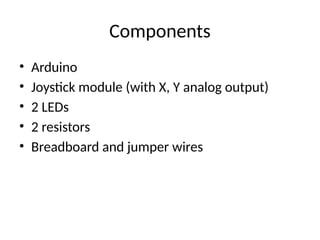
2.
Components • Arduino • Joystick
module (with X, Y analog output) • 2 LEDs • 2 resistors • Breadboard and jumper wires
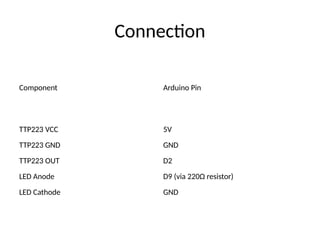
3.
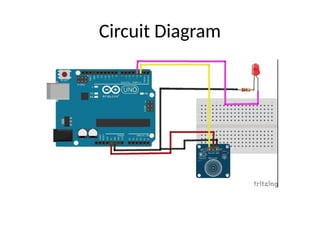
Connection Component Arduino Pin TTP223
VCC 5V TTP223 GND GND TTP223 OUT D2 LED Anode D9 (via 220Ω resistor) LED Cathode GND
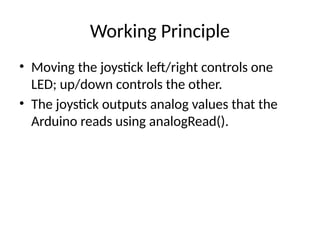
4.
Working Principle • Moving
the joystick left/right controls one LED; up/down controls the other. • The joystick outputs analog values that the Arduino reads using analogRead().
5.
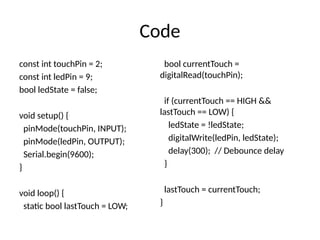
Code const int touchPin
= 2; const int ledPin = 9; bool ledState = false; void setup() { pinMode(touchPin, INPUT); pinMode(ledPin, OUTPUT); Serial.begin(9600); } void loop() { static bool lastTouch = LOW; bool currentTouch = digitalRead(touchPin); if (currentTouch == HIGH && lastTouch == LOW) { ledState = !ledState; digitalWrite(ledPin, ledState); delay(300); // Debounce delay } lastTouch = currentTouch; }
6.
Circuit Diagram
7.
Outcome • Understanding analog
signals • Mapping analog input to output action • Basic control interface
8.
Application • Touch-based night
lamps • DIY smart switches • Interactive exhibits • No-contact switches for hygiene purposes
Download