Business Law, Sixth Edition
© 2019 BVT Publishing. All rights reserved.
S-1
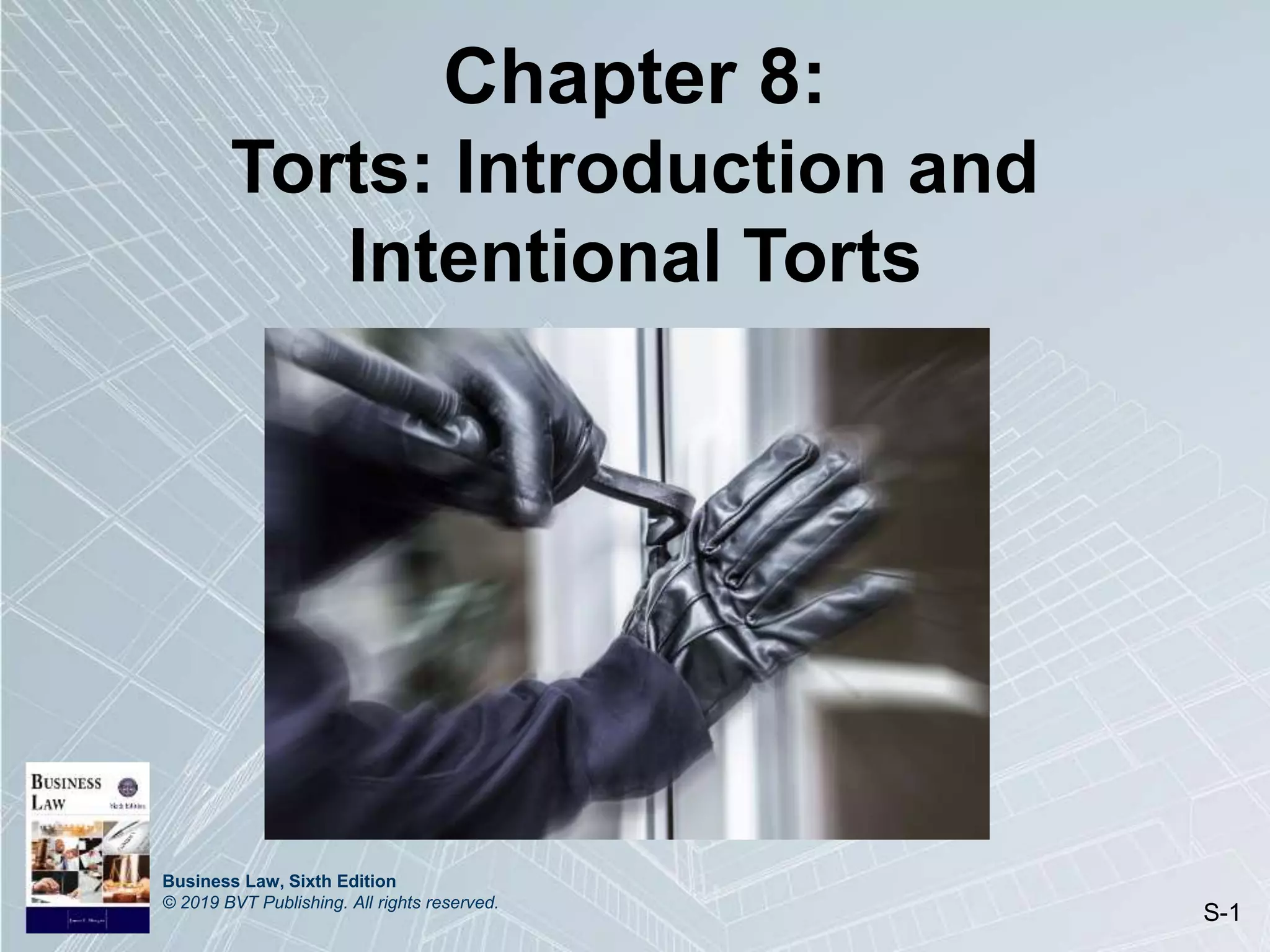
Chapter 8:
Torts: Introduction and
Intentional Torts
Business Law, Sixth Edition
© 2019 BVT Publishing. All rights reserved.
S-2
Learning Objectives
• Identify the theories of tort liability.
• Understand the various damages.
• Recognize persons liable for damages.
• Explain the various intentional torts.
Business Law, Sixth Edition
© 2019 BVT Publishing. All rights reserved.
S-3
8.0 In the News (Slide 1 of 2)
Italian in Europe’s Parliament Convicted of
Defamation for Racial Insult
http://bvtlab.com/QK6pb
An Italian member of the European Parliament has
been found guilty of defamation and ordered to pay
50,000 euros (about $59,000) in damages to a
fellow member of the European Union body, four
years after he was accused of racially insulting her
during a radio interview.
Business Law, Sixth Edition
© 2019 BVT Publishing. All rights reserved.
S-4
8.0 In the News (Slide 2 of 2)
• Discuss the difference between
slander and libel.
• What are the elements required of
slander or libel.
• Does the punishment fit the crime?
Business Law, Sixth Edition
© 2019 BVT Publishing. All rights reserved.
S-5
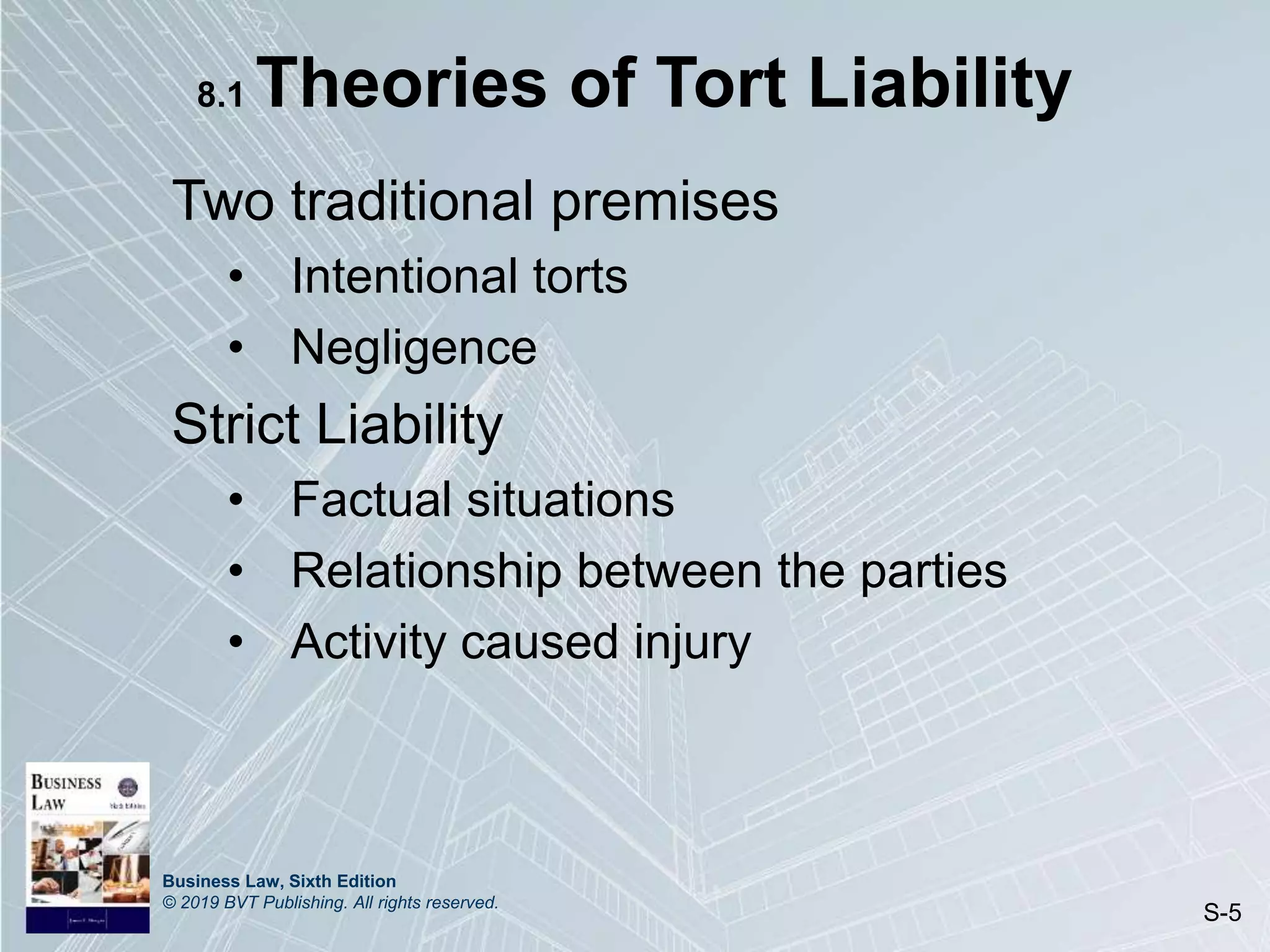
8.1 Theories of Tort Liability
Two traditional premises
• Intentional torts
• Negligence
Strict Liability
• Factual situations
• Relationship between the parties
• Activity caused injury
Business Law, Sixth Edition
© 2019 BVT Publishing. All rights reserved.
S-6
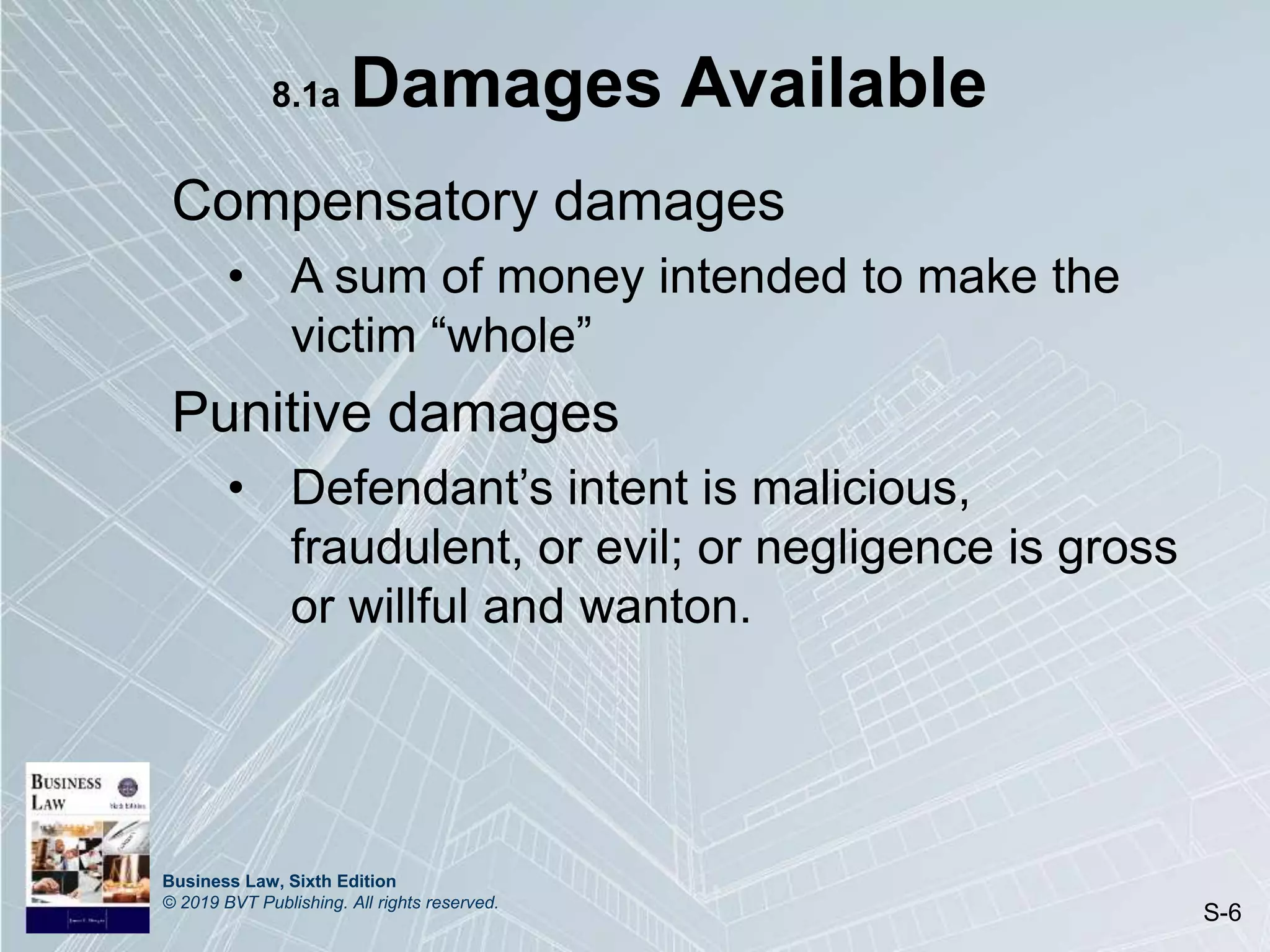
8.1a Damages Available
Compensatory damages
• A sum of money intended to make the
victim “whole”
Punitive damages
• Defendant’s intent is malicious,
fraudulent, or evil; or negligence is gross
or willful and wanton.
Business Law, Sixth Edition
© 2019 BVT Publishing. All rights reserved.
S-7
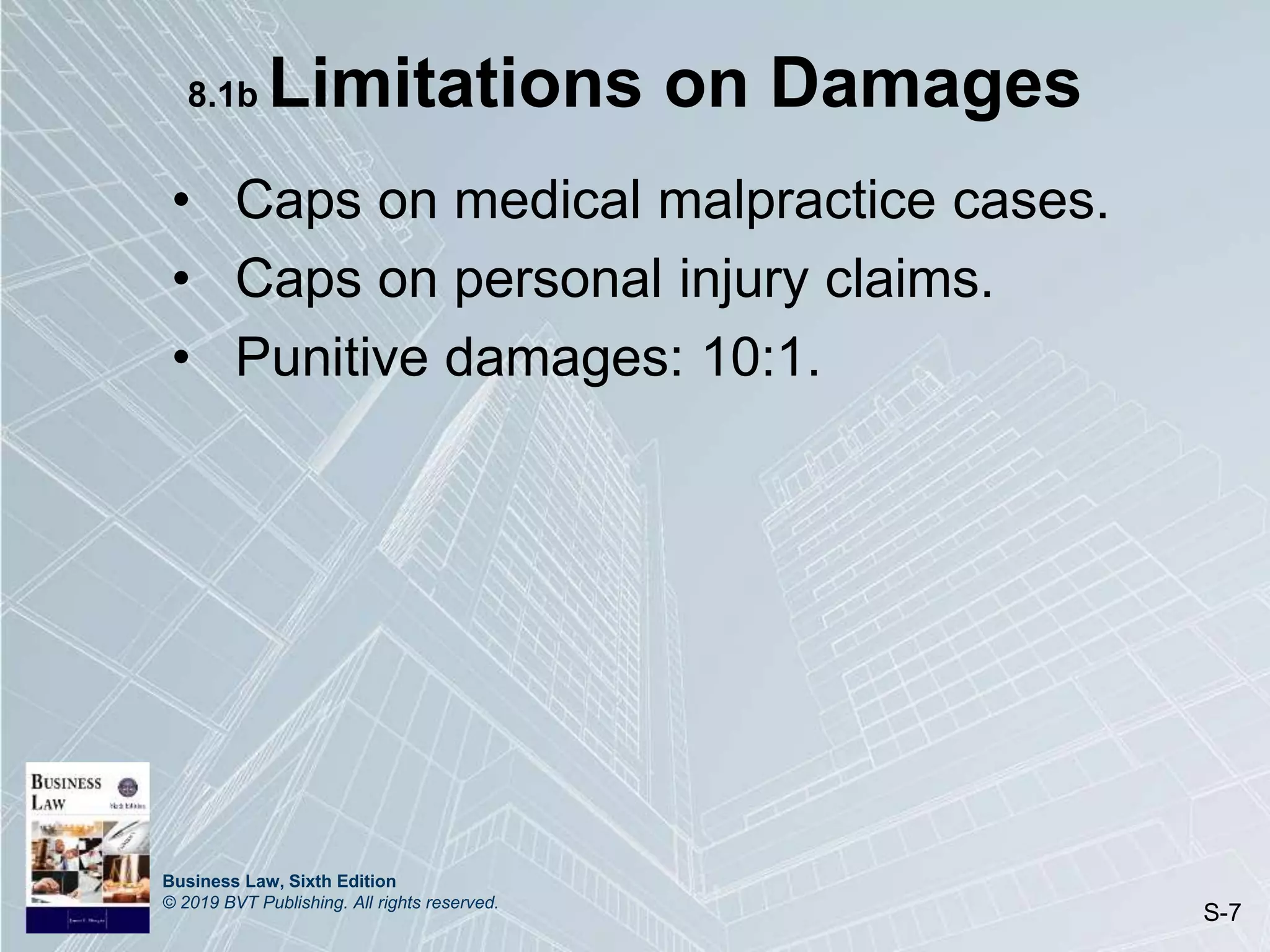
8.1b Limitations on Damages
• Caps on medical malpractice cases.
• Caps on personal injury claims.
• Punitive damages: 10:1.
Business Law, Sixth Edition
© 2019 BVT Publishing. All rights reserved.
S-8
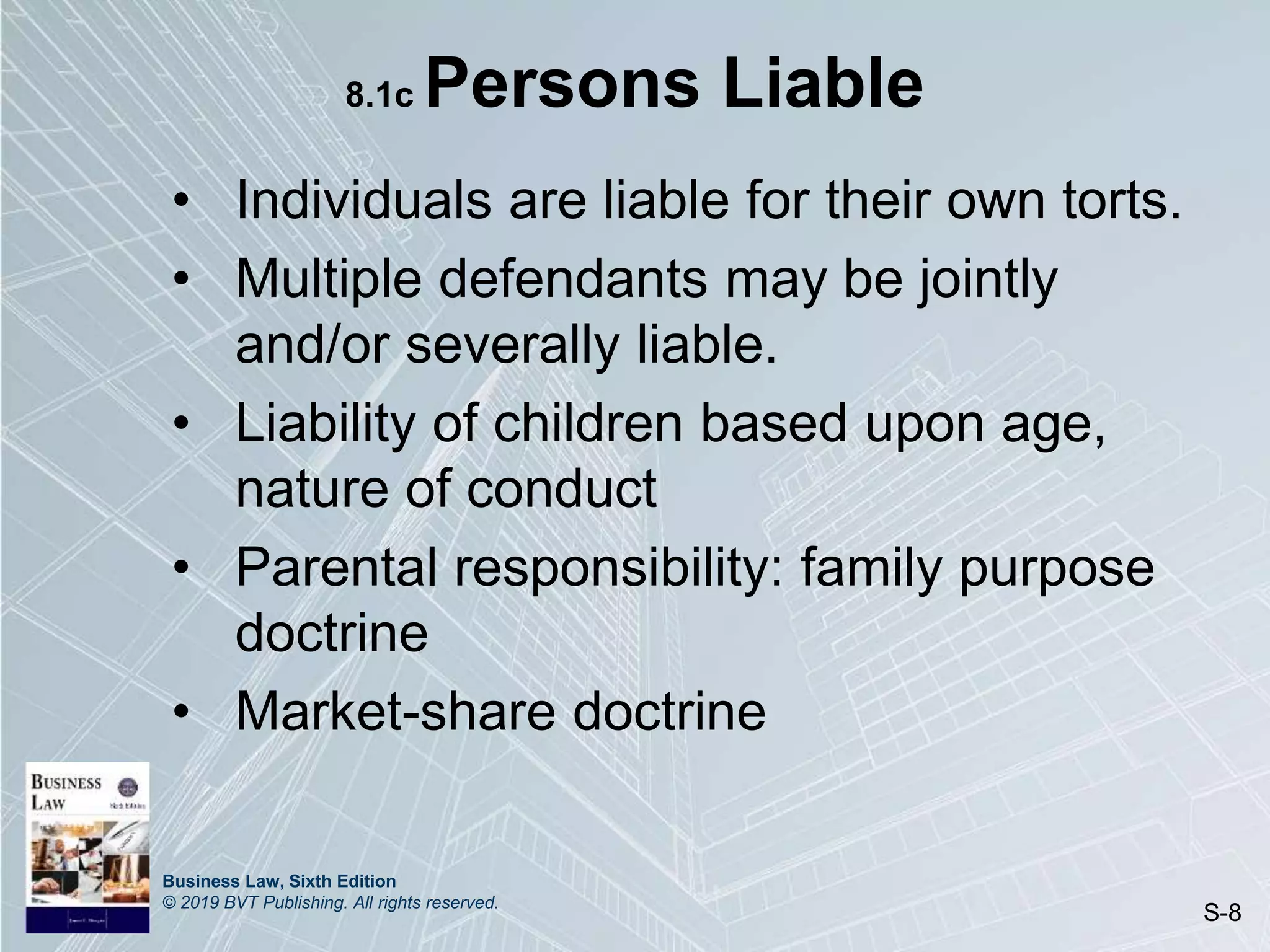
8.1c Persons Liable
• Individuals are liable for their own torts.
• Multiple defendants may be jointly
and/or severally liable.
• Liability of children based upon age,
nature of conduct
• Parental responsibility: family purpose
doctrine
• Market-share doctrine
Business Law, Sixth Edition
© 2019 BVT Publishing. All rights reserved.
S-9
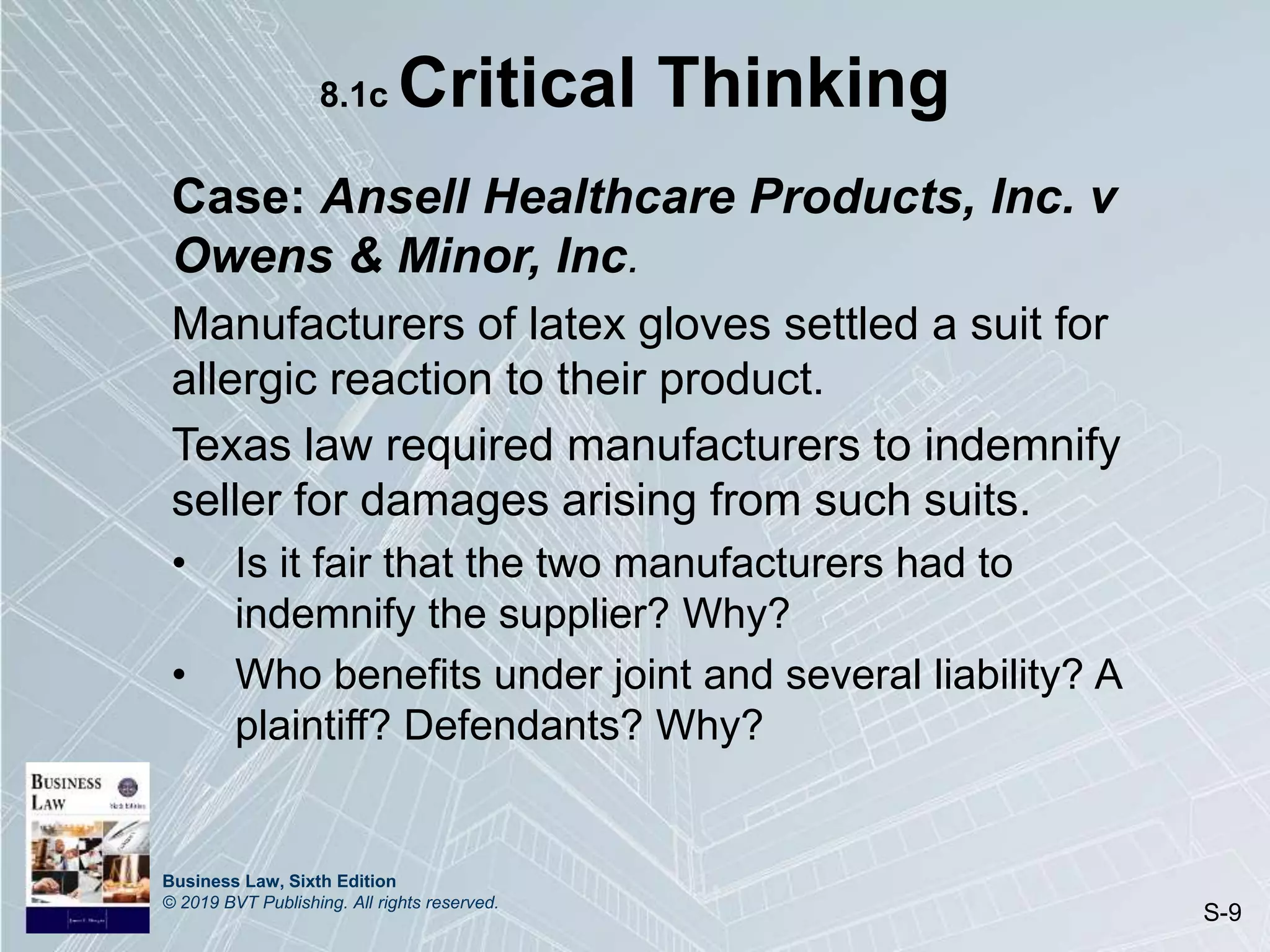
8.1c Critical Thinking
Case: Ansell Healthcare Products, Inc. v
Owens & Minor, Inc.
Manufacturers of latex gloves settled a suit for
allergic reaction to their product.
Texas law required manufacturers to indemnify
seller for damages arising from such suits.
• Is it fair that the two manufacturers had to
indemnify the supplier? Why?
• Who benefits under joint and several liability? A
plaintiff? Defendants? Why?
Business Law, Sixth Edition
© 2019 BVT Publishing. All rights reserved.
S-10
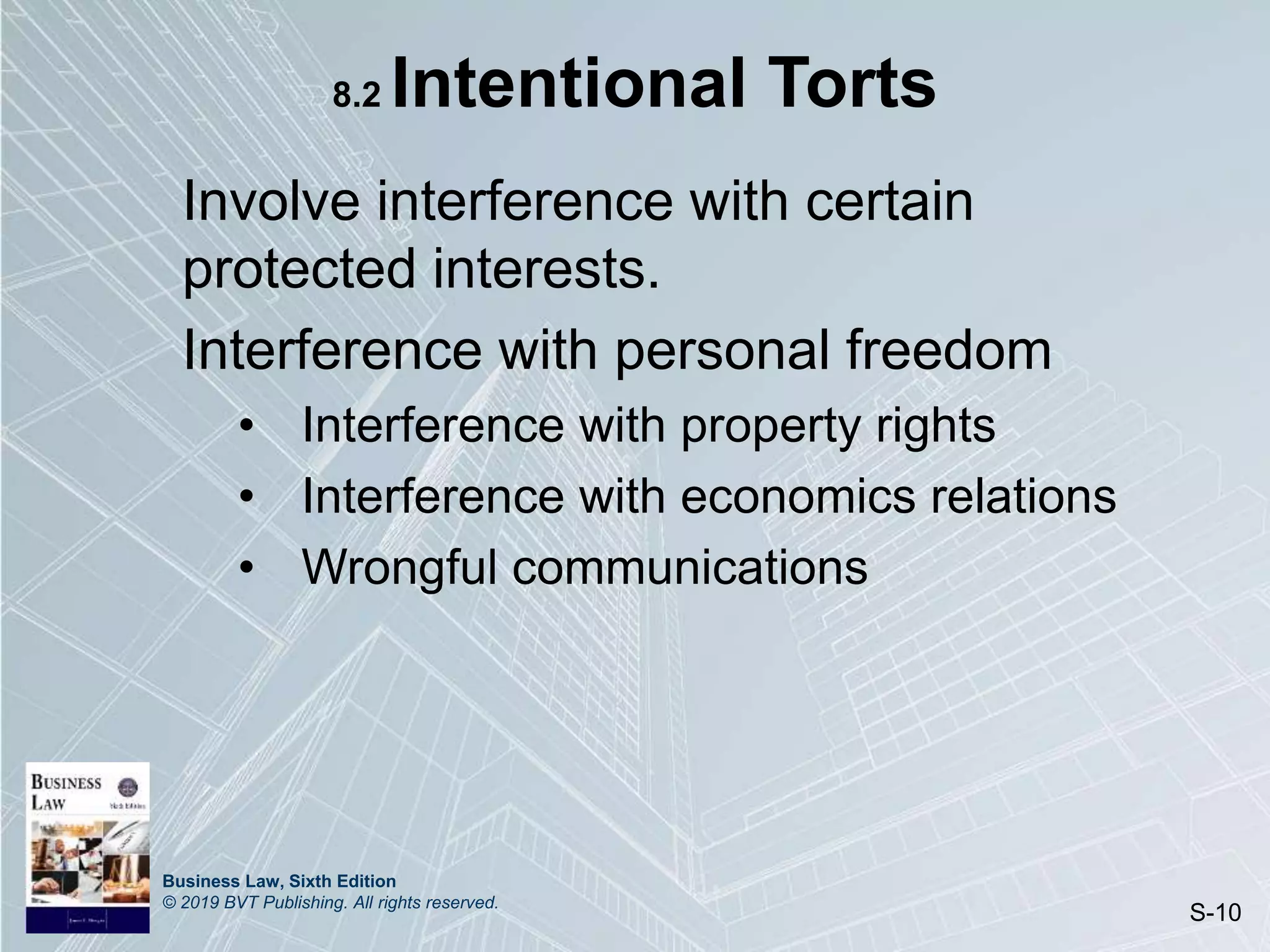
8.2 Intentional Torts
Involve interference with certain
protected interests.
Interference with personal freedom
• Interference with property rights
• Interference with economics relations
• Wrongful communications
Business Law, Sixth Edition
© 2019 BVT Publishing. All rights reserved.
S-11
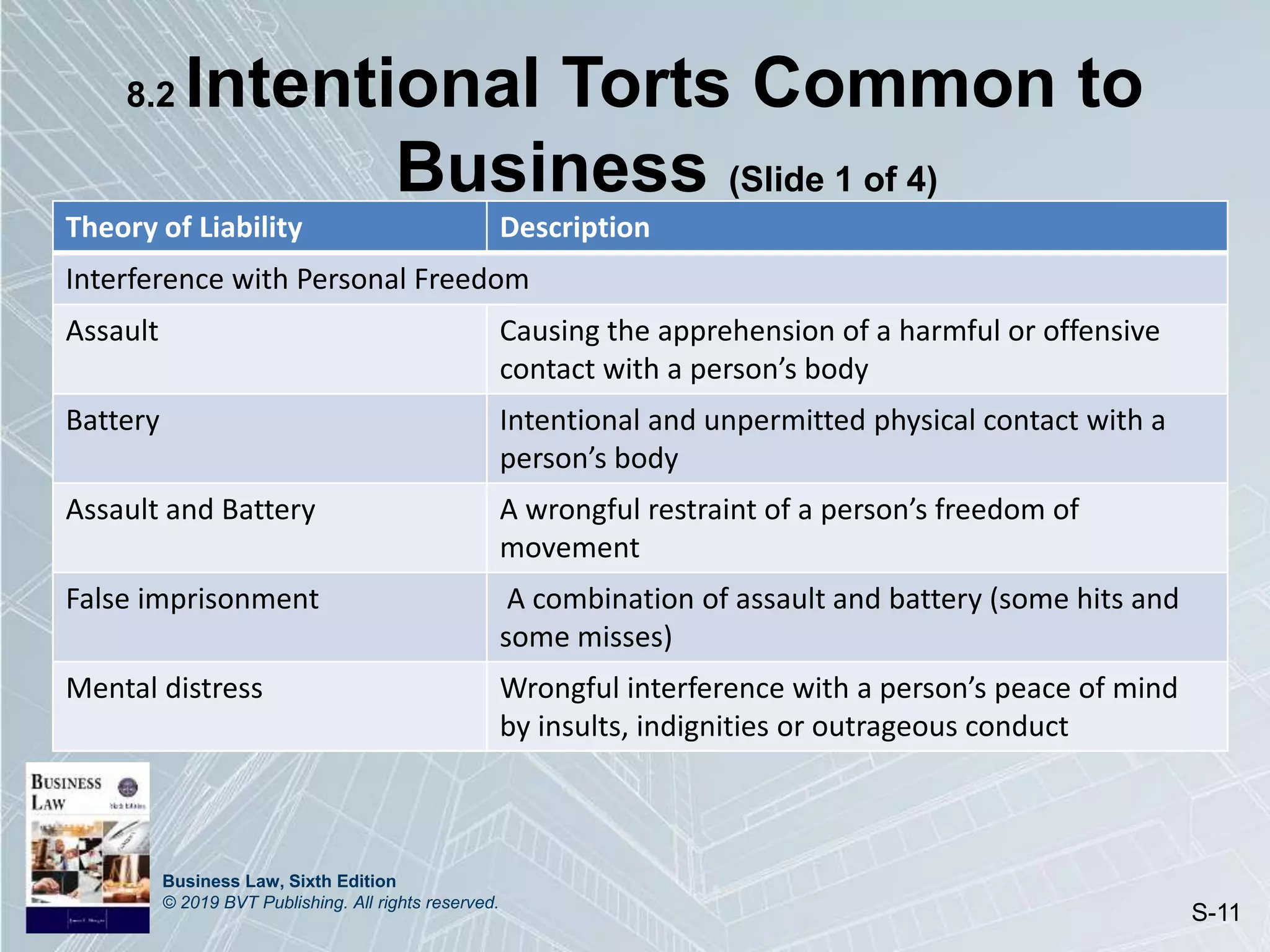
8.2 Intentional Torts Common to
Business (Slide 1 of 4)
Theory of Liability Description
Interference with Personal Freedom
Assault Causing the apprehension of a harmful or offensive
contact with a person’s body
Battery Intentional and unpermitted physical contact with a
person’s body
Assault and Battery A wrongful restraint of a person’s freedom of
movement
False imprisonment A combination of assault and battery (some hits and
some misses)
Mental distress Wrongful interference with a person’s peace of mind
by insults, indignities or outrageous conduct
Business Law, Sixth Edition
© 2019 BVT Publishing. All rights reserved.
S-12
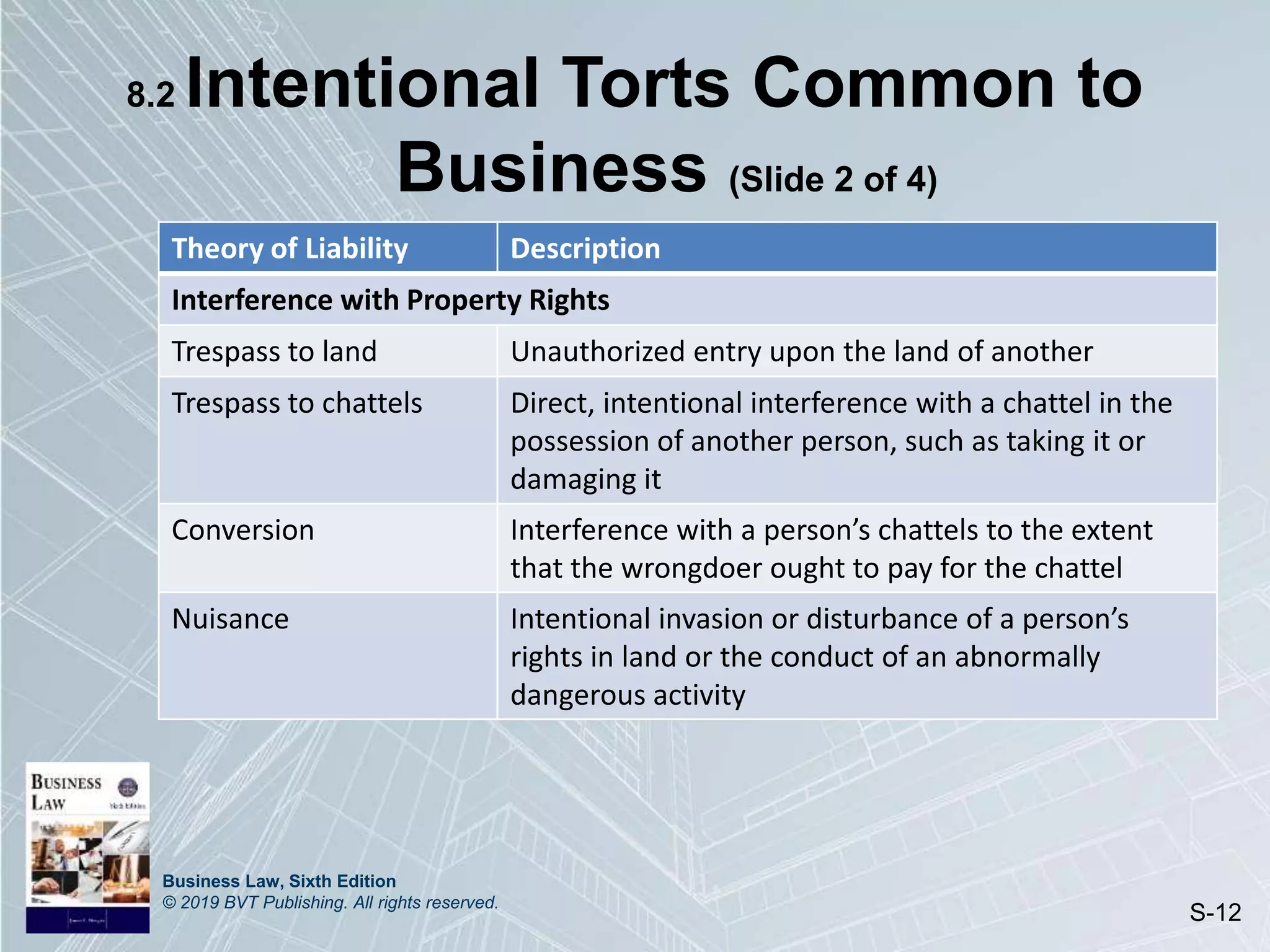
8.2 Intentional Torts Common to
Business (Slide 2 of 4)
Theory of Liability Description
Interference with Property Rights
Trespass to land Unauthorized entry upon the land of another
Trespass to chattels Direct, intentional interference with a chattel in the
possession of another person, such as taking it or
damaging it
Conversion Interference with a person’s chattels to the extent
that the wrongdoer ought to pay for the chattel
Nuisance Intentional invasion or disturbance of a person’s
rights in land or the conduct of an abnormally
dangerous activity
Business Law, Sixth Edition
© 2019 BVT Publishing. All rights reserved.
S-13
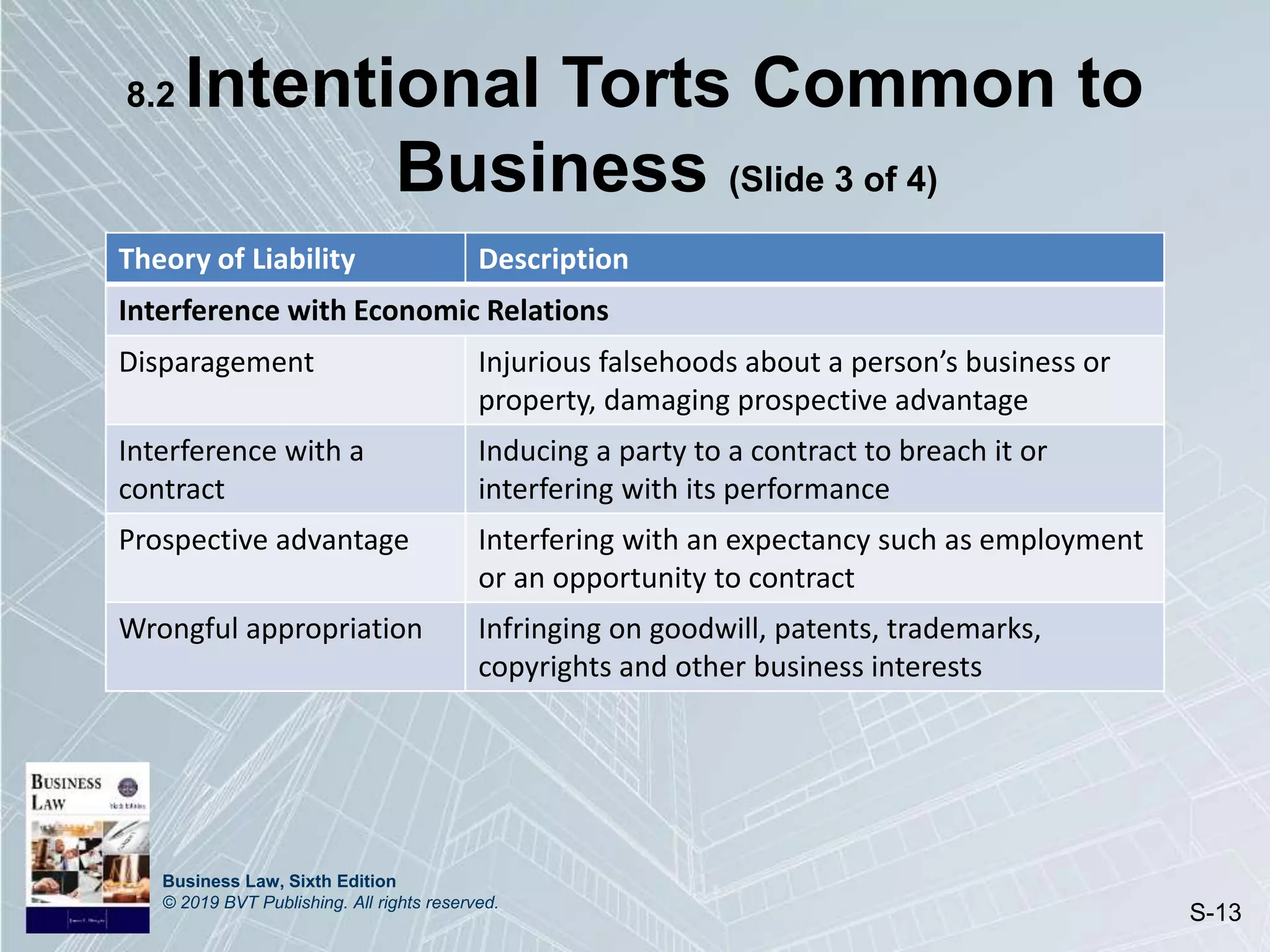
8.2 Intentional Torts Common to
Business (Slide 3 of 4)
Theory of Liability Description
Interference with Economic Relations
Disparagement Injurious falsehoods about a person’s business or
property, damaging prospective advantage
Interference with a
contract
Inducing a party to a contract to breach it or
interfering with its performance
Prospective advantage Interfering with an expectancy such as employment
or an opportunity to contract
Wrongful appropriation Infringing on goodwill, patents, trademarks,
copyrights and other business interests
Business Law, Sixth Edition
© 2019 BVT Publishing. All rights reserved.
S-14
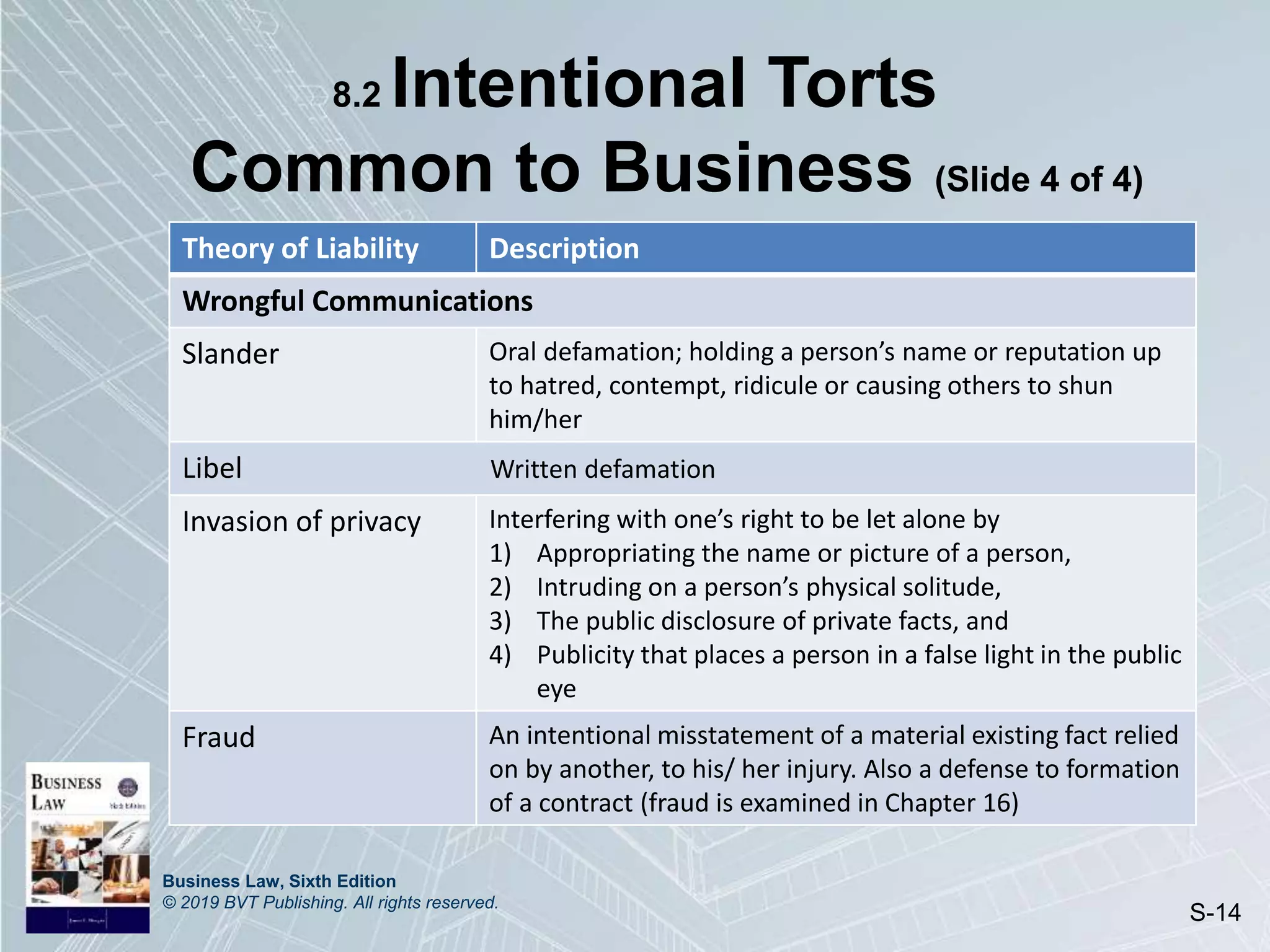
8.2 Intentional Torts
Common to Business (Slide 4 of 4)
Theory of Liability Description
Wrongful Communications
Slander Oral defamation; holding a person’s name or reputation up
to hatred, contempt, ridicule or causing others to shun
him/her
Libel Written defamation
Invasion of privacy Interfering with one’s right to be let alone by
1) Appropriating the name or picture of a person,
2) Intruding on a person’s physical solitude,
3) The public disclosure of private facts, and
4) Publicity that places a person in a false light in the public
eye
Fraud An intentional misstatement of a material existing fact relied
on by another, to his/ her injury. Also a defense to formation
of a contract (fraud is examined in Chapter 16)
Business Law, Sixth Edition
© 2019 BVT Publishing. All rights reserved.
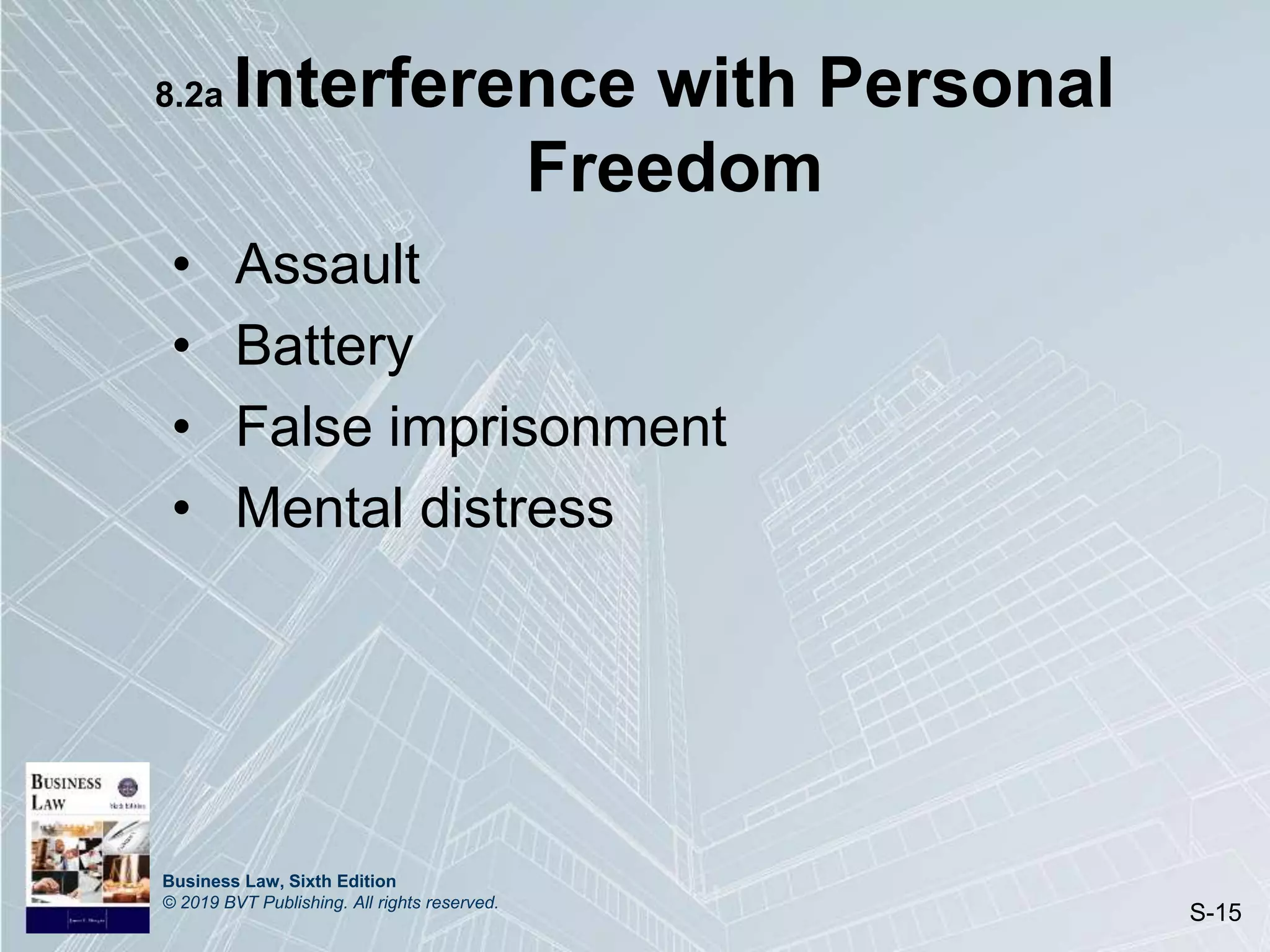
S-15
8.2a Interference with Personal
Freedom
• Assault
• Battery
• False imprisonment
• Mental distress
Business Law, Sixth Edition
© 2019 BVT Publishing. All rights reserved.
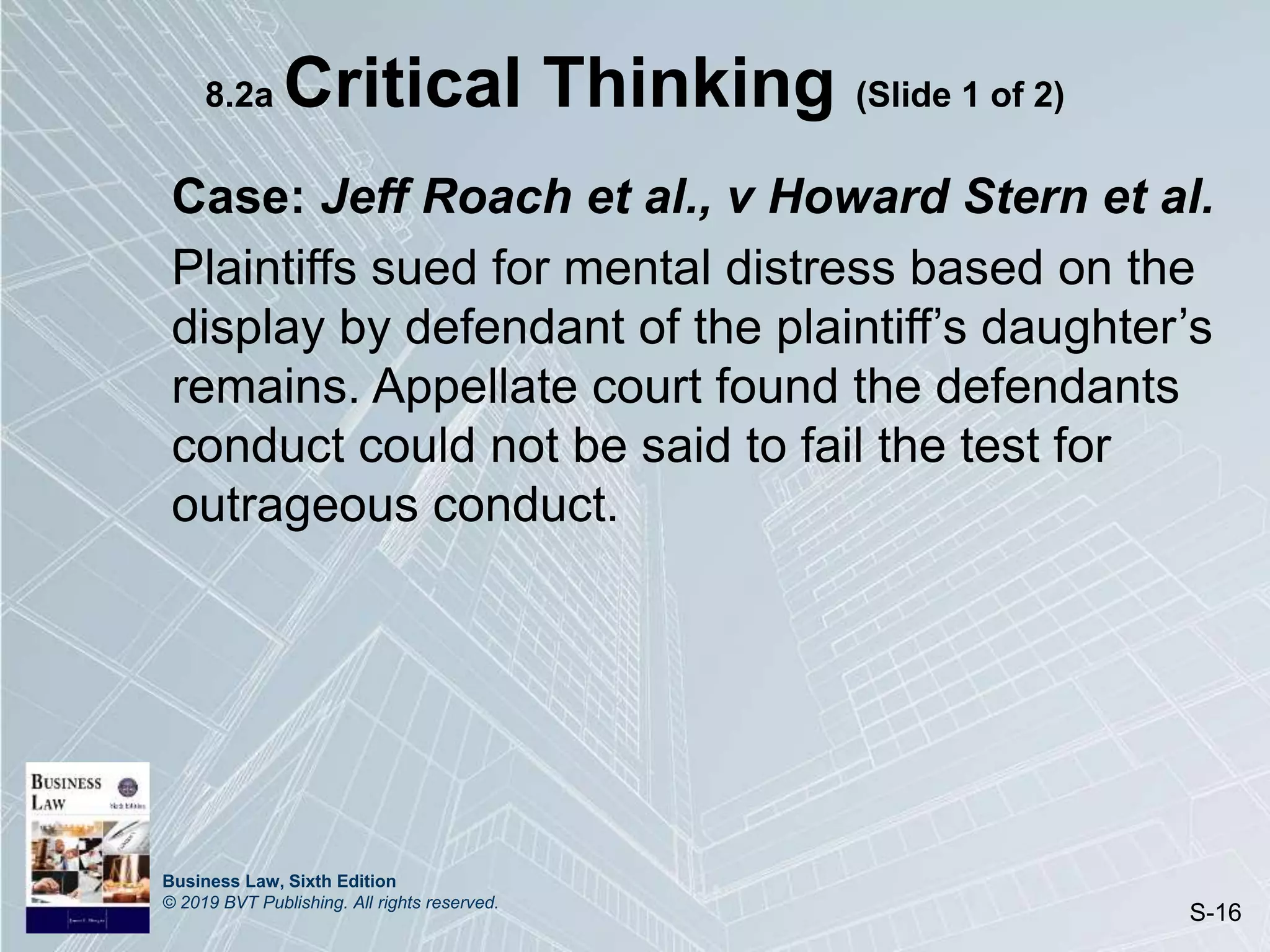
S-16
8.2a Critical Thinking (Slide 1 of 2)
Case: Jeff Roach et al., v Howard Stern et al.
Plaintiffs sued for mental distress based on the
display by defendant of the plaintiff’s daughter’s
remains. Appellate court found the defendants
conduct could not be said to fail the test for
outrageous conduct.
Business Law, Sixth Edition
© 2019 BVT Publishing. All rights reserved.
S-17
8.2a Critical Thinking (Slide 2 of 2)
• Do you think a jury might consider
defendants’ behavior “extreme and
outrageous”? Should the nature of the show
be considered?
• Does the majority opinion set too high a
standard for determining outrageous
conduct? Why?
• What is the central point of the dissent? Do
you agree with their position? Why?
Business Law, Sixth Edition
© 2019 BVT Publishing. All rights reserved.
S-18
8.2b Interference with
Property Rights (Slide 1 of 2)
Trespass
• Unauthorized entry upon land of another
- Innocent
- Willful
• Unlawful interference with the goods of
another
- Theft of the good
- Damage of the good
- Intent need not be wrongful
Business Law, Sixth Edition
© 2019 BVT Publishing. All rights reserved.
S-19
8.2b Interference with
Property Rights (Slide 2 of 2)
Conversion: used when the
interference is so significant the
defendant must pay the full value of the
goods as damages
Nuisance: unreasonable use of one’s
own property causing harm to others
Business Law, Sixth Edition
© 2019 BVT Publishing. All rights reserved.
S-20
8.2b Critical Thinking
Case: Kremen et al. v. Cohen et al.
Plaintiff sued on conversion theory for the
wrongful transfer of a domain name on the
internet.
• Should the tort of conversion apply to both
tangible and intangible property? Why?
• Did Network Solutions commit the tort of
conversion? Why?
Business Law, Sixth Edition
© 2019 BVT Publishing. All rights reserved.
S-21
8.2c Interference with
Economic Relations (Slide 1 of 2)
Disparagement: false, injurious
communication about a person’s
property, quality of product, or conduct
of business
Interference with a contract: inducing
a breach of contract
Business Law, Sixth Edition
© 2019 BVT Publishing. All rights reserved.
S-22
8.2c Interference with
Economic Relations (Slide 2 of 2)
Interference with prospective advantage:
intended to protect expectations of future
contracts, including prospects of
employment, employees, or customers
Other infringements: wrongful
appropriation of another’s goodwill or
business value (e.g., patents, copyrights, or
trademarks)
Business Law, Sixth Edition
© 2019 BVT Publishing. All rights reserved.
S-23
8.2d Wrongful Communications
(Slide 1 of 3)
Slander
• Usually requires proof of actual damages
• Slander per se requires no such proof
Libel
• Complicated by the First Amendment;
celebrities must prove constitutional malice
• If libelous on its face, special damages need
not be proved, otherwise actual damages
must be proved.
Business Law, Sixth Edition
© 2019 BVT Publishing. All rights reserved.
S-24
8.2d Wrongful Communications
(Slide 2 of 3)
• General View
– Defendant made a false statement
(statement must be of fact).
– Statement was published (passed on to
third party).
– One’s reputation was harmed by the
statement.
– Plaintiff was damaged as a result of the
statement.
Business Law, Sixth Edition
© 2019 BVT Publishing. All rights reserved.
S-25
8.2d Wrongful Communications
(Slide 3 of 3)
Exceptions
• Absolutely privileged
• Qualified or limited privileged
Invasion of Privacy
• Appropriation of a person’s identity
• Intrusion into privacy
• Public disclosure of private facts
• False light publication

Torts: Introduction and Intentional Torts

  • 1.
    Business Law, SixthEdition © 2019 BVT Publishing. All rights reserved. S-1 Chapter 8: Torts: Introduction and Intentional Torts
  • 2.
    Business Law, SixthEdition © 2019 BVT Publishing. All rights reserved. S-2 Learning Objectives • Identify the theories of tort liability. • Understand the various damages. • Recognize persons liable for damages. • Explain the various intentional torts.
  • 3.
    Business Law, SixthEdition © 2019 BVT Publishing. All rights reserved. S-3 8.0 In the News (Slide 1 of 2) Italian in Europe’s Parliament Convicted of Defamation for Racial Insult http://bvtlab.com/QK6pb An Italian member of the European Parliament has been found guilty of defamation and ordered to pay 50,000 euros (about $59,000) in damages to a fellow member of the European Union body, four years after he was accused of racially insulting her during a radio interview.
  • 4.
    Business Law, SixthEdition © 2019 BVT Publishing. All rights reserved. S-4 8.0 In the News (Slide 2 of 2) • Discuss the difference between slander and libel. • What are the elements required of slander or libel. • Does the punishment fit the crime?
  • 5.
    Business Law, SixthEdition © 2019 BVT Publishing. All rights reserved. S-5 8.1 Theories of Tort Liability Two traditional premises • Intentional torts • Negligence Strict Liability • Factual situations • Relationship between the parties • Activity caused injury
  • 6.
    Business Law, SixthEdition © 2019 BVT Publishing. All rights reserved. S-6 8.1a Damages Available Compensatory damages • A sum of money intended to make the victim “whole” Punitive damages • Defendant’s intent is malicious, fraudulent, or evil; or negligence is gross or willful and wanton.
  • 7.
    Business Law, SixthEdition © 2019 BVT Publishing. All rights reserved. S-7 8.1b Limitations on Damages • Caps on medical malpractice cases. • Caps on personal injury claims. • Punitive damages: 10:1.
  • 8.
    Business Law, SixthEdition © 2019 BVT Publishing. All rights reserved. S-8 8.1c Persons Liable • Individuals are liable for their own torts. • Multiple defendants may be jointly and/or severally liable. • Liability of children based upon age, nature of conduct • Parental responsibility: family purpose doctrine • Market-share doctrine
  • 9.
    Business Law, SixthEdition © 2019 BVT Publishing. All rights reserved. S-9 8.1c Critical Thinking Case: Ansell Healthcare Products, Inc. v Owens & Minor, Inc. Manufacturers of latex gloves settled a suit for allergic reaction to their product. Texas law required manufacturers to indemnify seller for damages arising from such suits. • Is it fair that the two manufacturers had to indemnify the supplier? Why? • Who benefits under joint and several liability? A plaintiff? Defendants? Why?
  • 10.
    Business Law, SixthEdition © 2019 BVT Publishing. All rights reserved. S-10 8.2 Intentional Torts Involve interference with certain protected interests. Interference with personal freedom • Interference with property rights • Interference with economics relations • Wrongful communications
  • 11.
    Business Law, SixthEdition © 2019 BVT Publishing. All rights reserved. S-11 8.2 Intentional Torts Common to Business (Slide 1 of 4) Theory of Liability Description Interference with Personal Freedom Assault Causing the apprehension of a harmful or offensive contact with a person’s body Battery Intentional and unpermitted physical contact with a person’s body Assault and Battery A wrongful restraint of a person’s freedom of movement False imprisonment A combination of assault and battery (some hits and some misses) Mental distress Wrongful interference with a person’s peace of mind by insults, indignities or outrageous conduct
  • 12.
    Business Law, SixthEdition © 2019 BVT Publishing. All rights reserved. S-12 8.2 Intentional Torts Common to Business (Slide 2 of 4) Theory of Liability Description Interference with Property Rights Trespass to land Unauthorized entry upon the land of another Trespass to chattels Direct, intentional interference with a chattel in the possession of another person, such as taking it or damaging it Conversion Interference with a person’s chattels to the extent that the wrongdoer ought to pay for the chattel Nuisance Intentional invasion or disturbance of a person’s rights in land or the conduct of an abnormally dangerous activity
  • 13.
    Business Law, SixthEdition © 2019 BVT Publishing. All rights reserved. S-13 8.2 Intentional Torts Common to Business (Slide 3 of 4) Theory of Liability Description Interference with Economic Relations Disparagement Injurious falsehoods about a person’s business or property, damaging prospective advantage Interference with a contract Inducing a party to a contract to breach it or interfering with its performance Prospective advantage Interfering with an expectancy such as employment or an opportunity to contract Wrongful appropriation Infringing on goodwill, patents, trademarks, copyrights and other business interests
  • 14.
    Business Law, SixthEdition © 2019 BVT Publishing. All rights reserved. S-14 8.2 Intentional Torts Common to Business (Slide 4 of 4) Theory of Liability Description Wrongful Communications Slander Oral defamation; holding a person’s name or reputation up to hatred, contempt, ridicule or causing others to shun him/her Libel Written defamation Invasion of privacy Interfering with one’s right to be let alone by 1) Appropriating the name or picture of a person, 2) Intruding on a person’s physical solitude, 3) The public disclosure of private facts, and 4) Publicity that places a person in a false light in the public eye Fraud An intentional misstatement of a material existing fact relied on by another, to his/ her injury. Also a defense to formation of a contract (fraud is examined in Chapter 16)
  • 15.
    Business Law, SixthEdition © 2019 BVT Publishing. All rights reserved. S-15 8.2a Interference with Personal Freedom • Assault • Battery • False imprisonment • Mental distress
  • 16.
    Business Law, SixthEdition © 2019 BVT Publishing. All rights reserved. S-16 8.2a Critical Thinking (Slide 1 of 2) Case: Jeff Roach et al., v Howard Stern et al. Plaintiffs sued for mental distress based on the display by defendant of the plaintiff’s daughter’s remains. Appellate court found the defendants conduct could not be said to fail the test for outrageous conduct.
  • 17.
    Business Law, SixthEdition © 2019 BVT Publishing. All rights reserved. S-17 8.2a Critical Thinking (Slide 2 of 2) • Do you think a jury might consider defendants’ behavior “extreme and outrageous”? Should the nature of the show be considered? • Does the majority opinion set too high a standard for determining outrageous conduct? Why? • What is the central point of the dissent? Do you agree with their position? Why?
  • 18.
    Business Law, SixthEdition © 2019 BVT Publishing. All rights reserved. S-18 8.2b Interference with Property Rights (Slide 1 of 2) Trespass • Unauthorized entry upon land of another - Innocent - Willful • Unlawful interference with the goods of another - Theft of the good - Damage of the good - Intent need not be wrongful
  • 19.
    Business Law, SixthEdition © 2019 BVT Publishing. All rights reserved. S-19 8.2b Interference with Property Rights (Slide 2 of 2) Conversion: used when the interference is so significant the defendant must pay the full value of the goods as damages Nuisance: unreasonable use of one’s own property causing harm to others
  • 20.
    Business Law, SixthEdition © 2019 BVT Publishing. All rights reserved. S-20 8.2b Critical Thinking Case: Kremen et al. v. Cohen et al. Plaintiff sued on conversion theory for the wrongful transfer of a domain name on the internet. • Should the tort of conversion apply to both tangible and intangible property? Why? • Did Network Solutions commit the tort of conversion? Why?
  • 21.
    Business Law, SixthEdition © 2019 BVT Publishing. All rights reserved. S-21 8.2c Interference with Economic Relations (Slide 1 of 2) Disparagement: false, injurious communication about a person’s property, quality of product, or conduct of business Interference with a contract: inducing a breach of contract
  • 22.
    Business Law, SixthEdition © 2019 BVT Publishing. All rights reserved. S-22 8.2c Interference with Economic Relations (Slide 2 of 2) Interference with prospective advantage: intended to protect expectations of future contracts, including prospects of employment, employees, or customers Other infringements: wrongful appropriation of another’s goodwill or business value (e.g., patents, copyrights, or trademarks)
  • 23.
    Business Law, SixthEdition © 2019 BVT Publishing. All rights reserved. S-23 8.2d Wrongful Communications (Slide 1 of 3) Slander • Usually requires proof of actual damages • Slander per se requires no such proof Libel • Complicated by the First Amendment; celebrities must prove constitutional malice • If libelous on its face, special damages need not be proved, otherwise actual damages must be proved.
  • 24.
    Business Law, SixthEdition © 2019 BVT Publishing. All rights reserved. S-24 8.2d Wrongful Communications (Slide 2 of 3) • General View – Defendant made a false statement (statement must be of fact). – Statement was published (passed on to third party). – One’s reputation was harmed by the statement. – Plaintiff was damaged as a result of the statement.
  • 25.
    Business Law, SixthEdition © 2019 BVT Publishing. All rights reserved. S-25 8.2d Wrongful Communications (Slide 3 of 3) Exceptions • Absolutely privileged • Qualified or limited privileged Invasion of Privacy • Appropriation of a person’s identity • Intrusion into privacy • Public disclosure of private facts • False light publication