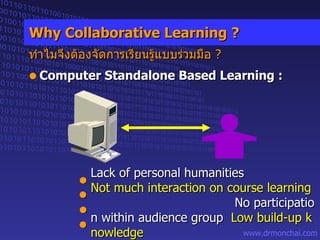
Why Collaborative Learning? ทำไมจึงต้องจัดการเรียนรู้แบบร่วมมือ ? Computer Standalone Based Learning : Lack of personal humanities Not much interaction on course learning No participation within audience group Low build-up knowledge
3.
Why Collaborative Learning? ทำไมจึงต้องจัดการเรียนรู้แบบร่วมมือ ? Traditional Learning in Classroom : Large audience in the same time Not much interaction occur Still l ow build-up knowledge Lack of teacher and too much workload
4.
Learn together vsLearn alone : เรียนรู้ร่วมกัน กับ เรียนรู้โดยลำพัง : Average t est s core of student working together and alone with structured & unstructured study : ( Source : Fantuzzo, Riggio, Connelly and Dimeff, 1989.) 84.8 % 70.1 % 69.0 % 66.3 % High Structure Low Structure
5.
Individual Learning :การเรียนรู้รายบุคคล : Individual Learning is an instruction method in which learners work individually at their own level and rate toward an academic goal. Individual Learning is defined as the capacity to build knowledge through individual reflection about external stimuli and sources, and through a personal re-elaboration of individual knowledge and experience in light of interaction with others and the environment.
6.
In individual learning,the learning objectives and content preferences are not uniform. One learner may wish to maximize the amount of content for the allowed time, the other will look for the most enjoyable way of doing it. Content may be studied in depth or scanned to evaluate the coverage of the recourse. The following table summarize the requisites for individual learning and the conditions for their achievement Individual Learning : การเรียนรู้รายบุคคล :
Collaborative Learning (CL) Cooperative Learning (CoL) c-Learning การเรียนรู้แบบร่วมมือ การเรียนรู้แบบร่วมมือกัน การร่วมมือกันเรียนตามที่ กำหนด Name and Definition : ชื่อและความหมาย : Learn together in group “ What children can do together today, they can do alone tomorrow” (Lev Vygotsky)
12.
Conceptual of CLand CoL : แนวความคิดของ CL และ CoL : Collaborative Learning (CL – Babara L. Smith) : Collaborative Learning is an umbrella term for a variety of educational approaches involving joint intellectual effort by students, or students and teachers together. Usually, students are working in groups of two or more, mutually searching for understanding, solutions, meanings, creating a product. Collaborative learning activities vary widely, but most center on students’ exploration or application of the course material, not simply the teacher’s presentation or explication of it.
13.
Conceptual of CLand CoL : แนวความคิดของ CL และ CoL : Collaborative Learning (CL – Ted Panitz) : CL is a personal philosophy, not just a classroom technique. In all situations where people come together in groups, it suggests a way of dealing with people which respects and highlights indivi-dual group members' abilities and contributions. There is a sharing of authority and acceptance of responsibility among group members for the groups actions. The underlying premise of collaborative learning is based upon consensus building through cooperation by group members.
14.
Conceptual of CLand CoL : แนวความคิดของ CL และ CoL : Collaborative Learning (CL – EBC) : CL is a method of teaching and learning in which students team together to explore a significant question or create a meaningful project. A group of students discussing a lecture or the students from different schools working together over the Internet on a shared assignment are both examples of collaborative learning.
15.
Conceptual of CLand CoL : แนวความคิดของ CL และ CoL : Cooperative Learning (CoL – Babara L. Smith) : CoL represents the most carefully structured end of the collaborative learning continuum. Defined as “The instructional use of small groups so that students work together to maximize their own and each other’s learning” (Johnson), CoL is based on the social interdependence theories of Kurt Lewin and Morton Deutsch . These theories and associated research explore the influence of the structure of social interdependence on indivi-dual interaction within a given situation which.
16.
Conceptual of CLand CoL : แนวความคิดของ CL และ CoL : Cooperative Learning (CoL – Ted Panitz) : Cooperative learning is defined by a set of the processes which help people interact together in order to accomplish a specific goal or develop an end product which is usually content specific. It is more directive than a collaborative system of governance and closely controlled by the teacher. While there are many mechanisms for group analysis and introspection the fundamental approach is teacher centered whereas collabor-ative learning is more student centered.
17.
Conceptual of CLand CoL : แนวความคิดของ CL และ CoL : Cooperative Learning (CoL – EBC) : CoL, which will be the primary focus of this work shop, is a specific kind of collaborative learning. In cooperative learning, students work together in small groups on a structured activity. They are individually accountable for their work, and the work of the group as a whole is also assessed. Cooperative groups work face-to-face and learn to work as a team.
18.
Conceptual of CLand CoL : แนวความคิดของ CL และ CoL : Cooperative Learning Cooperative Learning Cooperative Learning Collaborative Learning Personal Philosophy (not classroom technique) Process to work together
19.
Conceptual of CLand CoL : แนวความคิดของ CL และ CoL : CL = การเรียนรู้แบบร่วมมือ CoL = การร่วมมือเรียนตามที่กำหนด ความแตกต่างระหว่าง CL และ CoL ที่มีการสรุปไว้ ก็คือ โครงสร้าง การตัดสินใจด้วยตนเอง บท บาทของผู้สอน และสิ่งแวดล้อมทาง การเรียนรู้ C L เน้นความสำคัญในการพัฒนาการจัดการกิจกรรมกลุ่มด้วยตนเอง แต่ Co L มุ่งเน้นการจัดการ การนำทาง และความเข้าใจโดยผู้สอน บางคนสรุปว่า CL ใช้ได้ดีในการ นำเสนอความรู้โดยใช้การติดต่อสื่อสาร ส่วน CoL เหมาะ สำหรับการเรียนรู้ทางวิทยาศาสตร์ (Patricia)
“ Cooperative orCollaborative Learning” is a team process where members support and rely on each other to achieve an agreed-upon goal. The class room is an excellent place to develop team building skills you will need later in life. (Source : Joe Landsberger, St.Thomas University) CoLT stands for “Cooperative Learning” or “Collaborative Learning” Learning Techniques, because these techniques described from both of CL and CoL technigues. (Elizabeth Barkley) Conceptual of CL or CoL : แนวความคิดของ CL หรือ CoL :
22.
Conceptual of CLand CoL : แนวความคิดของ CL และ CoL : Collaborative Learning and Cooperative Learning is an educational approach for teaching and learning that involves groups of learners working together to solve a problem, complete a task, or create a product. Collaborative learning is based on the idea that learning is a naturally social act in which the participants talk among themselves. It is through the talk that learning occur. (Source : National Institute for Science Education)
23.
Conceptual of CLand CoL : แนวความคิดของ CL และ CoL : Why does Collaborative Learning Work ? 1. Cognitive approach : ด้านพุทธิพิสัย ผู้เรียนจะมีความเข้าใจในเนื้อหาที่ดี ขึ้น ในการเรียนรู้แบบกลุ่มย่อย ๆ ผู้เรียนจะมีโอกาส ซักซ้อมความเข้าใจกับคนอื่น ๆ แลกเปลี่ยนความคิด เห็น เพื่อสร้างสรรค์องค์ความรู้ด้วยตัวเองขึ้นมาใหม่ 2. Social constructivism : ด้านสร้างสรรค์สังคมเรียนรู้ การสนทนาในกลุ่มของ ผู้เรียนด้วยกัน ทำให้เกิดการสร้างสรรค์ความรู้ที่ไป เชื่อมโยงกับความรู้ ทักษะ และประสบการณ์เดิมของ ผู้เรียนแต่ละคนในแนวทฤษฎีคอนสตรัคติวิสต์
24.
Conceptual of CLand CoL : แนวความคิดของ CL และ CoL : Why does Collaborative Learning Work ? 3. Motivational theories : ทฤษฎีแรงจูงใจ การเรียนรู้แบบร่วมมือจะสร้างแรง จูงใจให้กับผู้เรียน เพื่อเรียนรู้และทำกิจกรรมตามที่ ตนเองปรารถนา การใฝ่รู้เกิดขึ้นจากแรงจูงใจของตน เองที่จะปฏิสัมพันธ์กับเพื่อนร่วมกลุ่ม ได้สนทนา ได้ แลกเปลี่ยนความคิดเห็นกับผู้อื่น ๆ ที่อยู่ในภาะเดียว กัน ซึ่งจะเป็นแรงขับที่ดีในการเรียนรู้วิธีนี้ โดยมีความ เชื่อว่า การเรียนรู้แบบร่วมมือเป็น "One for all and all for one attitude."
Conceptual of CLand CoL : แนวความคิดของ CL และ CoL : เงื่อนไข / สภาพการณ์การเรียนรู้แบบร่วมมือ : 3. Face-to-face promotive interaction : ส่งเสริมการปฏิสัมพันธ์แบบเผชิญหน้า ถึงแม้ว่าการ เรียนรู้แบบร่วมมือบางประเภทจะเป็นการศึกษาโดย อิสระก็ตาม แต่ก็ยังมีการเผชิญหน้าซึ่งอาจจะเป็น การปฏิสัมพันธ์ทางไกล เนื่องจากการปฏิสัมพันธ์ ทำให้เกิดการแบ่งปันความรู้ และการตรวจปรับ 4. Appropriate use of collaborative skills : การใช้ทักษะในการร่วมมือที่เหมาะสม โดยผู้เรียนจะ ช่วยเหลือกันในการพัฒนาและฝึกฝน เพื่อสร้างสรรค์ ความรู้ ตัดสินใจร่วมกัน และสื่อสารซึ่งกันและกัน
29.
Conceptual of CLand CoL : แนวความคิดของ CL และ CoL : เงื่อนไข / สภาพการณ์การเรียนรู้แบบร่วมมือ : 5. Group processing : มีการจัดกระบวนการกลุ่มร่วมกัน ทั้งเป้าหมาย ระยะ เวลา การดำเนินการกลุ่ม และการหน้าที่การดำเนิน การที่จะเป็นประโยชน์ต่อไปในอนาคต (Source : Johnson, Johnson, and Smith) In a collaborative learning setting, learners have the opportunity to converse (opposite) with peers, present and defend ideas, exchange diverse beliefs, question other conceptual frameworks, and be actively engaged.
30.
Groupwork on CollaborativeLearning : การร่วมกลุ่มในการเรียนรู้แบบร่วมมือ : ประเภทของการร่วมกลุ่ม : Informal Learning Groups 1 Formal Learning Groups 2 Study Teams 3
31.
Groupwork on CollaborativeLearning : การร่วมกลุ่มในการเรียนรู้แบบร่วมมือ : Informal Learning Groups : It’s an ad hoc temporary clusterings of students within a single class session. Informal learning groups can be initiated. For example, by asking students to turn to a neighbor and spend two minutes discussing a question. It can be formed groups of 3-5 to solve a problem. It can be organized informal groups at any time of any size to check on students' understanding, to give students an opportunity to apply what they are learning, or to provide a change of pace.
32.
Groupwork on CollaborativeLearning : การร่วมกลุ่มในการเรียนรู้แบบร่วมมือ : Informal Learning Groups : กลุ่มการเรียนรู้อย่างไม่เป็นทางการ เป็นกลุ่มเฉพาะกิจที่รวมกลุ่มในชั้นเรียนเพียงชั้นเดียว ตามความประสงค์ของผู้สอน เพื่อมอบหมายให้ทำงานอย่างใดอย่างหนึ่งร่วม กัน หรือเพื่อเปลี่ยนรูปแบบของการจัดกิจกรรมใหม่ หลัง จากเสร็จสิ้นภารกิจแล้ว ก็จะกลับสู่การเรียนปกติต่อไป (Source : Barbara Gross Davis) “ Informal Learning is that which enables you to participate successfully at work and in life” (Jay Cross)
33.
Formal Learning Groups: It’s a teams established to complete a specific task, such as perform a lab experiment, write a report, carry out a project, or prepare a position paper. These groups may complete their work in a single class session or over several weeks. Typically, students work together until the task is finished, and their project is graded. Groupwork on Collaborative Learning : การร่วมกลุ่มในการเรียนรู้แบบร่วมมือ :
Study Teams : It’s a long-term groups (usually existing over the course of a semester) with stable membership whose primary responsibility is to provide members with support, encouragement, and assistance in completing course requirements and assignments. Study teams also inform their members about lectures and assignments when someone has missed a session. The larger the class and the more complex the subject matter, the more valuable study teams can be. Groupwork on Collaborative Learning : การร่วมกลุ่มในการเรียนรู้แบบร่วมมือ :
Homogeneous Group :กลุ่มเอกพันธ์ กลุ่มร่วมคุณสมบัติ กลุ่มแบบเดียวกัน กลุ่มที่เหมือนกัน Heterogeneous Group : กลุ่มพหุพันธ์ กลุ่มต่างคุณสมบัติ กลุ่มต่างแบบกัน กลุ่มที่ไม่เหมือนกัน Homogeneous & Heterogeneous : กลุ่มที่เหมือนกันและกลุ่มที่แตกต่างกัน : Sex Prerequisite Career Experience Achievement Test Age Location Attitude/Opinion Skill
39.
It seems prudent to keep groups as small as possible to promote positive interdependence, yet as large as necessary to provide sufficient diversity of opinions and backgrounds as well as resources to get the job done. ( Cooper) For effective collaborative work group size usually ranges 2-6 students. While group size may be indicated any number of factor and preferences. (Bean) Group Size on Collaborative Learning : ขนาดของกลุ่มในการเรียนรู้แบบร่วมมือ : 2-6 Students usually !
40.
The size ofthe group depends on : The type of group The nature of assignment The duration of the task Some physical setting (location, community) Basicly , for informal activities, group size is often kept small (2-4 students) since larger groups have insufficient time to become cohesive. A complex semester long project may require the resources of a larger group (4-6 students) and there is enough time to become effective. (Cooper) ขนาดของกลุ่มในการเรียนรู้แบบร่วมมือ : Group Size on Collaborative Learning :
41.
วิธีการคัดเลือกสมาชิกเข้าร่วมกลุ่ม : 1. Random : การสุ่ม เป็นการคัดเลือกสมาชิกอย่างรวดเร็วแต่ใช้ได้ ผลดี ซึ่งอาจใช้คะแนนทดสอบย่อยมาพิจารณาก็ได้ 2. Student selection : ผู้เรียนเลือกเอง โดยให้ผู้เรียนเลือกสมาชิกตามต้อง การ ส่วนใหญ่จะเลือกสมาชิกที่ทำงานร่วมกันได้ 3. Instructor Determined : ผู้สอนตัดสินใจ เหมาะสำหรับกลุ่ม Formal Group และ Base Group ผู้สอนมักจะพิจารณาตามความ สนใจของผู้เรียนเอง ในการคัดเลือกเข้ากลุ่ม Selecting Group Members : การคัดเลือกสมาชิกเข้าร่วมกลุ่มใน CL :
กลยุทธ์ที่สำคัญ 4 ประการ : 1. Plan for each stage of group work : การวางแผนการทำงานกลุ่มในแต่ละขั้นตอน โดยเริ่ม ตั้งแต่การพัฒนาหลักสูตร จนถึงการประเมินผู้เรียน ว่าจะต้องดำเนินการอย่างไรจึงจะทำการเรียนรู้แบบ ร่วมมือได้ประสบความสำเร็จ 2. Carefully explain to your class how the groups will operate and how students will be graded : อธิบายให้ผู้เรียนเข้าใจถึงกระบวนการกลุ่มและการ ให้คะแนน เพื่อให้ผู้เรียนได้ทราบถึงกระบวนการที่ ใช้ในการเรียนรู้ และแนวทางการประเมินผลที่ใช้ General Strategies on Collaborative : กลยุทธ์ทั่วไปในการเรียนรู้แบบร่วมมือ :
54.
กลยุทธ์ที่สำคัญ 4 ประการ : 3. Give students the skills they need to succeed in groups : ชี้แนะทักษะที่จำเป็นแก่ผู้เรียนเพื่อให้การเรียนรู้แบบ ร่วมมือประสบความสำเร็จ เนื่องจากผู้เรียนส่วนใหญ่ ไม่มีประสบการณ์มาก่อน จึงต้องการคำแนะนำ 4. Consider written contracts : พิจารณาข้อตกลงที่เขียนขึ้น สถานศึกษาบางแห่งมัก จะเขียนข้อตกลงต่าง ๆ ไว้ด้วย เช่น ระเบียบ กฎใน การเข้ากลุ่ม เพื่อป้องกันปัญหาที่จะเกิดขึ้น รวมทั้ง ระยะเวลาในการดำเนินการกลุ่ม General Strategies on Collaborative : กลยุทธ์ทั่วไปในการเรียนรู้แบบร่วมมือ :
55.
สิ่งที่จะต้องพิจารณาในการออกแบบ : 1. Create group tasks that require interdepen- dence : สร้างสรรค์งานกลุ่มที่อาศัยการทำงานร่วมกัน เพื่อให้ งานสำเร็จจากการประสานการทำงานร่วมกัน ไม่ใช่ ทำเพียงคนเดียว ต้องร่วมคิด และรับผิดชอบร่วมกัน 2. Make the group work relevant : ให้งานที่เหมาะสมกับกลุ่ม โดยมีระดับความซับซ้อน ของงานไม่เกินความสามารถของกลุ่ม ที่จะช่วยกัน ระดมสมองจนงานนั้นสำเร็จ และจะต้องไม่เสียเวลา ในการทำงานนั้นมากเกินไป Principle of Designing Group Work : หลักการออกแบบการทำงานกลุ่มร่วมกัน :
56.
สิ่งที่จะต้องพิจารณาในการออกแบบ : 3. Create assignments that fit the students' skills and abilities : งานที่มอบหมายจะต้องเหมาะสมกับทักษะและความ สามารถของผู้เรียน ไม่ยากและง่ายเกินไป จะต้อง เกิดความจูงใจและท้าทายให้ผู้เรียนร่วมคิด ร่วมทำ 4. Assign group tasks that allow for a fair division of labor : งานที่มอบหมายจะต้องยุติธรรมในการแบ่งงาน โดย จะต้องเป็นภาระกับผู้ใดผู้หนึ่งมากเกินไป ซึ่งรวมถึง ระดับความยากของงานจะต้องสม่ำเสมอกันทั้งกลุ่ม Principle of Designing Group Work : หลักการออกแบบการทำงานกลุ่มร่วมกัน :
57.
สิ่งที่จะต้องพิจารณาในการออกแบบ : 5. Set up "competitions" among groups : ให้มีการการแข่งขันระหว่างกลุ่ม โดยเฉพาะงานทาง ด้านวิทยาศาสตร์ หากกำหนดให้มีการแข่งขันกัน ก็ จะได้ผลงานออกมามีประสิทธิภาพมากขึ้น 6 . Consider offering group test taking : พิจารณาการทดสอบทั้งกลุ่ม ในการทดสอบผลการ ทำงานของกลุ่ม มักจะเป็นทั้งรายบุคคลและกลุ่ม ซึ่ง ผลของกลุ่มส่วนใหญ่จะสูงกว่าผลรายบุคคล ทำให้ ผู้เรียนในการเรียนรู้แบบร่วมมือรู้สึกพอใจ Principle of Designing Group Work : หลักการออกแบบการทำงานกลุ่มร่วมกัน :
58.
สิ่งที่จะต้องพิจารณาในการจัดการกลุ่ม : 1. Decide how the groups will be formed : ตัดสินใจว่าจะจัดกลุ่มอย่างไร บางแห่งเลือกผู้เรียน เข้ากลุ่มแบบสุ่ม บางแห่งเลือกแบบอาศัยข้อมูลพื้น ฐาน ซึ่งให้พิจารณาสิ่งที่ต้องการศึกษาเป็นสำคัญ 2. Be conscious of group size : ให้คิดถึงขนาดของกลุ่ม จำนวนที่เหมาะสมอยู่ที่ 2-6 คน แต่กลุ่มบางรูปแบบอาจใช้ 4-5 คนจะได้ผลกว่า 3. Keep groups together : รักษาให้กลุ่มทำงานด้วยกันโดยตลอด เนื่องจากอาจ เกิดปัญหาในการร่วมกลุ่มกัน ผู้สอนจึงต้องควบคุม Organize Learning Group : การจัดการกลุ่มการเรียนรู้ :
59.
สิ่งที่จะต้องพิจารณาในการจัดการกลุ่ม : 4. Help groups plan how to proceed : ช่วยวางแผนในกลุ่มเพื่อให้ทำงานจนสำเร็จ สอบถาม กลุ่มถึงแผนการดำเนินงาน รวมทั้งกำหนดเวลา โดย ให้คำแนะนำกับกลุ่มเกี่ยวกับแผนในส่วนนี้ 5. Regularly check in with the groups : ตรวจสอบกลุ่มอยู่เสมอ ถ้ากระบวนการกลุ่มใช้เวลา เกินจากกำหนดมากเกินไป จะต้องหมั่นตรวจสอบ การดำเนินงานของกลุ่ม และสอบถามถึงกำหนดการ ที่ขยายออกไป Organize Learning Group : การจัดการกลุ่มการเรียนรู้ :
60.
สิ่งที่จะต้องพิจารณาในการจัดการกลุ่ม : 6. Provide mechanisms for groups to deal with uncooperative members : จัดหากลไกในการดำเนินการกับกลุ่มกรณีที่สมาชิก ไม่ให้ความร่วมมือ เช่น ให้เกรดไม่เหมือนกันทั้งกลุ่ม ( ต้องแจ้งล่วงหน้า ) หรือแยกสมาชิกที่ปัดความรับผิด ชอบออกจากกลุ่ม (Source : Elizabeth F. Barkley) Organize Learning Group : การจัดการกลุ่มการเรียนรู้ :
61.
สิ่งที่จะต้องพิจารณาในการประเมิน : 1. Ensure that individual student performance is assessed and that the groups know how their members are doing : ต้องแน่ใจว่าเป็นการประเมินผลของงานที่ผู้เรียนทำ รายบุคคลและกลุ่มรู้ดีว่าสมาชิกเหล่านั้นทำอะไรใน กลุ่มบ้าง 2. Give students an opportunity to evaluate the effectiveness of their group : ให้ผู้เรียนมีโอกาสที่จะประเมินความสำเร็จของกลุ่ม พวกเขาเองบ้าง Evaluating Group Work : การประเมินการทำงานกลุ่ม :
62.
สิ่งที่จะต้องพิจารณาในการประเมิน : 3. Decide how to grade members of the group : ตัดสินใจในการให้เกรดของกลุ่ม ในสิ่งต่าง ๆ ดังนี้ จะประเมินอะไร ? จะประเมินผลระหว่างดำเนินการหรือผลสรุป ? (Formative or Summative Evaluation) ใครจะเป็นผู้ประเมิน ? 1. Instructor 2. Student Self-Evaluation 3. Student Peer Evaluation 4. Group Evaluation Evaluating Group Work : การประเมินการทำงานกลุ่ม :
63.
Facilitating Student Collaboration: การดำเนินการเกี่ยวกับผู้เรียนในการร่วมมือ : 1 Introducing the Activity Observing and Interacting with Groups Address Problems Reporting Out Techniques Helping Groups Achieve Closure 2 3 4 5
Step 1 :Introducing the Activity : 5. Remind groups of the rules for group Interaction : เตือนกลุ่มเกี่ยวกับกฎการปฏิสัมพันธ์ของกลุ่ม โดยเฉพาะกลุ่มที่ร่วมกันเป็นระยะเวลานาน ควร จะต้องรักษากฎ กติกา รู้จักหน้าที่ของสมาชิก แต่ละคน เพื่อให้การดำเนินกลุ่มไม่มีปัญหา 6. Set time limit : กำหนดระยะเวลา เพื่อให้สามารถควบคุมเวลา ได้ จึงจะต้องกำหนดเวลาในการร่วมกลุ่ม ซึ่งจะ กำหนดไว้โดยประมาณก็ได้ เพื่อใช้วางแผน Facilitating Student Collaboration : การดำเนินการเกี่ยวกับผู้เรียนในการร่วมมือ :
67.
Step 1 :Introducing the Activity : 7. Provide the prompt : จัดหาข้อมูลให้ทันที ในระหว่างการดำเนินการ กลุ่ม อาจจะประสบปัญหาหรือมีคำถามเกิดขึ้น จึงจะต้องจัดเตรียมข้อมูลในส่วนนี้ด้วย เพื่อใช้ สนับสนุนกิจกรรมกลุ่ม 8. Query the students for understanding, and let students ask questions : ซักถามความเข้าใจและให้ผู้เรียนถาม ก่อนที่จะ เริ่มกระบวนการกลุ่ม เพื่อให้การดำเนินการกลุ่ม ประสบความสำเร็จในเวลาอันสั้น Facilitating Student Collaboration : การดำเนินการเกี่ยวกับผู้เรียนในการร่วมมือ :

![Monchai Tiantong www.drmonchai.com [email_address] Collaborative Learning & Cooperative Learning 6](https://image.slidesharecdn.com/topic6collaborative-1296332607-phpapp02/85/topic6_collaborative-1-320.jpg)






![Monchai Tiantong www.drmonchai.com [email_address] Collaborative Learning & Cooperative Learning 6 Q & A](https://image.slidesharecdn.com/topic6collaborative-1296332607-phpapp02/85/topic6_collaborative-91-320.jpg)


