Essential idea: All waves can be described by the
same sets of mathematical ideas. Detailed
knowledge of one area leads to the possibility of
prediction in another.
Nature of science: Imagination: It is speculated that
polarization had been utilized by the Vikings
through their use of Iceland Spar over 1300 years
ago for navigation (prior to the introduction of the
magnetic compass). Scientists across Europe in
the 17th–19th centuries continued to contribute to
wave theory by building on the theories and models
proposed as our understanding developed.
Topic 4: Waves
4.3 – Wave characteristics
Understandings:
• Wavefronts and rays
• Amplitude and intensity
• Superposition
• Polarization
Topic 4: Waves
4.3 – Wave characteristics
Applications and skills:
• Sketching and interpreting diagrams involving
wavefronts and rays
• Solving problems involving amplitude, intensity and the
inverse square law
• Sketching and interpreting the superposition of pulses
and waves
• Describing methods of polarization
• Sketching and interpreting diagrams illustrating
polarized, reflected and transmitted beams
• Solving problems involving Malus’s law
Topic 4: Waves
4.3 – Wave characteristics
Guidance:
• Students will be expected to calculate the resultant of
two waves or pulses both graphically and
algebraically
• Methods of polarization will be restricted to the use of
polarizing filters and reflection from a non-metallic
plane surface
Data booklet reference:
• I  A2
• I  x -2
• I = I0 cos2

Topic 4: Waves
4.3 – Wave characteristics
Theory of knowledge:
• Wavefronts and rays are visualizations that help our
understanding of reality, characteristic of modelling
in the physical sciences. How does the
methodology used in the natural sciences differ
from the methodology used in the human
sciences?
• How much detail does a model need to contain to
accurately represent reality?
Utilization:
• A number of modern technologies, such as LCD
displays, rely on polarization for their operation
Topic 4: Waves
4.3 – Wave characteristics
Aims:
• Aim 3: these universal behaviours of waves are
applied in later sections of the course in more
advanced topics, allowing students to generalize
the various types of waves
• Aim 6: experiments could include observation of
polarization under different conditions, including the
use of microwaves; superposition of waves;
representation of wave types using physical models
(eg slinky demonstrations)
• Aim 7: use of computer modelling enables students to
observe wave motion in three dimensions as well
as being able to more accurately adjust wave
characteristics in superposition demonstrations
Topic 4: Waves
4.3 – Wave characteristics
FYI
Wavefronts are perpendicular to the wave velocity.
Wavefronts and rays
Consider the transverse waves
shown here.
The wavefronts are by convention
located at the crests of the waves.
A top view simplifies the drawing:
Wavefronts
don’t have to
be straight.
Topic 4: Waves
4.3 – Wave characteristics
Wavefronts and rays
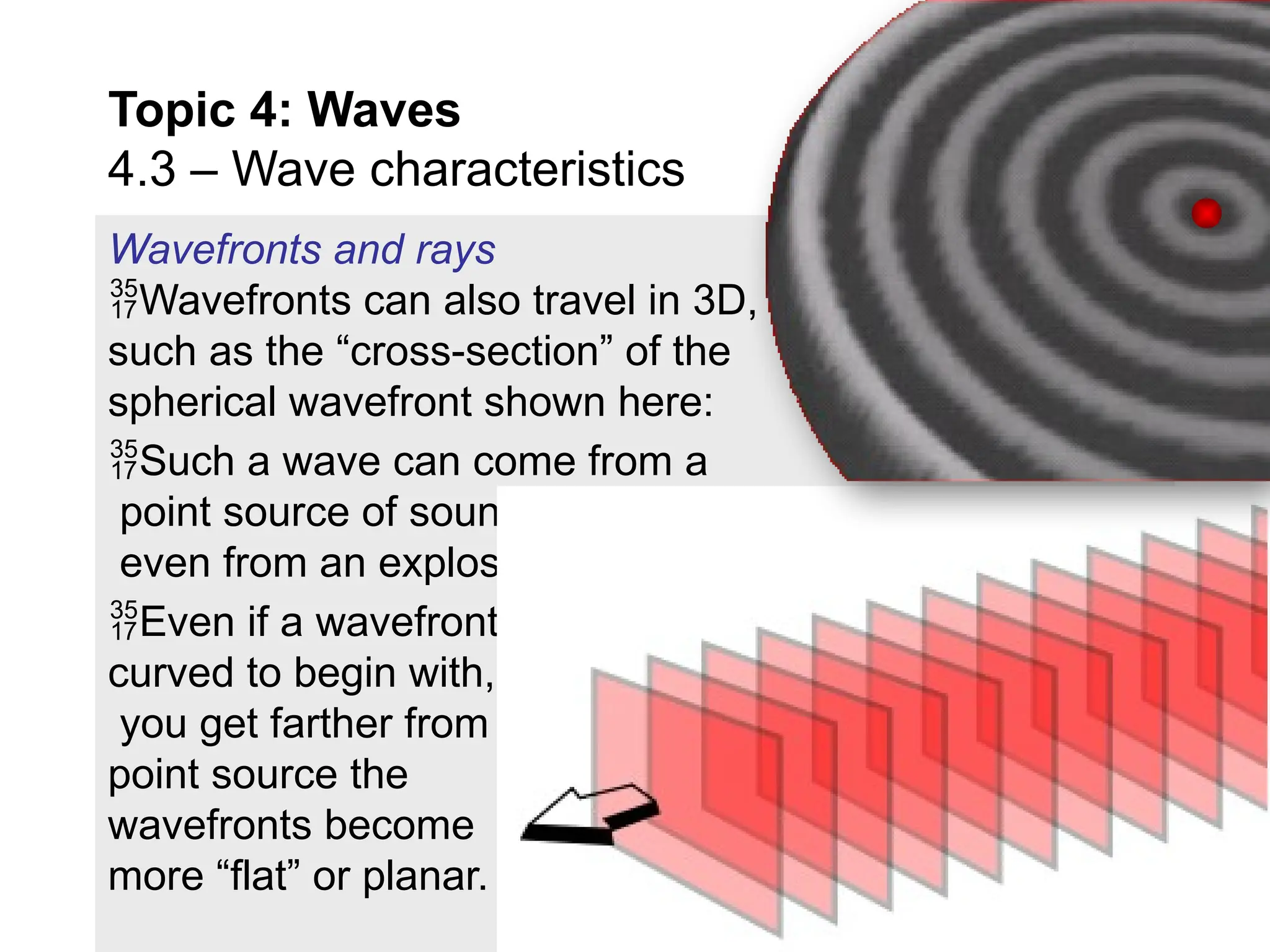
Wavefronts can also travel in 3D,
such as the “cross-section” of the
spherical wavefront shown here:
Such a wave can come from a
point source of sound or light, or
even from an explosion.
Even if a wavefront is
curved to begin with, as
you get farther from the
point source the
wavefronts become
more “flat” or planar.
Topic 4: Waves
4.3 – Wave characteristics
FYI
Rays are parallel to the wave velocity.
Wavefronts and rays
Wavefronts can also be bent by obstacles in the
environment, or by the properties of the medium
through which the wave passes:
The animation shows
flat wavefronts being
focused by a lens.
Oftentimes rather than
drawing wavefronts we
draw rays, which are
perpendicular to the
wavefronts.
Topic 4: Waves
4.3 – Wave characteristics
ray
FYI
As always, rays are parallel to the wave velocity.
Wavefronts and rays
Longitudinal waves also
have wavefronts and rays.
Instead of crests and troughs,
longitudinal waves have
compressions and rarefactions.
Just as crests were arbitrarily
chosen to be wavefronts in
transverse waves,
compressions are usually
chosen as wavefronts in
longitudinal waves.
Topic 4: Waves
4.3 – Wave characteristics
EXAMPLE: A 200. watt speaker projects sound in a
spherical wave. Find the intensity of the sound at a
distance of 1.0 m and 2.0 m from the speaker.
Note that whatever power is in the wavefront is
spread out over a larger area as it expands.
The area of a sphere of radius x is A = 4x2
.
For x = 1 m: I = P / (4x2
) = 200 / (41.02
) = 16 W
m-2
.
For x = 2 m: I = P / (4x2
) = 200 / (42.02
) = 4.0 W
Amplitude and intensity
Intensity is the rate energy is being transmitted per
unit area and is measured in (W m-2
).
Topic 4: Waves
4.3 – Wave characteristics
I = power / area definition of intensity I
Amplitude and intensity
Intensity is the rate energy is being transmitted per
unit area and is measured in (W m-2
).
Since A = 4x2
for a spherical wave, we can rewrite
our intensity formula.
Recall that the total energy ET of a particle in SHM
was ET = (1/2)kxMAX
2
, where xMAX was the amplitude A of
the oscillation.
Since P = ET / time, clearly P  ET so that P  A2
.
But I = power / area so that the following is true:
Topic 4: Waves
4.3 – Wave characteristics
I = power / area definition of intensity I
I = power / 4x2
Intensity I vs. distance x
I  x -2
I  A 2
Intensity I vs. amplitude A
EXAMPLE: At a distance of 18.5 m from a sound source
the intensity is 2.0010 -1
W m-2
.
(a) Find its intensity at a distance of 26.5 m.
SOLUTION: We can just use I  x -2
and dispense with
finding the actual power as an intermediate step.
Then I1  x1
-2
and I2  x2
-2
so that
I2 / I1 = x2
-2
/ x1
-2
= x1
2
/ x2
2
= (x1 / x2)2
.
Thus
I2 = I1 (x1 / x2)2
-1 2 -2
Solving problems involving amplitude and intensity
Topic 4: Waves
4.3 – Wave characteristics
EXAMPLE: At a distance of 18.5 m from a sound source
the intensity is 2.0010 -1
W m-2
.
(b) Compare the amplitudes of the sound at 18.5 m and
26.5 m.
SOLUTION: We can use I  A 2
and I1 and I2.
Then I1  A1
2
and I2  A2
2
so that
I1 / I2 = A1
2
/ A2
2
.
Then
A1 / A2 = I1 / I2
= 2.0010 -1
/ 0.0975
= 1.43.
This means that A is 1.43 times A .
Solving problems involving amplitude and intensity
Topic 4: Waves
4.3 – Wave characteristics
Interpreting diagrams involving reflection
Wave reflection occurs when a wave meets a
boundary, such as a solid object, or a change in the
medium, and is at least partially diverted backwards.
The angles of the rays are always measured with
respect to the normal which is
perpendicular to the surface.
The relationship between
the angle of incidence
incident and the angle of
reflection reflect is simple:
Topic 4: Waves
4.3 – Wave characteristics
reflective
surface
incident ray
reflected ray
incident
reflect
incident = reflect reflected waves
normal
Interpreting diagrams involving reflection
We can also look at the wave fronts: Observe…
During reflection the frequency and the wavelength of
the wave do not change.
Topic 4: Waves
4.3 – Wave characteristics
reflective
surface
spherical
wavefront
flat or straight
wavefront
reflective
surface
Interpreting diagrams involving refraction
Wave refraction occurs when a wave meets a
boundary, such as a solid object, or a change in the
medium ,and is at least partially allowed through the
boundary.
Topic 4: Waves
4.3 – Wave characteristics
CLEAR WATER MUDDY WATER
BOUN DARY
INCIDENT WAVE
REFRACTED WAVE
normal
incidence
angle of
incidence
refraction angle of
refraction
Interpreting diagrams involving refraction
It may help to imagine the ranks of a marching band.
Obviously, the
cadence does
not change.
Thus the
period and the
frequency do
not change.
But the speed
and the
wavelength do
change.
CONCRETE
DEEP MUD
Topic 4: Waves
4.3 – Wave characteristics
Interpreting diagrams involving refraction
During refraction the frequency and the period do not
change.
It should be clear that the incident wave is faster than
the refracted wave in this example.
Topic 4: Waves
4.3 – Wave characteristics
CLEAR WATER MUDDY WATER
BOUN DARY
INCIDENT WAVE
REFRACTED WAVE
normal
incidence
angle of
incidence
refraction angle of
refraction
Superposition – constructive interference
Wave superposition is simply the addition of two or
more waves passing simultaneously through a medium.
Superposition is also called interference and can be
constructive or destructive, or anything in between.
Consider two in-phase pulses coming from each end
of a taut rope.
The amplitudes x0 of the two pulses add together,
producing a momentary pulse of amplitude 2x0.
Topic 4: Waves
4.3 – Wave characteristics
0
x0
2x0
constructive
interference
Superposition – destructive interference
Wave superposition is simply the addition of two or
more waves passing simultaneously through a medium.
Superposition is also called interference and can be
constructive or destructive, or anything in between.
Consider two 180° out-of-phase pulses coming from
each end of a taut rope.
The amplitudes x0 of the two pulses cancel, producing
a momentary pulse of amplitude 0.
Topic 4: Waves
4.3 – Wave characteristics
- x0
0
x0
destructive
interference
Superposition
Topic 4: Waves
4.3 – Wave characteristics
PRACTICE: Two pulses are
shown in a string approaching
each other at 1 m s-1
.
Sketch diagrams to show each of the following:
(a) The shape of the string at exactly t = 0.5 s later.
(b) The shape of the string at exactly t = 1.0 s later.
1 m 1 m
1 m
Since the pulses are 1 m apart and approaching each
other at 1 ms-1
they will overlap at this instant,
temporarily canceling out.
Since the pulses are 1 m apart
and approaching each other at
1 m s-1
, at this time they will each have
moved ½ m and their leading edges will just
meet.
Superposition
Topic 4: Waves
4.3 – Wave characteristics
EXAMPLE:
Two waves P and Q
reach the same point
at the same time, as
shown in the
graph.
The amplitude of the resulting wave is
A. 0.0 mm. B. 1.0 mm. C. 1.4 mm. D. 2.0 mm.
In the orange regions P and Q do not cancel.
In the purple regions P and Q partially cancel.
Focus on orange. Try various combos…
Blue (0.7 mm) plus green (0.7 mm) = 1.4 mm.
Superposition
Topic 4: Waves
4.3 – Wave characteristics
EXAMPLE: Fourier series are examples of the
superposition principle. You can create any waveform
by summing up sine waves!
T 2T
t
y
0
1
4
1
2
1
4
1
2
-
-
y1 = - sin t
1
1
y2 = - sin 2t
1
2
y3 = - sin 3t
1
3 y4 = - sin 4t
1
4
y5 = - sin 5t
1
5
y =  yn
n=1
5
Polarization
In transverse waves the oscillations are
perpendicular to the direction of the propagation of the
traveling wave.
On the other hand, longitudinal waves
oscillate parallel to the direction of motion.
Transverse waves can have infinitely many modes
of oscillation, each of which is perpendicular to the
propagation, whereas longitudinal can only have a
single mode.
Because of these allowed modes, the phenomenon of
polarization only applies to transverse waves.
In this subtopic we will consider only one transverse
wave, namely electromagnetic waves, or light.
Topic 4: Waves
4.3 – Wave characteristics
FYI
In this subtopic we will consider
polarization in terms of the
electric field, not the magnetic
field.
Polarization
Light is a transverse wave
having two types of
oscillation perpendicular to
the direction of propagation
of the wave.
Note that electromagnetic
radiation consists of mutually perpendicular oscillating
electric and magnetic fields.
Topic 4: Waves
4.3 – Wave characteristics
Polarization
Sketching the electric field itself
is simplified even more:
If we look at the ray diagram from the edge of its plane
(at edge A) this is what we draw:
If we look at the ray diagram from the edge of a
perpendicular plane (at edge B) this is what we draw:
Topic 4: Waves
4.3 – Wave characteristics
View from Point A
View from Point B
A
B
c
Polarization
An oscillating electric charge produces an
electromagnetic wave.
For a light source such as the sun, or a glowing gas,
or an incandescent filament, the charges can oscillate in
any direction, thus producing random and continuous
orientations of the electric field.
Topic 4: Waves
4.3 – Wave characteristics
Polarization
Random orientations of electric
fields in a light source constitute
unpolarized light.
Rather than drawing the E-fields
along the whole length of the ray,
we can simplify our sketch by just
showing the fields at a single point:
A manmade film call Polaroid can take unpolarized
light, and absorb all rays of light whose electric fields
are not oriented in a certain line.
The E-fields of the light that passes through
are all oriented in a single direction and the
light is said to be polarized.
Topic 4: Waves
4.3 – Wave characteristics
Unpolarized
light
Unpolarized
light
(simplified
view)
Polaroid
filter
Polarization
EXAMPLE: If unpolarized light is passed through the
Polaroid film it will absorb all the rays not oriented with
the film.
Polaroid is not the only way to polarize light. For
example, if light reflects off of the surface of a liquid or
passes through a liquid or other solids it can become
partially or fully polarized.
In general, the object
used to polarize
unpolarized light is
called a polarizer.
Topic 4: Waves
4.3 – Wave characteristics
unpolarized
light
Polaroid
film
linearly-
polarized
light
POLARIZER
EXAMPLE:
Polaroid is made of very long, parallel molecules. A
simple model is a slotted disk. Only electric fields
oriented in the proper manner are allow to pass. The
rest are absorbed.
Although one would think that
the electric field would be allowed
to pass through the “slots” only if
parallel to them, in reality only
perpendicular E-fields can pass
through. Just live with it! Thus
the light that makes it through
Polaroid looks like this:
Polarization
Topic 4: Waves
4.3 – Wave characteristics
FYI
Linear-polarized is also called plane-polarized.
Polarization
EXAMPLE: This is a view of unpolarized light passing
through a linear polarizer. (The light is traveling from
right to left.)
Topic 4: Waves
4.3 – Wave characteristics
FYI
The first filter is called the polarizer, and the second
filter is called the analyzer.
Polarization
EXAMPLE: Two Polaroid
filters are placed in a beam
of unpolarized light.
Explain why when the
second filter is rotated
through 90º, the intensity
of the light passing through the pair decreases to zero.
The first filter plane-polarizes the incoming light.
The second filter, originally oriented to allow passage,
is now oriented to completely block the polarized beam.
LIGHT
first
filter
Topic 4: Waves
4.3 – Wave characteristics
Polarizer
Analyzer
second
filter
Observe the
light intensity
through two
polarizing filters
as the top one is
rotated through
180º.
Which filter is
the analyzer?
Which filter is
the polarizer?
RED FILTER
BLACK FILTER
Solving problems involving Malus’s law
In general, polarizing filters are
sketched with lines showing the
orientation of the E-field allowed
through:
Note that the analyzer is rotated
(rather than the polarizer).
 is the angle between the orientations of polarizer P
and analyzer A.
Topic 4: Waves
4.3 – Wave characteristics
P
A

direction of allowed
E-field (by analyzer)
polarized light E
(from polarizer) 
angle through which
analyzer has been
turned
E-field allowed to
pass

E
cos

E
Solving problems involving Malus’s law
Recall that the intensity of a wave is proportional to
the square of its amplitude.
Thus the intensity of the light that comes out of the
analyzer is proportional to (E cos )2
.
Topic 4: Waves
4.3 – Wave characteristics
Malus’s law
I = I0 cos2

Where I0 is the original intensity of the
light and  is the angle of the analyzer.
direction of allowed
E-field (by analyzer)
polarized light E
(from polarizer) 
angle through which
analyzer has been
turned
E-field allowed to
pass

E
cos

E
Solving problems involving Malus’s law
Topic 4: Waves
4.3 – Wave characteristics
PRACTICE: The preferred directions of two sheets of
Polaroid are initially parallel.
(a) Calculate the angle through which one sheet needs
to be turned in order to reduce the amplitude of the
observed E-field to half its original value.
(b) Calculate the effect this rotation has on the intensity.
(c) Calculate the rotation angle needed to halve the
intensity from its original value.
SOLUTION:
(a) Solve cos  = 1 / 2   = 60º.
(b) I = I0 cos2
 = I0(1/2)2
= I0 / 4.
(c) I0 / 2 = I0 cos2
  cos2
 = 1 / 2. Thus
cos  = (1 / 2)1/2
  = 45º.
Topic 4: Waves
4.3 – Wave characteristics
In general, light sources produce waves having
their E-fields oriented in many random directions.
Polarized light is light whose waves have their
E-fields oriented in one direction.
Solving problems involving Malus’s law
Topic 4: Waves
4.3 – Wave characteristics
Use I = I0 cos2
. Then
I = I0 cos2
60º
I = 0.25I0
Solving problems involving Malus’s law
Topic 4: Waves
4.3 – Wave characteristics
I0 cos2
0º = I0
I0 cos2
60º = 0.25I0
I0 cos2
90º = 0
I0 cos2
120º = 0.25I0
I0 cos2
180º = I0
Solving problems involving Malus’s law
Topic 4: Waves
4.3 – Wave characteristics
In general, light sources produce waves having
their E-fields oriented in many random directions.
Polarizing sunglasses only allow waves in one
direction through, thereby reducing the intensity of
the light entering the eye.
Reflecting surfaces also polarize light to a certain
extent, thereby rendering polarizing sunglasses
even more effective.
Solving problems involving Malus’s law
Topic 4: Waves
4.3 – Wave characteristics
Use I = I0 cos2
.
Then I = I0 (1/2)2
= I0 / 4.
Solving problems involving Malus’s law
Polarization
There are ways other than Polaroid film
to obtain polarized light.
Some EM radiation is polarized when
it is produced. For example, EM waves
used for television are often polarized
either horizontally or vertically,
depending on the arrangement of the aerials.
Circularly polarized light can be
constructed from two polarized rays.
Reflection of unpolarized light from a boundary
between two mediums can polarize light.
Transmission of polarized light through certain liquids
can change the polarization angle.
Topic 4: Waves
4.3 – Wave characteristics
FYI
Circular polarization is used in those 3D movies you
pay good money to see.
Polarization – circular polarization
EXAMPLE: In addition to plane-polarization there is also
elliptical or circular polarization.
Topic 4: Waves
4.3 – Wave characteristics
Polarization – circular polarization
EXAMPLE: Regardless of the
polarization type, a projection
of the E-field into any plane
will reveal a perfect sine wave.
The blue plane and the green
plane are mutually perpendicular.
Note that the blue and green
projections are in-phase for
linearly polarized light.
The blue and green projections
are 90º out-of-phase for circularly
polarized light.
Topic 4: Waves
4.3 – Wave characteristics
Polarization – circular polarization
EXAMPLE: An animation of circularly-polarized light
shows that in any plane perpendicular to the polarized
light, the E-field rotates over time.
Topic 4: Waves
4.3 – Wave characteristics
EXAMPLE: Besides a Polaroid filter, there
are other ways to polarize light. One way is
by reflecting light from a surface between
two media where you get reflection and refraction.
Topic 4: Waves
4.3 – Wave characteristics
unpolarized
light partially polarized
reflected light
FYI
Polarization occurs
parallel to the surface
between the two media
and varies with angle of
incidence.
unpolarized
refracted light
inc
refl
refr
Polarization by reflection
FYI Also, recall that inc = refl.
PRACTICE: Use the simplified
method to draw an unpolarized
incident ray becoming completely
polarized by reflection.
Polarization by reflection – Brewster’s law.
It turns out that if the refracted and reflected rays
make a 90º angle then the reflected ray will be totally
linearly polarized.
The particular angle of incidence at which this total
polarization occurs is called Brewster’s angle.
inc refl
refr
Brewster’s
law
If refl + refr = 90º then the reflected
ray will be completely plane-polarized.
( Or inc + refr = 90º )
Topic 4: Waves
4.3 – Wave characteristics
Polarization – optical activity
A substance is termed optically active if the plane of
polarized light rotates as it passes though the
substance. A sugar solution is an example of such a
substance. So is quartz.
The angle through
which the plane
rotates depends on
the concentration of
the solution (if the
substance can be
made into a solution),
and the distance through
which the light passes.

Topic 4: Waves
4.3 – Wave characteristics
Polarization uses – polarimeters
PRACTICE: Data for various concentrations of sugar
solution have been gathered for a
sample tube of fixed length.
(a) Plot a suitable graph to
represent the data.
SOLUTION:
Angle of
rotation
 / º
Concentration
C / g cm-3
5 0.08
10 0.17
15 0.23
/º
5 10 15
0.10
0.20
0.30
20
C/g cm-3
Topic 4: Waves
4.3 – Wave characteristics
Polarization uses – polarimeters
PRACTICE: Data for various concentrations of sugar
solution have been gathered for a
sample tube of fixed length.
(b) Find the concentration of a
sugar solution having  = 18º.
SOLUTION:
/º
5 10 15
0.10
0.20
0.30
20
C/g cm-3
Topic 4: Waves
4.3 – Wave characteristics
About 0.30 g cm-3
.
FYI
The above
apparatus is called
a polarimeter.
Polarimeter
FYI
The LCD is illuminated by ambient unpolarized light
from the external environment.
Polarization uses – liquid crystal displays
Liquid crystals (LC) are optically active
substances whose activity can be
controlled by applying a potential
difference across them.
If there is no p.d. across the LC it
will not be optically active.
If there is a p.d.
across the LC it will
rotate the light
through 90º.
Shaped
electrode
Liquid
crystal
Common
electrode
Second
polarizer
Reflector
First
polarizer
Topic 4: Waves
4.3 – Wave characteristics
Unpolarized
light
FYI An LCD projector replaces the reflector with a
light source.
Polarization uses – liquid crystal displays
The light is polarized by the first
polarizer.
If there is no p.d. it will continue
through to the second polarizer
at which point it will be
completely absorbed
because of the cross
polarization.
It is then reflected
back to the viewer
as black.
Shaped
electrode
Liquid
crystal
Common
electrode
Second
polarizer
Reflector
First
polarizer
Topic 4: Waves
4.3 – Wave characteristics
Unpolarized
light
FYI
The image received by the eye will have the shape
determined by the shaped electrode.
Polarization uses – liquid crystal displays
If there is a p.d. across the LC, it will
become optically active.
The LC will then rotate the polarized
light from the first polarizer an
additional 90º.
This action aligns it with the
second polarizer,
which now allows it
to pass through
unhindered.
Shaped
electrode
Liquid
crystal
Common
electrode
Second
polarizer
Reflector
First
polarizer
Topic 4: Waves
4.3 – Wave characteristics
Unpolarized
light
Polarization uses – stress analyzers
When stressed, glass and plastics develop optical
properties that are dependent on the plane of
polarization.
When placed between a polarizer and an analyzer,
and illuminated by white light, the regions of highest
stress will appear as colored lines.
Topic 4: Waves
4.3 – Wave characteristics
Review
• Topic 4: Waves 4.3 – Wave characteristics

Topic 4.3 - Wave characteristics IB HL CONTENT

  • 1.
    Essential idea: Allwaves can be described by the same sets of mathematical ideas. Detailed knowledge of one area leads to the possibility of prediction in another. Nature of science: Imagination: It is speculated that polarization had been utilized by the Vikings through their use of Iceland Spar over 1300 years ago for navigation (prior to the introduction of the magnetic compass). Scientists across Europe in the 17th–19th centuries continued to contribute to wave theory by building on the theories and models proposed as our understanding developed. Topic 4: Waves 4.3 – Wave characteristics
  • 2.
    Understandings: • Wavefronts andrays • Amplitude and intensity • Superposition • Polarization Topic 4: Waves 4.3 – Wave characteristics
  • 3.
    Applications and skills: •Sketching and interpreting diagrams involving wavefronts and rays • Solving problems involving amplitude, intensity and the inverse square law • Sketching and interpreting the superposition of pulses and waves • Describing methods of polarization • Sketching and interpreting diagrams illustrating polarized, reflected and transmitted beams • Solving problems involving Malus’s law Topic 4: Waves 4.3 – Wave characteristics
  • 4.
    Guidance: • Students willbe expected to calculate the resultant of two waves or pulses both graphically and algebraically • Methods of polarization will be restricted to the use of polarizing filters and reflection from a non-metallic plane surface Data booklet reference: • I  A2 • I  x -2 • I = I0 cos2  Topic 4: Waves 4.3 – Wave characteristics
  • 5.
    Theory of knowledge: •Wavefronts and rays are visualizations that help our understanding of reality, characteristic of modelling in the physical sciences. How does the methodology used in the natural sciences differ from the methodology used in the human sciences? • How much detail does a model need to contain to accurately represent reality? Utilization: • A number of modern technologies, such as LCD displays, rely on polarization for their operation Topic 4: Waves 4.3 – Wave characteristics
  • 6.
    Aims: • Aim 3:these universal behaviours of waves are applied in later sections of the course in more advanced topics, allowing students to generalize the various types of waves • Aim 6: experiments could include observation of polarization under different conditions, including the use of microwaves; superposition of waves; representation of wave types using physical models (eg slinky demonstrations) • Aim 7: use of computer modelling enables students to observe wave motion in three dimensions as well as being able to more accurately adjust wave characteristics in superposition demonstrations Topic 4: Waves 4.3 – Wave characteristics
  • 7.
    FYI Wavefronts are perpendicularto the wave velocity. Wavefronts and rays Consider the transverse waves shown here. The wavefronts are by convention located at the crests of the waves. A top view simplifies the drawing: Wavefronts don’t have to be straight. Topic 4: Waves 4.3 – Wave characteristics
  • 8.
    Wavefronts and rays Wavefrontscan also travel in 3D, such as the “cross-section” of the spherical wavefront shown here: Such a wave can come from a point source of sound or light, or even from an explosion. Even if a wavefront is curved to begin with, as you get farther from the point source the wavefronts become more “flat” or planar. Topic 4: Waves 4.3 – Wave characteristics
  • 9.
    FYI Rays are parallelto the wave velocity. Wavefronts and rays Wavefronts can also be bent by obstacles in the environment, or by the properties of the medium through which the wave passes: The animation shows flat wavefronts being focused by a lens. Oftentimes rather than drawing wavefronts we draw rays, which are perpendicular to the wavefronts. Topic 4: Waves 4.3 – Wave characteristics ray
  • 10.
    FYI As always, raysare parallel to the wave velocity. Wavefronts and rays Longitudinal waves also have wavefronts and rays. Instead of crests and troughs, longitudinal waves have compressions and rarefactions. Just as crests were arbitrarily chosen to be wavefronts in transverse waves, compressions are usually chosen as wavefronts in longitudinal waves. Topic 4: Waves 4.3 – Wave characteristics
  • 11.
    EXAMPLE: A 200.watt speaker projects sound in a spherical wave. Find the intensity of the sound at a distance of 1.0 m and 2.0 m from the speaker. Note that whatever power is in the wavefront is spread out over a larger area as it expands. The area of a sphere of radius x is A = 4x2 . For x = 1 m: I = P / (4x2 ) = 200 / (41.02 ) = 16 W m-2 . For x = 2 m: I = P / (4x2 ) = 200 / (42.02 ) = 4.0 W Amplitude and intensity Intensity is the rate energy is being transmitted per unit area and is measured in (W m-2 ). Topic 4: Waves 4.3 – Wave characteristics I = power / area definition of intensity I
  • 12.
    Amplitude and intensity Intensityis the rate energy is being transmitted per unit area and is measured in (W m-2 ). Since A = 4x2 for a spherical wave, we can rewrite our intensity formula. Recall that the total energy ET of a particle in SHM was ET = (1/2)kxMAX 2 , where xMAX was the amplitude A of the oscillation. Since P = ET / time, clearly P  ET so that P  A2 . But I = power / area so that the following is true: Topic 4: Waves 4.3 – Wave characteristics I = power / area definition of intensity I I = power / 4x2 Intensity I vs. distance x I  x -2 I  A 2 Intensity I vs. amplitude A
  • 13.
    EXAMPLE: At adistance of 18.5 m from a sound source the intensity is 2.0010 -1 W m-2 . (a) Find its intensity at a distance of 26.5 m. SOLUTION: We can just use I  x -2 and dispense with finding the actual power as an intermediate step. Then I1  x1 -2 and I2  x2 -2 so that I2 / I1 = x2 -2 / x1 -2 = x1 2 / x2 2 = (x1 / x2)2 . Thus I2 = I1 (x1 / x2)2 -1 2 -2 Solving problems involving amplitude and intensity Topic 4: Waves 4.3 – Wave characteristics
  • 14.
    EXAMPLE: At adistance of 18.5 m from a sound source the intensity is 2.0010 -1 W m-2 . (b) Compare the amplitudes of the sound at 18.5 m and 26.5 m. SOLUTION: We can use I  A 2 and I1 and I2. Then I1  A1 2 and I2  A2 2 so that I1 / I2 = A1 2 / A2 2 . Then A1 / A2 = I1 / I2 = 2.0010 -1 / 0.0975 = 1.43. This means that A is 1.43 times A . Solving problems involving amplitude and intensity Topic 4: Waves 4.3 – Wave characteristics
  • 15.
    Interpreting diagrams involvingreflection Wave reflection occurs when a wave meets a boundary, such as a solid object, or a change in the medium, and is at least partially diverted backwards. The angles of the rays are always measured with respect to the normal which is perpendicular to the surface. The relationship between the angle of incidence incident and the angle of reflection reflect is simple: Topic 4: Waves 4.3 – Wave characteristics reflective surface incident ray reflected ray incident reflect incident = reflect reflected waves normal
  • 16.
    Interpreting diagrams involvingreflection We can also look at the wave fronts: Observe… During reflection the frequency and the wavelength of the wave do not change. Topic 4: Waves 4.3 – Wave characteristics reflective surface spherical wavefront flat or straight wavefront reflective surface
  • 17.
    Interpreting diagrams involvingrefraction Wave refraction occurs when a wave meets a boundary, such as a solid object, or a change in the medium ,and is at least partially allowed through the boundary. Topic 4: Waves 4.3 – Wave characteristics CLEAR WATER MUDDY WATER BOUN DARY INCIDENT WAVE REFRACTED WAVE normal incidence angle of incidence refraction angle of refraction
  • 18.
    Interpreting diagrams involvingrefraction It may help to imagine the ranks of a marching band. Obviously, the cadence does not change. Thus the period and the frequency do not change. But the speed and the wavelength do change. CONCRETE DEEP MUD Topic 4: Waves 4.3 – Wave characteristics
  • 19.
    Interpreting diagrams involvingrefraction During refraction the frequency and the period do not change. It should be clear that the incident wave is faster than the refracted wave in this example. Topic 4: Waves 4.3 – Wave characteristics CLEAR WATER MUDDY WATER BOUN DARY INCIDENT WAVE REFRACTED WAVE normal incidence angle of incidence refraction angle of refraction
  • 20.
    Superposition – constructiveinterference Wave superposition is simply the addition of two or more waves passing simultaneously through a medium. Superposition is also called interference and can be constructive or destructive, or anything in between. Consider two in-phase pulses coming from each end of a taut rope. The amplitudes x0 of the two pulses add together, producing a momentary pulse of amplitude 2x0. Topic 4: Waves 4.3 – Wave characteristics 0 x0 2x0 constructive interference
  • 21.
    Superposition – destructiveinterference Wave superposition is simply the addition of two or more waves passing simultaneously through a medium. Superposition is also called interference and can be constructive or destructive, or anything in between. Consider two 180° out-of-phase pulses coming from each end of a taut rope. The amplitudes x0 of the two pulses cancel, producing a momentary pulse of amplitude 0. Topic 4: Waves 4.3 – Wave characteristics - x0 0 x0 destructive interference
  • 22.
    Superposition Topic 4: Waves 4.3– Wave characteristics PRACTICE: Two pulses are shown in a string approaching each other at 1 m s-1 . Sketch diagrams to show each of the following: (a) The shape of the string at exactly t = 0.5 s later. (b) The shape of the string at exactly t = 1.0 s later. 1 m 1 m 1 m Since the pulses are 1 m apart and approaching each other at 1 ms-1 they will overlap at this instant, temporarily canceling out. Since the pulses are 1 m apart and approaching each other at 1 m s-1 , at this time they will each have moved ½ m and their leading edges will just meet.
  • 23.
    Superposition Topic 4: Waves 4.3– Wave characteristics EXAMPLE: Two waves P and Q reach the same point at the same time, as shown in the graph. The amplitude of the resulting wave is A. 0.0 mm. B. 1.0 mm. C. 1.4 mm. D. 2.0 mm. In the orange regions P and Q do not cancel. In the purple regions P and Q partially cancel. Focus on orange. Try various combos… Blue (0.7 mm) plus green (0.7 mm) = 1.4 mm.
  • 24.
    Superposition Topic 4: Waves 4.3– Wave characteristics EXAMPLE: Fourier series are examples of the superposition principle. You can create any waveform by summing up sine waves! T 2T t y 0 1 4 1 2 1 4 1 2 - - y1 = - sin t 1 1 y2 = - sin 2t 1 2 y3 = - sin 3t 1 3 y4 = - sin 4t 1 4 y5 = - sin 5t 1 5 y =  yn n=1 5
  • 25.
    Polarization In transverse wavesthe oscillations are perpendicular to the direction of the propagation of the traveling wave. On the other hand, longitudinal waves oscillate parallel to the direction of motion. Transverse waves can have infinitely many modes of oscillation, each of which is perpendicular to the propagation, whereas longitudinal can only have a single mode. Because of these allowed modes, the phenomenon of polarization only applies to transverse waves. In this subtopic we will consider only one transverse wave, namely electromagnetic waves, or light. Topic 4: Waves 4.3 – Wave characteristics
  • 26.
    FYI In this subtopicwe will consider polarization in terms of the electric field, not the magnetic field. Polarization Light is a transverse wave having two types of oscillation perpendicular to the direction of propagation of the wave. Note that electromagnetic radiation consists of mutually perpendicular oscillating electric and magnetic fields. Topic 4: Waves 4.3 – Wave characteristics
  • 27.
    Polarization Sketching the electricfield itself is simplified even more: If we look at the ray diagram from the edge of its plane (at edge A) this is what we draw: If we look at the ray diagram from the edge of a perpendicular plane (at edge B) this is what we draw: Topic 4: Waves 4.3 – Wave characteristics View from Point A View from Point B A B
  • 28.
    c Polarization An oscillating electriccharge produces an electromagnetic wave. For a light source such as the sun, or a glowing gas, or an incandescent filament, the charges can oscillate in any direction, thus producing random and continuous orientations of the electric field. Topic 4: Waves 4.3 – Wave characteristics
  • 29.
    Polarization Random orientations ofelectric fields in a light source constitute unpolarized light. Rather than drawing the E-fields along the whole length of the ray, we can simplify our sketch by just showing the fields at a single point: A manmade film call Polaroid can take unpolarized light, and absorb all rays of light whose electric fields are not oriented in a certain line. The E-fields of the light that passes through are all oriented in a single direction and the light is said to be polarized. Topic 4: Waves 4.3 – Wave characteristics Unpolarized light Unpolarized light (simplified view) Polaroid filter
  • 30.
    Polarization EXAMPLE: If unpolarizedlight is passed through the Polaroid film it will absorb all the rays not oriented with the film. Polaroid is not the only way to polarize light. For example, if light reflects off of the surface of a liquid or passes through a liquid or other solids it can become partially or fully polarized. In general, the object used to polarize unpolarized light is called a polarizer. Topic 4: Waves 4.3 – Wave characteristics unpolarized light Polaroid film linearly- polarized light POLARIZER
  • 31.
    EXAMPLE: Polaroid is madeof very long, parallel molecules. A simple model is a slotted disk. Only electric fields oriented in the proper manner are allow to pass. The rest are absorbed. Although one would think that the electric field would be allowed to pass through the “slots” only if parallel to them, in reality only perpendicular E-fields can pass through. Just live with it! Thus the light that makes it through Polaroid looks like this: Polarization Topic 4: Waves 4.3 – Wave characteristics
  • 32.
    FYI Linear-polarized is alsocalled plane-polarized. Polarization EXAMPLE: This is a view of unpolarized light passing through a linear polarizer. (The light is traveling from right to left.) Topic 4: Waves 4.3 – Wave characteristics
  • 33.
    FYI The first filteris called the polarizer, and the second filter is called the analyzer. Polarization EXAMPLE: Two Polaroid filters are placed in a beam of unpolarized light. Explain why when the second filter is rotated through 90º, the intensity of the light passing through the pair decreases to zero. The first filter plane-polarizes the incoming light. The second filter, originally oriented to allow passage, is now oriented to completely block the polarized beam. LIGHT first filter Topic 4: Waves 4.3 – Wave characteristics Polarizer Analyzer second filter
  • 34.
    Observe the light intensity throughtwo polarizing filters as the top one is rotated through 180º. Which filter is the analyzer? Which filter is the polarizer? RED FILTER BLACK FILTER
  • 35.
    Solving problems involvingMalus’s law In general, polarizing filters are sketched with lines showing the orientation of the E-field allowed through: Note that the analyzer is rotated (rather than the polarizer).  is the angle between the orientations of polarizer P and analyzer A. Topic 4: Waves 4.3 – Wave characteristics P A  direction of allowed E-field (by analyzer) polarized light E (from polarizer)  angle through which analyzer has been turned E-field allowed to pass  E cos  E
  • 36.
    Solving problems involvingMalus’s law Recall that the intensity of a wave is proportional to the square of its amplitude. Thus the intensity of the light that comes out of the analyzer is proportional to (E cos )2 . Topic 4: Waves 4.3 – Wave characteristics Malus’s law I = I0 cos2  Where I0 is the original intensity of the light and  is the angle of the analyzer. direction of allowed E-field (by analyzer) polarized light E (from polarizer)  angle through which analyzer has been turned E-field allowed to pass  E cos  E
  • 37.
    Solving problems involvingMalus’s law Topic 4: Waves 4.3 – Wave characteristics PRACTICE: The preferred directions of two sheets of Polaroid are initially parallel. (a) Calculate the angle through which one sheet needs to be turned in order to reduce the amplitude of the observed E-field to half its original value. (b) Calculate the effect this rotation has on the intensity. (c) Calculate the rotation angle needed to halve the intensity from its original value. SOLUTION: (a) Solve cos  = 1 / 2   = 60º. (b) I = I0 cos2  = I0(1/2)2 = I0 / 4. (c) I0 / 2 = I0 cos2   cos2  = 1 / 2. Thus cos  = (1 / 2)1/2   = 45º.
  • 38.
    Topic 4: Waves 4.3– Wave characteristics In general, light sources produce waves having their E-fields oriented in many random directions. Polarized light is light whose waves have their E-fields oriented in one direction. Solving problems involving Malus’s law
  • 39.
    Topic 4: Waves 4.3– Wave characteristics Use I = I0 cos2 . Then I = I0 cos2 60º I = 0.25I0 Solving problems involving Malus’s law
  • 40.
    Topic 4: Waves 4.3– Wave characteristics I0 cos2 0º = I0 I0 cos2 60º = 0.25I0 I0 cos2 90º = 0 I0 cos2 120º = 0.25I0 I0 cos2 180º = I0 Solving problems involving Malus’s law
  • 41.
    Topic 4: Waves 4.3– Wave characteristics In general, light sources produce waves having their E-fields oriented in many random directions. Polarizing sunglasses only allow waves in one direction through, thereby reducing the intensity of the light entering the eye. Reflecting surfaces also polarize light to a certain extent, thereby rendering polarizing sunglasses even more effective. Solving problems involving Malus’s law
  • 42.
    Topic 4: Waves 4.3– Wave characteristics Use I = I0 cos2 . Then I = I0 (1/2)2 = I0 / 4. Solving problems involving Malus’s law
  • 43.
    Polarization There are waysother than Polaroid film to obtain polarized light. Some EM radiation is polarized when it is produced. For example, EM waves used for television are often polarized either horizontally or vertically, depending on the arrangement of the aerials. Circularly polarized light can be constructed from two polarized rays. Reflection of unpolarized light from a boundary between two mediums can polarize light. Transmission of polarized light through certain liquids can change the polarization angle. Topic 4: Waves 4.3 – Wave characteristics
  • 44.
    FYI Circular polarization isused in those 3D movies you pay good money to see. Polarization – circular polarization EXAMPLE: In addition to plane-polarization there is also elliptical or circular polarization. Topic 4: Waves 4.3 – Wave characteristics
  • 45.
    Polarization – circularpolarization EXAMPLE: Regardless of the polarization type, a projection of the E-field into any plane will reveal a perfect sine wave. The blue plane and the green plane are mutually perpendicular. Note that the blue and green projections are in-phase for linearly polarized light. The blue and green projections are 90º out-of-phase for circularly polarized light. Topic 4: Waves 4.3 – Wave characteristics
  • 46.
    Polarization – circularpolarization EXAMPLE: An animation of circularly-polarized light shows that in any plane perpendicular to the polarized light, the E-field rotates over time. Topic 4: Waves 4.3 – Wave characteristics
  • 47.
    EXAMPLE: Besides aPolaroid filter, there are other ways to polarize light. One way is by reflecting light from a surface between two media where you get reflection and refraction. Topic 4: Waves 4.3 – Wave characteristics unpolarized light partially polarized reflected light FYI Polarization occurs parallel to the surface between the two media and varies with angle of incidence. unpolarized refracted light inc refl refr Polarization by reflection
  • 48.
    FYI Also, recallthat inc = refl. PRACTICE: Use the simplified method to draw an unpolarized incident ray becoming completely polarized by reflection. Polarization by reflection – Brewster’s law. It turns out that if the refracted and reflected rays make a 90º angle then the reflected ray will be totally linearly polarized. The particular angle of incidence at which this total polarization occurs is called Brewster’s angle. inc refl refr Brewster’s law If refl + refr = 90º then the reflected ray will be completely plane-polarized. ( Or inc + refr = 90º ) Topic 4: Waves 4.3 – Wave characteristics
  • 49.
    Polarization – opticalactivity A substance is termed optically active if the plane of polarized light rotates as it passes though the substance. A sugar solution is an example of such a substance. So is quartz. The angle through which the plane rotates depends on the concentration of the solution (if the substance can be made into a solution), and the distance through which the light passes.  Topic 4: Waves 4.3 – Wave characteristics
  • 50.
    Polarization uses –polarimeters PRACTICE: Data for various concentrations of sugar solution have been gathered for a sample tube of fixed length. (a) Plot a suitable graph to represent the data. SOLUTION: Angle of rotation  / º Concentration C / g cm-3 5 0.08 10 0.17 15 0.23 /º 5 10 15 0.10 0.20 0.30 20 C/g cm-3 Topic 4: Waves 4.3 – Wave characteristics
  • 51.
    Polarization uses –polarimeters PRACTICE: Data for various concentrations of sugar solution have been gathered for a sample tube of fixed length. (b) Find the concentration of a sugar solution having  = 18º. SOLUTION: /º 5 10 15 0.10 0.20 0.30 20 C/g cm-3 Topic 4: Waves 4.3 – Wave characteristics About 0.30 g cm-3 . FYI The above apparatus is called a polarimeter. Polarimeter
  • 52.
    FYI The LCD isilluminated by ambient unpolarized light from the external environment. Polarization uses – liquid crystal displays Liquid crystals (LC) are optically active substances whose activity can be controlled by applying a potential difference across them. If there is no p.d. across the LC it will not be optically active. If there is a p.d. across the LC it will rotate the light through 90º. Shaped electrode Liquid crystal Common electrode Second polarizer Reflector First polarizer Topic 4: Waves 4.3 – Wave characteristics Unpolarized light
  • 53.
    FYI An LCDprojector replaces the reflector with a light source. Polarization uses – liquid crystal displays The light is polarized by the first polarizer. If there is no p.d. it will continue through to the second polarizer at which point it will be completely absorbed because of the cross polarization. It is then reflected back to the viewer as black. Shaped electrode Liquid crystal Common electrode Second polarizer Reflector First polarizer Topic 4: Waves 4.3 – Wave characteristics Unpolarized light
  • 54.
    FYI The image receivedby the eye will have the shape determined by the shaped electrode. Polarization uses – liquid crystal displays If there is a p.d. across the LC, it will become optically active. The LC will then rotate the polarized light from the first polarizer an additional 90º. This action aligns it with the second polarizer, which now allows it to pass through unhindered. Shaped electrode Liquid crystal Common electrode Second polarizer Reflector First polarizer Topic 4: Waves 4.3 – Wave characteristics Unpolarized light
  • 55.
    Polarization uses –stress analyzers When stressed, glass and plastics develop optical properties that are dependent on the plane of polarization. When placed between a polarizer and an analyzer, and illuminated by white light, the regions of highest stress will appear as colored lines. Topic 4: Waves 4.3 – Wave characteristics
  • 56.
    Review • Topic 4:Waves 4.3 – Wave characteristics

Editor's Notes

  • #1 © 2006 By Timothy K. Lund
  • #2 © 2006 By Timothy K. Lund
  • #3 © 2006 By Timothy K. Lund
  • #4 © 2006 By Timothy K. Lund
  • #5 © 2006 By Timothy K. Lund
  • #6 © 2006 By Timothy K. Lund
  • #7 © 2006 By Timothy K. Lund
  • #8 © 2006 By Timothy K. Lund
  • #9 © 2006 By Timothy K. Lund
  • #10 © 2006 By Timothy K. Lund
  • #11 © 2006 By Timothy K. Lund
  • #12 © 2006 By Timothy K. Lund
  • #13 © 2006 By Timothy K. Lund
  • #14 © 2006 By Timothy K. Lund
  • #15 © 2006 By Timothy K. Lund
  • #16 © 2006 By Timothy K. Lund
  • #17 © 2006 By Timothy K. Lund
  • #18 © 2006 By Timothy K. Lund
  • #19 © 2006 By Timothy K. Lund
  • #20 © 2006 By Timothy K. Lund
  • #21 © 2006 By Timothy K. Lund
  • #22 © 2006 By Timothy K. Lund
  • #23 © 2006 By Timothy K. Lund
  • #24 © 2006 By Timothy K. Lund
  • #25 © 2006 By Timothy K. Lund
  • #26 © 2006 By Timothy K. Lund
  • #27 © 2006 By Timothy K. Lund
  • #28 © 2006 By Timothy K. Lund
  • #29 © 2006 By Timothy K. Lund
  • #30 © 2006 By Timothy K. Lund
  • #31 © 2006 By Timothy K. Lund
  • #32 © 2006 By Timothy K. Lund
  • #33 © 2006 By Timothy K. Lund
  • #34 © 2006 By Timothy K. Lund
  • #35 © 2006 By Timothy K. Lund
  • #36 © 2006 By Timothy K. Lund
  • #37 © 2006 By Timothy K. Lund
  • #38 © 2006 By Timothy K. Lund
  • #39 © 2006 By Timothy K. Lund
  • #40 © 2006 By Timothy K. Lund
  • #41 © 2006 By Timothy K. Lund
  • #42 © 2006 By Timothy K. Lund
  • #43 © 2006 By Timothy K. Lund
  • #44 © 2006 By Timothy K. Lund
  • #45 © 2006 By Timothy K. Lund
  • #46 © 2006 By Timothy K. Lund
  • #47 © 2006 By Timothy K. Lund
  • #48 © 2006 By Timothy K. Lund
  • #49 © 2006 By Timothy K. Lund
  • #50 © 2006 By Timothy K. Lund
  • #51 © 2006 By Timothy K. Lund
  • #52 © 2006 By Timothy K. Lund
  • #53 © 2006 By Timothy K. Lund
  • #54 © 2006 By Timothy K. Lund
  • #55 © 2006 By Timothy K. Lund