BUSS 5251 International Business
Topic 3
International Business Environment –
Trade Theories
Overview Of Seminar
• Overview of Trade Theories.
• Regulating trade and investment.
• The role of the WTO.
THEORIES OF TRADE
• Mercantilism (1500 – late 1700s)
• Absolute advantage (Adam Smith, 1776)
• Comparative advantage (Ricardo, 1817)
• Factor-proportions theory (Heckscher-Ohlin
1933)
• Product Life Cycle (PLC) Theory (Vernon,
1966)
• National Competitive Advantage (Porter, 1990)
MERCANTILISM
• Theory that nations should accumulate financial wealth, usually in the
form of gold.
• Encourage exports and discourage imports.
• Living standards or human development are irrelevant.
• Was followed by Britain, France, The Netherlands, Portugal , and Spain
from about 1500 to late 1700s.
• National governments intervened to maintain a trade surplus by barring
certain imports or imposing restrictions such as tariffs or quotas.
THEORY OF ABSOLUTE ADVANTAGE
• a country’s wealth depends on the availability of goods
and services to its citizens.
• different countries produce some goods and services
more efficiently than others and hence they can sell what
they do best to gain absolute productivity advantages
over other countries.
• a country exports goods and services that it can produce
more efficiently than the importing country.
• a country imports the goods that can be produced more
efficiently abroad. (Smith, 1776)
Smith, A. (1776), An Inquiry into the Nature and Causes of the Wealth of Nations, (reprinted 1998 in Washington, Regnery Publishing).
TWO TYPES OF ABSOLUTE ADVANTAGE
• Natural Advantage
• What if a country does not have such
natural advantage?
• Acquired Advantage
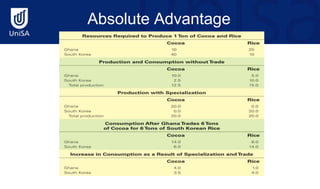
Absolute Advantage
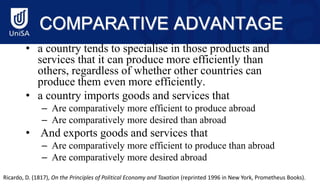
• a country tends to specialise in those products and
services that it can produce more efficiently than
others, regardless of whether other countries can
produce them even more efficiently.
• a country imports goods and services that
– Are comparatively more efficient to produce abroad
– Are comparatively more desired than abroad
• And exports goods and services that
– Are comparatively more efficient to produce than abroad
– Are comparatively more desired abroad
COMPARATIVE ADVANTAGE
Ricardo, D. (1817), On the Principles of Political Economy and Taxation (reprinted 1996 in New York, Prometheus Books).
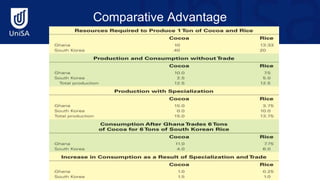
Comparative Advantage
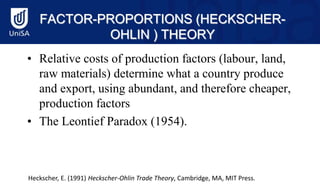
FACTOR-PROPORTIONS (HECKSCHER-
OHLIN ) THEORY
• Relative costs of production factors (labour, land,
raw materials) determine what a country produce
and export, using abundant, and therefore cheaper,
production factors
• The Leontief Paradox (1954).
Heckscher, E. (1991) Heckscher-Ohlin Trade Theory, Cambridge, MA, MIT Press.
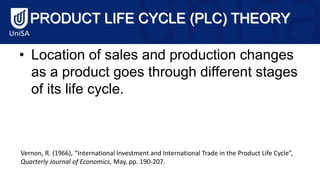
PRODUCT LIFE CYCLE (PLC) THEORY
• Location of sales and production changes
as a product goes through different stages
of its life cycle.
Vernon, R. (1966), “International Investment and International Trade in the Product Life Cycle”,
Quarterly Journal of Economics, May, pp. 190-207.
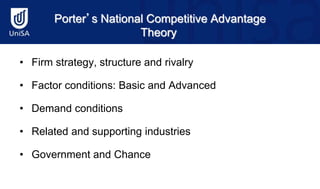
Porter’s National Competitive Advantage
Theory
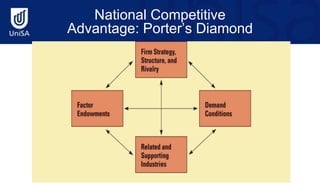
• Firm strategy, structure and rivalry
• Factor conditions: Basic and Advanced
• Demand conditions
• Related and supporting industries
• Government and Chance
National Competitive
Advantage: Porter’s Diamond
Instruments Of Trade Policy
The main instruments of trade policy are:
•Tariffs
•Subsides
•Import Quotas
•Voluntary Export Restraints
•Local Content Requirements
•Administrative Polices
•Antidumping Policies
Tariffs
•Tariffs are taxes levied on imports that effectively raise the
cost of imported products relative to domestic products
•Specific tariffs are levied as a fixed charge for each unit of
a good imported (for example $10 per unit)
•Ad valorem tariffs are levied as a proportion of the value of
the imported good (for example 10% on the price of the
unit).
Subsidies
•Subsidies are government payments to domestic
producers
•Consumers typically absorb the costs of subsidies
Subsidies help domestic producers in two ways:
•they help them compete against low-cost foreign
imports
•they help them gain export markets
Import Quotas And Voluntary
Export Restraints
•Import quotas directly restrict the quantity of some good that
may be imported into a country
•Tariff rate quotas are a hybrid of a quota and a tariff where a
lower tariff is applied to imports within the quota than to those
over the quota
•Voluntary export restraints are quotas on trade imposed by the
exporting country, typically at the request of the importing
country’s government
•A quota rent is the extra profit that producers make when supply
is artificially limited by an import quota
Local Content Requirements
•A local content requirement demands that
some specific fraction of a good be
produced domestically
•Local content requirements benefit
domestic producers, but consumers face
higher prices
Administrative Policies
•Administrative trade polices are
bureaucratic rules that are designed to make
it difficult for imports to enter a country
Antidumping Policies
•Dumping refers to selling goods in a foreign market below their costs
of production, or selling goods in a foreign market below their “fair”
market value
•Dumping enables firms to unload excess production in foreign markets
•Some dumping may be predatory behavior, with producers using
substantial profits from their home markets to subsidize prices in a
foreign market with a view to driving indigenous competitors out of that
market, and later raising prices and earning substantial profits
•Antidumping polices (or countervailing duties) are designed to
punish foreign firms that engage in dumping and protect domestic
producers from “unfair” foreign competition
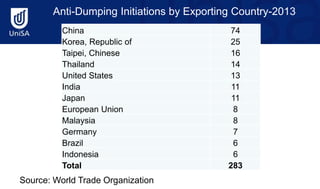
Anti-Dumping Initiations by Exporting Country-2013
China 74
Korea, Republic of 25
Taipei, Chinese 16
Thailand 14
United States 13
India 11
Japan 11
European Union 8
Malaysia 8
Germany 7
Brazil 6
Indonesia 6
Total 283
Source: World Trade Organization
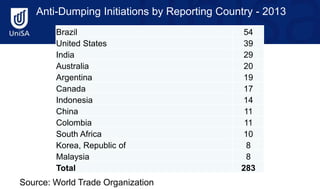
Anti-Dumping Initiations by Reporting Country - 2013
Brazil 54
United States 39
India 29
Australia 20
Argentina 19
Canada 17
Indonesia 14
China 11
Colombia 11
South Africa 10
Korea, Republic of 8
Malaysia 8
Total 283
Source: World Trade Organization
The Case For Government Intervention
Arguments for government intervention:
•Political arguments are concerned with protecting the
interests of certain groups within a nation
•Economic arguments are typically concerned with
boosting the overall wealth of a nation
Political Arguments For Free Trade
Political arguments for government intervention include:
•protecting jobs
•protecting industries deemed important for national
security
•retaliating to unfair foreign competition
•protecting consumers from “dangerous” products
•furthering the goals of foreign policy
•protecting the human rights of individuals in exporting
countries
Economic Arguments
For Intervention
Economic arguments for intervention
include:
•the infant industry argument
•strategic trade policy
The Infant Industry Argument
•The infant industry argument suggests that an industry
should be protected until it can develop and be viable and
competitive internationally
•The infant industry argument has been accepted as a
justification for temporary trade restrictions under the WTO
•However, it can be difficult to gauge when an industry has
“grown up”
Strategic Trade Policy
•Strategic trade policy suggests that in cases where there
may be important first mover advantages, governments can
help firms from their countries attain these advantages
•Strategic trade policy also suggests that governments can
help firms overcome barriers to entry into industries where
foreign firms have an initial advantage

Topic 3a.ppt

  • 1.
    BUSS 5251 InternationalBusiness Topic 3 International Business Environment – Trade Theories
  • 2.
    Overview Of Seminar •Overview of Trade Theories. • Regulating trade and investment. • The role of the WTO.
  • 3.
    THEORIES OF TRADE •Mercantilism (1500 – late 1700s) • Absolute advantage (Adam Smith, 1776) • Comparative advantage (Ricardo, 1817) • Factor-proportions theory (Heckscher-Ohlin 1933) • Product Life Cycle (PLC) Theory (Vernon, 1966) • National Competitive Advantage (Porter, 1990)
  • 4.
    MERCANTILISM • Theory thatnations should accumulate financial wealth, usually in the form of gold. • Encourage exports and discourage imports. • Living standards or human development are irrelevant. • Was followed by Britain, France, The Netherlands, Portugal , and Spain from about 1500 to late 1700s. • National governments intervened to maintain a trade surplus by barring certain imports or imposing restrictions such as tariffs or quotas.
  • 5.
    THEORY OF ABSOLUTEADVANTAGE • a country’s wealth depends on the availability of goods and services to its citizens. • different countries produce some goods and services more efficiently than others and hence they can sell what they do best to gain absolute productivity advantages over other countries. • a country exports goods and services that it can produce more efficiently than the importing country. • a country imports the goods that can be produced more efficiently abroad. (Smith, 1776) Smith, A. (1776), An Inquiry into the Nature and Causes of the Wealth of Nations, (reprinted 1998 in Washington, Regnery Publishing).
  • 6.
    TWO TYPES OFABSOLUTE ADVANTAGE • Natural Advantage • What if a country does not have such natural advantage? • Acquired Advantage
  • 7.
  • 8.
    • a countrytends to specialise in those products and services that it can produce more efficiently than others, regardless of whether other countries can produce them even more efficiently. • a country imports goods and services that – Are comparatively more efficient to produce abroad – Are comparatively more desired than abroad • And exports goods and services that – Are comparatively more efficient to produce than abroad – Are comparatively more desired abroad COMPARATIVE ADVANTAGE Ricardo, D. (1817), On the Principles of Political Economy and Taxation (reprinted 1996 in New York, Prometheus Books).
  • 9.
  • 10.
    FACTOR-PROPORTIONS (HECKSCHER- OHLIN )THEORY • Relative costs of production factors (labour, land, raw materials) determine what a country produce and export, using abundant, and therefore cheaper, production factors • The Leontief Paradox (1954). Heckscher, E. (1991) Heckscher-Ohlin Trade Theory, Cambridge, MA, MIT Press.
  • 11.
    PRODUCT LIFE CYCLE(PLC) THEORY • Location of sales and production changes as a product goes through different stages of its life cycle. Vernon, R. (1966), “International Investment and International Trade in the Product Life Cycle”, Quarterly Journal of Economics, May, pp. 190-207.
  • 13.
    Porter’s National CompetitiveAdvantage Theory • Firm strategy, structure and rivalry • Factor conditions: Basic and Advanced • Demand conditions • Related and supporting industries • Government and Chance
  • 14.
  • 19.
    Instruments Of TradePolicy The main instruments of trade policy are: •Tariffs •Subsides •Import Quotas •Voluntary Export Restraints •Local Content Requirements •Administrative Polices •Antidumping Policies
  • 20.
    Tariffs •Tariffs are taxeslevied on imports that effectively raise the cost of imported products relative to domestic products •Specific tariffs are levied as a fixed charge for each unit of a good imported (for example $10 per unit) •Ad valorem tariffs are levied as a proportion of the value of the imported good (for example 10% on the price of the unit).
  • 21.
    Subsidies •Subsidies are governmentpayments to domestic producers •Consumers typically absorb the costs of subsidies Subsidies help domestic producers in two ways: •they help them compete against low-cost foreign imports •they help them gain export markets
  • 22.
    Import Quotas AndVoluntary Export Restraints •Import quotas directly restrict the quantity of some good that may be imported into a country •Tariff rate quotas are a hybrid of a quota and a tariff where a lower tariff is applied to imports within the quota than to those over the quota •Voluntary export restraints are quotas on trade imposed by the exporting country, typically at the request of the importing country’s government •A quota rent is the extra profit that producers make when supply is artificially limited by an import quota
  • 23.
    Local Content Requirements •Alocal content requirement demands that some specific fraction of a good be produced domestically •Local content requirements benefit domestic producers, but consumers face higher prices
  • 24.
    Administrative Policies •Administrative tradepolices are bureaucratic rules that are designed to make it difficult for imports to enter a country
  • 25.
    Antidumping Policies •Dumping refersto selling goods in a foreign market below their costs of production, or selling goods in a foreign market below their “fair” market value •Dumping enables firms to unload excess production in foreign markets •Some dumping may be predatory behavior, with producers using substantial profits from their home markets to subsidize prices in a foreign market with a view to driving indigenous competitors out of that market, and later raising prices and earning substantial profits •Antidumping polices (or countervailing duties) are designed to punish foreign firms that engage in dumping and protect domestic producers from “unfair” foreign competition
  • 27.
    Anti-Dumping Initiations byExporting Country-2013 China 74 Korea, Republic of 25 Taipei, Chinese 16 Thailand 14 United States 13 India 11 Japan 11 European Union 8 Malaysia 8 Germany 7 Brazil 6 Indonesia 6 Total 283 Source: World Trade Organization
  • 28.
    Anti-Dumping Initiations byReporting Country - 2013 Brazil 54 United States 39 India 29 Australia 20 Argentina 19 Canada 17 Indonesia 14 China 11 Colombia 11 South Africa 10 Korea, Republic of 8 Malaysia 8 Total 283 Source: World Trade Organization
  • 30.
    The Case ForGovernment Intervention Arguments for government intervention: •Political arguments are concerned with protecting the interests of certain groups within a nation •Economic arguments are typically concerned with boosting the overall wealth of a nation
  • 31.
    Political Arguments ForFree Trade Political arguments for government intervention include: •protecting jobs •protecting industries deemed important for national security •retaliating to unfair foreign competition •protecting consumers from “dangerous” products •furthering the goals of foreign policy •protecting the human rights of individuals in exporting countries
  • 32.
    Economic Arguments For Intervention Economicarguments for intervention include: •the infant industry argument •strategic trade policy
  • 33.
    The Infant IndustryArgument •The infant industry argument suggests that an industry should be protected until it can develop and be viable and competitive internationally •The infant industry argument has been accepted as a justification for temporary trade restrictions under the WTO •However, it can be difficult to gauge when an industry has “grown up”
  • 34.
    Strategic Trade Policy •Strategictrade policy suggests that in cases where there may be important first mover advantages, governments can help firms from their countries attain these advantages •Strategic trade policy also suggests that governments can help firms overcome barriers to entry into industries where foreign firms have an initial advantage