DEFINING USER
REQUIREMENTS
SESSION -19
TYPES OF ELEMENTS OF THE REUIREMENTS
• The specific elements of the requirements model are dictated by the analysis
modeling method that is to be used. However, a set of generic elements is
common to most requirements models.
 Scenario-based elements
 Class-based elements
 Behavioral elements
 Flow-oriented elements
 Analysis patterns
2
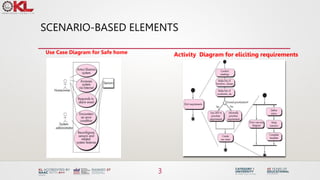
SCENARIO-BASED ELEMENTS
3
Use Case Diagram for Safe home Activity Diagram for eliciting requirements
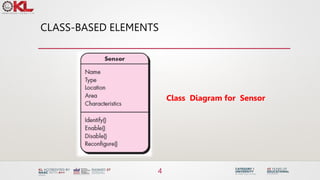
CLASS-BASED ELEMENTS
4
Class Diagram for Sensor
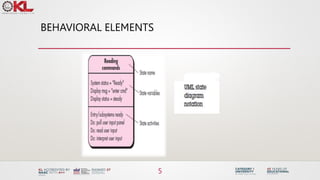
BEHAVIORAL ELEMENTS
5
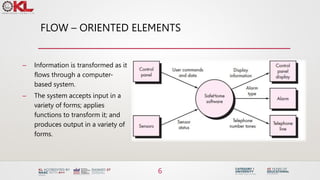
FLOW – ORIENTED ELEMENTS
– Information is transformed as it
flows through a computer-
based system.
– The system accepts input in a
variety of forms; applies
functions to transform it; and
produces output in a variety of
forms.
6
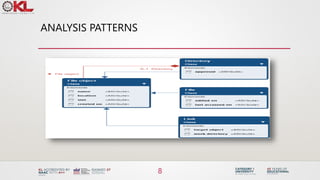
ANALYSIS PATTERNS
• Anyone who has done requirements engineering on a number of software
projects will note that some issues repeat across all projects within a certain
application area. These patterns of analysis provide solutions (e.g., a class, a
function, or a behavior) inside the application domain that can be reused when
modelling several applications.
• By referencing the pattern name, analysis patterns are integrated into the analysis
model. They are also stored in a repository so that requirements engineers can
find and apply them using search facilities. Information about an analysis pattern
(and other sorts of patterns) is contained in a standard template.
7
ANALYSIS PATTERNS
8
NEGOTIATING REQUIREMENTS
• The inception, elicitation, and elaboration tasks in an ideal requirements
engineering setting determine customer requirements in sufficient depth to
proceed to later software engineering activities.
• Boehm [Boe98] defines a set of negotiation activities at the beginning of each
software process iteration. Rather than a single customer communication
activity, the following activities are defined:
1. Identification of the system or subsystem’s key stakeholders.
2. Determination of the stakeholders’ “win conditions.”
3. Negotiation of the stakeholders’ win conditions to reconcile them into a
set of win-win conditions for all concerned (including the software team).
9
10
THANK YOU
Team – Adaptive Software Engineering

Topic 19. User Requirements.pptx

  • 1.
  • 2.
    TYPES OF ELEMENTSOF THE REUIREMENTS • The specific elements of the requirements model are dictated by the analysis modeling method that is to be used. However, a set of generic elements is common to most requirements models.  Scenario-based elements  Class-based elements  Behavioral elements  Flow-oriented elements  Analysis patterns 2
  • 3.
    SCENARIO-BASED ELEMENTS 3 Use CaseDiagram for Safe home Activity Diagram for eliciting requirements
  • 4.
  • 5.
  • 6.
    FLOW – ORIENTEDELEMENTS – Information is transformed as it flows through a computer- based system. – The system accepts input in a variety of forms; applies functions to transform it; and produces output in a variety of forms. 6
  • 7.
    ANALYSIS PATTERNS • Anyonewho has done requirements engineering on a number of software projects will note that some issues repeat across all projects within a certain application area. These patterns of analysis provide solutions (e.g., a class, a function, or a behavior) inside the application domain that can be reused when modelling several applications. • By referencing the pattern name, analysis patterns are integrated into the analysis model. They are also stored in a repository so that requirements engineers can find and apply them using search facilities. Information about an analysis pattern (and other sorts of patterns) is contained in a standard template. 7
  • 8.
  • 9.
    NEGOTIATING REQUIREMENTS • Theinception, elicitation, and elaboration tasks in an ideal requirements engineering setting determine customer requirements in sufficient depth to proceed to later software engineering activities. • Boehm [Boe98] defines a set of negotiation activities at the beginning of each software process iteration. Rather than a single customer communication activity, the following activities are defined: 1. Identification of the system or subsystem’s key stakeholders. 2. Determination of the stakeholders’ “win conditions.” 3. Negotiation of the stakeholders’ win conditions to reconcile them into a set of win-win conditions for all concerned (including the software team). 9
  • 10.
    10 THANK YOU Team –Adaptive Software Engineering