Software Development
Process
Activities and Steps
REQUIREMENTS ANALYSIS
Compiled and Illustrated by: MJLADO
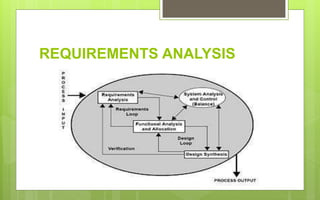
REQUIREMENTS ANALYSIS
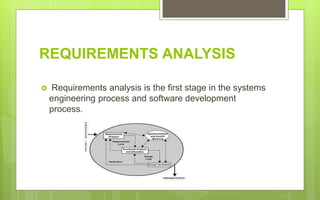
 Requirements analysis is the first stage in the systems
engineering process and software development
process.
REQUIREMENTS ANALYSIS
 Requirements analysis in systems engineering and
software engineering, encompasses those tasks that go
into determining the needs or conditions to meet for a
new or altered product, taking account of the possibly
conflicting requirements of the various stakeholders,
such as beneficiaries or users.
REQUIREMENTS ANALYSIS
 Requirements analysis is critical to the success of a
development project. Requirements must be actionable,
measurable, testable, related to identified business
needs or opportunities, and defined to a level of detail
sufficient for system design. Requirements can be
functional and non-functional.
REQUIREMENTS ANALYSIS
Overview
Conceptually, requirements analysis includes three types of
activity:
 Eliciting requirements: the task of communicating with customers
and users to determine what their requirements are. This is
sometimes also called requirements gathering.
 Analyzing requirements: determining whether the stated
requirements are unclear, incomplete, ambiguous, or contradictory,
and then resolving these issues.
 Recording requirements: Requirements might be documented in
various forms, such as natural-language documents, use cases,
user stories, or process specifications.
REQUIREMENTS ANALYSIS
Overview cont.…
 Requirements analysis can be a long and arduous
process during which many delicate psychological skills
are involved. New systems change the environment and
relationships between people, so it is important to
identify all the stakeholders, take into account all their
needs and ensure they understand the implications of
the new systems. Analysts can employ several
techniques to elicit the requirements from the customer.
REQUIREMENTS ANALYSIS
Overview cont.…
 Historically, this has included such things as holding
interviews, or holding focus groups (more aptly named
in this context as requirements workshops) and creating
requirements lists. More modern techniques. More
modern techniques include prototyping, and use cases.
Where necessary, the analyst will employ a combination
of these methods to establish the exact requirements of
the stakeholders, so that a system that meets the
business needs is produced.
Requirements engineering
 Systematic requirements analysis is also known as
requirements engineering. It is sometimes referred to
loosely by names such as requirements gathering,
requirements capture, or requirements specification.
The term requirements analysis can also be applied
specifically to the analysis proper, as opposed to
elicitation or documentation of the requirements, for
instance.
Requirements engineering
cont….
 Requirement engineering according to Laplante (2007) is "a
subdiscipline of systems engineering and software engineering that
is concerned with determining the goals, functions, and constraints
of hardware and software systems." In some life cycle models, the
requirement engineering process begins with a feasibility study
activity, which leads to a feasibility report. If the feasibility study
suggest that the product should be developed, then requirement
analysis can begin. If requirement analysis precedes feasibility
studies, which may foster outside the box thinking, then feasibility
should be determined before requirements are finalized.
Requirements analysis topics
Stakeholder identification
 See Stakeholder analysis for a discussion of business
uses. Stakeholders (SH) are persons or organizations
(legal entities such as companies, standards bodies)
which have a valid interest in the system. They may be
affected by it either directly or indirectly. A major new
emphasis in the 1990s was a focus on the identification
of stakeholders. It is increasingly recognized that
stakeholders are not limited to the organization
employing the analyst. Other stakeholders will include:
Requirements analysis topics
Stakeholder identification
cont….
 anyone who operates the system (normal and maintenance
operators)
 anyone who benefits from the system (functional, political,
financial and social beneficiaries)
 anyone involved in purchasing or procuring the system. In a
mass-market product organization, product management,
marketing and sometimes sales act as surrogate consumers
(mass-market customers) to guide development of the
product
Requirements analysis topics
Stakeholder identification
cont….
 organizations which regulate aspects of the system (financial,
safety, and other regulators)
 people or organizations opposed to the system (negative
stakeholders; see also Misuse case)
 organizations responsible for systems which interface with
the system under design
 those organizations who integrate horizontally with the
organization for whom the analyst is designing the system
Stakeholder interviews
 Stakeholder interviews are a common technique used in
requirement analysis. These interviews may reveal
requirements not previously envisaged as being within
the scope of the project, and requirements may be
contradictory. However, each stakeholder will have an
idea of their expectation or will have visualized their
requirements.
Contract-style requirement lists
 One traditional way of documenting requirements has
been contract style requirement lists. In a complex
system such requirements lists can run to hundreds of
pages.
Contract-style requirement lists
cont…
 An appropriate metaphor would be an extremely long
shopping list. Such lists are very much out of favour in
modern analysis; as they have proved spectacularly
unsuccessful at achieving their aims; but they are still
seen to this day.
Contract-style requirement lists
cont…
Strengths
1. Provides a checklist of requirements.
2. Provide a contract between the project sponsor(s) and
developers.
3. For a large system can provide a high level description.
Contract-style requirement lists
cont…
Weaknesses
1. Such lists can run to hundreds of pages. It is
virtually impossible to read such documents as a
whole and have a coherent understanding of the
system.
Contract-style requirement lists
cont…
Weaknesses
2. Such requirements lists abstract all the
requirements and so there is little context
2.1 This abstraction makes it impossible to
see how the requirements fit together.
2.2 This abstraction makes it difficult
Contract-style requirement lists
cont…
Weaknesses
2.3 This abstraction means that the more
people who read such requirements the
more different visions of the system you get.
2.4 This abstraction means that it's extremely
difficult to be sure that you have the majority
of the requirements. Necessarily, these
documents speak in generality; but the devil
as they say is in the details.
Contract-style requirement lists
cont…
Weaknesses
3. These lists create a false sense of mutual
understanding between the stakeholders and
developers.
4. These contract style lists give the stakeholders a false
sense of security that the developers must achieve
certain things. However, due to the nature of these lists,
they inevitably miss out crucial requirements which are
identified later in the process. Developers can use these
discovered requirements to renegotiate the terms and
conditions in their favour.
Contract-style requirement lists
cont…
Weaknesses
 These requirements lists are no help in system design,
since they do not lend themselves to application.
Measurable goals
 Best practices take the composed list of requirements merely
as clues and repeatedly ask "why?" until the actual business
purposes are discovered. Stakeholders and developers can
then devise tests to measure what level of each goal has
been achieved thus far. Such goals change more slowly than
the long list of specific but unmeasured requirements. Once a
small set of critical, measured goals has been established,
rapid prototyping and short iterative development phases
may proceed to deliver actual stakeholder value long before
the project is half over.
Prototypes
 In the mid-1980s, prototyping was seen as the solution to the
requirements analysis problem. Prototypes are Mockups of
an application. Mockups allow users to visualize an
application that hasn't yet been constructed. Prototypes help
users get an idea of what the system will look like, and make
it easier for users to make design decisions without waiting
for the system to be built. Major improvements in
communication between users and developers were often
seen with the introduction of prototypes. Early views of
applications led to fewer changes later and hence reduced
overall costs considerably.
Prototypes
cont…
However, over the next decade, while proving a useful
technique, prototyping did not solve the requirements problem:
 Managers, once they see a prototype, may have a hard time
understanding that the finished design will not be produced
for some time.
 Designers often feel compelled to use patched together
prototype code in the real system, because they are afraid to
'waste time' starting again.
Prototypes
cont…
 Prototypes principally help with design decisions and
user interface design. However, they can not tell you
what the requirements originally were.
 Designers and end users can focus too much on user
interface design and too little on producing a system
that serves the business process.
Prototypes
cont…
 Prototypes work well for user interfaces, screen layout
and screen flow but are not so useful for batch or
asynchronous processes which may involve complex
database updates and/or calculations.
Prototypes
conclusion.
Prototypes can be flat diagrams (often referred to as
Wireframes) or working applications using synthesized
functionality. Wireframes are made in a variety of graphic
design documents, and often remove all color from the
design (i.e. use a greyscale color palette) in instances
where the final software is expected to have graphic
design applied to it. This helps to prevent confusion over
the final visual look and feel of the application.
Use cases
 A use case is a technique for documenting the potential
requirements of a new system or software change.
Each use case provides one or more scenarios that
convey how the system should interact with the end
user or another system to achieve a specific business
goal. Use cases typically avoid technical jargon,
preferring instead the language of the end user or
domain expert. Use cases are often co-authored by
requirements engineers and stakeholders.
Use cases
cont….
 Use cases are deceptively simple tools for describing
the behavior of software or systems. A use case
contains a textual description of all of the ways which
the intended users could work with the software or
system. Use cases do not describe any internal
workings of the system, nor do they explain how that
system will be implemented. They simply show the
steps that a user follows to perform a task. All the ways
that users interact with a system can be described in
this manner.
Software requirements specification
 A software requirements specification (SRS) is a complete
description of the behavior of the system to be developed. It
includes a set of use cases that describe all of the
interactions that the users will have with the software. Use
cases are also known as functional requirements. In addition
to use cases, the SRS also contains nonfunctional (or
supplementary) requirements. Non-functional requirements
are requirements which impose constraints on the design or
implementation (such as performance requirements, quality
standards, or design constraints).
Software requirements specification
cont….
 Recommended approaches for the specification of
software requirements are described by IEEE 830-1998.
This standard describes possible structures, desirable
contents, and qualities of a software requirements
specification.
System Requirements

Software Development Process - REQUIREMENTS ANALYSIS / ANALYSIS OF TECHNICAL REQUIREMENT

  • 1.
    Software Development Process Activities andSteps REQUIREMENTS ANALYSIS Compiled and Illustrated by: MJLADO
  • 2.
  • 3.
    REQUIREMENTS ANALYSIS  Requirementsanalysis is the first stage in the systems engineering process and software development process.
  • 4.
    REQUIREMENTS ANALYSIS  Requirementsanalysis in systems engineering and software engineering, encompasses those tasks that go into determining the needs or conditions to meet for a new or altered product, taking account of the possibly conflicting requirements of the various stakeholders, such as beneficiaries or users.
  • 5.
    REQUIREMENTS ANALYSIS  Requirementsanalysis is critical to the success of a development project. Requirements must be actionable, measurable, testable, related to identified business needs or opportunities, and defined to a level of detail sufficient for system design. Requirements can be functional and non-functional.
  • 6.
    REQUIREMENTS ANALYSIS Overview Conceptually, requirementsanalysis includes three types of activity:  Eliciting requirements: the task of communicating with customers and users to determine what their requirements are. This is sometimes also called requirements gathering.  Analyzing requirements: determining whether the stated requirements are unclear, incomplete, ambiguous, or contradictory, and then resolving these issues.  Recording requirements: Requirements might be documented in various forms, such as natural-language documents, use cases, user stories, or process specifications.
  • 7.
    REQUIREMENTS ANALYSIS Overview cont.… Requirements analysis can be a long and arduous process during which many delicate psychological skills are involved. New systems change the environment and relationships between people, so it is important to identify all the stakeholders, take into account all their needs and ensure they understand the implications of the new systems. Analysts can employ several techniques to elicit the requirements from the customer.
  • 8.
    REQUIREMENTS ANALYSIS Overview cont.… Historically, this has included such things as holding interviews, or holding focus groups (more aptly named in this context as requirements workshops) and creating requirements lists. More modern techniques. More modern techniques include prototyping, and use cases. Where necessary, the analyst will employ a combination of these methods to establish the exact requirements of the stakeholders, so that a system that meets the business needs is produced.
  • 9.
    Requirements engineering  Systematicrequirements analysis is also known as requirements engineering. It is sometimes referred to loosely by names such as requirements gathering, requirements capture, or requirements specification. The term requirements analysis can also be applied specifically to the analysis proper, as opposed to elicitation or documentation of the requirements, for instance.
  • 10.
    Requirements engineering cont….  Requirementengineering according to Laplante (2007) is "a subdiscipline of systems engineering and software engineering that is concerned with determining the goals, functions, and constraints of hardware and software systems." In some life cycle models, the requirement engineering process begins with a feasibility study activity, which leads to a feasibility report. If the feasibility study suggest that the product should be developed, then requirement analysis can begin. If requirement analysis precedes feasibility studies, which may foster outside the box thinking, then feasibility should be determined before requirements are finalized.
  • 11.
    Requirements analysis topics Stakeholderidentification  See Stakeholder analysis for a discussion of business uses. Stakeholders (SH) are persons or organizations (legal entities such as companies, standards bodies) which have a valid interest in the system. They may be affected by it either directly or indirectly. A major new emphasis in the 1990s was a focus on the identification of stakeholders. It is increasingly recognized that stakeholders are not limited to the organization employing the analyst. Other stakeholders will include:
  • 12.
    Requirements analysis topics Stakeholderidentification cont….  anyone who operates the system (normal and maintenance operators)  anyone who benefits from the system (functional, political, financial and social beneficiaries)  anyone involved in purchasing or procuring the system. In a mass-market product organization, product management, marketing and sometimes sales act as surrogate consumers (mass-market customers) to guide development of the product
  • 13.
    Requirements analysis topics Stakeholderidentification cont….  organizations which regulate aspects of the system (financial, safety, and other regulators)  people or organizations opposed to the system (negative stakeholders; see also Misuse case)  organizations responsible for systems which interface with the system under design  those organizations who integrate horizontally with the organization for whom the analyst is designing the system
  • 14.
    Stakeholder interviews  Stakeholderinterviews are a common technique used in requirement analysis. These interviews may reveal requirements not previously envisaged as being within the scope of the project, and requirements may be contradictory. However, each stakeholder will have an idea of their expectation or will have visualized their requirements.
  • 15.
    Contract-style requirement lists One traditional way of documenting requirements has been contract style requirement lists. In a complex system such requirements lists can run to hundreds of pages.
  • 16.
    Contract-style requirement lists cont… An appropriate metaphor would be an extremely long shopping list. Such lists are very much out of favour in modern analysis; as they have proved spectacularly unsuccessful at achieving their aims; but they are still seen to this day.
  • 17.
    Contract-style requirement lists cont… Strengths 1.Provides a checklist of requirements. 2. Provide a contract between the project sponsor(s) and developers. 3. For a large system can provide a high level description.
  • 18.
    Contract-style requirement lists cont… Weaknesses 1.Such lists can run to hundreds of pages. It is virtually impossible to read such documents as a whole and have a coherent understanding of the system.
  • 19.
    Contract-style requirement lists cont… Weaknesses 2.Such requirements lists abstract all the requirements and so there is little context 2.1 This abstraction makes it impossible to see how the requirements fit together. 2.2 This abstraction makes it difficult
  • 20.
    Contract-style requirement lists cont… Weaknesses 2.3This abstraction means that the more people who read such requirements the more different visions of the system you get. 2.4 This abstraction means that it's extremely difficult to be sure that you have the majority of the requirements. Necessarily, these documents speak in generality; but the devil as they say is in the details.
  • 21.
    Contract-style requirement lists cont… Weaknesses 3.These lists create a false sense of mutual understanding between the stakeholders and developers. 4. These contract style lists give the stakeholders a false sense of security that the developers must achieve certain things. However, due to the nature of these lists, they inevitably miss out crucial requirements which are identified later in the process. Developers can use these discovered requirements to renegotiate the terms and conditions in their favour.
  • 22.
    Contract-style requirement lists cont… Weaknesses These requirements lists are no help in system design, since they do not lend themselves to application.
  • 23.
    Measurable goals  Bestpractices take the composed list of requirements merely as clues and repeatedly ask "why?" until the actual business purposes are discovered. Stakeholders and developers can then devise tests to measure what level of each goal has been achieved thus far. Such goals change more slowly than the long list of specific but unmeasured requirements. Once a small set of critical, measured goals has been established, rapid prototyping and short iterative development phases may proceed to deliver actual stakeholder value long before the project is half over.
  • 24.
    Prototypes  In themid-1980s, prototyping was seen as the solution to the requirements analysis problem. Prototypes are Mockups of an application. Mockups allow users to visualize an application that hasn't yet been constructed. Prototypes help users get an idea of what the system will look like, and make it easier for users to make design decisions without waiting for the system to be built. Major improvements in communication between users and developers were often seen with the introduction of prototypes. Early views of applications led to fewer changes later and hence reduced overall costs considerably.
  • 25.
    Prototypes cont… However, over thenext decade, while proving a useful technique, prototyping did not solve the requirements problem:  Managers, once they see a prototype, may have a hard time understanding that the finished design will not be produced for some time.  Designers often feel compelled to use patched together prototype code in the real system, because they are afraid to 'waste time' starting again.
  • 26.
    Prototypes cont…  Prototypes principallyhelp with design decisions and user interface design. However, they can not tell you what the requirements originally were.  Designers and end users can focus too much on user interface design and too little on producing a system that serves the business process.
  • 27.
    Prototypes cont…  Prototypes workwell for user interfaces, screen layout and screen flow but are not so useful for batch or asynchronous processes which may involve complex database updates and/or calculations.
  • 28.
    Prototypes conclusion. Prototypes can beflat diagrams (often referred to as Wireframes) or working applications using synthesized functionality. Wireframes are made in a variety of graphic design documents, and often remove all color from the design (i.e. use a greyscale color palette) in instances where the final software is expected to have graphic design applied to it. This helps to prevent confusion over the final visual look and feel of the application.
  • 29.
    Use cases  Ause case is a technique for documenting the potential requirements of a new system or software change. Each use case provides one or more scenarios that convey how the system should interact with the end user or another system to achieve a specific business goal. Use cases typically avoid technical jargon, preferring instead the language of the end user or domain expert. Use cases are often co-authored by requirements engineers and stakeholders.
  • 30.
    Use cases cont….  Usecases are deceptively simple tools for describing the behavior of software or systems. A use case contains a textual description of all of the ways which the intended users could work with the software or system. Use cases do not describe any internal workings of the system, nor do they explain how that system will be implemented. They simply show the steps that a user follows to perform a task. All the ways that users interact with a system can be described in this manner.
  • 31.
    Software requirements specification A software requirements specification (SRS) is a complete description of the behavior of the system to be developed. It includes a set of use cases that describe all of the interactions that the users will have with the software. Use cases are also known as functional requirements. In addition to use cases, the SRS also contains nonfunctional (or supplementary) requirements. Non-functional requirements are requirements which impose constraints on the design or implementation (such as performance requirements, quality standards, or design constraints).
  • 32.
    Software requirements specification cont…. Recommended approaches for the specification of software requirements are described by IEEE 830-1998. This standard describes possible structures, desirable contents, and qualities of a software requirements specification.
  • 33.