Top 10 things LearnedIntro to Public Relations
PR PioneersPresident Teddy Roosevelt was the first person to make extensive use of news conferences and press interviews.Edward Bernays, became known as the father of modern PR through the publication of his book, Crystallizing Public Opinion.Ivy Lee was the first public relations counselor.
PR CampaignsThe TylenolCrisis of the 80s has shown me how important itis to have a team ready to correct problems. The sooner the incident isfound the sooneritcanbecorrected. Tylenolhadsufferedfromeight people dying due to several of their capsules beinglacedwithcyanide. If itweren’t for PR wemay not beusingtylenol as much as we do today.
ResearchResearchcanbeused in several instances in PR:To achievecredibilitywith managementTo test messagesTo prevent crisesTo sway public opinion90% of crises are causedinternal, researchcanminimize the effectsbeforeitis put into the media.Researchisoftenused to determinewhat messages gel with audiences.
Program PlanningThe eight essential elements in PR program planning.SituationObjectivesAudienceStrategyTacticsCalendarBudgetEvaluationEachstepplays an essential role in the other. Leading to a successfulcampaign, thatdoesn’tsurpass the estimated time, money, and goal of the project. Thesesteps are the link to having a successfulcampaign.
CommunicationIn communication one tries to relay the message onto another. It sounds simple, but havingthesetargeted audiences act on the message isdifferent. I foundthese five keys of understanding how people accept and precieve new ideasveryhelpful.1. Awareness2. Interest3. Evaluation4. Trial5. AdoptionIf youbegin to understandyourown message as an audience memberwould, thatis the key to a successfulrelay of a product or new idea and shouldtakewell to the audience.
Conflict ManagementSincelearning of the Tylenolcrisis I have become a bigbelieverthatcrisis and conflict management play a bigrole in PR. Whendealingwith a crisis a public relations methodknown as the strategicconflict management is put into to play.The components are: strategic, management, competition, and conflict.Every situation must beapproached and handledwithdelicacysothat a company, firm, or organizationcanwalkawayfrom the incident withlittle to no damage to their image or product.Whencommunicatingduring a crisisalwaysconduct the following: behonest, put the public first, takeresponsibility, beaccesssible, appoint a single spokesperson, and set up an information center. Nobodylikes a liarsobehonest and straight to the point in the midst of a crisis, thismayfurtherinsure the public thatyourcompanywill not restuntil the problemisresolved or neutralized.
ToolsTools in order to survive in the Public Relations fieldI willneed to exertpenmanshipprowesswhenitcomes to writing in the AP format. It is the writing style both PR and Journalistsalikefollow as theirsurvival guide.Correctly and ethicallywritepress releases, speeches, and PSAs. Learn to adapt to my audience. Connectwiththeirneedsand wants. The saying the customerisalways right seems to followyou no matterwhatcareeryouchoose.
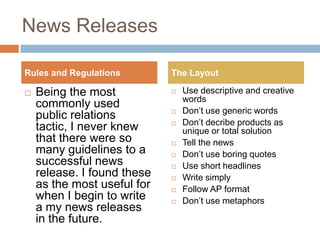
News ReleasesBeing the mostcommonlyused public relations tactic, I neverknewthatthereweresomany guidelines to a successful news release. I foundthese as the mostuseful for when I begin to write a my news releases in the future. Use descriptive and creativewordsDon’t use genericwordsDon’tdecribeproducts as unique or total solutionTell the newsDon’t use boringquotesUse short headlinesWritesimplyFollow AP formatDon’t use metaphorsRules and RegulationsThe Layout
Social Media and NetworkingI have alsolearnedtwo new keyways to connectwith people in the business world throughmy Intro to Public Relations classTwitter, has connected me withseveralprofessional people who are in myrelatedfield of study. Not only has thisconnected me, it has provided me withfriendsthat have accomplishedcollege and are nowactively in the work force I hope to join in a few years. Providing me withtips, tools, and new knowledge to getstartedbefore I take the leapinto the real world.
RecapI have learned the neccessarytools and guidelines to be a successfulemployee in the field of PR. Though I have not gained all the knowledgethereis to know about the field. I amwalkingawayfromthis class knowing I amready to tackleany obstacles thisstudy has to offer me.

Top 10 things learned

  • 1.
    Top 10 thingsLearnedIntro to Public Relations
  • 2.
    PR PioneersPresident TeddyRoosevelt was the first person to make extensive use of news conferences and press interviews.Edward Bernays, became known as the father of modern PR through the publication of his book, Crystallizing Public Opinion.Ivy Lee was the first public relations counselor.
  • 3.
    PR CampaignsThe TylenolCrisisof the 80s has shown me how important itis to have a team ready to correct problems. The sooner the incident isfound the sooneritcanbecorrected. Tylenolhadsufferedfromeight people dying due to several of their capsules beinglacedwithcyanide. If itweren’t for PR wemay not beusingtylenol as much as we do today.
  • 4.
    ResearchResearchcanbeused in severalinstances in PR:To achievecredibilitywith managementTo test messagesTo prevent crisesTo sway public opinion90% of crises are causedinternal, researchcanminimize the effectsbeforeitis put into the media.Researchisoftenused to determinewhat messages gel with audiences.
  • 5.
    Program PlanningThe eightessential elements in PR program planning.SituationObjectivesAudienceStrategyTacticsCalendarBudgetEvaluationEachstepplays an essential role in the other. Leading to a successfulcampaign, thatdoesn’tsurpass the estimated time, money, and goal of the project. Thesesteps are the link to having a successfulcampaign.
  • 6.
    CommunicationIn communication onetries to relay the message onto another. It sounds simple, but havingthesetargeted audiences act on the message isdifferent. I foundthese five keys of understanding how people accept and precieve new ideasveryhelpful.1. Awareness2. Interest3. Evaluation4. Trial5. AdoptionIf youbegin to understandyourown message as an audience memberwould, thatis the key to a successfulrelay of a product or new idea and shouldtakewell to the audience.
  • 7.
    Conflict ManagementSincelearning ofthe Tylenolcrisis I have become a bigbelieverthatcrisis and conflict management play a bigrole in PR. Whendealingwith a crisis a public relations methodknown as the strategicconflict management is put into to play.The components are: strategic, management, competition, and conflict.Every situation must beapproached and handledwithdelicacysothat a company, firm, or organizationcanwalkawayfrom the incident withlittle to no damage to their image or product.Whencommunicatingduring a crisisalwaysconduct the following: behonest, put the public first, takeresponsibility, beaccesssible, appoint a single spokesperson, and set up an information center. Nobodylikes a liarsobehonest and straight to the point in the midst of a crisis, thismayfurtherinsure the public thatyourcompanywill not restuntil the problemisresolved or neutralized.
  • 8.
    ToolsTools in orderto survive in the Public Relations fieldI willneed to exertpenmanshipprowesswhenitcomes to writing in the AP format. It is the writing style both PR and Journalistsalikefollow as theirsurvival guide.Correctly and ethicallywritepress releases, speeches, and PSAs. Learn to adapt to my audience. Connectwiththeirneedsand wants. The saying the customerisalways right seems to followyou no matterwhatcareeryouchoose.
  • 9.
    News ReleasesBeing themostcommonlyused public relations tactic, I neverknewthatthereweresomany guidelines to a successful news release. I foundthese as the mostuseful for when I begin to write a my news releases in the future. Use descriptive and creativewordsDon’t use genericwordsDon’tdecribeproducts as unique or total solutionTell the newsDon’t use boringquotesUse short headlinesWritesimplyFollow AP formatDon’t use metaphorsRules and RegulationsThe Layout
  • 10.
    Social Media andNetworkingI have alsolearnedtwo new keyways to connectwith people in the business world throughmy Intro to Public Relations classTwitter, has connected me withseveralprofessional people who are in myrelatedfield of study. Not only has thisconnected me, it has provided me withfriendsthat have accomplishedcollege and are nowactively in the work force I hope to join in a few years. Providing me withtips, tools, and new knowledge to getstartedbefore I take the leapinto the real world.
  • 11.
    RecapI have learnedthe neccessarytools and guidelines to be a successfulemployee in the field of PR. Though I have not gained all the knowledgethereis to know about the field. I amwalkingawayfromthis class knowing I amready to tackleany obstacles thisstudy has to offer me.