Topic : Tooth Development I
DR VINOD KUMAR R.B
PROF & HEAD
DEPT OF ORAL PATHOLOGY & MICROBIOLOGY
MALABAR DENTAL COLLEGE & RESEARCH CENTRE
Copyright © 2008 Pearson Education, Inc., publishing as Benjamin Cummings
Week 2 – The Two-Layered Embryo
 Bilaminar embryonic disc – inner cell mass divided into two sheets
 Epiblast and the hypoblast
Together they make up the bilaminar embryonic disc
Copyright © 2008 Pearson Education, Inc., publishing as Benjamin Cummings
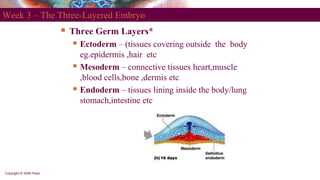
Week 3 – The Three-Layered Embryo
 Three Germ Layers*
 Ectoderm – (tissues covering outside the body
eg.epidermis ,hair etc
 Mesoderm – connective tissues heart,muscle
,blood cells,bone ,dermis etc
 Endoderm – tissues lining inside the body/lung
stomach,intestine etc
Copyright © 2008 Pearson Education, Inc., publishing as Benjamin Cummings
Crest of neural fold
During the development of the neural tube small groups of
ectodermal cells break away from the margins of the neural plate
and come to lie on either side of the neural tube.They constitute
the neural crest cells
Neural crest cells
Neural tube
In the cranial region the neural crest cells contribute the
meninges and much of the cartilage and bone of the facial
skeleton ,tissues which at one time were thought to arise from
the mesoderm
In order to distinguish betweeen the origins of the mesodermal
cells they can be referred to as endomesenchyme(mesodermal
origin) and ectomesenchyme(neural crest origin)
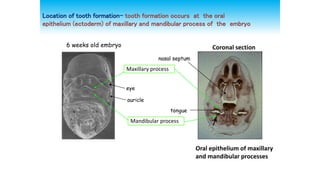
Location of tooth formation- tooth formation occurs at the oral
epithelium (ectoderm) of maxillary and mandibular process of the embryo
6 weeks old embryo
Maxillary process
Mandibular process
auricle
eye
Coronal section
Oral epithelium of maxillary
and mandibular processes
tongue
nasal septum
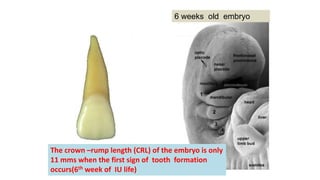
6 weeks old embryo
The crown –rump length (CRL) of the embryo is only
11 mms when the first sign of tooth formation
occurs(6th week of IU life)
Stages of tooth
development
1. Bud stage
2. Cap stage
3. Bell stage
4. Appositional stage (mineralization)
5. Root formation
6. Eruption
(epithelial ingrowth into ectomesenchyme)
(further epithelial growth)
(histo- and morpho-differentiation)
(formation of enamel and dentin of crown)
(formation of dentin and cementum of root)
Oral Histology and Embryology by Leslie P. Gartner, 1988
Bud stage
Mx
Mn
dental lamina
tooth bud
developing
maxillalry bone
tongue
palate
http://www.iob.uio.no/studier/undervisning/histologi/index.php
• Dental lamina
- is the horse shoe-shaped
epithelial band from oral epithelium
- one dental lamina per arch
- 10 tooth buds arise from dental lamina
corresponding to the position of future
primary teeth
developing
mandibular bone
Mx
Mn
vestibular lamina
http://www.iob.uio.no/studier/undervisning/histologi/index.php
vestibule
Bud stage
Another thickening arises lateral to the dental lamina and is called
vestibular lamina .It subsequently hollows out to form the vestbule
Labial frenum
Vestibule
ectomesenchymal cells
http://www.iob.uio.no/studier/undervisning/histologi/index.php
Bud stage
The enamel organ is shaped like a bud. It consists of epithelial cells
and is surrounded by a condensation of ectomesenchymal cells
condensation of
ectomesenchymal cells
around tooth bud
http://www.iob.uio.no/studier/undervisning/histologi/index.php
Bud stage
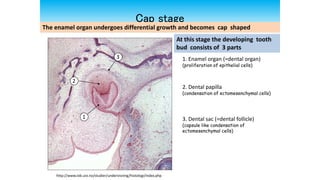
Cap stage
1. Enamel organ (=dental organ)
(proliferation of epithelial cells)
2. Dental papilla
(condensation of ectomesenchymal cells)
3. Dental sac (=dental follicle)
(capsule like condensation of
ectomesenchymal cells)
1
2
3
http://www.iob.uio.no/studier/undervisning/histologi/index.php
The enamel organ undergoes differential growth and becomes cap shaped
At this stage the developing tooth
bud consists of 3 parts
Cap stage
1. Enamel organ (=dental organ)
(proliferation of epithelial cells)
2. Dental papilla
(condensation of ectomesenchymal cells)
3. Dental sac (=dental follicle)
(capsule like condensation of
ectomesenchymal cells)
1
2
3
http://www.iob.uio.no/studier/undervisning/histologi/index.php
The enamel organ undergoes differential growth and becomes cap shaped
At this stage the developing tooth
bud consists of 3 parts
Future tooth products-derivatives
1. Enamel organ
2. Dental papilla
3. Dental sac1
2
3
enamel
dentin
pulp
cementum
periodontal ligament
alveolar bone
connective tissues of gingiva
http://www.iob.uio.no/studier/undervisning/histologi/index.php
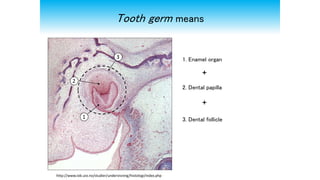
Tooth germ means
1. Enamel organ
2. Dental papilla
3. Dental follicle1
2
3
http://www.iob.uio.no/studier/undervisning/histologi/index.php
+
+
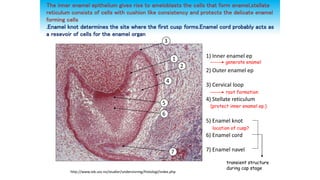
Enamel organ of cap stage consists of 3 layers –inner enamel
epithelium,outer enamel epithelium and stellate reticulum. Temporary
structures found during cap stage includes enamel knot,enamel cord and
enamel navel
2
1
3
1) Inner enamel ep
2) Outer enamel ep
3) Cervical loop
4) Stellate reticulum
5) Enamel knot
6) Enamel cord
7) Enamel navel
4
5
6
7
transient structure
during cap stage
http://www.iob.uio.no/studier/undervisning/histologi/index.php
(inner+outer enamel ep.)
2
1
3
1) Inner enamel ep
2) Outer enamel ep
3) Cervical loop
4) Stellate reticulum
5) Enamel knot
6) Enamel cord
7) Enamel navel
4
5
6
7
transient structure
during cap stage
root formation
generate enamel
location of cusp?
http://www.iob.uio.no/studier/undervisning/histologi/index.php
The inner enamel epithelium gives rise to ameloblasts the cells that form enamel,stellate
reticulum consists of cells with cushion like consistency and protects the delicate enamel
forming cells
.Enamel knot determines the site where the first cusp forms.Enamel cord probably acts as
a resevoir of cells for the enamel organ
(protect inner enamel ep.)

Tooth development

  • 1.
    Topic : ToothDevelopment I DR VINOD KUMAR R.B PROF & HEAD DEPT OF ORAL PATHOLOGY & MICROBIOLOGY MALABAR DENTAL COLLEGE & RESEARCH CENTRE
  • 2.
    Copyright © 2008Pearson Education, Inc., publishing as Benjamin Cummings Week 2 – The Two-Layered Embryo  Bilaminar embryonic disc – inner cell mass divided into two sheets  Epiblast and the hypoblast Together they make up the bilaminar embryonic disc
  • 3.
    Copyright © 2008Pearson Education, Inc., publishing as Benjamin Cummings Week 3 – The Three-Layered Embryo  Three Germ Layers*  Ectoderm – (tissues covering outside the body eg.epidermis ,hair etc  Mesoderm – connective tissues heart,muscle ,blood cells,bone ,dermis etc  Endoderm – tissues lining inside the body/lung stomach,intestine etc
  • 5.
    Copyright © 2008Pearson Education, Inc., publishing as Benjamin Cummings
  • 6.
    Crest of neuralfold During the development of the neural tube small groups of ectodermal cells break away from the margins of the neural plate and come to lie on either side of the neural tube.They constitute the neural crest cells Neural crest cells Neural tube
  • 8.
    In the cranialregion the neural crest cells contribute the meninges and much of the cartilage and bone of the facial skeleton ,tissues which at one time were thought to arise from the mesoderm In order to distinguish betweeen the origins of the mesodermal cells they can be referred to as endomesenchyme(mesodermal origin) and ectomesenchyme(neural crest origin)
  • 9.
    Location of toothformation- tooth formation occurs at the oral epithelium (ectoderm) of maxillary and mandibular process of the embryo 6 weeks old embryo Maxillary process Mandibular process auricle eye Coronal section Oral epithelium of maxillary and mandibular processes tongue nasal septum
  • 10.
    6 weeks oldembryo The crown –rump length (CRL) of the embryo is only 11 mms when the first sign of tooth formation occurs(6th week of IU life)
  • 11.
    Stages of tooth development 1.Bud stage 2. Cap stage 3. Bell stage 4. Appositional stage (mineralization) 5. Root formation 6. Eruption (epithelial ingrowth into ectomesenchyme) (further epithelial growth) (histo- and morpho-differentiation) (formation of enamel and dentin of crown) (formation of dentin and cementum of root) Oral Histology and Embryology by Leslie P. Gartner, 1988
  • 12.
    Bud stage Mx Mn dental lamina toothbud developing maxillalry bone tongue palate http://www.iob.uio.no/studier/undervisning/histologi/index.php • Dental lamina - is the horse shoe-shaped epithelial band from oral epithelium - one dental lamina per arch - 10 tooth buds arise from dental lamina corresponding to the position of future primary teeth developing mandibular bone
  • 13.
    Mx Mn vestibular lamina http://www.iob.uio.no/studier/undervisning/histologi/index.php vestibule Bud stage Anotherthickening arises lateral to the dental lamina and is called vestibular lamina .It subsequently hollows out to form the vestbule
  • 14.
  • 15.
    ectomesenchymal cells http://www.iob.uio.no/studier/undervisning/histologi/index.php Bud stage Theenamel organ is shaped like a bud. It consists of epithelial cells and is surrounded by a condensation of ectomesenchymal cells
  • 16.
    condensation of ectomesenchymal cells aroundtooth bud http://www.iob.uio.no/studier/undervisning/histologi/index.php Bud stage
  • 17.
    Cap stage 1. Enamelorgan (=dental organ) (proliferation of epithelial cells) 2. Dental papilla (condensation of ectomesenchymal cells) 3. Dental sac (=dental follicle) (capsule like condensation of ectomesenchymal cells) 1 2 3 http://www.iob.uio.no/studier/undervisning/histologi/index.php The enamel organ undergoes differential growth and becomes cap shaped At this stage the developing tooth bud consists of 3 parts
  • 18.
    Cap stage 1. Enamelorgan (=dental organ) (proliferation of epithelial cells) 2. Dental papilla (condensation of ectomesenchymal cells) 3. Dental sac (=dental follicle) (capsule like condensation of ectomesenchymal cells) 1 2 3 http://www.iob.uio.no/studier/undervisning/histologi/index.php The enamel organ undergoes differential growth and becomes cap shaped At this stage the developing tooth bud consists of 3 parts
  • 19.
    Future tooth products-derivatives 1.Enamel organ 2. Dental papilla 3. Dental sac1 2 3 enamel dentin pulp cementum periodontal ligament alveolar bone connective tissues of gingiva http://www.iob.uio.no/studier/undervisning/histologi/index.php
  • 20.
    Tooth germ means 1.Enamel organ 2. Dental papilla 3. Dental follicle1 2 3 http://www.iob.uio.no/studier/undervisning/histologi/index.php + +
  • 21.
    Enamel organ ofcap stage consists of 3 layers –inner enamel epithelium,outer enamel epithelium and stellate reticulum. Temporary structures found during cap stage includes enamel knot,enamel cord and enamel navel 2 1 3 1) Inner enamel ep 2) Outer enamel ep 3) Cervical loop 4) Stellate reticulum 5) Enamel knot 6) Enamel cord 7) Enamel navel 4 5 6 7 transient structure during cap stage http://www.iob.uio.no/studier/undervisning/histologi/index.php (inner+outer enamel ep.)
  • 22.
    2 1 3 1) Inner enamelep 2) Outer enamel ep 3) Cervical loop 4) Stellate reticulum 5) Enamel knot 6) Enamel cord 7) Enamel navel 4 5 6 7 transient structure during cap stage root formation generate enamel location of cusp? http://www.iob.uio.no/studier/undervisning/histologi/index.php The inner enamel epithelium gives rise to ameloblasts the cells that form enamel,stellate reticulum consists of cells with cushion like consistency and protects the delicate enamel forming cells .Enamel knot determines the site where the first cusp forms.Enamel cord probably acts as a resevoir of cells for the enamel organ (protect inner enamel ep.)

Editor's Notes

  • #10 Tooth formation occurs at the oral epithelium of maxillary and mandibular processes of embryo.
  • #12 Tooth develops by complicated continuous processes of proliferation and histomorphological differentiation. For convenience of explanation, the stages of tooth development are separated as presented. However, there is no clear cut between stages. * The figure only displays changes in the epithelium. * Note the disintegration of dental lamina in panel d.
  • #13 This slide shows the frontal section of the head of ~6 week-old embryo. Thin (within several micrometers) sections were stained by hematoxilin and eosin to reveal the structure under light microscopy. A tooth bud of a mandibular molar is shown. Bud stage is represented by the epithelial outgrowth. outgrowth of dental lamina from oral epithelium. outgrowth of vestibular lamina from oral epithelium. outgrowth of tooth buds from dental lamina.
  • #14 *vestibule a furrow between gingival and buccal cheek a junction of freely movable cheek and gingiva attached to alveolar bone.
  • #17 Purple dots represent nucleus of cells. Higher density of purple dots represent more dense distribution of cells. Note the higher density of ectomesenchymal cells around the tooth bud.
  • #18 This is a tooth germ of maxillary tooth. At this stage, epithelial cells proliferate to form enamel organ. Ectomesenchymal cells form two different structures, dental papilla and dental sac.
  • #19 This is a tooth germ of maxillary tooth. At this stage, epithelial cells proliferate to form enamel organ. Ectomesenchymal cells form two different structures, dental papilla and dental sac.
  • #20 Each structure will form tooth and periodontal structures in the future.
  • #21 Tooth germ = enamel organ + dental papilla + dental follicle.
  • #22 Inner enamel ep : a layer facing dental papilla. The cells are tall and polarized. Outer enamel ep : a layer facing mesenchyme. The cells are cuboidal or squamous. Cervical loop : junction of inner and outer enamel ep. Stellate reticulum : a mesh like structure composed of star-shaped cells. Enamel knot : a condensation of stellate reticulum at the deepest part of enamel organ. Enamel cord : an extension of enamel knot toward outer enamel ep. Enamel navel : a depression on the outer enamel ep to which enamel cord is directed. 5-7 are transiently observed during cap stage.
  • #23 Inner enamel ep is the most important structure since it will generate enamel in the future. Cervical loop will proliferate further to form the shape of crown and eventually guide the formation of root. Stellate reticulum and outer enamel ep might play a role to protect inner enamel ep layer. Enamel knot may be a site where the calcification is initiated and therefore the location of future cusp tip.