Tools Used For DOS Attack
1
Introduction to Tools used for DOS Attack
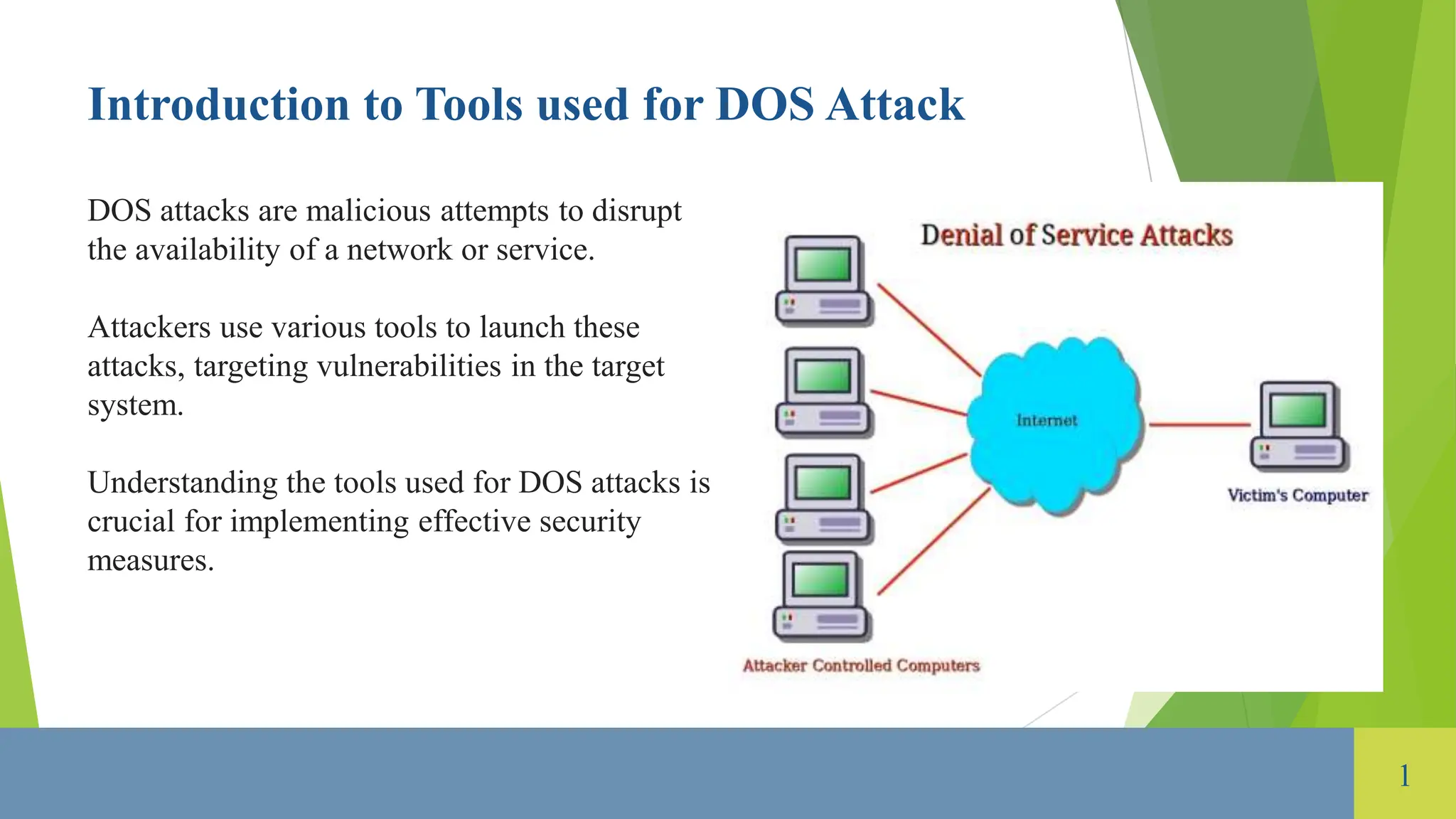
DOS attacks are malicious attempts to disrupt
the availability of a network or service.
Attackers use various tools to launch these
attacks, targeting vulnerabilities in the target
system.
Understanding the tools used for DOS attacks is
crucial for implementing effective security
measures.
Types of DOS attack
Volume Based Attacks . Includes UDP floods, ICMP
floods, and BPS(bits per second),GBPS(Giga bits per
second),spoofed-packet floods
Protocol Attacks . Includes SYN floods, fragmented
packet attacks, Ping of Death, Smurf DDoS, and
Packets per second(PPS)
Application Layer requests per second
Mainly dos attack are common in application layer,
Presentation layer , Transport layer and Network layer
2
LOIC (Low Orbit Ion Cannon)
LOIC is a widely used tool for DOS attacks.
It allows attackers to flood a target system with
a high volume of traffic.
Attackers can use LOIC to coordinate attacks
by connecting to a command and control server.
3
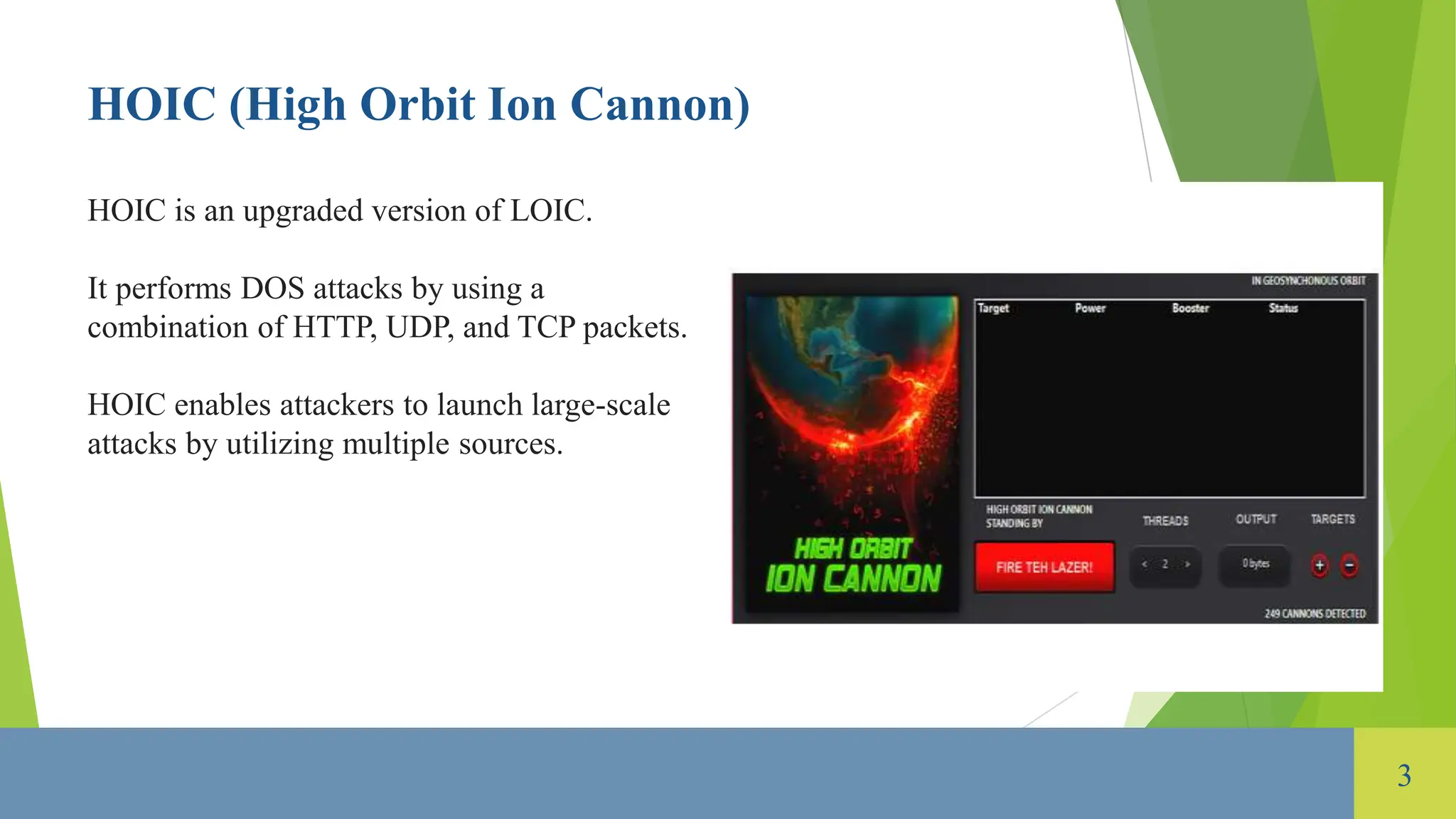
HOIC (High Orbit Ion Cannon)
HOIC is an upgraded version of LOIC.
It performs DOS attacks by using a
combination of HTTP, UDP, and TCP packets.
HOIC enables attackers to launch large-scale
attacks by utilizing multiple sources.
4
Slowloris
Slowloris is a tool that exploits the way web
servers handle concurrent connections.
It sends partial HTTP requests to the target
server and keeps them open for as long as
possible.
Slowloris exhausts the server's resources,
causing it to be unresponsive to legitimate
requests.
5
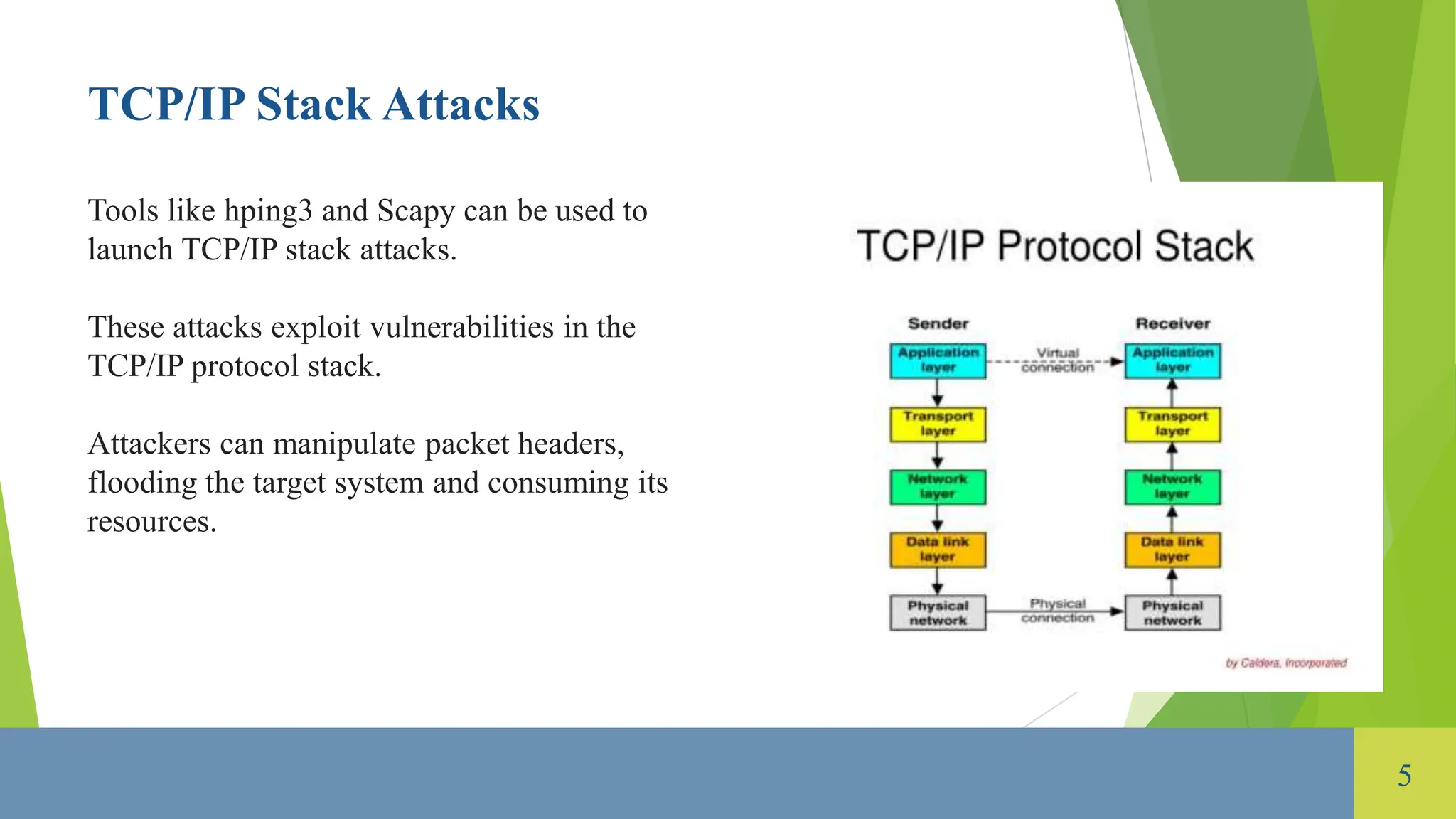
TCP/IP Stack Attacks
Tools like hping3 and Scapy can be used to
launch TCP/IP stack attacks.
These attacks exploit vulnerabilities in the
TCP/IP protocol stack.
Attackers can manipulate packet headers,
flooding the target system and consuming its
resources.
6
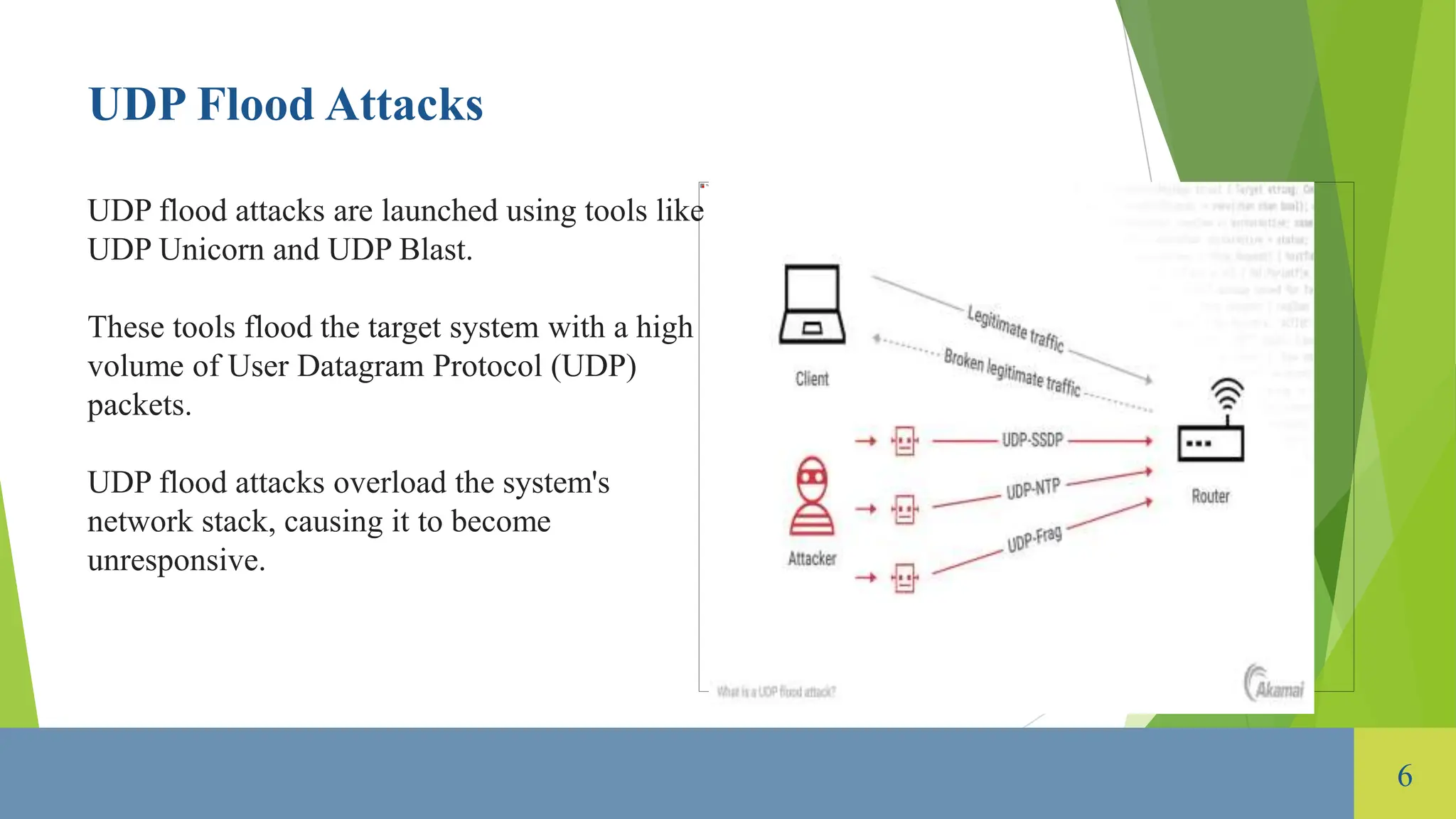
UDP Flood Attacks
UDP flood attacks are launched using tools like
UDP Unicorn and UDP Blast.
These tools flood the target system with a high
volume of User Datagram Protocol (UDP)
packets.
UDP flood attacks overload the system's
network stack, causing it to become
unresponsive.
7
ICMP Flood Attacks
ICMP flood attacks utilize tools like Ping of
Death and Smurf Attack.
These attacks send a large number of ICMP
Echo Request packets to the target system.
ICMP flood attacks can consume the target
system's bandwidth and processing power.
8
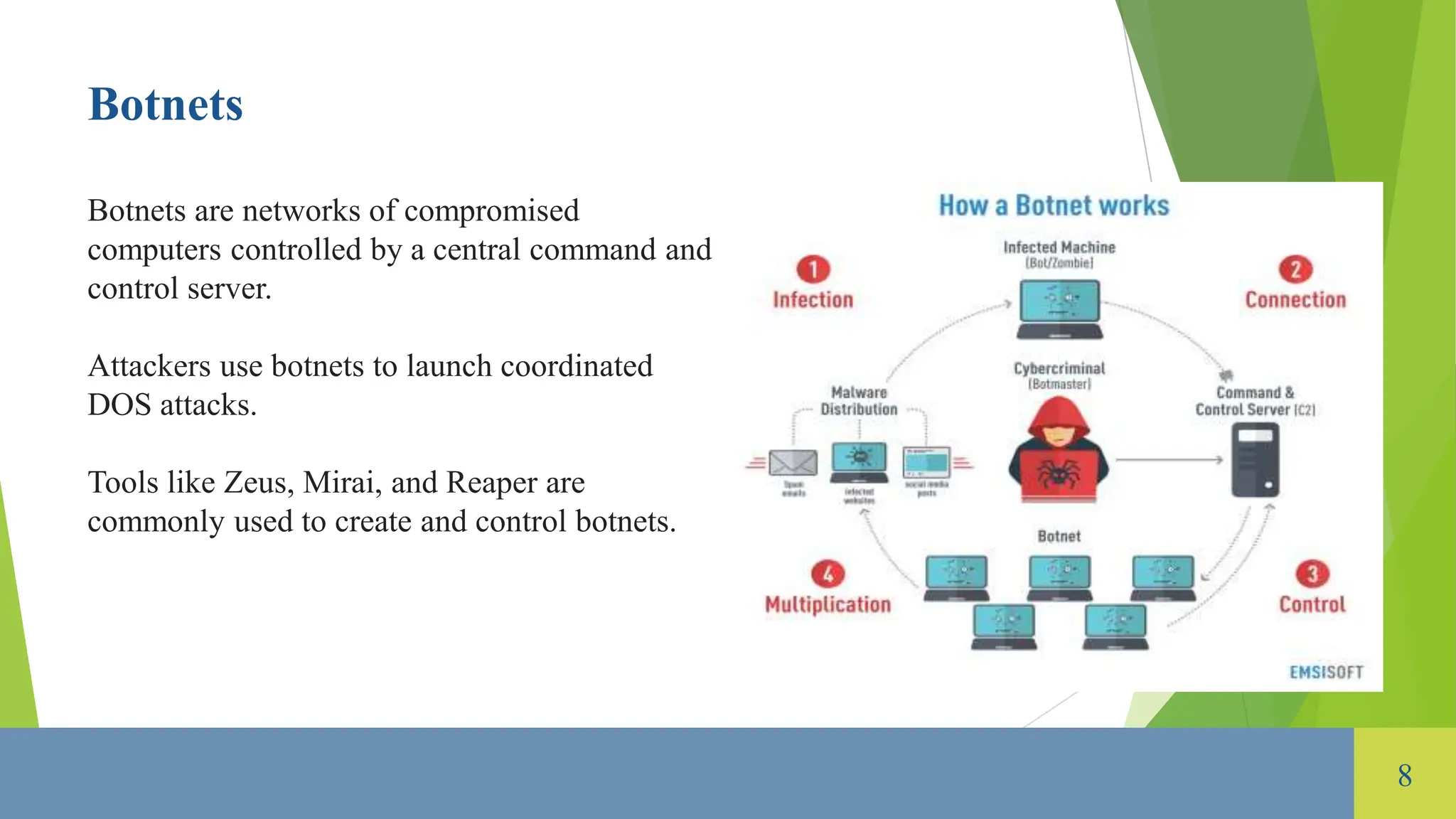
Botnets
Botnets are networks of compromised
computers controlled by a central command and
control server.
Attackers use botnets to launch coordinated
DOS attacks.
Tools like Zeus, Mirai, and Reaper are
commonly used to create and control botnets.
9
Reflection/Amplification Attacks
Reflection/Amplification attacks exploit
vulnerabilities in certain network protocols.
Tools like DNS Amplification, NTP
Amplification, and SSDPAmplification are
used for these attacks.
Attackers spoof the IP address of the target
system, causing it to receive amplified traffic
from multiple sources.
10
Defense Mechanisms
Implementing proper network security
measures can help mitigate DOS attacks.
Intrusion Prevention Systems (IPS) and
Firewalls can detect and block DOS attacks.
Regular security audits and patches can help
identify and fix vulnerabilities that could be
exploited.
VIDEO ON DOS AND DDOS ATTACK
TEAM MEMBERS
Muppuri Vyshnavi Joshitha
M Charani
Nidhi D Gowda
Monika T S
TOO;S USED IN DOS AND DDOS ATTACK12.pptx

TOO;S USED IN DOS AND DDOS ATTACK12.pptx

  • 1.
    Tools Used ForDOS Attack
  • 2.
    1 Introduction to Toolsused for DOS Attack DOS attacks are malicious attempts to disrupt the availability of a network or service. Attackers use various tools to launch these attacks, targeting vulnerabilities in the target system. Understanding the tools used for DOS attacks is crucial for implementing effective security measures.
  • 3.
    Types of DOSattack Volume Based Attacks . Includes UDP floods, ICMP floods, and BPS(bits per second),GBPS(Giga bits per second),spoofed-packet floods Protocol Attacks . Includes SYN floods, fragmented packet attacks, Ping of Death, Smurf DDoS, and Packets per second(PPS) Application Layer requests per second Mainly dos attack are common in application layer, Presentation layer , Transport layer and Network layer
  • 4.
    2 LOIC (Low OrbitIon Cannon) LOIC is a widely used tool for DOS attacks. It allows attackers to flood a target system with a high volume of traffic. Attackers can use LOIC to coordinate attacks by connecting to a command and control server.
  • 5.
    3 HOIC (High OrbitIon Cannon) HOIC is an upgraded version of LOIC. It performs DOS attacks by using a combination of HTTP, UDP, and TCP packets. HOIC enables attackers to launch large-scale attacks by utilizing multiple sources.
  • 6.
    4 Slowloris Slowloris is atool that exploits the way web servers handle concurrent connections. It sends partial HTTP requests to the target server and keeps them open for as long as possible. Slowloris exhausts the server's resources, causing it to be unresponsive to legitimate requests.
  • 7.
    5 TCP/IP Stack Attacks Toolslike hping3 and Scapy can be used to launch TCP/IP stack attacks. These attacks exploit vulnerabilities in the TCP/IP protocol stack. Attackers can manipulate packet headers, flooding the target system and consuming its resources.
  • 8.
    6 UDP Flood Attacks UDPflood attacks are launched using tools like UDP Unicorn and UDP Blast. These tools flood the target system with a high volume of User Datagram Protocol (UDP) packets. UDP flood attacks overload the system's network stack, causing it to become unresponsive.
  • 9.
    7 ICMP Flood Attacks ICMPflood attacks utilize tools like Ping of Death and Smurf Attack. These attacks send a large number of ICMP Echo Request packets to the target system. ICMP flood attacks can consume the target system's bandwidth and processing power.
  • 10.
    8 Botnets Botnets are networksof compromised computers controlled by a central command and control server. Attackers use botnets to launch coordinated DOS attacks. Tools like Zeus, Mirai, and Reaper are commonly used to create and control botnets.
  • 11.
    9 Reflection/Amplification Attacks Reflection/Amplification attacksexploit vulnerabilities in certain network protocols. Tools like DNS Amplification, NTP Amplification, and SSDPAmplification are used for these attacks. Attackers spoof the IP address of the target system, causing it to receive amplified traffic from multiple sources.
  • 12.
    10 Defense Mechanisms Implementing propernetwork security measures can help mitigate DOS attacks. Intrusion Prevention Systems (IPS) and Firewalls can detect and block DOS attacks. Regular security audits and patches can help identify and fix vulnerabilities that could be exploited.
  • 13.
    VIDEO ON DOSAND DDOS ATTACK
  • 14.
    TEAM MEMBERS Muppuri VyshnaviJoshitha M Charani Nidhi D Gowda Monika T S

Editor's Notes

  • #3 Image source: https://computersecuritypgp.blogspot.com/2016/01/different-types-of-dos-attacks.html
  • #5 Image source: https://www.androidout.com/item/android-apps/455042/loic-low-orbit-ion-cannon/
  • #6 Image source: https://www.wallarm.com/what/what-is-high-orbit-ion-cannon-hoic
  • #7 Image source: https://barcelonageeks.com/herramienta-de-ataque-slowloris-ddos-en-kali-linux/
  • #8 Image source: http://www.slideserve.com/cholena/building-tcp
  • #9 Image source: https://www.researchgate.net/figure/UDP-Flooding-attack_fig1_327036867
  • #10 Image source: https://intellipaat.com/blog/what-is-icmp/
  • #11 Image source: https://www.emsisoft.com/en/blog/27233/what-is-a-botnet/
  • #12 Image source: https://blog.sayan.page/dns-amplification-go/
  • #13 Image source: https://www.pinterest.es/pin/307792955777164527/