Designed by Made possible by
AMANI INSTITUE
The Amani Institute partners with leading NGOs, corporations and universities to prepare a new generation of
leaders tackling the world’s toughest problems. These issues call upon problem-solvers to submit their whole
being in the service of creating sustainable change. We develop individuals who have the knowledge, practical
skills, innovation ability, courage, and networks to take leadership roles in facing these challenges.
More information at: www.amaniinstitute.org
CISP
CISP's aims and objectives are related to the implementation of humanitarian, rehabilitation and development
projects in developing countries. In Italy and Europe CISP's work focuses mainly on awareness campaigns, train-
ing and information programs, the fight against social exclusion and racism, and educational campaigns on devel-
opment and intercultural realities. CISP aims at implementing the necessary conditions for development and
self-determination of people, at spreading and respecting human rights, and at satisfying people's basic needs.
More information at: www.cisp-som.org
The Organizations
The Process of Social Innovation how to create solutions for social change 03
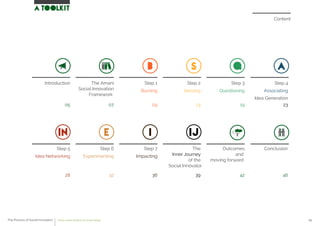
The
Inner Journey
of the
Social Innovator
Step 5
Idea Networking
Step 6
Experimenting
Step 7
Impacting
ConclusionOutcomes
and
moving forward
Step 1
Burning
Step 2
Sensing
Step 3
Questioning
Step 4
Associating
Idea Generation
The Amani
Social Innovation
Framework
Introduction
05 07 09 13 19 23
28 32 36 39 42 46
Content
The Process of Social Innovation how to create solutions for social change 04
Introduction
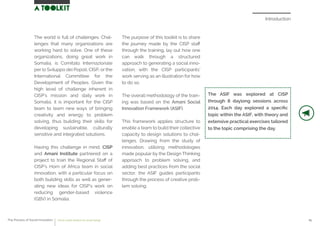
The ASIF was explored at CISP
through 8 daylong sessions across
2014. Each day explored a specific
topic within the ASIF, with theory and
extensive practical exercises tailored
to the topic comprising the day.
The world is full of challenges. Chal-
lenges that many organizations are
working hard to solve. One of these
organizations, doing great work in
Somalia, is Comitato Internazionale
per lo Sviluppo dei Popoli, CISP, or the
International Committee for the
Development of Peoples. Given the
high level of challenge inherent in
CISP’s mission and daily work in
Somalia, it is important for the CISP
team to learn new ways of bringing
creativity and energy to problem
solving, thus building their skills for
developing sustainable, culturally
sensitive and integrated solutions.
Having this challenge in mind, CISP
and Amani Institute partnered on a
project to train the Regional Staff of
CISP’s Horn of Africa team in social
innovation, with a particular focus on
both building skills as well as gener-
ating new ideas for CISP’s work on
reducing gender-based violence
(GBV) in Somalia.
The purpose of this toolkit is to share
the journey made by the CISP staff
through the training, lay out how one
can walk through a structured
approach to generating a social inno-
vation, with the CISP participants’
work serving as an illustration for how
to do so.
The overall methodology of the train-
ing was based on the Amani Social
Innovation Framework (ASIF).
This framework applies structure to
enable a team to build their collective
capacity to design solutions to chal-
lenges. Drawing from the study of
innovation, utilizing methodologies
made popular by the Design Thinking
approach to problem solving, and
adding best practices from the social
sector, the ASIF guides participants
through the process of creative prob-
lem solving.
The Process of Social Innovation how to create solutions for social change 05
Introduction
Since one of the key elements of
innovation is bringing together ideas
and elements from different sources
and applying them towards your
challenge, the training program con-
sciously sought to include perspec-
tives and methodologies from other
practitioners so that the CISP partici-
pants would have a rich set of influ-
ences to bring together.
As a result, the program included a
diverse array of guest speakers.
These were:
- Sean Brooks, United States Depart-
ment of State, an expert on Somalia
- Muna Abdillahi, UNICEF, an expert
on gender and Somalia
- Michele Leone, IDRC an expert on
donor funding and innovation
- Shilpa Shah, Co-Founder of Inside
Out Consultancy, who led a workshop
on Idea Generation using the Disney
approach
- Sitawa Namwalie, a poet and activ-
ist, who led a session on art and crea-
tivity.
We hope that readers will find this a
useful tool in their own work going
forward.
The Amani Institute
The Process of Social Innovation how to create solutions for social change 06
http://bit.ly/1DU3eWU
Click here towatch avideo about the 7 steps oftheASIF
The Amani
Social Innovation
Framework
A NEW MINDSET
The great writer Marcel Proust once said, “The real act
of discovering consists not in finding new lands, but
seeing with new eyes”. This is the perfect approach for
social innovation. Even if we are already familiar with
the community in which we are working, or feel like we
are very knowledgeable about the problem, we can
adopt a new mindset and try to look at the situation
differently. This is called having a “Beginner’s Mind” - it
is central to innovation.
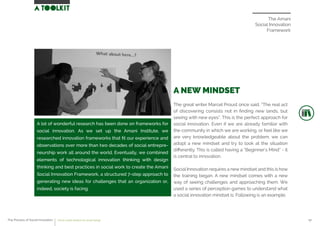
Social Innovation requires a new mindset and this is how
the training began. A new mindset comes with a new
way of seeing challenges and approaching them. We
used a series of perception games to understand what
a social innovation mindset is. Following is an example.
A lot of wonderful research has been done on frameworks for
social innovation. As we set up the Amani Institute, we
researched innovation frameworks that fit our experience and
observations over more than two decades of social entrepre-
neurship work all around the world. Eventually, we combined
elements of technological innovation thinking with design
thinking and best practices in social work to create the Amani
Social Innovation Framework, a structured 7-step approach to
generating new ideas for challenges that an organization or,
indeed, society is facing.
The Process of Social Innovation how to create solutions for social change 07
The Amani
Social Innovation
Framework
Solution
(Turn the page upside down)
If you want to develop an innovator’s mindset, keep reading as we get to the ASIF!
TIP
Doing perception games daily will
help you to develop your innovation
mindset!
Resources
Watch the Monkey Business Illusion
video by Christopher Chabris and
Daniel Simons http://bit.ly/1lLV6z1
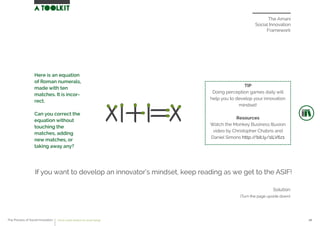
Here is an equation
of Roman numerals,
made with ten
matches. It is incor-
rect.
Can you correct the
equation without
touching the
matches, adding
new matches, or
taking away any?
The Process of Social Innovation how to create solutions for social change 08
Burning
SELF-AWARENESS
CLAY EXERCISE
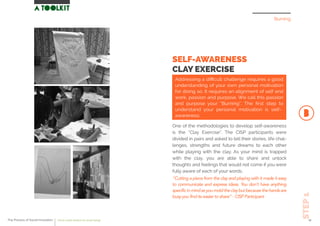
One of the methodologies to develop self-awareness
is the “Clay Exercise”. The CISP participants were
divided in pairs and asked to tell their stories, life chal-
lenges, strengths and future dreams to each other
while playing with the clay. As your mind is trapped
with the clay, you are able to share and unlock
thoughts and feelings that would not come if you were
fully aware of each of your words.
“Cutting a piece from the clay and playing with it made it easy
to communicate and express ideas. You don’t have anything
specificinmindasyoumoldtheclaybutbecausethehandsare
busy you find its easier to share” - CISP Participant
STEP1
Addressing a difficult challenge requires a good
understanding of your own personal motivation
for doing so. It requires an alignment of self and
work, passion and purpose. We call this passion
and purpose your “Burning”. The first step to
understand your personal motivation is self-
awareness.
The Process of Social Innovation how to create solutions for social change 10
To dig deeper into the burning we asked the participants to
remember a moment in their professional life when they felt
happy and fulfilled. While sharing this, people are able to realize
their burning.
Here a quote from one of the participants from Somalia
“(I felt burning) in 2008 during the big drought. Most of the
livestock had died. We were helping the community with
livelihood creation. I wondered how helpful we actually
were. Two years later I was in a remote area. We had a flat
tire and a lady came to greet us. Her family had 22 goats,
they were very happy and I was happy because I knew it was
a result of the project two years ago.”
Burning
STEP1
Do you want to know how to convert that burning into action? Keep reading!
TIP
If you haven’t done it recently, ask
yourself what matters to you, what
are the injustices in the world that you
don’t want to exist anymore. What
makes you burn?
Resources
Watch this TED talk by Jessica Jack-
ley from KIVA. Is she burning?
http://bit.ly/1tAB1Dt
The Process of Social Innovation how to create solutions for social change 11
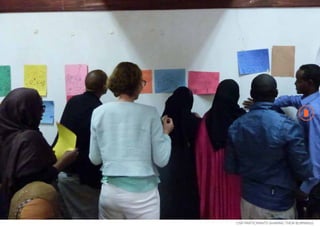
CISP PARTICIPANTS SHARING THEIR BURNINGS
Sensing
PROBLEM FINDING
ROOT CAUSE ANALYSIS
But what do we want to ‘sense’? In the former chapter
you discovered your burning as the participants in the
STEP2
Borrowing from design thinking, social innovation
requires that we use all our senses to engage in
“problem-finding.” This is a process of gathering as
much information as possible about the challenge
from as many available sources as possible, both
online and in-person. Specifically, it means talking to
different stakeholders about the problem, as well as
talking with non-stakeholders to get an “outsider
view”. In many cases, you may want to put yourself
in a position to experience the challenge firsthand,
which most of the participants in the workshop had
done, simply through daily life in Somalia.
The Process of Social Innovation how to create solutions for social change 14
Sensing
STEP2
workshop did. That burning
has the form of a challenge.
In the case of the CISP staff
the challenge they were
burning to solve was Gender
Based Violence (GVB) in
Somalia.
In order to understand the
challenge better, one good
tool is Root Cause Analysis.
Here is how it works.
First, write down your prob-
lem statement. Done?
Second, think about what
causes this problem. What is
the true reason we have this
situation? What are the
causes of the problem you
are addressing? Good. Now,
finally, think about all the
consequences of this prob-
lem. What are the negative
and positive impacts this
problem has? Think deeply
about this. Go beyond the
obvious issues and take
them to their logical conclu-
sion.
It may be useful to approach
this exercise conceptually
by drawing a tree with the
Problem as the Trunk of the
tree, the Causes as the
Roots of the tree, and the
Consequences as the
Branches.
The Root Cause Analysis is
not the only way to under-
stand a problem. Another
popular method is the “Five
Whys” exercise.
In this exercise, you state the
problem and then ask “Why
is this so?” five times to get
to the true root of the prob-
lem. It is important to com-
plete this exercise 2-3 times
so you can uncover several
roots of the problem and not
just the first set of roots.
Both of these approaches
ultimately lead to a way of
thinking and a critical mind-
set for innovators of all kinds,
whether a social or a busi-
ness innovator. This is known
as “Problem Finding” as
opposed to Problem Solving.
Problem Finding is very
important in innovation
because it is often the case
that the stated problem is
not in fact the real problem
that needs to be solved.
One of the most famous
examples of this mindset
comes from Henry Ford,
who invented the modern
automobile.
He famously said,
“If I had asked my
customers what they
wanted, I would have
designed a faster horse”.
The Process of Social Innovation how to create solutions for social change 15
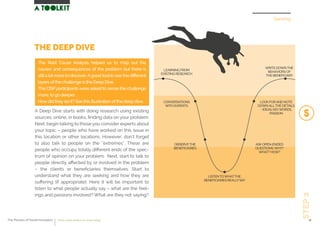
LEARNING FROM
EXISTING RESEARCH
CONVERSATIONS
WITH EXPERTS
LISTENTOWHATTHE
BENEFICIARIES REALLYSAY
WRITE DOWNTHE
BEHAVIORS OF
THE BENEFICIARY
ASKOPEN-ENDED
QUESTIONS:WHY?
WHAT? HOW?
LOOKFORAND NOTE
DOWNALLTHE DETAILS
- IDEAS, KEYWORDS,
PASSION
OBSERVETHE
BENEFICIARIES
Sensing
STEP2
THE DEEP DIVE
A Deep Dive starts with doing research using existing
sources: online, in books, finding data on your problem.
Next, begin talking to those you consider experts about
your topic – people who have worked on this issue in
this location or other locations. However, don’t forget
to also talk to people on the “extremes". These are
people who occupy totally different ends of the spec-
trum of opinion on your problem. Next, start to talk to
people directly affected by or involved in the problem
– the clients or beneficiaries themselves. Start to
understand what they are seeking and how they are
suffering (if appropriate). Here it will be important to
listen to what people actually say – what are the feel-
ings and passions involved? What are they not saying?
The Root Cause Analysis helped us to map out the
causes and consequences of the problem but there is
stillalotmoretodiscover.Agoodtooltoseethedifferent
layers ofthe challenge is the Deep Dive.
The CISPparticipantswere asked to sense the challenge
more, to go deeper.
Howdid theydo it? See this illustration ofthe deep dive.
The Process of Social Innovation how to create solutions for social change 16
TIP
Sensing is an ongoing step. Keep
sensing during the planning, execu-
tion and evaluation of your social
innovation! A good innovator never
stops sensing.
Resources
Watch David Kelley’s TED Talk about
building your creative confidence to
see an example of sensing directly
with the user.
http://bit.ly/1fWl1G6
Sensing
STEP2
To get at this type of understanding, it is wise to ask
“open-ended questions” such as questions that begin
with “Why” or “How” or “What do you think about…”
Avoid asking questions with Yes/No answers or
answers with just one or two words. It will also be
important to observe people. Do not talk to them, just
observe them in action. Remember that actions speak
much louder than words.
Don’t forget to document everything you are hearing
and seeing. Capture the details. Focus on emotions
expressed, both positive and negative. On ideas and
dreams and aspirations of people.
Do you want to know what to do with all the information found during the deep dive? Keep reading!
The Process of Social Innovation how to create solutions for social change 17
INSIGHTS BRAINSTORMING
Questioning
REFRAMING
HOW MIGHT WE? QUESTIONS
Often when we are given a problem to solve, it is not
the true problem that needs to be solved. For innova-
tion, we need to think deeper about what this true
problem might be. Let’s now walk through how to go
about reframing the problem you are out to solve.
First, a quick look at the relationship between Informa-
tion, Insights and Ideas. It works in a triangle. Informa-
tion leads to Insights, which lead to new Ideas. Let’s go
through this systematically.
STEP3
One of the most distinguishing behaviors of innova-
tors is asking the right questions—questions others
are not asking. It isn’t easy to find the root of the
problem (and you always wonder if you are really at
the root), but asking questions and reframing the
problem is a good way to look for alternatives.
The Process of Social Innovation how to create solutions for social change 20
Questioning
STEP3
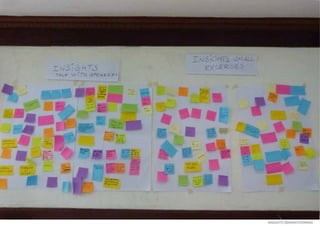
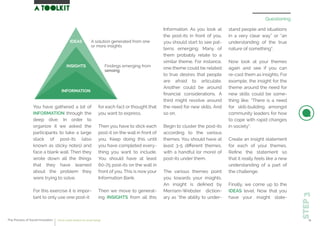
You have gathered a lot of
INFORMATION through the
deep dive. In order to
organize it we asked the
participants to take a large
stack of post-its (also
known as sticky notes) and
face a blank wall. Then they
wrote down all the things
that they have learned
about the problem they
were trying to solve.
For this exercise it is impor-
tant to only use one post-it
for each fact or thought that
you want to express.
Then you have to stick each
post-it on the wall in front of
you. Keep doing this until
you have completed every-
thing you want to include.
You should have at least
60-75 post-its on the wall in
front of you. This is now your
Information Bank.
Then we move to generat-
ing INSIGHTS from all this
Information. As you look at
the post-its in front of you,
you should start to see pat-
terns emerging. Many of
them probably relate to a
similar theme. For instance,
one theme could be related
to true desires that people
are afraid to articulate.
Another could be around
financial considerations. A
third might revolve around
the need for new skills. And
so on.
Begin to cluster the post-its
according to the various
themes. You should have at
least 3-5 different themes,
with a handful (or more) of
post-its under them.
The various themes point
you towards your insights.
An insight is defined by
Merriam-Webster diction-
ary as “the ability to under-
stand people and situations
in a very clear way” or “an
understanding of the true
nature of something”.
Now look at your themes
again and see if you can
re-cast them as insights. For
example, the insight for the
theme around the need for
new skills could be some-
thing like: “There is a need
for skill-building amongst
community leaders for how
to cope with rapid changes
in society”.
Create an insight statement
for each of your themes.
Refine the statement so
that it really feels like a new
understanding of a part of
the challenge.
Finally, we come up to the
IDEAS level. Now that you
have your insight state-
INFORMATION
INSIGHTS
IDEAS A solution generated from one
or more insights
Findings emerging from
sensing
The Process of Social Innovation how to create solutions for social change 21
Questioning
STEP3
ments, consider each of them in turn. Also think back to
your Root Cause Analysis and what that uncovered.
What new understanding are you coming to about
your problem? Think hard. What is truly at work here?
Re-write your new understanding as a Problem state-
ment, starting with the words, “How Might We”?
Congratulations, you have just re-framed your prob-
lem. Now, we can start to move towards the Solution!
After these exercises, the participants of the CISP train-
ing reframed the challenge of reducing GBV in Somalia
to the following three ‘How Might We’ questions:
- How might we create more collaborative relation-
ships between the two genders in a family?
- How might we bring access to legal solutions for
GBV in remote communities?
- How can schools be examples of inclusivity for all
children?
Do you want to know what to do with the reframed challenge? Keep reading!
TIP
Reframing the problem is a critical
step! It is also not easy to do. We
recommend you do this with plenty of
time and in a nice, creative, work-
space!
Resources
Here is an interesting tool from
THNK.org to help you reframe your
problem: http://reframe.thnk.org/
The Process of Social Innovation how to create solutions for social change 22
Associating
STEP4
ASSOCIATING
IDEA CASINO
Associating is a way to start thinking about creative
solutions to solve your challenge. We are better able to
associate when we interact in different spaces, do a
variety of activities and talk with very diverse people.
The more diverse set of things we have to associate
with, the more we are going to be able to come up with
new solutions for our reframed challenges.
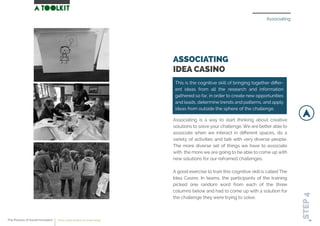
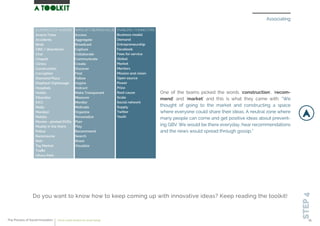
A good exercise to train this cognitive skill is called The
Idea Casino. In teams, the participants of the training
picked one random word from each of the three
columns below and had to come up with a solution for
the challenge they were trying to solve.
This is the cognitive skill of bringing together differ-
ent ideas from all the research and information
gathered so far, in order to create new opportunities
and leads, determine trends and patterns, and apply
ideas from outside the sphere of the challenge.
The Process of Social Innovation how to create solutions for social change 24
Associating
STEP4
One of the teams picked the words ‘construction’, ‘recom-
mend’ and ‘market’ and this is what they came with: “We
thought of going to the market and constructing a space
where everyone could share their ideas. A neutral zone where
many people can come and get positive ideas about prevent-
ing GBV. We would be there everyday, hear recommendations
and the news would spread through gossip.”
Do you want to know how to keep coming up with innovative ideas? Keep reading the toolkit!
ELEMENTS OF NAIROBI
Acacia Trees
Accidents
Birds
CBD / downtown
Chai
Chapati
Clinics
Construction
Corruption
Diamond Plaza
Elephant Orphanage
Hospitals
Hotels
Kibandas
KICC
Malls
Mandazi
Matatu
Movies - pirated DVDs
Muddy in the Rains
Police
Racecourse
Rain
Toy Market
Traffic
Uhuru Park
WAYSOFCREATINGVALUE
Access
Aggregate
Broadcast
Capture
Collaborate
Communicate
Create
Discover
Find
Follow
Inspire
Instruct
Make Transparent
Measure
Monitor
Motivate
Organize
Personalize
Plan
Play
Recommend
Search
Share
Visualize
ENABLERS/CONNECTORS
Business model
Demand
Entrepreneurship
Facebook
Fees for service
Global
Market
Mentors
Mission and vision
Open source
Power
Price
Root cause
Scale
Social network
Supply
Twitter
Youth
The Process of Social Innovation how to create solutions for social change 25
Associating
STEP4
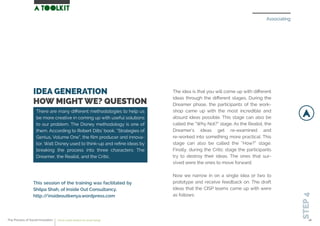
IDEA GENERATION
HOW MIGHT WE? QUESTION
The idea is that you will come up with different
ideas through the different stages. During the
Dreamer phase, the participants of the work-
shop came up with the most incredible and
absurd ideas possible. This stage can also be
called the “Why Not?” stage. As the Realist, the
Dreamer’s ideas get re-examined and
re-worked into something more practical. This
stage can also be called the “How?” stage.
Finally, during the Critic stage the participants
try to destroy their ideas. The ones that sur-
vived were the ones to move forward.
Now we narrow in on a single idea or two to
prototype and receive feedback on. The draft
ideas that the CISP teams came up with were
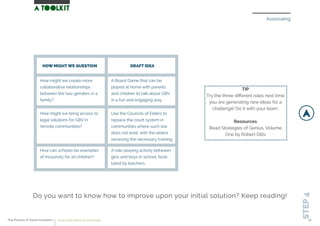
as follows:
This session of the training was facilitated by
Shilpa Shah, of Inside Out Consultancy.
http://insideoutkenya.wordpress.com
There are many different methodologies to help us
be more creative in coming up with useful solutions
to our problem. The Disney methodology is one of
them. According to Robert Dilts’ book, “Strategies of
Genius, Volume One”, the film producer and innova-
tor, Walt Disney used to think-up and refine ideas by
breaking the process into three characters: The
Dreamer, the Realist, and the Critic.
The Process of Social Innovation how to create solutions for social change 26
Do you want to know how to improve upon your initial solution? Keep reading!
Associating
STEP4
How might we create more
collaborative relationships
between the two genders in a
family?
A Board Game that can be
played at home with parents
and children to talk about GBV
in a fun and engaging way.
Use the Councils of Elders to
replace the court system in
communities where such law
does not exist, with the elders
receiving the necessary training.
A role-playing activity between
girls and boys in school, facili-
tated by teachers.
How might we bring access to
legal solutions for GBV in
remote communities?
How can schools be examples
of inclusivity for all children?
HOW MIGHT WE QUESTION DRAFT IDEA
TIP
Try the three different roles next time
you are generating new ideas for a
challenge! Do it with your team.
Resources
Read Strategies of Genius, Volume
One by Robert Dilts
The Process of Social Innovation how to create solutions for social change 27
Idea networking
STEP5
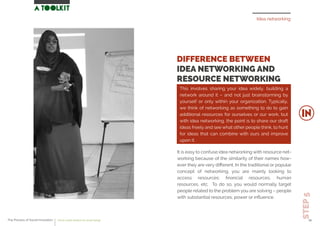
DIFFERENCE BETWEEN
IDEA NETWORKING AND
RESOURCE NETWORKING
It is easy to confuse idea networking with resource net-
working because of the similarity of their names how-
ever they are very different. In the traditional or popular
concept of networking, you are mainly looking to
access resources: financial resources, human
resources, etc. To do so, you would normally target
people related to the problem you are solving – people
with substantial resources, power or influence.
This involves sharing your idea widely, building a
network around it – and not just brainstorming by
yourself or only within your organization. Typically,
we think of networking as something to do to gain
additional resources for ourselves or our work, but
with idea networking, the point is to share our draft
ideas freely and see what other people think, to hunt
for ideas that can combine with ours and improve
upon it.
The Process of Social Innovation how to create solutions for social change 29
TIP
During this session with CISP one of
the main topics that came up was to
idea network inside your own organi-
zation. Many times we don’t share
enough with our colleagues or man-
agers. We encourage you to do it!
Their perspectives will be useful.
Resources
“Conclusion: The Fourth Quadrant”
from Where Good Ideas Come From:
The Natural History of Innovation by
Steven Johnson.
Do you want to know how to be sure you are on the right track with your solution? Keep reading!
STEP5
When you are idea net-
working your aim is not to
look for resources, but to
learn new things, gain new
perspectives, and get
inspired.
During the idea networking
process, you want to
discuss your initial ideas to
solve the problem and
receive feedback.
For this to be successful
you should talk with people
who are not like you, that
can contribute other points
of view or ways of thinking.
You should discuss with
experts and non-experts
from very different fields
and backgrounds.
Here are some of the tips
we shared with the partici-
pants on how to idea net-
work:
Build a bridge to different
groups to access different
ideas
Attend events, happy
hours, and conferences
within different networks
than yours
Talk with people who have
a very different way of
thinking than you - from
diverse backgrounds, eth-
nicities or religions. The
most unexpected conver-
sations can bring new, inter-
esting insights.
When talking with people,
let them do most of the
talking. Be open to listen to
different perspectives.
Sharing the
problem and
initial ideas with
very diverse
people will
provide you with
new insights and
perspectives that
you and the
stakeholders
were perhaps not
able to see.
Not all of the
conversations will
be useful, but
some of them will
provide you with
valuable new
insights to help
solve the prob-
lem you are
addressing.
The Process of Social Innovation how to create solutions for social change 30
GAINING NEW PERSPECTIVES
Experimenting
STEP6
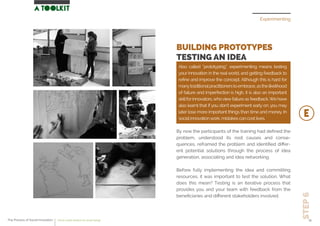
BUILDING PROTOTYPES
TESTING AN IDEA
By now the participants of the training had defined the
problem, understood its root causes and conse-
quences, reframed the problem and identified differ-
ent potential solutions through the process of idea
generation, associating and idea networking.
Before fully implementing the idea and committing
resources, it was important to test the solution. What
does this mean? Testing is an iterative process that
provides you and your team with feedback from the
beneficiaries and different stakeholders involved.
Also called “prototyping”, experimenting means testing
your innovation in the realworld, and getting feedback to
refine and improve the concept. Although this is hard for
manytraditionalpractitionerstoembrace,asthelikelihood
of failure and imperfection is high, it is also an important
skillforinnovators,whoviewfailure as feedback.We have
also learnt that if you don’t experiment early on, you may
later lose more important things than time and money. In
socialinnovationwork, mistakes can cost lives.
The Process of Social Innovation how to create solutions for social change 33
1 TEN TOOLS FOR DESIGN THINKING, Darden Business Publishing, University of Virginia, UVA-BP-0550
The best way to test an idea
is through the building of a
prototype. A prototype can
be a sketch, model, or a
pilot. It is a way to convey an
idea quickly. The purpose of
prototyping is to create
something quickly that can
then be tested with benefi-
ciaries. By making abstract
new ideas tangible to poten-
tial stakeholders and benefi-
ciaries, you can better facili-
tate meaningful conversa-
tions and feedback about
them.
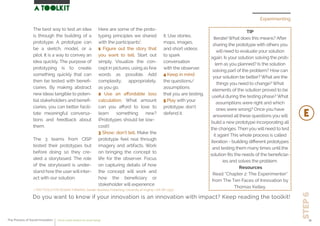
The 3 teams from CISP
tested their prototypes but
before doing so they cre-
ated a storyboard. The role
of the storyboard is under-
stand how the user will inter-
act with our solution.
Here are some of the proto-
typing principles we shared
with the participants :
1 Figure out the story that
you want to tell. Start out
simply. Visualize the con-
cept in pictures, using as few
words as possible. Add
complexity, appropriately,
as you go.
2 Use an affordable loss
calculation. What amount
can you afford to lose to
learn something new?
(Prototypes should be low-
cost!)
3 Show; don’t tell. Make the
prototype feel real through
imagery and artifacts. Work
on bringing the concept to
life for the observer. Focus
on capturing details of how
the concept will work and
how the beneficiary or
stakeholder will experience
it. Use stories,
maps, images,
and short videos
to spark
conversation
with the observer.
4 Keep in mind
the questions/
assumptions
that you are testing.
5 Play with your
prototype; don’t
defend it.
TIP
Iterate! What does this means? After
sharing the prototype with others you
will need to evaluate your solution
again. Is your solution solving the prob-
lem as you planned? Is the solution
solving part of the problem? How can
your solution be better? What are the
things you need to change? What
elements of the solution proved to be
useful during the testing phase? What
assumptions were right and which
ones were wrong? Once you have
answered all these questions you will
build a new prototype incorporating all
the changes. Then you will need to test
it again! This whole process is called
iteration - building different prototypes
and testing them many times until the
solution fits the needs of the beneficiar-
ies and solves the problem.
Resources
Read “Chapter 2: The Experimenter”
from The Ten Faces of Innovation by
Thomas Kelley.
Do you want to know if your innovation is an innovation with impact? Keep reading the toolkit!
Experimenting
STEP6
1
The Process of Social Innovation how to create solutions for social change 34
THE EXPERIMENTERS
Impacting
STEP7
IMPACTING
A GENUINE NEED
The innovation you are bringing to the world should
have an impact, should be based on a genuine need.
How can we be sure we are creating something that is
making a difference? There are three important ques-
tions that we asked the participants of the training to
think about:
Social innovation doesn’t end with the manifestation
of an idea; it needs to have impact. Every innovator
knows that there are more challenges in executing
an idea than in generating one. Impacting means
refining the idea based on more user feedback, cre-
ating a baseline and evaluation mechanism to
respond to this feedback, and trying to scale what
works.
The Process of Social Innovation how to create solutions for social change 37
Impacting
STEP7
What metrics will
you use and how
will you know you
have succeeded?
How will you have
changed the life
of a beneficiary
/customer in 1
year and in 5
years?
How would the
world look like if
your innovation
works at scale?
TIP
Sometimes we are so busy with daily
tasks that we forget to take the bal-
cony view of our social innovation and
see the bigger impact that it is having.
Don’t forget to stop and enjoy the
social innovation from the balcony!
Resources
Read How to Change the World:
Social Entrepreneurship and the
Power of New Ideas by David Born-
stein. It has many wonderful stories of
social innovators across the world!
The Process of Social Innovation how to create solutions for social change 38
Inner journey
In order to connect the personal change we need to
make in ourselves with the change in the world we
would like to see, we need to understand why we do
what we do and who we are.
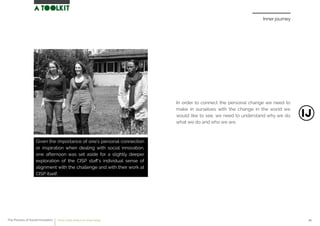
Given the importance of one’s personal connection
or inspiration when dealing with social innovation,
one afternoon was set aside for a slightly deeper
exploration of the CISP staff’s individual sense of
alignment with the challenge and with their work at
CISP itself.
The Process of Social Innovation how to create solutions for social change 40
Inner journey
To explore this further, the participants were asked to
explain in writing what they do for a living and why to the
following audiences:
· Their parents
· A child
· A friend from a different culture
· A potential beneficiary of their work
· Their future self at the end of their life.
Here are some of the reflections of the participants:
“Explainingtomyfutureselfwashardestasitrequiredgoingdeep.
It was very powerful going to that place because I imagined look-
ing back on my life and asking what I had done with it.”
“Oftentimes we have a lot of reasons for why we do things. It is
powerful to see what language and words I use when thinking. ”
“There are many things I could do out there. Telling myself ‘I want
todothis’insteadof‘Ihavetodothis’isverypowerfulbecauseyou
take more responsibility, and you could do the work with more
pleasure once you see you have a choice in what you do. Its like
choosing to fast during Ramadhan.”
Similar to this, the participants continued onto exercises
that explored their personal connection with the mission
and vision of CISP, and then the strengths and weak-
nesses in how they work together, particularly around
styles of communication and how things are received and
shared internally.
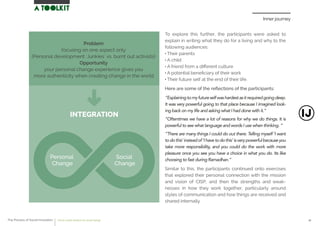
Problem
focusing on one aspect only
(Personal development ´Junkies´ vs. burnt out activists)
Opportunity
your personal change experience gives you
more authenticity when creating change in the world.
INTEGRATION
Personal
Change
Social
Change
The Process of Social Innovation how to create solutions for social change 41
Outcomes and Moving Forward
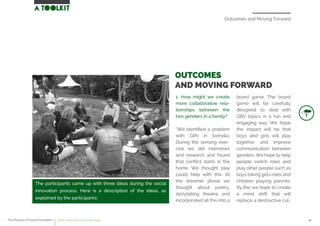
The participants came up with three ideas during the social
innovation process. Here is a description of the ideas, as
explained by the participants:
1. How might we create
more collaborative rela-
tionships between the
two genders in a family?
“We identified a problem
with GBV in Somalia.
During the sensing exer-
cise we did interviews
and research and found
that conflict starts in the
home. We thought play
could help with this. At
the dreamer phase we
thought about poetry,
storytelling, theatre, and
incorporated all this into a
board game. The board
game will be carefully
designed to deal with
GBV topics in a fun and
engaging way. We hope
the impact will be that
boys and girls will play
together and improve
communication between
genders. We hope to help
people switch roles and
play other people such as
boys taking girls roles and
children playing parents.
By this we hope to create
a mind shift that will
replace a destructive cul-
OUTCOMES
AND MOVING FORWARD
The Process of Social Innovation how to create solutions for social change 42
Outcomes and Moving Forward
ture and allow better rela-
tions between men and
women. It will also create
dialogue with parents. We
hope to partner with other
organizations such as
UNICEF to help spread it to
many people. We realize the
game could cause conflict
at home, however we see
more potential for it to foster
positive collaborations. We
will do baseline and obser-
vations to monitor our
impact.”
2. How might we bring
access to legal solutions for
GBV in remote communi-
ties?
“Five years ago while work-
ing with CISP we realized
there was no legal system to
support victims of GBV.
Thus, they refused to come
to us for help since we
couldn’t do anything. The
only help they had was the
Council of Elders for solving
conflict but the councils
were not dealing with GBV
situations. Our solution is to
incorporate elders in our
system. We will train them in
mediation and empathetic
communication skills, then
they will be able to deal with
GBV cases in communities
where is no legal regulation
about this topic”. This is a
temporary solution until new
laws are developed in these
remotes areas of Somalia”.
3. How can schools be
examples of inclusivity for
all children?
“It all started when we iden-
tified the issue about pro-
tecting women and girls in
Mogadishu. After a while we
noticed girls in schools did
not feel confident enough to
even go to the toilet or eat in
front of boys. This was sur-
prising. We went out there
to sense and observe. We
heard a story from a Somali
girl who lived in Australia
who complained she could
not fully participate in
school. We heard other
stories from Galgayo about
children – both girls and
boys who were bullied in
school. So we realized all
children could face discrimi-
nation in school based on
gender, minority clans, and
so on.
One of our own colleagues,
Brianna, told us about an
experiment that happened
in the USA to raise aware-
ness about discrimination.
We called it blue eyes –
brown eyes. We came up
with up a game we called
Wethajir, which means
cooperation. We would ask
children in school to role-
play for about a day to
tackle discrimination. We
want to promote inclusion
and participation for all chil-
dren in school. We talked to
the coordinator of education
in Somalia and she was
happy with the idea. We also
talked to people in Kenya
who said they liked the
game since it would help
build a better nation. We
hope the impact of Wethajir
will help parents and teach-
ers at school stop and ask
themselves why some chil-
dren are not eating or going
to the toilet.”
The Process of Social Innovation how to create solutions for social change 43
In addition, the CISP
staff agreed upon a
‘manifesto’ for their own
work going forward,
something they will
hold each other
accountable for.
Outcomes and Moving Forward
OUTCOME MANIFESTO
With regard to the different elements of the
Amani Social Innovation Framework:
1. Prototyping and experimenting before launching
a new program
2. Accepting Failure as part of the process
3. Using storyboards to help with the process and
flow of a program
4. Idea-networking: Learn to give and receive
feedback, specifically with non-experts
5. Creating an environment where people feel free
to share their thoughts
6 Training other colleagues or beneficiaries to go
through the process of Social Innovation
7. Identifying problems and sorting them into
Dreamer, Realistic and Critic stages
8. Reframing challenges into positive thinking
9. Using the creativity button to trigger creative
minds
10. Applying Deep Dive in their project implemen-
tation
The Process of Social Innovation how to create solutions for social change 44
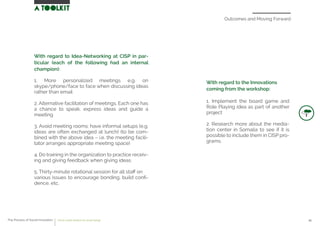
With regard to Idea-Networking at CISP in par-
ticular (each of the following had an internal
champion):
1. More personalized meetings e.g. on
skype/phone/face to face when discussing ideas
rather than email
2. Alternative facilitation of meetings. Each one has
a chance to speak, express ideas and guide a
meeting
3. Avoid meeting rooms: have informal setups (e.g.
ideas are often exchanged at lunch) (to be com-
bined with the above idea – i.e. the meeting facili-
tator arranges appropriate meeting space)
4. Do training in the organization to practice receiv-
ing and giving feedback when giving ideas
5. Thirty-minute rotational session for all staff on
various issues to encourage bonding, build confi-
dence, etc.
Outcomes and Moving Forward
With regard to the Innovations
coming from the workshop:
1. Implement the board game and
Role Playing idea as part of another
project
2. Research more about the media-
tion center in Somalia to see if it is
possible to include them in CISP pro-
grams.
The Process of Social Innovation how to create solutions for social change 45
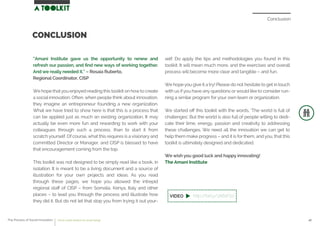
Conclusion
“Amani Institute gave us the opportunity to renew and
refresh our passion, and find new ways of working together.
And we really needed it.” – Rosaia Ruberto,
Regional Coordinator, CISP
We hope that you enjoyed reading this toolkit on howto create
a social innovation. Often, when people think about innovation,
they imagine an entrepreneur founding a new organization.
What we have tried to show here is that this is a process that
can be applied just as much an existing organization. It may
actually be even more fun and rewarding to work with your
colleagues through such a process, than to start it from
scratch yourself. Of course, what this requires is a visionary and
committed Director or Manager, and CISP is blessed to have
that encouragement coming from the top.
This toolkit was not designed to be simply read like a book, in
isolation. It is meant to be a living document and a source of
illustration for your own projects and ideas. As you read
through these pages, we hope you allowed the intrepid
regional staff of CISP – from Somalia, Kenya, Italy and other
places – to lead you through the process and illustrate how
they did it. But do not let that stop you from trying it out your-
self. Do apply the tips and methodologies you found in this
toolkit. It will mean much more, and the exercises and overall
process will become more clear and tangible – and fun.
We hope you give it a try! Please do not hesitate to get in touch
with us ifyou have any questions orwould like to consider run-
ning a similar program for your own team or organization.
We started off this toolkit with the words, ‘The world is full of
challenges’. But the world is also full of people willing to dedi-
cate their time, energy, passion and creativity to addressing
these challenges. We need all the innovation we can get to
help them make progress – and it is for them, and you, that this
toolkit is ultimately designed and dedicated.
We wish you good luck and happy innovating!
The Amani Institute
CONCLUSION
The Process of Social Innovation how to create solutions for social change 46
http://bit.ly/1A6sFb2
Tool kit Amani

Tool kit Amani

  • 2.
    Designed by Madepossible by
  • 3.
    AMANI INSTITUE The AmaniInstitute partners with leading NGOs, corporations and universities to prepare a new generation of leaders tackling the world’s toughest problems. These issues call upon problem-solvers to submit their whole being in the service of creating sustainable change. We develop individuals who have the knowledge, practical skills, innovation ability, courage, and networks to take leadership roles in facing these challenges. More information at: www.amaniinstitute.org CISP CISP's aims and objectives are related to the implementation of humanitarian, rehabilitation and development projects in developing countries. In Italy and Europe CISP's work focuses mainly on awareness campaigns, train- ing and information programs, the fight against social exclusion and racism, and educational campaigns on devel- opment and intercultural realities. CISP aims at implementing the necessary conditions for development and self-determination of people, at spreading and respecting human rights, and at satisfying people's basic needs. More information at: www.cisp-som.org The Organizations The Process of Social Innovation how to create solutions for social change 03
  • 4.
    The Inner Journey of the SocialInnovator Step 5 Idea Networking Step 6 Experimenting Step 7 Impacting ConclusionOutcomes and moving forward Step 1 Burning Step 2 Sensing Step 3 Questioning Step 4 Associating Idea Generation The Amani Social Innovation Framework Introduction 05 07 09 13 19 23 28 32 36 39 42 46 Content The Process of Social Innovation how to create solutions for social change 04
  • 5.
    Introduction The ASIF wasexplored at CISP through 8 daylong sessions across 2014. Each day explored a specific topic within the ASIF, with theory and extensive practical exercises tailored to the topic comprising the day. The world is full of challenges. Chal- lenges that many organizations are working hard to solve. One of these organizations, doing great work in Somalia, is Comitato Internazionale per lo Sviluppo dei Popoli, CISP, or the International Committee for the Development of Peoples. Given the high level of challenge inherent in CISP’s mission and daily work in Somalia, it is important for the CISP team to learn new ways of bringing creativity and energy to problem solving, thus building their skills for developing sustainable, culturally sensitive and integrated solutions. Having this challenge in mind, CISP and Amani Institute partnered on a project to train the Regional Staff of CISP’s Horn of Africa team in social innovation, with a particular focus on both building skills as well as gener- ating new ideas for CISP’s work on reducing gender-based violence (GBV) in Somalia. The purpose of this toolkit is to share the journey made by the CISP staff through the training, lay out how one can walk through a structured approach to generating a social inno- vation, with the CISP participants’ work serving as an illustration for how to do so. The overall methodology of the train- ing was based on the Amani Social Innovation Framework (ASIF). This framework applies structure to enable a team to build their collective capacity to design solutions to chal- lenges. Drawing from the study of innovation, utilizing methodologies made popular by the Design Thinking approach to problem solving, and adding best practices from the social sector, the ASIF guides participants through the process of creative prob- lem solving. The Process of Social Innovation how to create solutions for social change 05
  • 6.
    Introduction Since one ofthe key elements of innovation is bringing together ideas and elements from different sources and applying them towards your challenge, the training program con- sciously sought to include perspec- tives and methodologies from other practitioners so that the CISP partici- pants would have a rich set of influ- ences to bring together. As a result, the program included a diverse array of guest speakers. These were: - Sean Brooks, United States Depart- ment of State, an expert on Somalia - Muna Abdillahi, UNICEF, an expert on gender and Somalia - Michele Leone, IDRC an expert on donor funding and innovation - Shilpa Shah, Co-Founder of Inside Out Consultancy, who led a workshop on Idea Generation using the Disney approach - Sitawa Namwalie, a poet and activ- ist, who led a session on art and crea- tivity. We hope that readers will find this a useful tool in their own work going forward. The Amani Institute The Process of Social Innovation how to create solutions for social change 06 http://bit.ly/1DU3eWU Click here towatch avideo about the 7 steps oftheASIF
  • 7.
    The Amani Social Innovation Framework ANEW MINDSET The great writer Marcel Proust once said, “The real act of discovering consists not in finding new lands, but seeing with new eyes”. This is the perfect approach for social innovation. Even if we are already familiar with the community in which we are working, or feel like we are very knowledgeable about the problem, we can adopt a new mindset and try to look at the situation differently. This is called having a “Beginner’s Mind” - it is central to innovation. Social Innovation requires a new mindset and this is how the training began. A new mindset comes with a new way of seeing challenges and approaching them. We used a series of perception games to understand what a social innovation mindset is. Following is an example. A lot of wonderful research has been done on frameworks for social innovation. As we set up the Amani Institute, we researched innovation frameworks that fit our experience and observations over more than two decades of social entrepre- neurship work all around the world. Eventually, we combined elements of technological innovation thinking with design thinking and best practices in social work to create the Amani Social Innovation Framework, a structured 7-step approach to generating new ideas for challenges that an organization or, indeed, society is facing. The Process of Social Innovation how to create solutions for social change 07
  • 8.
    The Amani Social Innovation Framework Solution (Turnthe page upside down) If you want to develop an innovator’s mindset, keep reading as we get to the ASIF! TIP Doing perception games daily will help you to develop your innovation mindset! Resources Watch the Monkey Business Illusion video by Christopher Chabris and Daniel Simons http://bit.ly/1lLV6z1 Here is an equation of Roman numerals, made with ten matches. It is incor- rect. Can you correct the equation without touching the matches, adding new matches, or taking away any? The Process of Social Innovation how to create solutions for social change 08
  • 10.
    Burning SELF-AWARENESS CLAY EXERCISE One ofthe methodologies to develop self-awareness is the “Clay Exercise”. The CISP participants were divided in pairs and asked to tell their stories, life chal- lenges, strengths and future dreams to each other while playing with the clay. As your mind is trapped with the clay, you are able to share and unlock thoughts and feelings that would not come if you were fully aware of each of your words. “Cutting a piece from the clay and playing with it made it easy to communicate and express ideas. You don’t have anything specificinmindasyoumoldtheclaybutbecausethehandsare busy you find its easier to share” - CISP Participant STEP1 Addressing a difficult challenge requires a good understanding of your own personal motivation for doing so. It requires an alignment of self and work, passion and purpose. We call this passion and purpose your “Burning”. The first step to understand your personal motivation is self- awareness. The Process of Social Innovation how to create solutions for social change 10
  • 11.
    To dig deeperinto the burning we asked the participants to remember a moment in their professional life when they felt happy and fulfilled. While sharing this, people are able to realize their burning. Here a quote from one of the participants from Somalia “(I felt burning) in 2008 during the big drought. Most of the livestock had died. We were helping the community with livelihood creation. I wondered how helpful we actually were. Two years later I was in a remote area. We had a flat tire and a lady came to greet us. Her family had 22 goats, they were very happy and I was happy because I knew it was a result of the project two years ago.” Burning STEP1 Do you want to know how to convert that burning into action? Keep reading! TIP If you haven’t done it recently, ask yourself what matters to you, what are the injustices in the world that you don’t want to exist anymore. What makes you burn? Resources Watch this TED talk by Jessica Jack- ley from KIVA. Is she burning? http://bit.ly/1tAB1Dt The Process of Social Innovation how to create solutions for social change 11
  • 12.
  • 14.
    Sensing PROBLEM FINDING ROOT CAUSEANALYSIS But what do we want to ‘sense’? In the former chapter you discovered your burning as the participants in the STEP2 Borrowing from design thinking, social innovation requires that we use all our senses to engage in “problem-finding.” This is a process of gathering as much information as possible about the challenge from as many available sources as possible, both online and in-person. Specifically, it means talking to different stakeholders about the problem, as well as talking with non-stakeholders to get an “outsider view”. In many cases, you may want to put yourself in a position to experience the challenge firsthand, which most of the participants in the workshop had done, simply through daily life in Somalia. The Process of Social Innovation how to create solutions for social change 14
  • 15.
    Sensing STEP2 workshop did. Thatburning has the form of a challenge. In the case of the CISP staff the challenge they were burning to solve was Gender Based Violence (GVB) in Somalia. In order to understand the challenge better, one good tool is Root Cause Analysis. Here is how it works. First, write down your prob- lem statement. Done? Second, think about what causes this problem. What is the true reason we have this situation? What are the causes of the problem you are addressing? Good. Now, finally, think about all the consequences of this prob- lem. What are the negative and positive impacts this problem has? Think deeply about this. Go beyond the obvious issues and take them to their logical conclu- sion. It may be useful to approach this exercise conceptually by drawing a tree with the Problem as the Trunk of the tree, the Causes as the Roots of the tree, and the Consequences as the Branches. The Root Cause Analysis is not the only way to under- stand a problem. Another popular method is the “Five Whys” exercise. In this exercise, you state the problem and then ask “Why is this so?” five times to get to the true root of the prob- lem. It is important to com- plete this exercise 2-3 times so you can uncover several roots of the problem and not just the first set of roots. Both of these approaches ultimately lead to a way of thinking and a critical mind- set for innovators of all kinds, whether a social or a busi- ness innovator. This is known as “Problem Finding” as opposed to Problem Solving. Problem Finding is very important in innovation because it is often the case that the stated problem is not in fact the real problem that needs to be solved. One of the most famous examples of this mindset comes from Henry Ford, who invented the modern automobile. He famously said, “If I had asked my customers what they wanted, I would have designed a faster horse”. The Process of Social Innovation how to create solutions for social change 15
  • 16.
    LEARNING FROM EXISTING RESEARCH CONVERSATIONS WITHEXPERTS LISTENTOWHATTHE BENEFICIARIES REALLYSAY WRITE DOWNTHE BEHAVIORS OF THE BENEFICIARY ASKOPEN-ENDED QUESTIONS:WHY? WHAT? HOW? LOOKFORAND NOTE DOWNALLTHE DETAILS - IDEAS, KEYWORDS, PASSION OBSERVETHE BENEFICIARIES Sensing STEP2 THE DEEP DIVE A Deep Dive starts with doing research using existing sources: online, in books, finding data on your problem. Next, begin talking to those you consider experts about your topic – people who have worked on this issue in this location or other locations. However, don’t forget to also talk to people on the “extremes". These are people who occupy totally different ends of the spec- trum of opinion on your problem. Next, start to talk to people directly affected by or involved in the problem – the clients or beneficiaries themselves. Start to understand what they are seeking and how they are suffering (if appropriate). Here it will be important to listen to what people actually say – what are the feel- ings and passions involved? What are they not saying? The Root Cause Analysis helped us to map out the causes and consequences of the problem but there is stillalotmoretodiscover.Agoodtooltoseethedifferent layers ofthe challenge is the Deep Dive. The CISPparticipantswere asked to sense the challenge more, to go deeper. Howdid theydo it? See this illustration ofthe deep dive. The Process of Social Innovation how to create solutions for social change 16
  • 17.
    TIP Sensing is anongoing step. Keep sensing during the planning, execu- tion and evaluation of your social innovation! A good innovator never stops sensing. Resources Watch David Kelley’s TED Talk about building your creative confidence to see an example of sensing directly with the user. http://bit.ly/1fWl1G6 Sensing STEP2 To get at this type of understanding, it is wise to ask “open-ended questions” such as questions that begin with “Why” or “How” or “What do you think about…” Avoid asking questions with Yes/No answers or answers with just one or two words. It will also be important to observe people. Do not talk to them, just observe them in action. Remember that actions speak much louder than words. Don’t forget to document everything you are hearing and seeing. Capture the details. Focus on emotions expressed, both positive and negative. On ideas and dreams and aspirations of people. Do you want to know what to do with all the information found during the deep dive? Keep reading! The Process of Social Innovation how to create solutions for social change 17
  • 18.
  • 20.
    Questioning REFRAMING HOW MIGHT WE?QUESTIONS Often when we are given a problem to solve, it is not the true problem that needs to be solved. For innova- tion, we need to think deeper about what this true problem might be. Let’s now walk through how to go about reframing the problem you are out to solve. First, a quick look at the relationship between Informa- tion, Insights and Ideas. It works in a triangle. Informa- tion leads to Insights, which lead to new Ideas. Let’s go through this systematically. STEP3 One of the most distinguishing behaviors of innova- tors is asking the right questions—questions others are not asking. It isn’t easy to find the root of the problem (and you always wonder if you are really at the root), but asking questions and reframing the problem is a good way to look for alternatives. The Process of Social Innovation how to create solutions for social change 20
  • 21.
    Questioning STEP3 You have gathereda lot of INFORMATION through the deep dive. In order to organize it we asked the participants to take a large stack of post-its (also known as sticky notes) and face a blank wall. Then they wrote down all the things that they have learned about the problem they were trying to solve. For this exercise it is impor- tant to only use one post-it for each fact or thought that you want to express. Then you have to stick each post-it on the wall in front of you. Keep doing this until you have completed every- thing you want to include. You should have at least 60-75 post-its on the wall in front of you. This is now your Information Bank. Then we move to generat- ing INSIGHTS from all this Information. As you look at the post-its in front of you, you should start to see pat- terns emerging. Many of them probably relate to a similar theme. For instance, one theme could be related to true desires that people are afraid to articulate. Another could be around financial considerations. A third might revolve around the need for new skills. And so on. Begin to cluster the post-its according to the various themes. You should have at least 3-5 different themes, with a handful (or more) of post-its under them. The various themes point you towards your insights. An insight is defined by Merriam-Webster diction- ary as “the ability to under- stand people and situations in a very clear way” or “an understanding of the true nature of something”. Now look at your themes again and see if you can re-cast them as insights. For example, the insight for the theme around the need for new skills could be some- thing like: “There is a need for skill-building amongst community leaders for how to cope with rapid changes in society”. Create an insight statement for each of your themes. Refine the statement so that it really feels like a new understanding of a part of the challenge. Finally, we come up to the IDEAS level. Now that you have your insight state- INFORMATION INSIGHTS IDEAS A solution generated from one or more insights Findings emerging from sensing The Process of Social Innovation how to create solutions for social change 21
  • 22.
    Questioning STEP3 ments, consider eachof them in turn. Also think back to your Root Cause Analysis and what that uncovered. What new understanding are you coming to about your problem? Think hard. What is truly at work here? Re-write your new understanding as a Problem state- ment, starting with the words, “How Might We”? Congratulations, you have just re-framed your prob- lem. Now, we can start to move towards the Solution! After these exercises, the participants of the CISP train- ing reframed the challenge of reducing GBV in Somalia to the following three ‘How Might We’ questions: - How might we create more collaborative relation- ships between the two genders in a family? - How might we bring access to legal solutions for GBV in remote communities? - How can schools be examples of inclusivity for all children? Do you want to know what to do with the reframed challenge? Keep reading! TIP Reframing the problem is a critical step! It is also not easy to do. We recommend you do this with plenty of time and in a nice, creative, work- space! Resources Here is an interesting tool from THNK.org to help you reframe your problem: http://reframe.thnk.org/ The Process of Social Innovation how to create solutions for social change 22
  • 24.
    Associating STEP4 ASSOCIATING IDEA CASINO Associating isa way to start thinking about creative solutions to solve your challenge. We are better able to associate when we interact in different spaces, do a variety of activities and talk with very diverse people. The more diverse set of things we have to associate with, the more we are going to be able to come up with new solutions for our reframed challenges. A good exercise to train this cognitive skill is called The Idea Casino. In teams, the participants of the training picked one random word from each of the three columns below and had to come up with a solution for the challenge they were trying to solve. This is the cognitive skill of bringing together differ- ent ideas from all the research and information gathered so far, in order to create new opportunities and leads, determine trends and patterns, and apply ideas from outside the sphere of the challenge. The Process of Social Innovation how to create solutions for social change 24
  • 25.
    Associating STEP4 One of theteams picked the words ‘construction’, ‘recom- mend’ and ‘market’ and this is what they came with: “We thought of going to the market and constructing a space where everyone could share their ideas. A neutral zone where many people can come and get positive ideas about prevent- ing GBV. We would be there everyday, hear recommendations and the news would spread through gossip.” Do you want to know how to keep coming up with innovative ideas? Keep reading the toolkit! ELEMENTS OF NAIROBI Acacia Trees Accidents Birds CBD / downtown Chai Chapati Clinics Construction Corruption Diamond Plaza Elephant Orphanage Hospitals Hotels Kibandas KICC Malls Mandazi Matatu Movies - pirated DVDs Muddy in the Rains Police Racecourse Rain Toy Market Traffic Uhuru Park WAYSOFCREATINGVALUE Access Aggregate Broadcast Capture Collaborate Communicate Create Discover Find Follow Inspire Instruct Make Transparent Measure Monitor Motivate Organize Personalize Plan Play Recommend Search Share Visualize ENABLERS/CONNECTORS Business model Demand Entrepreneurship Facebook Fees for service Global Market Mentors Mission and vision Open source Power Price Root cause Scale Social network Supply Twitter Youth The Process of Social Innovation how to create solutions for social change 25
  • 26.
    Associating STEP4 IDEA GENERATION HOW MIGHTWE? QUESTION The idea is that you will come up with different ideas through the different stages. During the Dreamer phase, the participants of the work- shop came up with the most incredible and absurd ideas possible. This stage can also be called the “Why Not?” stage. As the Realist, the Dreamer’s ideas get re-examined and re-worked into something more practical. This stage can also be called the “How?” stage. Finally, during the Critic stage the participants try to destroy their ideas. The ones that sur- vived were the ones to move forward. Now we narrow in on a single idea or two to prototype and receive feedback on. The draft ideas that the CISP teams came up with were as follows: This session of the training was facilitated by Shilpa Shah, of Inside Out Consultancy. http://insideoutkenya.wordpress.com There are many different methodologies to help us be more creative in coming up with useful solutions to our problem. The Disney methodology is one of them. According to Robert Dilts’ book, “Strategies of Genius, Volume One”, the film producer and innova- tor, Walt Disney used to think-up and refine ideas by breaking the process into three characters: The Dreamer, the Realist, and the Critic. The Process of Social Innovation how to create solutions for social change 26
  • 27.
    Do you wantto know how to improve upon your initial solution? Keep reading! Associating STEP4 How might we create more collaborative relationships between the two genders in a family? A Board Game that can be played at home with parents and children to talk about GBV in a fun and engaging way. Use the Councils of Elders to replace the court system in communities where such law does not exist, with the elders receiving the necessary training. A role-playing activity between girls and boys in school, facili- tated by teachers. How might we bring access to legal solutions for GBV in remote communities? How can schools be examples of inclusivity for all children? HOW MIGHT WE QUESTION DRAFT IDEA TIP Try the three different roles next time you are generating new ideas for a challenge! Do it with your team. Resources Read Strategies of Genius, Volume One by Robert Dilts The Process of Social Innovation how to create solutions for social change 27
  • 29.
    Idea networking STEP5 DIFFERENCE BETWEEN IDEANETWORKING AND RESOURCE NETWORKING It is easy to confuse idea networking with resource net- working because of the similarity of their names how- ever they are very different. In the traditional or popular concept of networking, you are mainly looking to access resources: financial resources, human resources, etc. To do so, you would normally target people related to the problem you are solving – people with substantial resources, power or influence. This involves sharing your idea widely, building a network around it – and not just brainstorming by yourself or only within your organization. Typically, we think of networking as something to do to gain additional resources for ourselves or our work, but with idea networking, the point is to share our draft ideas freely and see what other people think, to hunt for ideas that can combine with ours and improve upon it. The Process of Social Innovation how to create solutions for social change 29
  • 30.
    TIP During this sessionwith CISP one of the main topics that came up was to idea network inside your own organi- zation. Many times we don’t share enough with our colleagues or man- agers. We encourage you to do it! Their perspectives will be useful. Resources “Conclusion: The Fourth Quadrant” from Where Good Ideas Come From: The Natural History of Innovation by Steven Johnson. Do you want to know how to be sure you are on the right track with your solution? Keep reading! STEP5 When you are idea net- working your aim is not to look for resources, but to learn new things, gain new perspectives, and get inspired. During the idea networking process, you want to discuss your initial ideas to solve the problem and receive feedback. For this to be successful you should talk with people who are not like you, that can contribute other points of view or ways of thinking. You should discuss with experts and non-experts from very different fields and backgrounds. Here are some of the tips we shared with the partici- pants on how to idea net- work: Build a bridge to different groups to access different ideas Attend events, happy hours, and conferences within different networks than yours Talk with people who have a very different way of thinking than you - from diverse backgrounds, eth- nicities or religions. The most unexpected conver- sations can bring new, inter- esting insights. When talking with people, let them do most of the talking. Be open to listen to different perspectives. Sharing the problem and initial ideas with very diverse people will provide you with new insights and perspectives that you and the stakeholders were perhaps not able to see. Not all of the conversations will be useful, but some of them will provide you with valuable new insights to help solve the prob- lem you are addressing. The Process of Social Innovation how to create solutions for social change 30
  • 31.
  • 33.
    Experimenting STEP6 BUILDING PROTOTYPES TESTING ANIDEA By now the participants of the training had defined the problem, understood its root causes and conse- quences, reframed the problem and identified differ- ent potential solutions through the process of idea generation, associating and idea networking. Before fully implementing the idea and committing resources, it was important to test the solution. What does this mean? Testing is an iterative process that provides you and your team with feedback from the beneficiaries and different stakeholders involved. Also called “prototyping”, experimenting means testing your innovation in the realworld, and getting feedback to refine and improve the concept. Although this is hard for manytraditionalpractitionerstoembrace,asthelikelihood of failure and imperfection is high, it is also an important skillforinnovators,whoviewfailure as feedback.We have also learnt that if you don’t experiment early on, you may later lose more important things than time and money. In socialinnovationwork, mistakes can cost lives. The Process of Social Innovation how to create solutions for social change 33
  • 34.
    1 TEN TOOLSFOR DESIGN THINKING, Darden Business Publishing, University of Virginia, UVA-BP-0550 The best way to test an idea is through the building of a prototype. A prototype can be a sketch, model, or a pilot. It is a way to convey an idea quickly. The purpose of prototyping is to create something quickly that can then be tested with benefi- ciaries. By making abstract new ideas tangible to poten- tial stakeholders and benefi- ciaries, you can better facili- tate meaningful conversa- tions and feedback about them. The 3 teams from CISP tested their prototypes but before doing so they cre- ated a storyboard. The role of the storyboard is under- stand how the user will inter- act with our solution. Here are some of the proto- typing principles we shared with the participants : 1 Figure out the story that you want to tell. Start out simply. Visualize the con- cept in pictures, using as few words as possible. Add complexity, appropriately, as you go. 2 Use an affordable loss calculation. What amount can you afford to lose to learn something new? (Prototypes should be low- cost!) 3 Show; don’t tell. Make the prototype feel real through imagery and artifacts. Work on bringing the concept to life for the observer. Focus on capturing details of how the concept will work and how the beneficiary or stakeholder will experience it. Use stories, maps, images, and short videos to spark conversation with the observer. 4 Keep in mind the questions/ assumptions that you are testing. 5 Play with your prototype; don’t defend it. TIP Iterate! What does this means? After sharing the prototype with others you will need to evaluate your solution again. Is your solution solving the prob- lem as you planned? Is the solution solving part of the problem? How can your solution be better? What are the things you need to change? What elements of the solution proved to be useful during the testing phase? What assumptions were right and which ones were wrong? Once you have answered all these questions you will build a new prototype incorporating all the changes. Then you will need to test it again! This whole process is called iteration - building different prototypes and testing them many times until the solution fits the needs of the beneficiar- ies and solves the problem. Resources Read “Chapter 2: The Experimenter” from The Ten Faces of Innovation by Thomas Kelley. Do you want to know if your innovation is an innovation with impact? Keep reading the toolkit! Experimenting STEP6 1 The Process of Social Innovation how to create solutions for social change 34
  • 35.
  • 37.
    Impacting STEP7 IMPACTING A GENUINE NEED Theinnovation you are bringing to the world should have an impact, should be based on a genuine need. How can we be sure we are creating something that is making a difference? There are three important ques- tions that we asked the participants of the training to think about: Social innovation doesn’t end with the manifestation of an idea; it needs to have impact. Every innovator knows that there are more challenges in executing an idea than in generating one. Impacting means refining the idea based on more user feedback, cre- ating a baseline and evaluation mechanism to respond to this feedback, and trying to scale what works. The Process of Social Innovation how to create solutions for social change 37
  • 38.
    Impacting STEP7 What metrics will youuse and how will you know you have succeeded? How will you have changed the life of a beneficiary /customer in 1 year and in 5 years? How would the world look like if your innovation works at scale? TIP Sometimes we are so busy with daily tasks that we forget to take the bal- cony view of our social innovation and see the bigger impact that it is having. Don’t forget to stop and enjoy the social innovation from the balcony! Resources Read How to Change the World: Social Entrepreneurship and the Power of New Ideas by David Born- stein. It has many wonderful stories of social innovators across the world! The Process of Social Innovation how to create solutions for social change 38
  • 40.
    Inner journey In orderto connect the personal change we need to make in ourselves with the change in the world we would like to see, we need to understand why we do what we do and who we are. Given the importance of one’s personal connection or inspiration when dealing with social innovation, one afternoon was set aside for a slightly deeper exploration of the CISP staff’s individual sense of alignment with the challenge and with their work at CISP itself. The Process of Social Innovation how to create solutions for social change 40
  • 41.
    Inner journey To explorethis further, the participants were asked to explain in writing what they do for a living and why to the following audiences: · Their parents · A child · A friend from a different culture · A potential beneficiary of their work · Their future self at the end of their life. Here are some of the reflections of the participants: “Explainingtomyfutureselfwashardestasitrequiredgoingdeep. It was very powerful going to that place because I imagined look- ing back on my life and asking what I had done with it.” “Oftentimes we have a lot of reasons for why we do things. It is powerful to see what language and words I use when thinking. ” “There are many things I could do out there. Telling myself ‘I want todothis’insteadof‘Ihavetodothis’isverypowerfulbecauseyou take more responsibility, and you could do the work with more pleasure once you see you have a choice in what you do. Its like choosing to fast during Ramadhan.” Similar to this, the participants continued onto exercises that explored their personal connection with the mission and vision of CISP, and then the strengths and weak- nesses in how they work together, particularly around styles of communication and how things are received and shared internally. Problem focusing on one aspect only (Personal development ´Junkies´ vs. burnt out activists) Opportunity your personal change experience gives you more authenticity when creating change in the world. INTEGRATION Personal Change Social Change The Process of Social Innovation how to create solutions for social change 41

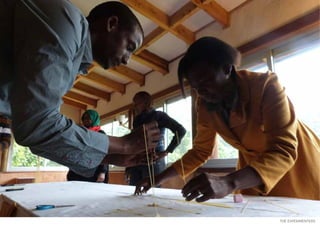
  • 42.
    Outcomes and MovingForward The participants came up with three ideas during the social innovation process. Here is a description of the ideas, as explained by the participants: 1. How might we create more collaborative rela- tionships between the two genders in a family? “We identified a problem with GBV in Somalia. During the sensing exer- cise we did interviews and research and found that conflict starts in the home. We thought play could help with this. At the dreamer phase we thought about poetry, storytelling, theatre, and incorporated all this into a board game. The board game will be carefully designed to deal with GBV topics in a fun and engaging way. We hope the impact will be that boys and girls will play together and improve communication between genders. We hope to help people switch roles and play other people such as boys taking girls roles and children playing parents. By this we hope to create a mind shift that will replace a destructive cul- OUTCOMES AND MOVING FORWARD The Process of Social Innovation how to create solutions for social change 42

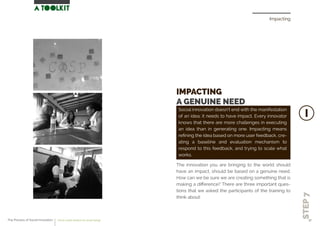
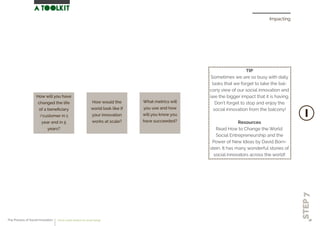
  • 43.
    Outcomes and MovingForward ture and allow better rela- tions between men and women. It will also create dialogue with parents. We hope to partner with other organizations such as UNICEF to help spread it to many people. We realize the game could cause conflict at home, however we see more potential for it to foster positive collaborations. We will do baseline and obser- vations to monitor our impact.” 2. How might we bring access to legal solutions for GBV in remote communi- ties? “Five years ago while work- ing with CISP we realized there was no legal system to support victims of GBV. Thus, they refused to come to us for help since we couldn’t do anything. The only help they had was the Council of Elders for solving conflict but the councils were not dealing with GBV situations. Our solution is to incorporate elders in our system. We will train them in mediation and empathetic communication skills, then they will be able to deal with GBV cases in communities where is no legal regulation about this topic”. This is a temporary solution until new laws are developed in these remotes areas of Somalia”. 3. How can schools be examples of inclusivity for all children? “It all started when we iden- tified the issue about pro- tecting women and girls in Mogadishu. After a while we noticed girls in schools did not feel confident enough to even go to the toilet or eat in front of boys. This was sur- prising. We went out there to sense and observe. We heard a story from a Somali girl who lived in Australia who complained she could not fully participate in school. We heard other stories from Galgayo about children – both girls and boys who were bullied in school. So we realized all children could face discrimi- nation in school based on gender, minority clans, and so on. One of our own colleagues, Brianna, told us about an experiment that happened in the USA to raise aware- ness about discrimination. We called it blue eyes – brown eyes. We came up with up a game we called Wethajir, which means cooperation. We would ask children in school to role- play for about a day to tackle discrimination. We want to promote inclusion and participation for all chil- dren in school. We talked to the coordinator of education in Somalia and she was happy with the idea. We also talked to people in Kenya who said they liked the game since it would help build a better nation. We hope the impact of Wethajir will help parents and teach- ers at school stop and ask themselves why some chil- dren are not eating or going to the toilet.” The Process of Social Innovation how to create solutions for social change 43
  • 44.
    In addition, theCISP staff agreed upon a ‘manifesto’ for their own work going forward, something they will hold each other accountable for. Outcomes and Moving Forward OUTCOME MANIFESTO With regard to the different elements of the Amani Social Innovation Framework: 1. Prototyping and experimenting before launching a new program 2. Accepting Failure as part of the process 3. Using storyboards to help with the process and flow of a program 4. Idea-networking: Learn to give and receive feedback, specifically with non-experts 5. Creating an environment where people feel free to share their thoughts 6 Training other colleagues or beneficiaries to go through the process of Social Innovation 7. Identifying problems and sorting them into Dreamer, Realistic and Critic stages 8. Reframing challenges into positive thinking 9. Using the creativity button to trigger creative minds 10. Applying Deep Dive in their project implemen- tation The Process of Social Innovation how to create solutions for social change 44
  • 45.
    With regard toIdea-Networking at CISP in par- ticular (each of the following had an internal champion): 1. More personalized meetings e.g. on skype/phone/face to face when discussing ideas rather than email 2. Alternative facilitation of meetings. Each one has a chance to speak, express ideas and guide a meeting 3. Avoid meeting rooms: have informal setups (e.g. ideas are often exchanged at lunch) (to be com- bined with the above idea – i.e. the meeting facili- tator arranges appropriate meeting space) 4. Do training in the organization to practice receiv- ing and giving feedback when giving ideas 5. Thirty-minute rotational session for all staff on various issues to encourage bonding, build confi- dence, etc. Outcomes and Moving Forward With regard to the Innovations coming from the workshop: 1. Implement the board game and Role Playing idea as part of another project 2. Research more about the media- tion center in Somalia to see if it is possible to include them in CISP pro- grams. The Process of Social Innovation how to create solutions for social change 45
  • 46.
    Conclusion “Amani Institute gaveus the opportunity to renew and refresh our passion, and find new ways of working together. And we really needed it.” – Rosaia Ruberto, Regional Coordinator, CISP We hope that you enjoyed reading this toolkit on howto create a social innovation. Often, when people think about innovation, they imagine an entrepreneur founding a new organization. What we have tried to show here is that this is a process that can be applied just as much an existing organization. It may actually be even more fun and rewarding to work with your colleagues through such a process, than to start it from scratch yourself. Of course, what this requires is a visionary and committed Director or Manager, and CISP is blessed to have that encouragement coming from the top. This toolkit was not designed to be simply read like a book, in isolation. It is meant to be a living document and a source of illustration for your own projects and ideas. As you read through these pages, we hope you allowed the intrepid regional staff of CISP – from Somalia, Kenya, Italy and other places – to lead you through the process and illustrate how they did it. But do not let that stop you from trying it out your- self. Do apply the tips and methodologies you found in this toolkit. It will mean much more, and the exercises and overall process will become more clear and tangible – and fun. We hope you give it a try! Please do not hesitate to get in touch with us ifyou have any questions orwould like to consider run- ning a similar program for your own team or organization. We started off this toolkit with the words, ‘The world is full of challenges’. But the world is also full of people willing to dedi- cate their time, energy, passion and creativity to addressing these challenges. We need all the innovation we can get to help them make progress – and it is for them, and you, that this toolkit is ultimately designed and dedicated. We wish you good luck and happy innovating! The Amani Institute CONCLUSION The Process of Social Innovation how to create solutions for social change 46 http://bit.ly/1A6sFb2