Handover process in multidisciplinary health care:
information transfer and common ground
construction

Giulio Toccafondi, Riccardo Tartaglia, Stefano Guidi, Sara Albolino
Background
Handover can be defined as “The transfer of professional responsibility and
accountability for some or all aspects of care for a patient, or group of patients, to
another person or professional group on a temporary or permanent basis”
                                                                     (Wong M. et al 2008 )


In health care systems patients’ transictions between diferrent care settings are
increasing in frequency. Usually more than one medical team is taking care of a
patient . The transfer of patient may pose threats to patient safety.


Poor communication during the exchange of medical information contributes to
handover incidents and inefficacy of care processes
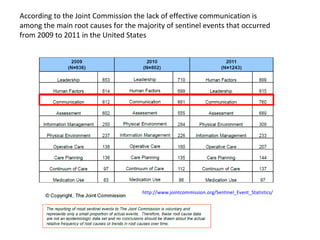
According to the Joint Commission the lack of effective communication is
among the main root causes for the majority of sentinel events that occurred
from 2009 to 2011 in the United States


                                     http://www.jointcommission.org/Sentinel_Event_Statistics/
Handover as Communication
The handover of medical information is a communication activity
which plays an important role in orienting care.


The 31% of the residents indicated something had happened while they were
on call that the handover had not prepared them for; and that
the only variable influencing doctors’ perception of preparedness for their
night on-call was the quality of the handover.

                                                      (Borowitz SM et al. 2008)


In order to make sense of patient handovers and improve them, we need to
analyze the relationships between the content conveyed and the social context
in which the communication occurs.
Handover as Cooperation
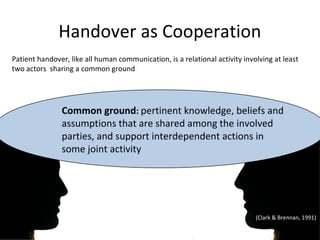
Patient handover, like all human communication, is a relational activity involving at least
two actors sharing a common ground


               Common ground: pertinent knowledge, beliefs and
               assumptions that are shared among the involved
               parties, and support interdependent actions in
               some joint activity


                                                                             (Clark & Brennan, 1991)
Study Setting
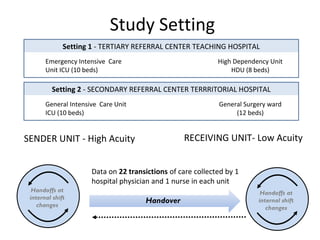
              Setting 1 - TERTIARY REFERRAL CENTER TEACHING HOSPITAL
       Emergency Intensive Care                              High Dependency Unit
       Unit ICU (10 beds)                                        HDU (8 beds)

         Setting 2 - SECONDARY REFERRAL CENTER TERRRITORIAL HOSPITAL
       General Intensive Care Unit                           General Surgery ward
       ICU (10 beds)                                              (12 beds)


SENDER UNIT - High Acuity                         RECEIVING UNIT- Low Acuity


                      Data on 22 transictions of care collected by 1
                      hospital physician and 1 nurse in each unit
  Handoffs at                                                             Handoffs at
 internal shift
                                      Handover                           internal shift
    changes                                                                 changes
Study Objective
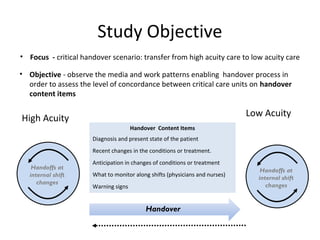
• Focus - critical handover scenario: transfer from high acuity care to low acuity care

• Objective - observe the media and work patterns enabling handover process in
  order to assess the level of concordance between critical care units on handover
  content items


High Acuity                                                                  Low Acuity
                                      Handover Content Items
                      Diagnosis and present state of the patient
                      Recent changes in the conditions or treatment.
                      Anticipation in changes of conditions or treatment
    Handoffs at                                                                 Handoffs at
   internal shift     What to monitor along shifts (physicians and nurses)
                                                                               internal shift
      changes                                                                     changes
                      Warning signs


                                           Handover
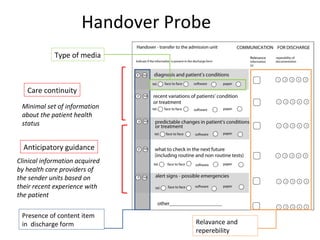
Handover Probe
             Type of media


   Care continuity
 Minimal set of information
 about the patient health
 status


  Anticipatory guidance
Clinical information acquired
by health care providers of
the sender units based on
their recent experience with
the patient

 Presence of content item
 in discharge form                Relavance and
                                  reperebility
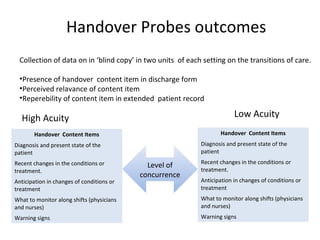
Handover Probes outcomes
  Collection of data on in ‘blind copy’ in two units of each setting on the transitions of care.

  •Presence of handover content item in discharge form
  •Perceived relavance of content item
  •Reperebility of content item in extended patient record

  High Acuity                                                            Low Acuity
       Handover Content Items                                      Handover Content Items
Diagnosis and present state of the                          Diagnosis and present state of the
patient                                                     patient
Recent changes in the conditions or                         Recent changes in the conditions or
                                             Level of
treatment.                                                  treatment.
                                           concurrence
Anticipation in changes of conditions or                    Anticipation in changes of conditions or
treatment                                                   treatment
What to monitor along shifts (physicians                    What to monitor along shifts (physicians
and nurses)                                                 and nurses)
Warning signs                                               Warning signs
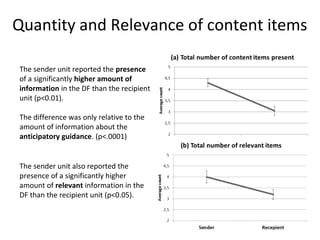
Quantity and Relevance of content items

The sender unit reported the presence
of a significantly higher amount of
information in the DF than the recipient
unit (p<0.01).

The difference was only relative to the
amount of information about the
anticipatory guidance. (p<.0001)


The sender unit also reported the
presence of a significantly higher
amount of relevant information in the
DF than the recipient unit (p<0.05).
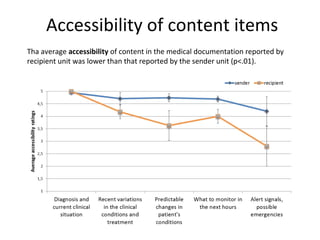
Accessibility of content items
Tha average accessibility of content in the medical documentation reported by
recipient unit was lower than that reported by the sender unit (p<.01).
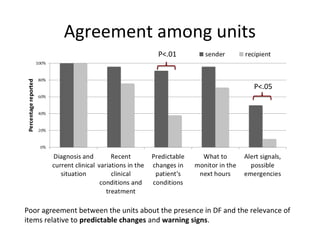
Agreement among units
                                       P<.01


                                                                   P<.05


Poor agreement between the units about the presence in DF and the relevance of
items relative to predictable changes and warning signs.
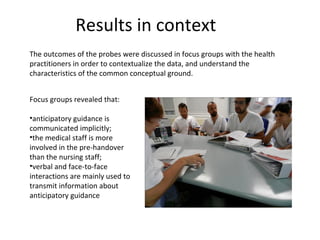
Results in context
The outcomes of the probes were discussed in focus groups with the health
practitioners in order to contextualize the data, and understand the
characteristics of the common conceptual ground.


Focus groups revealed that:

•anticipatory guidance is
communicated implicitly;
•the medical staff is more
involved in the pre-handover
than the nursing staff;
•verbal and face-to-face
interactions are mainly used to
transmit information about
anticipatory guidance
Conclusions
Our study highlighted that the handover process is shaped more by the information
needs of the sender units than by those of the recipients.


The limited participation of the nursing staff to a common conceptual ground
reduces the reliability and possibility of correct interpretation of patient
handovers and may contribute to adverse events.


The handover practices used in the settings seems to be lacking in important
information connected to the anticipatory guides.


Further research should address the interaction among sender and receiving
units and the common ground construction. Focusing only on tools and media,
in fact, does not allow to understand all the possible breakouts in handover
processes.
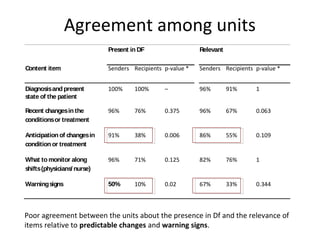
Agreement among units
                            Present in DF                  Relevant

Content item                Senders Recipients p-value *   Senders Recipients p-value *


Diagnosisand present        100%     100%      –           96%        91%     1
state of the patient

Recent changesin the        96%      76%       0.375       96%        67%     0.063
conditionsor treatment

Anticipation of changesin   91%      38%       0.006       86%        55%     0.109
condition or treatment

What to monitor along       96%      71%       0.125       82%        76%     1
shifts(physicians/ nurse)

Warningsigns                50%      10%       0.02        67%        33%     0.344


Poor agreement between the units about the presence in Df and the relevance of
items relative to predictable changes and warning signs.

Toccafondi et al AHFE 2012

  • 1.
    Handover process inmultidisciplinary health care: information transfer and common ground construction Giulio Toccafondi, Riccardo Tartaglia, Stefano Guidi, Sara Albolino
  • 2.
    Background Handover can bedefined as “The transfer of professional responsibility and accountability for some or all aspects of care for a patient, or group of patients, to another person or professional group on a temporary or permanent basis” (Wong M. et al 2008 ) In health care systems patients’ transictions between diferrent care settings are increasing in frequency. Usually more than one medical team is taking care of a patient . The transfer of patient may pose threats to patient safety. Poor communication during the exchange of medical information contributes to handover incidents and inefficacy of care processes
  • 3.
    According to theJoint Commission the lack of effective communication is among the main root causes for the majority of sentinel events that occurred from 2009 to 2011 in the United States http://www.jointcommission.org/Sentinel_Event_Statistics/
  • 4.
    Handover as Communication Thehandover of medical information is a communication activity which plays an important role in orienting care. The 31% of the residents indicated something had happened while they were on call that the handover had not prepared them for; and that the only variable influencing doctors’ perception of preparedness for their night on-call was the quality of the handover. (Borowitz SM et al. 2008) In order to make sense of patient handovers and improve them, we need to analyze the relationships between the content conveyed and the social context in which the communication occurs.
  • 5.
    Handover as Cooperation Patienthandover, like all human communication, is a relational activity involving at least two actors sharing a common ground Common ground: pertinent knowledge, beliefs and assumptions that are shared among the involved parties, and support interdependent actions in some joint activity (Clark & Brennan, 1991)
  • 6.
    Study Setting Setting 1 - TERTIARY REFERRAL CENTER TEACHING HOSPITAL Emergency Intensive Care High Dependency Unit Unit ICU (10 beds) HDU (8 beds) Setting 2 - SECONDARY REFERRAL CENTER TERRRITORIAL HOSPITAL General Intensive Care Unit General Surgery ward ICU (10 beds) (12 beds) SENDER UNIT - High Acuity RECEIVING UNIT- Low Acuity Data on 22 transictions of care collected by 1 hospital physician and 1 nurse in each unit Handoffs at Handoffs at internal shift Handover internal shift changes changes
  • 7.
    Study Objective • Focus- critical handover scenario: transfer from high acuity care to low acuity care • Objective - observe the media and work patterns enabling handover process in order to assess the level of concordance between critical care units on handover content items High Acuity Low Acuity Handover Content Items Diagnosis and present state of the patient Recent changes in the conditions or treatment. Anticipation in changes of conditions or treatment Handoffs at Handoffs at internal shift What to monitor along shifts (physicians and nurses) internal shift changes changes Warning signs Handover
  • 8.
    Handover Probe Type of media Care continuity Minimal set of information about the patient health status Anticipatory guidance Clinical information acquired by health care providers of the sender units based on their recent experience with the patient Presence of content item in discharge form Relavance and reperebility
  • 9.
    Handover Probes outcomes Collection of data on in ‘blind copy’ in two units of each setting on the transitions of care. •Presence of handover content item in discharge form •Perceived relavance of content item •Reperebility of content item in extended patient record High Acuity Low Acuity Handover Content Items Handover Content Items Diagnosis and present state of the Diagnosis and present state of the patient patient Recent changes in the conditions or Recent changes in the conditions or Level of treatment. treatment. concurrence Anticipation in changes of conditions or Anticipation in changes of conditions or treatment treatment What to monitor along shifts (physicians What to monitor along shifts (physicians and nurses) and nurses) Warning signs Warning signs
  • 10.
    Quantity and Relevanceof content items The sender unit reported the presence of a significantly higher amount of information in the DF than the recipient unit (p<0.01). The difference was only relative to the amount of information about the anticipatory guidance. (p<.0001) The sender unit also reported the presence of a significantly higher amount of relevant information in the DF than the recipient unit (p<0.05).
  • 11.
    Accessibility of contentitems Tha average accessibility of content in the medical documentation reported by recipient unit was lower than that reported by the sender unit (p<.01).
  • 12.
    Agreement among units P<.01 P<.05 Poor agreement between the units about the presence in DF and the relevance of items relative to predictable changes and warning signs.
  • 13.
    Results in context Theoutcomes of the probes were discussed in focus groups with the health practitioners in order to contextualize the data, and understand the characteristics of the common conceptual ground. Focus groups revealed that: •anticipatory guidance is communicated implicitly; •the medical staff is more involved in the pre-handover than the nursing staff; •verbal and face-to-face interactions are mainly used to transmit information about anticipatory guidance
  • 14.
    Conclusions Our study highlightedthat the handover process is shaped more by the information needs of the sender units than by those of the recipients. The limited participation of the nursing staff to a common conceptual ground reduces the reliability and possibility of correct interpretation of patient handovers and may contribute to adverse events. The handover practices used in the settings seems to be lacking in important information connected to the anticipatory guides. Further research should address the interaction among sender and receiving units and the common ground construction. Focusing only on tools and media, in fact, does not allow to understand all the possible breakouts in handover processes.
  • 15.
    Agreement among units Present in DF Relevant Content item Senders Recipients p-value * Senders Recipients p-value * Diagnosisand present 100% 100% – 96% 91% 1 state of the patient Recent changesin the 96% 76% 0.375 96% 67% 0.063 conditionsor treatment Anticipation of changesin 91% 38% 0.006 86% 55% 0.109 condition or treatment What to monitor along 96% 71% 0.125 82% 76% 1 shifts(physicians/ nurse) Warningsigns 50% 10% 0.02 67% 33% 0.344 Poor agreement between the units about the presence in Df and the relevance of items relative to predictable changes and warning signs.

Editor's Notes

  • #3 Healthcare are c omplex systems. M icorsystems are groups of clinicians and staff owrking together with a shared clinical purpose to provide care for a population of patients. It is very important to have continuity of care at the interface between different health microsystems.
  • #5 B orowitz. P rospective study on handover during night on-call in a pediatric high acuity care ward. 158 of 196 (81%) potential surveys were collected. Quality assessed on a survey on a five-point Likert scale from 1 = inadequate to answer call questions to 5 = adequate to answer call questions.
  • #6 C onsidering the handover process as a form of communication, aimed at orienting care and maintaining the continuity of care, means that it can be analysed as a relationshipp between to at least two actors, which are involved in a confersation and which share a commond ground. C ommond ground is essential for effective and meaningful communication. It requires several skills: A bility to share, inform and request A bility to jointly share attention and intentions with other C ommon cultural knowlegde
  • #7 C areggi, torregalli, pontedera, orbetello. Ma pontedera ha sbagliato a compilare le schede, mentre orbetello è troppo piccolo e non si confronta bene con altri due ospedali grandi e paragonabili
  • #8 A ustralian commission OZIE guide showed that handover da ICU a low acuity care is critical. C ontent item presi da piattaforma elearning australian commission
  • #12 F ollow up revealed that the difference was only relative to the item “things to monitor in the next hours” p&lt;.05
  • #13 Predictable changes: 40% (ci: 19%-62%) agreement on Presence. 47% (25%-70%) agreement on Relevance Warning signals: 50% (28%-72%) agreement on Presence. 20% (4%-52%) agreement on Relevance.
  • #14 P articipants: 4 physicians (2 high acuity unit – 2 low acuity) and 5 nurses (2 HC – 3 LC/HDU) in one setting 2 physicians (1ICU- 1 surgery ward) and 3 nurses (1ICU, 2 ward) in the other one 1. What type of medical information do you currently receive from the high acuity care unit? 2. What type of medical information do you currently give to the low acuity care unit? 3. What type of information would you like to receive from the high acuity unit? 4. What type of information would you like to give to the low acuity unit? 5. Which are the strong point and weak point of the handover practice as it is currently organized?
  • #16 Predictable changes: 40% (ci: 19%-62%) agreement on Presence. 47% (25%-70%) agreement on Relevance Warning signals: 50% (28%-72%) agreement on Presence. 20% (4%-52%) agreement on Relevance.