
R
                PROGNOSTICHECK
                  A BIOLOGICAL COMPASS TM


                    By Michaeal Singer

                   www.ipgdx.com
                  michaealsinger@ipgdx.com

www.ipgdx.com
R
                PROGNOSTICHECK
                  Product Overview

                    How it works

                    Why use it?

                   When to use it?


www.ipgdx.com
Product Overview
• The Phase Angle of a biological entity provides a reliable and objective index
  of prognosis by illustrating the unique individual patients burden of illness,
  treatment response, potential for complications and the timing of their
  non-acute death.
                                                          Treatment Response


                                                 R
                               PrognostiCheck Report
                                                         Operating Room      Treatment

                                    • Presence and
                  Patient             severity of      Potential for Complications
                                      disease.
                                    • Effectiveness
  Non                                 of Treatment.
Invasive
                                                          Patient Info    Progress Report


                                                       Timing of non-acute death


                                                          Wheel Chair         Deceased
www.ipgdx.com
Product Overview

                                Applications

Document POA conditions                Hospice              Support improved clinical
  /severity for MS-DRG                                          decision making


                Objectively allocate             Reduce DRG overstay
                    resources                        & pay-backs


www.ipgdx.com
Product Overview
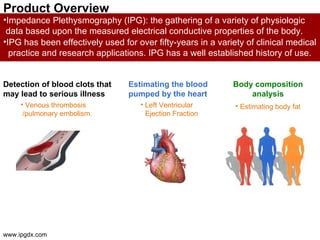
•Impedance Plethysmography (IPG): the gathering of a variety of physiologic
 data based upon the measured electrical conductive properties of the body.
•IPG has been effectively used for over fifty-years in a variety of clinical medical
  practice and research applications. IPG has a well established history of use.


Detection of blood clots that    Estimating the blood        Body composition
may lead to serious illness      pumped by the heart             analysis
     • Venous thrombosis            • Left Ventricular        • Estimating body fat
      /pulmonary embolism.            Ejection Fraction


www.ipgdx.com
Product Overview
                                 Accurately illustrate physiologic
                                 (pathophysiologic) parameters.

                                 Non Invasive.
       IPG
                                 Precision of IPG that
                                 makes it a valuable tool.

                                 The changes it documents are
                                 the changes inherent in the biological system.


• In our applications of IPG we have chosen to provide only the specific
  measured electrical values, the understanding of what their physiologic
  equivalents are and to compare those results in a visible illustration.

• This qualitative standard provides the basis for a reliable decision matrix suitable for
  clinical practice that is understandable to patient and provider forming the basis of a
  practical health-tool.


www.ipgdx.com
How it Works?
• Our body is made of materials that have varying degrees of conductivity based
 upon water and cells.


                            To make the measurement the subject becomes
                            the only unknown part of a safe electrical circuit.


                            The circuit is safe because the signal that is used
                            is at a frequency and strength (current and voltage)
                             so as not to stimulate or disturb any tissues.


                            The measurement can be repeated as often as
                            necessary to illustrate and report the information
                            sought.


www.ipgdx.com
How it Works?
• The measured impedance is vectored into two parts; Resistance (R) and
  Reactance (Xc) and the relationship between them is calculated as the
  Phase Angle (Pa).
                                    : Is a fluid Indicator
                   Resistance (R)                 1
                                    : R=
                                           Water Content of Body.


                      70% water            • Conduction is improved
                                           • Resistance is lessened


                      30% water            • Conduction is reduced
                                           • Resistance is greater


www.ipgdx.com
How it Works?
• Xc is proportionate to cell mass so when you are healthier and better
  nourished Xc is higher and when you are less healthy or nourished Xc
  is lower.


                                 Higher Xc Value
                                • More cells and healthier cells.
                                • Greater capacity to 'hold' the electrical energy.
                                • Subject is well nourished.


                                 Lower Xc Value
                                • Fewer and less healthier cells.
                Blood Cells     • Lower capacity to 'hold' the electrical energy.


www.ipgdx.com
How it Works?
• The Pa is the relationship between R and Xc defined mathematically (arc
  tangent Xc/R expressed in Degrees).


                                                  increasing
                                                  frequency
                Reactance (   )


   The average Phase Angle is from 50 to 90 -The higher the value the better
   the health.
   < 4o denotes serious illness and an opportunity for aggressive intervention.

   Continued diminution denotes worsening condition and if in the presence of
   aggressive intervention: non-response.

   <2o impending death (unrecoverable).


www.ipgdx.com
Why use it?
• Changes in R, Xc and Pa do not explain the reason for the change and they
must be taken in the context of the overall health of the subject and used in
addition to the existing clinical dataset.
• However their value is that they clearly and reliably illustrate change before changes
are seen through typical methods such as a blood chemistries/cell counts, physical
signs or imaging techniques.


                                                                                Illness
                                                                                Changes


www.ipgdx.com
Why use it?
• Since IPG values reflect what is happening at cellular- they act as a "early
  warning system".


                                        Valuable time to act


                                        To detect disease
     IPG values


                                        To improve treatment


                                        End-of-life management


www.ipgdx.com
Why use it?
• In addition the characterization of the cell membrane and the exchange it
mediates between the intracellular and extracellular environments illustrates
the condition of the subject unlike any other methodology providing valuable
information and insight.


          Extracellular Environment


                                                         Illustrates


   Cell membrane      Intra cellular environment
                                                                       Condition of Human body


                                          • Helpful to assess and maintain general health.
                                          • To detect the presence of disease.
                       R, Xc and          • Characterize its progression.
                       Pa                 • Measure effectiveness of Treatment.
                       Measurement        • Optimize treatment.
                                          • Transition to supportive care based upon
                                            objective values.
                                          • Patient and family can understand.
www.ipgdx.com
When to use it?
•The frequency of the measurement is based upon the phenomenon to be
captured and illustrated.


                                   General Health Related
                                   • To assess the condition and effects at hand to
                                     adjust health practices.


                                   Illness Related
       IPG                         • More frequently
   Measurement                     • To show what changes are occurring over time
        for                          to demonstrate recovery or to support further
                                     more definitive investigation.


                                   Serious Illness Related
                                   • Multiple times per day
                                   • To capture and track fluid changes which may
                                     occur rapidly (in hours).


www.ipgdx.com
R
                PROGNOSTICHECK
                  A BIOLOGICAL COMPASS TM


                   By Michaeal Singer

                  www.ipgdx.com
                 michaealsinger@ipgdx.com


www.ipgdx.com

PrognostiCheck® device measures prognosis. Reliable, Objective and Noninvasive.

  • 1.
    R PROGNOSTICHECK A BIOLOGICAL COMPASS TM By Michaeal Singer www.ipgdx.com michaealsinger@ipgdx.com www.ipgdx.com
  • 2.
    R PROGNOSTICHECK Product Overview How it works Why use it? When to use it? www.ipgdx.com
  • 3.
    Product Overview • ThePhase Angle of a biological entity provides a reliable and objective index of prognosis by illustrating the unique individual patients burden of illness, treatment response, potential for complications and the timing of their non-acute death. Treatment Response R PrognostiCheck Report Operating Room Treatment • Presence and Patient severity of Potential for Complications disease. • Effectiveness Non of Treatment. Invasive Patient Info Progress Report Timing of non-acute death Wheel Chair Deceased www.ipgdx.com
  • 4.
    Product Overview Applications Document POA conditions Hospice Support improved clinical /severity for MS-DRG decision making Objectively allocate Reduce DRG overstay resources & pay-backs www.ipgdx.com
  • 5.
    Product Overview •Impedance Plethysmography(IPG): the gathering of a variety of physiologic data based upon the measured electrical conductive properties of the body. •IPG has been effectively used for over fifty-years in a variety of clinical medical practice and research applications. IPG has a well established history of use. Detection of blood clots that Estimating the blood Body composition may lead to serious illness pumped by the heart analysis • Venous thrombosis • Left Ventricular • Estimating body fat /pulmonary embolism. Ejection Fraction www.ipgdx.com
  • 6.
    Product Overview Accurately illustrate physiologic (pathophysiologic) parameters. Non Invasive. IPG Precision of IPG that makes it a valuable tool. The changes it documents are the changes inherent in the biological system. • In our applications of IPG we have chosen to provide only the specific measured electrical values, the understanding of what their physiologic equivalents are and to compare those results in a visible illustration. • This qualitative standard provides the basis for a reliable decision matrix suitable for clinical practice that is understandable to patient and provider forming the basis of a practical health-tool. www.ipgdx.com
  • 7.
    How it Works? •Our body is made of materials that have varying degrees of conductivity based upon water and cells. To make the measurement the subject becomes the only unknown part of a safe electrical circuit. The circuit is safe because the signal that is used is at a frequency and strength (current and voltage) so as not to stimulate or disturb any tissues. The measurement can be repeated as often as necessary to illustrate and report the information sought. www.ipgdx.com
  • 8.
    How it Works? •The measured impedance is vectored into two parts; Resistance (R) and Reactance (Xc) and the relationship between them is calculated as the Phase Angle (Pa). : Is a fluid Indicator Resistance (R) 1 : R= Water Content of Body. 70% water • Conduction is improved • Resistance is lessened 30% water • Conduction is reduced • Resistance is greater www.ipgdx.com
  • 9.
    How it Works? •Xc is proportionate to cell mass so when you are healthier and better nourished Xc is higher and when you are less healthy or nourished Xc is lower. Higher Xc Value • More cells and healthier cells. • Greater capacity to 'hold' the electrical energy. • Subject is well nourished. Lower Xc Value • Fewer and less healthier cells. Blood Cells • Lower capacity to 'hold' the electrical energy. www.ipgdx.com
  • 10.
    How it Works? •The Pa is the relationship between R and Xc defined mathematically (arc tangent Xc/R expressed in Degrees). increasing frequency Reactance ( ) The average Phase Angle is from 50 to 90 -The higher the value the better the health. < 4o denotes serious illness and an opportunity for aggressive intervention. Continued diminution denotes worsening condition and if in the presence of aggressive intervention: non-response. <2o impending death (unrecoverable). www.ipgdx.com
  • 11.
    Why use it? •Changes in R, Xc and Pa do not explain the reason for the change and they must be taken in the context of the overall health of the subject and used in addition to the existing clinical dataset. • However their value is that they clearly and reliably illustrate change before changes are seen through typical methods such as a blood chemistries/cell counts, physical signs or imaging techniques. Illness Changes www.ipgdx.com
  • 12.
    Why use it? •Since IPG values reflect what is happening at cellular- they act as a "early warning system". Valuable time to act To detect disease IPG values To improve treatment End-of-life management www.ipgdx.com
  • 13.
    Why use it? •In addition the characterization of the cell membrane and the exchange it mediates between the intracellular and extracellular environments illustrates the condition of the subject unlike any other methodology providing valuable information and insight. Extracellular Environment Illustrates Cell membrane Intra cellular environment Condition of Human body • Helpful to assess and maintain general health. • To detect the presence of disease. R, Xc and • Characterize its progression. Pa • Measure effectiveness of Treatment. Measurement • Optimize treatment. • Transition to supportive care based upon objective values. • Patient and family can understand. www.ipgdx.com
  • 14.
    When to useit? •The frequency of the measurement is based upon the phenomenon to be captured and illustrated. General Health Related • To assess the condition and effects at hand to adjust health practices. Illness Related IPG • More frequently Measurement • To show what changes are occurring over time for to demonstrate recovery or to support further more definitive investigation. Serious Illness Related • Multiple times per day • To capture and track fluid changes which may occur rapidly (in hours). www.ipgdx.com
  • 15.
    R PROGNOSTICHECK A BIOLOGICAL COMPASS TM By Michaeal Singer www.ipgdx.com michaealsinger@ipgdx.com www.ipgdx.com