TYPES OF COURTSYSTEMS OF THE WORLD
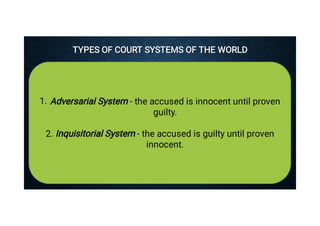
TYPES OF COURT SYSTEMS OF THE WORLD
1. Adversarial System - the accused is innocent until proven
guilty.
2. Inquisitorial System - the accused is guilty until proven
innocent.
2.
THEORIES OF POLICING
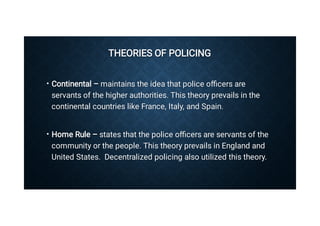
THEORIESOF POLICING
•
•
Continental – maintains the idea that police officers are
servants of the higher authorities. This theory prevails in the
continental countries like France, Italy, and Spain.
Continental – maintains the idea that police officers are
servants of the higher authorities. This theory prevails in the
continental countries like France, Italy, and Spain.
Home Rule – states that the police officers are servants of the
community or the people. This theory prevails in England and
United States. Decentralized policing also utilized this theory.
Home Rule – states that the police officers are servants of the
community or the people. This theory prevails in England and
United States. Decentralized policing also utilized this theory.
3.
CONCEPTS OF POLICESERVICE
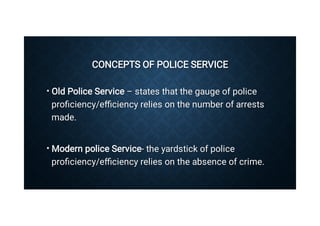
CONCEPTS OF POLICE SERVICE
•
•
Old Police Service – states that the gauge of police
proficiency/efficiency relies on the number of arrests
made.
Old Police Service – states that the gauge of police
proficiency/efficiency relies on the number of arrests
made.
Modern police Service- the yardstick of police
proficiency/efficiency relies on the absence of crime.
Modern police Service- the yardstick of police
proficiency/efficiency relies on the absence of crime.
4.
OTHER CONCEPTS
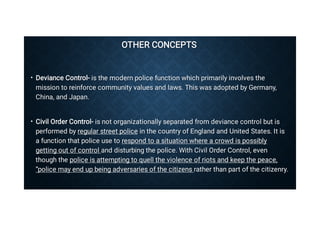
OTHER CONCEPTS
•
•
DevianceControl- is the modern police function which primarily involves the
mission to reinforce community values and laws. This was adopted by Germany,
China, and Japan.
Deviance Control- is the modern police function which primarily involves the
mission to reinforce community values and laws. This was adopted by Germany,
China, and Japan.
Civil Order Control- is not organizationally separated from deviance control but is
performed by regular street police in the country of England and United States. It is
a function that police use to respond to a situation where a crowd is possibly
getting out of control and disturbing the police. With Civil Order Control, even
though the police is attempting to quell the violence of riots and keep the peace,
“police may end up being adversaries of the citizens rather than part of the citizenry.
Civil Order Control- is not organizationally separated from deviance control but is
performed by regular street police in the country of England and United States. It is
a function that police use to respond to a situation where a crowd is possibly
getting out of control and disturbing the police. With Civil Order Control, even
though the police is attempting to quell the violence of riots and keep the peace,
“police may end up being adversaries of the citizens rather than part of the citizenry.
5.
MODELS OF POLICINGSYSTEMS
MODELS OF POLICING SYSTEMS
•
•
•
Traditional Policing- within this model the police officer would respond when a call
came in that a crime occurred. Once the officer responded to the crime, the officer
would then take a report and hand the investigation off to a detective. This policing
is reactive in nature.
Problem Solving Policing- within this model there is an emphasis on trying and
prevent crime from happening. This policing has detectives watching for patterns in
crimes to help understand when and how crimes are being committed.
Community Oriented Policing- within this model, the officers will take more
community involvement stance. No longer does an officer sits in his patrol car and
wait for a call that a crime has happened.
6.
THE NEED FORINNOVATIVE POLICING
THE NEED FOR INNOVATIVE POLICING
Theories and practices in law enforcement have been compared
in several studies under various circumstances, the goal is to
test whether the theory and practice in policing needs
modernization to meet the demands of the present trends in
crime fighting. Comparative research is usually carried out by the
“safari” method (a researcher visits another country) or
“collaborative” method (the researcher communicates with a
foreign researcher).
7.
GLOBALIZATION
GLOBALIZATION
Is the systemof interaction among the countries of the world in
order to develop the global economy. Globalization refers to the
integration of economics and societies all over the world.
Globalization involves technological, economic, political, and
cultural exchanges made possible largely by advances in
communication, transportation, and infrastructure.
8.
EFFECTS OF GLOBALIZATION
EFFECTSOF GLOBALIZATION
Industry: The world has become a huge market where you can buy
and sell things produced in any part of the world.
Culture: Globalization means a decrease in the cultural diversity that
used to exist in the world earlier. You can find people in several
countries dressing up like Westerners.
Legislation: There has been an increase in the establishment of
International courts of justice where someone accused could be dealt
with in any part of the world.
9.
EFFECTS OF GLOBALIZATION
EFFECTSOF GLOBALIZATION
Language: With increased globalization, people tend to forget their mother
tongue and use English instead as there is an idea that it makes them superior in
some way.
Information: With the wide use of Internet and other kinds of information
technology, it has become much easier and faster to share information
worldwide.
Finance: Globalization has made it easier to raise finance through individuals
and firms outside the country.
Politics: Powerful countries and individuals nowadays have political control over
the whole world, not only their country. The United States is an example of a
country that influences the whole of the world politics
10.
THE NEGATIVE EFFECTSOF GLOBALIZATION
THE NEGATIVE EFFECTS OF GLOBALIZATION
•
•
•
•
•
•
•
Developed nations have outsourced manufacturing and white collar jobs. That
means less-jobs for their people.
Globalization has led to exploitation of labor.
Job insecurity. Earlier people had stable, permanent jobs.
Terrorists have access to sophisticated weapons
Companies have set up industries causing pollution in countries
Fast food chains like McDonalds and KFC are spreading in the developing world.
People are consuming more junk food from these joints which has an adverse
impact on their health.
Money Laundering - the concealment of the origins of illegally obtained money,
typically by means of transfers involving foreign banks or legitimate businesses.
11.
EVOLUTION OF POLICING
EVOLUTIONOF POLICING
•
•
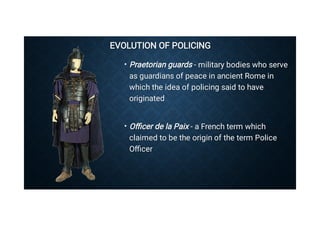
Praetorian guards - military bodies who serve
as guardians of peace in ancient Rome in
which the idea of policing said to have
originated
Praetorian guards - military bodies who serve
as guardians of peace in ancient Rome in
which the idea of policing said to have
originated
Officer de la Paix - a French term which
claimed to be the origin of the term Police
Officer
Officer de la Paix - a French term which
claimed to be the origin of the term Police
Officer
12.
EVOLUTION OF POLICING
EVOLUTIONOF POLICING
A. Tun Policing System - all male residents were required to guard the town (tun ) to
preserve peace and protect the lives and properties of the people.
A. Tun Policing System - all male residents were required to guard the town (tun ) to
preserve peace and protect the lives and properties of the people.
- Ten families in a town (tun) equaled a tithing. Each tithing elected a leader who was
known as the Tithingman. Since 10 tithings amounted to 100, the leader of the 100
families was named the reeve.
- Ten families in a town (tun) equaled a tithing. Each tithing elected a leader who was
known as the Tithingman. Since 10 tithings amounted to 100, the leader of the 100
families was named the reeve.
- Both the tithingman and reeve were elected officials. They possessed judicial power
as well as police authority.
- Both the tithingman and reeve were elected officials. They possessed judicial power
as well as police authority.
B. Hue and Cry - A village law started in Britain which provided methods of
apprehending a criminal by an act of the complainant to shout to call all male
residents to assemble and arrest the suspect.
B. Hue and Cry - A village law started in Britain which provided methods of
apprehending a criminal by an act of the complainant to shout to call all male
residents to assemble and arrest the suspect.
Anglo-Saxon Period of Policing System (Ancient England)
13.
EVOLUTION OF POLICING
EVOLUTIONOF POLICING
•
•
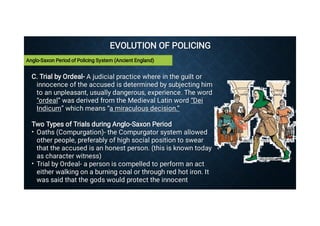
C. Trial by Ordeal- A judicial practice where in the guilt or
innocence of the accused is determined by subjecting him
to an unpleasant, usually dangerous, experience. The word
“ordeal” was derived from the Medieval Latin word “Dei
Indicum” which means “a miraculous decision.”
C. Trial by Ordeal- A judicial practice where in the guilt or
innocence of the accused is determined by subjecting him
to an unpleasant, usually dangerous, experience. The word
“ordeal” was derived from the Medieval Latin word “Dei
Indicum” which means “a miraculous decision.”
Two Types of Trials during Anglo-Saxon Period
Two Types of Trials during Anglo-Saxon Period
Oaths (Compurgation)- the Compurgator system allowed
other people, preferably of high social position to swear
that the accused is an honest person. (this is known today
as character witness)
Oaths (Compurgation)- the Compurgator system allowed
other people, preferably of high social position to swear
that the accused is an honest person. (this is known today
as character witness)
Trial by Ordeal- a person is compelled to perform an act
either walking on a burning coal or through red hot iron. It
was said that the gods would protect the innocent
Trial by Ordeal- a person is compelled to perform an act
either walking on a burning coal or through red hot iron. It
was said that the gods would protect the innocent
Anglo-Saxon Period of Policing System (Ancient England)
14.
EVOLUTION OF POLICING
EVOLUTIONOF POLICING
A. Shire-Reeve - Shire-Reeve was a policing system during the Norman Period when
England was divided into fifty-five (55) military areas, each headed by a ruler called
the Reeve (head-man or lieutenant of the army). The fifty-five (55) military divisions
in England are called shires.
A. Shire-Reeve - Shire-Reeve was a policing system during the Norman Period when
England was divided into fifty-five (55) military areas, each headed by a ruler called
the Reeve (head-man or lieutenant of the army). The fifty-five (55) military divisions
in England are called shires.
-The shire-reeve had absolute powers that no one could questions his or her actions.
-The shire-reeve had absolute powers that no one could questions his or her actions.
- Two “Constabuli” or “The Keeper of the Horse”were appointed to each village to aid
the Reeve in his duties. It became the source of the word Constable.
- Two “Constabuli” or “The Keeper of the Horse”were appointed to each village to aid
the Reeve in his duties. It became the source of the word Constable.
- The term “Shire-Reeve” is said to be the origin of the word “Sheriff.”
- The term “Shire-Reeve” is said to be the origin of the word “Sheriff.”
B. Travelling Judge or Circuit Judge- A judge selected to hear cases which were
formerly being judged by the Shire-Rieve and tasked to travel through and hear
criminal cases. This was the first instance of the division of the police and judicial
powers.
B. Travelling Judge or Circuit Judge- A judge selected to hear cases which were
formerly being judged by the Shire-Rieve and tasked to travel through and hear
criminal cases. This was the first instance of the division of the police and judicial
powers.
2. Norman Period of Policing System
15.
EVOLUTION OF POLICING
EVOLUTIONOF POLICING
•
•
•
•
C. Legis Henrici (Laws of Henry)- An act that was enacted during this period with the
following features:
C. Legis Henrici (Laws of Henry)- An act that was enacted during this period with the
following features:
Offenses were classified as against the king and individual.
Offenses were classified as against the king and individual.
Policeman becomes public servant.
Policeman becomes public servant.
The police and the citizens have the broad power to arrest. It introduced the system
called “citizen’s arrest.”
The police and the citizens have the broad power to arrest. It introduced the system
called “citizen’s arrest.”
Grand Jury was created to inquire on the facts of the law. It eliminated the “Anglo-
Saxon Trial” or “Trial by Ordeal System. ”
Grand Jury was created to inquire on the facts of the law. It eliminated the “Anglo-
Saxon Trial” or “Trial by Ordeal System. ”
D. Frankpledge System- A system of policing whereby a group of ten neighboring male
residents over twelve years of age were required to guard the town to preserve
peace and protect the lives and properties of the people
D. Frankpledge System- A system of policing whereby a group of ten neighboring male
residents over twelve years of age were required to guard the town to preserve
peace and protect the lives and properties of the people
2. Norman Period of Policing System
16.
EVOLUTION OF POLICING
EVOLUTIONOF POLICING
This period has the following features:
This period has the following features:
A: Guards were appointed and the duties of the constables at night
(watch) and in daytime (ward)were defined
A: Guards were appointed and the duties of the constables at night
(watch) and in daytime (ward)were defined
- Statute of Westminster of 1285, a collection of regulations aimed at
keeping the peace.
- Statute of Westminster of 1285, a collection of regulations aimed at
keeping the peace.
B. Statute of 1295- The law that marks the beginning of the curfew hours,
which demanded the closing of the gates of London during sundown.
B. Statute of 1295- The law that marks the beginning of the curfew hours,
which demanded the closing of the gates of London during sundown.
3. Westminster Period of Policing System
17.
EVOLUTION OF POLICING
EVOLUTIONOF POLICING
C. Justice of the Peace (About 1361)- Three or four men who were learned in the law
of the land were given authority to pursue, arrest, chastise and imprisonment
violators of law. They handled felonies, misdemeanors and infractions of city or
village ordinances. This was later abolished about 75 years after.
C. Justice of the Peace (About 1361)- Three or four men who were learned in the law
of the land were given authority to pursue, arrest, chastise and imprisonment
violators of law. They handled felonies, misdemeanors and infractions of city or
village ordinances. This was later abolished about 75 years after.
D. Star Chamber Court (1487)- A special court designed to try offenders against the
state. The room set-up is formed in a shape of a star and judges were given great
powers such as the power to force testimony from a defendant leading to a great
abuse of power or brutality on the part of the judges.
D. Star Chamber Court (1487)- A special court designed to try offenders against the
state. The room set-up is formed in a shape of a star and judges were given great
powers such as the power to force testimony from a defendant leading to a great
abuse of power or brutality on the part of the judges.
3. Westminster Period of Policing System
18.
EVOLUTION OF POLICING
EVOLUTIONOF POLICING
•
•
4. Keepers of the Peace- A proclamation issued by King Richard of England sometime
in 1195 that required the appointment of knights to keep the King’s peace by
standing as guards on bridges and gates while checking the people entering and
leaving the cities and towns.
4. Keepers of the Peace- A proclamation issued by King Richard of England sometime
in 1195 that required the appointment of knights to keep the King’s peace by
standing as guards on bridges and gates while checking the people entering and
leaving the cities and towns.
5. King Charles II of England (1663)- King Charles II passed an act which established
or promoted the employment of watchmen or bellmen to be on duty from sunset to
sunrise.
5. King Charles II of England (1663)- King Charles II passed an act which established
or promoted the employment of watchmen or bellmen to be on duty from sunset to
sunrise.
6. Magna Carta or The Great Charter- A law promulgated by King John of England
upon the demand of the Knights of the Round Table forcing the King to sign the
same with the following features:
6. Magna Carta or The Great Charter- A law promulgated by King John of England
upon the demand of the Knights of the Round Table forcing the King to sign the
same with the following features:
No freeman shall be taken, imprisoned, banished or exiled except by legal judgment
of his peers.
No freeman shall be taken, imprisoned, banished or exiled except by legal judgment
of his peers.
No person shall be tried for murder unless there is proof of the body of the victim.
No person shall be tried for murder unless there is proof of the body of the victim.
Others
19.
LONDON POLICING PRIORTO 1829
LONDON POLICING PRIOR TO 1829
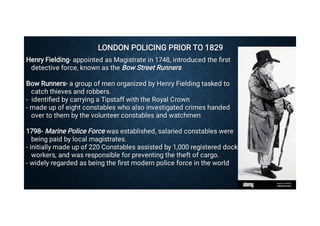
Henry Fielding- appointed as Magistrate in 1748, introduced the first
detective force, known as the Bow Street Runners
Henry Fielding- appointed as Magistrate in 1748, introduced the first
detective force, known as the Bow Street Runners
Bow Runners- a group of men organized by Henry Fielding tasked to
catch thieves and robbers.
Bow Runners- a group of men organized by Henry Fielding tasked to
catch thieves and robbers.
- identified by carrying a Tipstaff with the Royal Crown
- identified by carrying a Tipstaff with the Royal Crown
- made up of eight constables who also investigated crimes handed
over to them by the volunteer constables and watchmen
- made up of eight constables who also investigated crimes handed
over to them by the volunteer constables and watchmen
1798- Marine Police Force was established, salaried constables were
being paid by local magistrates.
1798- Marine Police Force was established, salaried constables were
being paid by local magistrates.
- initially made up of 220 Constables assisted by 1,000 registered dock
workers, and was responsible for preventing the theft of cargo.
- initially made up of 220 Constables assisted by 1,000 registered dock
workers, and was responsible for preventing the theft of cargo.
- widely regarded as being the first modern police force in the world
- widely regarded as being the first modern police force in the world
20.
LONDON 1829
LONDON 1829
SirRobert Peel- appointed as Home Secretary in 1822
Sir Robert Peel- appointed as Home Secretary in 1822
Metropolitan Police - organized in 1829 by Sir Robert Peel (Metropolitan
Police Act of 1829)
Metropolitan Police - organized in 1829 by Sir Robert Peel (Metropolitan
Police Act of 1829)
- the largest of the police services that operate in greater London (the others
include the City of London Police and the British Transport Police)
- the largest of the police services that operate in greater London (the others
include the City of London Police and the British Transport Police)
- finest police force around the world.
- finest police force around the world.
TOTAL POLICING- motto of London Metropolitan Police
TOTAL POLICING- motto of London Metropolitan Police



![Module-1-LAW-ENFORCEMENT-ORGANIZATION-AND-ADMINISTRATION-1[Replica]_081357.pptx](https://cdn.slidesharecdn.com/ss_thumbnails/module-1-law-enforcement-organization-and-administration-1replica081357-250417141605-7c7fd3c5-thumbnail.jpg?width=640&height=640&fit=bounds)


