Title IX & Gender Equity
When charges of discrimination are filed, the plaintiffs usually base their arguments on: Equal Protection and Due Process… State equal rights amendments… Some form of federal Civil Rights legislation…
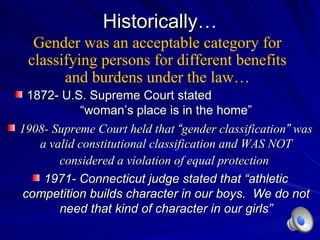
Historically… 1872- U.S. Supreme Court stated  “woman’s place is in the home” 1908- Supreme Court held that  “ gender classification ”  was a valid constitutional classification and WAS NOT considered a violation of equal protection   1971- Connecticut judge stated that  “athletic competition builds character in our boys.  We do not need that kind of character in our girls” Gender was an acceptable category for classifying persons for different benefits and burdens under the law…
The Nature of Sports Culture in America
Men ’ s Sport Culture Large, well organized, well funded hierarchical system * Community-based Youth Sports Programs * Intercollegiate level sports * Interscholastic Sports “ The Dream ” Professional Sports Model Values: --Strength, power, competition, survival of the fittest, opponent is the enemy, financial rewards --idealized, promoted, rewarded successful, elite athletes --established  “ The Dream ”  of a professional career in sports --Viewed mass participation as a tool of exclusion used to weed out the weak and generate a spectator fan base
Women ’ s Sport Culture Physical Education/Olympism Model Promoted participation regardless of ability and emphasized lifelong commitment to wellness Enjoyment Controlled:   social form of competition Healthy Recreation Values --Self-development, opponent viewed as a  “ devils advocate ”  pushing athletes to higher level of play --stressed cooperative teamwork over individual elitism -- ” Pay for Play ”  did not exist and was viewed as corrupt and undesirable --  “ A sport for every girl and  every girl in a sport ”
Historically… Sports reflected the  “ cultural norms ”  that perpetuated sex stereotypes and myths about what is  “ RIGHT ”  for a woman to do… For the first one hundred years of college sports – there were no women ’ s intercollegiate sports…  Few women were  “ allowed ”  access to the  “ fame and fortune ”  that men had historically enjoyed
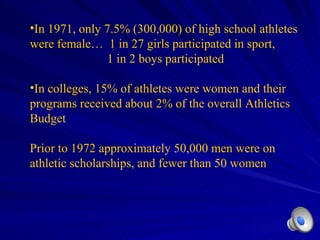
In 1971, only 7.5% (300,000) of high school athletes were female…  1 in 27 girls participated in sport,  1 in 2 boys participated In colleges, 15% of athletes were women and their programs received about 2% of the overall Athletics Budget Prior to 1972 approximately 50,000 men were on athletic scholarships, and fewer than 50 women
When women ’ s programs began to be introduced at the high school and college level…..  The design of those programs reflected a lack of access to financial and facility support: Historically…
Separate, but not equal Funding Participation Opportunities Facilities/Administration/Coaching
Civil Rights laws have historically been a powerful mechanism for effecting social change in the United States. Women ’ s Civil Rights Movement gained momentum in the late 1960 ’ s and early 1970 ’ s,  American ’ s began to focus attention on inequalities that inhibit the programs of girls and women in education Gender Equity is a  Child of the 60's
9 percent of medical degrees went to women  1 percent of dental degrees were awarded to women Of the doctoral degrees awarded, 25 percent went to women  In 1972
Issues of sex bias in education moved into the public policy realm when Representative Edith Green (R, Oregon) introduced an education bill with provisions regarding sex equity -- the hearings she held were the first ever devoted to this topic and are considered the first legislative step toward enacting Title IX. 1971 -- Five proposals -- all different, in the House, Senate, and White House proposed to end sex discrimination in education House-Senate Conference Committee worked for several months to settle on the over 250 differences in House-Senate Bills…. The final legislation became Title IX
Title IX Education Amendments of 1972 20 U.S.C. 1681 et. Seq. No person in the United States shall, on the basis of sex, be excluded from participation in, be denied the benefits of, or be subject to discrimination under any educational programs or activity receiving federal financial assistance.   -- From the preamble to Title IX of the Education Amendments of 1972
Equal Opportunity in Athletics Athletic Financial Assistance Accommodation of Athletic Interests and Abilities Three Prong Test Other Program Areas: all other benefits, opportunities, and treatments afforded to sports participants  are to be equivalent, but not necessarily identical
Athletic Financial Assistance ~ Financial Proportionality ~ Total Amounts of athletics aid must be substantiality proportionate to the ratio of male and female athletes
Substantial Proportionality.   Demonstrate that participation opportunities for  each sex are proportional to enrollment; OR History and Continuing Practice.   Show a history of expansion in its women ’ s  athletics programs; OR Effectively Accommodating Interests and Abilities. Demonstrate that the interests and abilities of  members of the underrepresented sex have been fully accommodated by the present program. -- from the 1979 Policy Interpretation 944 Fed. Reg. 71413 et. Seq.) “The Three-Prong Test”
Effective accommodation of students ’  interests and abilities Opportunities for males and females substantially proportionate to their respective enrollments Where one sex has been underrepresented, a history and continuing practice of program expansion responsive to the developing interests and abilities of that sex. Where one sex is underrepresented and cannot show a continuing practice of program expansion whether it can be demonstrated that the interests and abilities of that sex have been fully and effectively accommodated by that present program. EMAIL SURVEY
  Other Program Areas:   Benefits, opportunities and treatment Equipment and supplies Scheduling of practice and competition Travel and per diem Opportunities for coaching and academic tutors Assignment and compensation of coaches and academic tutors Locker room, practice and competitive facilities Medical and training facilities and services Housing and dining facilities and services Publicity
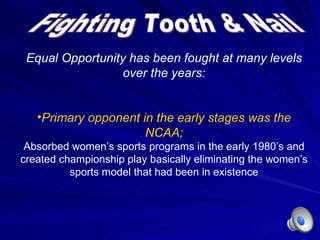
Fighting Tooth & Nail Equal Opportunity has been fought at many levels over the years: Primary opponent in the early stages was the NCAA; Absorbed women ’s sports programs in the early 1980’s and created championship play basically eliminating the women’s sports model that had been in existence
Hard History 1972 • passage of Title IX. 1974 • Javits Amendment: HEW must issue Title IX regulations.  “…with respect to intercollegiate athletic activities, reasonable provisions, considering the nature of particular sports.” 1974 • Amendment to exempt revenue-producing sports from Title IX rejected. 1975 • Bills to alter Title IX athletics coverage die in committee 1975 • HEW issues final regulations, reviewed by Congress, signed into law with provisions banning sex discrimination and establishes 3-year time frame to be compliant. 1975 • Congress reviews Title IX regulations and doesn ’t disapprove. 1975 & 1977 • Senate refuses to act on bills to curtail Title IX enforcement. 1979 • HEW issues final policy interpretations - Rather than relying on presumption of compliance, final policy focuses on institution ’s obligation to equal opportunity and details factors to assess compliance. 1980 • DOE established, OCR given oversight responsibilities.
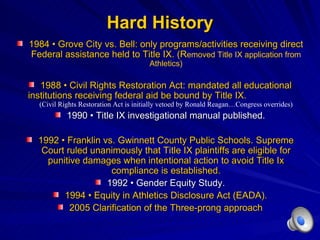
Hard History 1984 • Grove City vs. Bell: only programs/activities receiving direct Federal assistance held to Title IX. (R emoved Title IX application from Athletics) 1988 • Civil Rights Restoration Act: mandated all educational institutions receiving federal aid be bound by Title IX.  ( Civil Rights Restoration Act is initially vetoed by Ronald Reagan…Congress overrides) 1990 • Title IX investigational manual published. 1992 • Franklin vs. Gwinnett County Public Schools. Supreme Court ruled unanimously that Title IX plaintiffs are eligible for punitive damages when intentional action to avoid Title Ix compliance is established. 1992 • Gender Equity Study. 1994 • Equity in Athletics Disclosure Act (EADA). 2005 Clarification of the Three-prong approach
In addition to Title IX, three pieces of supporting and related legislation have been enacted:  The Women's Educational Equity Act of 1974 provides for federal financial and technical support to local efforts to remove barriers for females in all areas of education through, for example, the development of model programs, training, and research.  Title IV of the Civil Rights Act of 1964 provides for support to schools to comply with the mandate for nondiscrimination by providing funds for regional Desegregation Assistance Centers and grants to state education departments for providing more equitable education to students.  The 1976 amendments to the Vocational Education Act of 1963 require states to act affirmatively to eliminate sex bias, stereotyping, and discrimination in vocational education
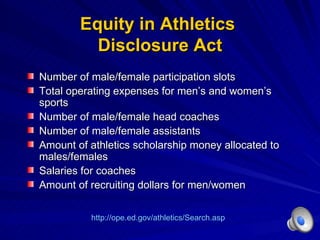
Equity in Athletics  Disclosure Act Number of male/female participation slots Total operating expenses for men ’s and women’s sports Number of male/female head coaches Number of male/female assistants Amount of athletics scholarship money allocated to males/females Salaries for coaches Amount of recruiting dollars for men/women http://ope.ed.gov/athletics/Search.asp
http://bailiwick.lib.uiowa.edu/ge/REresources.html
Interscholastic Level Pre-Title IX 300,000 interscholastic athletes were female….7% of all athletes 132,299 High School girls participate in basketball 1 in 27 girls participated in school sports, while 1in 2 boys participated
Today Over 2.4 million high school girls participate in organized sports…. 39% of all athletes -- not a lack of interest, it was a lack of opportunity... Over 400,000 High School girls participate in basketball…..300 % increase since 1972 1 in 3 girls participated in school sports, 1 in 2 boys Approximately 41% of US Soccer players are girls and women Over 300 girls played HS football 700 girls were wrestlers 350 baseball players on boys teams were girls
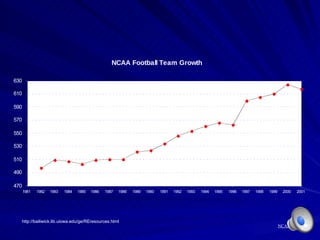
NCAA data http://bailiwick.lib.uiowa.edu/ge/REresources.html
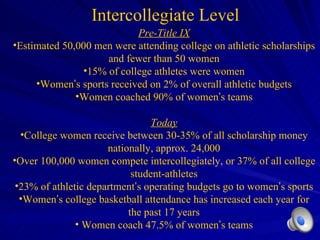
Intercollegiate Level Pre-Title IX Estimated 50,000 men were attending college on athletic scholarships and fewer than 50 women 15% of college athletes were women Women ’ s sports received on 2% of overall athletic budgets Women coached 90% of women ’ s teams Today College women receive between 30-35% of all scholarship money nationally, approx. 24,000 Over 100,000 women compete intercollegiately, or 37% of all college student-athletes 23% of athletic department ’ s operating budgets go to women ’ s sports Women ’ s college basketball attendance has increased each year for the past 17 years Women coach 47.5% of women ’ s teams
? The Death of College Sports
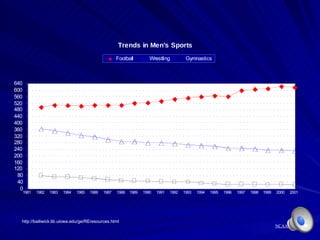
NCAA data http://bailiwick.lib.uiowa.edu/ge/REresources.html
Courtesy of Women ’ s Sports Foundation NCAA  RESEARCH  SITE http://bailiwick.lib.uiowa.edu/ge/REresources.html
General Accounting Office Study on NCAA & NAIA men ’s teams 1981-1982 1998-1999 Difference # of men ’ s teams 9,113 9,149 +36 teams # of male  student athletes 220,178 231,866 11,688 (+5%) GAO 1999 http://bailiwick.lib.uiowa.edu/ge/REresources.html
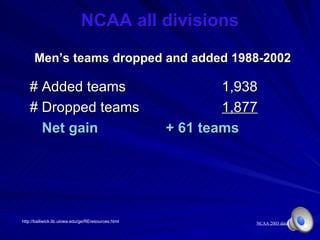
NCAA all divisions Men ’s teams dropped and added 1988-2002 # Added teams    1,938 # Dropped teams   1,877 Net gain    + 61 teams NCAA 2003 data http://bailiwick.lib.uiowa.edu/ge/REresources.html
Men ’s teams dropped and added 1988-2002 Division III # Added 1002 # Dropped 790   Net gain + 212 teams Division II # Added  494 # Dropped  471   Net gain:  +23 teams  Division I # Added  442 # Dropped 616   Net Loss  -174 teams NCAA 2003 data http://bailiwick.lib.uiowa.edu/ge/REresources.html
Summary: Losses/gains in  NCAA men ’s teams Division III  +212 teams Division II  +23 teams Division I-AAA -31 teams Division I-AA -38 teams Division I-A  -109 teams NCAA 2003 data http://bailiwick.lib.uiowa.edu/ge/REresources.html
* Wrestling -99 * Tennis -53 * Rifle -33 * Gymnastics -32 * Fencing -23 Swimming/diving -22 * Lost teams in all 3 divisions NCAA men ’s teams (all divisions):  greatest number lost 1988-2002 NCAA 2003 data http://bailiwick.lib.uiowa.edu/ge/REresources.html
http://bailiwick.lib.uiowa.edu/ge/REresources.html
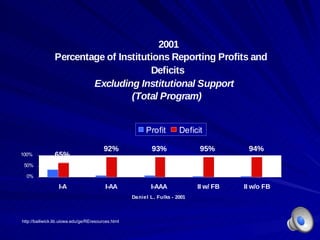
2001 http://bailiwick.lib.uiowa.edu/ge/REresources.html
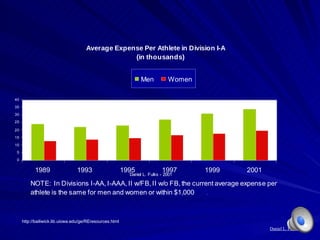
Daniel L. Fulks, 2001 http://bailiwick.lib.uiowa.edu/ge/REresources.html
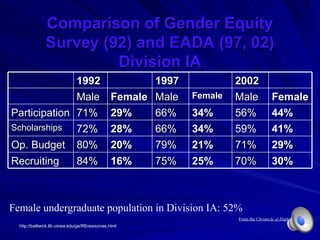
Comparison of Gender Equity Survey (92) and EADA (97, 02) Division IA Female undergraduate population in Division IA: 52%  From the  Chronicle of Higher Education http://bailiwick.lib.uiowa.edu/ge/REresources.html 1992 1997 2002 Male Female Male Female Male Female Participation 71% 29% 66% 34% 56% 44% Scholarships 72% 28% 66% 34% 59% 41% Op. Budget 80% 20% 79% 21% 71% 29% Recruiting 84% 16% 75% 25% 70% 30%
Changes in operating expenses NCAA  gender equity survey results Division I-A 1992 1997 Increase Men 1,049,000 2,429,000 1,380,000 Women 263,000 663,000 400,000 Division II 1992 1997 Increase Men  190,470  177,500   -12,970 Women  73,300  91,500 18,200 Division III 1992 1997 Increase Men 112,400 127,200 14,800 Women 56,120 73,400 17,280 NCAA data http://bailiwick.lib.uiowa.edu/ge/REresources.html
http://bailiwick.lib.uiowa.edu/ge/REresources.html
Growing deficits in athletic programs Daniel L. Fulks, 2001 http://bailiwick.lib.uiowa.edu/ge/REresources.html 1993 1999 2001 I-A -$2.10 -$3.30 -$3.80 I-AA -$1.91 -$2.69 -$3.60 I-AAA -$1.44 -$2.61 -$3.10 II with FB -$0.91 -$1.24 -$1.40 II w/o FB -$0.55 -$0.98 -$1.20
Daniel L. Fulks, 2001 http://bailiwick.lib.uiowa.edu/ge/REresources.html
http://bailiwick.lib.uiowa.edu/ge/REresources.html
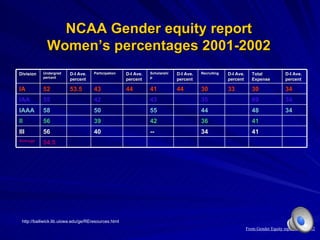
NCAA Gender equity report Women ’s percentages 2001-2002 From Gender Equity report 2001-2002 http://bailiwick.lib.uiowa.edu/ge/REresources.html Division Undergrad percent D-I Ave. percent Participation D-I Ave.  percent Scholarship D-I Ave. percent Recruiting D-I Ave. percent Total Expense D-I Ave. percent IA 52 53.5 43 44 41 44 30 33 30 34 IAA 55 42 43 35 69 34 IAAA 58 50 55 44 48 34 II 56 39 42 36 41 III 56 40 -- 34 41 Average 54.5
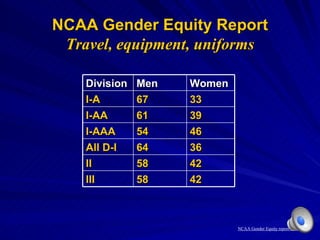
NCAA Gender Equity Report Travel, equipment, uniforms NCAA Gender Equity report 2001-02 Division Men Women I-A 67 33 I-AA 61 39 I-AAA 54 46 All D-I 64 36 II 58 42 III 58 42
Title IX Lawsuits April 16, 1993 US Court of Appeals Cohen, et al vs. Brown University Class action. Effective accommodation of interests/ abilities. Reinstated women ’ s gymnastics and volleyball. $6 million to fight a $150,000 annual expense! July 16, 1993  Settled Sanders et al vs. U. Texas at Austin Class action. Added softball, soccer, increased  walk-ons, and capped men. July 19, 1993  Settled Kiechal et al vs. Auburn U Class action followed by Title IX complaint. $140,000 to plaintiffs, started women ’ s varsity soccer with $200,000 budget, field and scholarship timetable. Oct. 21, 1993  Settled California NOW vs. California State University system Class action. Timetable for progress. Opportunities and aid within five percent and funding within 10 percent.
Universities have the right to reduce number of male athletes Cal-State Bakersfield Preliminary injunction to keep wrestling in  Feb. 1999, Panel of U.S. Court of Appeals did not uphold. Illinois State Dropped men ’s soccer and wrestling and added women’s soccer. Panel of U.S. Court of Appeals dismissed lawsuit.
Equal pay and/or wrongful termination Sex discrimination. Earned $70,000, seeks parity with men ’s coach, seeking $8 million and reinstatement. Marianne Stanley v. USC Pending, filed Aug. 5, 1993 1 st  amendment and breech of contract. VB coach assisted players settle lawsuit, awarded $1.35 million and undisclosed amount of punitive damages. James Huffman v. California State University System Feb. 8, 1994 Jury decision Sex discrimination lawsuit, first Title IX case awarding monetary damage, $1.1 million. Sanya Tyler v. Howard U June 23, 1993 Jury decision
Title IX websites http://bailiwick.lib.uiowa.edu/ge www.ncwge.org Title IX athletic policies, Aug. 2002 www.womenssportsfoundation.org
June 2003 Poll By Wall Street Journal and NBC News (from  Chronicle of Higher Education , January 2003) Approve Disapprove 1. Approve/Disapprove of Title IX 68% 20% 2. “Cutting back on men’s athletics to ensure equivalent athletic opportunities for women ” 66% 27% 3. Attitudes toward changing Title IX: 20%  Strengthen the law 50% No changes to law 21% Weaken the law i.e. 7 of 10 adults familiar with the law want Title IX strengthened or left alone. Title IX  “does not require colleges to give the same amount of money to men’s and women’s sports programs or to have equal numbers of male and female athletes; it does require colleges to provide equitable resources and opportunities in a non-discriminatory manner.”
The Bottom Line NCAA Division I-A EADA Data  1999-2000 Female and college participation High school: 2.9 million or 42 percent College: 153,601 or 42 percent MEN WOMEN Participation 57 43 Scholarships 59 41 Operating budget 70 30 Recruiting budget 70 30
Gender Equity “ Gender equity is an atmosphere and a reality where fair distribution of overall athletic opportunity and resources are proportionate to women and men and where no student-athlete, coach or athletic administrator is discriminated against in any way in the athletic program on the basis of gender. ” “ That is to say, an athletic program is gender equitable when the men ’ s sports program would be  pleased to accept for its own  the overall participation, opportunities and resources currently allocated to the women ’ s program and vice versa. ” NCAA Gender Equity Task Force
Since its passage in 1972, Title IX has had a profound impact on helping to change attitudes, assumptions and behavior and consequently, our understanding about how sexual stereotypes can limit educational opportunities. We now know, for example, that gender is a poor predictor of one's interests, proficiency in academic subjects, or athletic ability. As the First Circuit Court of Appeals noted in a recent Title IX case, "interest and ability rarely develop in a vacuum; they evolve as a function of opportunity and experience." Decision making in schools and in the labor market that relies on gender to assess what students and employees know and are able to do is both archaic and ineffective.  http://www.ed.gov/pubs/TitleIX/part4.html#math&science
Why support girls and women in sports? Federal Law…. Mental, physical, and social benefits of sports participation  that can last a lifetime Girls who participate in sports are: ~92% less likely to be involved in drugs ~80% less likely to have an unwanted pregnancy ~3x ’ s more likely to have higher grades ~more likely to graduate than non-athletic females Girls and Women in sports have: ~higher self-esteem ~less depression ~learn to be assertive ~make decisions ~be competitive ~learn teamwork and cooperation ~experience goal setting and prioritizing
Career opportunities in sports (participation and administration), coaching, athletic training and sports medicine, and management at various levels in private and public sector 80% of the women identified as  “key leaders” in Fortune 500  companies participated in sports during  their childhood Why support girls and women in sports?
Key Points Compliance  and  Equitable Treatment Three ways to show compliance Controlled spending Contact Sports allow for  “ exemptions ” Football players are not a separate gender Are you providing what you promise? Open mouth, open wallet

Title IX

  • 1.
    Title IX &Gender Equity
  • 2.
    When charges ofdiscrimination are filed, the plaintiffs usually base their arguments on: Equal Protection and Due Process… State equal rights amendments… Some form of federal Civil Rights legislation…
  • 3.
    Historically… 1872- U.S.Supreme Court stated “woman’s place is in the home” 1908- Supreme Court held that “ gender classification ” was a valid constitutional classification and WAS NOT considered a violation of equal protection 1971- Connecticut judge stated that “athletic competition builds character in our boys. We do not need that kind of character in our girls” Gender was an acceptable category for classifying persons for different benefits and burdens under the law…
  • 4.
    The Nature ofSports Culture in America
  • 5.
    Men ’ sSport Culture Large, well organized, well funded hierarchical system * Community-based Youth Sports Programs * Intercollegiate level sports * Interscholastic Sports “ The Dream ” Professional Sports Model Values: --Strength, power, competition, survival of the fittest, opponent is the enemy, financial rewards --idealized, promoted, rewarded successful, elite athletes --established “ The Dream ” of a professional career in sports --Viewed mass participation as a tool of exclusion used to weed out the weak and generate a spectator fan base
  • 6.
    Women ’ sSport Culture Physical Education/Olympism Model Promoted participation regardless of ability and emphasized lifelong commitment to wellness Enjoyment Controlled: social form of competition Healthy Recreation Values --Self-development, opponent viewed as a “ devils advocate ” pushing athletes to higher level of play --stressed cooperative teamwork over individual elitism -- ” Pay for Play ” did not exist and was viewed as corrupt and undesirable -- “ A sport for every girl and every girl in a sport ”
  • 7.
    Historically… Sports reflectedthe “ cultural norms ” that perpetuated sex stereotypes and myths about what is “ RIGHT ” for a woman to do… For the first one hundred years of college sports – there were no women ’ s intercollegiate sports… Few women were “ allowed ” access to the “ fame and fortune ” that men had historically enjoyed
  • 8.
    In 1971, only7.5% (300,000) of high school athletes were female… 1 in 27 girls participated in sport, 1 in 2 boys participated In colleges, 15% of athletes were women and their programs received about 2% of the overall Athletics Budget Prior to 1972 approximately 50,000 men were on athletic scholarships, and fewer than 50 women
  • 9.
    When women ’s programs began to be introduced at the high school and college level….. The design of those programs reflected a lack of access to financial and facility support: Historically…
  • 10.
    Separate, but notequal Funding Participation Opportunities Facilities/Administration/Coaching
  • 11.
    Civil Rights lawshave historically been a powerful mechanism for effecting social change in the United States. Women ’ s Civil Rights Movement gained momentum in the late 1960 ’ s and early 1970 ’ s, American ’ s began to focus attention on inequalities that inhibit the programs of girls and women in education Gender Equity is a Child of the 60's
  • 12.
    9 percent ofmedical degrees went to women 1 percent of dental degrees were awarded to women Of the doctoral degrees awarded, 25 percent went to women In 1972
  • 13.
    Issues of sexbias in education moved into the public policy realm when Representative Edith Green (R, Oregon) introduced an education bill with provisions regarding sex equity -- the hearings she held were the first ever devoted to this topic and are considered the first legislative step toward enacting Title IX. 1971 -- Five proposals -- all different, in the House, Senate, and White House proposed to end sex discrimination in education House-Senate Conference Committee worked for several months to settle on the over 250 differences in House-Senate Bills…. The final legislation became Title IX
  • 14.
    Title IX EducationAmendments of 1972 20 U.S.C. 1681 et. Seq. No person in the United States shall, on the basis of sex, be excluded from participation in, be denied the benefits of, or be subject to discrimination under any educational programs or activity receiving federal financial assistance. -- From the preamble to Title IX of the Education Amendments of 1972
  • 15.
    Equal Opportunity inAthletics Athletic Financial Assistance Accommodation of Athletic Interests and Abilities Three Prong Test Other Program Areas: all other benefits, opportunities, and treatments afforded to sports participants are to be equivalent, but not necessarily identical
  • 16.
    Athletic Financial Assistance~ Financial Proportionality ~ Total Amounts of athletics aid must be substantiality proportionate to the ratio of male and female athletes
  • 17.
    Substantial Proportionality. Demonstrate that participation opportunities for each sex are proportional to enrollment; OR History and Continuing Practice. Show a history of expansion in its women ’ s athletics programs; OR Effectively Accommodating Interests and Abilities. Demonstrate that the interests and abilities of members of the underrepresented sex have been fully accommodated by the present program. -- from the 1979 Policy Interpretation 944 Fed. Reg. 71413 et. Seq.) “The Three-Prong Test”
  • 18.
    Effective accommodation ofstudents ’ interests and abilities Opportunities for males and females substantially proportionate to their respective enrollments Where one sex has been underrepresented, a history and continuing practice of program expansion responsive to the developing interests and abilities of that sex. Where one sex is underrepresented and cannot show a continuing practice of program expansion whether it can be demonstrated that the interests and abilities of that sex have been fully and effectively accommodated by that present program. EMAIL SURVEY
  • 19.
    OtherProgram Areas: Benefits, opportunities and treatment Equipment and supplies Scheduling of practice and competition Travel and per diem Opportunities for coaching and academic tutors Assignment and compensation of coaches and academic tutors Locker room, practice and competitive facilities Medical and training facilities and services Housing and dining facilities and services Publicity
  • 20.
    Fighting Tooth &Nail Equal Opportunity has been fought at many levels over the years: Primary opponent in the early stages was the NCAA; Absorbed women ’s sports programs in the early 1980’s and created championship play basically eliminating the women’s sports model that had been in existence
  • 21.
    Hard History 1972• passage of Title IX. 1974 • Javits Amendment: HEW must issue Title IX regulations. “…with respect to intercollegiate athletic activities, reasonable provisions, considering the nature of particular sports.” 1974 • Amendment to exempt revenue-producing sports from Title IX rejected. 1975 • Bills to alter Title IX athletics coverage die in committee 1975 • HEW issues final regulations, reviewed by Congress, signed into law with provisions banning sex discrimination and establishes 3-year time frame to be compliant. 1975 • Congress reviews Title IX regulations and doesn ’t disapprove. 1975 & 1977 • Senate refuses to act on bills to curtail Title IX enforcement. 1979 • HEW issues final policy interpretations - Rather than relying on presumption of compliance, final policy focuses on institution ’s obligation to equal opportunity and details factors to assess compliance. 1980 • DOE established, OCR given oversight responsibilities.
  • 22.
    Hard History 1984• Grove City vs. Bell: only programs/activities receiving direct Federal assistance held to Title IX. (R emoved Title IX application from Athletics) 1988 • Civil Rights Restoration Act: mandated all educational institutions receiving federal aid be bound by Title IX. ( Civil Rights Restoration Act is initially vetoed by Ronald Reagan…Congress overrides) 1990 • Title IX investigational manual published. 1992 • Franklin vs. Gwinnett County Public Schools. Supreme Court ruled unanimously that Title IX plaintiffs are eligible for punitive damages when intentional action to avoid Title Ix compliance is established. 1992 • Gender Equity Study. 1994 • Equity in Athletics Disclosure Act (EADA). 2005 Clarification of the Three-prong approach
  • 23.
    In addition toTitle IX, three pieces of supporting and related legislation have been enacted: The Women's Educational Equity Act of 1974 provides for federal financial and technical support to local efforts to remove barriers for females in all areas of education through, for example, the development of model programs, training, and research. Title IV of the Civil Rights Act of 1964 provides for support to schools to comply with the mandate for nondiscrimination by providing funds for regional Desegregation Assistance Centers and grants to state education departments for providing more equitable education to students. The 1976 amendments to the Vocational Education Act of 1963 require states to act affirmatively to eliminate sex bias, stereotyping, and discrimination in vocational education
  • 24.
    Equity in Athletics Disclosure Act Number of male/female participation slots Total operating expenses for men ’s and women’s sports Number of male/female head coaches Number of male/female assistants Amount of athletics scholarship money allocated to males/females Salaries for coaches Amount of recruiting dollars for men/women http://ope.ed.gov/athletics/Search.asp
  • 25.
  • 26.
    Interscholastic Level Pre-TitleIX 300,000 interscholastic athletes were female….7% of all athletes 132,299 High School girls participate in basketball 1 in 27 girls participated in school sports, while 1in 2 boys participated
  • 27.
    Today Over 2.4million high school girls participate in organized sports…. 39% of all athletes -- not a lack of interest, it was a lack of opportunity... Over 400,000 High School girls participate in basketball…..300 % increase since 1972 1 in 3 girls participated in school sports, 1 in 2 boys Approximately 41% of US Soccer players are girls and women Over 300 girls played HS football 700 girls were wrestlers 350 baseball players on boys teams were girls
  • 28.
  • 29.
    Intercollegiate Level Pre-TitleIX Estimated 50,000 men were attending college on athletic scholarships and fewer than 50 women 15% of college athletes were women Women ’ s sports received on 2% of overall athletic budgets Women coached 90% of women ’ s teams Today College women receive between 30-35% of all scholarship money nationally, approx. 24,000 Over 100,000 women compete intercollegiately, or 37% of all college student-athletes 23% of athletic department ’ s operating budgets go to women ’ s sports Women ’ s college basketball attendance has increased each year for the past 17 years Women coach 47.5% of women ’ s teams
  • 30.
    ? The Deathof College Sports
  • 31.
  • 32.
  • 33.
  • 34.
    Courtesy of Women’ s Sports Foundation NCAA RESEARCH SITE http://bailiwick.lib.uiowa.edu/ge/REresources.html
  • 35.
    General Accounting OfficeStudy on NCAA & NAIA men ’s teams 1981-1982 1998-1999 Difference # of men ’ s teams 9,113 9,149 +36 teams # of male student athletes 220,178 231,866 11,688 (+5%) GAO 1999 http://bailiwick.lib.uiowa.edu/ge/REresources.html
  • 36.
    NCAA all divisionsMen ’s teams dropped and added 1988-2002 # Added teams 1,938 # Dropped teams 1,877 Net gain + 61 teams NCAA 2003 data http://bailiwick.lib.uiowa.edu/ge/REresources.html
  • 37.
    Men ’s teamsdropped and added 1988-2002 Division III # Added 1002 # Dropped 790 Net gain + 212 teams Division II # Added 494 # Dropped 471 Net gain: +23 teams Division I # Added 442 # Dropped 616 Net Loss -174 teams NCAA 2003 data http://bailiwick.lib.uiowa.edu/ge/REresources.html
  • 38.
    Summary: Losses/gains in NCAA men ’s teams Division III +212 teams Division II +23 teams Division I-AAA -31 teams Division I-AA -38 teams Division I-A -109 teams NCAA 2003 data http://bailiwick.lib.uiowa.edu/ge/REresources.html
  • 39.
    * Wrestling -99* Tennis -53 * Rifle -33 * Gymnastics -32 * Fencing -23 Swimming/diving -22 * Lost teams in all 3 divisions NCAA men ’s teams (all divisions): greatest number lost 1988-2002 NCAA 2003 data http://bailiwick.lib.uiowa.edu/ge/REresources.html
  • 40.
  • 41.
  • 42.
  • 43.
  • 44.
    Daniel L. Fulks,2001 http://bailiwick.lib.uiowa.edu/ge/REresources.html
  • 45.
    Daniel L. Fulks,2001 http://bailiwick.lib.uiowa.edu/ge/REresources.html
  • 46.
    Comparison of GenderEquity Survey (92) and EADA (97, 02) Division IA Female undergraduate population in Division IA: 52% From the Chronicle of Higher Education http://bailiwick.lib.uiowa.edu/ge/REresources.html 1992 1997 2002 Male Female Male Female Male Female Participation 71% 29% 66% 34% 56% 44% Scholarships 72% 28% 66% 34% 59% 41% Op. Budget 80% 20% 79% 21% 71% 29% Recruiting 84% 16% 75% 25% 70% 30%
  • 47.
    Changes in operatingexpenses NCAA gender equity survey results Division I-A 1992 1997 Increase Men 1,049,000 2,429,000 1,380,000 Women 263,000 663,000 400,000 Division II 1992 1997 Increase Men 190,470 177,500 -12,970 Women 73,300 91,500 18,200 Division III 1992 1997 Increase Men 112,400 127,200 14,800 Women 56,120 73,400 17,280 NCAA data http://bailiwick.lib.uiowa.edu/ge/REresources.html
  • 48.
  • 49.
  • 50.
    Growing deficits inathletic programs Daniel L. Fulks, 2001 http://bailiwick.lib.uiowa.edu/ge/REresources.html 1993 1999 2001 I-A -$2.10 -$3.30 -$3.80 I-AA -$1.91 -$2.69 -$3.60 I-AAA -$1.44 -$2.61 -$3.10 II with FB -$0.91 -$1.24 -$1.40 II w/o FB -$0.55 -$0.98 -$1.20
  • 51.
    Daniel L. Fulks,2001 http://bailiwick.lib.uiowa.edu/ge/REresources.html
  • 52.
  • 53.
    NCAA Gender equityreport Women ’s percentages 2001-2002 From Gender Equity report 2001-2002 http://bailiwick.lib.uiowa.edu/ge/REresources.html Division Undergrad percent D-I Ave. percent Participation D-I Ave. percent Scholarship D-I Ave. percent Recruiting D-I Ave. percent Total Expense D-I Ave. percent IA 52 53.5 43 44 41 44 30 33 30 34 IAA 55 42 43 35 69 34 IAAA 58 50 55 44 48 34 II 56 39 42 36 41 III 56 40 -- 34 41 Average 54.5
  • 54.
    NCAA Gender EquityReport Travel, equipment, uniforms NCAA Gender Equity report 2001-02 Division Men Women I-A 67 33 I-AA 61 39 I-AAA 54 46 All D-I 64 36 II 58 42 III 58 42
  • 55.
    Title IX LawsuitsApril 16, 1993 US Court of Appeals Cohen, et al vs. Brown University Class action. Effective accommodation of interests/ abilities. Reinstated women ’ s gymnastics and volleyball. $6 million to fight a $150,000 annual expense! July 16, 1993 Settled Sanders et al vs. U. Texas at Austin Class action. Added softball, soccer, increased walk-ons, and capped men. July 19, 1993 Settled Kiechal et al vs. Auburn U Class action followed by Title IX complaint. $140,000 to plaintiffs, started women ’ s varsity soccer with $200,000 budget, field and scholarship timetable. Oct. 21, 1993 Settled California NOW vs. California State University system Class action. Timetable for progress. Opportunities and aid within five percent and funding within 10 percent.
  • 56.
    Universities have theright to reduce number of male athletes Cal-State Bakersfield Preliminary injunction to keep wrestling in Feb. 1999, Panel of U.S. Court of Appeals did not uphold. Illinois State Dropped men ’s soccer and wrestling and added women’s soccer. Panel of U.S. Court of Appeals dismissed lawsuit.
  • 57.
    Equal pay and/orwrongful termination Sex discrimination. Earned $70,000, seeks parity with men ’s coach, seeking $8 million and reinstatement. Marianne Stanley v. USC Pending, filed Aug. 5, 1993 1 st amendment and breech of contract. VB coach assisted players settle lawsuit, awarded $1.35 million and undisclosed amount of punitive damages. James Huffman v. California State University System Feb. 8, 1994 Jury decision Sex discrimination lawsuit, first Title IX case awarding monetary damage, $1.1 million. Sanya Tyler v. Howard U June 23, 1993 Jury decision
  • 58.
    Title IX websiteshttp://bailiwick.lib.uiowa.edu/ge www.ncwge.org Title IX athletic policies, Aug. 2002 www.womenssportsfoundation.org
  • 59.
    June 2003 PollBy Wall Street Journal and NBC News (from Chronicle of Higher Education , January 2003) Approve Disapprove 1. Approve/Disapprove of Title IX 68% 20% 2. “Cutting back on men’s athletics to ensure equivalent athletic opportunities for women ” 66% 27% 3. Attitudes toward changing Title IX: 20% Strengthen the law 50% No changes to law 21% Weaken the law i.e. 7 of 10 adults familiar with the law want Title IX strengthened or left alone. Title IX “does not require colleges to give the same amount of money to men’s and women’s sports programs or to have equal numbers of male and female athletes; it does require colleges to provide equitable resources and opportunities in a non-discriminatory manner.”
  • 60.
    The Bottom LineNCAA Division I-A EADA Data 1999-2000 Female and college participation High school: 2.9 million or 42 percent College: 153,601 or 42 percent MEN WOMEN Participation 57 43 Scholarships 59 41 Operating budget 70 30 Recruiting budget 70 30
  • 61.
    Gender Equity “Gender equity is an atmosphere and a reality where fair distribution of overall athletic opportunity and resources are proportionate to women and men and where no student-athlete, coach or athletic administrator is discriminated against in any way in the athletic program on the basis of gender. ” “ That is to say, an athletic program is gender equitable when the men ’ s sports program would be pleased to accept for its own the overall participation, opportunities and resources currently allocated to the women ’ s program and vice versa. ” NCAA Gender Equity Task Force
  • 62.
    Since its passagein 1972, Title IX has had a profound impact on helping to change attitudes, assumptions and behavior and consequently, our understanding about how sexual stereotypes can limit educational opportunities. We now know, for example, that gender is a poor predictor of one's interests, proficiency in academic subjects, or athletic ability. As the First Circuit Court of Appeals noted in a recent Title IX case, "interest and ability rarely develop in a vacuum; they evolve as a function of opportunity and experience." Decision making in schools and in the labor market that relies on gender to assess what students and employees know and are able to do is both archaic and ineffective. http://www.ed.gov/pubs/TitleIX/part4.html#math&science
  • 63.
    Why support girlsand women in sports? Federal Law…. Mental, physical, and social benefits of sports participation that can last a lifetime Girls who participate in sports are: ~92% less likely to be involved in drugs ~80% less likely to have an unwanted pregnancy ~3x ’ s more likely to have higher grades ~more likely to graduate than non-athletic females Girls and Women in sports have: ~higher self-esteem ~less depression ~learn to be assertive ~make decisions ~be competitive ~learn teamwork and cooperation ~experience goal setting and prioritizing
  • 64.
    Career opportunities insports (participation and administration), coaching, athletic training and sports medicine, and management at various levels in private and public sector 80% of the women identified as “key leaders” in Fortune 500 companies participated in sports during their childhood Why support girls and women in sports?
  • 65.
    Key Points Compliance and Equitable Treatment Three ways to show compliance Controlled spending Contact Sports allow for “ exemptions ” Football players are not a separate gender Are you providing what you promise? Open mouth, open wallet