Tips from CEOs
Many of the following CEOs have seen dramatic ups and downs over
the course of their careers. The advice they give should help to inspire
anyone, no matter what stage in their career they are.
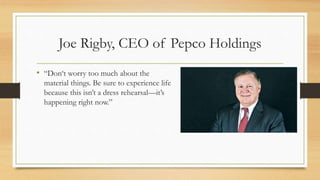
Joe Rigby, CEO of Pepco Holdings
• “Don‘t worry too much about the
material things. Be sure to experience life
because this isn’t a dress rehearsal—it’s
happening right now.”
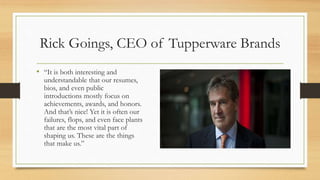
Rick Goings, CEO of Tupperware Brands
• “It is both interesting and
understandable that our resumes,
bios, and even public
introductions mostly focus on
achievements, awards, and honors.
And that’s nice! Yet it is often our
failures, flops, and even face plants
that are the most vital part of
shaping us. These are the things
that make us.”
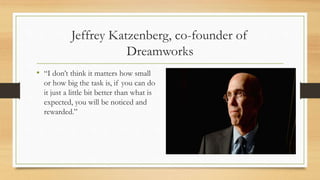
Jeffrey Katzenberg, co-founder of
Dreamworks
• “I don’t think it matters how small
or how big the task is, if you can do
it just a little bit better than what is
expected, you will be noticed and
rewarded.”
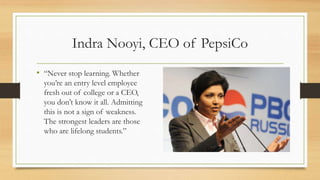
Indra Nooyi, CEO of PepsiCo
• “Never stop learning. Whether
you’re an entry level employee
fresh out of college or a CEO,
you don’t know it all. Admitting
this is not a sign of weakness.
The strongest leaders are those
who are lifelong students.”
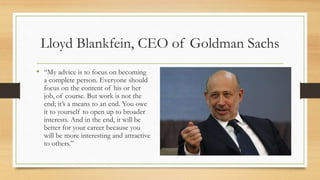
Lloyd Blankfein, CEO of Goldman Sachs
• “My advice is to focus on becoming
a complete person. Everyone should
focus on the content of his or her
job, of course. But work is not the
end; it’s a means to an end. You owe
it to yourself to open up to broader
interests. And in the end, it will be
better for your career because you
will be more interesting and attractive
to others.”
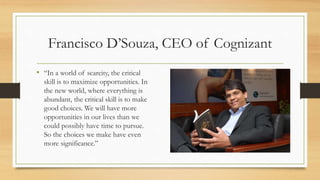
Francisco D’Souza, CEO of Cognizant
• “In a world of scarcity, the critical
skill is to maximize opportunities. In
the new world, where everything is
abundant, the critical skill is to make
good choices. We will have more
opportunities in our lives than we
could possibly have time to pursue.
So the choices we make have even
more significance.”
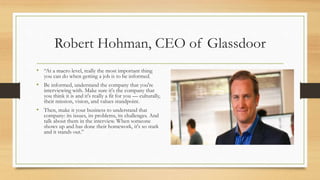
Robert Hohman, CEO of Glassdoor
• “At a macro level, really the most important thing
you can do when getting a job is to be informed.
• Be informed, understand the company that you're
interviewing with. Make sure it's the company that
you think it is and it's really a fit for you — culturally,
their mission, vision, and values standpoint.
• Then, make it your business to understand that
company: its issues, its problems, its challenges. And
talk about them in the interview. When someone
shows up and has done their homework, it's so stark
and it stands out.”
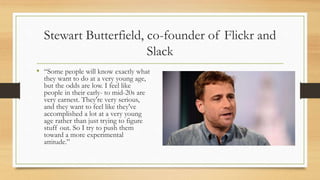
Stewart Butterfield, co-founder of Flickr and
Slack
• “Some people will know exactly what
they want to do at a very young age,
but the odds are low. I feel like
people in their early- to mid-20s are
very earnest. They're very serious,
and they want to feel like they've
accomplished a lot at a very young
age rather than just trying to figure
stuff out. So I try to push them
toward a more experimental
attitude.”
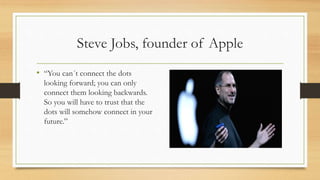
Steve Jobs, founder of Apple
• “You can´t connect the dots
looking forward; you can only
connect them looking backwards.
So you will have to trust that the
dots will somehow connect in your
future.”
To conclude…
• The common theme took from these CEOs is to never give up. Each of
them have suffered set-backs at some point in their life but it did not stop
them pursuing their dreams.
• You also have to have trust in yourself, take risks, don’t be afraid of
failure and always go the extra mile.

Tips from CEOS

  • 1.
    Tips from CEOs Manyof the following CEOs have seen dramatic ups and downs over the course of their careers. The advice they give should help to inspire anyone, no matter what stage in their career they are.
  • 2.
    Joe Rigby, CEOof Pepco Holdings • “Don‘t worry too much about the material things. Be sure to experience life because this isn’t a dress rehearsal—it’s happening right now.”
  • 3.
    Rick Goings, CEOof Tupperware Brands • “It is both interesting and understandable that our resumes, bios, and even public introductions mostly focus on achievements, awards, and honors. And that’s nice! Yet it is often our failures, flops, and even face plants that are the most vital part of shaping us. These are the things that make us.”
  • 4.
    Jeffrey Katzenberg, co-founderof Dreamworks • “I don’t think it matters how small or how big the task is, if you can do it just a little bit better than what is expected, you will be noticed and rewarded.”
  • 5.
    Indra Nooyi, CEOof PepsiCo • “Never stop learning. Whether you’re an entry level employee fresh out of college or a CEO, you don’t know it all. Admitting this is not a sign of weakness. The strongest leaders are those who are lifelong students.”
  • 6.
    Lloyd Blankfein, CEOof Goldman Sachs • “My advice is to focus on becoming a complete person. Everyone should focus on the content of his or her job, of course. But work is not the end; it’s a means to an end. You owe it to yourself to open up to broader interests. And in the end, it will be better for your career because you will be more interesting and attractive to others.”
  • 7.
    Francisco D’Souza, CEOof Cognizant • “In a world of scarcity, the critical skill is to maximize opportunities. In the new world, where everything is abundant, the critical skill is to make good choices. We will have more opportunities in our lives than we could possibly have time to pursue. So the choices we make have even more significance.”
  • 8.
    Robert Hohman, CEOof Glassdoor • “At a macro level, really the most important thing you can do when getting a job is to be informed. • Be informed, understand the company that you're interviewing with. Make sure it's the company that you think it is and it's really a fit for you — culturally, their mission, vision, and values standpoint. • Then, make it your business to understand that company: its issues, its problems, its challenges. And talk about them in the interview. When someone shows up and has done their homework, it's so stark and it stands out.”
  • 9.
    Stewart Butterfield, co-founderof Flickr and Slack • “Some people will know exactly what they want to do at a very young age, but the odds are low. I feel like people in their early- to mid-20s are very earnest. They're very serious, and they want to feel like they've accomplished a lot at a very young age rather than just trying to figure stuff out. So I try to push them toward a more experimental attitude.”
  • 10.
    Steve Jobs, founderof Apple • “You can´t connect the dots looking forward; you can only connect them looking backwards. So you will have to trust that the dots will somehow connect in your future.”
  • 11.
    To conclude… • Thecommon theme took from these CEOs is to never give up. Each of them have suffered set-backs at some point in their life but it did not stop them pursuing their dreams. • You also have to have trust in yourself, take risks, don’t be afraid of failure and always go the extra mile.