Sweet Communications Inc.Tips for Giving Effective Media interviews
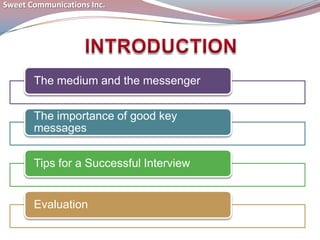
Sweet Communications Inc.INTRODUCTION
Sweet Communications Inc.Types of Coverage / Issues
Sweet Communications Inc.Know the Medium
Sweet Communications Inc.Message				AudienceKey Messages
Sweet Communications Inc.Rule of 3s
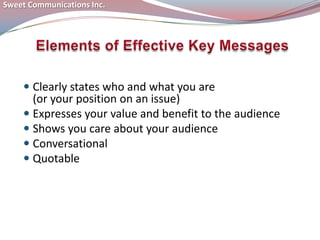
Sweet Communications Inc.Elements of Effective Key MessagesClearly states who and what you are (or your position on an issue)
Expresses your value and benefit to the audience
Shows you care about your audience
Conversational
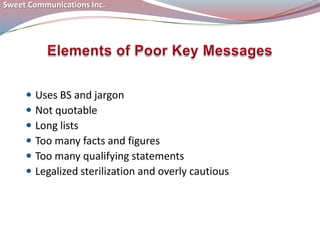
QuotableSweet Communications Inc.Elements of Poor Key MessagesUses BS and jargon
Not quotable
Long lists
Too many facts and figures
Too many qualifying statements
Legalized sterilization and overly cautiousSweet Communications Inc.Preparing for the InterviewMost interviews for print and radio are by phone
Use a landline, stand, stay focused

Tips for Effective Media Interviews

Editor's Notes

  • #4 Feature reportingMost common scenario for a start-upMedia really are relying on you to get the story – need your quote for good articleYou need them to tell your storyMay be part of a feature series with other playersIssues based reportingMore investigative – pressure for truth – media may be trying to find the dirtIf only a few people are affected, the legs will be shortIf you look like your covering up, it will run wildOr, if the public feed it, it can run wildCrisis/disaster newsUnlikely scenario for a start-upPreparation is keyCall in an expert – Board of education example
  • #6 Match the message to the medium, the reporter and the audience.
  • #7 3 messages:Segregate messages into three main take-away pointsThese may have three sub points3 impressions:The 3 messages initially came from the notion that in a news article, your messages are the three things you want the reader to walk away with.In broadcast media, aim for oneSafe HavenKey messages can serve as a safe haven if you feel like your babbling away from the topic.A key message is a vehicle to get from point A to point B.A place to retreat to if you have difficult questions. Myth:You can’t answer every question with 3 messages – if you do you’ll sound like a politician.This kind of spin leads to a tug-of-war between you and the reporter.Use Board of Ed example
  • #8 It’s not bragging if its trueWhat’s in it for the reader or listener
  • #10 Most interviews are done over the phone due to time constraintsLand line: avoid those dropped calls and skips in your voice – very frustrating.Always stand up: more aggressive posture and help focus.Limit outside distractions: turn off your computer and cell, close the door – stay focused.Research the reporter:Do they write favourablyLooking for human interest (Unlimited) or factual (Herald)How long are the pieces in that publicationThis information is usually accessible with a bit of diggingPotential questions:Include topics you may not be as comfortable answering and figure out how to handle them.Example: reporter was educated on the importance of the exit. How do you want to talk about the exit as a start up company? Will it hurt your customer sales?
  • #12 Tell stories and draw analogies and anecdotes – but don’t only talk in analogies – tie it back to the actual technologyAt some point actually talk about the technology in real terms (Gushor story)Tell the truth:Never spin a lie – you will get caughtIt’s harder to remember a lie, it’s easier to remember the truth.You’ll sound more believable if your confident in your message.Take your time:Don’t feel the need to jump on the answerWait for the reporter to finish asking the questionGive yourself time to form a proper answer
  • #13 Not the same as evading the question or answering a different question.
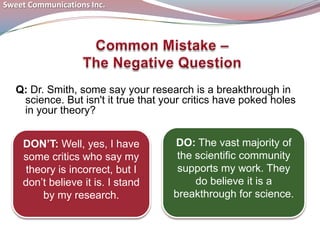
  • #14 Never repeat a negative question in your answer. Start from a positive position.
  • #15 Sound bites:Avoid going off on tangentsSprinkle in a few analogies or anecdotes – good for colourHere is where your key messages can come in really handyCordial:Strategy for difficult questions: open with “that’s a good question” to disarm the reporter and buy time