Recap
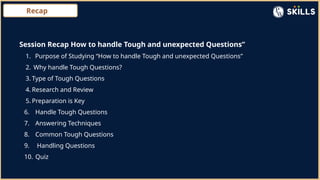
Session Recap Howto handle Tough and unexpected Questions”
1. Purpose of Studying “How to handle Tough and unexpected Questions”
2. Why handle Tough Questions?
3. Type of Tough Questions
4. Research and Review
5. Preparation is Key
6. Handle Tough Questions
7. Answering Techniques
8. Common Tough Questions
9. Handling Questions
10. Quiz
3.
Today’s Agenda
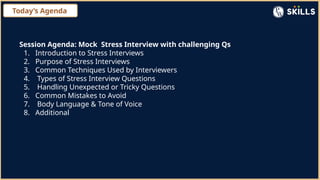
Session Agenda:Mock Stress Interview with challenging Qs
1. Introduction to Stress Interviews
2. Purpose of Stress Interviews
3. Common Techniques Used by Interviewers
4. Types of Stress Interview Questions
5. Handling Unexpected or Tricky Questions
6. Common Mistakes to Avoid
7. Body Language & Tone of Voice
8. Additional
4.
Introduction
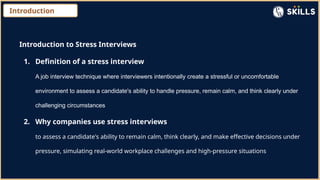
Introduction to StressInterviews
1. Definition of a stress interview
A job interview technique where interviewers intentionally create a stressful or uncomfortable
environment to assess a candidate's ability to handle pressure, remain calm, and think clearly under
challenging circumstances
2. Why companies use stress interviews
to assess a candidate's ability to remain calm, think clearly, and make effective decisions under
pressure, simulating real-world workplace challenges and high-pressure situations
5.
Introduction
Introduction to StressInterviews
3. Common industries where stress interviews are used
Finance
Consulting
Law Enforcement
Healthcare and
Technology
6.
Purpose
Purpose of StressInterviews
1. Assess candidate’s reaction under pressure
2. Test problem-solving and critical thinking skills
3. Evaluate emotional intelligence and resilience
7.
Purpose
Common Techniques Usedby Interviewers
1. Rapid-fire questions
2. Interrupting or challenging responses
3. Asking unrelated or confusing questions
4. Showing disinterest or being confrontational
8.
Purpose
Common Techniques Usedby Interviewers
Rapid-Fire Questions
"What is your biggest weakness?"
"Why should we not hire you?"
"Convince me why you deserve this job in 30 seconds."
9.
Purpose
Common Techniques Usedby Interviewers
Aggressive or Confrontational Questions
"I don’t think you are qualified for this job. Prove me wrong."
"Why do you think you’re better than other candidates?"
Types
Behavioral Stress Questions
Example:
"Tellme about a time you failed and how you handled it."
Sample Sol:
I once led a marketing project where I underestimated the time needed for research. As a result,
our campaign launched with gaps in understanding the target audience, leading to poor results.
To handle this, I organized a team debrief to identify what went wrong and encouraged open
communication. We then created a follow-up campaign based on thorough research, which
significantly improved engagement.
This experience taught me the value of preparation and teamwork, and I now prioritize clear
communication and realistic timelines in all my projects.
12.
Types
Behavioral Stress Questions
Example:
“Describea situation where everything went wrong and how you responded."
Sample Sol:
During a crucial product launch, we discovered a major issue with the product the day before it
was set to launch, and a key team member became ill.
I quickly organized an emergency meeting to address the problems. We split into teams: one
worked on fixing the issue, and the other created a communication plan for stakeholders. We
decided to delay the launch by a few days to ensure quality.
In the end, the launch went well, and I learned the value of adaptability and teamwork in
challenging situations.
13.
Types
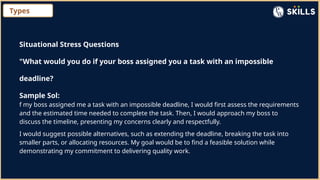
Situational Stress Questions
"Whatwould you do if your boss assigned you a task with an impossible
deadline?
Sample Sol:
f my boss assigned me a task with an impossible deadline, I would first assess the requirements
and the estimated time needed to complete the task. Then, I would approach my boss to
discuss the timeline, presenting my concerns clearly and respectfully.
I would suggest possible alternatives, such as extending the deadline, breaking the task into
smaller parts, or allocating resources. My goal would be to find a feasible solution while
demonstrating my commitment to delivering quality work.
14.
Types
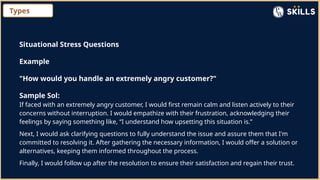
Situational Stress Questions
Example
"Howwould you handle an extremely angry customer?"
Sample Sol:
If faced with an extremely angry customer, I would first remain calm and listen actively to their
concerns without interruption. I would empathize with their frustration, acknowledging their
feelings by saying something like, “I understand how upsetting this situation is.”
Next, I would ask clarifying questions to fully understand the issue and assure them that I'm
committed to resolving it. After gathering the necessary information, I would offer a solution or
alternatives, keeping them informed throughout the process.
Finally, I would follow up after the resolution to ensure their satisfaction and regain their trust.
15.
Types
Logical & BrainteaserQuestions
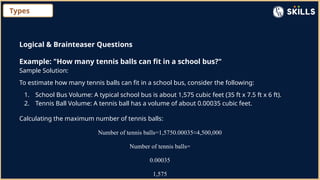
Example: "How many tennis balls can fit in a school bus?"
Sample Solution:
To estimate how many tennis balls can fit in a school bus, consider the following:
1. School Bus Volume: A typical school bus is about 1,575 cubic feet (35 ft x 7.5 ft x 6 ft).
2. Tennis Ball Volume: A tennis ball has a volume of about 0.00035 cubic feet.
Calculating the maximum number of tennis balls:
Number of tennis balls=1,5750.00035≈4,500,000
Number of tennis balls=
0.00035
1,575
16.
Types
Logical & BrainteaserQuestions
Example:
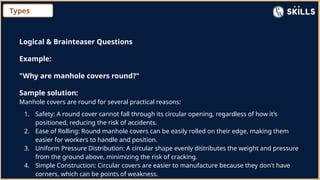
"Why are manhole covers round?"
Sample solution:
Manhole covers are round for several practical reasons:
1. Safety: A round cover cannot fall through its circular opening, regardless of how it’s
positioned, reducing the risk of accidents.
2. Ease of Rolling: Round manhole covers can be easily rolled on their edge, making them
easier for workers to handle and position.
3. Uniform Pressure Distribution: A circular shape evenly distributes the weight and pressure
from the ground above, minimizing the risk of cracking.
4. Simple Construction: Circular covers are easier to manufacture because they don't have
corners, which can be points of weakness.
17.
Purpose
Handling Unexpected orTricky Questions
1. Stay calm and composed
2. Take a moment before answering
3. Keep responses logical and structured
18.
Additional
How to StayCalm Under Pressure
1. Practice deep breathing techniques
2. Maintain positive body language
3. Reframe the situation as a challenge, not a threat
19.
Additional
Common Mistakes toAvoid
1. Getting defensive or aggressive
2. Losing confidence
3. Rushing to answer without thinking
20.
Additional
Post-Interview Reflection &Self-Assessment
Congratulations on completing the interview! Now it's time to reflect on your
performance and identify areas for improvement.
Self-Assessment Checklist:
1. Preparation:
- Did I research the company and role thoroughly?
- Did I review the job description and requirements?
- Did I prepare thoughtful questions to ask the interviewer?researching the
21.
Additional
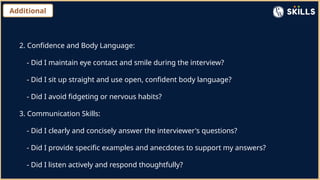
2. Confidence andBody Language:
- Did I maintain eye contact and smile during the interview?
- Did I sit up straight and use open, confident body language?
- Did I avoid fidgeting or nervous habits?
3. Communication Skills:
- Did I clearly and concisely answer the interviewer's questions?
- Did I provide specific examples and anecdotes to support my answers?
- Did I listen actively and respond thoughtfully?
22.
Additional
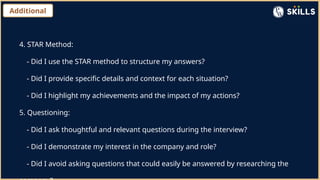
4. STAR Method:
-Did I use the STAR method to structure my answers?
- Did I provide specific details and context for each situation?
- Did I highlight my achievements and the impact of my actions?
5. Questioning:
- Did I ask thoughtful and relevant questions during the interview?
- Did I demonstrate my interest in the company and role?
- Did I avoid asking questions that could easily be answered by researching the
23.
Additional
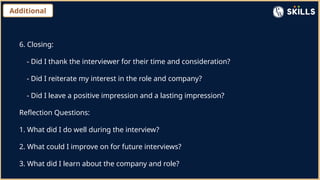
6. Closing:
- DidI thank the interviewer for their time and consideration?
- Did I reiterate my interest in the role and company?
- Did I leave a positive impression and a lasting impression?
Reflection Questions:
1. What did I do well during the interview?
2. What could I improve on for future interviews?
3. What did I learn about the company and role?
24.
Additional
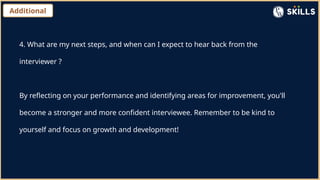
4. What aremy next steps, and when can I expect to hear back from the
interviewer ?
By reflecting on your performance and identifying areas for improvement, you'll
become a stronger and more confident interviewee. Remember to be kind to
yourself and focus on growth and development!
25.
Purpose
Practice Scenarios &Responses
Conducting a mock stress
interview and Sample
responses to tough questions
26.
Purpose
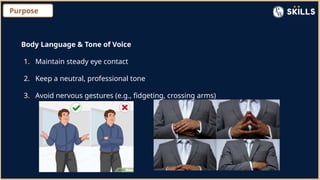
Body Language &Tone of Voice
1. Maintain steady eye contact
2. Keep a neutral, professional tone
3. Avoid nervous gestures (e.g., fidgeting, crossing arms)
27.
Purpose
Effective Strategies forSuccess
1. Research the company & job role
2. Prepare structured answers
3. Stay confident & professional
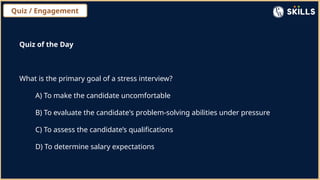
Quiz / Engagement
Quizof the Day
What is the primary goal of a stress interview?
A) To make the candidate uncomfortable
B) To evaluate the candidate's problem-solving abilities under pressure
C) To assess the candidate’s qualifications
D) To determine salary expectations
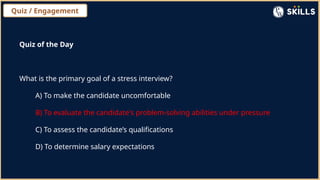
30.
Quiz / Engagement
Quizof the Day
What is the primary goal of a stress interview?
A) To make the candidate uncomfortable
B) To evaluate the candidate's problem-solving abilities under pressure
C) To assess the candidate’s qualifications
D) To determine salary expectations
31.
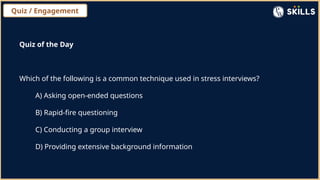
Quiz / Engagement
Quizof the Day
Which of the following is a common technique used in stress interviews?
A) Asking open-ended questions
B) Rapid-fire questioning
C) Conducting a group interview
D) Providing extensive background information
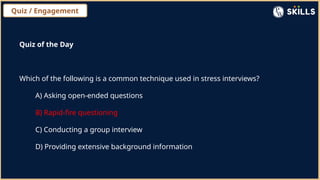
32.
Quiz / Engagement
Quizof the Day
Which of the following is a common technique used in stress interviews?
A) Asking open-ended questions
B) Rapid-fire questioning
C) Conducting a group interview
D) Providing extensive background information
33.
Quiz / Engagement
Quizof the Day
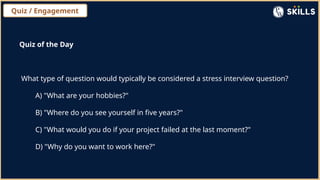
What type of question would typically be considered a stress interview question?
A) "What are your hobbies?"
B) "Where do you see yourself in five years?"
C) "What would you do if your project failed at the last moment?"
D) "Why do you want to work here?"
34.
Quiz / Engagement
Quizof the Day
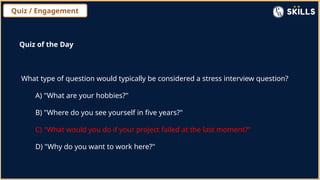
What type of question would typically be considered a stress interview question?
A) "What are your hobbies?"
B) "Where do you see yourself in five years?"
C) "What would you do if your project failed at the last moment?"
D) "Why do you want to work here?"
35.
Quiz / Engagement
Quizof the Day
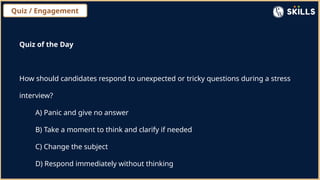
How should candidates respond to unexpected or tricky questions during a stress
interview?
A) Panic and give no answer
B) Take a moment to think and clarify if needed
C) Change the subject
D) Respond immediately without thinking
36.
Quiz / Engagement
Quizof the Day
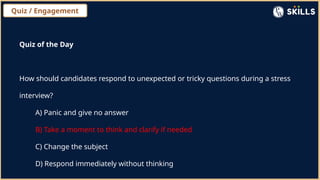
How should candidates respond to unexpected or tricky questions during a stress
interview?
A) Panic and give no answer
B) Take a moment to think and clarify if needed
C) Change the subject
D) Respond immediately without thinking
37.
Quiz / Engagement
Quizof the Day
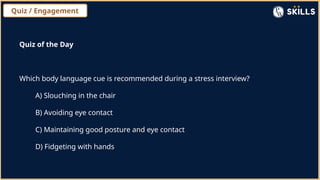
Which body language cue is recommended during a stress interview?
A) Slouching in the chair
B) Avoiding eye contact
C) Maintaining good posture and eye contact
D) Fidgeting with hands
38.
Quiz / Engagement
Quizof the Day
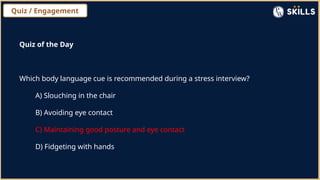
Which body language cue is recommended during a stress interview?
A) Slouching in the chair
B) Avoiding eye contact
C) Maintaining good posture and eye contact
D) Fidgeting with hands
39.
Tomorrow’s Agenda
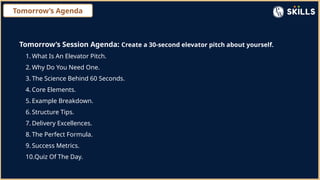
Tomorrow’s SessionAgenda: Create a 30-second elevator pitch about yourself.
1. What Is An Elevator Pitch.
2. Why Do You Need One.
3. The Science Behind 60 Seconds.
4. Core Elements.
5. Example Breakdown.
6. Structure Tips.
7. Delivery Excellences.
8. The Perfect Formula.
9. Success Metrics.
10.Quiz Of The Day.
40.
Lecture Summary
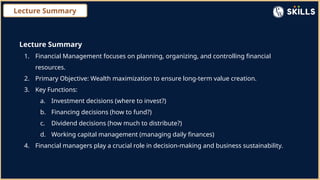
Lecture Summary
1.Financial Management focuses on planning, organizing, and controlling financial
resources.
2. Primary Objective: Wealth maximization to ensure long-term value creation.
3. Key Functions:
a. Investment decisions (where to invest?)
b. Financing decisions (how to fund?)
c. Dividend decisions (how much to distribute?)
d. Working capital management (managing daily finances)
4. Financial managers play a crucial role in decision-making and business sustainability.