(BCS-503)
Faculty: Devesh Garg
Course:B.Tech 5th
Semester (Section A &B)
Session 2024-25
Department of Computer Science & Engineering
Design And Analysis of
Algorithm
Design and Analysisof Algorithms
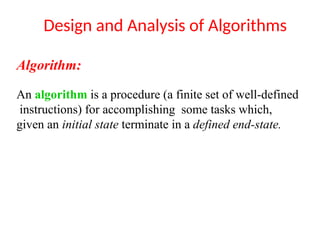
Algorithm:
An algorithm is a procedure (a finite set of well-defined
instructions) for accomplishing some tasks which,
given an initial state terminate in a defined end-state.
5.
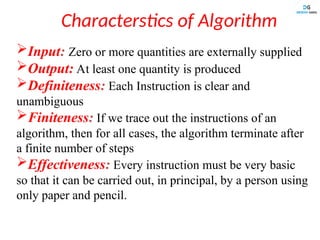
Characterstics of Algorithm
Input:Zero or more quantities are externally supplied
Output: At least one quantity is produced
Definiteness: Each Instruction is clear and
unambiguous
Finiteness: If we trace out the instructions of an
algorithm, then for all cases, the algorithm terminate after
a finite number of steps
Effectiveness: Every instruction must be very basic
so that it can be carried out, in principal, by a person using
only paper and pencil.
Analyze the Algorithm
•Time complexity
– How much no of steps is required to execute of an
Algorithm
• Space complexity
– How much space ( Memory Units) is required to
execute of an Algorithm
8.
• The amountof memory units required by an algorithm to
run to completion.
• Some algorithms may be more efficient if data completely
loaded into memory
Coding example #1
//Sum of n Elements: // Take constant at every Line
Algorithm Sum(a,n) // sum of arry elements of n
numbers
• sum=0;
• for ( i=0 ; i<n ; i++ )
• sum= sum+a[i];
• Return sum;
Total number of memory units:
Sum = 1 memory unit
i= 1 memory unit
n= 1 memory unit
A[]= n memory units // size of array
Total memory units= n+3
Space Complexity
9.
Recurring Equation
Coding example#2
Example : Recursive Sum of n elements
The total memory units will be
Rsum require at least 3 words ( space value for n, the
return address, and a pointer to a[] )
The depth of recursion is n+1
So recursion stack space needed is ≥ 3(n+1)
10.
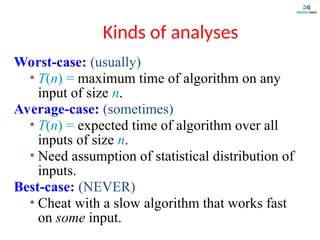
Kinds of analyses
Worst-case:(usually)
• T(n) = maximum time of algorithm on any
input of size n.
Average-case: (sometimes)
• T(n) = expected time of algorithm over all
inputs of size n.
• Need assumption of statistical distribution of
inputs.
Best-case: (NEVER)
• Cheat with a slow algorithm that works fast
on some input.
11.
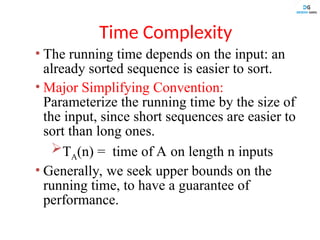
Time Complexity
• Therunning time depends on the input: an
already sorted sequence is easier to sort.
• Major Simplifying Convention:
Parameterize the running time by the size of
the input, since short sequences are easier to
sort than long ones.
TA(n) = time of A on length n inputs
• Generally, we seek upper bounds on the
running time, to have a guarantee of
performance.
12.
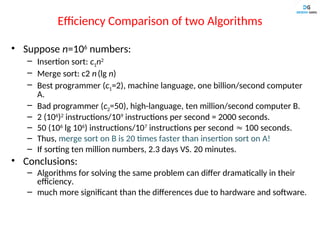
Efficiency Comparison oftwo Algorithms
• Suppose n=106
numbers:
– Insertion sort: c1n2
– Merge sort: c2 n(lg n)
– Best programmer (c1=2), machine language, one billion/second computer
A.
– Bad programmer (c2=50), high-language, ten million/second computer B.
– 2 (106
)2
instructions/109
instructions per second = 2000 seconds.
– 50 (106
lg 106
) instructions/107
instructions per second 100 seconds.
– Thus, merge sort on B is 20 times faster than insertion sort on A!
– If sorting ten million numbers, 2.3 days VS. 20 minutes.
• Conclusions:
– Algorithms for solving the same problem can differ dramatically in their
efficiency.
– much more significant than the differences due to hardware and software.
13.
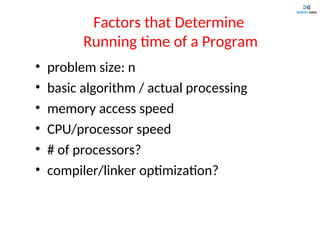
Factors that Determine
Runningtime of a Program
• problem size: n
• basic algorithm / actual processing
• memory access speed
• CPU/processor speed
• # of processors?
• compiler/linker optimization?
14.
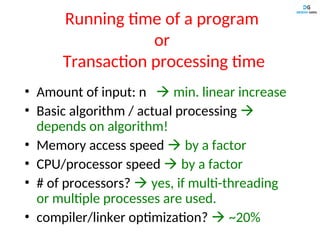
Running time ofa program
or
Transaction processing time
• Amount of input: n min. linear increase
• Basic algorithm / actual processing
depends on algorithm!
• Memory access speed by a factor
• CPU/processor speed by a factor
• # of processors? yes, if multi-threading
or multiple processes are used.
• compiler/linker optimization? ~20%
15.
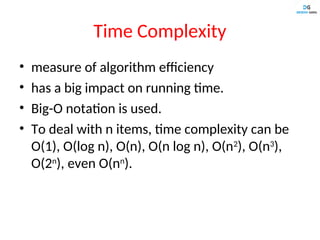
Time Complexity
• measureof algorithm efficiency
• has a big impact on running time.
• Big-O notation is used.
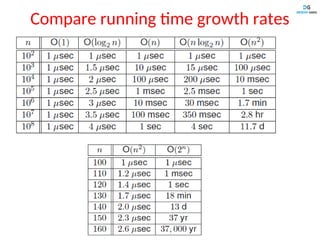
• To deal with n items, time complexity can be
O(1), O(log n), O(n), O(n log n), O(n2
), O(n3
),
O(2n
), even O(nn
).
16.
Coding example #1
//Sumof n Elements:// Take constant at every Line
Algorithm Sum(a,n) // sum of arry elements of n numbers
• Sum=0;
• for ( i=0 ; i<n ; i++ )
• Sum= sum +a[i];
• Return Sum;
17.
Coding example #1
//Sumof n Elements: // Take constant at every Line
Algorithm Sum(a,n) // sum of arry elements of n numbers
• Sum=0; // C1*1
• for ( i=0 ; i<n ; i++ ) // C2*(n+1)
• Sum= sum +a[i]; // C3 *n
• Return Sum; // C4 *1
Total Steps:
= C1*1+C2(n+1)+C3*n+C4*1
n(C2+C3)+(C1+C2 +C4)
In Order of n
18.
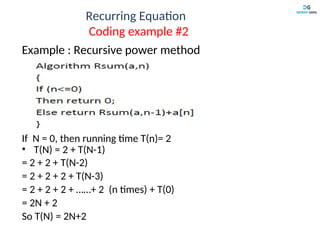
Recurring Equation
Coding example#2
Example : Recursive power method
If N = 0, then running time T(n)= 2
• T(N) = 2 + T(N-1)
= 2 + 2 + T(N-2)
= 2 + 2 + 2 + T(N-3)
= 2 + 2 + 2 + ……+ 2 (n times) + T(0)
= 2N + 2
So T(N) = 2N+2
Running time
Input
1 ms
2ms
3 ms
4 ms
5 ms
A B C D E F G
worst-case
best-case
}average-case?
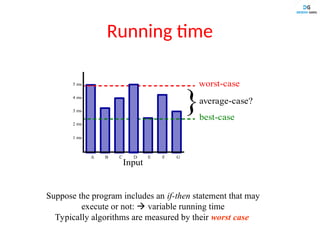
Suppose the program includes an if-then statement that may
execute or not: variable running time
Typically algorithms are measured by their worst case
24.
Growth Rates
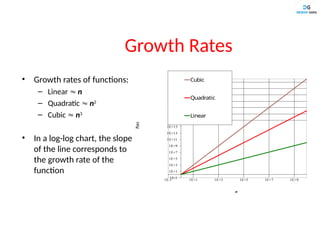
• Growthrates of functions:
– Linear n
– Quadratic n2
– Cubic n3
• In a log-log chart, the slope
of the line corresponds to
the growth rate of the
function
1E-1
1E+1
1E+3
1E+5
1E+7
1E+9
1E+11
1E+13
1E+15
1E+17
1E+19
1E+21
1E+23
1E+25
1E+27
1E+29
1E-1 1E+1 1E+3 1E+5 1E+7 1E+9
T(n)
n
Cubic
Quadratic
Linear
25.
Constant Factors
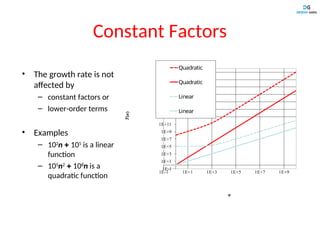
• Thegrowth rate is not
affected by
– constant factors or
– lower-order terms
• Examples
– 102
n 105
is a linear
function
– 105
n2
108
n is a
quadratic function
1E-1
1E+1
1E+3
1E+5
1E+7
1E+9
1E+11
1E+13
1E+15
1E+17
1E+19
1E+21
1E+23
1E+25
1E-1 1E+1 1E+3 1E+5 1E+7 1E+9
T(n)
n
Quadratic
Quadratic
Linear
Linear
26.
Machine-independent time
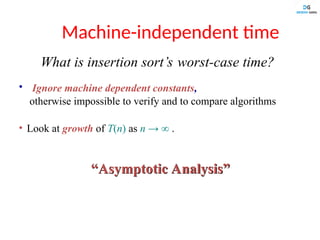
What isinsertion sort’s worst-case time?
• Ignore machine dependent constants,
otherwise impossible to verify and to compare algorithms
• Look at growth of T(n) as n → ∞ .
“Asymptotic Analysis”


![• The amount of memory units required by an algorithm to
run to completion.
• Some algorithms may be more efficient if data completely
loaded into memory
Coding example #1
//Sum of n Elements: // Take constant at every Line
Algorithm Sum(a,n) // sum of arry elements of n
numbers
• sum=0;
• for ( i=0 ; i<n ; i++ )
• sum= sum+a[i];
• Return sum;
Total number of memory units:
Sum = 1 memory unit
i= 1 memory unit
n= 1 memory unit
A[]= n memory units // size of array
Total memory units= n+3
Space Complexity](https://image.slidesharecdn.com/daalect1-250224172224-76b35421/85/Design-and-Analysis-of-Algorithm-Fundamental-8-320.jpg)
![Recurring Equation
Coding example #2
Example : Recursive Sum of n elements
The total memory units will be
Rsum require at least 3 words ( space value for n, the
return address, and a pointer to a[] )
The depth of recursion is n+1
So recursion stack space needed is ≥ 3(n+1)](https://image.slidesharecdn.com/daalect1-250224172224-76b35421/85/Design-and-Analysis-of-Algorithm-Fundamental-9-320.jpg)
![Coding example #1
//Sum of n Elements:// Take constant at every Line
Algorithm Sum(a,n) // sum of arry elements of n numbers
• Sum=0;
• for ( i=0 ; i<n ; i++ )
• Sum= sum +a[i];
• Return Sum;](https://image.slidesharecdn.com/daalect1-250224172224-76b35421/85/Design-and-Analysis-of-Algorithm-Fundamental-16-320.jpg)
![Coding example #1
//Sum of n Elements: // Take constant at every Line
Algorithm Sum(a,n) // sum of arry elements of n numbers
• Sum=0; // C1*1
• for ( i=0 ; i<n ; i++ ) // C2*(n+1)
• Sum= sum +a[i]; // C3 *n
• Return Sum; // C4 *1
Total Steps:
= C1*1+C2(n+1)+C3*n+C4*1
n(C2+C3)+(C1+C2 +C4)
In Order of n](https://image.slidesharecdn.com/daalect1-250224172224-76b35421/85/Design-and-Analysis-of-Algorithm-Fundamental-17-320.jpg)
![Coding example #3
for ( i=0 ; i<n ; i++ )
for( j=0 ; j<n ; j++ )
sum[i] += entry[i][j];](https://image.slidesharecdn.com/daalect1-250224172224-76b35421/85/Design-and-Analysis-of-Algorithm-Fundamental-19-320.jpg)
![Coding example #3
for ( i=0 ; i<n ; i++ ) //c1*(n+1)
for( j=0 ; j<n ; j++ )
//c2(n*(n+1))
sum[i] += entry[i][j];
//c3(n*n)
Total steps
= c1*(n+1)+ c2(n*(n+1))+ c3(n*n)
= n2
( c2+c3)+n(c1+c2)+c1
= order of n2](https://image.slidesharecdn.com/daalect1-250224172224-76b35421/85/Design-and-Analysis-of-Algorithm-Fundamental-20-320.jpg)