1
2
Remember that time is
money
Ben Franklin, 1748
Advice to a young
Dr.T.V.Rao MD
The predictable control an
individual can exercise over a
series of events.
3
Dr.T.V.Rao MD
. The Present
Yesterday is History
Tomorrow’s a Mystery
But Today is a Gift
That’s Why They Call it
The Present
 Today’s Medical Education is complex, over
loaded syllabus. The shortage of qualified
teachers, lack of teaching materials, poor
coordination in the system. Ever growing
specialization in specialties puts the students at
confused situation. However the Darwin's
theory of Survival of the fittest continues to
Dominate than in the past . A wise self
management of TIME is more important than
past
 Student is the master of Learning
5
Dr.T.V.Rao MD
 Time must be
explicitly
managed, just
like money
 Much of this
won’t make
sense until later
(too late?):
that’s why this is
on the priority list
of students. 6
Dr.T.V.Rao MD
 Time management
entails more than
keeping a calendar,
however. It is requires
identifying your
obligations, carefully
considering their
importance, and
making choices
about how to use
your time.
7
Dr.T.V.Rao MD
 Review and describe
common
impediments to
time efficiency
 Describe helpful time
management
principles and
adjunctive tools
 Finish on time!!!
8
Dr.T.V.Rao MD
24 hours per day
X
60 minutes per hour
X
60 seconds per
minute
=
86,400
Seconds
Dr.T.V.Rao MD 9
 Spend every
second in an
efficient and
productive way
 If you fail to use
the day’s
deposits, the loss
is yours.
Dr.T.V.Rao MD 10
11
 When you have completed this module you
will be able to define the key concepts
associated with Time Management and
you will be able to:
 Identify the main obstacles to effective
Time Management in your daily role
 Understand the nature of Time
Management
Dr.T.V.Rao MD
12
 Time is the most precious thing we have
 Time is ultimately the most valuable
resource
 Time and how we spend it within the
organization must be managed effectively
 Time is totally perishable
 Time cannot be stored up for use later
Dr.T.V.Rao MD
 What you accomplish during a 24-hour period depends on
your own motivation, your energy, your skills and abilities,
and other resources.
 Since there are always demands on your time, it may be
helpful to think about what you will do with your time and to
consider some strategies for more effective time
management.
 Time management is not a way to make you work harder
and longer, but a means to help you work smarter to
accomplish your work more easily and rapi
13
Dr.T.V.Rao MD
 Everything you are
today and everything
you become in the
future will be
determined by the
way you think and the
way you use your time.
Your attitude toward
time is a critical factor
in all you do and
everything you
accomplish
14
Dr.T.V.Rao MD
 Talking with friends
 Talking on telephone
 Daydreaming
 Watching television
 Sleeping
 Listening to music
 Drop-in visitors
 Reading (other than
assignments)
 Playing sports, games, or
hobbies
 Doing household chores
 Partying and goofing around
 Snacking and eating
 Hanging out
 Procrastinating or worrying
Dr.T.V.Rao MD 15
 The clearer you are about your goals
and objectives, the more efficient and
effective you will be in achieving them.
Clarity accounts for probably 80 percent
of success and happiness. People with
clear, written goals accomplish far more
in a shorter period of time than people
without them could ever imagine.
16
Dr.T.V.Rao MD
 Your ability to set clear and accurate
priorities on your time determines the
entire quality of your life. To achieve
great things, you must always be
concentrating on the small number of
activities that contribute the greatest
value to your life and your work.
17
Dr.T.V.Rao MD
 RANK
 ____ Class attendance
 ____ Relaxation
 ____ Volunteer service
 ____ Time with family
 ____ Exercise
 ____ Clubs/organizations
 ____ Required reading
 ____ Hobbies or entertainment
 ____ Time with girlfriend/boyfriend or spouse
 ____ Studying
 ____ Working at a job
 ____ Religious activities
 ____ Shopping
 ____ Grocery shopping
 ____ Preparing meals
 ____ Housecleaning
 ____ Non-required reading
 ____ Sleeping
 ____ Other: _____________________________
18
Dr.T.V.Rao MD
Weekly Expenditure of Time for Personal Needs, Classes, Job,
Family Responsibilities, and Commuting
Number of hours per week you need to sleep ________
Number of hours per week spent at work ________
Number of hours per week spent in class ________
Number of hours per week spent commuting ________
Number of hours per week used for meals ________
Number of hours per week used for personal grooming ________
Number of hours per week spent on household duties ________
Number of hours per week spent for church/volunteering ________
Total number of hours for personal needs ________
7 days x 24 hours = 168 (Total hours per week)
minus _____ (Total number of hours for personal needs =
Number of hours available for study and leisure _________
19
Dr.T.V.Rao MD
 Make your goals specific and concrete.
 Set long-term and short-term goals?
 Set a deadline for your goals.
 Monitor your goals.
 Change goals if needed.
20
Dr.T.V.Rao MD
 Before you start something new, you
must discontinue something old. You can
gain control of your life only to the
degree to which you stop doing things
that are no longer as valuable or as
important to you as other thing you
could be doing.
21
Dr.T.V.Rao MD
 Procrastination is a
major obstacle that
can prevent you
from practicing
good time
management skills.
 It is the constant
pushing aside of
tasks that need to be
completed and is
the archenemy of all
students.
Dr.T.V.Rao MD 22
Beware of Distractions
 Talking
 Daydreaming & Doodling
 Worrying
23
Dr.T.V.Rao MD
 Take Charge of Your
Lecture classes
 Concentrate and
Focus on the
Material
 Listen Critically
 Connect and
Capture Key Ideas
Dr.T.V.Rao MD 24
 Be Ready for the Message
 Listen to Main Concepts
 Listen for New Ideas
 Ask Questions
25
Dr.T.V.Rao MD
 Identify key words, themes and main points
 Relate Details to the Main Point
 Listen for Clues
› Note when a topic comes up more than once
› Transition words signal the change in topics or new key points
“In contrast to”
“Let’s move on”
“This will be on the next exam”
“You will see this again”
This one for sure!
26
Dr.T.V.Rao MD
 Outline Method
 The Cornell Method
 Paragraph
(Summarizing)
Method
 Fishbone Diagram
(Listing) Method
Dr.T.V.Rao MD 27
 Use headings and
subheadings
followed by course
material
 Easiest method with
organized lectures
Formal
Outline
Informal
Outline
28
Dr.T.V.Rao MD
 Divide your notepaper by
drawing a vertical line 2 inches
from the left margin.
 On the right side, take your
notes from class.
 On the left side, write
› key words
› questions
› comments
› Examples
 On the bottom, write a summary
 These will make your work easier
to review later
 Test yourself by identifying the
lecture material on the right ,
prompted by your comments
on the left.
29
Dr.T.V.Rao MD
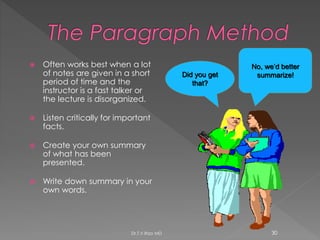
 Often works best when a lot
of notes are given in a short
period of time and the
instructor is a fast talker or
the lecture is disorganized.
 Listen critically for important
facts.
 Create your own summary
of what has been
presented.
 Write down summary in your
own words.
Did you get
that?
No, we’d better
summarize!
30
Dr.T.V.Rao MD
 The Problem or outcome is
printed in the “head” of
the fish.
 Identify the primary factors
and connect as ribs to the
backbone.
 Elaborate each rib with the
details related to the
primary factor.
31
Dr.T.V.Rao MD
 Always date your notes!
 Paraphrase your notes!
 Don’t Erase Mistakes!
 For Lectures with fast talkers, consider writing in
cursive or tape recording.
 Use Abbreviations!
 Be Organized!
 Evaluate your note-taking style strategy
regularly!
32
Dr.T.V.Rao MD
 Phones and
Pagers
 Visitors
 Meetings
 “Open Door
Policy”
 Miscommunication
 Fatigue
33
Dr.T.V.Rao MD
34
 Why am I doing this?
 What is the goal?
 Why will I succeed?
 What happens if I chose not to do it?
Dr.T.V.Rao MD
 Make a ‘to do’ list each day to remind
you of what you have to do each day.
 Prioritize each item on the list, labeling
the most important items A,
 the less important items B,
 and the nice to do items C.
 Be sure to start with the A’s so that you
complete the most important items first.
 Go on to your B’s and C’s only if you find
you have the time.
35
Dr.T.V.Rao MD
36
By some estimates, people waste about 2
hours per day. Signs of time wasting:
› Messy Table and cluttered
› Can’t find things
› Volunteer to do things other people should
do
› Tired/unable to concentrate
Dr.T.V.Rao MD
Learn when to say
“NO”
•You can’t do
everything
•Don’t undertake
things you can’t
complete
•Remain consistent
to your goals
 Every minute spent in
planning saves ten
minutes in execution.
The purpose of
"personal strategic
planning" is for you to
increase your "return
energy," and return on
the mental, emotional,
physical, and spiritual
capital you have
invested in your life
and career.
38
Dr.T.V.Rao MD
• Set goals
• Prioritize
• Organize
• Learn when to say
“NO”
• Use your waiting
time
• Concentrate on the
task at hand
• Consider your
personal prime time
• Celebrate success
Dr.T.V.Rao MD 39
 Time management
enables you to control
the sequence of
events in your life. Your
entire life today is the
sum total result of the
quality of your choices
and decisions to this
moment. If you are not
happy with any part of
your life, it is up to you
to begin to make
different choices and
better decisions.
40
Dr.T.V.Rao MD
 Evaluate how you
are spending your
time. Keep a diary
for three days to
track tasks. Look for
time that could be
used more wisely,
freeing up time to
spend exercising or
with family and
friends.
41
Dr.T.V.Rao MD
 Get plenty of
exercise and
sleep. Improved
focus and
concentration
help increase
efficiency, so
you can
complete tasks
in less time. 42
Dr.T.V.Rao MD
 Even during their
medical school careers,
many students take on
extracurricular activities
and projects that are not
covered at medical
school. This has made
many medical student
groups around the world
look hard at what the
needs of their members
are and how best to
meet them with a
training programme.
43
Dr.T.V.Rao MD
 . The range of skills is
almost endless—for
example, time
management,
communication,
presenting,
teaching, effective
learning, working in
a team, and
leadership—to name
just a few topics.
44
Dr.T.V.Rao MD
 Set up your semester calendar.
› Review Syllabus for class schedules.
› Block all class and lab times
› Highlight exams and project due dates.
› Identify routine homework.
› Incorporate break time.
 Divide study time into 50-minute blocks.
 Use spare time to review.
 Don’t forget to reward yourself when you
do something right.
 “Work smarter, not harder.” – Alan Lakein
45
Dr.T.V.Rao MD
 Even during their
medical school careers,
many students take on
extracurricular activities
and projects that are not
covered at medical
school. This has made
many medical student
groups around the world
look hard at what the
needs of their members
are and how best to
meet them with a
training programme.
46
Dr.T.V.Rao MD
 training beyond the curriculum should be a
priority for every medical student and every
group of medical students. Tomorrow's
Doctors states that “students must accept
responsibility for their own learning.”
Receiving and using training outside the
hospital will no doubt make for a better
medical profession—not only doctors who
know how to treat patients, but also how to
deal with the non-clinical workload that
comes as part of the job.
 Timothy Rittman, third year medical student and training director, International
Federation of Medical Students' Associations, University of Nottingham
Email: tim.rittman@doctors.org.uk
47
Dr.T.V.Rao MD
48
Being successful doesn’t
make you manage your
time well.
Managing your time well
makes you successful.
Dr.T.V.Rao MD
If you can dream
it, you can do it”
Walt Disney
 Disneyland was built
in 366 days, from
ground-breaking to
first day open to the
public.
49
Dr.T.V.Rao MD
 You don’t find time
for important things,
you make it
 Everything you do is
an opportunity cost
 Learn to say “No”
50
Dr.T.V.Rao MD
Cognitive, or mental, tasks such as
reading, calculating, and problem
solving are performed most efficiently
in the morning.
*If you are a Night Owl, shift these times about 3-4 hours later
in the day.
51
Dr.T.V.Rao MD
Short term memory tasks such as
last minute reviewing for tests
are best performed early in the
morning.
*If you are a Night Owl, shift these times about 3-4 hours later in the day.
52
Dr.T.V.Rao MD
You are most efficient at tasks involving
the use of your hands such as
keyboarding and carpentry in the
afternoon and early evening.
*If you are a Night Owl, shift these times about 3-4 hours later in the day.
53
Dr.T.V.Rao MD
Because of Circadian Rhythms it is best to
engage in physical activity in the evening
when your large muscle coordination is at its
peak.
Studies show you will perceive the workout to
be easier in the evening.
Exercising about 5 hours before bedtime
improves the quality of sleep.
*If you are a Night Owl, shift these times about 3-4 hours later in the day.
54
Dr.T.V.Rao MD
C=catalyst for change
A=alter thoughts to change feelings
L=listen and then make a diagnosis
M=make an agreement
E=education and follow-up
R=reach out and discuss feelings
Pomm, et al. (2004)
55
Dr.T.V.Rao MD
56
 Only read something if you’ll be fired for
not reading it
 Note that this refers to periodicals and
routine reading, which is different than a
research dig
Dr.T.V.Rao MD
By Randy Pausch, for the Building Virtual Worlds course at Carnegie Mellon, Spring 1998
 Meet people properly. It all starts with the introduction. Then,
exchange contact information, and make sure you know
how to pronounce everyone’s names. Exchange phone #s,
and find out what hours are acceptable to call during.
 Find things you have in common. You can almost always find
something in common with another person, and starting from
that baseline, it’s much easier to then address issues where
you have difference. This is why cities like professional sports
teams, which are socially galvanizing forces that cut across
boundaries of race and wealth. If nothing else, you probably
have in common things like the weather.
57
Dr.T.V.Rao MD
58
By Randy Pausch, for the Building Virtual Worlds course at Carnegie Mellon,
Spring 1998
 Avoid conflict at all costs. When stress occurs and
tempers flare, take a short break. Clear your
heads, apologize, and take another stab at it.
Apologize for upsetting your peers, even if you
think someone else was primarily at fault; the goal
is to work together, not start a legal battle over
whose transgressions were worse. It takes two to
have an argument, so be the peacemaker.
 Phrase alternatives as questions. Instead of “I think
we should do A, not B,” try “What if we did A,
instead of B?” That allows people to offer
comments, rather than defend one choice.
Dr.T.V.Rao MD
 Time is free, but it's
priceless. You can't
own it, but you can
use it. You can't
keep it, but you can
spend it. Once
you've lost it
you can never get it
back.”
Harvey MacKay
59
Dr.T.V.Rao MD
 Get Started Immediately On
Important Tasks.
 Reduce Meeting Time.
 Take Time To Plan.
 Learn To Say “No.”
 Remember That Now Is The Time To
Put It All Together.
60
Dr.T.V.Rao MD
61
 Have a great planning system and use it
 Take on realistic goals an schedule accurately
 Do not over-commit
 Set and agree priorities to distinguish between
urgent and important tasks
 Build in some flexibility to cope with anything
unexpected
 Control your documents, workspace and phone
Dr.T.V.Rao MD
62
 Don’t procrastinate – Manage Your Time Today
 Define and use periods of quality time in your
schedule
 Learn to say No in a professional manner
 Stay away from perfectionism and aim for
excellence
 Build in time for personal development
Dr.T.V.Rao MD
 Find balance
between:
›Academic
schedule
›Social life
›Time alone
Dr.T.V.Rao MD 63
64
 To deal with over-work, try the following
› Understand your pressures
› Don’t get worked up or panicked
› Don’t blame everything on yourself
› Walk away
› Estimate time as well as possible
› Agree priorities and keep them
› Remind yourself that there is a limited
amount of time available to you
Dr.T.V.Rao MD
 How much time do you have?
 What are your goals?
 Does free time really mean free time?
 Do you have a schedule?
 Do you use a planner?
 Do you procrastinate?
 Are you equipped with Time Management
Tips?
65
Dr.T.V.Rao MD
 ONE YEAR, ask a student who failed a grade.
 ONE MONTH, ask a mother who gave birth to a premature
baby.
 ONE WEEK, ask the editor of a weekly newspaper.
 ONE DAY, ask a daily wage laborer with kids to feed.
 ONE HOUR, ask the lovers who are waiting to meet.
 ONE MINUTE, ask a person who missed the train.
 ONE SECOND, ask a person who just avoided an accident.
 ONE MILLISECOND, ask the person who won a silver medal
in the Olympics.
66
Dr.T.V.Rao MD
Athletes know the
phenomenon of
running with someone
ahead of them to
increase their times.
The same effect can
be achieved with
studying and
completing
schoolwork.
 Select a planner that you
will be likely to carry with
you.
 At the beginning of each
semester, record test dates,
project due dates etc from
all of your syllabi for your
classes.
 Use pencil because
schedules change
 Keep your planner handy
Dr.T.V.Rao MD 68
 Examine your
schedule.
 Be realistic about
what you can
accomplish.
 Don’t try to juggle
too many things.
 Don’t set yourself
up for failure.
 For every hour you are in class, you
should study at least two hours
=
70
Dr.T.V.Rao MD
Time management really
means managing
yourself.
It’s a way to be happier,
more effective, and more
successful.
71
Dr.T.V.Rao MD
Just Keep
Going
And going
And going
And going
And going…
72
Dr.T.V.Rao MD
 We procrastinate because we fear FAILURE.
› It is easier to accept that we failed because we
didn’t even attempt a project than to fail at doing
the project.
 We procrastinate because we fear SUCCESS.
› If I get all “A’s” this semester, everyone will expect
the same next semester.
› If I do an outstanding job on this project, my boss will
just pile on more work.
CGQC 8/23/2007
Prioritize the Do’s
1. Address the urgent
2. Accomplish what you can
early
3. Attach deadlines to everything
 Write things down.
› Don’t rely on memory
 Prioritize your list
 Plan your week.
› Spend some time at the beginning of each
week to plan your schedule.
 Carry a notebook.
› Write down those great ideas and brilliant
insights (capture your thoughts).
 Learn to say no.
› Say no to low priority requests.
75
Dr.T.V.Rao MD
 Everything changes
 never stop
exploring
 and never stop
learning
 and you will change
the world
 Everything happens
faster than you
think.
76
Dr.T.V.Rao MD
Created by Dr.T.V.Rao MD for
benefit of Students for a creative
career
 Email
doctortvrao@gmail.com
77

time management for students.pdf

  • 1.
  • 2.
    2 Remember that timeis money Ben Franklin, 1748 Advice to a young Dr.T.V.Rao MD
  • 3.
    The predictable controlan individual can exercise over a series of events. 3 Dr.T.V.Rao MD
  • 4.
    . The Present Yesterdayis History Tomorrow’s a Mystery But Today is a Gift That’s Why They Call it The Present
  • 5.
     Today’s MedicalEducation is complex, over loaded syllabus. The shortage of qualified teachers, lack of teaching materials, poor coordination in the system. Ever growing specialization in specialties puts the students at confused situation. However the Darwin's theory of Survival of the fittest continues to Dominate than in the past . A wise self management of TIME is more important than past  Student is the master of Learning 5 Dr.T.V.Rao MD
  • 6.
     Time mustbe explicitly managed, just like money  Much of this won’t make sense until later (too late?): that’s why this is on the priority list of students. 6 Dr.T.V.Rao MD
  • 7.
     Time management entailsmore than keeping a calendar, however. It is requires identifying your obligations, carefully considering their importance, and making choices about how to use your time. 7 Dr.T.V.Rao MD
  • 8.
     Review anddescribe common impediments to time efficiency  Describe helpful time management principles and adjunctive tools  Finish on time!!! 8 Dr.T.V.Rao MD
  • 9.
    24 hours perday X 60 minutes per hour X 60 seconds per minute = 86,400 Seconds Dr.T.V.Rao MD 9
  • 10.
     Spend every secondin an efficient and productive way  If you fail to use the day’s deposits, the loss is yours. Dr.T.V.Rao MD 10
  • 11.
    11  When youhave completed this module you will be able to define the key concepts associated with Time Management and you will be able to:  Identify the main obstacles to effective Time Management in your daily role  Understand the nature of Time Management Dr.T.V.Rao MD
  • 12.
    12  Time isthe most precious thing we have  Time is ultimately the most valuable resource  Time and how we spend it within the organization must be managed effectively  Time is totally perishable  Time cannot be stored up for use later Dr.T.V.Rao MD
  • 13.
     What youaccomplish during a 24-hour period depends on your own motivation, your energy, your skills and abilities, and other resources.  Since there are always demands on your time, it may be helpful to think about what you will do with your time and to consider some strategies for more effective time management.  Time management is not a way to make you work harder and longer, but a means to help you work smarter to accomplish your work more easily and rapi 13 Dr.T.V.Rao MD
  • 14.
     Everything youare today and everything you become in the future will be determined by the way you think and the way you use your time. Your attitude toward time is a critical factor in all you do and everything you accomplish 14 Dr.T.V.Rao MD
  • 15.
     Talking withfriends  Talking on telephone  Daydreaming  Watching television  Sleeping  Listening to music  Drop-in visitors  Reading (other than assignments)  Playing sports, games, or hobbies  Doing household chores  Partying and goofing around  Snacking and eating  Hanging out  Procrastinating or worrying Dr.T.V.Rao MD 15
  • 16.
     The cleareryou are about your goals and objectives, the more efficient and effective you will be in achieving them. Clarity accounts for probably 80 percent of success and happiness. People with clear, written goals accomplish far more in a shorter period of time than people without them could ever imagine. 16 Dr.T.V.Rao MD
  • 17.
     Your abilityto set clear and accurate priorities on your time determines the entire quality of your life. To achieve great things, you must always be concentrating on the small number of activities that contribute the greatest value to your life and your work. 17 Dr.T.V.Rao MD
  • 18.
     RANK  ____Class attendance  ____ Relaxation  ____ Volunteer service  ____ Time with family  ____ Exercise  ____ Clubs/organizations  ____ Required reading  ____ Hobbies or entertainment  ____ Time with girlfriend/boyfriend or spouse  ____ Studying  ____ Working at a job  ____ Religious activities  ____ Shopping  ____ Grocery shopping  ____ Preparing meals  ____ Housecleaning  ____ Non-required reading  ____ Sleeping  ____ Other: _____________________________ 18 Dr.T.V.Rao MD
  • 19.
    Weekly Expenditure ofTime for Personal Needs, Classes, Job, Family Responsibilities, and Commuting Number of hours per week you need to sleep ________ Number of hours per week spent at work ________ Number of hours per week spent in class ________ Number of hours per week spent commuting ________ Number of hours per week used for meals ________ Number of hours per week used for personal grooming ________ Number of hours per week spent on household duties ________ Number of hours per week spent for church/volunteering ________ Total number of hours for personal needs ________ 7 days x 24 hours = 168 (Total hours per week) minus _____ (Total number of hours for personal needs = Number of hours available for study and leisure _________ 19 Dr.T.V.Rao MD
  • 20.
     Make yourgoals specific and concrete.  Set long-term and short-term goals?  Set a deadline for your goals.  Monitor your goals.  Change goals if needed. 20 Dr.T.V.Rao MD
  • 21.
     Before youstart something new, you must discontinue something old. You can gain control of your life only to the degree to which you stop doing things that are no longer as valuable or as important to you as other thing you could be doing. 21 Dr.T.V.Rao MD
  • 22.
     Procrastination isa major obstacle that can prevent you from practicing good time management skills.  It is the constant pushing aside of tasks that need to be completed and is the archenemy of all students. Dr.T.V.Rao MD 22
  • 23.
    Beware of Distractions Talking  Daydreaming & Doodling  Worrying 23 Dr.T.V.Rao MD
  • 24.
     Take Chargeof Your Lecture classes  Concentrate and Focus on the Material  Listen Critically  Connect and Capture Key Ideas Dr.T.V.Rao MD 24
  • 25.
     Be Readyfor the Message  Listen to Main Concepts  Listen for New Ideas  Ask Questions 25 Dr.T.V.Rao MD
  • 26.
     Identify keywords, themes and main points  Relate Details to the Main Point  Listen for Clues › Note when a topic comes up more than once › Transition words signal the change in topics or new key points “In contrast to” “Let’s move on” “This will be on the next exam” “You will see this again” This one for sure! 26 Dr.T.V.Rao MD
  • 27.
     Outline Method The Cornell Method  Paragraph (Summarizing) Method  Fishbone Diagram (Listing) Method Dr.T.V.Rao MD 27
  • 28.
     Use headingsand subheadings followed by course material  Easiest method with organized lectures Formal Outline Informal Outline 28 Dr.T.V.Rao MD
  • 29.
     Divide yournotepaper by drawing a vertical line 2 inches from the left margin.  On the right side, take your notes from class.  On the left side, write › key words › questions › comments › Examples  On the bottom, write a summary  These will make your work easier to review later  Test yourself by identifying the lecture material on the right , prompted by your comments on the left. 29 Dr.T.V.Rao MD
  • 30.
     Often worksbest when a lot of notes are given in a short period of time and the instructor is a fast talker or the lecture is disorganized.  Listen critically for important facts.  Create your own summary of what has been presented.  Write down summary in your own words. Did you get that? No, we’d better summarize! 30 Dr.T.V.Rao MD
  • 31.
     The Problemor outcome is printed in the “head” of the fish.  Identify the primary factors and connect as ribs to the backbone.  Elaborate each rib with the details related to the primary factor. 31 Dr.T.V.Rao MD
  • 32.
     Always dateyour notes!  Paraphrase your notes!  Don’t Erase Mistakes!  For Lectures with fast talkers, consider writing in cursive or tape recording.  Use Abbreviations!  Be Organized!  Evaluate your note-taking style strategy regularly! 32 Dr.T.V.Rao MD
  • 33.
     Phones and Pagers Visitors  Meetings  “Open Door Policy”  Miscommunication  Fatigue 33 Dr.T.V.Rao MD
  • 34.
    34  Why amI doing this?  What is the goal?  Why will I succeed?  What happens if I chose not to do it? Dr.T.V.Rao MD
  • 35.
     Make a‘to do’ list each day to remind you of what you have to do each day.  Prioritize each item on the list, labeling the most important items A,  the less important items B,  and the nice to do items C.  Be sure to start with the A’s so that you complete the most important items first.  Go on to your B’s and C’s only if you find you have the time. 35 Dr.T.V.Rao MD
  • 36.
    36 By some estimates,people waste about 2 hours per day. Signs of time wasting: › Messy Table and cluttered › Can’t find things › Volunteer to do things other people should do › Tired/unable to concentrate Dr.T.V.Rao MD
  • 37.
    Learn when tosay “NO” •You can’t do everything •Don’t undertake things you can’t complete •Remain consistent to your goals
  • 38.
     Every minutespent in planning saves ten minutes in execution. The purpose of "personal strategic planning" is for you to increase your "return energy," and return on the mental, emotional, physical, and spiritual capital you have invested in your life and career. 38 Dr.T.V.Rao MD
  • 39.
    • Set goals •Prioritize • Organize • Learn when to say “NO” • Use your waiting time • Concentrate on the task at hand • Consider your personal prime time • Celebrate success Dr.T.V.Rao MD 39
  • 40.
     Time management enablesyou to control the sequence of events in your life. Your entire life today is the sum total result of the quality of your choices and decisions to this moment. If you are not happy with any part of your life, it is up to you to begin to make different choices and better decisions. 40 Dr.T.V.Rao MD
  • 41.
     Evaluate howyou are spending your time. Keep a diary for three days to track tasks. Look for time that could be used more wisely, freeing up time to spend exercising or with family and friends. 41 Dr.T.V.Rao MD
  • 42.
     Get plentyof exercise and sleep. Improved focus and concentration help increase efficiency, so you can complete tasks in less time. 42 Dr.T.V.Rao MD
  • 43.
     Even duringtheir medical school careers, many students take on extracurricular activities and projects that are not covered at medical school. This has made many medical student groups around the world look hard at what the needs of their members are and how best to meet them with a training programme. 43 Dr.T.V.Rao MD
  • 44.
     . Therange of skills is almost endless—for example, time management, communication, presenting, teaching, effective learning, working in a team, and leadership—to name just a few topics. 44 Dr.T.V.Rao MD
  • 45.
     Set upyour semester calendar. › Review Syllabus for class schedules. › Block all class and lab times › Highlight exams and project due dates. › Identify routine homework. › Incorporate break time.  Divide study time into 50-minute blocks.  Use spare time to review.  Don’t forget to reward yourself when you do something right.  “Work smarter, not harder.” – Alan Lakein 45 Dr.T.V.Rao MD
  • 46.
     Even duringtheir medical school careers, many students take on extracurricular activities and projects that are not covered at medical school. This has made many medical student groups around the world look hard at what the needs of their members are and how best to meet them with a training programme. 46 Dr.T.V.Rao MD
  • 47.
     training beyondthe curriculum should be a priority for every medical student and every group of medical students. Tomorrow's Doctors states that “students must accept responsibility for their own learning.” Receiving and using training outside the hospital will no doubt make for a better medical profession—not only doctors who know how to treat patients, but also how to deal with the non-clinical workload that comes as part of the job.  Timothy Rittman, third year medical student and training director, International Federation of Medical Students' Associations, University of Nottingham Email: tim.rittman@doctors.org.uk 47 Dr.T.V.Rao MD
  • 48.
    48 Being successful doesn’t makeyou manage your time well. Managing your time well makes you successful. Dr.T.V.Rao MD
  • 49.
    If you candream it, you can do it” Walt Disney  Disneyland was built in 366 days, from ground-breaking to first day open to the public. 49 Dr.T.V.Rao MD
  • 50.
     You don’tfind time for important things, you make it  Everything you do is an opportunity cost  Learn to say “No” 50 Dr.T.V.Rao MD
  • 51.
    Cognitive, or mental,tasks such as reading, calculating, and problem solving are performed most efficiently in the morning. *If you are a Night Owl, shift these times about 3-4 hours later in the day. 51 Dr.T.V.Rao MD
  • 52.
    Short term memorytasks such as last minute reviewing for tests are best performed early in the morning. *If you are a Night Owl, shift these times about 3-4 hours later in the day. 52 Dr.T.V.Rao MD
  • 53.
    You are mostefficient at tasks involving the use of your hands such as keyboarding and carpentry in the afternoon and early evening. *If you are a Night Owl, shift these times about 3-4 hours later in the day. 53 Dr.T.V.Rao MD
  • 54.
    Because of CircadianRhythms it is best to engage in physical activity in the evening when your large muscle coordination is at its peak. Studies show you will perceive the workout to be easier in the evening. Exercising about 5 hours before bedtime improves the quality of sleep. *If you are a Night Owl, shift these times about 3-4 hours later in the day. 54 Dr.T.V.Rao MD
  • 55.
    C=catalyst for change A=alterthoughts to change feelings L=listen and then make a diagnosis M=make an agreement E=education and follow-up R=reach out and discuss feelings Pomm, et al. (2004) 55 Dr.T.V.Rao MD
  • 56.
    56  Only readsomething if you’ll be fired for not reading it  Note that this refers to periodicals and routine reading, which is different than a research dig Dr.T.V.Rao MD
  • 57.
    By Randy Pausch,for the Building Virtual Worlds course at Carnegie Mellon, Spring 1998  Meet people properly. It all starts with the introduction. Then, exchange contact information, and make sure you know how to pronounce everyone’s names. Exchange phone #s, and find out what hours are acceptable to call during.  Find things you have in common. You can almost always find something in common with another person, and starting from that baseline, it’s much easier to then address issues where you have difference. This is why cities like professional sports teams, which are socially galvanizing forces that cut across boundaries of race and wealth. If nothing else, you probably have in common things like the weather. 57 Dr.T.V.Rao MD
  • 58.
    58 By Randy Pausch,for the Building Virtual Worlds course at Carnegie Mellon, Spring 1998  Avoid conflict at all costs. When stress occurs and tempers flare, take a short break. Clear your heads, apologize, and take another stab at it. Apologize for upsetting your peers, even if you think someone else was primarily at fault; the goal is to work together, not start a legal battle over whose transgressions were worse. It takes two to have an argument, so be the peacemaker.  Phrase alternatives as questions. Instead of “I think we should do A, not B,” try “What if we did A, instead of B?” That allows people to offer comments, rather than defend one choice. Dr.T.V.Rao MD
  • 59.
     Time isfree, but it's priceless. You can't own it, but you can use it. You can't keep it, but you can spend it. Once you've lost it you can never get it back.” Harvey MacKay 59 Dr.T.V.Rao MD
  • 60.
     Get StartedImmediately On Important Tasks.  Reduce Meeting Time.  Take Time To Plan.  Learn To Say “No.”  Remember That Now Is The Time To Put It All Together. 60 Dr.T.V.Rao MD
  • 61.
    61  Have agreat planning system and use it  Take on realistic goals an schedule accurately  Do not over-commit  Set and agree priorities to distinguish between urgent and important tasks  Build in some flexibility to cope with anything unexpected  Control your documents, workspace and phone Dr.T.V.Rao MD
  • 62.
    62  Don’t procrastinate– Manage Your Time Today  Define and use periods of quality time in your schedule  Learn to say No in a professional manner  Stay away from perfectionism and aim for excellence  Build in time for personal development Dr.T.V.Rao MD
  • 63.
  • 64.
    64  To dealwith over-work, try the following › Understand your pressures › Don’t get worked up or panicked › Don’t blame everything on yourself › Walk away › Estimate time as well as possible › Agree priorities and keep them › Remind yourself that there is a limited amount of time available to you Dr.T.V.Rao MD
  • 65.
     How muchtime do you have?  What are your goals?  Does free time really mean free time?  Do you have a schedule?  Do you use a planner?  Do you procrastinate?  Are you equipped with Time Management Tips? 65 Dr.T.V.Rao MD
  • 66.
     ONE YEAR,ask a student who failed a grade.  ONE MONTH, ask a mother who gave birth to a premature baby.  ONE WEEK, ask the editor of a weekly newspaper.  ONE DAY, ask a daily wage laborer with kids to feed.  ONE HOUR, ask the lovers who are waiting to meet.  ONE MINUTE, ask a person who missed the train.  ONE SECOND, ask a person who just avoided an accident.  ONE MILLISECOND, ask the person who won a silver medal in the Olympics. 66 Dr.T.V.Rao MD
  • 67.
    Athletes know the phenomenonof running with someone ahead of them to increase their times. The same effect can be achieved with studying and completing schoolwork.
  • 68.
     Select aplanner that you will be likely to carry with you.  At the beginning of each semester, record test dates, project due dates etc from all of your syllabi for your classes.  Use pencil because schedules change  Keep your planner handy Dr.T.V.Rao MD 68
  • 69.
     Examine your schedule. Be realistic about what you can accomplish.  Don’t try to juggle too many things.  Don’t set yourself up for failure.
  • 70.
     For everyhour you are in class, you should study at least two hours = 70 Dr.T.V.Rao MD
  • 71.
    Time management really meansmanaging yourself. It’s a way to be happier, more effective, and more successful. 71 Dr.T.V.Rao MD
  • 72.
    Just Keep Going And going Andgoing And going And going… 72 Dr.T.V.Rao MD
  • 73.
     We procrastinatebecause we fear FAILURE. › It is easier to accept that we failed because we didn’t even attempt a project than to fail at doing the project.  We procrastinate because we fear SUCCESS. › If I get all “A’s” this semester, everyone will expect the same next semester. › If I do an outstanding job on this project, my boss will just pile on more work.
  • 74.
    CGQC 8/23/2007 Prioritize theDo’s 1. Address the urgent 2. Accomplish what you can early 3. Attach deadlines to everything
  • 75.
     Write thingsdown. › Don’t rely on memory  Prioritize your list  Plan your week. › Spend some time at the beginning of each week to plan your schedule.  Carry a notebook. › Write down those great ideas and brilliant insights (capture your thoughts).  Learn to say no. › Say no to low priority requests. 75 Dr.T.V.Rao MD
  • 76.
     Everything changes never stop exploring  and never stop learning  and you will change the world  Everything happens faster than you think. 76 Dr.T.V.Rao MD
  • 77.
    Created by Dr.T.V.RaoMD for benefit of Students for a creative career  Email doctortvrao@gmail.com 77