Module outcomes
• Bythe end of the module, the learner should:
Assess a client’s home environment using WHO-recommended tools and
guidelines.
Identify and assess a client’s condition using MOH-approved disability screening
and assessment tools.
Develop a work contract that reflects the client’s individual needs and support
requirements.
Provide appropriate disability care activities according to MOH disability
screening and assessment guidelines.
Prepare clear and accurate disability care reports following MOH
documentation guidelines.
Make appropriate referrals based on the client’s condition and identified needs.
4.
INTRODUCTION
• Disability isa broad term that refers to physical, sensory, intellectual,
mental, or neurological conditions that may limit a person’s ability to
perform daily activities or participate fully in society.
• According to the World Health Organization (WHO), disability is
defined as:“An umbrella term covering impairments, activity
limitations, and participation restrictions. Disability is the interaction
between individuals with a health condition and environmental and
personal factors.”
• Disabilities can be visible (e.g., amputations, blindness) or invisible
(e.g., learning difficulties, mental illness).
5.
Components of Disability
•Disability is understood through three interrelated components:
• 1. Impairment
• A problem in body function or structure
• Example: loss of vision, paralysis, hearing loss
• 2. Activity Limitation
• Difficulty in performing tasks or actions
• Example: difficulty walking, dressing, or communicating
• 3. Participation Restriction
• Difficulty in involvement in life situations
• Example: inability to attend school, work, or social events
6.
Social Model vsMedical Model of Disability
• Medical Model
• Focuses on the individual’s condition
• Disability is seen as a problem to be treated or cured
• Emphasis on diagnosis and medical intervention
• Social Model
• Focuses on societal and environmental barriers
• Disability results from inaccessible environments and discrimination
• Emphasizes inclusion, accessibility, and equal rights
7.
Characteristics of Disability
•Can be temporary or permanent
• Can be visible or invisible
• May be present at birth (congenital) or acquired later in life
• Severity can vary from mild to severe
• One person may have multiple disabilities
8.
Types of Disabilities
•1 Physical Disabilities
• Physical disabilities affect a person’s movement, strength,
coordination, or physical functioning.
• Causes:
• Congenital conditions
• Accidents or injuries
• Neurological disorders
• Chronic illnesses
9.
Cont;
• Examples:
• Spinalcord injury
• Cerebral palsy
• Muscular dystrophy
• Multiple sclerosis
• Amputation
• Arthritis
• Signs & Symptoms:
• Muscle weakness or paralysis
• Stiffness, pain, or joint deformities
• Loss of balance and coordination
• Difficulty walking, climbing, or standing
• Dependence on assistive devices (wheelchair, crutches, prosthetics)
10.
Cont;
• Common Challenges:
•Limited mobility
• Difficulty with balance and coordination
• Need for mobility aids (wheelchairs, walkers)
• Fatigue and pain
• Management:
• Physiotherapy and occupational therapy
• Use of assistive devices (wheelchair, prosthetics, walkers)
• Pain management (medications, exercise, relaxation)
• Surgical interventions (joint replacement, correction of deformities)
• Counseling and social support for independence
11.
2. Sensory Disabilities
•Disabilities that affect one or more senses such as sight, hearing, smell, taste, or touch.
• Examples:
• Visual impairment (cataracts, blindness, low vision)
• Hearing impairment (partial or total deafness)
• Dual sensory loss (deaf-blindness)
• Signs & Symptoms:
• Blurred or no vision, difficulty reading or recognizing objects
• Trouble hearing conversations, frequent repetition requests
• Difficulty communicating and moving independently (especially in dual sensory loss)
• Management:
• Glasses, surgery, Braille, large print materials, and screen readers for visual impairment
• Hearing aids, cochlear implants, sign language for hearing loss
• White canes, guide dogs, and assistive technology for mobility
• Special communication systems for deaf-blind persons
12.
3. Intellectual Disabilities
Limitationsin cognitive ability, reasoning, learning, and problem-
solving that affect daily functioning which appear before the age of 18..
• Examples: Down syndrome, fragile X syndrome
• 1. Down Syndrome
• A genetic disorder caused by the presence of an extra copy of
chromosome 21 (trisomy 21).
• Key Features:
• It leads to intellectual disability, distinctive facial features (such as
flat facial profile, upward slanting eyes, small ears), and may be
associated with congenital heart defects and other health problems.
13.
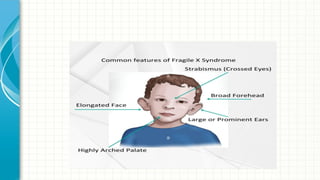
2. Fragile XSyndrome
A genetic condition caused by a mutation in the FMR1 gene on
the X chromosome, leading to reduced or absent production of
the fragile X mental retardation protein (FMRP), which is
essential for normal brain development.
• Key Features:
• It is the most common inherited cause of intellectual
disability and autism spectrum disorder. Signs include
developmental delays, learning difficulties, anxiety,
hyperactivity, large ears, long face, and sometimes seizures.
15.
4. Developmental disabilities
•Developmental disabilities are a group of chronic conditions
that originate during developmental periods (usually before
age 22) and result in significant limitations in; Intellectual
functioning, Physical functioning, Learning, Language,
Behavior, Self-care, Independent living
• Examples:
• Autism Spectrum Disorder (ASD)
• Attention Deficit Hyperactivity Disorder (ADHD)
• Cerebral palsy
• Global developmental delay
16.
Cont;
• 1. AutismSpectrum Disorder (ASD)
• A neurodevelopmental disorder that affects communication, social
interaction, and behavior.
• Features: Repetitive behaviors, difficulties with verbal and nonverbal
communication, restricted interests, and sensitivity to sensory input.
•
• 2. Cerebral Palsy (CP)
• A group of disorders affecting movement, muscle tone, and posture
caused by damage to the developing brain, often before or during
birth.
• Features: Stiff or floppy muscles, difficulty with coordination, delayed
motor milestones, and sometimes speech or learning challenges.
17.
Cont;
• 3. Attention-Deficit/HyperactivityDisorder (ADHD)
• A neurodevelopmental disorder marked by persistent patterns of
inattention, hyperactivity, and impulsivity.
• Features: Difficulty sustaining attention, fidgeting, interrupting, and
challenges in academic and social settings.
• 4. Developmental Delays
• A condition where a child does not reach developmental milestones
within the expected age range. This can affect one or more areas of
development: cognitive, motor, speech/language, social, or emotional.
• Key Features: Delays may be temporary or long-term and can result
from genetic disorders, medical conditions, environmental factors, or
unknown causes.
18.
5. Psychosocial /Mental Disabilities
• Disorders that affect emotions, thinking, and behavior, limiting the ability to cope with daily
life.
• Examples: Schizophrenia, bipolar disorder, depression, post-traumatic stress disorder (PTSD).
• Signs & Symptoms:
• Depression: sadness, hopelessness, fatigue, suicidal thoughts
• Bipolar disorder: extreme mood swings (mania and depression)
• Schizophrenia: hallucinations, delusions, disorganized thinking
• PTSD: flashbacks, nightmares, avoidance, anxiety
• Management:
• Counseling and psychotherapy (e.g., CBT)
• Medications: antidepressants, antipsychotics, mood stabilizers
• Rehabilitation programs and community support
• Stress management, self-care, and supportive relationships
• Family and peer involvement
19.
6. Communication Disabilities
•Conditions that affect the ability to produce, understand, or process language.
• Examples:
• Stammering,
• aphasia (after stroke) Aphasia is a communication disorder that results from damage to the parts of the brain
responsible for language (usually the left hemisphere). It affects a person’s ability to speak, understand, read,
or write, but does not affect intelligence., speech delays.
• Signs & Symptoms:
• Difficulty speaking clearly (stuttering, slurred speech)
• Trouble finding words or expressing thoughts
• Delayed speech in children
• Difficulty understanding spoken or written language
• Management:
• Speech and language therapy
• Use of alternative communication (sign language, writing, communication devices)
• Psychological support to reduce anxiety associated with stammering
• Family involvement in communication therapy
• Early intervention for children
20.
7. Learning Disabilities
•Neurological disorders that affect the ability to understand, process, and use information effectively.
• Examples:
• Dyslexia (reading difficulty)
• Dyscalculia (math difficulty),
• Dysgraphia (writing difficulty).
• Signs & Symptoms:
• Difficulty reading, spelling, or understanding written text (dyslexia)
• Struggles with numbers, arithmetic, and time concepts (dyscalculia)
• Poor handwriting and difficulty expressing thoughts in writing (dysgraphia)
• Easily distracted, short attention span
• Academic underperformance despite normal intelligence
• Management:
• Special teaching strategies (multi-sensory learning)
• Use of assistive technology (audio books, calculators, typing tools)
• Extra time in exams and personalized support
• Counseling for self-esteem and frustration
• Collaboration between teachers, parents, and therapists
21.
8. Neurological Disabilities
•Disabilities caused by damage to the brain, spinal cord, or nervous system.
• Examples: Epilepsy, multiple sclerosis (MS), Parkinson’s disease, brain injury.
• Signs & Symptoms:
• Epilepsy: recurrent seizures, unconsciousness, convulsions
• MS: fatigue, muscle weakness, blurred vision, numbness
• Parkinson’s: tremors, rigidity, slow movement, balance issues
• Brain injury: memory loss, mood changes, concentration difficulties
• Management:
• Medications (anti-seizure, dopamine therapy, steroids)
• Physiotherapy and occupational therapy
• Cognitive rehabilitation after brain injury
• Lifestyle modification (diet, exercise, stress control)
• Use of mobility aids and supportive care
22.
Multiple Disabilities
• Whena person has more than one type of impairment, leading to complex needs.
• Examples: Cerebral palsy with intellectual disability, deaf-blindness.
• Signs & Symptoms:
• Severe difficulties in communication, mobility, and learning
• Dependence on caregivers for most daily activities
• Multiple health complications (seizures, speech delays, sensory loss)
• Management:
• Multidisciplinary approach (doctors, therapists, teachers, psychologists)
• Assistive devices for both mobility and communication
• Individualized education plans (IEPs) for children
• Family training and counseling for long-term support
• Community-based rehabilitation and social inclusion
23.
HOME ENVIRONMENT ASSESSMENT
•Assessing the home environment of a person with a disability is an
important part of providing safe, effective, and person-centered
care.
• According to the World Health Organization (WHO), environmental
factors play a major role in a person’s ability to function, remain
independent, participate in daily activities, and maintain a good
quality of life.
• A structured home assessment allows health and support workers
to:
• Identify barriers that may limit movement or independence
• Recognize risks that could cause injury or harm
• Identify facilitators that support safety and participation
24.
Purpose of HomeEnvironment Assessment
• The main objectives of assessing a client’s home environment
are to:
• Promote safety and injury prevention
• Support independence and daily functioning
• Reduce environmental barriers
• Enhance participation in daily and social activities
• Prevent secondary complications (falls, pressure injuries,
infections)
• Ensure accessibility and comfort
• Support person-centered and inclusive care
25.
WHO Frameworks andGuidelines Used in Home
Assessment
• 1. WHO International Classification of Functioning, Disability and
Health (ICF)
• The ICF framework is the foundation for WHO’s approach to
disability assessment.
• Key ICF Components Relevant to Home Assessment:
• Body Functions and Structures – physical, sensory, cognitive abilities
• Activities – ability to perform daily tasks (mobility, self-care)
• Participation – involvement in home and community life
• Environmental Factors – physical, social, and attitudinal environment
• Personal Factors – age, lifestyle, coping strategies
26.
2. WHO DisabilityAssessment Schedule (WHODAS 2.0)
• WHODAS 2.0 helps understand how disability affects daily
functioning in the home.
• Areas Linked to Home Assessment:
• Mobility within the home
• Self-care (bathing, dressing, toileting)
• Household activities
• Participation in family life
• Use of assistive devices
27.
3. WHO HealthyHousing Guidelines
• These guidelines focus on how housing conditions affect
health, safety, and well-being.
• Key principles include:
• Safe physical structure
• Adequate lighting and ventilation
• Thermal comfort
• Clean water and sanitation
• Reduced exposure to hazards
28.
4. WHO Age-Friendlyand Disability-Inclusive Environment Principles
• Although originally developed for older adults, these
principles are widely applied to people with disabilities.
• Core concepts:
• Accessibility
• Safety
• Ease of movement
• Clear signage and layout
• Supportive design
29.
Areas Assessed inthe Client Home Environment
• External Environment
• Pathways and entrances
• Ramps or stairs
• Handrails
• Door width and threshold height
• Adequate lighting
• Non-slip surfaces
• Safe access for wheelchairs or mobility aids
30.
Cont;
• Internal LivingAreas
• Clear and uncluttered walkways
• Adequate space for mobility aids
• Stable furniture
• Non-slip flooring
• Appropriate lighting levels
• Safe placement of electrical cords
31.
Cont;
• Bathroom andToilet Areas
• High-risk area requiring careful assessment:
• Grab rails near toilet and shower
• Non-slip mats
• Shower chairs or bath boards
• Accessible sinks and mirrors
• Safe water temperature
• Emergency call systems if needed
32.
Cont;
• Bedroom
• Bedheight suitable for transfers
• Space for mobility aids
• Accessible storage
• Bed rails if required
• Lighting reachable from bed
• Emergency access
33.
Cont;
• Kitchen
• Accessiblebench heights
• Easy-to-use appliances
• Clear floor space
• Safe storage of sharp or hazardous items
• Adaptive utensils
• Fire safety equipment
34.
Cont;
• Assessment ofSafety Risks
• WHO guidelines emphasize risk prevention, especially for:
• Falls
• Burns and scalds
• Fire hazards
• Poor air quality
• Electrical hazards
• Infection risks
• Risk assessment includes identifying:
• Slippery surfaces
• Poor lighting
• Unsafe furniture
• Inadequate ventilation
• Lack of emergency exits
35.
Cont;
• Assistive Devicesand Environmental Modifications
• Assessment includes evaluating the need for:
• Wheelchairs
• Walking aids
• Transfer equipment
• Grab bars and rails
• Ramps and lifts
• Adjustable furniture
• Visual or auditory aids
• WHO promotes appropriate, affordable, and culturally acceptable
assistive technology.
36.
Cont;
• Client andFamily Involvement
• WHO guidelines stress participation and consent:
• Client preferences and routines are respected
• Cultural and personal values are considered
• Family or carers are involved in planning
• Education is provided on safe use of equipment
37.
Cont;
• Documentation andCare Planning
• Assessment findings are:
• Clearly documented
• Linked to identified risks and needs
• Used to develop individualised care plans
• Reviewed regularly as needs change
• Documentation supports:
• Continuity of care
• Legal and ethical accountability
• Multidisciplinary collaboration
38.
Cont;
• Role ofthe Support Worker
• Support workers contribute by:
• Observing environmental risks
• Reporting concerns
• Supporting implementation of modifications
• Encouraging safe practices
• Assisting clients to use assistive devices correctly
• Following WHO-aligned organisational policies



![NORMAL AND ABNORMAL PUERPERIUM [Autosaved] (1) (1) (2) (2).pptx](https://cdn.slidesharecdn.com/ss_thumbnails/normalandabnormalpuerperiumautosaved1122-250415070638-67a05e22-thumbnail.jpg?width=640&height=640&fit=bounds)


