Alireza Moghaddam
Hematology Supervisor
at Pars Hospital Lab
(PTT)
(PT)
Intrinsic Pathway
Extrinsic Pathway
(PTT)
 Blood must be fluid
 Must coagulate (clot) at appropriate time
• Rapid
• Localized
• Reversible
➢ Thrombosis inappropriate coagulation
➢ Vessel Wall
Endothelium
➢ Platelets
➢ Coagulation Cascade
Coagulation Proteins ( Factors)
• Anti-platelet properties
▪ Covers highly thrombogenic basement membrane
▪ Uninjured endothelium does not bind platelets
▪ PGI2 (prostacyclin) and NO from uninjured endothelium
inhibit platelet binding
▪ ADPase counters the platelet aggregating effects of ADP
➢ HEPARIN-LIKE MOLECULES: activate anti-
thrombin III (inactivates active proteases)
THROMBOMODULIN: changes specificity of
thrombin (activates protein C , which inactivates factors
Va and VIIIa
Endothelial cells produce t- PA which activates
fibrinolysis via plasminogen to plasmin
Prothrombotic Properties of the
Endothelium
•Synthesis of von Willebrand factor
•Release of tissue factor
•Production of plasminogen activator inhibitors (PAI)
•Membrane phospholipids bind and facilitate
activation of clotting factors via Ca++ bridges
Injury of vessels wall
leads to contact
between blood and
subendothelial cells
FXa binds to FVa on the
cell surface
The complex between
TF and FVIIa activates
FIX and FX
Tissue factor (TF) is
exposed and binds to
FVIIa or FVII which
is subsequently
converted to FVIIa
1. Initiation phase
(PTT)
(PT)
✓ All Clotting Factors are
within a blood vessels
✓ Clotting Slower
✓ Initiating Factor
is
Outside the blood
Vessels ( Tissue
Factor)
✓ Clotting Faster
(Blood Vessel Injury)
(Tissue Injury)
The FXa/FVa complex
converts small amounts
of prothrombin into
thrombin
The small amount of
thrombin generated
activates FVIII, FV, FXI
and platelets locally.
FXIa converts FIX
to FIXa
2. Amplification phase
Activated platelets
bind FVa, FVIIIa
and FIXa
➢ Disseminated Intravascular Coagulation
(DIVC)
➢ Liver Disease
➢ Nephrotic Syndrome
➢ Pregnancy
➢ Warfarin Therapy
➢ Acute Inflammatory Processes
➢ Acute Thrombosis
• Immobilization Medical Disorders
▪ Cancer/Anticancer Drugs * Hyperlipidemias
• Antiphospholipid Syndrome * Nephrotic Syndrome
• Vasculitis * Myeloproliferative Disease
• Pregnancy * Paroxysmal Nocturnal
• Oral Contraceptive Haemoglobinuria(PNH)
• Hormone Replacement Therapy * Adams 13 Deficiency
*Heparin Induce
Thrombopathy
* Obesity
• Antiphospholipid syndrome
• Hyperhomocysteinemia
• Miscellaneous
• Thrombocythemia
• Dysproteinemia
• Heparin-induced thrombocytopenia (HITT)
• Estrogens
– Birth control pills
– Hormone replacement therapy
➢ Malignancy
➢ Pregnancy
➢ Bed rest
➢ Surgery
➢ Trauma
• Activated protein C resistance (factor V Leiden)
• Protein S deficiency
• Protein C deficiency
• Antithrombin deficiency
• Hyperhomocysteinemia
• Prothrombin 20210A allele
• Dysplasminogenemia
• High plasminogen activator inhibitor
• Dysfibrinogenemia
• Elevated factor VIII
Physiologic Inhibitors of
coagulation
• Antithrombin III (serpin)
• Activated Protein C + protein S
– Inactivates Va and VIIIa (via proteolysis)
– NB: Factor V Leiden
• Thrombomodulin (EC glycoprotein)
– Binds to thrombin
– Decreases ability to produce fibrin
– Increases ability to activate Protein C
Non-physiologic inhibitors of coagulation
 Vitamin K antagonists (in vivo only)
 Ca chelators (in vitro only)
 EDTA
 Citrate
 Oxalate
* Heparin (in vivo and in vitro)
Abnormality Arterial Venous
Factor V Leiden - +
Prothrombin G20210A - +
Anti Thrombin Deficiency - +
Protein C Deficiency - +
Protein S Deficiency - +
Hyperhomocystinemia + +
Antiphospholipid Syndrome + +
Fibrinolysis
Fibrinogen
tPA
Plasmin
Fibrin Fibrin Split Product (FSP)
➢ Plasminogen Activator Inhibitors ( PAIs)
➢ a2-antiplasmin (serpin)
 Protein C pathway
• Factor V Leiden
• Protein C deficiency
• Protein S deficiency
 Prothrombin G20210A mutation
 Antithrombin deficiency
 Hyperhomocystinemia
• C677T MTHFR mutation
 Protein C deficiency
• Type I –  number and activity
• Type II –  activity
 Protein S deficiency
• Type I –  total and free forms
• Type II –  cofactor activity
• Type III -  free only
 Autosomal dominant
• 0.2-0.5, 0.8 prevalence
Protein C Pathway
C4BP
S
inactive
Thrombin
Endothelial surface
PC
Thrombomodulin
S
active APC
Platelet surface
Va Vi
VIIIa VIIIi
PAIa PAIi
 Mutation in Factor V
• Protein C/S complex
• Impaired anticoagulation
 5-11% of white Europeans
 Heterozygous
• Autosomal dominant
 Homozygous rare
 Multiple mutations
 Most thrombogenic disorder
 Type I
• Levels and activity
 Type II
• Activity
AT III
MTHFR and Thrombosis
 Hyperhomocystinemia implicated in both arterial and
venous thrombosis
 Why is homocysteine thrombogenic? Theories:
 Direct toxicity to endothelial cells
 Inhibits Protein C activation
 Promotes endothelial tissue factor expression
 Surpresses endothelial cell surface heparin sulfate
 Atherosclerosis, NTD, thromboembolism
 Severe – homozygous
• 1 in 200,000-355,000
• Cystathionine  -synthase
 Mild to moderate
• Heterozygotes for CS mutation
• Homozygous for 667C-T MTHFR (11%)
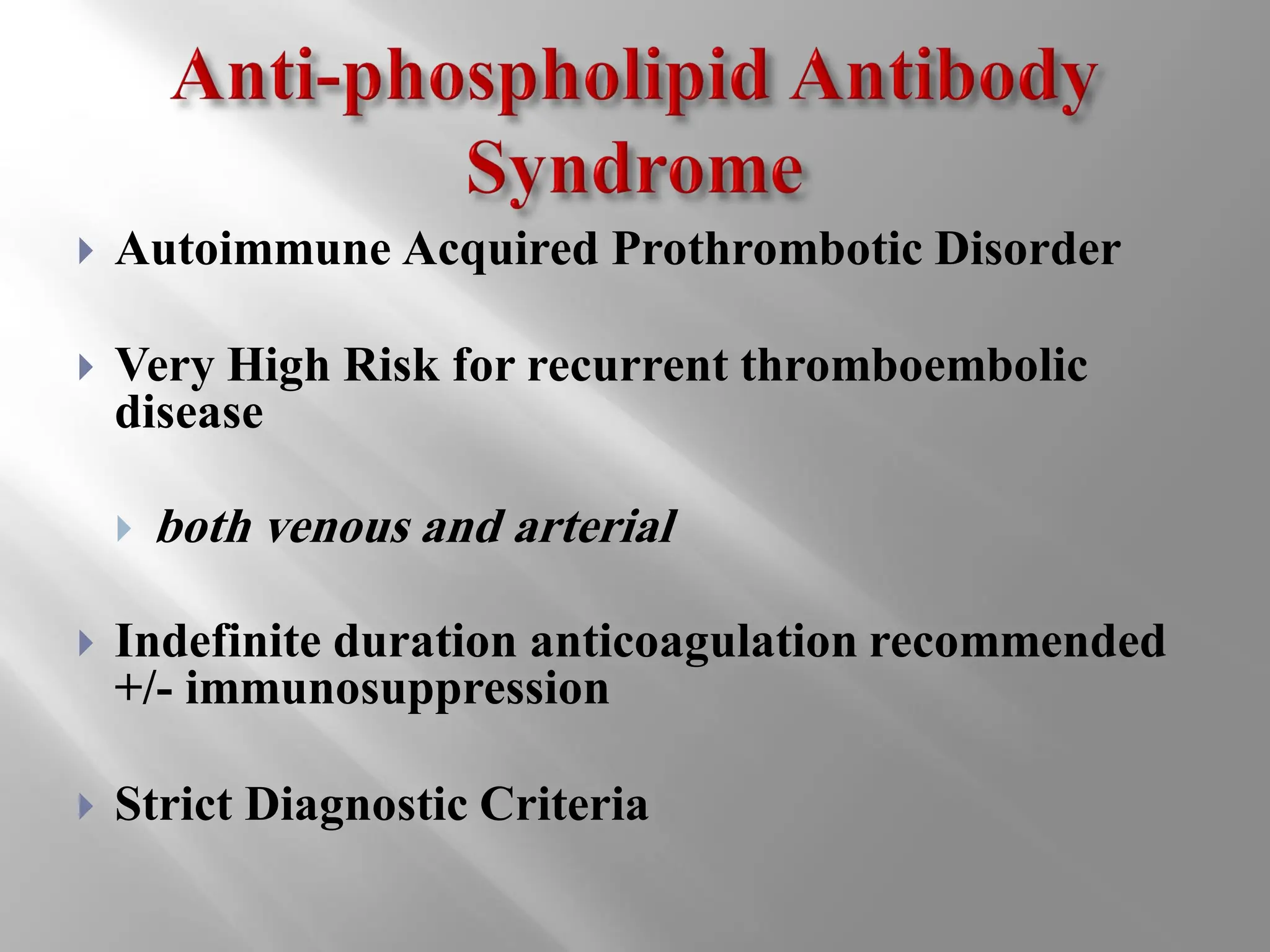
 Autoimmune Acquired Prothrombotic Disorder
 Very High Risk for recurrent thromboembolic
disease
 both venous and arterial
 Indefinite duration anticoagulation recommended
+/- immunosuppression
 Strict Diagnostic Criteria
Thrombophilia & Diagnostic Tests.pdf

Thrombophilia & Diagnostic Tests.pdf

  • 1.
  • 2.
  • 3.
     Blood mustbe fluid  Must coagulate (clot) at appropriate time • Rapid • Localized • Reversible ➢ Thrombosis inappropriate coagulation
  • 4.
    ➢ Vessel Wall Endothelium ➢Platelets ➢ Coagulation Cascade Coagulation Proteins ( Factors)
  • 5.
    • Anti-platelet properties ▪Covers highly thrombogenic basement membrane ▪ Uninjured endothelium does not bind platelets ▪ PGI2 (prostacyclin) and NO from uninjured endothelium inhibit platelet binding ▪ ADPase counters the platelet aggregating effects of ADP
  • 6.
    ➢ HEPARIN-LIKE MOLECULES:activate anti- thrombin III (inactivates active proteases) THROMBOMODULIN: changes specificity of thrombin (activates protein C , which inactivates factors Va and VIIIa Endothelial cells produce t- PA which activates fibrinolysis via plasminogen to plasmin
  • 7.
    Prothrombotic Properties ofthe Endothelium •Synthesis of von Willebrand factor •Release of tissue factor •Production of plasminogen activator inhibitors (PAI) •Membrane phospholipids bind and facilitate activation of clotting factors via Ca++ bridges
  • 10.
    Injury of vesselswall leads to contact between blood and subendothelial cells FXa binds to FVa on the cell surface The complex between TF and FVIIa activates FIX and FX Tissue factor (TF) is exposed and binds to FVIIa or FVII which is subsequently converted to FVIIa 1. Initiation phase
  • 11.
    (PTT) (PT) ✓ All ClottingFactors are within a blood vessels ✓ Clotting Slower ✓ Initiating Factor is Outside the blood Vessels ( Tissue Factor) ✓ Clotting Faster (Blood Vessel Injury) (Tissue Injury)
  • 13.
    The FXa/FVa complex convertssmall amounts of prothrombin into thrombin The small amount of thrombin generated activates FVIII, FV, FXI and platelets locally. FXIa converts FIX to FIXa 2. Amplification phase Activated platelets bind FVa, FVIIIa and FIXa
  • 15.
    ➢ Disseminated IntravascularCoagulation (DIVC) ➢ Liver Disease ➢ Nephrotic Syndrome ➢ Pregnancy ➢ Warfarin Therapy ➢ Acute Inflammatory Processes ➢ Acute Thrombosis
  • 16.
    • Immobilization MedicalDisorders ▪ Cancer/Anticancer Drugs * Hyperlipidemias • Antiphospholipid Syndrome * Nephrotic Syndrome • Vasculitis * Myeloproliferative Disease • Pregnancy * Paroxysmal Nocturnal • Oral Contraceptive Haemoglobinuria(PNH) • Hormone Replacement Therapy * Adams 13 Deficiency *Heparin Induce Thrombopathy * Obesity
  • 17.
    • Antiphospholipid syndrome •Hyperhomocysteinemia • Miscellaneous • Thrombocythemia • Dysproteinemia • Heparin-induced thrombocytopenia (HITT) • Estrogens – Birth control pills – Hormone replacement therapy
  • 18.
    ➢ Malignancy ➢ Pregnancy ➢Bed rest ➢ Surgery ➢ Trauma
  • 19.
    • Activated proteinC resistance (factor V Leiden) • Protein S deficiency • Protein C deficiency • Antithrombin deficiency • Hyperhomocysteinemia • Prothrombin 20210A allele • Dysplasminogenemia • High plasminogen activator inhibitor • Dysfibrinogenemia • Elevated factor VIII
  • 20.
    Physiologic Inhibitors of coagulation •Antithrombin III (serpin) • Activated Protein C + protein S – Inactivates Va and VIIIa (via proteolysis) – NB: Factor V Leiden • Thrombomodulin (EC glycoprotein) – Binds to thrombin – Decreases ability to produce fibrin – Increases ability to activate Protein C
  • 21.
    Non-physiologic inhibitors ofcoagulation  Vitamin K antagonists (in vivo only)  Ca chelators (in vitro only)  EDTA  Citrate  Oxalate * Heparin (in vivo and in vitro)
  • 23.
    Abnormality Arterial Venous FactorV Leiden - + Prothrombin G20210A - + Anti Thrombin Deficiency - + Protein C Deficiency - + Protein S Deficiency - + Hyperhomocystinemia + + Antiphospholipid Syndrome + +
  • 24.
  • 25.
    ➢ Plasminogen ActivatorInhibitors ( PAIs) ➢ a2-antiplasmin (serpin)
  • 27.
     Protein Cpathway • Factor V Leiden • Protein C deficiency • Protein S deficiency  Prothrombin G20210A mutation  Antithrombin deficiency  Hyperhomocystinemia • C677T MTHFR mutation
  • 28.
     Protein Cdeficiency • Type I –  number and activity • Type II –  activity  Protein S deficiency • Type I –  total and free forms • Type II –  cofactor activity • Type III -  free only  Autosomal dominant • 0.2-0.5, 0.8 prevalence
  • 29.
    Protein C Pathway C4BP S inactive Thrombin Endothelialsurface PC Thrombomodulin S active APC Platelet surface Va Vi VIIIa VIIIi PAIa PAIi
  • 31.
     Mutation inFactor V • Protein C/S complex • Impaired anticoagulation  5-11% of white Europeans  Heterozygous • Autosomal dominant  Homozygous rare
  • 34.
     Multiple mutations Most thrombogenic disorder  Type I • Levels and activity  Type II • Activity
  • 35.
  • 37.
    MTHFR and Thrombosis Hyperhomocystinemia implicated in both arterial and venous thrombosis  Why is homocysteine thrombogenic? Theories:  Direct toxicity to endothelial cells  Inhibits Protein C activation  Promotes endothelial tissue factor expression  Surpresses endothelial cell surface heparin sulfate
  • 38.
     Atherosclerosis, NTD,thromboembolism  Severe – homozygous • 1 in 200,000-355,000 • Cystathionine  -synthase  Mild to moderate • Heterozygotes for CS mutation • Homozygous for 667C-T MTHFR (11%)
  • 40.
     Autoimmune AcquiredProthrombotic Disorder  Very High Risk for recurrent thromboembolic disease  both venous and arterial  Indefinite duration anticoagulation recommended +/- immunosuppression  Strict Diagnostic Criteria