











Christian Ethics

                       Christianity
                       Depth Study
                         HSC Course

Monday, 28 June 2010
Syllabus Point
            Students learn to:
           describe and explain Christian
           ethical teachings on bioethics
           OR environmental ethics OR
           sexual ethics

Monday, 28 June 2010
Describe - Provide characteristics
    and features
    Explain - Relate cause and effect;
    make the relationships between
    things evident; provide why and/or
    how
Monday, 28 June 2010
Introduction


Monday, 28 June 2010
Introduction
         Christian morality is based upon the will of
         God.


Monday, 28 June 2010
Introduction
         Christian morality is based upon the will of
         God.
         Christians believe that God’s will is known
         and exampled through Jesus’ life and teaching.


Monday, 28 June 2010
Introduction
         Christian morality is based upon the will of
         God.
         Christians believe that God’s will is known
         and exampled through Jesus’ life and teaching.
         Humanity finds out about these teaching via
         the New Testament


Monday, 28 June 2010
Christian ethics can be divided
   into two very different
   approaches.


Monday, 28 June 2010
Christian ethics can be divided
   into two very different
   approaches.


Monday, 28 June 2010
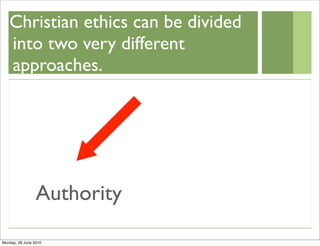
Christian ethics can be divided
   into two very different
   approaches.


                 Authority

Monday, 28 June 2010
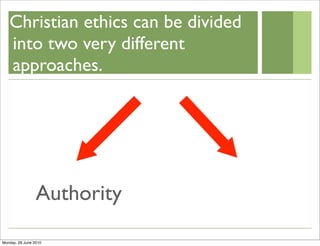
Christian ethics can be divided
   into two very different
   approaches.


                 Authority

Monday, 28 June 2010
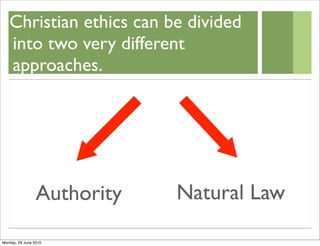
Christian ethics can be divided
   into two very different
   approaches.


                 Authority   Natural Law

Monday, 28 June 2010
Authority
                Christian ethics take
                  the following as
                sources of authority:
Monday, 28 June 2010
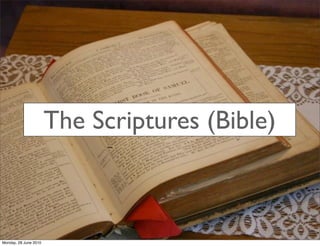
The Scriptures (Bible)


Monday, 28 June 2010
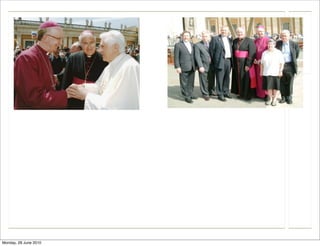
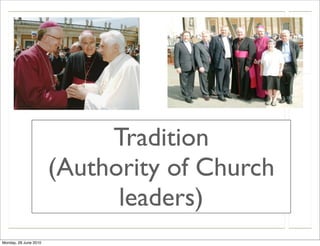
Tradition
                       (Authority of Church
                             leaders)
Monday, 28 June 2010
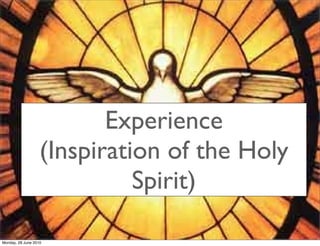
Experience
                   (Inspiration of the Holy
                             Spirit)

Monday, 28 June 2010
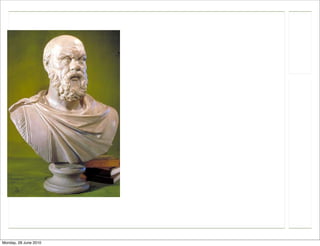
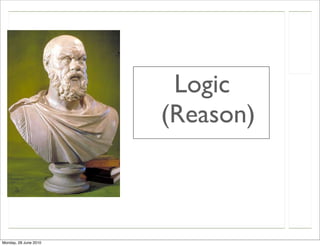
Logic
                       (Reason)


Monday, 28 June 2010
                       ?
Monday, 28 June 2010
The main issue for a Christian who
     attempts to follow Christian morality
      is exactly how the four sources of
      authority should be used and how
        are they balanced or weighted
        when a decision is to be made.

Monday, 28 June 2010
Central to Christian ethics is
                        the concept of agape or
                       unconditional love for all
                                  people.
                         Agape is an empathetic
                          attitude of caring for
                          everyone and anyone

Monday, 28 June 2010
“You have heard it been said,
                                    You shall love your
     Central part of Jesus’

                                 neighbour, and hate your
                                           enemy.
          teaching


                                  But I say unto you, Love
                                 your enemies, bless them
                                that curse you, do good to
                              them that hate you, and pray
                               for them which despitefully
                              use you, and persecute you”
                                   Matthew 5:43-44

Monday, 28 June 2010
Another central belief…..
                       “So in everything, do onto
                        others what you would
                         have them do to you”
                             Matthew 7:12


Monday, 28 June 2010
..which was summarised by
     Paul to;
                       “Love your neighbour
                        as yourself. Love does
                            no harm to its
                         neighbour. Therefore
                        love is the fulfillment
                              of the law.”
                            Romans 13:9-10

Monday, 28 June 2010
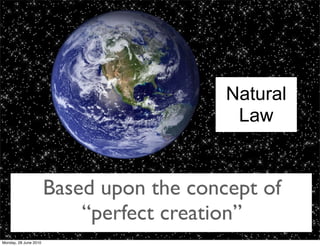
Natural
                                           Law


                       Based upon the concept of
                           “perfect creation”
Monday, 28 June 2010
The belief is that God created
                  everything perfectly and if we study
                 the way life works, and learn the laws
                    of nature, we will learn how to
                                 behave.


Monday, 28 June 2010
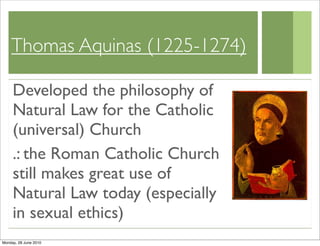
Thomas Aquinas (1225-1274)

     Developed the philosophy of
     Natural Law for the Catholic
     (universal) Church
     .: the Roman Catholic Church
     still makes great use of
     Natural Law today (especially
     in sexual ethics)
Monday, 28 June 2010
Aquinas wrote….


                       •That human nature is
                       defined by both reason
                       and freedom of choice.


Monday, 28 June 2010
Aquinas wrote….


                       •Reason allows us to
                       determine the will of God
                       whilst freedom of choice
                       allows us to follow God’s will
                       or not.


Monday, 28 June 2010
Aquinas wrote….


                       •Obviously, it is hoped that
                       humanity will equate freedom
                       with the responsibility to act
                       as if we made by God .: the
                       expectation is for humanity to
                       follow the natural law of God!

Monday, 28 June 2010
The 1st principle of Natural
    Law
     The first principle is to do good and not
     evil .: the questions that follow from this are
    1) What is good?
    2) What is evil?
    3) How do we distinguish between good and
      evil behaviour?

Monday, 28 June 2010
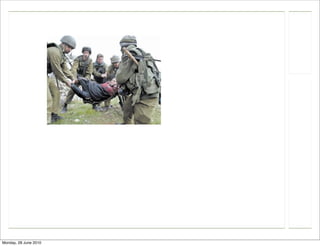
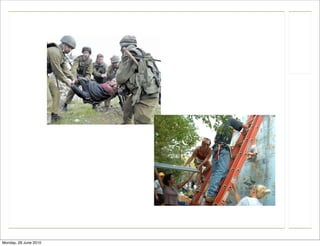
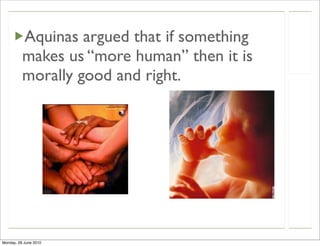
Aquinas argued that if something
          makes us “more human” then it is
          morally good and right.


Monday, 28 June 2010
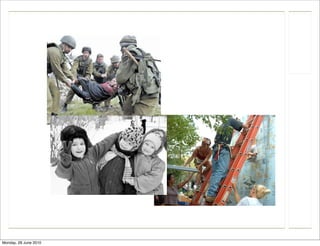
He also defined what it means to be
        human.
         The general purpose of humanity is to
        live, work, reproduce, educate children,
        have an ordered society and worship
        God!
         Following from this, actions that
        support these purposes are good,
        those that deny them are bad.

Monday, 28 June 2010
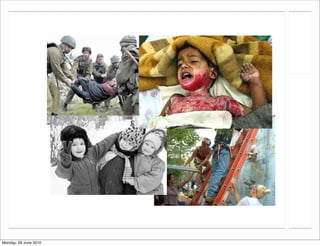
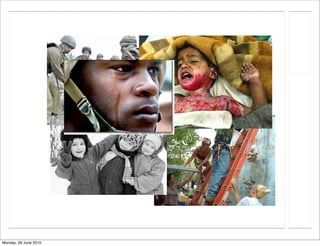
Humanity


Monday, 28 June 2010
Types of Ethical issues
                       NOTE: You will be expected to be familiar with these
                                        individual issues


Monday, 28 June 2010
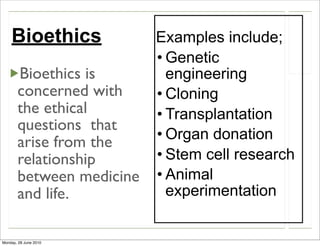
Bioethics             Examples include;
                          • Genetic
       Bioethics is         engineering
       concerned with     • Cloning
       the ethical        • Transplantation
       questions that
                          • Organ donation
       arise from the
       relationship       • Stem cell research
       between medicine   • Animal
       and life.            experimentation


Monday, 28 June 2010
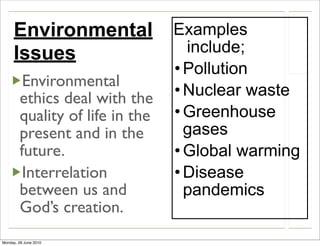
Environmental               Examples
     Issues                        include;
                                 • Pollution
         Environmental
        ethics deal with the     • Nuclear waste
        quality of life in the   • Greenhouse
        present and in the         gases
        future.                  • Global warming
         Interrelation           • Disease
        between us and             pandemics
        God’s creation.
Monday, 28 June 2010
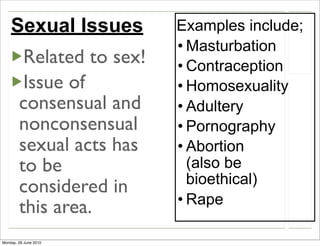
Sexual Issues          Examples include;
                           • Masturbation
         Related to sex!   • Contraception
         Issue of          • Homosexuality
        consensual and     • Adultery
        nonconsensual      • Pornography
        sexual acts has    • Abortion
        to be                (also be
                             bioethical)
        considered in
                           • Rape
        this area.
Monday, 28 June 2010
End
          † www.metatemporal.com


Monday, 28 June 2010

Yr 12 christian intro ethics

  • 1.
    Christian Ethics Christianity Depth Study HSC Course Monday, 28 June 2010
  • 2.
    Syllabus Point Students learn to: describe and explain Christian ethical teachings on bioethics OR environmental ethics OR sexual ethics Monday, 28 June 2010
  • 3.
    Describe - Providecharacteristics and features Explain - Relate cause and effect; make the relationships between things evident; provide why and/or how Monday, 28 June 2010
  • 4.
  • 5.
    Introduction Christian morality is based upon the will of God. Monday, 28 June 2010
  • 6.
    Introduction Christian morality is based upon the will of God. Christians believe that God’s will is known and exampled through Jesus’ life and teaching. Monday, 28 June 2010
  • 7.
    Introduction Christian morality is based upon the will of God. Christians believe that God’s will is known and exampled through Jesus’ life and teaching. Humanity finds out about these teaching via the New Testament Monday, 28 June 2010
  • 8.
    Christian ethics canbe divided into two very different approaches. Monday, 28 June 2010
  • 9.
    Christian ethics canbe divided into two very different approaches. Monday, 28 June 2010
  • 10.
    Christian ethics canbe divided into two very different approaches. Authority Monday, 28 June 2010
  • 11.
    Christian ethics canbe divided into two very different approaches. Authority Monday, 28 June 2010
  • 12.
    Christian ethics canbe divided into two very different approaches. Authority Natural Law Monday, 28 June 2010
  • 13.
    Authority Christian ethics take the following as sources of authority: Monday, 28 June 2010
  • 14.
  • 15.
  • 16.
  • 17.
    Tradition (Authority of Church leaders) Monday, 28 June 2010
  • 18.
  • 19.
    Experience (Inspiration of the Holy Spirit) Monday, 28 June 2010
  • 20.
  • 21.
    Logic (Reason) Monday, 28 June 2010
  • 22.
  • 23.
  • 24.
  • 25.
    The main issuefor a Christian who attempts to follow Christian morality is exactly how the four sources of authority should be used and how are they balanced or weighted when a decision is to be made. Monday, 28 June 2010
  • 26.
  • 27.
    Central to Christianethics is the concept of agape or unconditional love for all people. Agape is an empathetic attitude of caring for everyone and anyone Monday, 28 June 2010
  • 28.
    “You have heardit been said, You shall love your Central part of Jesus’ neighbour, and hate your enemy. teaching But I say unto you, Love your enemies, bless them that curse you, do good to them that hate you, and pray for them which despitefully use you, and persecute you” Matthew 5:43-44 Monday, 28 June 2010
  • 29.
  • 30.
    Another central belief….. “So in everything, do onto others what you would have them do to you” Matthew 7:12 Monday, 28 June 2010
  • 31.
    ..which was summarisedby Paul to; “Love your neighbour as yourself. Love does no harm to its neighbour. Therefore love is the fulfillment of the law.” Romans 13:9-10 Monday, 28 June 2010
  • 32.
    Natural Law Based upon the concept of “perfect creation” Monday, 28 June 2010
  • 33.
  • 34.
    The belief isthat God created everything perfectly and if we study the way life works, and learn the laws of nature, we will learn how to behave. Monday, 28 June 2010
  • 35.
    Thomas Aquinas (1225-1274) Developed the philosophy of Natural Law for the Catholic (universal) Church .: the Roman Catholic Church still makes great use of Natural Law today (especially in sexual ethics) Monday, 28 June 2010
  • 36.
    Aquinas wrote…. •That human nature is defined by both reason and freedom of choice. Monday, 28 June 2010
  • 37.
    Aquinas wrote…. •Reason allows us to determine the will of God whilst freedom of choice allows us to follow God’s will or not. Monday, 28 June 2010
  • 38.
    Aquinas wrote…. •Obviously, it is hoped that humanity will equate freedom with the responsibility to act as if we made by God .: the expectation is for humanity to follow the natural law of God! Monday, 28 June 2010
  • 39.
    The 1st principleof Natural Law The first principle is to do good and not evil .: the questions that follow from this are 1) What is good? 2) What is evil? 3) How do we distinguish between good and evil behaviour? Monday, 28 June 2010
  • 40.
  • 41.
  • 42.
  • 43.
  • 44.
  • 45.
  • 46.
  • 47.
    Aquinas argued thatif something makes us “more human” then it is morally good and right. Monday, 28 June 2010
  • 48.
    He also definedwhat it means to be human. The general purpose of humanity is to live, work, reproduce, educate children, have an ordered society and worship God! Following from this, actions that support these purposes are good, those that deny them are bad. Monday, 28 June 2010
  • 49.
  • 50.
  • 51.
    Types of Ethicalissues NOTE: You will be expected to be familiar with these individual issues Monday, 28 June 2010
  • 52.
    Bioethics Examples include; • Genetic Bioethics is engineering concerned with • Cloning the ethical • Transplantation questions that • Organ donation arise from the relationship • Stem cell research between medicine • Animal and life. experimentation Monday, 28 June 2010
  • 53.
    Environmental Examples Issues include; • Pollution Environmental ethics deal with the • Nuclear waste quality of life in the • Greenhouse present and in the gases future. • Global warming Interrelation • Disease between us and pandemics God’s creation. Monday, 28 June 2010
  • 54.
    Sexual Issues Examples include; • Masturbation Related to sex! • Contraception Issue of • Homosexuality consensual and • Adultery nonconsensual • Pornography sexual acts has • Abortion to be (also be bioethical) considered in • Rape this area. Monday, 28 June 2010
  • 55.
    End † www.metatemporal.com Monday, 28 June 2010