1
A SUPERVISED INTRUSIONSYSTEM
Presentation
of
Project
for Partial fulfilment for the degree of
B.Tech. (Computer Science)
by
Abhishek Patel
(Roll No. :-100210102)
Divyanshu Bhatt
(Roll No. :-100210167)
Naveen Patel
(Roll No. :-100210139)
Under the Guidance of
Er. Beenu Yadav
Department of Computer Science & Engineering
Sir Chhotu Ram Institute of Engineering and Technology
CHAUDHARY CHARAN SINGH UNIVERSITY MEERUT, U.P. (INDIA)
(NAAC A++ Accredited)
2024
2.
Introduction
Smart home IoTdevices are rapidly transforming the way we live, offering
convenience and connectivity. However, these interconnected systems also
create new cybersecurity challenges that require specialized Intrusion
Detection Systems (IDS) tailored for the smart home environment.
The ever-present threat of cyberattacks necessitates robust network
protection. Our project builds upon Intrusion Detection System
(IDS), aiming to achieve:
1. Enhanced Accuracy: We strive to improve the detection of
malicious activity while minimizing false alarms, allowing security
personnel to focus on genuine threats.
2. Increased Depth: Transitioning from a traditional CNN to a
multi-layered CNN architecture, leveraging deep learning's ability to
extract complex features from data, will provide a more
comprehensive and robust defense. 4
3.
Literature Survey
⚬Machine learning:LightGBM and ensemble methods improve
accuracy compared to traditional approaches.
⚬Feature engineering: Selecting and optimizing features
from datasets like KDD leads to better performance.
⚬Multi-layered defense: Combining signature-based and
anomaly-based detection provides comprehensive protection.
⚬Hybrid models: Integrating machine learning with other
security solutions strengthens defense capabilities.
⚬KDD dataset limitations: Address biases (outdated
attacks, data imbalance) through data augmentation and
advanced preprocessing for improved generalizability.
By incorporating these strategies, our project can achieve
its goals of enhanced accuracy, comprehensive detection, and
effective data utilization, leading to a more robust IDS.
6
4.
Objective
⚬Enhanced Accuracy: Toimprove the detection rate of malicious activity &
minimizing the chance of missed threats.
⚬Reduced False Positives: To Minimize false alarms, allowing security
personnel to focus on genuine threats and avoid wasted time investigating non-
issues.
⚬Increased Depth of Defense: Transition from traditional CNNs to multi-
layered CNNs, leveraging deep learning's ability to extract complex features and
patterns from network data. This leads to a more comprehensive and robust
defense against evolving cyber threats.
⚬Expanded Training Data: Utilize a larger portion of the KDD dataset,
exposing the model to a wider range of network behaviors. This enhances the
model's ability to identify diverse attack patterns and generalize effectively in
real-world scenarios.
By addressing these objectives, we aim to create a more reliable and
effective IDS, bolstering our network's resilience against evolving cyber threats.
5
5.
01 Data Preprocessing
02Model Design
03 Model Training and Evaluation
04 Deployment and Monitoring
Methadology
7
6.
2. Model Design:
⚬Architecture:Design a multi-layered CNN architecture with
convolutional and pooling layers.
⚬Convolutional layers extract local features from the data,
utilizing filters that move across the input.
⚬Pooling layers downsample the data, reducing its
dimensionality and computational cost while preserving key
features.
⚬Activation Functions: Employ appropriate activation
functions (e.g., ReLU) to introduce non-linearity and improve
the model's ability to learn complex patterns.
⚬Hyperparameter Tuning: Optimize hyperparameters like
filter size, number of layers, and learning rate through
experimentation to achieve optimal performance.
fig. Data Preprocessing
fig. CNN Model Design
Convolution
1. Data Preprocessing:
⚬Data Acquisition: Obtain and pre-process a larger portion of the
KDD dataset, ensuring its integrity and consistency.
⚬Feature Engineering: Select or create relevant features from the
dataset that effectively represent network behavior and potential
intrusions.
⚬Normalization: Scale the pre-processed data to a specific range,
enabling efficient learning by the CNN model.
8
7.
4. Deployment andMonitoring:
⚬Deploy the trained model into the IDS environment to analyze real-time
network traffic.
⚬Continuously monitor the system's performance and retrain the model
periodically on updated data to maintain optimal effectiveness against evolving
cyber threats.
⚬This methodology outlines a structured approach to developing and deploying a
multi-layered CNN-based IDS. By focusing on data quality, appropriate model
design, rigorous training and evaluation, and continuous monitoring, this system
can contribute significantly to enhancing network security.
3. Model Training and Evaluation:
⚬Divide the preprocessed data into training, validation, and
testing sets.
⚬Train the model on the training set using a suitable optimizer
(e.g., Adam) and loss function (e.g., binary cross-entropy).
⚬Evaluate the model's performance on the validation set,
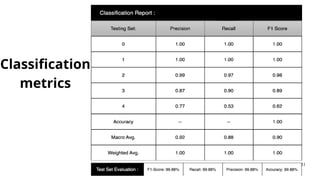
monitoring metrics like accuracy, precision, recall, and F1-
score.
⚬Fine-tune the model based on the validation results to
improve generalization and avoid overfitting.
fig. Deployment and Monitoring
fig. Model Training and Evaluation
9
8.
Future Work tobe Done
1. Accuracy Refinement:
⚬Elevate accuracy beyond 99.85%.
⚬Explore advanced algorithms and ensemble methods.
⚬Incorporate anomaly detection for novel threats.
2. Dataset Scalability:
⚬Expand training dataset for diverse network scenarios.
⚬Include real-world datasets and collaborate for contemporary
threats.
⚬Enhance robustness through broader dataset coverage.
3. Deepening Model Architecture:
⚬Add more layers for nuanced pattern recognition.
⚬Explore advanced architectures (RNNs, transformers).
⚬Integrate explainable AI for interpretability.
12
9.
Result
⚬By addressing theseobjectives, we aim to create a more reliable and effective
IDS, bolstering our network's resilience against evolving cyber threats.
Data Distribution in our input
dataset
10
Conclusion
3
Addressing Critical IoTSecurity Challenges: The exponential growth of smart home IoT devices necessitates advanced
cybersecurity measures to mitigate emerging vulnerabilities in interconnected environments.
Enhanced ID performance :
12.
13
⚬Network Security Monitoring:Detects unauthorized access or
malicious activities within a network. Monitors real-time traffic to
identify unusual patterns
⚬Malware Detection: Identifies suspicious files or payloads that
may contain malware or viruses.
⚬Safeguarding IoT Devices: Monitors Internet of Things (IoT)
devices for vulnerabilities and potential intrusions.
⚬Cloud Security: Monitors cloud environments for unauthorized
access, configuration errors, or unusual activities.
Application of Intrusion Detection System