The internet of things (IoT) and software-defined networks (SDN) play a significant role in enhancing efficiency and productivity. However, they encounter possible risks. Artificial intelligence (AI) has recently been employed in intrusion detection systems (IDSs), serving as an important instrument for improving security. Nevertheless, the necessity to store data on a centralized server poses a potential threat. Federated learning (FL) addresses this problem by training models locally. In this work, a network intrusion detection system (NIDS) is implemented on multi-controller SDN based IoT networks. The interplanetary file system (IPFS) FL has been employed to share and train deep learning (DL) models. Several clients participated in the training process using custom generated dataset IoT-SDN by training the model locally and sharing the parameters in an encrypted format, improving the overall effectiveness, safety, and security of the network. The model has successfully identified several types of attacks, including distributed denial of service (DDoS), denial of service (DoS), botnet, brute force, exploitation, malware, probe, web-based, spoofing, recon, and achieving an accuracy of 99.89% and a loss of 0.005.
![IAES International Journal of Artificial Intelligence (IJ-AI)
Vol. 14, No. 4, August 2025, pp. 3109~3120
ISSN: 2252-8938, DOI: 10.11591/ijai.v14.i4.pp3109-3120 3109
Journal homepage: http://ijai.iaescore.com
Federated deep learning intrusion detection system on software
defined-network based internet of things
Heba Dhirar, Ali H. Hamad
Department of Information and Communications Engineering, Al-Khwarizmi College of Engineering, University of Baghdad,
Baghdad, Iraq
Article Info ABSTRACT
Article history:
Received Oct 4, 2024
Revised Jan 29, 2025
Accepted Mar 15, 2025
The internet of things (IoT) and software-defined networks (SDN) play a
significant role in enhancing efficiency and productivity. However, they
encounter possible risks. Artificial intelligence (AI) has recently been
employed in intrusion detection systems (IDSs), serving as an important
instrument for improving security. Nevertheless, the necessity to store data
on a centralized server poses a potential threat. Federated learning (FL)
addresses this problem by training models locally. In this work, a network
intrusion detection system (NIDS) is implemented on multi-controller SDN-
based IoT networks. The interplanetary file system (IPFS) FL has been
employed to share and train deep learning (DL) models. Several clients
participated in the training process using custom generated dataset IoT-SDN
by training the model locally and sharing the parameters in an encrypted
format, improving the overall effectiveness, safety, and security of the
network. The model has successfully identified several types of attacks,
including distributed denial of service (DDoS), denial of service (DoS),
botnet, brute force, exploitation, malware, probe, web-based, spoofing,
recon, and achieving an accuracy of 99.89% and a loss of 0.005.
Keywords:
Federated deep learning
Internet of things
Interplanetary file system
Intrusion detection system
Software-defined network
This is an open access article under the CC BY-SA license.
Corresponding Author:
Heba Dhirar
Department of Information and Communications Engineering, Al-Khwarizmi College of Engineering
University of Baghdad
Jadriaa, Baghdad, Iraq
Email: heba.d@kecbu.uobaghdad.edu.iq
1. INTRODUCTION
The term "internet of things (IoT)" refers to connecting embedded devices to the internet. The idea
behind the IoT is to enable everyday items to be connected over the network and gather vast amounts of data
from devices with different powers and limited resources; hence, enforcing security and protection can be
challenging [1]. Network traffic analysis and abnormal activity identification are resource-intensive tasks.
Over the last several years, several lightweight approaches for improving IoT security have been created
[2], [3], but these systems are unable to handle the significant security risks that have been discovered lately.
Hence, it is imperative to design effective intrusion detection to efficiently defend against various forms of
attacks. Intrusion detection system (IDS) performs an essential part as the primary defense mechanism [4]
which employs many approaches to identify and flag abnormalities. Significant advancements have been
achieved using machine learning (ML) and deep learning (DL) in recent years, resulting in widespread use
across several domains. It can offer techniques to identify various forms of attack without the need for
significant human involvement. While these methods have proven effective for IDS, they often need a
centralized server to analyze the data gathered from all network users. Federated learning (FL) is a means to
implement on-device learning while preserving data privacy [5]–[7]. FL is an iterative procedure in which the](https://image.slidesharecdn.com/5027079-250912040913-5db45445/85/Federated-deep-learning-intrusion-detection-system-on-software-defined-network-based-internet-of-things-1-320.jpg)
![IAES International Journal of Artificial Intelligence (IJ-AI)
Vol. 14, No. 4, August 2025, pp. 3109~3120
ISSN: 2252-8938, DOI: 10.11591/ijai.v14.i4.pp3109-3120 3109
Journal homepage: http://ijai.iaescore.com
Federated deep learning intrusion detection system on software
defined-network based internet of things
Heba Dhirar, Ali H. Hamad
Department of Information and Communications Engineering, Al-Khwarizmi College of Engineering, University of Baghdad,
Baghdad, Iraq
Article Info ABSTRACT
Article history:
Received Oct 4, 2024
Revised Jan 29, 2025
Accepted Mar 15, 2025
The internet of things (IoT) and software-defined networks (SDN) play a
significant role in enhancing efficiency and productivity. However, they
encounter possible risks. Artificial intelligence (AI) has recently been
employed in intrusion detection systems (IDSs), serving as an important
instrument for improving security. Nevertheless, the necessity to store data
on a centralized server poses a potential threat. Federated learning (FL)
addresses this problem by training models locally. In this work, a network
intrusion detection system (NIDS) is implemented on multi-controller SDN-
based IoT networks. The interplanetary file system (IPFS) FL has been
employed to share and train deep learning (DL) models. Several clients
participated in the training process using custom generated dataset IoT-SDN
by training the model locally and sharing the parameters in an encrypted
format, improving the overall effectiveness, safety, and security of the
network. The model has successfully identified several types of attacks,
including distributed denial of service (DDoS), denial of service (DoS),
botnet, brute force, exploitation, malware, probe, web-based, spoofing,
recon, and achieving an accuracy of 99.89% and a loss of 0.005.
Keywords:
Federated deep learning
Internet of things
Interplanetary file system
Intrusion detection system
Software-defined network
This is an open access article under the CC BY-SA license.
Corresponding Author:
Heba Dhirar
Department of Information and Communications Engineering, Al-Khwarizmi College of Engineering
University of Baghdad
Jadriaa, Baghdad, Iraq
Email: heba.d@kecbu.uobaghdad.edu.iq
1. INTRODUCTION
The term "internet of things (IoT)" refers to connecting embedded devices to the internet. The idea
behind the IoT is to enable everyday items to be connected over the network and gather vast amounts of data
from devices with different powers and limited resources; hence, enforcing security and protection can be
challenging [1]. Network traffic analysis and abnormal activity identification are resource-intensive tasks.
Over the last several years, several lightweight approaches for improving IoT security have been created
[2], [3], but these systems are unable to handle the significant security risks that have been discovered lately.
Hence, it is imperative to design effective intrusion detection to efficiently defend against various forms of
attacks. Intrusion detection system (IDS) performs an essential part as the primary defense mechanism [4]
which employs many approaches to identify and flag abnormalities. Significant advancements have been
achieved using machine learning (ML) and deep learning (DL) in recent years, resulting in widespread use
across several domains. It can offer techniques to identify various forms of attack without the need for
significant human involvement. While these methods have proven effective for IDS, they often need a
centralized server to analyze the data gathered from all network users. Federated learning (FL) is a means to
implement on-device learning while preserving data privacy [5]–[7]. FL is an iterative procedure in which the](https://image.slidesharecdn.com/5027079-250912040913-5db45445/75/Federated-deep-learning-intrusion-detection-system-on-software-defined-network-based-internet-of-things-1-2048.jpg)
![ ISSN: 2252-8938
Int J Artif Intell, Vol. 14, No. 4, August 2025: 3109-3120
3110
entire model may be enhanced in each round by training the model on many devices and using their data
across numerous iterations without exchanging data with a centralized server achieving privacy preservation
and cost reduction, as expected in conventional centralized approaches [8]. Software-defined networking
(SDN) is an innovative architecture that separates network control from forwarding functions, enabling direct
programmability of network management and enhancing operational efficiency. The SDN network utilizes
these attributes to create a proactive system for detecting intrusions in IoT networks, making it a superior
choice for overcoming the challenges faced in the efficient operation of IoT due to its programmability and
comprehensive perspective [9], [10].
The network-based IDS, referred to as network intrusion detection system (NIDS), is designed to
determine whether IP traffic is compromised by threads. The process consists of a training phase utilizing an
accurate representation of recognized activities, followed by an operational classification and decision phase.
The training and classification phases rely on the definition and extraction of a set of statistical parameters
associated with each IP flow, which constitute the statistical fingerprint of the flow, and on DL classifiers
designed to differentiate between normal and malicious traffic. In this study, FL was utilized to cooperatively
train DL models to implement anomaly-based IDS on a multi-controller SDN-based IoT that leverages the
characteristics of SDN to establish a proactive system for detecting intrusions in IoT networks. Several
clients can obtain the DL model from the interplanetary file system (IPFS) network and participate in the
training process by training the model locally on their custom-generated dataset and sharing only the
parameters in an encrypted form using advanced encryption standards (AES) algorithm. This process
enhances the overall efficiency, safety, and security. The model has successfully identified several types of
attacks achieving an accuracy of 99.89% and a loss of 0.005.
The rest of the paper is organized as follows: section 2 focuses on IDS research in context of SDN
and IoT networks, and section 3 contains comprehensive background analysis with the details of our custom-
generated dataset IoT-SDN. The suggested methodology is discussed in section 4. The experimental results
and efficacy of proposed method are presented in section 5, whereas section 6 outlines the work's conclusion.
2. RELATED WORK
The substantial amount of data and the diversity of devices make the security of the IoT a significant
problem. IDSs have been developed employing various methodologies and strategies to secure and defend
IoT networks. Several prominent intrusion detection algorithms recently developed to address security
challenges in SDN and IoT networks are outlined in Table 1 which provides a summary of the researchers
who have concentrated on implementing IDS on the SDN network.
Table 1. Survey of the most related work of IDSs on the SDN and IoT networks
Reference Year Network Dataset Technique Accuracy (%)
Tang et al. [11] 2016 SDN NSL-KDD Deep neural network (DNN) 75.75
Ajaeiya et al. [12] 2017 SDN Custom Random forest (RF) 85.4
Ye et al. [13] 2018 SDN Custom Support vector machine (SVM) 95.24
Latah and Toker [14] 2018 SDN NSL-KDD Decision tree 71
Tang et al. [15] 2019 SDN NSL-KDD Gate recurrent unit (GRU)-
recurrent neural network (RNN)
89
Boppana et al. [16] 2019 SDN NSL-KDD RF 81.95
Hannache and Batouche [17] 2020 SDN Custom DNN 96.13
Lim et al. [18] 2020 SDN-IoT N. A. FL-RF with actor-critic PPO N.A
ElSayed et al. [19] 2021 SDN InSDN [20] Convolutional neural networks
(CNN)+RF
99.28
Hadem et al. [21] 2021 SDN NSL-KDD SVM 95.98
Alzahrani and Alenazi [22] 2021 SDN NSL-KDD XGBoost Detection: 95.5,
Classification: 95.95
Wani et al. [23] 2021 SDN CSE-CIC-IDS 2018 IDS IoT-SDL 99.05
Mohsin and Hamad [24] 2022 SDN Custom RF
KNN
Naive Bayes (NB)
Logistic regression (LR)
RF: 100
KNN: 99.99-100
NB: 72.11-83.5
LR: 59.44-92.74
Ravi et al. [25] 2022 SDN-IoT SDN-IoT [26] GRU feature fusion Detection: 99
Classification: 98
Jose and Jose [27] 2023 IoT CIC-IDS 2017 DNN; LSTM; CNN 94.61; 97.67; 98.61
Logeswari et al. [28] 2023 SDN NSL-KDD HFS-LGBM 98.72
Chaganti et al. [29] 2023 SDN-IoT SDN IoT-focused LSTM 97.1
Maddu and Rao [30] 2023 SDN InSDN edge IIoT DL 99.65
Elsayed et al. [31] 2023 SDN-IoT ToN-IoT InSDN LSTM 96.35; 99.73
Vidhya and Nagarajan [32] 2024 SDN-IoT CSE-CIC-IDS2018;
SDN-IoT
BiLSTM-based WNIDS 99.97-99.96
95.13-92.90
Niknami and Wu [33] 2024 SDN NSL-KDD; KDD99 DeepIDPS (CNN-LSTM+AM) 92.2-95.4; 95.26-97.42
Our work 2024 SDN-IoT IoT-SDN [34] FL-DL 99.89](https://image.slidesharecdn.com/5027079-250912040913-5db45445/85/Federated-deep-learning-intrusion-detection-system-on-software-defined-network-based-internet-of-things-2-320.jpg)
![Int J Artif Intell ISSN: 2252-8938
Federated deep learning intrusion detection system on software defined-network … (Heba Dhirar)
3111
Ajaeiya et al. [12] introduced RF based IDS for identifying network threats in SDN. The network
features used to train the model and predict network attacks consisted of tuple-5, packet count, byte count,
and packet interarrival time. The detection method was tested against many types of attacks, including brute
forcing, port scanning, and flooding attacks. While the results indicated a high level of accuracy in detecting
attacks using the RF method, there is a lack of detailed information on the selection of the dataset for attack
traffic. Therefore, these results may be solely relevant to non-IoT traffic.
Ye et al. [13] introduced a distributed denial of service (DDoS) attack detection system in SDN that
utilized SVM. The feature set used for predicting flooding attacks consisted of the 6-tuple network flow
characteristics. The authors state that they achieved an average detection accuracy rate of 95.24% in
detecting user datagram protocol (UDP) flooding attacks. However, the attack traffic created with the hping3
tool is not suitable for generating IoT traffic.
Latah and Toker [14] conducted a comparison of several supervised ML methods for anomaly-based
intrusion detection in SDNs. The authors stated that the decision tree algorithm obtained a higher accuracy
of 99.7% when the network security laboratory (NSL)-KDD dataset characteristics were utilized as input for
comparing ML detection models. However, the distinctive characteristics of SDN for detecting anomalies
should be taken into account. Nevertheless, the NSL-KDD dataset was specifically created to assess and
identify traditional network traffic, rather than focusing on the capabilities of SDN.
Boppana et al. [16] conducted a comparison of ML algorithms using various feature selection
methods in the SDN anomaly detection module. The NSL-KDD dataset was utilized to assess the
effectiveness of various feature and ML model combinations in the context of SDN. However, the authors
acknowledge that conducting tests on a real-time SDN testbed is a potential future goal to verify the validity
of their findings.
Hadem et al. [21] utilized an SVM and selective logging with IP traceback to accurately identify
attacks in SDN using an IDS which also helped conserve memory resources. The NSL-KDD dataset utilized
yielded a detection accuracy of 87.74%. However, the dataset is not sourced from non-IoT networks, and
there is still potential for enhancing accuracy.
Alzahrani and Alenazi [22] presented a NIDS for SDNs that uses the extreme gradient boosting
(XGBoost) model to accurately categorize network intrusions. Five features were chosen from 41 in the
NSL-KDD dataset. The given findings indicate a classification accuracy of 95.5% for XGBoost.
Additionally, the authors emphasize that their approach may be used for SDN.
Mohsin and Hamad [24] investigated the effectiveness of various supervised ML algorithms for
detecting DDoS attacks across different SDN network topologies. They applied RF, k-nearest neighbors
(KNN), NB, and LR to single, linear, and multi-controller architectures. Their results showed that while RF
and KNN achieved strong detection performance, NB and LR suffered from low accuracy and a high rate of
false predictions, limiting their suitability for practical deployment.
Jose and Jose [27] investigated the efficacy of DNN, convolutional neural networks (CNN), and
long short-term memory networks (LSTM) in IoT environments for the deployment of IDS utilizing the
CIC-IDS 2017 dataset. The results indicated that DL models outperformed previous methods used in IoT-
based IDS. Specifically, LSTM and CNN achieved accuracies of 97.67% and 98.61%, respectively, while the
overall DL approach reached 94.61% accuracy.
The aforementioned studies together either imitate the behavior of conventional network traffic or
employ the attributes of previous network traffic data to perform testing. The experiments confirm that it is
possible to integrate such enhancements into the module that is in charge of detecting attacks in the SDN
controller. However, IoT network traffic should be considered, as it is produced through the utilization of IoT
devices inside the SDN framework, or by combining the flow of IoT traffic with conventional network traffic
to evaluate the detection effectiveness of ML models. Furthermore, the performance of detecting or
classifying in supervised or unsupervised ML models still needs enhancement in the SDN network.
Nevertheless, some researchers investigated further the utilization of neural network models for the detection
and categorization of network attacks in SDN such as:
Chaganti et al [29] an LSTM-based architecture for intrusion detection in SDN-enabled IoT
networks. Their model effectively identified and classified various network attacks, including port scanning,
operating system fingerprinting, denial of service (DoS), and DDoS. The results highlight the model’s
suitability for capturing temporal patterns and enhancing detection accuracy in complex SDN-IoT
environments.
Elsayed et al. [31] conducted a secured automatic two-level intrusion detection system (SATIDS)
that employed an enhanced LSTM network and utilized ToN-IoT and InSDN datasets. The author stated that
the proposed system effectively distinguished between malicious and harmless network traffic, accurately
categorized the type of attack, and precisely identified the specific sub-attack. The research results
demonstrated that the suggested system surpasses others in identifying a wide range of attacks. However,
LSTM-based models need substantial memory capacity throughout the training process. The substantial](https://image.slidesharecdn.com/5027079-250912040913-5db45445/85/Federated-deep-learning-intrusion-detection-system-on-software-defined-network-based-internet-of-things-3-320.jpg)
![ ISSN: 2252-8938
Int J Artif Intell, Vol. 14, No. 4, August 2025: 3109-3120
3112
memory resource consumption might restrict the utilization of LSTM for IDS in SDN and IoT networks.
Also, in a complex IoT network, the suggested architecture requires significant time to train the model due to
the process of self-learning the features and adjusting the model weights.
3. TECHNOLOGY BACKGROUND
Before examining the proposed model, it is essential to get an understanding of the main technique
and method utilized in this study. Which was selected through an evaluation of the prior studies that consider
the development of an efficient IDS system and analyze the used tools. This section provides an overview of
the technologies and methodologies utilized to implement NIDS on an SDN network as follows.
3.1. Software defined network
Switches and routers were utilized in traditional networks to establish network connections and
facilitate the transmission of data throughout the network. This networking technique may be vulnerable to a
lack of confidentiality and susceptible to third-party attacks. SDN is a networking strategy that enhances the
efficiency of a centralized environment by separating data transfer from dedicated devices [35]. This
paradigm is structured around distinct planes, each with its own designated functions, i) data plane
responsible for the forwarding of packets; ii) the control plane determines routing by leveraging a flow table
that provides rules for efficiently managing incoming packets; and The application plan contains a range of
services that are offered to users.
However, new vulnerabilities may also be introduced from this separation. For example, the
controller can be illustrated by exhausting the communication bandwidth between infrastructure layers such
as the OpenFlow switch and SDN controller. Nevertheless, SDN can improve network security due to its
programming capabilities that enable the creation of security applications such as IDS that detect network
threats. Also, it is important to mention that flow rules may be modified based on requirements [36] by
leveraging the ability to program and control offered by SDN in comparison to traditional networking
systems [37]. Figure 1 illustrates the typical SDN architecture.
Figure 1. SDN network architecture
3.2. Intrusion detection systems
IDS is a crucial element in safeguarding systems by detecting and analyzing network traffic to
identify security breaches and threats using one of the following techniques: signature-based or anomaly-
based. The first method relies on predetermined network patterns and is therefore unable to identify new
attacks. In contrast, the latter method analyzes particular characteristics of network traffic, allowing any
divergence from normal network activity to be recognized as a potential attack; a simple comparison between
them is presented in Table 2, [38]. Nevertheless, some drawbacks were also introduced, such as the lack of
identification of encrypted packets and, the incidence of false alarms may be elevated, leading to the need for
human intervention to adjust the anomaly indicators and ultimately resulting in an inefficient security
solution [39].](https://image.slidesharecdn.com/5027079-250912040913-5db45445/85/Federated-deep-learning-intrusion-detection-system-on-software-defined-network-based-internet-of-things-4-320.jpg)
![Int J Artif Intell ISSN: 2252-8938
Federated deep learning intrusion detection system on software defined-network … (Heba Dhirar)
3113
Table 2. Detection technique comparison
Factor Detection technique
Signature Anomaly
Alarm rate Low High
Speed Hight Low
Flexibility Low High
Reliability High Moderate
Scalability Low High
Robustness Low High
Recently, several ML approaches have been introduced to identify intrusion in SDN and IoT [15],
[16], [19]-[21]. Also, the DL model was proposed in the context of SDN and the IoT to enhance intrusion
attack detection [17], [22], [25]. Previous research on intrusion detection has demonstrated that the DL model
provides superior performance when applied to large-scale network datasets [22], [25]. Despite the
substantial impact of ML and DL on practical problem-solving, they are subject to many limitations,
including: i) users must provide their data to a centralized server to train the model; ii) when network size
increases, the performance diminishes and there is a risk of a single point of failure that might undermine the
integrity and quality of services (QoS); iii) IDS needs rapid analysis, however, centralized processing is a
time-consuming process; and iv) IoT devices frequently gather data from end-users, potentially exposing
their sensitive information. To tackle these problems, it’s necessary to use methods that involve on-device
learning.
3.3. Federated learning
Google introduced the concept of FL to preserve data privacy on devices [5]‒[7] by allowing nodes
to learn collaboratively without sharing data with a centralized server. FL is an iterative procedure in which
the entire model is enhanced in each round until a specific number has been reached or the required level of
performance is attained. In the beginning, the FL server selects a distinct group of clients to participate in the
training process and distributes its global model to them [7]. Once the global model is obtained, each client
employs its data for local training and transmits their acquired parameters back to the server, as illustrated in
Figure 2. It offers a privacy protection technique that efficiently utilizes the processing resources of the parity
device for model training, thereby preventing the leakage of private information during data transfer.
Considering the enormous number of devices, there are a large number of relevant dataset resources that can
be effectively utilized.
Figure 2. FL overview
Generally, FL may be categorized into three types based on the distribution of clients' data: vertical,
horizontal, and transfer FL. Herts for learning (HFL) is an FL technique in which the datasets on the clients
share the same feature but have separate observations. Vertical federated learning (VFL), often referred to as
features-based FL, in which data from several domains is utilized to train a global model. In this context, the
client dataset may contain identical observations but with varying characteristics. Aside from HFL and VFL,
there is also the federated transfer learning (FTL) architecture presented in [40], which is applicable when the
datasets on the devices differ not only in occurrences but also in characteristics. However, to ensure privacy,
some problems must be addressed in the implementation of FL: i) it is imperative to guarantee that the](https://image.slidesharecdn.com/5027079-250912040913-5db45445/85/Federated-deep-learning-intrusion-detection-system-on-software-defined-network-based-internet-of-things-5-320.jpg)
![Int J Artif Intell ISSN: 2252-8938
Federated deep learning intrusion detection system on software defined-network … (Heba Dhirar)
3115
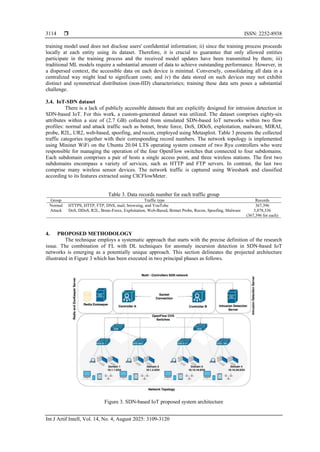
4.1. Deploying an SDN infrastructure for an IoT network
One of the significant vulnerabilities is the SDN network when the controller is exploited by
overwhelming the communication capacity with excessive and undesired traffic, leading to a DDoS attack.
However, network security can be enhanced by its programming capabilities, which allow for the
development of security applications such as IDS that can identify network threats. Our suggested
architecture comprises numerous objectives, which are i) a multi-controller SDN network was established
utilizing Zookeeper and Redis. ZooKeeper will promptly organize and coordinate the change of controller
role, whereas a backup copy from the flow table will be stored in Redis storage. This setup serves as a robust
framework to prevent network failure. If the master controller becomes inactive, the other controller retrieves
the flow entries from Redis storage and smoothly continues network operations, Figure 4 demonstrates the
multi-controller implementation steps; ii) ingress and egress policies were employed to manage and control
network traffic; iii) all packets received by the controller will be initially sent to the IDS server to predict
whether the traffic received is an attack or normal traffic. However, by flooding the controller, the IDS server
will also be flooded. To prevent this, DoS and DDoS attacks are mitigated once a threshold is reached; and
iv) the slave controller is utilized to efficiently manage the huge amount of data received on the master
controller by enabling Pushback police. Mininet WiFi used to construct a tree topology illustrated in Figure 4
consists of four domains. Each domain is composed of two hosts, an access point, three stations, and three
wireless sensors. IoT devices may experience communication resource limits that prevent them from
interacting with a central base station due to the limitations in communication resources.
Figure 4. ZooKeeper and Redis coordination system
4.2. Deploying anomaly-based network intrusion detection system
Initially, the coordinator server uploads the global model presented in Table 4, to the IPFS network
which is utilized to enhance secure model aggregation, ensuring that only authorized clients involved in the
training process can access and download the global model based on a specific hash identifier. IPFS is a
decentralized framework involving protocols, packages, and composable specifically designed to handle,
direct, and transmit content-addressed data. The system is both resource-efficient and reliably converges to
centralized FL frameworks with a drop of less than 1% [41]. The model consists of four dense layers with
256, 128, 64, and 32 neurons, respectively in addition to the input and output layers. Each layer is followed
by a batch normalization layer and a dropout rate of 0.5. The reason for adding these layers is to improve the
performance and generalization of the network. The batch normalization stabilizes the learning process by
normalizing the activations of the preceding layer. The dropout layer is utilized to mitigate overfitting in the
model by enhancing its ability to generalize to new data and increasing its overall resilience. The rectified
linear unit (ReLU) activation function was used in all the Dense layers due to its simplicity, efficiency, and
ability to address the vanishing gradient problem. SoftMax activation function was used in the output layer
for multi-class classification tasks to generate a probability distribution across different classes.
Table 4. DL training model
Algorithm Layers Neuron
DNN 4 Dense, in addition to input and output layer 256, 128, 64, 32
4 Batch Normalization layer
4 Dropout layer
Activation function ReLU, SoftMax
Loss function Categorical cross-entropy
Optimizer Adam
Batch-size 256
Table 5 illustrates the classification report of detecting each attack type after training the model. All
of the metrics demonstrate a superior degree of effectiveness in all types of traffic, with a notable exception](https://image.slidesharecdn.com/5027079-250912040913-5db45445/85/Federated-deep-learning-intrusion-detection-system-on-software-defined-network-based-internet-of-things-7-320.jpg)
![ ISSN: 2252-8938
Int J Artif Intell, Vol. 14, No. 4, August 2025: 3109-3120
3116
being the user to root (U2R) category which can be explained by the fact that other categories frequently
display more dissimilarity in comparison to normal traffic patterns. In contrast, the U2R attacking class has a
notable similarity to the standard data traffic.
The IDS model is deployed on a dedicated server to perform intrusion detection to the complete
network, which offers substantial advantages in terms of performance, scalability, security, and maintenance.
It guarantees that the controller can concentrate on its primary operations, while the IDS server is fine-tuned
and expanded expressly for efficient intrusion detection. In an SDN, the process of packet forwarding is
handled differently, when a host sends a request to another host, it is first forwarded to the Open vSwitch
(OVS) switch. The switch checks if there is any instruction to proceed with. If not, the packet is forwarded to
the controller to identify the optimal path. In our work, the master controller sends the packet to the NIDS
server, which contains the trained model. This model predicts whether the packet is normal or intrusion. In
the case of normal traffic, the controller identifies the optimal path to forward it to the destination, sends the
instruction back to the switch, and adds a new flow entry in Redis storage. If it is an intrusion traffic the
controller adds a flow entry to block the source host.
Table 5. DNN training model
Traffic Type Precision Recall F1-score
Botnet 0.9984 0.9936 0.9960
Brute-Force 0.9993 0.9815 0.9903
DDoS-ICMP 1.0 1.0 1.0
DDoS-UDP 0.9991 0.9994 0.9992
DoS-SYN 1.0 1.0 1.0
DoS-UDP 1.0 0.9998 0.9999
Exploitation 0.9936 0.9975 0.9956
Malware 0.9987 0.9944 0.9966
Mirai 0.9999 0.9989 0.9994
Normal 0.9994 0.9975 0.9985
Probe 1.0 0.9991 0.9995
R2L-IMAP 1.0 1.0 1.0
Recon-PingSweep 0.9936 0.9984 0.9960
Recon-Sniffing 0.9983 1.0 0.9991
Spoofing 1.0 1.0 1.0
U2R 0.9893 1.0 0.9946
Web-Attack 0.9908 1.0 0.9953
5. RESULTS AND DISCUSSION
The systematic review presents a thorough study of many research sources to assess and synthesize
information about federated DL anomaly intrusion detection in SDN-based IoT. The findings collected
indicate a variety of techniques and practices in the execution of the proposed methodology. This section
explains the research findings, which offer a summary of the present study.
5.1. Statistical metrics
Several performance indicators have been defined for the multi-class confusion matrix to evaluate
the effectiveness of the model. The multi-class confusion matrix is an N×N matrix, where N represents the
number of unique class labels (C0, C1, ..., CN). Matrix cells are determined by the output consisting of the
predicted label, which may be either positive or negative, that comes out of comparing the predicted label
with the actual class label, which can be either normal or attack [42]. As a result, the traditional classification
of true positive (TP), true negative (TN), false positive (FP), and false negative (FN) cases becomes
irrelevant. Alternatively, a more appropriate approach entails focusing on certain classes. This technique
allows for the formulation of class-specific metrics. By adeptly merging these measurements that are distinct
to each class, a comprehensive collection of metrics for the whole confusion matrix can be obtained, as
exemplified in (1) to (5) [43].
𝐴𝑐𝑐𝑢𝑟𝑎𝑐𝑦 =
∑ 𝑇𝑃(𝐶𝑖)
𝑁
𝑖=1
∑ ∑ 𝐶𝑖,𝑗
𝑁
𝑗=1
𝑁
𝑖=1
(1)
𝐹1(𝐶𝑖) =
2𝑇𝑃𝑅(𝐶𝑖)𝑃𝑃𝑉(𝐶𝑖)
𝑇𝑃𝑅(𝐶𝑖)+𝑃𝑃𝑉(𝐶𝑖)
(2)
𝑇𝑃𝑅(𝐶𝑖) =
𝑇𝑃(𝐶𝑖)
𝑇𝑃(𝐶𝑖)+𝐹𝑁(𝐶𝑖)
(3)](https://image.slidesharecdn.com/5027079-250912040913-5db45445/85/Federated-deep-learning-intrusion-detection-system-on-software-defined-network-based-internet-of-things-8-320.jpg)
![ ISSN: 2252-8938
Int J Artif Intell, Vol. 14, No. 4, August 2025: 3109-3120
3118
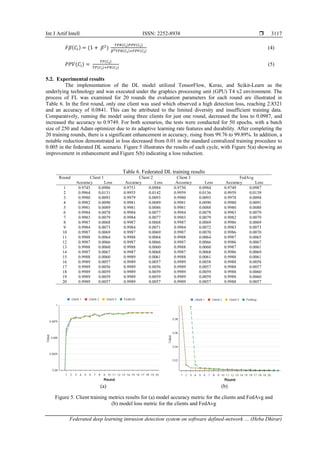
6. CONCLUSION
This work presents a federated DL for NIDS in an IoT context in a multi-controller SDN network,
using IPFS as the underlying technology and the AES encryption algorithm to help improve the security of
the aggregation and training. A custom-generated dataset of intra- and inter-attacks was utilized to extract
internal feature representations to detect and classify attacks. The proposed architecture successfully
mitigates DoS and DDoS attacks once the attack threshold is reached on the controller to avoid flooding the
IDS server, where the suggested model possesses an accuracy of 99.89% in identifying several attack types
demonstrated superior performance in both the detection and classification of attacks using FL, surpassing
conventional DL for the same model. The result shows a drop in loss from 0.01 in the standard centralized
training procedure that utilizes the DL model to 0.005 in the federated DL scenario. In addition, there is a
significant enhancement in accuracy, rising from 99.76 to 99.89%. The suggested technique can apply to a
wide range of situations and may be included as a component in a real-time SDN-IoT environment. Its
purpose is to detect any attacks and classify them into certain types, causing an alarm. The current work is
suboptimal. Instead of using a method that selects all the characteristics, it would be more effective to apply
kernel-based methods to choose the ideal features. This may significantly enhance the effectiveness of the
SDN-IoT IDS. In addition, doing a thorough examination and evaluation of the model and another model
inside the environment is crucial, as the majority of ML and DL models are susceptible to adversarial attacks.
FUNDING INFORMATION
Authors state no funding involved.
AUTHOR CONTRIBUTIONS STATEMENT
This journal uses the Contributor Roles Taxonomy (CRediT) to recognize individual author
contributions, reduce authorship disputes, and facilitate collaboration.
Name of Author C M So Va Fo I R D O E Vi Su P Fu
Heba Dhirar ✓ ✓ ✓ ✓ ✓ ✓ ✓ ✓ ✓ ✓ ✓
Ali H. Hamad ✓ ✓ ✓ ✓ ✓ ✓ ✓
C : Conceptualization
M : Methodology
So : Software
Va : Validation
Fo : Formal analysis
I : Investigation
R : Resources
D : Data Curation
O : Writing - Original Draft
E : Writing - Review & Editing
Vi : Visualization
Su : Supervision
P : Project administration
Fu : Funding acquisition
CONFLICT OF INTEREST STATEMENT
The authors declare that they have no conflicts of interest related to this work.
DATA AVAILABILITY
The data that support the findings of this study are openly available on Kaggle at
https://www.kaggle.com/datasets/hebadhirar/sdn-iot, under the title SDN-IoT Intrusion Detection Dataset.
REFERENCES
[1] A. Alrawais, A. Alhothaily, C. Hu, and X. Cheng, “Fog computing for the internet of things: security and privacy issues,” IEEE
Internet Computing, vol. 21, no. 2, pp. 34–42, Mar. 2017, doi: 10.1109/MIC.2017.37.
[2] L. Liu, B. Xu, X. Zhang, and X. Wu, “An intrusion detection method for internet of things based on suppressed fuzzy clustering,”
Eurasip Journal on Wireless Communications and Networking, vol. 2018, no. 1, 2018, doi: 10.1186/s13638-018-1128-z.
[3] H. Qushtom and K. Rabaya’h, “Enhancing the QoS of IoT networks with lightweight security protocol using Contiki OS,”
International Journal of Computer Network and Information Security, vol. 9, no. 11, pp. 27–35, 2017,
doi: 10.5815/ijcnis.2017.11.03.
[4] Y. Li, R. Ma, and R. Jiao, “A hybrid malicious code detection method based on deep learning,” International Journal of Security
and its Applications, vol. 9, no. 5, pp. 205–216, 2015, doi: 10.14257/ijsia.2015.9.5.21.
[5] J. Konečný, H. B. McMahan, F. X. Yu, P. Richtárik, A. T. Suresh, and D. Bacon, “Federated learning: strategies for improving
communication efficiency,” arXiv-Computer Science, pp. 1-10, 2016.
[6] P. Boobalan et al., “Fusion of federated learning and industrial internet of things: a survey,” Computer Networks, vol. 212, 2022,
doi: 10.1016/j.comnet.2022.109048.](https://image.slidesharecdn.com/5027079-250912040913-5db45445/85/Federated-deep-learning-intrusion-detection-system-on-software-defined-network-based-internet-of-things-10-320.jpg)
![Int J Artif Intell ISSN: 2252-8938
Federated deep learning intrusion detection system on software defined-network … (Heba Dhirar)
3119
[7] V. Mothukuri, R. M. Parizi, S. Pouriyeh, Y. Huang, A. Dehghantanha, and G. Srivastava, “A survey on security and privacy of
federated learning,” Future Generation Computer Systems, vol. 115, pp. 619–640, 2021, doi: 10.1016/j.future.2020.10.007.
[8] C. Zhang, Y. Xie, H. Bai, B. Yu, W. Li, and Y. Gao, “A survey on federated learning,” Knowledge-Based Systems, vol. 216,
2021, doi: 10.1016/j.knosys.2021.106775.
[9] Á. L. V. Caraguay, A. B. Peral, L. I. B. López, and L. J. G. Villalba, “SDN: evolution and opportunities in the development IoT
applications,” International Journal of Distributed Sensor Networks, vol. 2014, 2014, doi: 10.1155/2014/735142.
[10] F. Kiani, “A survey on management frameworks and open challenges in IoT,” Wireless Communications and Mobile Computing,
vol. 2018, 2018, doi: 10.1155/2018/9857026.
[11] T. A. Tang, L. Mhamdi, D. McLernon, S. A. R. Zaidi, and M. Ghogho, “Deep learning approach for network intrusion detection
in software defined networking,” 2016 International Conference on Wireless Networks and Mobile Communications, WINCOM
2016: Green Communications and Networking, pp. 258–263, 2016, doi: 10.1109/WINCOM.2016.7777224.
[12] G. A. Ajaeiya, N. Adalian, I. H. Elhajj, A. Kayssi, and A. Chehab, “Flow-based Intrusion detection system for SDN,” IEEE
Symposium on Computers and Communications, pp. 787–793, 2017, doi: 10.1109/ISCC.2017.8024623.
[13] J. Ye, X. Cheng, J. Zhu, L. Feng, and L. Song, “A DDoS attack detection method based on SVM in software defined network,”
Security and Communication Networks, vol. 2018, 2018, doi: 10.1155/2018/9804061.
[14] M. Latah and L. Toker, “Towards an efficient anomaly-based intrusion detection for software-defined networks,” IET Networks,
vol. 7, no. 6, pp. 453–459, 2018, doi: 10.1049/iet-net.2018.5080.
[15] T. A. Tang, D. McLernon, L. Mhamdi, S. A. R. Zaidi, and M. Ghogho, “Intrusion detection in sdn-based networks: Deep
recurrent neural network approach,” Advanced Sciences and Technologies for Security Applications, pp. 175–195, 2019,
doi: 10.1007/978-3-030-13057-2_8.
[16] R. V. Boppana, R. Chaganti, and V. Vedula, “Analyzing the vulnerabilities introduced by ddos mitigation techniques for
software-defined networks,” Advances in Intelligent Systems and Computing, vol. 1055, pp. 169–184, 2020, doi: 10.1007/978-3-
030-31239-8_14.
[17] O. Hannache and M. C. Batouche, “Neural network-based approach for detection and mitigation of DDoS attacks in SDN
environments,” International Journal of Information Security and Privacy, vol. 14, no. 3, pp. 50–71, 2020, doi:
10.4018/IJISP.2020070104.
[18] H. K. Lim, J. B. Kim, S. Y. Kim, and Y. H. Han, “Federated reinforcement learning for automatic control in SDN-based IoT
environments,” International Conference on ICT Convergence, pp. 1868–1873, 2020, doi: 10.1109/ICTC49870.2020.9289245.
[19] M. S. ElSayed, N. A. Le-Khac, M. A. Albahar, and A. Jurcut, “A novel hybrid model for intrusion detection systems in SDNs
based on CNN and a new regularization technique,” Journal of Network and Computer Applications, vol. 191, 2021,
doi: 10.1016/j.jnca.2021.103160.
[20] M. S. Elsayed, N. A. Le-Khac, and A. D. Jurcut, “InSDN: A novel SDN intrusion dataset,” IEEE Access, vol. 8,
pp. 165263–165284, 2020, doi: 10.1109/ACCESS.2020.3022633.
[21] P. Hadem, D. K. Saikia, and S. Moulik, “An SDN-based intrusion detection system using SVM with selective logging for IP
traceback,” Computer Networks, vol. 191, 2021, doi: 10.1016/j.comnet.2021.108015.
[22] A. O. Alzahrani and M. J. F. Alenazi, “Designing a network intrusion detection system based on machine learning for software
defined networks,” Future Internet, vol. 13, no. 5, 2021, doi: 10.3390/fi13050111.
[23] A. Wani, S. Revathi, and R. Khaliq, “SDN-based intrusion detection system for IoT using deep learning classifier (IDSIoT-
SDL),” CAAI Transactions on Intelligence Technology, vol. 6, no. 3, pp. 281–290, 2021, doi: 10.1049/cit2.12003.
[24] M. A. Mohsin and A. H. Hamad, “Performance evaluation of SDN DDoS attack detection and mitigation based random forest and
K-nearest neighbors machine learning algorithms,” Revue d’Intelligence Artificielle, vol. 36, no. 2, pp. 233–240, 2022,
doi: 10.18280/ria.360207.
[25] V. Ravi, R. Chaganti, and M. Alazab, “Deep learning feature fusion approach for an intrusion detection system in SDN-based IoT
networks,” IEEE Internet of Things Magazine, vol. 5, no. 2, pp. 24–29, 2022, doi: 10.1109/IOTM.003.2200001.
[26] A. K. Sarica and P. Angin, “A novel SDN dataset for intrusion detection in IoT networks,” 2020 16th International Conference on
Network and Service Management (CNSM), Izmir, Turkey, 2020, pp. 1-5, doi: 10.23919/CNSM50824.2020.9269042.
[27] J. Jose and D. V. Jose, “Deep learning algorithms for intrusion detection systems in internet of things using CIC-IDS 2017
dataset,” International Journal of Electrical and Computer Engineering, vol. 13, no. 1, pp. 1134–1141, 2023,
doi: 10.11591/ijece.v13i1.pp1134-1141.
[28] G. Logeswari, S. Bose, and T. Anitha, “An intrusion detection system for SDN using machine learning,” Intelligent Automation
and Soft Computing, vol. 35, no. 1, pp. 867–880, 2023, doi: 10.32604/iasc.2023.026769.
[29] R. Chaganti, W. Suliman, V. Ravi, and A. Dua, “Deep learning approach for SDN-enabled intrusion detection system in IoT
networks,” Information, vol. 14, no. 1, 2023, doi: 10.3390/info14010041.
[30] M. Maddu and Y. N. Rao, “Network intrusion detection and mitigation in SDN using deep learning models,” International
Journal of Information Security, vol. 23, no. 2, pp. 849–862, 2024, doi: 10.1007/s10207-023-00771-2.
[31] R. A. Elsayed, R. A. Hamada, M. I. Abdalla, and S. A. Elsaid, “Securing IoT and SDN systems using deep-learning based
automatic intrusion detection,” Ain Shams Engineering Journal, vol. 14, no. 10, 2023, doi: 10.1016/j.asej.2023.102211.
[32] G. S. Vidhya and R. Nagarajan, “A novel bidirectional LSTM model for network intrusion detection in SDN-IoT network,”
Computing, vol. 106, no. 8, pp. 2613–2642, Aug. 2024, doi: 10.1007/s00607-024-01295-w.
[33] N. Niknami and J. Wu, “DeepIDPS: an adaptive DRL-based intrusion detection and prevention system for SDN,” in ICC 2024 -
IEEE International Conference on Communications, Denver, USA, 2024, pp. 2040-2046, doi: 10.1109/ICC51166.2024.10622849.
[34] H. Dhirar, “IoT-SDN IDS dataset 2024,” Kaggle, 2024. Accessed: Sep. 07, 2024. [Online]. Available:
https://www.kaggle.com/datasets/hebadhirar/iot-sdn-ids-dataset
[35] D. Kreutz, F. M. V. Ramos, P. E. Verissimo, C. E. Rothenberg, S. Azodolmolky, and S. Uhlig, “Software-defined networking: a
comprehensive survey,” Proceedings of the IEEE, vol. 103, no. 1, pp. 14–76, 2015, doi: 10.1109/JPROC.2014.2371999.
[36] S. T. Ali, V. Sivaraman, A. Radford, and S. Jha, “A survey of securing networks using software defined networking,” IEEE
Transactions on Reliability, vol. 64, no. 3, pp. 1086–1097, 2015, doi: 10.1109/TR.2015.2421391.
[37] P. Megyesi, A. Botta, G. Aceto, A. Pescapé, and S. Molnár, “Challenges and solution for measuring available bandwidth in
software defined networks,” Computer Communications, vol. 99, pp. 48–61, 2017, doi: 10.1016/j.comcom.2016.12.004.
[38] N. Sultana, N. Chilamkurti, W. Peng, and R. Alhadad, “Survey on SDN based network intrusion detection system using machine
learning approaches,” Peer-to-Peer Networking and Applications, vol. 12, no. 2, pp. 493–501, Jan. 2019, doi: 10.1007/s12083-
017-0630-0.
[39] P. García-Teodoro, J. Díaz-Verdejo, G. Maciá-Fernández, and E. Vázquez, “Anomaly-based network intrusion detection:
Techniques, systems and challenges,” Computers and Security, vol. 28, no. 1–2, pp. 18–28, 2009,
doi: 10.1016/j.cose.2008.08.003.](https://image.slidesharecdn.com/5027079-250912040913-5db45445/85/Federated-deep-learning-intrusion-detection-system-on-software-defined-network-based-internet-of-things-11-320.jpg)
![ ISSN: 2252-8938
Int J Artif Intell, Vol. 14, No. 4, August 2025: 3109-3120
3120
[40] Y. Liu, Y. Kang, C. Xing, T. Chen, and Q. Yang, “A secure federated transfer learning framework,” IEEE Intelligent Systems,
vol. 35, no. 4, pp. 70–82, 2020, doi: 10.1109/MIS.2020.2988525.
[41] C. Pappas, Di. Chatzopoulos, S. Lalis, and M. Vavalis, “IPLS: a framework for decentralized federated learning,” 2021 IFIP
Networking Conference, IFIP Networking 2021, 2021, doi: 10.23919/IFIPNetworking52078.2021.9472790.
[42] Padmanayana and D. A. Anoop, “Binary classification of DR-diabetic retinopathy using CNN with fundus colour images,”
Materials Today: Proceedings, vol. 58, pp. 212–216, 2022, doi: 10.1016/j.matpr.2022.01.466.
[43] J. Opitz, “A closer look at classification evaluation metrics and a critical reflection of common evaluation practice,”
Sustainability, vol. 11, no. 1, pp. 1–14, Apr. 2024, doi: 10.1162/tacl_a_00675.
BIOGRAPHIES OF AUTHORS
Heba Dhirar received her B.S. in information and communications engineering,
from Al Khwarizmi College of Engineering, University of Baghdad, Iraq in 2019. Currently,
she is a master's student in information and communication engineering at the University of
Baghdad, Iraq. Her research interests include computer engineering, machine learning, and
information security. She can be contacted at email: heba.d@kecbu.uobaghdad.edu.iq.
Ali H. Hamad has been a faculty member at the Department of Information and
Communication Engineering, University of Baghdad, since 2003. He received his Ph.D. in
control and systems engineering from the University of Basrah, Iraq, in 2015. He obtained his
M.Sc. and B.Sc. degrees from the University of Technology, Iraq, in 2000 and 1997,
respectively. His research interests include the internet of things (IoT), machine learning,
information security, wireless sensor networks, and blockchain technology. He can be
contacted at email: ahamad@kecbu.uobaghdad.edu.iq.](https://image.slidesharecdn.com/5027079-250912040913-5db45445/85/Federated-deep-learning-intrusion-detection-system-on-software-defined-network-based-internet-of-things-12-320.jpg)


