Boredom during theliturgy is something
all Catholics have felt from time to time,
and it’s never justifiable. No matter how
mundane the architecture, how dull the
homily, or how bad the music, what’s taking
place on the altar is a miraculous sacrifice
that gives us the grace for salvation. That
reality should be enough to keep our
attention.
3.
And yet boredomis a reality that good
liturgy can help fight. Many parishes try to
do so by inventing every manner of new
enticement: brighter and larger display
banners, forced attempts to create an
upbeat environment of friendliness and
community, solemn procession by
ministers, and talk-show style homiletics.
4.
The attempt tojazz up the liturgy usually
takes the form of musical enhancements
and nearly always means more instruments
and rhythms drawn from popular music.
The rationale isn’t complicated. Liturgists
are frustrated that people don’t get as
excited about religion as they do about the
pop divas and music videos, and they
conclude that they need ever more musical
pyrotechnics to make the difference.
5.
But these approachesoften backfire since
the argument for them is flawed at its root.
Community feeling and fun are fine, but if
the liturgy doesn’t offer a setting
conducive to prayer and the contemplation
of eternal mysteries, it has failed its first
aesthetic aim.
6.
In any case,Catholics can’t compete with the
evangelical community centers for inspiring
a toe-tapping community feeling. An on-line
Gallup poll of Catholics in a Diocese in the
US shows that weekly Mass attendance (45
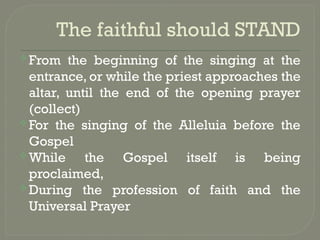
percent do so) continues to slip, and for the
first time has slipped behind Protestant
churches (48 percent). The defectors from
the Roman rite include those who flee to
Sects and Eastern liturgies or just drop out.
7.
There are manyreasons for this
(demographic, cultural, and theological)
and liturgists don’t deserve all the blame.
Yet the decline in the desire to attend Mass
coincides with the de-emphasis on
solemnity and the advance of mundane art
forms in liturgy—the popularization of
music being the most conspicuous shift.
8.
There are, however,ways to break with
routine and inspire steadfastness and
personal attachment to the liturgy. What
follows are some very simple steps for
repairing the weaknesses that mar many
Catholic liturgies. Professional liturgists resist
them because of the prevailing bias against
anything that smacks of a pre–Vatican II
sensibility. Nonetheless, the following
suggestions are born of experience and a
conviction that the first aim of liturgy is to
aid inner reflection.
9.
The suggestions beloware simple and
costless. They need not be implemented
all at once. Small changes week by week
will make a huge difference over time.
10.
1.Turn down thevolume.
It’s hard to imagine this today, but Christian
liturgy thrived for 1,950 years without
microphones, electronic keyboards,
amplifiers, mixers, sound technicians, and
surround-sound speakers. These days,
conventional guidebooks on liturgy
emphasize “proclaiming” and broadcasting
one’s voice. Cantors use microphones as if
they’re music-video performers.
11.
The virtue ofsilence has been rediscovered in
recent years, with numerous statements by
Pope John Paul II and Vatican officials praising
its ability to convey meaning in a noisy world.
The musical counterpart to silence is not in-
your-face pop but distant sounds of
contemplation. Turn down the mikes and sing
as if the human voice alone is responsible for
filling the space. This will diminish the
electronic presence in the liturgy and increase
the God-given one as a means through which
we are worshiping Him.
12.
2. Silence fora prelude.
Even before the celebration itself, it is
laudable for silence to be observed in the
Church, in the Sacristy, and in adjacent
areas, so that all may dispose themselves
to carry out the sacred action in a devout
and fitting manner.
If necessary, use some of this time to teach
the congregation a new hymn being sung
at Mass that day.
13.
3. Curb theannouncements.
In an age when the secular world lays claim on
most of our time, making a few announcements
has become a pastoral necessity. Sunday Mass is
often the only opportunity a pastor has to inform
his flock concerning parish and community life.
Few are lucky enough to have schedules that
permit them to go to daily Mass, much less have
their children attend Catholic schools, and gone
are the days where the parish or church plays a
central role in the life of the locality.
14.
That being thereality, it’s wise to adhere
closely to the General Instruction of the Roman
Missal’s directive, inserting announcements
after the liturgy of the Eucharist and before the
dismissal, where they have the least chance of
interrupting the framework of prayer set up by
the liturgy.Welcoming statements from cantors
or others before the procession even begins
have nothing to do with the rite itself and are
most likely utterances contrived for the
purpose of artificially engaging the attention
of the congregation.
15.
Announcements should notbe made before
Mass begins, save concerning matters
absolutely necessary to the people’s
understanding of that particular Mass itself or
other issues prudentially suggested by the
Priest.
Mass doesn’t begin because a cantor gets up
and proclaims when, where, and how it is to
happen. Mass begins when the Priest enters
the church, with or without a cross bearer,
book bearer, lector, or deacon.
16.
4.The Entrance Rite
Theparts preceding the Liturgy of the
Word, namely, the Entrance song, greeting,
penitential rite, Kyrie, Gloria, and opening
prayer or collect, have the character of a
beginning, introduction, and preparation.
17.
The purpose ofthese rites is that the
faithful who are assembling should
become a community and dispose
themselves to listen properly to God’s
Word and to celebrate the Eucharist
worthily.
The introductory rites are omitted or
performed in a special way in certain
celebrations, which, in accordance with the
norm of the liturgical books, are joined
with Mass.
18.
Once the congregationhas gathered, the
Priest and the ministers, clad in their
sacred vestments, go in procession to the
Altar in this order:
The censer bearer (thurifer) carrying a
censer (thurible) with burning incense, if
incense is used
The ministers who carry lighted candles,
and between them an acolyte or other
minister with the Cross
19.
The Acolytesand the other Ministers
(Extra Ordinary Ministers of the Eucharist)
A reader, who may carry the Book of the
Gospels, though not the Lectionary,
slightly elevated
The priest who is to celebrate the Mass
If incense is used, the priest puts some in
the censer before the procession begins
and blesses it with the sign of the cross in
silence
20.
5. Sing theKyrie.
One of the earliest and most recognizable parts
of the Mass is not in Latin but Greek: the Kyrie.
It has long been a living symbol of the unity of
Eastern and Western Christendom. And yet for
all the bits of music in the Roman Rite, the
“Lord, Have Mercy” is most often said, not sung,
by the priest and answered by the people. This
beautiful passage of the penitential rite begins
and is over in less than a few seconds.
21.
The Kyrie seemsto have taken on a diminished
role in the liturgy, but is it too much to ask that a
bit more time be taken in this beautiful
expression of penance? If active participation in
singing is what we desire, the Kyrie can be easily
sung by even the least-musical priest or cantor
and answered by the faithful. It can be sung in
the original Greek. Everyone knows the words.
By introducing new music settings according to
the liturgical season, variation can be brought to
the Mass. It serves at the outset as a reminder of
why we have gathered at Mass as a community.
22.
6. Choose aplainer Gloria.
So many thousands of settings of the Gloria
are available today. Our choirs must move
towards the simpler settings that can be
easily learned and sung by all. A simple,
English version can tap into traditional,
chant-like sensibilities and do much to
restore dignity and beauty to this song of
praise.
23.
An English Gloriamay well fit the needs of
the congregation on most occasions. Not to
be forgotten, however, is that the General
Instruction does permit a Gloria sung by
the choir alone.You might want to exercise
this option and do a plain Latin Gloria on
certain feast days only, or perhaps even
pull out all of the stops and do a
polyphonic version (many voices), if
rehearsal time and resources permit.
24.
7.The Responsorial Psalm
Itis preferable that the Responsorial Psalm
be sung, at least as far as the people’s
response is concerned. Hence the
Psalmist, or the Cantor of the Psalm, sings
the verses of the Psalm at the Ambo or
other suitable place. The entire
congregation remains seated and listens,
but also, as a rule, takes part by singing the
response.
25.
8. Homily
The homilyis an integral part of the Liturgy
and is strongly recommended. It should
ordinarily be given by the priest celebrant.
He may entrust it to a concelebrating priest,
or according to circumstances, also at times
to a deacon, but never to a layperson, and
for a just cause, the homily may even be
given by a Bishop or a priest who is present
at the celebration but cannot concelebrate.
26.
9. Profession ofFaith
The Profession of Faith is to be sung or said
by the priest together with the people on
Sundays and Solemnities. It may be said
also at special, more solemn celebrations.
Instead of the Niceno-Constantinopolitan
Creed, especially during Lent and Easter
Time, the baptismal symbol of the Roman
Church, known as the Apostles Creed, may
be used.
27.
10. General Intercessions
Itis desirable, as a rule, the Universal Prayer
(General Intercessions) be included in all
masses celebrated with a congregation.
As a rule, the sequence of intentions is to be:
a. For the needs of the Church
b. For Public Authorities and the salvation of
the world
c. For those oppressed by any need
d. For the local community
28.
Nevertheless, in aparticular celebration,
such as a Confirmation, a Marriage, or a
Funeral, the series of intercessions may
refer more specifically to the particular
occasion
29.
It is forthe priest celebrant to lead this
prayer from the chair. He himself begins
with a brief introduction by which he
invites the faithful to pray. He also
concludes it with a prayer. The intentions
announced should be considered,
composed freely though discreetly and
succinct, and should express the prayer of
the entire community.
30.
As a rule,the intentions are announced
from the ambo or another suitable place,
either by the deacon, the cantor, the reader
or a member of the lay faithful
The people stand and give expression to
their prayer either by an invocation said
together after each intention or by praying
in silence
31.
11. Offertory
The giftsare brought forward. It is desirable for
the faithful to present the bread and wine, which
are then accepted in an appropriate place by
the priest or deacon who carries them to the
altar.
Even though the faithful no longer, as in the
past, bring from their possessions the bread
and wine intended for the Liturgy, nevertheless,
the rite of carrying up the gifts retains the same
value and spiritual meaning.
32.
This is alsothe time to receive money or
other gifts for the poor or the Church
brought by the faithful or collected in the
Church. These are to be put in a suitable
place but away from the Eucharistic Table.
The priest may incense the gifts placed
upon the altar, and then incense the cross
and the altar itself.
33.
After he washeshis hands, the priest
returns to the centre and, facing the
people and extending and then joining his
hands, he invites the people to pray,
saying, Pray, brothers and sisters. The
people stand and make their response,
May the Lord accept the sacrifice.
34.
12. Eucharistic Prayer
Thechief elements making up the Eucharistic
Prayer may be distinguished as:
Thanksgiving
Acclamation
Epiclesis
Institution Narrative and Consecration
Anamnesis
Offering
Intercessions
Final Doxology (No rubic of bowing)
35.
13.The Lord’s Prayer
Thepriest offers the invitation to pray, but
all the faithful say the prayer with him; the
priest alone adds the embolism, Deliver us,
which the people conclude with a
doxology.
Rubric: He extends his hands and, together
with the people, continues….
(Certain gestures reserved to the Priest)
36.
14.The Rite ofPeace
As for the exchange of the sign of peace
itself, the manner is to be established by
Conferences of Bishops in accordance with
the culture and practices of the people.
Nevertheless, it is appropriate that each
person offer the sign of peace only to
those nearby and in a dignified manner.
37.
15.The Breaking ofthe Bread
The breaking of the Eucharistic Bread is
begun after the sign of peace and is
carried out with proper reverence. But it
should not be unnecessarily prolonged nor
its importance be inappropriately
emphasized. This rite is reserved to the
priest and the deacon.
38.
16. Communion
The priestprepares himself by the prayer,
said inaudibly, that he may fruitfully
receive Christ’s Body and Blood. The
faithful do the same by silent prayer.
The priest next shows the faithful the
Eucharistic Bread, held above the paten or
above the chalice, and invites them to the
banquet of Christ. Along with the faithful,
he then recites the prayer of humility.
39.
It is mostdesirable that the faithful, just as
the priest himself is bound to do, receive
the Lord’s Body from hosts consecrated at
the same Mass and that, in the instances
when it is permitted, they share in the
Chalice, so that, likewise, by means of the
signs Communion will stand out more
clearly as a sharing in the sacrifice actually
being offered.
40.
17. Concluding Rite
Theconcluding rite consists of:
Brief announcements, if necessary
The priest’s greeting and blessing (expanded on
certain days in the prayer over the people or
another more solemn formula)
The dismissal of the people by the deacon or the
priest
The kissing of the altar by the priest and the
deacon (ONLY), followed by a profound bow to the
altar by the priest, deacon and other ministers
41.
18. Movements andPostures
The external actions, movements, and
posture of the priest, the deacon, and the
ministers, as well as of the people ought to
draw things together in such a way that the
entire celebration shines with beauty and
noble simplicity, that the true and full
meaning of the different parts of the
celebration is perceived, and that the
participation of all is encouraged.
42.
Attention should bepaid to what is
determined by liturgical law and the
traditional practice of the Roman Rite and
to what pertains to the common spiritual
good of the people of God, rather than to
personal inclination and arbitrary choice.
The uniformity in posture to be observed
by all participants is a sign of the unity of
the members of the Christian community
gathered for the Sacred Liturgy.
43.
The faithful shouldSTAND
From the beginning of the singing at the
entrance, or while the priest approaches the
altar, until the end of the opening prayer
(collect)
For the singing of the Alleluia before the
Gospel
While the Gospel itself is being
proclaimed,
During the profession of faith and the
Universal Prayer
44.
From the response,May the Lord accept
the sacrifice…..to the end of the Mass,
except at the places indicated later
45.
The faithful shouldSIT
During the Readings before the Gospel
and during the Responsorial Psalm
For the homily
During the preparation of the gifts at the
presentation
And if circumstances allow, during the
period of sacred silence after
communion
46.
The faithful shouldKNEEL
At consecration, except when prevented by
reasons of health, lack of space, the large
number of people present, or some other good
reason
Those who do not kneel at the consecration,
however, should make a profound bow when
the priest genuflects after the Consecration
Where it is the practice for the people to remain
kneeling after the Sanctus until the end of the
Eucharistic Prayer, this is laudably retained
47.
When the distributionof Communion is
finished, as circumstances allow, the priest
and faithful spend some time praying silently.
If desired, a psalm, or other canticle of praise
or a hymn may also be sung by the entire
congregation.
To bring to completion the petition of the
people of God and also to conclude the entire
communion rite, the priest sings or says the
prayer after Communion in which he petitions
for the fruits of the mysteries just celebrated.
48.
19. Silence
It’s functiondepends on the time it occurs
in each part of the celebration
At the penitential Rite and again after the
invitation to pray, all recollect themselves
At the conclusion of a reading or a
homily, all meditate briefly on what has
been heard
After communion, all praise God in silent
prayer
49.
20. Concluding Remarks
Thewell-planned liturgy, brought to life
through the prayerful ministry of gifted
and experienced people, is a work of art. It
flows, it has integrity, it is beautiful. At such
a liturgy our attention is drawn to the
Scriptures, the rituals, the music, the rich
silence, the prayers of the assembly, the
worship of God.
50.
Liturgy is aboutmore than words.
Everything that is visible needs to
communicate something of the mystery we
are celebrating: the altar cloths, the Priest’s
vestments, the flowers, the images and
statues, the furnishings, the colours of the
liturgical season … all of these help to
create the atmosphere of prayer and
silently convey an invitation to worship.
51.
Those entrusted withcreating the
environment for liturgy have the task of
providing the People of God with a
beautiful and worthy place for worship.
The key to the ideal liturgical environment
is noble simplicity. Any form of clutter is to
be avoided. Noble simplicity does not
necessarily equate with expense. It
equates with what is genuine, simple and
beautiful.
52.
Noble simplicity isthe key to good liturgy.
Everything that is seen, heard, touched,
and tasted in liturgy has to bear the weight
of divine mystery and needs therefore to
be beautiful in the true sense of beauty.
53.
The altar, vessels,books and furniture are
to be worthy of what they represent: the
altar must be the most beautiful table the
community can provide because it
represents Christ himself; the vessels (the
chalice and paten) are to be worthy of
holding the Body and Blood of Christ; the
Book of Gospels that is held high needs to
convey that here, in this book, are the
sacred texts to be proclaimed as the living
Word of God.
54.
Even the seatingin the place of worship is
important because the people are the
Body of Christ gathered, in full view of one
another, around the altar. The People of
God are as holy as the Word of God and
the Body and Blood of Christ because
together they are, by their baptism,
Christ’s Body.
55.
Everything, therefore, needsto be taken
into consideration. Nothing is too small.
Even the way people are welcomed as
they enter the place of worship is
important. Everyone has a part to play
because, together, we are the Body of
Christ and each person is a significant part
of it.