The Evangelizing Community


            A DIFFERENT LENS
           WITH WHICH TO VIEW
          THE NEW ROMAN MISSAL
 Father Tim Keeney Saint Anne Catholic Church November 2011
Basic Gospel

 We are all about the death and resurrection of
 Jesus


 How we participate in    his death and
 resurrection is the story of our spiritual lives


 Our identity with Christ is accomplished and
 sealed by the Holy Spirit
The Paschal Mystery

  All ministry helps people experience the
   Paschal Mystery—the death and
   resurrection of Christ

  All ministry takes place in the dynamics of
   the Trinity—love and self-gift for the sake of
   the other

  Priests are, par excellence, ministers, and
   by our baptism all are ministers through
   our common priesthood
The Liturgy

          We have to be aware of how:

 Liturgy is an asset for    The language of the New
 people                      Roman Missal draws us
                                   into a deeper
 In today’s culture
                                   understanding of:
 liturgy can
 appear to be a                       The Gospel
 liability                         Paschal Mystery
                                 Mystery of the Trinity
A Useful Distinction


                                        Worship
Liturgy                               Experience

 A standard ritual        A designed service
 which everyone            which can contain many
 accepts that allows       points of novelty and
 people to enter it        which attempts to induce
 from many different       certain emotions and
 emotional and personal    perspectives in the
 perspectives              participants
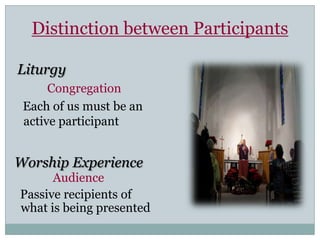
Distinction between Participants

Liturgy
      Congregation
 Each of us must be an
 active participant


Worship Experience
      Audience
Passive recipients of
what is being presented
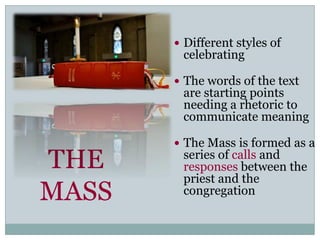
 Different styles of
        celebrating

        The words of the text
        are starting points
        needing a rhetoric to
        communicate meaning

        The Mass is formed as a

THE     series of calls and
        responses between the
        priest and the
MASS    congregation
The Language of the New Missal

      Closer to the Latin
      More Poetic
      Draws upon ancient prayers of the
         Church
        Emphasizes our humility before God
        Emphasizes the Holiness of God
        More Theological
        More Scriptural
        More unified with other languages
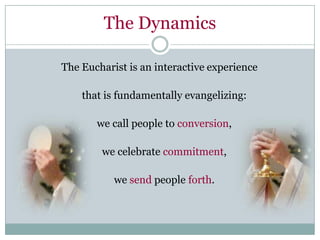
The Dynamics

The Eucharist is an interactive experience

    that is fundamentally evangelizing:

       we call people to conversion,

        we celebrate commitment,

           we send people forth.
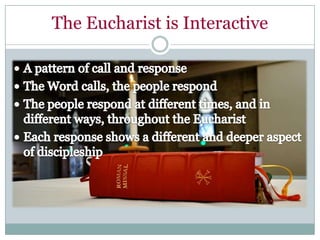
The Eucharist is Interactive
The Introductory Rites
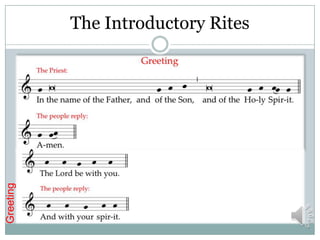
Greeting
The Introductory Rites


                    •    HI
Penitential Act
The Introductory Rites


                    •    HI
Penitential Act
The Introductory Rites


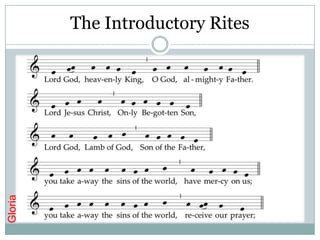
                 HI   GLORIA
Gloria
The Introductory Rites


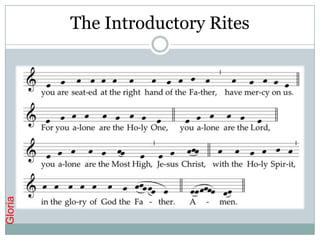
                 HI   GLORIA
Gloria
The Introductory Rites


                 HI   GLORIA
Gloria
The Liturgy of the Word


1ST Word and Response

   THE FIRST RESPONSE
   TO THE WORD OF GOD
   IS THE RECITATION OF
        THE CREED

    “I ACCEPT, I BELIEVE”
The Liturgy of the Word


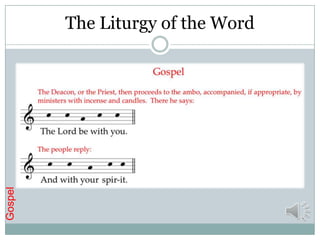
            • HI GOSPEL
Gospel
The Liturgy of the Word


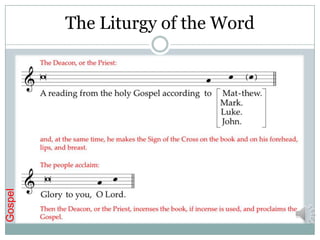
            • HI GOSPEL
Gospel
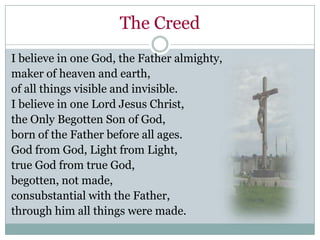
The Creed
I believe in one God, the Father almighty,
maker of heaven and earth,
of all things visible and invisible.
I believe in one Lord Jesus Christ,
the Only Begotten Son of God,
born of the Father before all ages.
God from God, Light from Light,
true God from true God,
begotten, not made,
consubstantial with the Father,
through him all things were made.
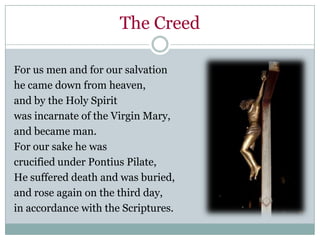
The Creed

For us men and for our salvation
he came down from heaven,
and by the Holy Spirit
was incarnate of the Virgin Mary,
and became man.
For our sake he was
crucified under Pontius Pilate,
He suffered death and was buried,
and rose again on the third day,
in accordance with the Scriptures.
The Creed

He ascended into heaven and is seated
at the right hand of the Father.
He will come again in glory to judge
the living and the dead,
and his kingdom will have no end.

I believe in the Holy Spirit, the Lord,
the giver of life, who proceeds from the
Father and the Son, who with the Father
and the Son is ad0red and glorified,
who has spoken through the prophets.
The Creed

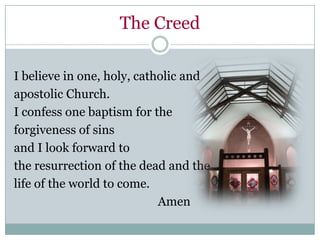
I believe in one, holy, catholic and
apostolic Church.
I confess one baptism for the
forgiveness of sins
and I look forward to
the resurrection of the dead and the
life of the world to come.
                            Amen
The Creed


Fides Quae…The content of
the articles of faith that I accept

Fides Qua…The act of faith by
which I accept not only the
content but the God who acts
in our lives
Faith


Beyond and through               Apostles Creed
 the words, how do               Alternating
 we help people                   sides recite the
 see the                          Creed
 fundamental act of              Renewal of
 trust and acceptance             baptism
 the Creed expresses?             promises
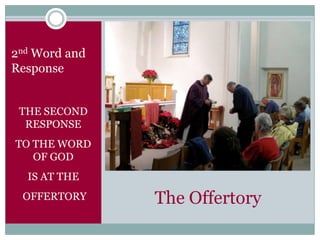
2nd Word and
Response


 THE SECOND
  RESPONSE
TO THE WORD
   OF GOD
  IS AT THE
 OFFERTORY     The Offertory
The Offertory


I give myself,          “By the mystery of this
  we give                water and wine may we
  ourselves                       come to share
  to God in                       in the divinity
  response                        of Christ who
  to                               humbled
  The W O R D                      himself to
                                   share in our
                                   humanity.”
The Offertory

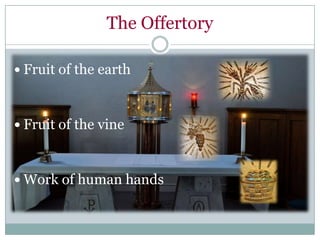
 Fruit of the earth


 Fruit of the vine


 Work of human hands
The Offertory


The Offertory is the GIFT OF ONE’S
                SELF,
   one’s resources, one’s being,

         in response to the

          LOVE OF GOD
The Offertory


 More radical than “tithing”
 More radical than “free will offering”
 More radical than “be generous”
 with your resources


WE ARE ASKING CATHOLICS
  TO GIVE THEMSELVES
The Offertory


We are not just asking
people to “support the
parish”(pay bills),
but to support the
Kingdom of God
which we believers
try to serve
The Offertory


WHAT IS GOD ASKING OF ME?

 AM I NOT LIKE ABRAHAM, MOSES,

   JEREMIAH, ESTHER, JUDITH,

  TOBIT, PETER, JOHN, PAUL?
The Offertory


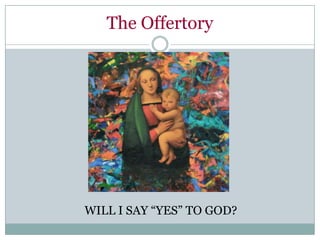
WILL I SAY “YES” TO GOD?
The Doxology

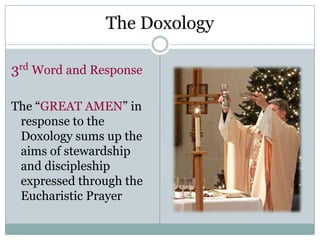
3rd Word and Response

The “GREAT AMEN” in
 response to the
 Doxology sums up the
 aims of stewardship
 and discipleship
 expressed through the
 Eucharistic Prayer
The Eucharistic Prayer

 The Doxology affirms the whole Eucharistic Prayer
 “Lift up your hearts” “Let us give thanks”
 Remembrance and re-enacting the gift of Christ of
  himself in the Eucharist
 The gifts are consecrated; the givers of the gifts
  are consecrated
Identity with Christ


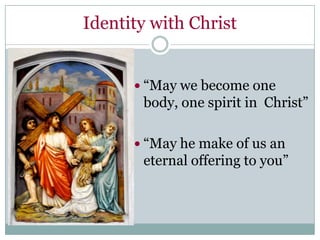
       “May we become one
       body, one spirit in Christ”

       “May he make of us an
       eternal offering to you”
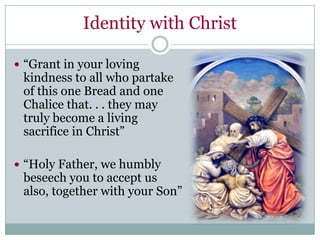
Identity with Christ

 “Grant in your loving
 kindness to all who partake
 of this one Bread and one
 Chalice that. . . they may
 truly become a living
 sacrifice in Christ”

 “Holy Father, we humbly
 beseech you to accept us
 also, together with your Son”
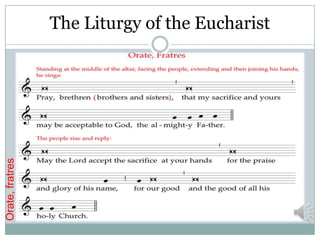
The Liturgy of the Eucharist


                                hi
Orate, fratres
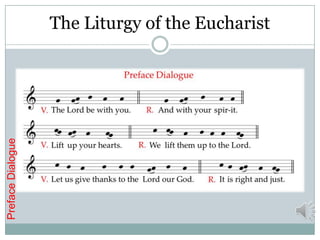
The Liturgy of the Eucharist


                          hi
Preface Dialogue
The sacrifice is not only the death of Jesus,
 not only the elements that bring us into
 unity with Jesus’ death and resurrection,
  but also the people are identified with
          Jesus’ eternal self-giving
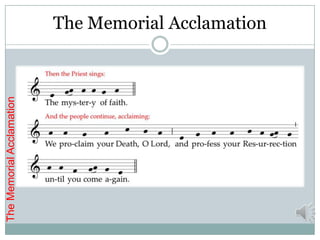
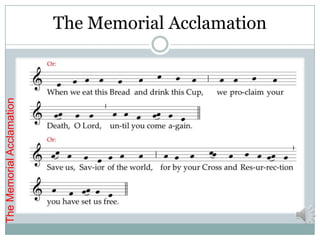
The Memorial Acclamation
The Doxology


“Through Him, with Him, in Him,
  in the unity of the Holy Spirit,
   all glory and honor is Yours,
          almighty Father,
          forever and ever.
              Amen.”
The Doxology and Stewardship


 We make God the center of our lives
 We pledge God all glory (praise)
 We pledge God all honor (resources of
  self and world)
 We center ourselves in the Trinity of
  eternal life and love
 We anticipate the Kingdom, when all
  creation reaches fulfillment
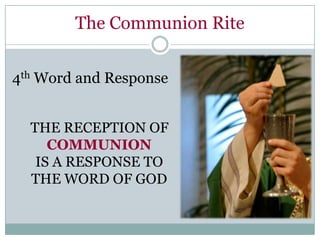
The Communion Rite


4th Word and Response


  THE RECEPTION OF
     COMMUNION
   IS A RESPONSE TO
  THE WORD OF GOD
The Communion Rite


     I become Christ’s body
         I live Christ’s life
The Communion Rite

 More than just a receiving of the Body of
 Christ (passive)


 Also a commitment to become the Body of
 Christ—on the part of the congregation and
 on the part of the individual disciple (active)
The Communion Rite

Will I take to myself the body of Jesus?
   The body that was broken?

Will I take his chalice to my lips?
    The chalice that is shed for the life of all?

Will I live Christ’s death so I may live his life?
     Will I live his life in the world?
The Communion Rite


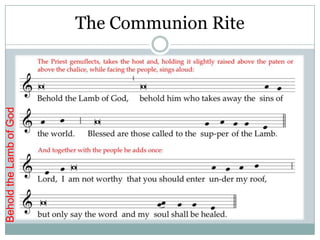
                                lord I am
Behold the Lamb of God
The Communion Rite


 Communion is our way of accepting
      the challenge of Jesus,
    “UNLESS YOU TAKE UP
   YOUR CROSS EVERY DAY,
YOU CANNOT BE MY DISCIPLES”
The Concluding Rites


5th Word and Response


    THE DISMISSAL IS OUR FINAL

   RESPONSE TO THE WORD OF GOD
The Concluding Rites

Dismissal           Commitment

“Go and announce      “I will live my
 the Gospel of           faith in the
 the Lord”                     world”
The Concluding Rites

 We are not church mice


 We are not monks


 We go forth into the world (world having both
 good and bad meanings)

 We go forth to be Christ’s Body in the World
The Concluding Rites


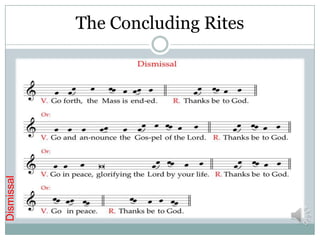
                     hi
Dismissal
The Concluding Rites


Dismissal is our        Dismissal is our
 accepting the          commitment to
 fundamental            live out the
 idea of                meaning of the
 MISSION                Mass
 at the heart of        throughout the
 discipleship           week as disciples-
                        family, work,
                        friendship, civic
                        life
Celebration


The problem of automatic pilot ~
priests and people “go through the
routine” and, worst of all, they
look like they are just going
through the routine
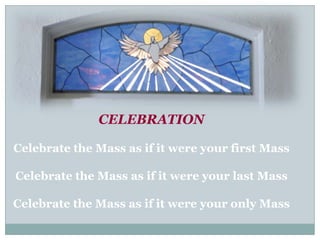
CELEBRATION

Celebrate the Mass as if it were your first Mass

Celebrate the Mass as if it were your last Mass

Celebrate the Mass as if it were your only Mass
At every Mass


 There are seekers
 There are people thinking about returning
 There are grieving people
 There are spiritually starving people
 There are people from groups that are
 on the edge—young adults, parents
By my participation and
how I participate at Mass,
am I willing to be part of an
evangelizing community?

Roman Missal III Presentation

  • 1.
    The Evangelizing Community A DIFFERENT LENS WITH WHICH TO VIEW THE NEW ROMAN MISSAL Father Tim Keeney Saint Anne Catholic Church November 2011
  • 2.
    Basic Gospel  Weare all about the death and resurrection of Jesus  How we participate in his death and resurrection is the story of our spiritual lives  Our identity with Christ is accomplished and sealed by the Holy Spirit
  • 3.
    The Paschal Mystery  All ministry helps people experience the Paschal Mystery—the death and resurrection of Christ  All ministry takes place in the dynamics of the Trinity—love and self-gift for the sake of the other  Priests are, par excellence, ministers, and by our baptism all are ministers through our common priesthood
  • 4.
    The Liturgy We have to be aware of how:  Liturgy is an asset for  The language of the New people Roman Missal draws us into a deeper  In today’s culture understanding of: liturgy can appear to be a The Gospel liability Paschal Mystery Mystery of the Trinity
  • 5.
    A Useful Distinction Worship Liturgy Experience  A standard ritual  A designed service which everyone which can contain many accepts that allows points of novelty and people to enter it which attempts to induce from many different certain emotions and emotional and personal perspectives in the perspectives participants
  • 6.
    Distinction between Participants Liturgy Congregation Each of us must be an active participant Worship Experience Audience Passive recipients of what is being presented
  • 7.
     Different stylesof celebrating  The words of the text are starting points needing a rhetoric to communicate meaning  The Mass is formed as a THE series of calls and responses between the priest and the MASS congregation
  • 8.
    The Language ofthe New Missal  Closer to the Latin  More Poetic  Draws upon ancient prayers of the Church  Emphasizes our humility before God  Emphasizes the Holiness of God  More Theological  More Scriptural  More unified with other languages
  • 9.
    The Dynamics The Eucharistis an interactive experience that is fundamentally evangelizing: we call people to conversion, we celebrate commitment, we send people forth.
  • 10.
    The Eucharist isInteractive
  • 11.
  • 12.
    The Introductory Rites • HI Penitential Act
  • 13.
    The Introductory Rites • HI Penitential Act
  • 14.
    The Introductory Rites HI GLORIA Gloria
  • 15.
    The Introductory Rites HI GLORIA Gloria
  • 16.
    The Introductory Rites HI GLORIA Gloria
  • 17.
    The Liturgy ofthe Word 1ST Word and Response THE FIRST RESPONSE TO THE WORD OF GOD IS THE RECITATION OF THE CREED “I ACCEPT, I BELIEVE”
  • 18.
    The Liturgy ofthe Word • HI GOSPEL Gospel
  • 19.
    The Liturgy ofthe Word • HI GOSPEL Gospel
  • 20.
    The Creed I believein one God, the Father almighty, maker of heaven and earth, of all things visible and invisible. I believe in one Lord Jesus Christ, the Only Begotten Son of God, born of the Father before all ages. God from God, Light from Light, true God from true God, begotten, not made, consubstantial with the Father, through him all things were made.
  • 21.
    The Creed For usmen and for our salvation he came down from heaven, and by the Holy Spirit was incarnate of the Virgin Mary, and became man. For our sake he was crucified under Pontius Pilate, He suffered death and was buried, and rose again on the third day, in accordance with the Scriptures.
  • 22.
    The Creed He ascendedinto heaven and is seated at the right hand of the Father. He will come again in glory to judge the living and the dead, and his kingdom will have no end. I believe in the Holy Spirit, the Lord, the giver of life, who proceeds from the Father and the Son, who with the Father and the Son is ad0red and glorified, who has spoken through the prophets.
  • 23.
    The Creed I believein one, holy, catholic and apostolic Church. I confess one baptism for the forgiveness of sins and I look forward to the resurrection of the dead and the life of the world to come. Amen
  • 24.
    The Creed Fides Quae…Thecontent of the articles of faith that I accept Fides Qua…The act of faith by which I accept not only the content but the God who acts in our lives
  • 25.
    Faith Beyond and through  Apostles Creed the words, how do  Alternating we help people sides recite the see the Creed fundamental act of  Renewal of trust and acceptance baptism the Creed expresses? promises
  • 26.
    2nd Word and Response THE SECOND RESPONSE TO THE WORD OF GOD IS AT THE OFFERTORY The Offertory
  • 27.
    The Offertory I givemyself, “By the mystery of this we give water and wine may we ourselves come to share to God in in the divinity response of Christ who to humbled The W O R D himself to share in our humanity.”
  • 28.
    The Offertory  Fruitof the earth  Fruit of the vine  Work of human hands
  • 29.
    The Offertory The Offertoryis the GIFT OF ONE’S SELF, one’s resources, one’s being, in response to the LOVE OF GOD
  • 30.
    The Offertory  Moreradical than “tithing”  More radical than “free will offering”  More radical than “be generous” with your resources WE ARE ASKING CATHOLICS TO GIVE THEMSELVES
  • 31.
    The Offertory We arenot just asking people to “support the parish”(pay bills), but to support the Kingdom of God which we believers try to serve
  • 32.
    The Offertory WHAT ISGOD ASKING OF ME? AM I NOT LIKE ABRAHAM, MOSES, JEREMIAH, ESTHER, JUDITH, TOBIT, PETER, JOHN, PAUL?
  • 33.
    The Offertory WILL ISAY “YES” TO GOD?
  • 34.
    The Doxology 3rd Wordand Response The “GREAT AMEN” in response to the Doxology sums up the aims of stewardship and discipleship expressed through the Eucharistic Prayer
  • 35.
    The Eucharistic Prayer The Doxology affirms the whole Eucharistic Prayer  “Lift up your hearts” “Let us give thanks”  Remembrance and re-enacting the gift of Christ of himself in the Eucharist  The gifts are consecrated; the givers of the gifts are consecrated
  • 36.
    Identity with Christ  “May we become one body, one spirit in Christ”  “May he make of us an eternal offering to you”
  • 37.
    Identity with Christ “Grant in your loving kindness to all who partake of this one Bread and one Chalice that. . . they may truly become a living sacrifice in Christ”  “Holy Father, we humbly beseech you to accept us also, together with your Son”
  • 38.
    The Liturgy ofthe Eucharist hi Orate, fratres
  • 39.
    The Liturgy ofthe Eucharist hi Preface Dialogue
  • 40.
    The sacrifice isnot only the death of Jesus, not only the elements that bring us into unity with Jesus’ death and resurrection, but also the people are identified with Jesus’ eternal self-giving
  • 41.
    The Memorial Acclamation TheMemorial Acclamation
  • 42.
    The Memorial Acclamation TheMemorial Acclamation
  • 43.
    The Doxology “Through Him,with Him, in Him, in the unity of the Holy Spirit, all glory and honor is Yours, almighty Father, forever and ever. Amen.”
  • 44.
    The Doxology andStewardship  We make God the center of our lives  We pledge God all glory (praise)  We pledge God all honor (resources of self and world)  We center ourselves in the Trinity of eternal life and love  We anticipate the Kingdom, when all creation reaches fulfillment
  • 45.
    The Communion Rite 4thWord and Response THE RECEPTION OF COMMUNION IS A RESPONSE TO THE WORD OF GOD
  • 46.
    The Communion Rite I become Christ’s body I live Christ’s life
  • 47.
    The Communion Rite More than just a receiving of the Body of Christ (passive)  Also a commitment to become the Body of Christ—on the part of the congregation and on the part of the individual disciple (active)
  • 48.
    The Communion Rite WillI take to myself the body of Jesus? The body that was broken? Will I take his chalice to my lips? The chalice that is shed for the life of all? Will I live Christ’s death so I may live his life? Will I live his life in the world?
  • 49.
    The Communion Rite lord I am Behold the Lamb of God
  • 50.
    The Communion Rite Communion is our way of accepting the challenge of Jesus, “UNLESS YOU TAKE UP YOUR CROSS EVERY DAY, YOU CANNOT BE MY DISCIPLES”
  • 51.
    The Concluding Rites 5thWord and Response THE DISMISSAL IS OUR FINAL RESPONSE TO THE WORD OF GOD
  • 52.
    The Concluding Rites Dismissal Commitment “Go and announce “I will live my the Gospel of faith in the the Lord” world”
  • 53.
    The Concluding Rites We are not church mice  We are not monks  We go forth into the world (world having both good and bad meanings)  We go forth to be Christ’s Body in the World
  • 54.
  • 55.
    The Concluding Rites Dismissalis our Dismissal is our accepting the commitment to fundamental live out the idea of meaning of the MISSION Mass at the heart of throughout the discipleship week as disciples- family, work, friendship, civic life
  • 56.
    Celebration The problem ofautomatic pilot ~ priests and people “go through the routine” and, worst of all, they look like they are just going through the routine
  • 57.
    CELEBRATION Celebrate the Massas if it were your first Mass Celebrate the Mass as if it were your last Mass Celebrate the Mass as if it were your only Mass
  • 58.
    At every Mass There are seekers  There are people thinking about returning  There are grieving people  There are spiritually starving people  There are people from groups that are on the edge—young adults, parents
  • 59.
    By my participationand how I participate at Mass, am I willing to be part of an evangelizing community?

Editor's Notes

  • #12 This dialogue will be repeated five times during the liturgy with greater intensity each time, at the greeting, at the gospel, at the dialogue at the beginning of the Eucharistic prayer, at the sign of peace, and before the final blessing.
  • #15 This dialogue will be repeated five times during the liturgy with greater intensity each time, at the greeting, at the gospel, at the dialogue at the beginning of the Eucharistic prayer, at the sign of peace, and before the final blessing.
  • #16 This dialogue will be repeated five times during the liturgy with greater intensity each time, at the greeting, at the gospel, at the dialogue at the beginning of the Eucharistic prayer, at the sign of peace, and before the final blessing.
  • #17 This dialogue will be repeated five times during the liturgy with greater intensity each time, at the greeting, at the gospel, at the dialogue at the beginning of the Eucharistic prayer, at the sign of peace, and before the final blessing.
  • #41 THE WORDING OF THIS STILL SEEMS AWKWARD