Thinking In Sets Auxiliary Temporal And Virtual Tables In Sql Celko
Thinking In Sets Auxiliary Temporal And Virtual Tables In Sql Celko
Thinking In Sets Auxiliary Temporal And Virtual Tables In Sql Celko
Thinking In Sets Auxiliary Temporal And Virtual Tables In Sql Celko
Thinking In Sets Auxiliary Temporal And Virtual Tables In Sql Celko
1.
Thinking In SetsAuxiliary Temporal And Virtual
Tables In Sql Celko download
https://ebookbell.com/product/thinking-in-sets-auxiliary-
temporal-and-virtual-tables-in-sql-celko-1020680
Explore and download more ebooks at ebookbell.com
2.
Here are somerecommended products that we believe you will be
interested in. You can click the link to download.
Simplify 7 In 1 Box Set A Practical Guide On How To Live A Meaningful
Life With Lesspositive Thinking Organize Your Dayinterior
Designsleepfeng Shui Bonus Secrets Of Danish Happy Life Rose
https://ebookbell.com/product/simplify-7-in-1-box-set-a-practical-
guide-on-how-to-live-a-meaningful-life-with-lesspositive-thinking-
organize-your-dayinterior-designsleepfeng-shui-bonus-secrets-of-
danish-happy-life-rose-35503906
Simplify 7 In 1 Box Set A Practical Guide On How To Live A Meaningful
Life With Lesspositive Thinking Organize Your Dayinterior
Designsleepfeng Shui Bonus Secrets Of Danish Happy Life Emma Rose
Michael Dyer Alexia Edra Zane Maxwell Hans
https://ebookbell.com/product/simplify-7-in-1-box-set-a-practical-
guide-on-how-to-live-a-meaningful-life-with-lesspositive-thinking-
organize-your-dayinterior-designsleepfeng-shui-bonus-secrets-of-
danish-happy-life-emma-rose-michael-dyer-alexia-edra-zane-maxwell-
hans-37000788
Simplify 7 In 1 Box Set A Practical Guide On How To Live A Meaningful
Life With Lesspositive Thinking Organize Your Dayinterior
Designsleepfeng Shui Bonus Secrets Of Danish Happy Life Emma Rose
Michael Dyer Alexia Edra Zane Maxwell Hans
https://ebookbell.com/product/simplify-7-in-1-box-set-a-practical-
guide-on-how-to-live-a-meaningful-life-with-lesspositive-thinking-
organize-your-dayinterior-designsleepfeng-shui-bonus-secrets-of-
danish-happy-life-emma-rose-michael-dyer-alexia-edra-zane-maxwell-
hans-37089308
Selfimprovement Guide Box Set 5 In 1 Learn How To Boost Your
Productivity Nail Your Dream Job Quit Drinking Feel Good And Be
Happier Productivity Positive Thinking Kim Higgins Michelle Henson
Wendy Cole Tiffany Brook Sherry Morgan
https://ebookbell.com/product/selfimprovement-guide-box-
set-5-in-1-learn-how-to-boost-your-productivity-nail-your-dream-job-
quit-drinking-feel-good-and-be-happier-productivity-positive-thinking-
kim-higgins-michelle-henson-wendy-cole-tiffany-brook-sherry-
morgan-61895868
3.
Thinking In JavaBruce Eckel
https://ebookbell.com/product/thinking-in-java-bruce-eckel-46475176
Thinking In Constellations Walter Benjamin In The Humanities Caroline
Sauter Nassima Sahraoui
https://ebookbell.com/product/thinking-in-constellations-walter-
benjamin-in-the-humanities-caroline-sauter-nassima-sahraoui-47544992
Thinking In Translation Scripture And Redemption In The Thought Of
Franz Rosenzweig Orr Scharf
https://ebookbell.com/product/thinking-in-translation-scripture-and-
redemption-in-the-thought-of-franz-rosenzweig-orr-scharf-49056962
Thinking In Search Of A Language Essays On American Intellect And
Intuition Herwig Friedl
https://ebookbell.com/product/thinking-in-search-of-a-language-essays-
on-american-intellect-and-intuition-herwig-friedl-49183198
Thinking In Education Research Applying Philosophy And Theory Nick
Peim
https://ebookbell.com/product/thinking-in-education-research-applying-
philosophy-and-theory-nick-peim-50030686
5.
J O EC E L K O’S
THINKING IN SETS
Auxiliary, Temporal, and
Virtual Tables in SQL
Joe Celko
AMSTERDAM • BOSTON HEIDELBERG • LONDON
NEW YORK • OXFORD • PARIS • SAN DIEGO
SAN FRANCISCO • SINGAPORE • SYDNEY • TOKYO
Morgan Kaufmann is an imprint of Elsevier
Preface xvii
1 SQLIs Declarative, Not Procedural 1
1.1 Different Programming Models 2
1.2 Different Data Models 4
1.2.1 Columns Are Not Fields 5
1.2.2 Rows Are Not Records 7
1.2.3 Tables Are Not Files 11
1.2.4 Relational Keys Are Not Record Locators 13
1.2.5 Kinds of Keys 15
1.2.6 Desirable Properties of Relational Keys 17
1.2.7 Unique But Not Invariant 18
1.3 Tables as Entities 19
1.4 Tables as Relationships 20
1.5 Statements Are Not Procedures 20
1.6 Molecular, Atomic, and Subatomic Data Elements 21
1.6.1 Table Splitting 21
1.6.2 Column Splitting 22
1.6.3 Temporal Splitting 24
1.6.4 Faking Non-1NF Data 24
1.6.5 Molecular Data Elements 25
1.6.6 Isomer Data Elements 26
1.6.7 Validating a Molecule 27
2 Hardware, Data Volume, and Maintaining Databases 29
2.1 Parallelism 30
2.2 Cheap Main Storage 31
2.3 Solid-State Disk 32
2.4 Cheaper Secondary and Tertiary Storage 32
2.5 The Data Changed 33
2.6 The Mindset Has Not Changed 33
CONTENTS
CONTENTS ix
5.1.2 SequenceConstructor 68
5.1.3 Replacing an Iterative Loop 69
5.2 Permutations 72
5.2.1 Permutations via Recursion 72
5.2.2 Permutations via CROSS JOIN 73
5.3 Functions 75
5.3.1 Functions without a Simple Formula 76
5.4 Encryption via Tables 78
5.5 Random Numbers 79
5.6 Interpolation 83
6 Views 87
6.1 Mullins VIEW Usage Rules 88
6.1.1 Efficient Access and Computations 88
6.1.2 Column Renaming 89
6.1.3 Proliferation Avoidance 90
6.1.4 The VIEW Synchronization Rule 90
6.2 Updatable and Read-Only VIEWs 91
6.3 Types of VIEWs 93
6.3.1 Single-Table Projection and Restriction 93
6.3.2 Calculated Columns 93
6.3.3 Translated Columns 94
6.3.4 Grouped VIEWs 95
6.3.5 UNIONed VIEWs 96
6.3.6 JOINs in VIEWs 98
6.3.7 Nested VIEWs 98
6.4 Modeling Classes with Tables 100
6.4.1 Class Hierarchies in SQL 100
6.4.2 Subclasses via ASSERTIONs and TRIGGERs 103
6.5 How VIEWs Are Handled in the Database System 103
6.5.1 VIEW Column List 104
6.5.2 VIEW Materialization 104
6.6 In-Line Text Expansion 105
6.7 WITH CHECK OPTION Clause 106
6.7.1 WITH CHECK OPTION as CHECK() Clause 110
6.8 Dropping VIEWs 112
12.
x CONTENTS
6.9 OutdatedUses for VIEWs 113
6.9.1 Domain Support 113
6.9.2 Table Expression VIEWs 114
6.9.3 VIEWs for Table Level CHECK() Constraints 114
6.9.4 One VIEW per Base Table 115
7 Virtual Tables 117
7.1 Derived Tables 118
7.1.1 Column Naming Rules 118
7.1.2 Scoping Rules 119
7.1.3 Exposed Table Names 121
7.1.4 LATERAL() Clause 122
7.2 Common Table Expressions 124
7.2.1 Nonrecursive CTEs 124
7.2.2 Recursive CTEs 126
7.3 Temporary Tables 128
7.3.1 ANSI/ISO Standards 128
7.3.2 Vendors Models 128
7.4 The Information Schema 129
7.4.1 The INFORMATION_SCHEMA Declarations 130
7.4.2 A Quick List of VIEWS and Their Purposes 130
7.4.3 DOMAIN Declarations 132
7.4.4 Definition Schema 132
7.4.5 INFORMATION_SCHEMA Assertions 135
8 Complicated Functions via Tables 137
8.1 Functions without a Simple Formula 137
8.1.1 Encryption via Tables 138
8.2 Check Digits via Tables 139
8.2.1 Check Digits Defined 139
8.2.2 Error Detection versus Error Correction 140
8.3 Classes of Algorithms 141
8.3.1 Weighted-Sum Algorithms 141
8.3.2 Power-Sum Check Digits 144
8.3.3 Luhn Algorithm 145
8.3.4 Dihedral Five Check Digit 146
13.
CONTENTS xi
8.4 Declarations,Not Functions, Not Procedures 148
8.5 Data Mining for Auxiliary Tables 152
9 Temporal Tables 155
9.1 The Nature of Time 155
9.1.1 Durations, Not Chronons 156
9.1.2 Granularity 158
9.2 The ISO Half-Open Interval Model 159
9.2.1 Use of NULL for “Eternity” 161
9.2.2 Single Timestamp Tables 162
9.2.3 Overlapping Intervals 164
9.3 State Transition Tables 174
9.4 Consolidating Intervals 178
9.4.1 Cursors and Triggers 180
9.4.2 OLAP Function Solution 181
9.4.3 CTE Solution 181
9.5 Calendar Tables 182
9.5.1 Day of Week via Tables 183
9.5.2 Holiday Lists 184
9.5.3 Report Periods 186
9.5.4 Self-Updating Views 186
9.6 History Tables 188
9.6.1 Audit Trails 189
10 Scrubbing Data with Non-1NF Tables 191
10.1 Repeated Groups 192
10.1.1 Sorting within a Repeated Group 195
10.2 Designing Scrubbing Tables 198
10.3 Scrubbing Constraints 201
10.4 Calendar Scrubs 202
10.4.1 Special Dates 203
10.5 String Scrubbing 204
10.6 Sharing SQL Data 205
10.6.1 A Look at Data Evolution 206
10.6.2 Databases 207
14.
xii CONTENTS
10.7 Extract,Transform, and Load Products 208
10.7.1 Loading Data Warehouses 209
10.7.2 Doing It All in SQL 211
10.7.3 Extract, Load, and then Transform 212
11 Thinking in SQL 215
11.1 Warm-up Exercises 216
11.1.1 The Whole and Not the Parts 216
11.1.2 Characteristic Functions 217
11.1.3 Locking into a Solution Early 219
11.2 Heuristics 220
11.2.1 Put the Specification into a Clear Statement 220
11.2.2 Add the Words “Set of All…” in Front of the Nouns 220
11.2.3 Remove Active Verbs from the Problem Statement 221
11.2.4 You Can Still Use Stubs 221
11.2.5 Do Not Worry about Displaying the Data 222
11.2.6 Your First Attempts Need Special Handling 223
11.2.7 Do Not Be Afraid to Throw Away
Your First Attempts at DDL 223
11.2.8 Save Your First Attempts at DML 224
11.2.9 Do Not Think with Boxes and Arrows 225
11.2.10 Draw Circles and Set Diagrams 225
11.2.11 Learn Your Dialect 226
11.2.12 Imagine that Your WHERE Clause Is “Super Amoeba” 227
11.2.13 Use the Newsgroups, Blogs, and Internet 228
11.3 Do Not Use BIT or BOOLEAN Flags in SQL 228
11.3.1 Flags Are at the Wrong Level 229
11.3.2 Flags Confuse Proper Attributes 230
12 Group Characteristics 235
12.1 Grouping Is Not Equality 237
12.2 Using Groups without Looking Inside 238
12.2.1 Semiset-Oriented Approach 239
12.2.2 Grouped Solutions 240
15.
CONTENTS xiii
12.2.3 AggregatedSolutions 241
12.3 Grouping over Time 242
12.3.1 Piece-by-Piece Solution 243
12.3.2 Data as a Whole Solution 244
12.4 Other Tricks with HAVING Clauses 245
12.5 Groupings, Rollups, and Cubes 247
12.5.1 GROUPING SET Clause 247
12.5.2 The ROLLUP Clause 249
12.5.3 The CUBE Clause 249
12.5.4 A Footnote about Super Grouping 250
12.6 The WINDOW Clause 250
12.6.1 The PARTITION BY Clause 251
12.6.2 The ORDER BY Clause 252
12.6.3 The RANGE Clause 253
12.6.4 Programming Tricks 253
13 Turning Specifications into Code 255
13.1 Signs of Bad SQL 255
13.1.1 Is the Code Formatted Like Another Language? 256
13.1.2 Assuming Sequential Access 256
13.1.3 Cursors 256
13.1.4 Poor Cohesion 257
13.1.5 Table-Valued Functions 257
13.1.6 Multiple Names for the Same Data Element 258
13.1.7 Formatting in the Database 258
13.1.8 Keeping Dates in Strings 259
13.1.9 BIT Flags, BOOLEAN, and Other
Computed Columns 259
13.1.10 Attribute Splitting Across Columns 259
13.1.11 Attribute Splitting Across Rows 259
13.1.12 Attribute Splitting Across Tables 260
13.2 Methods of Attack 260
13.2.1 Cursor-Based Solution 261
13.2.2 Semiset-Oriented Approach 262
13.2.3 Pure Set-Oriented Approach 264
16.
xiv CONTENTS
13.2.4 Advantagesof Set-Oriented Code 264
13.3 Translating Vague Specifications 265
13.3.1 Go Back to the DDL 266
13.3.2 Changing Specifications 269
14 Using Procedure and Function Calls 273
14.1 Clearing out Spaces in a String 273
14.1.1 Procedural Solution #1 274
14.1.2 Functional Solution #1 275
14.1.3 Functional Solution #2 278
14.2 The PRD( ) Aggregate Function 280
14.3 Long Parameter Lists in Procedures and Functions 282
14.3.1 The IN() Predicate Parameter Lists 283
15 Numbering Rows 287
15.1 Procedural Solutions 287
15.1.1 Reordering on a Numbering Column 289
15.2 OLAP Functions 291
15.2.1 Simple Row Numbering 291
15.2.2 RANK() and DENSE_RANK() 292
15.3 Sections 293
16 Keeping Computed Data 297
16.1 Procedural Solution 297
16.2 Relational Solution 299
16.3 Other Kinds of Computed Data 299
17 Triggers for Constraints 301
17.1 Triggers for Computations 301
17.2 Complex Constraints via CHECK() and CASE Constraints 302
17.3 Complex Constraints via VIEWs 305
17.3.1 Set-Oriented Solutions 306
17.4 Operations on VIEWs as Constraints 308
17.4.1 The Basic Three Operations 308
17.4.2 WITH CHECK OPTION Clause 308
17.
CONTENTS xv
17.4.3 WITHCHECK OPTION as CHECK() clause 313
17.4.4 How VIEWs Behave 314
17.4.5 UNIONed VIEWs 316
17.4.6 Simple INSTEAD OF Triggers 317
17.4.7 Warnings about INSTEAD OF Triggers 321
18 Procedural and Data Driven Solutions 323
18.1 Removing Letters in a String 323
18.1.1 The Procedural Solution 324
18.1.2 Pure SQL Solution 325
18.1.3 Impure SQL Solution 326
18.2 Two Approaches to Sudoku 326
18.2.1 Procedural Approach 327
18.2.2 Data-Driven Approach 327
18.2.3 Handling the Given Digits 329
18.3 Data Constraint Approach 331
18.4 Bin Packing Problems 335
18.4.1 The Procedural Approach 336
18.4.2 The SQL Approach 336
18.5 Inventory Costs over Time 339
18.5.1 Inventory UPDATE Statements 343
18.5.2 Bin Packing Returns 344
Index 349
THIS BOOK DEALSwith the use of various kinds of SQL programming
techniques that make use of tables rather than procedural code.
I have been telling people that the biggest obstacle to learning SQL is
unlearning procedural programming, but saying that does not show
someone who has been thinking in files and procedural code his or
her entire career how to do things in a declarative relational language.
Hence this book, with actual techniques and an explanation of the
thought processes that lead to them.
Like all of my other books, this one is for the working SQL
programmer who wants to pick up good SQL programming
techniques. It assumes that readers know the language well enough
to write code that runs and that they are approaching their first year
of actual SQL experience.
Why a year? My experience in teaching SQL for the past few
decades is that the average SQL programmer goes through phases while
moving from procedural programming languages such as FORTRAN,
Cobol, Pascal, the C family, OO languages, and whatever else the
“application language du jour” happens to be this year. A declarative
language is totally different from anything they have done before.
Learning a new programming language is much like learning a
foreign language. At first, you mispronounce words and try to use the
word order and syntax of your native language. Then you can assem-
ble a proper sentence using a template and a bit of effort. Finally, you
Preface
20.
actually think andspeak that foreign language and do not have to really
focus on the effort.
The initial phase in using SQL programming is just copying existing
code blindly from someone else’s programs. This is not really program-
ming. You might as well be using a GUI tool that assembles SQL from
text files without ever showing you the actual code.
The next step is writing new SQL code, but doing it as if it were your
original or best-known language. A symptom of this mind-set is using
the wrong terminology, such as calling a column a field, as if we were
still using sequential filing systems. But it also shows up in the form of
cursors and temporary tables used to mimic sequential file systems at
great danger and expense.
Toward the end that first year of SQL programming, the program-
mer’s mind-set starts to change. She or he has seen good SQL code, read
something about RDBMS, and is finally starting to think in SQL. If the
person is lucky, he or she might have taken a college or training course
during this time.
The funniest example of the mindset problem was a college class I
taught decades ago to engineers who knew only FORTRAN and C. They
assumed that SQL must have WHILE-loops and IF-THEN constructs.
The one LISP programmer in the class was actually quite happy about
the lack of iterative loops and the ability to nest code modules but could
not understand the lack of recursive constructs in SQL.
Developers are using databases and cannot stay in the comfort of
their native language. There was an article in the IT trade press on
March 22, 2007 from Evans Data about a two-year survey that showed
that 40 percent of American developers are using databases in their
work. A year before, only 32 percent of developers were using databases
in their work, according to the study.
Auxiliary, Temporal, and Virtual Tables
There is only one data structure in SQL: the table. How tables are used
often affects how they are declared. There are base, or operational,
tables that persist in storage. They hold the core data of the data model,
but they are not the only kind of table.
Staging tables are horrible monsters without constraints or even
keys. But SQL allows you to create them. You use them as staging areas
for dirty, raw data that you would never ever put in your beautiful clean
base tables.
Auxiliary tables are used to compute functions and other values by
joins rather than by procedural programming. Common examples are
xviii PREFACE
21.
look-up tables fortranslating encodings and functions that cannot be
computed easily. They should not appear in the ER diagrams for the
data model, because they are not really entities or relationships.
Temporal tables are those that support temporal queries, histori-
cal data, and audit information. Although you can consider them to
be auxiliary or base tables, they need special emphasis. This topic is
complicated in both the concepts and the implementations.
Virtual tables are materialized (or appear to be materialized) by the
SQL engine. They do not exist in the schema like base tables. They
come in several “flavors” and can be used to improve the performance of
SQL statements.
This book also contains a discussion about the Schema Information
Tables that SQL uses to describe a schema in SQL itself. There is an
ANSI/ISO standard for them, but most products have their own versions
of them.
Corrections and Additions
Please send any corrections, additions, suggestions, improvements,
or alternative solutions to me or to the publisher at Morgan Kaufmann,
30 Corporate Drive, Suite 400, Burlington, MA 01803.
PREFACE xix
IN THE PREFACEI told a short story about FORTRAN programmers
who could only solve problems using loops and a LISP programmer
who could only solve problems recursively. This is not uncommon
because we love the tools we know. Let me tell a joke instead of a
story: A mathematician, a physicist, and a database programmer were
all given a rubber ball and told to find the volume.
The mathematician carefully measured the diameter and either
evaluated the volume of sphere formula or used a triple integral if the
ball was not perfectly round.
The physicist filled a beaker with water, put the ball in the water,
and measured the total displacement. He does not care about the
details of the shape of the ball.
The database programmer looked up the model and serial numbers
in his rubber ball manufacturer’s on-line database. He does not care
about the actual ball. But he has information about the tolerances to
which it was made, the expected shape and size, and a bunch of other
things that apply to the entire rubber ball production process.
The moral of the story is: The mathematician knows how to
compute. The physicist knows how to measure. The database guy
knows how to look up data. Each person grabs his tools to solve the
problem.
Now change the problem to an inventory of thousands of rubber
balls. The mathematician and the physicist are stuck with a lot of
C H A P T E R
1
SQL Is Declarative,
Not Procedural
24.
2 CHAPTER 1:SQL IS DECLARATIVE, NOT PROCEDURAL
manual labor. The database guy does a few downloads and he can
produce rubber ball industry standards (assuming that there are such
things) and detailed documentation in court with his answers.
1.1 Different Programming Models
Perfecting oneself is as much unlearning as it is learning.
—Edsgar Dijkstra
There are many models of programming. Procedural programming
languages use a sequence of procedural steps guided by flow of control
statements (WHILE-DO, IF-THEN-ELSE, and BEGIN-END) that change
the input data to output data. This was the traditional view of program-
ming, and it is often called the von Neumann Model after John von
Neumann, the mathematician who was responsible for it. The same
source code runs through the same compiler and generates the same
executable module every time. The same program will work exactly
the same way every time it is invoked. The keywords in this model are
predictable and deterministic. It is also subject to some mathematical
analysis because it is deterministic.
There are some variations on the theme. Some languages use differ-
ent flow control statements. FORTRAN and COBOL allocated all the
storage for the data at the start of the program. Later, the Algol family of
languages did dynamic storage allocation based on the scope of the data
within a block-structured language.
Edsgar Dijkstra (see his archives at www.cs.utexas.edu/users/EWD/)
came up with a language that was nondeterministic. Statements, called
guarded commands, have a control that either blocks or allows the
statement to be executed, but there is no particular order of execution
among the open statements. This model was not implemented in a com-
mercial product, but it demonstrated that something we had thought
was necessary for programming (determinism) could be dropped.
Functional programming languages are based on solving problems as
a series of nested function calls. The concept of higher-order functions
to change one function to another is important in these languages.
The derivative and integral transforms are mathematical examples of
such higher-order functions. One of the goals of such languages is to
avoid a side effect in programs so they can be optimized algebraically.
In particular, once you have an expression that is equal to another (in
some sense of equality), they can substitute for each other without
affecting the result of the computation.
25.
APL is themost successful functional programming language and
had a fad period as a teaching language when Ken Iverson wrote his
book A Programming Language in 1962. IBM produced special keyboards
that included the obscure mathematical symbols used in APL for their
desktop machines. Most of the functional languages never made it out
of academia, but some survive in commercial applications today. Erlang
is used for concurrent applications; R is a statistical language; Mathe-
matica is a popular symbolic mathematics product; and Kx Systems uses
the K language for large-volume financial analysis. More recently, the
ML and Haskell programming languages have become popular among
Linux and UNIX programmers.
Here we dropped another concept that had been regarded as
fundamental: There is no flow of control in these languages.
Constraint or constraint logic programming languages are a series
of constraints on a problem domain. As you add more constraints, the
system figures out which answers are possible and which are not. The
most popular such language is PROLOG, which also had an academic
fad many years ago when Borland Software (www.borland.com) made
a cheap student version available. The website ON-LINE GUIDE TO
CONSTRAINT PROGRAMMING by Roman Barták is a good place to
start if you are interested in this topic (http://kti.ms.mff.cuni.cz/~bartak/
constraints/index.html).
Here we dropped the concept of an algorithm altogether and just
provided a problem specification.
Object-oriented (OO) programming is based on the ideas of objects
that have both data and behavior in the same module of code. The
programming model is a collection of independent cooperating objects
instead of a single program invoking functions. An object is capable
of receiving messages, processing data, and sending messages to other
objects.
The idea is that each object can be maintained and written indepen-
dently of any particular application and dropped into place where it is
needed. Imagine a community of people who do particular jobs. They
receive orders from their customers, process them, and return a result.
Many years ago, the INCITS H2 Database Standards Committee (née
ANSI X3H2 Database Standards Committee) had a meeting in Rapid
City, South Dakota. We had Mount Rushmore and Bjarne Stroustrup
as special attractions. Mr. Stroustrup did his slide show with overhead
transparencies (yes, this was before PowerPoint was ubiquitous!) about
Bell Labs inventing C++ and OO programming, and we got to ask
questions.
1.1 Different Programming Models 3
26.
4 CHAPTER 1:SQL IS DECLARATIVE, NOT PROCEDURAL
One of the questions was how we should put OO features into the
working model of the next version of the SQL standard, which was
known as SQL3 internally. His answer was that Bell Labs, with all their
talent, had tried four different approaches to this problem and they
came to the conclusion that it should not be done. OO was great for
programming but deadly for data.
I have watched people try to force OO models into SQL, and it falls
apart in about a year. Every typo becomes a new attribute or class,
queries that would have been so easy in a relational model are now
multitable monster outer joins, redundancy grows at an exponential
rates, constraints are virtually impossible to write so you can kiss data
integrity goodbye, and so forth.
With all these programming models, why should we not have
different data models?
1.2 Different Data Models
Consider the humble punch card. Punch cards had been used in France
to control textile looms since the early 1700s; the method was perfected
by Joseph Marie Jacquard in 1801 with his Jacquard loom.
Flash forward to the year 1890, when a man named Herman
Hollerith invented a punch card and tabulating machines for that
year’s United States Census. His census project was so successful that
Mr. Hollerith left the government and started the Tabulating Machine
Company in 1896. After a series of mergers and name changes, this
company became IBM. You might have heard of it.
Up to the 1970s, the “IBM card” and related machinery was every-
where. The most common card was the IBM 5081, and that part
number became the common term for it—even across vendors! The
punch card was data processing back then.
The physical characteristics of the card determined how we stored
and processed data for decades afterwards. The card was the size of
an 1887 United States dollar bill (3.25 inches by 7.375 inches). The
reason for that size was simple; when Hollerith worked on the Census,
he could get drawers to store the decks of cards from the Department of
the Treasury across the street.
The cards had a grid of 80 columns of 12 rows, which could
accommodate holes. This was for physical reasons again. But once
the 80-column convention was established, it stuck. The early video
terminals that replaced the key punch machines used screens with
80 columns of text and 24 or 25 rows—that is, two punch cards high
and possibly a line for error messages.
27.
Magnetic tapes startedreplacing punch cards in the 1970s, but they
also mimicked the 80-column convention, although there was no longer
any need. Many of the early ANSI tape standards for header records are
based on this convention. Legacy systems simply replaced card read-
ers with magnetic tape units for obvious reasons, but new applications
continued to be built to this standard, too.
The physical nature of the cards meant that data was written and
read from left to right in sequential order. Likewise, the deck of cards
was written and read from front to back in sequential order.
A magnetic tape file is also written and read in the same way, but
with the added bonus that when you drop a tape on the floor, it does
not get scrambled like a deck of cards. The downside of a tape over a
deck of cards is that it cannot be rearranged manually on purpose either.
Card and tape files are pretty passive creatures and will take what-
ever an application program throws at them without much objection.
Files are also independent of each other, simply because they are con-
nected to one application program at a time and therefore have no idea
what other files look like.
Early disk systems also mimicked this model—physically contiguous
storage read in a sequential order, with meaning given to the data by the
program reading it.
It was a while before disk systems realized that the read/write heads
could be moved to any physical position on the disk. This gave us ran-
dom access storage. We still have a contiguous storage concept within
each field and each record, however.
The Relational Model was a big jump, because it divorced the physi-
cal and logical models of data. If you read the specifications for many of
the early programming languages, they describe physically contiguous
data and storage methods. SQL describes only the behavior of the data
without any reference to physical storage methods.
1.2.1 Columns Are Not Fields
A field within a record is defined by the application program that
reads it. A column in a row in a table is defined independently of any
application by the database schema in DDL. The data types in a column
are always scalar and NULL-able.
This is a problem for files. If I mount the wrong tape on a tape drive,
say a COBOL file, and read it with a FORTRAN program, it can produce
meaningless output. The program simply counts the number of bytes
from the start of the tape and slices off so many characters into each
field from left to right.
1.2 Different Data Models 5
28.
6 CHAPTER 1:SQL IS DECLARATIVE, NOT PROCEDURAL
The order of the application program variables in the READ or
INPUT statements is important, because the values are read into the
program variables in that order. In SQL, columns are referenced only by
their names. Yes, there are shorthands like the SELECT * clause and
“INSERT INTO <table name>” statements that expand into a list of
column names in the physical order in which the column names appear
within their table declaration, but these are shorthands that resolve to
named lists. This is a leftover from the early days of SQL, when we were
doing our unlearning and still had a “record-oriented” mindset.
The use of NULLs in SQL is also unique to the language. Fields do
not support a missing data marker as part of the field, record, or file
itself. Nor do fields have constraints that can be added to them in the
record, like the DEFAULT and CHECK() clauses in SQL.
Nor do fields have a data type. Fields have meaning and are defined
by the program reading them, not in themselves. Thus, four columns
on a punch card containing 1223 might be an integer in one program,
a string in a second program, or read as four fields instead of one in a
third program.
The choice of data types is not always obvious. The sure symptom
of a newbie programmer is that they blindly pick data types without
any research. My favorite example is the use of a “VARCHAR (<magical
length>)” declaration for almost every column, where <magical
length> is an integer value that their particular implement of SQL
generates as a default or maximum. In the Microsoft world, look for 255
and 50 to appear.
As an example of the difference in research versus impulse design,
consider trying to sort the sections of this book that use a numeric
outline for the sections. If you model the outline numbers as character
strings, you lose the natural order when you sort them.
For example:
1.1
1.2
1.3
...
1.10
Sorts as:
1.1
1.10
29.
1.2
1.3
...
When this questionappeared in a newsgroup, the various solutions
included a recursive function, an external function, a proprietary name
parsing function, and an extra column for the sort order.
My solution is to pad each section with leading zeros and hope
I never have more than 99 headings. Most publishers have an acceptable
maximum depth of five levels.
00.00.
01.00.
01.01.
01.01.02.
etc.
You enforce this with SIMILAR TO predicate in the DDL rather than
trying to do it in the ORDER BY clause in the DML.
CREATE TABLE Outline
(section_nbr VARCHAR(15) NOT NULL PRIMARY KEY,
CHECK (section_nbr SIMILAR TO '[:digit:][:digit:].+'),
..);
When you want to display the section numbers without the leading
zeros, use a REPLACE() or TRANSLATE function in the query. We will
get to this principle in a later section.
In 25 words or less, columns are active and define themselves; fields
are passive and are interpreted by the application program.
1.2.2 Rows Are Not Records
Rows are not records. A record is defined in the application program
that reads it, just like the fields. The name of the field in the READ state-
ments of the application language tells the program where to put the
data. The physical order of the field names in the READ statement is vital.
That means “READ a, b, c;” is not the same as “READ c, a, b;”
because of the sequential order.
A row in a table is defined in the database schema and not by a pro-
gram at all. The columns are referenced by their names in the schema
and not by local program names or physical locations. That means
1.2 Different Data Models 7
30.
8 CHAPTER 1:SQL IS DECLARATIVE, NOT PROCEDURAL
“SELECT a, b, c FROM...” is the same data as “SELECT c, a, b
FROM...” when the data goes into a host program.
All empty files look alike; they are a directory entry in the operating
system registry with a name, a length of zero bytes of storage, and a
NIL pointer to their starting position. Empty tables still have columns,
constraints, security privileges, and other structures, even though they
have no rows. All CHECK() constraints are TRUE on an empty table, so
you must use a CREATE ASSERTION statement that is external to the
tables if you wish to impose business rules on potentially empty tables
or among tables.
This is in keeping with the set theoretical model, in which the empty
set is a perfectly good set. The difference between SQL’s set model and
standard mathematical set theory is that set theory has only one empty
set, but in SQL each table has a different structure, so they cannot be used
in places where nonempty versions of themselves could not be used.
Another characteristic of rows in a table is that they are all alike in
structure and they are all the “same kind of thing” in the model. In a
file system, records can vary in size, data types, and structure by having
flags in the data stream that tell the program reading the data how to
interpret it. The most common examples are Pascal’s variant record, C’s
struct syntax, and COBOL’s OCCURS clause.
Here is an example in COBOL-85. The syntax is fairly easy to
understand, even if you do not read COBOL. The language has a data
declaration section in the programs that uses a hierarchical outline num-
bering system. The fields are strings, described by a template or PICTURE
clause. The dash serves the same purpose as the underscore in SQL.
01 PRIOR-PERIOD-TABLE.
05 PERIOD-AMT PICTURE 9(6)
OCCURS ZERO TO 12 TIMES
DEPENDING ON PRIOR-PERIODS.
The PRIOR-PERIODS field holds the value that controls how many
PERIOD-AMT fields we have. ZERO option was added in COBOL-85,
but COBOL-74 had to have at least one occurrence.
In Pascal, consider a record for library items that can be either a
book or a CD. The declarations look like this:
ItemClasses = (Book, CD);
LibraryItems =
RECORD
31.
Ref: 0..999999;
Title: ARRAY[1..30] OF CHAR;
Author: ARRAY [1..16] OF CHAR;
Publisher: ARRAY [1..20] OF CHAR;
CASE Class: ItemClasses
OF Book: (Edition: 1..50; PubYear: 1400..2099);
CD: (Artist: ARRAY [1..30] OF CHAR;
END;
The ItemClasses is a flag that picks which branch of the CASE declara-
tion is to be used. The order of the declaration is important. You might
also note that the CASE declaration in Pascal was one of the sources for
the CASE expression in SQL.
Unions in C are another way of doing the same thing we saw done in
Pascal. This declaration:
union x {int ival; char j[4];} mystuff;
defines mystuff to be either an integer (which are 4 bytes on most
modern C compilers, but this code is nonportable) or an array of 4 bytes,
depending on whether you say mystuff.ival or mystuff.j [0].
As an aside, I tried to stick with the idioms of the languages—all
uppercase for COBOL, capitalized name in Pascal, and lowercase
in C. COBOL is all uppercase because it was first used on punch
cards, which only have uppercase. C was first written on Teletype
terminals for mini computers, which have a shift key, but the touch
is so hard and so long that you have to hit the keys vertically; you
cannot type with your fingertips. C was designed for two-finger
typists, pushing the keys with strokes from their elbows rather than
the wrist or fingertips. SQL and modern language idioms are based
on the ease of text formatters and electronic keyboards that respond
to fingertip touch.
Once more, the old technology is reflected in the next technology,
until eventually the new technology finds its voice. These styles of
formatting code are not the best practices for human readability, but
they were the easiest way of doing the job at the time. You can get some
details about human factors and readability in my other book, SQL
Programming Style (ISBN 0-12-088797-5).
The OCCURS keyword in Cobol, union in C, and the variant records
in Pascal have a number or flag that tells the program how to read a
record structure you input as bytes from left to right.
1.2 Different Data Models 9
32.
10 CHAPTER 1:SQL IS DECLARATIVE, NOT PROCEDURAL
In SQL the entire row is read and handled as the “unit of work,” and
it is not read sequentially. You UPDATE, INSERT, and DELETE entire
rows and not columns within a row. The ANSI model of an UPDATE is
that it acts as if
1. You go to the base table (updatable VIEWs are first resolved to
their underlying base table). It cannot have an alias because an
alias would create a working table that would be updated and
then disappear after the statement is finished, thus doing nothing.
2. You go to the WHERE clause. All rows (if any!) that test TRUE
are marked as a subset. If there is no WHERE clause or the
search condition is always TRUE, then the entire table is
marked as the subset. If the search condition is always FALSE
or UNKNOWN, then the subset is empty. But an emptyset is still
a set and gets treated as such. The name of this set/pseudo-
table is OLD in Standard SQL, and it can be used in TRIGGERs.
3. You go to the SET clause and construct a set/pseudo-table
called NEW. The rows in the NEW table are built two ways: if
they are not on the left side of the SET clause, then the values
from the original row are copied; if the columns are on the left
side of the SET clause, then the expression on the right side
determined their value. This is supposed to happen in parallel
for all the columns, all at once. That is, the unit of work is a
row, not one column at a time.
4. The OLD subset is deleted and the NEW set is inserted. This is why
UPDATE Foobar
SET a = b, b = a;
swaps the values in the columns “a” and “b,” while a sequence
of assignment statements in a procedural file–oriented language
would behave like this:
BEGIN
SET a = b;
SET b = a;
END;
and leave the original value of “b” in both columns.
33.
5. The enginechecks constraints and does a ROLLBACK if there
are violations.
In full SQL-92, you can use row constructors to say things like:
UPDATE Foobar
SET (a, b)
= (SELECT x, y
FROM Floob AS F1
WHERE F1.keycol= Foobar.keycol);
Think about what a confused mess this statement is in the SQL model:
SELECT f(c2) AS c1, f(c1) AS c2 FROM Foobar;
The entire row comes into existence all at once as a single unit. That
means that “c1” does not exist before the second function call. Such
nonsense is illegal syntax.
1.2.3 Tables Are Not Files
There is no sequential access or ordering in table, so “first,” “next,”
and “last” rows are totally meaningless. If you want an ordering, then
you need to have a column that defines that ordering. You must use an
ORDER BY clause in a cursor or in an OVER() clause.
An RDBMS seeks to maintain the correctness of all its data. The
methods used are triggers, constraints, and declarative referential integrity.
Declarative referential integrity (DRI) says, in effect, that data in one
table has a particular relationship with data in a second (possibly the
same) table. It is also possible to have the database change itself via
referential actions associated with the DRI.
For example, a business rule might be that we do not sell prod-
ucts that are not in inventory. This rule would be enforced by a
REFERENCES clause on the Orders table that references the Inventory
table and a referential action of ON DELETE CASCADE, SET DEFAULT,
or whatever.
Triggers are a more general way of doing much the same thing as
DRI. A trigger is a block of procedural code that is executed before,
after, or instead of an INSERT INTO or UPDATE FROM statement. You
can do anything with a trigger that you can do with DRI and more.
1.2 Different Data Models 11
34.
12 CHAPTER 1:SQL IS DECLARATIVE, NOT PROCEDURAL
However, there are problems with triggers. While there is a standard
syntax for them in the SQL-92 standard, most vendors have not
implemented it. What they have is very proprietary syntax instead.
Second, a trigger cannot pass information to the optimizer like DRI.
In the example in this section, I know that for every product number
in the Orders table, I have that same product number in the Inventory
table. The optimizer can use that information in setting up EXISTS()
predicates and JOINs in the queries. There is no reasonable way to
parse procedural trigger code to determine this relationship.
The CREATE ASSERTION statement in SQL-92 will allow the
database to enforce conditions on the entire database as a whole. An
ASSERTION is not like a CHECK() clause, but the difference is subtle.
A CHECK() clause is executed when there are rows in the table to which
it is attached. If the table is empty, then all CHECK() clauses are effec-
tively TRUE. Thus, if we wanted to be sure that the Inventory table is
never empty, we might naively write:
CREATE TABLE Inventory
( ...
CONSTRAINT inventory_not_empty
CHECK ((SELECT COUNT(*) FROM Inventory) > 0), ... );
and it would not work. However, we could write:
CREATE ASSERTION Inventory_not_empty
CHECK ((SELECT COUNT(*) FROM Inventory) > 0);
and we would get the desired results. The assertion is checked at the
schema level and not at the table level.
A file is closely related to its physical storage media. A table may or
may not be a physical file at all. DB2 from IBM uses one physical file per
table, while Sybase puts several entire databases inside one physical file.
A table is a set of rows of the same kind of thing. A set has no ordering
and it makes no sense to ask for the first or last row.
A deck of punch cards is sequential, and so are magnetic tape files.
Therefore, a physical file of ordered sequential records also became the
mental model for data processing and it is still hard to shake. Anytime
you look at data, it is in some physical ordering.
The various access methods for disk storage system came later, but
even these access methods could not shake the contiguous, sequential
mental model.
35.
Another conceptual differenceis that a file is usually data that deals
with a whole business process. A file has to have enough data in itself to
support applications for that business process. Files tend to be “mixed”
data that can be described by the name of the business process to which
they belong, such as “the Payroll file” or something like that.
Tables can be entities, relationships, or auxiliaries within a busi-
ness process. This means the data that was held in one file is often put
into several tables. Tables tend to be “pure” data that can be described
by single words. The payroll would now have separate tables for time
cards, employess, projects, and so forth.
1.2.4 Relational Keys Are Not Record Locators
One of the first things that a newbie does is use a proprietary
autonumbering feature in their SQL product as a PRIMARY KEY. This is
completely wrong, and it violates the definition of a relational key.
An attribute has to belong to an entity in the real world being
modeled by the RDBMS. Autonumbering does not exist in an entity in
the real world being modeled by the RDBMS. Thus, it is not an attribute
and cannot be in a table, by definition.
Autonumbering is a result of the physical state of particular piece
of hardware at a particular time as read by the current release of a
particular database product. It is not a data type. You cannot have more
than one column of this “type” in a table. It is not NULL-able, which all
data types have to be in SQL. It is not a numeric; you cannot do math
with it. It is what is called a “tag number”—basically, a nominal scale
written with numbers instead of letters. Only equality tests make sense.
1.2.4.1 Redundant Duplicates
Assume we have a table of vehicles with some autonumbering feature as
its key—I will use a function call notation here. Execute this code with
the same VALUES() clause.
INSERT INTO Vehicles (auto_nbr(), vin, mileage, ..)
VALUES ( ..);
INSERT INTO Vehicles (auto_nbr(), vin, mileage, ..)
VALUES ( ..);
I now have two cars with the same VIN number. Actually, I have two
copies of the same car (object) with an autonumber pseudo-key instead
1.2 Different Data Models 13
36.
14 CHAPTER 1:SQL IS DECLARATIVE, NOT PROCEDURAL
of the industry standard VIN as the proper relational key. This is called
an insertion anomaly.
Assume that this pair of insertions led to creating vehicles with
pseudo-keys 41 and 42 in the table, which are the same actual
object. I can update 42’s mileage without touching 41. I now have
two versions of the truth in my table. This is a called an update
anomaly.
Likewise, if I wreck vehicle 41, I still have copy 42 in the motor pool
in spite of the fact that the actual object no longer exists. This is deletion
anomaly.
1.2.4.2 Uniqueness Is Ruined
Before you say that you can make a key from (auto-numbering, vin),
read more from Dr. E. F
. Codd: “If the primary key is composite and if
one of the columns is dropped from the primary key, the first property
[uniqueness] is no longer guaranteed.”
Assume that I have correct VINs and use (auto-numbering, vin) as
a key. Dropping the pair clearly does not work—a lot of vehicles could
have the same mileage and tire sizes, so I do not have unique rows guar-
anteed. Dropping the autonumber will leave me with a proper key that
can be validated, verified, and repeated.
Dropping the VIN does not leave me with a guarantee (i.e., repeat-
ability and predictability). If I run this code:
BEGIN ATOMIC
DELETE FROM Vehicles
WHERE id = 41;
INSERT INTO Vehicles (mileage, ..)
VALUES (<<values of #41>> );
END;
the relational algebra says that I should have in effect done nothing.
I have dropped and reinserted the same object—an EXCEPT and UNION
operation that cancel. But since autonumbering is physical and not
logical, this does not work.
If I insert the same vehicle (object) into another table, the system
will not guarantee me that I get the same autonumbering as the
relational key in the other table. The VIN would be guaranteed
constant in this schema and any other schema that needs to model a
vehicle.
37.
The guarantee requirementgets worse. SQL is a set-oriented
language and allows me to write things like this:
INSERT INTO Vehicles (pseudo_key, vin, mileage, ..)
SELECT auto_nbr(), vin, mileage, ..
FROM NewPurchases;
Since a query result is a table, and a table is a set that has no ordering,
what should the autonumbers be? The entire, whole, completed set is
presented to Vehicles all at once, not a row at a time. There are (n!) ways
to number (n) rows. Which one did you pick? Why? The answer in such
SQL products has been to use whatever the physical order of the physical
table happened to be. That nonrelational phrase “physical order” again!
But it is actually worse than that. If the same query is executed again, but
with new statistics or after an index has been dropped or added, the new
execution plan could bring the result set back in a different physical order.
Can you explain from a logical model why the same rows in the
second query get different pseudo-keys? In the relational model, they
should be treated the same if all the values of all the attributes are iden-
tical and each row models the same object as it did before.
1.2.5 Kinds of Keys
Now for a little more practice than theory. Here is my classification of
types of keys. It is based on common usage.
1. A natural key is a subset of attributes that occur in a table and
act as a unique identifier. They are seen by the user. You can go
to the external reality or a trusted source and verify them. You
would also like to have some validation rule. Example: UPC
codes on consumer goods (read the package barcode), which
can be validated with a check digit, a manufacturer’s website,
or a tool (geographical coordinates validate with a GPS tool).
2. An artificial key is an extra attribute added to the table that is
seen by the user. It does not exist in the external reality, but can
be verified for syntax or check digits inside itself. It is up to the
DBA to maintain a trusted source for them inside the enterprise.
Example: the open codes in the UPC scheme to which a user
can assign products made inside the store. The most common
example is grocery stores that have bakeries or delicatessens
1.2 Different Data Models 15
38.
16 CHAPTER 1:SQL IS DECLARATIVE, NOT PROCEDURAL
inside the stores. The check digits still work, but you have to
define and verify them inside your own enterprise.
If you have to construct a key yourself, it takes time to design
them, to invent a validation rule, set up audit trails, and so
forth. Yes, doing things right takes time and work. Not like just
popping an autonumbering on every table in the schema, is it?
3. An “exposed physical locator” is not based on attributes in the
data model but in the physical storage and is exposed to the
user. There is no reasonable way to predict it or verify it, since
it usually comes from the physical state of the hardware at the
time of data insertion. The system obtains a value through
some physical process in the hardware totally unrelated to the
logical data model.
Just because autonumbering does not hold a track/sector
address (like Oracle’s ROWID) does not make it a logical key.
A hash points to a table with the address. An index (the
mechanism in autonumbering) resolves to the target address
via pointer chains. If you rehash or reindex, the physical loca-
tor has to resolve to the new physical location.
4. Surrogate keys were defined in a quote from Dr. E. F
. Codd:
“...Database users may cause the system to generate or delete
a surrogate, but they have no control over its value, nor is
its value ever displayed to them ...” (Dr. E. F
. Codd in ACM
Transactions on Database Systems, pp. 409–410), and in Codd,
E. F
., “Extending the Database Relational Model to Capture
More Meaning,” ACM Transactions on Database Systems,
4(4), 1979, pp. 397–434.
This means that a surrogate ought to act like an index: created by the
user, managed by the system, and NEVER seen by a user. That means
never used in queries, DRI, or anything else that a user does.
Codd also wrote the following:
There are three difficulties in employing user-controlled keys as
permanent surrogates for entities.
1. The actual values of user-controlled keys are determined
by users and must therefore be subject to change by
them (e.g., if two companies merge, the two employee
databases might be combined with the result that some
or all of the serial numbers might be changed.)
2. Two relations may have user-controlled keys defined on
distinct domains (e.g., one uses Social Security, while
39.
the other usesemployee serial numbers) and yet the
entities denoted are the same.
3. It may be necessary to carry information about an entity
either before it has been assigned a user-controlled key
value or after it has ceased to have one (e.g., an applicant
for a job and a retiree).
These difficulties have the important consequence that an equi-
join on common key values may not yield the same result as a join on
common entities. A solution—proposed in Chapter 4 and more fully
in Chapter 14—is to introduce entity domains that contain system-
assigned surrogates.
Database users may cause the system to generate or delete a surrogate,
but they have no control over its value, nor is its value ever displayed to
them....
—Codd, in ACM TODS, pp. 409–410).
1.2.6 Desirable Properties of Relational Keys
In an article at www.TDAN.com by Mr. James P. O’Brien (Maximum
Business Solutions), the author outlined desirable properties of rela-
tional keys. I agree with almost everything he had to say, but I have to
take issue on some points.
I agree that natural keys can be inherent characteristics, such as DNA
signatures, fingerprints, and (longitude, latitude). I also agree that the
ISO-3779 Vehicle Identification Number (VIN) can be a natural key.
What makes all of these natural keys is a property that Mr. O’Brien does
not mention: they can be verified and validated in the real world.
When I worked for a state prison system, we moved inmates by
fingerprinting them because we had to be absolutely sure that we did
not let someone out before their time, or keep them in prison longer
than their sentence. If I want to verify (longitude, latitude) as an attri-
bute, I can walk to the location, pull out a GPS tool, and push a button.
The same principle holds for colors, weights, and other physical mea-
surements that can be done with instruments.
The VIN is a bit different. I can look at the format and determine if it
is a valid VIN—Honda does not make a Diablo and Lamborghini does
not make a Civic. However, if the parts of the VIN are in the correct for-
mat, I need to contact the automobile manufacturer and ask if the VIN
was actually issued. If Honda made 1,000,000 Civics, then a VIN for the
1,000,001th Civic is a fake.
1.2 Different Data Models 17
40.
18 CHAPTER 1:SQL IS DECLARATIVE, NOT PROCEDURAL
Validate internally, and verify externally. But this leads to the concept
of a “trusted source” that can give us verification. And that leads to the
question, “How trusted?” is my source.
My local grocery story believes that the check I cash is good and
that the address on the check and driver’s license number are correct.
If I produced a license with a picture of Britney Spears that did not
match the name on the check, they would question it. But as long as the
photo ID looks good and has a bald white male who looks like “Ming
the Merciless” from the old Flash Gordon comic strips on it, they will
probably cash the check.
When I travel to certain countries, I need a birth certificate and
a passport. This is a higher degree of trust. For some security things
I need to provide fingerprints. For some medical things, I need to
provide DNA—that is probably the highest degree of trust, since in
theory you could make a clone from my sample, á la many science
fiction stories.
The points I want to challenge in Mr. O’Brien’s article are that a
natural key
1. Must have an invariant value
2. Must have an invariant format
1.2.7 Unique But Not Invariant
In 2007, the retail industry in the United States switched from the
10-digit UPC barcode on products to the 13-digit EAN system, and the
International Standard Book Number (ISBN) is falling under the same
scheme. Clearly, this violates Mr. O’Brien’s condition. But the retail
industry is still alive and well in the United States. Why?
The most important property of a key is that it must ensure unique-
ness. But that uniqueness does not have to be eternal. Nor does the
format have to be fixed for all time. It simply has to be verifiable at the
time I ask my question.
The retail industry has assured that the old and the new barcodes
will identify the same products by a carefully planned migration path.
This is what allowed us to change the values and the formats of one of
the most common identifiers on earth. The migration path started with
changing the length of the old UPC code columns from 10 to 13 and
padding them with leftmost zeros.
In a well-designed RDBMS product, referenced keys are easy to
change. Thus, I might have an Inventory table that is referenced in the
41.
Orders table. Thephysical implementation is a pointer in the Orders
table back to the single value in the Inventory table. The main problem
is getting the data types correctly altered.
Mr. O’Brien argues for exposed physical locators when
No suitable natural key for the entity exists.
A concatenated key is so lengthy that performance is adversely
affected.
The first condition—no suitable natural key exists—is a violation of
Aristotle’s law of identity (to be is to be something in particular) and the
result of a bad RDBMS design flaw. Or the designer is too lazy to look
for industry standards.
But if you honestly cannot find an industry standard and have to
create an identifier, then you need to take the time to design one, with
validation and verification rules, instead of returning to 1950s-style
magnetic tape files’ use of an exposed physical locator.
The argument that a concatenated key that is “too long” forgets
that you have to ensure the uniqueness of that key to maintain data
integrity anyway. Your performance choices are to either have the
SQL engine produce a true surrogate or to design an encoding that is
shorter for performance. The VIN has a lot of data (country, company,
make, model, plant, etc.) encoded in its 17-character string for
verification.
1.3 Tables as Entities
An entity is a physical or conceptual “thing” that has meaning in itself.
A person, a sale, or a product would be an example. In a relational data-
base, an entity is defined by its attributes, which are shown as values in
columns in rows in a table.
To remind users that tables are sets of entities, I like to use collec-
tive or plural nouns that describe the function of the entities within
the system for the names of tables. Thus “Employee” is a bad name
because it is singular; “Employees” is a better name because it is plural;
“Personnel” is best because it is collective noun and does not summon
up a mental picture of individual persons, but of an abstraction (see
SQL Programming Style, ISBN: 0-12088-797-5, for more details).
If you have tables with exactly the same structure, then they are sets
of the same kind of elements. But you should have only one set for each
kind of data element! Files, on the other hand, were physically separate
units of storage that could be alike—each tape or disk file represents
■
■
1.3 Tables as Entities 19
42.
20 CHAPTER 1:SQL IS DECLARATIVE, NOT PROCEDURAL
a step in the procedure, such as moving from raw data to edited data,
sorting and splitting the data for different reports, and finally sending it
to archival storage.
In SQL, this physical movement should be replaced by a logical
status code in a single table. Even better, perhaps the RDBMS will
change status code for you without your actions. For example, an
account over 120 days past due is changed to “collections status” and
we send the account holder a computer-generated letter.
1.4 Tables as Relationships
A relationship is shown in a table by columns that reference one or
more entity tables. Without the entities, the relationship has no mean-
ing, but the relationship can have attributes of its own. For example, a
show business contract might have an agent, a studio, and a movie star.
The method of payment is an attribute of the contract itself, and not of
any of the three parties.
These tables will always have FOREIGN KEY references to the enti-
ties in the relationship and DRI actions to enforce the business rules.
1.5 Statements Are Not Procedures
Declarative programming is not like procedural programming. We seek
to keep the data correct by using constraints that exclude the bad data
at the start. We also want to use data rather than computations to solve
problems, because SQL is a data retrieval language and not a computa-
tional one.
As an example of the difference, the PASS-2006 SQL Server group
conference has a talk on Common Language Resources (CLR) in that
product. This is a proprietary Microsoft “feature” that lets you embed
any of several procedural or OO languages inside the database. The
example the speaker used was putting a Regular Expression object to
parse an e-mail address as a constraint.
The overhead was high, execution time was slow, and the regular
expression parser called might or might not match the SIMILAR TO
predicate in ANSI/ISO Standard SQL, depending on the CLR language
used. But the real point was that needless complexity could have been
avoided. Using a TRANSLATION (or nested REPLACE()functions if your
SQL does not support ANSI/ISO Standard SQL) in a CHECK() con-
straint could have prevented bad e-mail addresses in the first place.
Declarative programming prevents bad data, while procedural
programming corrects it.
43.
1.6 Molecular, Atomic,and Subatomic Data Elements
If you grew up as a kid in the 1950s, you will remember those
wonderful science fiction movies that always had the word “atomic” in
the title, like Atomic Werewolf from Mars or worse. We were still in awe
of the atomic bomb and were assured that we would soon be driving
atomic cars and airplanes. It was sort of like the adjectives “extreme”
or “agile” are today. Nobody knows quite what it means, but it sounds
really, really cool.
Technically, “atom” is the Greek word meaning “without parts” or
“indivisible.” The original idea was that if you kept dividing a physical
entity into smaller and smaller pieces, you would eventually hit some
lower bound. If you went beyond that lower bound, you would destroy
that entity.
When we describe First Normal Form (1NF) we say that a data ele-
ment should hold atomic or scalar values. What we mean is that if I try to
pull out “subatomic parts” from the value in a column, it loses meaning.
Scalar is used as a synonym for atomic, but it actually is a little
trickier. It requires that there be a scale of measurement from which the
value is drawn and from which it takes meaning. It is a bit stricter, and a
good database designer will try to establish the scales of measurement in
his or her data model.
Most newbies assume that if they have a column in an SQL table,
this automatically makes the value atomic. A column cannot hold a
data structure, like an array, linked list, or another table, and it has
to be of a simple data type. Ergo, it must be an atomic value. This
was very easy up to Standard SQL-92, since the language had no
support for those structures. This is no longer true in SQL-99, which
introduces several very nonrelational “features,” and to which several
vendors added their own support for arrays, nested tables, and variant
data types.
Failure to understand atomic versus scalar data leads to design flaws
that split the data so as to hide or destroy facts, much like splitting
atomic structures destroys or changes them.
1.6.1 Table Splitting
The worst way to design a schema is probably to split an attribute along
tables. If I were to design a schema with a “Male_Personnel” and a
“Female_Personnel” table or one table per department, you would see
the fallacy instantly. Here an attribute, gender, or department, is turned
into metadata for defining tables.
1.6 Molecular, Atomic, and Subatomic Data Elements 21
44.
22 CHAPTER 1:SQL IS DECLARATIVE, NOT PROCEDURAL
In the old punch cards and tape file system days, we physically
moved data to such selective files to make processing easier. It was
how we got parallelism and did a selection. The most common split
is based on time—one table per day, week, month, or year. The old
IBM magnetic tape library systems used a label based on a “yyddd”
format—Julianized day within a two-digit year. That label was used to
control when a tape was refreshed—magnetic tape degrades over time
due to cosmic rays and heat, so tapes had to be reread and rewritten
periodically. Reports were also based on time periods, so the physi-
cal tapes served the same filtering function as a WHERE clause with a
date range.
The next most common split is geographical. Each physical location
in the enterprise is modeled as its own table, even though they are the
same kind of entity. Again, this can be traced back to the old days, when
each branch office prepared its own reports on paper, then on punch
cards, and then on magnetic tapes for the central office.
A partitioned table is not the same thing. It is one logical, semantic
unit of data; the system and not the applications maintain it. The fact
that it is physically split across physical file structures has nothing to do
with the semantics.
Perhaps the fact that DDL often has a mix of logical data descrip-
tions mixed with physical implementations in vendor extensions
confuses us. As an aside, I often wonder if SQL should have had
a separate syntax for referential integrity, relational cardinality,
membership, domain constraints, and so forth, rather than allowing
them in the DDL.
1.6.2 Column Splitting
The other mistake is having an atomic attribute and splitting it into
columns. As we all know from those 1950s science fiction movies, noth-
ing good comes from splitting atoms—it could turn your brother into
an atomic werewolf!
A phone number in the United States is displayed as three sections
(area code, exchange, and number). Each part is useless by itself. In fact,
you should include the international prefixes to make it more exact, but
usually context is enough. You would not split this data element over
three columns, because you search and use this value in the order that
it is presented, and you use it as a whole unit. This is an atom and not a
molecule.
45.
You can alsosplit a single data element across rows. Consider this
absurd table:
CREATE TABLE Personnel
(worker_name CHAR(20) NOT NULL,
attribute_name CHAR(15) NOT NULL
CHECK (attribute_name IN ('weight', 'height',
'bowling score')),
attribute_value INTEGER NOT NULL,
PRIMARY KEY (worker_name, attribute_name));
The bad news is that you will see this kind of thing in the real world.
One column gives metadata and the other gives a value.
Look at a subtler version of the same thing. Consider this table that
mimics a clipboard upon which we record the start and finish of a task
by an employee.
CREATE TABLE TaskList
(worker_name CHAR(20) NOT NULL,
task_nbr INTEGER NOT NULL,
task_time TIMESTAMP DEFAULT CURRENT_TIMESTAMP NOT NULL,
task_status CHAR(1) DEFAULT 'S' NOT NULL
CHECK (task_status IN ('S', 'F')),
PRIMARY KEY (worker_name, task_nbr, task_status));
In order to know if a task is finished (task_status = 'F'), we first
need to know that it was started (task_status = 'S'). That means a
self-join in a constraint. A good heuristic is that a self-joined constraint
means that the schema is bad, because something is split and has to be
reassembled in the constraint.
Let’s rewrite the DDL with the idea that a task is a data element.
CREATE TABLE TaskList
(worker_name CHAR(20) NOT NULL,
task_nbr INTEGER NOT NULL,
task_start_time TIMESTAMP DEFAULT CURRENT_TIMESTAMP NOT NULL,
task_end_time TIMESTAMP, -- null means in process
PRIMARY KEY (worker_name, task_nbr));
Temporal split is the most common example, but there are other ways
to split a data element over rows in the same table.
1.6 Molecular, Atomic, and Subatomic Data Elements 23
46.
24 CHAPTER 1:SQL IS DECLARATIVE, NOT PROCEDURAL
1.6.3 Temporal Splitting
The most common newbie error is splitting a temporal data element
into (year, month, day) columns or as (year, month) or just (year)
columns. There is a problem with temporal data. By its nature, it is
not atomic; it is a continuum. A continuum has no atomic parts; it can
infinitely subdivide. Thus, the year ‘2005’ is shorthand for the pair
(‘2005-01-01 00:00:00’, ‘2005-12-31 23:59:59.999 …’) where we live
with the precision that our SQL product has for the open end on the
left. It includes every point in between. That means every uncountable
infinite one of them.
The Greeks did not have a concept of a continuum, and this lead
to Zeno’s famous paradoxes. Hey, this is a database book, but you
can Google Greek philosophy for yourself. In particular, look for
“Resolving Zeno’s Paradoxes” by W. I. McLaughin (Scientific American,
November 1994).
1.6.4 Faking Non-1NF Data
So, how do programmers “fake it” within the syntax of SQL when they
want non-1NF data semantics to mimic a familiar record layout? One
way is to use a group of columns where all the members of the group
have the same semantic value; that is, they represent the same data
element. Consider the table of an employee and his children:
CREATE TABLE Employees
(emp_nbr INTEGER NOT NULL,
emp_name CHAR(30) NOT NULL,
...
child1 CHAR(30), birthday1 DATE, sex1 CHAR(1),
child2 CHAR(30), birthday2 DATE, sex2 CHAR(2),
child3 CHAR(30), birthday3 DATE, sex3 CHAR(1),
child4 CHAR(30), birthday4 DATE, sex4 CHAR(1));
This looks like the layouts of many existing file system records in
COBOL and other 3GL languages. The birthday and sex information for
each child is part of a repeated group and therefore violates 1NF
. This is
faking a four-element array in SQL; the index just happens to be part of
the column name!
Very clearly, the dependents should have been in their own table.
There would be no upper limit on family size, aggregation would
be much easier, the schema would have fewer NULLs, and so forth.
47.
Suppose I havea table with the quantity of a product sold in each
month of a particular year, and I originally built the table to look like this:
CREATE TABLE Abnormal
(product CHAR(10) NOT NULL PRIMARY KEY,
month_01 INTEGER, -- null means
month_02 INTEGER,
...
month_12 INTEGER);
and I wanted to flatten it out into a more normalized form, like this:
CREATE TABLE Normal
(product CHAR(10) NOT NULL,
month_nbr INTEGER NOT NULL,
qty INTEGER NOT NULL,
PRIMARY KEY (product, month_nbr));
I can use the statement
INSERT INTO Normal (product, month_nbr, qty)
SELECT product, 1, month_01
FROM Abnormal
WHERE month_01 IS NOT NULL
UNION ALL
SELECT product, 2, month_02
FROM Abnormal
WHERE month_02 IS NOT NULL
...
UNION ALL
SELECT product, 12, month_12
FROM Abnormal
WHERE bin_12 IS NOT NULL;
While a UNION ALL expression is usually slow, this has to be run only
once to load the normalized table, and then the original table can be
dropped.
1.6.5 Molecular Data Elements
A molecule is a unit of matter made up of atoms in a particular
arrangement. So let me define a unit of data made up of scalar or
atomic values in a particular arrangement. The principle characteristic
1.6 Molecular, Atomic, and Subatomic Data Elements 25
48.
26 CHAPTER 1:SQL IS DECLARATIVE, NOT PROCEDURAL
is that the whole loses precise meaning when any part is removed. Note
that I said precise meaning—it can still have some meaning, but it now
refers to a set, possibly infinite, of values instead of single value or data
element.
One example would be (longitude, latitude) pairs kept in separate
columns. Together they give you a precise location, a geographical point
(within a certain error), but apart they describe a line or a circle with an
infinite number of points.
Yes, you could model a location as a single column with the pair
forced inside it, but the arithmetic would be a screaming pain. You
would have to write a special parser to read that column, effectively
making it a user-defined data type. Making it a “two-atom molecule”
makes much more sense. But the point is that semantically it is one data
element, namely a geographical location.
Likewise, the most common newbie error is to put a person’s name
into one column, rather than having last_name, first_name, and
middle_name columns. The error is easy to understand; a name is a
(relatively) unique identifier for a person and identifiers are semantically
atomic. But in practice, sorting, searching, and matching are best done
with the atoms exposed.
1.6.6 Isomer Data Elements
The worst situation is isomer data elements. An isomer is a molecule
that has the same atoms as another molecule but arranged a little differ-
ently. The most common examples are right- and left-handed versions of
the same sugar. One creature can eat the right-handed sugar but not the
left-handed isomer.
The simple example is a table with a mix of scales, say temperatures
in both Celsius and Fahrenheit. This requires two columns, one for the
number and one for the scale. I can then write VIEWs to display the
numbers on either scale, depending on the user. Here the same seman-
tic value is modeled dynamically by a VIEW. The correct design would
have picked one and only one scale, but bear with me; things get worse.
Consider mixed currencies. On a given date, I get a deposit in one of
many currencies, which I need to convert to other currencies, all based
on the daily exchange rate.
CREATE TABLE Deposits
(..
deposit_amt DECIMAL (20,2) NOT NULL,
49.
currency_code CHAR(3) NOTNULL, -- use ISO code
deposit_date DATE DEFAULT CURRENT_DATE NOT NULL,
..);
CREATE TABLE ExchangeRates
(..
currency_code CHAR(3) NOT NULL, -- use ISO code
exchange_date DATE DEFAULT CURRENT_DATE NOT NULL,
exchange_rate DECIMAL (8,4)NOT NULL,
..);
Semantically, the deposit had one and only one value at that time. But
I express it in U.S. dollars, and my friend thinks in euros. There is no
single hard formula for converting the currencies, so you have to use
a join.
CREATE VIEW DepositsDollars (.., dollar_amt, )
AS
SELECT .., (D1.deposit_amt * E1.exchange_rate),
FROM Deposits AS D1, ExchangeRates AS E1
WHERE D1.deposit_date = E1.exchange_date;
and likewise there will be a “DepositsEuros” with a euro-amt column,
and whatever else we need. The VIEWs are good, atomic scalar designs,
but the underlying base tables are not!
Another approach would have been to find one unit of currency and
only use it, doing the conversion on the front end. The bad news is that
such an approach would have lost information about the relative posi-
tions among the currencies and been subject to rounding errors. This is
not an easy problem.
1.6.7 Validating a Molecule
The major advantage of keeping each atomic data element in a column
is that you can easily set up rules among them to validate the whole. For
example, an address is a molecular unit of data. Within it, I can see if
the city and state codes match the ZIP code.
Instead of putting such constraints into one CHECK() constraint,
break it into separate constraints that have meaningful names that will
show up in errors messages.
This leads to the next section and a solution for the storage versus
processing problem.
1.6 Molecular, Atomic, and Subatomic Data Elements 27
AMAJOR FACTOR indata processing is that the hardware has changed
radically in the last few years. Moore’s Law is a rule of thumb that
computing speed doubles every 18 months; but the principle applies
to more than just processor speeds. All hardware is faster and cheaper
than it has ever been and it continues to get faster and cheaper.
Because storing data is cheaper, the volume of data is increasing.
The question for a database is how to keep up with the changes.
In an article entitled “A Conversation with Jim Gray” (Storage,
Vol. 1, No. 4, June 2003), Dave Patterson began the interview with
the question “What is the state of storage today [2003]?”
Jim Gray’s response was:
We have an embarrassment of riches in that we’re able to store
more than we can access. Capacities continue to double each
year, while access times are improving at 10 percent per year.
So, we have a vastly larger storage pool, with a relatively
narrow pipeline into it.
We’re not really geared for this. Having lots of RAM helps.
We can cache a lot in main memory and reduce secondary
storage access. But the fundamental problem is that we are
building a larger reservoir with more or less the same diameter
pipe coming out of the reservoir. We have a much harder time
accessing things inside the reservoir.
C H A P T E R
2
Hardware, Data Volume,
and Maintaining Databases
52.
30 CHAPTER 2:HARDWARE, DATA VOLUME, AND MAINTAINING DATABASES
2.1 Parallelism
That was 2003. In 2007, InformationWeek ran an article entitled
“Where’s the Software to Catch Up to Multicore Computing?” (http://
www.informationweek.com/news/showArticle.jhtml?articleID=197001130)
after INTEL had announced a business strategy to have 100 percent
of its server processors shipped with multicore processors by end of
2007. IBM’s chief architect Catherine Crawford stated that “We will
never, ever return to single processor computers.”
The current (this is written in 2007) dual-core processors are a
response to success. Intel and AMD pushed the clock speeds towards
3 GHz. But the trade-off was more energy consumption, which lead to
more heat, which lead to less efficiency and performance. Parallelism
was the easy way out. We know how to make chips, and the multicore
chips required no technological breakthrough. These chips, can
simultaneously perform calculations on two streams of data, which
increases total efficiency and speed when running multiple programs
at conventional clock speeds. This approach is great for multithreaded
software, such as video and audio applications.
The Relational Model is based on sets, and one of the rules of finite
sets is that the union of a partition is the original set. If you want to see
this in symbols:
(∩i Ai) = Ø defines a partitioning of set A
(∪i Ai) = A is the union of all the partitions of set A
This means that for most of the operations I do on a row in a table, I can
do them in parallel. Again, if you like symbols:
∪i f(Ai) = f(A)
Nothing is faster than simultaneous. Many years ago Jerry Pournelle,
a columnist in BYTE magazine and an award-winning science fiction
author, invented Pournelle’s Laws and observations, one of which is:
You want one CPU per task when hardware is cheap enough.
In terms of a database, the extreme of Pournelle’s Law would be to
have one processor handling each row of a table to either reject or pass
that row to an intermediate result set managed by its own processor.
Then the intermediate results sets would be joined together to produce
a final result set by another group of processors.
In the above-quoted InformationWeek article, Catherine Crawford
explained why current is not going to run well on new multicore
processors, because it was never built with parallelism in mind.
53.
About the sametime as this article appeared, the April 2007
edition of Dr. Dobb’s Journal (www.ddj.com) ran an article on the IBM
Cell Processor (“Programming the Cell Processor,” by Daniele Paolo
Scarpazza, Oreste Villa, and Fabrizio Petrini), which is used in the Xbox
video game machine. The Cell contains one general-purpose 64-bit
processor, called the power processing element (PPE), that uses the
PowerPC instruction set. Eight simpler processors, called the synergistic
processor elements (SPE), are connected to it on a bus.
The SPEs have 128 registers and a “single instruction, multiple data”
(SIMD) instruction set that work in parallel. Having that much register
space means that you can unroll a loop in main storage for speed.
Instead of having cache, there is a 256-KB scratchpad memory called
the local storage (LS), and all variables have to be kept in it.
The example program used in the article was depth-first graph
search. The single-processor version was written in 60 lines of C code,
and the Cell version required about 1,200 lines of rather complex code.
However, the single-processor program could handle 24 million edges
in the graph; the parallel version processed 538 million edges.
2.2 Cheap Main Storage
Traditionally, main storage (older programmers called this “core
memory” or “primary storage” and called tapes and disk “secondary
storage,” while younger programmers call it “memory” and “storage,”
respectively) was fast, but small and expensive in a computer. This is no
longer true, since it is made from the same materials as the processors.
The real problem today is managing the address space once you have
reached a physical limit in the software and/or hardware. Here we have
random access that does not require moving a physical read/write head
to locate data.
There is still an open question as to when (or if) the cost of
solid-state storage will become lower than magnetic media. To quote
from Jim Gray’s interview:
From about 1960 to 1990, the magnetic material density
improved at something like 35 percent per year—a little slower
than Moore’s Law. In fact, there was a lot of discussion that RAM
megabyte per dollar would surpass disks because RAM was
following Moore’s Law and disks were evolving much more slowly.
But starting about 1989, disk densities began to double each
year. Rather than going slower than Moore’s Law, they grew faster.
Moore’s Law is something like 60 percent a year, and disk densi-
ties improved 100 percent per year.
2.2 Cheap Main Storage 31
54.
32 CHAPTER 2:HARDWARE, DATA VOLUME, AND MAINTAINING DATABASES
Today disk-capacity growth continues at this blistering rate,
maybe a little slower. But disk access, which is to say, “Move the
disk arm to the right cylinder and rotate the disk to the right
block,” has improved about tenfold. The rotation speed has gone
up from 3,000 to 15,000 RPM, and the access times have gone
from 50 milliseconds down to 5 milliseconds. That’s a factor
of 10. Bandwidth has improved about 40-fold, from 1 megabyte
per second to 40 megabytes per second. Access times are
improving about 7 to 10 percent per year. Meanwhile, densities
have been improving at 100 percent per year.
2.3 Solid-State Disk
This has switched around again. The Internet added another aspect
to data volume. Databases have to service high-demand networks.
Databases are constantly read from or written to by multiple sources
across the network. Lots of fast main storage and high-speed disks are
helpful, but demand is growing even faster.
According to StorageReview.com, the fastest hard disk drives
have peak access times of ~5 milliseconds. Solid-state disks have a
15-microsecond access time, or ~250 times faster than hard disk drives.
The solid-state disk needs backup batteries to persist data in RAM,
but battery technology has also improved. It is also not a huge power
demand. For absolute safety, the data in the solid disk can be moved to
permanent storage with extended redundancy checks.
2.4 Cheaper Secondary and Tertiary Storage
Bulk storage is also cheaper and faster today. Traditionally, secondary
storage meant disk drives that required moving a physical read/write
head to locate data. When you connected to the database, the system
connected to these drives and got ready to move data in and out of
primary storage to and from them.
In 2007, the traditional disk drive is being challenged by solid-state
memory. When the right price point is hit, there will be little speed
difference between primary and secondary data.
Tertiary or archival storage is the slowest storage on a system, and it
is usually off-line. That means the user has to deliberately “mount” or
“dismount” the media to get to the data. This is for data that is not often
used or that has to be secured in another physical location for whatever
reasons.
The use of blue lasers, vertical magnetic recording, and other
technology gives us physically denser storage units, which means more
Lähteitä:
Victoria Benedictsson (ErnstAhlgren). En själfbiografi ur bref och
anteckningar samlade och utgifna af Axel Lundegård.
Bref från Victoria Benedictsson (Ernst Ahlgren) till Karl och Matti af
Geijerstam. Utgifna af Matti af Geijerstam.
Ellen Key. Ernst Ahlgren. Några biografiska meddelanden.
Ernst Ahlgren och Esselde. En brefväxling utgifven af Sigrid
Leijonhufvud.
David Sprengel: De nya poeterna. (80-talet.)
61.
*** END OFTHE PROJECT GUTENBERG EBOOK SIIPIRIKKO: ERNST
AHLGREN KIRJAILIJANA JA IHMISENÄ ***
Updated editions will replace the previous one—the old editions
will be renamed.
Creating the works from print editions not protected by U.S.
copyright law means that no one owns a United States
copyright in these works, so the Foundation (and you!) can copy
and distribute it in the United States without permission and
without paying copyright royalties. Special rules, set forth in the
General Terms of Use part of this license, apply to copying and
distributing Project Gutenberg™ electronic works to protect the
PROJECT GUTENBERG™ concept and trademark. Project
Gutenberg is a registered trademark, and may not be used if
you charge for an eBook, except by following the terms of the
trademark license, including paying royalties for use of the
Project Gutenberg trademark. If you do not charge anything for
copies of this eBook, complying with the trademark license is
very easy. You may use this eBook for nearly any purpose such
as creation of derivative works, reports, performances and
research. Project Gutenberg eBooks may be modified and
printed and given away—you may do practically ANYTHING in
the United States with eBooks not protected by U.S. copyright
law. Redistribution is subject to the trademark license, especially
commercial redistribution.
START: FULL LICENSE
PLEASE READ THISBEFORE YOU DISTRIBUTE OR USE THIS WORK
To protect the Project Gutenberg™ mission of promoting the
free distribution of electronic works, by using or distributing this
work (or any other work associated in any way with the phrase
“Project Gutenberg”), you agree to comply with all the terms of
the Full Project Gutenberg™ License available with this file or
online at www.gutenberg.org/license.
Section 1. General Terms of Use and
Redistributing Project Gutenberg™
electronic works
1.A. By reading or using any part of this Project Gutenberg™
electronic work, you indicate that you have read, understand,
agree to and accept all the terms of this license and intellectual
property (trademark/copyright) agreement. If you do not agree
to abide by all the terms of this agreement, you must cease
using and return or destroy all copies of Project Gutenberg™
electronic works in your possession. If you paid a fee for
obtaining a copy of or access to a Project Gutenberg™
electronic work and you do not agree to be bound by the terms
of this agreement, you may obtain a refund from the person or
entity to whom you paid the fee as set forth in paragraph 1.E.8.
1.B. “Project Gutenberg” is a registered trademark. It may only
be used on or associated in any way with an electronic work by
people who agree to be bound by the terms of this agreement.
There are a few things that you can do with most Project
Gutenberg™ electronic works even without complying with the
full terms of this agreement. See paragraph 1.C below. There
are a lot of things you can do with Project Gutenberg™
electronic works if you follow the terms of this agreement and
help preserve free future access to Project Gutenberg™
electronic works. See paragraph 1.E below.
64.
1.C. The ProjectGutenberg Literary Archive Foundation (“the
Foundation” or PGLAF), owns a compilation copyright in the
collection of Project Gutenberg™ electronic works. Nearly all the
individual works in the collection are in the public domain in the
United States. If an individual work is unprotected by copyright
law in the United States and you are located in the United
States, we do not claim a right to prevent you from copying,
distributing, performing, displaying or creating derivative works
based on the work as long as all references to Project
Gutenberg are removed. Of course, we hope that you will
support the Project Gutenberg™ mission of promoting free
access to electronic works by freely sharing Project Gutenberg™
works in compliance with the terms of this agreement for
keeping the Project Gutenberg™ name associated with the
work. You can easily comply with the terms of this agreement
by keeping this work in the same format with its attached full
Project Gutenberg™ License when you share it without charge
with others.
1.D. The copyright laws of the place where you are located also
govern what you can do with this work. Copyright laws in most
countries are in a constant state of change. If you are outside
the United States, check the laws of your country in addition to
the terms of this agreement before downloading, copying,
displaying, performing, distributing or creating derivative works
based on this work or any other Project Gutenberg™ work. The
Foundation makes no representations concerning the copyright
status of any work in any country other than the United States.
1.E. Unless you have removed all references to Project
Gutenberg:
1.E.1. The following sentence, with active links to, or other
immediate access to, the full Project Gutenberg™ License must
appear prominently whenever any copy of a Project
Gutenberg™ work (any work on which the phrase “Project
65.
Gutenberg” appears, orwith which the phrase “Project
Gutenberg” is associated) is accessed, displayed, performed,
viewed, copied or distributed:
This eBook is for the use of anyone anywhere in the United
States and most other parts of the world at no cost and
with almost no restrictions whatsoever. You may copy it,
give it away or re-use it under the terms of the Project
Gutenberg License included with this eBook or online at
www.gutenberg.org. If you are not located in the United
States, you will have to check the laws of the country
where you are located before using this eBook.
1.E.2. If an individual Project Gutenberg™ electronic work is
derived from texts not protected by U.S. copyright law (does not
contain a notice indicating that it is posted with permission of
the copyright holder), the work can be copied and distributed to
anyone in the United States without paying any fees or charges.
If you are redistributing or providing access to a work with the
phrase “Project Gutenberg” associated with or appearing on the
work, you must comply either with the requirements of
paragraphs 1.E.1 through 1.E.7 or obtain permission for the use
of the work and the Project Gutenberg™ trademark as set forth
in paragraphs 1.E.8 or 1.E.9.
1.E.3. If an individual Project Gutenberg™ electronic work is
posted with the permission of the copyright holder, your use and
distribution must comply with both paragraphs 1.E.1 through
1.E.7 and any additional terms imposed by the copyright holder.
Additional terms will be linked to the Project Gutenberg™
License for all works posted with the permission of the copyright
holder found at the beginning of this work.
1.E.4. Do not unlink or detach or remove the full Project
Gutenberg™ License terms from this work, or any files
66.
containing a partof this work or any other work associated with
Project Gutenberg™.
1.E.5. Do not copy, display, perform, distribute or redistribute
this electronic work, or any part of this electronic work, without
prominently displaying the sentence set forth in paragraph 1.E.1
with active links or immediate access to the full terms of the
Project Gutenberg™ License.
1.E.6. You may convert to and distribute this work in any binary,
compressed, marked up, nonproprietary or proprietary form,
including any word processing or hypertext form. However, if
you provide access to or distribute copies of a Project
Gutenberg™ work in a format other than “Plain Vanilla ASCII” or
other format used in the official version posted on the official
Project Gutenberg™ website (www.gutenberg.org), you must,
at no additional cost, fee or expense to the user, provide a copy,
a means of exporting a copy, or a means of obtaining a copy
upon request, of the work in its original “Plain Vanilla ASCII” or
other form. Any alternate format must include the full Project
Gutenberg™ License as specified in paragraph 1.E.1.
1.E.7. Do not charge a fee for access to, viewing, displaying,
performing, copying or distributing any Project Gutenberg™
works unless you comply with paragraph 1.E.8 or 1.E.9.
1.E.8. You may charge a reasonable fee for copies of or
providing access to or distributing Project Gutenberg™
electronic works provided that:
• You pay a royalty fee of 20% of the gross profits you derive
from the use of Project Gutenberg™ works calculated using the
method you already use to calculate your applicable taxes. The
fee is owed to the owner of the Project Gutenberg™ trademark,
but he has agreed to donate royalties under this paragraph to
the Project Gutenberg Literary Archive Foundation. Royalty
67.
payments must bepaid within 60 days following each date on
which you prepare (or are legally required to prepare) your
periodic tax returns. Royalty payments should be clearly marked
as such and sent to the Project Gutenberg Literary Archive
Foundation at the address specified in Section 4, “Information
about donations to the Project Gutenberg Literary Archive
Foundation.”
• You provide a full refund of any money paid by a user who
notifies you in writing (or by e-mail) within 30 days of receipt
that s/he does not agree to the terms of the full Project
Gutenberg™ License. You must require such a user to return or
destroy all copies of the works possessed in a physical medium
and discontinue all use of and all access to other copies of
Project Gutenberg™ works.
• You provide, in accordance with paragraph 1.F.3, a full refund of
any money paid for a work or a replacement copy, if a defect in
the electronic work is discovered and reported to you within 90
days of receipt of the work.
• You comply with all other terms of this agreement for free
distribution of Project Gutenberg™ works.
1.E.9. If you wish to charge a fee or distribute a Project
Gutenberg™ electronic work or group of works on different
terms than are set forth in this agreement, you must obtain
permission in writing from the Project Gutenberg Literary
Archive Foundation, the manager of the Project Gutenberg™
trademark. Contact the Foundation as set forth in Section 3
below.
1.F.
1.F.1. Project Gutenberg volunteers and employees expend
considerable effort to identify, do copyright research on,
transcribe and proofread works not protected by U.S. copyright
68.
law in creatingthe Project Gutenberg™ collection. Despite these
efforts, Project Gutenberg™ electronic works, and the medium
on which they may be stored, may contain “Defects,” such as,
but not limited to, incomplete, inaccurate or corrupt data,
transcription errors, a copyright or other intellectual property
infringement, a defective or damaged disk or other medium, a
computer virus, or computer codes that damage or cannot be
read by your equipment.
1.F.2. LIMITED WARRANTY, DISCLAIMER OF DAMAGES - Except
for the “Right of Replacement or Refund” described in
paragraph 1.F.3, the Project Gutenberg Literary Archive
Foundation, the owner of the Project Gutenberg™ trademark,
and any other party distributing a Project Gutenberg™ electronic
work under this agreement, disclaim all liability to you for
damages, costs and expenses, including legal fees. YOU AGREE
THAT YOU HAVE NO REMEDIES FOR NEGLIGENCE, STRICT
LIABILITY, BREACH OF WARRANTY OR BREACH OF CONTRACT
EXCEPT THOSE PROVIDED IN PARAGRAPH 1.F.3. YOU AGREE
THAT THE FOUNDATION, THE TRADEMARK OWNER, AND ANY
DISTRIBUTOR UNDER THIS AGREEMENT WILL NOT BE LIABLE
TO YOU FOR ACTUAL, DIRECT, INDIRECT, CONSEQUENTIAL,
PUNITIVE OR INCIDENTAL DAMAGES EVEN IF YOU GIVE
NOTICE OF THE POSSIBILITY OF SUCH DAMAGE.
1.F.3. LIMITED RIGHT OF REPLACEMENT OR REFUND - If you
discover a defect in this electronic work within 90 days of
receiving it, you can receive a refund of the money (if any) you
paid for it by sending a written explanation to the person you
received the work from. If you received the work on a physical
medium, you must return the medium with your written
explanation. The person or entity that provided you with the
defective work may elect to provide a replacement copy in lieu
of a refund. If you received the work electronically, the person
or entity providing it to you may choose to give you a second
opportunity to receive the work electronically in lieu of a refund.
69.
If the secondcopy is also defective, you may demand a refund
in writing without further opportunities to fix the problem.
1.F.4. Except for the limited right of replacement or refund set
forth in paragraph 1.F.3, this work is provided to you ‘AS-IS’,
WITH NO OTHER WARRANTIES OF ANY KIND, EXPRESS OR
IMPLIED, INCLUDING BUT NOT LIMITED TO WARRANTIES OF
MERCHANTABILITY OR FITNESS FOR ANY PURPOSE.
1.F.5. Some states do not allow disclaimers of certain implied
warranties or the exclusion or limitation of certain types of
damages. If any disclaimer or limitation set forth in this
agreement violates the law of the state applicable to this
agreement, the agreement shall be interpreted to make the
maximum disclaimer or limitation permitted by the applicable
state law. The invalidity or unenforceability of any provision of
this agreement shall not void the remaining provisions.
1.F.6. INDEMNITY - You agree to indemnify and hold the
Foundation, the trademark owner, any agent or employee of the
Foundation, anyone providing copies of Project Gutenberg™
electronic works in accordance with this agreement, and any
volunteers associated with the production, promotion and
distribution of Project Gutenberg™ electronic works, harmless
from all liability, costs and expenses, including legal fees, that
arise directly or indirectly from any of the following which you
do or cause to occur: (a) distribution of this or any Project
Gutenberg™ work, (b) alteration, modification, or additions or
deletions to any Project Gutenberg™ work, and (c) any Defect
you cause.
Section 2. Information about the Mission
of Project Gutenberg™
70.
Project Gutenberg™ issynonymous with the free distribution of
electronic works in formats readable by the widest variety of
computers including obsolete, old, middle-aged and new
computers. It exists because of the efforts of hundreds of
volunteers and donations from people in all walks of life.
Volunteers and financial support to provide volunteers with the
assistance they need are critical to reaching Project
Gutenberg™’s goals and ensuring that the Project Gutenberg™
collection will remain freely available for generations to come. In
2001, the Project Gutenberg Literary Archive Foundation was
created to provide a secure and permanent future for Project
Gutenberg™ and future generations. To learn more about the
Project Gutenberg Literary Archive Foundation and how your
efforts and donations can help, see Sections 3 and 4 and the
Foundation information page at www.gutenberg.org.
Section 3. Information about the Project
Gutenberg Literary Archive Foundation
The Project Gutenberg Literary Archive Foundation is a non-
profit 501(c)(3) educational corporation organized under the
laws of the state of Mississippi and granted tax exempt status
by the Internal Revenue Service. The Foundation’s EIN or
federal tax identification number is 64-6221541. Contributions
to the Project Gutenberg Literary Archive Foundation are tax
deductible to the full extent permitted by U.S. federal laws and
your state’s laws.
The Foundation’s business office is located at 809 North 1500
West, Salt Lake City, UT 84116, (801) 596-1887. Email contact
links and up to date contact information can be found at the
Foundation’s website and official page at
www.gutenberg.org/contact
71.
Section 4. Informationabout Donations to
the Project Gutenberg Literary Archive
Foundation
Project Gutenberg™ depends upon and cannot survive without
widespread public support and donations to carry out its mission
of increasing the number of public domain and licensed works
that can be freely distributed in machine-readable form
accessible by the widest array of equipment including outdated
equipment. Many small donations ($1 to $5,000) are particularly
important to maintaining tax exempt status with the IRS.
The Foundation is committed to complying with the laws
regulating charities and charitable donations in all 50 states of
the United States. Compliance requirements are not uniform
and it takes a considerable effort, much paperwork and many
fees to meet and keep up with these requirements. We do not
solicit donations in locations where we have not received written
confirmation of compliance. To SEND DONATIONS or determine
the status of compliance for any particular state visit
www.gutenberg.org/donate.
While we cannot and do not solicit contributions from states
where we have not met the solicitation requirements, we know
of no prohibition against accepting unsolicited donations from
donors in such states who approach us with offers to donate.
International donations are gratefully accepted, but we cannot
make any statements concerning tax treatment of donations
received from outside the United States. U.S. laws alone swamp
our small staff.
Please check the Project Gutenberg web pages for current
donation methods and addresses. Donations are accepted in a
number of other ways including checks, online payments and
72.
credit card donations.To donate, please visit:
www.gutenberg.org/donate.
Section 5. General Information About
Project Gutenberg™ electronic works
Professor Michael S. Hart was the originator of the Project
Gutenberg™ concept of a library of electronic works that could
be freely shared with anyone. For forty years, he produced and
distributed Project Gutenberg™ eBooks with only a loose
network of volunteer support.
Project Gutenberg™ eBooks are often created from several
printed editions, all of which are confirmed as not protected by
copyright in the U.S. unless a copyright notice is included. Thus,
we do not necessarily keep eBooks in compliance with any
particular paper edition.
Most people start at our website which has the main PG search
facility: www.gutenberg.org.
This website includes information about Project Gutenberg™,
including how to make donations to the Project Gutenberg
Literary Archive Foundation, how to help produce our new
eBooks, and how to subscribe to our email newsletter to hear
about new eBooks.
73.
Welcome to ourwebsite – the perfect destination for book lovers and
knowledge seekers. We believe that every book holds a new world,
offering opportunities for learning, discovery, and personal growth.
That’s why we are dedicated to bringing you a diverse collection of
books, ranging from classic literature and specialized publications to
self-development guides and children's books.
More than just a book-buying platform, we strive to be a bridge
connecting you with timeless cultural and intellectual values. With an
elegant, user-friendly interface and a smart search system, you can
quickly find the books that best suit your interests. Additionally,
our special promotions and home delivery services help you save time
and fully enjoy the joy of reading.
Join us on a journey of knowledge exploration, passion nurturing, and
personal growth every day!
ebookbell.com



![Publisher Denise E. M. Penrose
Publishing Services Manager George Morrison
Project Manager Marilyn E. Rash
Assistant Editor Mary E. James
Production Management Multiscience Press, Inc.
Design Direction Joanne Blank
Cover Design Dick Hannus
Typesetting/Illustrations diacriTech
Interior Printer Sheridan Books
Cover Printer Phoenix Color Corp.
Morgan Kaufmann Publishers is an imprint of Elsevier.
30 Corporate Drive, Burlington, MA 01803-4255
This book is printed on acid-free paper.
Copyright © 2008 by Elsevier Inc. All rights reserved.
Designations used by companies to distinguish their products are often claimed as
trademarks or registered trademarks. In all instances in which Morgan Kaufmann
Publishers is aware of a claim, the product names appear in initial capital or all capital
letters. Readers, however, should contact the appropriate companies for more complete
information regarding trademarks and registration.
No part of this publication may be reproduced, stored in a retrieval system, or
transmitted in any form or by any means—electronic, mechanical, photocopying,
scanning, or otherwise—without prior written permission of the publisher.
Permissions may be sought directly from Elsevier’s Science & Technology Rights
Department in Oxford, UK: phone: (+44) 1865 843830, fax: (+44) 1865 853333, e-mail:
permissions@elsevier.com. You may also complete your request on-line via the Elsevier
homepage (http://elsevier.com), by selecting “Support & Contact” then “Copyright and
Permission” and then “Obtaining Permissions.”
Library of Congress Cataloging-in-Publication Data
Celko, Joe.
[Thinking in sets]
Joe Celko’s thinking in sets : auxiliary, temporal, and virtual tables in SQL
/ Joe Celko.
p. cm.
Includes index.
ISBN 978-0-12-374137-0 (alk. paper)
1. SQL (Computer program language) 2. Declarative programming. I. Title.
II. Title: Thinking in sets.
QA76.73.S67C463 2008
005.13—dc22 2007043898
For information on all Morgan Kaufmann publications, visit our Web site at
www.mkp.com or www.books.elsevier.com.
Printed in the United States
08 09 10 11 12 10 9 8 7 6 5 4 3 2 1
Working together to grow
libraries in developing countries
www.elsevier.com | www.bookaid.org | www.sabre.org](https://image.slidesharecdn.com/510340-250531005527-5addf607/85/Thinking-In-Sets-Auxiliary-Temporal-And-Virtual-Tables-In-Sql-Celko-6-320.jpg)

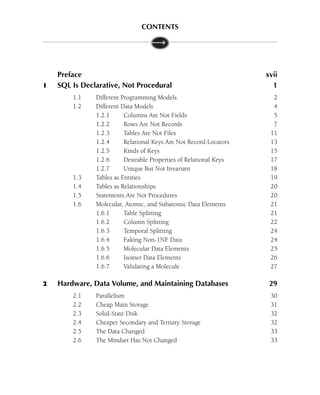
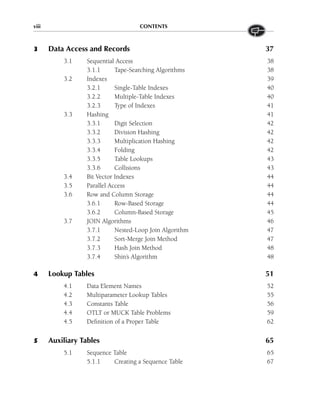
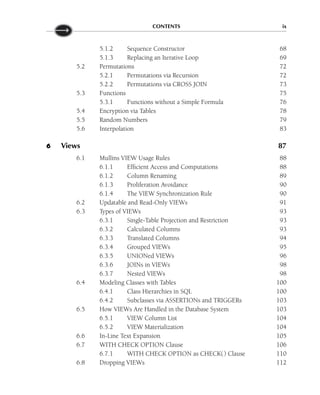
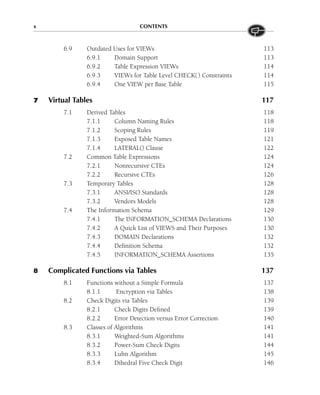
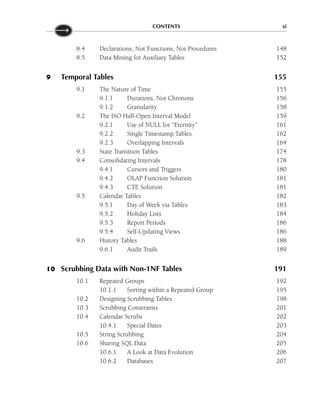
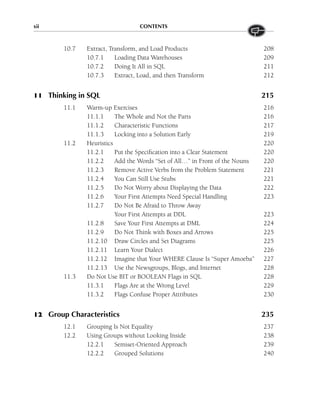
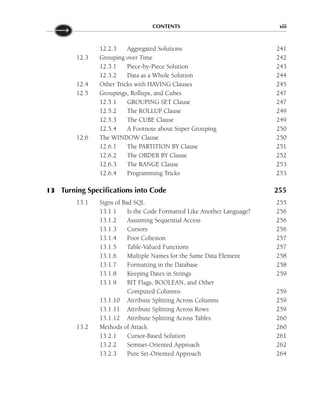
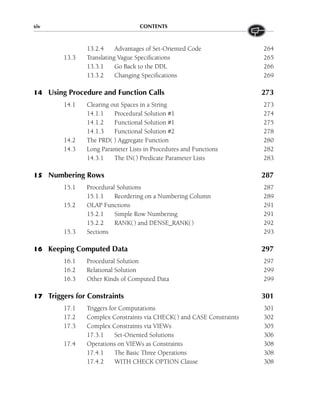
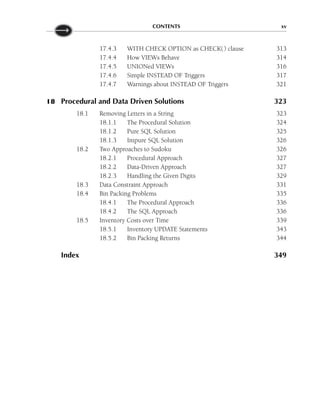


![1.2
1.3
...
When this question appeared in a newsgroup, the various solutions
included a recursive function, an external function, a proprietary name
parsing function, and an extra column for the sort order.
My solution is to pad each section with leading zeros and hope
I never have more than 99 headings. Most publishers have an acceptable
maximum depth of five levels.
00.00.
01.00.
01.01.
01.01.02.
etc.
You enforce this with SIMILAR TO predicate in the DDL rather than
trying to do it in the ORDER BY clause in the DML.
CREATE TABLE Outline
(section_nbr VARCHAR(15) NOT NULL PRIMARY KEY,
CHECK (section_nbr SIMILAR TO '[:digit:][:digit:].+'),
..);
When you want to display the section numbers without the leading
zeros, use a REPLACE() or TRANSLATE function in the query. We will
get to this principle in a later section.
In 25 words or less, columns are active and define themselves; fields
are passive and are interpreted by the application program.
1.2.2 Rows Are Not Records
Rows are not records. A record is defined in the application program
that reads it, just like the fields. The name of the field in the READ state-
ments of the application language tells the program where to put the
data. The physical order of the field names in the READ statement is vital.
That means “READ a, b, c;” is not the same as “READ c, a, b;”
because of the sequential order.
A row in a table is defined in the database schema and not by a pro-
gram at all. The columns are referenced by their names in the schema
and not by local program names or physical locations. That means
1.2 Different Data Models 7](https://image.slidesharecdn.com/510340-250531005527-5addf607/85/Thinking-In-Sets-Auxiliary-Temporal-And-Virtual-Tables-In-Sql-Celko-29-320.jpg)
![Ref: 0..999999;
Title: ARRAY [1..30] OF CHAR;
Author: ARRAY [1..16] OF CHAR;
Publisher: ARRAY [1..20] OF CHAR;
CASE Class: ItemClasses
OF Book: (Edition: 1..50; PubYear: 1400..2099);
CD: (Artist: ARRAY [1..30] OF CHAR;
END;
The ItemClasses is a flag that picks which branch of the CASE declara-
tion is to be used. The order of the declaration is important. You might
also note that the CASE declaration in Pascal was one of the sources for
the CASE expression in SQL.
Unions in C are another way of doing the same thing we saw done in
Pascal. This declaration:
union x {int ival; char j[4];} mystuff;
defines mystuff to be either an integer (which are 4 bytes on most
modern C compilers, but this code is nonportable) or an array of 4 bytes,
depending on whether you say mystuff.ival or mystuff.j [0].
As an aside, I tried to stick with the idioms of the languages—all
uppercase for COBOL, capitalized name in Pascal, and lowercase
in C. COBOL is all uppercase because it was first used on punch
cards, which only have uppercase. C was first written on Teletype
terminals for mini computers, which have a shift key, but the touch
is so hard and so long that you have to hit the keys vertically; you
cannot type with your fingertips. C was designed for two-finger
typists, pushing the keys with strokes from their elbows rather than
the wrist or fingertips. SQL and modern language idioms are based
on the ease of text formatters and electronic keyboards that respond
to fingertip touch.
Once more, the old technology is reflected in the next technology,
until eventually the new technology finds its voice. These styles of
formatting code are not the best practices for human readability, but
they were the easiest way of doing the job at the time. You can get some
details about human factors and readability in my other book, SQL
Programming Style (ISBN 0-12-088797-5).
The OCCURS keyword in Cobol, union in C, and the variant records
in Pascal have a number or flag that tells the program how to read a
record structure you input as bytes from left to right.
1.2 Different Data Models 9](https://image.slidesharecdn.com/510340-250531005527-5addf607/85/Thinking-In-Sets-Auxiliary-Temporal-And-Virtual-Tables-In-Sql-Celko-31-320.jpg)
![14 CHAPTER 1: SQL IS DECLARATIVE, NOT PROCEDURAL
of the industry standard VIN as the proper relational key. This is called
an insertion anomaly.
Assume that this pair of insertions led to creating vehicles with
pseudo-keys 41 and 42 in the table, which are the same actual
object. I can update 42’s mileage without touching 41. I now have
two versions of the truth in my table. This is a called an update
anomaly.
Likewise, if I wreck vehicle 41, I still have copy 42 in the motor pool
in spite of the fact that the actual object no longer exists. This is deletion
anomaly.
1.2.4.2 Uniqueness Is Ruined
Before you say that you can make a key from (auto-numbering, vin),
read more from Dr. E. F
. Codd: “If the primary key is composite and if
one of the columns is dropped from the primary key, the first property
[uniqueness] is no longer guaranteed.”
Assume that I have correct VINs and use (auto-numbering, vin) as
a key. Dropping the pair clearly does not work—a lot of vehicles could
have the same mileage and tire sizes, so I do not have unique rows guar-
anteed. Dropping the autonumber will leave me with a proper key that
can be validated, verified, and repeated.
Dropping the VIN does not leave me with a guarantee (i.e., repeat-
ability and predictability). If I run this code:
BEGIN ATOMIC
DELETE FROM Vehicles
WHERE id = 41;
INSERT INTO Vehicles (mileage, ..)
VALUES (<<values of #41>> );
END;
the relational algebra says that I should have in effect done nothing.
I have dropped and reinserted the same object—an EXCEPT and UNION
operation that cancel. But since autonumbering is physical and not
logical, this does not work.
If I insert the same vehicle (object) into another table, the system
will not guarantee me that I get the same autonumbering as the
relational key in the other table. The VIN would be guaranteed
constant in this schema and any other schema that needs to model a
vehicle.](https://image.slidesharecdn.com/510340-250531005527-5addf607/85/Thinking-In-Sets-Auxiliary-Temporal-And-Virtual-Tables-In-Sql-Celko-36-320.jpg)
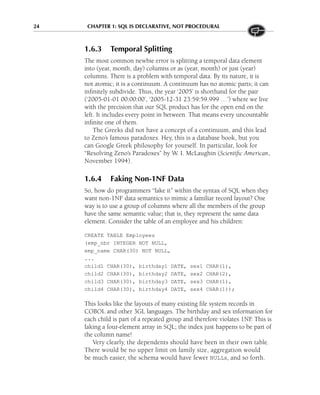
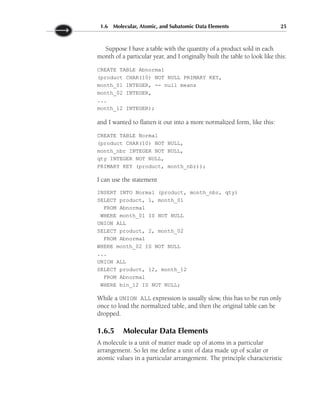
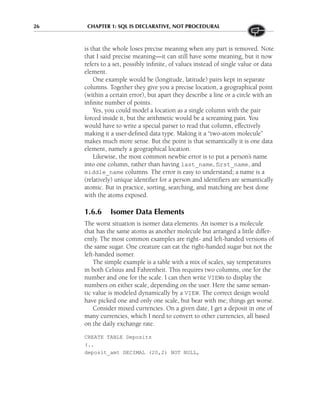
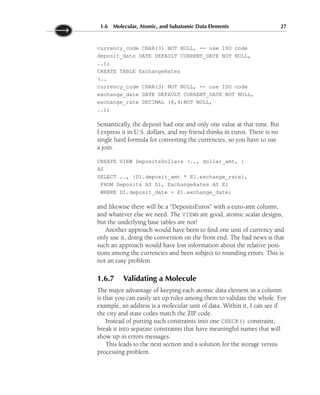

![AMAJOR FACTOR in data processing is that the hardware has changed
radically in the last few years. Moore’s Law is a rule of thumb that
computing speed doubles every 18 months; but the principle applies
to more than just processor speeds. All hardware is faster and cheaper
than it has ever been and it continues to get faster and cheaper.
Because storing data is cheaper, the volume of data is increasing.
The question for a database is how to keep up with the changes.
In an article entitled “A Conversation with Jim Gray” (Storage,
Vol. 1, No. 4, June 2003), Dave Patterson began the interview with
the question “What is the state of storage today [2003]?”
Jim Gray’s response was:
We have an embarrassment of riches in that we’re able to store
more than we can access. Capacities continue to double each
year, while access times are improving at 10 percent per year.
So, we have a vastly larger storage pool, with a relatively
narrow pipeline into it.
We’re not really geared for this. Having lots of RAM helps.
We can cache a lot in main memory and reduce secondary
storage access. But the fundamental problem is that we are
building a larger reservoir with more or less the same diameter
pipe coming out of the reservoir. We have a much harder time
accessing things inside the reservoir.
C H A P T E R
2
Hardware, Data Volume,
and Maintaining Databases](https://image.slidesharecdn.com/510340-250531005527-5addf607/85/Thinking-In-Sets-Auxiliary-Temporal-And-Virtual-Tables-In-Sql-Celko-51-320.jpg)
![[61] 18/10 1885.
[62] 24/10 1885.
[63] 25/10 1885.
[64] 14/10 1885.
[65] 28/10 1885.
[66] Ellen Key, Ernst Ahlgren, s. 41.
[67] Ellen Key, Ernst Ahlgren, s. 43.
[68] 5/11 1885.
[69] 12/11 1885.
[70] Ellen Key, Ernst Ahlgren, s. 44.
[71] 3/11 1885.
[72] 5/11 1885.
[73] Tammik. 1886.
[74] 3/2 1886.
[75] 3/2 1886.
[76] 21/5 1886.
[77] 1887.
[78] 24/2 1886.
[79] 18/2 1886.
[80] 13/4 1886.
[81] 24/2 1886.
[82] 24/2 1886.
[83] 27/3 1886.
[84] 5/6 1886.
[85] 16/8 1886.
[86] 1/11 1886.
[87] 20/9 1886.
[88] 20/9 1886.
[89] 20/9 1886.
[90] Maalisk. 1887.](https://image.slidesharecdn.com/510340-250531005527-5addf607/85/Thinking-In-Sets-Auxiliary-Temporal-And-Virtual-Tables-In-Sql-Celko-56-320.jpg)
![[91] 5/6 1886.
[92] Marrask. 1887.
[93] 5/12 1886.
[94] 20/8 1886.
[95] 1/10 1886.
[96] 8/12 1886.
[97] 4/2 1887.
[98] Helmik. 1887.
[99] Helmik. 1887.
[100] 24/5 1887.
[101] 23/6 1887.
[102] 12/7 1887.
[103] 22/7 1888.
[104] 15/4 1887.
[105] 11/5 1887.
[106] 10/6 1887.
[107] Maalisk. 1889.
[108] 24/5 1887.
[109] 24/5 18S7.
[110] 1/7 1887.
[111] 2/7 1887.
[112] 12/7 1887.
[113] 12/7 1887.
[114] 25/6 1887.
[115] 30/6 1887.
[116] 25/6 1887.
[117] 30/6 1887.
[118] 8/7 1887.
[119] 3/8 1887.
[120] 6/9 1887.](https://image.slidesharecdn.com/510340-250531005527-5addf607/85/Thinking-In-Sets-Auxiliary-Temporal-And-Virtual-Tables-In-Sql-Celko-57-320.jpg)
![[121] 6/8 1887.
[122] 23/1 1887.
[123] 10/10 1887.
[124] 18/6 1887.
[125] Göteborgs Handels och Sjöfarts Tidning 22/6 1887.
[126] 1887.
[127] Kesäkuu 1887.
[128] 15/9 1887.
[129] Jyllandsposten 3/7 1887.
[130] Dagens Nyheder 4/6 1887.
[131] 13/6 1887.
[132] 9/6 1887
[133] 21/10 1885.
[134] 7/2 1887.
[135] 1888.
[136] N:o 11, 12, 1887.
[137] 19/12 1887, Julkaistu myös G. Brandesin kootuissa
teoksissa III, s. 679.
[138] Toukok. 1887.
[139] 6/12 1887.
[140] 10/3 1888.
[141] 31/3 1888.
[142] Huhtik. 1888.
[143] 17/3 1888.
[144] 28/5 1888.
[145] 11/6 1888.
[146] 14/6 18S8.
[147] 2/6 1888.
[148] 8/6 1888.
[149] 29/8 1888.](https://image.slidesharecdn.com/510340-250531005527-5addf607/85/Thinking-In-Sets-Auxiliary-Temporal-And-Virtual-Tables-In-Sql-Celko-58-320.jpg)