Read Anytime Anywhere Easy Ebook Downloads at ebookmeta.com
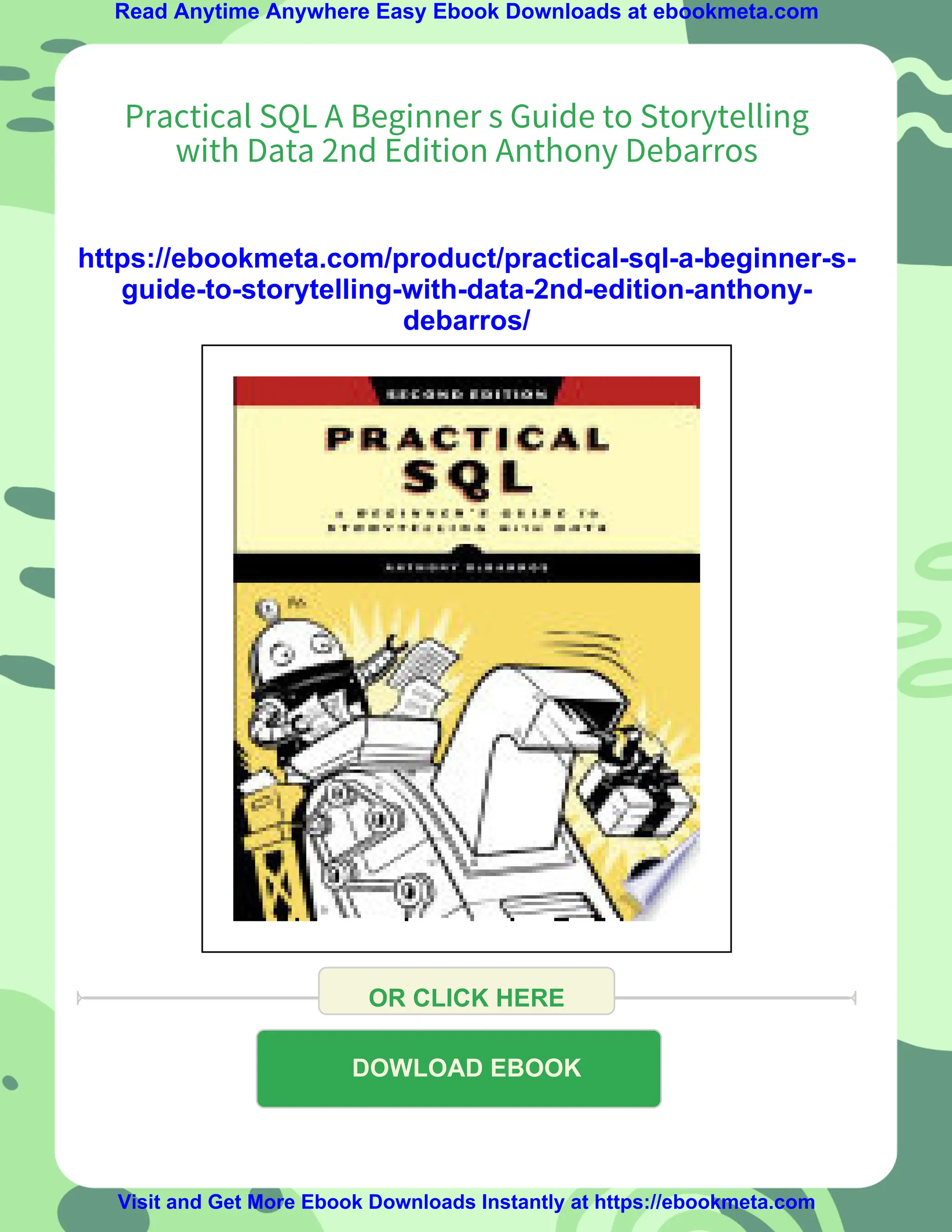
Practical SQL A Beginner s Guide to Storytelling
with Data 2nd Edition Anthony Debarros
https://ebookmeta.com/product/practical-sql-a-beginner-s-
guide-to-storytelling-with-data-2nd-edition-anthony-
debarros/
OR CLICK HERE
DOWLOAD EBOOK
Visit and Get More Ebook Downloads Instantly at https://ebookmeta.com
Recommended digital products (PDF, EPUB, MOBI) that
you can download immediately if you are interested.
Practical SQL A Beginner s Guide to Storytelling with Data
2nd Edition Anthony Debarros
https://ebookmeta.com/product/practical-sql-a-beginner-s-guide-to-
storytelling-with-data-2nd-edition-anthony-debarros/
ebookmeta.com
Practical SQL: A Beginner's Guide to Storytelling with
Data, 2nd Edition Anthony Debarros
https://ebookmeta.com/product/practical-sql-a-beginners-guide-to-
storytelling-with-data-2nd-edition-anthony-debarros/
ebookmeta.com
SQL QuickStart Guide The Simplified Beginner s Guide to
Managing Analyzing and Manipulating Data With SQL Walter
Shields
https://ebookmeta.com/product/sql-quickstart-guide-the-simplified-
beginner-s-guide-to-managing-analyzing-and-manipulating-data-with-sql-
walter-shields/
ebookmeta.com
Mathematics Mathematics HL Option Discrete Mathematics 1st
Edition Catherine Quinn Peter Blythe Chris Sangwin Robert
Haese Michael Haese
https://ebookmeta.com/product/mathematics-mathematics-hl-option-
discrete-mathematics-1st-edition-catherine-quinn-peter-blythe-chris-
sangwin-robert-haese-michael-haese/
ebookmeta.com
Nothing s Worse Than A Clown Gone Bad 1st Edition Ponk
Vonsydow
https://ebookmeta.com/product/nothing-s-worse-than-a-clown-gone-
bad-1st-edition-ponk-vonsydow/
ebookmeta.com
Revenge Of Her Wolves Tara West
https://ebookmeta.com/product/revenge-of-her-wolves-tara-west/
ebookmeta.com
Demystifying the Order from Above 1st Edition Lubogo Isaac
Christopher
https://ebookmeta.com/product/demystifying-the-order-from-above-1st-
edition-lubogo-isaac-christopher/
ebookmeta.com
Blockchain and the Supply Chain: Concepts, Strategies and
Practical Applications, 2nd Edition Nick Vyas
https://ebookmeta.com/product/blockchain-and-the-supply-chain-
concepts-strategies-and-practical-applications-2nd-edition-nick-vyas/
ebookmeta.com
A Warning for Fair Women Adultery and Murder in
Shakespeare s Theater 1st Edition Ann C Christensen
https://ebookmeta.com/product/a-warning-for-fair-women-adultery-and-
murder-in-shakespeare-s-theater-1st-edition-ann-c-christensen/
ebookmeta.com
Contemporary Strategy : Theories and Policies 1st Edition
John Baylis
https://ebookmeta.com/product/contemporary-strategy-theories-and-
policies-1st-edition-john-baylis/
ebookmeta.com
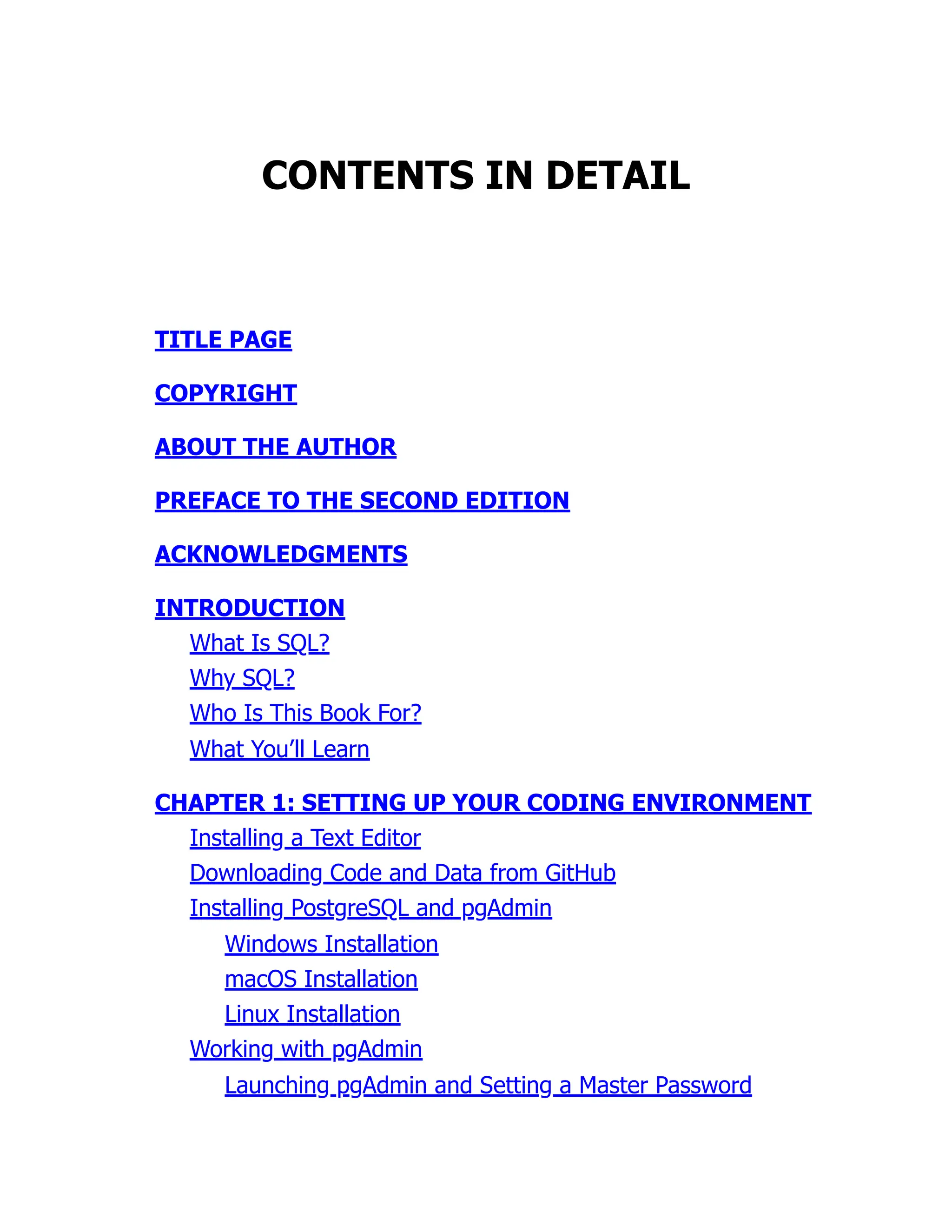
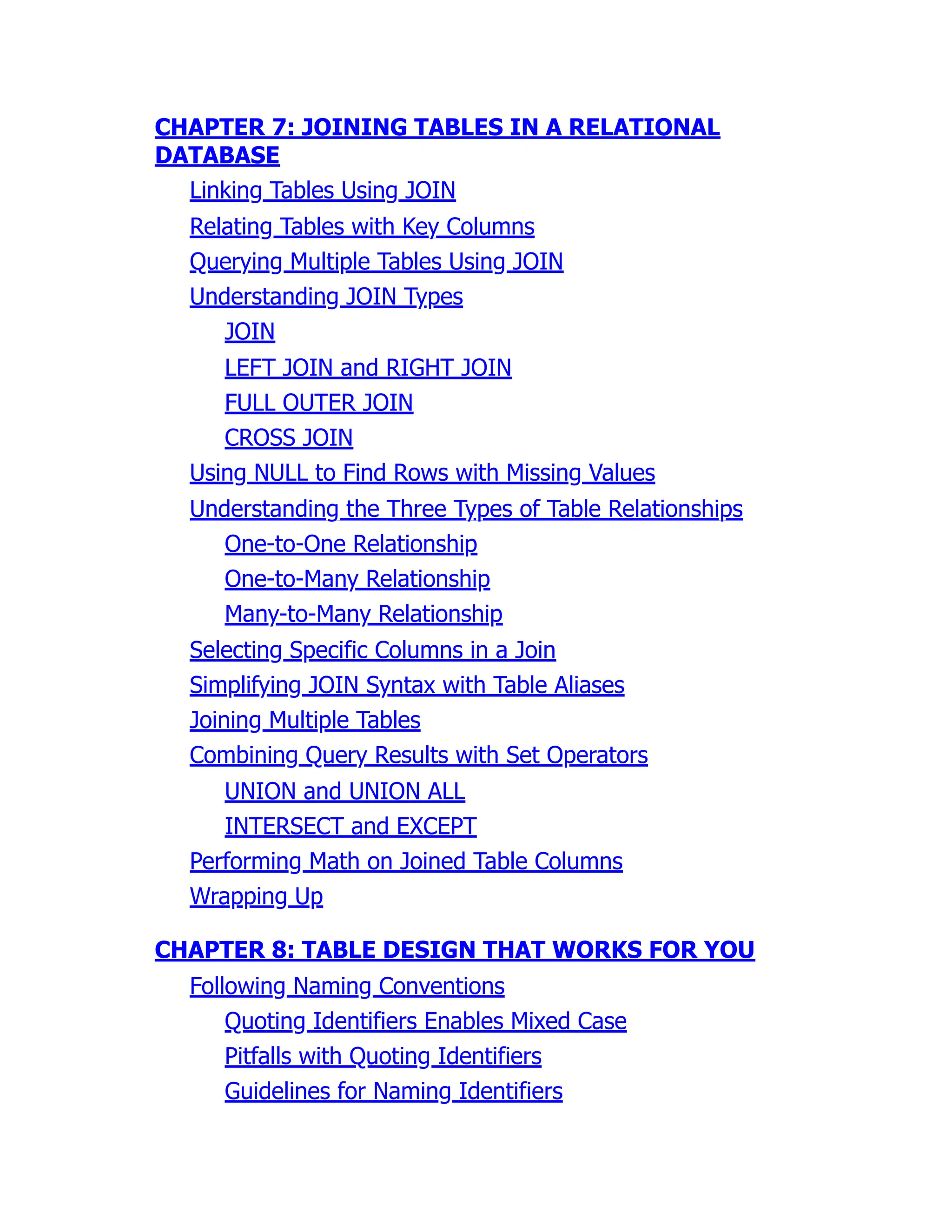
CONTENTS IN DETAIL
TITLE PAGE
COPYRIGHT
ABOUT THE AUTHOR
PREFACE TO THE SECOND EDITION
ACKNOWLEDGMENTS
INTRODUCTION
What Is SQL?
Why SQL?
Who Is This Book For?
What You’ll Learn
CHAPTER 1: SETTING UP YOUR CODING ENVIRONMENT
Installing a Text Editor
Downloading Code and Data from GitHub
Installing PostgreSQL and pgAdmin
Windows Installation
macOS Installation
Linux Installation
Working with pgAdmin
Launching pgAdmin and Setting a Master Password
Connecting to the Default postgres Database
Exploring the Query Tool
Customizing pgAdmin
Alternatives to pgAdmin
Wrapping Up
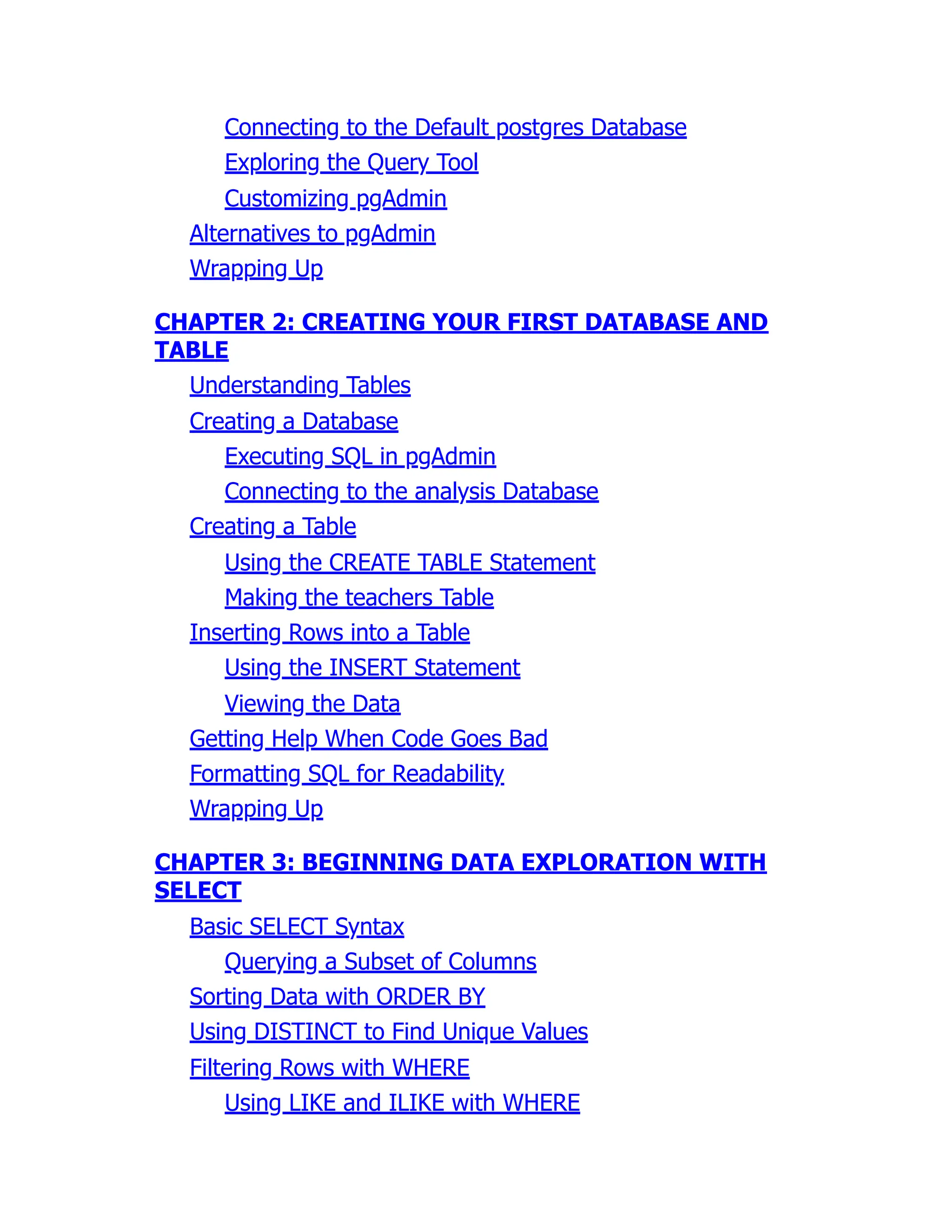
CHAPTER 2: CREATING YOUR FIRST DATABASE AND
TABLE
Understanding Tables
Creating a Database
Executing SQL in pgAdmin
Connecting to the analysis Database
Creating a Table
Using the CREATE TABLE Statement
Making the teachers Table
Inserting Rows into a Table
Using the INSERT Statement
Viewing the Data
Getting Help When Code Goes Bad
Formatting SQL for Readability
Wrapping Up
CHAPTER 3: BEGINNING DATA EXPLORATION WITH
SELECT
Basic SELECT Syntax
Querying a Subset of Columns
Sorting Data with ORDER BY
Using DISTINCT to Find Unique Values
Filtering Rows with WHERE
Using LIKE and ILIKE with WHERE
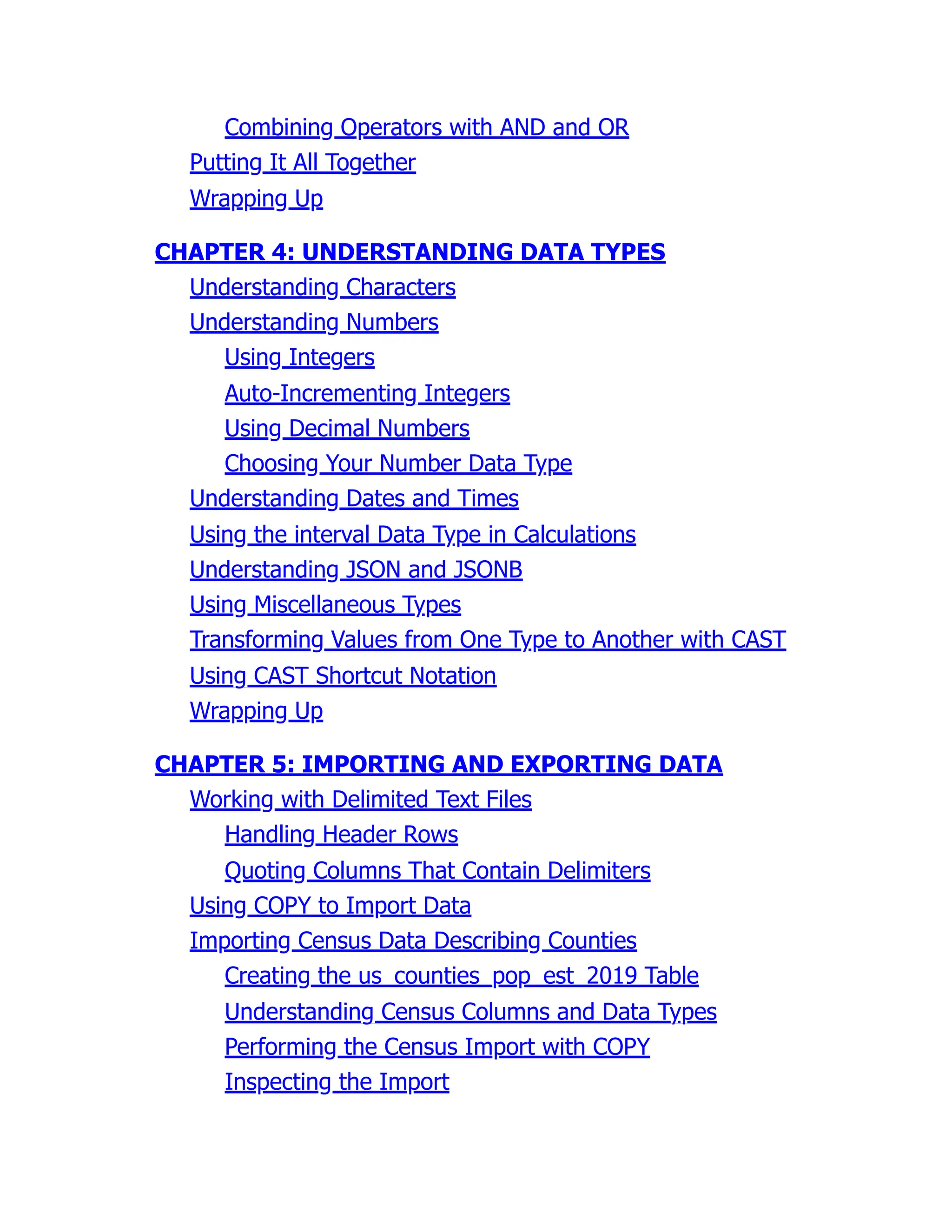
Combining Operators with AND and OR
Putting It All Together
Wrapping Up
CHAPTER 4: UNDERSTANDING DATA TYPES
Understanding Characters
Understanding Numbers
Using Integers
Auto-Incrementing Integers
Using Decimal Numbers
Choosing Your Number Data Type
Understanding Dates and Times
Using the interval Data Type in Calculations
Understanding JSON and JSONB
Using Miscellaneous Types
Transforming Values from One Type to Another with CAST
Using CAST Shortcut Notation
Wrapping Up
CHAPTER 5: IMPORTING AND EXPORTING DATA
Working with Delimited Text Files
Handling Header Rows
Quoting Columns That Contain Delimiters
Using COPY to Import Data
Importing Census Data Describing Counties
Creating the us_counties_pop_est_2019 Table
Understanding Census Columns and Data Types
Performing the Census Import with COPY
Inspecting the Import
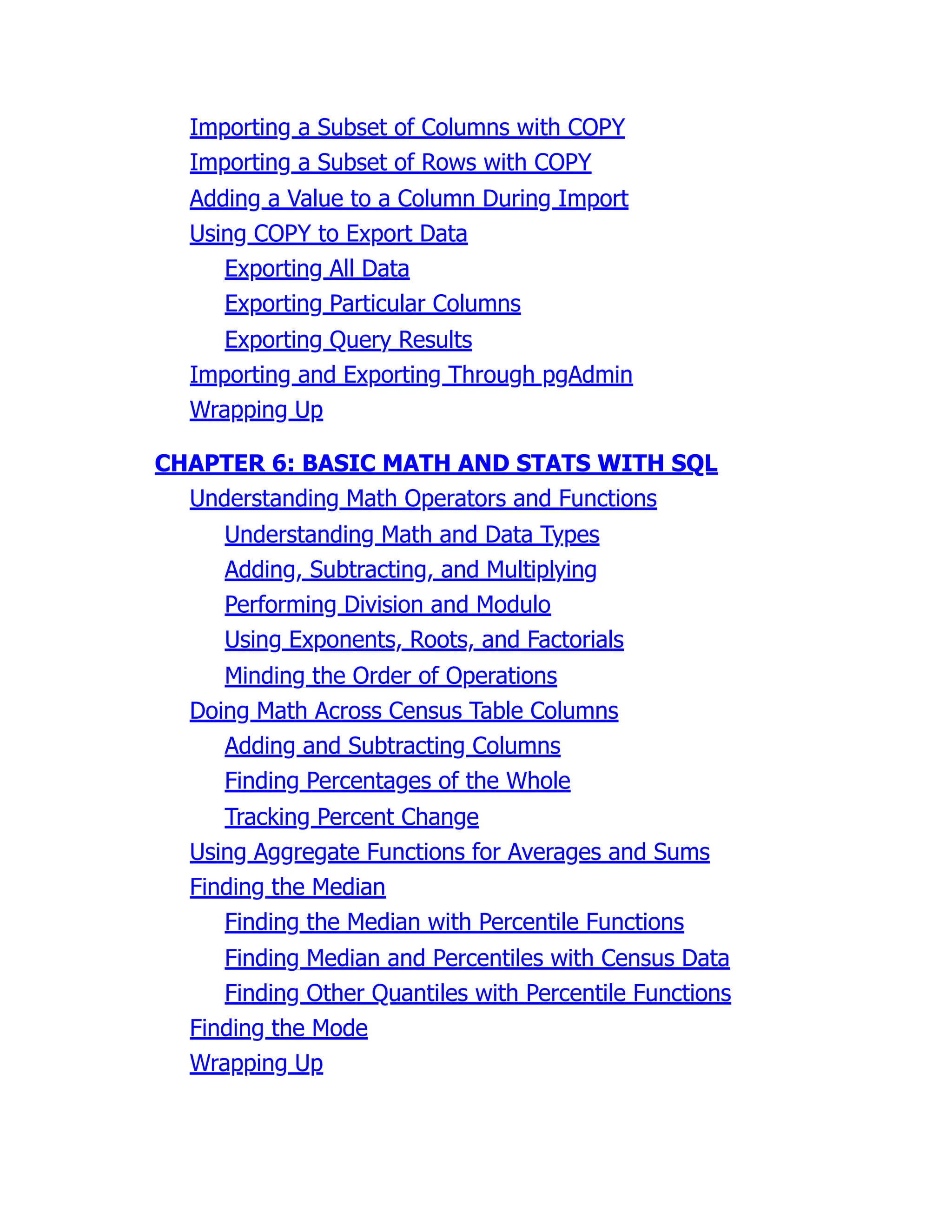
Importing a Subset of Columns with COPY
Importing a Subset of Rows with COPY
Adding a Value to a Column During Import
Using COPY to Export Data
Exporting All Data
Exporting Particular Columns
Exporting Query Results
Importing and Exporting Through pgAdmin
Wrapping Up
CHAPTER 6: BASIC MATH AND STATS WITH SQL
Understanding Math Operators and Functions
Understanding Math and Data Types
Adding, Subtracting, and Multiplying
Performing Division and Modulo
Using Exponents, Roots, and Factorials
Minding the Order of Operations
Doing Math Across Census Table Columns
Adding and Subtracting Columns
Finding Percentages of the Whole
Tracking Percent Change
Using Aggregate Functions for Averages and Sums
Finding the Median
Finding the Median with Percentile Functions
Finding Median and Percentiles with Census Data
Finding Other Quantiles with Percentile Functions
Finding the Mode
Wrapping Up
CHAPTER 7: JOINING TABLES IN A RELATIONAL
DATABASE
Linking Tables Using JOIN
Relating Tables with Key Columns
Querying Multiple Tables Using JOIN
Understanding JOIN Types
JOIN
LEFT JOIN and RIGHT JOIN
FULL OUTER JOIN
CROSS JOIN
Using NULL to Find Rows with Missing Values
Understanding the Three Types of Table Relationships
One-to-One Relationship
One-to-Many Relationship
Many-to-Many Relationship
Selecting Specific Columns in a Join
Simplifying JOIN Syntax with Table Aliases
Joining Multiple Tables
Combining Query Results with Set Operators
UNION and UNION ALL
INTERSECT and EXCEPT
Performing Math on Joined Table Columns
Wrapping Up
CHAPTER 8: TABLE DESIGN THAT WORKS FOR YOU
Following Naming Conventions
Quoting Identifiers Enables Mixed Case
Pitfalls with Quoting Identifiers
Guidelines for Naming Identifiers
Controlling Column Values with Constraints
Primary Keys: Natural vs. Surrogate
Foreign Keys
How to Automatically Delete Related Records with
CASCADE
The CHECK Constraint
The UNIQUE Constraint
The NOT NULL Constraint
How to Remove Constraints or Add Them Later
Speeding Up Queries with Indexes
B-Tree: PostgreSQL’s Default Index
Considerations When Using Indexes
Wrapping Up
CHAPTER 9: EXTRACTING INFORMATION BY GROUPING
AND SUMMARIZING
Creating the Library Survey Tables
Creating the 2018 Library Data Table
Creating the 2017 and 2016 Library Data Tables
Exploring the Library Data Using Aggregate Functions
Counting Rows and Values Using count()
Finding Maximum and Minimum Values Using max() and
min()
Aggregating Data Using GROUP BY
Wrapping Up
CHAPTER 10: INSPECTING AND MODIFYING DATA
Importing Data on Meat, Poultry, and Egg Producers
Interviewing the Dataset
Checking for Missing Values
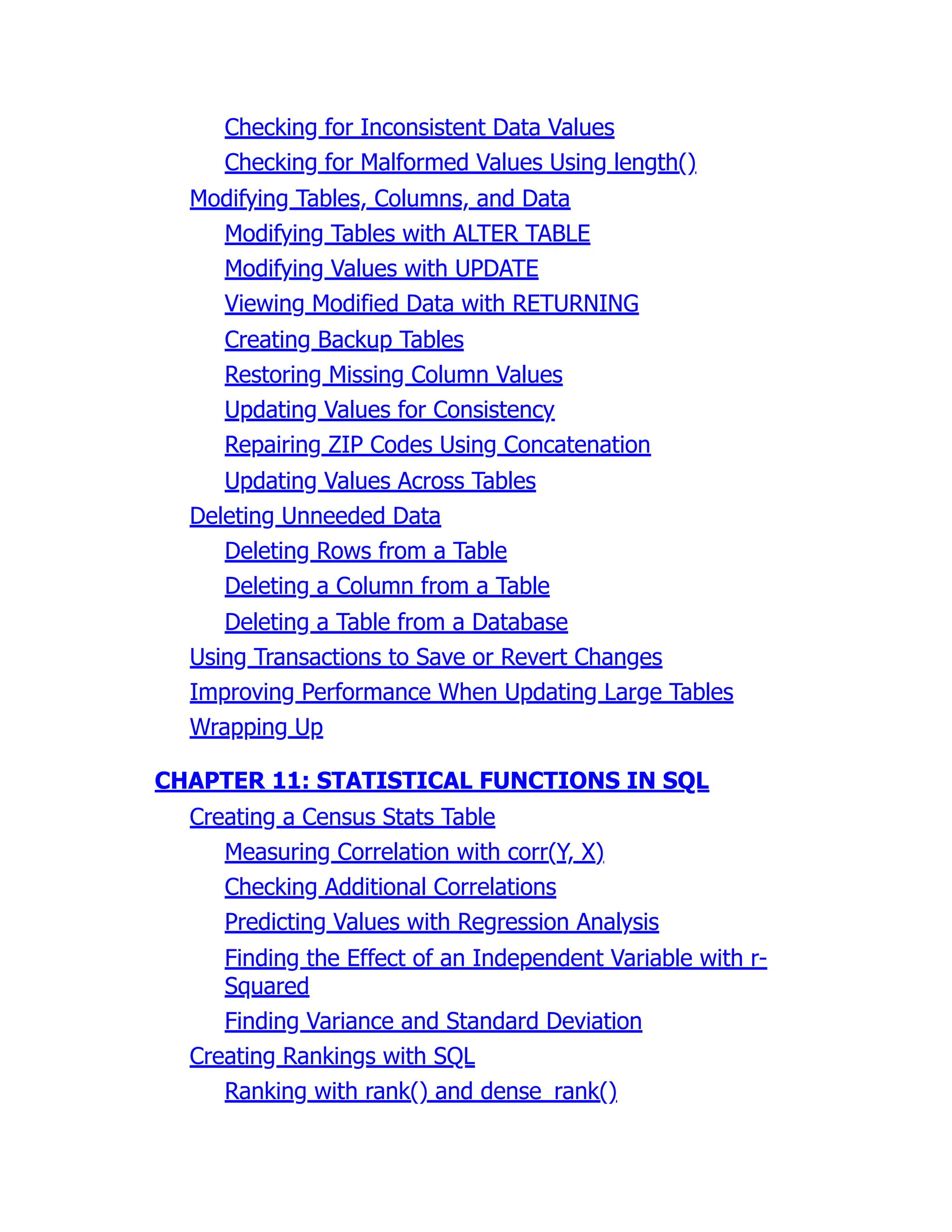
Checking for Inconsistent Data Values
Checking for Malformed Values Using length()
Modifying Tables, Columns, and Data
Modifying Tables with ALTER TABLE
Modifying Values with UPDATE
Viewing Modified Data with RETURNING
Creating Backup Tables
Restoring Missing Column Values
Updating Values for Consistency
Repairing ZIP Codes Using Concatenation
Updating Values Across Tables
Deleting Unneeded Data
Deleting Rows from a Table
Deleting a Column from a Table
Deleting a Table from a Database
Using Transactions to Save or Revert Changes
Improving Performance When Updating Large Tables
Wrapping Up
CHAPTER 11: STATISTICAL FUNCTIONS IN SQL
Creating a Census Stats Table
Measuring Correlation with corr(Y, X)
Checking Additional Correlations
Predicting Values with Regression Analysis
Finding the Effect of an Independent Variable with r-
Squared
Finding Variance and Standard Deviation
Creating Rankings with SQL
Ranking with rank() and dense_rank()
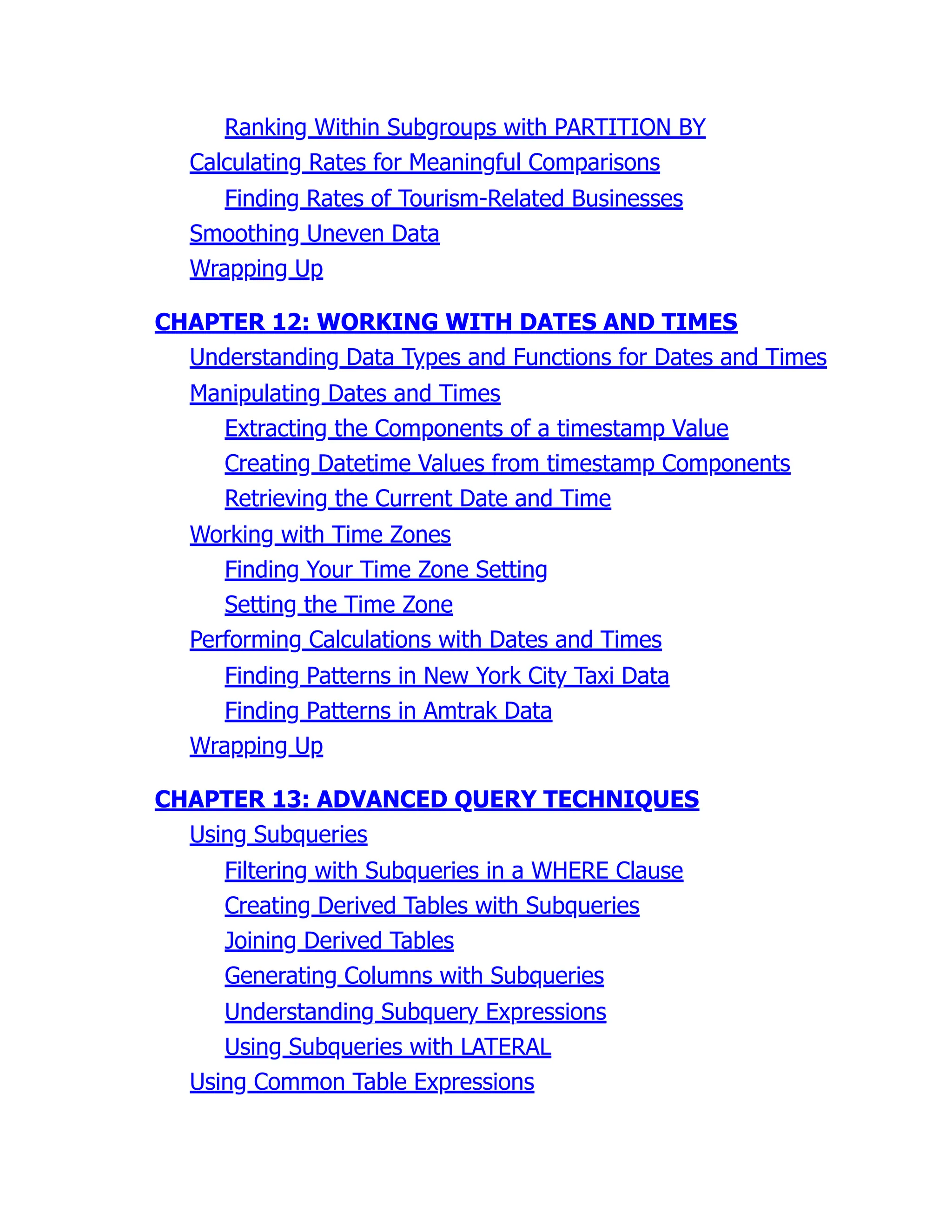
Ranking Within Subgroups with PARTITION BY
Calculating Rates for Meaningful Comparisons
Finding Rates of Tourism-Related Businesses
Smoothing Uneven Data
Wrapping Up
CHAPTER 12: WORKING WITH DATES AND TIMES
Understanding Data Types and Functions for Dates and Times
Manipulating Dates and Times
Extracting the Components of a timestamp Value
Creating Datetime Values from timestamp Components
Retrieving the Current Date and Time
Working with Time Zones
Finding Your Time Zone Setting
Setting the Time Zone
Performing Calculations with Dates and Times
Finding Patterns in New York City Taxi Data
Finding Patterns in Amtrak Data
Wrapping Up
CHAPTER 13: ADVANCED QUERY TECHNIQUES
Using Subqueries
Filtering with Subqueries in a WHERE Clause
Creating Derived Tables with Subqueries
Joining Derived Tables
Generating Columns with Subqueries
Understanding Subquery Expressions
Using Subqueries with LATERAL
Using Common Table Expressions
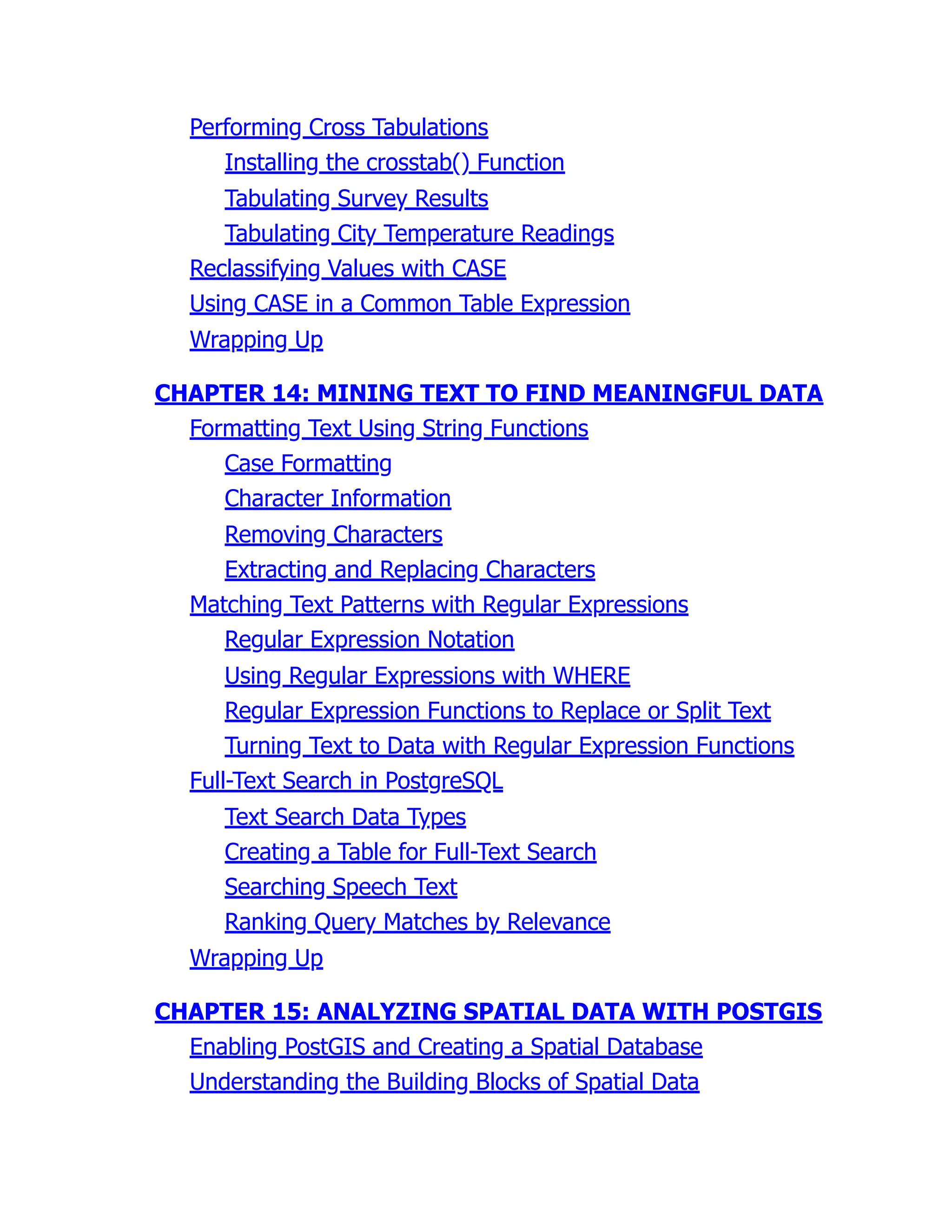
Performing Cross Tabulations
Installing the crosstab() Function
Tabulating Survey Results
Tabulating City Temperature Readings
Reclassifying Values with CASE
Using CASE in a Common Table Expression
Wrapping Up
CHAPTER 14: MINING TEXT TO FIND MEANINGFUL DATA
Formatting Text Using String Functions
Case Formatting
Character Information
Removing Characters
Extracting and Replacing Characters
Matching Text Patterns with Regular Expressions
Regular Expression Notation
Using Regular Expressions with WHERE
Regular Expression Functions to Replace or Split Text
Turning Text to Data with Regular Expression Functions
Full-Text Search in PostgreSQL
Text Search Data Types
Creating a Table for Full-Text Search
Searching Speech Text
Ranking Query Matches by Relevance
Wrapping Up
CHAPTER 15: ANALYZING SPATIAL DATA WITH POSTGIS
Enabling PostGIS and Creating a Spatial Database
Understanding the Building Blocks of Spatial Data
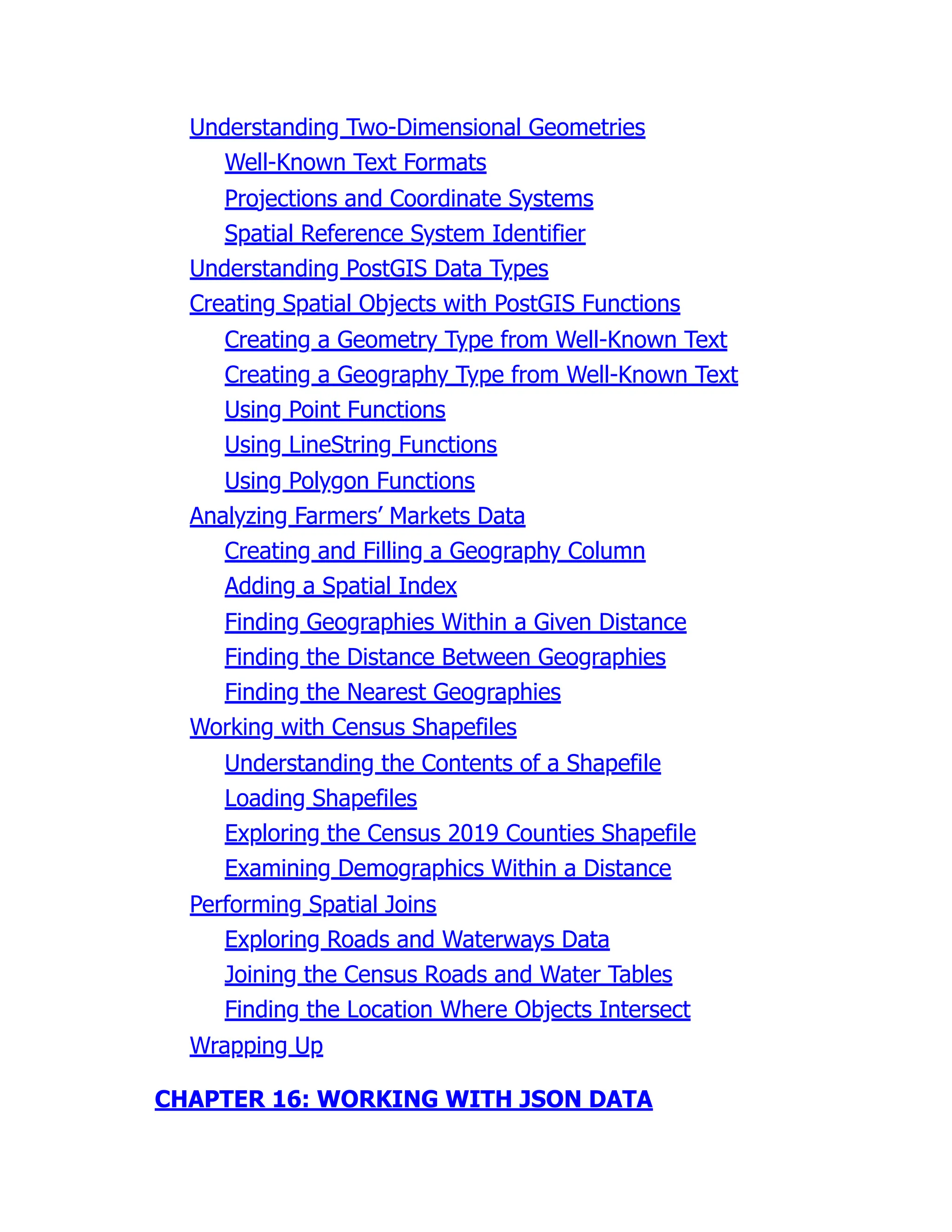
Understanding Two-Dimensional Geometries
Well-Known Text Formats
Projections and Coordinate Systems
Spatial Reference System Identifier
Understanding PostGIS Data Types
Creating Spatial Objects with PostGIS Functions
Creating a Geometry Type from Well-Known Text
Creating a Geography Type from Well-Known Text
Using Point Functions
Using LineString Functions
Using Polygon Functions
Analyzing Farmers’ Markets Data
Creating and Filling a Geography Column
Adding a Spatial Index
Finding Geographies Within a Given Distance
Finding the Distance Between Geographies
Finding the Nearest Geographies
Working with Census Shapefiles
Understanding the Contents of a Shapefile
Loading Shapefiles
Exploring the Census 2019 Counties Shapefile
Examining Demographics Within a Distance
Performing Spatial Joins
Exploring Roads and Waterways Data
Joining the Census Roads and Water Tables
Finding the Location Where Objects Intersect
Wrapping Up
CHAPTER 16: WORKING WITH JSON DATA
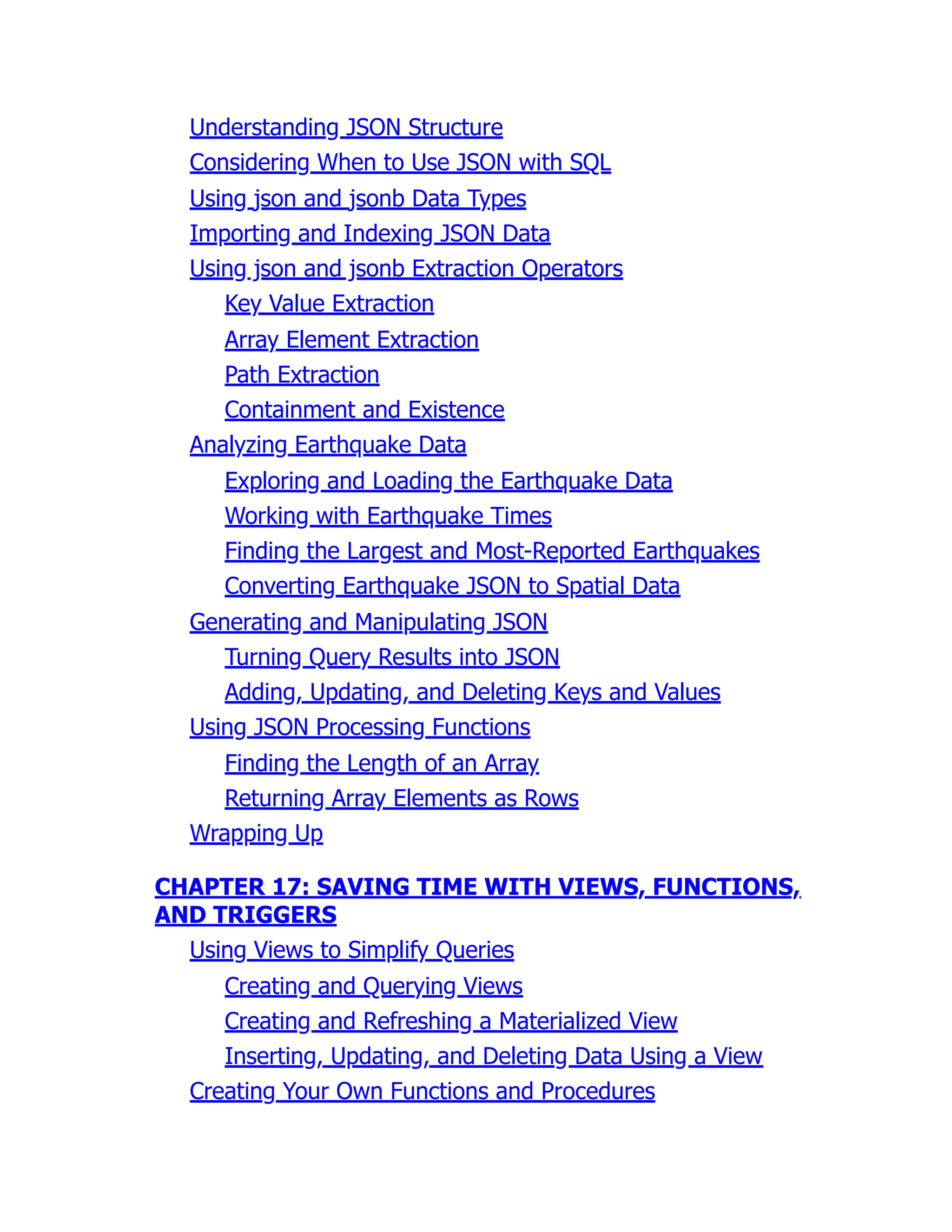
Understanding JSON Structure
Considering When to Use JSON with SQL
Using json and jsonb Data Types
Importing and Indexing JSON Data
Using json and jsonb Extraction Operators
Key Value Extraction
Array Element Extraction
Path Extraction
Containment and Existence
Analyzing Earthquake Data
Exploring and Loading the Earthquake Data
Working with Earthquake Times
Finding the Largest and Most-Reported Earthquakes
Converting Earthquake JSON to Spatial Data
Generating and Manipulating JSON
Turning Query Results into JSON
Adding, Updating, and Deleting Keys and Values
Using JSON Processing Functions
Finding the Length of an Array
Returning Array Elements as Rows
Wrapping Up
CHAPTER 17: SAVING TIME WITH VIEWS, FUNCTIONS,
AND TRIGGERS
Using Views to Simplify Queries
Creating and Querying Views
Creating and Refreshing a Materialized View
Inserting, Updating, and Deleting Data Using a View
Creating Your Own Functions and Procedures
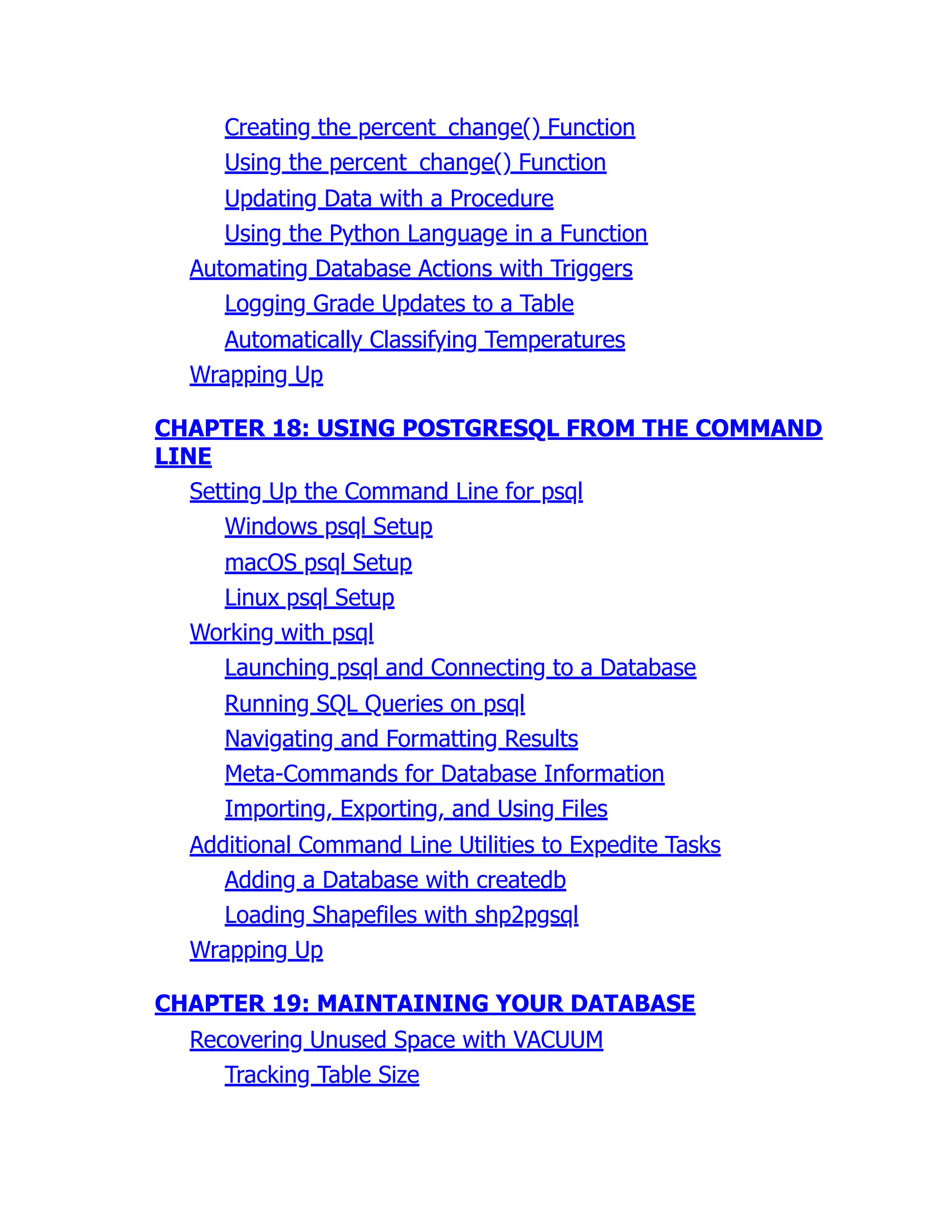
Creating the percent_change() Function
Using the percent_change() Function
Updating Data with a Procedure
Using the Python Language in a Function
Automating Database Actions with Triggers
Logging Grade Updates to a Table
Automatically Classifying Temperatures
Wrapping Up
CHAPTER 18: USING POSTGRESQL FROM THE COMMAND
LINE
Setting Up the Command Line for psql
Windows psql Setup
macOS psql Setup
Linux psql Setup
Working with psql
Launching psql and Connecting to a Database
Running SQL Queries on psql
Navigating and Formatting Results
Meta-Commands for Database Information
Importing, Exporting, and Using Files
Additional Command Line Utilities to Expedite Tasks
Adding a Database with createdb
Loading Shapefiles with shp2pgsql
Wrapping Up
CHAPTER 19: MAINTAINING YOUR DATABASE
Recovering Unused Space with VACUUM
Tracking Table Size
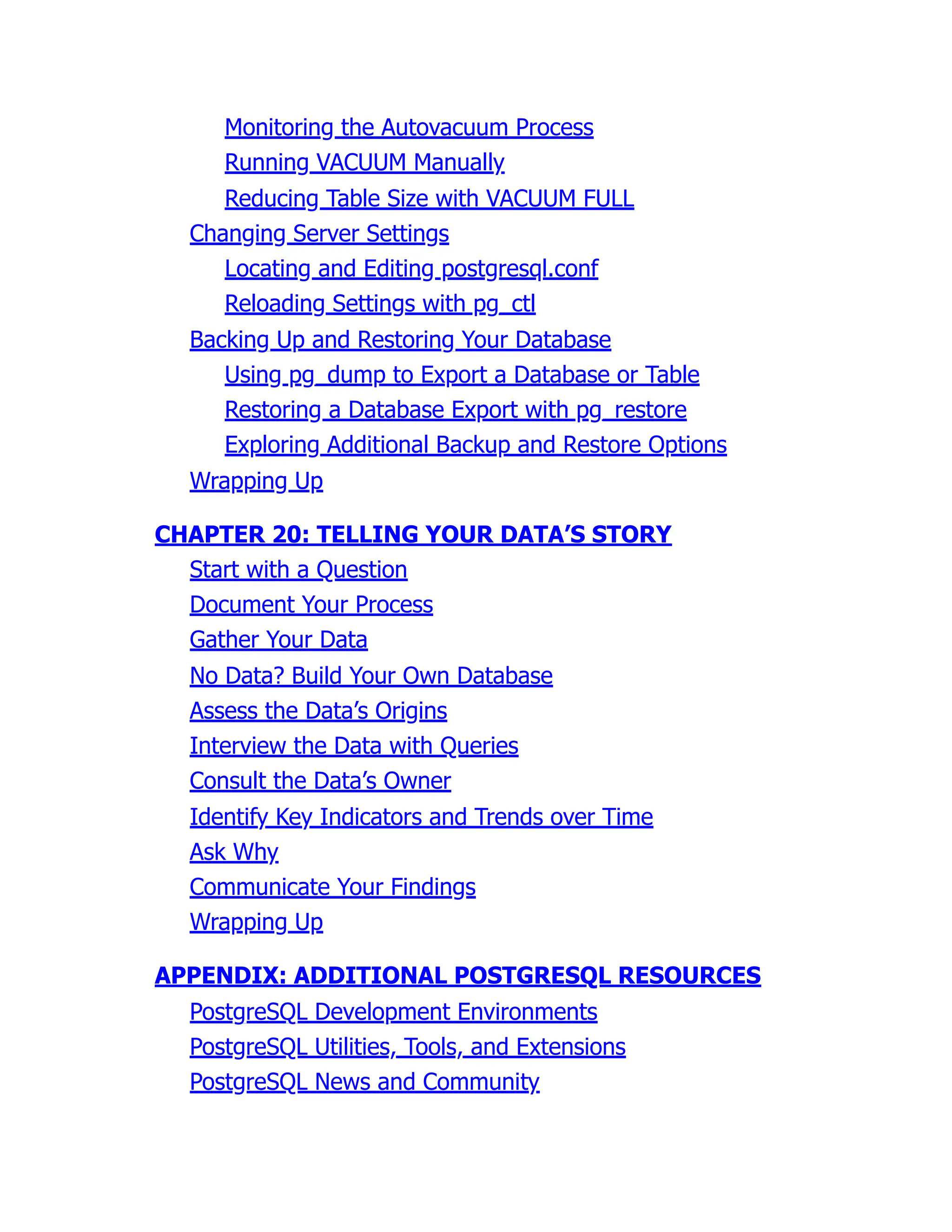
Monitoring the Autovacuum Process
Running VACUUM Manually
Reducing Table Size with VACUUM FULL
Changing Server Settings
Locating and Editing postgresql.conf
Reloading Settings with pg_ctl
Backing Up and Restoring Your Database
Using pg_dump to Export a Database or Table
Restoring a Database Export with pg_restore
Exploring Additional Backup and Restore Options
Wrapping Up
CHAPTER 20: TELLING YOUR DATA’S STORY
Start with a Question
Document Your Process
Gather Your Data
No Data? Build Your Own Database
Assess the Data’s Origins
Interview the Data with Queries
Consult the Data’s Owner
Identify Key Indicators and Trends over Time
Ask Why
Communicate Your Findings
Wrapping Up
APPENDIX: ADDITIONAL POSTGRESQL RESOURCES
PostgreSQL Development Environments
PostgreSQL Utilities, Tools, and Extensions
PostgreSQL News and Community
Documentation
INDEX
PRACTICAL SQL
2nd Edition
A Beginner’s Guide to Storytelling
with Data
by Anthony DeBarros
PRACTICAL SQL, 2ND EDITION. Copyright © 2022 by Anthony DeBarros.
All rights reserved. No part of this work may be reproduced or transmitted in any
form or by any means, electronic or mechanical, including photocopying,
recording, or by any information storage or retrieval system, without the prior
written permission of the copyright owner and the publisher.
Printed in the United States of America
First printing
25 24 23 22 21 1 2 3 4 5 6 7 8 9
ISBN-13: 978-1-7185-0106-5 (print)
ISBN-13: 978-1-7185-0107-2 (ebook)
Publisher: William Pollock
Managing Editor: Jill Franklin
Production Manager: Rachel Monaghan
Production Editors: Jennifer Kepler and Paula Williamson
Developmental Editor: Liz Chadwick
Cover Illustrator: Josh Ellingson
Interior Design: Octopod Studios
Technical Reviewer: Stephen Frost
Copyeditor: Kim Wimpsett
Compositor: Maureen Forys, Happenstance Type-O-Rama
Proofreader: Liz Wheeler
For information on book distributors or translations, please contact No Starch
Press, Inc. directly:
No Starch Press, Inc.
245 8th Street, San Francisco, CA 94103
phone: 1.415.863.9900; info@nostarch.com
www.nostarch.com
The Library of Congress has catalogued the first edition as follows:
Names: DeBarros, Anthony, author.
Title: Practical SQL : a beginner's guide to storytelling with data / Anthony
DeBarros.
Description: San Francisco : No Starch Press, 2018. | Includes index.
Identifiers: LCCN 2018000030 (print) | LCCN 2017043947 (ebook) | ISBN 9781593278458
(epub) | ISBN
1593278454 (epub) | ISBN 9781593278274 (paperback) | ISBN 1593278276 (paperback)
| ISBN 9781593278458
(ebook)
Subjects: LCSH: SQL (Computer program language) | Database design. | BISAC:
COMPUTERS / Programming
Languages / SQL. | COMPUTERS / Database Management / General. | COMPUTERS /
Database Management
/ Data Mining.
Classification: LCC QA76.73.S67 (print) | LCC QA76.73.S67 D44 2018 (ebook) | DDC
005.75/6--dc23
LC record available at https://lccn.loc.gov/2018000030
No Starch Press and the No Starch Press logo are registered trademarks of No
Starch Press, Inc. Other product and company names mentioned herein may be
the trademarks of their respective owners. Rather than use a trademark symbol
with every occurrence of a trademarked name, we are using the names only in an
editorial fashion and to the benefit of the trademark owner, with no intention of
infringement of the trademark.
The information in this book is distributed on an “As Is” basis, without warranty.
While every precaution has been taken in the preparation of this work, neither the
author nor No Starch Press, Inc. shall have any liability to any person or entity
with respect to any loss or damage caused or alleged to be caused directly or
indirectly by the information contained in it.
About the Author
Anthony DeBarros is a longtime journalist and early adopter of “data
journalism,” the use of spreadsheets, databases, and code to find
news in data. He’s currently a data editor for the Wall Street
Journal, where he covers topics including the economy, trade,
demographics, and the Covid-19 pandemic. Previously, he worked
for the Gannett company at USA Today and the Poughkeepsie
Journal and held product development and content strategy roles for
Questex and DocumentCloud.
About the Technical Reviewer
Stephen Frost is the chief technology officer at Crunchy Data. He has
been working with PostgreSQL since 2003 and general database
technology since before then. Stephen began contributing to
PostgreSQL development in 2004 and has been involved in the
development of the role system, column-level privileges, row-level
security, GSSAPI encryption, and the predefined roles system. He
has also served on the board of the United States PostgreSQL
Association and Software in the Public Interest, regularly speaks at
PostgreSQL Community conferences and events, and works as a
member of various PostgreSQL community teams.
PREFACE TO THE SECOND EDITION
Since the publication of the first edition of Practical
SQL, I’ve received kind notes about the book from
readers around the world. One happy reader said it
helped him ace SQL questions on a job interview.
Another, a teacher, wrote to say that his students
remarked favorably about having the book assigned
for class. Others just wanted to say thanks because
they found the book helpful and a good read, two
pieces of feedback that will warm the heart of most
any author.
I also sometimes heard from readers who hit a roadblock while
working through an exercise or who had trouble with software or
data files. I paid close attention to those emails, especially when the
same question seemed to crop up more than once. Meanwhile,
during my own journey of learning SQL—I use it every day at work—
I’d often discover a technique and wish that I’d included it in the
book.
With all that in mind, I approached the team at No Starch Press
with the idea of updating and expanding Practical SQL into a second
edition. I’m thankful they said yes. This new version of the book is
more complete, offers stronger guidance for readers related to
software and code, and clarifies information that wasn’t as clear or
presented as accurately as it could have been. The book has been
thoroughly enjoyable to revisit, and I’ve learned much along the way.
This second edition includes numerous updates, expansions, and
clarifications in every chapter. Throughout, I’ve been careful to note
when code syntax adheres to the SQL standard—meaning you can
generally use it across database systems—or when the syntax is
specific to the database used in the book, PostgreSQL.
The following are among the most substantial changes:
Two chapters are new. Chapter 1, “Setting Up Your Coding
Environment,” details how to install PostgreSQL, pgAdmin, and
additional PostgreSQL components on multiple operating
systems. It also shows how to obtain the code listings and data
from GitHub. In the first edition, this information was located in
the introduction and occasionally missed by readers. Chapter 16,
“Working with JSON Data,” covers PostgreSQL’s support for the
JavaScript Object Notation data format, using datasets about
movies and earthquakes.
In Chapter 4 on data types, I’ve added a section on IDENTITY, the
ANSI SQL standard implementation for auto-incrementing
integer columns. Throughout the book, IDENTITY replaces the
PostgreSQL-specific serial auto-incrementing integer type so that
code examples more closely reflect the SQL standard.
Chapter 5 on importing and exporting data now includes a
section about using the WHERE keyword with the COPY command to
filter which rows are imported from a source file to a table.
I’ve removed the user-created median() function from Chapter 6 on
basic math in favor of focusing exclusively on the SQL standard
percentile_cont() function for calculating medians.
In Chapter 7 on table joins, I’ve added a section covering the set
operators UNION, UNION ALL, INTERSECT, and EXCEPT. Additionally, I’ve
added a section covering the USING clause in joins to reduce
redundant output and simplify query syntax.
Chapter 10 on inspecting and modifying data includes a new
section on using the RETURNING keyword in an UPDATE statement to
display the data that the statement modified. I’ve also added a
section that describes how to use the TRUNCATE command to remove
all rows from a table and restart an IDENTITY sequence.
In Chapter 11 on statistical functions, a new section demonstrates
how to create a rolling average to smooth uneven data to get a
better sense of trends over time. I’ve also added information on
functions for calculating standard deviation and variance.
Chapter 13 on advanced query techniques now shows how to use
the LATERAL keyword with subqueries. One benefit is that, by
combining LATERAL with JOIN, you get functionality similar to a for
loop in a programming language.
In Chapter 15 on analyzing spatial data, I demonstrate how to use
the Geometry Viewer in pgAdmin to see geographies placed on a
map. This feature was added to pgAdmin after publication of the
first edition.
In Chapter 17 on views, functions, and triggers, I’ve added
information about materialized views and showed how their
behavior differs from standard views. I also cover procedures,
which PostgreSQL now supports in addition to functions.
Finally, where practical, datasets have been updated to the most
recent available at the time of writing. This primarily applies to
US Census population statistics but also includes the text of
presidential speeches and library usage statistics.
Thank you for reading Practical SQL! If you have any questions or
feedback, please get in touch by emailing
practicalsqlbook@gmail.com.
ACKNOWLEDGMENTS
This second edition of Practical SQL is the work of many hands. My
thanks, first, go to the team at No Starch Press. Thanks to Bill
Pollock for capturing the vision and sharpening the initial concept
for the book—and for agreeing to let me have another go at it. Special
thanks and appreciation to senior editor Liz Chadwick, who
improved each chapter with her insightful suggestions and deft
editing, and to copyeditor Kim Wimpsett and the production team of
Paula Williamson and Jennifer Kepler.
Stephen Frost, chief technology officer at Crunchy Data and
longtime contributor to the PostgreSQL community, served as the
technical reviewer for this edition. I deeply appreciate the time
Stephen took to explain the inner workings of PostgreSQL and SQL
concepts. This book is better, more thorough, and more accurate
thanks to his detailed eye. I’d also like to acknowledge Josh Berkus,
whose many contributions as technical reviewer for the first edition
persist in this new version.
Thank you to Investigative Reporters and Editors (IRE) and its
members and staff past and present for training journalists to find
stories in data. IRE is where I got my start with SQL and data
journalism.
Many of my colleagues have not only imparted memorable lessons
on data analysis, they’ve also made my workdays brighter. Special
thanks to Paul Overberg for sharing his vast knowledge of
demographics and the US Census, to Lou Schilling for many
technical lessons, to Christopher Schnaars for his SQL expertise, to
Peter Matseykanets for his encouragement, and to Chad Day, John
West, and Maureen Linke and the WSJ DC visuals team for continual
inspiration.
My deepest appreciation goes to my dear wife, Elizabeth, and our
sons. You are the brightest lights in my day. As we are fond of saying,
“To the journey . . .”
INTRODUCTION
Shortly after joining the staff of USA
Today, I received a dataset that I would
analyze almost every week for the next
decade. It was the weekly Best-Selling
Books list, which ranked the nation’s top-selling titles
based on confidential sales data. Not only did the list
produce an endless stream of story ideas to pitch, it
also captured the zeitgeist of America in a singular
way.
Did you know that cookbooks sell a bit more during the week of
Mother’s Day or that Oprah Winfrey turned many obscure writers
into number-one best-selling authors just by having them on her
show? Every week, the book list editor and I pored over the sales
figures and book genres, ranking the data in search of a new
headline. Rarely did we come up empty: we chronicled everything
from the rocket-rise of the blockbuster Harry Potter series to the
fact that Oh, the Places You’ll Go! by Dr. Seuss had become a
perennial gift for new graduates.
My technical companion in that time was the database
programming language SQL (for Structured Query Language). Early
on, I convinced USA Today’s IT department to grant me access to the
SQL-based database system that powered our book list application.
Using SQL, I was able to discover the stories hidden in the database,
which contained sales data related to titles, authors, genres, and the
codes that defined the publishing world.
SQL has been useful to me ever since, whether my role was in
product development, in content strategy, or, lately, as a data editor
for the Wall Street Journal. In each case, SQL has helped me find
interesting stories in data—and that’s exactly what you’ll learn to do
using this book.
What Is SQL?
SQL is a widely used programming language for managing data and
database systems. Whether you’re a marketing analyst, a journalist,
or a researcher mapping neurons in the brain of a fruit fly, you’ll
benefit from using SQL to collect, modify, explore, and summarize
data.
Because SQL is a mature language that’s been around for decades,
it’s ingrained in many modern systems. A pair of IBM researchers
first outlined the syntax for SQL (then called SEQUEL) in a 1974
paper, building on the theoretical work of the British computer
scientist Edgar F. Codd. In 1979, a precursor to the database
company Oracle (then called Relational Software) became the first to
use the language in a commercial product. Today, SQL still ranks as
one of the most-used computer languages in the world, and that’s
unlikely to change soon.
Each database system, such as PostgreSQL, MySQL or Microsoft
SQL Server, implements its own variant of SQL, so you’ll notice
subtle—or sometimes significant—differences in syntax if you jump
from one system to another. There are several reasons behind this.
The American National Standards Institute (ANSI) adopted a
standard for SQL in 1986, followed by the International Organization
for Standardization (ISO) in 1987. But the standard doesn’t cover all
aspects of SQL that are required for a database implementation—for
example, it has no entry for creating indexes. That leaves each
database system maker to choose how to implement features the
standard doesn’t cover—and no database maker currently claims to
conform to the entire standard.
Meanwhile, business considerations can lead commercial database
vendors to create nonstandard SQL features for both competitive
advantage and as a way to keep users in their ecosystem. For
example, Microsoft’s SQL Server uses the proprietary Transact-SQL
(T-SQL) that includes a number of features not in the SQL standard,
such as its syntax for declaring local variables. Migrating code
written using T-SQL to another database system may not be trivial,
therefore.
In this book, the examples and code use the PostgreSQL database
system. PostgreSQL, or simply Postgres, is a robust application that
can handle large amounts of data. Here are some reasons
PostgreSQL is a great choice to use with this book:
It’s free.
It’s available for Windows, macOS, and Linux operating systems.
Its SQL implementation aims to closely follow the SQL standard.
It’s widely used, so finding help online is easy.
Its geospatial extension, PostGIS, lets you analyze geometric data
and perform mapping functions and is often used with mapping
software such as QGIS.
It’s available in cloud computing environments such as Amazon
Web Services and Google Cloud.
It’s a common choice as a data store for web applications,
including those powered by the popular web framework Django.
The good news is that the fundamental concepts and much of the
core SQL syntactical conventions of PostgreSQL will work across
databases. So, if you’re using MySQL at work, you can employ much
of what you learn here—or easily find parallel code concepts. When
syntax is PostgreSQL-specific, I make sure to point that out. If you
need to learn the SQL syntax of a system with features that deviate
from the standard, such as Microsoft SQL Server’s T-SQL, you may
want to further explore a resource focusing on that system.
Why SQL?
SQL certainly isn’t the only option for crunching data. Many people
start with Microsoft Excel spreadsheets and their assortment of
analytic functions. After working with Excel, they might graduate to
Access, the database system built into some versions of Microsoft
Office, which has a graphical query interface that makes it easy to get
work done. So why learn SQL?
One reason is that Excel and Access have their limits. Excel
currently allows 1,048,576 rows maximum per worksheet. Access
limits database size to two gigabytes and limits columns to 255 per
table. It’s not uncommon for datasets to surpass those limits. The
last obstacle you want to discover while facing a deadline is that your
database system doesn’t have the capacity to get the job done.
Using a robust SQL database system allows you to work with
terabytes of data, multiple related tables, and thousands of columns.
It gives you fine-grained control over the structure of your data,
leading to efficiency, speed, and—most important—accuracy.
SQL is also an excellent adjunct to programming languages used in
the data sciences, such as R and Python. If you use either language,
you can connect to SQL databases and, in some cases, even
incorporate SQL syntax directly into the language. For people with
no background in programming languages, SQL often serves as an
easy-to-understand introduction into concepts related to data
structures and programming logic.
Finally, SQL is useful beyond data analysis. If you delve into
building online applications, you’ll find that databases provide the
backend power for many common web frameworks, interactive
maps, and content management systems. When you need to dig
beneath the surface of these applications, the ability to manage data
and databases with SQL will come in very handy.
Who Is This Book For?
Practical SQL is for people who encounter data in their everyday
lives and want to learn how to analyze, manage, and transform it.
With that in mind, we cover real-world data and scenarios, such as
US Census demographics, crime reports, and data about taxi rides in
New York City. We aim to understand not only how SQL works but
how we can use it to find valuable insights.
This book was written with people new to programming in mind,
so the early chapters cover key basics about databases, data, and SQL
syntax. Readers with some SQL experience should benefit from later
chapters that cover more advanced topics, such as Geographical
Information Systems (GIS). I assume that you know your way
around your computer, including how to install programs, navigate
your hard drive, and download files from the internet, but I don’t
assume you have any experience with programming or data analysis.
What You’ll Learn
Practical SQL starts with a chapter on setting up your system and
getting the code and data examples and then moves through the
basics of databases, queries, tables, and data that are common to
SQL across many database systems. Chapters 14 to 19 cover topics
more specific to PostgreSQL, such as full-text search, functions, and
GIS. Although many chapters in this book can stand alone, you
should work through the book sequentially to build on the
fundamentals. Datasets presented in early chapters often reappear
later, so following the book in order will help you stay on track.
The following summary provides more detail about each chapter:
Chapter 1: Setting Up Your Coding Environment walks
through setting up PostgreSQL, the pgAdmin user interface, and a
text editor, plus how to download example code and data.
Chapter 2: Creating Your First Database and Table
provides step-by-step instructions for the process of loading a simple
dataset about teachers into a new database.
Chapter 3: Beginning Data Exploration with SELECT
explores basic SQL query syntax, including how to sort and filter
data.
Chapter 4: Understanding Data Types explains the
definitions for setting columns in a table to hold specific types of
data, from text to dates to various forms of numbers.
Chapter 5: Importing and Exporting Data explains how to
use SQL commands to load data from external files and then export
it. You’ll load a table of US Census population data that you’ll use
throughout the book.
Chapter 6: Basic Math and Stats with SQL covers arithmetic
operations and introduces aggregate functions for finding sums,
averages, and medians.
Chapter 7: Joining Tables in a Relational Database
explains how to query multiple, related tables by joining them on key
columns. You’ll learn how and when to use different types of joins.
Chapter 8: Table Design that Works for You covers how to
set up tables to improve the organization and integrity of your data
as well as how to speed up queries using indexes.
Chapter 9: Extracting Information by Grouping and
Summarizing explains how to use aggregate functions to find
trends in US library usage based on annual surveys.
Chapter 10: Inspecting and Modifying Data explores how to
find and fix incomplete or inaccurate data using a collection of
records about meat, egg, and poultry producers as an example.
Chapter 11: Statistical Functions in SQL introduces
correlation, regression, ranking, and other functions to help you
derive more meaning from datasets.
Chapter 12: Working with Dates and Times explains how to
create, manipulate, and query dates and times in your database,
including working with time zones and with data about New York
City taxi trips and Amtrak train schedules.
Chapter 13: Advanced Query Techniques explains how to
use more complex SQL operations such as subqueries and cross
tabulations, plus the CASE statement, to reclassify values in a dataset
on temperature readings.
Chapter 14: Mining Text to Find Meaningful Data covers
how to use PostgreSQL’s full-text search engine and regular
expressions to extract data from unstructured text, using police
reports and a collection of speeches by US presidents as examples.
Chapter 15: Analyzing Spatial Data with PostGIS
introduces data types and queries related to spatial objects, which
will let you analyze geographical features such as counties, roads,
and rivers.
Chapter 16: Working with JSON Data introduces the
JavaScript Object Notation (JSON) data format and uses data about
movies and earthquakes to explore PostgreSQL JSON support.
Chapter 17: Saving Time with Views, Functions, and
Triggers explains how to automate database tasks so you can avoid
repeating routine work.
Chapter 18: Using PostgreSQL from the Command Line
covers how to use text commands at your computer’s command
prompt to connect to your database and run queries.
Chapter 19: Maintaining Your Database provides tips and
procedures for tracking the size of your database, customizing
settings, and backing up data.
Chapter 20: Telling Your Data’s Story provides guidelines for
generating ideas for analysis, vetting data, drawing sound
conclusions, and presenting your findings clearly.
Appendix: Additional PostgreSQL Resources lists software
and documentation to help you grow your skills.
Each chapter ends with a “Try It Yourself” section that contains
exercises to help you reinforce the topics you learned.
Ready? Let’s begin with Chapter 1, “Setting Up Your Coding
Environment.”
1
SETTING UP YOUR CODING
ENVIRONMENT
Let’s begin by installing the resources
you’ll need to complete the exercises in
the book. In this chapter, you’ll install a
text editor, download the example code
and data, and then install the PostgreSQL database
system and its companion graphical user interface,
pgAdmin. I’ll also tell you how to get help if you need
it. When you’re finished, your computer will have a
robust environment for you to learn how to analyze
data with SQL.
Avoid the temptation to skip ahead to the next chapter. My high
school teacher (clearly a fan of alliteration) used to tell us that
“proper planning prevents poor performance.” If you follow all the
steps in this chapter, you’ll avoid headaches later.
Our first task is to set up a text editor suitable for working with
data.
Installing a Text Editor
The source data you’ll add to a SQL database is typically stored in
multiple text files, often in a format called comma-separated values
(CSV). You’ll learn more about the CSV format in Chapter 5, in the
section “Working with Delimited Text Files,” but for now let’s make
sure you have a text editor that will let you open those files without
inadvertently harming the data.
Common business applications—word processors and spreadsheet
programs—tend to introduce styles or hidden characters into files
without asking, and that makes using them for data work
problematic, as data software expects data in precise formats. For
example, if you open a CSV file with Microsoft Excel, the program
will automatically alter some data to make it more human-readable;
it will assume, for example, that an item code of 3-09 is a date and
format it as 9-Mar. Text editors deal exclusively with plain text with no
embellishments such as formatting, and for that reason
programmers use them to edit files that hold source code, data, and
software configurations—all cases where you want your text to be
treated as text, and nothing more.
Any text editor should work for the book’s purposes, so if you have
a favorite, feel free to use it. Here are some I have used and
recommend. Except where noted, they are free and available for
macOS, Windows, and Linux.
Visual Studio Code by Microsoft: https://code.visualstudio.com/
Atom by GitHub: https://atom.io/
Sublime Text by Sublime HQ (free to evaluate but requires
purchase for continued use): https://www.sublimetext.com/
Notepad++ by author Don Ho (Windows only): https://notepad-
plus-plus.org/ (note that this is a different application than
Notepad.exe, which comes with Windows)
More advanced users who prefer to work in the command line may
want to use one of these two text editors, which are installed by
default in macOS and Linux:
vim by author Bram Moolenaar and the open source community:
https://www.vim.org/
GNU nano by author Chris Allegretta and the open source
community: https://www.nano-editor.org/
If you don’t have a text editor, download and install one and get
familiar with the basics of opening folders and working with files.
Next, let’s get the book’s example code and data.
Downloading Code and Data from GitHub
All of the code and data you’ll need for working through the book’s
exercises are available for download. To get it, follow these steps:
1. Visit the book’s page on the No Starch Press website at
https://nostarch.com/practical-sql-2nd-edition/.
2. On the page, click Download the code from GitHub to visit
the repository on https://github.com/ that holds the material.
3. On the Practical SQL 2nd Edition page at GitHub, you should see
a Code button. Click it, and then select Download ZIP to save
the ZIP file to your computer. Place it in a location where you can
easily find it, such as your desktop. (If you’re a GitHub user, you
can also clone or fork the repository.)
4. Unzip the file. You should then see a folder named practical-sql-
2-master that contains the various files and subfolders for the
book. Again, place this folder where you can easily find it.
NOTE
Windows users will need to provide permission for the
PostgreSQL database you will install to read and write to the
contents of the practical-sql-2-master folder. To do so, right-
click the folder, click Properties, and click the Security
tab. Click Edit and then Add. Type the name Everyone into
the object names box and click OK. Highlight Everyone in
the user list, select all boxes under Allow, and then click
Apply and OK.
Inside the practical-sql-2-master folder, for each chapter you’ll
find a subfolder named Chapter_XX (XX is the chapter number).
Inside subfolders, each chapter that includes code examples will also
have a file named Chapter_XX that ends with a .sql extension. This
is a SQL code file that you can open with your text editor or with the
PostgreSQL administrative tool you’ll install later in this chapter.
Note that in the book several code examples are truncated to save
space, but you’ll need the full listing from the .sql file to complete the
exercise. You’ll know an example is truncated when you see --snip--
in the listing.
The chapter folders also contain the public data you’ll use in the
exercises, stored in CSV and other text-based files. As noted, it’s fine
to view CSV files with a true text editor, but don’t open these files
with Excel or a word processor.
Now, with the prerequisites complete, let’s load the database
software.
Installing PostgreSQL and pgAdmin
In this section, you’ll install both the PostgreSQL database system
and a companion graphical administrative tool, pgAdmin. Think of
pgAdmin as a helpful visual workspace for managing your
PostgreSQL database. Its interface lets you see your database objects,
manage settings, import and export data, and write queries, which is
the code that retrieves data from your database.
One benefit of using PostgreSQL is that the open source
community has provided excellent guidelines that make it easy to get
PostgreSQL up and running. The following sections outline
installation for Windows, macOS, and Linux as of this writing, but
the steps might change as new versions of the software or operating
systems are released. Check the documentation noted in each section
as well as the GitHub repository with the book’s resources; I’ll
maintain files there with updates and answers to frequently asked
questions.
NOTE
I recommend you install the latest available version of
PostgreSQL for your operating system to ensure that it’s up-
to-date on security patches and new features. For this book,
I’ll assume you’re using version 11.0 or later.
Windows Installation
For Windows, I recommend using the installer provided by the
company EDB (formerly EnterpriseDB), which offers support and
services for PostgreSQL users. When you download the PostgreSQL
package bundle from EDB, you also get pgAdmin and Stack Builder,
which includes a few other tools you’ll use in this book and
throughout your SQL career.
To get the software, visit
https://www.postgresql.org/download/windows/ and click
Download the installer in the EDB section. This should lead to a
downloads page on the EDB site. Select the latest available 64-bit
Windows version of PostgreSQL unless you’re using an older PC with
32-bit Windows.
NOTE
The following section covers installation for Windows 10. If
you’re using Windows 11, please check the GitHub repository
with the book’s resources for notes about any adjustments to
these instructions.
After you download the installer, follow these steps to install
PostgreSQL, pgAdmin, and additional components:
1. Right-click the installer and select Run as administrator.
Answer Yes to the question about allowing the program to make
changes to your computer. The program will perform a setup task
and then present an initial welcome screen. Click through it.
2. Choose your installation directory, accepting the default.
3. On the Select Components screen, select the boxes to install
PostgreSQL Server, the pgAdmin tool, Stack Builder, and the
command line tools.
4. Choose the location to store data. You can choose the default,
which is in a data subdirectory in the PostgreSQL directory.
5. Choose a password. PostgreSQL is robust with security and
permissions. This password is for the default initial database
superuser account, which is called postgres.
6. Select the default port number where the server will listen. Unless
you have another database or application using it, use the default,
which should be 5432. You can substitute 5433 or another number if
you already have an application using the default port.
7. Select your locale. Using the default is fine. Then click through
the summary screen to begin the installation, which will take
several minutes.
8. When the installation is done, you’ll be asked whether you want
to launch EnterpriseDB’s Stack Builder to obtain additional
packages. Make sure the box is checked and click Finish.
9. When Stack Builder launches, choose the PostgreSQL installation
on the drop-down menu and click Next. A list of additional
applications should download.
10. Expand the Spatial Extensions menu and select the PostGIS
Bundle for the version of PostgreSQL you installed. You may see
more than one listed; if so, choose the newest version. Also,
expand the Add-ons, tools and utilities menu and select EDB
Language Pack, which installs support for programming
languages including Python. Click through several times; you’ll
need to wait while the installer downloads the additional
components.
11. When installation files have been downloaded, click Next to
install the language and PostGIS components. For PostGIS, you’ll
need to agree to the license terms; click through until you’re
asked to Choose Components. Make sure PostGIS and Create
spatial database are selected. Click Next, accept the default
install location, and click Next again.
12. Enter your database password when prompted and continue
through the prompts to install PostGIS.
13. Answer Yes when asked to register the PROJ_LIB and GDAL_DATA
environment variables. Also, answer Yes to the questions about
setting POSTGIS_ENABLED_DRIVERS and enabling the
POSTGIS_ENABLE_OUTDB_RASTERS environment variable. Finally, click
through the final Finish steps to complete the installation and
exit the installers. Depending on the version, you may be
prompted to restart your computer.
When finished, you should have two new folders in your Windows
Start menu: one for PostgreSQL and another for PostGIS.
If you’d like to get started right away, you can skip ahead to the
section “Working with pgAdmin.” Otherwise, follow the steps in the
next section to set environment variables for optional Python
language support. We cover using Python with PostgreSQL in
Chapter 17; you can wait until then to set up Python if you’d like to
move ahead now.
Configuring Python Language Support
In Chapter 17, you’ll learn how to use the Python programming
language with PostgreSQL. In the previous section, you installed the
EDB Language Pack, which provides Python support. Follow these
steps to add the location of the Language Pack files to your Windows
system’s environment variables:
1. Open the Windows Control Panel by clicking the Search icon on
the Windows taskbar, entering Control Panel, and then clicking
the Control Panel icon.
2. In the Control Panel app, enter Environment in the search box.
In the list of search results displayed, click Edit the System
Environment Variables. A System Properties dialog will
appear.
3. In the System Properties dialog, on the Advanced tab, click
Environment Variables. The dialog that opens has two
sections: User variables and System variables. In the System
variables section, if you don’t see a PATH variable, continue to step
a to create a new one. If you do see an existing PATH variable,
continue to step b to modify it.
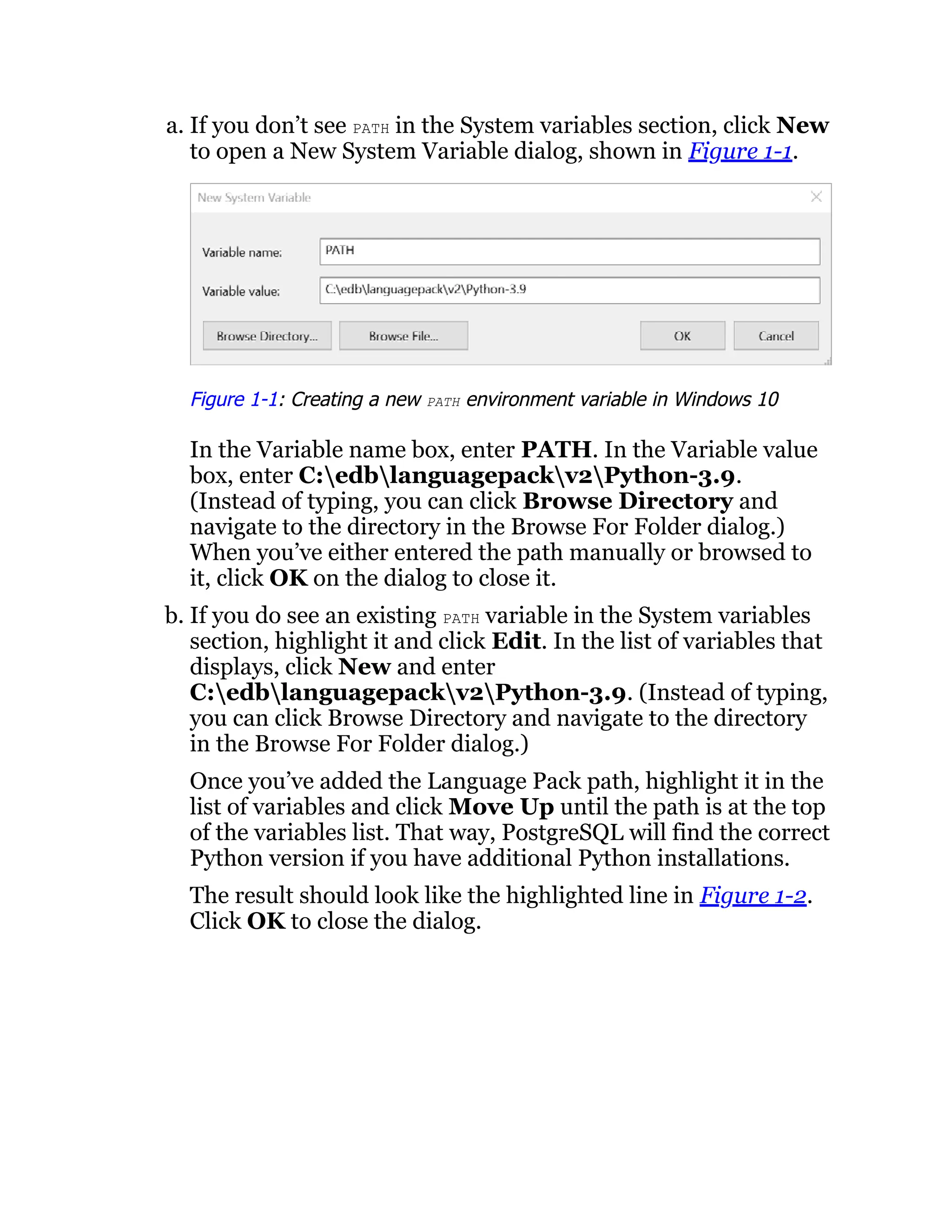
a. If you don’t see PATH in the System variables section, click New
to open a New System Variable dialog, shown in Figure 1-1.
Figure 1-1: Creating a new PATH environment variable in Windows 10
In the Variable name box, enter PATH. In the Variable value
box, enter C:edblanguagepackv2Python-3.9.
(Instead of typing, you can click Browse Directory and
navigate to the directory in the Browse For Folder dialog.)
When you’ve either entered the path manually or browsed to
it, click OK on the dialog to close it.
b. If you do see an existing PATH variable in the System variables
section, highlight it and click Edit. In the list of variables that
displays, click New and enter
C:edblanguagepackv2Python-3.9. (Instead of typing,
you can click Browse Directory and navigate to the directory
in the Browse For Folder dialog.)
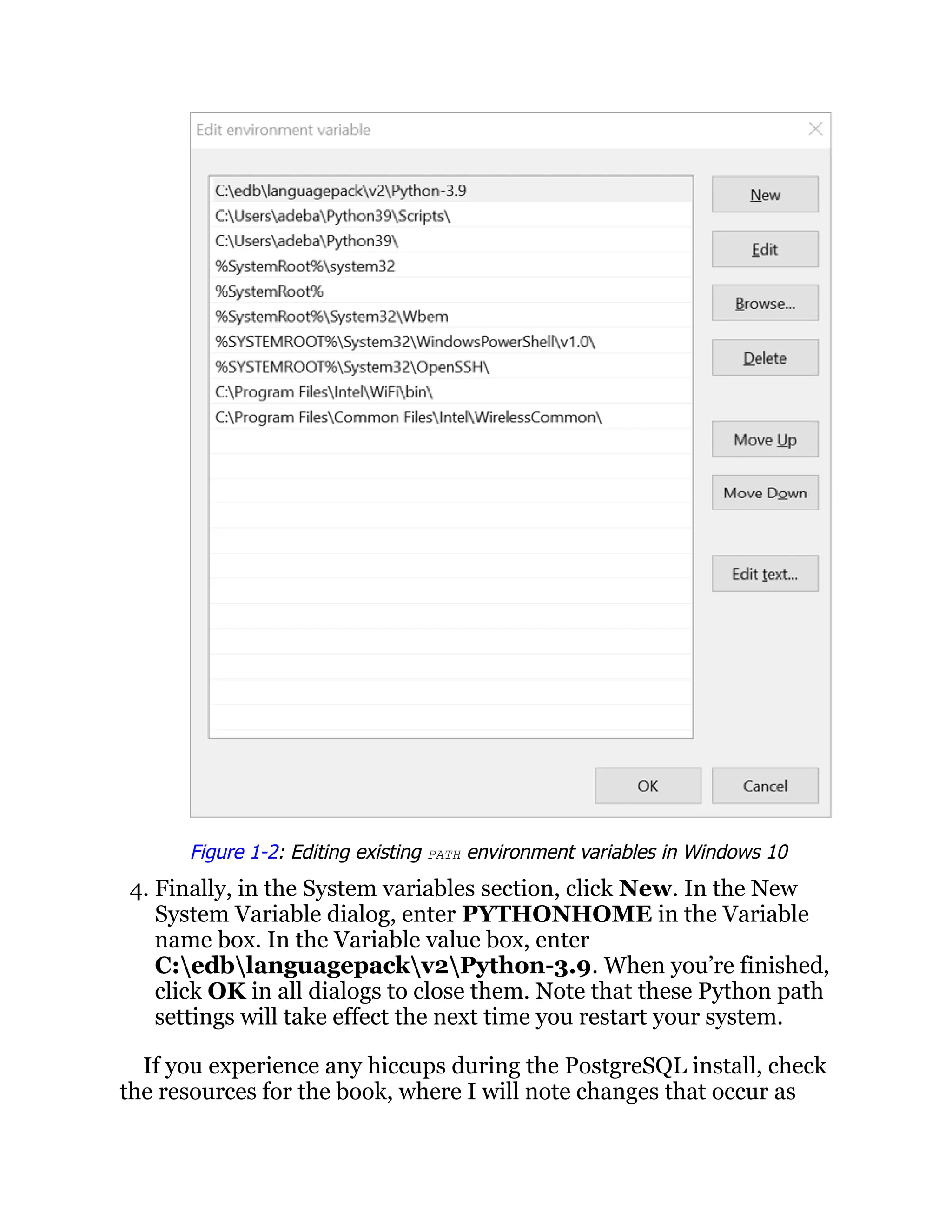
Once you’ve added the Language Pack path, highlight it in the
list of variables and click Move Up until the path is at the top
of the variables list. That way, PostgreSQL will find the correct
Python version if you have additional Python installations.
The result should look like the highlighted line in Figure 1-2.
Click OK to close the dialog.
Figure 1-2: Editing existing PATH environment variables in Windows 10
4. Finally, in the System variables section, click New. In the New
System Variable dialog, enter PYTHONHOME in the Variable
name box. In the Variable value box, enter
C:edblanguagepackv2Python-3.9. When you’re finished,
click OK in all dialogs to close them. Note that these Python path
settings will take effect the next time you restart your system.
If you experience any hiccups during the PostgreSQL install, check
the resources for the book, where I will note changes that occur as
Other documents randomly have
different content
Het was in 1681 toen dat gedenkteeken voltooid was.
Een paar dagen na de onthulling ervan, kwam er een stok-oud man in de
kerk, en stond bij het praalgraf onder diep zuchten, de beeltenis van den
Admiraal te bekijken.
„Een mooi praalgraf, he, ouwentje?” zeide een deftig heer, die hem
ongemerkt genaderd was.
„Ja, Meneer, ja! En wat staat daar zoo al te lezen?”
De heer zeide dat het Latijn was en vertaalde voor den ouden man het
opschrift.
Zoodra deze hiermede klaar was, zeide de oude: „Alles mooi en waar,
Meneer, doch nog veel te weinig gezegd. En daar boven den ingang, staat
daar ook niet wat?”
„Zeker, zeker, goede vriend! Daar staat: „Intaminates fulget honoribus.”
„Wat wil dat zeggen, Meneer?”
„Dat wil zeggen: „Hij blinkt in onbedoezelde eere.”
„Meneer, Meneer, dat is mooi gezegd, dat is waar!”
„Hebt gij hem dan soms zoo goed gekend, oude?” vroeg de heer, die den
grijsaard oplettend aanzag.
„Of ik hem gekend heb!” riep de oude den heer toe, en hierop het beeld
aansprekende, sprak hij op eenen toon, aangrijpend schoon door de
hartelijke geestdrift en liefde: „Michiel, Bestevaêr Michiel, daar vragen ze
Lievensz. of ik u gekend heb! De „Barre Bruinvisch” zou zijn zeekind niet
gekend hebben! Michiel, Michiel! Straks kom ik bij u, hoor! Mijn
avondschot zal ook spoedig vallen.”
De oude Bootsman groette den vriendelijken heer beleefd en strompelde
naar huis.
De heer bleef een oogenblik staan, wreef de tranen uit de oogen en
fluisterde: „Wel te rusten, Vlissinger Michiel! Van hoe weinigen kan men
zeggen wat men van u zegt: „Hij was groot als mensch, groot als held, groot
als burger!”
Wij zijn niet meer het volk dat we in de zeventiende eeuw waren. Allerlei
oorzaken hebben daartoe medegewerkt. Doch wij betreuren dat niet zoo erg,
daar wij in de wereldgeschiedenis zien, dat ieder volk zoo zijnen tijd van
luister en verval heeft. Het moet alleen ons streven zijn, niet om weer zoo
machtig te worden, als in de zeventiende eeuw, maar om ons bestaan eervol
te doen zijn, om te zorgen, dat wij bij andere volken niet te zeer achter
staan.
Daarom is het goed, dat de mannen, die ons Vaderland eenmaal zoo groot
gemaakt hebben, met standbeelden vereerd worden. Van die eer weten zij
niets, voor wie zulke gedenkteekens opgericht worden. Het is dan ook niet
zoo zeer voor hen, dat een standbeeld verrijst, als wel om het volk van den
tegenwoordigen tijd in herinnering te brengen, wat een mensch kan, als hij
wil, en om hen aan te sporen te doen, zooals zij deden.
Daarom is dan ook, den vijfentwintigsten Augustus 1841, te Vlissingen een
standbeeld voor onzen held opgericht, en het staat daar om ons, kinderen
der negentiende eeuw, als het ware toe te roepen: „Niet kunnen bestaat niet;
met God en goeden wil kan men bijna alles. Ik heb u den weg gewezen!
Nederland, oud en jong, rijk en arm, volg mijn voorbeeld na! In mijne
dagen waren er bange tijden, banger dan gij ooit gekend hebt; maar inplaats
van moedeloos de handen in den schoot te laten rusten, hielden we het
hoofd omhoog, en moedig ging het voorwaarts tot we door de bange tijden
heengeslagen waren, en vrij en frank ons weer overal konden vertoonen.
„De „Zeven Provinciën” konden veel; zouden „De Elf Provinciën” dan
minder kunnen?”3
Bestevaêr, wij, oud en jong Nederland, hebben uw woord verstaan, en wij
hopen, als voor ons geliefd Vaderland nog eens een jaar als 1672 was,
1
2
3
moest aanbreken, dat wij met het oog op Stadhouder Willem III roepen
zullen: „Oranje boven!” en met het oog op u: „Hoezee! Bestevaêr Michiel!
Hoezee!”
De levensbeschrijver van De Ruyter, onze bekende Gerard Brandt is niet vrij te
pleiten van partijdigheid. Naar zijne meening was het niet enkel een Lid der
Amsterdamsche Admiraliteit, die onzen De Ruyter minachtend bejegende, maar maakten
zelfs de Hoog-Mogende Heeren zich aan die minachting schuldig, en hij zegt dat de
Voorzitter hem b e v a l in alles den meesten dienst van het Land te betrachten. En om dit
bevel nog meer, als een bewijs van minachting te doen uitkomen, voegt hij er bij, dat men
onzen held deed nederzitten „op een gemeenen stoel zonder armen.” ↑
De Fransche vloot bestond uit dertig schepen zonder de branders. Er waren er vijf van
90 of 96 stukken bij, vier van 80, elf van 70 tot 76, zes van 60 tot 70, vier van 50 enz. In
het geheel was de vloot bemand met 10,665 koppen en gewapend 2,172 stukken geschut.
Bij onze vloot mocht inderdaad de Spaansche niet geteld worden. De Franschman De
Vivonne schrijft: „De Spanjaarden schoten van zeer verre, zonder orde te houden, zoodat er
slechts vier schepen van hen bij elkander waren, waaronder de Admiraal, schietende in het
wilde en zonder op onzen middeltocht af te komen.” ↑
Den 1sten Mei 1830 drukten de Heeren P. J. Zijnen en D. Uyttenhoven, Predikant en
Notaris te Vlissingen, den eersten wensch in het openbaar uit, een standbeeld voor Michiel
Adriaensz. De Ruyter te Vlissingen te kunnen oprichten. Die twee Heeren mochten
eindelijk hunne pogingen met eenen goeden uitslag bekroond zien. Een volk dat zijne
groote mannen vereert, is waard groote mannen bezeten te hebben. Hulde daarom aan hen,
die in die vereering vóórgingen. ↑
Colofon
Beschikbaarheid
Dit eBoek is voor kosteloos gebruik door iedereen overal, met vrijwel
geen beperkingen van welke soort dan ook. U mag het kopiëren,
weggeven of hergebruiken onder de voorwaarden van de Project
Gutenberg Licentie bij dit eBoek of on-line op
www.gutenberg.org .
Dit eBoek is geproduceerd door het on-line gedistribueerd
correctieteam op www.pgdp.net .
Codering
Dit boek is weergegeven in oorspronkelijke schrijfwijze. Afgebroken
woorden aan het einde van de regel zijn stilzwijgend hersteld.
Kennelijke zetfouten in het origineel zijn verbeterd. Deze
verbeteringen zijn aangegeven in de colofon aan het einde van dit
boek.
Documentgeschiedenis
2016-06-01 Begonnen.
Externe Referenties
Dit Project Gutenberg eBoek bevat externe referenties. Het kan zijn
dat deze links voor u niet werken.
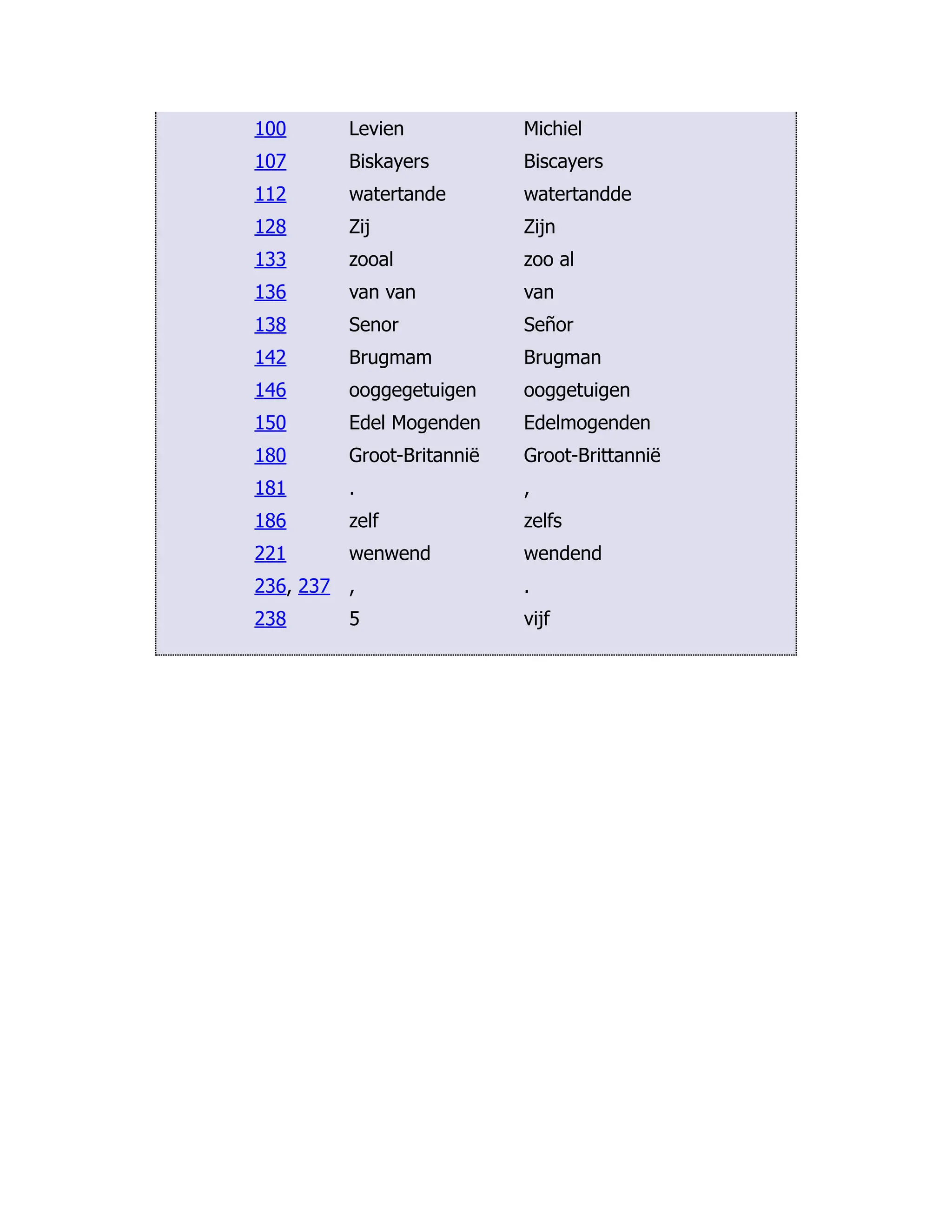
Verbeteringen
De volgende verbeteringen zijn aangebracht in de tekst:
Bladzijde Bron Verbetering
2, 41, 45,
66, 144,
145, 199,
220
„ [Verwijderd]
4, 5, 7,
38, 42,
42, 46,
60, 67,
113, 166
[Niet in bron] ”
14, 78,
102, 211
[Niet in bron] ,
19, 56,
154, 207,
208
[Niet in bron] .
21, 36 kwajongen kwâjongen
28, 38,
45, 67,
106, 144,
174
[Niet in bron] „
31, 180 zett’en zetten
42, 147,
192
” [Verwijderd]
57 vertrouwd vertrouwt
67, 176 ’ [Verwijderd]
69 zuchte zuchtte
74, 88,
237, 241,
242
, [Verwijderd]
75 speelde speelden
79 mekaer mekaêr
93
koopvaardij
schepen
koopvaardijschepen
100 Levien Michiel
107 Biskayers Biscayers
112 watertande watertandde
128 Zij Zijn
133 zooal zoo al
136 van van van
138 Senor Señor
142 Brugmam Brugman
146 ooggegetuigen ooggetuigen
150 Edel Mogenden Edelmogenden
180 Groot-Britannië Groot-Brittannië
181 . ,
186 zelf zelfs
221 wenwend wendend
236, 237 , .
238 5 vijf
*** END OF THE PROJECT GUTENBERG EBOOK VLISSINGER
MICHIEL, OF NEERLANDS GLORIE TER ZEE: TWEEDE
OMGEWERKTE DRUK. ***
Updated editions will replace the previous one—the old editions
will be renamed.
Creating the works from print editions not protected by U.S.
copyright law means that no one owns a United States
copyright in these works, so the Foundation (and you!) can copy
and distribute it in the United States without permission and
without paying copyright royalties. Special rules, set forth in the
General Terms of Use part of this license, apply to copying and
distributing Project Gutenberg™ electronic works to protect the
PROJECT GUTENBERG™ concept and trademark. Project
Gutenberg is a registered trademark, and may not be used if
you charge for an eBook, except by following the terms of the
trademark license, including paying royalties for use of the
Project Gutenberg trademark. If you do not charge anything for
copies of this eBook, complying with the trademark license is
very easy. You may use this eBook for nearly any purpose such
as creation of derivative works, reports, performances and
research. Project Gutenberg eBooks may be modified and
printed and given away—you may do practically ANYTHING in
the United States with eBooks not protected by U.S. copyright
law. Redistribution is subject to the trademark license, especially
commercial redistribution.
START: FULL LICENSE
THE FULL PROJECT GUTENBERG LICENSE
PLEASE READ THIS BEFORE YOU DISTRIBUTE OR USE THIS WORK
To protect the Project Gutenberg™ mission of promoting the
free distribution of electronic works, by using or distributing this
work (or any other work associated in any way with the phrase
“Project Gutenberg”), you agree to comply with all the terms of
the Full Project Gutenberg™ License available with this file or
online at www.gutenberg.org/license.
Section 1. General Terms of Use and
Redistributing Project Gutenberg™
electronic works
1.A. By reading or using any part of this Project Gutenberg™
electronic work, you indicate that you have read, understand,
agree to and accept all the terms of this license and intellectual
property (trademark/copyright) agreement. If you do not agree
to abide by all the terms of this agreement, you must cease
using and return or destroy all copies of Project Gutenberg™
electronic works in your possession. If you paid a fee for
obtaining a copy of or access to a Project Gutenberg™
electronic work and you do not agree to be bound by the terms
of this agreement, you may obtain a refund from the person or
entity to whom you paid the fee as set forth in paragraph 1.E.8.
1.B. “Project Gutenberg” is a registered trademark. It may only
be used on or associated in any way with an electronic work by
people who agree to be bound by the terms of this agreement.
There are a few things that you can do with most Project
Gutenberg™ electronic works even without complying with the
full terms of this agreement. See paragraph 1.C below. There
are a lot of things you can do with Project Gutenberg™
electronic works if you follow the terms of this agreement and
help preserve free future access to Project Gutenberg™
electronic works. See paragraph 1.E below.
1.C. The Project Gutenberg Literary Archive Foundation (“the
Foundation” or PGLAF), owns a compilation copyright in the
collection of Project Gutenberg™ electronic works. Nearly all the
individual works in the collection are in the public domain in the
United States. If an individual work is unprotected by copyright
law in the United States and you are located in the United
States, we do not claim a right to prevent you from copying,
distributing, performing, displaying or creating derivative works
based on the work as long as all references to Project
Gutenberg are removed. Of course, we hope that you will
support the Project Gutenberg™ mission of promoting free
access to electronic works by freely sharing Project Gutenberg™
works in compliance with the terms of this agreement for
keeping the Project Gutenberg™ name associated with the
work. You can easily comply with the terms of this agreement
by keeping this work in the same format with its attached full
Project Gutenberg™ License when you share it without charge
with others.
1.D. The copyright laws of the place where you are located also
govern what you can do with this work. Copyright laws in most
countries are in a constant state of change. If you are outside
the United States, check the laws of your country in addition to
the terms of this agreement before downloading, copying,
displaying, performing, distributing or creating derivative works
based on this work or any other Project Gutenberg™ work. The
Foundation makes no representations concerning the copyright
status of any work in any country other than the United States.
1.E. Unless you have removed all references to Project
Gutenberg:
1.E.1. The following sentence, with active links to, or other
immediate access to, the full Project Gutenberg™ License must
appear prominently whenever any copy of a Project
Gutenberg™ work (any work on which the phrase “Project
Gutenberg” appears, or with which the phrase “Project
Gutenberg” is associated) is accessed, displayed, performed,
viewed, copied or distributed:
This eBook is for the use of anyone anywhere in the United
States and most other parts of the world at no cost and
with almost no restrictions whatsoever. You may copy it,
give it away or re-use it under the terms of the Project
Gutenberg License included with this eBook or online at
www.gutenberg.org. If you are not located in the United
States, you will have to check the laws of the country
where you are located before using this eBook.
1.E.2. If an individual Project Gutenberg™ electronic work is
derived from texts not protected by U.S. copyright law (does not
contain a notice indicating that it is posted with permission of
the copyright holder), the work can be copied and distributed to
anyone in the United States without paying any fees or charges.
If you are redistributing or providing access to a work with the
phrase “Project Gutenberg” associated with or appearing on the
work, you must comply either with the requirements of
paragraphs 1.E.1 through 1.E.7 or obtain permission for the use
of the work and the Project Gutenberg™ trademark as set forth
in paragraphs 1.E.8 or 1.E.9.
1.E.3. If an individual Project Gutenberg™ electronic work is
posted with the permission of the copyright holder, your use and
distribution must comply with both paragraphs 1.E.1 through
1.E.7 and any additional terms imposed by the copyright holder.
Additional terms will be linked to the Project Gutenberg™
License for all works posted with the permission of the copyright
holder found at the beginning of this work.
1.E.4. Do not unlink or detach or remove the full Project
Gutenberg™ License terms from this work, or any files
containing a part of this work or any other work associated with
Project Gutenberg™.
1.E.5. Do not copy, display, perform, distribute or redistribute
this electronic work, or any part of this electronic work, without
prominently displaying the sentence set forth in paragraph 1.E.1
with active links or immediate access to the full terms of the
Project Gutenberg™ License.
1.E.6. You may convert to and distribute this work in any binary,
compressed, marked up, nonproprietary or proprietary form,
including any word processing or hypertext form. However, if
you provide access to or distribute copies of a Project
Gutenberg™ work in a format other than “Plain Vanilla ASCII” or
other format used in the official version posted on the official
Project Gutenberg™ website (www.gutenberg.org), you must,
at no additional cost, fee or expense to the user, provide a copy,
a means of exporting a copy, or a means of obtaining a copy
upon request, of the work in its original “Plain Vanilla ASCII” or
other form. Any alternate format must include the full Project
Gutenberg™ License as specified in paragraph 1.E.1.
1.E.7. Do not charge a fee for access to, viewing, displaying,
performing, copying or distributing any Project Gutenberg™
works unless you comply with paragraph 1.E.8 or 1.E.9.
1.E.8. You may charge a reasonable fee for copies of or
providing access to or distributing Project Gutenberg™
electronic works provided that:
• You pay a royalty fee of 20% of the gross profits you derive
from the use of Project Gutenberg™ works calculated using the
method you already use to calculate your applicable taxes. The
fee is owed to the owner of the Project Gutenberg™ trademark,
but he has agreed to donate royalties under this paragraph to
the Project Gutenberg Literary Archive Foundation. Royalty
payments must be paid within 60 days following each date on
which you prepare (or are legally required to prepare) your
periodic tax returns. Royalty payments should be clearly marked
as such and sent to the Project Gutenberg Literary Archive
Foundation at the address specified in Section 4, “Information
about donations to the Project Gutenberg Literary Archive
Foundation.”
• You provide a full refund of any money paid by a user who
notifies you in writing (or by e-mail) within 30 days of receipt
that s/he does not agree to the terms of the full Project
Gutenberg™ License. You must require such a user to return or
destroy all copies of the works possessed in a physical medium
and discontinue all use of and all access to other copies of
Project Gutenberg™ works.
• You provide, in accordance with paragraph 1.F.3, a full refund of
any money paid for a work or a replacement copy, if a defect in
the electronic work is discovered and reported to you within 90
days of receipt of the work.
• You comply with all other terms of this agreement for free
distribution of Project Gutenberg™ works.
1.E.9. If you wish to charge a fee or distribute a Project
Gutenberg™ electronic work or group of works on different
terms than are set forth in this agreement, you must obtain
permission in writing from the Project Gutenberg Literary
Archive Foundation, the manager of the Project Gutenberg™
trademark. Contact the Foundation as set forth in Section 3
below.
1.F.
1.F.1. Project Gutenberg volunteers and employees expend
considerable effort to identify, do copyright research on,
transcribe and proofread works not protected by U.S. copyright
law in creating the Project Gutenberg™ collection. Despite these
efforts, Project Gutenberg™ electronic works, and the medium
on which they may be stored, may contain “Defects,” such as,
but not limited to, incomplete, inaccurate or corrupt data,
transcription errors, a copyright or other intellectual property
infringement, a defective or damaged disk or other medium, a
computer virus, or computer codes that damage or cannot be
read by your equipment.
1.F.2. LIMITED WARRANTY, DISCLAIMER OF DAMAGES - Except
for the “Right of Replacement or Refund” described in
paragraph 1.F.3, the Project Gutenberg Literary Archive
Foundation, the owner of the Project Gutenberg™ trademark,
and any other party distributing a Project Gutenberg™ electronic
work under this agreement, disclaim all liability to you for
damages, costs and expenses, including legal fees. YOU AGREE
THAT YOU HAVE NO REMEDIES FOR NEGLIGENCE, STRICT
LIABILITY, BREACH OF WARRANTY OR BREACH OF CONTRACT
EXCEPT THOSE PROVIDED IN PARAGRAPH 1.F.3. YOU AGREE
THAT THE FOUNDATION, THE TRADEMARK OWNER, AND ANY
DISTRIBUTOR UNDER THIS AGREEMENT WILL NOT BE LIABLE
TO YOU FOR ACTUAL, DIRECT, INDIRECT, CONSEQUENTIAL,
PUNITIVE OR INCIDENTAL DAMAGES EVEN IF YOU GIVE
NOTICE OF THE POSSIBILITY OF SUCH DAMAGE.
1.F.3. LIMITED RIGHT OF REPLACEMENT OR REFUND - If you
discover a defect in this electronic work within 90 days of
receiving it, you can receive a refund of the money (if any) you
paid for it by sending a written explanation to the person you
received the work from. If you received the work on a physical
medium, you must return the medium with your written
explanation. The person or entity that provided you with the
defective work may elect to provide a replacement copy in lieu
of a refund. If you received the work electronically, the person
or entity providing it to you may choose to give you a second
opportunity to receive the work electronically in lieu of a refund.
If the second copy is also defective, you may demand a refund
in writing without further opportunities to fix the problem.
1.F.4. Except for the limited right of replacement or refund set
forth in paragraph 1.F.3, this work is provided to you ‘AS-IS’,
WITH NO OTHER WARRANTIES OF ANY KIND, EXPRESS OR
IMPLIED, INCLUDING BUT NOT LIMITED TO WARRANTIES OF
MERCHANTABILITY OR FITNESS FOR ANY PURPOSE.
1.F.5. Some states do not allow disclaimers of certain implied
warranties or the exclusion or limitation of certain types of
damages. If any disclaimer or limitation set forth in this
agreement violates the law of the state applicable to this
agreement, the agreement shall be interpreted to make the
maximum disclaimer or limitation permitted by the applicable
state law. The invalidity or unenforceability of any provision of
this agreement shall not void the remaining provisions.
1.F.6. INDEMNITY - You agree to indemnify and hold the
Foundation, the trademark owner, any agent or employee of the
Foundation, anyone providing copies of Project Gutenberg™
electronic works in accordance with this agreement, and any
volunteers associated with the production, promotion and
distribution of Project Gutenberg™ electronic works, harmless
from all liability, costs and expenses, including legal fees, that
arise directly or indirectly from any of the following which you
do or cause to occur: (a) distribution of this or any Project
Gutenberg™ work, (b) alteration, modification, or additions or
deletions to any Project Gutenberg™ work, and (c) any Defect
you cause.
Section 2. Information about the Mission
of Project Gutenberg™
Project Gutenberg™ is synonymous with the free distribution of
electronic works in formats readable by the widest variety of
computers including obsolete, old, middle-aged and new
computers. It exists because of the efforts of hundreds of
volunteers and donations from people in all walks of life.
Volunteers and financial support to provide volunteers with the
assistance they need are critical to reaching Project
Gutenberg™’s goals and ensuring that the Project Gutenberg™
collection will remain freely available for generations to come. In
2001, the Project Gutenberg Literary Archive Foundation was
created to provide a secure and permanent future for Project
Gutenberg™ and future generations. To learn more about the
Project Gutenberg Literary Archive Foundation and how your
efforts and donations can help, see Sections 3 and 4 and the
Foundation information page at www.gutenberg.org.
Section 3. Information about the Project
Gutenberg Literary Archive Foundation
The Project Gutenberg Literary Archive Foundation is a non-
profit 501(c)(3) educational corporation organized under the
laws of the state of Mississippi and granted tax exempt status
by the Internal Revenue Service. The Foundation’s EIN or
federal tax identification number is 64-6221541. Contributions
to the Project Gutenberg Literary Archive Foundation are tax
deductible to the full extent permitted by U.S. federal laws and
your state’s laws.
The Foundation’s business office is located at 809 North 1500
West, Salt Lake City, UT 84116, (801) 596-1887. Email contact
links and up to date contact information can be found at the
Foundation’s website and official page at
www.gutenberg.org/contact
Section 4. Information about Donations to
the Project Gutenberg Literary Archive
Foundation
Project Gutenberg™ depends upon and cannot survive without
widespread public support and donations to carry out its mission
of increasing the number of public domain and licensed works
that can be freely distributed in machine-readable form
accessible by the widest array of equipment including outdated
equipment. Many small donations ($1 to $5,000) are particularly
important to maintaining tax exempt status with the IRS.
The Foundation is committed to complying with the laws
regulating charities and charitable donations in all 50 states of
the United States. Compliance requirements are not uniform
and it takes a considerable effort, much paperwork and many
fees to meet and keep up with these requirements. We do not
solicit donations in locations where we have not received written
confirmation of compliance. To SEND DONATIONS or determine
the status of compliance for any particular state visit
www.gutenberg.org/donate.
While we cannot and do not solicit contributions from states
where we have not met the solicitation requirements, we know
of no prohibition against accepting unsolicited donations from
donors in such states who approach us with offers to donate.
International donations are gratefully accepted, but we cannot
make any statements concerning tax treatment of donations
received from outside the United States. U.S. laws alone swamp
our small staff.
Please check the Project Gutenberg web pages for current
donation methods and addresses. Donations are accepted in a
number of other ways including checks, online payments and
credit card donations. To donate, please visit:
www.gutenberg.org/donate.
Section 5. General Information About
Project Gutenberg™ electronic works
Professor Michael S. Hart was the originator of the Project
Gutenberg™ concept of a library of electronic works that could
be freely shared with anyone. For forty years, he produced and
distributed Project Gutenberg™ eBooks with only a loose
network of volunteer support.
Project Gutenberg™ eBooks are often created from several
printed editions, all of which are confirmed as not protected by
copyright in the U.S. unless a copyright notice is included. Thus,
we do not necessarily keep eBooks in compliance with any
particular paper edition.
Most people start at our website which has the main PG search
facility: www.gutenberg.org.
This website includes information about Project Gutenberg™,
including how to make donations to the Project Gutenberg
Literary Archive Foundation, how to help produce our new
eBooks, and how to subscribe to our email newsletter to hear
about new eBooks.

Practical SQL A Beginner s Guide to Storytelling with Data 2nd Edition Anthony Debarros
  • 1.
    Read Anytime AnywhereEasy Ebook Downloads at ebookmeta.com Practical SQL A Beginner s Guide to Storytelling with Data 2nd Edition Anthony Debarros https://ebookmeta.com/product/practical-sql-a-beginner-s- guide-to-storytelling-with-data-2nd-edition-anthony- debarros/ OR CLICK HERE DOWLOAD EBOOK Visit and Get More Ebook Downloads Instantly at https://ebookmeta.com
  • 2.
    Recommended digital products(PDF, EPUB, MOBI) that you can download immediately if you are interested. Practical SQL A Beginner s Guide to Storytelling with Data 2nd Edition Anthony Debarros https://ebookmeta.com/product/practical-sql-a-beginner-s-guide-to- storytelling-with-data-2nd-edition-anthony-debarros/ ebookmeta.com Practical SQL: A Beginner's Guide to Storytelling with Data, 2nd Edition Anthony Debarros https://ebookmeta.com/product/practical-sql-a-beginners-guide-to- storytelling-with-data-2nd-edition-anthony-debarros/ ebookmeta.com SQL QuickStart Guide The Simplified Beginner s Guide to Managing Analyzing and Manipulating Data With SQL Walter Shields https://ebookmeta.com/product/sql-quickstart-guide-the-simplified- beginner-s-guide-to-managing-analyzing-and-manipulating-data-with-sql- walter-shields/ ebookmeta.com Mathematics Mathematics HL Option Discrete Mathematics 1st Edition Catherine Quinn Peter Blythe Chris Sangwin Robert Haese Michael Haese https://ebookmeta.com/product/mathematics-mathematics-hl-option- discrete-mathematics-1st-edition-catherine-quinn-peter-blythe-chris- sangwin-robert-haese-michael-haese/ ebookmeta.com
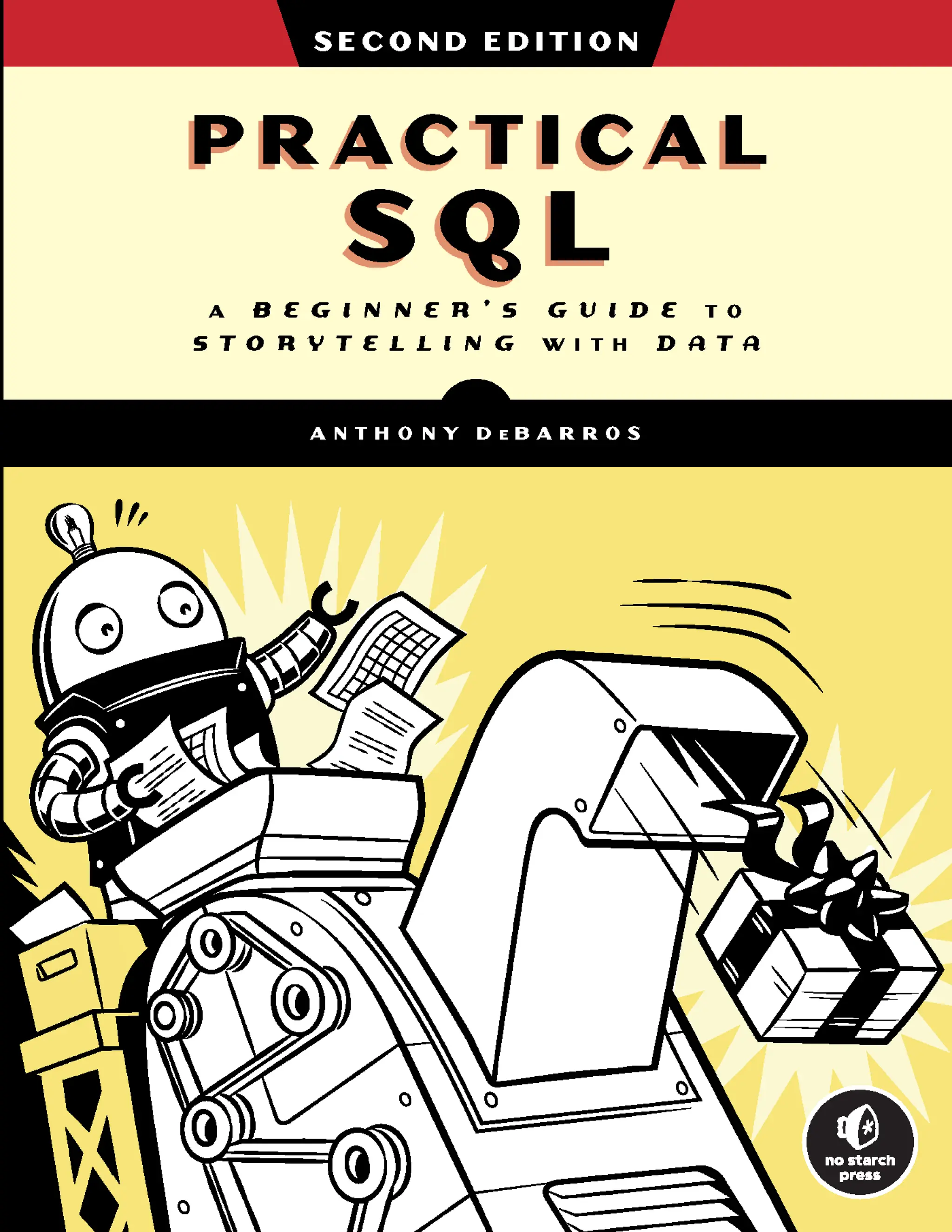
  • 3.
    Nothing s WorseThan A Clown Gone Bad 1st Edition Ponk Vonsydow https://ebookmeta.com/product/nothing-s-worse-than-a-clown-gone- bad-1st-edition-ponk-vonsydow/ ebookmeta.com Revenge Of Her Wolves Tara West https://ebookmeta.com/product/revenge-of-her-wolves-tara-west/ ebookmeta.com Demystifying the Order from Above 1st Edition Lubogo Isaac Christopher https://ebookmeta.com/product/demystifying-the-order-from-above-1st- edition-lubogo-isaac-christopher/ ebookmeta.com Blockchain and the Supply Chain: Concepts, Strategies and Practical Applications, 2nd Edition Nick Vyas https://ebookmeta.com/product/blockchain-and-the-supply-chain- concepts-strategies-and-practical-applications-2nd-edition-nick-vyas/ ebookmeta.com A Warning for Fair Women Adultery and Murder in Shakespeare s Theater 1st Edition Ann C Christensen https://ebookmeta.com/product/a-warning-for-fair-women-adultery-and- murder-in-shakespeare-s-theater-1st-edition-ann-c-christensen/ ebookmeta.com
  • 4.
    Contemporary Strategy :Theories and Policies 1st Edition John Baylis https://ebookmeta.com/product/contemporary-strategy-theories-and- policies-1st-edition-john-baylis/ ebookmeta.com
  • 6.
    CONTENTS IN DETAIL TITLEPAGE COPYRIGHT ABOUT THE AUTHOR PREFACE TO THE SECOND EDITION ACKNOWLEDGMENTS INTRODUCTION What Is SQL? Why SQL? Who Is This Book For? What You’ll Learn CHAPTER 1: SETTING UP YOUR CODING ENVIRONMENT Installing a Text Editor Downloading Code and Data from GitHub Installing PostgreSQL and pgAdmin Windows Installation macOS Installation Linux Installation Working with pgAdmin Launching pgAdmin and Setting a Master Password
  • 7.
    Connecting to theDefault postgres Database Exploring the Query Tool Customizing pgAdmin Alternatives to pgAdmin Wrapping Up CHAPTER 2: CREATING YOUR FIRST DATABASE AND TABLE Understanding Tables Creating a Database Executing SQL in pgAdmin Connecting to the analysis Database Creating a Table Using the CREATE TABLE Statement Making the teachers Table Inserting Rows into a Table Using the INSERT Statement Viewing the Data Getting Help When Code Goes Bad Formatting SQL for Readability Wrapping Up CHAPTER 3: BEGINNING DATA EXPLORATION WITH SELECT Basic SELECT Syntax Querying a Subset of Columns Sorting Data with ORDER BY Using DISTINCT to Find Unique Values Filtering Rows with WHERE Using LIKE and ILIKE with WHERE
  • 8.
    Combining Operators withAND and OR Putting It All Together Wrapping Up CHAPTER 4: UNDERSTANDING DATA TYPES Understanding Characters Understanding Numbers Using Integers Auto-Incrementing Integers Using Decimal Numbers Choosing Your Number Data Type Understanding Dates and Times Using the interval Data Type in Calculations Understanding JSON and JSONB Using Miscellaneous Types Transforming Values from One Type to Another with CAST Using CAST Shortcut Notation Wrapping Up CHAPTER 5: IMPORTING AND EXPORTING DATA Working with Delimited Text Files Handling Header Rows Quoting Columns That Contain Delimiters Using COPY to Import Data Importing Census Data Describing Counties Creating the us_counties_pop_est_2019 Table Understanding Census Columns and Data Types Performing the Census Import with COPY Inspecting the Import
  • 9.
    Importing a Subsetof Columns with COPY Importing a Subset of Rows with COPY Adding a Value to a Column During Import Using COPY to Export Data Exporting All Data Exporting Particular Columns Exporting Query Results Importing and Exporting Through pgAdmin Wrapping Up CHAPTER 6: BASIC MATH AND STATS WITH SQL Understanding Math Operators and Functions Understanding Math and Data Types Adding, Subtracting, and Multiplying Performing Division and Modulo Using Exponents, Roots, and Factorials Minding the Order of Operations Doing Math Across Census Table Columns Adding and Subtracting Columns Finding Percentages of the Whole Tracking Percent Change Using Aggregate Functions for Averages and Sums Finding the Median Finding the Median with Percentile Functions Finding Median and Percentiles with Census Data Finding Other Quantiles with Percentile Functions Finding the Mode Wrapping Up
  • 10.
    CHAPTER 7: JOININGTABLES IN A RELATIONAL DATABASE Linking Tables Using JOIN Relating Tables with Key Columns Querying Multiple Tables Using JOIN Understanding JOIN Types JOIN LEFT JOIN and RIGHT JOIN FULL OUTER JOIN CROSS JOIN Using NULL to Find Rows with Missing Values Understanding the Three Types of Table Relationships One-to-One Relationship One-to-Many Relationship Many-to-Many Relationship Selecting Specific Columns in a Join Simplifying JOIN Syntax with Table Aliases Joining Multiple Tables Combining Query Results with Set Operators UNION and UNION ALL INTERSECT and EXCEPT Performing Math on Joined Table Columns Wrapping Up CHAPTER 8: TABLE DESIGN THAT WORKS FOR YOU Following Naming Conventions Quoting Identifiers Enables Mixed Case Pitfalls with Quoting Identifiers Guidelines for Naming Identifiers
  • 11.
    Controlling Column Valueswith Constraints Primary Keys: Natural vs. Surrogate Foreign Keys How to Automatically Delete Related Records with CASCADE The CHECK Constraint The UNIQUE Constraint The NOT NULL Constraint How to Remove Constraints or Add Them Later Speeding Up Queries with Indexes B-Tree: PostgreSQL’s Default Index Considerations When Using Indexes Wrapping Up CHAPTER 9: EXTRACTING INFORMATION BY GROUPING AND SUMMARIZING Creating the Library Survey Tables Creating the 2018 Library Data Table Creating the 2017 and 2016 Library Data Tables Exploring the Library Data Using Aggregate Functions Counting Rows and Values Using count() Finding Maximum and Minimum Values Using max() and min() Aggregating Data Using GROUP BY Wrapping Up CHAPTER 10: INSPECTING AND MODIFYING DATA Importing Data on Meat, Poultry, and Egg Producers Interviewing the Dataset Checking for Missing Values
  • 12.
    Checking for InconsistentData Values Checking for Malformed Values Using length() Modifying Tables, Columns, and Data Modifying Tables with ALTER TABLE Modifying Values with UPDATE Viewing Modified Data with RETURNING Creating Backup Tables Restoring Missing Column Values Updating Values for Consistency Repairing ZIP Codes Using Concatenation Updating Values Across Tables Deleting Unneeded Data Deleting Rows from a Table Deleting a Column from a Table Deleting a Table from a Database Using Transactions to Save or Revert Changes Improving Performance When Updating Large Tables Wrapping Up CHAPTER 11: STATISTICAL FUNCTIONS IN SQL Creating a Census Stats Table Measuring Correlation with corr(Y, X) Checking Additional Correlations Predicting Values with Regression Analysis Finding the Effect of an Independent Variable with r- Squared Finding Variance and Standard Deviation Creating Rankings with SQL Ranking with rank() and dense_rank()
  • 13.
    Ranking Within Subgroupswith PARTITION BY Calculating Rates for Meaningful Comparisons Finding Rates of Tourism-Related Businesses Smoothing Uneven Data Wrapping Up CHAPTER 12: WORKING WITH DATES AND TIMES Understanding Data Types and Functions for Dates and Times Manipulating Dates and Times Extracting the Components of a timestamp Value Creating Datetime Values from timestamp Components Retrieving the Current Date and Time Working with Time Zones Finding Your Time Zone Setting Setting the Time Zone Performing Calculations with Dates and Times Finding Patterns in New York City Taxi Data Finding Patterns in Amtrak Data Wrapping Up CHAPTER 13: ADVANCED QUERY TECHNIQUES Using Subqueries Filtering with Subqueries in a WHERE Clause Creating Derived Tables with Subqueries Joining Derived Tables Generating Columns with Subqueries Understanding Subquery Expressions Using Subqueries with LATERAL Using Common Table Expressions
  • 14.
    Performing Cross Tabulations Installingthe crosstab() Function Tabulating Survey Results Tabulating City Temperature Readings Reclassifying Values with CASE Using CASE in a Common Table Expression Wrapping Up CHAPTER 14: MINING TEXT TO FIND MEANINGFUL DATA Formatting Text Using String Functions Case Formatting Character Information Removing Characters Extracting and Replacing Characters Matching Text Patterns with Regular Expressions Regular Expression Notation Using Regular Expressions with WHERE Regular Expression Functions to Replace or Split Text Turning Text to Data with Regular Expression Functions Full-Text Search in PostgreSQL Text Search Data Types Creating a Table for Full-Text Search Searching Speech Text Ranking Query Matches by Relevance Wrapping Up CHAPTER 15: ANALYZING SPATIAL DATA WITH POSTGIS Enabling PostGIS and Creating a Spatial Database Understanding the Building Blocks of Spatial Data
  • 15.
    Understanding Two-Dimensional Geometries Well-KnownText Formats Projections and Coordinate Systems Spatial Reference System Identifier Understanding PostGIS Data Types Creating Spatial Objects with PostGIS Functions Creating a Geometry Type from Well-Known Text Creating a Geography Type from Well-Known Text Using Point Functions Using LineString Functions Using Polygon Functions Analyzing Farmers’ Markets Data Creating and Filling a Geography Column Adding a Spatial Index Finding Geographies Within a Given Distance Finding the Distance Between Geographies Finding the Nearest Geographies Working with Census Shapefiles Understanding the Contents of a Shapefile Loading Shapefiles Exploring the Census 2019 Counties Shapefile Examining Demographics Within a Distance Performing Spatial Joins Exploring Roads and Waterways Data Joining the Census Roads and Water Tables Finding the Location Where Objects Intersect Wrapping Up CHAPTER 16: WORKING WITH JSON DATA
  • 16.
    Understanding JSON Structure ConsideringWhen to Use JSON with SQL Using json and jsonb Data Types Importing and Indexing JSON Data Using json and jsonb Extraction Operators Key Value Extraction Array Element Extraction Path Extraction Containment and Existence Analyzing Earthquake Data Exploring and Loading the Earthquake Data Working with Earthquake Times Finding the Largest and Most-Reported Earthquakes Converting Earthquake JSON to Spatial Data Generating and Manipulating JSON Turning Query Results into JSON Adding, Updating, and Deleting Keys and Values Using JSON Processing Functions Finding the Length of an Array Returning Array Elements as Rows Wrapping Up CHAPTER 17: SAVING TIME WITH VIEWS, FUNCTIONS, AND TRIGGERS Using Views to Simplify Queries Creating and Querying Views Creating and Refreshing a Materialized View Inserting, Updating, and Deleting Data Using a View Creating Your Own Functions and Procedures
  • 17.
    Creating the percent_change()Function Using the percent_change() Function Updating Data with a Procedure Using the Python Language in a Function Automating Database Actions with Triggers Logging Grade Updates to a Table Automatically Classifying Temperatures Wrapping Up CHAPTER 18: USING POSTGRESQL FROM THE COMMAND LINE Setting Up the Command Line for psql Windows psql Setup macOS psql Setup Linux psql Setup Working with psql Launching psql and Connecting to a Database Running SQL Queries on psql Navigating and Formatting Results Meta-Commands for Database Information Importing, Exporting, and Using Files Additional Command Line Utilities to Expedite Tasks Adding a Database with createdb Loading Shapefiles with shp2pgsql Wrapping Up CHAPTER 19: MAINTAINING YOUR DATABASE Recovering Unused Space with VACUUM Tracking Table Size
  • 18.
    Monitoring the AutovacuumProcess Running VACUUM Manually Reducing Table Size with VACUUM FULL Changing Server Settings Locating and Editing postgresql.conf Reloading Settings with pg_ctl Backing Up and Restoring Your Database Using pg_dump to Export a Database or Table Restoring a Database Export with pg_restore Exploring Additional Backup and Restore Options Wrapping Up CHAPTER 20: TELLING YOUR DATA’S STORY Start with a Question Document Your Process Gather Your Data No Data? Build Your Own Database Assess the Data’s Origins Interview the Data with Queries Consult the Data’s Owner Identify Key Indicators and Trends over Time Ask Why Communicate Your Findings Wrapping Up APPENDIX: ADDITIONAL POSTGRESQL RESOURCES PostgreSQL Development Environments PostgreSQL Utilities, Tools, and Extensions PostgreSQL News and Community
  • 19.
  • 20.
    PRACTICAL SQL 2nd Edition ABeginner’s Guide to Storytelling with Data by Anthony DeBarros
  • 21.
    PRACTICAL SQL, 2NDEDITION. Copyright © 2022 by Anthony DeBarros. All rights reserved. No part of this work may be reproduced or transmitted in any form or by any means, electronic or mechanical, including photocopying, recording, or by any information storage or retrieval system, without the prior written permission of the copyright owner and the publisher. Printed in the United States of America First printing 25 24 23 22 21 1 2 3 4 5 6 7 8 9 ISBN-13: 978-1-7185-0106-5 (print) ISBN-13: 978-1-7185-0107-2 (ebook) Publisher: William Pollock Managing Editor: Jill Franklin Production Manager: Rachel Monaghan Production Editors: Jennifer Kepler and Paula Williamson Developmental Editor: Liz Chadwick Cover Illustrator: Josh Ellingson Interior Design: Octopod Studios Technical Reviewer: Stephen Frost Copyeditor: Kim Wimpsett Compositor: Maureen Forys, Happenstance Type-O-Rama Proofreader: Liz Wheeler For information on book distributors or translations, please contact No Starch Press, Inc. directly: No Starch Press, Inc. 245 8th Street, San Francisco, CA 94103 phone: 1.415.863.9900; info@nostarch.com www.nostarch.com The Library of Congress has catalogued the first edition as follows: Names: DeBarros, Anthony, author. Title: Practical SQL : a beginner's guide to storytelling with data / Anthony DeBarros. Description: San Francisco : No Starch Press, 2018. | Includes index. Identifiers: LCCN 2018000030 (print) | LCCN 2017043947 (ebook) | ISBN 9781593278458 (epub) | ISBN 1593278454 (epub) | ISBN 9781593278274 (paperback) | ISBN 1593278276 (paperback) | ISBN 9781593278458 (ebook) Subjects: LCSH: SQL (Computer program language) | Database design. | BISAC: COMPUTERS / Programming Languages / SQL. | COMPUTERS / Database Management / General. | COMPUTERS / Database Management / Data Mining. Classification: LCC QA76.73.S67 (print) | LCC QA76.73.S67 D44 2018 (ebook) | DDC 005.75/6--dc23 LC record available at https://lccn.loc.gov/2018000030
  • 22.
    No Starch Pressand the No Starch Press logo are registered trademarks of No Starch Press, Inc. Other product and company names mentioned herein may be the trademarks of their respective owners. Rather than use a trademark symbol with every occurrence of a trademarked name, we are using the names only in an editorial fashion and to the benefit of the trademark owner, with no intention of infringement of the trademark. The information in this book is distributed on an “As Is” basis, without warranty. While every precaution has been taken in the preparation of this work, neither the author nor No Starch Press, Inc. shall have any liability to any person or entity with respect to any loss or damage caused or alleged to be caused directly or indirectly by the information contained in it.
  • 23.
    About the Author AnthonyDeBarros is a longtime journalist and early adopter of “data journalism,” the use of spreadsheets, databases, and code to find news in data. He’s currently a data editor for the Wall Street Journal, where he covers topics including the economy, trade, demographics, and the Covid-19 pandemic. Previously, he worked for the Gannett company at USA Today and the Poughkeepsie Journal and held product development and content strategy roles for Questex and DocumentCloud. About the Technical Reviewer Stephen Frost is the chief technology officer at Crunchy Data. He has been working with PostgreSQL since 2003 and general database technology since before then. Stephen began contributing to PostgreSQL development in 2004 and has been involved in the development of the role system, column-level privileges, row-level security, GSSAPI encryption, and the predefined roles system. He has also served on the board of the United States PostgreSQL Association and Software in the Public Interest, regularly speaks at PostgreSQL Community conferences and events, and works as a member of various PostgreSQL community teams.
  • 24.
    PREFACE TO THESECOND EDITION Since the publication of the first edition of Practical SQL, I’ve received kind notes about the book from readers around the world. One happy reader said it helped him ace SQL questions on a job interview. Another, a teacher, wrote to say that his students remarked favorably about having the book assigned for class. Others just wanted to say thanks because they found the book helpful and a good read, two pieces of feedback that will warm the heart of most any author. I also sometimes heard from readers who hit a roadblock while working through an exercise or who had trouble with software or data files. I paid close attention to those emails, especially when the same question seemed to crop up more than once. Meanwhile, during my own journey of learning SQL—I use it every day at work— I’d often discover a technique and wish that I’d included it in the book. With all that in mind, I approached the team at No Starch Press with the idea of updating and expanding Practical SQL into a second edition. I’m thankful they said yes. This new version of the book is more complete, offers stronger guidance for readers related to software and code, and clarifies information that wasn’t as clear or presented as accurately as it could have been. The book has been thoroughly enjoyable to revisit, and I’ve learned much along the way.
  • 25.
    This second editionincludes numerous updates, expansions, and clarifications in every chapter. Throughout, I’ve been careful to note when code syntax adheres to the SQL standard—meaning you can generally use it across database systems—or when the syntax is specific to the database used in the book, PostgreSQL. The following are among the most substantial changes: Two chapters are new. Chapter 1, “Setting Up Your Coding Environment,” details how to install PostgreSQL, pgAdmin, and additional PostgreSQL components on multiple operating systems. It also shows how to obtain the code listings and data from GitHub. In the first edition, this information was located in the introduction and occasionally missed by readers. Chapter 16, “Working with JSON Data,” covers PostgreSQL’s support for the JavaScript Object Notation data format, using datasets about movies and earthquakes. In Chapter 4 on data types, I’ve added a section on IDENTITY, the ANSI SQL standard implementation for auto-incrementing integer columns. Throughout the book, IDENTITY replaces the PostgreSQL-specific serial auto-incrementing integer type so that code examples more closely reflect the SQL standard. Chapter 5 on importing and exporting data now includes a section about using the WHERE keyword with the COPY command to filter which rows are imported from a source file to a table. I’ve removed the user-created median() function from Chapter 6 on basic math in favor of focusing exclusively on the SQL standard percentile_cont() function for calculating medians. In Chapter 7 on table joins, I’ve added a section covering the set operators UNION, UNION ALL, INTERSECT, and EXCEPT. Additionally, I’ve added a section covering the USING clause in joins to reduce redundant output and simplify query syntax. Chapter 10 on inspecting and modifying data includes a new section on using the RETURNING keyword in an UPDATE statement to display the data that the statement modified. I’ve also added a section that describes how to use the TRUNCATE command to remove all rows from a table and restart an IDENTITY sequence.
  • 26.
    In Chapter 11on statistical functions, a new section demonstrates how to create a rolling average to smooth uneven data to get a better sense of trends over time. I’ve also added information on functions for calculating standard deviation and variance. Chapter 13 on advanced query techniques now shows how to use the LATERAL keyword with subqueries. One benefit is that, by combining LATERAL with JOIN, you get functionality similar to a for loop in a programming language. In Chapter 15 on analyzing spatial data, I demonstrate how to use the Geometry Viewer in pgAdmin to see geographies placed on a map. This feature was added to pgAdmin after publication of the first edition. In Chapter 17 on views, functions, and triggers, I’ve added information about materialized views and showed how their behavior differs from standard views. I also cover procedures, which PostgreSQL now supports in addition to functions. Finally, where practical, datasets have been updated to the most recent available at the time of writing. This primarily applies to US Census population statistics but also includes the text of presidential speeches and library usage statistics. Thank you for reading Practical SQL! If you have any questions or feedback, please get in touch by emailing practicalsqlbook@gmail.com.
  • 27.
    ACKNOWLEDGMENTS This second editionof Practical SQL is the work of many hands. My thanks, first, go to the team at No Starch Press. Thanks to Bill Pollock for capturing the vision and sharpening the initial concept for the book—and for agreeing to let me have another go at it. Special thanks and appreciation to senior editor Liz Chadwick, who improved each chapter with her insightful suggestions and deft editing, and to copyeditor Kim Wimpsett and the production team of Paula Williamson and Jennifer Kepler. Stephen Frost, chief technology officer at Crunchy Data and longtime contributor to the PostgreSQL community, served as the technical reviewer for this edition. I deeply appreciate the time Stephen took to explain the inner workings of PostgreSQL and SQL concepts. This book is better, more thorough, and more accurate thanks to his detailed eye. I’d also like to acknowledge Josh Berkus, whose many contributions as technical reviewer for the first edition persist in this new version. Thank you to Investigative Reporters and Editors (IRE) and its members and staff past and present for training journalists to find stories in data. IRE is where I got my start with SQL and data journalism. Many of my colleagues have not only imparted memorable lessons on data analysis, they’ve also made my workdays brighter. Special thanks to Paul Overberg for sharing his vast knowledge of demographics and the US Census, to Lou Schilling for many technical lessons, to Christopher Schnaars for his SQL expertise, to Peter Matseykanets for his encouragement, and to Chad Day, John West, and Maureen Linke and the WSJ DC visuals team for continual inspiration.
  • 28.
    My deepest appreciationgoes to my dear wife, Elizabeth, and our sons. You are the brightest lights in my day. As we are fond of saying, “To the journey . . .”
  • 29.
    INTRODUCTION Shortly after joiningthe staff of USA Today, I received a dataset that I would analyze almost every week for the next decade. It was the weekly Best-Selling Books list, which ranked the nation’s top-selling titles based on confidential sales data. Not only did the list produce an endless stream of story ideas to pitch, it also captured the zeitgeist of America in a singular way. Did you know that cookbooks sell a bit more during the week of Mother’s Day or that Oprah Winfrey turned many obscure writers into number-one best-selling authors just by having them on her show? Every week, the book list editor and I pored over the sales figures and book genres, ranking the data in search of a new headline. Rarely did we come up empty: we chronicled everything from the rocket-rise of the blockbuster Harry Potter series to the fact that Oh, the Places You’ll Go! by Dr. Seuss had become a perennial gift for new graduates. My technical companion in that time was the database programming language SQL (for Structured Query Language). Early on, I convinced USA Today’s IT department to grant me access to the SQL-based database system that powered our book list application. Using SQL, I was able to discover the stories hidden in the database, which contained sales data related to titles, authors, genres, and the codes that defined the publishing world.
  • 30.
    SQL has beenuseful to me ever since, whether my role was in product development, in content strategy, or, lately, as a data editor for the Wall Street Journal. In each case, SQL has helped me find interesting stories in data—and that’s exactly what you’ll learn to do using this book. What Is SQL? SQL is a widely used programming language for managing data and database systems. Whether you’re a marketing analyst, a journalist, or a researcher mapping neurons in the brain of a fruit fly, you’ll benefit from using SQL to collect, modify, explore, and summarize data. Because SQL is a mature language that’s been around for decades, it’s ingrained in many modern systems. A pair of IBM researchers first outlined the syntax for SQL (then called SEQUEL) in a 1974 paper, building on the theoretical work of the British computer scientist Edgar F. Codd. In 1979, a precursor to the database company Oracle (then called Relational Software) became the first to use the language in a commercial product. Today, SQL still ranks as one of the most-used computer languages in the world, and that’s unlikely to change soon. Each database system, such as PostgreSQL, MySQL or Microsoft SQL Server, implements its own variant of SQL, so you’ll notice subtle—or sometimes significant—differences in syntax if you jump from one system to another. There are several reasons behind this. The American National Standards Institute (ANSI) adopted a standard for SQL in 1986, followed by the International Organization for Standardization (ISO) in 1987. But the standard doesn’t cover all aspects of SQL that are required for a database implementation—for example, it has no entry for creating indexes. That leaves each database system maker to choose how to implement features the standard doesn’t cover—and no database maker currently claims to conform to the entire standard. Meanwhile, business considerations can lead commercial database vendors to create nonstandard SQL features for both competitive advantage and as a way to keep users in their ecosystem. For
  • 31.
    example, Microsoft’s SQLServer uses the proprietary Transact-SQL (T-SQL) that includes a number of features not in the SQL standard, such as its syntax for declaring local variables. Migrating code written using T-SQL to another database system may not be trivial, therefore. In this book, the examples and code use the PostgreSQL database system. PostgreSQL, or simply Postgres, is a robust application that can handle large amounts of data. Here are some reasons PostgreSQL is a great choice to use with this book: It’s free. It’s available for Windows, macOS, and Linux operating systems. Its SQL implementation aims to closely follow the SQL standard. It’s widely used, so finding help online is easy. Its geospatial extension, PostGIS, lets you analyze geometric data and perform mapping functions and is often used with mapping software such as QGIS. It’s available in cloud computing environments such as Amazon Web Services and Google Cloud. It’s a common choice as a data store for web applications, including those powered by the popular web framework Django. The good news is that the fundamental concepts and much of the core SQL syntactical conventions of PostgreSQL will work across databases. So, if you’re using MySQL at work, you can employ much of what you learn here—or easily find parallel code concepts. When syntax is PostgreSQL-specific, I make sure to point that out. If you need to learn the SQL syntax of a system with features that deviate from the standard, such as Microsoft SQL Server’s T-SQL, you may want to further explore a resource focusing on that system. Why SQL? SQL certainly isn’t the only option for crunching data. Many people start with Microsoft Excel spreadsheets and their assortment of
  • 32.
    analytic functions. Afterworking with Excel, they might graduate to Access, the database system built into some versions of Microsoft Office, which has a graphical query interface that makes it easy to get work done. So why learn SQL? One reason is that Excel and Access have their limits. Excel currently allows 1,048,576 rows maximum per worksheet. Access limits database size to two gigabytes and limits columns to 255 per table. It’s not uncommon for datasets to surpass those limits. The last obstacle you want to discover while facing a deadline is that your database system doesn’t have the capacity to get the job done. Using a robust SQL database system allows you to work with terabytes of data, multiple related tables, and thousands of columns. It gives you fine-grained control over the structure of your data, leading to efficiency, speed, and—most important—accuracy. SQL is also an excellent adjunct to programming languages used in the data sciences, such as R and Python. If you use either language, you can connect to SQL databases and, in some cases, even incorporate SQL syntax directly into the language. For people with no background in programming languages, SQL often serves as an easy-to-understand introduction into concepts related to data structures and programming logic. Finally, SQL is useful beyond data analysis. If you delve into building online applications, you’ll find that databases provide the backend power for many common web frameworks, interactive maps, and content management systems. When you need to dig beneath the surface of these applications, the ability to manage data and databases with SQL will come in very handy.
  • 33.
    Who Is ThisBook For? Practical SQL is for people who encounter data in their everyday lives and want to learn how to analyze, manage, and transform it. With that in mind, we cover real-world data and scenarios, such as US Census demographics, crime reports, and data about taxi rides in New York City. We aim to understand not only how SQL works but how we can use it to find valuable insights. This book was written with people new to programming in mind, so the early chapters cover key basics about databases, data, and SQL syntax. Readers with some SQL experience should benefit from later chapters that cover more advanced topics, such as Geographical Information Systems (GIS). I assume that you know your way around your computer, including how to install programs, navigate your hard drive, and download files from the internet, but I don’t assume you have any experience with programming or data analysis. What You’ll Learn Practical SQL starts with a chapter on setting up your system and getting the code and data examples and then moves through the basics of databases, queries, tables, and data that are common to SQL across many database systems. Chapters 14 to 19 cover topics more specific to PostgreSQL, such as full-text search, functions, and GIS. Although many chapters in this book can stand alone, you should work through the book sequentially to build on the fundamentals. Datasets presented in early chapters often reappear later, so following the book in order will help you stay on track. The following summary provides more detail about each chapter: Chapter 1: Setting Up Your Coding Environment walks through setting up PostgreSQL, the pgAdmin user interface, and a text editor, plus how to download example code and data. Chapter 2: Creating Your First Database and Table provides step-by-step instructions for the process of loading a simple dataset about teachers into a new database.
  • 34.
    Chapter 3: BeginningData Exploration with SELECT explores basic SQL query syntax, including how to sort and filter data. Chapter 4: Understanding Data Types explains the definitions for setting columns in a table to hold specific types of data, from text to dates to various forms of numbers. Chapter 5: Importing and Exporting Data explains how to use SQL commands to load data from external files and then export it. You’ll load a table of US Census population data that you’ll use throughout the book. Chapter 6: Basic Math and Stats with SQL covers arithmetic operations and introduces aggregate functions for finding sums, averages, and medians. Chapter 7: Joining Tables in a Relational Database explains how to query multiple, related tables by joining them on key columns. You’ll learn how and when to use different types of joins. Chapter 8: Table Design that Works for You covers how to set up tables to improve the organization and integrity of your data as well as how to speed up queries using indexes. Chapter 9: Extracting Information by Grouping and Summarizing explains how to use aggregate functions to find trends in US library usage based on annual surveys. Chapter 10: Inspecting and Modifying Data explores how to find and fix incomplete or inaccurate data using a collection of records about meat, egg, and poultry producers as an example. Chapter 11: Statistical Functions in SQL introduces correlation, regression, ranking, and other functions to help you derive more meaning from datasets. Chapter 12: Working with Dates and Times explains how to create, manipulate, and query dates and times in your database, including working with time zones and with data about New York City taxi trips and Amtrak train schedules. Chapter 13: Advanced Query Techniques explains how to use more complex SQL operations such as subqueries and cross
  • 35.
    tabulations, plus theCASE statement, to reclassify values in a dataset on temperature readings. Chapter 14: Mining Text to Find Meaningful Data covers how to use PostgreSQL’s full-text search engine and regular expressions to extract data from unstructured text, using police reports and a collection of speeches by US presidents as examples. Chapter 15: Analyzing Spatial Data with PostGIS introduces data types and queries related to spatial objects, which will let you analyze geographical features such as counties, roads, and rivers. Chapter 16: Working with JSON Data introduces the JavaScript Object Notation (JSON) data format and uses data about movies and earthquakes to explore PostgreSQL JSON support. Chapter 17: Saving Time with Views, Functions, and Triggers explains how to automate database tasks so you can avoid repeating routine work. Chapter 18: Using PostgreSQL from the Command Line covers how to use text commands at your computer’s command prompt to connect to your database and run queries. Chapter 19: Maintaining Your Database provides tips and procedures for tracking the size of your database, customizing settings, and backing up data. Chapter 20: Telling Your Data’s Story provides guidelines for generating ideas for analysis, vetting data, drawing sound conclusions, and presenting your findings clearly. Appendix: Additional PostgreSQL Resources lists software and documentation to help you grow your skills. Each chapter ends with a “Try It Yourself” section that contains exercises to help you reinforce the topics you learned. Ready? Let’s begin with Chapter 1, “Setting Up Your Coding Environment.”
  • 36.
    1 SETTING UP YOURCODING ENVIRONMENT Let’s begin by installing the resources you’ll need to complete the exercises in the book. In this chapter, you’ll install a text editor, download the example code and data, and then install the PostgreSQL database system and its companion graphical user interface, pgAdmin. I’ll also tell you how to get help if you need it. When you’re finished, your computer will have a robust environment for you to learn how to analyze data with SQL. Avoid the temptation to skip ahead to the next chapter. My high school teacher (clearly a fan of alliteration) used to tell us that “proper planning prevents poor performance.” If you follow all the steps in this chapter, you’ll avoid headaches later. Our first task is to set up a text editor suitable for working with data.
  • 37.
    Installing a TextEditor The source data you’ll add to a SQL database is typically stored in multiple text files, often in a format called comma-separated values (CSV). You’ll learn more about the CSV format in Chapter 5, in the section “Working with Delimited Text Files,” but for now let’s make sure you have a text editor that will let you open those files without inadvertently harming the data. Common business applications—word processors and spreadsheet programs—tend to introduce styles or hidden characters into files without asking, and that makes using them for data work problematic, as data software expects data in precise formats. For example, if you open a CSV file with Microsoft Excel, the program will automatically alter some data to make it more human-readable; it will assume, for example, that an item code of 3-09 is a date and format it as 9-Mar. Text editors deal exclusively with plain text with no embellishments such as formatting, and for that reason programmers use them to edit files that hold source code, data, and software configurations—all cases where you want your text to be treated as text, and nothing more. Any text editor should work for the book’s purposes, so if you have a favorite, feel free to use it. Here are some I have used and recommend. Except where noted, they are free and available for macOS, Windows, and Linux. Visual Studio Code by Microsoft: https://code.visualstudio.com/ Atom by GitHub: https://atom.io/ Sublime Text by Sublime HQ (free to evaluate but requires purchase for continued use): https://www.sublimetext.com/ Notepad++ by author Don Ho (Windows only): https://notepad- plus-plus.org/ (note that this is a different application than Notepad.exe, which comes with Windows) More advanced users who prefer to work in the command line may want to use one of these two text editors, which are installed by default in macOS and Linux:
  • 38.
    vim by authorBram Moolenaar and the open source community: https://www.vim.org/ GNU nano by author Chris Allegretta and the open source community: https://www.nano-editor.org/ If you don’t have a text editor, download and install one and get familiar with the basics of opening folders and working with files. Next, let’s get the book’s example code and data. Downloading Code and Data from GitHub All of the code and data you’ll need for working through the book’s exercises are available for download. To get it, follow these steps: 1. Visit the book’s page on the No Starch Press website at https://nostarch.com/practical-sql-2nd-edition/. 2. On the page, click Download the code from GitHub to visit the repository on https://github.com/ that holds the material. 3. On the Practical SQL 2nd Edition page at GitHub, you should see a Code button. Click it, and then select Download ZIP to save the ZIP file to your computer. Place it in a location where you can easily find it, such as your desktop. (If you’re a GitHub user, you can also clone or fork the repository.) 4. Unzip the file. You should then see a folder named practical-sql- 2-master that contains the various files and subfolders for the book. Again, place this folder where you can easily find it. NOTE Windows users will need to provide permission for the PostgreSQL database you will install to read and write to the contents of the practical-sql-2-master folder. To do so, right- click the folder, click Properties, and click the Security tab. Click Edit and then Add. Type the name Everyone into the object names box and click OK. Highlight Everyone in the user list, select all boxes under Allow, and then click Apply and OK.
  • 39.
    Inside the practical-sql-2-masterfolder, for each chapter you’ll find a subfolder named Chapter_XX (XX is the chapter number). Inside subfolders, each chapter that includes code examples will also have a file named Chapter_XX that ends with a .sql extension. This is a SQL code file that you can open with your text editor or with the PostgreSQL administrative tool you’ll install later in this chapter. Note that in the book several code examples are truncated to save space, but you’ll need the full listing from the .sql file to complete the exercise. You’ll know an example is truncated when you see --snip-- in the listing. The chapter folders also contain the public data you’ll use in the exercises, stored in CSV and other text-based files. As noted, it’s fine to view CSV files with a true text editor, but don’t open these files with Excel or a word processor. Now, with the prerequisites complete, let’s load the database software. Installing PostgreSQL and pgAdmin In this section, you’ll install both the PostgreSQL database system and a companion graphical administrative tool, pgAdmin. Think of pgAdmin as a helpful visual workspace for managing your PostgreSQL database. Its interface lets you see your database objects, manage settings, import and export data, and write queries, which is the code that retrieves data from your database. One benefit of using PostgreSQL is that the open source community has provided excellent guidelines that make it easy to get PostgreSQL up and running. The following sections outline installation for Windows, macOS, and Linux as of this writing, but the steps might change as new versions of the software or operating systems are released. Check the documentation noted in each section as well as the GitHub repository with the book’s resources; I’ll maintain files there with updates and answers to frequently asked questions.
  • 40.
    NOTE I recommend youinstall the latest available version of PostgreSQL for your operating system to ensure that it’s up- to-date on security patches and new features. For this book, I’ll assume you’re using version 11.0 or later. Windows Installation For Windows, I recommend using the installer provided by the company EDB (formerly EnterpriseDB), which offers support and services for PostgreSQL users. When you download the PostgreSQL package bundle from EDB, you also get pgAdmin and Stack Builder, which includes a few other tools you’ll use in this book and throughout your SQL career. To get the software, visit https://www.postgresql.org/download/windows/ and click Download the installer in the EDB section. This should lead to a downloads page on the EDB site. Select the latest available 64-bit Windows version of PostgreSQL unless you’re using an older PC with 32-bit Windows. NOTE The following section covers installation for Windows 10. If you’re using Windows 11, please check the GitHub repository with the book’s resources for notes about any adjustments to these instructions. After you download the installer, follow these steps to install PostgreSQL, pgAdmin, and additional components: 1. Right-click the installer and select Run as administrator. Answer Yes to the question about allowing the program to make changes to your computer. The program will perform a setup task and then present an initial welcome screen. Click through it. 2. Choose your installation directory, accepting the default. 3. On the Select Components screen, select the boxes to install PostgreSQL Server, the pgAdmin tool, Stack Builder, and the
  • 41.
    command line tools. 4.Choose the location to store data. You can choose the default, which is in a data subdirectory in the PostgreSQL directory. 5. Choose a password. PostgreSQL is robust with security and permissions. This password is for the default initial database superuser account, which is called postgres. 6. Select the default port number where the server will listen. Unless you have another database or application using it, use the default, which should be 5432. You can substitute 5433 or another number if you already have an application using the default port. 7. Select your locale. Using the default is fine. Then click through the summary screen to begin the installation, which will take several minutes. 8. When the installation is done, you’ll be asked whether you want to launch EnterpriseDB’s Stack Builder to obtain additional packages. Make sure the box is checked and click Finish. 9. When Stack Builder launches, choose the PostgreSQL installation on the drop-down menu and click Next. A list of additional applications should download. 10. Expand the Spatial Extensions menu and select the PostGIS Bundle for the version of PostgreSQL you installed. You may see more than one listed; if so, choose the newest version. Also, expand the Add-ons, tools and utilities menu and select EDB Language Pack, which installs support for programming languages including Python. Click through several times; you’ll need to wait while the installer downloads the additional components. 11. When installation files have been downloaded, click Next to install the language and PostGIS components. For PostGIS, you’ll need to agree to the license terms; click through until you’re asked to Choose Components. Make sure PostGIS and Create spatial database are selected. Click Next, accept the default install location, and click Next again. 12. Enter your database password when prompted and continue through the prompts to install PostGIS.
  • 42.
    13. Answer Yeswhen asked to register the PROJ_LIB and GDAL_DATA environment variables. Also, answer Yes to the questions about setting POSTGIS_ENABLED_DRIVERS and enabling the POSTGIS_ENABLE_OUTDB_RASTERS environment variable. Finally, click through the final Finish steps to complete the installation and exit the installers. Depending on the version, you may be prompted to restart your computer. When finished, you should have two new folders in your Windows Start menu: one for PostgreSQL and another for PostGIS. If you’d like to get started right away, you can skip ahead to the section “Working with pgAdmin.” Otherwise, follow the steps in the next section to set environment variables for optional Python language support. We cover using Python with PostgreSQL in Chapter 17; you can wait until then to set up Python if you’d like to move ahead now. Configuring Python Language Support In Chapter 17, you’ll learn how to use the Python programming language with PostgreSQL. In the previous section, you installed the EDB Language Pack, which provides Python support. Follow these steps to add the location of the Language Pack files to your Windows system’s environment variables: 1. Open the Windows Control Panel by clicking the Search icon on the Windows taskbar, entering Control Panel, and then clicking the Control Panel icon. 2. In the Control Panel app, enter Environment in the search box. In the list of search results displayed, click Edit the System Environment Variables. A System Properties dialog will appear. 3. In the System Properties dialog, on the Advanced tab, click Environment Variables. The dialog that opens has two sections: User variables and System variables. In the System variables section, if you don’t see a PATH variable, continue to step a to create a new one. If you do see an existing PATH variable, continue to step b to modify it.
  • 43.
    a. If youdon’t see PATH in the System variables section, click New to open a New System Variable dialog, shown in Figure 1-1. Figure 1-1: Creating a new PATH environment variable in Windows 10 In the Variable name box, enter PATH. In the Variable value box, enter C:edblanguagepackv2Python-3.9. (Instead of typing, you can click Browse Directory and navigate to the directory in the Browse For Folder dialog.) When you’ve either entered the path manually or browsed to it, click OK on the dialog to close it. b. If you do see an existing PATH variable in the System variables section, highlight it and click Edit. In the list of variables that displays, click New and enter C:edblanguagepackv2Python-3.9. (Instead of typing, you can click Browse Directory and navigate to the directory in the Browse For Folder dialog.) Once you’ve added the Language Pack path, highlight it in the list of variables and click Move Up until the path is at the top of the variables list. That way, PostgreSQL will find the correct Python version if you have additional Python installations. The result should look like the highlighted line in Figure 1-2. Click OK to close the dialog.
  • 44.
    Figure 1-2: Editingexisting PATH environment variables in Windows 10 4. Finally, in the System variables section, click New. In the New System Variable dialog, enter PYTHONHOME in the Variable name box. In the Variable value box, enter C:edblanguagepackv2Python-3.9. When you’re finished, click OK in all dialogs to close them. Note that these Python path settings will take effect the next time you restart your system. If you experience any hiccups during the PostgreSQL install, check the resources for the book, where I will note changes that occur as
  • 45.
    Other documents randomlyhave different content
  • 46.
    Het was in1681 toen dat gedenkteeken voltooid was. Een paar dagen na de onthulling ervan, kwam er een stok-oud man in de kerk, en stond bij het praalgraf onder diep zuchten, de beeltenis van den Admiraal te bekijken. „Een mooi praalgraf, he, ouwentje?” zeide een deftig heer, die hem ongemerkt genaderd was. „Ja, Meneer, ja! En wat staat daar zoo al te lezen?” De heer zeide dat het Latijn was en vertaalde voor den ouden man het opschrift. Zoodra deze hiermede klaar was, zeide de oude: „Alles mooi en waar, Meneer, doch nog veel te weinig gezegd. En daar boven den ingang, staat daar ook niet wat?” „Zeker, zeker, goede vriend! Daar staat: „Intaminates fulget honoribus.” „Wat wil dat zeggen, Meneer?” „Dat wil zeggen: „Hij blinkt in onbedoezelde eere.” „Meneer, Meneer, dat is mooi gezegd, dat is waar!” „Hebt gij hem dan soms zoo goed gekend, oude?” vroeg de heer, die den grijsaard oplettend aanzag. „Of ik hem gekend heb!” riep de oude den heer toe, en hierop het beeld aansprekende, sprak hij op eenen toon, aangrijpend schoon door de hartelijke geestdrift en liefde: „Michiel, Bestevaêr Michiel, daar vragen ze Lievensz. of ik u gekend heb! De „Barre Bruinvisch” zou zijn zeekind niet gekend hebben! Michiel, Michiel! Straks kom ik bij u, hoor! Mijn avondschot zal ook spoedig vallen.” De oude Bootsman groette den vriendelijken heer beleefd en strompelde naar huis.
  • 47.
    De heer bleefeen oogenblik staan, wreef de tranen uit de oogen en fluisterde: „Wel te rusten, Vlissinger Michiel! Van hoe weinigen kan men zeggen wat men van u zegt: „Hij was groot als mensch, groot als held, groot als burger!” Wij zijn niet meer het volk dat we in de zeventiende eeuw waren. Allerlei oorzaken hebben daartoe medegewerkt. Doch wij betreuren dat niet zoo erg, daar wij in de wereldgeschiedenis zien, dat ieder volk zoo zijnen tijd van luister en verval heeft. Het moet alleen ons streven zijn, niet om weer zoo machtig te worden, als in de zeventiende eeuw, maar om ons bestaan eervol te doen zijn, om te zorgen, dat wij bij andere volken niet te zeer achter staan. Daarom is het goed, dat de mannen, die ons Vaderland eenmaal zoo groot gemaakt hebben, met standbeelden vereerd worden. Van die eer weten zij niets, voor wie zulke gedenkteekens opgericht worden. Het is dan ook niet zoo zeer voor hen, dat een standbeeld verrijst, als wel om het volk van den tegenwoordigen tijd in herinnering te brengen, wat een mensch kan, als hij wil, en om hen aan te sporen te doen, zooals zij deden. Daarom is dan ook, den vijfentwintigsten Augustus 1841, te Vlissingen een standbeeld voor onzen held opgericht, en het staat daar om ons, kinderen der negentiende eeuw, als het ware toe te roepen: „Niet kunnen bestaat niet; met God en goeden wil kan men bijna alles. Ik heb u den weg gewezen! Nederland, oud en jong, rijk en arm, volg mijn voorbeeld na! In mijne dagen waren er bange tijden, banger dan gij ooit gekend hebt; maar inplaats van moedeloos de handen in den schoot te laten rusten, hielden we het hoofd omhoog, en moedig ging het voorwaarts tot we door de bange tijden heengeslagen waren, en vrij en frank ons weer overal konden vertoonen. „De „Zeven Provinciën” konden veel; zouden „De Elf Provinciën” dan minder kunnen?”3 Bestevaêr, wij, oud en jong Nederland, hebben uw woord verstaan, en wij hopen, als voor ons geliefd Vaderland nog eens een jaar als 1672 was,
  • 48.
    1 2 3 moest aanbreken, datwij met het oog op Stadhouder Willem III roepen zullen: „Oranje boven!” en met het oog op u: „Hoezee! Bestevaêr Michiel! Hoezee!” De levensbeschrijver van De Ruyter, onze bekende Gerard Brandt is niet vrij te pleiten van partijdigheid. Naar zijne meening was het niet enkel een Lid der Amsterdamsche Admiraliteit, die onzen De Ruyter minachtend bejegende, maar maakten zelfs de Hoog-Mogende Heeren zich aan die minachting schuldig, en hij zegt dat de Voorzitter hem b e v a l in alles den meesten dienst van het Land te betrachten. En om dit bevel nog meer, als een bewijs van minachting te doen uitkomen, voegt hij er bij, dat men onzen held deed nederzitten „op een gemeenen stoel zonder armen.” ↑ De Fransche vloot bestond uit dertig schepen zonder de branders. Er waren er vijf van 90 of 96 stukken bij, vier van 80, elf van 70 tot 76, zes van 60 tot 70, vier van 50 enz. In het geheel was de vloot bemand met 10,665 koppen en gewapend 2,172 stukken geschut. Bij onze vloot mocht inderdaad de Spaansche niet geteld worden. De Franschman De Vivonne schrijft: „De Spanjaarden schoten van zeer verre, zonder orde te houden, zoodat er slechts vier schepen van hen bij elkander waren, waaronder de Admiraal, schietende in het wilde en zonder op onzen middeltocht af te komen.” ↑ Den 1sten Mei 1830 drukten de Heeren P. J. Zijnen en D. Uyttenhoven, Predikant en Notaris te Vlissingen, den eersten wensch in het openbaar uit, een standbeeld voor Michiel Adriaensz. De Ruyter te Vlissingen te kunnen oprichten. Die twee Heeren mochten eindelijk hunne pogingen met eenen goeden uitslag bekroond zien. Een volk dat zijne groote mannen vereert, is waard groote mannen bezeten te hebben. Hulde daarom aan hen, die in die vereering vóórgingen. ↑
  • 49.
    Colofon Beschikbaarheid Dit eBoek isvoor kosteloos gebruik door iedereen overal, met vrijwel geen beperkingen van welke soort dan ook. U mag het kopiëren, weggeven of hergebruiken onder de voorwaarden van de Project Gutenberg Licentie bij dit eBoek of on-line op www.gutenberg.org . Dit eBoek is geproduceerd door het on-line gedistribueerd correctieteam op www.pgdp.net . Codering Dit boek is weergegeven in oorspronkelijke schrijfwijze. Afgebroken woorden aan het einde van de regel zijn stilzwijgend hersteld. Kennelijke zetfouten in het origineel zijn verbeterd. Deze verbeteringen zijn aangegeven in de colofon aan het einde van dit boek. Documentgeschiedenis 2016-06-01 Begonnen. Externe Referenties Dit Project Gutenberg eBoek bevat externe referenties. Het kan zijn dat deze links voor u niet werken. Verbeteringen De volgende verbeteringen zijn aangebracht in de tekst:
  • 50.
    Bladzijde Bron Verbetering 2,41, 45, 66, 144, 145, 199, 220 „ [Verwijderd] 4, 5, 7, 38, 42, 42, 46, 60, 67, 113, 166 [Niet in bron] ” 14, 78, 102, 211 [Niet in bron] , 19, 56, 154, 207, 208 [Niet in bron] . 21, 36 kwajongen kwâjongen 28, 38, 45, 67, 106, 144, 174 [Niet in bron] „ 31, 180 zett’en zetten 42, 147, 192 ” [Verwijderd] 57 vertrouwd vertrouwt 67, 176 ’ [Verwijderd] 69 zuchte zuchtte 74, 88, 237, 241, 242 , [Verwijderd] 75 speelde speelden 79 mekaer mekaêr 93 koopvaardij schepen koopvaardijschepen
  • 51.
    100 Levien Michiel 107Biskayers Biscayers 112 watertande watertandde 128 Zij Zijn 133 zooal zoo al 136 van van van 138 Senor Señor 142 Brugmam Brugman 146 ooggegetuigen ooggetuigen 150 Edel Mogenden Edelmogenden 180 Groot-Britannië Groot-Brittannië 181 . , 186 zelf zelfs 221 wenwend wendend 236, 237 , . 238 5 vijf
  • 52.
    *** END OFTHE PROJECT GUTENBERG EBOOK VLISSINGER MICHIEL, OF NEERLANDS GLORIE TER ZEE: TWEEDE OMGEWERKTE DRUK. *** Updated editions will replace the previous one—the old editions will be renamed. Creating the works from print editions not protected by U.S. copyright law means that no one owns a United States copyright in these works, so the Foundation (and you!) can copy and distribute it in the United States without permission and without paying copyright royalties. Special rules, set forth in the General Terms of Use part of this license, apply to copying and distributing Project Gutenberg™ electronic works to protect the PROJECT GUTENBERG™ concept and trademark. Project Gutenberg is a registered trademark, and may not be used if you charge for an eBook, except by following the terms of the trademark license, including paying royalties for use of the Project Gutenberg trademark. If you do not charge anything for copies of this eBook, complying with the trademark license is very easy. You may use this eBook for nearly any purpose such as creation of derivative works, reports, performances and research. Project Gutenberg eBooks may be modified and printed and given away—you may do practically ANYTHING in the United States with eBooks not protected by U.S. copyright law. Redistribution is subject to the trademark license, especially commercial redistribution. START: FULL LICENSE
  • 53.
    THE FULL PROJECTGUTENBERG LICENSE
  • 54.
    PLEASE READ THISBEFORE YOU DISTRIBUTE OR USE THIS WORK To protect the Project Gutenberg™ mission of promoting the free distribution of electronic works, by using or distributing this work (or any other work associated in any way with the phrase “Project Gutenberg”), you agree to comply with all the terms of the Full Project Gutenberg™ License available with this file or online at www.gutenberg.org/license. Section 1. General Terms of Use and Redistributing Project Gutenberg™ electronic works 1.A. By reading or using any part of this Project Gutenberg™ electronic work, you indicate that you have read, understand, agree to and accept all the terms of this license and intellectual property (trademark/copyright) agreement. If you do not agree to abide by all the terms of this agreement, you must cease using and return or destroy all copies of Project Gutenberg™ electronic works in your possession. If you paid a fee for obtaining a copy of or access to a Project Gutenberg™ electronic work and you do not agree to be bound by the terms of this agreement, you may obtain a refund from the person or entity to whom you paid the fee as set forth in paragraph 1.E.8. 1.B. “Project Gutenberg” is a registered trademark. It may only be used on or associated in any way with an electronic work by people who agree to be bound by the terms of this agreement. There are a few things that you can do with most Project Gutenberg™ electronic works even without complying with the full terms of this agreement. See paragraph 1.C below. There are a lot of things you can do with Project Gutenberg™ electronic works if you follow the terms of this agreement and help preserve free future access to Project Gutenberg™ electronic works. See paragraph 1.E below.
  • 55.
    1.C. The ProjectGutenberg Literary Archive Foundation (“the Foundation” or PGLAF), owns a compilation copyright in the collection of Project Gutenberg™ electronic works. Nearly all the individual works in the collection are in the public domain in the United States. If an individual work is unprotected by copyright law in the United States and you are located in the United States, we do not claim a right to prevent you from copying, distributing, performing, displaying or creating derivative works based on the work as long as all references to Project Gutenberg are removed. Of course, we hope that you will support the Project Gutenberg™ mission of promoting free access to electronic works by freely sharing Project Gutenberg™ works in compliance with the terms of this agreement for keeping the Project Gutenberg™ name associated with the work. You can easily comply with the terms of this agreement by keeping this work in the same format with its attached full Project Gutenberg™ License when you share it without charge with others. 1.D. The copyright laws of the place where you are located also govern what you can do with this work. Copyright laws in most countries are in a constant state of change. If you are outside the United States, check the laws of your country in addition to the terms of this agreement before downloading, copying, displaying, performing, distributing or creating derivative works based on this work or any other Project Gutenberg™ work. The Foundation makes no representations concerning the copyright status of any work in any country other than the United States. 1.E. Unless you have removed all references to Project Gutenberg: 1.E.1. The following sentence, with active links to, or other immediate access to, the full Project Gutenberg™ License must appear prominently whenever any copy of a Project Gutenberg™ work (any work on which the phrase “Project
  • 56.
    Gutenberg” appears, orwith which the phrase “Project Gutenberg” is associated) is accessed, displayed, performed, viewed, copied or distributed: This eBook is for the use of anyone anywhere in the United States and most other parts of the world at no cost and with almost no restrictions whatsoever. You may copy it, give it away or re-use it under the terms of the Project Gutenberg License included with this eBook or online at www.gutenberg.org. If you are not located in the United States, you will have to check the laws of the country where you are located before using this eBook. 1.E.2. If an individual Project Gutenberg™ electronic work is derived from texts not protected by U.S. copyright law (does not contain a notice indicating that it is posted with permission of the copyright holder), the work can be copied and distributed to anyone in the United States without paying any fees or charges. If you are redistributing or providing access to a work with the phrase “Project Gutenberg” associated with or appearing on the work, you must comply either with the requirements of paragraphs 1.E.1 through 1.E.7 or obtain permission for the use of the work and the Project Gutenberg™ trademark as set forth in paragraphs 1.E.8 or 1.E.9. 1.E.3. If an individual Project Gutenberg™ electronic work is posted with the permission of the copyright holder, your use and distribution must comply with both paragraphs 1.E.1 through 1.E.7 and any additional terms imposed by the copyright holder. Additional terms will be linked to the Project Gutenberg™ License for all works posted with the permission of the copyright holder found at the beginning of this work. 1.E.4. Do not unlink or detach or remove the full Project Gutenberg™ License terms from this work, or any files
  • 57.
    containing a partof this work or any other work associated with Project Gutenberg™. 1.E.5. Do not copy, display, perform, distribute or redistribute this electronic work, or any part of this electronic work, without prominently displaying the sentence set forth in paragraph 1.E.1 with active links or immediate access to the full terms of the Project Gutenberg™ License. 1.E.6. You may convert to and distribute this work in any binary, compressed, marked up, nonproprietary or proprietary form, including any word processing or hypertext form. However, if you provide access to or distribute copies of a Project Gutenberg™ work in a format other than “Plain Vanilla ASCII” or other format used in the official version posted on the official Project Gutenberg™ website (www.gutenberg.org), you must, at no additional cost, fee or expense to the user, provide a copy, a means of exporting a copy, or a means of obtaining a copy upon request, of the work in its original “Plain Vanilla ASCII” or other form. Any alternate format must include the full Project Gutenberg™ License as specified in paragraph 1.E.1. 1.E.7. Do not charge a fee for access to, viewing, displaying, performing, copying or distributing any Project Gutenberg™ works unless you comply with paragraph 1.E.8 or 1.E.9. 1.E.8. You may charge a reasonable fee for copies of or providing access to or distributing Project Gutenberg™ electronic works provided that: • You pay a royalty fee of 20% of the gross profits you derive from the use of Project Gutenberg™ works calculated using the method you already use to calculate your applicable taxes. The fee is owed to the owner of the Project Gutenberg™ trademark, but he has agreed to donate royalties under this paragraph to the Project Gutenberg Literary Archive Foundation. Royalty
  • 58.
    payments must bepaid within 60 days following each date on which you prepare (or are legally required to prepare) your periodic tax returns. Royalty payments should be clearly marked as such and sent to the Project Gutenberg Literary Archive Foundation at the address specified in Section 4, “Information about donations to the Project Gutenberg Literary Archive Foundation.” • You provide a full refund of any money paid by a user who notifies you in writing (or by e-mail) within 30 days of receipt that s/he does not agree to the terms of the full Project Gutenberg™ License. You must require such a user to return or destroy all copies of the works possessed in a physical medium and discontinue all use of and all access to other copies of Project Gutenberg™ works. • You provide, in accordance with paragraph 1.F.3, a full refund of any money paid for a work or a replacement copy, if a defect in the electronic work is discovered and reported to you within 90 days of receipt of the work. • You comply with all other terms of this agreement for free distribution of Project Gutenberg™ works. 1.E.9. If you wish to charge a fee or distribute a Project Gutenberg™ electronic work or group of works on different terms than are set forth in this agreement, you must obtain permission in writing from the Project Gutenberg Literary Archive Foundation, the manager of the Project Gutenberg™ trademark. Contact the Foundation as set forth in Section 3 below. 1.F. 1.F.1. Project Gutenberg volunteers and employees expend considerable effort to identify, do copyright research on, transcribe and proofread works not protected by U.S. copyright
  • 59.
    law in creatingthe Project Gutenberg™ collection. Despite these efforts, Project Gutenberg™ electronic works, and the medium on which they may be stored, may contain “Defects,” such as, but not limited to, incomplete, inaccurate or corrupt data, transcription errors, a copyright or other intellectual property infringement, a defective or damaged disk or other medium, a computer virus, or computer codes that damage or cannot be read by your equipment. 1.F.2. LIMITED WARRANTY, DISCLAIMER OF DAMAGES - Except for the “Right of Replacement or Refund” described in paragraph 1.F.3, the Project Gutenberg Literary Archive Foundation, the owner of the Project Gutenberg™ trademark, and any other party distributing a Project Gutenberg™ electronic work under this agreement, disclaim all liability to you for damages, costs and expenses, including legal fees. YOU AGREE THAT YOU HAVE NO REMEDIES FOR NEGLIGENCE, STRICT LIABILITY, BREACH OF WARRANTY OR BREACH OF CONTRACT EXCEPT THOSE PROVIDED IN PARAGRAPH 1.F.3. YOU AGREE THAT THE FOUNDATION, THE TRADEMARK OWNER, AND ANY DISTRIBUTOR UNDER THIS AGREEMENT WILL NOT BE LIABLE TO YOU FOR ACTUAL, DIRECT, INDIRECT, CONSEQUENTIAL, PUNITIVE OR INCIDENTAL DAMAGES EVEN IF YOU GIVE NOTICE OF THE POSSIBILITY OF SUCH DAMAGE. 1.F.3. LIMITED RIGHT OF REPLACEMENT OR REFUND - If you discover a defect in this electronic work within 90 days of receiving it, you can receive a refund of the money (if any) you paid for it by sending a written explanation to the person you received the work from. If you received the work on a physical medium, you must return the medium with your written explanation. The person or entity that provided you with the defective work may elect to provide a replacement copy in lieu of a refund. If you received the work electronically, the person or entity providing it to you may choose to give you a second opportunity to receive the work electronically in lieu of a refund.
  • 60.
    If the secondcopy is also defective, you may demand a refund in writing without further opportunities to fix the problem. 1.F.4. Except for the limited right of replacement or refund set forth in paragraph 1.F.3, this work is provided to you ‘AS-IS’, WITH NO OTHER WARRANTIES OF ANY KIND, EXPRESS OR IMPLIED, INCLUDING BUT NOT LIMITED TO WARRANTIES OF MERCHANTABILITY OR FITNESS FOR ANY PURPOSE. 1.F.5. Some states do not allow disclaimers of certain implied warranties or the exclusion or limitation of certain types of damages. If any disclaimer or limitation set forth in this agreement violates the law of the state applicable to this agreement, the agreement shall be interpreted to make the maximum disclaimer or limitation permitted by the applicable state law. The invalidity or unenforceability of any provision of this agreement shall not void the remaining provisions. 1.F.6. INDEMNITY - You agree to indemnify and hold the Foundation, the trademark owner, any agent or employee of the Foundation, anyone providing copies of Project Gutenberg™ electronic works in accordance with this agreement, and any volunteers associated with the production, promotion and distribution of Project Gutenberg™ electronic works, harmless from all liability, costs and expenses, including legal fees, that arise directly or indirectly from any of the following which you do or cause to occur: (a) distribution of this or any Project Gutenberg™ work, (b) alteration, modification, or additions or deletions to any Project Gutenberg™ work, and (c) any Defect you cause. Section 2. Information about the Mission of Project Gutenberg™
  • 61.
    Project Gutenberg™ issynonymous with the free distribution of electronic works in formats readable by the widest variety of computers including obsolete, old, middle-aged and new computers. It exists because of the efforts of hundreds of volunteers and donations from people in all walks of life. Volunteers and financial support to provide volunteers with the assistance they need are critical to reaching Project Gutenberg™’s goals and ensuring that the Project Gutenberg™ collection will remain freely available for generations to come. In 2001, the Project Gutenberg Literary Archive Foundation was created to provide a secure and permanent future for Project Gutenberg™ and future generations. To learn more about the Project Gutenberg Literary Archive Foundation and how your efforts and donations can help, see Sections 3 and 4 and the Foundation information page at www.gutenberg.org. Section 3. Information about the Project Gutenberg Literary Archive Foundation The Project Gutenberg Literary Archive Foundation is a non- profit 501(c)(3) educational corporation organized under the laws of the state of Mississippi and granted tax exempt status by the Internal Revenue Service. The Foundation’s EIN or federal tax identification number is 64-6221541. Contributions to the Project Gutenberg Literary Archive Foundation are tax deductible to the full extent permitted by U.S. federal laws and your state’s laws. The Foundation’s business office is located at 809 North 1500 West, Salt Lake City, UT 84116, (801) 596-1887. Email contact links and up to date contact information can be found at the Foundation’s website and official page at www.gutenberg.org/contact
  • 62.
    Section 4. Informationabout Donations to the Project Gutenberg Literary Archive Foundation Project Gutenberg™ depends upon and cannot survive without widespread public support and donations to carry out its mission of increasing the number of public domain and licensed works that can be freely distributed in machine-readable form accessible by the widest array of equipment including outdated equipment. Many small donations ($1 to $5,000) are particularly important to maintaining tax exempt status with the IRS. The Foundation is committed to complying with the laws regulating charities and charitable donations in all 50 states of the United States. Compliance requirements are not uniform and it takes a considerable effort, much paperwork and many fees to meet and keep up with these requirements. We do not solicit donations in locations where we have not received written confirmation of compliance. To SEND DONATIONS or determine the status of compliance for any particular state visit www.gutenberg.org/donate. While we cannot and do not solicit contributions from states where we have not met the solicitation requirements, we know of no prohibition against accepting unsolicited donations from donors in such states who approach us with offers to donate. International donations are gratefully accepted, but we cannot make any statements concerning tax treatment of donations received from outside the United States. U.S. laws alone swamp our small staff. Please check the Project Gutenberg web pages for current donation methods and addresses. Donations are accepted in a number of other ways including checks, online payments and
  • 63.
    credit card donations.To donate, please visit: www.gutenberg.org/donate. Section 5. General Information About Project Gutenberg™ electronic works Professor Michael S. Hart was the originator of the Project Gutenberg™ concept of a library of electronic works that could be freely shared with anyone. For forty years, he produced and distributed Project Gutenberg™ eBooks with only a loose network of volunteer support. Project Gutenberg™ eBooks are often created from several printed editions, all of which are confirmed as not protected by copyright in the U.S. unless a copyright notice is included. Thus, we do not necessarily keep eBooks in compliance with any particular paper edition. Most people start at our website which has the main PG search facility: www.gutenberg.org. This website includes information about Project Gutenberg™, including how to make donations to the Project Gutenberg Literary Archive Foundation, how to help produce our new eBooks, and how to subscribe to our email newsletter to hear about new eBooks.