Think Big
(enabled by the Cloud)
Build Small
What we’ll cover
• The way we used to (or still) build software
• Timing is everything - Hello Cloud
• A better* (not easier) way to build software
• Not a silver bullet
• How to get started
Evolution of Software
Development
• Long planning, gather requirements, build one big thing
• Iterative planning, ship fast, continuous delivery, still build
one big thing
• Everything becomes an API, mobile on the rise
• Automate all things - DevOps
• Mostly, still building one big thing - Monolith (or many - still big -
things, SOA)
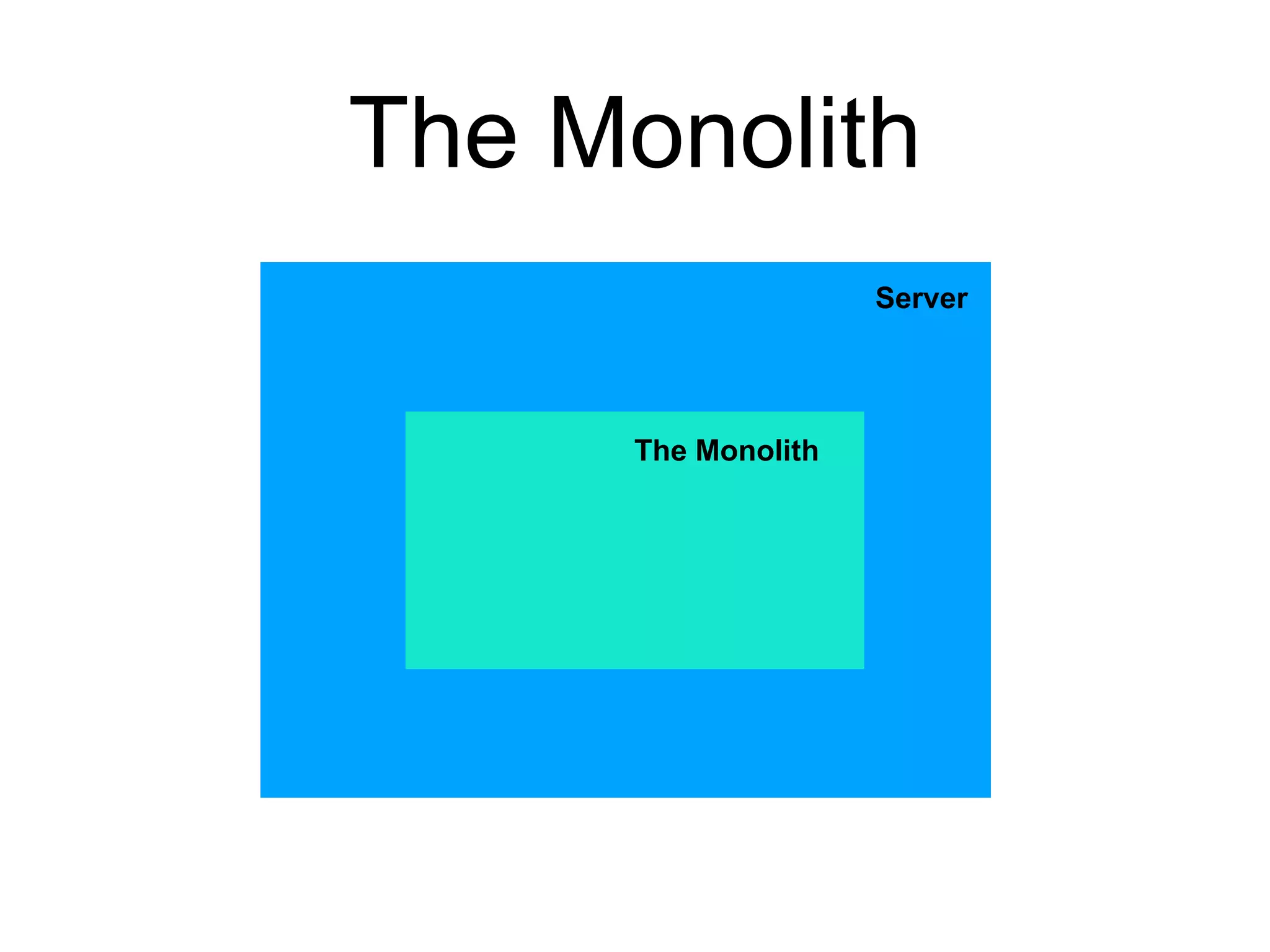
The Monolith
Server
The Monolith
The Monolith (closer look)
The Monolith
Module 1
Module n
Module 2 …
• Upgrade server OS
• Upgrade framework
• Modify module n
• Ship new code
• Adopt some new technology
The Monolith Struggle
(Hard) Lessons Learned
• Codebase becomes huge - Difficult to maintain, on-board
new members
• Tightly coupled code
• Tied in to a specific technology, no room to explore
something new or attract more diverse talent
• Change is “expensive” and risky
• Not shipping fast enough
On Cloud 9
• Servers on demand - no more slow, painful provisioning
• Best industry practices available to everyone
• API’s to manage servers and services
• Ease of deployment
• “Infinite” scalability / elasticity
Perfect Timing
• Finally, we can afford the operational cost of breaking the
monolith
• Provisioning new services can be fast and cheap
• No need to pre-invest in infra-structure, invest as you go
• New cloud services offering automation on so many levels
• The rise of containerization (no more “but it works on my local”)
A New Hope (any Star Wars fans out there?)
• “Microservices is an architectural style that structures an
application as a collection of loosely coupled services,
which implement business capabilities”
• Divide and conquer - your business isn’t just one
department, why should your software be?
• Iterate fast and cheaper, easier to experiment
• Identify and isolate areas of experimentation, R&D
Microservices (oversimplified)
Server 1
Service 1
Server 2
Service 2
Server n
Service n
…
APIAPI
API
Service 1 Service 2
APIAPI
Micro-service Benefits
• Smaller, loosely coupled components, easier to manage,
refactor
• Each service, only communicating with the outside world via
its API
• Adopt best technology / tools for each use case
• Each service owns its own data (enables polyglot persistency)
• Scale per service as needed, more fine grained control
• Self organizing teams
Who’s in?
and many more…
With great power…
• Not a silver bullet, it still requires solid development and
architectural practices
• Many moving parts / Complex architecture
• Automate automate automate
• Setting up an integrated development environment
How do I get started?
• Truly understand your business and your data
• Identify areas of responsibility and relationships between
them
• Educate yourself on microservices, build some pet projects
(internal tools are ideal candidates)
• Implement a small, low-risk module as a micro-service
• Measure impact (time to ship, etc.)
• Wash, rinse, repeat
Key Takeaways
• Micro-services are not easy and are not for everyone or for every
use case
• You shouldn’t consider micro-services if you don’t understand your
data
• If you can’t build a good monolith, simply opting for micro-services is
not going to fix anything
• Getting it right is a constant iterative process
• Start small. Experiment.
• Automation is King
Thank you!
@IraklisAlex
Iraklis Alexopoulos

Think Big - Build Small

  • 1.
    Think Big (enabled bythe Cloud) Build Small
  • 2.
    What we’ll cover •The way we used to (or still) build software • Timing is everything - Hello Cloud • A better* (not easier) way to build software • Not a silver bullet • How to get started
  • 3.
    Evolution of Software Development •Long planning, gather requirements, build one big thing • Iterative planning, ship fast, continuous delivery, still build one big thing • Everything becomes an API, mobile on the rise • Automate all things - DevOps • Mostly, still building one big thing - Monolith (or many - still big - things, SOA)
  • 4.
  • 5.
    The Monolith (closerlook) The Monolith Module 1 Module n Module 2 …
  • 6.
    • Upgrade serverOS • Upgrade framework • Modify module n • Ship new code • Adopt some new technology The Monolith Struggle
  • 7.
    (Hard) Lessons Learned •Codebase becomes huge - Difficult to maintain, on-board new members • Tightly coupled code • Tied in to a specific technology, no room to explore something new or attract more diverse talent • Change is “expensive” and risky • Not shipping fast enough
  • 8.
    On Cloud 9 •Servers on demand - no more slow, painful provisioning • Best industry practices available to everyone • API’s to manage servers and services • Ease of deployment • “Infinite” scalability / elasticity
  • 9.
    Perfect Timing • Finally,we can afford the operational cost of breaking the monolith • Provisioning new services can be fast and cheap • No need to pre-invest in infra-structure, invest as you go • New cloud services offering automation on so many levels • The rise of containerization (no more “but it works on my local”)
  • 10.
    A New Hope(any Star Wars fans out there?) • “Microservices is an architectural style that structures an application as a collection of loosely coupled services, which implement business capabilities” • Divide and conquer - your business isn’t just one department, why should your software be? • Iterate fast and cheaper, easier to experiment • Identify and isolate areas of experimentation, R&D
  • 11.
    Microservices (oversimplified) Server 1 Service1 Server 2 Service 2 Server n Service n … APIAPI API Service 1 Service 2 APIAPI
  • 12.
    Micro-service Benefits • Smaller,loosely coupled components, easier to manage, refactor • Each service, only communicating with the outside world via its API • Adopt best technology / tools for each use case • Each service owns its own data (enables polyglot persistency) • Scale per service as needed, more fine grained control • Self organizing teams
  • 13.
  • 14.
    With great power… •Not a silver bullet, it still requires solid development and architectural practices • Many moving parts / Complex architecture • Automate automate automate • Setting up an integrated development environment
  • 15.
    How do Iget started? • Truly understand your business and your data • Identify areas of responsibility and relationships between them • Educate yourself on microservices, build some pet projects (internal tools are ideal candidates) • Implement a small, low-risk module as a micro-service • Measure impact (time to ship, etc.) • Wash, rinse, repeat
  • 16.
    Key Takeaways • Micro-servicesare not easy and are not for everyone or for every use case • You shouldn’t consider micro-services if you don’t understand your data • If you can’t build a good monolith, simply opting for micro-services is not going to fix anything • Getting it right is a constant iterative process • Start small. Experiment. • Automation is King
  • 17.