
29th Jun,2019
Hyderabad MuleSoft Meetup Group
All contents © MuleSoft Inc.
Agenda
2
• 15:30 Introduction
• 15:45 Session 1
• 16:45 Break for Snacks
• 17:05 Session 2
• 17:40 Q&A
Introductions
All contents © MuleSoft Inc.
Introductions
4
About the organizer/speaker :
– Ravishankar Mishra – Integration Architect , Accenture
– Satwinder Singh Banipal - Integration Architect, Accenture
Partner:
• Consulting services
• Professional Services
All contents © MuleSoft Inc.
Introductions
5
Introduce yourselves !
– Name
– Background
• What’s your experience with Anypoint platform/ Mule ESB?
• Why are you here ? Expectations?
New Foundation of Mule 4
All contents © MuleSoft Inc.
New Foundation of Mule 4
7
• What’s In-Scope
-Reactive Programming Model
-Non Blocking Operations
-Thread Management in Mule 4.x
-Streaming in Mule 4.x
All contents © MuleSoft Inc.
New Foundation of Mule 4
8
• We build integration solutions which cater to high volumes of real-time and batch
data
– Connectivity, Transformation, Enrichment, Validation, Routing, Error Handling, Security
• Horizontal Scalability: High rates of API calls per second(More workers)
• Vertical Scalability :Memory intensive processing (More vCore)
• In Mule 4 vertical scaling is done differently using reactive programming. The aim
is to maximize throughput and higher concurrency using non-blocking operations.
This leads to more efficient use of CPU, memory and disk space.
All contents © MuleSoft Inc.
New Foundation of Mule 4
9
• Non Blocking Operations
-Fundamental to Reactive Programming (eventually Mule 4)
-No Thread waits for any operation
-Increases Concurrency however Latency is also more
-Manual and E toll on highways
All contents © MuleSoft Inc.
New Foundation of Mule 4
10
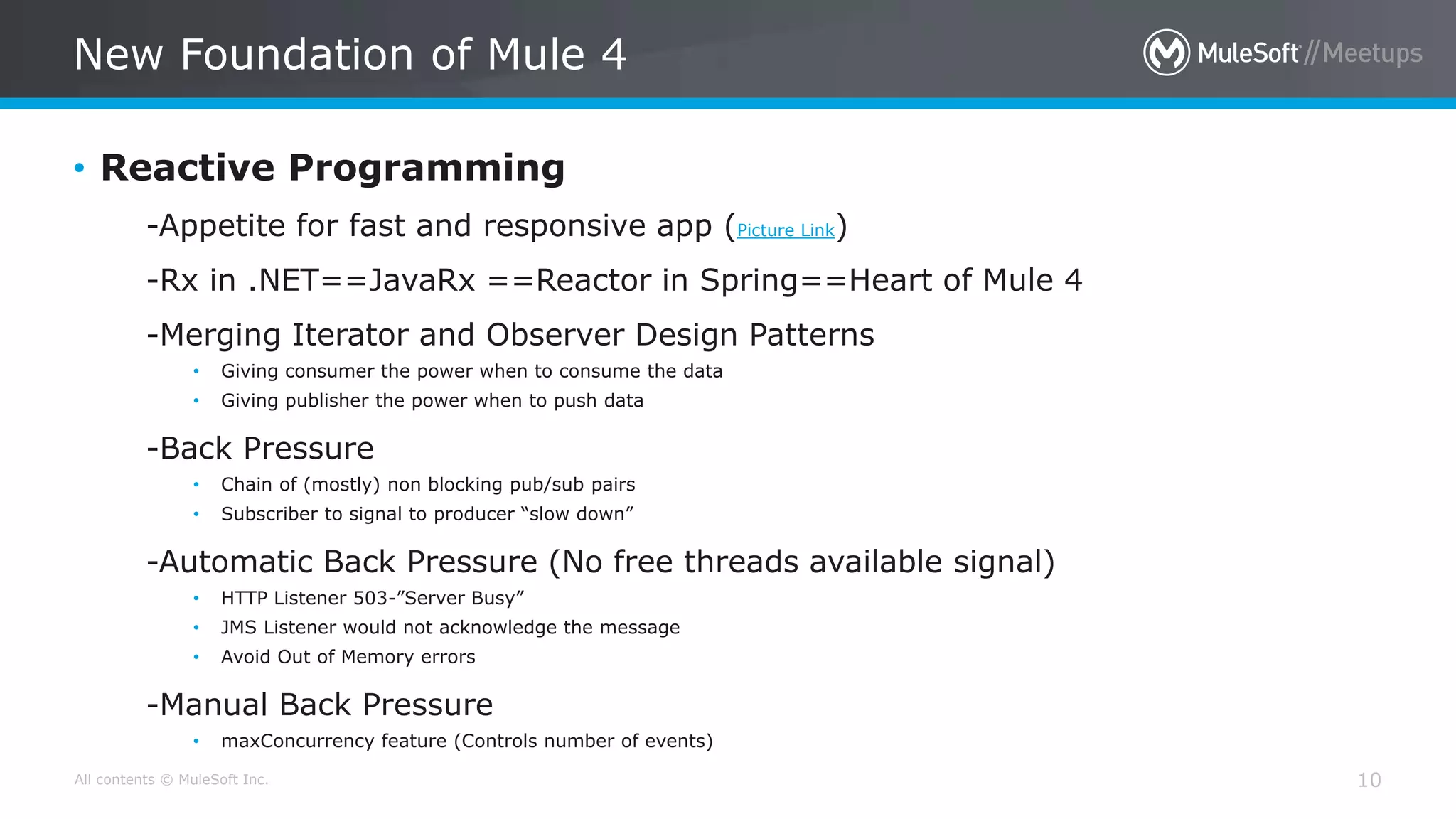
• Reactive Programming
-Appetite for fast and responsive app (Picture Link)
-Rx in .NET==JavaRx ==Reactor in Spring==Heart of Mule 4
-Merging Iterator and Observer Design Patterns
• Giving consumer the power when to consume the data
• Giving publisher the power when to push data
-Back Pressure
• Chain of (mostly) non blocking pub/sub pairs
• Subscriber to signal to producer “slow down”
-Automatic Back Pressure (No free threads available signal)
• HTTP Listener 503-”Server Busy”
• JMS Listener would not acknowledge the message
• Avoid Out of Memory errors
-Manual Back Pressure
• maxConcurrency feature (Controls number of events)
All contents © MuleSoft Inc.
New Foundation of Mule 4
11
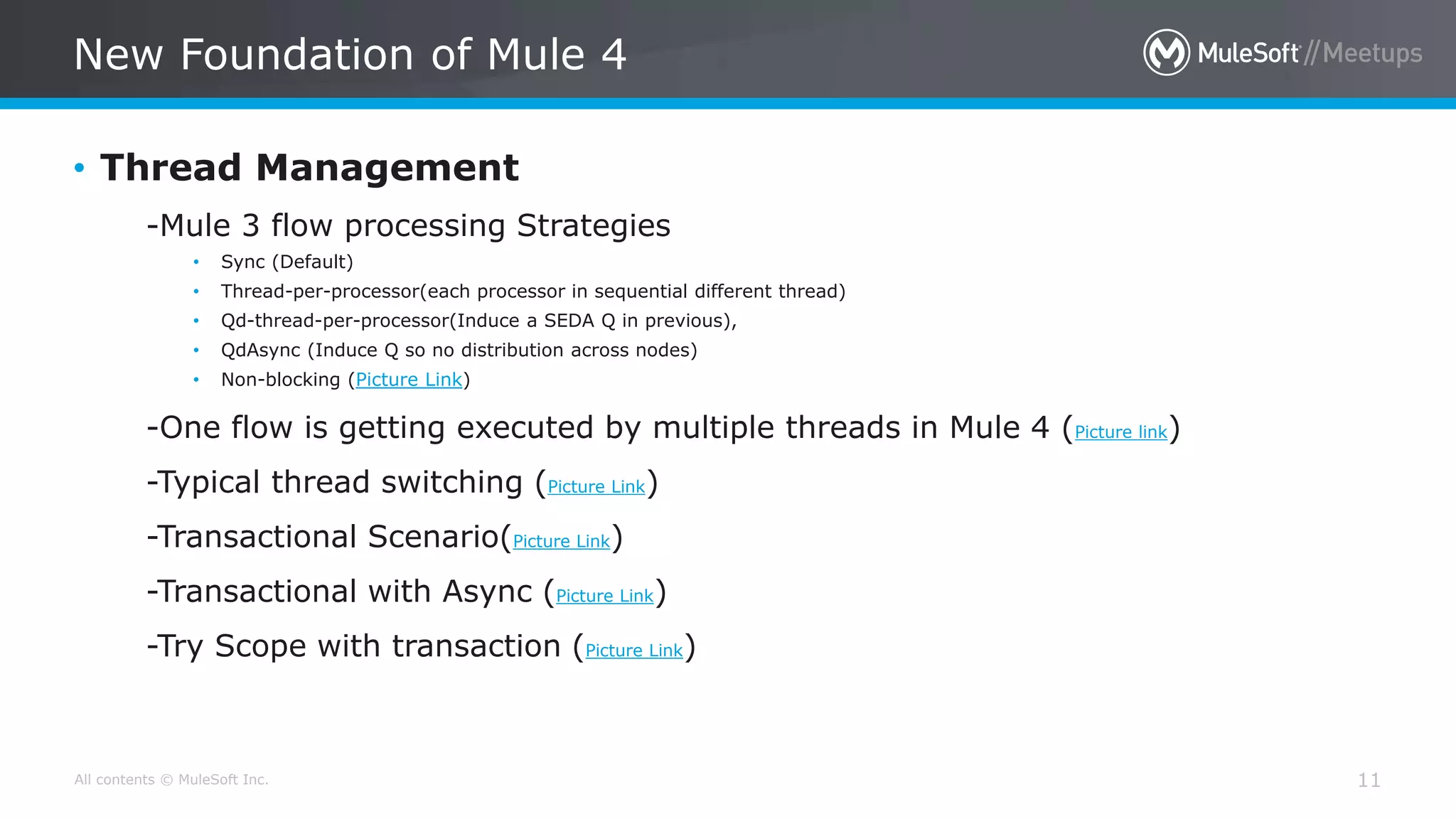
• Thread Management
-Mule 3 flow processing Strategies
• Sync (Default)
• Thread-per-processor(each processor in sequential different thread)
• Qd-thread-per-processor(Induce a SEDA Q in previous),
• QdAsync (Induce Q so no distribution across nodes)
• Non-blocking (Picture Link)
-One flow is getting executed by multiple threads in Mule 4 (Picture link)
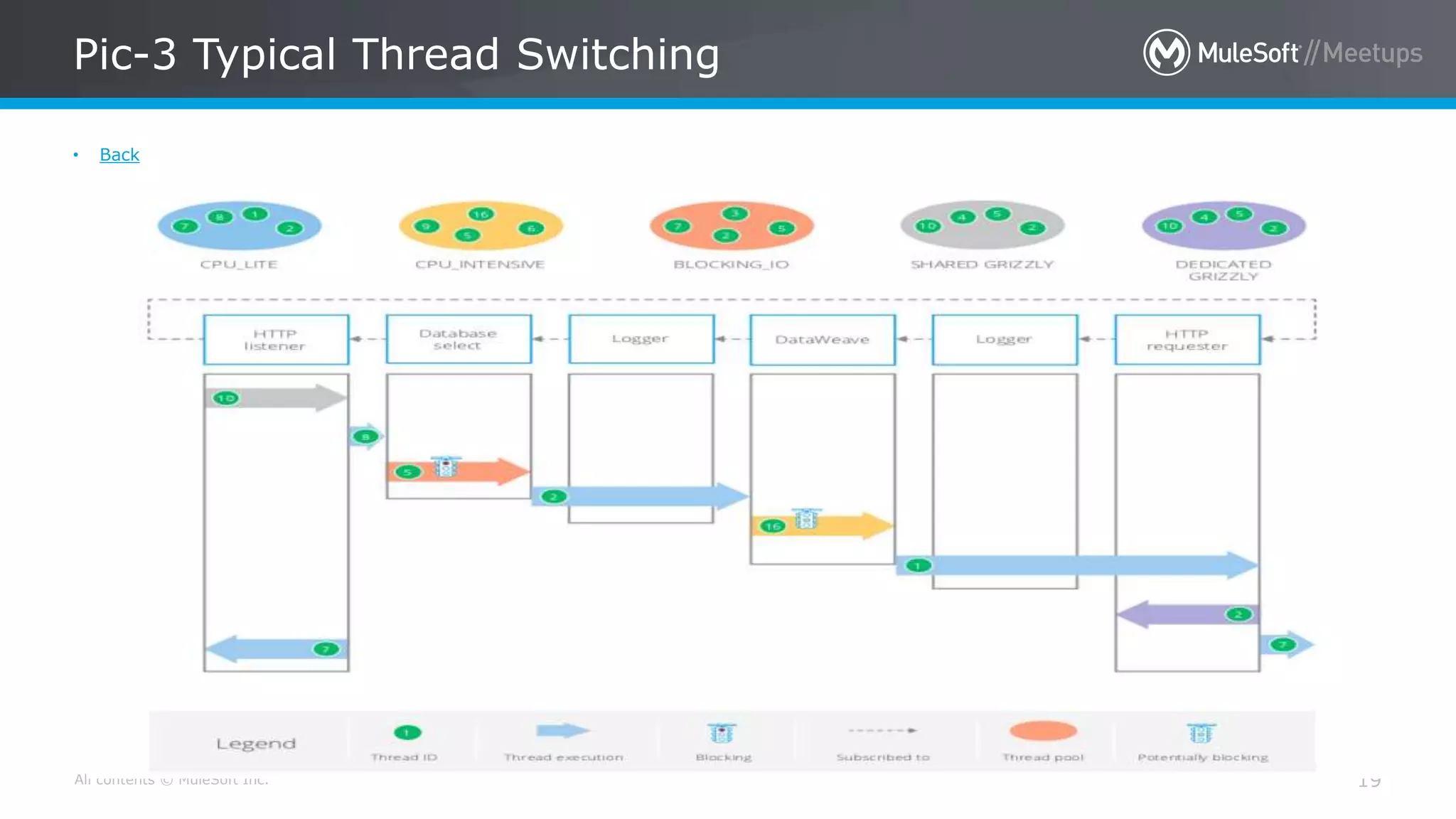
-Typical thread switching (Picture Link)
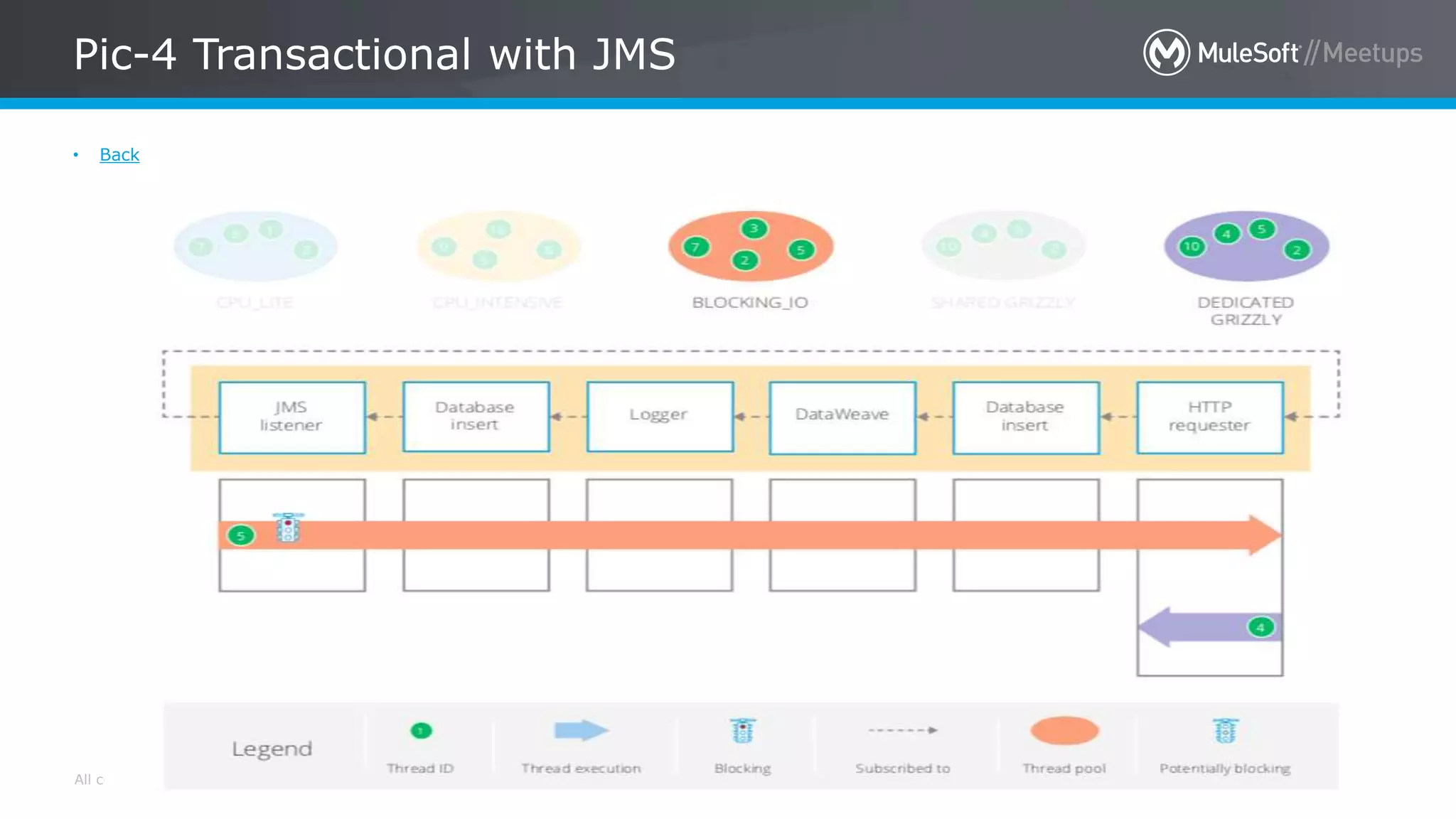
-Transactional Scenario(Picture Link)
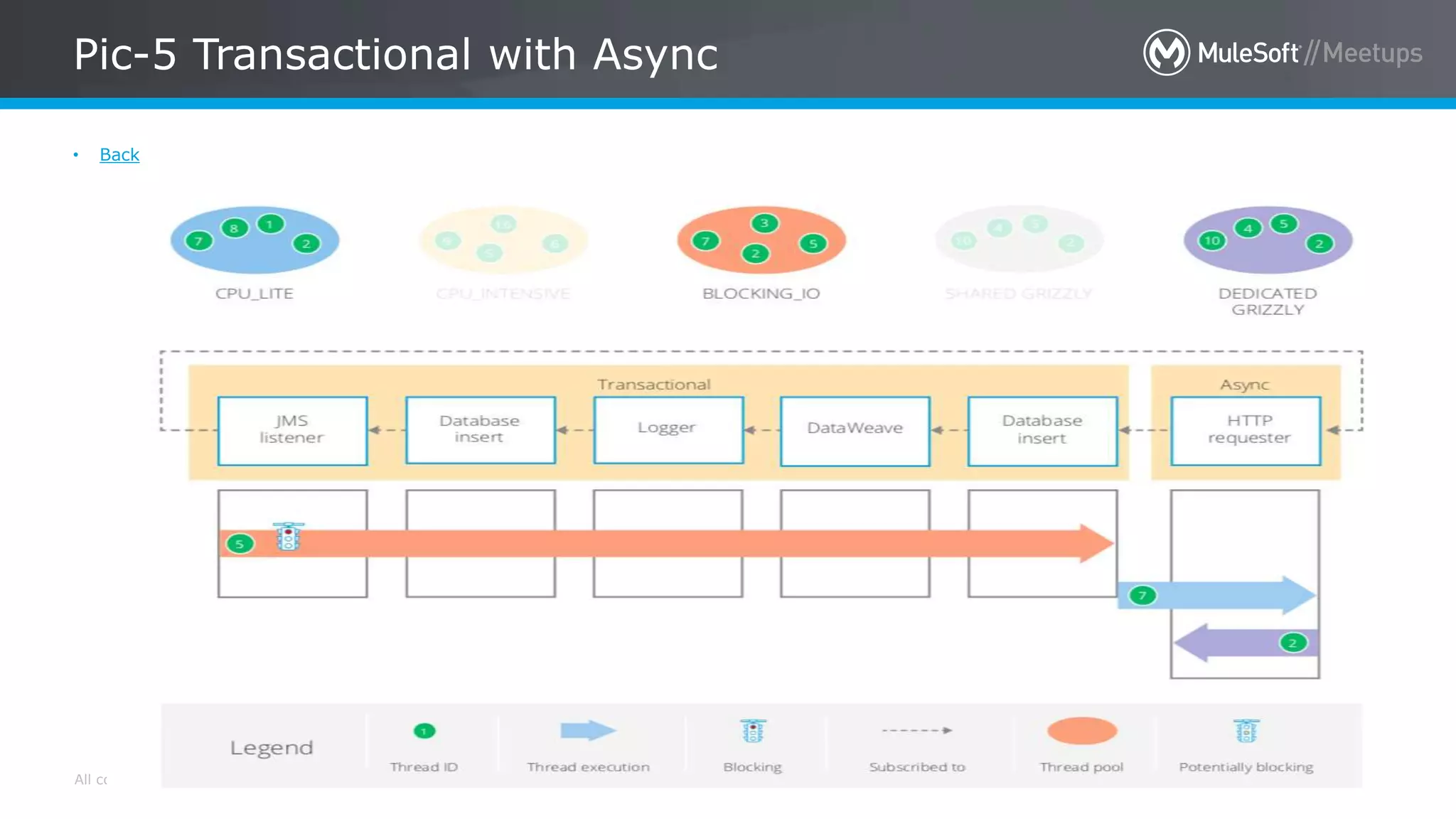
-Transactional with Async (Picture Link)
-Try Scope with transaction (Picture Link)
All contents © MuleSoft Inc.
Streaming: To process larger-than-memory Mule events, they are data structures that helps to process
large data objects such as files, documents, and records by processing data continuously as it arrives.
- Does not hold all the values in memory for processing unlike In-memory data structures
- Avoids Out-Of-Memory while processing large data objects
Mule 4 runtime by default streams large data payloads without any explicit configuration.
All the Mule4 components that returns an InputStream or a Streamable collections support repeatable
streams
Some Connectors that support repeatable streams:
-File
-FTP
-DB
-HTTP
-Sockets
-Salesforce
New Foundation of Mule 4
All contents © MuleSoft Inc.
New Foundation of Mule 4
13
• Streaming options in Mule 4
- File based Repeatable Streams
• Only available for Enterprise Edition
• By Default store 500 objects in its In-Memory buffer and can be configured further
• Excess objects get written to disk via Kyro Serializer
- In-Memory Repeatable Streams
• Default for Mule Community Edition
• Uses default max buffer size of 500 objects
• Increment size is 100 Objects until it reaches max buffer size
• In case stream exceed max buffer limit, then application fails
-Non Repeatable Streams
• The input stream is only Read Once
• No extra memory/performance overhead compared with repeatable streams
All contents © MuleSoft Inc.
New Foundation of Mule 4
14
• Types of Repeatable Streams
Binary Streaming: Stream does not understand its data structure for modules like
HTTP, SFTP, and File.(Picture Link)
Object Streaming: Generally used for operations which support paging. Eg: Database,
Salesforce select operations.(Picture Link)
Thank You!!!
Open discussion
All contents © MuleSoft Inc.
Pic-1 Non Blocking
17
• Back
All contents © MuleSoft Inc.
Pic-2 Thread Pools
18
• Back
All contents © MuleSoft Inc.
Pic-3 Typical Thread Switching
19
• Back
All contents © MuleSoft Inc.
Pic-4 Transactional with JMS
20
• Back
All contents © MuleSoft Inc.
Pic-5 Transactional with Async
21
• Back
All contents © MuleSoft Inc.
Pic-6 Transactional with Try scope
22
• Back
All contents © MuleSoft Inc.
Pic-7 Pub-Sub model
23
• Back
All contents © MuleSoft Inc.
Pic-8 Binary Streaming
24
• Back
All contents © MuleSoft Inc.
Pic-9 Object Streaming
25
• Back

Mulesoft meetup 29.06

  • 1.
  • 2.
    All contents ©MuleSoft Inc. Agenda 2 • 15:30 Introduction • 15:45 Session 1 • 16:45 Break for Snacks • 17:05 Session 2 • 17:40 Q&A
  • 3.
  • 4.
    All contents ©MuleSoft Inc. Introductions 4 About the organizer/speaker : – Ravishankar Mishra – Integration Architect , Accenture – Satwinder Singh Banipal - Integration Architect, Accenture Partner: • Consulting services • Professional Services
  • 5.
    All contents ©MuleSoft Inc. Introductions 5 Introduce yourselves ! – Name – Background • What’s your experience with Anypoint platform/ Mule ESB? • Why are you here ? Expectations?
  • 6.
  • 7.
    All contents ©MuleSoft Inc. New Foundation of Mule 4 7 • What’s In-Scope -Reactive Programming Model -Non Blocking Operations -Thread Management in Mule 4.x -Streaming in Mule 4.x
  • 8.
    All contents ©MuleSoft Inc. New Foundation of Mule 4 8 • We build integration solutions which cater to high volumes of real-time and batch data – Connectivity, Transformation, Enrichment, Validation, Routing, Error Handling, Security • Horizontal Scalability: High rates of API calls per second(More workers) • Vertical Scalability :Memory intensive processing (More vCore) • In Mule 4 vertical scaling is done differently using reactive programming. The aim is to maximize throughput and higher concurrency using non-blocking operations. This leads to more efficient use of CPU, memory and disk space.
  • 9.
    All contents ©MuleSoft Inc. New Foundation of Mule 4 9 • Non Blocking Operations -Fundamental to Reactive Programming (eventually Mule 4) -No Thread waits for any operation -Increases Concurrency however Latency is also more -Manual and E toll on highways
  • 10.
    All contents ©MuleSoft Inc. New Foundation of Mule 4 10 • Reactive Programming -Appetite for fast and responsive app (Picture Link) -Rx in .NET==JavaRx ==Reactor in Spring==Heart of Mule 4 -Merging Iterator and Observer Design Patterns • Giving consumer the power when to consume the data • Giving publisher the power when to push data -Back Pressure • Chain of (mostly) non blocking pub/sub pairs • Subscriber to signal to producer “slow down” -Automatic Back Pressure (No free threads available signal) • HTTP Listener 503-”Server Busy” • JMS Listener would not acknowledge the message • Avoid Out of Memory errors -Manual Back Pressure • maxConcurrency feature (Controls number of events)
  • 11.
    All contents ©MuleSoft Inc. New Foundation of Mule 4 11 • Thread Management -Mule 3 flow processing Strategies • Sync (Default) • Thread-per-processor(each processor in sequential different thread) • Qd-thread-per-processor(Induce a SEDA Q in previous), • QdAsync (Induce Q so no distribution across nodes) • Non-blocking (Picture Link) -One flow is getting executed by multiple threads in Mule 4 (Picture link) -Typical thread switching (Picture Link) -Transactional Scenario(Picture Link) -Transactional with Async (Picture Link) -Try Scope with transaction (Picture Link)
  • 12.
    All contents ©MuleSoft Inc. Streaming: To process larger-than-memory Mule events, they are data structures that helps to process large data objects such as files, documents, and records by processing data continuously as it arrives. - Does not hold all the values in memory for processing unlike In-memory data structures - Avoids Out-Of-Memory while processing large data objects Mule 4 runtime by default streams large data payloads without any explicit configuration. All the Mule4 components that returns an InputStream or a Streamable collections support repeatable streams Some Connectors that support repeatable streams: -File -FTP -DB -HTTP -Sockets -Salesforce New Foundation of Mule 4
  • 13.
    All contents ©MuleSoft Inc. New Foundation of Mule 4 13 • Streaming options in Mule 4 - File based Repeatable Streams • Only available for Enterprise Edition • By Default store 500 objects in its In-Memory buffer and can be configured further • Excess objects get written to disk via Kyro Serializer - In-Memory Repeatable Streams • Default for Mule Community Edition • Uses default max buffer size of 500 objects • Increment size is 100 Objects until it reaches max buffer size • In case stream exceed max buffer limit, then application fails -Non Repeatable Streams • The input stream is only Read Once • No extra memory/performance overhead compared with repeatable streams
  • 14.
    All contents ©MuleSoft Inc. New Foundation of Mule 4 14 • Types of Repeatable Streams Binary Streaming: Stream does not understand its data structure for modules like HTTP, SFTP, and File.(Picture Link) Object Streaming: Generally used for operations which support paging. Eg: Database, Salesforce select operations.(Picture Link)
  • 15.
  • 16.
  • 17.
    All contents ©MuleSoft Inc. Pic-1 Non Blocking 17 • Back
  • 18.
    All contents ©MuleSoft Inc. Pic-2 Thread Pools 18 • Back
  • 19.
    All contents ©MuleSoft Inc. Pic-3 Typical Thread Switching 19 • Back
  • 20.
    All contents ©MuleSoft Inc. Pic-4 Transactional with JMS 20 • Back
  • 21.
    All contents ©MuleSoft Inc. Pic-5 Transactional with Async 21 • Back
  • 22.
    All contents ©MuleSoft Inc. Pic-6 Transactional with Try scope 22 • Back
  • 23.
    All contents ©MuleSoft Inc. Pic-7 Pub-Sub model 23 • Back
  • 24.
    All contents ©MuleSoft Inc. Pic-8 Binary Streaming 24 • Back
  • 25.
    All contents ©MuleSoft Inc. Pic-9 Object Streaming 25 • Back