Reliable Distributed Systems Technologies Web
Services And Applications Kenneth P Birman
download
https://ebookbell.com/product/reliable-distributed-systems-
technologies-web-services-and-applications-kenneth-p-
birman-4106992
Explore and download more ebooks at ebookbell.com
Here are some recommended products that we believe you will be
interested in. You can click the link to download.
Designing Reliable Distributed Systems A Formal Methods Approach Based
On Executable Modeling In Maude 1st Edition Peter Csaba Lveczky Auth
https://ebookbell.com/product/designing-reliable-distributed-systems-
a-formal-methods-approach-based-on-executable-modeling-in-maude-1st-
edition-peter-csaba-lveczky-auth-6988498
Making Reliable Distributed Systems In The Presence Ofsodware Errors
1st Edition Joe Armstrong
https://ebookbell.com/product/making-reliable-distributed-systems-in-
the-presence-ofsodware-errors-1st-edition-joe-armstrong-36860072
Guide To Reliable Distributed Systems Building Highassurance
Applications And Cloudhosted Services Kenneth P Birman
https://ebookbell.com/product/guide-to-reliable-distributed-systems-
building-highassurance-applications-and-cloudhosted-services-kenneth-
p-birman-2504676
Designing Distributed Systems Patterns And Paradigms For Scalable
Reliable Services Paperback Brendan Burns
https://ebookbell.com/product/designing-distributed-systems-patterns-
and-paradigms-for-scalable-reliable-services-paperback-brendan-
burns-7196322
Designing Distributed Systems Patterns And Paradigms For Scalable
Reliable Systems Using Kubernetes Brendan Burns
https://ebookbell.com/product/designing-distributed-systems-patterns-
and-paradigms-for-scalable-reliable-systems-using-kubernetes-brendan-
burns-171594350
Learning Nservicebus 2nd Edition Build Reliable And Scalable
Distributed Software Systems Using The Industry Leading Net Enterprise
Service Bus David Boike
https://ebookbell.com/product/learning-nservicebus-2nd-edition-build-
reliable-and-scalable-distributed-software-systems-using-the-industry-
leading-net-enterprise-service-bus-david-boike-5473808
Distributed Services With Go Your Guide To Reliable Scalable And
Maintainable Systems 1st Edition Travis Jeffery
https://ebookbell.com/product/distributed-services-with-go-your-guide-
to-reliable-scalable-and-maintainable-systems-1st-edition-travis-
jeffery-24030282
Introduction To Reliable Distributed Programming Rachid Guerraoui Luis
Rodrigues
https://ebookbell.com/product/introduction-to-reliable-distributed-
programming-rachid-guerraoui-luis-rodrigues-4103324
Introduction To Reliable And Secure Distributed Programming 2nd
Edition Christian Cachin
https://ebookbell.com/product/introduction-to-reliable-and-secure-
distributed-programming-2nd-edition-christian-cachin-4521656
Kenneth P. Birman
Reliable Distributed Systems
Technologies, Web Services,
and Applications
Kenneth P. Birman
Cornell University
Department of Computer Science
Ithaca, NY 14853
U.S.A.
ken@cs.cornell.edu
Mathematics Subject Classification (2000): 68M14, 68W15, 68M15, 68Q85, 68M12
Based on Building Secure and Reliable Network Applications, Manning Publications Co., Greenwich, c
1996.
ISBN-10 0-387-21509-3 Springer New York, Heidelberg, Berlin
ISBN-13 978-0-387-21509-9 Springer New York, Heidelberg, Berlin
c
2005 Springer Science+Business Media, Inc.
All rights reserved. This work may not be translated or copied in whole or in part without the written permission of the
publisher (Springer Science+Business Media Inc., 233 Spring Street, New York, NY, 10013 USA), except for brief excerpts
in connection with reviews or scholarly analysis. Use in connection with any form of information storage and retrieval,
electronic adaptation, computer software, or by similar or dissimilar methodology now known or hereafter developed is
forbidden.
The use in this publication of trade names, trademarks, service marks and similar terms, even if they are not identified as
such, is not to be taken as an expression of opinion as to whether or not they are subject to proprietary rights.
Printed in the United States of America. (KeS/HP)
9 8 7 6 5 4 3 2 1 SPIN 10969700
springeronline.com
0
Contents
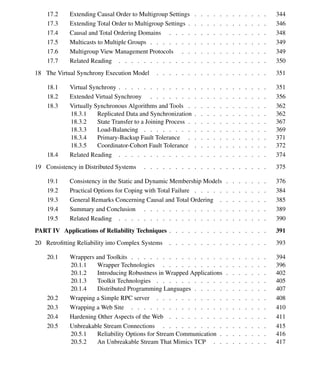
Preface . . . . . . . . . . . . . . . . . . . . . . . . . . . . . . . . xvii
Introduction . . . . . . . . . . . . . . . . . . . . . . . . . . . . . . xix
A User’s Guide to This Book . . . . . . . . . . . . . . . . . . . . . . . xxix
Trademarks . . . . . . . . . . . . . . . . . . . . . . . . . . . . . . xxxiii
PART I Basic Distributed Computing Technologies . . . . . . . . . . . . . . 1
1 Fundamentals . . . . . . . . . . . . . . . . . . . . . . . . . . . . . 3
1.1 Introduction . . . . . . . . . . . . . . . . . . . . . . . . . . 3
1.2 Components of a Reliable Distributed Computing System . . . . . . . . 7
1.2.1 Communication Technology . . . . . . . . . . . . . . . 12
1.2.2 Basic Transport and Network Services . . . . . . . . . . . 14
1.2.3 Reliable Transport Software and Communication Support . . . 15
1.2.4 Middleware: Software Tools, Utilities, and Programming Languages 16
1.2.5 Distributed Computing Environments . . . . . . . . . . . 17
1.2.6 End-User Applications . . . . . . . . . . . . . . . . . 19
1.3 Critical Dependencies . . . . . . . . . . . . . . . . . . . . . . 20
1.4 Next Steps . . . . . . . . . . . . . . . . . . . . . . . . . . . 22
1.5 Related Reading . . . . . . . . . . . . . . . . . . . . . . . . 23
2 Basic Communication Services . . . . . . . . . . . . . . . . . . . . . . 25
2.1 Communication Standards . . . . . . . . . . . . . . . . . . . . 25
2.2 Addressing . . . . . . . . . . . . . . . . . . . . . . . . . . 27
2.3 Network Address Translation . . . . . . . . . . . . . . . . . . . 31
2.4 IP Tunnelling . . . . . . . . . . . . . . . . . . . . . . . . . 33
2.5 Internet Protocols . . . . . . . . . . . . . . . . . . . . . . . . 33
2.5.1 Internet Protocol: IP layer . . . . . . . . . . . . . . . . 33
2.5.2 Transmission Control Protocol: TCP . . . . . . . . . . . . 34
2.5.3 User Datagram Protocol: UDP . . . . . . . . . . . . . . 34
2.5.4 Multicast Protocol . . . . . . . . . . . . . . . . . . . 35
2.6 Routing . . . . . . . . . . . . . . . . . . . . . . . . . . . . 36
2.7 End-to-End Argument . . . . . . . . . . . . . . . . . . . . . . 37
vi Contents
2.8 OS Architecture Issues: Buffering and Fragmentation . . . . . . . . . 39
2.9 Next Steps . . . . . . . . . . . . . . . . . . . . . . . . . . . 41
2.10 Related Reading . . . . . . . . . . . . . . . . . . . . . . . . 43
3 High Assurance Communication . . . . . . . . . . . . . . . . . . . . . 45
3.1 Notions of Correctness and High Assurance Distributed Communication . . 45
3.2 The Many Dimensions of Reliability . . . . . . . . . . . . . . . . 45
3.3 Scalability and Performance Goals . . . . . . . . . . . . . . . . . 49
3.4 Security Considerations . . . . . . . . . . . . . . . . . . . . . 50
3.5 Next Steps . . . . . . . . . . . . . . . . . . . . . . . . . . . 51
3.6 Related Reading . . . . . . . . . . . . . . . . . . . . . . . . 52
4 Remote Procedure Calls and the Client/Server Model . . . . . . . . . . . . . 53
4.1 The Client/Server Model . . . . . . . . . . . . . . . . . . . . . 53
4.2 RPC Protocols and Concepts . . . . . . . . . . . . . . . . . . . 57
4.3 Writing an RPC-based Client or Server Program . . . . . . . . . . . 60
4.4 The RPC Binding Problem . . . . . . . . . . . . . . . . . . . . 63
4.5 Marshalling and Data Types . . . . . . . . . . . . . . . . . . . . 65
4.6 Associated Services . . . . . . . . . . . . . . . . . . . . . . . 67
4.6.1 Naming Services . . . . . . . . . . . . . . . . . . . . 67
4.6.2 Time Services . . . . . . . . . . . . . . . . . . . . . 69
4.6.3 Security Services . . . . . . . . . . . . . . . . . . . . 70
4.6.4 Threads packages . . . . . . . . . . . . . . . . . . . 71
4.6.5 Transactions . . . . . . . . . . . . . . . . . . . . . 74
4.7 The RPC Protocol . . . . . . . . . . . . . . . . . . . . . . . . 75
4.8 Using RPC in Reliable Distributed Systems . . . . . . . . . . . . . 78
4.9 Layering RPC over TCP . . . . . . . . . . . . . . . . . . . . . 81
4.10 Related Reading . . . . . . . . . . . . . . . . . . . . . . . . 83
5 Styles of Client/Server Computing . . . . . . . . . . . . . . . . . . . . . 85
5.1 Stateless and Stateful Client/Server Interactions . . . . . . . . . . . . 85
5.2 Major Uses of the Client/Server Paradigm . . . . . . . . . . . . . . 85
5.3 Distributed File Systems . . . . . . . . . . . . . . . . . . . . . 92
5.4 Stateful File Servers . . . . . . . . . . . . . . . . . . . . . . . 99
5.5 Distributed Database Systems . . . . . . . . . . . . . . . . . . . 106
5.6 Applying Transactions to File Servers . . . . . . . . . . . . . . . . 113
5.7 Message-Queuing Systems . . . . . . . . . . . . . . . . . . . . 116
Contents vii
5.8 Related Topics . . . . . . . . . . . . . . . . . . . . . . . . . 116
5.9 Related Reading . . . . . . . . . . . . . . . . . . . . . . . . 117
6 CORBA: The Common Object Request Broker Architecture . . . . . . . . . . 119
6.1 The ANSA Project . . . . . . . . . . . . . . . . . . . . . . . 119
6.2 Beyond ANSA to CORBA . . . . . . . . . . . . . . . . . . . . 122
6.3 Web Services . . . . . . . . . . . . . . . . . . . . . . . . . 124
6.4 The CORBA Reference Model . . . . . . . . . . . . . . . . . . 124
6.5 IDL and ODL . . . . . . . . . . . . . . . . . . . . . . . . . 131
6.6 ORB . . . . . . . . . . . . . . . . . . . . . . . . . . . . . 132
6.7 Naming Service . . . . . . . . . . . . . . . . . . . . . . . . 133
6.8 ENS—The CORBA Event Notification Service . . . . . . . . . . . . 133
6.9 Life-Cycle Service . . . . . . . . . . . . . . . . . . . . . . . 135
6.10 Persistent Object Service . . . . . . . . . . . . . . . . . . . . . 135
6.11 Transaction Service . . . . . . . . . . . . . . . . . . . . . . . 135
6.12 Interobject Broker Protocol . . . . . . . . . . . . . . . . . . . . 136
6.13 Properties of CORBA Solutions . . . . . . . . . . . . . . . . . . 136
6.14 Performance of CORBA and Related Technologies . . . . . . . . . . 137
6.15 Related Reading . . . . . . . . . . . . . . . . . . . . . . . . 140
7 System Support for Fast Client/Server Communication . . . . . . . . . . . . . 141
7.1 Lightweight RPC . . . . . . . . . . . . . . . . . . . . . . . . 143
7.2 fbufs and the x-Kernel Project . . . . . . . . . . . . . . . . . . . 146
7.3 Active Messages . . . . . . . . . . . . . . . . . . . . . . . . 147
7.4 Beyond Active Messages: U-Net . . . . . . . . . . . . . . . . . . 149
7.5 Protocol Compilation Techniques . . . . . . . . . . . . . . . . . 154
7.6 Related Reading . . . . . . . . . . . . . . . . . . . . . . . . 155
PART II Web Technologies . . . . . . . . . . . . . . . . . . . . . . . . 157
8 The World Wide Web . . . . . . . . . . . . . . . . . . . . . . . . . . 159
8.1 The World Wide Web . . . . . . . . . . . . . . . . . . . . . . 159
8.2 The Web Services Vision . . . . . . . . . . . . . . . . . . . . . 161
8.3 Web Security and Reliability . . . . . . . . . . . . . . . . . . . 164
8.4 Computing Platforms . . . . . . . . . . . . . . . . . . . . . . 169
8.5 Related Reading . . . . . . . . . . . . . . . . . . . . . . . . 169
viii Contents
9 Major Web Technologies . . . . . . . . . . . . . . . . . . . . . . . . . 171
9.1 Components of the Web . . . . . . . . . . . . . . . . . . . . . 171
9.2 HyperText Markup Language . . . . . . . . . . . . . . . . . . . 173
9.3 Extensible Markup Language . . . . . . . . . . . . . . . . . . . 174
9.4 Uniform Resource Locators . . . . . . . . . . . . . . . . . . . 174
9.5 HyperText Transport Protocol . . . . . . . . . . . . . . . . . . . 175
9.6 Representations of Image Data . . . . . . . . . . . . . . . . . . . 179
9.7 Authorization and Privacy Issues . . . . . . . . . . . . . . . . . . 180
9.8 Web Proxy Servers . . . . . . . . . . . . . . . . . . . . . . . 187
9.9 Web Search Engines and Web Crawlers . . . . . . . . . . . . . . . 188
9.10 Browser Extensibility Features: Plug-in Technologies . . . . . . . . . 189
9.11 Future Challenges for the Web Community . . . . . . . . . . . . . . 190
9.12 Consistency and the Web . . . . . . . . . . . . . . . . . . . . . 192
9.13 Related Reading . . . . . . . . . . . . . . . . . . . . . . . . 192
10 Web Services . . . . . . . . . . . . . . . . . . . . . . . . . . . . . 193
10.1 What is a Web Service? . . . . . . . . . . . . . . . . . . . . . 193
10.2 Web Service Description Language: WSDL . . . . . . . . . . . . . 197
10.3 Simple Object Access Protocol: SOAP . . . . . . . . . . . . . . . 198
10.4 Talking to a Web Service: HTTP over TCP . . . . . . . . . . . . . . 201
10.5 Universal Description, Discovery and Integration Language: UDDI . . . . 202
10.6 Other Current and Proposed Web Services Standards . . . . . . . . . . 203
10.6.1 WS−RELIABILITY . . . . . . . . . . . . . . . . . . 203
10.6.2 WS−TRANSACTIONS . . . . . . . . . . . . . . . . . 204
10.6.3 WS−RELIABILITY . . . . . . . . . . . . . . . . . . 206
10.6.4 WS−MEMBERSHIP . . . . . . . . . . . . . . . . . . 208
10.7 How Web Services Deal with Failure . . . . . . . . . . . . . . . . 208
10.8 The Future of Web Services . . . . . . . . . . . . . . . . . . . . 210
10.9 Grid Computing: A Major Web Services Application . . . . . . . . . . 211
10.10 Autonomic Computing: Technologies to Improve Web Services Configuration
Management . . . . . . . . . . . . . . . . . . . . . . . . . 212
10.11 Related Readings . . . . . . . . . . . . . . . . . . . . . . . . 213
11 Related Internet Technologies . . . . . . . . . . . . . . . . . . . . . . . 215
11.1 File Transfer Tools . . . . . . . . . . . . . . . . . . . . . . . 215
11.2 Electronic Mail . . . . . . . . . . . . . . . . . . . . . . . . . 216
Contents ix
11.3 Network Bulletin Boards (Newsgroups) . . . . . . . . . . . . . . . 217
11.4 Instant Messaging Systems . . . . . . . . . . . . . . . . . . . . 219
11.5 Message-Oriented Middleware Systems (MOMS) . . . . . . . . . . . 220
11.6 Publish-Subscribe and Message Bus Architectures . . . . . . . . . . . 222
11.7 Internet Firewalls and Network Address Translators . . . . . . . . . . 225
11.8 Related Reading . . . . . . . . . . . . . . . . . . . . . . . . 226
12 Platform Technologies . . . . . . . . . . . . . . . . . . . . . . . . . . 227
12.1 Microsoft’s .NET Platform . . . . . . . . . . . . . . . . . . . . 228
12.1.1 .NET Framework . . . . . . . . . . . . . . . . . . . 228
12.1.2 XML Web Services . . . . . . . . . . . . . . . . . . . 229
12.1.3 Language Enhancements . . . . . . . . . . . . . . . . 230
12.1.4 Tools for Developing for Devices . . . . . . . . . . . . . 230
12.1.5 Integrated Development Environment . . . . . . . . . . . 230
12.2 Java Enterprise Edition . . . . . . . . . . . . . . . . . . . . . . 231
12.2.1 J2EE Framework . . . . . . . . . . . . . . . . . . . . 231
12.2.2 Java Application Verification Kit (AVK) . . . . . . . . . . 232
12.2.3 Enterprise JavaBeans Specification . . . . . . . . . . . . 232
12.2.4 J2EE Connectors . . . . . . . . . . . . . . . . . . . . 233
12.2.5 Web Services . . . . . . . . . . . . . . . . . . . . . 233
12.2.6 Other Java Platforms . . . . . . . . . . . . . . . . . . 233
12.3 .NET and J2EE Comparison . . . . . . . . . . . . . . . . . . . 233
12.4 Further Reading . . . . . . . . . . . . . . . . . . . . . . . . 234
PART III Reliable Distributed Computing . . . . . . . . . . . . . . . . . . 235
13 How and Why Computer Systems Fail . . . . . . . . . . . . . . . . . . . 237
13.1 Hardware Reliability and Trends . . . . . . . . . . . . . . . . . . 237
13.2 Software Reliability and Trends . . . . . . . . . . . . . . . . . . 238
13.3 Other Sources of Downtime . . . . . . . . . . . . . . . . . . . . 240
13.4 Complexity . . . . . . . . . . . . . . . . . . . . . . . . . . 241
13.5 Detecting Failures . . . . . . . . . . . . . . . . . . . . . . . . 242
13.6 Hostile Environments . . . . . . . . . . . . . . . . . . . . . . 243
13.7 Related Reading . . . . . . . . . . . . . . . . . . . . . . . . 246
14 Overcoming Failures in a Distributed System . . . . . . . . . . . . . . . . 247
14.1 Consistent Distributed Behavior . . . . . . . . . . . . . . . . . . 247
14.1.1 Static Membership . . . . . . . . . . . . . . . . . . . 249
14.1.2 Dynamic Membership . . . . . . . . . . . . . . . . . . 251
x Contents
14.2 Formalizing Distributed Problem Specifications . . . . . . . . . . . . 253
14.3 Time in Distributed Systems . . . . . . . . . . . . . . . . . . . 254
14.4 Failure Models and Reliability Goals . . . . . . . . . . . . . . . . 261
14.5 The Distributed Commit Problem . . . . . . . . . . . . . . . . . 262
14.5.1 Two-Phase Commit . . . . . . . . . . . . . . . . . . . 264
14.5.2 Three-Phase Commit . . . . . . . . . . . . . . . . . . 271
14.5.3 Quorum update revisited . . . . . . . . . . . . . . . . . 274
14.6 Related Reading . . . . . . . . . . . . . . . . . . . . . . . . 275
15 Dynamic Membership . . . . . . . . . . . . . . . . . . . . . . . . . . 277
15.1 Dynamic Group Membership . . . . . . . . . . . . . . . . . . . 277
15.1.1 GMS and Other System Processes . . . . . . . . . . . . . 278
15.1.2 Protocol Used to Track GMS Membership . . . . . . . . . . 282
15.1.3 GMS Protocol to Handle Client Add and Join Events . . . . . 284
15.1.4 GMS Notifications With Bounded Delay . . . . . . . . . . 286
15.1.5 Extending the GMS to Allow Partition and Merge Events . . . . 288
15.2 Replicated Data with Malicious Failures . . . . . . . . . . . . . . . 290
15.3 The Impossibility of Asynchronous Consensus (FLP) . . . . . . . . . 294
15.3.1 Three-Phase Commit and Consensus . . . . . . . . . . . . 297
15.4 Extending our Protocol into the Full GMS . . . . . . . . . . . . . . 300
15.5 Related Reading . . . . . . . . . . . . . . . . . . . . . . . . 302
16 Group Communication Systems . . . . . . . . . . . . . . . . . . . . . . 303
16.1 Group Communication . . . . . . . . . . . . . . . . . . . . . . 303
16.2 A Closer Look at Delivery Ordering Options . . . . . . . . . . . . . 307
16.2.1 Nonuniform Failure-Atomic Group Multicast . . . . . . . . 311
16.2.2 Dynamically Uniform Failure-Atomic Group Multicast . . . . 313
16.2.3 Dynamic Process Groups . . . . . . . . . . . . . . . . 314
16.2.4 View-Synchronous Failure Atomicity . . . . . . . . . . . 316
16.2.5 Summary of GMS Properties . . . . . . . . . . . . . . . 318
16.2.6 Ordered Multicast . . . . . . . . . . . . . . . . . . . 320
16.3 Communication from Nonmembers to a Group . . . . . . . . . . . . 333
16.3.1 Scalability . . . . . . . . . . . . . . . . . . . . . . 335
16.4 Communication from a Group to a Nonmember . . . . . . . . . . . . 336
16.5 Summary of Multicast Properties . . . . . . . . . . . . . . . . . . 336
16.6 Related Reading . . . . . . . . . . . . . . . . . . . . . . . . 338
17 Point to Point and Multi-group Considerations . . . . . . . . . . . . . . . . 341
17.1 Causal Communication Outside of a Process Group . . . . . . . . . . 342
Contents xi
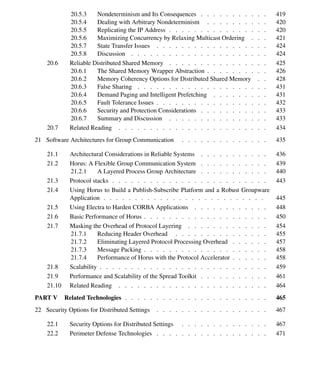
17.2 Extending Causal Order to Multigroup Settings . . . . . . . . . . . . 344
17.3 Extending Total Order to Multigroup Settings . . . . . . . . . . . . . 346
17.4 Causal and Total Ordering Domains . . . . . . . . . . . . . . . . 348
17.5 Multicasts to Multiple Groups . . . . . . . . . . . . . . . . . . . 349
17.6 Multigroup View Management Protocols . . . . . . . . . . . . . . 349
17.7 Related Reading . . . . . . . . . . . . . . . . . . . . . . . . 350
18 The Virtual Synchrony Execution Model . . . . . . . . . . . . . . . . . . 351
18.1 Virtual Synchrony . . . . . . . . . . . . . . . . . . . . . . . . 351
18.2 Extended Virtual Synchrony . . . . . . . . . . . . . . . . . . . 356
18.3 Virtually Synchronous Algorithms and Tools . . . . . . . . . . . . . 362
18.3.1 Replicated Data and Synchronization . . . . . . . . . . . . 362
18.3.2 State Transfer to a Joining Process . . . . . . . . . . . . . 367
18.3.3 Load-Balancing . . . . . . . . . . . . . . . . . . . . 369
18.3.4 Primary-Backup Fault Tolerance . . . . . . . . . . . . . 371
18.3.5 Coordinator-Cohort Fault Tolerance . . . . . . . . . . . . 372
18.4 Related Reading . . . . . . . . . . . . . . . . . . . . . . . . 374
19 Consistency in Distributed Systems . . . . . . . . . . . . . . . . . . . . 375
19.1 Consistency in the Static and Dynamic Membership Models . . . . . . . 376
19.2 Practical Options for Coping with Total Failure . . . . . . . . . . . . 384
19.3 General Remarks Concerning Causal and Total Ordering . . . . . . . . 385
19.4 Summary and Conclusion . . . . . . . . . . . . . . . . . . . . 389
19.5 Related Reading . . . . . . . . . . . . . . . . . . . . . . . . 390
PART IV Applications of Reliability Techniques . . . . . . . . . . . . . . . . 391
20 Retrofitting Reliability into Complex Systems . . . . . . . . . . . . . . . . 393
20.1 Wrappers and Toolkits . . . . . . . . . . . . . . . . . . . . . . 394
20.1.1 Wrapper Technologies . . . . . . . . . . . . . . . . . 396
20.1.2 Introducing Robustness in Wrapped Applications . . . . . . . 402
20.1.3 Toolkit Technologies . . . . . . . . . . . . . . . . . . 405
20.1.4 Distributed Programming Languages . . . . . . . . . . . . 407
20.2 Wrapping a Simple RPC server . . . . . . . . . . . . . . . . . . 408
20.3 Wrapping a Web Site . . . . . . . . . . . . . . . . . . . . . . 410
20.4 Hardening Other Aspects of the Web . . . . . . . . . . . . . . . . 411
20.5 Unbreakable Stream Connections . . . . . . . . . . . . . . . . . 415
20.5.1 Reliability Options for Stream Communication . . . . . . . . 416
20.5.2 An Unbreakable Stream That Mimics TCP . . . . . . . . . 417
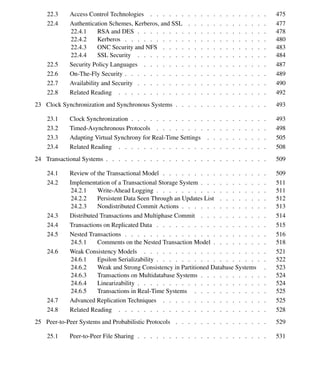
xii Contents
20.5.3 Nondeterminism and Its Consequences . . . . . . . . . . . 419
20.5.4 Dealing with Arbitrary Nondeterminism . . . . . . . . . . 420
20.5.5 Replicating the IP Address . . . . . . . . . . . . . . . . 420
20.5.6 Maximizing Concurrency by Relaxing Multicast Ordering . . . 421
20.5.7 State Transfer Issues . . . . . . . . . . . . . . . . . . 424
20.5.8 Discussion . . . . . . . . . . . . . . . . . . . . . . 424
20.6 Reliable Distributed Shared Memory . . . . . . . . . . . . . . . . 425
20.6.1 The Shared Memory Wrapper Abstraction . . . . . . . . . . 426
20.6.2 Memory Coherency Options for Distributed Shared Memory . . 428
20.6.3 False Sharing . . . . . . . . . . . . . . . . . . . . . 431
20.6.4 Demand Paging and Intelligent Prefetching . . . . . . . . . 431
20.6.5 Fault Tolerance Issues . . . . . . . . . . . . . . . . . . 432
20.6.6 Security and Protection Considerations . . . . . . . . . . . 433
20.6.7 Summary and Discussion . . . . . . . . . . . . . . . . 433
20.7 Related Reading . . . . . . . . . . . . . . . . . . . . . . . . 434
21 Software Architectures for Group Communication . . . . . . . . . . . . . . 435
21.1 Architectural Considerations in Reliable Systems . . . . . . . . . . . 436
21.2 Horus: A Flexible Group Communication System . . . . . . . . . . . 439
21.2.1 A Layered Process Group Architecture . . . . . . . . . . . 440
21.3 Protocol stacks . . . . . . . . . . . . . . . . . . . . . . . . . 443
21.4 Using Horus to Build a Publish-Subscribe Platform and a Robust Groupware
Application . . . . . . . . . . . . . . . . . . . . . . . . . . 445
21.5 Using Electra to Harden CORBA Applications . . . . . . . . . . . . 448
21.6 Basic Performance of Horus . . . . . . . . . . . . . . . . . . . . 450
21.7 Masking the Overhead of Protocol Layering . . . . . . . . . . . . . 454
21.7.1 Reducing Header Overhead . . . . . . . . . . . . . . . 455
21.7.2 Eliminating Layered Protocol Processing Overhead . . . . . . 457
21.7.3 Message Packing . . . . . . . . . . . . . . . . . . . . 458
21.7.4 Performance of Horus with the Protocol Accelerator . . . . . . 458
21.8 Scalability . . . . . . . . . . . . . . . . . . . . . . . . . . . 459
21.9 Performance and Scalability of the Spread Toolkit . . . . . . . . . . . 461
21.10 Related Reading . . . . . . . . . . . . . . . . . . . . . . . . 464
PART V Related Technologies . . . . . . . . . . . . . . . . . . . . . . . 465
22 Security Options for Distributed Settings . . . . . . . . . . . . . . . . . . 467
22.1 Security Options for Distributed Settings . . . . . . . . . . . . . . 467
22.2 Perimeter Defense Technologies . . . . . . . . . . . . . . . . . . 471
Contents xiii
22.3 Access Control Technologies . . . . . . . . . . . . . . . . . . . 475
22.4 Authentication Schemes, Kerberos, and SSL . . . . . . . . . . . . . 477
22.4.1 RSA and DES . . . . . . . . . . . . . . . . . . . . . 478
22.4.2 Kerberos . . . . . . . . . . . . . . . . . . . . . . . 480
22.4.3 ONC Security and NFS . . . . . . . . . . . . . . . . . 483
22.4.4 SSL Security . . . . . . . . . . . . . . . . . . . . . 484
22.5 Security Policy Languages . . . . . . . . . . . . . . . . . . . . 487
22.6 On-The-Fly Security . . . . . . . . . . . . . . . . . . . . . . . 489
22.7 Availability and Security . . . . . . . . . . . . . . . . . . . . . 490
22.8 Related Reading . . . . . . . . . . . . . . . . . . . . . . . . 492
23 Clock Synchronization and Synchronous Systems . . . . . . . . . . . . . . . 493
23.1 Clock Synchronization . . . . . . . . . . . . . . . . . . . . . . 493
23.2 Timed-Asynchronous Protocols . . . . . . . . . . . . . . . . . . 498
23.3 Adapting Virtual Synchrony for Real-Time Settings . . . . . . . . . . 505
23.4 Related Reading . . . . . . . . . . . . . . . . . . . . . . . . 508
24 Transactional Systems . . . . . . . . . . . . . . . . . . . . . . . . . . 509
24.1 Review of the Transactional Model . . . . . . . . . . . . . . . . . 509
24.2 Implementation of a Transactional Storage System . . . . . . . . . . . 511
24.2.1 Write-Ahead Logging . . . . . . . . . . . . . . . . . . 511
24.2.2 Persistent Data Seen Through an Updates List . . . . . . . . 512
24.2.3 Nondistributed Commit Actions . . . . . . . . . . . . . . 513
24.3 Distributed Transactions and Multiphase Commit . . . . . . . . . . . 514
24.4 Transactions on Replicated Data . . . . . . . . . . . . . . . . . . 515
24.5 Nested Transactions . . . . . . . . . . . . . . . . . . . . . . . 516
24.5.1 Comments on the Nested Transaction Model . . . . . . . . . 518
24.6 Weak Consistency Models . . . . . . . . . . . . . . . . . . . . 521
24.6.1 Epsilon Serializability . . . . . . . . . . . . . . . . . . 522
24.6.2 Weak and Strong Consistency in Partitioned Database Systems . 523
24.6.3 Transactions on Multidatabase Systems . . . . . . . . . . . 524
24.6.4 Linearizability . . . . . . . . . . . . . . . . . . . . . 524
24.6.5 Transactions in Real-Time Systems . . . . . . . . . . . . 525
24.7 Advanced Replication Techniques . . . . . . . . . . . . . . . . . 525
24.8 Related Reading . . . . . . . . . . . . . . . . . . . . . . . . 528
25 Peer-to-Peer Systems and Probabilistic Protocols . . . . . . . . . . . . . . . 529
25.1 Peer-to-Peer File Sharing . . . . . . . . . . . . . . . . . . . . . 531
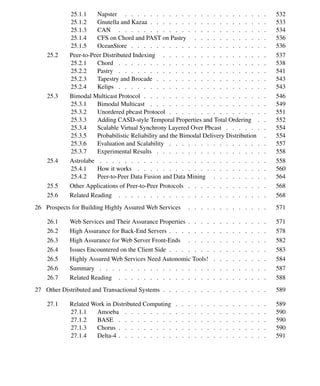
xiv Contents
25.1.1 Napster . . . . . . . . . . . . . . . . . . . . . . . 532
25.1.2 Gnutella and Kazaa . . . . . . . . . . . . . . . . . . . 533
25.1.3 CAN . . . . . . . . . . . . . . . . . . . . . . . . 534
25.1.4 CFS on Chord and PAST on Pastry . . . . . . . . . . . . 536
25.1.5 OceanStore . . . . . . . . . . . . . . . . . . . . . . 536
25.2 Peer-to-Peer Distributed Indexing . . . . . . . . . . . . . . . . . 537
25.2.1 Chord . . . . . . . . . . . . . . . . . . . . . . . . 538
25.2.2 Pastry . . . . . . . . . . . . . . . . . . . . . . . . 541
25.2.3 Tapestry and Brocade . . . . . . . . . . . . . . . . . . 543
25.2.4 Kelips . . . . . . . . . . . . . . . . . . . . . . . . 543
25.3 Bimodal Multicast Protocol . . . . . . . . . . . . . . . . . . . . 546
25.3.1 Bimodal Multicast . . . . . . . . . . . . . . . . . . . 549
25.3.2 Unordered pbcast Protocol . . . . . . . . . . . . . . . . 551
25.3.3 Adding CASD-style Temporal Properties and Total Ordering . . 552
25.3.4 Scalable Virtual Synchrony Layered Over Pbcast . . . . . . . 554
25.3.5 Probabilistic Reliability and the Bimodal Delivery Distribution . 554
25.3.6 Evaluation and Scalability . . . . . . . . . . . . . . . . 557
25.3.7 Experimental Results . . . . . . . . . . . . . . . . . . 558
25.4 Astrolabe . . . . . . . . . . . . . . . . . . . . . . . . . . . 558
25.4.1 How it works . . . . . . . . . . . . . . . . . . . . . 560
25.4.2 Peer-to-Peer Data Fusion and Data Mining . . . . . . . . . 564
25.5 Other Applications of Peer-to-Peer Protocols . . . . . . . . . . . . . 568
25.6 Related Reading . . . . . . . . . . . . . . . . . . . . . . . . 568
26 Prospects for Building Highly Assured Web Services . . . . . . . . . . . . . 571
26.1 Web Services and Their Assurance Properties . . . . . . . . . . . . . 571
26.2 High Assurance for Back-End Servers . . . . . . . . . . . . . . . . 578
26.3 High Assurance for Web Server Front-Ends . . . . . . . . . . . . . 582
26.4 Issues Encountered on the Client Side . . . . . . . . . . . . . . . . 583
26.5 Highly Assured Web Services Need Autonomic Tools! . . . . . . . . . 584
26.6 Summary . . . . . . . . . . . . . . . . . . . . . . . . . . . 587
26.7 Related Reading . . . . . . . . . . . . . . . . . . . . . . . . 588
27 Other Distributed and Transactional Systems . . . . . . . . . . . . . . . . . 589
27.1 Related Work in Distributed Computing . . . . . . . . . . . . . . . 589
27.1.1 Amoeba . . . . . . . . . . . . . . . . . . . . . . . 590
27.1.2 BASE . . . . . . . . . . . . . . . . . . . . . . . . 590
27.1.3 Chorus . . . . . . . . . . . . . . . . . . . . . . . . 590
27.1.4 Delta-4 . . . . . . . . . . . . . . . . . . . . . . . . 591
Contents xv
27.1.5 Ensemble . . . . . . . . . . . . . . . . . . . . . . . 591
27.1.6 Harp . . . . . . . . . . . . . . . . . . . . . . . . . 591
27.1.7 The Highly Available System (HAS) . . . . . . . . . . . . 592
27.1.8 The Horus System . . . . . . . . . . . . . . . . . . . 593
27.1.9 The Isis Toolkit . . . . . . . . . . . . . . . . . . . . 593
27.1.10 Locus . . . . . . . . . . . . . . . . . . . . . . . . 594
27.1.11 Manetho . . . . . . . . . . . . . . . . . . . . . . . 594
27.1.12 NavTech . . . . . . . . . . . . . . . . . . . . . . . 595
27.1.13 Paxos . . . . . . . . . . . . . . . . . . . . . . . . 595
27.1.14 Phalanx . . . . . . . . . . . . . . . . . . . . . . . 596
27.1.15 Phoenix . . . . . . . . . . . . . . . . . . . . . . . 596
27.1.16 Psync . . . . . . . . . . . . . . . . . . . . . . . . 596
27.1.17 Rampart . . . . . . . . . . . . . . . . . . . . . . . 597
27.1.18 Relacs . . . . . . . . . . . . . . . . . . . . . . . . 597
27.1.19 RMP . . . . . . . . . . . . . . . . . . . . . . . . 597
27.1.20 Spread . . . . . . . . . . . . . . . . . . . . . . . . 598
27.1.21 StormCast . . . . . . . . . . . . . . . . . . . . . . 598
27.1.22 Totem . . . . . . . . . . . . . . . . . . . . . . . . 599
27.1.23 Transis . . . . . . . . . . . . . . . . . . . . . . . . 600
27.1.24 The V System . . . . . . . . . . . . . . . . . . . . . 600
27.2 Peer-to-Peer Systems . . . . . . . . . . . . . . . . . . . . . . 601
27.2.1 Astrolabe . . . . . . . . . . . . . . . . . . . . . . . 601
27.2.2 Bimodal Multicast . . . . . . . . . . . . . . . . . . . 602
27.2.3 Chord/CFS . . . . . . . . . . . . . . . . . . . . . . 602
27.2.4 Gnutella/Kazaa . . . . . . . . . . . . . . . . . . . . 602
27.2.5 Kelips . . . . . . . . . . . . . . . . . . . . . . . . 602
27.2.6 Pastry/PAST and Scribe . . . . . . . . . . . . . . . . . 602
27.2.7 QuickSilver . . . . . . . . . . . . . . . . . . . . . . 603
27.2.8 Tapestry/Brocade . . . . . . . . . . . . . . . . . . . 603
27.3 Systems That Implement Transactions . . . . . . . . . . . . . . . . 603
27.3.1 Argus . . . . . . . . . . . . . . . . . . . . . . . . 603
27.3.2 Arjuna . . . . . . . . . . . . . . . . . . . . . . . 604
27.3.3 Avalon . . . . . . . . . . . . . . . . . . . . . . . . 604
27.3.4 Bayou . . . . . . . . . . . . . . . . . . . . . . . . 605
27.3.5 Camelot and Encina . . . . . . . . . . . . . . . . . . 605
27.3.6 Thor . . . . . . . . . . . . . . . . . . . . . . . . . 606
Appendix: Problems . . . . . . . . . . . . . . . . . . . . . . . . . . 607
Bibliography . . . . . . . . . . . . . . . . . . . . . . . . . . . . . 629
Index . . . . . . . . . . . . . . . . . . . . . . . . . . . . . . . . 661
PART I
Basic Distributed Computing Technologies
Although our treatment is motivated by the emergence of the World Wide Web, object-
oriented distributed computing platforms such as J2EE (for Java), .NET (for C# and other
languages) and CORBA, the first part of the book focuses on the general technologies on
which any distributed computing system relies. We review basic communication options
and the basic software tools that have emerged for utilizing them and for simplifying the
development of distributed applications. In the interests of generality, we cover more than
just the specific technologies embodied in the Web as it exists at the time of this writing,
and, in fact terminology and concepts specific to the Web are not introduced until Part II.
However, even in this first part, we discuss some of the most basic issues that arise in
building reliable distributed systems, and we begin to establish the context within which
reliability can be treated in a systematic manner.
1
Fundamentals
1.1 Introduction
Reduced to the simplest terms, a distributed computing system is a set of computer programs,
executing on one or more computers, and coordinating actions by exchanging messages. A
computer network is a collection of computers interconnected by hardware that directly
supports message passing. Most distributed computing systems operate over computer
networks, but one can also build a distributed computing system in which the components
execute on a single multitasking computer, and one can build distributed computing systems
in which information flows between the components by means other than message passing.
Moreover, there are new kinds of parallel computers, called clustered servers, which
have many attributes of distributed systems despite appearing to the user as a single machine
built using rack-mounted components. With the emergence of what people are calling “Grid
Computing,” clustered distributed systems may surge in importance. And we are just starting
to see a wave of interest in wireless sensor devices and associated computing platforms.
Down the road, much of the data pulled into some of the world’s most exciting databases
will come from sensors of various kinds, and many of the actions we’ll want to base on
the sensed data will be taken by actuators similarly embedded in the environment. All of
this activity is leading many people who do not think of themselves as distributed systems
specialists to direct attention to distributed computing.
We will use the term “protocol” in reference to an algorithm governing the exchange
of messages, by which a collection of processes coordinate their actions and communicate
information among themselves. Much as a program is a set of instructions, and a process
denotes the execution of those instructions, a protocol is a set of instructions governing the
communication in a distributed program, and a distributed computing system is the result
of executing some collection of such protocols to coordinate the actions of a collection of
processes in a network.
4 1. Fundamentals
This text is concerned with reliability in distributed computing systems. Reliability is
a very broad term that can have many meanings, including:
• Fault tolerance: The ability of a distributed computing system to recover from
component failures without performing incorrect actions.
• High availability: In the context of a fault-tolerant distributed computing system,
the ability of the system to restore correct operation, permitting it to resume provid-
ing services during periods when some components have failed. A highly available
system may provide reduced service for short periods of time while reconfiguring
itself.
• Continuous availability: A highly available system with a very small recovery time,
capable of providing uninterrupted service to its users. The reliability properties
of a continuously available system are unaffected or only minimally affected by
failures.
• Recoverability: Also in the context of a fault-tolerant distributed computing system, the
ability of failed components to restart themselves and rejoin the system, after the cause
of failure has been repaired.
• Consistency: The ability of the system to coordinate related actions by multiple com-
ponents, often in the presence of concurrency and failures. Consistency underlies the
ability of a distributed system to emulate a non-distributed system.
• Scalability: The ability of a system to continue to operate correctly even as some aspect
is scaled to a larger size. For example, we might increase the size of the network on
which the system is running—doing so increases the frequency of such events as network
outages and could degrade a “non-scalable” system. We might increase numbers of users,
or numbers of servers, or load on the system. Scalability thus has many dimensions; a
scalable system would normally specify the dimensions in which it achieves scalability
and the degree of scaling it can sustain.
• Security: The ability of the system to protect data, services, and resources against misuse
by unauthorized users.
• Privacy: The ability of the system to protect the identity and locations of its users, or
the contents of sensitive data, from unauthorized disclosure.
• Correct specification: The assurance that the system solves the intended problem.
• Correct implementation: The assurance that the system correctly implements its
specification.
• Predictable performance: The guarantee that a distributed system achieves desired levels
of performance—for example, data throughput from source to destination, latencies
measured for critical paths, requests processed per second, and so forth.
• Timeliness: In systems subject to real-time constraints, the assurance that actions are
takenwithinthespecifiedtimebounds, orareperformedwithadesireddegreeoftemporal
synchronization between the components.
Underlying many of these issues are questions of tolerating failures. Failure, too, can have
many meanings:
1.1 Introduction 5
• Halting failures: In this model, a process or computer either works correctly, or simply
stops executing and crashes without taking incorrect actions, as a result of failure. As
the model is normally specified, there is no way to detect that the process has halted
except by timeout: It stops sending “keep alive” messages or responding to “pinging”
messages and hence other processes can deduce that it has failed.
• Fail-stop failures: These are accurately detectable halting failures. In this model, pro-
cesses fail by halting. However, other processes that may be interacting with the faulty
process also have a completely accurate way to detect such failures—for example, a
fail-stop environment might be one in which timeouts can be used to monitor the status
of processes, and no timeout occurs unless the process being monitored has actually
crashed. Obviously, such a model may be unrealistically optimistic, representing an
idealized world in which the handling of failures is reduced to a pure problem of how
the system should react when a failure is sensed. If we solve problems with this model,
we then need to ask how to relate the solutions to the real world.
• Send-omission failures: These are failures to send a message that, according to the logic
of the distributed computing systems, should have been sent. Send-omission failures
are commonly caused by a lack of buffering space in the operating system or network
interface, which can cause a message to be discarded after the application program has
sent it but before it leaves the sender’s machine. Perhaps surprisingly, few operating
systems report such events to the application.
• Receive-omission failures: These are similar to send-omission failures, but they occur
when a message is lost near the destination process, often because of a lack of memory
in which to buffer it or because evidence of data corruption has been discovered.
• Network failures: These occur when the network loses messages sent between certain
pairs of processes.
• Network partitioning failures: These are a more severe form of network failure, in
which the network fragments into disconnected sub-networks, within which messages
can be transmitted, but between which messages are lost. When a failure of this sort is
repaired, one talks about merging the network partitions. Network partitioning failures
are a common problem in modern distributed systems; hence, we will discuss them in
detail in Part III of this book.
• Timing failures: These occur when a temporal property of the system is violated—for
example, when a clock on a computer exhibits a value that is unacceptably far from the
values of other clocks, or when an action is taken too soon or too late, or when a message
is delayed by longer than the maximum tolerable delay for a network connection.
• Byzantine failures: This is a term that captures a wide variety of other faulty behaviors,
including data corruption, programs that fail to follow the correct protocol, and even
malicious or adversarial behaviors by programs that actively seek to force a system to
violate its reliability properties.
An even more basic issue underlies all of these: the meaning of computation, and the model
one assumes for communication and coordination in a distributed system. Some examples
of models include these:
6 1. Fundamentals
• Real-world networks: These are composed of workstations, personal computers, and
other computing devices interconnected by hardware. Properties of the hardware and
software components will often be known to the designer, such as speed, delay, and error
frequencies for communication devices; latencies for critical software and scheduling
paths; throughput for data generated by the system and data distribution patterns; speed
of the computer hardware, accuracy of clocks; and so forth. This information can be
of tremendous value in designing solutions to problems that might be very hard—or
impossible—in a completely general sense.
A specific issue that will emerge as being particularly important when we consider
guarantees of behavior in Part III concerns the availability, or lack, of accurate temporal
information. Until the late 1980s, the clocks built into workstations were notoriously
inaccurate, exhibiting high drift rates that had to be overcome with software protocols
for clock resynchronization. There are limits on the quality of synchronization possible
in software, and this created a substantial body of research and lead to a number of
competing solutions. In the early 1990s, however, the advent of satellite time sources
as part of the global positioning system (GPS) changed the picture: For the price of
an inexpensive radio receiver, any computer could obtain accurate temporal data, with
resolution in the sub-millisecond range. However, the degree to which GPS receivers
actually replace quartz-based time sources remains to be seen. Thus, real-world systems
are notable (or notorious) in part for having temporal information, but of potentially low
quality.
The architectures being proposed for networks of lightweight embedded sensors
may support high-quality temporal information, in contrast to more standard distributed
systems, which “work around” temporal issues using software protocols. For this reason,
a resurgence of interest in communication protocols that use time seems almost certain
to occur in the coming decade.
• Asynchronous computing systems: This is a very simple theoretical model used to
approximate one extreme sort of computer network. In this model, no assumptions
can be made about the relative speed of the communication system, processors, and
processes in the network. One message from a process p to a process q may be delivered
in zero time, while the next is delayed by a million years. The asynchronous model
reflects an assumption about time, but not failures: Given an asynchronous model, one
can talk about protocols that tolerate message loss, protocols that overcome fail-stop
failures in asynchronous networks, and so forth. The main reason for using the model is
to prove properties about protocols for which one makes as few assumptions as possible.
The model is very clean and simple, and it lets us focus on fundamental properties
of systems without cluttering up the analysis by including a great number of practical
considerations. If a problem can be solved in this model, it can be solved at least as
well in a more realistic one. On the other hand, the converse may not be true: We may
be able to do things in realistic systems by making use of features not available in the
asynchronous model, and in this way may be able to solve problems in real systems that
are impossible in ones that use the asynchronous model.
1.2 Components of a Reliable Distributed Computing System 7
• Synchronous computing systems: Like the asynchronous systems, these represent an
extreme end of the spectrum. In the synchronous systems, there is a very strong concept
of time that all processes in the system share. One common formulation of the model can
be thought of as having a system wide gong that sounds periodically; when the processes
in the system hear the gong, they run one round of a protocol, reading messages from
one another, sending messages that will be delivered in the next round, and so forth. And
these messages always are delivered to the application by the start of the next round, or
not at all.
Normally, the synchronous model also assumes bounds on communication latency
betweenprocesses, clockskewandprecision, andotherpropertiesoftheenvironment. As
in the case of an asynchronous model, the synchronous one takes an extreme point of view
because this simplifies reasoning about certain types of protocols. Real-world systems
are not synchronous—it is impossible to build a system in which actions are perfectly
coordinated as this model assumes. However, if one proves the impossibility of solving
some problem in the synchronous model, or proves that some problem requires at least
a certain number of messages in this model, one has established a sort of lower bound.
In a real-world system, things can only get worse, because we are limited to weaker
assumptions. This makes the synchronous model a valuable tool for understanding how
hard it will be to solve certain problems.
• Parallel-shared memory systems: An important family of systems is based on multiple
processors that share memory. Unlike for a network, where communication is by message
passing, in these systems communication is by reading and writing shared memory
locations. Clearly, the shared memory model can be emulated using message passing,
and can be used to implement message communication. Nonetheless, because there are
important examples of real computers that implement this model, there is considerable
theoretical interest in the model per-se. Unfortunately, although this model is very rich
and a great deal is known about it, it would be beyond the scope of this book to attempt
to treat the model in any detail.
1.2 Components of a Reliable Distributed Computing
System
Reliable distributed computing systems are assembled from basic building blocks. In the
simplest terms, these are just processes and messages, and if our interest was purely theoret-
ical, it might be reasonable to stop at that. On the other hand, if we wish to apply theoretical
results in practical systems, we will need to work from a fairly detailed understanding
of how practical systems actually work. In some ways, this is unfortunate, because real
systems often include mechanisms that are deficient in ways that seem simple to fix, or
inconsistent with one another, but have such a long history (or are so deeply embedded into
standards) that there may be no way to improve on the behavior in question. Yet, if we want
to actually build reliable distributed systems, it is unrealistic to insist that we will only do
8 1. Fundamentals
so in idealized environments that support some form of theoretically motivated structure.
The real world is heavily committed to standards, and the task of translating our theoretical
insights into practical tools that can interplay with these standards is probably the most
important challenge faced by the computer systems engineer.
It is common to think of a distributed system as operating over a layered set of network
services (see Table 1.1). It should be stated at the outset that the lower layers of this hierarchy
make far more sense than the upper ones, and when people talk about ISO compatibility or
the ISO layering, they almost always have layers below the “session” in mind, not the session
layer or those above it. Unfortunately, for decades, government procurement offices didn’t
understand this and often insisted on ISO “compatibility.” Thankfully, most such offices
have finally given up on that goal and accepted that pure ISO compatibility is meaningless
because the upper layers of the hierarchy don’t make a great deal of sense.
Table 1.1. OSI Protocol Layers
Application The program using the communication connection
Presentation Software to encode application data into messages and to decode on reception
Session The logic associated with guaranteeing end-to-end properties such as reliability
Transport Software concerned with fragmenting big messages into small packets
Network Routing functionality, usually limited to small- or fixed-size packets
Data Link The protocol used to send and receive packets
Physical The protocol used to represent packets on the wire
Each layer corresponds to a software abstraction or hardware feature, and may be imple-
mented in the application program itself, in a library of procedures to which the program
is linked, in the operating system, or even in the hardware of the communication device.
As an example, here is the layering of the International Organization for Standardization
(ISO) Open Systems Interconnection (OSI) protocol model (see Comer, Comer and Stevens
[1991, 1993], Coulouris et al., Tanenbaum):
• Application: This is the application program itself, up to the points at which it performs
communication operations.
• Presentation: This is the software associated with placing data into messages in a format
that can be interpreted by the destination process(es) to which the message will be sent
and for extracting data from messages in the destination process.
• Session: This is the software associated with maintaining connections between pairs
or sets of processes. A session may have reliability properties and may require some
form of initialization or setup, depending on the specific setting with which the user is
working. In the OSI model, the session software implements any reliability properties,
and lower layers of the hierarchy are permitted to be unreliable—for example, by losing
messages.
1.2 Components of a Reliable Distributed Computing System 9
• Transport: The transport layer is responsible for breaking large messages into smaller
packets that respect size limits imposed by the network communication hardware. On the
incoming side, the transport layer reassembles these packets into messages, discarding
packets that are identified as duplicates, or messages for which some constituent packets
were lost in transmission.
• Network: This is the layer of software concerned with routing and low-level flow control
on networks composed of multiple physical segments interconnected by what are called
bridges and gateways.
• Data link: The data-link layer is normally part of the hardware that implements a
communication device. This layer is responsible for sending and receiving packets,
recognizing packets destined for the local machine and copying them in, discarding
corrupted packets, and other interface-level aspects of communication.
• Physical: The physical layer is concerned with representation of packets on the wire—
for example, the hardware technology for transmitting individual bits and the protocol
for gaining access to the wire if multiple computers share it.
It is useful to distinguish the types of guarantees provided by the various layers: end-to-
end guarantees in the case of the session, presentation, and application layers and point-to-
point guarantees for layers below these. The distinction is important in complex networks
where a message may need to traverse many links to reach its destination. In such settings,
a point-to-point property is one that holds only on a per-hop basis—for example, the data-
link protocol is concerned with a single hop taken by the message, but not with its overall
route or the guarantees that the application may expect from the communication link itself.
The session, presentation, and application layers, in contrast, impose a more complex
logical abstraction on the underlying network, with properties that hold between the end
points of a communication link that may physically extend over a complex substructure. In
Part III of this book we will discuss increasingly elaborate end-to-end properties, until we
finally extend these properties into a completely encompassing distributed communication
abstraction that embraces the distributed system as a whole and provides consistent behavior
and guarantees throughout. And, just as the OSI layering builds its end-to-end abstractions
over point-to-point ones, we will need to build these more sophisticated abstractions over
what are ultimately point-to-point properties.
As seen in Figure 1.1, each layer is logically composed of transmission logic and the
corresponding reception logic. In practice, this often corresponds closely to the imple-
mentation of the architecture—for example, most session protocols operate by imposing
a multiple session abstraction over a shared (or multiplexed) link-level connection. The
packets generated by the various higher-level session protocols can be thought of as merging
into a single stream of packets that are treated by the IP link level as a single customer for
its services.
Oneshouldnotassumethattheimplementationoflayeredprotocolarchitectureinvolves
some sort of separate module for each layer. Indeed, one reason that existing systems
deviate from the ISO layering is that a strict ISO-based protocol stack would be quite
10 1. Fundamentals
Figure 1.1. Data flow in an OSI protocol stack. Each sending layer is invoked by the layer above it and passes
data off to the layer below it, and conversely on the receive-side. In a logical sense, however, each layer interacts
with its peer on the remote side of the connection—for example, the send-side session layer may add a header
to a message that the receive-side session layer strips off.
inefficient in the context of a modern operating system, where code-reuse is important and
mechanisms such as IP tunneling may want to reuse the ISO stack “underneath” what is
conceptually a second instance of the stack. Conversely, to maximize performance, the
functionality of a layered architecture is often compressed into a single piece of software,
and in some cases layers may be completely bypassed for types of messages where the
layer would take no action—for example, if a message is very small, the OSI transport layer
wouldn’t need to fragment it into multiple packets, and one could imagine a specialized
implementation of the OSI stack that omits the transport layer. Indeed, the pros and cons
of layered protocol architecture have become a major topic of debate in recent years (see
Abbott and Peterson, Braun and Diot, Clark and Tennenhouse, Karamcheti and Chien, Kay
and Pasquale).
Although the OSI layering is probably the best known such architecture, layered com-
munication software is pervasive, and there are many other examples of layered architectures
and layered software systems. Later in this book we will see additional senses in which the
OSI layering is outdated, because it doesn’t directly address multiparticipant communication
sessions and doesn’t match very well with some new types of communication hardware, such
asasynchronoustransfermode(ATM)switchingsystems. Indiscussingthispointwewillsee
that more appropriate layered architectures can be constructed, although they don’t match
the OSI layering very closely. Thus, one can think of layering as a methodology matched
1.2 Components of a Reliable Distributed Computing System 11
to the particular layers of the OSI hierarchy. The former perspective is a popular one that
is only gaining importance with the introduction of object-oriented distributed computing
environments, which have a natural form of layering associated with object classes and
subclasses. The latter form of layering has probably become hopelessly incompatible with
standard practice by the time of this writing, although many companies and governments
continue to require that products comply with it.
It can be argued that layered communication architecture is primarily valuable as a
descriptive abstraction—a model that captures the essential functionality of a real com-
munication system but doesn’t need to accurately reflect its implementation. The idea
of abstracting the behavior of a distributed system in order to concisely describe it or to
reason about it is a very important one. However, if the abstraction doesn’t accurately
correspond to the implementation, this also creates a number of problems for the system
designer, who now has the obligation to develop a specification and correctness proof
for the abstraction; to implement, verify, and test the corresponding software; and to
undertake an additional analysis that confirms that the abstraction accurately models the
implementation.
It is easy to see how this process can break down—for example, it is nearly inevitable
that changes to the implementation will have to be made long after a system has been
deployed. If the development process is really this complex, it is likely that the analysis of
overall correctness will not be repeated for every such change. Thus, from the perspective
of a user, abstractions can be a two-edged sword. They offer appealing and often simplified
ways to deal with a complex system, but they can also be simplistic or even incorrect. And
this bears strongly on the overall theme of reliability. To some degree, the very process of
cleaning up a component of a system in order to describe it concisely can compromise the
reliability of a more complex system in which that component is used.
Throughout the remainder of this book, we will often have recourse to models and
abstractions, in much more complex situations than the OSI layering. This will assist us in
reasoning about and comparing protocols, and in proving properties of complex distributed
systems. At the same time, however, we need to keep in mind that this whole approach
demands a sort of meta-approach, namely a higher level of abstraction at which we can
question the methodology itself, asking if the techniques by which we create reliable systems
are themselves a possible source of unreliability. When this proves to be the case, we need
to take the next step as well, asking what sorts of systematic remedies can be used to fight
these types of reliability problems.
Can well structured distributed computing systems be built that can tolerate the failures
of their own components, or guarantee other kinds of assurance properties? In layerings such
as OSI, this issue is not really addressed, which is one of the reasons that the OSI layering
won’t work well for our purposes. However, the question is among the most important
ones that will need to be resolved if we want to claim that we have arrived at a workable
methodology for engineering reliable distributed computing systems. A methodology, then,
must address descriptive and structural issues, as well as practical ones such as the protocols
used to overcome a specific type of failure or to coordinate a specific type of interaction.
12 1. Fundamentals
1.2.1 Communication Technology
The most basic communication technology in any distributed system is the hardware support
for message passing. Although there are some types of networks that offer special properties,
most modern networks are designed to transmit data in packets with some fixed, but small,
maximum size. Each packet consists of a header, which is a data structure containing
information about the packet—its destination, route, and so forth. It contains a body, which
are the bytes that make up the content of the packet. And it may contain a trailer, which is
a second data structure that is physically transmitted after the header and body and would
normally consist of a checksum for the packet that the hardware computes and appends to
it as part of the process of transmitting the packet.
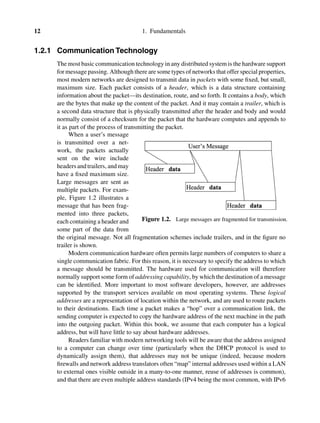
Figure 1.2. Large messages are fragmented for transmission.
When a user’s message
is transmitted over a net-
work, the packets actually
sent on the wire include
headers and trailers, and may
have a fixed maximum size.
Large messages are sent as
multiple packets. For exam-
ple, Figure 1.2 illustrates a
message that has been frag-
mented into three packets,
each containing a header and
some part of the data from
the original message. Not all fragmentation schemes include trailers, and in the figure no
trailer is shown.
Modern communication hardware often permits large numbers of computers to share a
single communication fabric. For this reason, it is necessary to specify the address to which
a message should be transmitted. The hardware used for communication will therefore
normally support some form of addressing capability, by which the destination of a message
can be identified. More important to most software developers, however, are addresses
supported by the transport services available on most operating systems. These logical
addresses are a representation of location within the network, and are used to route packets
to their destinations. Each time a packet makes a “hop” over a communication link, the
sending computer is expected to copy the hardware address of the next machine in the path
into the outgoing packet. Within this book, we assume that each computer has a logical
address, but will have little to say about hardware addresses.
Readers familiar with modern networking tools will be aware that the address assigned
to a computer can change over time (particularly when the DHCP protocol is used to
dynamically assign them), that addresses may not be unique (indeed, because modern
firewalls and network address translators often “map” internal addresses used within a LAN
to external ones visible outside in a many-to-one manner, reuse of addresses is common),
and that there are even multiple address standards (IPv4 being the most common, with IPv6
1.2 Components of a Reliable Distributed Computing System 13
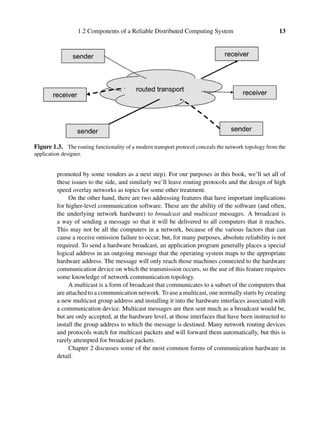
Figure 1.3. The routing functionality of a modern transport protocol conceals the network topology from the
application designer.
promoted by some vendors as a next step). For our purposes in this book, we’ll set all of
these issues to the side, and similarly we’ll leave routing protocols and the design of high
speed overlay networks as topics for some other treatment.
On the other hand, there are two addressing features that have important implications
for higher-level communication software. These are the ability of the software (and often,
the underlying network hardware) to broadcast and multicast messages. A broadcast is
a way of sending a message so that it will be delivered to all computers that it reaches.
This may not be all the computers in a network, because of the various factors that can
cause a receive omission failure to occur, but, for many purposes, absolute reliability is not
required. To send a hardware broadcast, an application program generally places a special
logical address in an outgoing message that the operating system maps to the appropriate
hardware address. The message will only reach those machines connected to the hardware
communication device on which the transmission occurs, so the use of this feature requires
some knowledge of network communication topology.
A multicast is a form of broadcast that communicates to a subset of the computers that
are attached to a communication network. To use a multicast, one normally starts by creating
a new multicast group address and installing it into the hardware interfaces associated with
a communication device. Multicast messages are then sent much as a broadcast would be,
but are only accepted, at the hardware level, at those interfaces that have been instructed to
install the group address to which the message is destined. Many network routing devices
and protocols watch for multicast packets and will forward them automatically, but this is
rarely attempted for broadcast packets.
Chapter 2 discusses some of the most common forms of communication hardware in
detail.
14 1. Fundamentals
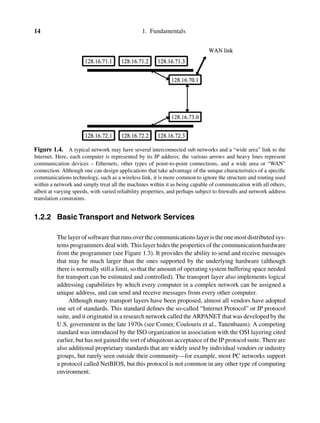
Figure 1.4. A typical network may have several interconnected sub networks and a “wide area” link to the
Internet. Here, each computer is represented by its IP address; the various arrows and heavy lines represent
communication devices – Ethernets, other types of point-to-point connections, and a wide area or “WAN”
connection. Although one can design applications that take advantage of the unique characteristics of a specific
communications technology, such as a wireless link, it is more common to ignore the structure and routing used
within a network and simply treat all the machines within it as being capable of communication with all others,
albeit at varying speeds, with varied reliability properties, and perhaps subject to firewalls and network address
translation constraints.
1.2.2 Basic Transport and Network Services
The layer of software that runs over the communications layer is the one most distributed sys-
tems programmers deal with. This layer hides the properties of the communication hardware
from the programmer (see Figure 1.3). It provides the ability to send and receive messages
that may be much larger than the ones supported by the underlying hardware (although
there is normally still a limit, so that the amount of operating system buffering space needed
for transport can be estimated and controlled). The transport layer also implements logical
addressing capabilities by which every computer in a complex network can be assigned a
unique address, and can send and receive messages from every other computer.
Although many transport layers have been proposed, almost all vendors have adopted
one set of standards. This standard defines the so-called “Internet Protocol” or IP protocol
suite, and it originated in a research network called the ARPANET that was developed by the
U.S. government in the late 1970s (see Comer, Coulouris et al., Tanenbaum). A competing
standard was introduced by the ISO organization in association with the OSI layering cited
earlier, but has not gained the sort of ubiquitous acceptance of the IP protocol suite. There are
also additional proprietary standards that are widely used by individual vendors or industry
groups, but rarely seen outside their community—for example, most PC networks support
a protocol called NetBIOS, but this protocol is not common in any other type of computing
environment.
1.2 Components of a Reliable Distributed Computing System 15
All of this is controlled using routing tables, as shown in Table 1.2. A routing table is a
data structure local to each computer in a network—each computer has one, but the contents
will generally not be identical from machine to machine. Routing mechanisms differ for
wired and wireless networks, and routing for a new class of “ad hoc” wireless networks
is a topic of active research, although beyond our scope here. Generally, a routing table is
indexed by the logical address of a destination computer, and entries contain the hardware
device on which messages should be transmitted (the next hop to take). Distributed protocols
for dynamically maintaining routing tables have been studied for many years and seek to
optimize performance, while at the same time attempting to spread the load evenly and
routing around failures or congested nodes. In local area networks, static routing tables are
probably more common; dynamic routing tables dominate in wide-area settings. Chapter 3
discusses some of the most common transport services in more detail.
1.2.3 Reliable Transport Software and Communication Support
A limitation of the basic message passing services discussed in Section 1.2.2 is that they
operate at the level of individual messages and provide no guarantees of reliability. Messages
can be lost for many reasons, including link failures, failures of intermediate machines on
a complex multi-hop route, noise that causes corruption of the data in a packet, lack of
buffering space (the most common cause), and so forth. For this reason, it is common to
layer a reliability protocol over the message-passing layer of a distributed communication
architecture. The result is called a reliable communication channel. This layer of software
is the one that the OSI stack calls the session layer, and it corresponds to the TCP protocol
of the Internet. UNIX and Linux programmers may be more familiar with the concept from
their use of pipes and streams (see Ritchie).
The protocol implementing a reliable communication channel will typically guarantee
that lost messages will be retransmitted and the out-of-order messages will be re-sequenced
and delivered in the order sent. Flow control and mechanisms that choke back the sender
when data volume becomes excessive are also common in protocols for reliable transport
(see Jacobson [1988]). Just as the lower layers can support one-to-one, broadcast, and mul-
ticast communication, these forms of destination addressing are also potentially interesting
Table 1.2. A sample routing table, such as might be used by computer
128.16.73.0 in Figure 1.4
Destination Route Via Forwarded By Estimated Distance
128.16.72.* Outgoing link 1 (direct) 1 hop
128.16.71.* Outgoing link 2 128.16.70.1 2 hops
128.16.70.1 Outgoing link 2 (direct) 1 hop
∗. ∗ . ∗ .∗ Outgoing link 2 128.16.70.1 (infinite)
16 1. Fundamentals
in reliable transport layers. Moreover, some systems go further and introduce additional
reliability properties at this level, such as authentication (a trusted mechanism for verifying
the identity of the processes at the ends of a communication connection), data integrity
checking (mechanisms for confirming that data has not been corrupted since it was sent),
or other forms of security (such as trusted mechanisms for concealing the data transmitted
over a channel from processes other than the intended destinations).
1.2.4 Middleware: Software Tools, Utilities, and Programming
Languages
The most interesting issues that we will consider in this book are those relating to pro-
gramming environments and tools that live in the middle, between the application program
and the communication infrastructure for basic message passing and support for reliable
channels.
Examples of important middleware services include the naming service, resource dis-
covery services, the file system, the time service, and the security key services used for
authentication in distributed systems. We will be looking at all of these in more detail later,
but we review them briefly here for clarity.
A naming service is a collection of user-accessible directories that map from application
names (or other selection criteria) to network addresses of computers or programs. Name
services can play many roles in a distributed system, and they represent an area of intense
research interest and rapid evolution. When we discuss naming, we’ll see that the whole
question of what a name represents is itself subject to considerable debate, and raises
important questions about concepts of abstraction and services in distributed computing
environments. Reliability in a name service involves issues such as trust—can one trust the
name service to truthfully map a name to the correct network address? How can one know
that the object at the end of an address is the same one that the name service was talking
about? These are fascinating issues, and we will discuss them in detail later in the book
(see, for example, Sections 6.7 and 10.5).
A related topic concerns resource discovery. In large networks there is more and more
interest in supporting self-configuration and self-repair mechanisms. For example, one
would wish that a universal controller (for VCRs, televisions, etc) could automatically
discover the media devices in a room, or that a computer might automatically discover
printers in the vicinity. Some programming environments, such as the JINI environment for
Java programmers, provide a form of ICQ (“I seek you”) functionality, although these are
not standard in other kinds of Internet environments. As we move to a world with larger
and larger numbers of computers, new kinds of small mobile devices, and intelligence
embedded into the environment, this type of resource discovery will become an important
problem and it seems likely that standards will rapidly emerge. Notice that discovery differs
from naming: discovery is the problem of finding the resources matching some criteria in
the area, hence of generating a list of names. Naming, on the other hand, is concerned with
rules for how names are assigned to devices, and for mapping device names to addresses.
1.2 Components of a Reliable Distributed Computing System 17
From the outset, though, the reader may want to consider that if an intruder breaks
into a system and is able to manipulate the mapping of names to network addresses, it
will be possible to interpose all sorts of snooping software components in the path of
communication from an application to the services it is using over the network. Such
attacks are now common on the Internet and reflect a fundamental issue, which is that
most network reliability technologies tend to trust the lowest-level mechanisms that map
from names to addresses and that route messages to the correct host when given a destination
address.
A time service is a mechanism for keeping the clocks on a set of computers closely
synchronized and close to real time. Time services work to overcome the inaccuracy of
inexpensive clocks used on many types of computers, and they are important in applications
that either coordinate actions using real time or that make use of time for other purposes, such
as to limit the lifetime of a cryptographic key or to timestamp files when they are updated.
Much can be said about time in a distributed system, and we will spend a considerable
portion of this book on issues that revolve around the whole concept of before and after
and it’s relation to intuitive concepts of time in the real world. Clearly, the reliability of a
time service will have important implications for the reliability of applications that make
use of time, so time services and associated reliability properties will prove to be important
in many parts of this book.
Authentication services are, perhaps surprisingly, a new technology that is lacking in
most distributed computing environments. These services provide trustworthy mechanisms
for determining who sent a message, for making sure that the message can only be read by the
intended destination, and for restricting access to private data so that only authorized access
can occur. Most modern computing systems evolved from a period when access control
was informal and based on a core principle of trust among users. One of the really serious
implications is that distributed systems that want to superimpose a security or protection
architecture on a heterogeneous environment must overcome a pervasive tendency to accept
requests without questioning them, to believe the user-Id information included in messages
without validating it, and to route messages wherever they may wish to go.
If banks worked this way, one could walk up to a teller in a bank and pass that person
a piece of paper requesting a list of individuals that have accounts in the branch. Upon
studying the response and learning that W. Gates is listed, one could then fill out an account
balance request in the name of W. Gates, asking how much money is in that account. And,
after this, one could withdraw some of that money, up to the bank’s policy limits. At no
stage would one be challenged: The identification on the various slips of paper would be
trusted for each operation. Such a world model may seem strangely trusting, but it is the
model from which modern distributed computing systems emerged.
1.2.5 Distributed Computing Environments
An important topic around which much of this book is oriented concerns the development of
general purpose tools from which specialized distributed systems can be constructed. Such
18 1. Fundamentals
tools can take many forms and can be purely conceptual—for example, a methodology or
theory that offers useful insight into the best way to solve a problem or that can help the
developer confirm that a proposed solution will have a desired property. A tool can offer
practical help at a very low level—for example, by eliminating the relatively mechanical
steps required to encode the arguments for a remote procedure call into a message to the
server that will perform the action. A tool can embody complex higher-level behavior, such
as a protocol for performing some action or overcoming some class of errors. Tools can
even go beyond this, taking the next step by offering mechanisms to control and manage
software built using other tools.
It has become popular to talk about distributed systems that support distributed operat-
ing environments—well-integrated collections of tools that can be used in conjunction with
one another to carry out potentially complex distributed programming tasks. Examples of
the current generation of distributed programming environments include Microsoft’s .NET
technology, the Java Enterprise Edition (J2EE), Sun’s JINI system for mobile computing
and CORBA. Older environments still in wide use include the Open Network Computing
(ONC) environment of Sun Microsystems, the Distributed Computing Environment (DCE)
of the Open Software Foundation, and this is just a partial list. Some environments are
especially popular for users of specific languages—for example, the Java community tends
to favor J2EE, and the C# community (a language almost identical to Java) is more familiar
with .NET. C++ programmers tend to work with CORBA-compliant programming tools.
Layered over these environments one sometimes finds middleware tools that extend the
basic environment with additional features. Examples that will be discussed in this text
include the Isis and Spread Toolkits—the former was developed by my colleagues and me
and will be discussed in Chapter 21, while the latter is a more modern system developed
at John Hopkins University by Yair Amir, but with similar features. (This is anything but a
complete list!)
Distributed systems architectures undertake to step even beyond the concept of a dis-
tributed computing environment. An architecture is a general set of design principles and
implementation standards by which a collection of compliant systems can be developed. In
principle, multiple systems that implement the same architecture will interoperate, so that
if vendors implement competing solutions, the resulting software can still be combined into
a single system with components that might even be able to communicate and cooperate
with one another. Despite the emergence of .NET and J2EE, which are more commercially
important at the time of this writing, the Common Request Broker, or CORBA, is probably
still the best-known distributed computing architecture. CORBA is useful for building sys-
tems using an object-oriented approach in which the systems are developed as modules that
cooperate. Thus, CORBA is an architecture, and the various CORBA-based products that
comply with the architecture are distributed computing environments. .NET and J2EE are
CORBA’s younger siblings; both inherit a great many features directly from CORBA, while
also supporting very powerful mechanisms for building applications that access databases—
a specialization lacking in CORBA until fairly recently, when that architecture began to lose
ground to these new upstarts.
1.2 Components of a Reliable Distributed Computing System 19
Looking to the future, many analysts are now claiming that the most important
architecture of all will be the new Web Services standards, aimed at promoting direct
computer-to-computer interactions by standardizing all aspects of naming, invocation, mak-
ing sense of data, and so forth. While these predictions (much like predictions of the “vintage
of the century”) need to be viewed with skepticism, there is no question that Web Services
are both extremely ambitious and extremely interoperable—designers promise that these
standards will, for the first time, let almost anything talk to almost anything else. This is
just a first step: If you speak French and I speak English, I may be able to talk to you, but
you won’t necessarily understand me. Similarly, Web Services will need to be supported
by standards for, say, communicating with a pharmacy inventory system, or requesting a
quote on a batch of machine parts. Nonetheless, such standards can certainly be defined in
many settings. Vendors supporting .NET and J2EE tout the ease of building Web Services
systems when using their products, and a great many vendors have announced plans to
support this architecture. On the other hand, the architecture is ill-suited for some purposes:
Web Services have a confused notion of reliability and will definitely not be appropriate for
building very high availability systems (at least for the first few years), or for supporting
applications like very large-scale information monitoring systems, or large-scale sensor
architectures. Indeed, it may be best to think of Web Services (for the time being) as the
likely winner in the battle for architectures by which a client connects to a single database
at a time, although perhaps as part of a longer series of operations involving transactions on
multiple databases (e.g., to purchase a plane ticket, then reserve a hotel room, then reserve
a car, etc). For these sorts of pipelined, relatively asynchronous applications, Web Services
seem like an outstanding development. Were one focused on the development of a new
military platform aimed at integrating all the computer-controlled devices on a battlefield,
Web Services would seem much less appropriate for the need.
1.2.6 End-User Applications
One might expect that the end of the line for a layered distributed system architecture would
be the application level, but this is not necessarily the case. A distributed application might
also be some sort of operating system service built over the communication tools that we
have been discussing—for example, the distributed file system is an application in the sense
of the OSI layering, but the user of a computing system might think of the file system as an
operating system service over which applications can be defined and executed. Within the
OSI layering, then, an application is any freestanding solution to a well-defined problem
that presents something other than a point-to-point communication abstraction to its users.
The distributed file system is just one example among many. Others include message bus
technologies, distributed database systems, electronic mail, network bulletin boards, and the
Web. In the near future, computer-supported collaborative work systems, sensor networks,
and multimedia digital library systems are likely to emerge as further examples in this area.
An intentional limitation of a layering such as the OSI hierarchy is that it doesn’t really
distinguish these sorts of applications, which provide services to higher-level distributed
20 1. Fundamentals
applications, from what might be called end-user solutions—namely, programs that operate
over the communication layer to directly implement commands for a human being. One
would like to believe that there is much more structure to a distributed air traffic control
system than to a file transfer program, yet the OSI hierarchy views both as examples of
applications. We lack a good classification system for the various types of distributed
applications.
In fact, even complex distributed applications may merely be components of even
larger-scale distributed systems—one can easily imagine a distributed system that uses a
distributed computing toolkit to integrate an application that exploits distributed files with
one that stores information into a distributed database. In an air traffic control environment,
availability may be so critical that one is compelled to run multiple copies of the software
concurrently, with one version backing up the other. Here, the entire air traffic control
system is at one level a complex distributed application in its own right, but, at a different
meta level, is just a component of an over-arching reliability structure visible on a scale of
hundreds of computers located within multiple air traffic centers.
These observations point to the need for further research on architectures for distributed
computing, particularly in areas relevant to high assurance. With better architectural tools we
could reason more effectively about large, complex systems such as the ones just mentioned.
Moreover, architectural standards would encourage vendors to offer tools in support of the
model. Ten years ago, when the earlier book was written, it would have seemed premature
to argue that we were ready to tackle this task. Today, though, the maturity of the field
has reached a level at which both the awareness of the problem is broader, and the options
available for solving the problem are better understood. It would be a great shame if the
community developing Web Services architectures misses this unique chance to really tackle
this pressing need. As this revision was being prepared, there were many reasons to feel
encouraged—notably, a whole series of Web Services “special interest groups” focused on
these areas. However, a discussion is one thing, and a widely adopted standard is quite
another. Those of us looking for mature standards backed by a variety of competing tools
and products will need to watch, wait, and hope that these efforts are successes.
1.3 Critical Dependencies
One of the major challenges to building reliable distributed systems is that computer net-
works have evolved to have a great many dependencies on a variety of technologies. Some
of the major ones are identified in Figure 1.5; however the set is growing steadily and
this figure is not necessarily complete. In fact it deliberately omits all sorts of components
associated with network routing, dynamic allocation of IP addresses, and mapping host
names to IP addresses in settings with firewalls or network address translators. When an
organization builds a “mission-critical” application, that application may add new servers
and critical components not shown in the figure. Also, the figure does not treat dependencies
on hardware components of the distributed infrastructure, such as the communication net-
work itself, power supply, or hardware routers. Indeed, the telecommunication infrastructure
1.3 Critical Dependencies 21
Figure 1.5. Technologies on which a distributed application may depend in order to provide correct, reliable
behavior. The figure is organized so that dependencies are roughly from top to bottom (the lower technologies
being dependent upon the upper ones), although a detailed dependency graph would be quite complex. Failures in
any of these technologies can result in visible application-level errors, inconsistency, security violations, denial
of service, or other problems. These technologies are also interdependent in complex and often unexpected
ways—for example, some types of UNIX and Linux workstations will hang (freeze) if the NIS (network
information service) server becomes unavailable, even if there are duplicate NIS servers that remain operational.
Moreover, such problems can impact an application that has been running normally for an extended period and
is not making any explicit new use of the server in question.
underlying a typical network application is itself a complex network with many of the same
dependencies, together with additional ones such as the databases used to resolve mobile
telephone numbers or to correctly account for use of network communication lines. One
can easily imagine that a more complete figure might cover a wall, showing level upon level
of complexity and interdependency.
Of course, this is just the sort of concern that gave rise to such panic about the year 2000
problem, andaswesawatthattime, dependencyisn’talwaysthesameasvulnerability. Many
services are fairly reliable, and one can plan around potential outages of such critical services
as the network information service. The Internet is already quite loosely coupled in this
sense. A key issue is to understand the technology dependencies that can impact reliability
issues for a specific application and to program solutions into the network to detect and work
around potential outages. In this book we will be studying technical options for taking such
steps. The emergence of integrated environments for reliable distributed computing will,
however, require a substantial effort from the vendors offering the component technologies:
22 1. Fundamentals
An approach in which reliability is left to the application inevitably overlooks the problems
that can be caused when such applications are forced to depend upon technologies that are
themselves unreliable for reasons beyond the control of the developer.
1.4 Next Steps
While distributed systems are certainly layered, Figure 1.5 makes it clear that one should
question the adequacy of any simple layering model for describing reliable distributed
systems. We noted, for example, that many governments tried to mandate the use of the ISO
layering for description of distributed software, only to discover that this is just not feasible.
Moreover, there are important reliability technologies that require structures inexpressible
in this layering, and it is unlikely that those governments intended to preclude the use of
reliable technologies. More broadly, the types of complex layerings that can result when
tools are used to support applications that are in turn tools for still higher-level applications
are not amenable to any simple description of this nature. Does this mean that users should
refuse the resulting complex software structures, because they cannot be described in terms
of the standard? Should they accept the perspective that software should be used but not
described, because the description methodologies seem to have lagged behind the state of
the art? Or should governments insist on new standards each time a new type of system
finds it useful to circumvent the standard?
Questions such as these may seem narrow and almost pointless, yet they point to a
deep problem. Certainly, if we are unable to even describe complex distributed systems in a
uniform way, it will be very difficult to develop a methodology within which one can reason
about them and prove that they respect desired properties. On the other hand, if a standard
proves unwieldy and constraining, it will eventually become difficult for systems to adhere
to it.
Perhaps for these reasons, there has been little recent work on layering in the precise
sense of the OSI hierarchy: Most researchers view this as an unpromising direction. Instead,
the concepts of structure and hierarchy seen in the OSI protocol have reemerged in much
more general and flexible ways: the object-class hierarchies supported by technologies in the
CORBA framework, the layered protocol stacks supported in operating systems like UNIX
and Linux or the x-Kernel, or in systems such as Isis, Spread and Horus. We’ll be reading
about these uses of hierarchy later in the book, and the OSI hierarchy remains popular as a
simple but widely understood framework within which to discuss protocols.
Nonetheless, particularly given the energy being expended on Web Service architec-
tures, itmaybetimetorethinkarchitecturesandlayering. Ifwecanarriveatanaturallayering
to play the roles of the OSI architecture but without the constraints of its simplistic, narrow
structure, doing so would open the door to wider support for high assurance computing
techniques and tools. An architecture can serve as a roadmap both for technology developers
and for end users. The lack of a suitable architecture is thus a serious problem for all of
us interested in highly assured computing systems. Research that might overcome this
limitation would have a tremendous, positive, impact.
1.5 Related Reading 23
1.5 Related Reading
General discussion of network architectures and the OSI hierarchy: (see Architecture
Projects Management Limited [1989, April 1991, November 1991], Comer, Comer and
Stevens [1991, 1993], Coulouris et al., Cristian and Delancy, Tanenbaum, XTP Forum).
Pros and cons of layered architectures: (see Abbott and Peterson, Braun and Diot,
Clark and Tennenhouse, Karamcheti and Chien, Kay and Pasquale, Ousterhout [1990], van
Renesse et al. [1988, 1989]).
Reliable stream communication: (see Comer, Comer and Stevens [1991, 1993],
Coulouris et al., Jacobson [1988], Ritchie, Tanenbaum).
Failure models and classifications: (see Chandra and Toueg [1991], Chandra et al.
[1992], Cristian [February 1991], Christian and Delancy, Fischer et al. [April 1985], Gray
and Reuter, Lamport [1978, 1984], Marzullo [1990], Sabel and Marzullo, Skeen [June
1982], Srikanth and Toueg).
2
Basic Communication Services
2.1 Communication Standards
A communication standard is a collection of specifications governing the types of messages
that can be sent in a system, the formats of message headers and trailers, the encoding
rules for placing data into messages, and the rules governing format and use of source and
destination addresses. In addition to this, a standard will normally specify a number of
protocols that a provider should implement.
Examples of communication standards that are used widely, although not universally,
are:
• The Internet protocols: These protocols originated in work done by the Defense Depart-
ment’sAdvancedResearchProjectsAgency, orDARPA,inthe1970s, andhavegradually
grown into a wider-scale high-performance network interconnecting millions of com-
puters. The protocols employed in the Internet include IP, the basic packet protocol,
and UDP, TCP and IP-multicast, each of which is a higher-level protocol layered
over IP. With the emergence of the Web, the Internet has grown explosively since the
mid-1990s.
• SOAP (Simple Object Access Protocol): This protocol has been proposed as part of
a set of standards associated with Web Services, the architectural framework by which
computers talk to other computers much as a browser talks to a Web site. SOAP messages
are encoded in XML, an entirely textual format, and hence are very verbose and rather
large compared to other representations. On the other hand, the standard is supported by
a tremendous range of vendors.
• Proprietary standards: Many vendors employ proprietary standards within their prod-
ucts, and it is common to document these so that customers and other vendors can build
compliant applications.
26 2. Basic Communication Services
But just because something is a standard doesn’t mean that it will be widely
accepted. For example, here are some widely cited standards that never cut the mustard
commercially:
• The Open Systems Interconnect protocols: These protocols are similar to the Internet
protocol suite, but employ standards and conventions that originated with the ISO
organization. We mention them only because the European Union mandated the use
of these protocols in the 1980’s. They are in fact not well supported, and developers
who elect to employ them are thus placed in the difficult situation of complying with
a standard and yet abandoning the dominant technology suite for the entire Internet. In
practice, the EU has granted so many exceptions to its requirements over the past two
decades that they are effectively ignored—a cautionary tale for those who believe that
simply because something is “standard,” it is preferable to alternatives that have greater
commercial support.
• The Orange Book Security Standard: Defined by the United States Department of
Defense, the Orange Book defined rules for managing secure information in US military
and government systems. The standard was very detailed and was actually mandatory in
the United States for many years. Yet almost every system actually purchased by the mil-
itary was exempted from compliance because the broader industry simply didn’t accept
the need for this kind of security and questioned the implicit assumptions underlying
the actual technical proposal. At the time of this writing, Orange Book seems to have
died.
During the 1990s, open systems—namely, systems in which computers from differ-
ent vendors could run independently developed software—emerged as an important trend,
gaining a majority market share on server systems; simultaneously, Microsoft’s proprietary
Windows operating system became dominant on desktops. The two side-by-side trends
posed a dilemma for protocol developers and designers. Today, we see a mix of widely-
accepted standards within the Internet as a whole and proprietary standards (such as the
Microsoft file-system access protocol) used within local area networks. In many ways, one
could suggest that “best of breed” solutions have dominated. For example, the Microsoft
remote file access protocols are generally felt to be superior to the NFS protocols with which
they initially competed. Yet there is also a significant element of serendipity. The fact is
that any technology evolves over time. Windows and the open (Linux) communities have
basically tracked one-another, with each imitating any successful innovations introduced by
the other. In effect, market forces have proved to be far more important than the mere fact
of standardization, or laws enforce within one closed market or another.
The primary driver in favor of standards has been interoperability. That is, computing
users need ways to interconnect major applications and to create new applications that
access old ones. For a long time, interoperability was primarily an issue seen in the database
community, but the trend has now spread to the broader networking and distributed systems
arena as well. Over the coming decade, it seems likely that the most significant innovations
will emerge in part from the sudden improvements in interoperation, an idea that can be
2.2 Addressing 27
traced to the CORBA community. Interoperability was initially given somewhat reduced
emphasis by the Java community, because its early focus on a “single universal language.”
In recent years, interoperability was championed by Microsoft in its .NET product line, and
this emphasis soon motivated the J2EE community to invest more effort in the question
as well. Today, one of the most important reasons for having standards is to promote
interoperability.
The Web Services architecture seeks to carry out this goal, at least for the basic issues of
matching a client program with the services it needs, and permitting it to invoke operations
in a platform and location independent manner. For this latter purpose, the SOAP protocol
is employed, giving SOAP a uniquely central role in the coming generation of distributed
applications. SOAP is a layered standard: it expresses rules for encoding a request, but not
for getting messages from the client to the server. In the most common layering, SOAP runs
over HTTP, the standard protocol for talking to a Web site, and HTTP in turn runs over TCP,
which emits IP packets.
The remainder of this chapter touches briefly on each of these components. Our treat-
ment omits all sorts of other potentially relevant standards, and is intended more as “a taste”
of the topic than as any sort of exhaustive treatment. The reader is referred to the Web sites
maintained by the W3 consortium, and by vendors such as IBM or Microsoft, for details of
how SOAP and HTTP behave. Details of how the IP suite is implemented can be found in
Comer, Comer and Stevens (1991, 1993).
2.2 Addressing
The addressing tools in a distributed communication system provide unique identification
for the source and destination of a message, together with ways of mapping from symbolic
names for resources and services to the corresponding network address, and for obtaining
the best route to use for sending messages.
Addressing is normally standardized as part of the general communication specifica-
tions for formatting data in messages, defining message headers, and communicating in a
distributed environment.
Within the Internet, several address formats are available, organized into classes aimed
at different styles of application. However, for practical purposes, we can think of the
address space as a set of 32-bit identifiers that are handed out in accordance with various
rules. Internet addresses have a standard ASCII representation, in which the bytes of the
address are printed as unsigned decimal numbers in a standardized order—for example, this
book was edited on host gunnlod.cs.cornell.edu, which has Internet address 128.84.218.58.
This is a class B Internet address (should anyone care), with network address 42 and host
ID 218.58. Network address 42 is assigned to Cornell University, as one of several class B
addresses used by the University. The 218.xxx addresses designate a segment of Cornell’s
internal network—namely the Ethernet to which my computer is attached. The number 58
was assigned within the Computer Science Department to identify my host on this Ethernet
segment.
28 2. Basic Communication Services
A class D Internet address is intended for special uses: IP multicasting. These addresses
are allocated for use by applications that exploit IP multicast. Participants in the applica-
tion join the multicast group, and the Internet routing protocols automatically reconfigure
themselves to route messages to all group members. Unfortunately, multicast is not widely
deployed—some applications do use it, and some companies are willing to enable multicast
for limited purposes, but it simply isn’t supported in the Internet as a whole. IP multicast
falls into that category of standards that seemed like a good idea at the time, but just never
made it commercially—an ironic fate considering that most network routers do support IP
multicast, and a tremendous amount of money has presumably been spent building those
mechanisms and testing them.
The string gunnlod.cs.cornell.edu is a symbolic name for the IP address. The name
consists of a machine name (gunnlod, an obscure hero of Norse mythology) and a suffix
(cs.cornell.edu), designating the Computer Science Department at Cornell University, which
is an educational institution (Cornell happens to be in the United States, and as a practical
matter .edu is largely limited to the USA, but this is not written in stone anywhere). The
suffix is registered with a distributed service called the domain name service, or DNS, which
supports a simple protocol for mapping from string names to IP network addresses.
Here’s the mechanism used by the DNS when it is asked to map my host name to
the appropriate IP address for my machine. DNS basically forwards the request up a
hierarchical tree formed of DNS servers with knowledge for larger and larger parts of the
naming space: above gunnold.cs.cornell.edu is a server (perhaps the same one) responsible
for cs.cornell.edu, then cornell.edu, then the entire edu namespace, and finally the whole
Internet—there are a few of these “root” servers. So, perhaps you work at foosball.com
and are trying to map cs.cornell.edu. Up the tree of DNS servers your request will go, until
finally it reaches a server that knows something about .edu domains—namely the IP address
of some other server that can handle cornell.edu requests. Now the request heads back
down the tree. Finally, a DNS server is reached that actually knows the current IP address
of gunnold.cs.cornell.edu; this one sends the result back to the DNS that made the initial
request. If the application that wanted the mapping hasn’t given up in boredom, we’re home
free.
All of this forwarding can be slow. To avoid long delays, DNS makes heavy use of
caching. Thus, if some DNS element in the path already knows how to map my host name
to my IP address, we can short-circuit this whole procedure. Very often, Internet activity
comes in bursts. Thus, the first request to gunnold may be a little slow, but from then on, the
local DNS will know the mapping and subsequent requests will be handled with essentially
no delay at all. There are elaborate rules concerning how long to keep a cached record, but
we don’t need to get quite so detailed here.
DNS can manage several types of information, in addition to host-to-IP address map-
pings. For example, one kind of DNS record tells you where to find an e-mail server for a
given machine. In fact, one could devote a whole chapter of a book like this to DNS and
its varied capabilities, and perhaps a whole book to the kinds of programs that have been
built to exploit some of the more esoteric options. However, our focus is elsewhere, and
2.2 Addressing 29
we’ll just leave DNS as an example of the kind of protocol that one finds in the Internet
today.
Notice, however, that there are many ways the DNS mapping mechanism can stumble.
If a host gets a new IP address (and this happens all the time), a DNS cache entry may
become stale. For a period of time, requests will be mapped to the old IP address, essentially
preventing some systems from connecting to others—much as if you had moved, mail isn’t
being forwarded, and the telephone listing shows your old address. DNS itself can be slow
or the network can be overloaded, and a mapping request might then time out, again leaving
someapplicationsunabletoconnecttoothers. Insuchcases, weperceivetheInternetasbeing
unreliable, even though the network isn’t really doing anything outside of its specification.
DNS, and the Internet, is a relatively robust technology, but when placed under stress, all
bets are off, and this is true of much of the Internet.
The Internet address specifies a machine, but the identification of the specific appli-
cation program that will process the message is also important. For this purpose, Internet
addresses contain a field called the port number, which is at present a 16-bit integer. A
program that wants to receive messages must bind itself to a port number on the machine to
which the messages will be sent. A predefined list of port numbers is used by standard
system services, and has values ranging from 0 to 1,023. Symbolic names have been
assigned to many of these predefined port numbers, and a table mapping from names to
port numbers is generally provided—for example, messages sent to gunnlod.cs.cornell.edu
that specify port 53 will be delivered to the DNS server running on machine gunnlod.
E-mail is sent using a subsystem called Simple Mail Transfer Protocol (SMTP), on port
25. Of course, if the appropriate service program isn’t running, messages to a port will
be silently discarded. Small port numbers are reserved for special services and are often
trusted, in the sense that it is assumed that only a legitimate SMTP agent will ever be
connected to port 25 on a machine. This form of trust depends upon the operating system,
which decides whether or not a program should be allowed to bind itself to a requested
port.
Port numbers larger than 1,024 are available for application programs. A program can
request a specific port, or allow the operating system to pick one randomly. Given a port
number, a program can register itself with the local Network Information Service (NIS)
program, giving a symbolic name for itself and the port number on which it is listening.
Or, it can send its port number to some other program—for example, by requesting a
service and specifying the Internet address and port number to which replies should be
transmitted.
The randomness of port selection is, perhaps unexpectedly, an important source of
security in many modern protocols. These protocols are poorly protected against intruders,
who could attack the application if they were able to guess the port numbers being used.
By virtue of picking port numbers randomly, the protocol assumes that the barrier against
attack has been raised substantially and that it need only protect against accidental delivery
of packets from other sources (presumably an infrequent event, and one that is unlikely
to involve packets that could be confused with the ones legitimately used by the protocol
30 2. Basic Communication Services
2.1 Internet Brownouts: Power Failures on the Data
Superhighway?
The data superhighway is experiencing serious growing pains. Growth in load has vastly exceeded
the capacity of the protocols used in the Internet and World Wide Web. Issues of consistency,
reliability, and availability of technologies, such as the ones that support these applications, are at
the core of this book.
Beginning in late 1995, clear signs emerged that the Internet was beginning to overload. One
reason is that the root servers for the DNS architecture are experiencing exponential growth in the
load of DNS queries that require action by the top levels of the DNS hierarchy. A server that saw
ten queries per minute in 1993 was up to 250 queries per second in early 1995, and traffic was
doubling every three months. Such problems point to fundamental aspects of the Internet that were
based on assumptions of a fairly small and lightly loaded user population repeatedly performing
the same sorts of operations. In this small world, it makes sense to use a single hierarchical DNS
structure with caching, because cache hits are possible for most data. In a network that suddenly
has millions of users, and that will eventually support billions of users, such design considerations
must be reconsidered: Only a completely decentralized architecture can possibly scale to support a
truly universal and worldwide service.
The near-exponential growth of the network lagged in 1999 as the .com boom abruptly ended.
Simultaneously the widespread use of network address translators allowed re-use of IP addresses,
essentially eliminating the threat that the IP address space would soon be exhausted. Yet as this text
was being revised in 2003, there were signs that rapid growth may be reemerging, fueled by cellular
telephones and other small devices with network connectivity.
These problems of scale have visible but subtle impact on the Internet user: They typically
cause connections to break, or alert boxes to appear on your Web browser warning you that the host
possessing some resource is unavailable. There is no obvious way to recognize that the problem is not
one of local overload or congestion, but in fact is an overloaded DNS server or one that has crashed
at a major Internet routing point. Unfortunately, such problems have become increasingly common:
The Internet is starting to experience brownouts. Indeed, the Internet became largely unavailable
for many hours during one crash in September of 1995, and this was hardly an unusual event. As
the data superhighway becomes increasingly critical, such brownouts represent increasingly serious
threats to reliability.
Conventional wisdom has it that the Internet does not follow the laws of physics, there is no
limit to how big, fast, and dense the Internet can become. As with the hardware itself, which seems
outmoded almost before it reaches the market, we assume that the technology of the network is
also speeding up in ways that exceed demand. But the reality of the situation is that the software
architecture of the Internet is in some basic ways not scalable. Short of redesigning these protocols,
the Internet won’t keep up with growing demands. In some ways, it already can’t.
Internet scalability problems don’t imply some form of catastrophic collapse. Rather, they take
the form of visible quality disruptions that prevent applications with strong “quality of service”
requirements from operating smoothly. Paradoxically, this means that even as the Internet degra-
des from the perspective of one category of users, it may seem to be working better and better for a
2.3 Network Address Translation 31
different category of users whose needs are less stringent. In particular, since browsing Web pages
is an activity that doesn’t demand particularly extreme reliability in any case, Web users may
be quite happy with the status quo. Yet developers of high assurance applications would have
good reason to feel frustrated, because they find that the Internet is offering higher and higher
bandwidth when it works well, but that it continues to suffer from unpredictable outages and to
offer no real options for applications needing steady guarantees of higher quality communications
connectivity.
Here’s an example of the sort of thing a developer of a mission-critical networked application
might want. Suppose that the application depends on sending a megabyte of data per minute from
server A to server B, and that the normal bandwidth of the Internet is more than adequate to sustain
this data rate. The developer will still be forced to ask how the application can survive a transient
network overload during which the bandwidth available might drop well below the desired level.
A few ideas come to mind: perhaps she could make multiple connections, or perhaps even ask
the network to route the data on more than one path. But as it turns out, multiple connections
between identical endpoints would almost certainly route over the same paths within the Inter-
net, hence experiencing correlated outages. And there isn’t any way to obtain “path independent
routes” within the Internet today. That developer, then, would encounter a dead-end.
Thus, today’s Internet is alive and well, for many purposes, and yet can be a frustrating
environment for those seeking to construct high assurance applications.
on the port). Later, however, we will see that such assumptions may not always be safe:
Modern network hackers may be able to steal port numbers out of IP packets; indeed, this
has become a serious enough problem so that many kinds of Internet control messages
are encrypted (IPSec), and there have been proposals to use encryption even more exten-
sively in IPv6, a “next generation” Internet protocol standard that may, however, never be
deployed.
Finally, each network service publishes information specifying the protocol to use
when communicating with it: TCP, when communicating with the UUCP service; UDP
when communication with the TFTP service (a file transfer program); and so forth. Some
services support multiple options, such as the domain name service.
2.3 Network Address Translation
All of the above discussion presumes that any computer can be addressed by any other.
However, this is not the case. In the modern Internet, devices called “Network Address
Translators” are widely employed. As the name suggests, these serve to translate from an
“internal” IP address and port number used within a local area network to an external address
and port number, used for routing in the wider public Internet.
Network address translators first emerged as a response to the shortage of network
addresses mentioned earlier. With such a translator, it becomes possible for a user to define
32 2. Basic Communication Services
a private domain containing a potentially large number of computers, using an internal
convention to assign IP addresses within that domain. When a machine within the private
domain wishes to connect to the external network, it “punches” a new hole through the
network address translation devices. More specifically, the device substitutes its own IP
address and a unique port number for the IP address and port number used by the application.
As responses are received, the box translates addresses and ports on the fly. This creates the
ability to make connections from the inside of the private network to the outside world—but
not in the reverse direction, because the address translation box will only route packets on
behalf of connections it knows about, and it learns about connections only when packets
first traverse it in an outward direction.
This limitation has recently been overcome by a protocol called STUN. STUN permits
applications to discover one-another and form connections even when one or both are behind
network address translators and hence cannot address each other directly. The protocol
makes use of a trusted third party—a STUN “server,” addressable on the Internet, which
informs the endpoints of their “external” addresses, permitting them to tunnel through most
forms of network address translation and firewall mechanisms during a brief connection-
establishment period. With STUN, it is possible for most applications to exchange UDP
messages (but not TCP messages), even if one or both endpoints reside behind firewalls or
NATs—for such applications, anything normally possible in the absence of network address
translation becomes possible again, albeit with a small set-up delay while running the STUN
protocol, and with an extra obligation to send “keep alive” messages periodically (otherwise,
the network address translation box will close the connection and recycle its IP address and
port number pair). On the other hand, there are a small number of especially “smart” firewalls
and NATs that would be able to defeat STUN. Thus until the IETF community designates
STUN as a standard (which would encourage all firewall manufacturers to comply), the
technology may have limited impact.
Network address translators create a complex world, in which the majority of Internet-
enabled computers can’t communicate directly without running STUN or a proprietary
equivalent, but where the risk of running out of IP addresses is essentially eliminated. On
the other hand, these devices have become ubiquitous, permitting huge numbers of home
computing enthusiasts to link multiple home computers to a single Internet connection,
freeing companies from the need to obtain large numbers of IP addresses in support of
their large internal networks, and relieving what was fast becoming an intolerable stress
on the Internet as a whole. Indeed, there is a real possibility that network address transla-
tion, in conjunction with STUN, could eliminate most of the rationale for deployment of
IPv6.
An interesting historical footnote: IPv6 is a consensus standard, created by merging
several proposals; we’ll discuss it in the next subsection. One of these standards was authored
by Paul Francis, who is thus a co-author of the IPv6 standard. But Paul is also the inventor
of network address translation. Thus, the NAT story may be a rare instance of a high impact
invention killed off by an even higher impact invention by the same individual! As the saying
goes, if someone is going to eat your lunch, it might as well be you!
2.4 IP Tunnelling 33
2.4 IP Tunnelling
A technique called IP tunneling creates further confusion for those who might have preferred
to think of IP addresses as unique identifiers for individual computers. Basically, an IP
tunnel is a piece of software that takes packets from some source, encapsulates them into
other packets (perhaps fragmenting them to do so), and then ships them to a counterpart
elsewhere in the network, where the packets are de-encapsulated and retransmitted in the
local network. IP tunnels are often used to route packets from one local addressing region
of the network, across some form of large-scale link, and then back into a remote portion of
the same private network. With tunneling, machines that might not normally have been able
to talk to one-another can potentially do so. Moreover, one can potentially tunnel over all
sorts of technologies. For example, there are “silly” IP tunnels that can run through e-mail
messages, or over instant messenger protocols. One can even tunnel using the DNS service
(the packet content would be stored as the “value” field of a DNS record monitored by the
remote de-encapsulation process).
IP tunneling is not necessarily a good thing. While there are good reasons to tunnel,
for example when connecting disparate components of a corporate network, or routing
messages to a mobile device that may change its IP address as it moves around, tunnels are
also a mechanism for evading security and in some cases, evading billing policies. Indeed,
there are products designed specifically to monitor communication flows in an effort to try
to discover tunnels (however, encryption will defeat most such mechanisms).
2.5 Internet Protocols
This section presents the three major components of the Internet protocol suite: the IP
protocol, on which the others are based, and the TCP and UDP protocols, which are the
ones normally employed by applications. We also discuss some recent extensions to the IP
protocol layer in support of IP multicast protocols. There has been considerable discussion
of security for the IP layer, but no single proposal has gained wide acceptance as of the time
of this writing, and we will say very little about this ongoing work for reasons of brevity.
2.5.1 Internet Protocol: IP layer
The lowest layer of the Internet protocol suite is a connectionless packet transmission
protocol called IP. IP is responsible for unreliable transmission of variable-size packets
from the sender’s machine to the destination machine. Although IP actually can support
fairly large packet sizes, there is normally an upper limit of 1,518 bytes. IP packets are
required to conform to a fixed format consisting of a variable-length packet header and a
variable-length body. The actual lengths of the header, body, and trailer are specified through
length fields, which are located at fixed offsets in the header. An application that makes direct
use of the IP is expected to format its packets according to this standard. However, direct use
of IP is normally restricted by the operating system because of security issues raised by the
34 2. Basic Communication Services
prospect of applications that might exploit such a feature to mimic some standard protocol,
such as the Transmission Control Protocol (TCP), doing this in a nonstandard manner that
could disrupt the remote machines or create security loopholes.
Implementations of IP normally provide routing functionality, using either a static or
dynamic routing architecture. The type of routing used will depend upon the complexity of
the installation and its configuration of the Internet software, and this is a topic beyond the
scope of this book.
In 1995, IP was enhanced to provide a security architecture, whereby packet payloads
can be encrypted to prevent intruders from determining packet contents, and to provide
options for signatures or other authentication data in the packet trailer.
2.5.2 Transmission Control Protocol:TCP
TCP is a name for the connection-oriented protocol within the Internet protocol suite. TCP
users start by making a TCP connection, which is done by having one program set itself
up to listen for and accept incoming connections, while the other program connects to it.
A TCP connection guarantees that data will be delivered in the order sent, without loss or
duplication, and will report an end of file if the process at either end exits or closes the
channel. TCP connections are byte-stream oriented: Although the sending program can
send blocks of bytes, the underlying communication model views this communication as
a continuous sequence of bytes. TCP is thus permitted to lose the boundary information
between messages, so that what is logically a single message may be delivered in several
smaller chunks, or delivered together with fragments of a previous or subsequent message
(however, always preserving the byte ordering). If very small messages are transmitted,
TCP will delay them slightly to attempt to fill larger packets for efficient transmission; the
user must disable this behavior if immediate transmission is desired.
Applications that involve concurrent use of a TCP connection must interlock against the
possibility that multiple write operations will be done simultaneously on the same channel;
if this occurs, then data from different writers can be interleaved when the channel becomes
full.
2.5.3 User Datagram Protocol: UDP
UDP is a message or datagram-oriented protocol. With this protocol, the application sends
messages, which are preserved in the form sent and delivered intact, or not at all, to the
destination. No connection is needed and there are no guarantees that the message will get
through, or that messages will be delivered in any particular order, or even that duplicates
will not arise. The operating system associates a size limit on each UDP socket, typically
8 KB. Thus, an application needing to send a large message must increase this OS controlled
limit, or break the message into multiple packets. Moreover, there is a 64 KB limit on the
maximum possible UDP packet size.
Internally, UDP will normally fragment a message into smaller pieces, which match
closely with the maximum-size packet that an Ethernet can transmit in a single hardware
2.5 Internet Protocols 35
packet. If a UDP packet exceeds the maximum packet size, the UDP packet is sent as a
series of smaller IP packets. On reception, these are reassembled into a larger packet. If any
fragment is lost, the UDP packet will eventually be discarded.
The reader may wonder why this sort of two-level fragmentation scheme is used—why
not simply limit UDP to 1,518 bytes, too? To understand this design, it is helpful to start
with a measurement of the cost associated with a communication system call. On a typical
operating system, such an operation has a minimum overhead of twenty thousand to fifty
thousand instructions, regardless of the size of the data object to be transmitted. The idea,
then, is to avoid repeatedly traversing long code paths within the operating system. When an
8 KB UDP packet is transmitted, the code to fragment it into smaller chunks executes deep
within the operating system. This can save tens of thousands of instructions. On the other
hand, no effort is made to ensure that IP packets get through, and UDP packets consume a
scarce resource: kernel memory. Thus one doesn’t want a UDP packet size limit to become
too large, because the risk that at least one IP fragment will be lost rises (in this case the
whole UDP packet has to be discarded), and because the amount of memory required would
become prohibitive. While 8KB seems a bit small by modern standards, this became the
accepted default size limit in the late 1980’s.
Onemightalsowonderwhycommunicationneedstobesoexpensiveinthefirstplace. In
fact, this is a very interesting and rather current topic, particularly in light of recent work that
has reduced the cost of sending a message (on some platforms) to as little as six instructions.
In this approach, which is called Active Messages (see von Eicken et al. [1992, 1995]), the
operating system is kept completely off the message path, and if one is willing to pay a
slightly higher price, a similar benefit is possible even in a more standard communication
architecture (see Section 7.4). Commercial operating systems products offering comparably
low latency and high throughput became available in the late 1990s. However, the average
operating system will certainly not catch up with the leading-edge approaches for many
years. Thus, applications may have to continue to live with huge and in fact unnecessary
overheads for the time being.
2.5.4 Multicast Protocol
IP multicast was a relatively late addition to the Internet protocol suite (see Deering [1988,
1989], Deering and Cheriton). With IP multicast, UDP or IP messages can be transmitted
to groups of destinations, as opposed to a single point-to-point destination. The approach
extends the multicast capabilities of the Ethernet interface to work even in complex networks
with routing and bridges between Ethernet segments.
IP multicast is a session-oriented protocol: Some work is required before communica-
tion can begin. The processes that will communicate must create an IP multicast address,
which is a class D Internet address containing a multicast identifier in the lower 28 bits.
These processes must also agree upon a single port number, which all will use for the
communication session. As each process starts, it installs IP address into its local system,
using system calls that place the IP multicast address on the Ethernet interface(s) to which
36 2. Basic Communication Services
the machine is connected. The routing tables used by IP, discussed in more detail below, are
also updated to ensure that IP multicast packets will be forwarded to each destination and
network on which group members are found.
Once this setup has been done, an IP multicast is initiated by simply sending a UDP
packet with the IP multicast group address and port number in it. As this packet reaches
a machine that is included in the destination list, a copy is made and delivered to local
applications receiving packets on the port. If several are bound to the same port on the same
machine, a copy is made for each.
Like UDP, IP multicast is an unreliable protocol: Packets can be lost, duplicated, or
delivered out of order, and not all members of a group will see the same pattern of loss and
delivery. Thus, although one can build reliable communication protocols over IP multicast,
the protocol itself is inherently unreliable.
When used through the UDP interface, a UDP multicast facility is similar to a UDP
datagram facility, in that each packet can be as long as the maximum size of UDP trans-
missions, which is typically 8 KB. However, when sending an IP or UDP multicast, it is
important to remember that the reliability observed may vary from destination to destination.
One machine may receive a packet that others drop because of memory limitations or
corruption caused by a weak signal on the communication medium, and the loss of even a
single fragment of a large UDP message will cause the entire message to be dropped. Any
application that uses this transport protocol should carefully instrument loss rates, because
the effective performance for small messages may actually be better than for large ones due
to this limitation.
When large numbers of senders simultaneously send IP multicast packets, episodes
of very high loss rates are sometimes observed. Termed “broadcast storms” or “multicast
storms,” these arise when the capacity overwhelmed by bursts of back-to-back incoming
packets. Applications that run on IP multicast must therefore limit themselves to data rates
lower than the threshold at which this might occur.
2.6 Routing
Routing is the method by which a communication system computes the path by which
packets will travel from source to destination. A routed packet is said to take a series of
hops, as it passes from machine to machine. The algorithm used is generally as follows:
• An application generates a packet, or a packet is read from a network interface.
• The packet destination is checked and, if it matches with any of the addresses that the
machine accepts, delivered locally (one machine can have multiple addresses—a feature
that is sometimes exploited in networks with dual hardware for increased fault tolerance).
• The hop count of the message is incremented. If the message has a maximum hop count
and would exceed it, the message is discarded. The hop count is also called the time to
live, or TTL, in some protocols.
2.7 End-to-End Argument 37
• For messages that do not have a local destination, or class D multicast messages, the
destination is used to search the routing table. Each entry specifies an address, or a pattern
covering a range of addresses. The outgoing interface and a physical next-hop address
are identified for the message (or a list of them, if the message is a class D multicast).
For a point-to-point message, if there are multiple possible routes, the least costly route
is employed. For this purpose, each route includes an estimated cost, in hops.
• The packet is transmitted on interfaces in this list, other than the one on which the packet
was received.
A number of methods have been developed for maintaining routing tables. The most
common approach is to use static routing. In this approach, the routing table is maintained
by system administrators, and is never modified while the system is active.
Dynamic routing employs a class of protocols by which machines can adjust their
routing tables to benefit from load changes, route around congestion and broken links,
and reconfigure to exploit links that have recovered from failures. In the most common
approaches, machines periodically distribute their routing tables to nearest neighbors, or
periodically broadcast their routing tables within the network as a whole. For this latter
case, a special address is used, which causes the packet to be routed down every possible
interface in the network; a hop-count limit prevents such a packet from bouncing endlessly.
The introduction of IP multicast has resulted in a new class of routers, which are static
for most purposes, but that maintain special dynamic routing policies for use when an IP
multicast group spans several segments of a routed local area network. In very large settings,
this multicast routing daemon can take advantage of the multicast backbone, or mbone
network to provide group communication or conferencing support to sets of participants
working at physically remote locations. However, most use of IP multicast is limited to
local area networks at the time of this writing, and wide area multicast remains a somewhat
speculative research topic.
Finally, we are now seeing the emergence of a new class of routing protocols designed
to support mobile devices and physically fixed devices using wireless links. These protocols
must deal with rapidly changing connectivity, and some are additionally designed to support
“ad hoc” networking, where a set of mobile machines cooperate to route one-another’s
wireless traffic. However, although the topic is a fascinating one, it lies outside the scope of
this book.
2.7 End-to-End Argument
The reader may be curious about the following issue. The architecture described above
permits packets to be lost at each hop in the communication subsystem. If a packet takes
many hops, the probability of loss would seem likely to grow proportionately, causing the
reliability of the network to drop linearly with the diameter of the network. There is an
alternative approach in which error correction would be done hop by hop. Although packets
could still be lost if an intermediate machine crashes, such an approach would have loss
38 2. Basic Communication Services
rates that are greatly reduced, at some small but fixed background cost (when we discuss
the details of reliable communication protocols, we will see that the overhead need not be
very high). Why, then, do most systems favor an approach that seems likely to be much less
reliable?
In a classic paper, Jerry Saltzer and others took up this issue in 1984 (see Saltzer et al).
Thispapercomparedend-to-endreliabilityprotocols, whichoperateonlybetweenthesource
and destination of a message, with hop-by-hop reliability protocols. They argued that even
if reliability of a routed network is improved by the use of hop-by-hop reliability protocols,
it will still not be high enough to completely overcome packet loss. Packets can still be
corrupted by noise on the lines, machines can crash, and dynamic routing changes can
bounce a packet around until it is discarded. Moreover, they argued, the measured average
loss rates for lightly to moderately loaded networks are extremely low. True, routing exposes
a packet to repeated threats, but the overall reliability of a routed network will still be
very high on average, with worst-case behavior dominated by events like routing table
updates and crashes that hop-by-hop error correction would not overcome. From this the
authors conclude that since hop-by-hop reliability methods increase complexity and reduce
performance, and must still be duplicated by end-to-end reliability mechanisms, one might
as well use a simpler and faster link-level communication protocol. This is the end-to-end
argument and has emerged as one of the defining principles governing modern network
design.
Saltzer’s paper revolves around a specific example, involving a file transfer protocol
(FTP). The paper makes the point that the analysis used is in many ways tied to the example
and the actual reliability properties of the communication lines in question. Moreover,
Saltzer’s interest was specifically in reliability of the packet transport mechanism: failure
rates and ordering. These points are important because many authors have come to cite the
end-to-end argument in a much more expansive way, claiming that it is an absolute argument
against putting any form of property or guarantee within the communication subsystem.
Later, we will be discussing protocols that need to place properties and guarantees into
subsystems, as a way of providing system-wide properties that would not otherwise be
achievable. Thus, those who accept the generalized end-to-end argument would tend to
oppose the use of these sorts of protocols on philosophical (one is tended to say “religious”)
grounds.
A more mature view is that the end-to-end argument is one of those situations where
one should accept a very general insight, but with a degree of skepticism. On the one hand,
the end-to-end argument is clearly correct in situations where an analysis comparable to
Saltzer’s original one is possible. However, the end-to-end argument cannot be applied
blindly: There are situations in which low-level properties are beneficial and genuinely
reduce complexity and cost in application software, and, for these situations, a pure end-to-
end approach might be inappropriate, leading to more complex applications that are error
prone or, in a practical sense, impossible to construct.
In a network with high link-level loss rates, or one that is at serious risk of running
out of memory unless flow control is used link to link, an end-to-end approach may result
2.8 OS Architecture Issues: Buffering and Fragmentation 39
in near-total packet loss, while a scheme that corrects packet loss and does flow control at
the link level could yield acceptable performance. This, then, is a case in which Saltzer’s
analysis could be applied as he originally formulated it, but it would lead to a different
conclusion. When we look at the reliability protocols presented in Part III of this book,
we will see that certain forms of consistent distributed behavior (such as is needed in a
fault-tolerant coherent caching scheme) depend upon system-wide agreement, which must
be standardized and integrated with low-level failure-reporting mechanisms. Omitting such
a mechanism from the transmission layer merely forces the application programmer to build
it as part of the application; if the programming environment is intended to be general and
extensible, this may mean that one makes the mechanism part of the environment or gives
up on it entirely. Thus, when we look at distributed programming environments such as the
CORBAarchitecture, discussedinChapter5, thereisinfactabasicdesignchoicetobemade.
Either such a function is made part of the architecture, or, by omitting it, no application can
achieve this type of consistency in a general and interoperable way except with respect to
other applications implemented by the same development team. These examples illustrate
that like many engineering arguments, the end-to-end approach is highly appropriate in
certain situations, but not uniformly so.
2.8 OS Architecture Issues: Buffering and Fragmentation
We have reviewed most stages of the communication architecture that interconnects a send-
ing application to a receiving application. But what of the operating system software at the
two ends?
The communication software of a typical operating system is modular, organized as
a set of components that subdivide the tasks associated with implementing the protocol
stack or stacks in use by application programs. One of these components is the buffering
subsystem, which maintains a collection of kernel memory buffers that can be used to
temporarily store incoming or outgoing messages. On most UNIX and Linux systems,
these are called mbufs, and the total number available is a configuration parameter, which
should be set when the system is built. Other operating systems allocate buffers dynamically,
competing with the disk I/O subsystem and other I/O subsystems for kernel memory. All
operating systems share a key property, however: The amount of buffering space available is
limited.
The TCP and UDP protocols are implemented as software modules that include inter-
faces up to the user, and down to the IP software layer. In a typical UNIX or Linux
implementation, these protocols allocate some amount of kernel memory space for each
open communication socket, at the time the socket is created. TCP, for example, allocates
an 8 KB buffer, and UDP allocates two 8 KB buffers, one for transmission and one for
reception (both can often be increased to 64 KB). The message to be transmitted is copied
into this buffer (in the case of TCP, this is done in chunks if necessary). Fragments are then
generated by allocating successive memory chunks for use by IP, copying the data to be
sent into them, prepending an IP header, and then passing them to the IP sending routine.
Another Random Scribd Document
with Unrelated Content
with active links or immediate access to the full terms of the Project
Gutenberg™ License.
1.E.6. You may convert to and distribute this work in any binary,
compressed, marked up, nonproprietary or proprietary form,
including any word processing or hypertext form. However, if you
provide access to or distribute copies of a Project Gutenberg™ work
in a format other than “Plain Vanilla ASCII” or other format used in
the official version posted on the official Project Gutenberg™ website
(www.gutenberg.org), you must, at no additional cost, fee or
expense to the user, provide a copy, a means of exporting a copy, or
a means of obtaining a copy upon request, of the work in its original
“Plain Vanilla ASCII” or other form. Any alternate format must
include the full Project Gutenberg™ License as specified in
paragraph 1.E.1.
1.E.7. Do not charge a fee for access to, viewing, displaying,
performing, copying or distributing any Project Gutenberg™ works
unless you comply with paragraph 1.E.8 or 1.E.9.
1.E.8. You may charge a reasonable fee for copies of or providing
access to or distributing Project Gutenberg™ electronic works
provided that:
• You pay a royalty fee of 20% of the gross profits you derive
from the use of Project Gutenberg™ works calculated using the
method you already use to calculate your applicable taxes. The
fee is owed to the owner of the Project Gutenberg™ trademark,
but he has agreed to donate royalties under this paragraph to
the Project Gutenberg Literary Archive Foundation. Royalty
payments must be paid within 60 days following each date on
which you prepare (or are legally required to prepare) your
periodic tax returns. Royalty payments should be clearly marked
as such and sent to the Project Gutenberg Literary Archive
Foundation at the address specified in Section 4, “Information
about donations to the Project Gutenberg Literary Archive
Foundation.”
• You provide a full refund of any money paid by a user who
notifies you in writing (or by e-mail) within 30 days of receipt
that s/he does not agree to the terms of the full Project
Gutenberg™ License. You must require such a user to return or
destroy all copies of the works possessed in a physical medium
and discontinue all use of and all access to other copies of
Project Gutenberg™ works.
• You provide, in accordance with paragraph 1.F.3, a full refund of
any money paid for a work or a replacement copy, if a defect in
the electronic work is discovered and reported to you within 90
days of receipt of the work.
• You comply with all other terms of this agreement for free
distribution of Project Gutenberg™ works.
1.E.9. If you wish to charge a fee or distribute a Project Gutenberg™
electronic work or group of works on different terms than are set
forth in this agreement, you must obtain permission in writing from
the Project Gutenberg Literary Archive Foundation, the manager of
the Project Gutenberg™ trademark. Contact the Foundation as set
forth in Section 3 below.
1.F.
1.F.1. Project Gutenberg volunteers and employees expend
considerable effort to identify, do copyright research on, transcribe
and proofread works not protected by U.S. copyright law in creating
the Project Gutenberg™ collection. Despite these efforts, Project
Gutenberg™ electronic works, and the medium on which they may
be stored, may contain “Defects,” such as, but not limited to,
incomplete, inaccurate or corrupt data, transcription errors, a
copyright or other intellectual property infringement, a defective or
damaged disk or other medium, a computer virus, or computer
codes that damage or cannot be read by your equipment.
1.F.2. LIMITED WARRANTY, DISCLAIMER OF DAMAGES - Except for
the “Right of Replacement or Refund” described in paragraph 1.F.3,
the Project Gutenberg Literary Archive Foundation, the owner of the
Project Gutenberg™ trademark, and any other party distributing a
Project Gutenberg™ electronic work under this agreement, disclaim
all liability to you for damages, costs and expenses, including legal
fees. YOU AGREE THAT YOU HAVE NO REMEDIES FOR
NEGLIGENCE, STRICT LIABILITY, BREACH OF WARRANTY OR
BREACH OF CONTRACT EXCEPT THOSE PROVIDED IN PARAGRAPH
1.F.3. YOU AGREE THAT THE FOUNDATION, THE TRADEMARK
OWNER, AND ANY DISTRIBUTOR UNDER THIS AGREEMENT WILL
NOT BE LIABLE TO YOU FOR ACTUAL, DIRECT, INDIRECT,
CONSEQUENTIAL, PUNITIVE OR INCIDENTAL DAMAGES EVEN IF
YOU GIVE NOTICE OF THE POSSIBILITY OF SUCH DAMAGE.
1.F.3. LIMITED RIGHT OF REPLACEMENT OR REFUND - If you
discover a defect in this electronic work within 90 days of receiving
it, you can receive a refund of the money (if any) you paid for it by
sending a written explanation to the person you received the work
from. If you received the work on a physical medium, you must
return the medium with your written explanation. The person or
entity that provided you with the defective work may elect to provide
a replacement copy in lieu of a refund. If you received the work
electronically, the person or entity providing it to you may choose to
give you a second opportunity to receive the work electronically in
lieu of a refund. If the second copy is also defective, you may
demand a refund in writing without further opportunities to fix the
problem.
1.F.4. Except for the limited right of replacement or refund set forth
in paragraph 1.F.3, this work is provided to you ‘AS-IS’, WITH NO
OTHER WARRANTIES OF ANY KIND, EXPRESS OR IMPLIED,
INCLUDING BUT NOT LIMITED TO WARRANTIES OF
MERCHANTABILITY OR FITNESS FOR ANY PURPOSE.
1.F.5. Some states do not allow disclaimers of certain implied
warranties or the exclusion or limitation of certain types of damages.
If any disclaimer or limitation set forth in this agreement violates the
law of the state applicable to this agreement, the agreement shall be
interpreted to make the maximum disclaimer or limitation permitted
by the applicable state law. The invalidity or unenforceability of any
provision of this agreement shall not void the remaining provisions.
1.F.6. INDEMNITY - You agree to indemnify and hold the Foundation,
the trademark owner, any agent or employee of the Foundation,
anyone providing copies of Project Gutenberg™ electronic works in
accordance with this agreement, and any volunteers associated with
the production, promotion and distribution of Project Gutenberg™
electronic works, harmless from all liability, costs and expenses,
including legal fees, that arise directly or indirectly from any of the
following which you do or cause to occur: (a) distribution of this or
any Project Gutenberg™ work, (b) alteration, modification, or
additions or deletions to any Project Gutenberg™ work, and (c) any
Defect you cause.
Section 2. Information about the Mission
of Project Gutenberg™
Project Gutenberg™ is synonymous with the free distribution of
electronic works in formats readable by the widest variety of
computers including obsolete, old, middle-aged and new computers.
It exists because of the efforts of hundreds of volunteers and
donations from people in all walks of life.
Volunteers and financial support to provide volunteers with the
assistance they need are critical to reaching Project Gutenberg™’s
goals and ensuring that the Project Gutenberg™ collection will
remain freely available for generations to come. In 2001, the Project
Gutenberg Literary Archive Foundation was created to provide a
secure and permanent future for Project Gutenberg™ and future
generations. To learn more about the Project Gutenberg Literary
Archive Foundation and how your efforts and donations can help,
see Sections 3 and 4 and the Foundation information page at
www.gutenberg.org.
Section 3. Information about the Project
Gutenberg Literary Archive Foundation
The Project Gutenberg Literary Archive Foundation is a non-profit
501(c)(3) educational corporation organized under the laws of the
state of Mississippi and granted tax exempt status by the Internal
Revenue Service. The Foundation’s EIN or federal tax identification
number is 64-6221541. Contributions to the Project Gutenberg
Literary Archive Foundation are tax deductible to the full extent
permitted by U.S. federal laws and your state’s laws.
The Foundation’s business office is located at 809 North 1500 West,
Salt Lake City, UT 84116, (801) 596-1887. Email contact links and up
to date contact information can be found at the Foundation’s website
and official page at www.gutenberg.org/contact
Section 4. Information about Donations to
the Project Gutenberg Literary Archive
Foundation
Project Gutenberg™ depends upon and cannot survive without
widespread public support and donations to carry out its mission of
increasing the number of public domain and licensed works that can
be freely distributed in machine-readable form accessible by the
widest array of equipment including outdated equipment. Many
small donations ($1 to $5,000) are particularly important to
maintaining tax exempt status with the IRS.
The Foundation is committed to complying with the laws regulating
charities and charitable donations in all 50 states of the United
States. Compliance requirements are not uniform and it takes a
considerable effort, much paperwork and many fees to meet and
keep up with these requirements. We do not solicit donations in
locations where we have not received written confirmation of
compliance. To SEND DONATIONS or determine the status of
compliance for any particular state visit www.gutenberg.org/donate.
While we cannot and do not solicit contributions from states where
we have not met the solicitation requirements, we know of no
prohibition against accepting unsolicited donations from donors in
such states who approach us with offers to donate.
International donations are gratefully accepted, but we cannot make
any statements concerning tax treatment of donations received from
outside the United States. U.S. laws alone swamp our small staff.
Please check the Project Gutenberg web pages for current donation
methods and addresses. Donations are accepted in a number of
other ways including checks, online payments and credit card
donations. To donate, please visit: www.gutenberg.org/donate.
Section 5. General Information About
Project Gutenberg™ electronic works
Professor Michael S. Hart was the originator of the Project
Gutenberg™ concept of a library of electronic works that could be
freely shared with anyone. For forty years, he produced and
distributed Project Gutenberg™ eBooks with only a loose network of
volunteer support.
Project Gutenberg™ eBooks are often created from several printed
editions, all of which are confirmed as not protected by copyright in
the U.S. unless a copyright notice is included. Thus, we do not
necessarily keep eBooks in compliance with any particular paper
edition.
Most people start at our website which has the main PG search
facility: www.gutenberg.org.
This website includes information about Project Gutenberg™,
including how to make donations to the Project Gutenberg Literary
Archive Foundation, how to help produce our new eBooks, and how
to subscribe to our email newsletter to hear about new eBooks.
Welcome to our website – the perfect destination for book lovers and
knowledge seekers. We believe that every book holds a new world,
offering opportunities for learning, discovery, and personal growth.
That’s why we are dedicated to bringing you a diverse collection of
books, ranging from classic literature and specialized publications to
self-development guides and children's books.
More than just a book-buying platform, we strive to be a bridge
connecting you with timeless cultural and intellectual values. With an
elegant, user-friendly interface and a smart search system, you can
quickly find the books that best suit your interests. Additionally,
our special promotions and home delivery services help you save time
and fully enjoy the joy of reading.
Join us on a journey of knowledge exploration, passion nurturing, and
personal growth every day!
ebookbell.com

Reliable Distributed Systems Technologies Web Services And Applications Kenneth P Birman
  • 1.
    Reliable Distributed SystemsTechnologies Web Services And Applications Kenneth P Birman download https://ebookbell.com/product/reliable-distributed-systems- technologies-web-services-and-applications-kenneth-p- birman-4106992 Explore and download more ebooks at ebookbell.com
  • 2.
    Here are somerecommended products that we believe you will be interested in. You can click the link to download. Designing Reliable Distributed Systems A Formal Methods Approach Based On Executable Modeling In Maude 1st Edition Peter Csaba Lveczky Auth https://ebookbell.com/product/designing-reliable-distributed-systems- a-formal-methods-approach-based-on-executable-modeling-in-maude-1st- edition-peter-csaba-lveczky-auth-6988498 Making Reliable Distributed Systems In The Presence Ofsodware Errors 1st Edition Joe Armstrong https://ebookbell.com/product/making-reliable-distributed-systems-in- the-presence-ofsodware-errors-1st-edition-joe-armstrong-36860072 Guide To Reliable Distributed Systems Building Highassurance Applications And Cloudhosted Services Kenneth P Birman https://ebookbell.com/product/guide-to-reliable-distributed-systems- building-highassurance-applications-and-cloudhosted-services-kenneth- p-birman-2504676 Designing Distributed Systems Patterns And Paradigms For Scalable Reliable Services Paperback Brendan Burns https://ebookbell.com/product/designing-distributed-systems-patterns- and-paradigms-for-scalable-reliable-services-paperback-brendan- burns-7196322
  • 3.
    Designing Distributed SystemsPatterns And Paradigms For Scalable Reliable Systems Using Kubernetes Brendan Burns https://ebookbell.com/product/designing-distributed-systems-patterns- and-paradigms-for-scalable-reliable-systems-using-kubernetes-brendan- burns-171594350 Learning Nservicebus 2nd Edition Build Reliable And Scalable Distributed Software Systems Using The Industry Leading Net Enterprise Service Bus David Boike https://ebookbell.com/product/learning-nservicebus-2nd-edition-build- reliable-and-scalable-distributed-software-systems-using-the-industry- leading-net-enterprise-service-bus-david-boike-5473808 Distributed Services With Go Your Guide To Reliable Scalable And Maintainable Systems 1st Edition Travis Jeffery https://ebookbell.com/product/distributed-services-with-go-your-guide- to-reliable-scalable-and-maintainable-systems-1st-edition-travis- jeffery-24030282 Introduction To Reliable Distributed Programming Rachid Guerraoui Luis Rodrigues https://ebookbell.com/product/introduction-to-reliable-distributed- programming-rachid-guerraoui-luis-rodrigues-4103324 Introduction To Reliable And Secure Distributed Programming 2nd Edition Christian Cachin https://ebookbell.com/product/introduction-to-reliable-and-secure- distributed-programming-2nd-edition-christian-cachin-4521656
  • 5.
    Kenneth P. Birman ReliableDistributed Systems Technologies, Web Services, and Applications
  • 6.
    Kenneth P. Birman CornellUniversity Department of Computer Science Ithaca, NY 14853 U.S.A. ken@cs.cornell.edu Mathematics Subject Classification (2000): 68M14, 68W15, 68M15, 68Q85, 68M12 Based on Building Secure and Reliable Network Applications, Manning Publications Co., Greenwich, c 1996. ISBN-10 0-387-21509-3 Springer New York, Heidelberg, Berlin ISBN-13 978-0-387-21509-9 Springer New York, Heidelberg, Berlin c 2005 Springer Science+Business Media, Inc. All rights reserved. This work may not be translated or copied in whole or in part without the written permission of the publisher (Springer Science+Business Media Inc., 233 Spring Street, New York, NY, 10013 USA), except for brief excerpts in connection with reviews or scholarly analysis. Use in connection with any form of information storage and retrieval, electronic adaptation, computer software, or by similar or dissimilar methodology now known or hereafter developed is forbidden. The use in this publication of trade names, trademarks, service marks and similar terms, even if they are not identified as such, is not to be taken as an expression of opinion as to whether or not they are subject to proprietary rights. Printed in the United States of America. (KeS/HP) 9 8 7 6 5 4 3 2 1 SPIN 10969700 springeronline.com
  • 7.
    0 Contents Preface . .. . . . . . . . . . . . . . . . . . . . . . . . . . . . . . xvii Introduction . . . . . . . . . . . . . . . . . . . . . . . . . . . . . . xix A User’s Guide to This Book . . . . . . . . . . . . . . . . . . . . . . . xxix Trademarks . . . . . . . . . . . . . . . . . . . . . . . . . . . . . . xxxiii PART I Basic Distributed Computing Technologies . . . . . . . . . . . . . . 1 1 Fundamentals . . . . . . . . . . . . . . . . . . . . . . . . . . . . . 3 1.1 Introduction . . . . . . . . . . . . . . . . . . . . . . . . . . 3 1.2 Components of a Reliable Distributed Computing System . . . . . . . . 7 1.2.1 Communication Technology . . . . . . . . . . . . . . . 12 1.2.2 Basic Transport and Network Services . . . . . . . . . . . 14 1.2.3 Reliable Transport Software and Communication Support . . . 15 1.2.4 Middleware: Software Tools, Utilities, and Programming Languages 16 1.2.5 Distributed Computing Environments . . . . . . . . . . . 17 1.2.6 End-User Applications . . . . . . . . . . . . . . . . . 19 1.3 Critical Dependencies . . . . . . . . . . . . . . . . . . . . . . 20 1.4 Next Steps . . . . . . . . . . . . . . . . . . . . . . . . . . . 22 1.5 Related Reading . . . . . . . . . . . . . . . . . . . . . . . . 23 2 Basic Communication Services . . . . . . . . . . . . . . . . . . . . . . 25 2.1 Communication Standards . . . . . . . . . . . . . . . . . . . . 25 2.2 Addressing . . . . . . . . . . . . . . . . . . . . . . . . . . 27 2.3 Network Address Translation . . . . . . . . . . . . . . . . . . . 31 2.4 IP Tunnelling . . . . . . . . . . . . . . . . . . . . . . . . . 33 2.5 Internet Protocols . . . . . . . . . . . . . . . . . . . . . . . . 33 2.5.1 Internet Protocol: IP layer . . . . . . . . . . . . . . . . 33 2.5.2 Transmission Control Protocol: TCP . . . . . . . . . . . . 34 2.5.3 User Datagram Protocol: UDP . . . . . . . . . . . . . . 34 2.5.4 Multicast Protocol . . . . . . . . . . . . . . . . . . . 35 2.6 Routing . . . . . . . . . . . . . . . . . . . . . . . . . . . . 36 2.7 End-to-End Argument . . . . . . . . . . . . . . . . . . . . . . 37
  • 8.
    vi Contents 2.8 OSArchitecture Issues: Buffering and Fragmentation . . . . . . . . . 39 2.9 Next Steps . . . . . . . . . . . . . . . . . . . . . . . . . . . 41 2.10 Related Reading . . . . . . . . . . . . . . . . . . . . . . . . 43 3 High Assurance Communication . . . . . . . . . . . . . . . . . . . . . 45 3.1 Notions of Correctness and High Assurance Distributed Communication . . 45 3.2 The Many Dimensions of Reliability . . . . . . . . . . . . . . . . 45 3.3 Scalability and Performance Goals . . . . . . . . . . . . . . . . . 49 3.4 Security Considerations . . . . . . . . . . . . . . . . . . . . . 50 3.5 Next Steps . . . . . . . . . . . . . . . . . . . . . . . . . . . 51 3.6 Related Reading . . . . . . . . . . . . . . . . . . . . . . . . 52 4 Remote Procedure Calls and the Client/Server Model . . . . . . . . . . . . . 53 4.1 The Client/Server Model . . . . . . . . . . . . . . . . . . . . . 53 4.2 RPC Protocols and Concepts . . . . . . . . . . . . . . . . . . . 57 4.3 Writing an RPC-based Client or Server Program . . . . . . . . . . . 60 4.4 The RPC Binding Problem . . . . . . . . . . . . . . . . . . . . 63 4.5 Marshalling and Data Types . . . . . . . . . . . . . . . . . . . . 65 4.6 Associated Services . . . . . . . . . . . . . . . . . . . . . . . 67 4.6.1 Naming Services . . . . . . . . . . . . . . . . . . . . 67 4.6.2 Time Services . . . . . . . . . . . . . . . . . . . . . 69 4.6.3 Security Services . . . . . . . . . . . . . . . . . . . . 70 4.6.4 Threads packages . . . . . . . . . . . . . . . . . . . 71 4.6.5 Transactions . . . . . . . . . . . . . . . . . . . . . 74 4.7 The RPC Protocol . . . . . . . . . . . . . . . . . . . . . . . . 75 4.8 Using RPC in Reliable Distributed Systems . . . . . . . . . . . . . 78 4.9 Layering RPC over TCP . . . . . . . . . . . . . . . . . . . . . 81 4.10 Related Reading . . . . . . . . . . . . . . . . . . . . . . . . 83 5 Styles of Client/Server Computing . . . . . . . . . . . . . . . . . . . . . 85 5.1 Stateless and Stateful Client/Server Interactions . . . . . . . . . . . . 85 5.2 Major Uses of the Client/Server Paradigm . . . . . . . . . . . . . . 85 5.3 Distributed File Systems . . . . . . . . . . . . . . . . . . . . . 92 5.4 Stateful File Servers . . . . . . . . . . . . . . . . . . . . . . . 99 5.5 Distributed Database Systems . . . . . . . . . . . . . . . . . . . 106 5.6 Applying Transactions to File Servers . . . . . . . . . . . . . . . . 113 5.7 Message-Queuing Systems . . . . . . . . . . . . . . . . . . . . 116
  • 9.
    Contents vii 5.8 RelatedTopics . . . . . . . . . . . . . . . . . . . . . . . . . 116 5.9 Related Reading . . . . . . . . . . . . . . . . . . . . . . . . 117 6 CORBA: The Common Object Request Broker Architecture . . . . . . . . . . 119 6.1 The ANSA Project . . . . . . . . . . . . . . . . . . . . . . . 119 6.2 Beyond ANSA to CORBA . . . . . . . . . . . . . . . . . . . . 122 6.3 Web Services . . . . . . . . . . . . . . . . . . . . . . . . . 124 6.4 The CORBA Reference Model . . . . . . . . . . . . . . . . . . 124 6.5 IDL and ODL . . . . . . . . . . . . . . . . . . . . . . . . . 131 6.6 ORB . . . . . . . . . . . . . . . . . . . . . . . . . . . . . 132 6.7 Naming Service . . . . . . . . . . . . . . . . . . . . . . . . 133 6.8 ENS—The CORBA Event Notification Service . . . . . . . . . . . . 133 6.9 Life-Cycle Service . . . . . . . . . . . . . . . . . . . . . . . 135 6.10 Persistent Object Service . . . . . . . . . . . . . . . . . . . . . 135 6.11 Transaction Service . . . . . . . . . . . . . . . . . . . . . . . 135 6.12 Interobject Broker Protocol . . . . . . . . . . . . . . . . . . . . 136 6.13 Properties of CORBA Solutions . . . . . . . . . . . . . . . . . . 136 6.14 Performance of CORBA and Related Technologies . . . . . . . . . . 137 6.15 Related Reading . . . . . . . . . . . . . . . . . . . . . . . . 140 7 System Support for Fast Client/Server Communication . . . . . . . . . . . . . 141 7.1 Lightweight RPC . . . . . . . . . . . . . . . . . . . . . . . . 143 7.2 fbufs and the x-Kernel Project . . . . . . . . . . . . . . . . . . . 146 7.3 Active Messages . . . . . . . . . . . . . . . . . . . . . . . . 147 7.4 Beyond Active Messages: U-Net . . . . . . . . . . . . . . . . . . 149 7.5 Protocol Compilation Techniques . . . . . . . . . . . . . . . . . 154 7.6 Related Reading . . . . . . . . . . . . . . . . . . . . . . . . 155 PART II Web Technologies . . . . . . . . . . . . . . . . . . . . . . . . 157 8 The World Wide Web . . . . . . . . . . . . . . . . . . . . . . . . . . 159 8.1 The World Wide Web . . . . . . . . . . . . . . . . . . . . . . 159 8.2 The Web Services Vision . . . . . . . . . . . . . . . . . . . . . 161 8.3 Web Security and Reliability . . . . . . . . . . . . . . . . . . . 164 8.4 Computing Platforms . . . . . . . . . . . . . . . . . . . . . . 169 8.5 Related Reading . . . . . . . . . . . . . . . . . . . . . . . . 169
  • 10.
    viii Contents 9 MajorWeb Technologies . . . . . . . . . . . . . . . . . . . . . . . . . 171 9.1 Components of the Web . . . . . . . . . . . . . . . . . . . . . 171 9.2 HyperText Markup Language . . . . . . . . . . . . . . . . . . . 173 9.3 Extensible Markup Language . . . . . . . . . . . . . . . . . . . 174 9.4 Uniform Resource Locators . . . . . . . . . . . . . . . . . . . 174 9.5 HyperText Transport Protocol . . . . . . . . . . . . . . . . . . . 175 9.6 Representations of Image Data . . . . . . . . . . . . . . . . . . . 179 9.7 Authorization and Privacy Issues . . . . . . . . . . . . . . . . . . 180 9.8 Web Proxy Servers . . . . . . . . . . . . . . . . . . . . . . . 187 9.9 Web Search Engines and Web Crawlers . . . . . . . . . . . . . . . 188 9.10 Browser Extensibility Features: Plug-in Technologies . . . . . . . . . 189 9.11 Future Challenges for the Web Community . . . . . . . . . . . . . . 190 9.12 Consistency and the Web . . . . . . . . . . . . . . . . . . . . . 192 9.13 Related Reading . . . . . . . . . . . . . . . . . . . . . . . . 192 10 Web Services . . . . . . . . . . . . . . . . . . . . . . . . . . . . . 193 10.1 What is a Web Service? . . . . . . . . . . . . . . . . . . . . . 193 10.2 Web Service Description Language: WSDL . . . . . . . . . . . . . 197 10.3 Simple Object Access Protocol: SOAP . . . . . . . . . . . . . . . 198 10.4 Talking to a Web Service: HTTP over TCP . . . . . . . . . . . . . . 201 10.5 Universal Description, Discovery and Integration Language: UDDI . . . . 202 10.6 Other Current and Proposed Web Services Standards . . . . . . . . . . 203 10.6.1 WS−RELIABILITY . . . . . . . . . . . . . . . . . . 203 10.6.2 WS−TRANSACTIONS . . . . . . . . . . . . . . . . . 204 10.6.3 WS−RELIABILITY . . . . . . . . . . . . . . . . . . 206 10.6.4 WS−MEMBERSHIP . . . . . . . . . . . . . . . . . . 208 10.7 How Web Services Deal with Failure . . . . . . . . . . . . . . . . 208 10.8 The Future of Web Services . . . . . . . . . . . . . . . . . . . . 210 10.9 Grid Computing: A Major Web Services Application . . . . . . . . . . 211 10.10 Autonomic Computing: Technologies to Improve Web Services Configuration Management . . . . . . . . . . . . . . . . . . . . . . . . . 212 10.11 Related Readings . . . . . . . . . . . . . . . . . . . . . . . . 213 11 Related Internet Technologies . . . . . . . . . . . . . . . . . . . . . . . 215 11.1 File Transfer Tools . . . . . . . . . . . . . . . . . . . . . . . 215 11.2 Electronic Mail . . . . . . . . . . . . . . . . . . . . . . . . . 216
  • 11.
    Contents ix 11.3 NetworkBulletin Boards (Newsgroups) . . . . . . . . . . . . . . . 217 11.4 Instant Messaging Systems . . . . . . . . . . . . . . . . . . . . 219 11.5 Message-Oriented Middleware Systems (MOMS) . . . . . . . . . . . 220 11.6 Publish-Subscribe and Message Bus Architectures . . . . . . . . . . . 222 11.7 Internet Firewalls and Network Address Translators . . . . . . . . . . 225 11.8 Related Reading . . . . . . . . . . . . . . . . . . . . . . . . 226 12 Platform Technologies . . . . . . . . . . . . . . . . . . . . . . . . . . 227 12.1 Microsoft’s .NET Platform . . . . . . . . . . . . . . . . . . . . 228 12.1.1 .NET Framework . . . . . . . . . . . . . . . . . . . 228 12.1.2 XML Web Services . . . . . . . . . . . . . . . . . . . 229 12.1.3 Language Enhancements . . . . . . . . . . . . . . . . 230 12.1.4 Tools for Developing for Devices . . . . . . . . . . . . . 230 12.1.5 Integrated Development Environment . . . . . . . . . . . 230 12.2 Java Enterprise Edition . . . . . . . . . . . . . . . . . . . . . . 231 12.2.1 J2EE Framework . . . . . . . . . . . . . . . . . . . . 231 12.2.2 Java Application Verification Kit (AVK) . . . . . . . . . . 232 12.2.3 Enterprise JavaBeans Specification . . . . . . . . . . . . 232 12.2.4 J2EE Connectors . . . . . . . . . . . . . . . . . . . . 233 12.2.5 Web Services . . . . . . . . . . . . . . . . . . . . . 233 12.2.6 Other Java Platforms . . . . . . . . . . . . . . . . . . 233 12.3 .NET and J2EE Comparison . . . . . . . . . . . . . . . . . . . 233 12.4 Further Reading . . . . . . . . . . . . . . . . . . . . . . . . 234 PART III Reliable Distributed Computing . . . . . . . . . . . . . . . . . . 235 13 How and Why Computer Systems Fail . . . . . . . . . . . . . . . . . . . 237 13.1 Hardware Reliability and Trends . . . . . . . . . . . . . . . . . . 237 13.2 Software Reliability and Trends . . . . . . . . . . . . . . . . . . 238 13.3 Other Sources of Downtime . . . . . . . . . . . . . . . . . . . . 240 13.4 Complexity . . . . . . . . . . . . . . . . . . . . . . . . . . 241 13.5 Detecting Failures . . . . . . . . . . . . . . . . . . . . . . . . 242 13.6 Hostile Environments . . . . . . . . . . . . . . . . . . . . . . 243 13.7 Related Reading . . . . . . . . . . . . . . . . . . . . . . . . 246 14 Overcoming Failures in a Distributed System . . . . . . . . . . . . . . . . 247 14.1 Consistent Distributed Behavior . . . . . . . . . . . . . . . . . . 247 14.1.1 Static Membership . . . . . . . . . . . . . . . . . . . 249 14.1.2 Dynamic Membership . . . . . . . . . . . . . . . . . . 251
  • 12.
    x Contents 14.2 FormalizingDistributed Problem Specifications . . . . . . . . . . . . 253 14.3 Time in Distributed Systems . . . . . . . . . . . . . . . . . . . 254 14.4 Failure Models and Reliability Goals . . . . . . . . . . . . . . . . 261 14.5 The Distributed Commit Problem . . . . . . . . . . . . . . . . . 262 14.5.1 Two-Phase Commit . . . . . . . . . . . . . . . . . . . 264 14.5.2 Three-Phase Commit . . . . . . . . . . . . . . . . . . 271 14.5.3 Quorum update revisited . . . . . . . . . . . . . . . . . 274 14.6 Related Reading . . . . . . . . . . . . . . . . . . . . . . . . 275 15 Dynamic Membership . . . . . . . . . . . . . . . . . . . . . . . . . . 277 15.1 Dynamic Group Membership . . . . . . . . . . . . . . . . . . . 277 15.1.1 GMS and Other System Processes . . . . . . . . . . . . . 278 15.1.2 Protocol Used to Track GMS Membership . . . . . . . . . . 282 15.1.3 GMS Protocol to Handle Client Add and Join Events . . . . . 284 15.1.4 GMS Notifications With Bounded Delay . . . . . . . . . . 286 15.1.5 Extending the GMS to Allow Partition and Merge Events . . . . 288 15.2 Replicated Data with Malicious Failures . . . . . . . . . . . . . . . 290 15.3 The Impossibility of Asynchronous Consensus (FLP) . . . . . . . . . 294 15.3.1 Three-Phase Commit and Consensus . . . . . . . . . . . . 297 15.4 Extending our Protocol into the Full GMS . . . . . . . . . . . . . . 300 15.5 Related Reading . . . . . . . . . . . . . . . . . . . . . . . . 302 16 Group Communication Systems . . . . . . . . . . . . . . . . . . . . . . 303 16.1 Group Communication . . . . . . . . . . . . . . . . . . . . . . 303 16.2 A Closer Look at Delivery Ordering Options . . . . . . . . . . . . . 307 16.2.1 Nonuniform Failure-Atomic Group Multicast . . . . . . . . 311 16.2.2 Dynamically Uniform Failure-Atomic Group Multicast . . . . 313 16.2.3 Dynamic Process Groups . . . . . . . . . . . . . . . . 314 16.2.4 View-Synchronous Failure Atomicity . . . . . . . . . . . 316 16.2.5 Summary of GMS Properties . . . . . . . . . . . . . . . 318 16.2.6 Ordered Multicast . . . . . . . . . . . . . . . . . . . 320 16.3 Communication from Nonmembers to a Group . . . . . . . . . . . . 333 16.3.1 Scalability . . . . . . . . . . . . . . . . . . . . . . 335 16.4 Communication from a Group to a Nonmember . . . . . . . . . . . . 336 16.5 Summary of Multicast Properties . . . . . . . . . . . . . . . . . . 336 16.6 Related Reading . . . . . . . . . . . . . . . . . . . . . . . . 338 17 Point to Point and Multi-group Considerations . . . . . . . . . . . . . . . . 341 17.1 Causal Communication Outside of a Process Group . . . . . . . . . . 342
  • 13.
    Contents xi 17.2 ExtendingCausal Order to Multigroup Settings . . . . . . . . . . . . 344 17.3 Extending Total Order to Multigroup Settings . . . . . . . . . . . . . 346 17.4 Causal and Total Ordering Domains . . . . . . . . . . . . . . . . 348 17.5 Multicasts to Multiple Groups . . . . . . . . . . . . . . . . . . . 349 17.6 Multigroup View Management Protocols . . . . . . . . . . . . . . 349 17.7 Related Reading . . . . . . . . . . . . . . . . . . . . . . . . 350 18 The Virtual Synchrony Execution Model . . . . . . . . . . . . . . . . . . 351 18.1 Virtual Synchrony . . . . . . . . . . . . . . . . . . . . . . . . 351 18.2 Extended Virtual Synchrony . . . . . . . . . . . . . . . . . . . 356 18.3 Virtually Synchronous Algorithms and Tools . . . . . . . . . . . . . 362 18.3.1 Replicated Data and Synchronization . . . . . . . . . . . . 362 18.3.2 State Transfer to a Joining Process . . . . . . . . . . . . . 367 18.3.3 Load-Balancing . . . . . . . . . . . . . . . . . . . . 369 18.3.4 Primary-Backup Fault Tolerance . . . . . . . . . . . . . 371 18.3.5 Coordinator-Cohort Fault Tolerance . . . . . . . . . . . . 372 18.4 Related Reading . . . . . . . . . . . . . . . . . . . . . . . . 374 19 Consistency in Distributed Systems . . . . . . . . . . . . . . . . . . . . 375 19.1 Consistency in the Static and Dynamic Membership Models . . . . . . . 376 19.2 Practical Options for Coping with Total Failure . . . . . . . . . . . . 384 19.3 General Remarks Concerning Causal and Total Ordering . . . . . . . . 385 19.4 Summary and Conclusion . . . . . . . . . . . . . . . . . . . . 389 19.5 Related Reading . . . . . . . . . . . . . . . . . . . . . . . . 390 PART IV Applications of Reliability Techniques . . . . . . . . . . . . . . . . 391 20 Retrofitting Reliability into Complex Systems . . . . . . . . . . . . . . . . 393 20.1 Wrappers and Toolkits . . . . . . . . . . . . . . . . . . . . . . 394 20.1.1 Wrapper Technologies . . . . . . . . . . . . . . . . . 396 20.1.2 Introducing Robustness in Wrapped Applications . . . . . . . 402 20.1.3 Toolkit Technologies . . . . . . . . . . . . . . . . . . 405 20.1.4 Distributed Programming Languages . . . . . . . . . . . . 407 20.2 Wrapping a Simple RPC server . . . . . . . . . . . . . . . . . . 408 20.3 Wrapping a Web Site . . . . . . . . . . . . . . . . . . . . . . 410 20.4 Hardening Other Aspects of the Web . . . . . . . . . . . . . . . . 411 20.5 Unbreakable Stream Connections . . . . . . . . . . . . . . . . . 415 20.5.1 Reliability Options for Stream Communication . . . . . . . . 416 20.5.2 An Unbreakable Stream That Mimics TCP . . . . . . . . . 417
  • 14.
    xii Contents 20.5.3 Nondeterminismand Its Consequences . . . . . . . . . . . 419 20.5.4 Dealing with Arbitrary Nondeterminism . . . . . . . . . . 420 20.5.5 Replicating the IP Address . . . . . . . . . . . . . . . . 420 20.5.6 Maximizing Concurrency by Relaxing Multicast Ordering . . . 421 20.5.7 State Transfer Issues . . . . . . . . . . . . . . . . . . 424 20.5.8 Discussion . . . . . . . . . . . . . . . . . . . . . . 424 20.6 Reliable Distributed Shared Memory . . . . . . . . . . . . . . . . 425 20.6.1 The Shared Memory Wrapper Abstraction . . . . . . . . . . 426 20.6.2 Memory Coherency Options for Distributed Shared Memory . . 428 20.6.3 False Sharing . . . . . . . . . . . . . . . . . . . . . 431 20.6.4 Demand Paging and Intelligent Prefetching . . . . . . . . . 431 20.6.5 Fault Tolerance Issues . . . . . . . . . . . . . . . . . . 432 20.6.6 Security and Protection Considerations . . . . . . . . . . . 433 20.6.7 Summary and Discussion . . . . . . . . . . . . . . . . 433 20.7 Related Reading . . . . . . . . . . . . . . . . . . . . . . . . 434 21 Software Architectures for Group Communication . . . . . . . . . . . . . . 435 21.1 Architectural Considerations in Reliable Systems . . . . . . . . . . . 436 21.2 Horus: A Flexible Group Communication System . . . . . . . . . . . 439 21.2.1 A Layered Process Group Architecture . . . . . . . . . . . 440 21.3 Protocol stacks . . . . . . . . . . . . . . . . . . . . . . . . . 443 21.4 Using Horus to Build a Publish-Subscribe Platform and a Robust Groupware Application . . . . . . . . . . . . . . . . . . . . . . . . . . 445 21.5 Using Electra to Harden CORBA Applications . . . . . . . . . . . . 448 21.6 Basic Performance of Horus . . . . . . . . . . . . . . . . . . . . 450 21.7 Masking the Overhead of Protocol Layering . . . . . . . . . . . . . 454 21.7.1 Reducing Header Overhead . . . . . . . . . . . . . . . 455 21.7.2 Eliminating Layered Protocol Processing Overhead . . . . . . 457 21.7.3 Message Packing . . . . . . . . . . . . . . . . . . . . 458 21.7.4 Performance of Horus with the Protocol Accelerator . . . . . . 458 21.8 Scalability . . . . . . . . . . . . . . . . . . . . . . . . . . . 459 21.9 Performance and Scalability of the Spread Toolkit . . . . . . . . . . . 461 21.10 Related Reading . . . . . . . . . . . . . . . . . . . . . . . . 464 PART V Related Technologies . . . . . . . . . . . . . . . . . . . . . . . 465 22 Security Options for Distributed Settings . . . . . . . . . . . . . . . . . . 467 22.1 Security Options for Distributed Settings . . . . . . . . . . . . . . 467 22.2 Perimeter Defense Technologies . . . . . . . . . . . . . . . . . . 471
  • 15.
    Contents xiii 22.3 AccessControl Technologies . . . . . . . . . . . . . . . . . . . 475 22.4 Authentication Schemes, Kerberos, and SSL . . . . . . . . . . . . . 477 22.4.1 RSA and DES . . . . . . . . . . . . . . . . . . . . . 478 22.4.2 Kerberos . . . . . . . . . . . . . . . . . . . . . . . 480 22.4.3 ONC Security and NFS . . . . . . . . . . . . . . . . . 483 22.4.4 SSL Security . . . . . . . . . . . . . . . . . . . . . 484 22.5 Security Policy Languages . . . . . . . . . . . . . . . . . . . . 487 22.6 On-The-Fly Security . . . . . . . . . . . . . . . . . . . . . . . 489 22.7 Availability and Security . . . . . . . . . . . . . . . . . . . . . 490 22.8 Related Reading . . . . . . . . . . . . . . . . . . . . . . . . 492 23 Clock Synchronization and Synchronous Systems . . . . . . . . . . . . . . . 493 23.1 Clock Synchronization . . . . . . . . . . . . . . . . . . . . . . 493 23.2 Timed-Asynchronous Protocols . . . . . . . . . . . . . . . . . . 498 23.3 Adapting Virtual Synchrony for Real-Time Settings . . . . . . . . . . 505 23.4 Related Reading . . . . . . . . . . . . . . . . . . . . . . . . 508 24 Transactional Systems . . . . . . . . . . . . . . . . . . . . . . . . . . 509 24.1 Review of the Transactional Model . . . . . . . . . . . . . . . . . 509 24.2 Implementation of a Transactional Storage System . . . . . . . . . . . 511 24.2.1 Write-Ahead Logging . . . . . . . . . . . . . . . . . . 511 24.2.2 Persistent Data Seen Through an Updates List . . . . . . . . 512 24.2.3 Nondistributed Commit Actions . . . . . . . . . . . . . . 513 24.3 Distributed Transactions and Multiphase Commit . . . . . . . . . . . 514 24.4 Transactions on Replicated Data . . . . . . . . . . . . . . . . . . 515 24.5 Nested Transactions . . . . . . . . . . . . . . . . . . . . . . . 516 24.5.1 Comments on the Nested Transaction Model . . . . . . . . . 518 24.6 Weak Consistency Models . . . . . . . . . . . . . . . . . . . . 521 24.6.1 Epsilon Serializability . . . . . . . . . . . . . . . . . . 522 24.6.2 Weak and Strong Consistency in Partitioned Database Systems . 523 24.6.3 Transactions on Multidatabase Systems . . . . . . . . . . . 524 24.6.4 Linearizability . . . . . . . . . . . . . . . . . . . . . 524 24.6.5 Transactions in Real-Time Systems . . . . . . . . . . . . 525 24.7 Advanced Replication Techniques . . . . . . . . . . . . . . . . . 525 24.8 Related Reading . . . . . . . . . . . . . . . . . . . . . . . . 528 25 Peer-to-Peer Systems and Probabilistic Protocols . . . . . . . . . . . . . . . 529 25.1 Peer-to-Peer File Sharing . . . . . . . . . . . . . . . . . . . . . 531
  • 16.
    xiv Contents 25.1.1 Napster. . . . . . . . . . . . . . . . . . . . . . . 532 25.1.2 Gnutella and Kazaa . . . . . . . . . . . . . . . . . . . 533 25.1.3 CAN . . . . . . . . . . . . . . . . . . . . . . . . 534 25.1.4 CFS on Chord and PAST on Pastry . . . . . . . . . . . . 536 25.1.5 OceanStore . . . . . . . . . . . . . . . . . . . . . . 536 25.2 Peer-to-Peer Distributed Indexing . . . . . . . . . . . . . . . . . 537 25.2.1 Chord . . . . . . . . . . . . . . . . . . . . . . . . 538 25.2.2 Pastry . . . . . . . . . . . . . . . . . . . . . . . . 541 25.2.3 Tapestry and Brocade . . . . . . . . . . . . . . . . . . 543 25.2.4 Kelips . . . . . . . . . . . . . . . . . . . . . . . . 543 25.3 Bimodal Multicast Protocol . . . . . . . . . . . . . . . . . . . . 546 25.3.1 Bimodal Multicast . . . . . . . . . . . . . . . . . . . 549 25.3.2 Unordered pbcast Protocol . . . . . . . . . . . . . . . . 551 25.3.3 Adding CASD-style Temporal Properties and Total Ordering . . 552 25.3.4 Scalable Virtual Synchrony Layered Over Pbcast . . . . . . . 554 25.3.5 Probabilistic Reliability and the Bimodal Delivery Distribution . 554 25.3.6 Evaluation and Scalability . . . . . . . . . . . . . . . . 557 25.3.7 Experimental Results . . . . . . . . . . . . . . . . . . 558 25.4 Astrolabe . . . . . . . . . . . . . . . . . . . . . . . . . . . 558 25.4.1 How it works . . . . . . . . . . . . . . . . . . . . . 560 25.4.2 Peer-to-Peer Data Fusion and Data Mining . . . . . . . . . 564 25.5 Other Applications of Peer-to-Peer Protocols . . . . . . . . . . . . . 568 25.6 Related Reading . . . . . . . . . . . . . . . . . . . . . . . . 568 26 Prospects for Building Highly Assured Web Services . . . . . . . . . . . . . 571 26.1 Web Services and Their Assurance Properties . . . . . . . . . . . . . 571 26.2 High Assurance for Back-End Servers . . . . . . . . . . . . . . . . 578 26.3 High Assurance for Web Server Front-Ends . . . . . . . . . . . . . 582 26.4 Issues Encountered on the Client Side . . . . . . . . . . . . . . . . 583 26.5 Highly Assured Web Services Need Autonomic Tools! . . . . . . . . . 584 26.6 Summary . . . . . . . . . . . . . . . . . . . . . . . . . . . 587 26.7 Related Reading . . . . . . . . . . . . . . . . . . . . . . . . 588 27 Other Distributed and Transactional Systems . . . . . . . . . . . . . . . . . 589 27.1 Related Work in Distributed Computing . . . . . . . . . . . . . . . 589 27.1.1 Amoeba . . . . . . . . . . . . . . . . . . . . . . . 590 27.1.2 BASE . . . . . . . . . . . . . . . . . . . . . . . . 590 27.1.3 Chorus . . . . . . . . . . . . . . . . . . . . . . . . 590 27.1.4 Delta-4 . . . . . . . . . . . . . . . . . . . . . . . . 591
  • 17.
    Contents xv 27.1.5 Ensemble. . . . . . . . . . . . . . . . . . . . . . . 591 27.1.6 Harp . . . . . . . . . . . . . . . . . . . . . . . . . 591 27.1.7 The Highly Available System (HAS) . . . . . . . . . . . . 592 27.1.8 The Horus System . . . . . . . . . . . . . . . . . . . 593 27.1.9 The Isis Toolkit . . . . . . . . . . . . . . . . . . . . 593 27.1.10 Locus . . . . . . . . . . . . . . . . . . . . . . . . 594 27.1.11 Manetho . . . . . . . . . . . . . . . . . . . . . . . 594 27.1.12 NavTech . . . . . . . . . . . . . . . . . . . . . . . 595 27.1.13 Paxos . . . . . . . . . . . . . . . . . . . . . . . . 595 27.1.14 Phalanx . . . . . . . . . . . . . . . . . . . . . . . 596 27.1.15 Phoenix . . . . . . . . . . . . . . . . . . . . . . . 596 27.1.16 Psync . . . . . . . . . . . . . . . . . . . . . . . . 596 27.1.17 Rampart . . . . . . . . . . . . . . . . . . . . . . . 597 27.1.18 Relacs . . . . . . . . . . . . . . . . . . . . . . . . 597 27.1.19 RMP . . . . . . . . . . . . . . . . . . . . . . . . 597 27.1.20 Spread . . . . . . . . . . . . . . . . . . . . . . . . 598 27.1.21 StormCast . . . . . . . . . . . . . . . . . . . . . . 598 27.1.22 Totem . . . . . . . . . . . . . . . . . . . . . . . . 599 27.1.23 Transis . . . . . . . . . . . . . . . . . . . . . . . . 600 27.1.24 The V System . . . . . . . . . . . . . . . . . . . . . 600 27.2 Peer-to-Peer Systems . . . . . . . . . . . . . . . . . . . . . . 601 27.2.1 Astrolabe . . . . . . . . . . . . . . . . . . . . . . . 601 27.2.2 Bimodal Multicast . . . . . . . . . . . . . . . . . . . 602 27.2.3 Chord/CFS . . . . . . . . . . . . . . . . . . . . . . 602 27.2.4 Gnutella/Kazaa . . . . . . . . . . . . . . . . . . . . 602 27.2.5 Kelips . . . . . . . . . . . . . . . . . . . . . . . . 602 27.2.6 Pastry/PAST and Scribe . . . . . . . . . . . . . . . . . 602 27.2.7 QuickSilver . . . . . . . . . . . . . . . . . . . . . . 603 27.2.8 Tapestry/Brocade . . . . . . . . . . . . . . . . . . . 603 27.3 Systems That Implement Transactions . . . . . . . . . . . . . . . . 603 27.3.1 Argus . . . . . . . . . . . . . . . . . . . . . . . . 603 27.3.2 Arjuna . . . . . . . . . . . . . . . . . . . . . . . 604 27.3.3 Avalon . . . . . . . . . . . . . . . . . . . . . . . . 604 27.3.4 Bayou . . . . . . . . . . . . . . . . . . . . . . . . 605 27.3.5 Camelot and Encina . . . . . . . . . . . . . . . . . . 605 27.3.6 Thor . . . . . . . . . . . . . . . . . . . . . . . . . 606 Appendix: Problems . . . . . . . . . . . . . . . . . . . . . . . . . . 607 Bibliography . . . . . . . . . . . . . . . . . . . . . . . . . . . . . 629 Index . . . . . . . . . . . . . . . . . . . . . . . . . . . . . . . . 661
  • 18.
    PART I Basic DistributedComputing Technologies Although our treatment is motivated by the emergence of the World Wide Web, object- oriented distributed computing platforms such as J2EE (for Java), .NET (for C# and other languages) and CORBA, the first part of the book focuses on the general technologies on which any distributed computing system relies. We review basic communication options and the basic software tools that have emerged for utilizing them and for simplifying the development of distributed applications. In the interests of generality, we cover more than just the specific technologies embodied in the Web as it exists at the time of this writing, and, in fact terminology and concepts specific to the Web are not introduced until Part II. However, even in this first part, we discuss some of the most basic issues that arise in building reliable distributed systems, and we begin to establish the context within which reliability can be treated in a systematic manner.
  • 19.
    1 Fundamentals 1.1 Introduction Reduced tothe simplest terms, a distributed computing system is a set of computer programs, executing on one or more computers, and coordinating actions by exchanging messages. A computer network is a collection of computers interconnected by hardware that directly supports message passing. Most distributed computing systems operate over computer networks, but one can also build a distributed computing system in which the components execute on a single multitasking computer, and one can build distributed computing systems in which information flows between the components by means other than message passing. Moreover, there are new kinds of parallel computers, called clustered servers, which have many attributes of distributed systems despite appearing to the user as a single machine built using rack-mounted components. With the emergence of what people are calling “Grid Computing,” clustered distributed systems may surge in importance. And we are just starting to see a wave of interest in wireless sensor devices and associated computing platforms. Down the road, much of the data pulled into some of the world’s most exciting databases will come from sensors of various kinds, and many of the actions we’ll want to base on the sensed data will be taken by actuators similarly embedded in the environment. All of this activity is leading many people who do not think of themselves as distributed systems specialists to direct attention to distributed computing. We will use the term “protocol” in reference to an algorithm governing the exchange of messages, by which a collection of processes coordinate their actions and communicate information among themselves. Much as a program is a set of instructions, and a process denotes the execution of those instructions, a protocol is a set of instructions governing the communication in a distributed program, and a distributed computing system is the result of executing some collection of such protocols to coordinate the actions of a collection of processes in a network.
  • 20.
    4 1. Fundamentals Thistext is concerned with reliability in distributed computing systems. Reliability is a very broad term that can have many meanings, including: • Fault tolerance: The ability of a distributed computing system to recover from component failures without performing incorrect actions. • High availability: In the context of a fault-tolerant distributed computing system, the ability of the system to restore correct operation, permitting it to resume provid- ing services during periods when some components have failed. A highly available system may provide reduced service for short periods of time while reconfiguring itself. • Continuous availability: A highly available system with a very small recovery time, capable of providing uninterrupted service to its users. The reliability properties of a continuously available system are unaffected or only minimally affected by failures. • Recoverability: Also in the context of a fault-tolerant distributed computing system, the ability of failed components to restart themselves and rejoin the system, after the cause of failure has been repaired. • Consistency: The ability of the system to coordinate related actions by multiple com- ponents, often in the presence of concurrency and failures. Consistency underlies the ability of a distributed system to emulate a non-distributed system. • Scalability: The ability of a system to continue to operate correctly even as some aspect is scaled to a larger size. For example, we might increase the size of the network on which the system is running—doing so increases the frequency of such events as network outages and could degrade a “non-scalable” system. We might increase numbers of users, or numbers of servers, or load on the system. Scalability thus has many dimensions; a scalable system would normally specify the dimensions in which it achieves scalability and the degree of scaling it can sustain. • Security: The ability of the system to protect data, services, and resources against misuse by unauthorized users. • Privacy: The ability of the system to protect the identity and locations of its users, or the contents of sensitive data, from unauthorized disclosure. • Correct specification: The assurance that the system solves the intended problem. • Correct implementation: The assurance that the system correctly implements its specification. • Predictable performance: The guarantee that a distributed system achieves desired levels of performance—for example, data throughput from source to destination, latencies measured for critical paths, requests processed per second, and so forth. • Timeliness: In systems subject to real-time constraints, the assurance that actions are takenwithinthespecifiedtimebounds, orareperformedwithadesireddegreeoftemporal synchronization between the components. Underlying many of these issues are questions of tolerating failures. Failure, too, can have many meanings:
  • 21.
    1.1 Introduction 5 •Halting failures: In this model, a process or computer either works correctly, or simply stops executing and crashes without taking incorrect actions, as a result of failure. As the model is normally specified, there is no way to detect that the process has halted except by timeout: It stops sending “keep alive” messages or responding to “pinging” messages and hence other processes can deduce that it has failed. • Fail-stop failures: These are accurately detectable halting failures. In this model, pro- cesses fail by halting. However, other processes that may be interacting with the faulty process also have a completely accurate way to detect such failures—for example, a fail-stop environment might be one in which timeouts can be used to monitor the status of processes, and no timeout occurs unless the process being monitored has actually crashed. Obviously, such a model may be unrealistically optimistic, representing an idealized world in which the handling of failures is reduced to a pure problem of how the system should react when a failure is sensed. If we solve problems with this model, we then need to ask how to relate the solutions to the real world. • Send-omission failures: These are failures to send a message that, according to the logic of the distributed computing systems, should have been sent. Send-omission failures are commonly caused by a lack of buffering space in the operating system or network interface, which can cause a message to be discarded after the application program has sent it but before it leaves the sender’s machine. Perhaps surprisingly, few operating systems report such events to the application. • Receive-omission failures: These are similar to send-omission failures, but they occur when a message is lost near the destination process, often because of a lack of memory in which to buffer it or because evidence of data corruption has been discovered. • Network failures: These occur when the network loses messages sent between certain pairs of processes. • Network partitioning failures: These are a more severe form of network failure, in which the network fragments into disconnected sub-networks, within which messages can be transmitted, but between which messages are lost. When a failure of this sort is repaired, one talks about merging the network partitions. Network partitioning failures are a common problem in modern distributed systems; hence, we will discuss them in detail in Part III of this book. • Timing failures: These occur when a temporal property of the system is violated—for example, when a clock on a computer exhibits a value that is unacceptably far from the values of other clocks, or when an action is taken too soon or too late, or when a message is delayed by longer than the maximum tolerable delay for a network connection. • Byzantine failures: This is a term that captures a wide variety of other faulty behaviors, including data corruption, programs that fail to follow the correct protocol, and even malicious or adversarial behaviors by programs that actively seek to force a system to violate its reliability properties. An even more basic issue underlies all of these: the meaning of computation, and the model one assumes for communication and coordination in a distributed system. Some examples of models include these:
  • 22.
    6 1. Fundamentals •Real-world networks: These are composed of workstations, personal computers, and other computing devices interconnected by hardware. Properties of the hardware and software components will often be known to the designer, such as speed, delay, and error frequencies for communication devices; latencies for critical software and scheduling paths; throughput for data generated by the system and data distribution patterns; speed of the computer hardware, accuracy of clocks; and so forth. This information can be of tremendous value in designing solutions to problems that might be very hard—or impossible—in a completely general sense. A specific issue that will emerge as being particularly important when we consider guarantees of behavior in Part III concerns the availability, or lack, of accurate temporal information. Until the late 1980s, the clocks built into workstations were notoriously inaccurate, exhibiting high drift rates that had to be overcome with software protocols for clock resynchronization. There are limits on the quality of synchronization possible in software, and this created a substantial body of research and lead to a number of competing solutions. In the early 1990s, however, the advent of satellite time sources as part of the global positioning system (GPS) changed the picture: For the price of an inexpensive radio receiver, any computer could obtain accurate temporal data, with resolution in the sub-millisecond range. However, the degree to which GPS receivers actually replace quartz-based time sources remains to be seen. Thus, real-world systems are notable (or notorious) in part for having temporal information, but of potentially low quality. The architectures being proposed for networks of lightweight embedded sensors may support high-quality temporal information, in contrast to more standard distributed systems, which “work around” temporal issues using software protocols. For this reason, a resurgence of interest in communication protocols that use time seems almost certain to occur in the coming decade. • Asynchronous computing systems: This is a very simple theoretical model used to approximate one extreme sort of computer network. In this model, no assumptions can be made about the relative speed of the communication system, processors, and processes in the network. One message from a process p to a process q may be delivered in zero time, while the next is delayed by a million years. The asynchronous model reflects an assumption about time, but not failures: Given an asynchronous model, one can talk about protocols that tolerate message loss, protocols that overcome fail-stop failures in asynchronous networks, and so forth. The main reason for using the model is to prove properties about protocols for which one makes as few assumptions as possible. The model is very clean and simple, and it lets us focus on fundamental properties of systems without cluttering up the analysis by including a great number of practical considerations. If a problem can be solved in this model, it can be solved at least as well in a more realistic one. On the other hand, the converse may not be true: We may be able to do things in realistic systems by making use of features not available in the asynchronous model, and in this way may be able to solve problems in real systems that are impossible in ones that use the asynchronous model.
  • 23.
    1.2 Components ofa Reliable Distributed Computing System 7 • Synchronous computing systems: Like the asynchronous systems, these represent an extreme end of the spectrum. In the synchronous systems, there is a very strong concept of time that all processes in the system share. One common formulation of the model can be thought of as having a system wide gong that sounds periodically; when the processes in the system hear the gong, they run one round of a protocol, reading messages from one another, sending messages that will be delivered in the next round, and so forth. And these messages always are delivered to the application by the start of the next round, or not at all. Normally, the synchronous model also assumes bounds on communication latency betweenprocesses, clockskewandprecision, andotherpropertiesoftheenvironment. As in the case of an asynchronous model, the synchronous one takes an extreme point of view because this simplifies reasoning about certain types of protocols. Real-world systems are not synchronous—it is impossible to build a system in which actions are perfectly coordinated as this model assumes. However, if one proves the impossibility of solving some problem in the synchronous model, or proves that some problem requires at least a certain number of messages in this model, one has established a sort of lower bound. In a real-world system, things can only get worse, because we are limited to weaker assumptions. This makes the synchronous model a valuable tool for understanding how hard it will be to solve certain problems. • Parallel-shared memory systems: An important family of systems is based on multiple processors that share memory. Unlike for a network, where communication is by message passing, in these systems communication is by reading and writing shared memory locations. Clearly, the shared memory model can be emulated using message passing, and can be used to implement message communication. Nonetheless, because there are important examples of real computers that implement this model, there is considerable theoretical interest in the model per-se. Unfortunately, although this model is very rich and a great deal is known about it, it would be beyond the scope of this book to attempt to treat the model in any detail. 1.2 Components of a Reliable Distributed Computing System Reliable distributed computing systems are assembled from basic building blocks. In the simplest terms, these are just processes and messages, and if our interest was purely theoret- ical, it might be reasonable to stop at that. On the other hand, if we wish to apply theoretical results in practical systems, we will need to work from a fairly detailed understanding of how practical systems actually work. In some ways, this is unfortunate, because real systems often include mechanisms that are deficient in ways that seem simple to fix, or inconsistent with one another, but have such a long history (or are so deeply embedded into standards) that there may be no way to improve on the behavior in question. Yet, if we want to actually build reliable distributed systems, it is unrealistic to insist that we will only do
  • 24.
    8 1. Fundamentals soin idealized environments that support some form of theoretically motivated structure. The real world is heavily committed to standards, and the task of translating our theoretical insights into practical tools that can interplay with these standards is probably the most important challenge faced by the computer systems engineer. It is common to think of a distributed system as operating over a layered set of network services (see Table 1.1). It should be stated at the outset that the lower layers of this hierarchy make far more sense than the upper ones, and when people talk about ISO compatibility or the ISO layering, they almost always have layers below the “session” in mind, not the session layer or those above it. Unfortunately, for decades, government procurement offices didn’t understand this and often insisted on ISO “compatibility.” Thankfully, most such offices have finally given up on that goal and accepted that pure ISO compatibility is meaningless because the upper layers of the hierarchy don’t make a great deal of sense. Table 1.1. OSI Protocol Layers Application The program using the communication connection Presentation Software to encode application data into messages and to decode on reception Session The logic associated with guaranteeing end-to-end properties such as reliability Transport Software concerned with fragmenting big messages into small packets Network Routing functionality, usually limited to small- or fixed-size packets Data Link The protocol used to send and receive packets Physical The protocol used to represent packets on the wire Each layer corresponds to a software abstraction or hardware feature, and may be imple- mented in the application program itself, in a library of procedures to which the program is linked, in the operating system, or even in the hardware of the communication device. As an example, here is the layering of the International Organization for Standardization (ISO) Open Systems Interconnection (OSI) protocol model (see Comer, Comer and Stevens [1991, 1993], Coulouris et al., Tanenbaum): • Application: This is the application program itself, up to the points at which it performs communication operations. • Presentation: This is the software associated with placing data into messages in a format that can be interpreted by the destination process(es) to which the message will be sent and for extracting data from messages in the destination process. • Session: This is the software associated with maintaining connections between pairs or sets of processes. A session may have reliability properties and may require some form of initialization or setup, depending on the specific setting with which the user is working. In the OSI model, the session software implements any reliability properties, and lower layers of the hierarchy are permitted to be unreliable—for example, by losing messages.
  • 25.
    1.2 Components ofa Reliable Distributed Computing System 9 • Transport: The transport layer is responsible for breaking large messages into smaller packets that respect size limits imposed by the network communication hardware. On the incoming side, the transport layer reassembles these packets into messages, discarding packets that are identified as duplicates, or messages for which some constituent packets were lost in transmission. • Network: This is the layer of software concerned with routing and low-level flow control on networks composed of multiple physical segments interconnected by what are called bridges and gateways. • Data link: The data-link layer is normally part of the hardware that implements a communication device. This layer is responsible for sending and receiving packets, recognizing packets destined for the local machine and copying them in, discarding corrupted packets, and other interface-level aspects of communication. • Physical: The physical layer is concerned with representation of packets on the wire— for example, the hardware technology for transmitting individual bits and the protocol for gaining access to the wire if multiple computers share it. It is useful to distinguish the types of guarantees provided by the various layers: end-to- end guarantees in the case of the session, presentation, and application layers and point-to- point guarantees for layers below these. The distinction is important in complex networks where a message may need to traverse many links to reach its destination. In such settings, a point-to-point property is one that holds only on a per-hop basis—for example, the data- link protocol is concerned with a single hop taken by the message, but not with its overall route or the guarantees that the application may expect from the communication link itself. The session, presentation, and application layers, in contrast, impose a more complex logical abstraction on the underlying network, with properties that hold between the end points of a communication link that may physically extend over a complex substructure. In Part III of this book we will discuss increasingly elaborate end-to-end properties, until we finally extend these properties into a completely encompassing distributed communication abstraction that embraces the distributed system as a whole and provides consistent behavior and guarantees throughout. And, just as the OSI layering builds its end-to-end abstractions over point-to-point ones, we will need to build these more sophisticated abstractions over what are ultimately point-to-point properties. As seen in Figure 1.1, each layer is logically composed of transmission logic and the corresponding reception logic. In practice, this often corresponds closely to the imple- mentation of the architecture—for example, most session protocols operate by imposing a multiple session abstraction over a shared (or multiplexed) link-level connection. The packets generated by the various higher-level session protocols can be thought of as merging into a single stream of packets that are treated by the IP link level as a single customer for its services. Oneshouldnotassumethattheimplementationoflayeredprotocolarchitectureinvolves some sort of separate module for each layer. Indeed, one reason that existing systems deviate from the ISO layering is that a strict ISO-based protocol stack would be quite
  • 26.
    10 1. Fundamentals Figure1.1. Data flow in an OSI protocol stack. Each sending layer is invoked by the layer above it and passes data off to the layer below it, and conversely on the receive-side. In a logical sense, however, each layer interacts with its peer on the remote side of the connection—for example, the send-side session layer may add a header to a message that the receive-side session layer strips off. inefficient in the context of a modern operating system, where code-reuse is important and mechanisms such as IP tunneling may want to reuse the ISO stack “underneath” what is conceptually a second instance of the stack. Conversely, to maximize performance, the functionality of a layered architecture is often compressed into a single piece of software, and in some cases layers may be completely bypassed for types of messages where the layer would take no action—for example, if a message is very small, the OSI transport layer wouldn’t need to fragment it into multiple packets, and one could imagine a specialized implementation of the OSI stack that omits the transport layer. Indeed, the pros and cons of layered protocol architecture have become a major topic of debate in recent years (see Abbott and Peterson, Braun and Diot, Clark and Tennenhouse, Karamcheti and Chien, Kay and Pasquale). Although the OSI layering is probably the best known such architecture, layered com- munication software is pervasive, and there are many other examples of layered architectures and layered software systems. Later in this book we will see additional senses in which the OSI layering is outdated, because it doesn’t directly address multiparticipant communication sessions and doesn’t match very well with some new types of communication hardware, such asasynchronoustransfermode(ATM)switchingsystems. Indiscussingthispointwewillsee that more appropriate layered architectures can be constructed, although they don’t match the OSI layering very closely. Thus, one can think of layering as a methodology matched
  • 27.
    1.2 Components ofa Reliable Distributed Computing System 11 to the particular layers of the OSI hierarchy. The former perspective is a popular one that is only gaining importance with the introduction of object-oriented distributed computing environments, which have a natural form of layering associated with object classes and subclasses. The latter form of layering has probably become hopelessly incompatible with standard practice by the time of this writing, although many companies and governments continue to require that products comply with it. It can be argued that layered communication architecture is primarily valuable as a descriptive abstraction—a model that captures the essential functionality of a real com- munication system but doesn’t need to accurately reflect its implementation. The idea of abstracting the behavior of a distributed system in order to concisely describe it or to reason about it is a very important one. However, if the abstraction doesn’t accurately correspond to the implementation, this also creates a number of problems for the system designer, who now has the obligation to develop a specification and correctness proof for the abstraction; to implement, verify, and test the corresponding software; and to undertake an additional analysis that confirms that the abstraction accurately models the implementation. It is easy to see how this process can break down—for example, it is nearly inevitable that changes to the implementation will have to be made long after a system has been deployed. If the development process is really this complex, it is likely that the analysis of overall correctness will not be repeated for every such change. Thus, from the perspective of a user, abstractions can be a two-edged sword. They offer appealing and often simplified ways to deal with a complex system, but they can also be simplistic or even incorrect. And this bears strongly on the overall theme of reliability. To some degree, the very process of cleaning up a component of a system in order to describe it concisely can compromise the reliability of a more complex system in which that component is used. Throughout the remainder of this book, we will often have recourse to models and abstractions, in much more complex situations than the OSI layering. This will assist us in reasoning about and comparing protocols, and in proving properties of complex distributed systems. At the same time, however, we need to keep in mind that this whole approach demands a sort of meta-approach, namely a higher level of abstraction at which we can question the methodology itself, asking if the techniques by which we create reliable systems are themselves a possible source of unreliability. When this proves to be the case, we need to take the next step as well, asking what sorts of systematic remedies can be used to fight these types of reliability problems. Can well structured distributed computing systems be built that can tolerate the failures of their own components, or guarantee other kinds of assurance properties? In layerings such as OSI, this issue is not really addressed, which is one of the reasons that the OSI layering won’t work well for our purposes. However, the question is among the most important ones that will need to be resolved if we want to claim that we have arrived at a workable methodology for engineering reliable distributed computing systems. A methodology, then, must address descriptive and structural issues, as well as practical ones such as the protocols used to overcome a specific type of failure or to coordinate a specific type of interaction.
  • 28.
    12 1. Fundamentals 1.2.1Communication Technology The most basic communication technology in any distributed system is the hardware support for message passing. Although there are some types of networks that offer special properties, most modern networks are designed to transmit data in packets with some fixed, but small, maximum size. Each packet consists of a header, which is a data structure containing information about the packet—its destination, route, and so forth. It contains a body, which are the bytes that make up the content of the packet. And it may contain a trailer, which is a second data structure that is physically transmitted after the header and body and would normally consist of a checksum for the packet that the hardware computes and appends to it as part of the process of transmitting the packet. Figure 1.2. Large messages are fragmented for transmission. When a user’s message is transmitted over a net- work, the packets actually sent on the wire include headers and trailers, and may have a fixed maximum size. Large messages are sent as multiple packets. For exam- ple, Figure 1.2 illustrates a message that has been frag- mented into three packets, each containing a header and some part of the data from the original message. Not all fragmentation schemes include trailers, and in the figure no trailer is shown. Modern communication hardware often permits large numbers of computers to share a single communication fabric. For this reason, it is necessary to specify the address to which a message should be transmitted. The hardware used for communication will therefore normally support some form of addressing capability, by which the destination of a message can be identified. More important to most software developers, however, are addresses supported by the transport services available on most operating systems. These logical addresses are a representation of location within the network, and are used to route packets to their destinations. Each time a packet makes a “hop” over a communication link, the sending computer is expected to copy the hardware address of the next machine in the path into the outgoing packet. Within this book, we assume that each computer has a logical address, but will have little to say about hardware addresses. Readers familiar with modern networking tools will be aware that the address assigned to a computer can change over time (particularly when the DHCP protocol is used to dynamically assign them), that addresses may not be unique (indeed, because modern firewalls and network address translators often “map” internal addresses used within a LAN to external ones visible outside in a many-to-one manner, reuse of addresses is common), and that there are even multiple address standards (IPv4 being the most common, with IPv6
  • 29.
    1.2 Components ofa Reliable Distributed Computing System 13 Figure 1.3. The routing functionality of a modern transport protocol conceals the network topology from the application designer. promoted by some vendors as a next step). For our purposes in this book, we’ll set all of these issues to the side, and similarly we’ll leave routing protocols and the design of high speed overlay networks as topics for some other treatment. On the other hand, there are two addressing features that have important implications for higher-level communication software. These are the ability of the software (and often, the underlying network hardware) to broadcast and multicast messages. A broadcast is a way of sending a message so that it will be delivered to all computers that it reaches. This may not be all the computers in a network, because of the various factors that can cause a receive omission failure to occur, but, for many purposes, absolute reliability is not required. To send a hardware broadcast, an application program generally places a special logical address in an outgoing message that the operating system maps to the appropriate hardware address. The message will only reach those machines connected to the hardware communication device on which the transmission occurs, so the use of this feature requires some knowledge of network communication topology. A multicast is a form of broadcast that communicates to a subset of the computers that are attached to a communication network. To use a multicast, one normally starts by creating a new multicast group address and installing it into the hardware interfaces associated with a communication device. Multicast messages are then sent much as a broadcast would be, but are only accepted, at the hardware level, at those interfaces that have been instructed to install the group address to which the message is destined. Many network routing devices and protocols watch for multicast packets and will forward them automatically, but this is rarely attempted for broadcast packets. Chapter 2 discusses some of the most common forms of communication hardware in detail.
  • 30.
    14 1. Fundamentals Figure1.4. A typical network may have several interconnected sub networks and a “wide area” link to the Internet. Here, each computer is represented by its IP address; the various arrows and heavy lines represent communication devices – Ethernets, other types of point-to-point connections, and a wide area or “WAN” connection. Although one can design applications that take advantage of the unique characteristics of a specific communications technology, such as a wireless link, it is more common to ignore the structure and routing used within a network and simply treat all the machines within it as being capable of communication with all others, albeit at varying speeds, with varied reliability properties, and perhaps subject to firewalls and network address translation constraints. 1.2.2 Basic Transport and Network Services The layer of software that runs over the communications layer is the one most distributed sys- tems programmers deal with. This layer hides the properties of the communication hardware from the programmer (see Figure 1.3). It provides the ability to send and receive messages that may be much larger than the ones supported by the underlying hardware (although there is normally still a limit, so that the amount of operating system buffering space needed for transport can be estimated and controlled). The transport layer also implements logical addressing capabilities by which every computer in a complex network can be assigned a unique address, and can send and receive messages from every other computer. Although many transport layers have been proposed, almost all vendors have adopted one set of standards. This standard defines the so-called “Internet Protocol” or IP protocol suite, and it originated in a research network called the ARPANET that was developed by the U.S. government in the late 1970s (see Comer, Coulouris et al., Tanenbaum). A competing standard was introduced by the ISO organization in association with the OSI layering cited earlier, but has not gained the sort of ubiquitous acceptance of the IP protocol suite. There are also additional proprietary standards that are widely used by individual vendors or industry groups, but rarely seen outside their community—for example, most PC networks support a protocol called NetBIOS, but this protocol is not common in any other type of computing environment.
  • 31.
    1.2 Components ofa Reliable Distributed Computing System 15 All of this is controlled using routing tables, as shown in Table 1.2. A routing table is a data structure local to each computer in a network—each computer has one, but the contents will generally not be identical from machine to machine. Routing mechanisms differ for wired and wireless networks, and routing for a new class of “ad hoc” wireless networks is a topic of active research, although beyond our scope here. Generally, a routing table is indexed by the logical address of a destination computer, and entries contain the hardware device on which messages should be transmitted (the next hop to take). Distributed protocols for dynamically maintaining routing tables have been studied for many years and seek to optimize performance, while at the same time attempting to spread the load evenly and routing around failures or congested nodes. In local area networks, static routing tables are probably more common; dynamic routing tables dominate in wide-area settings. Chapter 3 discusses some of the most common transport services in more detail. 1.2.3 Reliable Transport Software and Communication Support A limitation of the basic message passing services discussed in Section 1.2.2 is that they operate at the level of individual messages and provide no guarantees of reliability. Messages can be lost for many reasons, including link failures, failures of intermediate machines on a complex multi-hop route, noise that causes corruption of the data in a packet, lack of buffering space (the most common cause), and so forth. For this reason, it is common to layer a reliability protocol over the message-passing layer of a distributed communication architecture. The result is called a reliable communication channel. This layer of software is the one that the OSI stack calls the session layer, and it corresponds to the TCP protocol of the Internet. UNIX and Linux programmers may be more familiar with the concept from their use of pipes and streams (see Ritchie). The protocol implementing a reliable communication channel will typically guarantee that lost messages will be retransmitted and the out-of-order messages will be re-sequenced and delivered in the order sent. Flow control and mechanisms that choke back the sender when data volume becomes excessive are also common in protocols for reliable transport (see Jacobson [1988]). Just as the lower layers can support one-to-one, broadcast, and mul- ticast communication, these forms of destination addressing are also potentially interesting Table 1.2. A sample routing table, such as might be used by computer 128.16.73.0 in Figure 1.4 Destination Route Via Forwarded By Estimated Distance 128.16.72.* Outgoing link 1 (direct) 1 hop 128.16.71.* Outgoing link 2 128.16.70.1 2 hops 128.16.70.1 Outgoing link 2 (direct) 1 hop ∗. ∗ . ∗ .∗ Outgoing link 2 128.16.70.1 (infinite)
  • 32.
    16 1. Fundamentals inreliable transport layers. Moreover, some systems go further and introduce additional reliability properties at this level, such as authentication (a trusted mechanism for verifying the identity of the processes at the ends of a communication connection), data integrity checking (mechanisms for confirming that data has not been corrupted since it was sent), or other forms of security (such as trusted mechanisms for concealing the data transmitted over a channel from processes other than the intended destinations). 1.2.4 Middleware: Software Tools, Utilities, and Programming Languages The most interesting issues that we will consider in this book are those relating to pro- gramming environments and tools that live in the middle, between the application program and the communication infrastructure for basic message passing and support for reliable channels. Examples of important middleware services include the naming service, resource dis- covery services, the file system, the time service, and the security key services used for authentication in distributed systems. We will be looking at all of these in more detail later, but we review them briefly here for clarity. A naming service is a collection of user-accessible directories that map from application names (or other selection criteria) to network addresses of computers or programs. Name services can play many roles in a distributed system, and they represent an area of intense research interest and rapid evolution. When we discuss naming, we’ll see that the whole question of what a name represents is itself subject to considerable debate, and raises important questions about concepts of abstraction and services in distributed computing environments. Reliability in a name service involves issues such as trust—can one trust the name service to truthfully map a name to the correct network address? How can one know that the object at the end of an address is the same one that the name service was talking about? These are fascinating issues, and we will discuss them in detail later in the book (see, for example, Sections 6.7 and 10.5). A related topic concerns resource discovery. In large networks there is more and more interest in supporting self-configuration and self-repair mechanisms. For example, one would wish that a universal controller (for VCRs, televisions, etc) could automatically discover the media devices in a room, or that a computer might automatically discover printers in the vicinity. Some programming environments, such as the JINI environment for Java programmers, provide a form of ICQ (“I seek you”) functionality, although these are not standard in other kinds of Internet environments. As we move to a world with larger and larger numbers of computers, new kinds of small mobile devices, and intelligence embedded into the environment, this type of resource discovery will become an important problem and it seems likely that standards will rapidly emerge. Notice that discovery differs from naming: discovery is the problem of finding the resources matching some criteria in the area, hence of generating a list of names. Naming, on the other hand, is concerned with rules for how names are assigned to devices, and for mapping device names to addresses.
  • 33.
    1.2 Components ofa Reliable Distributed Computing System 17 From the outset, though, the reader may want to consider that if an intruder breaks into a system and is able to manipulate the mapping of names to network addresses, it will be possible to interpose all sorts of snooping software components in the path of communication from an application to the services it is using over the network. Such attacks are now common on the Internet and reflect a fundamental issue, which is that most network reliability technologies tend to trust the lowest-level mechanisms that map from names to addresses and that route messages to the correct host when given a destination address. A time service is a mechanism for keeping the clocks on a set of computers closely synchronized and close to real time. Time services work to overcome the inaccuracy of inexpensive clocks used on many types of computers, and they are important in applications that either coordinate actions using real time or that make use of time for other purposes, such as to limit the lifetime of a cryptographic key or to timestamp files when they are updated. Much can be said about time in a distributed system, and we will spend a considerable portion of this book on issues that revolve around the whole concept of before and after and it’s relation to intuitive concepts of time in the real world. Clearly, the reliability of a time service will have important implications for the reliability of applications that make use of time, so time services and associated reliability properties will prove to be important in many parts of this book. Authentication services are, perhaps surprisingly, a new technology that is lacking in most distributed computing environments. These services provide trustworthy mechanisms for determining who sent a message, for making sure that the message can only be read by the intended destination, and for restricting access to private data so that only authorized access can occur. Most modern computing systems evolved from a period when access control was informal and based on a core principle of trust among users. One of the really serious implications is that distributed systems that want to superimpose a security or protection architecture on a heterogeneous environment must overcome a pervasive tendency to accept requests without questioning them, to believe the user-Id information included in messages without validating it, and to route messages wherever they may wish to go. If banks worked this way, one could walk up to a teller in a bank and pass that person a piece of paper requesting a list of individuals that have accounts in the branch. Upon studying the response and learning that W. Gates is listed, one could then fill out an account balance request in the name of W. Gates, asking how much money is in that account. And, after this, one could withdraw some of that money, up to the bank’s policy limits. At no stage would one be challenged: The identification on the various slips of paper would be trusted for each operation. Such a world model may seem strangely trusting, but it is the model from which modern distributed computing systems emerged. 1.2.5 Distributed Computing Environments An important topic around which much of this book is oriented concerns the development of general purpose tools from which specialized distributed systems can be constructed. Such
  • 34.
    18 1. Fundamentals toolscan take many forms and can be purely conceptual—for example, a methodology or theory that offers useful insight into the best way to solve a problem or that can help the developer confirm that a proposed solution will have a desired property. A tool can offer practical help at a very low level—for example, by eliminating the relatively mechanical steps required to encode the arguments for a remote procedure call into a message to the server that will perform the action. A tool can embody complex higher-level behavior, such as a protocol for performing some action or overcoming some class of errors. Tools can even go beyond this, taking the next step by offering mechanisms to control and manage software built using other tools. It has become popular to talk about distributed systems that support distributed operat- ing environments—well-integrated collections of tools that can be used in conjunction with one another to carry out potentially complex distributed programming tasks. Examples of the current generation of distributed programming environments include Microsoft’s .NET technology, the Java Enterprise Edition (J2EE), Sun’s JINI system for mobile computing and CORBA. Older environments still in wide use include the Open Network Computing (ONC) environment of Sun Microsystems, the Distributed Computing Environment (DCE) of the Open Software Foundation, and this is just a partial list. Some environments are especially popular for users of specific languages—for example, the Java community tends to favor J2EE, and the C# community (a language almost identical to Java) is more familiar with .NET. C++ programmers tend to work with CORBA-compliant programming tools. Layered over these environments one sometimes finds middleware tools that extend the basic environment with additional features. Examples that will be discussed in this text include the Isis and Spread Toolkits—the former was developed by my colleagues and me and will be discussed in Chapter 21, while the latter is a more modern system developed at John Hopkins University by Yair Amir, but with similar features. (This is anything but a complete list!) Distributed systems architectures undertake to step even beyond the concept of a dis- tributed computing environment. An architecture is a general set of design principles and implementation standards by which a collection of compliant systems can be developed. In principle, multiple systems that implement the same architecture will interoperate, so that if vendors implement competing solutions, the resulting software can still be combined into a single system with components that might even be able to communicate and cooperate with one another. Despite the emergence of .NET and J2EE, which are more commercially important at the time of this writing, the Common Request Broker, or CORBA, is probably still the best-known distributed computing architecture. CORBA is useful for building sys- tems using an object-oriented approach in which the systems are developed as modules that cooperate. Thus, CORBA is an architecture, and the various CORBA-based products that comply with the architecture are distributed computing environments. .NET and J2EE are CORBA’s younger siblings; both inherit a great many features directly from CORBA, while also supporting very powerful mechanisms for building applications that access databases— a specialization lacking in CORBA until fairly recently, when that architecture began to lose ground to these new upstarts.
  • 35.
    1.2 Components ofa Reliable Distributed Computing System 19 Looking to the future, many analysts are now claiming that the most important architecture of all will be the new Web Services standards, aimed at promoting direct computer-to-computer interactions by standardizing all aspects of naming, invocation, mak- ing sense of data, and so forth. While these predictions (much like predictions of the “vintage of the century”) need to be viewed with skepticism, there is no question that Web Services are both extremely ambitious and extremely interoperable—designers promise that these standards will, for the first time, let almost anything talk to almost anything else. This is just a first step: If you speak French and I speak English, I may be able to talk to you, but you won’t necessarily understand me. Similarly, Web Services will need to be supported by standards for, say, communicating with a pharmacy inventory system, or requesting a quote on a batch of machine parts. Nonetheless, such standards can certainly be defined in many settings. Vendors supporting .NET and J2EE tout the ease of building Web Services systems when using their products, and a great many vendors have announced plans to support this architecture. On the other hand, the architecture is ill-suited for some purposes: Web Services have a confused notion of reliability and will definitely not be appropriate for building very high availability systems (at least for the first few years), or for supporting applications like very large-scale information monitoring systems, or large-scale sensor architectures. Indeed, it may be best to think of Web Services (for the time being) as the likely winner in the battle for architectures by which a client connects to a single database at a time, although perhaps as part of a longer series of operations involving transactions on multiple databases (e.g., to purchase a plane ticket, then reserve a hotel room, then reserve a car, etc). For these sorts of pipelined, relatively asynchronous applications, Web Services seem like an outstanding development. Were one focused on the development of a new military platform aimed at integrating all the computer-controlled devices on a battlefield, Web Services would seem much less appropriate for the need. 1.2.6 End-User Applications One might expect that the end of the line for a layered distributed system architecture would be the application level, but this is not necessarily the case. A distributed application might also be some sort of operating system service built over the communication tools that we have been discussing—for example, the distributed file system is an application in the sense of the OSI layering, but the user of a computing system might think of the file system as an operating system service over which applications can be defined and executed. Within the OSI layering, then, an application is any freestanding solution to a well-defined problem that presents something other than a point-to-point communication abstraction to its users. The distributed file system is just one example among many. Others include message bus technologies, distributed database systems, electronic mail, network bulletin boards, and the Web. In the near future, computer-supported collaborative work systems, sensor networks, and multimedia digital library systems are likely to emerge as further examples in this area. An intentional limitation of a layering such as the OSI hierarchy is that it doesn’t really distinguish these sorts of applications, which provide services to higher-level distributed
  • 36.
    20 1. Fundamentals applications,from what might be called end-user solutions—namely, programs that operate over the communication layer to directly implement commands for a human being. One would like to believe that there is much more structure to a distributed air traffic control system than to a file transfer program, yet the OSI hierarchy views both as examples of applications. We lack a good classification system for the various types of distributed applications. In fact, even complex distributed applications may merely be components of even larger-scale distributed systems—one can easily imagine a distributed system that uses a distributed computing toolkit to integrate an application that exploits distributed files with one that stores information into a distributed database. In an air traffic control environment, availability may be so critical that one is compelled to run multiple copies of the software concurrently, with one version backing up the other. Here, the entire air traffic control system is at one level a complex distributed application in its own right, but, at a different meta level, is just a component of an over-arching reliability structure visible on a scale of hundreds of computers located within multiple air traffic centers. These observations point to the need for further research on architectures for distributed computing, particularly in areas relevant to high assurance. With better architectural tools we could reason more effectively about large, complex systems such as the ones just mentioned. Moreover, architectural standards would encourage vendors to offer tools in support of the model. Ten years ago, when the earlier book was written, it would have seemed premature to argue that we were ready to tackle this task. Today, though, the maturity of the field has reached a level at which both the awareness of the problem is broader, and the options available for solving the problem are better understood. It would be a great shame if the community developing Web Services architectures misses this unique chance to really tackle this pressing need. As this revision was being prepared, there were many reasons to feel encouraged—notably, a whole series of Web Services “special interest groups” focused on these areas. However, a discussion is one thing, and a widely adopted standard is quite another. Those of us looking for mature standards backed by a variety of competing tools and products will need to watch, wait, and hope that these efforts are successes. 1.3 Critical Dependencies One of the major challenges to building reliable distributed systems is that computer net- works have evolved to have a great many dependencies on a variety of technologies. Some of the major ones are identified in Figure 1.5; however the set is growing steadily and this figure is not necessarily complete. In fact it deliberately omits all sorts of components associated with network routing, dynamic allocation of IP addresses, and mapping host names to IP addresses in settings with firewalls or network address translators. When an organization builds a “mission-critical” application, that application may add new servers and critical components not shown in the figure. Also, the figure does not treat dependencies on hardware components of the distributed infrastructure, such as the communication net- work itself, power supply, or hardware routers. Indeed, the telecommunication infrastructure
  • 37.
    1.3 Critical Dependencies21 Figure 1.5. Technologies on which a distributed application may depend in order to provide correct, reliable behavior. The figure is organized so that dependencies are roughly from top to bottom (the lower technologies being dependent upon the upper ones), although a detailed dependency graph would be quite complex. Failures in any of these technologies can result in visible application-level errors, inconsistency, security violations, denial of service, or other problems. These technologies are also interdependent in complex and often unexpected ways—for example, some types of UNIX and Linux workstations will hang (freeze) if the NIS (network information service) server becomes unavailable, even if there are duplicate NIS servers that remain operational. Moreover, such problems can impact an application that has been running normally for an extended period and is not making any explicit new use of the server in question. underlying a typical network application is itself a complex network with many of the same dependencies, together with additional ones such as the databases used to resolve mobile telephone numbers or to correctly account for use of network communication lines. One can easily imagine that a more complete figure might cover a wall, showing level upon level of complexity and interdependency. Of course, this is just the sort of concern that gave rise to such panic about the year 2000 problem, andaswesawatthattime, dependencyisn’talwaysthesameasvulnerability. Many services are fairly reliable, and one can plan around potential outages of such critical services as the network information service. The Internet is already quite loosely coupled in this sense. A key issue is to understand the technology dependencies that can impact reliability issues for a specific application and to program solutions into the network to detect and work around potential outages. In this book we will be studying technical options for taking such steps. The emergence of integrated environments for reliable distributed computing will, however, require a substantial effort from the vendors offering the component technologies:
  • 38.
    22 1. Fundamentals Anapproach in which reliability is left to the application inevitably overlooks the problems that can be caused when such applications are forced to depend upon technologies that are themselves unreliable for reasons beyond the control of the developer. 1.4 Next Steps While distributed systems are certainly layered, Figure 1.5 makes it clear that one should question the adequacy of any simple layering model for describing reliable distributed systems. We noted, for example, that many governments tried to mandate the use of the ISO layering for description of distributed software, only to discover that this is just not feasible. Moreover, there are important reliability technologies that require structures inexpressible in this layering, and it is unlikely that those governments intended to preclude the use of reliable technologies. More broadly, the types of complex layerings that can result when tools are used to support applications that are in turn tools for still higher-level applications are not amenable to any simple description of this nature. Does this mean that users should refuse the resulting complex software structures, because they cannot be described in terms of the standard? Should they accept the perspective that software should be used but not described, because the description methodologies seem to have lagged behind the state of the art? Or should governments insist on new standards each time a new type of system finds it useful to circumvent the standard? Questions such as these may seem narrow and almost pointless, yet they point to a deep problem. Certainly, if we are unable to even describe complex distributed systems in a uniform way, it will be very difficult to develop a methodology within which one can reason about them and prove that they respect desired properties. On the other hand, if a standard proves unwieldy and constraining, it will eventually become difficult for systems to adhere to it. Perhaps for these reasons, there has been little recent work on layering in the precise sense of the OSI hierarchy: Most researchers view this as an unpromising direction. Instead, the concepts of structure and hierarchy seen in the OSI protocol have reemerged in much more general and flexible ways: the object-class hierarchies supported by technologies in the CORBA framework, the layered protocol stacks supported in operating systems like UNIX and Linux or the x-Kernel, or in systems such as Isis, Spread and Horus. We’ll be reading about these uses of hierarchy later in the book, and the OSI hierarchy remains popular as a simple but widely understood framework within which to discuss protocols. Nonetheless, particularly given the energy being expended on Web Service architec- tures, itmaybetimetorethinkarchitecturesandlayering. Ifwecanarriveatanaturallayering to play the roles of the OSI architecture but without the constraints of its simplistic, narrow structure, doing so would open the door to wider support for high assurance computing techniques and tools. An architecture can serve as a roadmap both for technology developers and for end users. The lack of a suitable architecture is thus a serious problem for all of us interested in highly assured computing systems. Research that might overcome this limitation would have a tremendous, positive, impact.
  • 39.
    1.5 Related Reading23 1.5 Related Reading General discussion of network architectures and the OSI hierarchy: (see Architecture Projects Management Limited [1989, April 1991, November 1991], Comer, Comer and Stevens [1991, 1993], Coulouris et al., Cristian and Delancy, Tanenbaum, XTP Forum). Pros and cons of layered architectures: (see Abbott and Peterson, Braun and Diot, Clark and Tennenhouse, Karamcheti and Chien, Kay and Pasquale, Ousterhout [1990], van Renesse et al. [1988, 1989]). Reliable stream communication: (see Comer, Comer and Stevens [1991, 1993], Coulouris et al., Jacobson [1988], Ritchie, Tanenbaum). Failure models and classifications: (see Chandra and Toueg [1991], Chandra et al. [1992], Cristian [February 1991], Christian and Delancy, Fischer et al. [April 1985], Gray and Reuter, Lamport [1978, 1984], Marzullo [1990], Sabel and Marzullo, Skeen [June 1982], Srikanth and Toueg).
  • 40.
    2 Basic Communication Services 2.1Communication Standards A communication standard is a collection of specifications governing the types of messages that can be sent in a system, the formats of message headers and trailers, the encoding rules for placing data into messages, and the rules governing format and use of source and destination addresses. In addition to this, a standard will normally specify a number of protocols that a provider should implement. Examples of communication standards that are used widely, although not universally, are: • The Internet protocols: These protocols originated in work done by the Defense Depart- ment’sAdvancedResearchProjectsAgency, orDARPA,inthe1970s, andhavegradually grown into a wider-scale high-performance network interconnecting millions of com- puters. The protocols employed in the Internet include IP, the basic packet protocol, and UDP, TCP and IP-multicast, each of which is a higher-level protocol layered over IP. With the emergence of the Web, the Internet has grown explosively since the mid-1990s. • SOAP (Simple Object Access Protocol): This protocol has been proposed as part of a set of standards associated with Web Services, the architectural framework by which computers talk to other computers much as a browser talks to a Web site. SOAP messages are encoded in XML, an entirely textual format, and hence are very verbose and rather large compared to other representations. On the other hand, the standard is supported by a tremendous range of vendors. • Proprietary standards: Many vendors employ proprietary standards within their prod- ucts, and it is common to document these so that customers and other vendors can build compliant applications.
  • 41.
    26 2. BasicCommunication Services But just because something is a standard doesn’t mean that it will be widely accepted. For example, here are some widely cited standards that never cut the mustard commercially: • The Open Systems Interconnect protocols: These protocols are similar to the Internet protocol suite, but employ standards and conventions that originated with the ISO organization. We mention them only because the European Union mandated the use of these protocols in the 1980’s. They are in fact not well supported, and developers who elect to employ them are thus placed in the difficult situation of complying with a standard and yet abandoning the dominant technology suite for the entire Internet. In practice, the EU has granted so many exceptions to its requirements over the past two decades that they are effectively ignored—a cautionary tale for those who believe that simply because something is “standard,” it is preferable to alternatives that have greater commercial support. • The Orange Book Security Standard: Defined by the United States Department of Defense, the Orange Book defined rules for managing secure information in US military and government systems. The standard was very detailed and was actually mandatory in the United States for many years. Yet almost every system actually purchased by the mil- itary was exempted from compliance because the broader industry simply didn’t accept the need for this kind of security and questioned the implicit assumptions underlying the actual technical proposal. At the time of this writing, Orange Book seems to have died. During the 1990s, open systems—namely, systems in which computers from differ- ent vendors could run independently developed software—emerged as an important trend, gaining a majority market share on server systems; simultaneously, Microsoft’s proprietary Windows operating system became dominant on desktops. The two side-by-side trends posed a dilemma for protocol developers and designers. Today, we see a mix of widely- accepted standards within the Internet as a whole and proprietary standards (such as the Microsoft file-system access protocol) used within local area networks. In many ways, one could suggest that “best of breed” solutions have dominated. For example, the Microsoft remote file access protocols are generally felt to be superior to the NFS protocols with which they initially competed. Yet there is also a significant element of serendipity. The fact is that any technology evolves over time. Windows and the open (Linux) communities have basically tracked one-another, with each imitating any successful innovations introduced by the other. In effect, market forces have proved to be far more important than the mere fact of standardization, or laws enforce within one closed market or another. The primary driver in favor of standards has been interoperability. That is, computing users need ways to interconnect major applications and to create new applications that access old ones. For a long time, interoperability was primarily an issue seen in the database community, but the trend has now spread to the broader networking and distributed systems arena as well. Over the coming decade, it seems likely that the most significant innovations will emerge in part from the sudden improvements in interoperation, an idea that can be
  • 42.
    2.2 Addressing 27 tracedto the CORBA community. Interoperability was initially given somewhat reduced emphasis by the Java community, because its early focus on a “single universal language.” In recent years, interoperability was championed by Microsoft in its .NET product line, and this emphasis soon motivated the J2EE community to invest more effort in the question as well. Today, one of the most important reasons for having standards is to promote interoperability. The Web Services architecture seeks to carry out this goal, at least for the basic issues of matching a client program with the services it needs, and permitting it to invoke operations in a platform and location independent manner. For this latter purpose, the SOAP protocol is employed, giving SOAP a uniquely central role in the coming generation of distributed applications. SOAP is a layered standard: it expresses rules for encoding a request, but not for getting messages from the client to the server. In the most common layering, SOAP runs over HTTP, the standard protocol for talking to a Web site, and HTTP in turn runs over TCP, which emits IP packets. The remainder of this chapter touches briefly on each of these components. Our treat- ment omits all sorts of other potentially relevant standards, and is intended more as “a taste” of the topic than as any sort of exhaustive treatment. The reader is referred to the Web sites maintained by the W3 consortium, and by vendors such as IBM or Microsoft, for details of how SOAP and HTTP behave. Details of how the IP suite is implemented can be found in Comer, Comer and Stevens (1991, 1993). 2.2 Addressing The addressing tools in a distributed communication system provide unique identification for the source and destination of a message, together with ways of mapping from symbolic names for resources and services to the corresponding network address, and for obtaining the best route to use for sending messages. Addressing is normally standardized as part of the general communication specifica- tions for formatting data in messages, defining message headers, and communicating in a distributed environment. Within the Internet, several address formats are available, organized into classes aimed at different styles of application. However, for practical purposes, we can think of the address space as a set of 32-bit identifiers that are handed out in accordance with various rules. Internet addresses have a standard ASCII representation, in which the bytes of the address are printed as unsigned decimal numbers in a standardized order—for example, this book was edited on host gunnlod.cs.cornell.edu, which has Internet address 128.84.218.58. This is a class B Internet address (should anyone care), with network address 42 and host ID 218.58. Network address 42 is assigned to Cornell University, as one of several class B addresses used by the University. The 218.xxx addresses designate a segment of Cornell’s internal network—namely the Ethernet to which my computer is attached. The number 58 was assigned within the Computer Science Department to identify my host on this Ethernet segment.
  • 43.
    28 2. BasicCommunication Services A class D Internet address is intended for special uses: IP multicasting. These addresses are allocated for use by applications that exploit IP multicast. Participants in the applica- tion join the multicast group, and the Internet routing protocols automatically reconfigure themselves to route messages to all group members. Unfortunately, multicast is not widely deployed—some applications do use it, and some companies are willing to enable multicast for limited purposes, but it simply isn’t supported in the Internet as a whole. IP multicast falls into that category of standards that seemed like a good idea at the time, but just never made it commercially—an ironic fate considering that most network routers do support IP multicast, and a tremendous amount of money has presumably been spent building those mechanisms and testing them. The string gunnlod.cs.cornell.edu is a symbolic name for the IP address. The name consists of a machine name (gunnlod, an obscure hero of Norse mythology) and a suffix (cs.cornell.edu), designating the Computer Science Department at Cornell University, which is an educational institution (Cornell happens to be in the United States, and as a practical matter .edu is largely limited to the USA, but this is not written in stone anywhere). The suffix is registered with a distributed service called the domain name service, or DNS, which supports a simple protocol for mapping from string names to IP network addresses. Here’s the mechanism used by the DNS when it is asked to map my host name to the appropriate IP address for my machine. DNS basically forwards the request up a hierarchical tree formed of DNS servers with knowledge for larger and larger parts of the naming space: above gunnold.cs.cornell.edu is a server (perhaps the same one) responsible for cs.cornell.edu, then cornell.edu, then the entire edu namespace, and finally the whole Internet—there are a few of these “root” servers. So, perhaps you work at foosball.com and are trying to map cs.cornell.edu. Up the tree of DNS servers your request will go, until finally it reaches a server that knows something about .edu domains—namely the IP address of some other server that can handle cornell.edu requests. Now the request heads back down the tree. Finally, a DNS server is reached that actually knows the current IP address of gunnold.cs.cornell.edu; this one sends the result back to the DNS that made the initial request. If the application that wanted the mapping hasn’t given up in boredom, we’re home free. All of this forwarding can be slow. To avoid long delays, DNS makes heavy use of caching. Thus, if some DNS element in the path already knows how to map my host name to my IP address, we can short-circuit this whole procedure. Very often, Internet activity comes in bursts. Thus, the first request to gunnold may be a little slow, but from then on, the local DNS will know the mapping and subsequent requests will be handled with essentially no delay at all. There are elaborate rules concerning how long to keep a cached record, but we don’t need to get quite so detailed here. DNS can manage several types of information, in addition to host-to-IP address map- pings. For example, one kind of DNS record tells you where to find an e-mail server for a given machine. In fact, one could devote a whole chapter of a book like this to DNS and its varied capabilities, and perhaps a whole book to the kinds of programs that have been built to exploit some of the more esoteric options. However, our focus is elsewhere, and
  • 44.
    2.2 Addressing 29 we’lljust leave DNS as an example of the kind of protocol that one finds in the Internet today. Notice, however, that there are many ways the DNS mapping mechanism can stumble. If a host gets a new IP address (and this happens all the time), a DNS cache entry may become stale. For a period of time, requests will be mapped to the old IP address, essentially preventing some systems from connecting to others—much as if you had moved, mail isn’t being forwarded, and the telephone listing shows your old address. DNS itself can be slow or the network can be overloaded, and a mapping request might then time out, again leaving someapplicationsunabletoconnecttoothers. Insuchcases, weperceivetheInternetasbeing unreliable, even though the network isn’t really doing anything outside of its specification. DNS, and the Internet, is a relatively robust technology, but when placed under stress, all bets are off, and this is true of much of the Internet. The Internet address specifies a machine, but the identification of the specific appli- cation program that will process the message is also important. For this purpose, Internet addresses contain a field called the port number, which is at present a 16-bit integer. A program that wants to receive messages must bind itself to a port number on the machine to which the messages will be sent. A predefined list of port numbers is used by standard system services, and has values ranging from 0 to 1,023. Symbolic names have been assigned to many of these predefined port numbers, and a table mapping from names to port numbers is generally provided—for example, messages sent to gunnlod.cs.cornell.edu that specify port 53 will be delivered to the DNS server running on machine gunnlod. E-mail is sent using a subsystem called Simple Mail Transfer Protocol (SMTP), on port 25. Of course, if the appropriate service program isn’t running, messages to a port will be silently discarded. Small port numbers are reserved for special services and are often trusted, in the sense that it is assumed that only a legitimate SMTP agent will ever be connected to port 25 on a machine. This form of trust depends upon the operating system, which decides whether or not a program should be allowed to bind itself to a requested port. Port numbers larger than 1,024 are available for application programs. A program can request a specific port, or allow the operating system to pick one randomly. Given a port number, a program can register itself with the local Network Information Service (NIS) program, giving a symbolic name for itself and the port number on which it is listening. Or, it can send its port number to some other program—for example, by requesting a service and specifying the Internet address and port number to which replies should be transmitted. The randomness of port selection is, perhaps unexpectedly, an important source of security in many modern protocols. These protocols are poorly protected against intruders, who could attack the application if they were able to guess the port numbers being used. By virtue of picking port numbers randomly, the protocol assumes that the barrier against attack has been raised substantially and that it need only protect against accidental delivery of packets from other sources (presumably an infrequent event, and one that is unlikely to involve packets that could be confused with the ones legitimately used by the protocol
  • 45.
    30 2. BasicCommunication Services 2.1 Internet Brownouts: Power Failures on the Data Superhighway? The data superhighway is experiencing serious growing pains. Growth in load has vastly exceeded the capacity of the protocols used in the Internet and World Wide Web. Issues of consistency, reliability, and availability of technologies, such as the ones that support these applications, are at the core of this book. Beginning in late 1995, clear signs emerged that the Internet was beginning to overload. One reason is that the root servers for the DNS architecture are experiencing exponential growth in the load of DNS queries that require action by the top levels of the DNS hierarchy. A server that saw ten queries per minute in 1993 was up to 250 queries per second in early 1995, and traffic was doubling every three months. Such problems point to fundamental aspects of the Internet that were based on assumptions of a fairly small and lightly loaded user population repeatedly performing the same sorts of operations. In this small world, it makes sense to use a single hierarchical DNS structure with caching, because cache hits are possible for most data. In a network that suddenly has millions of users, and that will eventually support billions of users, such design considerations must be reconsidered: Only a completely decentralized architecture can possibly scale to support a truly universal and worldwide service. The near-exponential growth of the network lagged in 1999 as the .com boom abruptly ended. Simultaneously the widespread use of network address translators allowed re-use of IP addresses, essentially eliminating the threat that the IP address space would soon be exhausted. Yet as this text was being revised in 2003, there were signs that rapid growth may be reemerging, fueled by cellular telephones and other small devices with network connectivity. These problems of scale have visible but subtle impact on the Internet user: They typically cause connections to break, or alert boxes to appear on your Web browser warning you that the host possessing some resource is unavailable. There is no obvious way to recognize that the problem is not one of local overload or congestion, but in fact is an overloaded DNS server or one that has crashed at a major Internet routing point. Unfortunately, such problems have become increasingly common: The Internet is starting to experience brownouts. Indeed, the Internet became largely unavailable for many hours during one crash in September of 1995, and this was hardly an unusual event. As the data superhighway becomes increasingly critical, such brownouts represent increasingly serious threats to reliability. Conventional wisdom has it that the Internet does not follow the laws of physics, there is no limit to how big, fast, and dense the Internet can become. As with the hardware itself, which seems outmoded almost before it reaches the market, we assume that the technology of the network is also speeding up in ways that exceed demand. But the reality of the situation is that the software architecture of the Internet is in some basic ways not scalable. Short of redesigning these protocols, the Internet won’t keep up with growing demands. In some ways, it already can’t. Internet scalability problems don’t imply some form of catastrophic collapse. Rather, they take the form of visible quality disruptions that prevent applications with strong “quality of service” requirements from operating smoothly. Paradoxically, this means that even as the Internet degra- des from the perspective of one category of users, it may seem to be working better and better for a
  • 46.
    2.3 Network AddressTranslation 31 different category of users whose needs are less stringent. In particular, since browsing Web pages is an activity that doesn’t demand particularly extreme reliability in any case, Web users may be quite happy with the status quo. Yet developers of high assurance applications would have good reason to feel frustrated, because they find that the Internet is offering higher and higher bandwidth when it works well, but that it continues to suffer from unpredictable outages and to offer no real options for applications needing steady guarantees of higher quality communications connectivity. Here’s an example of the sort of thing a developer of a mission-critical networked application might want. Suppose that the application depends on sending a megabyte of data per minute from server A to server B, and that the normal bandwidth of the Internet is more than adequate to sustain this data rate. The developer will still be forced to ask how the application can survive a transient network overload during which the bandwidth available might drop well below the desired level. A few ideas come to mind: perhaps she could make multiple connections, or perhaps even ask the network to route the data on more than one path. But as it turns out, multiple connections between identical endpoints would almost certainly route over the same paths within the Inter- net, hence experiencing correlated outages. And there isn’t any way to obtain “path independent routes” within the Internet today. That developer, then, would encounter a dead-end. Thus, today’s Internet is alive and well, for many purposes, and yet can be a frustrating environment for those seeking to construct high assurance applications. on the port). Later, however, we will see that such assumptions may not always be safe: Modern network hackers may be able to steal port numbers out of IP packets; indeed, this has become a serious enough problem so that many kinds of Internet control messages are encrypted (IPSec), and there have been proposals to use encryption even more exten- sively in IPv6, a “next generation” Internet protocol standard that may, however, never be deployed. Finally, each network service publishes information specifying the protocol to use when communicating with it: TCP, when communicating with the UUCP service; UDP when communication with the TFTP service (a file transfer program); and so forth. Some services support multiple options, such as the domain name service. 2.3 Network Address Translation All of the above discussion presumes that any computer can be addressed by any other. However, this is not the case. In the modern Internet, devices called “Network Address Translators” are widely employed. As the name suggests, these serve to translate from an “internal” IP address and port number used within a local area network to an external address and port number, used for routing in the wider public Internet. Network address translators first emerged as a response to the shortage of network addresses mentioned earlier. With such a translator, it becomes possible for a user to define
  • 47.
    32 2. BasicCommunication Services a private domain containing a potentially large number of computers, using an internal convention to assign IP addresses within that domain. When a machine within the private domain wishes to connect to the external network, it “punches” a new hole through the network address translation devices. More specifically, the device substitutes its own IP address and a unique port number for the IP address and port number used by the application. As responses are received, the box translates addresses and ports on the fly. This creates the ability to make connections from the inside of the private network to the outside world—but not in the reverse direction, because the address translation box will only route packets on behalf of connections it knows about, and it learns about connections only when packets first traverse it in an outward direction. This limitation has recently been overcome by a protocol called STUN. STUN permits applications to discover one-another and form connections even when one or both are behind network address translators and hence cannot address each other directly. The protocol makes use of a trusted third party—a STUN “server,” addressable on the Internet, which informs the endpoints of their “external” addresses, permitting them to tunnel through most forms of network address translation and firewall mechanisms during a brief connection- establishment period. With STUN, it is possible for most applications to exchange UDP messages (but not TCP messages), even if one or both endpoints reside behind firewalls or NATs—for such applications, anything normally possible in the absence of network address translation becomes possible again, albeit with a small set-up delay while running the STUN protocol, and with an extra obligation to send “keep alive” messages periodically (otherwise, the network address translation box will close the connection and recycle its IP address and port number pair). On the other hand, there are a small number of especially “smart” firewalls and NATs that would be able to defeat STUN. Thus until the IETF community designates STUN as a standard (which would encourage all firewall manufacturers to comply), the technology may have limited impact. Network address translators create a complex world, in which the majority of Internet- enabled computers can’t communicate directly without running STUN or a proprietary equivalent, but where the risk of running out of IP addresses is essentially eliminated. On the other hand, these devices have become ubiquitous, permitting huge numbers of home computing enthusiasts to link multiple home computers to a single Internet connection, freeing companies from the need to obtain large numbers of IP addresses in support of their large internal networks, and relieving what was fast becoming an intolerable stress on the Internet as a whole. Indeed, there is a real possibility that network address transla- tion, in conjunction with STUN, could eliminate most of the rationale for deployment of IPv6. An interesting historical footnote: IPv6 is a consensus standard, created by merging several proposals; we’ll discuss it in the next subsection. One of these standards was authored by Paul Francis, who is thus a co-author of the IPv6 standard. But Paul is also the inventor of network address translation. Thus, the NAT story may be a rare instance of a high impact invention killed off by an even higher impact invention by the same individual! As the saying goes, if someone is going to eat your lunch, it might as well be you!
  • 48.
    2.4 IP Tunnelling33 2.4 IP Tunnelling A technique called IP tunneling creates further confusion for those who might have preferred to think of IP addresses as unique identifiers for individual computers. Basically, an IP tunnel is a piece of software that takes packets from some source, encapsulates them into other packets (perhaps fragmenting them to do so), and then ships them to a counterpart elsewhere in the network, where the packets are de-encapsulated and retransmitted in the local network. IP tunnels are often used to route packets from one local addressing region of the network, across some form of large-scale link, and then back into a remote portion of the same private network. With tunneling, machines that might not normally have been able to talk to one-another can potentially do so. Moreover, one can potentially tunnel over all sorts of technologies. For example, there are “silly” IP tunnels that can run through e-mail messages, or over instant messenger protocols. One can even tunnel using the DNS service (the packet content would be stored as the “value” field of a DNS record monitored by the remote de-encapsulation process). IP tunneling is not necessarily a good thing. While there are good reasons to tunnel, for example when connecting disparate components of a corporate network, or routing messages to a mobile device that may change its IP address as it moves around, tunnels are also a mechanism for evading security and in some cases, evading billing policies. Indeed, there are products designed specifically to monitor communication flows in an effort to try to discover tunnels (however, encryption will defeat most such mechanisms). 2.5 Internet Protocols This section presents the three major components of the Internet protocol suite: the IP protocol, on which the others are based, and the TCP and UDP protocols, which are the ones normally employed by applications. We also discuss some recent extensions to the IP protocol layer in support of IP multicast protocols. There has been considerable discussion of security for the IP layer, but no single proposal has gained wide acceptance as of the time of this writing, and we will say very little about this ongoing work for reasons of brevity. 2.5.1 Internet Protocol: IP layer The lowest layer of the Internet protocol suite is a connectionless packet transmission protocol called IP. IP is responsible for unreliable transmission of variable-size packets from the sender’s machine to the destination machine. Although IP actually can support fairly large packet sizes, there is normally an upper limit of 1,518 bytes. IP packets are required to conform to a fixed format consisting of a variable-length packet header and a variable-length body. The actual lengths of the header, body, and trailer are specified through length fields, which are located at fixed offsets in the header. An application that makes direct use of the IP is expected to format its packets according to this standard. However, direct use of IP is normally restricted by the operating system because of security issues raised by the
  • 49.
    34 2. BasicCommunication Services prospect of applications that might exploit such a feature to mimic some standard protocol, such as the Transmission Control Protocol (TCP), doing this in a nonstandard manner that could disrupt the remote machines or create security loopholes. Implementations of IP normally provide routing functionality, using either a static or dynamic routing architecture. The type of routing used will depend upon the complexity of the installation and its configuration of the Internet software, and this is a topic beyond the scope of this book. In 1995, IP was enhanced to provide a security architecture, whereby packet payloads can be encrypted to prevent intruders from determining packet contents, and to provide options for signatures or other authentication data in the packet trailer. 2.5.2 Transmission Control Protocol:TCP TCP is a name for the connection-oriented protocol within the Internet protocol suite. TCP users start by making a TCP connection, which is done by having one program set itself up to listen for and accept incoming connections, while the other program connects to it. A TCP connection guarantees that data will be delivered in the order sent, without loss or duplication, and will report an end of file if the process at either end exits or closes the channel. TCP connections are byte-stream oriented: Although the sending program can send blocks of bytes, the underlying communication model views this communication as a continuous sequence of bytes. TCP is thus permitted to lose the boundary information between messages, so that what is logically a single message may be delivered in several smaller chunks, or delivered together with fragments of a previous or subsequent message (however, always preserving the byte ordering). If very small messages are transmitted, TCP will delay them slightly to attempt to fill larger packets for efficient transmission; the user must disable this behavior if immediate transmission is desired. Applications that involve concurrent use of a TCP connection must interlock against the possibility that multiple write operations will be done simultaneously on the same channel; if this occurs, then data from different writers can be interleaved when the channel becomes full. 2.5.3 User Datagram Protocol: UDP UDP is a message or datagram-oriented protocol. With this protocol, the application sends messages, which are preserved in the form sent and delivered intact, or not at all, to the destination. No connection is needed and there are no guarantees that the message will get through, or that messages will be delivered in any particular order, or even that duplicates will not arise. The operating system associates a size limit on each UDP socket, typically 8 KB. Thus, an application needing to send a large message must increase this OS controlled limit, or break the message into multiple packets. Moreover, there is a 64 KB limit on the maximum possible UDP packet size. Internally, UDP will normally fragment a message into smaller pieces, which match closely with the maximum-size packet that an Ethernet can transmit in a single hardware
  • 50.
    2.5 Internet Protocols35 packet. If a UDP packet exceeds the maximum packet size, the UDP packet is sent as a series of smaller IP packets. On reception, these are reassembled into a larger packet. If any fragment is lost, the UDP packet will eventually be discarded. The reader may wonder why this sort of two-level fragmentation scheme is used—why not simply limit UDP to 1,518 bytes, too? To understand this design, it is helpful to start with a measurement of the cost associated with a communication system call. On a typical operating system, such an operation has a minimum overhead of twenty thousand to fifty thousand instructions, regardless of the size of the data object to be transmitted. The idea, then, is to avoid repeatedly traversing long code paths within the operating system. When an 8 KB UDP packet is transmitted, the code to fragment it into smaller chunks executes deep within the operating system. This can save tens of thousands of instructions. On the other hand, no effort is made to ensure that IP packets get through, and UDP packets consume a scarce resource: kernel memory. Thus one doesn’t want a UDP packet size limit to become too large, because the risk that at least one IP fragment will be lost rises (in this case the whole UDP packet has to be discarded), and because the amount of memory required would become prohibitive. While 8KB seems a bit small by modern standards, this became the accepted default size limit in the late 1980’s. Onemightalsowonderwhycommunicationneedstobesoexpensiveinthefirstplace. In fact, this is a very interesting and rather current topic, particularly in light of recent work that has reduced the cost of sending a message (on some platforms) to as little as six instructions. In this approach, which is called Active Messages (see von Eicken et al. [1992, 1995]), the operating system is kept completely off the message path, and if one is willing to pay a slightly higher price, a similar benefit is possible even in a more standard communication architecture (see Section 7.4). Commercial operating systems products offering comparably low latency and high throughput became available in the late 1990s. However, the average operating system will certainly not catch up with the leading-edge approaches for many years. Thus, applications may have to continue to live with huge and in fact unnecessary overheads for the time being. 2.5.4 Multicast Protocol IP multicast was a relatively late addition to the Internet protocol suite (see Deering [1988, 1989], Deering and Cheriton). With IP multicast, UDP or IP messages can be transmitted to groups of destinations, as opposed to a single point-to-point destination. The approach extends the multicast capabilities of the Ethernet interface to work even in complex networks with routing and bridges between Ethernet segments. IP multicast is a session-oriented protocol: Some work is required before communica- tion can begin. The processes that will communicate must create an IP multicast address, which is a class D Internet address containing a multicast identifier in the lower 28 bits. These processes must also agree upon a single port number, which all will use for the communication session. As each process starts, it installs IP address into its local system, using system calls that place the IP multicast address on the Ethernet interface(s) to which
  • 51.
    36 2. BasicCommunication Services the machine is connected. The routing tables used by IP, discussed in more detail below, are also updated to ensure that IP multicast packets will be forwarded to each destination and network on which group members are found. Once this setup has been done, an IP multicast is initiated by simply sending a UDP packet with the IP multicast group address and port number in it. As this packet reaches a machine that is included in the destination list, a copy is made and delivered to local applications receiving packets on the port. If several are bound to the same port on the same machine, a copy is made for each. Like UDP, IP multicast is an unreliable protocol: Packets can be lost, duplicated, or delivered out of order, and not all members of a group will see the same pattern of loss and delivery. Thus, although one can build reliable communication protocols over IP multicast, the protocol itself is inherently unreliable. When used through the UDP interface, a UDP multicast facility is similar to a UDP datagram facility, in that each packet can be as long as the maximum size of UDP trans- missions, which is typically 8 KB. However, when sending an IP or UDP multicast, it is important to remember that the reliability observed may vary from destination to destination. One machine may receive a packet that others drop because of memory limitations or corruption caused by a weak signal on the communication medium, and the loss of even a single fragment of a large UDP message will cause the entire message to be dropped. Any application that uses this transport protocol should carefully instrument loss rates, because the effective performance for small messages may actually be better than for large ones due to this limitation. When large numbers of senders simultaneously send IP multicast packets, episodes of very high loss rates are sometimes observed. Termed “broadcast storms” or “multicast storms,” these arise when the capacity overwhelmed by bursts of back-to-back incoming packets. Applications that run on IP multicast must therefore limit themselves to data rates lower than the threshold at which this might occur. 2.6 Routing Routing is the method by which a communication system computes the path by which packets will travel from source to destination. A routed packet is said to take a series of hops, as it passes from machine to machine. The algorithm used is generally as follows: • An application generates a packet, or a packet is read from a network interface. • The packet destination is checked and, if it matches with any of the addresses that the machine accepts, delivered locally (one machine can have multiple addresses—a feature that is sometimes exploited in networks with dual hardware for increased fault tolerance). • The hop count of the message is incremented. If the message has a maximum hop count and would exceed it, the message is discarded. The hop count is also called the time to live, or TTL, in some protocols.
  • 52.
    2.7 End-to-End Argument37 • For messages that do not have a local destination, or class D multicast messages, the destination is used to search the routing table. Each entry specifies an address, or a pattern covering a range of addresses. The outgoing interface and a physical next-hop address are identified for the message (or a list of them, if the message is a class D multicast). For a point-to-point message, if there are multiple possible routes, the least costly route is employed. For this purpose, each route includes an estimated cost, in hops. • The packet is transmitted on interfaces in this list, other than the one on which the packet was received. A number of methods have been developed for maintaining routing tables. The most common approach is to use static routing. In this approach, the routing table is maintained by system administrators, and is never modified while the system is active. Dynamic routing employs a class of protocols by which machines can adjust their routing tables to benefit from load changes, route around congestion and broken links, and reconfigure to exploit links that have recovered from failures. In the most common approaches, machines periodically distribute their routing tables to nearest neighbors, or periodically broadcast their routing tables within the network as a whole. For this latter case, a special address is used, which causes the packet to be routed down every possible interface in the network; a hop-count limit prevents such a packet from bouncing endlessly. The introduction of IP multicast has resulted in a new class of routers, which are static for most purposes, but that maintain special dynamic routing policies for use when an IP multicast group spans several segments of a routed local area network. In very large settings, this multicast routing daemon can take advantage of the multicast backbone, or mbone network to provide group communication or conferencing support to sets of participants working at physically remote locations. However, most use of IP multicast is limited to local area networks at the time of this writing, and wide area multicast remains a somewhat speculative research topic. Finally, we are now seeing the emergence of a new class of routing protocols designed to support mobile devices and physically fixed devices using wireless links. These protocols must deal with rapidly changing connectivity, and some are additionally designed to support “ad hoc” networking, where a set of mobile machines cooperate to route one-another’s wireless traffic. However, although the topic is a fascinating one, it lies outside the scope of this book. 2.7 End-to-End Argument The reader may be curious about the following issue. The architecture described above permits packets to be lost at each hop in the communication subsystem. If a packet takes many hops, the probability of loss would seem likely to grow proportionately, causing the reliability of the network to drop linearly with the diameter of the network. There is an alternative approach in which error correction would be done hop by hop. Although packets could still be lost if an intermediate machine crashes, such an approach would have loss
  • 53.
    38 2. BasicCommunication Services rates that are greatly reduced, at some small but fixed background cost (when we discuss the details of reliable communication protocols, we will see that the overhead need not be very high). Why, then, do most systems favor an approach that seems likely to be much less reliable? In a classic paper, Jerry Saltzer and others took up this issue in 1984 (see Saltzer et al). Thispapercomparedend-to-endreliabilityprotocols, whichoperateonlybetweenthesource and destination of a message, with hop-by-hop reliability protocols. They argued that even if reliability of a routed network is improved by the use of hop-by-hop reliability protocols, it will still not be high enough to completely overcome packet loss. Packets can still be corrupted by noise on the lines, machines can crash, and dynamic routing changes can bounce a packet around until it is discarded. Moreover, they argued, the measured average loss rates for lightly to moderately loaded networks are extremely low. True, routing exposes a packet to repeated threats, but the overall reliability of a routed network will still be very high on average, with worst-case behavior dominated by events like routing table updates and crashes that hop-by-hop error correction would not overcome. From this the authors conclude that since hop-by-hop reliability methods increase complexity and reduce performance, and must still be duplicated by end-to-end reliability mechanisms, one might as well use a simpler and faster link-level communication protocol. This is the end-to-end argument and has emerged as one of the defining principles governing modern network design. Saltzer’s paper revolves around a specific example, involving a file transfer protocol (FTP). The paper makes the point that the analysis used is in many ways tied to the example and the actual reliability properties of the communication lines in question. Moreover, Saltzer’s interest was specifically in reliability of the packet transport mechanism: failure rates and ordering. These points are important because many authors have come to cite the end-to-end argument in a much more expansive way, claiming that it is an absolute argument against putting any form of property or guarantee within the communication subsystem. Later, we will be discussing protocols that need to place properties and guarantees into subsystems, as a way of providing system-wide properties that would not otherwise be achievable. Thus, those who accept the generalized end-to-end argument would tend to oppose the use of these sorts of protocols on philosophical (one is tended to say “religious”) grounds. A more mature view is that the end-to-end argument is one of those situations where one should accept a very general insight, but with a degree of skepticism. On the one hand, the end-to-end argument is clearly correct in situations where an analysis comparable to Saltzer’s original one is possible. However, the end-to-end argument cannot be applied blindly: There are situations in which low-level properties are beneficial and genuinely reduce complexity and cost in application software, and, for these situations, a pure end-to- end approach might be inappropriate, leading to more complex applications that are error prone or, in a practical sense, impossible to construct. In a network with high link-level loss rates, or one that is at serious risk of running out of memory unless flow control is used link to link, an end-to-end approach may result
  • 54.
    2.8 OS ArchitectureIssues: Buffering and Fragmentation 39 in near-total packet loss, while a scheme that corrects packet loss and does flow control at the link level could yield acceptable performance. This, then, is a case in which Saltzer’s analysis could be applied as he originally formulated it, but it would lead to a different conclusion. When we look at the reliability protocols presented in Part III of this book, we will see that certain forms of consistent distributed behavior (such as is needed in a fault-tolerant coherent caching scheme) depend upon system-wide agreement, which must be standardized and integrated with low-level failure-reporting mechanisms. Omitting such a mechanism from the transmission layer merely forces the application programmer to build it as part of the application; if the programming environment is intended to be general and extensible, this may mean that one makes the mechanism part of the environment or gives up on it entirely. Thus, when we look at distributed programming environments such as the CORBAarchitecture, discussedinChapter5, thereisinfactabasicdesignchoicetobemade. Either such a function is made part of the architecture, or, by omitting it, no application can achieve this type of consistency in a general and interoperable way except with respect to other applications implemented by the same development team. These examples illustrate that like many engineering arguments, the end-to-end approach is highly appropriate in certain situations, but not uniformly so. 2.8 OS Architecture Issues: Buffering and Fragmentation We have reviewed most stages of the communication architecture that interconnects a send- ing application to a receiving application. But what of the operating system software at the two ends? The communication software of a typical operating system is modular, organized as a set of components that subdivide the tasks associated with implementing the protocol stack or stacks in use by application programs. One of these components is the buffering subsystem, which maintains a collection of kernel memory buffers that can be used to temporarily store incoming or outgoing messages. On most UNIX and Linux systems, these are called mbufs, and the total number available is a configuration parameter, which should be set when the system is built. Other operating systems allocate buffers dynamically, competing with the disk I/O subsystem and other I/O subsystems for kernel memory. All operating systems share a key property, however: The amount of buffering space available is limited. The TCP and UDP protocols are implemented as software modules that include inter- faces up to the user, and down to the IP software layer. In a typical UNIX or Linux implementation, these protocols allocate some amount of kernel memory space for each open communication socket, at the time the socket is created. TCP, for example, allocates an 8 KB buffer, and UDP allocates two 8 KB buffers, one for transmission and one for reception (both can often be increased to 64 KB). The message to be transmitted is copied into this buffer (in the case of TCP, this is done in chunks if necessary). Fragments are then generated by allocating successive memory chunks for use by IP, copying the data to be sent into them, prepending an IP header, and then passing them to the IP sending routine.
  • 55.
    Another Random ScribdDocument with Unrelated Content
  • 56.
    with active linksor immediate access to the full terms of the Project Gutenberg™ License. 1.E.6. You may convert to and distribute this work in any binary, compressed, marked up, nonproprietary or proprietary form, including any word processing or hypertext form. However, if you provide access to or distribute copies of a Project Gutenberg™ work in a format other than “Plain Vanilla ASCII” or other format used in the official version posted on the official Project Gutenberg™ website (www.gutenberg.org), you must, at no additional cost, fee or expense to the user, provide a copy, a means of exporting a copy, or a means of obtaining a copy upon request, of the work in its original “Plain Vanilla ASCII” or other form. Any alternate format must include the full Project Gutenberg™ License as specified in paragraph 1.E.1. 1.E.7. Do not charge a fee for access to, viewing, displaying, performing, copying or distributing any Project Gutenberg™ works unless you comply with paragraph 1.E.8 or 1.E.9. 1.E.8. You may charge a reasonable fee for copies of or providing access to or distributing Project Gutenberg™ electronic works provided that: • You pay a royalty fee of 20% of the gross profits you derive from the use of Project Gutenberg™ works calculated using the method you already use to calculate your applicable taxes. The fee is owed to the owner of the Project Gutenberg™ trademark, but he has agreed to donate royalties under this paragraph to the Project Gutenberg Literary Archive Foundation. Royalty payments must be paid within 60 days following each date on which you prepare (or are legally required to prepare) your periodic tax returns. Royalty payments should be clearly marked as such and sent to the Project Gutenberg Literary Archive Foundation at the address specified in Section 4, “Information
  • 57.
    about donations tothe Project Gutenberg Literary Archive Foundation.” • You provide a full refund of any money paid by a user who notifies you in writing (or by e-mail) within 30 days of receipt that s/he does not agree to the terms of the full Project Gutenberg™ License. You must require such a user to return or destroy all copies of the works possessed in a physical medium and discontinue all use of and all access to other copies of Project Gutenberg™ works. • You provide, in accordance with paragraph 1.F.3, a full refund of any money paid for a work or a replacement copy, if a defect in the electronic work is discovered and reported to you within 90 days of receipt of the work. • You comply with all other terms of this agreement for free distribution of Project Gutenberg™ works. 1.E.9. If you wish to charge a fee or distribute a Project Gutenberg™ electronic work or group of works on different terms than are set forth in this agreement, you must obtain permission in writing from the Project Gutenberg Literary Archive Foundation, the manager of the Project Gutenberg™ trademark. Contact the Foundation as set forth in Section 3 below. 1.F. 1.F.1. Project Gutenberg volunteers and employees expend considerable effort to identify, do copyright research on, transcribe and proofread works not protected by U.S. copyright law in creating the Project Gutenberg™ collection. Despite these efforts, Project Gutenberg™ electronic works, and the medium on which they may be stored, may contain “Defects,” such as, but not limited to, incomplete, inaccurate or corrupt data, transcription errors, a copyright or other intellectual property infringement, a defective or
  • 58.
    damaged disk orother medium, a computer virus, or computer codes that damage or cannot be read by your equipment. 1.F.2. LIMITED WARRANTY, DISCLAIMER OF DAMAGES - Except for the “Right of Replacement or Refund” described in paragraph 1.F.3, the Project Gutenberg Literary Archive Foundation, the owner of the Project Gutenberg™ trademark, and any other party distributing a Project Gutenberg™ electronic work under this agreement, disclaim all liability to you for damages, costs and expenses, including legal fees. YOU AGREE THAT YOU HAVE NO REMEDIES FOR NEGLIGENCE, STRICT LIABILITY, BREACH OF WARRANTY OR BREACH OF CONTRACT EXCEPT THOSE PROVIDED IN PARAGRAPH 1.F.3. YOU AGREE THAT THE FOUNDATION, THE TRADEMARK OWNER, AND ANY DISTRIBUTOR UNDER THIS AGREEMENT WILL NOT BE LIABLE TO YOU FOR ACTUAL, DIRECT, INDIRECT, CONSEQUENTIAL, PUNITIVE OR INCIDENTAL DAMAGES EVEN IF YOU GIVE NOTICE OF THE POSSIBILITY OF SUCH DAMAGE. 1.F.3. LIMITED RIGHT OF REPLACEMENT OR REFUND - If you discover a defect in this electronic work within 90 days of receiving it, you can receive a refund of the money (if any) you paid for it by sending a written explanation to the person you received the work from. If you received the work on a physical medium, you must return the medium with your written explanation. The person or entity that provided you with the defective work may elect to provide a replacement copy in lieu of a refund. If you received the work electronically, the person or entity providing it to you may choose to give you a second opportunity to receive the work electronically in lieu of a refund. If the second copy is also defective, you may demand a refund in writing without further opportunities to fix the problem. 1.F.4. Except for the limited right of replacement or refund set forth in paragraph 1.F.3, this work is provided to you ‘AS-IS’, WITH NO OTHER WARRANTIES OF ANY KIND, EXPRESS OR IMPLIED,
  • 59.
    INCLUDING BUT NOTLIMITED TO WARRANTIES OF MERCHANTABILITY OR FITNESS FOR ANY PURPOSE. 1.F.5. Some states do not allow disclaimers of certain implied warranties or the exclusion or limitation of certain types of damages. If any disclaimer or limitation set forth in this agreement violates the law of the state applicable to this agreement, the agreement shall be interpreted to make the maximum disclaimer or limitation permitted by the applicable state law. The invalidity or unenforceability of any provision of this agreement shall not void the remaining provisions. 1.F.6. INDEMNITY - You agree to indemnify and hold the Foundation, the trademark owner, any agent or employee of the Foundation, anyone providing copies of Project Gutenberg™ electronic works in accordance with this agreement, and any volunteers associated with the production, promotion and distribution of Project Gutenberg™ electronic works, harmless from all liability, costs and expenses, including legal fees, that arise directly or indirectly from any of the following which you do or cause to occur: (a) distribution of this or any Project Gutenberg™ work, (b) alteration, modification, or additions or deletions to any Project Gutenberg™ work, and (c) any Defect you cause. Section 2. Information about the Mission of Project Gutenberg™ Project Gutenberg™ is synonymous with the free distribution of electronic works in formats readable by the widest variety of computers including obsolete, old, middle-aged and new computers. It exists because of the efforts of hundreds of volunteers and donations from people in all walks of life. Volunteers and financial support to provide volunteers with the assistance they need are critical to reaching Project Gutenberg™’s goals and ensuring that the Project Gutenberg™ collection will
  • 60.
    remain freely availablefor generations to come. In 2001, the Project Gutenberg Literary Archive Foundation was created to provide a secure and permanent future for Project Gutenberg™ and future generations. To learn more about the Project Gutenberg Literary Archive Foundation and how your efforts and donations can help, see Sections 3 and 4 and the Foundation information page at www.gutenberg.org. Section 3. Information about the Project Gutenberg Literary Archive Foundation The Project Gutenberg Literary Archive Foundation is a non-profit 501(c)(3) educational corporation organized under the laws of the state of Mississippi and granted tax exempt status by the Internal Revenue Service. The Foundation’s EIN or federal tax identification number is 64-6221541. Contributions to the Project Gutenberg Literary Archive Foundation are tax deductible to the full extent permitted by U.S. federal laws and your state’s laws. The Foundation’s business office is located at 809 North 1500 West, Salt Lake City, UT 84116, (801) 596-1887. Email contact links and up to date contact information can be found at the Foundation’s website and official page at www.gutenberg.org/contact Section 4. Information about Donations to the Project Gutenberg Literary Archive Foundation Project Gutenberg™ depends upon and cannot survive without widespread public support and donations to carry out its mission of increasing the number of public domain and licensed works that can be freely distributed in machine-readable form accessible by the widest array of equipment including outdated equipment. Many
  • 61.
    small donations ($1to $5,000) are particularly important to maintaining tax exempt status with the IRS. The Foundation is committed to complying with the laws regulating charities and charitable donations in all 50 states of the United States. Compliance requirements are not uniform and it takes a considerable effort, much paperwork and many fees to meet and keep up with these requirements. We do not solicit donations in locations where we have not received written confirmation of compliance. To SEND DONATIONS or determine the status of compliance for any particular state visit www.gutenberg.org/donate. While we cannot and do not solicit contributions from states where we have not met the solicitation requirements, we know of no prohibition against accepting unsolicited donations from donors in such states who approach us with offers to donate. International donations are gratefully accepted, but we cannot make any statements concerning tax treatment of donations received from outside the United States. U.S. laws alone swamp our small staff. Please check the Project Gutenberg web pages for current donation methods and addresses. Donations are accepted in a number of other ways including checks, online payments and credit card donations. To donate, please visit: www.gutenberg.org/donate. Section 5. General Information About Project Gutenberg™ electronic works Professor Michael S. Hart was the originator of the Project Gutenberg™ concept of a library of electronic works that could be freely shared with anyone. For forty years, he produced and distributed Project Gutenberg™ eBooks with only a loose network of volunteer support.
  • 62.
    Project Gutenberg™ eBooksare often created from several printed editions, all of which are confirmed as not protected by copyright in the U.S. unless a copyright notice is included. Thus, we do not necessarily keep eBooks in compliance with any particular paper edition. Most people start at our website which has the main PG search facility: www.gutenberg.org. This website includes information about Project Gutenberg™, including how to make donations to the Project Gutenberg Literary Archive Foundation, how to help produce our new eBooks, and how to subscribe to our email newsletter to hear about new eBooks.
  • 63.
    Welcome to ourwebsite – the perfect destination for book lovers and knowledge seekers. We believe that every book holds a new world, offering opportunities for learning, discovery, and personal growth. That’s why we are dedicated to bringing you a diverse collection of books, ranging from classic literature and specialized publications to self-development guides and children's books. More than just a book-buying platform, we strive to be a bridge connecting you with timeless cultural and intellectual values. With an elegant, user-friendly interface and a smart search system, you can quickly find the books that best suit your interests. Additionally, our special promotions and home delivery services help you save time and fully enjoy the joy of reading. Join us on a journey of knowledge exploration, passion nurturing, and personal growth every day! ebookbell.com