Academic media Theories
Auteur Theory
• Auteur
Theory: The
theory of
filmmaking in
which the
director is
viewed as
the main
creative force
in a project.
What is Auteur Theory? - Definition and Examples | Indie Film Hustle®
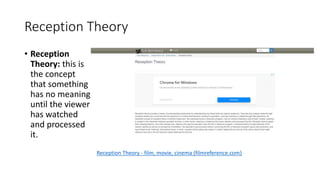
Reception Theory
• Reception
Theory: this is
the concept
that something
has no meaning
until the viewer
has watched
and processed
it.
Reception Theory - film, movie, cinema (filmreference.com)
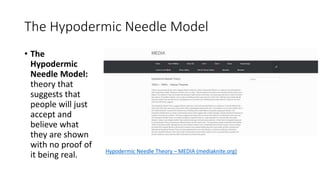
The Hypodermic Needle Model
• The
Hypodermic
Needle Model:
theory that
suggests that
people will just
accept and
believe what
they are shown
with no proof of
it being real. Hypodermic Needle Theory – MEDIA (mediaknite.org)
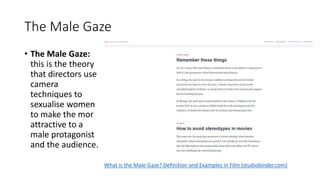
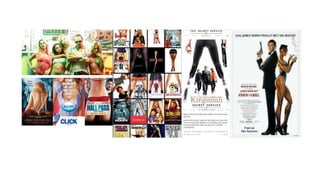
The Male Gaze
• The Male Gaze:
this is the theory
that directors use
camera
techniques to
sexualise women
to make the mor
attractive to a
male protagonist
and the audience.
What is the Male Gaze? Definition and Examples in Film (studiobinder.com)
Bibliography
• Indie Film Hustle . (2021). What is Auteur Theory? – Definition and
Examples. Available: https://indiefilmhustle.com/auteur-theroy/ . Last accessed 9th
September 2021.
• Anon. (2021). Reception Theory. Available:
http://www.filmreference.com/encyclopedia/Independent-Film-Road-Movies/Reception-
Theory.html . Last accessed 9th September 2021.
• Anon. (2021). Hypodermic Needle Theory. Available:
http://www.mediaknite.org/hypodermic-needle-theory/ . Last accessed 9th September
2021.
• Leonard, K. (2021). What is the Male Gaze? Definition and Examples in Film. Available:
https://www.studiobinder.com/blog/what-is-the-male-gaze-definition/ . Last accessed
9th September 2021.
Build Refe
The Male Gaze
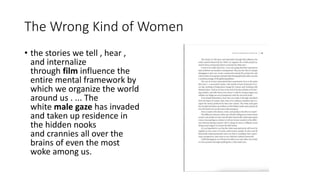
The Wrong Kind of Women
• the stories we tell , hear ,
and internalize
through film influence the
entire mental framework by
which we organize the world
around us . ... The
white male gaze has invaded
and taken up residence in
the hidden nooks
and crannies all over the
brains of even the most
woke among us.
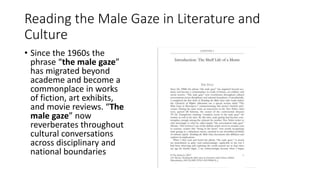
Reading the Male Gaze in Literature and
Culture
• Since the 1960s the
phrase “the male gaze”
has migrated beyond
academe and become a
commonplace in works
of fiction, art exhibits,
and movie reviews. “The
male gaze” now
reverberates throughout
cultural conversations
across disciplinary and
national boundaries
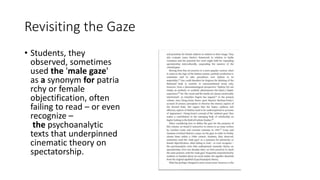
Revisiting the Gaze
• Students, they
observed, sometimes
used the 'male gaze'
as a synonym for patria
rchy or female
objectification, often
failing to read – or even
recognize –
the psychoanalytic
texts that underpinned
cinematic theory on
spectatorship.
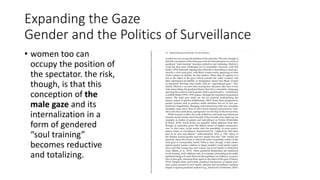
Expanding the Gaze
Gender and the Politics of Surveillance
• women too can
occupy the position of
the spectator. the risk,
though, is that this
conception of the
male gaze and its
internalization in a
form of gendered
“soul training”
becomes reductive
and totalizing.
Bibliography
• McDougall Jones, N. (2020). Songs my Brother Taught me. In: The
Wrong Kind of Women. United States of America: Beacon Press. 272.
• Bloom.D, J (2017). Reading the Male Gaze in Literature and Culture.
USA: Springer International Publishing. 1-225.
• Mulvey, L (2020). Revisiting the Gaze The Fashioned Body and the
Politics of Looking. USA: Bloomsbury Publishing. 1-288.
• Van der Meulen, E. Heynen, R (2016). Expanding the Gaze Gender and
the Politics of Surveillance. USA: University of Toronto Press. 1-311.
Scream
Research
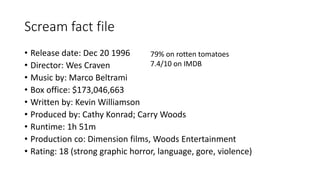
Scream fact file
• Release date: Dec 20 1996
• Director: Wes Craven
• Music by: Marco Beltrami
• Box office: $173,046,663
• Written by: Kevin Williamson
• Produced by: Cathy Konrad; Carry Woods
• Runtime: 1h 51m
• Production co: Dimension films, Woods Entertainment
• Rating: 18 (strong graphic horror, language, gore, violence)
79% on rotten tomatoes
7.4/10 on IMDB
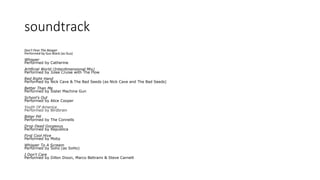
soundtrack
Don't Fear The Reaper
Performed by Gus Black (as Gus)
Whisper
Performed by Catherine
Artificial World (Interdimensional Mix)
Performed by Julee Cruise with The Flow
Red Right Hand
Performed by Nick Cave & The Bad Seeds (as Nick Cave and The Bad Seeds)
Better Than Me
Performed by Sister Machine Gun
School's Out
Performed by Alice Cooper
Youth Of America
Performed by Birdbrain
Bitter Pill
Performed by The Connells
Drop Dead Gorgeous
Performed by Republica
First Cool Hive
Performed by Moby
Whisper To A Scream
Performed by Soho (as SoHo)
I Don't Care
Performed by Dillon Dixon, Marco Beltrami & Steve Carnelli
Trivia
• Skeet Ulrich was cast as Billy Loomis partly because of his resemblance to Johnny Depp, who had a significant role in A Nightmare on Elm
Street (1984).
• The use of caller ID increased more than threefold after the release of this film.
• The film was released in December, five days before Christmas. The studio did this because during the holiday season, family friendly movies are
usually released, and the studio wanted to give the horror audience something to see during a time when no horror movies would be out. It opened
at number four with $6.4 million, which led the studio to believe the film had flopped. However, the film's good word of mouth is what led to its
success at the box office. With every week it went up or stayed at the same place in the box office. By the end of its run, it ended up making over
$100 million at the U.S. box office.
• Drew Barrymore and Neve Campbell did not meet Roger Jackson, the actor who played The Voice, before shooting commenced. Whenever they are
talking on the phone to the killer, they are talking to him. In fact, none of the cast met him. Craven thought that would be better to bring out the
shock reactions he needed from everyone when they heard that voice.
• Courtney Cox approached the production to pursue the role. She was interested in playing a "bitch" character to offset her "nice" Friends (1994)
image. This image was the main reason why the producers initially refused to consider Cox for the part. Cox continued to lobby the studio as she felt
she could believably play the character. Her efforts ultimately succeeded.
• Originally titled "Scary Movie", which was later used for a parody of this movie, and other pop culture horror films in the Scary Movie film franchise.
The term "Scary Movie" is mentioned five times.
• The special effects artists used about fifty gallons of blood.
• Rose McGowan dyed her hair blonde for the role of Tatum in order to contrast her naturally brown hair from that of Neve Campbell.
• The mask is based on a few things: the painting "Scream" by Edvard Munch, the characters on the cover of the Pink Floyd album The Wall, and the
ghostly characters that appeared in the 1930s "Betty Boop" (1930) cartoon. The mask is stark white and depicts a caricature of someone screaming
and crying at the same time. Designer Sleiertin stated that the mask displayed different emotions, "It's a horrible look, it's a sorry look, it's a frantic
look."
Trivia
• All the killer's phone calls were really done by Roger Jackson on-set with a cell phone. At one point, the crew were contacted by the police demanding
to know who they were, because they thought there was a real killer making the phone calls.
• (At around one hour and thirty minutes) It is mentioned near the end of the film that they used corn syrup dyed red for the blood in several famous
horror movies. During the films climax, the production crew really did use corn syrup dyed red.
• Wes Craven initially turned down the film. He was already busy developing a remake of The Haunting (1963) and was considering distancing himself
from the horror genre. He signed on to direct after Drew Barrymore agreed to appear in the film. Also he was confronted by a young little boy fan who
was about ten. The boy accused Craven of "going soft"; and that he had more guts back in the day when he was making movies like "Last House on
the Left". That pushed him over the edge and he called the people at Miramax and agreed to do Scream.
• Although the killer's costume is often referred to as "Ghostface", the costume is actually called "Father Death". Dewey (David Arquette) brings a
costume in the labelled package into the police station after Sidney (Neve Campbell) is first attacked.
• Despite competition from other box-office fare such as Jerry Maguire (1996) and Mars Attacks! (1996) (which flopped), its release during the
Christmas season, and Variety labelling it "D.O.A." before it was even released, it became the fifteenth highest-grossing film of 1996, well placed
amongst big-budget blockbusters released that year such as Independence Day (1996) and Mission: Impossible (1996). It was shown in theatres for
nearly eight months after its release.
• In order to keep animal lover Drew Barrymore scared and crying, Wes Craven told her real-life stories of animal cruelty. During the DVD commentary,
Craven said: "The night before we started shooting, she told me a horrible story about a newspaper article about a dog being burnt by its owner.
Petrified her, and she started crying as she was telling me this. So, every time that I needed her to get over that edge and into complete tears, I would
just say: 'Drew, lightning the lighter' and she would just burst into tears.“
• Drew Barrymore insisted on shooting all of her scenes barefoot because her part in the movie was brief and she doesn't like wearing shoes.
• Wes Craven: (At around fifty-two minutes) Fred, the janitor. He's wearing a red and green striped sweater, just like Freddy Krueger from the A
Nightmare on Elm Street film franchise. They are also the actual clothes from A Nightmare on Elm Street (1984).
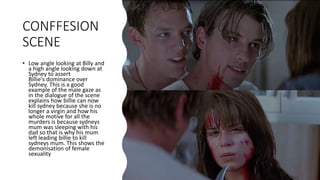
CONFFESION
SCENE
• Low angle looking at Billy and
a high angle looking down at
Sydney to assert
Billie's dominance over
Sydney. This is a good
example of the male gaze as
in the dialogue of the scene
explains how billie can now
kill sydney because she is no
longer a virgin and how his
whole motive for all the
murders is because sydneys
mum was sleeping with his
dad so that is why his mum
left leading billie to kill
sydneys mum. This shows the
demonisation of female
sexuality

Theory research

  • 1.
  • 2.
    Auteur Theory • Auteur Theory:The theory of filmmaking in which the director is viewed as the main creative force in a project. What is Auteur Theory? - Definition and Examples | Indie Film Hustle®
  • 3.
    Reception Theory • Reception Theory:this is the concept that something has no meaning until the viewer has watched and processed it. Reception Theory - film, movie, cinema (filmreference.com)
  • 4.
    The Hypodermic NeedleModel • The Hypodermic Needle Model: theory that suggests that people will just accept and believe what they are shown with no proof of it being real. Hypodermic Needle Theory – MEDIA (mediaknite.org)
  • 5.
    The Male Gaze •The Male Gaze: this is the theory that directors use camera techniques to sexualise women to make the mor attractive to a male protagonist and the audience. What is the Male Gaze? Definition and Examples in Film (studiobinder.com)
  • 6.
    Bibliography • Indie FilmHustle . (2021). What is Auteur Theory? – Definition and Examples. Available: https://indiefilmhustle.com/auteur-theroy/ . Last accessed 9th September 2021. • Anon. (2021). Reception Theory. Available: http://www.filmreference.com/encyclopedia/Independent-Film-Road-Movies/Reception- Theory.html . Last accessed 9th September 2021. • Anon. (2021). Hypodermic Needle Theory. Available: http://www.mediaknite.org/hypodermic-needle-theory/ . Last accessed 9th September 2021. • Leonard, K. (2021). What is the Male Gaze? Definition and Examples in Film. Available: https://www.studiobinder.com/blog/what-is-the-male-gaze-definition/ . Last accessed 9th September 2021. Build Refe
  • 7.
  • 9.
    The Wrong Kindof Women • the stories we tell , hear , and internalize through film influence the entire mental framework by which we organize the world around us . ... The white male gaze has invaded and taken up residence in the hidden nooks and crannies all over the brains of even the most woke among us.
  • 10.
    Reading the MaleGaze in Literature and Culture • Since the 1960s the phrase “the male gaze” has migrated beyond academe and become a commonplace in works of fiction, art exhibits, and movie reviews. “The male gaze” now reverberates throughout cultural conversations across disciplinary and national boundaries
  • 11.
    Revisiting the Gaze •Students, they observed, sometimes used the 'male gaze' as a synonym for patria rchy or female objectification, often failing to read – or even recognize – the psychoanalytic texts that underpinned cinematic theory on spectatorship.
  • 12.
    Expanding the Gaze Genderand the Politics of Surveillance • women too can occupy the position of the spectator. the risk, though, is that this conception of the male gaze and its internalization in a form of gendered “soul training” becomes reductive and totalizing.
  • 13.
    Bibliography • McDougall Jones,N. (2020). Songs my Brother Taught me. In: The Wrong Kind of Women. United States of America: Beacon Press. 272. • Bloom.D, J (2017). Reading the Male Gaze in Literature and Culture. USA: Springer International Publishing. 1-225. • Mulvey, L (2020). Revisiting the Gaze The Fashioned Body and the Politics of Looking. USA: Bloomsbury Publishing. 1-288. • Van der Meulen, E. Heynen, R (2016). Expanding the Gaze Gender and the Politics of Surveillance. USA: University of Toronto Press. 1-311.
  • 14.
  • 15.
    Scream fact file •Release date: Dec 20 1996 • Director: Wes Craven • Music by: Marco Beltrami • Box office: $173,046,663 • Written by: Kevin Williamson • Produced by: Cathy Konrad; Carry Woods • Runtime: 1h 51m • Production co: Dimension films, Woods Entertainment • Rating: 18 (strong graphic horror, language, gore, violence) 79% on rotten tomatoes 7.4/10 on IMDB
  • 16.
    soundtrack Don't Fear TheReaper Performed by Gus Black (as Gus) Whisper Performed by Catherine Artificial World (Interdimensional Mix) Performed by Julee Cruise with The Flow Red Right Hand Performed by Nick Cave & The Bad Seeds (as Nick Cave and The Bad Seeds) Better Than Me Performed by Sister Machine Gun School's Out Performed by Alice Cooper Youth Of America Performed by Birdbrain Bitter Pill Performed by The Connells Drop Dead Gorgeous Performed by Republica First Cool Hive Performed by Moby Whisper To A Scream Performed by Soho (as SoHo) I Don't Care Performed by Dillon Dixon, Marco Beltrami & Steve Carnelli
  • 17.
    Trivia • Skeet Ulrichwas cast as Billy Loomis partly because of his resemblance to Johnny Depp, who had a significant role in A Nightmare on Elm Street (1984). • The use of caller ID increased more than threefold after the release of this film. • The film was released in December, five days before Christmas. The studio did this because during the holiday season, family friendly movies are usually released, and the studio wanted to give the horror audience something to see during a time when no horror movies would be out. It opened at number four with $6.4 million, which led the studio to believe the film had flopped. However, the film's good word of mouth is what led to its success at the box office. With every week it went up or stayed at the same place in the box office. By the end of its run, it ended up making over $100 million at the U.S. box office. • Drew Barrymore and Neve Campbell did not meet Roger Jackson, the actor who played The Voice, before shooting commenced. Whenever they are talking on the phone to the killer, they are talking to him. In fact, none of the cast met him. Craven thought that would be better to bring out the shock reactions he needed from everyone when they heard that voice. • Courtney Cox approached the production to pursue the role. She was interested in playing a "bitch" character to offset her "nice" Friends (1994) image. This image was the main reason why the producers initially refused to consider Cox for the part. Cox continued to lobby the studio as she felt she could believably play the character. Her efforts ultimately succeeded. • Originally titled "Scary Movie", which was later used for a parody of this movie, and other pop culture horror films in the Scary Movie film franchise. The term "Scary Movie" is mentioned five times. • The special effects artists used about fifty gallons of blood. • Rose McGowan dyed her hair blonde for the role of Tatum in order to contrast her naturally brown hair from that of Neve Campbell. • The mask is based on a few things: the painting "Scream" by Edvard Munch, the characters on the cover of the Pink Floyd album The Wall, and the ghostly characters that appeared in the 1930s "Betty Boop" (1930) cartoon. The mask is stark white and depicts a caricature of someone screaming and crying at the same time. Designer Sleiertin stated that the mask displayed different emotions, "It's a horrible look, it's a sorry look, it's a frantic look."
  • 18.
    Trivia • All thekiller's phone calls were really done by Roger Jackson on-set with a cell phone. At one point, the crew were contacted by the police demanding to know who they were, because they thought there was a real killer making the phone calls. • (At around one hour and thirty minutes) It is mentioned near the end of the film that they used corn syrup dyed red for the blood in several famous horror movies. During the films climax, the production crew really did use corn syrup dyed red. • Wes Craven initially turned down the film. He was already busy developing a remake of The Haunting (1963) and was considering distancing himself from the horror genre. He signed on to direct after Drew Barrymore agreed to appear in the film. Also he was confronted by a young little boy fan who was about ten. The boy accused Craven of "going soft"; and that he had more guts back in the day when he was making movies like "Last House on the Left". That pushed him over the edge and he called the people at Miramax and agreed to do Scream. • Although the killer's costume is often referred to as "Ghostface", the costume is actually called "Father Death". Dewey (David Arquette) brings a costume in the labelled package into the police station after Sidney (Neve Campbell) is first attacked. • Despite competition from other box-office fare such as Jerry Maguire (1996) and Mars Attacks! (1996) (which flopped), its release during the Christmas season, and Variety labelling it "D.O.A." before it was even released, it became the fifteenth highest-grossing film of 1996, well placed amongst big-budget blockbusters released that year such as Independence Day (1996) and Mission: Impossible (1996). It was shown in theatres for nearly eight months after its release. • In order to keep animal lover Drew Barrymore scared and crying, Wes Craven told her real-life stories of animal cruelty. During the DVD commentary, Craven said: "The night before we started shooting, she told me a horrible story about a newspaper article about a dog being burnt by its owner. Petrified her, and she started crying as she was telling me this. So, every time that I needed her to get over that edge and into complete tears, I would just say: 'Drew, lightning the lighter' and she would just burst into tears.“ • Drew Barrymore insisted on shooting all of her scenes barefoot because her part in the movie was brief and she doesn't like wearing shoes. • Wes Craven: (At around fifty-two minutes) Fred, the janitor. He's wearing a red and green striped sweater, just like Freddy Krueger from the A Nightmare on Elm Street film franchise. They are also the actual clothes from A Nightmare on Elm Street (1984).
  • 19.
    CONFFESION SCENE • Low anglelooking at Billy and a high angle looking down at Sydney to assert Billie's dominance over Sydney. This is a good example of the male gaze as in the dialogue of the scene explains how billie can now kill sydney because she is no longer a virgin and how his whole motive for all the murders is because sydneys mum was sleeping with his dad so that is why his mum left leading billie to kill sydneys mum. This shows the demonisation of female sexuality